Impose costs on China for Azhar backing

Image result for pics of masood azhar

(Xi, Azhar)

Last evening on India Today news show at 7:30 PM, I said that (1) Delhi’s eagerness to brand Mohammad Masood Azhar Alvi a “global terrorist” is more symbolic in wanting to restore the country’s reputation on account of the hit it took after the humiliation in Kandahar than because this man is any more of intrinsic importance to Pakistan’s management of the asymmetric war it has successfully waged against India over the last 30-odd years, (2) even if China were  provided with “smoking gun” evidence, Beijing would be disinclined to accept it because it treasures Pakistan’s utility in keeping India shackled, and (3) it was time to ruthlessly cut off access to all ‘Made in China’ products  to the Indian market in the name of “balancing trade”. More generally, I also wondered out aloud why it is that the Indian government simply won’t do the obvious thing and start imposing costs on China for such repeated provocations when Delhi wastes no time in puffing out its chest, ordering minor counter-strikes, and promising Pakistan retribution, even as the Indian press and media hurrah the government along?

In this context, does Home Minister Rajnath Singh’s promise to “go to any extent for our national pride” mean nothing at all, or is it Delhi’s reflex of stopping dead in its tracks when a contemptuous Beijing heaps insult on top of injury? (For Rajnath’s remarks see his interview to a pink paper — https://economictimes.indiatimes.com/news/politics-and-nation/government-will-always-respond-on-terror-attacks-and-do-its-best-for-the-people-of-kashmir-says-rajnath-singh/articleshow/68401413.cms

The Modi government swears by the “Wuhan spirit”. Whatever it is, Beijing has shown no signs of abiding by it but is happy as long as Delhi does. And still the Indian government hopes, prays and acts like the impotent entity it is proving to be every time a confident China bumps up against it, banking on diplomacy to persuade Beijing. Modi and MEA seem undeterred by failure upon failure — that’s optimism for you! Indeed, our Man in Beijing who recently demitted office as ambassador, Gautam Bambawale, outlined the MEA’s softly-softly approach in an interview. ( https://www.thehindu.com/opinion/interview/india-must-work-slowly-on-china-so-that-it-aligns-itself-with-us-on-terror/article26514702.ece     ) “India must”, he said, “work slowly on China so that it aligns itself with us on terror.” By this reckoning,  Delhi, it would appear, is seeking a favour. Like a beggar daily importuning a rich person in the hope that the latter will some day relent and drop a coin or two in his bowl.

It is not cued to the fundamental aspect of international relations that diplomacy works best when backed by the fear of cost in terms of real and serious economic loss and/or political-military and security disadvantage and discomfiture.  It is a principle the Foreign Office mandarinate particularly abhors, which was proved in the wake of the Pulwama attack. It wasted time “burning the wires”, as a newspaper headline reported, to get major countries to side with India on the Azhar issue. We have learnt, yet again, just how much good this sort of activity does India.

(As an aside, the Indian rep at the UN, Syed Akbaruddin, compounded the Chinese veto with a diplomatic faux pas of his own — tweeting gratitude to “all the small and big” states in the 15-member UNSC for supporting India, thus no doubt upsetting small and sensitive developing  countries and temporary members of UNSC, such as Ivory Coast, Dominican Republic, Equatorial Guinea, Kuwait, and Peru.  Six months hence, should the new government in search of symbolic victory want to get India’s nose rubbed in the dirt one more time, Akbaruddin, having dismissed these countries so callously, may find it harder to convince them to fall in line.)

Cutting off market access to Chinese trade and goods is the most obvious and natural thing to do considering the horrendous negative balance of payments that this country has borne for the last decade and more. Delhi can follow up by banning Huawei  from selling its mobile phones here, again an entirely defensible action on the basis of the suspicion and fear of these devices being cyber Trojan Horses, which, in fact, they actually are. It is reason why the US and several West European countries have already banned government agencies from buying Huawei stuff. It is such a ban that I have been advocating since this Chinese telecom giant was first given permission to sell in India.

The more substantive costs India can impose on China lie in facilitating the diversion of the Central Asian jihadi traffic that is turning into a small flood in the extended region after the Islamic State’s decimation in Syria  to East Turkestan that China expropriated and calls Xinjiang. The strategic idea here being to render the Muslim Uyghur dominant western province more attractive to Islamic extremists as a bigger challenge than Kashmir by secretly mobilizing and providing them with financial, material and moral support. China will then face a Kashmir-like terrorist-armed insurgency but on a far grander scale, one which many countries, including US, Russia, Japan and Taiwan may be keen covertly to stoke. Delhi could begin by having some RSS arm or the other semi-formally and publicly promote the cause of freedom for the Uyghurs, which will also burnish its secular credentials.

The ideal long term riposte to keeping China militarily distracted and  unsettled is to conjoin India’s clandestine backing for the ETIM (East Turkestan Islamic Movement) and the East Turkestan Liberation Organization that Beijing has labeled terrorist, with more open support to the cause of freeing Tibet from Chinese occupation. It will be a bold stroke, to begin with, by inviting the Washington- area-based Uyghur exile Rabeeya Kadeer, leader of the nonviolent World Uyghur Congress, to receive the Jawaharlal Nehru Peace Prize. (Isn’t it ironic that no noodle-spined Indian government has so far thought it fit to confer this award on His Holiness, the Dalai Lama — the ultimate peacenik when some very odd people such as Barbara Ward, Bruno Kreisky, and Giuseppe Tucci, have won it ?)

There are nervous Nellies galore in PMO, MEA, academic outposts like JNU, and in the commentariat in the press and media who will counsel against the hard options. They have long been taken in by the wrong things in Nehruvian thought, such as accommodationism that Jawaharlal was cured  of only after PLA ran over the Indian Army in the 1962 War. It is not too late to inject correctives in the present China policy, however, one that emphasizes paying Beijing back in its own coin and no nonsense about it. Alas, the Modi-Doval combo is simply not up to it, they don’t have it in them to do something really meaningful, they lack mettle. All the steam they readily blow off is only against that great big bad bone chilling bogey —  Pakistan!!

Posted in asia-Pacific/Indo-Pacific, Asian geopolitics, Central Asia, China, China military, Cyber & Space, Decision-making, Europe, Geopolitics, Great Power imperatives, guerilla warfare, India's China Policy, India's Pakistan Policy, India's strategic thinking and policy, Indian Air Force, Indian Army, Indian ecobomic situation, Indian Navy, Indian para-military forces, indian policy -- Israel, Iran and West Asia, Japan, MEA/foreign policy, Military/military advice, Pakistan, Pakistan military, Relations with Russia, Russia, russian assistance, society, South Asia, Strategic Relations with South East Asia & Far East, Strategic Relations with the US & West, Taiwan, Terrorism, Tibet, UN, United States, US., West Asia | 7 Comments

Time for India to Break Free


Image result for pics of India's military power

The March 2019 edition of the ‘Swarajya’ magazine has published ‘The Right Manifesto’ on the eve of the general elections, containing short pieces by domain experts. C. Rajagopalachari — the rightist ideologue and free market enthusiast, who left the Congress party in the early years of the Republic because he believed Nehru was too steeped in socialism to do the country any good, it may be recalled, founded this magazine.  A version of my short contribution (relating to foreign and military policy) was published in this Manifesto. The original  is reproduced below.

—————

Notwithstanding its attributes and natural assets, not the least of which are an extraordinarily resilient people who never lost hope or their belief in the manifest destiny of the country to be a great power, India is very far from realizing its potential.

Jawaharlal Nehru was an imaginative statesman who turned the country’s all-round weakness into moral leverage to carve out a role for India and for the Nonaligned Movement as the balancer of power between the US and USSR and gaining from the competing attention of both. He appreciated that, while soft power is good, but hard power is what matters. Nehru seeded the dual-purpose nuclear energy and space programmes and the first jet combat aircraft project in Asia, which last, he hoped, would lay the foundations for the cutting-edge Indian aviation industry. Most importantly, he articulated a stunning strategic vision for India as the fulcrum of power in the arc Maghreb-Indonesia, marred only by his blind spot for China. Succeeding Prime Ministers, lacking his “map reading habit of mind”, foreign policy intuition, historical insights, and the confidence to prosecute surefooted diplomacy, began the country’s slide.

Ironically, it was post-1971 War and post-nuclear test three years later that the county’s prospects darkened. India’s military policy shrank, its focus on a weak and truncated Pakistan and, in the strategic realm, the benefits of increased global heft from full-scale nuclear weaponization were lost because the government developed qualms. India, in the new Century and under different party dispensations, forsook “strategic autonomy” for the comforts of American camp follower and, with near total reliance on imported armaments, has become a second-rate military power to match. To recover for India its inherent significance, it is necessary for an expansive national vision to be defined in geostrategic terms of making India the foremost power in the quadrant Caspian-Central Asia-South China Sea-southern Indian Ocean-the East African littoral-Gulf and by the by, ensuring that the Indian Ocean once again becomes an “Indian lake”. It is imperative that India embrace disruptive policies to force itself back into international reckoning.

To achieve the above aims, the Indian government needs to have the following foreign and military policy priorities. These are here presented in bullet-points.

In the foreign policy sphere: India should

  • seek to undermine with actions all international and multilateral agreements and regimes that impinge on the national interest and which it had no role in negotiating;
  • incentivize countries in the extended neighbourhood, including Iran and the Central Asian Republics, and particularly adjoining states, especially Pakistan, with generous grants, financial and trade agreements, to join in an extended southern Asian economic, trade and eventually security schemes;
  • align all external, economic and trade, and national security policies of government with reference to China as the most credible comprehensive threat to India, especially using denial of access to the vast Indian market as lever to obtain more equitable trade and less aggressive Chinese policies on the border and in the subcontinent;
  • implement severely reciprocal measures to signal Beijing that whatever bad it does will be returned to it in trumps. Thus, for instance, its deliberate policy of nuclear missile arming Pakistan should be the precedent for India equalizing the situation, a little belatedly, by transferring sensitive strategic armaments and technologies to all the countries on China’s periphery;
  • cobble together a loose and informal organic security architecture in Asia of rimland and offshore nations, including Taiwan and Japan, to ring-fence China without according any role for extra-continental powers, such as the US;
  • on the larger stage, to prevent the US and China from setting the security agenda in Asia and the world, structure equally loose military cooperation collectives of BRIS (Brazil, Russia, India, South Africa), i.e., BRICS minus China, while retaining BRICS for economic purposes only, and of the Modified Quadrilateral or Mod Quad with India, Japan, Australia and militarily capable Southeast Asian states, the last mentioned to replace the US in the Quadrilateral, with the US being free to engage in such activities of the Combine as it may choose to.

In the military sphere, India should

  • abandon its defensive-passive-reactive mindset and become proactive and expeditionary;
  • equalize the military situation with China by strategically missile arming states on China’s  border;
  • urgently build-up military use foreign bases (in Duqm, Oman, the Agalega Islands in Mauritius, the Gan Island in the Maldives, Nha Trang in Vietnam, Sabang in Indoenesia, and Subic bay and Clark’s air base in the Philippines, and man them with forward deployed Indian forces;
  • rationalize and restructure land forces by forming a single composite armoured and mechanized corps from the current three strike corps meant for the Pakistan front, channeling the freed up manpower, war materiel and financial resources into speedily raising three mountain offensive strike corps equipped with light tanks and high-altitude terrain specific weapon systems to take the fight to the PLA on the Tibetan Plateau;
  • constitute a dynamic cyber warfare force capable of preemptive and ceaseless offensive and defensive operations manned mainly by highly paid IT specialists and algorithm-writers from the private sector and universities;
  • resume thermonuclear testing to upend the global nonproliferation regime and to obtain proven and tested warheads/weapons, ranging from those of megaton- and tailored-yield to micronukes for battlefield use, and atomic demolition munitions for placement in Himalayan passes to deter the PLA, and canisterised long range Agni missiles for launch-on-launch and launch-on-warning capability to firm up the country’s deterrent posture;
  • create an exclusive nuclear cadre of officers and men in the three armed Services to run the Strategic Forces Command;
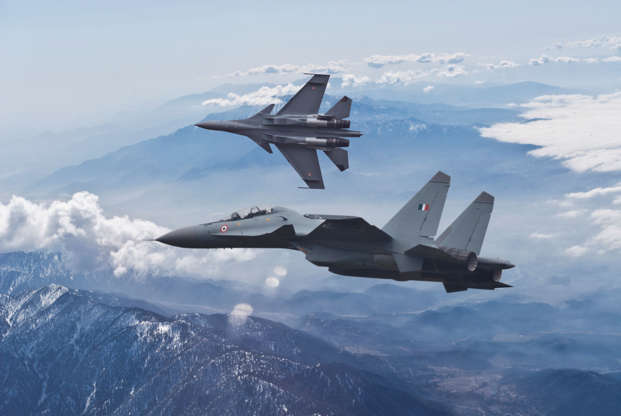
  • scrap large aircraft carriers and their construction, secure strategic and relatively invulnerable reach and punch for the navy with an augmented fleet of SSBNs and SSNs, and for the air force with 2 squadrons of Tu-160M2 strategic bombers taken on long-term lease from Russia but for tactical and theatre-level air operations rationalize the air order-of-battle with Tejas LCA as the bulk aircraft, Su-30 MKI upgraded to “super Sukhoi” configuration for air superiority, with Rafales and  upgraded MiG-29s, Mirage 2000s and Jaguars providing specialist mission punch.
Posted in arms exports, asia-Pacific/Indo-Pacific, Asian geopolitics, Australia, Bangladesh, Bhutan, Central Asia, China, China military, civil-military relations, Culture, Cyber & Space, Decision-making, Defence Industry, disarmament, Geopolitics, Great Power imperatives, guerilla warfare, India's China Policy, India's Pakistan Policy, India's strategic thinking and policy, Indian Air Force, Indian Army, Indian ecobomic situation, Indian Navy, Indian Ocean, Intelligence, Israel, Japan, Maldives, MEA/foreign policy, Military Acquisitions, Military/military advice, Missiles, Myanmar, Nepal, nonproliferation, Northeast Asia, Nuclear Policy & Strategy, Nuclear Weapons, Pakistan military, Russia, russian assistance, russian military, society, South Asia, Sri Lanka, Strategic Forces Command, Strategic Relations with South East Asia & Far East, Strategic Relations with the US & West, Taiwan, Terrorism, Tibet, UN, United States, US., Vietnam, Weapons | 14 Comments

Why was MiG-29 missing in action? And, why the ‘stability-instability paradox’ has proved a dud

Image result for pics of IAF MiG-29s

[IAF’s MiG-29 at a forward base]

The delayed Indian riposte to the Pulwama attack finally took place with the aerial attack on Jaish-e-Mohammad ops centre in Balakot, fairly deep into the Pakistani province of Khyber-Pakhtunkhwa. It played out, however, in the usual fashion when India and Pakistan are involved — a lot of patriotic noise covering up for minimal action, and also on the Indian side, the familiar charges of intelligence failure. The eventual Bahalwalpur feint followed by the Mirage 2000 strike sortie was, however, nicely staged by IAF.

The important thing about the Balakot strike was not the numbers of JeM cadres eliminated or the extent to which JeM’s terrorist infrastructure was destroyed, but the fact that the strike took place at all. During the time it took the Modi government to gird up its loins and seek armed retribution, it seemed Delhi was going down the familiar path of doing little itself but relying on other countries to pressure Islamabad to rein in the terrorist outfits under its wing, and otherwise trying its hardest diplomatically to “isolate” Pakistan — as if this somehow would restrain GHQ, Rawalpindi, or convince Imran Khan to go on bended knees to Pakistan COAS General Javed Bajwa. Indeed, prior to Balakot the Pakistan Foreign Minister Shah Qureishi all but laughed at MEA’s contention that his country was isolated in the world for its sponsorship of terrorist gangs as asymmetric means of warfare. So, when IAF finally went into action against Balakot, it was a huge relief.

The downside of the Balakot episode was that Modi government felt compelled to first touch base with Washington, rather than immediately after the strike had gone in. US President George W Bush’s National Security Adviser (NSA), Stephen Hadley, candidly described US’ role in India-Pakistan crises on Christiane Amanpour’s CNN programme, February 27, as divulging to each side intelligence on the other side it could trust – a sort of honest intelligence broker! This leads one to wonder, if Hadley spoke true, about the kind of intelligence that Modi’s NSA Ajit Doval was after when he betook himself to America mid-February to meet with his US opposite number, John Bolton. It would appear from a consideration of Indian intelligence capabilities, the operational planning predicates and the interval between Pulwama and Balakot that what Doval sought and was provided were refinements of the Indian military’s target coordinates for the JeM training centre that the Indian Mirage 2000s pulverized on February 26. This reading is reinforced by GOI sources conceding that owing to technical infirmities of its satellite and other sensors gauging exact damage done and killing of JeM personnel in Balakot was “speculative”.  The US government would have been interested in letting IAF obtain extremely accurate target data to preempt the possibility of large scale collateral civilian damage, which could have prompted Pakistan to escalate. This is a more positive read on events than if Doval met with Bolton with the sole objective of seeking US’ “blessings” for the operation then under planning, because that would have resulted in India’s status as a self-respecting independent country taking a hit. It did not prevent President Trump from hinting in Hanoi (after the failed summit with North Korean President Kim Jong-un) about a mediating US role and even a peaceful outcome. “They’ve been going at it, and we’ve been involved in trying to have them stop…..It’s been going on for a long time — decades and decades.  There’s a lot of dislike, unfortunately”, he said.  “So we’ve been in the middle, trying to help them both out and see if we can get some organization and some peace.  And I think, probably, that’s going to be happening.”

The downing of the IAF pilot, Wing Commander Abhinandan Varthaman, however, raises the troubling issue of why the aged MiG-21 bis were sent up to blunt the incoming counter-strike by the Pakistan Air Force? May be Varthaman’s R-73 air-to-air missile did down the F-16 and the Wing Commander, once he rejoins his squadron, can sport this kill on the next plane he pilots. But why was the far more advanced and immeasurably more capable air defence aircraft in the IAF inventory — the MiG-29, not deployed for air defence in the first place? This is not to second-guess IAF’s operations staff but to flag a legitimate concern. Why keep your best horse in the stable when the adversary is fielding his prize steed? Is IAF’s Western Air Command to blame for this operational faux pas? Doubtful, considering how much of the operational thinking was taken over by Air HQrs with CAS ACM BS Dhanoa in constant touch with NSA to craft a just-so response. So, the question: why was the MiG-29 ignored?

If the late-1950s vintage MiG-21, a wonderful plane in its day, could take out an F-16, the redoubtable MiG-29, it is reasonable to assume, would have made mincemeat out of the equally antiquated F-16 aided and assisted by a bevy of PAF’s bulk multi-role aircraft — the ex-Chinese JF-17. Considering MiG-29’s extraordinary agility, the chances would have been minimized of getting an IAF plane shot down and a pilot captured. So, why wasn’t the MiG-29 used? There are two explanations. One, that the MiG-29, like every other combat aircraft an ultimate switchable military asset, was deemed too valuable to risk in live action. And two, that most of the MiG-29s were not in operational readiness, and couldn’t, therefore, be called up.

The latter explanation doesn’t cut mustard and, in any case, with so much time available between the Pulwama provocation and Indian reaction, sufficient numbers of MiG-29s would have been brought into fighting-fit condition. If, on the other hnd, the MiG-29 was considered too valuable to lose, how much more operationally hesitant would Vayu Bhavan be in using the Rafale in similar situations – the point I have repeatedly made in questioning the military utility of Rafales in the IAF inventory, and particularly of only 36 of them? I bring up this aspect because Prime Minister Modi, without perhaps realizing the import of what he was saying, implied that Varthaman would not have been shot down had he been riding Rafale rather than MiG-21, in making the political point in an election year about the decade-long delay by the Manmohan Singh’s Congress regime in making the MMRCA decision and its responsibility in undermining military preparedness.

Lucky for Varthaman that he was not kept prisoner and used as a political pawn as many in the Pakistan military would have preferred to do, and that Imran prevailed on Bajwa to let the Indian pilot go. With Varthaman in captivity, moreover, the pressure would have daily mounted on Modi to ratchet up India’s counter counter-response in the hope to, if not get the Indian flier back, than inflict more attrition and pain on Pakistan, in the process, possibly triggering an action-reaction sequence that Western strategists have long feared as a “nuclear flashpoint”.

This fear, however, got diluted once Pakistan was armed by China with nuclear missiles some 35 years ago, and also on the basis of the last 20 years record of Delhi’s inaction when confronted by Pakistan’s terrorist excesses. It led US thinktankers to try and explain India’s restraint by conceiving of something they called the “stability-instability paradox”, which got traction in this country with their local acolytes (C. Raja Mohan, et al) supporting it and, for obvious reasons, in Pakistan.  I showed it up as a flawed and nonsensical concept during the time I spent in 1996 at the Henry L. Stimson Center in Washington DC, among the main propagators of this concept, and deconstructed this concept at length in my 2002 tome — Nuclear Weapons and Indian Security.

The paradox concept is as follows: By acquiring nuclear weapons Pakistan gained  strategic parity with India making for stability at that level and, because of the fear of tripping the nuclear wire, also at the conventional military level. But Pakistan army, protected by the overhang that its nuclear weapons provides it, feels free to wage sub-conventional/asymmetric warfare in J&K making for instability, with nuclear weapons deterring India from responding in kind and that this, in turn, makes for Indian non-response but also for stability.

The fatal flaw in this concept, as I pointed out, is in its basic premise — of parity at any level when the fact is India can up the ante every level. In fact, the disparity is not only in terms of the resources India can muster to assure an edge in the conventional military sphere, but also in the sub-conventional military and covert warfare sectors to exploit Pakistan’s far deeper and more serious socio-cultural, sectarian (shia-sunni), and regional-ethnic faultlines than anything India suffers from. For every Srinagar Valley there’s an independent Baluchistan, Baltistan, or even Sindh to egg on, and for every Khalistan, a Jinnahstan (propelled by the grievances of the muhajir community in Pakistan) and even Seraikistan! And that, attempts at radicalizing the Indian muslim can fetch Delhi (in cahoots with Iran) radicalized Pakistani shia enclaves and an energized Tehreek-i-Taliban Pakistan. All it needs is for a strong-willed Indian government to ratchet up the response in kind in any or in all three of the hostile engagement sectors that Pakistan chooses to venture into including, I have said, the nuclear warfare field.

Have admired the strategically-driven Pakistan army for its professionalism, a main component of which is its ability to measure the risk in pushing India only so much and no further, to generally appreciate that country’s geographic, political and economic limitations when facing a comprehensively superior adversary, and to call a halt to the hostilities when they begin trending against it. So, like in previous conflict situations, this time too Islamabad terminated the budding action-reaction sequence once its F-16 was downed, the Indian AD firmed up, the Indian army was geared for movement, and the Modi government showed an appetite for still bigger military action.

Thus, I have argued that while Pakistan, run by its army, is far better at holding its nerve in crises than the Indian government ruled by a disinterested political class and advised into responding sub-optimally by a strategically slow-witted military and civil servants manning the permanent secretariat of government, if a conventional military push actually comes to nuclear shove, GHQ, Rawalpindi, will ultimately be persuaded by the logic of the exchange ratio.

The exchange ratio (ER) refers to the cost and destruction one suffers compared to what can be inflicted/imposed on the enemy. The ER is so adverse to Pakistan and so skewed in India’s favour — two Indian cities for Pakistan – with all its eminently targetable main population and wealth-producing centres lying in a north-south corridor within easy reach from the border, becoming extinct as a social organism — that even the most rabid Pakistan COAS – and Bajwa is far from being one — would not ever contemplate a nuclear exchange, let alone a full-fledged, no-holds, nuclear war. This is exactly the calculus embedded in former Pak President and COAS General Parvez Musharraf’s recent statement to the press that  “if we drop one bomb, they [India] will drop 20.”

This unalterable fact of geography will always leave Islamabad stuck in the terminal nuclear sabre-rattling mode, and well short of risking annihilation. Hence I concluded that the stability-instability paradox is a dud concept. It is a conclusion dutiful Indian supporters of the US policy line and concepts are, in the face of the Balakot Indian reaction, belatedly coming round to accepting. (Refer https://indianexpress.com/article/explained/pulwama-attack-pakistan-narendra-modi-balakot-air-strike-iaf-5609325/ )

Posted in arms exports, asia-Pacific/Indo-Pacific, Asian geopolitics, China, China military, civil-military relations, Culture, Decision-making, domestic politics, Geopolitics, Great Power imperatives, guerilla warfare, India's China Policy, India's Pakistan Policy, India's strategic thinking and policy, Indian Air Force, Indian Army, Indian ecobomic situation, Indian Politics, MEA/foreign policy, Military Acquisitions, Military/military advice, Missiles, Nuclear Policy & Strategy, Nuclear Weapons, Pakistan, Pakistan military, Pakistan nuclear forces, SAARC, society, South Asia, Strategic Relations with the US & West, Terrorism, United States, US., Vietnam, Weapons | 28 Comments

China is the villain

Image result for pics of Imran and Xi

[Xi in Pakistan]


‘The Week’ published the following column of mine in its Feb 23, 2019 edition, advising that in all the raked up excitement over Pulwama-Balakot, India’s main threat — China not be lost sight of, at https://www.theweek.in/theweek/cover/2019/02/23/china-is-the-villain.html

—-

Pakistan has long been China’s cat’s paw in the region. Between the two of them, India has been reduced to a shrinking violet of a country. Beijing’s unwillingness to brand terrorist outfits prospering under Pakistan army protection reflects how masterfully China wields its one-two punch: using proxy terrorist outfits to unsettle India in the sub-conventional military sphere and a nuclearised Pakistan to checkmate it strategically, besides providing Islamabad political cover in case things go wrong.

The success of the China-Pakistan nexus is mainly due to India’s extraordinarily defensive-passive attitude to Chinese provocation. Beijing’s hold on Delhi is so complete, its every move occasions a sense of foreboding and dread in the Indian government. Its rocketing economic growth has added the element of awe to the fear of China, resulting in Delhi’s characteristic stoop as a second-rate power. It is not too late for India to stop being preoccupied with the cat’s paw and to instead deal with the cat.

In its habitual kowtowing, India has lost sight of China’s frailties and ways of exploiting them. The greatest strategic blunder Beijing committed was providing nuclear missiles to Pakistan. India knew of these clandestine transactions when they began in the mid-1970s. Rather than reciprocating by arming states with nuclear missiles, starting with Vietnam on China’s periphery, most of whom have territorial disputes with it, India sought to burnish its moral stature as a “responsible state” and handed the strategic advantage to China. Strategically-equipped southeast Asian nations would have brought China to its knees, because its maritime weakness against the powerful Japanese and US navies in the Sea of Japan and the East Sea would have been matched by its vulnerability in the South China Sea. Its seaborne trade, accounting for more than 90 per cent of its exports and generating much of China’s wealth, would then have been in peril.

Then there is Tibet, which is under Chinese military occupation since 1950, which India chose not to contest. It is suffering systematic “cultural genocide”, its people treated with utmost cruelty in their own land. Far from fighting for the ‘Free Tibet’ cause and leading an international campaign against human rights excesses in Tibet, and in Xinjiang, thereby conjoining the Uyghur and Tibet causes, Delhi acts as Beijing’s thanedar, preventing exiled Tibetans from even protesting peacefully in front of the Chinese embassy. If Beijing does not subscribe to ‘One India’, inclusive of the whole of Jammu and Kashmir, where is the need for Delhi to continue to accept Tibet or Taiwan as part of the ‘One China, many systems’ concept?

And, isn’t it time that India, burdened by a colossally unbalanced $70 billion trade with China, used the threat of loss of access of Chinese goods to the vast Indian market to leverage a more equitable trading regime? And, shouldn’t India, like many European countries and the US, ban Huawei and other companies peddling mobile phones and switching systems, and rendering our communications grid vulnerable to cyber attacks?

Moreover, India has been lax in raising offensive mountain strike corps fast enough to take the fight to the People’s Liberation Army on the Tibetan Plateau, and not considering the utility of placing atomic demolition munitions in Himalayan passes to deter China from aggressing in the northeast. Doklam was just a foretaste of territorial aggrandisement to come if India does not wake up.

Posted in asia-Pacific/Indo-Pacific, Asian geopolitics, China, China military, civil-military relations, Culture, Decision-making, Geopolitics, Great Power imperatives, India's China Policy, India's Pakistan Policy, India's strategic thinking and policy, Indian Air Force, Indian Army, Indian ecobomic situation, MEA/foreign policy, Military/military advice, Nuclear Policy & Strategy, Nuclear Weapons, Pakistan, Pakistan military, Pakistan nuclear forces, SAARC, society, South Asia, South East Asia, Strategic Forces Command, Strategic Relations with South East Asia & Far East, Strategic Relations with the US & West, Taiwan, Terrorism, Tibet, United States, US., Vietnam, Weapons | 7 Comments

Using the brahamastra — diverting rivers; think again!

Image result for pics of Imran Khan and General Bajwa

(PM Imran Khan and Pak COAS Gen. Javed Bajwa)

The over-the-top public breast-beating with everybody a jingo demanding telling retribution for the Pulwama terrorist suicide attack has forced a, national security-wise, disinterested political class to hyper-ventilate. In this situation, there’s the ready danger of a government’s response decision, prompted by the media-driven frenzy and hysteria, being very, very wrong. With general elections in sight, moreover, the  government is more interested in impacting public consciousness than embark on a well thought-out punitive strategy, which’s all the more reason that cool heads prevail in the South Block and the Prime Minister calmly tones down the rhetoric, while instructing his cabinet colleagues and BJP minions to do the same. This won’t happen of course because, as is virtually an Indian norm in crisis, political leaders without a clue about what sensibly to do, spout blood in their speeches and fire up the public anger still more. The danger of the government being led by the nose by public sentiment is nigh and results in fiasco.

Recall the immediate aftermath of the hijacking of Indian Airlines flight IC 814 to Kandahar on 24 December 1999, when families of passengers on board sat on dharna on the pavement across from the Race Course Road prime ministerial complex with TV cameras airing in endless loops heart-rending scenes of mothers, wives and children hollering for PM Atal Bihari Vajpayee to give into the terrorists’ demand and save their kin which, minute by minute, hour by hour, eroded the first BJP regime’s resolve to halt the Jaish terrorists in their tracks by preventing the plane captured by them from taking off from Amritsar for Dubai. Had Vajpayee steeled his heart and decided that he’d not be swayed by public cries but by national interest, the 176 passengers in the Airbus A 300 may have died but the message would have gone out strong and clear to all terrorist quarters that they wouldn’t enjoy easy victories by aiming at soft targets. Instead, the farce at the Amritsar airport was played out when the aircraft was refueled and flew out of Indian air space and the situation got out of India’s control. At the mercy of the Taliban government, the Indian government had to eat crow on the bare airfield in Kandahar as external affairs minister Jaswant Singh handed over known terrorist kingpins — Maulana Masood Azhar, Mushtaq Ahmed Zagar, and Omar Saeed Sheikh until then in Indian jails. The precedent, however, was established exactly a decade earlier, in December 1989, with the kidnapping of Rubaiya Sayeed by members of the Jammu Kashmir Liberation Front, who demanded the freeing of 13 militants for the release of the daughter of the then Union Home Minister in Prim Minister VP Singh’s coalition government cabinet, Mufti Mohammed Sayeed, and sister of the erstwhile Chief Minister Mehbooba Mufti. The Indian government complied with the terrorists’ demand, and the  exchange went through despite being opposed, to his credit, by the then J&K Chief Minister Farooq Abdullah.

Blood counted for Mufti Sayeed more than national interest. Vajpayee in the Kandahar episode extended that principle democratically to mean that thereafter any terrorist outfit holding Indians hostage would also hold the Indian nation hostage to its whims. The terrorism problem in J&K has been out of a reactive-passive India’s control ever since.  Over subsequent years, heinous strikes against army, paramil and police personnel in Srinagar Valley was escalated by the Pakistan ISI-sponsored terrorist gangs to attacks on Parliament in 1999 and, nine years later, the 26/11 sea-borne strike on Mumbai. And still Delhi was not stirred from its lassitude to think up and articulate a long term strategy to deal with the terrorist scourge, to lay down a protocol and SOPs and train all agencies in following them once a terrorist action is underway. The Indian government time and again settled instead for passion-rousing rhetoric, public cries for vengeance to match the people’s mood, followed by some slapdash response or the other. In recent times,  thunderous threats of “surgical strikes”, etc. are regularly mouthed, leaving the IS to meticulously plan the next incident to spring on India.

Post-Pulwama, an infinitely more serious, even reckless reaction was voiced by the only hard performing minister in Modi’s cabinet who is his also own man, perhaps, because of his direct access to RSS HQ in Nagpur, the Road Transport and Water Resources Minister Nitin Gadkari. Addressing a public rally in IP yesterday he said, “When India and Pakistan were divided, three rivers were given to Pakistan and three to India. However, India continuously gave the river water supply to Pakistan, but now we will use that river water supply to nurture the Yamuna river through the Yamuna project.” Hr elaborated that view in another political rally today to inaugurate numerous water projects in Uttar Pradesh.  “Our government has decided”, he informed the country, “to stop our share of water which used to flow to Pakistan. We will divert water from eastern rivers and supply it to our people in Jammu and Kashmir, and Punjab.” He added: “Three of our rivers have been flowing into Pakistan. So water which we rightfully owned was going into Pakistan. …Construction of dam has started at Shahpur-Kandi on Ravi river. Ujh project will store our share of water for use in Jammu and Kashmir and balance water will flow from second Ravi-Beas link to provide water to other basin states. Above projects are declared as national projects.”

Throttling Pakistan by denying it water under the 1960 Indus Waters Treaty has been recommended by some as a heavy-punch strategy to visibly impose a devastating economic cost on Pakistan for persisting with its hugely successful policy of waging asymmetric war using willing Kashmiri proxies. Because no clarification has been issued by Prime Minister Modi, PMO or MEA, one supposes this is one of the two prongs of strategy the Indian government will now implement. The other prong being a military response at a time of the Indian army’s choosing. This last is an excellent ploy to keep Islamabad guessing and on tenterhooks, unleashing a destructive strike when Pakistan forces relax — because they can’t remain on alert forever.

If the diversion, in effect, of the waters of the Sutlej, Ravi, and Beas Rivers designated by the Treaty for India’s use that Gadkari  has promised is indeed state policy then there should really have been  much greater debate and cogitation within government circles about its regional and international ramifications than has evidently occurred to-date. Has the MEA informed PMO about what this significant step means? Under international law, for a lower riparine country to be denied its legitimate portion of shared river waters can be casus belli — cause for war. Fine, the onus will be on Pakistan to start one, and it is in no position to do so. The trouble is a war for such an elemental reason could quickly spiral into a war of annihilation unlike all the previous relatively harmless wars of maneuver that, I have argued in my books, India and Pakistan have engaged in since 1947. Because, let’s be clear, damming and diverting the Indus River tributary waters is a matter of life and death for Pakistan. It is the brahamastra — not nuclear weapons — that can, quite literally, turn much of Pakistani Punjab and upper Sindh, in no more than 30 years, into an arid extension of the Thar Desert.

Yes, emotions are running high and rational thinking is apparently another casualty. But the Modi government has to really THINK, strategically weigh the ill-effects that may follow in its train. The first thing to weigh is whether junking the Indus Waters Treaty is anywhere a proportionate response to the Pulwama provocation. Proportionality — whether anybody likes it or not — is an established central tenet of international law of war.

Secondly, and it is this consequence that I have harped on in my writings, it will immediately gift China the justification for pell-mell damming and diversion of all rivers originating in the Tibetan Plateau — the Tsang-po (Brahmapurtra River) as also the Indus. Beijing has been more hesitant in building upstream facilities to siphon of water from the Indus than it has been in paying ducks and drakes with the Brahamaputra waters because its all-weather friend, Pakistan, is at the lower end of this River. Assuming Pakistan cannot and will not initiate a suicidal all-out war to settle the water issue for once and for all, how long does the Indian government reckon it will be before Beijing, citing the Indian precedent on the Sutlej, Ravi and Beas, orders huge construction projects to redirect the precious Indus waters in Tibet itself and away from its natural pattern of flow south of the Tibetan watershed and into the subcontinent? Because then the Pakistan reason for caution will go missing.

What then? What case will Delhi make to mobilize international opinion against the Chinese action? As it is, Delhi has not anything other than squawk ineffectually about the Chinese civil works and dams at the great bend obstructing the Brahmaputra.  India will find itself squarely in Pakistan’s position of being unable to prevent diversion but also incapable of militarily taking on a far superior China. It is this aspect of Indus waters diversion that Delhi has to be most wary of. But then Indians have always been tactical minded, not strategically oriented.

(No need to go back to Prithviraj Chauhan, the various Battles of Panipat, et al — the upcoming Cricket World Cup will do! There are calls, for instance, to not play Pakistan — the biggest draw in the upcoming championship rounds, when doing so may cost India the chance of winning the World Cup — with Virat Kohli’s team rated as one of the two top teams in the game. So, we are prepared to forfeit matches, concede Pakistan 2 or even 4 points, and even help it get to the Finals for such small change of emotional satisfaction as can be extracted from this self-abnegating gesture.)

And India will once again end up paying the greater price. Talk of cutting off one’s nose to spite someone else’s face!!

Posted in Afghanistan, asia-Pacific/Indo-Pacific, Asian geopolitics, China, China military, civil-military relations, Culture, Decision-making, domestic politics, Geopolitics, Great Power imperatives, India's China Policy, India's Pakistan Policy, India's strategic thinking and policy, Indian Army, Indian democracy, Indian ecobomic situation, Indian Politics, Intelligence, Internal Security, MEA/foreign policy, Military/military advice, Nuclear Weapons, Pakistan, Pakistan military, Pakistan nuclear forces, SAARC, society, South Asia | 24 Comments

What’s cooking in the Indian-Saudi pot?

LIVE Updates: Saudi Crown Prince, PM Modi Hold Bilateral Talks Today

[Saudi Prince MbS and Modi at Palam]

The one — some may argue — the only bit of Prime Minister Narendra Modi’s foreign policy that managed depart form the expected was his gambit in courting Saudi Arabia and the Gulf states. What’s not clear is the game plan or the thinking behind these moves. True, this approach has achieved several things: It has firmed up the Saudi source of energy and, with Riyadh leading the Arab pack in the Gulf, also lessened the psychological distance between Delhi and the Sauds on the one hand, and on the other, encouraged the Gulf states (known in the colonial era as the Trucial states) to be unusually helpful when it comes, for instance, to handing over to India Indian nationals who sought safe haven in these parts after committing crimes or being complicit in acts of terror and find the host nations, to their alarm, ready to hand them over to Indian authorities. Further, Modi’s personal success with the Sauds and the Gulf emirs and Sheikhs also strengthens the India-Gulf economic connection in terms of improving the prospects of these countries importing skilled and semi-skilled Indian labour and strengthening the flow of remittances that are propping up the economies of several Indian states, particularly Kerala, UP, and Bihar. Just Saudi Arabia accounts for some $12 billion in remittances, and together with the Gulf nations, make up for the bulk of around $70 billion sent home by Indian workers.

These secular strands of a bilateral relationship with Saudi Arabia contrasts sharply with the ties of shared religion, Islam, and strategic security cooperation strongly hinted at in the reports of long standing about the Pakistani A-Bomb being at Riyadh’s disposal if the latter ever finds itself in dire military straits — a quid pro quo for the Saudis generously funding Pakistan’s sourcing its  “Islamic Bomb” and missile programmes from China starting in the mid-1970s. General Zia ul-Haq, it may be recalled, as Brigadier led the Pakistan army-manned Palace Guard for the Saud Family in Riyadh. This arrangement of personal protection may still be active. It is for a reason that Pak COAS General Qamar Bajwa’s immediate predecessor, Gen. Raheel Sharif, post-retirement, accepted the offer to lead the army of Islamic states that the ruling Saudis dreamed up. It is another matter, that Gen-Raheel has no actual army to run!

This is the context in which Modi tried to get some traction on the Pulwama attack by getting however distant an acknowledgement by Mohammad bin Sultan (MbS) of a Pakistani hand in the suicide bomber attack on the CRPF personnel. This was plainly a fool’s errand because the almost Saudi supremo had already made clear during the Pakistan leg of his trip that he was happy to consolidate the Saudi stake in Pakistan by economically rescuing it from imminent bankruptcy with an emergency injection of $20 billion, something Washington cannot any more afford to do. But this Saudi action has the Trump Administration’s support because Riyadh’s willingness to financially help out Islamabad also acts as a brake against the Imran Khan regime sliding helplessly into Beijing’s strategic lap and economic servitude, courtesy CPEC.

Hence, Washington’s publicly siding with India in calling for branding Azhar Masood, the Jaish-e-Mohammad emir,  as a terrorist under the UN aegis doesn’t really impose a cost in terms of an alienated Islamabad which would hurt the US plan for a face saving getaway for its forces out of Afghanistan. This last is all that the US Special Representative Zalmay Khalilzad is interested in securing from the Afghan Taliban. All the American talk of achieving regional peace, etc. being so much smokescreen for US’ real intent. In the event, Washington relies on China to veto the “Masood terrorist” campaign mounted by Delhi even as America pleases Modi by seemingly being on India’s side. Clever.

Whether or not Modi has a larger foreign policy scheme or not for West Asia in being effusive in his welcome, MbS certainly does. For one thing he is embarked on cleaning up his act after his role in the killing in the Saudi consulate in Istanbul of the Washington Post columnist Adnan Khashoggi was revealed by the Tayyip Erdogan government. Erdogan wants Turkey to displace Saudi Arabia as the putative head of the sunni bloc of Islamic countries. The situation is piquant — Saudis have the oil and money to buy allegiance; Ankara has the nous of a modern nation-state which also boasts of technological and military proficiency. Erdogan last year visited Delhi, part of his agenda being to polish Turkey’s image with the subcontinental Muslim community, by offering his good offices as a mediator on Kashmir. MbS has come avisiting with exactly the same mission as peace-maker on Kashmir between India and Pakistan that he spelled out in Islamabad. The chances of Riyadh being so accommodated by Delhi is minus-zero but the optics for MbS in Pakistan were too good to pass up. In India, the visiting Saudi leader no doubt cagily brought up the possibility of his being the honest broker with Modi, which met the same fate as the Indian PM’s effort to persuade him of the Pakistani hand in the Pulwama incident. So, it was a wash, with both parties refusing to make an issue of the other side not agreeing with its position.

But MbS has still another angle in mind. Ramping up the imagery of closeness to India — manifested in much hugging and embracing — Modi’s diplomatic innovation helps Riyadh  in the Islamic world if India, with the second largest Muslim population after Indonesia and, in a few short years, headed to be the largest Muslim nation in the world, is seen to be on its side not only in the competition with Erdogan and Turkey for leadership, but in the more significant sunni-shia tussle underway with Iran for influence in, and control of, West Asia.

This is the quick sand India has every chance of getting sucked into because whatever the level of security and strategic cooperation with Saudi Arabia and the Gulf nations, it pales before the potential that Iran holds out. Iran,  through Chabahar, is the gateway to Afghanistan and Central Asia and, as I have argued, is one end of a naval pincer that can not only close in on Pakistan’s Gwadar but also the Chinese navy operating out of Gwadar and ex-Djibouti, making China’s maritime presence in western Arabian Sea tenuous (especially if PLAN is also denied access to Humbantota in crisis – a Chinese Company’s 99-year lease notwithstanding). Indeed, Iran’s strategic importance to India matches Vietnam’s and, hence, Modi will have to be careful of not getting India embroiled in a US-backed Saudi struggle with Iran.

The more troubling aspect of MbS’s reach to Modi and India and his clucking hypocritically in sympathy about the perils of terrorism is that Saudi Arabia has single-handedly birthed and grown the extremist wahabbi menace over the last 40 years that  has mutated into the hideous Islamic State. IS, according to news reports, is fighting its last in its stronghold of Mosul in Iraq. This may actually, however, be the beginning of a massive internal security problem for India — the Pulwama attack by a radicalised local Kashmiri being but a warning sign. One can expect ISI to quickly exploit the opening so provided by funneling beaten Islamic State stalwarts hailing from Central Asia and other proximal areas, into joining Jaish and Lashkar and fighting the kafir with the aim of setting up the ambitious caliphate in a less trying milieu than Syria and the Levant. All things considered, it is unlikely Mohammad bin Sultan will mind such a denouement.

Posted in Afghanistan, Africa, asia-Pacific/Indo-Pacific, Asian geopolitics, China, China military, civil-military relations, Decision-making, domestic politics, Geopolitics, Great Power imperatives, guerilla warfare, India's China Policy, India's Pakistan Policy, India's strategic thinking and policy, Indian Army, Indian ecobomic situation, Indian Navy, Indian Ocean, Indian para-military forces, indian policy -- Israel, Iran and West Asia, Indian Politics, Intelligence, Internal Security, Iran and West Asia, MEA/foreign policy, Military/military advice, Nuclear Weapons, Pakistan, Pakistan military, Pakistan nuclear forces, society, South Asia, Special Forces, Sri Lanka, Strategic Relations with the US & West, Terrorism, UN, United States, US., Vietnam, Weapons, West Asia | 6 Comments

India Has To Solve The Pakistan-Sourced Terrorist Problem By Itself 

Image result for pics of pulwama

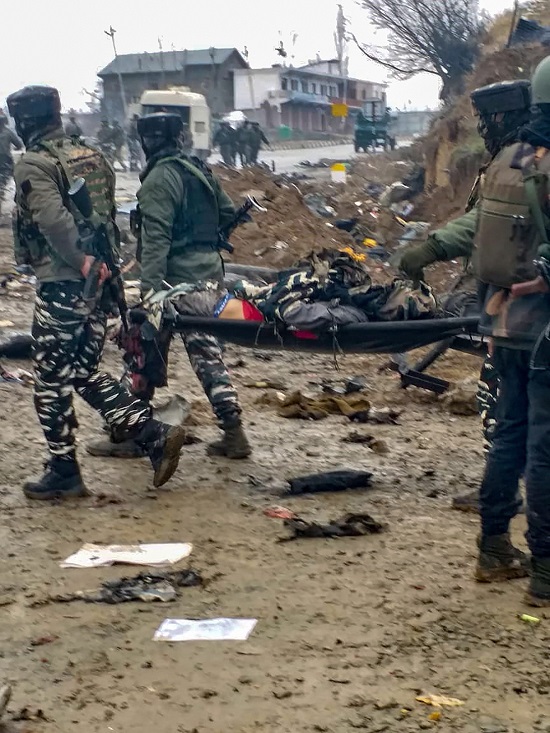
[In the wake of the Pulwama suicide attack]

[Published in BloombergQuint. com on Feb 18, 2019 in my occasional Realpolitik column, at https://www.bloombergquint.com/opinion/india-has-to-solve-the-pakistan-sourced-terrorist-problem-by-itself#gs.Iohjmoso  ]

Owing to the image Prime Minister Narendra Modi has projected of himself and his
government as strong and decisive, many media commentators are of the view that a telling response to the blowing up of 40 Central Reserve Police Force troopers in Pulwama is on the anvil. They appear to be influenced more by his rhetoric than his actions, but shouldn’t hold their breath waiting for an Indian counter.

Nothing very much is likely to transpire by way of meting out condign punishment to
Pakistan despite the near universal condemnation of this terrorist act and of Pakistan’s role in facilitating it and the US government signalling its acceptance of Indian retaliation as self-defence. This last matters because successive Indian governments in the new Century have cravenly sought Washington’s permission before doing anything remotely adventurous. Recall that after the 2001 attack on Parliament – a far more serious provocation because it was targeted directly at India’s sovereignty, the US Embassy handed over to the Atal Bihari Vajpayee regime detailed aerial maps of the Jacobabad air base with portions of it that housed US military assets clearly marked out; the implication being that India was free to hit any other part of that Pakistan Air Force base it wanted to. In the event, India did nothing, even after general mobilization for war and the two armies eyeballing each other for six months before Delhi and Islamabad called it quits. It was a sheer waste of time and resources. To believe that in the present situation, Delhi will act differently, forcefully, is to expect the untoward, which
won’t happen.

Delhi’s idea of coercive diplomacy is to get other countries to do something about the
Pakistan-sourced terrorist problem that it won’t do itself, such as prosecute seriously punitive actions and impose costs. Thus, the Ministry for External Affairs (MEA) is reportedly burning the wires to convince friendly countries to pressure Islamabad to rein in terrorist outfits like the Jaish-e-Mohammad (JeM) and Lashkar-e-Tayyaba. Nursed by the Pakistan Army’s Inter-Services Intelligence (ISI) to fight its proxy war in Jammu and Kashmir, JeM, in this instance, uploaded to the net the video of the suicide bomber Ahmed Dar’s last testimonial for the Jihadi cause filled with stock Jaish fulminations.

There are two factors that have emboldened Islamabad to stay with its enormously
successful strategy of covert warfare against the Indian state. Because it needs Pakistan to be the frontline state anchor for its policy of military withdrawal from Afghanistan, the United States will not risk alienating it by pushing the UN too hard in declaring the country a “state sponsor of terrorism”. China has stood four-square behind Pakistan for decades now, having nuclear missile-armed it and cultivated it as a near perfect foil to India’s regional ambitions and as a means of keeping India militarily preoccupied with the subcontinent. With the China-Pakistan Economic Corridor, moreover, Beijing is realizing the expansive contours of its expansive Belt and Road Initiative that affords Chinese trade and military all-year access to the warm water port of Gwadar on the Balochistan coastline, and pleasing Islamabad is one of Beijing’s major aims. It thus avers with a straight face that Azhar Masood, the Jaish leader, does not fit the UN standard of terrorist and nor does Pakistan as state sponsor of terrorism. The overlapping of US and Chinese interests means Pakistan is immune to any external pressure that Delhi is able to mobilize and, in any case, can continue prosecuting its covert war in Kashmir using terrorist proxies.

As Delhi has lacked the wit over the years to utilize open trade and commerce with Pakistan to build-up stakeholders in the Pakistani Establishment for an entente cordiale with India, Modi’s decision to rescind the Most Favoured Nation status for Pakistan will have little impact because the bilateral trade of some $3 plus billion is small compared to its potential — $30 billion. There’s no other ready leverage that Delhi can wield considering the two countries are virtually on par as far as deployable conventional forces and their nuclear arsenals are concerned.

What is left is the dirty option of mounting intelligence operations to physically terminate leaders of anti-India terrorist outfits, such as Hafiz Sayeed and Azhar Masood. Such precision targeting to eliminate the terrorist leadership by covert means will have cascading effects on the morale of the radicalized youth in the Srinagar Valley who are in the forefront of the so-called intifada in Kashmir. This is a doable strategy that Delhi, for unknown reasons, seems loath to implement.

The other is to pay Pakistan back in the same coin: Stoke the ambitions of the mainly Pakhtuni Tehreeq-e-Taliban Pakistan (TTP) and its impulses to fight the Pakistan
army and state. Indeed, TTP’s fighting qualities are sufficiently developed and effective to simultaneously fight the Pakistan army in Pakistan and the US-led NATO forces in Afghanistan. It is a wonderful asset for India to support and grow with moral and materiel support, and to develop as a bargaining card when the two sides do sit down across the table to talk and hammer out a mutually acceptable solution for Jammu & Kashmir once the 2019 general elections are out of the way.


Posted in asia-Pacific/Indo-Pacific, Asian geopolitics, China, China military, civil-military relations, Culture, Decision-making, Geopolitics, Great Power imperatives, guerilla warfare, India's China Policy, India's Pakistan Policy, India's strategic thinking and policy, Indian Air Force, Indian Army, Indian ecobomic situation, Indian Politics, Intelligence, Internal Security, MEA/foreign policy, Military/military advice, Pakistan, Pakistan military, society, South Asia, Strategic Relations with the US & West, Terrorism, UN, United States, US. | 4 Comments

Talk of avenging Pulwama attack hot air: Here’s how to deal with Jaish-e-Mohammad, other terrorist groups

Image result for pics of Indian soldiers in kashmir

(After the Pulwama attack)

It is funny how, and with what ease and confidence, Islamabad time and again reduces India to a blabbering mess. Over 40 CRPF men get blown up by a suicide bomber who rams his RDX-laden Scorpio into a bus on Route 44 and, as if on cue, the Indian media screams for action, demands demarches and what not, television cameras zoom in on grieving families demanding badla, bickering politicians turn sober and cluck in feigned sadness, a cowering Home Minister promises a fitting response and the Prime Minister, more magisterially, assures the people that the death of the latest lot of martyrs won’t go unavenged. And, in the background, are heard murmurs of telling punitive action in the offing. Meanwhile, in GHQ, Rawalpindi, the generals have a quiet chuckle seeing the same tamasha across the border being replayed for the umpteenth time.

Pakistan government knows it is on to a good thing. As co-legatees of Chanakayan statecraft Pakistani decision-makers, I have long argued, are better practitioners of kuttayuddha (covert war) than their Indian counterparts, who are handicapped by the idea of doing the right thing in the right way and according to, what else, international law and accepted practice which no self-respecting country, incidentally, observes when its vital interests are on the line. India is the sole exception. Because covert warfare is necessarily dirty and prosecuted without scruples, it is apparently beyond this country’s ken to engage in. In the event, it is left hoping that, other than the regulation bombast emanating non-stop from Indian news channels, that international denunciation will bring Islamabad to heel. Well, good luck!

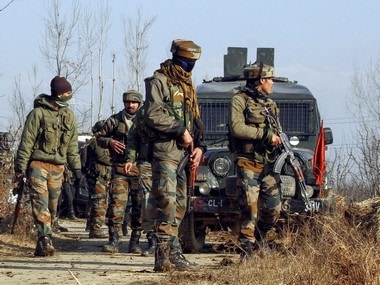
Army soldiers take positions during an encounter with militants at Sirnoo in Pulwama. PTI

Pakistan is no amateur at this game. It was party to managing (with an assist from the US Central Intelligence Agency) the proxy fight using the Afghan mujahideen to push the mighty Soviet military out of Afghanistan in the 1980s without seeding enduring enmity with Moscow. It is a far lesser task to use radicalized Kashmiris to discomfit India that acts as a punching bag of a nation. Pakistan is emboldened because there’s China as a backstop to Pakistani terrorist ventures, ready to blunt any international opprobrium. Never mind that its own restless Uyghur population in Xinjiang is susceptible to the Islamist virus, and the sunni hotheads in Jaish could, in a slightly altered context, be the medium to stoke Uyghur militancy.

So, how do you deal with the pestilence called Saeed Hafiz, Azhar Masood and others of that ilk and their scrofulous followers bent on attempting – albeit materially and infrastructure-wise supported and encouraged by their minders in the Pakistan Army’s Inter-Services intelligence (ISI) —  the impossible? Loosening India’s hold on Jammu And Kashmir is no easy thing to try and do for Pakistan. But that’s not what ISI hopes to accomplish. It is intent and itching to draw the Indian military and the state into a brawl with the natives, not get Delhi so riled up that it overcomes its self-imposed inhibitions.  Equally, India — big in every way and enjoying a huge margin of safety and of error, seems unable to summon the necessary nerve and the gumption to do anything remotely incautious.

All the talk of air/missile strikes, more surgical strikes, etc “to teach Pakistan a lesson” is a lot of hot air because if the Modi government had it in mind to actually unleash an aerial strike, for instance, it would have done so instantaneously after the suicide attack, not informed the media about the ruling party contemplating such actions. Moreover, the standard operating procedure on the other side is that as soon as a big terrorist operation is mounted, the Pakistan military firms up its forward lines, puts its SILLAC air defence system out of Sargodha on 24/7 radar sweeps to detect any aerial approach by India, and field formations assume a war-ready posture, prepared for any affray that an angry, perennially reactive, India may care to launch.  Which is to say such Indian response has zero prospects.

I have long argued that the answer to Pakistan’s use of asymmetric means is not for the government to approve the army’s formal counter-strike proposals, which to-date have proved futile in deterring ISI from waging a covert war, leave alone cowing GHQ, Rawalpindi, into restraining itself on this count. But rather that time is nigh to physically target and eliminate trouble-makers like Hafeez and Azhar.

Two options have always been readily available to Delhi. One is the sniper solution – a designated covert team infiltrated into Pakistan around Muridke in Pakistani Punjab, HQrs of Jaish, say, with one or two master marksmen to take out these terrorists, and for this team to be exfiltrated after the deed is done. The trouble here, again, is that the Pakistan army is besting India in this department, meaning that either Pakistan army sharp shooters or a few Kashmiri natives rigorously trained for sniper shoots have been making life miserable for the Indian armed forces – army and para-military for many years now. Their use of the Chinese Zijiang M99 Sniper Rifle, rated as one of best five of its kind in the world, has been exemplary. Its ability to precision hit targets at 1,800 metre range, ie, almost 2 kilometers, has played havoc with Indian troops in the Valley and elsewhere.  It is something the army, para-military and the J&K and Indian governments do not publicly acknowledge. The Indian army snipers, on the other hand, make do with a dated Russian piece – the Dragunov SVD when the newer, more advanced, Chukavin, with 1,600 metre range, is in the market. Worse, the Dragunov ammo stock is so low at only 25 percent of requirement that Indian snipers get to fire just 4 or 5 rounds for practice per year! This is a joke.

The other, more effective, option is right in the National Security Adviser Ajit Doval’s supposed area of expertise – activating RAW and other sleeper cells in Pakistan for attacks to execute Sayeed, Masood, et al. If successful, it will put the fear of God into these miscreants without disturbing the general tenor of bilateral relations. The Pakistan government cannot publicly object to their killing because it does not own up to sponsoring them in the first place. Moreover, there are lots of ways to make their elimination look like accidents.  This is the very essence of kuttayuddha that the Indian government, intelligence and military are distanced from, but which Islamabad has grasped. It is also the only thing that will, in fact, work.

————

[Published in Firstpost.com, Feb 16, 2019 at https://www.firstpost.com/india/talk-of-avenging-pulwama-attack-hot-air-heres-how-to-deal-with-jaish-e-mohammad-other-terrorist-groups-6098781.html \

Posted in Afghanistan, asia-Pacific/Indo-Pacific, Asian geopolitics, China, civil-military relations, Culture, Decision-making, Geopolitics, Great Power imperatives, guerilla warfare, India's Pakistan Policy, India's strategic thinking and policy, Indian Air Force, Indian Army, Indian para-military forces, Indian Politics, Intelligence, Internal Security, MEA/foreign policy, Military/military advice, Missiles, Pakistan, Pakistan military, Relations with Russia, Russia, SAARC, society, South Asia, Special Forces | 11 Comments

The Rafale conundrum: Who induced PMO to accept extortionist terms and how did France get such a sweet deal?


Image result for pics of anil ambani in rafale aircraft

(Anil Ambani preparing for a Rafale sortie)

Akin to the exquisite Chinese torture by water endlessly hitting the forehead, drop at a time, leading the victim to own up, confess, recant, the drip, drip, drip publication in newspapers of hitherto unknown tidbits and classified documents related to the procurement of the Rafale combat aircraft from France may be driving the ruling Bharatiya Janata Party (BJP) government to distraction.

It has certainly undermined its carefully tended case regarding this high-value deal, and impacted Prime Minister Narendra Modi’s reputation for uprightness. The hope, nursed by some in government, that Part B of the Comptroller and Auditor General of India’s (CAG) Report on the ‘Acquisition of 36 Rafale Aircraft through IGA (Inter-Government Agreement)’ tabled in Parliament on 13 February would rescue the ruling party has been belied. What it actually does is confound the already existing confusion about the real cost of the deal.

The predicament the Modi dispensation finds itself in is due mainly to a bunch of crucial documents relating to the Rafale transaction leaked to The Hindu and splashed on its pages in the last couple of weeks. Particularly damning has been the dissenting note about the IGA by three Ministry of Defence (MoD) officials and members of the Indian Negotiating Team (INT) — Adviser (Cost) MP Singh, Finance Manager (Air) AR Sule, and Joint Secretary Rajeev Verma. Also, of interest is the article in The Wire by former MoD Financial Adviser Sudhansu Mohanty, who indicated that the direct negotiating track set up by the National Security Adviser Ajit Doval obviously on Modi’s say-so was outside the ambit of the Defence Procurement Procedures, and had rendered INT redundant.

The dissent document which The Hindu published and the CAG report are crucial to understanding why the ill-advised initiative by the prime minister to speed up the Rafale procurement by cutting INT out of the negotiating process and getting Doval and the Prime Minister’s Office (PMO), with limited domain competence and expertise, to finalise a deal with Paris, has backfired. That the three dissenters eventually signed the final acceptance of IGA may be attributed to bureaucrats’ desire to avoid rubbing the government the wrong way because that could result in punitive actions — postings in the boondocks, troubles with promotions and retirement pay, etc.
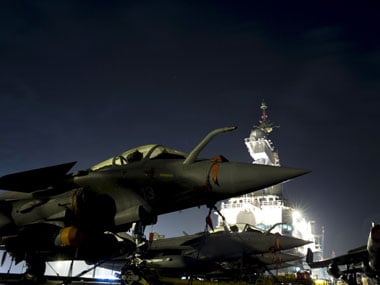
A Rafale fighter aircraft. Reuters

Not all arms deals are created equal. Most go through the bureaucratic grind and long testing trials over years before the competing products are shortlisted, which is when corruption usually occurs in terms of changing the rank order to favour this or that supplier/country. It is facilitated by middle-men servicing political leaders, bureaucrats and even uniformed personnel in the decision-making loop and their tendency to pelf and personal profit via commissions and considerations in kind.

Rafale, too, went through a trying testing regime. However, while the usual commission-mongering, at least during the NDA government’s tenure, was missing, the PMO’s role in ensuring that Anil Ambani’s Reliance Defence gains from the offsets attending on the Rafale buy and so admitted by the then French President Francoise Hollande, is as apparent as Ambani’s playing the part of the intermediary – something that has not been plumbed as it should be — between Modi and PMO on the one hand and the French government and the French supplier Companies, Dassault Avions and MBDA, the missile maker, on the other hand. It substantiates suspicions about Modi’s crony capitalism which may have led to New Delhi agreeing to extremely generous terms and conditions in the IGA for Dassault and MBDA. More on this later.

The dissenting note stated plainly that the IGA did not meet the main criteria laid down in the Indo-French Joint Statement of April 10, 2015 of expeditious delivery of the Rafale aircraft on “terms that would be better” than those in the 2007 MMRCA deal that Dassault had acceded to. It was pointed out that IGA, instead of sticking to the “firm and fixed” price basis for negotiation mentioned in the original Request For Proposal, had accepted an escalation formula advanced by the French parties resulting in a 55.6 percent increase over the “benchmark price”, i.e., the cost-figure (calculated by IAF) as the high end of the acceptable price range for aircraft and weapons package of €5.06 billion. The dissenters deemed the resulting €7.87 billion price tag for 36 Rafales unreasonable. They also mentioned that EADS had offered the Typhoon Eurofighter at a 20 percent discount without any escalation clause. Another 5 percent discount was seen by INT as a negotiating margin that could be extracted from EADS for a total 25 percent discount. This would have eventuated in a cost figure markedly lower than anything Dassault was offering for Rafale. Using the EADS offer to leverage a better price for the 36 Rafales never, however, occurred to the PMO negotiating the terms in the IGA.

More significantly, the IGA did away with sovereign guarantees and payment to vendors through an escrow account operated by the French government, which would have made Paris accountable for any default on the contract by Dassault and MBDA. It made for huge savings to France in bank charges, which as the CAG Report suggests, were not passed on to India or factored into the final price calculations by IGA and, in any case, was 5.3percent higher than what Dassault had quoted for the MMRCA. Further, the French government, per the dissenting note, ignored the pleas by INT to apply the commercial rates offered by industrial suppliers for the MMRCA to the 36 Rafale purchase. In the event, the French insisted and received in the IGA a virtual license to act in their own best commercial interests or France’s national interest without fear of penalty, with India requiring to exhaust all avenues of international arbitration to redress its grievances before approaching the French government to make good.

Indeed, with Paris minimising its financial exposure and that of the French Companies, and getting a deal so tilted to benefit France in every way, one wonders if the PMO, clueless about the technical and financial nuances of high-value deal making, simply accepted the French draft as IGA. This in fact is what seems to have happened with a Joint Secretary in PMO, as The Hindu disclosed, calling up a senior French official to inform him about some French conditions or the other that had been accepted.

The CAG report makes many of the same points the dissenting note did with respect, for instance, to the sovereign and bank guarantees, escrow account, etc. But it does not take the extra step of faulting the IGA and hauling up the government for making do with a “letter of comfort” that by way of legal commitment means nothing but imposes a severe financial burden on the country. At the core, the difficulty, and the CAG hints at it, was with reconciling the costs of an MMRCA deal for 126 aircraft with 18 Rafales bought in flyaway condition and the rest produced with transfer of technology and under license in India to fit the buy of only 36 aircraft, with Paris no doubt demanding that the total cost figure of the originally contemplated MMRCA deal not be tampered with.

The CAG Report observed that such small number of aircraft nowhere filled the “wide gap in the operational preparedness of the IAF”. The enhanced costs of producing the aircraft at HAL involving 2.7 times more man-hours per Rafale, however, provided the government the rationale to junk the license production portion of the deal, with the monies thus saved channeled into the 10 year spares package promising 72 percent-75 percent serviceability of the Rafales in IAF fleet.

But the CAG does not comment adversely on the other device to jack up the costs by €1.4 billion — the India-specific Enhancements (ISE), which the dissenters, using the €348 million that Dassault charged for the Mirage 2000 upgrade programme as a measuring stick, slammed as “exorbitant and unrealistic.”

Moreover, it isn’t clear why the need for ISE arose in the first place if the idea was to hew to the Joint Statement that required delivery of aircraft “in the same configuration as had been tested and approved by IAF..with longer maintenance responsibility by France.” Seemingly, these enhancements were of no great import, in any case, because IAF proposed postponing six such enhancements as a “cost reduction measure,” something MoD rejected.

Under the IGA, moreover, Dassault has been allowed to incorporate the ISEs only after the last Rafale is inducted into service some 71 months after the IGA was signed — a month longer, incidentally, than the MMRCA deal the INT had negotiated. But CAG is skeptical about Dassault meeting delivery timelines owing to the backlog orders for the aircraft and the French Company’s annual production capacity of only 11 aircraft – something the dissenting note too flagged while marking the Dassault capacity at 8 aircraft per year.

Except, CAG accepts on faith the government’s belief that the delivery of the Rafales will somehow adhere to the laid down time-table, thereby implicitly accepting that, with the French government absolving itself of all fiduciary responsibility, IAF is at the mercy of the supplier firms.

The real problem with the CAG report is elsewhere. Its conclusion that IGA was 2.86 percent cheaper than the MMRCA deal hammered out by the Congress party-led UPA government is based on its calculation of savings of 4.77 percent in services and product support, 17.08 percent in the ISE category and 1.05 percent in weapons package while conceding increases in cost in several other categories — 6.54 percent in engineering support as also in Performance-Based Logistics (the 10 year spares and service support scheme). But the figures are fully redacted and the workings completely obscure.

How the CAG arrived at any of these figures is a mystery. The opposition claim that the CAG report is tainted because the Comptroller General as Finance Secretary oversaw the financial aspects of the Rafale deal overlooks the fact that all CAGs are political appointees and the assessments they produce are political documents which try and put the best possible spin on controversial deals, which is why select civil servants are placed in that position.

This brings us to the conundrum of just how France managed to get a deal so favourable to it which, in turn, brings the role of Anil Ambani to the fore. On 12 February, The Indian Express reported that Ambani met with top French defence ministry officials — all advisers to defence minister Jean-Yves Le Drian, a week or so before Modi landed in Paris in the first week of April 2015. Le Drian’s Industry Advisor, Christophe Salomon described their meeting with Ambani as “confidential, and planned, as you can imagine, with very short notice.” The Indian Express report suggests that the Reliance Defence owner may have used the occasion to alert the French defence ministry about Prime Minister’s Modi’s Rafale decision coming down the pike and, in the event, for the French government to prepare its act together with Dassault and MBDA with respect to firming up terms, conditions, and price parameters of their liking. It is a matter of conjecture as to what, in the circumstances, motivated Ambani: Obtaining a good deal for India or a great deal for his Company?

It is reasonable to speculate, going by the Indian Express report, that the tycoon had a tip-off, allowing the use of the deal to set up his company as a major defence industrial entity in the country. This can be inferred from the statement of the Defence Minister Nirmala Sitharaman that “No offset contracts have been signed so far. If two private firms come together, that doesn’t require permission from the ministry. And if it is consistent with the DIPP’s [Department of Industrial Policy & Promotion’s] policy, they go ahead with it. To think that that has something to do with the inter-governmental agreement in the purchase of Rafale is just unfounded.”

That the Rafale deal, apart from the PMO, did not involve any other agency of government may be read in the statement the then Foreign Secretary K. Jaishankar made to the press on the eve of the Modi-Francoise Hollande meeting. “In terms of Rafale, my understanding is that there are discussions underway between the French company, our Ministry of Defence, the HAL which is involved in this”, said Jaishankar. “These are ongoing discussions. These are very technical, detailed discussions. We do not mix up leadership level visits with deep details of ongoing defence contracts. That is on a different track.” If the PM sprang a surprise on the country, MEA, MoD and HAL too were unaware of the “track” they were moving on being separated from the one the PM and his PMO had already taken to reach a decision.

That the decision to go with Dassault was early communicated to Ambani is evidenced in the fact that, as part of the offsets requirement, Reliance Defence assisted by Dassault, began investing in production infrastructure ere the IGA was signed, has already plugged into Dassault’s supply chain and is supplying parts and assemblies for the Dassault executive jet programme and is expected to output the whole Falcon 2000 LX jet by 2022 at its Nashik facility. This means that Ambani had a commercial stake not only in Dassault bagging the Rafale deal but doing so on preferential terms and conditions. The IGA that transpired reflects this last aspect.

It is therefore not too outlandish to conclude that Ambani served as a two-way communications channel in the Rafale deal – conveying to Paris the PMO’s thinking, and prompting the PMO to accept near extortionist terms and conditions that, for such a big international weapons deal, are unique.


[Published in Firstpost.com Feb 14, 2019, at https://www.firstpost.com/india/the-rafale-conundrum-who-induced-pmo-to-accept-extortionist-terms-and-how-did-france-get-such-a-sweet-deal-6086261.html
 

Posted in arms exports, asia-Pacific/Indo-Pacific, Asian geopolitics, civil-military relations, corruption, Culture, Decision-making, Defence Industry, domestic politics, DRDO, Europe, Geopolitics, Great Power imperatives, India's strategic thinking and policy, Indian Air Force, Indian ecobomic situation, Indian Politics, MEA/foreign policy, Military Acquisitions, Military/military advice, Missiles, society, South Asia, Technology transfer, Weapons | 1 Comment

Rafale: A political disaster foretold

Image result for pics of modi in paris

(Modi enjoying a boat ride down the Seine in Paris with President Hollande in April 2015)

On April 17, 2015 — some 11 days after Modi had made the surprise announcement in Paris when on a state visit about his government’s purchase of 36 Rafales, the French combat aircraft, an op-ed of mine published in The New Indian Express titled “Impatience seals worst possible defence deal” (http://www.newindianexpress.com/columns/Impatience-Seals-Worst-Possible-Defence-Deal/2015/04/17/article2767483.ece ), was the first article in the Indian press critical of this transaction, one that foresaw the political squall the BJP regime was heading into.  (This piece was also posted on this blog — https://bharatkarnad.com/2015/04/17/impatience-seals-worst-possible-defence-deal/

In the first few paras of that piece I said about this prime ministerial initiative that it “was portrayed as Modi’s ‘out of the box’ solution for a problem that didn’t really exist. Plainly, he mistook the hard, extended, bargaining between the two sides as evidence of red tape, and cutting it as his unique achievement. But impatience is a liability in international relations and can cost the country plenty. Rather than pressuring French president Francois Hollande and the French aviation major, Dassault, which is in dire straits and was in no position to resist sustained Indian pressure to deliver the Rafale and the technologies involved in toto to India, Modi eased off, promising a munificent $5billion-$8 billion for 36 Rafales off the shelf minus any reference to the L1 (lowest cost) MMRCA tender offer, possibly a buy of another 30 of them, and no onerous technology transfer obligation. It is a turn that must have astonished Hollande and Dassault with its exceptional generosity….” and concluded, prophetically, that “Previous prime ministers have been victimised by bad advice, and paid the political price, for instance, Rajiv Gandhi with regard to the Bofors gun. Modi will have to carry the can for this Rafale transaction—a boondoggle in the making. With the opposition parties …waking up to its potential to politically hamstring the BJP government and mar Modi’s prospects, anything can happen.” It also mentioned how the then defence minister Manohar Parrikar, favouring the speedy, economical, enlargement of the Su-30 fleet to meet the urgent requirements of IAF, was blindsided by the Modi decision. I repeatedly  warned of a brewing political storm over Rafale in my writings and in the posts on this blog, ever since.

That day of reckoning has arrived.

Whether Modi manages to rides out this crisis is besides the point; that he cannot and will not escape the taint is certain. What is making it progressively difficult for the Modi dispensation to explain away a plainly flawed approach to military procurement by the PM taking the matter into his own hands and bypassing the established processes is that it has left a paper trail. The PM, in his capacity, can call in the Defence Secretary and instruct him to accelerate the acquisition process. But that’s a fry cry from his intervening forcefully at the price negotiation stage to, in effect, have his own representative — in this case the NSA, Ajit Doval, set up a separate negotiating track, which is absolutely barred by the settled “rules of business” of the GOI. The Prime Minister was bound to pay a political price.

When bureaucrats in the decision loop are bypassed for any reason by the political poohbahs, they usually make sure to not end up becoming the fall guys. The remarkable thing is that it took so long — nearly four years — for the dam to burst, document drip at a a time. Considering that so many MoD officials were involved in the price negotiation committee over the years, all of them no doubt squirreled away copies of potentially “hot” files for just such an occasion as has now come to pass. Copies of the most sensitive documents are a safeguard, evidence to absolve themselves of any responsibility for things going wrong, as has happened re: the Rafale. Many of these dissenting officials, incidentally, were abruptly posted out of MoD not too long ago, which added to the general discontentment of the babus in the govt at-large and in the Defence Ministry in particular  with Modi and his way of doing things.  This to say that it was only a matter of time before these documents were “leaked” to the press.

But why at this time? Babus, in their careers, develop very sensitive antennae. With Rahul Gandhi’s charge of corruption getting the traction it has — something the ruling BJP did not anticipate, the bureaucratic ill will towards Modi oiled the predisposition of those having the precious information about what really occurred to make the notings available to media persons. N. Ram, owner and sometime editor of the Leftist ‘The Hindu’ newspaper, and a longstanding “Cadillac communist” was the perfect vehicle for such leakage, because it segued in with the “mahagatbandhan” the numerous “socialist”-minded political parties are putting together to take on the BJP in the coming general elections.

The entire tranche of files and related documents on the Rafale deal have apparently been handed over to Ram. This is obvious from the numerous hints in Ram’s two Hindu stories to-date — the one featured in today’s edition being more damaging because it provides evidence of PM-run parlays with the Elysee Palace, which seemed more intent on  accommodating the French government and aviation major, Dassault Avions, than in chiseling away at the humungous price tag for the total Rafale transaction.

Worse, for Modi, this revelation contradicts his government’s case before the Supreme Court that the latter had been given all the information about the Rafale deal and the deal-making processes and that the PMO had no hand in any of it. This is important because the Modi regime is basing its defence on the Supreme Court finding nothing amiss with the mechanics of how the final contracted price was arrived at, when it is obvious it was not given  all the files related to the reservations the PNC had with respect to a Joint Secretary in PMO acting as a plenipotentiary in working out the provisions in the deal that are all to the advantage of France and the French vendor.

This entire Rafale file-load with Ram means the Modi government will have to be careful about what it says to wriggle out of a hole it has dug itself into because it can, in no time be shown to be a lie with some pertinent document or the other being splashed on the front page of The Hindu.

It is still a wonder why Modi was convinced to buy the 36 Rafales which, as I have argued, will be the classic ‘white elephants’ — good for nothing very much beyond Republic day flypasts. Surely, Doval couldn’t have advised him about the finer points of this fighter plane mainly because he knows so little about things military. There’s also no personal corruption involving Modi — that’s for certain. The prime minister is too upright a person for that.  Modi may, however, have sought some benefits from the deal to accrue to the Ambanis and Reliance Defence possibly in return for funds for the BJP’s election campaign, which kind of exchange incidentally, is par for the course. Nothing new here, and the BJP did not originate such means of financing political parties either.

I have speculated (in my books, including the latest — Staggering Forward: Narendra Modi and India’s Global Ambition) that in this context, perhaps, the reason for Modi siding with the Rafale was that France promised some highly strategic good to India. Like for instance, access by Indian nuclear weapons designers to the French inertial confinement fusion complex in Bordeaux. ICF is the means short of physical underground testing to improve thermonuclear warhead designs and to modernize the strategic arsenal, wherein miniaturized thermonuclear explosions are obtained by targeting high-intensity laser beams on small nuggets of fissile material.

This may be the aspect the Modi govt does not want to disclose and is part of the “secrecy” clause in the deal. OK. But is Modi’s desire to escape the Russian embrace so powerful as to overturn its relationship with Moscow based on decades of extremely sensitive strategic cooperation such as the access BARC weapons directorate scientists have long enjoyed to the Russian ICF at Troitsk outside Moscow? Where was the need to beggar the country to buy the Rafale to access Bordeaux when Troitsk was always available as was the Su-30 for a fraction of the price Modi pledged to Hollande?

Posted in arms exports, asia-Pacific/Indo-Pacific, Asian geopolitics, Decision-making, Defence Industry, domestic politics, DRDO, Europe, Geopolitics, Great Power imperatives, guerilla warfare, India's strategic thinking and policy, Indian Air Force, Indian democracy, Indian ecobomic situation, Indian Politics, MEA/foreign policy, Military Acquisitions, Military/military advice, Nuclear Policy & Strategy, Nuclear Weapons, Russia, russian assistance, South Asia, Strategic Forces Command, Technology transfer, Weapons | 19 Comments