[Finance Minister Nirmala Sitharaman on the way to presenting her first budget]
There has been only a notional increase in Finance Minister Sitharaman’s defence allocation. It may not be sufficient to deal with even the rate of real inflation, what to speak of price tags on military hardware that gallop at almost a geometric pace.
There’s one aspect of the general budget with impact on defence acquisitions that Sitharaman did not clarify — whether the amendment of the slabs in the existing Goods & Services Tax (GST) structure will be part of her effort to simplify and streamline it, which is what she promised in her budget speech, because of the glaring anomalies in the GST slabs that Arun Jaitley created. The sort of absurdities that resulted were flagged in my recent book ‘Staggering Forward: Narendra Modi and India’s Global Ambition’ (Pages 317-318). But here’s reiterating some of them.
The current scheme boasts of numerous and confusing rate-slabs often not aligned with the larger objectives. It was early recognized as being flawed, as they inflated the procurement costs all round. Putting all production machinery in the 28% GST bracket has meant, for instance, that if machinery is bought related to intermediate and capital goods for, say, Rs 100, with GST of 28%, Rs. 128 is lost right away by the buyer. With 3 years as payback period – the average age of a modern machine, where are the funds to invest even under the ‘Make in India’ rubric?
Similarly, if building infrastructure – roads, highways, etc. is a priority for the Modi government, shouldn’t excavators, road rollers, and so on have been in the 5% GST category? Likewise, as regards the Swacch Bharat Abhiyan, sanitaryware attracts 18% GST! Also consider the Jan Awas Yojna (for low cost public housing) – the doors, window frames, etc. that go into a house costing Rs. 2.5 lakhs under this Yojna has a GST component of 18%. In the event, won’t fewer houses be built for the same fund allocation?
In any case, the GST slabs of 5%, 12%, 18% and 28% are arbitrary. On what basis did Jaitley decide 5% for this item, 8% for that and 18% GST slab for ‘services’.
Now ponder the GST effect specifically on defence production costs. Warships and aircraft are in the 5% slab. But the propulsion system in warships is pegged at 28%, army’s tanks are pegged at 28%, and 3-tonners – the trucks most commonly used to move troops, etc. was originally in the 28% category. Moreover, everything connected with the railways attracts 5% GST, anything connected with space is 0%.
Without the 28% GST more goods would be produced in the country, more people would be employed, the country’s wealth would grow faster and India will progress faster.
If 100 trucks get made now, without GST 128 trucks would have been manufactured, with more impetus provided for steel production, rubber production for tyres, and so on. Worse still is the working capital requirement. The GST rules mandate that an input tax credit can be claimed only when the next producer up the chain pays up. An aircraft is produced in 3 years, so the manufacturer of components, say, has to wait for three years to get paid.
Hopefully, Sitharaman will get round — sooner the better — to ironing out such GST kinks. The armed services will then be able to purchase more of what they want for the allotted quantum of funds. But, significantly, this kind of a wonky GST system ends up making arms imports cheaper because the global supply chains tied to major foreign armaments makers are not subjected to Indian GST.
[Kim Jong-un and Trump at Punmunjom on the DMZ, Korea]
“I never expected to meet you at this place,” a smiling North Korean supremo Kim Jong-un said to the US President, after he had induced the latter with the hinted promise of a quick deal to cross the line on the De-Militarized Zone (DMZ) and step into North Korea. “Big moment,” Mr Trump replied, a little lamely, “tremendous progress.”
There’s tremendous progress alright but mostly by Kim to compel Trump to back down, two steps at a time, from the forward position staked by his NSA, John Bolton, the main architect of a policy to denuclearize North Korea by force or through talks. Except, Washington discovered that talk of force merely prompted Kim to up the ante and promise nuclear reprisals if the US acted tough. It was a response that had sufficient credibility for Trump to sue for peace on North Korean terms. This much is evident from reports after the Trump-Kim meeting at Punmunjom in the De-Militarized Zone (DMZ) yesterday (June 30) that referred to the US being reconciled to letting Pyongyang keep its existing nuclear arsenal if the North Korean dictator agreed, in principle, to have his main nuclear complex and associated facilities periodically inspected by the Vienna-based International Atomic Energy Commission (IAEA).
Kim agreed to these terms after verifying the hydrogen bomb designs gifted by China through repeated testing of thermonuclear weapons. The fifth and sixth tests were of hydrogen bombs, with the last such underground explosion on 3rd September 2017 clocking in at as much as 270-370 kiloton yield — a genuine thermonuclear blast. So, before Kim agreed to safeguards on anything, he had ensured that his thermonuclear weapons inventory was physically proven and in fine fettle.
Contrast this with India’s negotiating strategy executed by the then MEA Joint Secretary S. Jaishankar, and now foreign minister, that secured for India an outcome that guarantees the country will remain a pretend thermonuclear power. This because the pre-conditions built into the 2008 civil nuclear cooperation deal are such they are actually an economic deterrent against Delhi resuming testing, thus reducing that option to a theoretical one which, Washington is certain, will never be exercised.
A major economic deterrent, for instance, is the supply of low enriched uranium fuel for the imported American Westinghouse AP 1000 reactors and the French Areva 1000 reactors costing tens of billions of dollars being instantly terminated if India tests again, resulting in electricity going off the grid and these reactors slowly grinding to a halt and becoming dead investments. One can see just how fearful any Indian government would be of violating the no-testing terms. This then is the strategic corner Jaishankar, with supposedly finely honed negotiating skills, pushed India into because he ignored the history of big powers intent on imposing their will being repeatedly frustrated by states, such as North Korea and to an extent even Pakistan, with the overarching will to forcefully advance their national interest and prepared to be seriously disruptive if they don’t get their way. With PMs and the governments since 2004 led successively by Manmohan Singh and Narendra Modi being content with Western flattery and with having their egos skillfully massaged, what is consolidated is India’s status as a large but hollow power that can be any super power’s handmaiden.
If North Korea proceeds down the road Kim has picked for his country, it is near definite that it will, by itself, have de-fanged the United States and so conspicuously that America’s residual will to assert itself in Asia for any reason will be zeroed out. Will India, with its billowing reputation for following the US, pack the same political punch as an otherwise lowly North Korea? No, and for the good reason that Pyongyang has the most destructive thermonuclear weapons and the ultimate adjudicator of interstate relations, at hand, even as India will be left brandishing its piddling fission bombs that scare nobody.
[Abe with a “there he goes again”-look , a bemused Trump, and an earnest Modi, perhaps, repeating something the other two have heard many times before! — at the G-20 summit in Tokyo]
The most important meeting at the G-20 summit in Tokyo from India’s national interest point of view was the one Prime Minister Narendra Modi had with Russian President Vladimir Putin and Chinese President Xi Jinping. It was left to Xi to utter the substantive — that China, Russia and India take “global responsibility” for the downward-spiraling international economic situation and protect it against the vagaries of US President Donald Trump’s whimsical turns and about-turns, in the main pitching for new financial instruments and channels to prevent the trade and commerce of these three countries being held hostage by US policy of economic sanctions as first resort. While Delhi has apparently firmed up a Euro channel for hard currency payments to Russia for import of armaments, it does not want to be too vocal about thus bypassing US sanctions.
In response to Xi’s voicing the above meta-strategic economic concern, Modi, true to his growing “one-tune canary” reputation, tagged terrorism as “the biggest threat to humanity” and, by extension, put Pakistan in the dock, insisting that Moscow and Beijing join Delhi in convening an international conference to fight terrorism. It is such small successes the Modi regime seems to excel in. So, yes, Russia and China may well support such an Indian initiative because it means expending very little political capital while notching up IOUs with Modi. The PM apparently feels buoyed by his success in selling this line to the US, with Pompeo in an interview to an Indian daily talking about Washington doing “a 180-degree turn with respect to Pakistan” and referring to America’s role in pressing Islamabad on the UN Financial Action Task Force provisions. This sort of Delhi-pleasing gestures, as I have long maintained, mean little because the US is unlikely to let go of Pakistan or permit it to sink in a terrorism morass, certainly not until Pakistan remains the indispensable front line state for war against the Taliban in Afghanistan, and now the means of frustrating China’s plans for securing the Gwadar port on the Arabian Sea — the 21st Century version of the 19th Century Great Game in which Britain did all it could to stop Imperial Russia moving south across the Hindukush to acquire a warm seawater port, except now China replaces Russia and a whole bunch of Asian states, including India, and the US are in the place of Britain.
Meanwhile, the meeting of Modi, Japanese premier Shinzo Abe and Trump produced another variety of hot air — “sharing views” about joint efforts in the security, connectivity and infrastructure fields to counter the lure of China’s Belt & Road Initiative in Southeast Asia and offshore states in that region and in the Indian Ocean region generally. So even as China builds and rapidly consolidates its presence in the extended region, this threesome of democracies just talks, and talks some more!
Back home in the wake of US Secretary of State Mike Pompeo’s visit, foreign minister Jaishankar made public the fact that he stood his ground on the purchase of the Russian S-400 Air Defence system on the basis of “national interest”. This last came as great relief considering every right thinking person in Delhi is on tenterhooks every time he sits down to negotiate anything with the Americans — his tell-tale record of giveaways to Washington being too obvious to ignore. But then one recalls the Modi government’s announcement a fortnight before Pompeo’s trip of a buy of 10 additional P-8I armed maritime reconnaissance aircraft worth $3 billion to augment an existing fleet of 12 such aircraft already in Indian Navy service, and the unavoidable conclusion is that this purchase was a pre-concession made to the US to prevent Pompeo raising a stink over the S-400 and Iran.
So, how is the national interest served when the Modi-Jaishankar duo merely bought peace in the short term and forked out $3 billion for the privilege?
With both the prime minister and his new external affairs minister, S. Jaishankar, tilting towards the United States, India’s status and stature in the world is all set to decline.
[Minister for external affairs S. Jaishankar, national security adviser Ajit Doval and Prime Minister Narendra Modi]
India has spent trillions of rupees since 1947 on education, social welfare programmes and defence. But, 70-odd years later, the country has the largest population in the world of ill-educated, unskilled, unemployable youth, certain health and socio-economic indices that are worse than those of some of the world’s poorest states, and a showy but short-legged and second-rate military dependent on imported armaments.
Yet look at India in macro terms using the somewhat dubious ‘purchasing power parity’ concept and it gets rated as a trillion-dollar economy. What explains this anomaly?
Tufts University political scientist Michael Beckley’s pioneering theory of international relations suggests that gross measures – such as population, GDP, defence budgets, size of armed forces, etc. – are less accurate in assessing the power of nations than “net” factors, such as how effectively national resources are converted into measurable and decisive political, economic and military capability and diplomatic leverage and clout.
In other words, it’s the outcomes that matter. By this standard, the more advanced countries of the West seem to be more efficient converters of their human and material resources into usable policy assets relative to India and other middling powers, or even China, which in this respect falls somewhere in between these two sets of states.
So analysing the outcomes of Narendra Modi’s foreign policy – which is a continuation of the Indian government’s approach and policy from the days of P.V. Narasimha Rao, Atal Bihari Vajpayee and Manmohan Singh – and of S. Jaishankar’s central role in crafting several crucial agreements in service of this policy, may be a good way of judging its success.
The distinctive feature of India’s external relations in the new century is the pronounced tilt towards the United States. Narasimha Rao worked to obtain a rapprochement in the 1990s, and Vajpayee agreed on the Next Steps in Strategic Partnership (NSSP). This culminated in 2008 with the civil nuclear cooperation deal with the US and, during Modi’s first term, in India signing two of the three “foundational accords” proposed by Washington – the Logistics Exchange Memorandum of Agreement (LEMOA) and the Communications Compatibility and Security Agreement (COMCASA). The third, Basic Exchange and Cooperation Agreement (BECA) for sharing geo-spatial information, is awaiting signature.
Jaishankar helped negotiate the nuclear deal and thereafter in his various posts facilitated and relentlessly pushed the foundational accords through the Ministry of External Affairs (MEA) and the Prime Minister’s Office (PMO). Briefly, what are these various agreements about and what do they say about Modi’s and Jaishankar’s thinking?
Senior functionaries in the Manmohan Singh government, it may be recalled, ballyhooed the civil nuclear cooperation deal with the US as all gain and no pain. They declared that the deal had left India’s nuclear deterrent intact, protected its weapon-grade plutonium producing capacity and preserved the option to resume testing in the future, and that imports of the 1000 MW light water reactors from abroad would obtain for the country “20,000 MW by 2020”. Remember this endlessly repeated mantra of Manmohan Singh’s to justify the accord?
[Then US President George W. Bush and Indian Prime Minister Manmohan Singh in New Delhi on March 2, 2006.]
The US, on the other hand, made no bones about its intent at a minimum to “cap and freeze” India’s nuclear weapons technology at the fission weapons-level achieved with the 1998 Shakti series of tests, and to prevent it at any cost from advancing to the thermonuclear weapons threshold.
The US government, however, happily joined the Manmohan Singh government in touting the energy rationale, especially because Indian purchases of the AP 1000 Westinghouse light water reactors would also revive a moribund US nuclear industry. As to what was actually accomplished in the negotiations was made plain soon after the nuclear deal was sealed by the chief US negotiator, under secretary of state for political affairs Nicholas Burns.
“To strengthen the nonproliferation system for the future, it just [made] every bit of sense to bring India into it and to do that in such a way that doesn’t strengthen its military arsenal,” explained Nicholas Burns in a 2007 interview to the Council on Foreign Relations in New York. “It allows [India] to put 14 of [its] 22 power reactors under safeguards and all future breeder reactors [a reactor that produces energy and weapons grade plutonium]. And within 25 years, I think 90%-95% of the entire [Indian nuclear] establishment will be fully safeguarded. So the choice [was]: Should we isolate India for the next 35 years, or bring it in partially now and nearly totally in the future? I think that [was] an easy choice for us to make strategically.”
Because of the deal, not only is India’s nuclear arsenal frozen at the elementary fission weapon stage – no amount of computer simulation and component testing can rectify the design flaws in the failed thermonuclear weapon design tested in 1998, leave alone produce a credible hydrogen bomb or fusion weapon the Indian armed forces can have confidence in without additional nuclear testing. Except testing is prohibited on the pain of the US imposing sanctions and terminating the deal. Also voided is India’s capacity for surge production of fissile material with most of the heavy water-moderated natural uranium-fuelled CANDU reactors shoved into the UN International Atomic Energy Agency (IAEA) safeguards net.
With the “islanding”, or separation of Indian weapons directorate, from the rest of the work in Trombay, moreover, the earlier cross-pollinating milieu of scientists and engineers from any field getting involved in solving difficult weapons-related problems that often resulted in innovative solutions, is lost and, with the no-testing regime in place, the best and the brightest have gravitated away from weapons work.
To add insult to injury, even the power reactors India is in the process of buying from the US and France are a risk on two counts. Of the 12 low-enriched uranium fuelled light water reactors India is seeking to purchase, six each from the US and France, the American Westinghouse 1000 reactor has not been cleared by the US regulatory authority for safety reasons.
In addition, the smooth functioning of these imported reactors is ensured only so long as India refrains from conducting nuclear tests. Should India resume underground tests, the supply of foreign fuel will be instantly and permanently terminated, the electricity sourced from these power plants will peter off, and the industries dependent on them will progressively close down, with untold effects on the economy. Further, the tens of billions of dollars expended in acquiring these reactors will become dead investment.
This is the economic deterrent against India resuming tests. And, by way of closing all weapon options, the deal decrees that the spent fuel from the foreign reactors can only be reprocessed in a specially constructed, IAEA-safeguarded, reprocessing unit put up at this country’s cost.
All this is Jaishankar’s handiwork. Why the nuclear deal is hailed as a great diplomatic victory for India and Jaishankar as a diplomat par excellence is a mystery, considering he gave away the store. The first responsibility of an official negotiator is not to undermine the nation’s sovereignty or cede even the smallest ground in this respect, and to protect and further the national interest to the maximum, and here Jaishankar defaulted.
The normal thing to do if something minor is conceded is to get disproportionate benefits in return. It is the sort of bargain Chinese negotiators routinely manage when dealing with the US. But what did India get in return?
This giveaway mentality is even more conspicuous in the so-called ”foundational” accords – LEMOA, COMCASA and BECA – that Manmohan Singh agreed to mull over and which Jaishankar pushed as ambassador in Beijing (2009-13) and, more centrally, as ambassador in Washington (2013-15), and finally as foreign secretary when the Modi dispensation formally signed LEMOA in August 2016 and COMCASA in September 2018.
Ponder this: LEMOA allows US military forces to stage military actions in the region out of Indian air, naval and army bases and, hence, willy-nilly embroil India in the US’s wars, and COMCASA will permit US intelligence agencies seamlessly to penetrate the most secret Indian communications networks, including the nuclear command and control links.
BECA under consideration, concerned with the digital mapping of the country, potentially provides the US militarily useful digitised Indian target sets – information that Washington can at any time pass on to friendly states (such as Pakistan, and even China) in crisis and conflict to serve its larger strategic-cum-geopolitical purpose of maintaining the balance in South Asia – the overarching US aim since the 1950s.
On the flip side, it will reinforce India’s dependence on the US for the digitised information related to targets in adjoining states. Again, in agreeing to become a virtual regional sidekick of the US, what did India get? Absolutely nothing, other than endless promises of advanced military and technology collaboration, for example, that so far have turned out to be so much hot air.
[Secretary of State Mike Pompeo, former US Secretary of Defence James Mattis and ex-foreign minister Sushma Swaraj and former defence minister Nirmala Sitharaman]
These accords obligating India to render assistance are particularly egregious considering they are entirely redundant. The Indian government was always in a position to contingently assist the US armed forces on a case-by-case basis if Delhi considered it politic and the costs of doing so were deemed bearable. It would have amounted to tremendous diplomatic and political leverage. Thus, US Air Force planes from the far east theatre refuelled in Mumbai before flying on to Kuwait during the 1992 Operation Desert Storm. There was no LEMOA then.
Communications compatibility, likewise, could at any given time be established between the fighting platforms of the two countries without COMCASA by plugging into jerry-built technical interfaces, like the UNIX system, used in the earlier versions of the Malabar naval exercises.
Such arrangements would have protected the country’s freedom of action and political manoeuvre, the integrity of India’s communications system at-large and of the software driving it. Most significantly, the country’s standing as an independent player on the international scene would have been enhanced. But mindless compromises and one-sided agreements seriously hurtful of the national interest have characterised the Indian foreign policy in the new millennium and Jaishankar’s diplomatic oeuvre, as it were.
One of the reasons India invariably gets the short end of the stick in negotiations with the US as the nuclear deal, LEMOA and COMCASA reveal is because Indian diplomats, like civil servants, are generalists and have no legal training, nor are they backed up in a sustained manner by legal experts. It disadvantages them against their American counterparts who, if not lawyers themselves, are supported by teams of legal specialists who conduct negotiations with an eye on the minutiae of legal rights, responsibilities and obligations that nations undertake in treaties they sign.
No wonder, then, that the MEA teams, including the one Jaishankar led when shaping the nuclear deal, relied on draft agreements originally produced by the US State Department as working text for negotiation, a pattern repeated in reaching an understanding on LEMOA and COMCASA. Under the circumstances, no prize for guessing which nation’s interests got served.
Prime ministers may set the direction of foreign policy but it is the professional diplomats who finesse and flesh it out. It is another matter that the political goal of bettering relations with the US is sought to be reached by turning away from “strategic autonomy”. Rao’s motivation to rebalance India’s foreign policy by leaning less on Soviet Russia at a time when it was falling apart was sensible. Vajpayee’s NSSP was devised as a step function to improve relations with the US but also to develop leverages. But it was Manmohan Singh’s partiality, in his own words, for “short term [benefit] maximiser” policies, that really greased India’s slide into a subsidiary partner status that Jaishankar cemented via the nuclear deal and LEMOA and COMCASA.
Until a really strong-willed Indian leader with a powerful national vision, and someone not besotted by, or beholden to, the US in any way emerges on the scene, India’s quest for great power status will be futile.
But why is Modi so pro-US? Other than the aspirational reason to see India become as materially prosperous as the US, it is a socialisation issue. Influenced by his long apprenticeship with the Rashtriya Swayamsevak Sangh and immersed in its socially conservative ethos and culture Modi, as detailed in my book Staggering Forward: Narendra Modi and India’s Global Ambition, is much influenced by the RSS norms lauding hierarchy with seniors and superiors given deference.
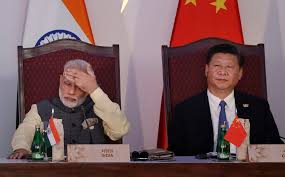
In the external realm this gets translated by Modi into deferring to his “superiors” – Trump and Xi Jinping and, by extension, India, to the US and China; his actions, perhaps, even conforming to some kind of international varna order and a social given. (Observe, in this respect, his interactions with Trump and Xi when he is fawning and eager to please, and contrast it with his meetings with African and other Third World leaders when his back straightens up, his chest is out, and he is correct and officious.)
[Prime Minister Narendra Modi with Chinese President Xi Jinping]
In this setting, the need for the country to retain its historical role as a power balancer in the international system and using its potential tipping weight to lever substantial benefits to India from the US, China and Russia (which still has the military muscle to stop the other two cold) has been ignored. But Jaishankar’s policy formulation, like Modi’s, excels in small politics as one of his service-mates stated, of siding with one state to counter another for the nonce, with a series of such small balancing acts amounting to nothing, nor fitting into any grand strategy or larger game plan.
But some of these tactical moves are beginning to tax the patience and goodwill of India’s more steadfast friends, and there’s bound to be adverse reaction. India’s growing military closeness to the US and its seeming compliance with Washington’s demand that it cut its reliance on Russian arms has already stirred Russian President Vladimir Putin, called the “apostle of payback” by former US Deputy Secretary of State William Burns and ambassador to Moscow, into selling Kamov utility helicopters to Pakistan as a warning to Delhi. More lethal and technologically sophisticated military hardware at “friendship prices” could be headed Islamabad’s way in the future. Should Moscow get really punitive, India would face the nightmare of a Russia-China-Pakistan nexus.
Egged on by Jaishankar, the Modi government’s short-term, short-sighted, policies to placate the US and turn around and try and pacify Russia will succeed only if Moscow, used to giant meals, is content with breadcrumbs from the arms sales table. The sideline contracts, such as the one for Russian shipyards to build two Grigoryvich-class frigates for the Indian Navy, are unlikely to be enough recompense for Moscow, or make up for its loss of multi-billion dollar transactions for “big ticket” military items.
Should things get out of hand, Putin could tighten the tourniquet by ending India’s lease of high-value weapons platforms such as the Akula-II class nuclear powered attack submarines – the sort of fighting asset the US will not loan India for democratic love, liberal values, or money. By way of perspective, the US is unwilling even to transfer conventional submarine technology it no longer uses, what to speak of in-date and advanced military hardware.
None of this apparently concerns the Modi-Jaishankar duo. But the Indian armed forces have to worry about whether the government will be able to resist the US unloading the antiquated 1960s vintage F-16 fighter plane dressed up in the new F-21 combat aircraft guise, and the overpriced and unproven electro-magnetic aircraft launch system (EMALS) to equip aircraft carriers under construction in Kochi. EMALS is something the US Navy is leery of after testing it on the Gerald Ford-class nuclear-powered carriers and President Donald Trump has publicly rejected it. The Modi regime’s response to the US opposing its buy of the Russian S-400 air defence system reflects the confusion at the heart of its foreign policy.
India is being pressed by Washington to junk the S-400 contract signed with Moscow and to opt for the less effective, more costly and technologically inferior American counterpart – the medium range National Advanced Surface-to Air Missile System (NASAMS) or the fast reaction Patriot-3 missiles, instead. The offer of the NASAMS/Patriot-3 is on the one hand baited with the promise of the F-35 – the latest US combat aircraft that veteran American combat aircraft designers, such as Pierre Sprey, have damned as unable to fight or scoot out of trouble and, on the other hand, comes freighted with the threat of sanctions under the US Countering America’s Adversaries Through Sanctions Act.
Presumably advised by Jaishankar, Modi is attempting simultaneously to placate both Russia and the US by proposing to also buy the redundant NASAM system. It is a solution that will at once send the defence procurement budget soaring, complicate the country’s air defence problem, put the country in a double bind by exposing it to disruption by two rival and competing suppliers at odds with each other, and fail to address the basic US fear of the S-400 radar getting insights into US-sourced combat aircraft.
The first two years of the Trump administration ought to have sobered up Modi, familiarised the MEA about the US president’s “art” of cutting deals, and convinced the Indian government to lower its sights where the US is concerned. None of this has happened.
[Prime Minister Narendra Modi hugging US President Donald Trump in 2017.]
While his first visit in June 2017 to the Trump White House – replete with Modi hugging a somewhat nonplussed US president – passed off without incident, the first bad signs appeared soon thereafter. The US withdrew from the Paris Climate Accord and Trump lambasted China and India as the main culprits for carbon emissions and atmospheric pollution. He threatened to charge India as a “currency manipulator” which would trigger its own set of economic sanctions, and slammed India’s tariff barriers against US goods, especially Harley-Davidson motorcycles, and American agricultural commodities.
More recently and to show he means business, Trump removed India from the Generalised System of Preferences permitting duty-free entry for Indian exports valued at $5.7 billion-$6.3 billion out of the total exports of some $55 billion to the US. Of course, Trump left some slack for the restoration of GSP as a bargaining card to finagle a slew of high-value military sales.
Accommodating the US on agricultural commodities would imperil the ruling Bharatiya Janata Party’s stock with the farmer community, which is in distress across the country, so that’s out. But the purchase of the seriously decrepit F-16, and of the F-35 as follow-on aircraft – which was what Lockheed Martin, the producer of these aircraft, first offered the Indian government nearly 15 years ago, may mollify Trump.
But on the matter closest to Modi – the H1B visa – Trump has slammed the doorson the Indian prime minister’s face. The US intake of Indian techies has been reduced, the processing time has been lengthened, and life has been made difficult for visa holders by eliminating work visas for spouses and the “family reunion” provision, the last liberally used by a generation of Indian professionals to bring their extended family members into the US as lawful immigrants.
Trump has almost incentivised foreign countries to be wary of the US. He has had no compunction in treating the US’s treaty allies and partners in Europe and Asia with the utmost disdain, admonishing, hectoring and insulting them in turn, calling their leaders names, pressuring them to reimburse the US for the costs of protecting them, and otherwise ordering them to toe the US line on everything, or else.
In the economic and trade spheres, Trump has been just as harsh towards friendly states, closing down the Trans-Pacific Partnership that was meant economically to compete with and constrain China, and forced a “fairer” US-Canada-Mexico [trade] Agreement down the throats of the US’s northern and southern neighbours, and then within hours of signing it nullified it by tweeting a message critical of it.
Modi, a believer literally in hands-on diplomacy, innocently thought that the hugs and embraces he bestowed on Trump would soften the US stance but discovered these had zero effect. With historical allies and partners suffering Trump’s lash, what chance does Modi reckon India has of being treated decently or getting reasonable deals?
Of course, Trump is transactional but his negotiating method is really quite simple and transparent, which Modi and Jaishankar haven’t got the hang of yet. He uses the US’s market clout, technological edge and diplomatic reach like a bludgeon. Trump does not give a fig for the niceties of diplomacy, for the usual diplomatic give and take, of compromise, of IOUs that can be encashed later – the stock-in trade of international relations.
As ex-US deputy secretary of state William Burns recently observed in an interview to New Yorker magazine, “In the Trump era, what’s happened is the [White House is] cavalierly disregarding that there are trade-offs at all and not even recognising them.” In other words, as far as Trump is concerned, success lies in taking a mile without giving an inch. There’s also no exchange of favours or concessions because for Trump each transaction is a singular, discrete event in itself with no connection to anything that preceded it or might follow it. Meaning, a foreign country accommodating the US in one forum or deal does not automatically merit Washington’s consideration in another transaction.
[US President Donald Trump does not give a fig for the niceties of diplomacy.]
Acting as if unaware of this reality, Jaishankar apparently has a plan to tackle Trump and his administration – the primary reason why Modi brought him into the loop at an elevated position in the first place. Jaishankar’s supposedly bulging phonebook of contacts in the US government and in Washington at large is expected to do the trick.
It will be of no avail because the Washington Jaishankar knew a few years ago as ambassador is not the Washington he will be visiting as foreign minister. Most of his contacts are out of the picture – eased off their sinecures in a purge of the US State Department that saw 74 career ambassadors resigning in 2017 alone or being shoved out the door. Senior positions in the State Department have remained unfilled, and its budget has been slashed by 30%. William Burns has called it “diplomatic disarmament”.
The pattern of Trump’s involvement in policymaking is that, without doing any homework or reading policy briefs, he alights on some position or the other and expects that the country of his momentary interest will jump to it. Trump’s all take and no give negotiating strategy unfortunately dovetails with the Indian government’s method as evidenced in its record of being all give and no take. After all, where’s the problem for the US if India, rather than engaging in hard negotiations, gives away what Washington desires for free – to wit LEMOA and COMCASA?
Even on issues where the differences have predated Trump and Modi, such as over Russian arms, Venezuelan oil and Iran, India has chosen to give in. Particularly disturbing is the marked decrease in the inflow of oil from Iran to avoid US sanctions, when a more self-respecting and strategic-minded nation would have immediately coordinated efforts with the other major importers of Iranian oil (China and Japan) to explore setting up an alternative payment channel to the dollar system.
Such a move would have strengthened the country’s energy situation and propelled India’s strategy for Afghanistan and Central Asia pivoting on the Chabahar port. Located on the North Arabian Sea and outflanking the Pakistani and Chinese navies ex-Gwadar, and landward constructing rail and road corridors to link up with the Russian Northern Distribution Network, it would have consolidated Indian trade, market access and civil and military cooperation with Russia, Afghanistan and the Central Asian Republics. Such a plan would also constitute a massive leverage, ensuring good US behaviour.
[Chabahar in Iranian Balochistan.]
Trump’s foreign policy decision-making for all practical purposes is restricted to himself, his whims and fancies and his Twitter handle, with the US secretary of state Mike Pompeo present there to realise his boss’s desires the best he can but, more often, to clean up after him. The only person Trump pays some slight heed to is national security adviser John Bolton. Except, the Indian embassy in Washington and the MEA have almost no ready access to him – NSA Ajit Doval’s getting through to his US opposite number during the Pulwama crisis was a one-off thing, covering up for Bolton’s contempt for India which took root, or so it is rumoured, at the UN when he was President George W. Bush’s ambassador. So, Jaishankar’s traditional diplomacy will draw a blank there.
The sure shot way of commanding Trump’s attention is by being disruptively combative – the method perfected by Kim Jong-Un of North Korea. It is one Modi has no stomach for and will never attempt. Trump’s initial threat against Kim was met with panache. He responded to the US leader’s threat of “raining down fire and fury” by calling him a “deranged dotard” and daring him to carry out a strike, revealing his own plans of firing nuclear missiles to take out the mid-Pacific US military island base of Guam.
A sobered up Trump quickly backtracked, and offered to meet. In the two summits – in Singapore in June 2018 and in Hanoi this year – Kim dismissed Trump’s call to denuclearise his country, demanding the US remove all its nuclear weapons from the region. It won Kim more than respect; “We are in love!” trilled Trump. All the hugging did not extract for Modi any similar reaction. The lesson to learn is that desirable outcomes are best reached by being immovable when the national interest is at stake.
Kim’s modus operandi is unlike Modi’s and, even more, Jaishankar’s. The Indian prime minister seems unwilling to accord primacy to India’s national interest above every other factor when transacting with the US. On this count, Jaishankar’s recent views and the manner in which he has dilated on foreign policy concepts that he has borrowed from others, do not inspire confidence. He has talked of “multi-alignment” proposed by Shashi Tharoor in his 2012 book Pax Indica without explaining just what he understands by it and how he expects to work it, given that the Indian policy during Modi’s watch has leaned so much to the US side. And he has referred to “issue-based coalitions” mooted in my 2015 book Why India is Not a Great Power (Yet), talking of it as an instrument for “positioning” the country and not, according to him, for “balancing” regional and international power. This last is passing strange and begs the question: Positioning being a static notion, how will limiting policy manoeuvre further the country’s interests?
Jaishankar’s attitude clashes with these concepts, in the main, because they presuppose India having a free hand and a foreign policy unencumbered by the need to play second fiddle to any country, or to conform to US aims and objectives in the Indo-Pacific. Having tilted over so much to the US side, Modi and Jaishankar may soon discover that Trump will compel them to bend backwards some more.
India is already a much reduced presence in the world. Absent the strategic will and vision for the country other than, in essence, turning it into an American camp follower, India, in the next five years, will find its status and stature shrinking fast. At the heart of Modi’s foreign policy is the big worrisome question: Does the prime minister actually believe that what is good for the US is good for India?
The Swiss Pilatus P-7 trainer aircraft for the air force was a new government’s turn away from becoming a full-blown public scandal. (Please refer all my past posts on the Pilatus in the ‘Indian Air Force’ section of this blog.) The only real surprise is that the Modi regime in its first term did nothing to pursue the arms middleman Sanjay Bhandari who, along with Deepak Talwar, kept a whole bunch of politicals and babus during the Manmohan Singh era liquid. Talwar is the man who ensured the Air India buy at high rates of passenger aircraft and the preferential treatment of various Gulf airlines until now when the latter all but monopolize the lucrative to- and fro- traffic and also the onward routing of growingly large numbers of Indians to Europe and North America. Both Bhandari and Talwar can expect no leniency unless they begin leaking detailed information, especially of the beneficiaries of the secret flow of monies to offshore accounts and diverted to property purchases in London, and so on.
While newspapers report that certain MOD and IAF officers have also been collared, there is no mention of any names. The real question is how high do the investigating agencies want to go in bringing senior IAF officers to book? Or, rather what’s the level of military officers the Modi dispensation would consider politic to bung into jail? This is the most intriguing part because, at the time the Pilatus contracts were signed, some very senior officers were rumoured to have been on the take.
———-
June 25th sees the American Secretary of State Mike Pompeo alighting in Delhi to try and smooth out ruffled feathers at both the India and the US ends. The danger is that the foreign minister S. Jaishankar, a khandaani babu, is more adept at taking orders, following instructions, and embroidering the policy line dictated by Prime Minister Narendra Modi. And where the US is concerned, Modi has shown himself a pussy, always angling, this way and that, to be in the good books of the current resident of the White House — Barack Obama, initially, and now Donald Trump. To therefore expect that Jaishankar will do anything unusual like drawing a firm line and telling Washington where to get off and telling him that India would not be kicked around as it has been for the last decade and more, is to expect the unthinkable. Because remember, Jaishankar is the person who delivered to the US what it desperately sought for decades — a denatured Indian nuclear deterrent in perpetuity (vide the nuclear deal)
Have written two big books (Why India is Not a Great Power (Yet), and Staggering Forward: Narendra Modi and India’s Global Ambition) detailing and analysing at great length why India should be wary of the US and why distrust of America (or Russia and China and Western European ) should be this country’s default option. Indian diplomats and MEA staffers who, according to one of their own, Natwar Singh, are not known to read books after joining Service — his exact words and so featured in one of my books, were — “The last time they read anything was when they sat for the UPSC exam!” mean that they are unwilling to learn anything except what they pick up during their careers. This leaves a whole world of analyses and insights out of their reckoning. To top it all, like the Americans with Trump, we have Modi who reads little but, nevertheless, is his own fount of foreign policy wisdom and ideas.
Iran is the sticking point here. The Modi government has done enough by siding with the US to not only rile Tehran but also Moscow. If this trending policy is not soon righted India will pay a heavy strategic price. India may be well advised then to prepare for a future in which, as I have repeatedly warned, it is America’s regional appendage.
Thus with Modi satisfied that the US is all good, benign and into furthering shared interests — the sort of thing that Jaishankar would enthusiastically second, despite a meager body of evidence — helping get Azhar Masood in the dock, putting the FATF squeeze on Pakistan, with these events touted by a compliant Indian media as outstanding diplomatic achievements denoting the heights the Indo-US relationship can supposedly scale, the Indian government willfully ignores the larger American game plan that’s in play. It is a plan the motivated caucus in Delhi — the Delhi chapters of Carnegie/Brookings-led camp of Indian commentators in the media, thinktankers and and academics, and hordes of retired civil servants and, increasingly, military officers, all eager to cadge invitations to the “seminar circuit” in the US by saying and writing stuff supportive of the current Washington stance. How else to explain the routine, mindless and ill-informed writing by former Indian officials and the like over the years extolling the virtues of the as-is hobbled Indian nuclear arsenal?
In this flood of subservient opinions and verbiage backed by no real knowledge within and outside government, the basics of the US plan for India never get forensically addressed. So what’s the US strategy?
It is as follows: The US needs to
have a sub-par nuclear weaponized India armed with second-rate American conventional weaponry to hold up the western end of the Indo-Pacific to complement a conventionally militarized Japan that has improved on first rate US equipments, but not one to be trusted with its own nuclear weapons which will only spin that country out of Washington’s control, at the other end of Asia to prevent a hegemonic China from emerging.
by fear of consequences and threat of sanctions prevent India from resuming thermonuclear testing in order to, by and by, have the Indian government rely on the US for its strategic security, in other words, to outsource the country’s meta-strategic concerns to Washington’.
sever India from its Russian arms supply links and place US Companies to provide military technology that the US armed services have either phased out or, for good reasons, never inducted. Such as the Guardian sea drones, the F-21/F-16 combat aircraft, the unaffordably expensive EMALS (electro-magnetic aircraft launch system) for Indian navy’s aircraft carriers, and the long-in-the-tooth M-777 light howitzers for use against the PLA on the Tibet front, and the offer of the vastly inferior NASAM/Patriots missile systems instead of the Russian S-400 which costs less! This when China is negotiating for the still more advanced S-500. The bigger aim being that via military supply links to gain the political edge in Delhi that Moscow has enjoyed.
begin capitalizing on the foundational accords — LEMOA and COMCASA signed by a clueless and gullible Indian government, and prepare the ground for the US military to permanently access Indian military bases, facilities, installations and communications capabilities as prelude to staging all-year, all-weather operations out of India in the Indian Ocean arc Simonstown-Western Australia, with the Indian armed services acting as backup.
But how to get around the real differences on trade, H1B visas, etc? As stressed in my book and writing to-date, these are less hurdles than things to get around by small-time and contingent gestures to mollify the Indian government. In this respect, first imposing sanctions and then removing them piecemeal is portrayed as great concessions by the US. Washington has realized it can get anything past the foolish and shortsighted Indian government if small benefits are dressed up as big American giveaways — the result, it is put out, of “hard negotiating” by the likes of Jaishankar.
Thus, the H1B visa door is all but closed to Indian IT professionals. But on the eve of the Pompeo visit Trump announced that the US immigration service would hold off on hunting down unregistered aliens — there are over 700,000 Indians in the US who have overstayed their visas or been smuggled into America via Mexico and elsewhere — and evicting them. And the Modi-Jaishankar duo would feel great about these kinds of US tactics? Likewise, re: data portability and GOI’s insistence that all commercial and other electronic data generated through the Net and various portals, be housed in-country, Pompeo is here to pressure the Modi regime into giving in — in the name of India’s role in globalization. But at the same time he will reject India’s demands for free movement of labour and services, and to follow WTO guidelines. The give on the US’ part, in this particular instance, will be a certain dilution of the Generalised System of Preferences as applied to India. The US is also seeking GOI measures in intellectual property rights that will end up crippling the Indian pharmaceutical industry — among the biggest export revenue earners, and denying the world cheaper but equally effective medicines derived from Western pharma formulae.
On Huawei and the 5th gen communications gear, however, it may be no bad thing if the Indian government, lacking any sense of how to promote Indian telecom technology competitiveness, is pushed by Pompeo into terminating Huawei sales and rolling back the presence of this and other Chinese companies specializing in mobile telephony. The fallout of this will be to reduce Beijing’s capacity to wage cyber warfare through electronic bugs and Trojan Horses embedded in the Chinese communications systems that the Indian government has so far allowed free entry, which in an instant can disrupt financial networks, power grids and of course, communications systems, including critical ones. If Delhi doesn’t have the brains to see the onrushing Chinese cyber warfare train, better it removes India from the tracks even if at Washington’s prompting.
So tips to Modi-Jaishankar:
In pure geostrategic terms, the US needs India far more than India needs America. Internalize this basic fact into all negotiations and prepare to shut down all channels.
The US does not any more have the will or the wealth to be security provider to littoral and offshore Asia, so to rely on America when all its traditional allies (NATO, Japan) are exploring arrangements to defend themselves the best they can by themselves, is to be perversely foolish.
Stop obsessing about Pakistan and start worrying meaningfully about China, and absolutely end the pattern in place of contentment with being fobbed off by the US with pinpricks against Pakistan. If you think FATF, etc will convince GHQ, Rawalpindi, from rethinking terrorism as tool of symmetric warfare, then India is in greater trouble than anybody thought possible.
Alternative arrangements to bolster India’s national security oriented to China and solely China (so Pakistan will ipso facto be taken care off) have to be put in place. It will require that, at a minimum, the roles of both the US and China in Asia be minimized. In this respect, the most promising sets of loose security coalitions are offered by BRIS (Brazil-Russia-India-South Africa), i.e., BRICS without China, and the modified Quadrilateral or Mod Quad of India, Japan, Australia and a select group of rich and militarily capable Southeast Asian states led by Vietnam and Singapore, i.e., the Quadrilateral without the US. BRIS and Mod Quad are detailed in my book ‘Staggering Forward’. In the last, the US can come in as and when it cares to without this coalition making its concerns central to the working of the Mod Quad.
The hankering for cutting edge US technology is a fool’s errand. India will not get it, no matter what. Remember, the US has not parted with the source codes of the F-35 aircraft the UK, its most intimate friend and partner, has chosen for its air force and navy, and which programme it invested in. That’s a fact of life. Where realistically should India then be placed with respect to the UK, say, in America’s affections?
Appreciate the leverages India has and start using them, rather than treating them as free goods for Delhi to squander to win Washington’s attention. India has an unsurpassed geographic location as the central strategic pivot in the Indian Ocean region and landward in Central Asia, its vast manpower that however require to be rapidly and massively upskilled can become a national resource, and its market for all kinds of manufactures and capital goods, ranging from Boeing and Eurobus transport aircraft — just the order of 243 Eurobus aircraft by Indigo Airlines is going to keep European aviation companies in the clover for a long time, and denial of access to which can be a powerful means of bringing US, China and, even more, any European state, to heel.
The above mandates Jaishankar talks with Pompeo and US interlocuters from a position of strength rather than, as has been the case to-date, from a presumed position of weakness.
Above all else, the Indian government has to understand that the biggest stick India wields is its inherently strong status as an independent actor on the world scene that can no more fit into the American bandwagon than into the Russian or Chinese basket. That keeping a distance from Washington will serve the national interest, in the short as well as long term, immensely better than jumping into bed with America. Because doing the latter will only gain for India the passing advantages of a harlot, a country to hire by the hour.
In the Indian system, political leaders don’t have to know much about anything. The civil servants manning the apparatus of state get by knowing even less but can and do argue the virtues of their generalist background (usually BA or MA in History or in English). So the requisite technical proficiency necessary to make decisions related to national defence has to be mustered by armed services’ chiefs — the designated providers of “professional advice” to the government. And then they can only offer their recommendations, in light of which the prime minister/defence minister-defence secretary combo decides. Except, and this is a very important factor, the armed services chiefs — even though no part of the final decisionmaking — have to sign off on decisions pertaining to their Service before it is sent up to the Cabinet Committee on Security (CCS) for final formal approval.
Presently everything and everybody, including the CCS, is a sideshow. If Prime Minister Narendra Modi wants something done, services chiefs play ball. To ensure this, pliable armed services chiefs are the norm. Because a lot of homework goes into carefully choosing them, the political inconvenience of having a chief who disagrees and hence is disagreeable is absent. The fact is the country has not had a strong-minded and strong-willed service chief since the 1980s when General K Sundarji, single-handedly, convinced PM Rajiv Gandhi to intervene militarily in Sri Lanka and, separately, to approve the plan for the last major restructuring of the army. That he was wrong in the first instance there’s no doubt. That the restructuring elevated mobile warfare when it had long since become passe is another story. But he didn’t lack for conviction and that’s the point here. Such officers have been few and far between. The only other service chief prior to Sundarji to fit these metrics was General SHFJ Maneckshaw.
The reason these issues are raised here will become clear soon.
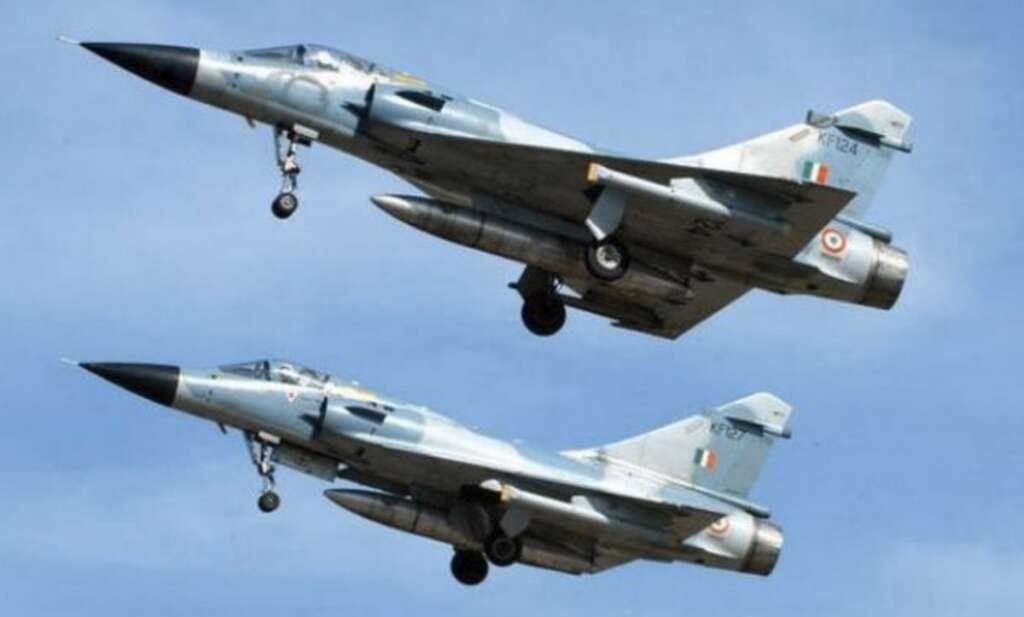
Modi is given to making odd utterances to showcase his supposed insights into technology that often end up revealing a slightly wonky grasp of science. In the service of a mythical India, he famously recounted, it may be recalled, to a flustered audience of doctors of medicine at AIIMS during his first term, the country’s ancient expertise in plastic surgery and cited the example of the elephant-headed Lord Ganesh heading the pantheon of Hindu dieties. Post Balakote aerial strike on 26 February he referred in an interview to radar and cloud cover. “The weather was not good on the day of air strike. There was a thought that crept in the minds of the experts that the day of strike should be changed”, the PM said. “However, I suggested that the clouds could actually help our planes escape the radars.” It created a bit of hub-hub in air force circles.
Troposcatter technology still constitutes some small parts of the Indian air defence system on the western front. Radar based on this technology is, in fact, susceptible to atmospheric disturbances, and indicates security weakness the IAF is trying to address by replacing these with more modern systems. But Pakistan has had for a long time the modern, powerful and now augmented SILLAC (Siemens Low Level Air Control) System for early warning, based in Sargodha, District Miani. As far as is known, there are no vulnerable troposcatter systems in Pakistan’s Air Defence. So, Modi’s contention that his pushing the IAF to strike despite bad weather doesn’t hold up.
What actually happened is this: CAS Air Chief Marshal BS Dhanoa asked the PM for a delay of two days for the strike mission to go in. He explained that the helmet-mounted targeting system requiring the Mirage 2000 pilot to keep his eyes on target in order to guide the Israeli SPICE (Smart, Precise Impact, Cost-Effective) electro-optically guided bomb to it, would function sub-optimally with cloud cover as the pilot would not be able clearly to see the target. Dhanoa preferred as alternative the original IAF plan to deploy a more accurate munition with a 1 metre CEP (versus 3 metres CEP for SPICE) which too needed better weather. The meterological department said that the clouds would clear starting Feb 28. At this meeting there may also have been talk of Pakistani radars, etc. All the technical details of the strike plans, weapons, radar systems, weather, etc. apparently got garbled in Modi’s mind leading to the confused statement (above), occasioning much mirth on twitter and elsewhere.
If Dhanoa was convinced that delaying the attack on Balakote was best, why didn’t he stick to it, after all it was his Service that would execute the strike and how and when to do it was his call, not the PM’s. Especially because there was no real urgency as postponing the mission by two days wouldn’t have altered its political profile or in any way complicated the diplomatic dynamic then in play. Had the CAS stuck to his guns, Modi would have had perforce to accept it. Maneckshaw firmly diverted pressure by Indira Gandhi to begin operations against the Pakistan Army in East Pakistan in April 1971 because, as he informed the Prime Minister, his forces weren’t ready or mobilized and if Mrs Gandhi still insisted on the early dateline for action, she’d have to find another army chief. The Bangladesh War was a far bigger issue for the then COAS to stake his reputation and career on compared to Dhanoa re: the retaliatory strike on Balakote. And yet the CAS didn’t stand behind his professional recommendation.
If the CAS didn’t act on his expert assessment, neither did the army chief General Bipin Rawat do the honourable thing when several months back the then defence minister Nirmala Sitharaman ordered the “opening” of military cantonment roads to all manner of civilian traffic in the teeth of COAS’s strong advice against such move. Rawat could have threatened to resign and right there and then stopped the defence minister’s harebrained scheme — that newspaper reports alleged would personally benefit her owing to a school run by her family and located on the edge of a cantonment — from taking wing. But he didn’t do any such thing and the effect is there for all to see. It may not take very long for terrorist outfits to consider the ease of just motoring into cantonments to launch their attacks. Then, Sitharaman, now safely ensconced in the Finance Ministry, will happily disavow any responsibility for it. A terrorist strike is what it will take to reverse this perfectly idiotic decision taken under Modi’s watch. As Gujarat chief minister, he actually wanted the cantonment in the centre of Ahmedabad to be moved to the outskirts of the city, making nonsense of the whole idea of “peace station” where frontline troops are rotated to charge their batteries, as it were. Modi sought this military land for “public use”. (It is an episode detailed in my book ‘Staggering Forward: Narendtra Modi and India’s Global Ambition’.) If it is the opening of cantonment roads today, who is to say the proposal to sell off military lands to private developers, something mooted by Sharad Pawar when he was defence minister, won’t be revived in the cause of serving “public good”?
Resignation is the most powerful weapon armed services chiefs have to not do what’s not in the nation’s interest and in the individual service’s interest but which elected political leaders persuade them to do. It is the brahmastra that curiously has not been used by the Chiefs of Staff, considering just how many patently wrong decisions are pushed through by MOD/GOI, and how much wrong doing and plunder takes place under their noses to which they are parties, courtesy their silence. Thimayya raised his stock when he resigned to protest defence minister VK Krishna Menon’s untoward interference and then besmirched his reputation by withdrawing it on Nehru’s say-so. The mere threat of resignation by a COS can keep the politicos on the straight and narrow path. The pity is our military leaders don’t use it and instead are content with merely complaining about it.
Visit any cantonment, and they are a mess with the traffic and the attendant habitation taking over military roads, negating the very notion of a “peace station” where frontline troops are rotated to charge their batteries as it were. Sitharaman, perhaps, took her cue from Modi who as Gujarat chief minister wanted the Ahmedabad cantonment shifted to the outskirts of the city so that the vacated and very valuable land could be used for public purposes (an episode discussed in my book ‘Staggering Forward: Narendra Modi and India’s Global Ambition’). Who is to say that with the cantonment roads thus forcibly expropriated for “public use” — a political decision facilitated by an unresisting army chief, cantonment lands in the future won’t be? And more, what’s to prevent terrorist outfits from now quite literally motoring into cantonments to attack them? Having moved to Finance Ministry, Sitharaman will happily not be blamed for it.
Then again, pliable armed services chiefs are political assets to any government, less because the Indian military can win laurels in war, than because they do the government’s bidding on any and every issue.
In terms of rewarding rectitude, the Modi government, however, did the right thing by trashing the seniority principle and selecting Admiral Karambir Singh, a helicopter pilot, as the new Chief of the Naval Staff. Hope he will show the grit and “spine” in his dealings with MOD/GOI that he did, for instance, as a lowly Lieutenant Commander on the staff of a Flag Officer Commanding in Chief when he did not waver in the face of immense pressure to “modify” the requirements of naval aviation he had worked on, and otherwise refused to compromise offering, in fact, to resign if his recommendation was overturned. His willingness to stand up for what he believed was right so impressed, he made a fan of that particular FOCINC, much as he did his other superiors in his upwardly progress. Indeed, the Admiral’s career record is a warning to the government to not trifle with him.
Over a million residents of Hong Kong came out on the street to protest the Extradition Bill that the stooge Beijing regime of Chief Executive Carrie Lam wanted to enact into law in this once British crown colony that after the expiry of its 99-year lease was returned to China in 1998. “This is a very important piece of legislation that will help to uphold justice and also ensure that Hong Kong will fulfill her international obligations in terms of cross-boundary and transnational crimes,” Lam explained. The authoritarian government of Mainland China then run by Chairman Dengxiaoping agreed that the system of freedoms Hong Kong enjoyed under British rule would be retained on UK’s withdrawal. It was to reconcile the continuation of the Western notions of rights and freedoms with the absence of these and other freedoms (including of free press and the freedom of expression) in the rest of China which led to the Chinese government conceiving the “One China, two systems” concept. These freedoms have steadily been encroached upon by the Xi Jinping dispensation, eager to iron out all anomalies under the rubric of uniting China.
The Hong-Kongers would have none of it. By coming out on to the street in unprecedented numbers, they frustrated the initial decision to let loose a reign of terror by the puppet police which might have worked had there been only a few protesters and sporadic violence. With a million plus people out peaceably resisting Lam’s move, the CEO threw in the towel and publicly announced the act of rendition to be held in abeyance. But the opposition wants a complete abrogation of that law and seems confident they’ll get it. The reason this act is anathema to the people is because — and this is how Beijing had hoped it would work — that any “trouble maker” was shipped to China for whatever “re-education” or other punishment the Orwellian Chinese state can dream up. This to prevent a contrasting model of a free people existing within China’s fold and making mainland Chinese wonder if they too shouldn’t be enjoying the same freedoms.
Recall that members of the harmless and entirely peaceful religious sect, the Falun Gong, were hunted down and hounded into near extinction with leading members harvested for their organs in hideous transplant operations or skinned alive and injected with formaldehyde until one could see the human body — a punishment meted out to criminals as well. These bodies then toured the world in exhibitions and became a hit mainly because they were so awfully macabre. It is the sort of medical actions not carried out anywhere since European Jews headed for the gas chambers were picked out by the Nazi surgeon Josef Mengele for the grossest surgical experimentation — with children and women being especially favoured for his treatments.
If Xi at the SCO summit in Bishkek felt free to advice Prime Minister Narendra Modi to talk to Pakistan and resolve the outstanding Kashmir issue, what keeps the Modi government and MEA from publicly and loudly and repeatedly counselling Beijing to respect the rights and freedoms of the people of Hong Kong, something they undertook to do vide the conditions in the lease termination agreement with Britain?
But, of course, with Modi always respectful of Xi, Minister S Jaishankar of his master’s voice, and MEA filled with “honorary Chinamen” of China, surely Chinese sensibilities will be respected and nothing untoward will be said by the ministry spokesman even as Hong Kong is enveloped in tear gas smoke and the people beaten with truncheons and pummeled by water cannons as they become targets of opportunity for the HK police — the handmaiden of the Chinese communist state. Will Modi ever muster the gumption to payback China and Xi in theur own coin? Nah! He lacks the strategic vision and, quite simply, the guts. (No such deficiency where Imran Khan and Pakistan are concerned.)
Then again the sucking up to countries he considers Big Powers seems this government’specialty. At the other end of extended southern Asia is an oil tanker on fire which Washington claims is owed to Iranian mines attached to the ship by Iranian OPVs. And the Trump Administration has been flashing a grainy video of a supposed Iranian boat caught in the act. America’s closest allies Germany and Japan dismissed the evidence as unconvincing. A 2020 Democratic Party presidential aspirant Pete Buttigieg, a naval intel veteran in Afghanistan, has come out and charged Trump with manufacturing an incident to start a war against Iran, likening the attempt to George W Bush’s entirely concocted reasons of nuclear weapons with Iraq to trigger the war against Saddam Hussein’s regime 2001 that so destabilized West Asia and the world, everyone is still suffering its backwash — the Islamic State, Syria, etc.
The fact is such invention is par for the course for the US government. In August 1964, President Lyndon Johnson used the “attack” on the American naval ship USS Maddox in the Gulf of Tonkin — a small insignificant naval encounter involving the US and North Vietnamese navies to secure a carte blanche from the US Congress for increased military involvement in Vietnam.
Now Trump’s NSA John Bolton appears to be on like mission. He has been recommending regime change in Tehran from the time he had President George W Bush’s ear. Now that he is in a position to do something about it he’s itching to start a war to realize that goal, seeking any lame excuse to do so. The tanker fire is coming in handy, with the unscrupulous Saudi regime of Crown Prince MbS aka Mohammad bin Sultan doing its bit to force America’s hand in the hope of ridding himself of his country’s main ideological rival — the shia regime led by Hassan Rouhani in Iran. Except, neither the US Congress nor America’s NATO allies are in a mood to accommodate him. And Trump seems to be in two minds and for good reason. Brazenly starting hostilities with no certainty that the theocratic regime in Iran won’t come out fighting and involve US forces in a costly war in a proximal theatre to Afghanistan and Iraq which he will be fully blamed for and, perhaps, sink his chances of reelection in 2020 is what’s holding him back.
With the US in a sort of jam of Trump-Bolton’s making, shouldn’t the Indian government get into the act of sagely urging Washington to cease and desist and not disturb the peace more than it already is in the region and, to put the knife in, suggesting Trump talk to the Mullahs? After all, not an incident on the LoC passes without some Pentagon or State Dept spokesman telling Delhi to calm down and not react harshly to some Pak-sponsored terrorist attack or the other. Having deliberately and without much forethought imperiled India’s close relations with Iran by obeying American orders to cut off Iranian oil supplies, this publicly offered advice to Trump is not much of a recompense, but such a statement from Delhi asking both countries to get to the negotiating table — something Tehran wants — will retrieve the situation for India some. It would be a nice diplomatic tit-for-tat. Except, again, Modi is into hugging and humouring Trump and the US and not into restoring for India a measure of self-respect and its now lost room for diplomatic maneuver.
Prime Minister Modi’s flight took some 2-3 hours longer to reach Bishkek from New Delhi, having to go around Pakistan and the northern Arabian Sea and over Iran than if his plane had just flown north directly over and across the neighbouring state to the west, permission for which overflight though delayed by Islamabad was ultimately given.
Why did the PM decide to take the longer route and stay in the air so much longer? Because MEA veterans on Monday June 10 — Vivek Katju in an op/ed and his compatriot KC Singh at a ‘strategic seminar’ in Kasauli (the latter on a panel with this writer) — wondered why Modi was refusing to restart talks with Pakistan but seeking permission to overfly that country. Caught out on this supposed inconsistency, the PM swiftly reversed course and the Air India aircraft lumbered for hours before landing in Bishkek for the annual SCO bash.
Couldn’t, shouldn’t, he have graciously accepted instead the Pakistani decision and overflown that country and while doing so telegraphed the customary Good Wishes to Imran Khan and the Pakistani people? It would have been an indirect sign of his desire to resume a dialogue, which would in no way have diluted India’s formal position he voiced at the plenary session about no real possibility of an advance towards normalcy if the Pakistani Army-qua-state continued to rely on terrorism as a diplomatic tool because far from bringing Delhi to the table it was driving it farther away from it. That gesture plus this message would have left open that wee little space for the “back channel” to become active once again and it’d have been in sync with Imran’s cooing to the Press about a negotiable Kashmir solution. That didn’t happen. Perhaps because that would have been a dissonant note in his policy of cultivating Pakistan as a bogey to beat up on.
Trouble is Modi is ever mindful of correcting small inconsistencies but entirely oblivious to the larger inconsistencies of his foreign policy approach. He seeks to retain a degree of warmth in relations with Putin and Russia and not upset the apple cart with Xi and China while leaning over so much towards the US as to fall right into America’s lap. In fact, that’s exactly where Washington hopes India will be with Modi as the willing tool. This much was signaled by the US Secretary of State Mike Pompeo.
Even as Modi was characteristically hugging a somewhat uncomfortable Putin — no matter how many times one is hugged it is hard to get used to!, and a more skeptical Xi was holding him at arm’s length, the US Secretary of State Mike Pompeo was repeating a Modi election slogan — “Modi hai toh mumkin hai” (Every thing is possible with Modi there) before the US-India Business Council in Washington. Clearly, the Trump Admin expects that Modi — hand-held by his chief minion and foreign minister S. Jaishankar — will do whatever the US government asks him to do.
The US has made clear its priorities where India is concerned. Pompeo, besides aping Trump, his vocabulary-challenged boss, who repeats the word “incredible” quite often, mostly to describe himself and his presumed successes by mouthing “incredible” twice in the first minute of his speech, he explained that during his Delhi trip later this month he will push (1) the F-16/F-21 for the IAF and the F-18 Super Hornet for the Indian Navy, to enable India, he said, “to become a full-fledged security provider throughout the Indo-Pacific”, (2) to eliminate tariffs on max number of American goods and services exported to India, (3) to remove curbs on the functioning of social media companies (Facebook) and American firms doing commerce over the Net (Amazon) and, most significantly, (4) Delhi to finalize the sale of Westinghouse nuclear power plants and increased imports of LNG and crude oil from the US to, as Pompeo put it, “give Indians reliable, affordable, diversified energy independence so they will no longer have to rely on difficult regimes like those in Venezuela and in Iran.”
What Pompeo naturally failed to concern himself with was, for instance, the cost to the Indian armed services of two additional and new types of combat aircraft in an already horribly, and counterproductively, diversified air-order-of-battle. Or, the effect of alienating Iran which may end up depriving India of access to cheap oil at concessionary rates, but also to Chabahar port around which pivots this country’s long term and long-reach strategy for Gulf and Russia, and Afghanistan and Central Asia. Such willful distancing by Delhi from Tehran will also lose India the shia counterpoise and leverage to potentially use against the sunni Arab bloc led by the wahabbism-promoting Saudi Arabia.
It is astonishing just how ignorant Modi and his chief minion, Jaishankar, seem to be regarding the basic logic of India’s geopolitics which, in no way, is convergent with that of the United States, and how cavalierly they are going about undermining India’s strategic options, national interest and national security.
Were the Modi government not so top-down driven, there would be a point in urging the PM to restrain his foreign minister from jumping on to the American coattails on every issue and otherwise turning India into a virtual banana republic. But this is Modi’s thoughtlessly pro-US reflex too.
This is the full version of the shortened paper posted earlier in the day. All the Papers by CPR faculty are to be compiled in a booklet — ‘Policy Challenges 2018-2024: The Key Policy Questions for the New Government and Possible Pathways’ and to be published soon as a booklet.
Several mega-trends are visible in international affairs on the cusp of the third decade of the 21st century. After a trillion dollars spent on the 18-year old war with the Taliban in Afghanistan following a similar amount expended in Iraq and Syria, the US is drained of its wealth, stamina and will for military confrontations of any kind. A reactive and retreating America under President Donald Trump, besides generating unprecedented levels of uncertainty and anxiety, has accentuated the conditions of unusual flux in the international system. Second, with the old certainties gone, traditional alliances (North Atlantic Treaty Organization), trading regimes (Trans-Pacific Partnership), schemes of regional peace (Shanghai Cooperation Organization), and technology and supplier cartels (Missile Technology Control Regime, Nuclear Suppliers Group, et al.) are all alike in disarray; their concerns are now matters of contestation with China staking claim to the pole position vacated by the US. And finally, these developments are compelling major countries to try to protect themselves the best they can by handling things on their own, in coalition with other similarly encumbered nations, and by exploring new security/military cooperation agreements. There is particular urgency in Asia to blunt China’s hegemonic ambitions and preclude its domination from taking root.
State of Play
Unfortunately India finds itself on the wrong side of these trends in the main. This is because it has, in the new millennium, accelerated its efforts to join the very same nonproliferation regimes and cartels that had victimized it all along. Worse, by sidling up to the US and virtually outsourcing its strategic security to Washington, India’s historical role as prime balancer in the international balance-of-power set-up – courtesy its hoary policies of nonalignment and its latter-day avatar, strategic autonomy – has been imperiled. This is at a time when doubts about the US commitment to other countries’ security have increased along with the apprehensions of allies and friends. With security made a transactional commodity by the Trump administration, treaty alliances have been weakened, unsettling West European and Far Eastern states traditionally close to the US.i India’s trend-bucking policy, in the event, will only cement the growing perceptions of the country as unable to perceive its own best interests and to act on them. Its downgrade, as a result of its more recent strategies, to the status of a subordinate state and subsidiary ‘strategic partner’ of the US means that India will have restricted strategic choices. Its foreign and military policies will therefore lose the freedom and latitude for diplomatic manoeuvre that they have always enjoyed.
Thus, the 2008 civilian nuclear deal, for all practical purposes, signed away India’s sovereign right to resume underground testing and froze its nuclear arsenal at the sub-thermonuclear technology level (as the 1998 fusion test was a dud). Agreeing to the Logistics Exchange Memorandum of Agreement and the Communications Compatibility and Security Agreement – the so-called ‘foundational accords’ – will, respectively, permit the US to stage its military forces out of Indian bases and embroil India in its wars in the extended region, and (ii) to penetrate the most secret Indian communications grid, including the nuclear command and control network.
The Indian government’s eagerness to cement the partnership is astonishing considering the trust deficit evident in a long history of duplicitous US behaviour and policies.ii By clinging to a feckless and demanding US, India’s profile as a fiercely independent state has taken a beating, distanced the country from old friends such as Russia (which is pivotal to balancing China and the US) and Iran (central to India’s geostrategic concerns in the Gulf, Afghanistan and Central Asia), lost the nation its diplomatic elan, and has seriously hurt vital national interests.
Placating China is the other imprudent theme that Indian foreign policy has latched on to. It has mollycoddled its most dangerous adversary and comprehensively capable rival in Asia with giveaways – such as non-use of the Tibet and Taiwan cards, refraining from nuclear missile-arming states on China’s periphery as a tit-for-tat measure for Beijing’s missile-arming of Pakistan, giving the Chinese manufacturing sector unhindered access to the Indian market through a massively unfair and unbalanced bilateral trade regime, etc. On the other hand, it has treated Pakistan, a weak flanking country, as a full-bore security threat when, realistically, it is only a military nuisance. This strategy is at the core of India’s external troubles. It has practically incentivized Beijing to desist from peaceful resolution of the border dispute. It has also undermined India’s credibility and credentials as ‘security provider’ to and strategic partner of a host of Asian littoral and offshore states fearful of an ambitious and aggressive China, as well as complicated the country’s attempts at obtaining a tier of friendly nations around it as buffer.
A topsy-turvy threat perception has also meant a lopsided Indian military geared to handle Pakistan but incapable of defending well against China, even less of taking the fight to the Chinese People’s Liberation Army (PLA) on land, air and distant seas; it is also laughably unprepared for future warfare featuring cyber pre-emption, remotely controlled armed drone swarms, robotic weapons systems managed by Artificial Intelligence, space-based weapons platforms, and clean micro-thermonuclear bombs. In the context, moreover, of a recessive foreign policy and a military that seems unable to wean itself away from imported armaments, it is almost as if the Indian government and armed services have given up on national security. This bewildering state of affairs is in urgent need of drastic overhaul and repair.
Geopolitical Vision and Strategy
Strong nations in the modern era have transitioned into great powers not only through expansive national visions, but also, more significantly, by pursuing policies disruptive of the prevailing order and multilateral regimes they had no hand in creating. India in the 21st century, on the other hand, seems content with the existing international system, measuring its foreign policy success in terms of entry gained or denied in congeries of international power (UN Security Council) and trade and technology cartels (Nuclear Suppliers Group, Missile Technology Control Regime, etc.). In other words, it covets a place at the high table on terms set by other countries. It is not a mistake made by China or the US (or, to go back in history, Elizabethan England, Germany, Imperial Japan, the Soviet Union and now Vladimir Putin’s Russia). The Indian government is hampered by its mistaken belief that upholding the current regional and international correlation of forces and mechanisms of order, and stressing its soft ‘civilizational’ power, will make the country great.
India with its many infirmities is in no position to undertake system disruption by itself.iii For India to rise as the premier Asian challenger to China and as the other economic-political-military power node in the continent in the shortest possible time – which should be the legitimate national aim and vision –it requires a subtle but telling approach. It needs a double-pronged strategy. One prong should stress absolutely reciprocal positions and policies. Thus, Beijing’s insistence on ‘One China, two systems’ should be met with a ‘One India’ concept. Similarly, the non-acceptance by Beijing of all of Jammu and Kashmir (including the Pakistan-occupied portion) as inalienably Indian territory should lead to formal recognition of and relations with Taiwan; it should also spark off New Delhi’s world-wide advocacy of a free Tibet and a free East Turkestan, and of campaigns against ‘cultural genocide’ and ‘ethnic cleansing’ in Tibet and Xinjiang.iv And China’s nuclear missile arming of Pakistan should, even if belatedly, trigger India’s transferring strategic missiles to the states on the Chinese periphery, so that China too thereafter suffers permanent geostrategic disadvantage.
Hamstringing China should also involve meta-measures to carve out separate, loose and specifically anti-China security coalitions from the two important groups India is part of. BRICS (Brazil-Russia-India-China-South Africa) is an entity dominated economically and trade-wise by China. This is something that arouses wariness in the other three countries, which can be mobilized to form a smaller, informal, security-cooperation-minded coalition, BRIS (Brazil-Russia-India-South Africa). It will assist in hedging Beijing’s military options and affect China’s economic expansiveness. Likewise, the US’s importance to international security has to be whittled away. The Quadrilateral (US-Japan-India-Australia) proposed by Japan’s Shinzo Abe to contain China in the Indo-Pacific is problematic owing to the centrality accorded to the capricious US. India could propose a different set-up – a modified Quadrilateral or ‘Mod Quad’ with India, Japan, Australia and the leading littoral and offshore states of South East Asia (Vietnam, Philippines, Indonesia and Singapore) disputing China’s claims in the South China Sea; a cooperative Taiwan could be accorded ‘observer’ status. This would at once define the strategic geopolitical face-off between ‘rimland Asia’ and a hegemonic ‘heartland’ China, and reduce the uncertainty attending on America’s security role (given that the US and China, owing to their close economic and trading links, are inseparable). Mod Quad will clarify the strategic calculi of member states, while encouraging the US to contribute militarily to the extent it wants to at any time but as an outside party.v
BRIS and Mod Quad are extremely practicable geopolitical solutions to share the cost, divide the danger, and generate synergy from the wide-spectrum capabilities, singly and together, of the member states in these two collectives. At the same time, they would stretch China’s military resources and minimize the uncertainty and confusion attending on any US participation. These new arrangements adhere to the time-tested principle of vision shaping strategy but geography driving it, which makes for cohesion and sense of purpose. BRIS and Mod Quad will enable their member states to be less inhibited in cooperating with each other to deal with the overarching security threat posed by China, but without the intimidating presence of the US (which, typically, pursues its own particular interests). They will instill in the Indian government’s external outlook an outcomes-oriented, competitive bent. It may result, for instance, in getting the east-west Ganga-Mekong connectivity project – as a rival to China’s north-south Belt & Road Initiative – off the ground.vi
But BRIS and Mod Quad leave Pakistan out of the reckoning. Pakistan is strong enough to be a spoiler and, in cahoots with China, pose a substantial problem. More than 70 years of tension and conflict with India haven’t helped. For a lasting solution it is essential to break up the Pakistan-China nexus. The military palliative for terrorist provocations – air and land strikes – will only drive Islamabad deeper into China’s camp. A Kashmir solution roughly along the lines negotiated with General Pervez Musharraf in 2007 that Prime Minister Imran Khan has said Pakistan will accept, is a reasonable end state to work towards.vii But India can lubricate such an offer with policies to co-opt Pakistan (along with India’s other subcontinental neighbours) economically, by means of trade on concessional terms, and easy credit and access to the Indian market for manufactures and produce. This will obtain the goal of unitary economic space in the subcontinent and lay the foundations for a pacified South Asia – the first step in India’s long overdue achievement of great power. Such actions should, however, be preceded by several unilateral and risk-averse military initiatives (outlined later) to establish India’s peaceful bonafides and to denature the Indian threat that Pakistan perceives. Simultaneously, prioritizing strategic and expeditionary military capabilities against China and for distant operations jointly with friendly states in the Indian Ocean Region and in Southeast Asia will secure India’s extended security perimeter.
National Security Policy Priorities
Lack of money has never been the hitch. Rather, the problem has been and continues to be the misuse of financial resources by the three armed services with their faulty expenditure priorities. Intent on equipping and sustaining inappropriate force structures geared to the lesser threat, they have squandered the colonial legacy of expeditionary and ‘out of area operations’. Consequently, they have shrunk greatly in stature even as they have increased in size.viii Persisting with thinking of Pakistan as the main threat long after it credibly ceased to be one post the 1971 war has resulted in an Indian military able to fight only short-range, short-duration, small and inconclusive wars. Indeed, so geared to territorial defence and tactical warfare are the Indian armed services that they have paid scant attention to strategic objectives and to the means of realizing them. The political leadership, for its part, has shown marked lack of interest, failure to articulate a national vision, and inability to outline a game plan and strategy in this respect. It has chosen the easy way of relying on the armed services professionally to do the right thing by proffering the right advice – which they haven’t.
Breaking the Pakistan-China nexus is an imperative. It requires the Indian government to first seed a conducive political milieu by making certain safe unilateral military moves. What the Pakistan Army most fears is India’s three Strike Corps; if this ‘threat’ is denatured, a milieu with enormous peaceful potential can be created. Considering the nuclear overhang and zero probability of the Indian government ever ordering a war of annihilation – which is the only time when these armoured and mechanized formations will fight full tilt – three corps are way in excess of need. They can be reconstituted and the resources shifted to form a single composite corps adequate for any conceivable Pakistan contingency. The rest of the heavily armoured units can be converted to airborne cavalry, and to light tanks with engines optimized for high-altitude conditions; three offensive mountain corps can thereby be equipped to take the fight to the PLA on the Tibetan Plateau. The nuclear backdrop can likewise be changed for the better by India removing its short-range nuclear missiles from forward deployment on the western border and perhaps even getting rid of them altogether, because hinterland-based missiles can reach Pakistani targets with ease. These two moves made without demanding matching responses will cost India little in terms of security, establish a modicum of trust, persuade Pakistan of India’s goodwill, and confirm China as the Indian military’s primary concern. It will hasten normalcy in bilateral relations.
Tackling China at a time when it is widening the gap with India in all respects necessitates India using the playbook the Chinese successfully used against the US – Pakistan against India, and North Korea against America – when facing an adversary with a marked conventional military edge. It means resorting to Nuclear First Use (NFU) and deploying weapons to make this stance credible. Emplacing atomic demolition munitions in Himalayan passes to deter PLA units ingressing in strength across the disputed border is one tripwire. Another is to declare that any forceful Chinese military action that crosses a certain undefined threshold may automatically trigger the firing of canisterised medium- and long-range Agni missiles, now capable of launch-on-launch and launch-on warning. Additionally, the large numbers of Chinese missiles positioned in Tibet should be seen as the third nuclear tripwire. As there is no technology to reliably detect and determine the nature of incoming warheads, any missile PLA fires will reasonably have to be assumed to be nuclear-warheaded. Such a hair-trigger posture leaning towards action will create precisely the kind of uncertainty about the Indian reaction and response that will bolster its deterrent stance.ix
Exorbitantly priced aircraft carriers are unaffordable and, in the age of hypersonic and supersonic missiles, a military liability. The Indian naval budget should instead prioritize nuclear-powered ballistic missile-firing and attack submarines, and a surface fleet of multipurpose frigates. The Indian Air Force needs to radically cut the diversity of combat aircraft in its inventory, rationalize its force structure and streamline its logistics set-up. This will be facilitated by limiting the fleet to just two types of fighter planes and a strategic bomber. The multi-role Su-30MKI upgraded to ‘super Sukhoi’ configuration in the strike and air superiority role and progressively enhanced versions of the indigenous Tejas light combat aircraft for air defence, the follow-on Advanced Medium Combat Aircraft for longer reach and bigger punch, will suffice. The lease-buying of 1-2 squadrons of Tu-160M2 ‘Blackjack’ strategic bomber from Russia as the manned, recallable, vector will make the country’s nuclear triad more versatile.
Politically, the most difficult policy decision for the government will be to resume nuclear testing. In the wake of the failed fusion device tested in 1998 (S-1 test), this is absolutely necessary to obtain proven thermonuclear weapons of different power-to-yield ratios. India has got by with a suspect thermonuclear arsenal for 20 years. It is time India’s strategic deterrent acquired credibility.
—————
i An unreliable US, in fact, so concerns its NATO allies that the French defence minister Florence Parly in Washington asked a little plaintively, ‘What Europeans are worried about is this: Will the U.S. commitment [to NATO] be perennial? Should we assume that it will go on as was the case in the past 70 years?’ See ‘French defense chief questions US commitment to NATO’, AFP, RadioFreeEurope, Radio Liberty, 18 March 2019, https://www.rferl.org/a/french-defense-chief-questions-us-commitment-to-….
ii Bharat Karnad, Why India is Not a Great Power (Yet) (New Delhi: Oxford University Press, 2015), 187-219.
iii For a detailed analysis of its various infirmities that preclude India’s becoming a great power anytime soon, see Karnad, Why India Is Not a Great Power (Yet).
iv China sees itself as the main protector of Pakistan’s sovereignty and territorial integrity. Visiting Islamabad during the Pulwama crisis, the foreign minister Wang Yi declared: ‘No matter how things change in the world and the region, China will firmly support Pakistan upholding its independence and territorial integrity and dignity.’ See Sutirtho Patranobis, ‘China firmly with Pakistan, says Beijing as Islamabad raises Kashmir in top talks’, Hindustan Times, 19 March 2019, https://www.hindustantimes.com/world-news/china-firmly-with-pakistan-says-beijing-as-islamabad-raises-kashmir-in-top-talks/story-5qM8HPgUQkl7ZwPCQEfh3O.html.
v Bharat Karnad, ‘India’s Weak Geopolitics and What To Do About It’, in Bharat Karnad, ed., Future Imperilled: India’s Security in the 1990s and Beyond (New Delhi: Viking, 1994), 19-20.
vi Bharat Karnad, Staggering Forward: Narendra Modi and India’s Global Ambition (New Delhi: Penguin-Viking, 2018), ch. 4.
viii Karnad, Why India is Not a Great Power (Yet), ch. 5.
ix Bharat Karnad, ‘Shifting the Nuclear Security Focus to China’, in Lieutenant General A.K. Singh and Lieutenant General B.S. Nagal, eds., India’s Military Strategy in the 21st Century (New Delhi: Centre for Land Warfare Studies and KW Publishers, 2019); Karnad, Staggering Forward, 344-349.
Instead of disruptive foreign and national security policies, India seems content with the existing world order. It covets a place at the high-table but on terms set by other countries.
International affairs is witnessing several megatrends, but India is yet to respond actively. And it won’t do anymore.
A reactive and retreating America under President Donald Trump has accentuated the conditions of unusual flux in the international system. With the old certainties gone, traditional alliances (North Atlantic Treaty Organization), trading regimes (Trans-Pacific Partnership), schemes of regional peace (Shanghai Cooperation Organization), and technology and supplier cartels (Missile Technology Control Regime, Nuclear Suppliers Group, et al) are all alike in disarray, their concerns now are matters of contestation with China staking claim to the pole position vacated by the US.
There’s a particular urgency in Asia to blunt China’s hegemonic ambitions and preclude its domination from taking root.
State of play
Unfortunately, India finds itself on the wrong side of these trends because it has accelerated its efforts to join these very same non-proliferation regimes and cartels that had victimised it all along.
Worse, by sidling up to the US and virtually outsourcing its strategic security to Washington, India’s historical role as a prime balancer in the international balance-of-power system, courtesy its hoary policies of nonalignment and strategic autonomy, has been imperilled.
So, the 2008 civilian nuclear deal, for all practical purposes, signed away India’s sovereign right to resume underground testing, and froze its nuclear arsenal at the sub-thermonuclear technology level (1998 fusion test was a dud). Agreeing to the Logistics Exchange Memorandum of Agreement and the Communications Compatibility and Security Agreement – the so-called “foundational accords” will, respectively, permit America to stage its military forces out of Indian bases and embroil the country in its wars in the extended region, and to penetrate the most secret Indian communications grid, including the nuclear command and control network.
By clinging to a feckless and demanding US, India’s profile as a fiercely independent state has taken a beating, distanced the country from old friends, such as Russia, which is pivotal to balancing China and US, and Iran – central to India’s geostrategic concerns in the Gulf, Afghanistan and Central Asia.
Placating China is the other imprudent theme that Indian foreign policy has cottoned on to. Mollycoddling the country’s most dangerous adversary in Asia with giveaways while treating Pakistan, a weak flanking country, as a full-bore security threat when it is only a military nuisance, is at the core of India’s external troubles.
A topsy-turvy threat perception has also meant a lopsided Indian military geared to handle Pakistan but incapable of defending against China.
It is almost as if the Indian government and armed services have given up on national security. This bewildering state of affairs is in urgent need of drastic overhaul and repair.
Geopolitical vision & strategy
Strong nations in the modern era have transitioned into great powers by pursuing policies disrespectful and disruptive of the prevailing order and multilateral regimes they had no hand in creating.
India, on the other hand, seems content with measuring its foreign policy success in terms of entry gained or denied in congeries of international power (UN Security Council) and trade and technology cartels (Nuclear Suppliers Group, Missile Technology Control Regime, etc.).
The Indian government is hampered by its mistaken belief that stressing its soft “civilisational” power will make the country great.
India with its many infirmities is in no position to undertake system disruption by itself. Rather, for India to rise as the premier Asian challenger to China and as the other economic-political-military power node in the continent in the shortest possible time needs a double-pronged strategy.
One prong should stress absolutely reciprocal positions and policies. Beijing’s insistence on ‘One China, two systems’ should be met with ‘One India’ concept, and acceptance by Beijing of all Jammu & Kashmir (including the Pakistan-occupied portion) as inalienably Indian territory. And, China’s nuclear missile arming of Pakistan should, even if belatedly, trigger India’s transferring strategic missiles to the states on the Chinese periphery so that China too, thereafter, suffers permanent geostrategic disadvantage.
Second, hamstringing China should also involve meta-measures to carve out separate, loose and specifically anti-China security coalitions from the two important existing groups India is part of – BRICS (Brazil-Russia-India-China-South Africa) and the Quad (India-Japan-Australia-US). BRICS can be mobilised to form a smaller, informal, security-cooperation BRIS (Brazil,-Russia-India-South Africa). Likewise, a modified Quadrilateral or ‘Mod Quad’ with India, Japan, Australia, and a group of leading Southeast Asian states, including Vietnam and Singapore to replace the US, would reduce the uncertainty of America’s security role given that the US and China owing to their close economic and trading links are inseparable.
BRIS and Mod Quad will enable their member states to be less inhibited in cooperating with each other to deal with the overarching security threat posed by China, but without the intimidating presence of the US.
But BRIS and Mod Quad leave Pakistan out of the reckoning. Pakistan is strong enough to be a spoiler and, in cahoots with China, pose a substantial problem. A lasting solution is essential to break up the Pakistan-China nexus.
A Kashmir solution roughly along the lines negotiated with General Parvez Musharraf in 2007 that Prime Minister Imran Khan has said Pakistan will accept, is a reasonable end-state to work towards. But lubricating such an offer with policies economically to co-opt Pakistan, along with India’s other subcontinental neighbours, will help it obtain the goal of unitary economic space in the subcontinent and lay the foundations for a pacified South Asia.
National security policy priorities
Lack of money has never been the hitch. Rather, the problem has been and is the continued misuse of financial resources by India’s three-armed services with faulty expenditure priorities.
Intent on equipping and sustaining inappropriate force structures geared to the lesser threat, they have squandered their colonial legacy of expeditionary and “out of area operations” and, consequently, shrunk greatly in stature even as they have increased in size.
Seeing Pakistan as a threat long after it credibly ceased to be one post-1971 War, has resulted in an Indian military able to fight only short-range, short-duration, small and inconclusive wars.
The political leadership, for its part, has chosen the easy way of relying on the armed services professionally to do the right thing by proffering the right advice, which they haven’t.
Breaking the Pakistan-China nexus requires a conducive political milieu making certain safe unilateral military moves. What the Pakistan Army most fears are India’s three Strike Corps, which “threat” if denatured can obtain a milieu with enormous peaceful potential. The nuclear backdrop can likewise be changed for the better by India removing its short-range nuclear missiles from forward deployment on the western border and, perhaps, even getting rid of them altogether, because hinterland-based missiles can reach Pakistani targets with ease. These two moves will cost India little in terms of security and persuade Pakistan of India’s goodwill and China as the Indian military’s primary concern.
Tackling China at a time when it is widening the gap with India in all respects necessitates India using the playbook the Chinese successfully used against the US, Pakistan against India, and North Korea against America, when facing an adversary with a marked conventional military edge. It means resorting to Nuclear First Use (NFU) and deploying weapons to make this stance credible.
Politically, the most difficult policy decision for the Modi government will, however, be to resume nuclear testing. This is absolutely necessary to obtain tested and proven thermonuclear weapons of different power-to-yield ratios. India has got by with a suspect thermonuclear arsenal for 20 years. It is time India’s strategic deterrent acquired credibility.