

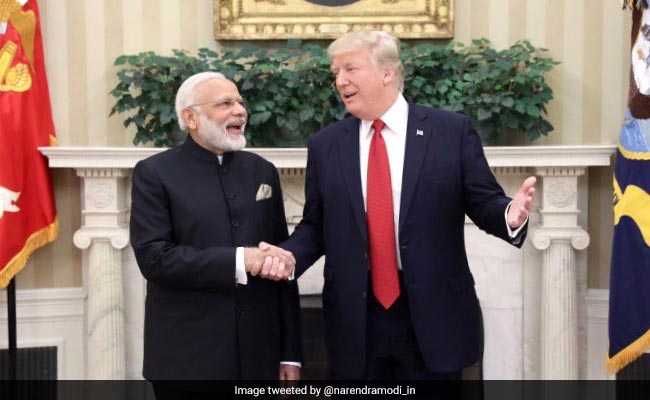
[Trump, to his left, General James Mattis, and Commerce Secretary William Ross]
The September 6 timeline for the 2×2 talks between the Indian and US foreign and defence ministers was approaching fast. This is a postponement of the July 6 meeting. Because of preoccupations of Washington at the time, the US secretary of state Mike Pompeo in particular — whose agency conducts America’s foreign affairs — found on the eve of the visit by Messrs Sushma Swaraj and Nirmala Sitharaman to Washington in July that the Trump administration had not addressed the growing doubts and skepticism in Delhi, occasioned by possible CAATSA sanctions, about the advisability and benefits of getting close to the US which the American ambassador Kenneth Juster in Delhi had warned could become a stumbling block in 2×2 forum. So the two month period was sought by Pompeo to try and see what could be done to retrieve the situation by giving evidence of US good faith. With the 2012 Defence Trade and Technology Initiative (DTTI) having produced nothing in the last six years but hot air, and with Mattis’ and Juster’s concerted pushing, Pompeo got the Trump White House to approve the Strategic Trade Authorization (STA)-1 status for India, because Washington has long been aware that Delhi can be pacified with symbolic gestures. There’s much glee hereabouts that Pakistan and China are no part of the STA-schemata. Such are the small things Indians are happy with.
STA-1 is just a symbolic gesture because all it does is merely enlarge a little the list of technologies India can access — NOT open America’s advanced technology shop for the Indian MOD and military to raid as uninformed Indian press and media elatedly implied. The MEA pitched in, with the idea of providing a fig leaf, saying it would help promote defence technology cooperation under the aegis of the so far barren DTTI when the real US purpose behind according India STA-1 standing is to prompt the sale of more high value military goods to this country. In theory STA-1 will allow India the same access as NATO allies, Japan and South Korea. In practice, no cutting edge stuff will be made available. Just to prove what I am saying the Indian government should try asking for the Globohawk — the long duration flying armed drone. As technologies go, it isn’t at all cutting edge — but Delhi will discover it can’t get it. Why, because that will loosen the already tenuous bonds with Pakistan, which Washington cannot afford, not if it is serious about persisting with its hopeless strategy of militarily defeating the Taliban in Afghanistan. Nor will the US countenance the transfer the “know why” for combat aircraft design — the source codes and operational algorithms, etc. or for designing and producing combat aircraft jet engines. Or, the silencing technologies for submarines. Or,….
But the Indian ambassador Navtej Sarna piped up to extol this development as “a sign of trust not only in the relationship but also on India’s capabilities as an economy and as a security partner, because it also presupposes that India has the multilateral export control regime in place.” Mind you, the export regimes Sarna is referring to are the missile technology control regime, the 2008 civilian nuclear deal, and the Wassenar Agreement, that Delhi has signed, even when aware that this put legal clamps on India exporting even indigenously designed and developed sensitive goods and technologies to countries that the US feels shouldn’t have them. India is thus compelled to conform to Washington’s threat perceptions and to follow its policy dictates at the expense of its own national interest, technology leverage and foreign policy options which India could otherwise have exercised.
US’ still more salient and significant strategic objective is to ensure that STA-1 incentivizes the already American hardware-besotted Indian armed services to source more and more of their requirements from US companies — a trend greenlighted by defence minister Sitharaman, a former employee of both BBC and PriceWaterhouse Cooper who, it may be recalled, some months backs blithely announced that the Indian military is free to procure its needs from anywhere and are not restricted in any way. But, let’s also be clear that it is the PMO passing this policy line for Sitharaman to pursue. [There was reason for installing Sitharaman, a fairly undistinguished junior minister and political ingenue in MoD — susceptibility to accepting directions from PMO without hesitation.] Most US military high-tech, like any other technology, is routed in Washington through the Commerce Department headed by secretary William Ross, whose brief is to promote the interests of US industry. Giving the game away, Ross explained that STA-1 means that “US companies will be able to more efficiently export a much wider range of products to Indian high technology and military customers. India’s new status will benefit US manufacturers while continuing to protect our national security.”
What is the flip side of more monies to fund the larger volume of imports of military armaments and technologies? Yes, you guessed it — something I have been hammering away at in this blog — the throttling of funds for indigenous R&D projects and programmes, turning a potentially vibrant defence industry in the private sector into another link in the global supply chain — and all to make financial room for more extensive arms imports. This is how the killing of the national effort at arms indigenization and achieving self-sufficiency in weaponry will be furthered. And the twin meta-strategic goals of crowding Russia out of the Indian arms market and replacing it with America as India’s main military supplier, and keeping this country forever an arms dependency, accomplished.
Strange to think that Modi was voted to power as a nationalist!
/arc-anglerfish-arc2-prod-mco.s3.amazonaws.com/public/KUYNKHA265HSDODGXCOINAWW7Q.jpg)





 Security Wise