The need for reintroducing light battle tank (LBT)-equipped mountain forces into the army’s order-of-battle was first recommended in a classified report I prepared for the (10th) Finance Commission and submitted to the PV Narasimha Rao government end-1995. That report, mindful of accommodating an LBT fleet within the then budgetary allocation for armoured-mech units, also proposed restructuring the armoured and mechanised formations in the three strike corps featuring heavier Main Battle Tanks (MBTs) along the lines I have been advocating ever since — of a single composite corps (i.e., corps plus several independent armoured brigades) for the western front with the bulk units of the remaining two strike corps converted for mountain use with LBTs.
But a Pakistan-fixated army did not then bite. And DRDO failed to commit fully to the LBT project of building on the Sarath (BMP-1) chassis, leave alone, developing a lighter, down-sized variant, of the Arjun MBT because right through the 1980s and 1990s the army officially deemed an LBT unnecessary! Apparently, the Rommels and the Guderians of the Indian armoured corps could not even imagine the possibility of the Tibetan Plateau extending into northern Sikkim and eastern Ladakh being tank-friendly terrain exploitable by LBTs despite, mind you, wallowing in the lore of Col. Rajinder Singh ‘Sparrow’-led 7th Cavalry with its (ex-US) Stuart light tanks clearing the Zoji La Pass (at nearly 12,000 feet altitude) of Pakistani troops in November 1948 during the first Kashmir war. This action recovered the road connecting Srinagar with Kargil and Leh.
Meanwhile, starting in the 1970s the army plonked successively for the T-72, the T-72S and, in the new Century, the T-90, from Russia. It may have gained Moscow’s goodwill no doubt but also stifled the production of locally designed and developed MBTs and LBTs. This love affair with Russian tanks persisted even when the Arjun tank pitted against the T-90 MBT in extensive field trials in the 2000s handily beat the Russian item in all aspects, including in the two most critical metrics of armoured warfare — mobility and accurate firepower. This was insufficient reason, however, for the import-besotted armoured warfare directorate in army HQ, which like most other combat arms in the Indian military prefer foreign hardware, to switch its custom to Indian-made military goods. It has consequented in the continuing drain of vital financial resources that succesive governments — influenced by the counsel of “professional”, “technically competent”, advisers in the defence procurement loop — namely, the army’s armour directorate, apparently failed to stop. It undermined the economic viability of the Arjun MBT, whose stated deficiencies — slightly excess weight and width, could have been easily resolved over the years if only the armoured corps had taken ownership of, and helmed, the programme.
It has eventuated in a fairly ridiculous state of affairs. There are some 52 frontline armoured regiments. Of these, 33 regiments feature T-72s, 17 regiments the T-90s, and only two regiments (43rd and 75th) boast of the Arjun MBT. In terms of acquisition costs, imagine the hard currency outflows! These less nimble tanks — T-72s and T-90s — deployed on the Himalayan heights, moreover, find it difficult to fire up their engines in the cold mornings and require special fuel and elaborate warm-up rituals just so the power surges at the first “kick”. Even so, on any given morning more than half the tanks refuse to start! These MBTs are now deployed on the Depsang Plain in eastern Ladakh and in northern Sikkim against the Chinese People’s Liberation Army stocked with the 25-tonne ZTQ-15 ‘Black Panther’, a third generation — please note — light tank, powered by an engine designed for high-altitude use. Guess which force is going to run circles around the other when Xi Jinping, wishing to do an Ukraine in Ladakh, ramps up hostilities in summer that’s round the corner?
Waking up, as if suddenly from a stupor, the army finally and formally evinced an interest in a light battle tank. And then, predictably, its armoured wing took an axe to its own feet. Colonel Ajai Shukla, ex-CO, Hodson’s Horse, and currently Military Editor, Business Standard, reported last year that “A major hurdle to the [LBT’s] design is that the army has not yet shared with the DRDO its notion of what design features and performance it would like. This is usually shared in a document called the ‘preliminary staff qualitative requirements’, or PSQR. Without this, the DRDO’s designers are groping in the dark.” And then to compound matters, the army, Shukla wrote, “is soft-pedalling the Defence R&D Organisation (DRDO) proposal to manufacture in L&T’s facilities a line of at least 500 light tanks, which will be powered by the same 28-tonne chassis, hull and engine that powers the K-9 Vajra.” The last of the K-9s — a 155mm, 52mm calibre long range gun mounted on tracks — a mobile artillery adjunct to the T-72s and T-90s, was delivered recently to the army by Larsen & Toubro under a contract that, unlike the Defence Public Sector Units-handled defence deals, came in under cost and right on time!
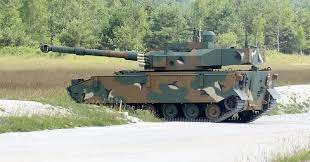
DRDO is making the best of an uncertain situation created by the army by mooting this proposal, which not only uses the L&T’s skilled manpower and production line, now lying fallow at its K-9 production plant in Hazira, to meet an urgent army need but, aware of the systemic problems of designing a new LBT to the army’s GSQRs and then producing it at the DPSU — the Heavy Vehicles factory in Avadi, is suggesting a shortcut. It proposes to get the South Korean firm, Hanwha Defence, to once again partner L&T to speedily produce its K-21 LBT with a rifled 105mm gun. The trouble is the armour directorate and the army are caught between realizing their desire and choosing the optimal course.
Ideally, the army would like to issue a global tender for an LBT in order ultimately to down select a lighter version of the T-14 48 tonne Armata tank with rapid fire capability because of an unmanned turret geared for automatic loading and firing, that the Russians are pitching as the perfect light tank for the Indian army. Global tendering means a long and laborious process that can go on, literally, forever until the army gets its way. As against this option, is the less cumbersome path offered by L&T-Hanwha. The K-21 at 25 tonnes is well within the army’s 30 tonne weight limit. More importantly, besides its ability to take out targets by direct fire, its turret is designed so the gun can elevate 42 degrees and fire as a howitzer, lob shells that is, at targets 10 kms away, over mountains. Even more significant, it will be built at the Hazira plant — in Gujarat, and how will this not please Prime Minister Narendra Modi?
But it all depends, as Jane’s reported on 9 February, on the category the Defence Ministry chooses to place the LBT production deal in. That will decide if and to what extent a foreign vendor can be involved. Of course, MOD, in turn, will be hugely influenced, by the army in case it backs DRDO’s Gujarat-friendly proposal. The good thing is it will incentivise other companies in the private sector defence industry to get more fully into designing and developing armoured vehicles generally, if included in the deal with L&T is permission for it to export a down-rated version of the K-21. An economical LBT, which has the Indian army as its chief customer, will instantly create a very large export market for it in the neighbourhood and, widely, in the ‘le tiers monde’.
Further, with an initial order of 500 LBTs, incorporating some very fine electronics, fire control system, etc. DRDO developed for the Arjun MBT, and the Indian light tank’s potentially big global market staring it in the face, Hanwha will be only too happy to hand over every thing, including its tank design cell, to India. With so many things going right for a change in this specific area, if the Indian Defence Ministry and army still foul up — God knows, they tend to do so oftener than not, then they should know that India is being set up for a shellacking by China.
Not too long ago in Islamabad, Prime Minister Imran Khan’s National Security Adviser, Dr Moeed Yusuf, did something unexpected. On the occasion of the Margalla Dialogue 21, he confessed that the Pakistan government lacked the capacity to digest all information and data and provide useful inputs to the making of national security policy. In the last couple of years in harness, having acquainted himself with the weaknesses of the policymaking process, he has sought to strengthen it. Yusuf’s solution: Attach the Islamabad Policy Research Institute (IPRI) — a leading government-funded thinktank to the NSA ‘s office and then connect it on a secure and realtime comunications link with other select thinktanks in the country to ensure both the widest possible base of disparate expert views on a range of policy issues, and then to ensure the policy products that accrue are institutionally accessible to the NSA, and other decisionmakers in the various ministries and agencies of Pakistan government, presumably, including the Pakistan Army. IPRI and other orgs, in this scheme of things, appear most significantly to have available for their analyses classified material accessed by line officers in the Foreign Office and elsewhere in government.
Owning up to this institutional debility was the great hump Yusuf pushed the Pakistan government over. He was an outsider who had the PM’s confidence; he could do it. It could be the beginning of a continuous stream of research papers distilled into ‘executive summaries’ for dissemination within the concerned agencies and the Pakistan government at-large. Yusuf is trying to replicate in Islamabad the policy-wise live intellectual milieu of Washington, DC, of which he has vast experience. Before taking up his present post, he headed the South Asia programme at the US Congress-funded US Institute for Peace. (The mark against him is that as an American ‘Green card’-holder it was problematic for Imran to appoint him his NSA and, in any case, that his advice will always be suspect for leaning US-wards.) Except, Imran hoisted him on to the chair anyway, seemingly tired of the same old, same old, foreign and military policy line fed him by the entrenched policy elite.
That’s the hump India will make no effort to cross because Prime Minister Narendra Modi is a votary of the policy Establishment as-is, having moulded it into his handmaiden. So the country will continue to be handicapped by the manifest shortfalls in India’s foreign and military policy-making process, with his two prime advisers — the NSA Ajit Doval and external affairs minister S Jaishankar only too happy to do the PM’s bidding. The result over the last seven-odd years are policies dawdling in the ‘comme ci comme ca’ (French for neither good nor bad)-realm. This is fine by Modi. And also, for obvious reasons, by Messrs Doval and Jaishankar — because they don’t have to mentally exert themselves much, if at all.
An example: The only refreshing departure from the old foreign policy is the cultivation of the Gulf states, including Saudi Arabia. It is fetching huge geostrategic gains — and was Modi’s idea. He instinctively understood that it is not the IT professionals pining for the US H1B visa who will produce recurring and longterm benefits for the country but the masses of carpenters, masons, plumbers, electricians, janitors and clerks in the UAE and elsewhere and, at a higher level, financial and business managers , engineers and and medical doctors and technicians running the Gulf economies and health and engineering systems who, clockwork-fashion, send back remittances and are the economic pillars requiring solidification. They keep homes and hearths in India warm, kitchen stoves, now gassified, lit up, and their children in “English-medium” schools — such and other activities collaterally pumping state and regional economies. Last year, the remittances were worth US$ 83 billion and this in a “flat year”, courtesy the vagaries of the COVID pandemic! Thanks to this Modi policy the majority Hindus in this expat workforce now even have their own temple in UAE to propitiate their Gods in. And there are yoga classes for those interested in attending them in Riyadh and other Saudi cities where, until the other year, women were not permitted to walk around/shop unescorted by men of the family and, horror of horrors, drive cars! The “feel good” sentiment of this Gulf diaspora translates into votes at home, positively affecting even Muslims in the Indian workforce in the Gulf and their dependents back home.
The assorted sheiks and emirs and the King-in-waiting of Saudi Arabia — MBS (Mohammed bin Salman) are no chumps. (The Saudi ambassador to the US in the 1980s with similar name triggered much mirth for South Asians — Bandar bin Sultan or, was it Sultan bin Bandar, in either case everyone asked about the monkey?!) Sharing native cunning with Modi, they are only too aware that the sandy parcels they lord over are living on borrowed time. Saudi Arabia with 17% of the world’s remaining oil reserves of some 260 billion barrels — second largest after Venezuela, pumps out 10.2 million barrels every day amounting to 3.7 billion barrels extracted annually. Meaning, these keffiyeh-sporting monarchs can expect to live high on the hog for as little as another 60 years but for no more than 70 years on the outside. Then what? A return to the Bedouin paradise in the desert, desultory grazing of camels, what?! Appalled at this prospect, they are weighing investment destinations to guarantee large incomes into the oil-less future and see the emerging economies, with India in the van, as their best bet. Hence, the Saudi ambassador in Delhi promised in December 2020 that $100 billion investment was “on track”, and the Gulf emirs are financing malls in Srinagar Valley (sending shivers in Islamabad which fears this will bury Articles 370 and 35A for good, formalising for the world Modi’s absorption of Jammu, Ladakh and Kashmir into the Indian Union).
Could Jaishankar or Doval ever have summoned such bravura political instincts to suggest this turn in India’s policy? It is because the PM knows they are career babus incapable of any new policy ideas, but that’s why he hired them. They are there not to think but to implement whatever the boss comes up with. You still need the heavers of policy wood! It has reinforced Modi’s view of himself as his own best thinktank, even if there’s much less to show for it in other policy areas! And, zero movement on a critical strategic issue — resumption of thermonuclear testing to inject credibility into an Indian arsenal filled with unproven and, therefore, useless simulation-designed hydrogen weapons. And this despite being offered every possible provocation and justification for open-ended nuclear testing — the Chinese proxy North Korea’s relentless nuclear and missile testing regimes, and the unhindered transfer of the resulting technological advances to the third member of this rogue triad — Pakistan, and US’, Russia’s, and China’s ongoing nuclear modernization programmes to obtain, among other things, more usable low yield thermonuclear weapons by minimizing radio active fallout. But Delhi’s priority remains to keep Washington placated and pacified, its nonproliferation policy objectives of freezing India’s weapons technology at the 20KT threshold, safely achieved.
To return to Yusuf’s IPRI initiative, is there any possibility of a counterpart development here? Of course, not. Why not? Firstly, because of the secrecy phobia. In an age where there’s very little worth classifying — almost all of the material involved in crafting policy finds its way, one way or another, to the open global information commons, the Official Secrets Act, etc are an anomaly and are, perhaps, retained just so the top people in government feel important! Only 3%-5% of information coursing through Indian official channels deserve the “secret” or “top secret” label and less than 1% of it merits the highest classification status for extremely sensitive information. Secondly, because the IFS officers manning the MEA, like their fellow generalists in the other civil services, especially the shortsighted IAS honchos manning the Defence Ministry, and Departments of Space, Atomic Energy, et al, are loath to share any information with thinktankers — information being power, etc. This attitude in the information age is laughable. More perspicacious analysis can be penned by analysts sitting in Delhi, say, than by staffers in distant embassies churning out turgid despatches. Those habiting MEA are disadvantaged further by another fact once revealed to me by an ex-IFS appointed foreign minister, Natwar Singh, according to whom the last “book” most MEA officers are likely to have read was when cramming for the UPSC! So much for keeping professionally abreast of new thought currents and trends to inform Indian foreign policy-making!
The MEA-subsidised Institute for Defence Studies & Analyses now prefixed with the late defence minister’s moniker to become Manohar ParrikarIDSA, for its part is marking time, remaining right where it was at its founding in the mid-1960s — a bunch of academics with wings clipped. Denied access to any worthwhile technical or other policy-related information, the bulk of the faculty comprise researchers of JNU-type, making-do fulltime by embroidering the policies of the government of the day. There’s no published evidence of any original thinking being done. Whole lifetimes in MPIDSA are wasted by its staffers producing very little that’s new or novel. Further, to guarantee this remains so is installed a retired diplomat as “Director General”, whose brief seems to be to not let disruptive ideas-persons rile the Institute’s “unndata” — MEA/MOD.
Much of why IDSA is what it is can be laid at the door of the late K. Subrahmanyam — the Institute’s long-serving second Director (the first, it is usually forgotten, being retired Major General Som Dutt). KS made no effort to bring IDSA institutionally into the policymaking process in MEA and MOD, despite his unique standing, in the words of his son, external affairs minister, S Jaishankar, as the ultimate “insider-outsider”. He was centrally involved, not the IDSA he headed, in influencing policy. Many senior staffers in the Institute during his stewardship of it complained that Subrahmanyam was like “a Bunyan tree” — letting nothing grow underneath it. But KS’ was a wonderfully fertile intellect yoked, unfortunately, to policies hurtful of the national interest. He argued forcefully for India’s going weapons nuclear in the early 1970s but, post-1998, hurt the natural development of India’s nuclear deterrent by his advocacy of “minimum deterrence”. Likewise, his case for getting in thick with the US post-Soviet Union’s collapse in 1992 terminated in the 2008 US-India civilian nuclear deal, and the foundational accords (LEMOA, COMCASA, BECA), which other than restricting Indian nuclear weapons development, has curtailed India’s policy latitude and strategic choices, and shrunk India’s international profile to a Western dependency.
Jaishankar explained his father’s policy journey from steadfast friendship with Russia to wanting India to climb into America’s lap in the new Century, for instance, as adjusting to the changes in international reality. That’s one way of putting it. Jaishankar was speaking at the conclusion of IDSA’s virtual K Subrahmanyam Memorial Lecture on 3rd February. The eminence who delivered this year’s lecture was Edward Luttwak, a longtime fixture on the strategic policy scene in Washington, who in his talk on an intriguing subject — “Applying the K. Subrahmanyam method today”, rationalised KS’ counterproductive policy slants in terms of, what he called, “linear logic”. I failed to understand what Subrahmanyam’s logic that Luttwak was expounding on, was about. It seems to me that logic linearly applied better fits a simpler international system of the early Cold War era — a duopoly with defined blocs and lots of room for manuever by third parties. It is less pertinent, however, in a world in electric flux in the new millennium and why, in the event, riding US’ strategic coattails is a big mistake.
Luttwak said “Americans would be outmatched by the Chinese numbers”, whence his fairly banal “antidote” conforming to KS’ view, of India and the US needing to “align” to deal with China — the common threat. Luttwak thereafter recommended an “organic alliance” of India, Japan and the US, and argued, among other things, why aircraft carriers in the Indian Navy would be easily sunk, but nuclear attack submarines would lend an edge.
Listening to Luttwak, some of his ideas sounded familiar. It occurred to me that I had been propounding the notion of an “organic security” system in Asia in all my books starting with in my first one in 1994 –‘Future Imperilled: India’s Security in the 1990s and Beyond’. And I have been crying myself hoarse about carriers being a naval liability for India for as long (most recently in a detailed analysis in my 2015 book – ‘Why India is Not a Great Power (Yet)’, pages 349-351!
But because, as Imran Khan said in his opening address at the Margalla Dialogue, Pakistanis (and Indians too) are partial to everything offered up by Westerners, may be the Indian government/MEA/MOD will now incorporate the “organic security” system notion in their policy rhetoric and considerations and the Indian Navy will begin stressing SSNs for its order-of-battle!!
It is my perennial lament. I pen it again, with sorrow, on the country’s 73rd Republic Day. (Yea, I watched the parade — but what’s with the marching columns with .303 rifles of World War I vintage, or the 60-year old Centurion tanks on carriers? And, how come every imported flying object was featured in the massive fly-past but not the home grown Tejas LCA?)
The lament is about the Indian government being so addle-brained it still doesn’t know which is its one true enemy — Xijinpingistan, a fact that, in one sense, is at the root of all our external problems and the country’s subordinate status. [The suffix ‘stan’ to denote the orientalizing of the Communist Chinese state as a cult along Stalinist lines!]As a people, we are so blinded by traditional prejudices and cultural bias, rational strategizing goes out the window. I am referring to the anti-Muslim sentiment, of course.
This factor has shaped India’s foreign policy, undermined vital national interests, and shrunk the country into a dependency and a pawn in the global chessboard of power politics. It offers an object lesson for other well endowed states on how not to screw things up and connive at one’s own reduction. The real tragedy, however, is that no one — not the people at-large, not the government, and not the policy establishment, has learned from this still unfolding fiasco, because no one thinks anything is seriously wrong!
Antipathy to subcontinental Islam, Muslims, anything remotely local Muslim-related (and even Urdu language, aka Hindustani — a mellifluous hodge-podge of Arabic, Farsi, and a host of dialects of the Gangetic Plains that Mohammad Ali Jinnah, who was barely able to mouth it but imposed it as state language on Pakistan where it was alien to both its western and eastern wings!) is real, and a horrendous liability. Externalized and cemented into India’s Pakistan policy, this antipathy has diverted the country from taking on Xijinpingistan by criminally frittering away national resources and effort. If, as I keep saying, New Delhi misperceives Pakistan, which is at most a military nuisance, as a full-blooded threat, then it is no surprise it gets very little else right in the national security sphere either. The result is the Indian government and the Indian military have saddled the nation with the problem of a menacing Xijinpingistan which, frankly, they seem incapable of handling but, curiously, makes them more determined to beat down Pakistan!
Xijinpingistan (also known previously as Dengxiaopingistan and, still earlier, as Maozedongistan) is, however, doing India and Indians a favour. By clubbing the slumbering, lumbering and slow-witted trimurti of Indian government, Indian military, and the Indian foreign policy establishment, on their heads with ceaseless military moves to grab more and more Indian territory, disadvantage Indian forces in-theatre and on every dip in the terrain, and consolidate the disputed border along its desired lines in eastern Ladakh it has, sort of, wakened India and, possibly even the Indian government, to the mortal danger that it poses. But still nowhere enough for the country finally and irrevocably to orient itself strategically, militarily, economically and diplomatically to take on Xijinpingistan.
The latest frictive development is the bridge nearing completion over the sort of elongated boomerang-shaped Pangong Lake, to connect its Moldo garrison on the southern shore with its stronghold on the Khurnak Fort on the northern bank. Khurnak marks nearly the mid-point of the lake and was under Indian control until the 1962 War when the Gurkha unit — 3/1, I think, posted there was swamped by the PLA. The fact of the Khurnak area as Indian territory was not contested by Maozedongistan in the numerous meetings the two sides had in the period leading up to the ’62 hostilities. As always and in its usual reactive mode, MEA is all aflutter about this new construction, reminding the world just how casual and negligent the Indian government has been since 1947 about losing territory and more, how it has lacked the guts militarily to vacate the creeping annexation by the adversary on the Line of Actual Control. Aware that the Modi regime is as noodle-spined as the earlier Indian governments, and will do nothing no matter what the latest outrage or provocation, the Xijinpingi official rag — Global Times, editorially advised Delhi to stop making a “fuss” about that bridge. (https://www.globaltimes.cn/page/202201/1246411.shtml )
An obedient GOI is bending over backwards to not make a fuss about developments in Ladakh. It is important to gain perspective though: Maozedongistan succeeded with its 1962 hostilities to strip India of its military big power pretence. Dengxiaopingistan nuclear missile-armed Pakistan and, at a stroke, strategically crippled India by tying it militarily to a hapless and flailing state on the flank which move, incidentally, only reinforced New Delhi’s predisposition to mistake a cat for a tiger, and then crowned this strategy by making it all cost-free and economically profitable for itself by getting the appeasement-minded-Indian establishment to accept heavily unbalanced bilateral trade. So, hey, can Beijing be blamed for believing that the Indian political leadership across parties is a “confederation of dunces”?
In this context, Xijinpingistan’s capture and formal absorption of the Indian Aksai China region of eastern Ladakh, vide its new sovereignty law, is by MEA’s debased reckoning, a mere blip! And it will so remain even when a yet more adventurous Xi orders a new round of territorial grab come this Spring and summer. Once again, the Indian army will be “surprised”, will get quickly on the backfoot, and scrounge around for reasons to explain why it neither anticipated, nor resisted, the PLA.
Meanwhile, Imran Khan in Islamabad filled a hall with government officials and the like to announce in the first week of the New Year a National Security Policy [NSP-1, 2022-26] that’s been in the making since 2014. News reports about its contents suggest that the only new thing in it is its discovery of “geoeconomics” at a time when Xijinpingistan’s bullish, one-sided, economic profit-mongering policies have turned the rest of the world against the idea of economic interdependence. Of course, there’s the obligatory mention in the NSP of India needing to reverse the abrogation of Constitution Articles 370 and 35A conferring special status on Jammu & Kashmir, before a dialogue can be initiated to realize the fruits of normalcy. Except, without normalcy in Indo-Pak ties any tilt by Pakistan towards geoeconomics is nonsense.
But, most noticeably, this document heralds Islamabad’s inward turn, its principal focus shifting to the revival of a plunging economy by increasing trade and export revenues, attracting foreign investment, and somehow riding out the economic crisis engulfing Pakistan. Pakistan is in a dual debt trap and is obliged to service debts owed the International Monetary Fund and China. Debt servicing will take up some 70 percent plus of the budget into the forseeable future. Because the Pakistani currency is expected soon to fall to 200 rupees to a US dollar level, and because Pakistan imports just about everything what people buy by way of esentials grow pricier by the day with neither China nor IMF in a mood to cut Islamabad slack. It is forcing the Imran Khan government to take on still more debt to payoff current creditors, and willy-nilly to push that country deeper into “circular debt” — a vicious cycle it cannot easily escape.
To add to Imran’s troubles, his regime’s main prop — the Pakistan army, accustomed to living comfortably off some 16% of the budget, is uneasy. With some 70% of the budget sequestered for debt repayment, 16% of the remaining 30% in absolute terms leaves the Pakistan government next to nothing to spend on health and social welfare, after other government expenditures — in the main, the salary bill of government employees, the railways, P&T, and the public sector industry, is met. The international pressure to generate more revenues to payoff these spiralling debts means increased taxes on petrol, grain and foostuffs, gas in the kitchen stove, and such, until now when the Pakistani people have their cup of woe runneth over. Their discontent stoked, the Pakistani people are sliding into a rebellious mood, a terrible situation exacerbated by rising sectarian and terrorist violence unleashed by several well-armed, well funded and highly motivated outlier elements.
Among these are the extremist Tehreeq-i-Labbaik Pakistan (TLP) fighting to obtain strict sunni salafi rule. In October last year, it dug up arterial highways (the Grand Trunk Road) and held the country hostage until the Imran Khan government capitulated (which ending mirrored the farmer agitation on Delhi’s borders). Then there is the Tehreeq-i-Taliban Pakistan (TTP) whose disregard for the Durand Line is reflected in its aim to wrest FATA (Federally Administered Tribal Areas) and Khyber Pakhtunkhwa province away from Pakistan for a Greater Afghanistan either for the Taliban regime in Kabul or, more ambitiously, to spin off into a twin Sharia-run emirate. Soon after ending the ceasefire agreement with the Imran govt on January 23, a bunch of explosions rocked Pakistani cities TTP took credit for. Then there are the freedom fighters of the Baluch Liberation Army (BLA) and the Baluch National Army (BNA), who are accused of getting support from India, and the embryonic sub-regional nationalist movements in Sindh and the shia-dominated Gilgit-Baltistan. All these groups are insurgent in nature and the Pakistani state has failed to quell them.
The Pakistan Army and its Inter-Services Intelligence (ISI) find they are hoist with their own petard. Having at America’s behest originally spawned, nursed and deployed jihadi terrorists to oust the Soviet occupation forces from Afghanistan in the 1980s, they find they cannot distance themselves from the various orgs that have splintered from that mujahideen whole, including the Afghan Taliban, al-Qaeda (recall that Osama bin Laden was among the mujahideen ranks fighting the Soviet troops) and Daesh (Islamic State) and its Khorasan variant, or prevent a blowback in terms of the more rabid sections among them turning on their one-time benefactors — the Pakistan army and state. The ISI, on its part, has resisted shutting down these terrorist/mujahideen gangs because of their utility as coercive instruments to target India and, as trouble-making leverage, to extract monies and policy concessions from the US and the West. Hence, the Pakistan army wants nothing to do with anti-terrorist/counter-insurgency ops, like the one it mounted in FATA some years back. The Pakistani paramilitaries and the police are left facing the brunt.
If the internal situation is beyond alarming, the external milieu isn’t less onerous for Pakistan. With the US distancing itself, Islamabad is minus the surefire option of relying on Washington to douse any startling Indian military reaction to terrorist incidents that ISI-nurtured Kashmiri militants may engineer within Kashmir or elsewhere in India. The Arab states in the Gulf find India a more promising partner and have all but abandoned Pakistan. Firming up the nexus with China only heightens its strategic dilemma without easing the debt-trap, even though most of the infrastructure associated with the China-Pakistan Economc Corridor (CPEC), including the Gwadar port, will mostly serve Xijinpingi interests. Also, Xijinpingitsan is not convinced Pakistan can stop sunni mullahs from Pakistan and Afghanistan from infiltrating through the Wakhan Corridor into Xinjiang and there radicalizing the restive Uyghur Muslim majority population, or that the Pakistani state can protect the Chinese staff and labourers working on CPEC projects. The $11.4 million extracted from Islamabad by the Xijinpingi state as recompense for the six or so Chinese killed in the terrorist attack on the bus carrying them to project site, may have made the Chinese CPEC employees in Pakistan more attractive targets. Worse, a Taliban-run Afghanistan has worsened Pakistan’s position on the frontier because the fate and the future of FATA and Khyber-Pakhtunkhwa now depend on how hard the powerful Taliban Afghan defence minister Mullah Yaqoob (son of the emir of the first Taliban regime, Mullah Omar) will push to recover these once Afghan territories.
With just about everything that can go wrong going wrong for Pakistan, the COAS General Qamar Javed Bajwa, has almost thrown up his hands, and left the floundering Imran government to its own devices, to make peace with India if it can. The desperately difficult straits Pakistan finds itself in is an obvious prompt for the viscerally anti-Muslim/anti-Pakistan elements in the Indian society to rejoice. But for them to see this as the beginning of the end of Pakistan is delusory. Whatever happens, Pakistan will no more fall apart than India will for any reason.
Incidentally, Bajwa is the third successive Pakistan army chief, after Ashfaq Kayani (2007-2013) and Raheel Sharif (2013-2016) to publicly declare that India is not a threat to Pakistan, but that armed militants of all kinds active within that country are the primary threat. This even as the Indian government and the Indian armed forces hyperventilate about Pakistan, which is less credible as a threat than as a joke.
I have repeatedly challenged senior military officers over the years to prove how Pakistan, whose GDP is one-thirteenth that of India’s, and whose total annual budget is less than India’s defence budget, can realistically be a threat. And have argued in my writings and books — see Why India is Not a great Power (Yet), that generosity will cost India nothing. That the Indian army can safely and unilaterally remove all forwardly deployed field units from the western border, and the Strategic Forces Command can do the same with nuclear-tipped short range ballistic missiles. And that, these two steps in tandem, I contend, will be the ultimate security and confidence building measures to induce GHQ, Rawalpindi, into sort of trusting India, and to feel somewhat reassured that India will do nothing to imperil Pakistan.
Taking such “de-militarization” steps, moreover, will free scarce financial resources, manpower, and war materiel that currently sustain a wasted aggressive forward posture on the western front symbolized by the three strike corps on the Gujarat-Rajasthan-Punjab front. And as I have detailed, it will help rationalize the three strike corps-based force structure into a single composite armoured corps for Pakistan contingencies while shifting the bulk of the now freed resources into the raising of two additional offensive mountain corps (OMCs) to augment XVII Corps now almost fully formed. Hopefully, the three OMCs can take the fight to the PLA on the Tibetan Plateau, and not just get locked down defensively on the LAC, or in bases on the plains (like XVII Corps in Panagarh).
Once the above moves eliminate its sense of insecurity, Islamabad will reconcile to reality and gladly grab at any figleaf of an “honourable” accord. The draft Musharraf-Manmohan Singh agreement is on the table. It can be tweaked to accommodate the new reality of separate Jammu, Ladakh and Valley administrative jurisdictions post-removal of Articles 370 & 35A.
But is it too much to expect some strategic soul within the vast edifice of the Government of India, just one person with clout in the Modi dispensation, to see such strategic opportunity not so much to push Pakistan’s head under water but for the Indian army as the senior service to take the lead in aligning the armed forces and the country more centrally against Xijinpingistan?
Even as the new military orientation and alignment is being implemented, the more urgent twin prong of this policy should be to rescue Pakistan from the abyss of economic disaster, domestic turmoil, and further encoilment in Xijinpingistan’s CPEC design. The Modi regime did the wonderfully good and right thing of providing Sri Lanka, which is in hock to Beijing and has just $1.5 billion as usable reserves, a billion dollar credit line. It has initiated the process of drawing the ruling Rajpaksa family away from the deadly lure of easy Xijinpingstani credit. It has already fetched India the strategic oil farm and a potential naval presence in Trincomalee that Lord Nelson called the finest deep water port in Asia. This is the blueprint for slowly but steadily diminishing the dragon’s footprint in India’s backyard. The hectoring and arm-twisting of neighbouring states have to be replaced by offering substantive deals which they cannot refuse and which will end up benefiting India strategically. Pakistan, like Sri Lanka, is ripe for co-optation, and should be given immediate economic assistance — a billion dollar credit line? At the other end, efforts need to be enhanced to bring Bangladesh more rapidly into the subcontinental fold, because Dhaka seems lately to be slipping into Xijinpingistan’s grasp. In this respect, why not provide all the adjoining countries free access to the Indian market for their wholly produced commodities and manufactures? This is economically feasible because the Indian economy is large and rich enough to afford and absorb such intra-subcontinental trade.
In any case, India is in a better place now to realize something it has not so far attempted — a pacified neighbourhood with all the adjoining states, including Pakistan, plugging naturally into the Indian economy, riding the connectivity infrastructure (railways, roads and communications networks) radiating outwards from India towards the subcontinent’s extremeties, producing peace and loads of common good in, what I have in my books called, the “Greater South Asia co-prosperity sphere”. This goal is entirely achievable. It is a nice thought to end the day with.
The answer to the General’s question is no. And this is historically been the case from the days when Jawaharlal Nehru personally managed the country’s China policy. On the other hand, have the Chinese laid down red lines on the ground for India to respect and parameters for negotiation for Delhi to observe? Of course, and repeatedly. Worse, each new redline drawn by Beijing was meekly accepted by the MEA & Indian government, formalizing a new fait accompli every time only for it to trigger a new round of Chinese territorial creep and impositions.
So, why this discrepancy? Because once Beijing got India’s measure in military terms with the PLA not just handily beating, but humiliating, the fabled Indian army of Second World War repute, the way was cleared for Beijing to keep exploiting the moral and psychological edge they had gained on the Indian military. Mind you, this was the great Indian Army the PLA confronted on the India-Tibet border which had, after all, brought down Rommel’s Panzar armee Afrika, and ground the famed 33rd and 55th Divisions of the Japanese Imperial 15th Army into the dust in Burma and, therefore, aroused quite a bit of wariness in the PLA operations command planning the October 1962 hostilities. Except, the Indian army folded and Beijing realized that neither Indian governments, Nehru’s and the subsequent ones, nor the Indian army had the fight in them. Whence the process began of dictating red lines to Indian negotiators in the numerous forums, including the military-to-military talks involving theatre commanders, to push the de facto border India-wards.. This has become fairly routine practice because for Beijing it is risk free, cost free.
The pattern is this. Some PLA troops pitch a tent in an area Beijing desires, install markers, return a few summers later, and based on the self-same markers — a pile of stones, a painted slogan, a tattered flag left behind, claim the area as their own, with Chinese foreign ministry thereafter referring to it by some ridiculous Chinese name they have given the encampment. If the piece of land is particularly strategic and prized, a spurious history is invented for it about some ruler of the southern Han or the other sending an expedition in the distant past or similar nonsense, to legitimate and consolidate the territorial grab. Such piecemeal annexation and absorption of Indian border areas is relentless. And, voila! every other year a newly delineated LAC is on the negotiating table that the Indian side meekly accepts. For the Chinese, it really is that simple and they know that where India is concerned aggression pays.
The latest PLA offense — the building of the bridge over the Pangong Tso proximal to the old Khurnak Fort is on the line connecting it to Moldo — the two current PLA strong points from where the Chinese ousted the Indian army in 1962. This is only the latest example of Chinese brazen-ness and, as the Indian defence ministry now concedes, cuts the travel time between them from 12 hours to as little as 3 hours, enabling rapid switching of forces. It is the same Moldo post, incidentally, where the PLA garrison felt pressured by the Indian Special Frontier Force troops occupying the Kailash Range heights around Rezangla — heights overlooking Moldo that the Indian government — ever so sensitive to Chinese demands and helpful to China’s cause, ordered vacated nearly a year back, in February 2021, in exchange for the PLA not patroling the ‘Fingers’ 5 to 8 on the northern shore of the Pangong Lake which is Indian territory the Chinese annexed!
Unsurprisingly, the MEA’s reaction to the Pangong bridge was along expected lines, noting that
“Regarding reports about a bridge being made by the Chinese side on Pangong lake, government has been monitoring this activity closely. This bridge is being constructed in areas that have been under the illegal occupation by China for around 60 years now. As you’re well aware, India has never accepted such illegal occupation.“
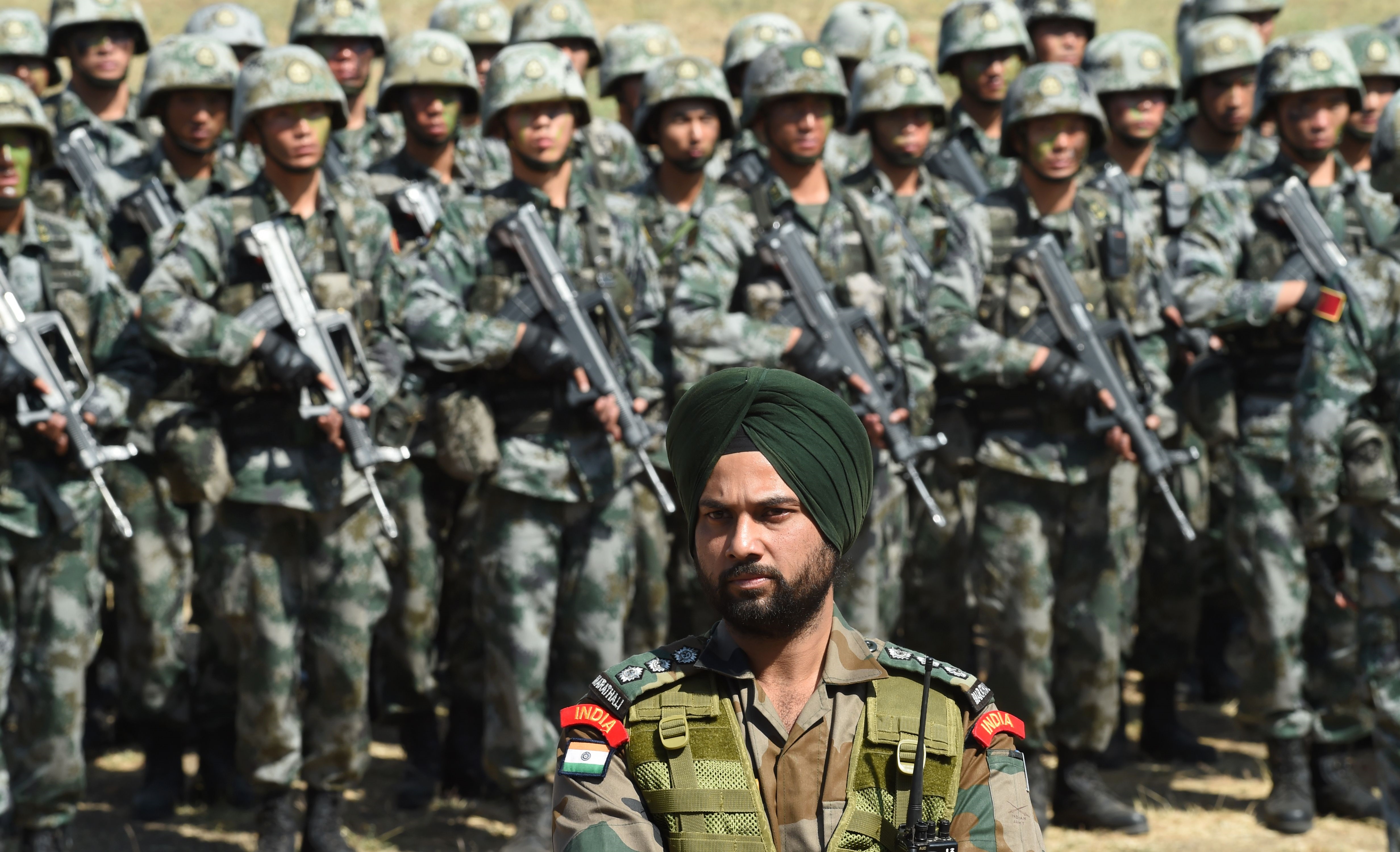
[Gifting sweets to PLA troops on the LAC]
Notice that far from hinting that such construction was unacceptable and that India will counter with military measures, whatever the cost, the MEA, accepted the bridge as a fact of life India can do little about. If by such means the Indian government is reconciling frequently to the changing Chinese delineation of the Sino-Indian border, why doesn’t the Narendra Modi regime stop the charade, go the whole hog, recognize the Chinese claimline in toto, and hand over all the Indian territory China contests because that’s what’s going to happen over time any way if Delhi does not mean to use force to defend and protect Indian territory,or take back the areas the PLA has stealithily occupied?
Meanwhile, after each new disruption caused by PLA action that violates the status quo, dumbfounded — or perhaps, simply dumb — Indian diplomats housed in that perfectly hideously designed building housing the Indian embassy in Beijing — an architectural horror reflecting Indian ‘PWD chic’ aesthetic also evidenced in the new MEA building on the Rajpath, issue mealymouthed protests, even as the Indian government on its part tries as hard as possible to ignore such provocation. And a horde of panda-hugging retired diplomats rationalize for an ignorant media each new Chinese provocation as not something to get worked up over, and even less to treat as casus belli (cause for war).
It leaves the lead units of the Indian army, who invariably fail to either preempt PLA actions, or forcefully react to PLA intrusions — assuming in the first place that field intelligence had been generated in time, to await instructions from Delhi, ending up, likewise, twiddling their thumbs, doing their best imitation of the MEA and Indian government, and hoping that ignoring the latest incremental loss of territory due to China’s map-changing tactics will, somehow, make the problem go away! Or, more optimistically, expecting that gifts of Indian sweetmeats (on New Year, Diwali, whatever!!) will lead to grateful PLA commanders responding to Indian niceness returning recently annexed Indian territory!
There’s a limit to the Indian government and military’s gullibility, naivete, pusillanimity, and just plain strategic stupidity — not that we have scraped the bottom of that barrel yet. Is there even a single instance of a “China specialist” in the Foreign Service and even among the retired lot of diplomats who while in service or after retirement has advocated military measures to deal sternly with China?
Indeed, the garden variety Mandarin blubberers spending time in Beijing, Shanghai and elsewhere if anything do a lot of harm, They retrun home to fill the China Study Circle/Group or as, in the case of the most recent ambassador, Vikram Misri, to join the PMO as the third deputy National Security Adviser (the other two DyNSAs being langotia yaars of the NSA, Ajit Doval, from the IPS). What are the chances he will counsel the PM of the diminishing returns of continuing to appease China in the manner India has been doing since… for ever? Nil, because the advice he offers the PM is likely to be along the lines evidenced in his statements in the virtual farewell meet he had with the Chinese foreign minister Wang Yi, December 6, 2021.
Misri had nothing to lose by being brutally honest and publicly telling the Xi Jinping dispensation via Wang what Indian ambassadors have long needed to say but shied away from saying, that India has had it with Beijing playing India for a fool, and that Delhi will not take it any longer, will certainly not put up with the PLA gobbling Indian territory in bits, and that the Chinese strategy of wearing out Indian negotiators in endless talks, has run its course. That’s not what he said though, chosing rather to speak tangentially as his predecessors have done: “Our relations comprised both opportunities and challenges,” he intoned, “and even though certain challenges since last year had overpowered the vast opportunities in the relationship.” If one wasn’t aware of China’s capture of a vast slice of Indian territory northeast of the Y-Junction on the Depsang Plains in eastern Ladakh in summer last year, and consolidating its military hold on it, one would be forgiven for believing that Misri was referencing a minor blip in otherwise warm and smooth bilateral ties.
Contrast Misri’s and the Indian government’s defeatist approach laced with awe of China to the “wolf warrior” attitude of Chinese diplomats. A junior official in the Chinese embassy in Delhi publicly upbraided Indian Members of Parliament as if they were a bunch of errant school boys for attending a function hosted by the Tibetan Government-in-exile. Or see how the Chinese Foreign Ministry spokesman reacted to the brouhaha in India over the Pangong bridge and the MEA’s reminder that this construction was “in areas that have been under the illegal occupation by China for around 60 years [which] India has never accepted”. China’s response: An airy dismissal. Asserting that he was “not aware of” any untoward situation in that area, the Chinese spokesperson informed the international media that such infrastructure build-up “falls within [China’s] sovereignty.”
Professionaly habituated to banal language, Indian foreign service types are wont to repeat that old saw about disagreeing without being disaggreeable. This is fine if one knows the animal they are dealing with. But mostly they seem to have a wrong fix on Xi Jinping’s China. Consider how the newly appointed Chinese ambassador to the US, Qin Gang, began his innings in Washington in September last year. “If we cannot resolve our differences”, he told the Joe Biden Administration, “please SHUT UP”!! And he proceeded to wag a finger in the US government’s face, warning of “disastrous consequences” should it follow the “Cold War playbook”. Diplomatic quarters in Washington are still reeling from that assault, awed by this newby Chinese envoy’s gambit. It took balls, but Qin was no doubt told by President Xi to take a hammer to the Washington establishment, which he did with gusto.
That’s the sort of national self-respect and self-confidence Indians can only dream about Indian leaders, ministers, army generals and MEA officials sporting. Would Modi ever, in any circumstances, instruct the Indian ambassador to do a similar plainspeak in Beijing? Or, order the newly installed Commander, XIV Corps (Leh), Lt. Gen. Anindya Sengupta, in the manifestly useless and futile talks scheduled for January 12, to be abrasive, initiate the meeting by not shaking hands with his Chinese opposite number and, by way of signaling seriousness, walking out of the meeting after telling the PLA general that there’s only one-point on the agenda to discuss — the mechanics of the PLA’s vacating its aggression, pronto, and then staying the hell out. And demand that Army HQrs issue standing orders to the forward deployed Indian units to make the LAC live with artillery duels and ceaseless tactical action to wrest back lost territory any which way they can, and at any cost? This won’t happen, of course.
It leaves me to wonder at another level about the aptness of the contempt and disdain China has always shown, and continues to show Indian leadership and the Indian government — a treatment they so richly deserve, but India and the Indian people don’t. How deliciously ironical it is then to contemplate this almost brahminical attitude of Beijing’s towards India!!
There are two significant national security failures of longstanding that need correction. Hopefully, 2022 will be the year that practical solutions begin to get implemented.
China has occupied some 1,000 sq miles of strategically important Indian territory in the Depsang Plains in eastern Ladakh. The Narendra Modi government’s response, other than talking about China needing to restore the “status quo ante”, has been underwhelming. India’s China policy needs a massive course correction to institutionalise a strictly reciprocal — tit for tat — approach. India needs to strategically arm Vietnam, Indonesia, and the Philippines as Beijing has done Pakistan.
Chinese market access has to be restricted to the same level Indian exporters face in China, and the flow of Chinese automobiles, mobile telephony goods, and light manufactures ought to be shut down. If the Bharatiya Janata Party (BJP)-led government at the Centre wants India to replace China as the ‘workshop’ of the world, it should begin at home by jettisoning the still suffocating regulatory and bureaucratic controls.
The hardline policy has to be complemented with appropriate military force structuring. While the Indian Army may be able to mount a passable defence with massed forces to match China’s People’s Liberation Army (PLA) presence on the disputed border, it lacks the capacity to snatch back lost territory.
Such capability can be obtained by three offensive mountain corps (OMCs) for sustained proactive or aggressive action, and become financially viable only if the army’s three armoured strike corps — good only for the minor front against Pakistan — are reconfigured into a single composite corps for any Pakistan contingency. The remaining two strike corps need to be converted for mountain use with light tanks for high altitude operations.
These two formations, along with the Panagarh-based OMC (XVII Corps), will provide the means for the army to punch/counterpunch the PLA hard, and together with the existing defensively arrayed mountain divisions constitute a formidable fighting force able to blunt the PLA’s edge across the Himalayas, and limit Chinese influence in the extended region. Such repurposing of the armoured-cum-mechanised forces, if made part of the ongoing military reorganisation, that includes theaterisation, will minimise resistance to it within the army.
The other failure is regarding the aatmanirbhar (self-sufficiency) policy marked by confused thinking. Will the country be genuinely self-sufficient in arms if foreign supplier companies ‘make’ — in reality merely assemble — their products in India? This is exactly the ‘screwdrivering’ level of manufacturing technology the defence public sector units (DPSUs), such as HAL, Mazgaon Dockyard, et al, and the ordnance factories, have been mired in for the last 60 years.
They are habituated to license-manufacture contracts requiring them to just unpack the imported Completely Knocked-Down kits and Semi-Knocked-Down kits, and to screwdriver the various components and assemblies together to obtain weapons systems. Even here the advanced technologies pertaining to the weapons payload, propulsion, situational awareness, avionics, complex fire control systems, communications, etc. are transferred only as ‘black boxes’.
This process is labelled ‘indigenous production’, and the resulting ‘Made in India’ warships, submarines, and combat aircraft are boasted of as having 80 percent indigenous content, when this proportion is by weight, not value, as most high-end technologies that cost a bomb are imported whole, and account for 70 percent or more of the total contract value.
Further, these ‘screwdrivered’ DPSU-Ordnance Factory projects characterised by sloth, sleaze, corruption, bad work ethos, and low labour productivity and quality control rarely come in on time, or within cost. Worse, there is minimal technology ingestion, little reverse engineering, and no technology innovation and creation worth the name. This is the vicious arms dependency cycle the Department of Defence Production (DPP) in the defence ministry, the military and the DPSU-dominated defence industry now perpetuate in the guise of aatmnirbharta!
The stranglehold of the DPSUs in defence-related production is a liability. No government to-date has shown the political will, and economic common sense to integrate the highly-accomplished private sector into the national effort by allowing them to compete with the DPSUs for major military procurement deals. Consequently, accomplished firms with skilled workforce survive on sub-contracts from these DPSUs.
Consider the Tejas light combat aircraft. HAL’s annual production capacity is 16 aircraft; a second assembly line will double it, but won’t prevent the stretching of the induction period of the 83 Tejas the Indian Air Force has indented for, and to meet the potential demand for it abroad. The solution is multiple Tejas production lines requiring the DRDO to transfer source codes to several private sector companies for them to produce this aircraft and its variants in bulk for the IAF and for exports. Besides enabling the nascent Indian aerospace industry to take-off, it will create high-paying jobs, and generate revenues to amortise the vast investments made in this sector.
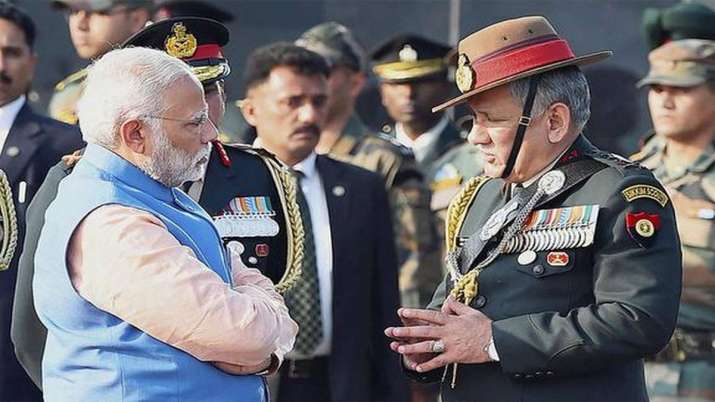
[Prime Minister Modi and the late General Bipin Rawat, CDS]
Soon after the death in a helicopter crash of General Bipin Rawat, the first Chief of the Defence Staff and Secretary, Department of Military Affairs (DMA), the army began canvassing for its chief, General MM Naravane, to fill the CDS post on the basis of seniority.
Whom seniority favours at any given time is happenstance, not a qualification. Had this accident occurred, say, a week or so before the navy chief retired November-end, Admiral Karambir Singh would have been a shoo-in. As a naval pilot, moreover, he had the experience to deal professionally with the air force and army aviation and hence the army — the sort of background few chiefs of staff possess, and Rawat lacked (whence his dismissal of the Indian Air Force as a “supporting arm”). Seniority is a bonus not a prerequisite and, in any case, was ignored by the government when appointing Rawat as army chief in 2016 superseding two officers.
Rawat’s appointment was no bad thing because CDS is a quintessentially political post. To prompt the military to get on with integration required both the political will of the Prime Minister Narendra Modi to drive the process and a CDS, au fait with his vision, to thrust jointness down sometimes resisting throats of the military services too bureaucratically entrenched to fall in readily with the restructuring demands made of them. The PM’s confidence in Rawat was due to the latter’s native Pauri-Garhwal connection with Ajit Doval, his National Security Adviser, whom Modi trusts. Having made the political decision to re-order the armed services, Modi needed someone he could rely on to not botch things up.
The Modi-Doval thinking on the subject of CDS and military integration can be outlined thus: First establish the CDS post, next install a person of choice in it, and then hope he carries out their remit within the constrained bureaucratic ambit he is placed in, but help him out by backing him in the inevitable bureaucratic tussles.
It helped that Rawat was the senior most service chief when he was made CDS. It pre-empted the carping that follows any military promotion not based on seniority. Even so, Rawat faced covert defiance because the government avoided doing the one thing in a hierarchy-minded military that would have eased his dealings with the serving chiefs of staff — raised CDS to Field Marshal or equivalent 5-star rank to establish a clear line of authority and obviate foot dragging. But that would have raked up the politically sensitive matter of installing a military supremo, which has been anathema to the country’s political leadership and government. The Modi regime instead vested “the first among equals”-notion with bureaucratic heft the nascent CDS system cannot carry, unless future CDSs are guaranteed the same access to the PM and NSA that Rawat was, which’s unlikely.
Scanning the senior serving ranks, including the chiefs of staff, no name jumps off the page in terms of visioning capacity, broad-based professional competence or, importantly, proximity to Modi (or Doval). A former Defence Secretary G. Mohan Kumar has suggested sifting through retired four and three star-rank officers of note. By this reckoning Admiral Karambir Singh is a frontrunner, as is the former Deputy Chief of the Army Staff (Plans), retired Lieutenant General Subrata Saha responsible for pushing indigenous procurement by the senior service. There is a democratic precedent for such decision. President John F. Kennedy appointed retired army General Maxwell Taylor as Chairman, US Joint Chiefs of Staff. Alternatively, Kumar mentions “deep selection” preferably of an officer with tenure on the Integrated Defence Staff (IDS). But hoisting a CDS junior to the services’ chiefs is recipe for ruction. His solutions to unburden the CDS of “paper work” by reverting “statutory matters relating to appeals, representations” to the Defence Secretary, and appointing a Special Secretary reporting to the CDS to handle the “drab [administrative] work” of the DMA, however, are worth considering.
Still, the military integration process has, in a manner of speaking, been initiated. There is a plan, albeit army-friendly, that Rawat and the IDS worked on. Consider the schema Rawat publicly sketched out on 15 September. It envisions four theatre commands — for the Pakistan front, the China front, national maritime security in the Arabian Sea, Bay of Bengal and the Indian Ocean, and the Andaman and Nicobar Integrated Command tasked with the defence of island territories. Further, while cyber warfare and Space/air defence have merited separate commands, not so logistics, intelligence, and Special Forces as was talked about earlier, which are the necessary adjuncts, along with cyber and Space/air defence, to the theatre commands.
This design has faced tremendous resistance from the armed services and not just because it involves collapsing 17 military commands into just six Commands — four theatre commands plus the two commands for support functions, and the concurrent loss of administrative and operational control by the services’ chiefs. But because it, prima facie, seems slapdash and insufficiently thought through.
There are some obvious deficiencies in the Rawat plan. Are Space and landbased and airborne surveillance and air defence systems banded together just because, as Rawat said, some artillery shells reach 15 kms into space, this when anti-satellite weapons for offense and retaliation will be in vogue in future conflicts? Where’s the sense, moreover, in splitting the navy’s focus between the open seas and “island defence”, or in the Coast Guard being relegated, implicitly, to a naval auxiliary? And why in the maritime security domain are the coastal/brown water roles not the Coast Guard’s bailiwick, true blue water missions not the preserve of the navy, and the Andaman Command not tasked expansively to consolidate Indian military presence on either side of the Malacca, Sunda and Lumbock Straits? In the event, wouldn’t the goal be better served with a capability and missions based integration? It would entail, for example, the aviation assets in all the Services being concentrated — with the exception of aircraft carriers — in distinct national commands for helicopter and fighter aircraft-based Ground Support, Air Defence, Strike and Transport.
Military integration is too important an issue for the Modi government to make a hash of by implementing a bad plan. Hopefully, the next CDS will present to the government for approval a more balanced and coherent jointness scheme featuring capability-cum-mission based integrated Commands.
Some people just look the part. May be it was the rakish tilt of the Australian bush hat sported by the Gurkhas, and underneath it the broad, bluff, face, and a cheery confident demeanour. But the late, well respected, Bipin Rawat fit the cinematic image of the likeably tough, plain speaking infantry General.
General Rawat, heading the military affairs of the country as the first Chief of the Defence Staff died because of errors commited by a spatially disoriented pilot, not because of bad weather.
The crash in the Nilgiris of the Mi-17, the workhorse utility helicopter of the Indian military, that killed the CDS and others is already being attributed, a little too conveniently, to “weather conditions” by retired IAF officers on television programmes. The truth is that IAF stalwarts and the Service itself instinctively and institutionally shy away from blaming the real reason for many aircraft crashes — pilot error, because doing so, they believe, would reflect poorly on the training and competence of the pilots in question, and of IAF pilots generally.
Indeed, what may have really happened in Coonoor is this: The helicopter rose from the valley floor to 6,000 feet altitude in an attempt to clear the mountain tops for its final descent into the Wellington bowl crested by the Defence Services Staff College. But, in the light mist that was hugging the mountainside, a momentarily disoriented Wing Commander Prithvi Singh Chauhan piloting the craft simply flew into the mountainside instead of turning away from it. However, experienced the pilot, spatial disorientation is a fact of life and happens oftener than is admitted by authorities in India .
This rendering of the incident conforms with the eye witness accounts related on TV newscasts by tea plantation workers and others who witnessed the accident as it unfolded. One moment they saw a helicopter rising into view, the next a fireball as the plane rammed into the tall trees on the mountain slope, its rotors scything through them, even as the aircraft crumbled into a melted metallic mess.
A recent analog of the Rawat accident is the mishap that killed the Los Angeles Lakers basketball star, Kobe Bryant, and eight others in February this year. He was riding with his friends in a Sikorsky S-76B helicopter he had hired with a pilot with 10 years flying experience and over 8,500 flying hours on this type of aircraft. Taking off in clear skies from an Orange County airport in southern California Kobe’s helicopter veered towards the Pasadena Hills where they were supposed to alight. Except, the hills skirting the Pacific Highway suddenly shrouded over by mist rolling in from sea is where the disoriented Sikosky pilot, misjudging his landing site, slammed his aircraft into the hillside, failing to clear the top by some 30 feet.
During a public hearing held by the US National Transportation Safety Board (NTSB) to consider the likely cause of this crash, its chairman Robert Sumwalt said the pilot most likely suffered from an episode “of spatial disorientation,” described by him as “the powerful, misleading sensations that can confuse a pilot conducting a visual flight who loses visual references, and what types of training can be effective in countering this effect.” “We have seen this accident before, unfortunately,” confrmed NTSB board member Michael Graham. “Helicopters continue the VFR (visual flight rules) flight into meteorological conditions and unfortunately lose control of the aircraft due to spatial disorientation.”
The country has lost a good man, a good soldier and solid miltary leader in Rawat. His loss is not going to be mitigated by the IAF blaming the weather for it. The Indian Air Force has to become more responsible and to begin assessing realistically why air accidents occur in the country, and why pilot disorientation in flight — not at all an unusual phenomemon, is not acknowledged as the prime cause for the many fatal crashes its aircraft annually suffer. Advanced air forces have no problem owning up to the occasionally spatially disoriented pilots crashing aircraft.
Hopefully. starting with the ‘Court of Inquiry’ looking into this Mi-17 mishap, the IAF will begin to honestly accept and possibly acknowledge pilot error in terms of sheer disorientation as the reason for such aircraft accidents.
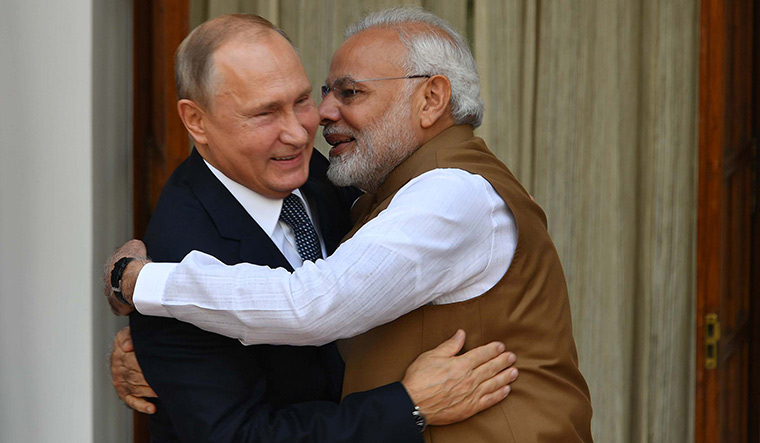
The official read on the summit between Prime Minister Narendra Modi and Russian President Vladimir Putin on December 6, alongside the inaugural2x2meeting of the foreign and defence ministers of both countries — respectively S. Jaishankar and Rajnath Singh, and Sergei Lavrov and General Sergey Shoygu, is too sanguine for comfort.
Indian foreign policy is dictated less by geostrategics or long-term policy calculations than by immediate tactical political concerns, in the instant case, the need to pacify Moscow. So, the Modi regime is doing what Indian governments have done in the new millennium to get big powers on its side — appeasing them with arms purchases. To palliate Moscow, a draft mutual military logistics support agreement, similar to the Logistics Exchange Memorandum of Agreement signed with America in 2019, has been readied to strategically equalise the situation. It is topped by a new spate of arms contracts for short range air defence systems, helicopters, assault rifles, etc worth over $5 billion.
This is in line with balancing India’s buys from the US over the last 20 years for mostly 1960s vintage military technology – M-777 light howitzers, C-130 and C-17 transport planes, and in New Delhi’s acquiescing in Washington’s ploy to use the 2012 Defence Trade and Technology Initiative (DTTI) not to promote any worthwhile collaboration in the military high-tech sphere, as was promised, but to push for production of obsolete American weapons systems in India, such as the 1970s vintage F-16 fighter aircraft.
All this because Washington is convinced the Narendra Modi government values the fact of the production of something/anything in India, and not what is produced. It suggests the confusion at the heart of Modi’s Atmanirbharta programme and his government’s failure to use DTTI to pit the high-quality military hardware Russia provides along with technology transfer against the dated tech the US offers to make the point that the differential in technology and the American unwillingness to part with high-end tech are too significant a factor to ignore. That’s the kind of plain talk Americans understand but the Indian side is reluctant to deploy.
This is the arms supply scene in a nutshell and the backdrop for the Modi-Putin summit. The trouble is this meeting comes at a difficult time.
What restricts Russia
Western intelligence agencies, the Ukrainian government, and NATO, which are tracking real-time build-up and offensive maneuvering by 100,000 Russian troops in the Donbas region of the border with Ukraine — a former constituent republic of the USSR and now member of NATO — believe invasion is imminent. Moscow long ago made it clear it would not countenance an expansion of NATO, and to prove it is serious, snatched Crimea from Ukraine in Spring of 2014 and wants to add parts of eastern Ukraine, to its bag if it can. Russia has drawn the “red line”, indicating Ukraine is within its sphere of influence. The Biden Administration has responded by promising to beef up Ukrainian defence capability.
Short of a Russian invasion, that’s where matters will stand. Except, determined to dominate its periphery, Putin could create an international flashpoint by using some Ukrainian defensive step as pretext to attack.
If Moscow initiates hostilities, New Delhi can expect to be squeezed in a power play. Washington will demand that India, as a fellow democracy, act in concert with the West to oppose the Russian aggression. Depending on the timing of possible Russian hostilities, the 9 December virtual conference of democracies called by President Joe Biden to which India and Pakistan are invited — the old hyphenation there? — but, strangely, not Bangladesh or Sri Lanka, could end up as a means of pressing Modi to join the “democratic” consensus on Ukraine and to pressure his government, which mistakenly believes India is in no position to resist.
Putin , on the other hand, will expect India to be mindful of Russia liberally dispensing advanced weaponry and sensitive military technology (think Arihant-class nuclear powered ballistic missile-firing submarines!). He will hope that New Delhi will say or do nothing to irk Russia. Whether Modi will be able to side with Washington — how much and how successfully, without upsetting Russia, is the game to look out for.
In this regard, Jaishankar and Rajnath Singh in their 2×2 meeting will no doubt make much of New Delhi risking punitive provisions in the Countering America’s Adversaries Through Sanctions Act or CAATSA to stick with the $5.43 billion deal for five squadrons of the Russian S-400 air defence system.
However, there was never any chance of CAATSA being invoked because the US has too much to lose strategically if it does so. India is central to the security of the ‘Indo’ part of the Indo-Pacific and pivotal to holding off China, especially with President Xi Jinping itching to validate his newly acquired “helmsman” status by precipitating a showdown on Taiwan. Washington also doesn’t want to lose the political foothold it has gained in New Delhi over the last 25 years, courtesy Indian PMs putting out for the US, and a host of American think tanks who have set up shop in New Delhi and are manned by retired civil servants, senior military officers and diplomats peddling US-tilting policy options to the government.
Pakistan: Russia’s leverage against India
Except, there’s Putin. No slouch at the strategic chess game, the Russian President has already made a blocking move, putting in place Russia’s new Pakistan policy to ensure Modi does not deviate much, or go overboard on Ukraine, or other combustible issues. Sometime back, Moscow agreed to sell assault helicopters to the Pakistan army. On 26 November, Moscow and Islamabad initialled a wide-ranging draft-accord for economic coopertion, topped by a proposal for a 1,100km long north-south gas pipeline to stream 12.4 billion cubic metres of Russian gas to Pakistan, a deal to be formalised by February 2022, and for collaboration in the telecommunications, information technology, and various other fields.
Should New Delhi not heed these warnings, Putin will surely up the ante. Instead of making do with second-rate Chinese copies of Russian hardware (JF-17, a Chinese version of MiG-21), Pakistan may be able to access the latest and progressively more advanced Russian military equipment.
The geopolitics-minded Putin will not push India beyond a point though. He wants India in Russia’s corner as he expects relations with China to sour sooner rather than later, owing to clashing interests and friction points. Among these is the Russian fear of Chinese annexation by stealth of natural resources-rich Siberia. There’s already a flood of Chinese petty businessmen and labourers settling down in the Siberian districts adjoining the Chinese border, taking local Russian wives, and spawning not just a new breed of colonisers of the vast empty spaces in the Russian Far East but a consequential demographic creep that could lead to Chinese-origin people becoming a majority, in time to buttress Beijing’s claims on that part of Russian territory. Beijing is, after all, expert at alluding to some historical event or the other of a Chinese emperor or his emissary long ago reaching Vladivostok and points north or whatever and etching “a nine-dash line” in Siberia, who knows! — to claim all of it as China’s eminent domain!! Who is to say this won’t happen? It is, in any case, a nightmare prospect many Russian strategists worry about.
The other probable cause for a falling out is Central Asia. Beijing is rapidly advancing its BRI (Belt Road Initiative) objectives via rail, road, air and telecom connectivity schemes along with massive commercial investments that are increasingly making the Central Asian Republics economic captives of China. It is stoking Moscow’s fears of a China growing too big too fast to contain. It is a subject where the interests of Russia converge with those of India and even the US, none of whom cares to have China dominate Asia, or even the Central Asian economies, which last could potentially have “a narco-terrorist” Afghanistan , an “insolvent [Pakistan] with nuclear weapons”, and India. in that order, falling like nine pins to the status of tributaries of China.
Where Modi’s going wrong
But Modi, hoping for rapprochement with China, has adopted a conciliatory attitude advised by the apex China policy forum within the government — the China Study Group (CSG) — appeasing Beijing by backing its contention that it has not intruded into the Indian side of Line of Actual Control. Reality is, over 1,000 sq miles of Indian territory northeast of the Y-Junction in the Depsang Plains in eastern Ladakh has been de facto annexed by the Chinese People’s Liberation Army.
Such defeatist counsel is emblematic of a soft-headed Indian foreign policy. Look at what it has fetched the country: An India not doing anything proactive, or acting assertively and on its own to protect its territory and vital national interests. Instead, it is trying desperately to appease big powers by making arms purchases to get them on its side in a possible military conflict with China while seeking to postpone such contingency by appeasing the adversary with an approach that soft-pedals its aggression.
But such appeasement of friends and main adversary won’t obtain a more congenial correlation of forces. Nor is it a substitute for India needing to fight its own battles by itself and preparing to pay the price for it, because one thing is certain — the status quo ante in Ladakh that Jaishankar keeps talking about as a prerequisite for normal relations, will not be restored at the negotiating table.
[PM Narendra Modi inaugurating the gigantic statue of Sardar Vallabhbhai Patel, near the Sardar Sarovar dam]
I ask this question because many of us see the dots but don’t connect them. Aakar Patel, a Gujrati and sometime India head of Amnesty International, did in an article after the 2014 general elections about four Gujrati leaders who have — for good or ill — shaped India and its politics. He wittily summed up the Gujju Maha-Four and posed his own question thus: “One hundred years ago, a Gujarati man arrived from South Africa to save Indians from the British. Some years after that a Gujarati man arrived from London to save Muslims from Hindus. Some years after that a Gujarati man arrived to save India from disintegration. This year a Gujarati man arrived to save India from corruption, underdevelopment, lack of hygiene and other stuff. The question is: Why do you people need so much saving? And why must Gujarati Man always have to do it?” considering his state constitutes only 5% of the country’s population. (https://www.livemint.com/Leisure/9bPcjodNrxhX8bZaj7q2wK/An-introduction-to-the-Gujarati-man.html)
Aakar Patel was, of course, referring respectively to Mohandas Karamchand Gandhi, Mohammad Ali Jinnah, Vallabhbhai Patel, and Narendra Modi. His mock-serious query, however, raises an interesting issue of whether there is, in fact, an identifiably Gujrati way of statecraft, just as there’s supposedly a distinctly British way of diplomacy, and of war, or an American way of conducting international relations, or even a Pakistani way of war. Patel identifies the Gujrati trait of showing no talent for war or things military which he attributes to the fact that the last time Gujratis actively took up arms was against the invading Afghan looter Allauddin Khilji and then in a losing effort in 1297 AD. “Useless at fighting, Gujarati Man”, he writes, “has forgotten the smell of freedom, so long has he been under the thumb of Afghan, Mughal, Maratha and Englishman.”
While all the fighting spirit was thus leached out of Gujratis and other Indians in a system of peace imposed by elements external to the state when not foreign to the subcontinent, the natives of Gujrat did what other Indians didn’t do as well — channel the violence and competitiveness natural to homo sapiens into business and politics, until now when the Gujrati brand of business and politics reflects unmatched cunning, ruthlessness and amorality — qualities which if yoked to advancing national security, for instance, would have done the country a lot of good. Instead, Gujratis in particular became productive camp followers of the British in their colonizing efforts in Africa, opening up the African hinterland to petty commerce with their “dukus” and earning the eternal hostility of black Africans as exploiters (which is evident to this day in Kenya, Tanzania, and Uganda). The Maha-Four characterised these Gujrati qualities in their politicking on the national scene.
This Gujrati behaviour was, however, unlike that of the other people in what was pre-1947 India, who seemed so beaten down and sapped of will the British were surprised at just how easy it all was, how owing to very little resistance from the locals, they had taken over India. When not in a triumphalist vein attributing the acquisition of this territorial jewel in their crown to the manifest destiny of an all-conquering race, the British pointed to the “cowardice” of “the Hindoo” — an agnostic description, incidentally, to cover all the peoples of India — Hindu, Muslim and others alike, as the reason for their success.
Robert Orme, the historian who as secretary to Robert Clive travelled with him on his military campaigns in the Gangetic Plains wrote after the Battle of Plassey (1757) that brought down Sirajudaulla, Nawab of Bengal, and laid the foundations of the British Raj, that the Indian was the “most enervated inhabitant of the globe [who] shudders at the sight of blood, and is of a pusillanimity only to be excused and accounted for by the great delicacy of his configuration.” It was an impression reinforced by the vegetarianism practised by many Hindus, which is also of paramount social concern in Gujrat. Except, the passivity and pacifism displayed by the Indian populace was only for the firangi because Indians, whenever permitted to do so, happily cut each other’s throat, driven by localised animus that curiously spared the British during the Raj. It was a short step from there for Rudyard Kipling by the end of the 19th Century to commend colonialism and to enjoin the US to carry the “White man’s burden” until then supposedly borne manfully by Britain, of bringing order to much of the world peopled by “lawless breeds”.
So, what has this bit of social-colonial and imperial history got to do with with Gujrati statecraft? Every thing!
Central to the Gujrati mindset is “dhanda” — business — and the pursuit of personal profit. By its very nature, it involves genuflecting before the powerful and compromising and conciliating with them and, generally, avoiding activities disruptive of good relations, like tension-mongering, violence and war. In this context, posturing is permitted, not so taking matters to a breakdown of ties. And should things not work out, to consider use of force but only against the weak.
Judging the main actions of each of the first three among the Gujju Maha-Four by the above metric reveals that (1) the three freedom movement leaders — Gandhi, Jinnah (until the 1920s) and Patel were, like all members of the Indian National Congress, collaborators with the British who did not believe in, nor advocate, the violent overthrow of the Raj but were committed to winning freedom legally, through “Constitutional means”, i.e., by working within the limits dictated by the British, (2) Patel, ever the practical Gujrati, pushed for Partition based on his experience of Muslim League ministers making the Nehru-led Interim government (1946-47) non-functional, this even as Gandhi, typically sent mixed signals about conceding Pakistan (and Jawaharlal Nehru opposed it); (3) Patel, unlike Nehru, also supported the giving of Jammu and Kashmir to Pakistan in return for Jinnah accepting Junagarh and Hyderabad in India, and was for a complete exchange of populations to enable India and Pakistan to emerge as wholly Hindu and Muslim respectively, which proposal was negatived by Nehru, and (4) Gandhi, Patel and Jinnah all trusted the English enough to want continued close association with Britain after independence despite Britain’s horrific colonial record — an intolerably demeaning system of racial apartheid, its long standing policy of sharpening Hindu-Muslim differences eventuating in the bloody partitioning of the country, and sustained looting of India and transfer to Britain of unimaginable wealth that, in current value, amounts to some $47 TRILLION according to recent calculations by the Columbia University economist Utsa Patnaik.
A similar pattern of behaviour fueled by the same dhanda imperative informs Modi’s actions and policies. Consider this: Very like Gandhi, Jinnah and Patel, Modi is very mindful of appeasing the powerful, taking care not to upset or alienate either the US or China, and reluctant to respond aggressively to even the direst provocation offered by them.
Thus, notwithstanding the American record of over 60 years of subterfuge, sabotage and stratgems that, in the main, sought to “balance” India in South Asia by conventionally arming Pakistan, and to keep India non-weapons nuclear, failing in which aim and for the sake of restoring “balance”, approving China’s transfer of nuclear weapon and missile technologies and design expertise to Islamabad, and the fact that the US pressured the Congress party regime of Manmohan Singh to refrain from reacting to the seaborne strike on Mumbai by Pakistan ISI-sponsored terrorists, Modi trusts America to do right by India.
Modi, from day one in office, courted the US, going out of his way to accommodate Washington by aligning Indian policies with US strategic interests. He signed the three “foundational accords” — LEMOA, COMCASA, BECA, for instance, that could result in US armed forces utilizing Indian bases for military operations in the Indo-Pacific — the reason why his Congress party predecessor Manmohan Singh refrained from doing so because he felt it was politically risky.
And Modi very early bought into Xi Jinping’s transparently bogus line of a concert of India and China for the greater good of Asia. This was to be cemented by the airy promises Xi made in Wuhan and reiterated at the Mammallapuram summit of tens of billions of dollars worth Chinese infrastructure investment funds to turn India into another version of Shanghai. A Prime Minister would have to be particularly naive and gullible or, as is more likely, predisposed to act in this way, to fall for this Chinese approach. But Modi fell for it.
His belief in the value of friendship with China is such that he has persisted with the policy of not demanding recognition of “One India” inclusive of all of Jammu & Kashmir for recommitting to the “One China, two systems” that Beijing has flogged, and with the “No tit- for-tat” policy — of not responding in kind, even if belatedly, to Beijing’s proliferating nuclear bombs and missiles to Pakistan by speedily onpassing nuclear warheaded medium and short range missiles and other armaments to countries on China’s border — Vietnam, Indoensia and Philippines. And, two years into the Chinese absorbing 1,000 sq kms of manifestly Indian territory in the Depsang Plains adjoining the Karakorum Pass in eastern Ladakh and the construction of “villages” on disputed territory in Arunachal Pradesh and in the trijunction area with Bhutan, he remains unwilling to even admit the Chinese PLA have annexed Indian land. And, far from instructing the army to vacate the Chinese military presence from Ladakh by any and all means and at whatever cost, he has, in effect, formalized the Chinese claim lines on the Pangong Tso by coupling the withdrawal of PLA units from terrain features — Fingers 3 and 4 — on the northern shore of the lake, with the retreat of Indian SFF units from the Kailash Range, thereby losing India a major foothold and the last vestiges of negotiating leverage with China.
So, OK, Modi is a realist about Indian military capabilities and aware of the difficulty of forcibly removing the PLA from Indian real estate. But why did he have to walk the extra mile to second Beijing’s stated position that its army had not intruded into Indian territory even an inch by, in fact. claiming “Koi andar ghus ke nahin aya hai”? In any case, one can see why Xi desires rapprochement with Modi’s India (on Chinese terms, of course).
Meanwhile, our esteemed foreign minister S Jaishankar, conforming to the PM’s policy proclivities, mouthed inanities such as his contention that Sino-Indian relations were going “through a bad patch”, as though the dispute with China is some small clubhouse disagreement at the Delhi Gymkhana about which the Indian government does not need to be disagreeable. And, that Beijing has understood the message he has been trying to send since the Galwan encounter first came to light in May 2020 that the restoration of territorial status quo ante is the precondition for resumption of normal relations, as if China cares two hoots for the return of normalcy because even a supposedly strained relationship has not hurt annual Chinese exports to India, which remain in excess of $70 billion. So, what’s the incentive for China to pullback its forces from the sizeable area it has grabbed? In other words, Jaishankar’s self-proclaimed clear messaging has not registered on Beijing.
And as regards the US, Jaishankar has assumed the role of America’s bullhorn in the region. Addressing a Bloomberg economic event November 19, unprecedentedly for India’s foreign minister, he justified the US posture, calling the reality of a strategically receding America, post-military defeat in Afghanistan, “ridiculous” and advising the audience “not to confuse” the ongoing global “rebalancing” with USA’s “decline”. He sounded verily like an earnest junior public relations staffer at the US Embassy! This was ineffably sad both because of the optics and because of substance, considering US President Joe Biden and the newly designated “Helmsman”, Xi, had decided in their November 15 virtual summit “to chart a more positive course” as reported by the US Institute for Peace. Meaning, Washington is prepared to cut a seperate deal with Beijing, leaving its Asian allies and strategic partners, including India, to scurry around to secure their own interests the best they can!
Then again, if you don’t acknowledge a problem, it doesn’t exist!
[he Indian Army deploying M-777 ultra-light howitzers i Tawang District]
National security expert Bharat Karnad, emeritus professor of national security studies at the Centre for Policy Research is not surprised at the Chief of Army Staff General Bipin Rawat’s comments on the precarious security situation on both our northern and eastern borders.
Prof. Karnad spoke out to Rediff.com‘s Senior Contributor Rashme Sehgal about how the Chinese have now turned their focus towards our eastern border.
The first of a two-part interview:
Why has General Rawat stepped into troubled waters by contradicting the US department of defence report highlighting that China is building a 100 house civilian village in Arunachal Pradesh?
Apparently, General Rawat is unable to resist his urge to rise to every media bait, rather than refer the question, as he should have done, to the MEA which articulates the country’s responses on all external-related issues.
ISRO satellites would have confirmed to our military intelligence wing by now whether this construction has taken place on the ground? MEA spokesperson Arindam Bagchi said on Thursday that India had taken note of the DOD report and that this was not unexpected since China had undertake similar construction activities. Even if this construction is taking place to accommodate their military, this is akin to a warning signal for us.
Yes, Indian satellites have enough resolution to identify encroachments by the Chinese even in mountainous areas and, over time, to pinpoint the structures that have come up.
Such information would have been available to the Defence Image Processing and Analysis Centre (DIPAC) and hence to the military, defence ministry, MEA and the rest of the government as soon as the first ingress was made by the PLA many years back.
This much is evident from the Pentagon report’s mentioning that ‘these infrastructure development efforts’ had occasioned ‘consternation’ in the Indian government, and the subsequent MEA statement that such illegal buildup by China has been ongoing for several ‘decades’ which, in fact, is a damning indictment of the government as much as of the army, and the Indian military, generally.
This is not the first time this has happened. We were witness to the strange drama where Prime Minister Modi said on June 19, 2020 that there ‘is and has been no intrusion by the Chinese’ which contradicted the press note issued by the MEA on June 17 after External Affairs Minister S Jaishankar had spoken to his Chinese counterpart Wang Yi that the Chinese had crossed the LAC and erected a structure there?
This is obviously a case — all too frequent in the Government of India, of the right hand not knowing what the left hand is doing, and the brain of this entire organism — the PM and the PMO, not being sure what the immediate response and the longer term policy should be and therefore unable to coordinate positions taken by the PM, MEA, and the armed services.
The PLA occupies 1,000 square kilometres of our land. We appear to have agreed to their terms in Hot Springs and the Depsang Plains. What effect will this have on our army commanders when they go for talks with their Chinese counterparts on this contentious issue?
India may have agreed to keep talking and, presumably, negotiating with the Chinese for the restoration of the status quo ante, which Foreign Minister S Jaishankar has repeatedly said is the prerequisite for return of normalcy to bilateral relations.
Except, by withdrawing from the Kailash Range heights held by the Special Frontier Force units in return for minor pullback by the PLA from terrain features Fingers’ 3 and 4 on the Pangong Tso, India not only lost the army several important vantage points, but the Modi government the negotiating leverage to obtain the PLA’s withdrawal from the Y-Junction on the Depsang Plains.
And, it has permanently unsettled India’s negotiating strategy, assuming there is one, by accepting, ipso facto, the Chinese annexation of the area proximal to the Karakorum Pass of national security interest to India.
What will the repercussions of this be for India given that there are 23 such ‘areas of differing perception’, be along the entire length of the India-China boundary stretching from Ladakh to Arunachal Pradesh to the east?
Why wouldn’t so strategically-minded an adversary, such as China, not militarily exploit to the maximum Indian timidity, stupidity, and cupidity all along the LAC and legitimate, as it has done so often in the past, the fait accompli of incremental territorial grabs which, by the way, is its strategy and policy as implemented on the ground?
Already, after 13 rounds of talks, it appears as though India has conceded Hot Springs and the Depsang Plains to China, so it should come as no surprise that the Chinese are now asserting themselves in the Eastern Sector?
Having secured their western flank by first pushing and then freezing the Indian forward line in Ladakh, the PLA are now begining to concentrate their attention on Arunachal Pradesh they call ‘South Tibet’ to acquire which is Xi Jinping’s dream end-state.
‘Xi is keen that the remaining three territories still outside the Chinese ambit — Taiwan, Arunachal Pradesh, and the Senkaku Islands in the East Sea — be absorbed by the Communist regime by the time the centenary of the revolution rolls around in 2049.’
General Rawat made a very strange statement at the Times Now Summit where he has said, ‘Locals (in Kashmir) are giving information about terrorists. Now they are saying they will lynch the terrorists which is a very positive sign that is coming in. If there is a terrorist operating in your area, why should you not lynch him?’
Don’t confuse two separate issues. If the locals, suffering from collateral damage of anti-terrorist actions by the army and state police are fatigued enough to be driven to ‘lynch’ a terrorist in their area, that is their business and, in a sense, not preventable.
Had General Rawat advocated open lynching of such miscreants, then that would be an objectionable thing for the CDS (Chief of Defence Staff) to do. But that is not what Rawat said.
India and the US already have a military intelligence sharing agreement. How successful has this proved in the past?
The intelligence-sharing arrangement has been there for some twenty years now.
The trouble is that while the US secures ‘raw intelligence’ from us, what we get in return is ‘processed’ intelligence that is run throuh several filters by the US agencies keeping in mind American national interests and policy vis a vis, say, China and Pakistan, before it is passed on to Indian intelligence.
This is neither particularly helpful nor equitable.
For instance, the US government had prior information about the 2008 seaborne strike on Mumbai but gave no inkling of it to New Delhi.
Rahul Gandhi tweeted that ‘our national security is unpardonably compromised because the government has no strategy.
It is natural for Opposition leaders to make hay while the sun of misreading China and the attendant policy discomfiture shines on Prime Minister Narendra Modi.
With Xi Jinping set to remain in power for life, will we see an increase in the aggressive policies being pursued by China?
Xi has just had the Communist party plenum declare him ‘the helmsman’.
The last beneficiary of this title was Deng Xiaoping, who singlehandedly guided China into becoming an economic and trading powerhouse and the fairly wealthy country that it is now.
Xi, it turns out, is only a wannabe Deng, but without any of the foresight shown by that genuinely great Chinese leader in realising for China its supposed old imperium.
Xi is keen that the remaining three territories still outside the Chinese ambit — Taiwan, Arunachal Pradesh, and the Senkaku Islands in the East Sea — be absorbed by the Communist regime by the time the centenary of the revolution rolls around in 2049.