It was a very clever political move that foreign minister S Jaishankar pulled yesterday by instructing the MEA spokesperson publicly to differ with the Chief of the Defence Staff General Bipin Rawat and the military on the worrisome matter of “dual use” Chinese habitations that have sprung up on the Indian side of the Line of Actual Control (LAC). Based, presumably, on photo imagery correlated with digitised terrain mapping data available to the US government, the Pentagon in its 2021 annual report to the US Congress on Chinese military power stated categorically that several of these modern hamlets have recently been put up by the PLA on the Indian side of the claim line.
Instead of waiting for the MEA to pronounce on these “villages” — which issue was bound to be raised Rawat, prompted by the media, rose to the bait and, fell in with the line he thinks is Prime Minister Narendra Modi’s position voiced last summer that no Chinese intrusion has taken place anywhere along the LAC. The simple minded General conceded that such buildings had indeed come up. But he suggested these were on the Chinese side of the LAC and were for the purpose of “billeting” the civilians and PLA soldiers posted to the Indian front. The little space he left himself to maneuver out of possible trouble was his qualifying his reference to the LAC with the Indian army’s and government’s “perception” of it. This sort anbiguity has allowed the army and the government to escape accountability for the Indian territory absorbed by China. Except, Modi’s ill-considered remark exonerating China was so laughably wrong he has not repeated it for fear of further damaging his credibility, which fact Rawat had not noted before reacting in the same vein.
But Jaishankar had. With his antennae picking up signals that this issue could become the proverbial political hot potato should the opposition go to town about the Modi regime accepting the Chinese land grab without as much as a squeak, the foreign minister sought deftly to distance himself and his Ministry from Rawat and the military. At his behest, the MEA — assuming it is speaking for Modi and the BJP goverment, not Rawat — immediately contradicted the CDS. Stating that the Chinese had, in fact, violated the LAC and constructed these villages on illegally occupied Indian land, it disclosed it had made a “strong protest against such activities”, as if such protests by a meek and timid India ever register on Beijing. But it left Rawat dangling in the wind.
Such a preemptively defensive MEA statement was considered necessary by Jaishankar because the Pentagon report had also put him in an embarrassing situation by declaring baldly that “these infrastructure development efforts” had occasioned “consternation” in the Modi government, which makes it plain that the GOI, MEA and the Indian army were all aware of the Chinese ingress well inside Indian territory for quite some time. It also reveals that they did not want to publicly complain, convinced that what the Indian people don’t know won’t hurt them, and that making a brouhaha over lost territory would only pressure the Modi government to try futilely to recover the said parcels of land — something the Indian army is not capable of, and hence that it was sensible to say and do nothing! And then Modi’s best friend power, the US, had to go and spoil it.
This was also the logic behind Modi’s original statement in 2020 summer about “koi andar ghus ke NAHI aya hai” and the army’s attempt to misdirect by referring yesterday to a biggish encampment that has emerged in Longju on territory lost in 1959 which does not address the issue of the many other such pucca villages built by the PLA on the Indian side of the LAC since.
What’s not a surprise are the Chinese villages on Indian territory — a result, I said in my 2018 book, of Beijing’s policy of creeping territorial aggrandizement that requires the local PLA and Communist Tibetan authorities to build on newer pieces of Indian land before periodically presenting what’s built and the real estate so annexed as faits accompli that a passive-reactive Indian government and armed forces feel compelled to reconcile to because, well, they can’t do much about it.
What’s more interesting, is the larger game that’s on where the institutional rift opened up between the MEA and the military doesn’t matter all that much. The military by itself being a light weight in intra-governmental politics and power games, Jaishankar’s showing up Rawat on this issue is really to get at the CDS’ patron, his fellow Pauri-Garhwali, the National Security Adviser, Ajit Doval. If Rawat is made to look like a political liability, it will reflect poorly on Doval and proportionately strengthen, Jaishankar hopes, his hand and relative power positioning in Modi’s court.
[The canisterised Dong Feng-31 missiles on parade in Beijing]
There’s not a thing China does wrong strategically and not many things India does right. Whence my advice to the government in my 2015 book – Why India is Not a Great Power (Yet), that owig to its institutionalized inability to think and act strategically, it should merely imitate whatever China does.
What China is doing is building up its nuclear forces, reaching the threshold of 1,000-odd deliverable nuclear weapons and still larger numbers of missiles. The Pentagon in its 2021 (annual) report to the US Congress on Chinese military power conveyed this piece of information with as much alarm as surprise. Why so? Because successive US administrations have trusted in the line taken by the likes of Jeffrey Lewis rather than the assessments of experts like Lawrence Korb and the Pentagon’s own intel supplied by the US Defence Intelligence Agency, who counted the missile silos, the very long tunnels bored into mountain sides as missile emplacement and firing sites, monitored the traffic to them as picked up by satellite imaging and other sensors, and came up with more realistic numbers of nuclear missiles with the PLA Second Artlliery Strategic Forces (SASF). Indeed, the US DIA had concluded by the late 1990s that China had some 800 nuclear weapons and missiles. The 200 or so added since then is par for the course.
This was the SASF figure I based my analysis on and suggested in my 2002, (2nd edition in 2005) book — Nuclear Weapons and Indian Security, that because the likely operational strength of the Chinese arsenal would be some 500 missiles, with the rest held in reserve, and because a goodly number of these are India-targetable medium range ballistic missiles (MRBMs) and intermediate range ballistic missiles (IRBMs), the minimum Indian strategic force size needs prudently to be around 475 thermonuclar weapons and delivery systems, without counting the reserves. And that, this force size should be elastic enough and automatically increase to be within striking distance of whatever weapons level China attains over the years. This was necessary I argued to ensure that (1) notional strategic parity is maintained, (2) the Chinese conventional military prowess is blunted, and (3) China is never able to wield the psychological edge of thermonuclear superiority in any prospective confrontation. By my 2002 standard, the Indian SFC should now have a minimum of approx 900 nuclear weapons.
But with the “minimum deterrence”-wallahs having the ear of the government from the beginning and convincing all incoming PMs about the supposed wisdom of small nuclear forces, successive governments have thought nothing about taking an axe to India’s own nuclear weapons manufacturing capability to please and pacify external powers, chiefly the US. So, the civilian nuclear deal was negotiated with America and the option of resuming testing signed away. In keeping with the minimalist thinking, the freedom of policy choices and military options too was surrendered by agreeing to the Missile Technology Control Regime and the Wassenaar Arrangement. And by seeking membership in NSG, New Delhi will ensure India cannot respond, even if it wanted to in the future and belatedly, to Beijing’s nuclear weapons and missile proliferation to Pakistan by hurting China in equal measure by arming its neighbours with like strategic armaments. Having thus painted itself into a corner, Manmohan Singh and now Narendra Modi are embarked on a policy, as I have argued, that is tantamount to outsourcing India’s strategic security to the US.
As if to prove that this is indeed the case, India has let Pakistan outpace it in producing nuclear warheads and bombs. The Pakistan army’s Strategic Plans Division has in excess of 150 nuclear weapons; India’s Strategic Forces Command, on the other hand, has apparently leveled out at 110 weapons or thereabouts. And as mentioned in a previous post, India has been even more niggardly in producing and fielding Agni-5s and, more detrimental to the national interest, has consigned the indigenous MIRV-technology that enables a single missile to carry multiple warheads to the rubbish heap. What else does refusing to test and induct the MIRV system mean?
But minimum this, and minimal that, sort of thinking fits in with the advice on China given by an unending line of foolishly optimistic mandarin-speaking diplomats, intel types, and their ilk crowding the China and East Asia Desks in the MEA, the Beijing ambassador and Foreign Secretary posts, and the apex level policy forum — the ‘China Study Circle/Group’ (CSC). CSC and all within it are terminal misreaders of Beijing’s intentions, underestimators of Chinese military strength, and unapologetic surrenderers of India’s military and other initiatives because they value Sino-Indian relations more than they do the national interest. The CSC has been so wrong about China so often, it is a surprise anybody takes it seriously. But hark, the Indian government does! Even though, no Prime Minister in his right mind should have done other than terminated this cabal long ago and those within it dismissed from service with extreme prejudice. Instead, CSC continues in its merry way — pushing India deeper into the hole it has dug for the country and the Indian military.
The last such bit of harmful counsel was the negotiating parameter that resulted in the pullback of the Special Frontier Force units from the Kailash range — the only Indian action that showed initiative and was of some consequence, in exchange for the PLA withdrawing from ‘Finger 3’ on the Pangong Lake. These worthies expected that the Chinese, suitably softened, would suddenly start behaving like a good neighbour and withdraw from the Y-Junction on the Depsang Plain, to allow the Indian army to once again patrol Gogra, Hot Springs, and other points proximal to the Karakorum Pass. Predicatbly, India fell for a Chinese mirage and, thanks to CSC, lost the slight leverage it had with the occupation of the Kailash heights.
The expertise of these desi China specialists and professional policy bunglers stops at a benign reading of the Chinese threat. They mirror the kind of nonsense the China lovers in the US have been spewing for decades. These MEA mandarins and CSC members propagate the view about the Chinese Communist party leadership being driven by the purest of motives, and believing in “no first use”, and in “minimum deterrence” and, despite the altercations on the border and PLA’s relentless massing of forces in the Tibet theatre, why the Modi regime should talk it out with Beijing, and similar piffle. Those more besotted among them try to display their deep understanding of everything Chinese by citing all kinds of supporting evidence — gobbeldygook references to party plenums, Confucius, “warring kingdoms”, Suntzu, and obscure warriors, strategists and whatnot, that while, perhaps, plausible sounding, are usually off kilter. In the main because their rationalizations and justifications of Chinese actions are informed more, it seems, by sentimentalism and delusions of what could have been if only Xi Jinping had not sported his hardline approach. Dengxiaoping’s “long handshake” with Rajiv Gandhi in 1986 is still recalled, and the illusory promise of ‘Chindia’ — the combined Asian powerhouse of the two countries in the new Century is mulled over.
Characteristically, these thinly veiled China sympathizers have habitually missed out on the traditional animus fueling Beijing’s India policy. Lest it be forgottgen, Deng strategically screwed India; he was the architect of the policy that has proved the most strategiclly damaging — establishing Pakistan as a nuclear weapons state. Except, it is only another version of Maozedong’s clear-eyed ruthlessness in pulling India down by showing up the Indian army in 1962 as an imperial era ‘paper tiger’ with pretentions. If Rajiv Gandhi was taken in by Deng’s avuncular behaviour, Atal Bihari Vajpayee (and his alter ego — Brajesh Mishra) by Jiang Xemin’s promise of peace, and if Modi, had drunk a little too much of the Wuhan and Mamallapuram “spirits”, he is now sobered enough to crash down to the earth, what with his government seemingly so bewildered by Xi’s actions in eastern Ladakh and along the Line of Actual Control that his China policy is stranded in a “no man’s land”. Who is to blame for this state of affairs other than the consistently gullible Indian leaders and their compromised advisers in MEA and CSC?
Just how confused the Modi government is is plain from the non-use of the weighty economc leverage provided by denying Chinese exports access to the Indian market. It has resulted, ironically, in Chinese exports touching a new high (some $67 billion in 2020!), further skewing the balance of payments problem already hugely favouring China. It is not as if Indian exports to China are high value or big revenue earners as, say, German exports to China are — some 700,000 Mercedes Benz passenger cars were reportedly sold in 2020. So, India has little to lose by legally restricting Chinese exports. After all, China is the prime enemy country, is it not? Then why accord it favourable treatment? Shouldn’t Chinese exports to India be severely curtailed, and Indian retailers, including petty shopkeepers, deterred from stocking and selling Chinese goods and light manufactures, on the pain of punitive fines and even jail time? Why this has so far not been done is a mystery, considering such measures are legitimate under the GATT and Doha Round provisions for fair and equitable trade, and because it is the right of countries to protect their economies from being inundated with cheap goods and stuff produced by heavily subsidized Chinese industries.
A fearful Indian government shies away from undertaking even reciprocal actions in the economic, diplomatic and military spheres in response to Xi’s precision targeted policies and actions. In the event, for Modiji to believe India can become China’s equal by carrying on strategically as it has these past few decades, is to do a lot of day dreamin’. But, dreams cost nothing.
——-
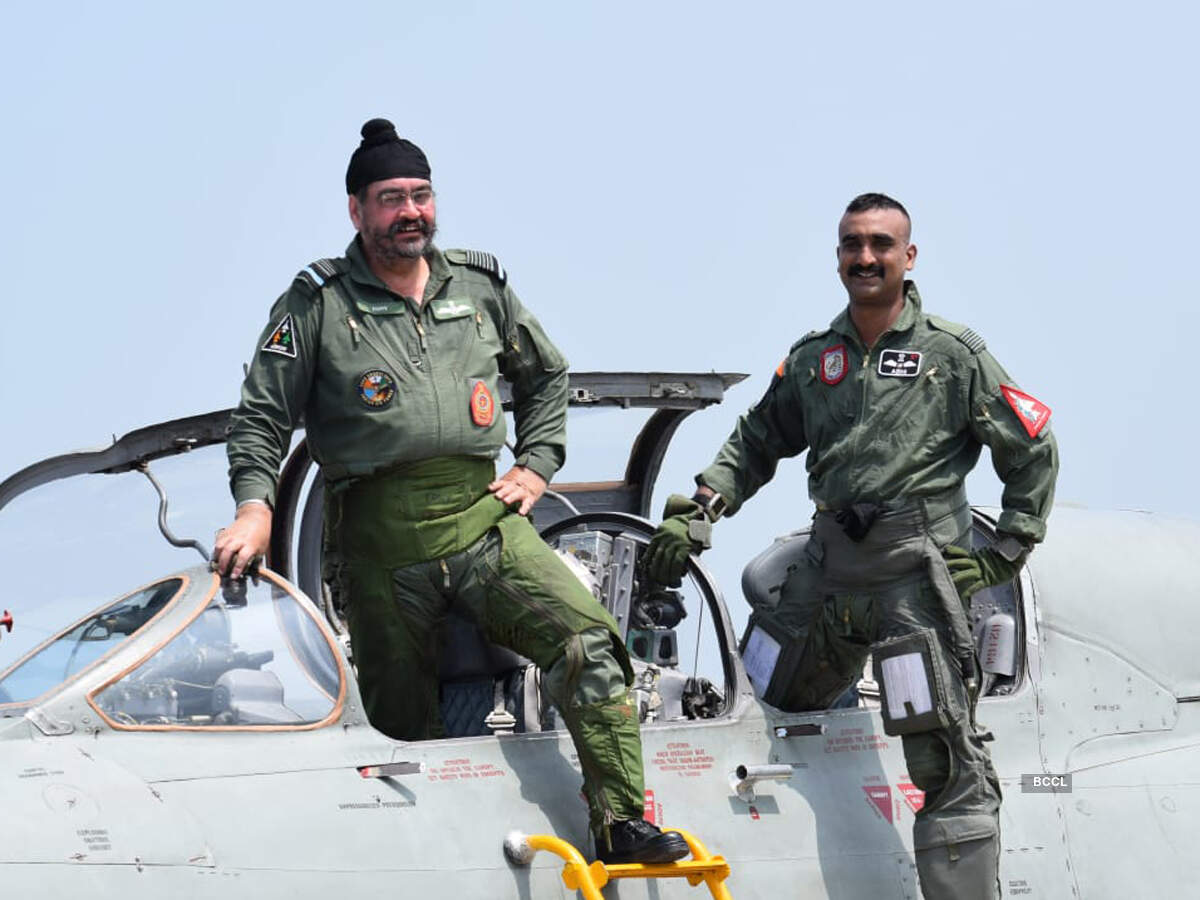
[WingCo Abhinandan with the then CAS ACM BS Dhanoa in a 2-seater MiG-21 Bison]
The news about Wing Commander Abhinandan making a time-grade promotion to Group Captain made me think about what brought him notoriety. He is perhaps the only fighter pilot in history to be awarded a gallantry award — Vir Chakra, for being shot down over enemy territory after a questionable, if not imaginary, kill by him of an enemy warplane. The IAF and the Indian government doubled down on the story that the combat aircraft Abhinandan shot out of the skies was a Pakistani F-16 even when it had too many holes in it. He was welcomed back, feted as a war hero with the then Air Chief, BS Dhanoa, even flying a celebratory sortie with him in a twin-seater MiG-21 Bison. Such are the small successes IAF is now reduced to.
Not to go into the details of this episode, but what really happened? In broad brush terms, Abhinandan was obviously hotdoggin’ it, picked up an adversary aircraft on his radar, went after it in hot pursuit, fired off a shortrange R-60 air-to-air missile. That missile hit something; he claimed it was an F-16. In the heat of the pursuit, he little realized he had intruded into Pakistani airspace and, too late to maneuver and scoot out of trouble, found himself and his MiG-21 shot down by a PAF plane that had him in its “cone”.
But it was not an F-16. The fact that no team from Lockheed Martin — producer of the F-16 aircraft, hightailed it to India or Pakistan to ascertain the details of that engagement is proof enough that no hardware of their’s was involved.
If it was not a PAF F-16, many IAF veterans speculate what Abhinandan had in his sights was an ex- Chinese-built JF-17. Two parachutes were observed floating down after that fighting incident, conforming to the fact of two pilots of two downed aircraft. So, why have Abhinandan and the IAF stuck to the F-16 story? Because, well, there is more glory in shooting down a frontline F-16 than a Chinese ripoff of a Russian MiG-21 — the JF-17.
And why was Abhinandan so speedily released? For one thing because, it is said, the IAF, backed by the Modi government,warned PAF that should anything happen to Abhinandan in captivity, or he not be returned forthwith, it was prepared to go to war — a threat that worked, especially on the Imran Khan government. The question arises: Why did the IAF make such a threat? Because, Abhinandan’s father, also a MiG fighter pilot, Air Marshal Simhakutty Varthaman, retired in 2012 as commander-in-chief, Eastern Air Command, and the IAF brass had made his son’s expeditious release by Islamabad, its personal business.
The troubling question: Would the IAF HQ have gone to bat for Abhinandan as aggressively, and decorated him with a VrC, had he not, in a sense, been IAF royalty?
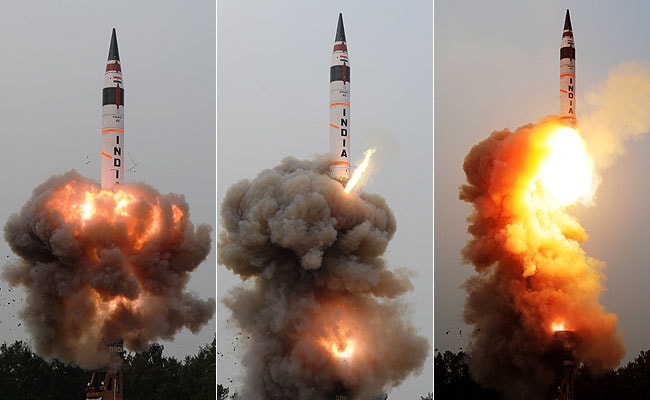
A decision approving a series of test firings of the Agni-5 intermediate range ballistic missile (IRBM) has been pending for the last 10 years. When it was finally taken by Prime Minister Narendra Modi it was done, it seems, again on a one-off basis, and with some reluctance. As to why this should be so is one of those mysteries only Modiji can unravel. It is clear the trigger for the test launch of Agni-5 was not some longview calculation in the wake of the news of the spectacular Chinese test of a Fractional Orbital Bombardment System (FOBS) in the guise of testing a hypersonic glide vehicle, but an attempt by India, a nuclear minnow, to say: Hey, notice me — I’m in the game too!!
Just how far ahead China is may be guaged from the Chairman, US Joint Chiefs of Staff, General Mark Milley, calling the Chinese achievement “significant” and a near “Sputnik moment” for America.
First re: Milley’s Sputnik ejaculation. The US was startled out of its wits when the Soviet Union in October 1957, launched the first man-made satellite — the 80kg, football-sized, orbiter — Sputnik-1, which event the History Division of the US National Aeronautics and Space Administration (NASA), heralds as the “Dawn of the space age”. Incidentally, NASA was created by the stirred and much shaken Eisenhower Administration in 1958. It led, in that period, to the US handily winning the space race by landing Neil Armstrong on the moon in May1969, and meeting President John F Kennedy’s May 1961 challenge to the American science & technology community and industry to do so by the end of that decade.
The shock in a complacent Washington at China’s successfully testing FOBS is as great as when a doubting US was rendered aghast at the Soviet Union’s pulling off a Sputnik some 65 years ago. We can now expect a full-fledged arms race in space to get underway with American companies being pushed, pulled, prodded and incentivised to, as soon as possible, have the US military not just field an array of FOBS, but also technology to neutralize hypersonic glide weapons able to home in on targets at 21 kms per second (Mach 5 to Mach 7 speeds) after transiting through space and re-entering the earth’s atmosphere.
The Chinese FOBS occasioned the 5,000 km Agni-5 IRBM test, which was a sort of small, “me too” reaction by India. There’s no parity, of course, because DRDO’s hypersonic programme is having the usual kind of troubles with this tech relating to the design of the glide vehicle (for smooth reentry) as also with the propellant mix for the initial and terminal phases of hypersonic flight. It may not be like for like, but Agni-5 is the only weapon available to India to blunt Beijing’s tendency to show India up as a strategic nonentity and to prevent nuclear bullying of the kind the Indian army, in the conventional arena, routinely suffers at the hands of the PLA on the disputed border.
Hence, the great mystery about the Indian government’s reticence in showboating with the A-5. And why it is that these Agni’s aren’t regularly fired into the southern Indian Ocean after pointedly sending Beijing notices warning Chinese naval and merchant ships to keep off the designated target areas (whether there are any Chinese ships in the vicinity or not); the idea being to make a splash on the minds of Chinese strategists who are contemptuous of what they consider India’s strategic pretensions.
At the heart of this tragedy is a wimpy Indian government. Consider the pattern: Talented and highly motivated missileers at the Advanced Systems Laboratory, Hyderabad, design and develop missiles of various kinds and associated weapons technologies only for things to come to a shuddering halt as Delhi dithers endlessly first on testing, and then on inducting and deploying these systems, thus keeping the country in a state of peril.
In the CEP (circular error probable) metric to assess accuracy of missiles, the Indian A-5 is as good as any missile in the world. In the event, the country should by now have had, quite literally, hundreds of these missiles — conventional and nuclear warheaded, to provide flexible strike options to take out the most distant countervalue or counterforce targets in China. Alas, test firings of the A-5 have been few and far between, and even though there are variants of the A-5, including one that is road mobile, the A-5 technology would gain refinement from many more and regular test firings. The strategic situation versus China is aggravated, moreover, by a low production rate of Agni-5s with its numbers to-date in the arsenal constituting only a fraction of the desired strength. But at least the A-5 has some testing behind it. They also remain relatively exposed owing to a marked deficiency of invulnerable mountain tunnel complexes to store and stockpile these Agni’s and, in crisis, to trundle out into firing positions clear of the mountainous overhang. The tunnel complexes is was I had advocated during my time on the first National Security Advisroy Board and then in my 2002 book — Nuclear Weapons and Indian Security.
The equally indigenous MIRV (multiple independently maneuverable vehicle) technology that allows a single missile to carry several warheads and to fire them at widely dispersed targets has not been so lucky. Designed, developed and readied for testing as far back as 2001-2002, the MIRV design and tech has been collecting dust in ASL ever since. Three governments in the new millennium –Vajpayee’s, Manmohan Singh’s and Modi’s, have felt no urgency whatsoever to give the green signal to test the MIRV prototype! More likely, as I have argued in my books, they have succumbed to American pressure to not test and induct this disruptive tech. Meanwhile, China took only a couple of years, from design to deployment, for its MIRV-ed missiles to enter the PLA strategic rocket forces’ inventory. [For details of the Indian MIRV tech, see my 2008 book — India’s Nuclear Policy].
If all these factors were not liability enough, we have the Indian government whose lack of strategic intellect is shocking, if not surprising. The collective ignorance of the phenomenon of nuclear deterrence and its dynamics in the highest reaches of the government, the military, in the bureaucracy, generally, and in MEA in particular, is a sad but costly joke at the expense of national security. It is evidenced in the statement issued by the Indian government following the IRBM test launch: “The successful test of Agni-5 is in line with India’s stated policy to have credible minimum deterrence that underpins the commitment to ‘No First Use’.” !!! This is on par with the endlessly repeated piece of idiocy mouthed by politcal leaders, military chieftains, and addle-brained diplomats alike that “nuclear weapons are meant for deterrence, not war fighting.” These strategic-nuclear illiterates are also convinced, for instance, that India’s gazetted doctrine emphasizing “massive retaliation” works even though the last two decades have clearly proven otherwise with even Pakistan mocking India’s nuclear posture by continuing to play the terrorism card and by speedily building up its stock of tactical nuclear weapons whose first use pronouncements, it surmises and the record bears it out, clearly deters India from exploiting its conventional military edge.
Despite the examples of Kim Jong-un threatening to take out Tokyo and the mid-Pacific US military island base of Guam in response to Trump’s talk of “fire and fury” that led to Trump slinking away and earlier, of China preparing to go with nuclear first use if the US tried to impose its military will, Delhi sticks with the simpletonish, one dimensional, view of the utility of nuclear weapons. Hence, the voicing of half-understood concepts like ‘minimum deterrence’ and ‘no first use’ from the Indian government and its representatives. It has consigned the country to a state of permanent strategic disadvantage and left it with no means to leverage a more respectful Chinese attitude to India’s national interest and its position on LAC, or to dissuade Beijing from pushing and pressuring this country at every turn. Xi Jinping and his team are by now only too aware that the Indian worm — nuclear or otherwise, does not turn.
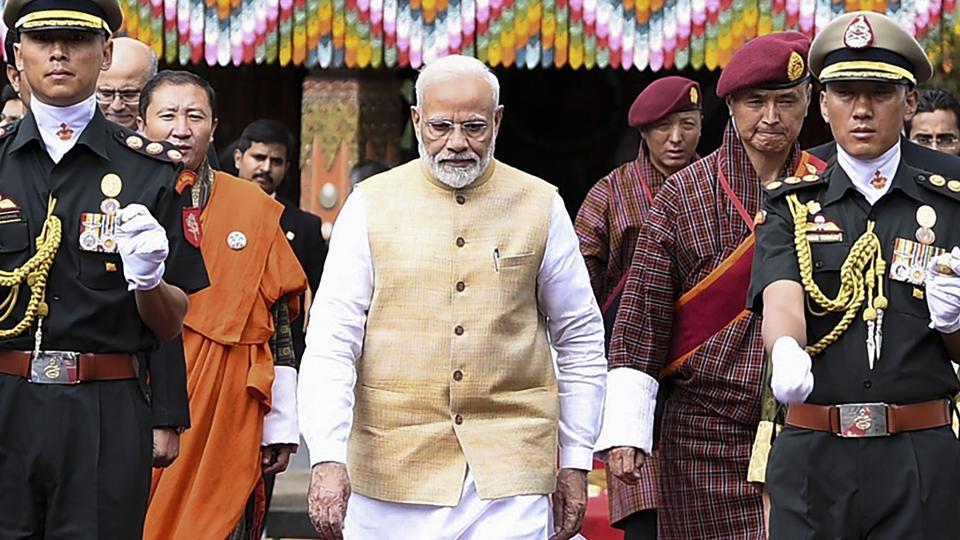
[Modi going to inspect a Guard of Honour presented by the Bhutanese Army in Thimpu]
“Who will not want a friend and a neighbour like Bhutan?” an elated Prime Minister Narendra Modi asked rhetorically, after wrapping up his visit to Thimpu, August 19, 2019. “The two countries are living the definition of true friendship.”
He had just concluded a warm, friendly, and successful visit during which 10 Memoranda of Understanding were signed in several fields ranging from space, avaiation Information Technology, power and education. Modi also inaugurated the Rs. 4,500 crore, 720MW, Mangdechhu hydroelectric power plant in central Bhutan, one of a series of power projects India has helped finance and build over the years to harness that country’s rivers to the tune of 10,000 MW — a milestone reached last year. It is electricity an energy starved India buys back at remunerative prices in a virtuous cycle of joint Indo-Bhutanese planning, Indian investment and construction, and goodly economic returns for both parties.
Two short years later, it was the turn of Beijing on Oct 14, 2021 to crow that the “deadlock” had been broken in the talks begun in 1984 with Bhutan to settle the border, and that the latest (24th) virtual round — of characteristically interminable negotiations (a tactic the Chinese use to break the opposing side’s patience and resolve), had resulted in Thimpu agreeing to a three step process for final demarcation of the disputed Sino-Bhutanese border, and the establishment of formal diplomatic ties.
Soon India will no more have Bhutan to itself . Wth a doubtless big, fully manned, Chinese embassy in Thimpu contesting the diplomatic space with India, the Chinese will overwhelm the Bhutanese with offers of infrastructure projects and easy credit to built them and, perhaps, a Chinese military training scheme and transfer of armaments to compete with IMTRAT (Indian Military Training Team). Bhutan too will begin doing what other South Asian states — Sri Lanka, Bangladesh, Nepal and Maldives, have learned to do do — profitably play New Delhi off against Beijing. That’s the least of the problems though.
What’s really worrisome is that MEA had no inkling about this development, was caught unawares and was surprised by this breakthrough coming down the pike. For Bhutan, an Indian protectorate in all but name, to keep such an important decision — one to cut a deal with Beijing a secret, suggests Thimpu may be willing to agree to an exchange the Chinese had proposed in 1997: Beijing giving up its claims in central Bhutan for territory in western Bhutan that includes the Doklam trijunction with India. Except, per an earlier three way agreement, any decision on Doklam has to be in consultation with India. It will be interesting to see how Thimpu and Beijing manage this, assuming MEA doesn’t just lay down as is its habit and let the Chinese run a steamroller over its diplomats.
Doklam is where Chinese ingress by way of roadbuilding southwestwards towards the Siliguri corridor — the “chicken’s neck”, had almost sparked hostilities in June 2017. Some 270 Sikkim-based Indian troops alongside two bulldozers had then stopped the Chinese road construction. That standoff did not, however,result in a PLA withdrawal from that area and the Chinese completed the road. Then in mid-2020, while India was preoccupied with the Chinese transgressions in eastern Ladakh, Beijing laid claim to the Sakteng wildlife sanctuary in eastern Bhutan. In response, India proposed constructing a road through the Yeti region of Bhutan to Tawang, cutting the distance to Guwahati by 150 kms to enable faster shifting of land forces in an emergency. It is not known whether there’s progress, if any, in this project. And this is where matters stand today.
The historic pattern is that India always reacts and reacts some more, never ever taking the initiative at any time for anything in terms of aggressively occupying contested land, especially where China is concerned. It seems fearful of the inevitable Chinese response, which it apprehends the Indian military will not be able to deal with. The Indian army is silently complicit in this arrangement because it doesn’t — if it can help it — want to tangle with the PLA handing it, in the process, the psychological edge. Signalling in any way reluctance to engage in military action is tantamount to ceding ground.
How one wishes for a dashing General Sagat Singh to emerge from somewhere, take charge, and get a fist up PLA’s nose, as he did as GOC, 17 Division, at Nathu la in 1967.
Meanwhile, with Bhutan in the bag China has about finished its grand geostrategic design of encircling India, and confining it to its subcontinental strategic coffin. Circlement and counter-encirclement are at the core and the very essence of Chinese military maneuvering and strategy. It is something the strategically dim-witted Indian government has historically been unable for some incomprehensible reason to even envision, let alone practice. So, while India’s neighbourhood is now palpably under Chinese control with Pakistan posing as Beijing’s stalking horse, the Chinese periphery is terra incognita and, owing to Indian diplomatic and military passivity, is getting beyond India’s political-military reach. In this respect consider the heavy weather the Indian government has made over the last 20 years of merely transferring Brahmos cruise missiles to Vietnam when this should have been A-1 priority. Indulging periodically in Malabar naval exercises with the US and other navies in the seas WEST of the Malacca Straits is not going to cut it.
Ah, yes, but as I have always reassuringly reminded everybody, there’s fortunately Pakistan to berate and beat up on, and threaten more Balakots with — no matter that the original Balakot aerial excursion, as I had mentioned in a post soon after that “operation”, was a bad joke, a non-event. (Refer my March 19, 2019 post — “IAF goofs and Delhi’s post-Pulwama debacle: A post mortem” at https://bharatkarnad.com/2019/03/19/iafs-goofs-and-delhis-post-pulwama-debacle-a-post-mortem/)
Pakistan, I suspect — Home Minister Amit Shahji please note — would welcome your verbal “sturm und drang” topped with such harmless military Indian actions!
An imminent Sino-US war over Taiwan makes for sensational analysis, but is unrealistic and, military-wise, unsound assessment of likely hostilities. A spate of ill-informed media commentaries and the like have been published, many of them by Mandarin-speaking former diplomats who ought to know better. A former Foreign Secretary Shyam Saran, for instance, in an op-ed (https://www.thehindu.com/opinion/lead/a-taiwan-flashpoint-in-the-indo-pacific/article36933319.ece) propagated the questionable thesis about China initiating an offensive on the grounds of a growing power imbalance — of Beijing acting sooner to forcfully reunify Taiwan with the mainland because doing so later would mean having to contend with a more powerful enemy lineup with a nuclear submarine equipped-Australia firming up the forward maritime stance of the new military alliance on the block — AUKUS (Australia-UK-US).
Further, his contention of bilateral Taiwanese capital stock worth some $188.5 billion in 1991-2020 or 15% of Taiwan’s GDP invested in China versus China’s $2.4 billion investment in the island-nation trade far from adding up as evidence actually suggests a contrary conclusion — a disincentive for Beijing going to war in the context of other sources of FDI slowly drying up, and China getting slowly economically isolated.
The massive flyovers staged in recent days by the PLA Air Force over Taiwan are, moreover, no more precursors of war than the US Navy periodically despatching its warships on freedom of navigation patrols (FONOPs) through the Taiwan Strait, or US troops regularly visiting Taiwan to jointly train with the Taiwanese armed services. As actions go, these are more show of force and symbolic than provocative. Had the Chinese planes dropped bombs or the Taiwanese air defence systems brought down an intruding aircraft or two is when the fat would be on fire. This last won’t happen because the Democratic Progressive Party government in Taipei, convinced America would offer no more than expressions of solidarity in defence of Taiwan, has no reason to challenge Beijing. And because all the talk out of China, including by Xi Jinping, about reunification — peaceful or otherwise notwithstanding, PLA simply does not have the capacity for a sustained military invasion and capture of the offshore island, especially one that, intelligence and cyber-wise, long ago penetrated the mainland defences and would have almost instantaneous knowledge of any decision to invade made by the CMC (Central Military Commission), which would void the surprise element. The PLA generals know all too well that an invasion would trigger an all-out Taiwanese response.
More than half of any Chinese invasion fleet is expected to be sunk by concentrations of shore-based Harpoon cruise missiles supported by a host of Taiwanese air and sea launched land attack and anti-ship cruise missiles — the 120 km range Hsiung Feng II, the 150km Hsiung Feng III, and for strategic deterrence the 600 km range Hsiung Feng IIE, and the 120km short range Wan Chien ballistic missile. Taipei is also developing on a war footing masses of the 2,000km range Yun Feng cruise missile to reach Beijing. And any attempts at aerial bombing is negatived by a dense and effective Taiwanese air defence. But even without the Yun Feng, Taiwan’s missile forces can, at a minimum, devastate the entire manufacturing base around Shanghai and its hinterland and up the Fujian province coast opposite Taiwan, and fully wreck the flourishing Chinese economy. Taipei knows this, and so does Beijing.
Sure, the 2049 dateline looms by which Xi Jinping would ideally like to see a reunified China with Taiwan accommodated in some version of a “One China, two systems” compromise. But while Xi may be an ideological blowhard, he is not a military idiot, however much he is urged by certain higher sections of the PLA command to once and for all and early sort out the Taiwan problem. So, where’s the question of war?
Indeed, just to clarify the Taiwan situation for an Indian audience, the possibility of forcible reunification of Taiwan with China is less of a flashpoint than Kashmir is — and this when the prospects of the Pakistan army attempting to wrench Jammu & Kashmir from India’s grasp is less than zero — whatever posturing Indian generals and militarymen eager to justify a wonky Pakistan-fixated Indian force structure and the ocassional brain-addled Pakistani politicians, may say.
From an Indian perspective, nothing would better serve India’s national interest than for China’s economy to get it in the neck and for Beijing to get diplomatically sidestreamed with a PLA misadventure against Taiwan, and one would very much hope that Xi is somehow persuaded by his military chieftains to start a real hard affray that Taipei is compelled to react violently to. But because this is unlikely, what’s next best India can do, proactively?
It has been Taipei’s policy before the DPP regime under President Tsai Ing-wen hove into view of Taiwan prudently disinvesting from China and moving its monies to more politically receptive climes. It was the context for the Taiwanese trade representative in Delhi — ambassador by another name, complaining to me some 20 years ago that the Indian government was doing nothing much, if anything, to attract Taiwanese investment capital in order to kickstart India’s development as a manufacturing hub for the world — something Indian governments Vajpayee’s onwards have been yacking about but doing little substantively to realize, and to otherwise assisting Taiwanese capitalists and manufacturers to do for India what they did for China in the Eighties and after.
The BJP government of Narendra Modi, on its part, seems entirely unmindful of the need to intensely cultivate Asian investors and companies, especially Taiwanese, Japanese and South Korean, to shift their production bases to India with attractive tax holidays, automatic “one window” clearances, and extensive language training and cultural acclimatization to speedily create a class of Mandarin-speaking Indian youth, say, to act as intermediaries, whose absence the Taiwan ambassador in Delhi long ago asserted was the single biggest obstacle — the other being the oppressive bureaucratism of all state authorities, state and central, to the flow of Taiwanese capital and production wherewithal into India. It is a problem the Indian government has failed to address.
While Modi’s ardour for Chinese infrastructure investment may have dropped down to realistic levels owing to happenings in eastern Ladakh and elsewhere along the extended Line of Actual Control, it is replaced by a hope of convincing American companies for FDI increases and manufacturing investment. Except, the Biden Administration’s priority is not India’s economic betterment, but welcoming investors from everywhere just so that the so far “jobless growth” produces more employment in the US.
Taiwan, Japan and South Korea are the biggest investment and technology sources India can productively tap, which the Indian government has done little to court and incentivize. It is time the DRDO, IISc, Bengaluru, and the IITs begin collaborating, for example, with the National Chung-Shan Institute of Science and Technology in Taipei that is designing and helping local companies produce world class weapons, platforms amd sensors to arm its own military. This is so because the Modi dispensation, unfortunately, is hung up on the US and the West as the locus geneses of these things, enabling Washington to play New Delhi like a fiddle with S. Jaishankar, the most destructively pro-American diplomat in history as first Foreign Secretary and now foreign minister advancing Modi’s harmfully overt policy tilt. Just what such policies have fetched India and how much real weight Modi packs in Washington, in the US, the West and in the world generally, as a result was evidenced from not a single major American newspaper covering the recent Modi-Biden meet in the White House, the so-called Quad summit in Washington Sept 24 — what little exposure this last event got related to the nuclear submarines to Australia-angle, and from the fact that Modi addressed a near empty hall in the UN General Assembly, September 25.
The sooner Modi appreciates that India’s future is tied to the future of Asian states whose interests too clash with those of China, the lesser will be the delay for the present counterproductive US-dependent Indian strategic security policy to correct itself and get back on track to genuine “strategic autonomy”.
Other than the necessary economic initiatives to attract Taiwanese, Japanese and South Korean investment capital and manufacturing, and technology, the Modi government can signal India’s strategic intent by ordering regular and frequent sailings of Indian warships and flotillas, through the disputed waters of the South China Sea, of course, but more meaningfully also through the Taiwan Strait with Indian naval vessels carrying out, to begin with, simple jackstay-kind of exercises with the Taiwan Navy and docking pointedly at major naval bases on the island-state’s east coast, such as Su’ao, headquarters of one of its leading units — the 124th Fleet.
Isn’t it time India responded in kind to Chinese naval sailings in India’s Indian Ocean domain and Chinese surface combatants and submarines docking at Karachi or in Humbantota at will?
Whatever the other effects of the Taliban takeover of Afghanistan, it has transformed global geopolitics. It sparked four notable geopolitical events. Apprehending China as potentially the principal beneficiary of the emerging order in Central Asia and, through its most important regional client, Pakistan, in southern Asia and, possibly, the Indian Ocean region as well, the United States countered with a new military alliance with its old Anglo-saxon partners — AUKUS (Australia, United Kingdom and US) to replace the moribund Cold War-era ANZUS (Australia, New Zealand, US).
Paris reacted with vehemence with a visibly agitated French foreign minister Jean-Yves Le Drian calling it a “stab in the back”. Not only because France lost a US$ 65 billion contract with Australia for its Barracuda diesel submarine that would have kept its high-tech military sector in the clover for a while but because a supposedly trusted, traditional ally, the US, trumped it by offering a nuclear-powered attack submarine (SSN) along with its production expertise, something Canberra could not refuse. It led to Paris renewing its call for a European security alliance that Germany too supports and for the same reason that NATO, rather than protecting Europe and advancing European interests, acts as a handmaiden of the US.
Besides damning AUKUS as a destabilizing move and a strategic provocation, Beijing has reacted by mooting an Africa Quadrilateral of China, Russia, France or Germany, and a group of African countries as counterweight, also to the India-Japan-US-Australia Quadrilateral. But this Africa Quad is a stillborn idea, their immediate anger aside, because neither France nor Germany intends to deal a deathblow to NATO, and because few of the prospective African member states want to alienate the US.
That leaves the future of the original ‘Security Diamond’ or Quadrilateral to contain China that the former Japanese prime minister Shinzo Abe had conceived in 2007 up in the air. AUKUS has occasioned serious doubts about the utility of the Quad other than as its strategic backup — a distinctly subsidiary role neither India nor Japan signed up for. In order to mollify hurt sentiments and to preempt a rethink on the Quad by New Delhi and Tokyo, President Joe Biden convened the Quad summit in Washington and scheduled one-on-one meetings with Prime Ministers Narendra Modi and Yoshihide Suga September 24-25. But these meetings have not dissipated the confusion and doubts about America’s intentions.
Arming Australia with a fleet of nuclear attack submarines is, however, a US decision with a fallout. Apparently, Washington considered the fast-changing Asian and international ‘correlation of forces’ to be alarming enough to part with its military crown jewels — technologies constituting the Virginia-class SSN firing Tomahawk long range cruise missiles, a deal that includes the wherewithal to manufacture the boat. To speed up the process of nuclearizing the Australian Navy, moreover, the US reportedly is even considering handing off to the Aussies the three Guam-based Los Angeles-class SSNs as platforms for training crews and maintenance personnel. Until now, the UK was the only country to benefit from such American technological largesse, with Britain being helped to produce eight Trafalgar and Astute-class SSNs and four heavier Vanguard-class nuclear powered ballistic missile-firing submarines (SSBNs).
An Australian Navy with Tomahawk-equipped SSNs does three things. It terminates any plans President Xi Jinping may have had to invade Taiwan with a naval armada and forcibly assimilate it into mainland China by 2049, the centenary year of the Communist revolution, by when Beijing expects the country to surpass the US as the wealthiest country in the world and as a military power to be at least the equal of America. Secondly, it heralds the end of the inequitable nuclear nonproliferation order based on the 1968 Non-Proliferation Treaty. With the US onpassing lethal nuclear technologies to an ally, Washington will be in no position any longer to preach nonproliferation and sanction proliferators.
And thirdly, it starts the clock on Japan and South Korea acquiring nuclear arsenals of their own, convinced as they would be by now that while the US will go to any extent to protect its interests and those of its fellow Anglosaxon partners, and AUKUS is evidence of it, traditional Asian allies of the US cannot bank on Washington to effectively deliver extended nuclear deterrence against an aggressive China. Thinking along these lines began in recent years in Tokyo and Seoul around when the Republican presidential candidate Donald Trump in 2015 advised the Japanese government to go get nuclear weapons to tackle the nuclear sabre rattling North Korean dictator Kim Jong-Un. And this when the far more onerous security threat then as now continues to be China. The US reticence in challenging Beijing militarily is as pronounced with the Democrat Joe Biden in the White House as when Donald Trump was president. But it meshes with America’s long term objective of a G-2 ruling condominium with China that was first outlined by President Barack Obama. AUKUS only furthers this aim.
Most of these developments are unhelpful from the Indian perspective. For instance, building up Australia’s naval muscle will not lessen the Chinese pressure in the Himalayas. But the alacrity with which Washington transferred its most sensitive military technologies to Australia has contrasted badly with the American foot-dragging evidenced in the 2012 India-US Defence Trade and Technology Initiative that, other than hot air and shrill sales pitches for the antique F-16 (dressed up as a modern F-21) fighter aircraft, has to-date produced no transfer of advanced technology or any collaborative project.
On the collective security front, with AUKUS emerging centre stage, the Quad has receded into the background as has India’s importance. India can, however, avoid becoming a bit player in an US security scheme by organizing an India and Japan-led modified Quadrilateral (Mod Quad) with Taiwan replacing Australia and a group of Southeast Asian nations substituting for the US, with AUKUS free to cooperate or not with the Mod Quad militaries in restricting China’s options. India has no other alternative to retain its independent strategic status and standing.
The future of non-Sinic Asia has reached a true inflection point. The new military alliance of the US, UK and Australia (AUKUS), superseding ANZUS (Australia-New Zealand-US), is set up to exclusively protect Western interests against a recklessly ambitious China in what is now called the Indo-Pacific. There is no other way to put it, but this is the old white Anglosaxon order (that excludes Gallic France, the new/Slavic European members of NATO, and even Japan, accorded, if anybody cares to recall, “honorary White”status by the apartheid regime in white-ruled South Africa, which suited the US and Western Europe fine) trying to maintain its hold in a much-changed Asia.
Having once again been militarily beaten by a wilful Asian people and forcibly ousted from Afghanistan in a 20-year war whose cost is estimated to be as high as USD 14 Trillion, AUKUS is a natural reaction of the US and its hangers-on to retain their relevance in a continent the Anglosaxon powers have long dominated, and post-1945, tried to dominate.
An impasse in the Korean war in the Fifties followed by a humiliating defeat in Vietnam after a nearly 15-year wasted military effort should have forewarned Washington about what to expect when taking on a highly motivated indigenous foe disinclined to tolerate foreign invaders. This is where great power hubris once again kicked in only for the US forces to discover that remote warfighting by drones piloted from Nellis air force base in Nevada is ultimately no match for AK47-armed groups primed for a religious war— a jihad, ready to suffer any privation and absorb unimaginable human losses. It is an end-state the US government should have expected considering it had uncorked the Extremist Islamic djinn in Afghanistan just to get even with the Soviet Union in the Cold War that had seen Soviet material help to North Vietnam result in the military humbling of the US in 1972. It is the very same CIA-funded and mobilized mujahideen who had run the Soviet occupation troops out of Afghanistan who form the core of the Afghan Taliban that victoriously took Kabul August 15.
The Afghan fiasco crystallized AUKUS as much in response to the fear of Afghanistan emerging as a potential jumping-off point for China to acquire unhindered access to the warm water ports on the Arabian Sea and, more importantly, to the ”Wells of Power” in the Gulf and the greater Middle East of Olaf Caroe’s conception. Caroe, British India’s Foreign Secretary in the 1930s who last served as Lt. Governor of the North West Frontier Province during Partition, was referring to the oil resources of Iran and Arab West Asia. It is the source of energy still for much of the world and especially China, which depends on this oil to fuel its rise as the Numero Uno economic and military power in the 21st Century. China is taking the place of Imperial Russia in the old Great Game of the colonial era, and of Soviet Russia of the 1980s, when the West apprehended it reaching for the Indian Ocean. Its rise is what the AUKUS alliance is gearing up to thwart by preventing Beijing’s access to Pakistan’s Gwadar and Iran’s Chahbahar, and to the region’s oil wealth via numerous connectivity projects under its Belt & Road initiative (BRI), including the China-Pakistan Economic Corridor (CPEC).
With AUKUS on the scene, the Quadrilateral (Quad) of India, Japan, Australia and the US, has obviously been pushed strategically to the sidelines, and is important only as a pseudo supportive military mechanism. Indeed, the primacy of AUKUS in the Indo-Pacific has been emphasized by Washington promising Australia transfer of technology and wherewithal to manufacture eight nuclear-powered, possibly the Los Angeles-class, attack submarines — the crown jewels of America’s military hightech — the sort of technology India does not remotely have a chance of getting. It will immeasurably enhance the Australian Navy’s sea denial capability against anything the PLA Navy (PLAN) will qualitatively be able to field in the foreseeable future. Canberra, courtesy AUKUS, will also be able to incorporate into its military forces the cutting edge US Artificial Intelligence and cyber warfare hardware and algorithms New Delhi can only dream about, however frightful and threatening China becomes in these realms in the future to India.
This takes care of American interests without in the least addressing India’s landward or maritime concerns about PLAN’s capacity to egress in mass west of the Malacca Strait. Because the one thing Washington will demand in return is that the Australian N-sub fleet be deployed to mesh with the US Naval presence essentially to block PLAN activity as envisaged by Beijing in the ”first island chain” and beyond.
This larger American game plan was signalled by US Secretary of State Anthony Blinken reportedly asking foreign minister S Jaishankar, in their meeting, for the Modi government’s permission to stage drone strikes on targets in Afghanistan — whatever these might be, from north Indian bases and, worse, to have India train Da’esh (Islamic State) irregulars in Rajasthan — as reported by ANI, for use by the CIA. That India appears committed to launching drone attacks and to train IS militants suggests Blinken proposed these actions as basically anti-China — the likely targets being CPEC and PLA units in Baltistan, and the IS to infiltrate the Uyghur society and radicalize Xinjiang, to render the Chinese management of its western province difficult.
Never mind that the IS-angle backs what has long been suspected about Da’esh’s antecedents as a CIA invention that for a time went rogue under al-Baghdadi — meaning it turned against US interests in Iraq and Syria, before recently recovering its US patronage. Assuming the newly formed Taliban emirate has approved of these anti-China moves on plausible deniability-basis because it hopes to milk China for monies and such BRI benefits as it can, these measures cohere with India’s strategic interests of undermining China every which way.
There may also be a view in some quarters that just as certain sections of the Tehriq-e-Taliban Pakistan (TTP) are amenable to creating trouble for the Pakistan army and state, the IS too could be marshalled for similar purpose. But then as Krishna Menon once reminded the Eisenhower Administration which justified US arms aid to Pakistan by saying it was defensive weaponry meant for use only against the USSR, that there’s no gun that fires in only one direction, what is the guarantee the IS, finding Chinese Xinjiang a hard nut to crack, won’t turn on India and, being Islamic fundamentalists, get on the Ghazwaa-e-Hind track instead to violently Islamise India? Further, training IS flies in the face of our own experience with preparing the LTTE to battle Colombo. We know how that turned out, don’t we?
Such are the dubious assurances Prime Minister Modi will be seeking when he meets President Biden in Washington in person on September 24 — knowing fully well they will count for nothing because Washington, in any case, always acts on its interests of the moment, and because its metasrategic interests — G-2, the condominium of the US and China proposed by President Barrack Obama to rule the world, converge actually with those of Xi Jinping’s Beijing. And Biden, mind you, was Obama’s Vice President through two terms.
Moreover, Biden is no Donald Trump, and looks askance at the deteriorating human rights and religious freedom situation in Modi’s India. Blinken has publicly upbraided the Indian government on these counts. And, no, Modi’s attempts to get around this inconvenient reality by getting Biden into embraces and bear hugs, will not help.
Perhaps, the PM can use his time with Biden usefully by doing and saying nothing of any consequence. But utilize the sidelines of the Quad summit to have a private talk with the Japanese prime minister to see if India and Japan can further the cause of collective security against China by fostering a modified Quad of India, Japan, a group of Southeast Asian nations and, formally, Taiwan (to replace Australia).
Asian states immediately bordering China on land and sea actively partnering against China is the model of a security architecture organic to Asia, of security by and for Asian states. It can be of enduring strategic value, if only some government in Delhi will wrap its mind around this idea. It is something I have been advocating for over 20 years now. Because there is no other credible alternative for India and other littoral and offshore Asian states.
What the Modi government will actually do in the difficult circumstances it finds itself in is predictable. It will join up with the other outlier, France. Upset because Australia is about to cancel the USD 65 Billion deal with Australia for the Barracuda diesel submarine, which cannot compete with the American offer of nuclear-powered subs, Paris will be only too happy if India adopts this sub for its Project 75i, and will massage Modi’s ego no end to achieve it. Macron will happily match Modi’s every embrace with a hug of his own. After all, it worked for President Francois Hollande vis a vis the Rafale fighter plane!
[A pic of a graduating class of Afghan Gentlemen Cadets at the Indian Militarty Academy, Dehradun]
India’s last day as (the monthly rotating) chairman of the UN Security Council resulted in a watered down version of a resolution whose anti-Taliban sting was removed because of threat of Chinese veto. But even then China and Russia abstained from voting. India also decided on August 29 against joining in the joint statement signed by 98 countries of the world that announced their willingness to accept Afghan nationals. Had India signed on it would have meant taking in those Afghans who worked in, and with, the Indian embassy in Kabul and in the consulates in Kandahar, Herat and Mazar-i-Sharif and included Afghans, who over the years, have been instrumental in gathering useful intelligence and doing other such work inside that country.
These actions taken together with the government’s precipitate pull-out of India’s diplomatic presence lock, stock and barrel from Afghanistan for no good reason other than that it blindly and lemming-like followed the Biden Administration’s actions, reveal that having serially done these very foolish things, the MEA is fresh out of ideas — bright or not — about what to do next. It suggests the vaccuous state India’s Afghanistan policy has plunged into.
My Aug 17 post, in the event, in which I first pleaded the case for immediately recognizing the Taliban emirate in-being and raking in the benefits from being the first mover in this respect and impressing the top Taliban leadership with this display of good faith, set the proverbial cat among the MEA pigeons. Because accepting this advice would show up India’s earlier decision of abandoning the Kabul ambassy and the consulates as thoughtless, hasty and wrong. My August 27 contribution in the Face-Off section of the Times of India — and reproduced in the preceding post, fleshed out the arguments some more. Since then a significant thing happened.
Yesterday, a senior Taliban leader dealing with foreign affairs in the leadership team, Sher Mohammad Abbas Stanikzai, made the effort and took the initiative to contact the Indian mission in Qatar, conveying to Ambassador Deepak Mittal the Mullah Abdul Ghani Barader-led interim dispensation’s eagerness to have India not only return to Kabul and continue with the development projects in that country, but to get overland and aerial traffic routes opened through Pakistan for trade and commerce with India. Assurances were also given that Afghan territory would not be allowed to be used as staging areas by any terrorist outfits associated with the Taliban in their final push for Kabul, namely, Lashkar-e-Tayyaba (LeT) and Jaish-e-Mohammad (JeM), and possibly even, Islamic State-Khorasan (IS-K), for attacks in Jammu & Kashmir, and that the Indians and their dependents, and Indian-origin Afghans would have safe passage to India. All these utterances by Stanikzai, incidentally, merely reiterated what Barader had publicly stated earlier..
That Stanikzai made the effort to call on ambassador Mittal is significant for several reasons. One, it couldn’t have pleased GHQ, Rawalpindi, and ISI in particular that despite India’s formal anti-Taliban stance and hurtful follow-up actions, the Taliban are keen — and are going out of their way to make it obvious — that they want India back in Kabul. This may be because, as I have argued, the Taliban leadership wants desperately to have India as a hefty counterpoise to Pakistan in Afghanistan’s national life. Secondly, that it also wants India to be a strategic counter-weight to an overweaning China which could provide the Barader team with a range of economic, political, and even military options. And finally, because India’s resuming its diplomatic presence in Kabul will establish a direct and physical communications channel the better, from the Taliban perspective, to work the counterpoise to Pakistan and the strategic counterweight to China aspects of its policies. Indeed, the first mover recogntion advantage could be translated into lucrative concessions — which is what the Indian government should pitch for — to Indian companies, especially to mine Afghanistan’s rare mineral — Lithium — reserves.
It is significant too that the Taliban spokesperson reacted to Islamabad’s complaint that the Taliban seem unable to prevent the Tehreeq-e-Taliban Pakistan’s violent actions against the Pakistan army by saying that that is an issue the Pakistan government will have to sort out with the TTP! It should have given many in the Indian government pause to reconsider its wait and watch policy.
But predictably, the English language TV news channels trying to curry favour with the Modi government assembled talking heads against the recognition option; they ranted and raved, their rhetorical excess centered on the unwarranted belief that the Taliban are the same old gang of extremist Islamic yahoos and cuthroats of medievalist mindset last encountered in the 1990s and the early 2000s, and that they cannot be trusted to do anything right by India. Further, that Messrs Barader & Stanikzai’s assurances do not amount to much because Taliban Central cannot control the violence junkies constituting the outlier organizations — Lashkar-e-Tayyaba, Jaish-e-Mohammad and Islamic State-Khorasan bent on doing India harm. And, hence, that the almost inert “wait and watch” is the right policy for India to adopt. So far though almost all these assumptions, presumptions, and predicates for a do-nothing policy have proved to be wrong.
The Taliban leadership has shown it has learned its lessons from the Mullah Omar period (1996-2001) when that regime was happy for Afghanistan to be a backwater, and thus to cut itself off from the world and to survive hand-to-mouth. The new Taliban leadership has determined that to continue in that mode would be to again paint a big bull’s eye on their backs, making their regime vulnerable to future military interventions especially if it also remains a safe haven for al-Qaeda and IS-K. Moreover, it has discovered that Afghanistan has changed. Whatever the flaws and deficits in governance of the Hamid Karzai and Ashraf Ghani governments, they created in the last 20 years a thriving urban middle class with educated and career-minded womenfolk in the lead, that had the Afghan society tippy-toeing into modernity. This middle class now constitutes 30% of Afghanistan’s population and is the driver of its economy — something Barader and his cohort recognize as an element they cannot do without. Whence their pleas to Afghan professionals — engineers, educationists, lawyers, bueaucrats and technicians, trying to get the hell out of the country, to please stay put and help them to run Afghanistan.
Also of note is why the Taliban cadres — under the effective control of Mullah Yaqoob — Mullah’s Omar’s son, who is in-charge of military operations and is the likely Taliban defence minister, by and large displayed restraint in treating the police and Afghan militarymen who surrendered or accepted the new authority. And how the strategic lessons they learned made them prioritise the capture of border checkposts on the Durrand Line with Pakistan, such as Spinboldak, and with the various Central Asian Republics on the Amu Darya River that at once brought the sources of customs revenue into their hands and placed them in a position to choke off military and other supplies to the new “Northern Alliance” now forming in the Panjshir Valley under the leadership of Amrullah Saleh, Ahmad Massoud, and possibly Col. Abdul Rashid Dostum, to militarily oppose the Taliban government.
The Stanikzai connection though is a useful pointer to a unique advantage India has. Stanikzai, an ex-Afghan National Army veteran graduated in 1982 — the 119th Course — from the Indian Military Academy, Dehradun. His course-mates remember him as a normal sort of guy who participated in all the activities and made friends easily. Surely, it cannot be denied that the time he spent at IMA and the exposure he had to India, has made him like this country, which liking is reflected in his taking the Qatar initiative. He can be expected to act favourably towards India in high Taliban decisionmaking circles. But none of this can happen if India stays stuck with its current policy of seeing everything Taliban through the glass darkly, and dealing and communicating with the Taliban apex only through indirect means and at a remove.
Fostering a connection with the until rcently Doha-based Stanikzai-Barader ‘political’ faction who negotiated the US withdrawal with the American representative Zalmay Khailzad, is particularly important because it is in contestation for power within the yet to be formed government with the ‘military’ faction under Yaqoob, who have dismissed the former as soft, luxury-loving, group who took no part in the hard fighting. Except the Yaqoob cohort are also at daggers drawn with the ISI proxy — the Haqqani Network, also in the fray.
This only highlights the need for an active Indian embassy in Kabul, without which India is simply not in a position, for instance, to bring together the Barader and Yaqoob factions in order to consolidate this front — which is in India’s national interest, strategically and geopolitics-wise, against the ISI-directed Haqqani fighter group.
In this fraught situation, it has been suggested by a former ambassador to Afghanistan, Vivek Katju, that India re-man its embassy in Kabul and communicate directly with the Taliban leadership without, however, according the prospective Afghan emirate diplomatic recognition, just yet. It is the typical MEA way of doing every thing half-cocked and by half-measures, and will get India nowhere.
But Stanikzai’s IMA background underlines the dilemma faced by some 80 graduating gentlemen-cadets in the current batch of the IMA, and some 40 other Afghan army officers undergoing specialized military training in different military institutions in India. What do they do when there is no Afghan army to go back to? The government has decided to let all of them finish their training, which’s fine. Then what? Having not signed the August 29 statement to voluntarily take-in fleeing Afghans and absorb them here, the Indian government has, in a sense, washed its hands off even those Afghans who worked for India as embassy and consulate staff and in various other capacities. This is a crying shame, and this decision needs to be urgently reversed.
Such a reversal would offer the 120-odd Afghan army officers in training in India the chance to settle down in India along with their families — whose protection and safe journey to India should be speedily negotiated with the Taliban. How would these officers be useful? Think of how these officers with fluency in Pashto and Darri languages can be deployed by the army Special Forces for distant operations, and in mountain fighting on the LoC. Indeed, a small SF unit along the lines of the SFF (Special Frontier Force composed of Tibetan exiles) of hard-trained Afghan armymen for trans-border covert actions can be set up — India’s own version of the French Foreign Legion! And how a select lot among them can be inducted into the army’s Military Intelligence Directorate for gathering of strategic intelligence in the neighbourhood. And, female members in the families of these Afghan officers, once in India, could be hired by the external services division of All India Radio and Doordarshan to beam news and other programmes in Darri and Pashto languages, including targeted information campaigns to Pakistan’s Khyber-Pakhtunkhwa province and Afghanistan.
The stranded Afghan army trainees in India are a precious national security asset that has fallen into our lap. It will be criminal to let it go waste.
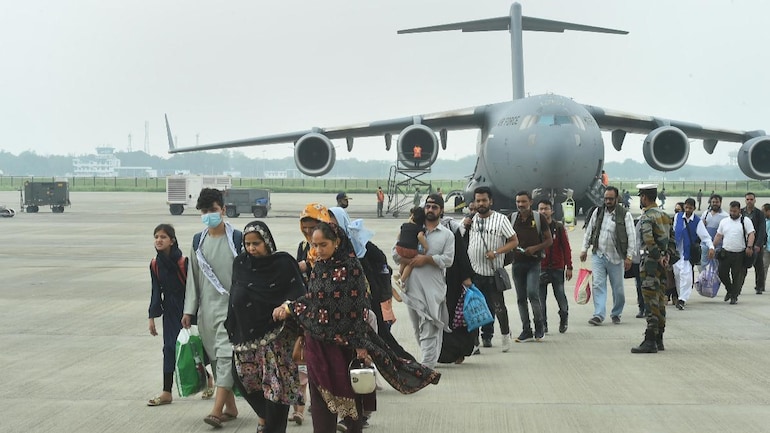
[Indians and Aghan dependents Airlifted from Kabul]
Wars occur, popular unrests happen, foreign interventions fail, governments fall, regimes change. These are constants of the Third World scene. Hence, there were no real surprises in the recent developments in Afghanistan. Predictably, the United States ran out of political will, the finger pointing over “Who lost Afghanistan” has begun in Washington, Ashraf Ghani got out of harm’s way, and the Afghan National Army disappeared like the two trillion dollars America spent on the “never ending war”. The only surprise was how with a minimum of fuss the Taliban reclaimed Kabul.
Now comes the tricky part for all the countries with a stake in Afghanistan of doing a hard count of gains and losses, and configuring future policies. This requires getting a fix on the prospective Taliban system, and the attitude of the five countries in play — India, Pakistan, China, Russia and the United States.
An emir advised by a guardianship council is the sort of sunni dispensation outlined in two Taliban-sourced documents — the 1998 ‘Dastur Emarat Islami Afghanistan’ drafted by some Islamic scholars at the bidding of the previous emir, Mullah Omar, and the ‘Manshur Emarat Islami Afghanistan’ of 2020 vintage. Both papers reject electoral democracy as lacking sanction of the Shar’ia. The leadership cohort headed by Habaibullah Akhundzada and Abdul Ghani Barader have so far sounded reasonable, promised an inclusive government and amnesty, but armed opposition is nevertheless coalescing.
Because the Taliban are a force of mostly Gilzai tribesmen, other Pashtun tribes could join the Tajiks, Baloch, and the shia Hazaras in making common cause with the former President Ashraf Ghani’s deputy, Amrullah Saleh, and NSA, Hamdullah Mohib, controlling several intact Afghan army units, and the Tajiks loyal to Ahmad Massoud congregating in the Panjshir Valley. With Col. Abdul Dostam mobilizing the Uzbek faction, resistance is firming up, potentially stronger than the Northern Alliance of yore.
India, Pakistan, China and Russia fear that, contrary to its pronouncements, the Taliban could coordinate with the al-Qaeda, Da’esh (Islamic State), Lashkar-e-Tayyaba and Jaish-e-Mohammad elements who were part of its victorious sweep through Afghanistan to respectively foment trouble in Kashmir, Talibanize Pakistan (via Tehreeq-e-Taliban Pakistan — TTP), radicalize the Uyghur Muslims of Xinjiang (by infiltrating armed militants through the Wakhan Corridor), and to spread “terrorist ideology” in the seven Muslim majority enclaves (Tatarstan to Bashkortostan) in Russia’s southern tier. China believes it can buy the cash-strapped Taliban’s compliance with massive credit and infrastructure projects (in return for concessions to mine lithium, gold, and copper, and extract oil and gas Afghanistan is rich in). Russia, publicly pro-Taliban, thinks it can encourage the adjoining Central Asian states to help the Panjshir opposition, which Tajikistan is already doing. Pakistan hopes its ISI can work the Quetta and Peshawar shuras it has hosted since the US initiated the war in 2001 to defang the TTP. All three countries are convinced they need to formally recognize the Taliban regime at the earliest to effectively pursue their separate goals.
India mindlessly followed the US lead and got out. America has reinforced its reputation for unreliability and India, by forsaking a Kabul presence and direct dialogue with the Taliban leadership, has lost the ability to closely manage its interests. Rather than “wait and watch”, India should garner first mover advantage by immediately recognizing the Afghan emirate. As a surprise move in the face of Western efforts to isolate the Taliban regime, India’s interests will be accommodated by the grateful mullahs, also because, TTP aside, it will be a counter-leverage against Pakistan. A diplomatic foothold will consolidate India’s influence and more effectively neutralise anti-India groups, such as the Gulbadin Hekmatyar-led Hizb-e-Islami, active in Kabul. This move, moreover, can draw on the enormous goodwill and popularity India enjoys, courtesy Bollywood musicals, Afghan cricketers in the IPL, etc. with the nearly 30% of the urban population the Taliban need to connect with.
The now experienced firm of Barader and Akhundzada understands that establishing an emirate is one thing. But constituting an “inclusive government” is something else, and that strict implementation of the Sha’ria will deny it the legitimacy it craves in a still West-dominated world. However, association with a democratic India will, to some extent, soften the Afghan emirate’s image, raise its acceptability levels, and incentivise the ruling clique to foster substantive relations with India. New Delhi can offer more development projects and this work has been appreciated by the Taliban for good reason. The India-financed and built Zaranj-Delaram Highway, for instance, has eased the transportation of opium poppy from remote fields to makeshift heroin processing labs on the Iran border, and increased manifold Taliban’s revenues from the illicit drug-trade.
The benefit of such a realist and clear-sighted policy is that it does not prevent India from maintaining its longstanding links with the Panjshir coalition. Indeed, the first mover recognition – the carrot, and the threat to strengthen ties with the resistance – the stick, wielded together will serve India’s strategic interests better than any other option can.
The US has high-tailed it out of Afghanistan. A pithy, darkly humourous, speculation of what will happen next in America in the wake of its military humiliation by a ragtag Taliban force, was provided by the mountaineer, Joydeep Sircar, who corresponds with me fairly regularly. “By the end of 2021”, he confidently prophecies, “Hollywood will produce multiple movies showing how heroically the Americans fought and defeated the Taliban as a first step towards airbrushing history. By 2025 a large portion of the American public will believe the USA won in Afghanistan. American military thinkers will produce scholarly works showing Afghanistan was a victory because the USA took 20 years to run away whereas the USSR took only 7, and managed a higher Taliban body count. [Indian army officers] deputed to the US War College will come back full of dollars, and praise the US skill in seizing defeat out of the jaws of stalemate.”!!! He could have added by way of a last line that a bored US will then scout the map to see where it can intervene next to change a regime or build a nation.
The Afghan National Army (ANA) the Americans funded and sustained over 20 years simply melted into the countryside, or the urban chaos, Taliban having done an exemplary job of signalling to those wearing military and police uniform that unless they abandoned their posts and all ideas of fighting, when caught they’d be shot like dogs, or hung from the nearest rafter. But how and why did this happen and with such suddenness and finality? Mohan Guruswamy has come up with some revealing statistics that point to the problem. Over the last 20-odd years the US and the West annually poured into Afghanistan grant-in aid worth $60-$70 Billion. The Ashraf Ghani dispensation (and before him Hamid Karzai’s) yearly spent about $11 Billion. The revenue it generated totaled $3 Billion. Simple Math suggests that this left roughly $68-$78 Billion as “loose change” for Hamid Karzai (2001-2014) and Ashraf Ghani (2014-2021) to play around with. This was the scale of corruption — a readily accessible and replenishible trough of hard currency every minister and senior official and military officer liberally helped himself to. It sapped, in the process, the fighting spirit of the army and the police and hollowed out the government. Signs of this were available with the ANA desertion rate of some 9% before Biden’s announcement of full military pullout rising to some 26% after it. The Taliban needed to merely tip over the shell of the Ashraf Ghani regime and of the ANA.
With the Taliban in Kabul and a warning from Washington to not in any way hinder the evecuation of American citizens, the only activity being witnessed is at the Kabul airport where masses of people are seeking desperately to get the hell out, some — as seen in video clips — even clinging to the tyres in the landing systems of giant C-17 transport planes as they took off, being shaken loose as the aircraft gained altitude, and plunging to their death.
This time around though the armed Taliban motorized units in Kabul seem more disciplined, and are doing things differently. They haven’t as yet dynamited the new India-funded and built Parliament building, for instance, as they did the Bamiyan Buddhas during their first stint in power, 1996-2001, under the one-eyed Mullah Omar. In fact, the official directive to the residents of Kabul is to carry on with their lives as usual but to respect the prohibitions on women. Whence, large bill-boards featuring women models selling this or that have been blackened. And the Taliban field commanders holding court in the presidential palace, pending the imminent presence of their leaders, are posing in the grand hall, not tearing it up.
The new Talibani emirate in the offing will be run by a trio. There is Habaibullah Akhundzada who is emerging as the spiritual head, Mullah Abdul Ghani Barader the founder, along with Mullah Omar, of the Taliban, heading the negotiations with the interlocuters from various countries, including India, in Doha, and the likely future Emir, and the man in-charge of military operations and controlling the fighting cadres — Mullah Omar’s son, Mullah Yaqoob. It will be interesting to see how the tensions between the stalwart, Barader, and the scion, Yaqoob, get worked out, or don’t and with what results, once the regime starts functioning.
But how do developments affect the neighbouring states and how are they preparing to handle their prospective relations with a Taliban government?
Of all the proximal countries, Pakistan is at once in the most advantageous position and, danger-wise, the most exposed. It has earned leverage with the Taliban owing to hosting and housing the leaders and their families in Quetta and in Peshawar for two decades after they were run out of Kabul by George W Bush’s regime-changing intervention post-26/11 attack on New York in 2001. Both these cities now boast tribal shuras presided over by these leaders comprising Afghans, who to- and fro- and longtime refugees from camps dotting the Pakistani side of the Durand Line in the Khyber-Pakhtunkhwa province (KPP) that notionally separates the two countries.
The problem for Pakistan that I alluded to in a previous post on this subject is this, the refugee Taliban element along with the Haqqani Network led by Sirajuddin Haqqani dominating the FATA (Federally Administered Tribal Areas) in northwestern Pakistan is only tenuously under Barader-Yaqoob’s control. Their ambition could drive them to want their own fief and to fight for an independent Pakhtunistan incorporating the southern Afghanistan belt and KPP. So, even though Taliban Central may feel beholden to ISI, the Taliban in Pakistan who form the bulk of the Tehreeq-e-Taliban Pakistan (TTP) have no such loyalty, and have, in fact, waged a war for many years against the Pakistani state. More recently, some of the TTP foot soldiers have gone across the Durand Line to assist the Taliban mainforce take Kabul, which they didn’t expect to be the child’s play it turned out to be. So, one can readily see how grave a threat TTP poses to Pakistan. The issue for ISI is whether Islamabad can cash in on Taliban gratitude and get it translated into a pacified TTP on the ground.
For China the Taliban takeover is a double-edged sword. They have the monies to simply bribe the Taliban into complying with their objectives. These are to (1) keep Islamic extremists — al-Qaeda and Islamic State (Da’esh), in the main, nesting in Afghanistan, from staging armed infiltrations into the Muslim Uyghur province of Xinjiang through the strategic Wakhan Corridor and stirring up that pot — a prospect Beijing is paranoid about, and (2) facilitate the Belt & Road Initiative (BRI) of which CPEC (China-Pakistan Economic Corridor) is flagship venture, and other rail-road, and oil-pipeline connectivity projects in Central Asia. China will also offer its trademark infrastructure buildup programme and as a financial fallback option for the Taliban who in government will be strapped for cash because of two things. Firstly, Afghanistan government’s financial holdings (some $9.4 Billion) are held in US treasury bonds, etc., and the Biden Administration has announced Talibani Kabul will not be allowed access it. And, secondly, Taliban generates most of its independent revenues — which helped it finance its war — from growing poppy and converting it into heroin for mostly the US and West European markets, and amounts to a whopping $8-$10 Billion annually. Should Washington also further constrict this latter illicit trade with more world-wide policing, Taliban will be in trouble. This is the reason why the Taliban have been fairly well behaved to-date. But China would not care to have this drug trade directed to its mainland, and will be just as apprehensive of that possibilty. Beijing will, of course, be happy to fork over oodles of monies as also millions of dollars worth military hardware of all kinds, to prevent this from happening. But for all these considerations Beijing, as is its wont when dealing with Third World states it wants to have transition into clients, will extract a steep price. In Afghanistan’s case, it is its extraordinary natural resources and mineral wealth. Soon we will be hearing about Kabul approving generous concessions to Chinese companies to tap into Afghanistan’s oil and natural gas reserves, and to mine coal, iron ore, gold, copper, lead, and zinc.
Does China ever not come out on top?
Russia’s concerns are different. It wants to minimize the role of the US and the West in Afghanistan and Central Asia at-large. Indeed, Russian Foreign Minister Sergey Lavrov has asked the Chinese government to coordinate its Afghanistan-related policies with Russia, and together to build up an anti-US front in Eurasia, which goal President Xi Jinping will be extremely enthused by. At the same time, though Moscow will strive to keep the Central Asian ‘stans from being tempted by Beijing’s economic promises and gravitating militarily towards China. It wants a return of the Soviet-era sphere of influence in Central Asia and Afghanistan is a key player for some of the same reasons that China perceives it — it does not want the Islam of al-Qaeda and Da’esh to spread to Central Asia or to its own smaller provinces around the Caspian Sea.
India has a few things going for it that other countries don’t. Barader and his leadership team in Doha have let it be known publicly that the Taliban appreciate the good development work India has done and the projects it has invested in in their country and, short of interfering militarily in Afghanistan’s internal affairs — something he warned Delhi against doing, have no interest whatsoever in diverting excess fighting manpower from their country to Kashmir or any such external cause. The Afghan cultural goodwill for India, moreover, transcends the Taliban-nonTaliban divide. Everybody there loves Bollywood films and cricket (especially after the success of several local boys in IPL). So much so that it was said during the Soviet occupation period that the Russians found an easy way to round up the Taliban in the cities and towns: Raid cinema theatres mid-show of Bollywood blockbusters where the bearded AK47-toting cadres, otherwise of severe mien, would be found dancing in the aisles and singing along in the song sequences! How strategists underestimate the power of Bollywood naach-gaana!
The trouble for India is not from the Taliban or the TTP. But from the Lashkar-e-Tayyaba (LeT) and Jaish-e-Mohammad (JeM) fighters who too went north to help the Taliban establish the emirate and, having done their bit, will now feel free with ISI encouragement to turn their attention to Jammu & Kashmir. Taking on these war-seasoned LeT and JeM fighters will not additionally tax the Indian army, which has become expert in tackling them. Rather the core problem for India is how to preempt China from putting down strong roots in Afghanistan?
Offering more development aid and infrastructure assistance and generally building on Afghan goodwill is one way. But how can Delhi ensure China does not corner all the Mining concessions in Afghanistan and, by other means, enhance its strategic presence in that country? There’s only one way — and I’ll stress this: IMMEDIATELY RECOGNIZE THE TALIBAN GOVERNMENT IN KABUL before eveyone else does. The first-mover advantage will impress Barader and Co. no end and incline them, pari passu, to give weightage to Indian proposals in contestation with China in economically developing that country, once we also offer military goods at “friendship prices” and our diplomats emphasize and keep propagandizing China’s inhumane treatment of Uyghur Muslims.
Such formal recognition will require a 180 degree turnaround from the position the Modi government has so far adopted — more, it seems, to please the Biden White House than to serve India’s national interest, of not recognizing the Taliban government owing to its bad human rights record and its plonking for a manifestly undemocratic system — which’s in line with the US policy. I am not sure how it helps India’s cause for its government to be a thekedar (guardian) of democracy in the region.
A former ISI chief, retired Pakistan army Lieutenant General Assad Durrani has, perhaps, mischievously suggested that India buy the Taliban government’s compliance on various issues, pointing out that even the US military that was supposedly fighting the Taliban in Afghanistan paid them $150 million annually to enable smooth passage of American truck convoys carrying supplies sustaining the American military operations in Afghanistan. Such payouts are actually a reasonable and realistic way around such Talibani intransigence as might be encountered!