DPC turning out, as expected, to be yet another bureaucratic pimple

Image result for pics of NSA ajit doval with indian military services chiefs

[PM and Doval]

The worst fears about the Defence Planning Committee (DPC) being yet another bureaucratic contrivance rather than an instrument for centralizing national security and defence decision-making were realized once the outcome of its first meeting became known.

One report talked about the DPC chaired by NSA Ajit Doval with the three armed services chiefs  — Admiral Satish Lanba, General Bipin Rawat, Air Chief Marshal BS Dhanoa, defence secretary Sanjay Mitra, expenditure secretary  Ajay Jha, foreign secretary Vijay Gokhale, and Lt Gen Satish Dua heading the Integrated Services HQrs as member-secretary writing up the minutes, surveying the “geostrategic landscape” and deciding to come up with an äction plan. Another reported that the stress was on the military services alighting on a coordinated plan to avoid developing duplication and triplication of capabilities that would be mindful of the financial constraints and keep in view rapidly advancing technologies and the likely nature of the wars of the future. In this context, the navy was asked not to push for the third indigenous aircraft carrier (that NHQ had hoped would have on board the prohibitively costly electromagnetic aircraft launch system (EMALS) that the US Navy is finding to be unaffordable.  All present also apparently agreed that the flab needs to be excised. That’s all that has come out in the public realm.

This is all very good, particularly the non-sanctioning of the EMALS carrier that this analyst has long suggested is a criminal waste of money and operationally will reduce the Indian navy’s footprint in the Indian Ocean, because the bulk of the not so very large naval forces will have to be deployed to protect its prized aircraft carriers — which however many ships are tasked as escorts will be unable to do given that the near future heralds the dawn of hypersonic glide weapons speeding to targets at Mach 7+ , superceding supersonic Brahmos-type missiles that had already rendered aircraft carriers obsolete as I have argued in my writings, and extensively in my last book, ‘Why India is Not a Great Power (Yet)’.

But these are operational aspects of force planning that the DPC, perhaps, will deliberate on, hopefully with an open mind, in the months to come. The basic problem, however, is with the forces that the services HQrs have planned. I have long contended that the Indian armed services, considering their organization and history, are not transformation-minded and, therefore, not transformation-enabled. What they have in mind when talking future war capability is beefing up the force structure in place with modern versions of weapons already in the arsenal. So it is one-for one replacement, which is all that they are catering for as their force planning predicate. This defeats the entire notion of a transformed military based on genuine integration in line function and in terms of support logistics, full-spectrum command, control and communications, and procurement.

Moreover, with robotic, functionally autonomous, weapons now being experimented with in terms of man-machine interface by advanced militaries, and with cyber capabilities integral to the offensive and defensive plans  and generally warfighting, what the DPC should ideally do is design a future force guided by these defining metrics. This will necessitate configuring a singular future force with air, land, and naval elements that are slimmed down, and which will require the military’s “tail” to actually be lot bigger in size than “teeth”. This goes against the grain of the flawed understanding of trending military technology in govt and military circles, which is reflected in the illiterate Indian print and electronic media, and in DPC wanting “lean and mean” military forces. (Talk of banalities!)

Such force redesign is impossible without a military organization with a single head of the armed forces and one-point adviser to govt — Chief of Defence Staff (CDS). CDS is what the Modi government promised before it was elected in 2014. Four years later the country gets the NSA as CDS (as the previous post in this blog argued) and in Doval, a policeman fixated on Pakistan and smaller and weaker neighbouring states, not a strategist with the mental wherewithal for strategic thinking. All you have to do is listen to the speeches he has delivered to-date (and to be found on youtube.com) to know that not a single original idea has ever been uttered by him on national security issues in the flood of banal statements that he has mouthed over the years. Hard to imagine then that overnight he will become a tremendous intellectual defence resource for the country, and hence even less likely he will be able credibly to give imaginative guidance to the services chiefs and MEA, or instruct the defence and expenditure secretaries to fork out the monies (which task — allocation of funds for military planning being beyond his brief as NSA-cum-DPC head).

What he will end up doing is leave it to the military chiefs to draw up plans. Whence, he can be certain there will be no re-orientation of the armed forces from Pakistan to China, and no restructuring of forces to follow in train, involving the rationalizing of the armoured-mech heavy land forces into a single composite armoured-mech corps with materiel and monies thus freed up diverted to raising and forward deployment of three offensive mountain corps for rapid debouching on to the Tibetan plateau for war. This would mean paying only lip service to the “Wuhan consensus” that Modi and Xi agreed on and which the foreign secretary Gokhale is threatening to implement when the trouble is there was no consensus.

Jay Ranade, the Mandarin-speaking former RAW man on China ops, for instance, points out that two very different communiques were issued at the end of the Wuhan Meet. The Indian version mentions “guidelines” issued by the principals to their respective militaries to ensure there’s no Dokla La redux, but the Chinese version, typically, has no such mention. Consequently, while India will put out — as per China friendly MEA’s faulty appreciation of what transpired at Wuhan, Beijing will sit pretty and do nothing other than maintain its agro on the LAC and await the Modi govt, prompted by Gokhale and his ilk to, as usual, do its trademark tail-between-the legs routine!

Meanwhile the defence secretary will again get to play god, and play off the three armed services against each other — because the DPC does not in any way sideline the defence secretary’s role. And the expenditure secretary will report to Finance Minister, Arun Jaitley, about the proceedings, allowing him to sit back  and do the normal thing when resources are scarce — fund programmes in drips and drabs to guarantee that India’s military has only limited capabilities for use against, weaker, smaller adjoining states, if that, leaving national security no better off after the DPC than it was before its founding. This is the reason why I had warned that the DPC will amount to nothing more than yet another bureaucratic layer gumming up the works, another bureaucratic pimple on the already pock-marked face of the Indian state.
 

Posted in asia-Pacific/Indo-Pacific, Bangladesh, Bhutan, China, China military, civil-military relations, Cyber & Space, Decision-making, domestic politics, DRDO, Geopolitics, Great Power imperatives, India's China Policy, India's Pakistan Policy, India's strategic thinking and policy, Indian Air Force, Indian Army, Indian ecobomic situation, Indian Navy, Indian Ocean, MEA/foreign policy, Military Acquisitions, Military/military advice, Missiles, Myanmar, Nepal, Pakistan, Pakistan military, society, South Asia, United States, US., Weapons, Western militaries | 23 Comments

DPC: Doval’s Aggrandizing move?

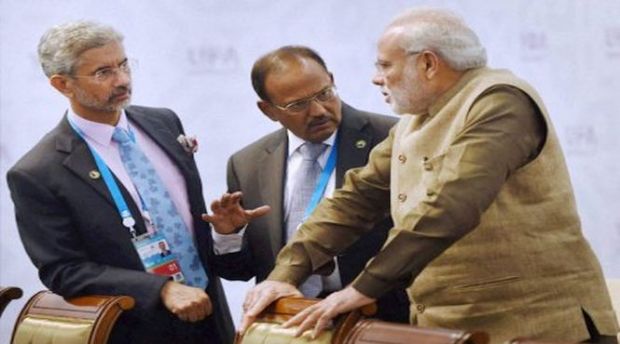
Image result for pics of ajit doval and k. jaishankar with modi

(Jaishankar, Doval and the PM)

The Defence Planning Committee (DPC) as the apex institution to deal with national security was in the works for awhile with Modi’s original plan of splitting the NSA responsibilities between the external and internal and retaining the retired Foreign Secretary S. Jaishankar for the external role, and Doval continuing with what he knows best as a police service veteran — intel and domestic security, being pushed out of contention by the man in place.  Doval succeeded in convincing the Prime Minister over time that such a move would be detrimental to national interest. Jaishankar’s retirement was the time Doval used to ensure the erstwhile FS did not get back in, whence the formation of DPC to function in effect as National Security Council (NSC) which, incidentally, has met just once or twice so far during Modi’s tenure, but with the three armed services chiefs as members.

Ideally, Doval would have wanted to be to Modi what Brajesh Mishra was to Atal Bihari Vajpayee — the person actually running the government. Except Modi is not the retiring, Scotch-loving, Vajpayee and Doval doesn’t have the personal relations with Modi that Mishra had with Vajpayee. Where Mishra could begin issuing directives, orders and instructions from  7, Race Course Road ere the clock struck eight (most evenings), Doval, as he told a Manmohan Singh-era senior official, only awaits “decisions by the boss” so that he can implement them. Doval knows his place in the Modi universe as someone who takes orders, not gives them. Were he to begin to act like Mishra did, Doval would be (1) ignored by people like the Additional Principal Secretary to the Prime Minister, PK Mishra, who personally are far closer to Modi, and (2) out on his ears.

So, the new fangled DPC was a means of getting Jaishankar out of the picture, fobbing him off with the waiver of the one-year “cooling off” rule so he can join the Tata’s as head of “global operations”. According to Sanjay Ahluwalia, ex-IAS, writing his eminently readable newspaper column, this job will fetch Jaishankar a cool six crore rupees yearly. Jaishankar’s attributes meld well with Tata’s corporate plans, for instance, its decision to be the “strategic partner” to Lockheed Martin to produce the 1960s vintage F-16 in India — which project will require’s Jaishankar’s fervent pleadings with Modi to be realized. Who is to say that, in line with the Indian government’s penchant generally to give away a lot in return for little and Modi’s own leanings, Jaishankar won’t succeed?

It is a win-win arrangement for Modi as well, who mostly prized Jaishankar for his America connections, and now feels that he will be able to complement the BJP regime’s push of a US tilted foreign policy through private sector channels. Setting India up as Washington’s poodle the PM believes is the big foreign policy achievement he can go to the people with, come the next general elections.  On this front, as in much else, he may have miscalculated because his policy of appeasing Washington has not worked a bit. Far from relenting, Trump has particularly targeted India — after all when does a punching back punch back? — as a prime subject for his bullying tactics. So no give whatsoever on the H1B/H-4 visa issues, on trade, or on transfer of advanced tech — military and civilian, and threat of sanctions via CAATSA (Countering America’s Adversaries Through Sanction Act) for buying arms from Russia. And when elections come around he will be hard put to indicate which among his many slogan-promises he has fulfilled, or to pacify an upset middle class who, other than the emergence of an illiberal state within, find their America dream (for their IIT and IIM-trained progeny) vaporizing without.

But, coming back to Doval’s nifty bureaucratic maneuver, what will DPC do exactly? And how? DPC would have had teeth had Doval also managed to get Modi to simply eliminate a whole bunch of agencies and organizations in the national security loop, entities like the Defence Acquisitions Council. But to centralize national security decision-making and render it more effective and efficient was never the intention behind establishing the DPC. All DPC does is add another layer to an already multi-layered heavy national security decision making apparatus of state, and will not do much, other than aggrandize Doval’s personal authority and power at the sub-PM level, assuming Modi allows any of it, other than as a bureaucratic contrivance to keep his NSA busy. For Doval it is yet another excuse for things not working, and for the boss’ decisions not getting implemented. So while aggrandizing bureaucratic turf he has distanced himself even more from accountability. Fancy babu footwork!

There may also be a still more intimate reason why Doval desires to be headman of DPC — it will enable him to lord it over the military chiefs. This is important because — and what a delicious insight from a former armyman, Colonel Ali Ahmed (Retd.), a Maratha  officer like his father Lieutenant General Mohammad Zaki (Retd) of 19 Maratha Light Infantry —   who speculates that Doval as a matriculate from the Ajmer Military School (formerly King George’s Military School), having failed or, perhaps, having never tried to enter the National Defence Academy as many graduating from KG Schools did, now sees a chance to play Commander-in-Chief, India! See Çol. Ahmed’s “A policewallah as proto chief of defence staff”, The Citizen, April 26, 2018, at http://www.thecitizen.in/index.php/en/NewsDetail/index/4/13644/A-Policewallah-As-Proto-Chief-of-Defence-Staff

[I should know — I passed out of King George’s, Belgaum, in December 1963 possibly around the same time Doval  got out of KGS, Ajmer, and what a yearning there is deep down for things military that one’s cohort was part of and one has missed out on.]

There may, however, be a bigger Constitutional problem with the Defence Planning Committee, which’s pointed out by the reputed Mumbai lawyer, Niloufer Bhagwat. She wonders if  the “National Security Advisory Board has any Statutory authority?  That  is [whether] this Advisory Board   is embedded in Law / Constitution or is it a creation [by] Executive Fiat , as this has Constitutional implications as such a body cannot overrule STATUTORY or CONSTITUTIONAL AUTHORITIES and cannot overrule the service chiefs or preside over any committee of the Armed Forces even of junior officers as the Armed Forces are bound by the Statute and the Constitution.  This is an important question which has arisen from the [establishment] of the Defense Planning Committee and has Constitutional Law and Administrative Law implications.”

Apparently, when Messrs Modi & Doval were creating the DPC they were not paying attention to Constitutional proprieties. I mean, did the DPC proposal pass muster with  the Ministry of Law and Justice under Ravi Shankar Prasad? Depending on who wants to take the Modi govt to court on this issue, the DPC may be racing towards a legal limbo.

Posted in asia-Pacific/Indo-Pacific, Asian geopolitics, civil-military relations, Culture, Decision-making, Defence Industry, domestic politics, Geopolitics, Great Power imperatives, India's strategic thinking and policy, Indian Air Force, Indian Army, Indian Navy, Indian Politics, Intelligence, Internal Security, MEA/foreign policy, Military Acquisitions, Military/military advice, SAARC, South Asia, Strategic Relations with the US & West, United States, US., Weapons | 18 Comments

Why Modi has failed in the foreign policy arena: the perils of Personalized Diplomacy

Image result for ics of xi and modi

A year before the next general elections, it is dawning on the Modi government that it has nothing much to show for the Prime Minister’s extensive travels all over the globe, whence the desperation-tinged diplomatic activity to fashion something out of thin air and that too with the sternest negotiator in the business — China!

The suddenly announced “informal summit” in Wuhan involving Modi and Xi Jinping on April 27-28, is presumably the vehicle that is supposed to get some results that Modi can crow about and Xi can hold up as the kind of transaction the Chinese supremo can extract out of a nettlesome country on its border with pretensions to become a “leading power” (of originally US description)!  Except, this coach is likely to turn, as in Cinderella’s case, into a pumpkin ere the clock strikes twelve or, as in this case, when the meeting at Xi’s private resort on East Lake ends with nothing in Modi’s bag!

That absolutely nothing will come out of this summit is hinted at by the prefix “informal”  attached to it. It means basically that even though the two governments tried desperately hard to narrow the differences on the numerous outstanding issues in which the two sides have a stake, nothing was able to be worked out, not between the Foreign Offices, nor at the level of the Foreign Ministers, Sushma Swaraj and Wang Yi, or Defence Ministers, Nirmala Sitharaman and General Wei Fenghe. And that it is now left to the principals to conjure up something.

What must particularly bother Modi is that time and again, in the run-up to the 2014 elections, he talked of “business” being in his “blood” which led the Indian people to expect, among lot else, that he’d also be extremely successful in cutting a whole bunch of deals to economically advantage the country. In the last four years the only deal the Prime Minister has managed to finalize is the $12 billion plus contract for 36 Rafale combat aircraft, an outlay for which France had previously promised 126 of these aircraft! This looks like a great deal. For France! So may be the French President Francoise Hollande deserves the award for champion businessman and deal-maker.

The question that arises in the face of such conspicuous failure is why Modi has failed? Perhaps he relied too much on his trademark hugs and embraces to personalize diplomacy to a point where he hoped the opposite numbers, succumbing to the charms of good fellowship, would up and generously agree to whatever Modi had in mind to obtain. The simpletonish premise here is that if you are physically pally with someone that person is somehow duty bound to be nice to you (which is subcontinental kind of thinking).  Except, as hard politicians just about every one of them kept to the true north represented by their nations’ interests and succeeded in pulling Modi over to their side rather than going over to Modi’s. This has happened frequently enough to now be a  pattern.

Consider this: Trump humoured Modi and gamely accepted his embraces in Washington and then stuck it into India — constricting the H1B visa worm hole through which a generation of Indian Indian techies — economic refugees with technical skills, had squirmed through with their careerist wives to the good life in America, imposing tariffs on imports from India (steel and aluminum), rejecting Delhi’s advice to return to WTO table, and readying legislatively to punish India for dealing with Iran, and for buying arms from Russia. And all this while Modi hoped that by tagging on to the American line, accepting Washington’s advice, he’d get something out of the US.

Or, China and Xi: the Indian Foreign Secretary Vijay Gokhale — a Mandarin-speaking  diplomat — the kind this analyst has always warned as more likely to further China’s interests than India’s — was permitted cravenly to seek approval from Beijing for putting the clamps on the Dalai Lama by preventing the Tibetan exile community from celebrating 60 years of his safe exile in India. This was obviously seen as a sweetener in the hope that this gesture would soften the Chinese attitude and negotiating stance on numerous issues. Messrs Gokhale and others of his China loving ilk should have known that this would only whet Beijing’s appetite, which is exactly what has happened.

Having correctly gauged that Modi was in urgent need of some success in the external realm, the Xi dispensation laid out the agenda. Foreign Minister Wang wants India to sign on along with China as a “guardian of globalism” and jointly work out means and measures to oppose Trump’s protectionist policies. Global trade is, of course, good for India but shouldn’t Modi demand that Xi eliminate the trade deficit of $50 billion in bilateral trade and accord Indian companies in China the same treatment as Chinese firms in India enjoy? And if Beijing fails, to impose harsher but indirect counter-taxes to equalize the economic opportunity, and to keep China out of the RCEP benefits basket unless that happens instead of Delhi always playing the sap and sucker?

But  there’s no hint that Xi will concede even a millimeter on matters of interest to India, in the main, the expeditious resolution of the border dispute and delineation of the Line of Actual Control as the formal boundary, and the acceptance of ‘One India’ in return for Delhi’s agreeing to the ‘One China’ concept; ‘One India’ to include the boundaries f the erstwhile princely kingdom of Kashmir meaning, ipso facto, Gilgit and Baltistan and the rest of Pakistan-occupied Kashmir. And that if Xi does not agree with this, then India would instantly withdraw from its earlier agreed position of the Tibetan Autonomous Region (TAR) as part  of China — which historically it never was, a fact proven by the Great Ming Unification Record of 1461.  (Incidentally, the conclusions of his revealing research into China’s imperial records going as far back as Yuan Dynasty (1279-1368) and up to the Ming Dynasty ,1368-1644, were conveyed  by Professor Hon-shiang Lau, formerly of the University of Hong Kong, in his lecture at the India International Centre on April 11, 2018,  among the most  enlightening this analyst has ever heard anywhere.) This research makes nonsense of the traditional Chinese claim of Tibet as part of China “since antiquity”, because it shows that “antiquity” means only as far back as the Yuan emperors in the Middle Ages, and then only to strengthen the point the Tibetan govt in exile has been making from the beginning that Tibet was never part of imperial China and was so acknowledged by the Emperors!

Indeed, the Great  Unification Records–are documents clearly describing the exact  extent of the Chinese Empire, listing all the regions within it, that the dispensation of each emperor prepared anew are clear in identifying Tibet as lying WELL OUTSIDE the Chinese imperial domain.

Shouldn’t Mandarin-speaking Foreign Service officers, who busy themselves with useless work, not be tasked with researching into these documents to buttress India’s case for a rethink on Tibet?  (Communist Beijing’s  explanation for this is — according to Prof Lau –that, oh, the Qing and successor emperors  “had not educated” themselves on Tibet!!! On such  historical nonsense are China’s territorial claims based. Shouldn’t  Modi bring this up and his government hereafter draw up a legal case to separate Tibet from China?

Because of the wrongheaded orientation of his government from the start — Modi will likely be fobbed of by Xi with some infirm commitment about Beijing perhaps reconsidering its India’s case for membership in the Nuclear Suppliers Group — a cartel that I have long argued will restrict India’s freedom for policy maneuver and to exercise leverage in the nonproliferation field for a change instead of always being victimised by the NPT regime; and about declaring Azhar Mahmood a terrorist,and some small understanding that PLA will not start a flareup in Dok La and elsewhere on the LAC that could give the Indian army a bloody nose and sink Modi’s re-election chances.  Modi will return happy with this kind of small giveaways that he will then ballyhoo as some great achievement. If the Modi government thinks that the Gagan Shakti kind of military exercise (11,000 sorties, 6 sorties per platform per day) will impress, it should think again. They should recall that in 1958 when a joint air-army exercise was staged in Ambala for a visiting Chinese dignitary who led the PLA  in the 1962 War, complete with Hunter aircraft on strafing sorties, the PLA commander coolly turned to ask Nehru if he thought aircraft would be available to the Indian army in the mountains!

That Xi is the hardest negotiator Modi has met is evident from a simple fact: Modi never tried to hug Xi — if he did, he must have done so in secret because there are no pics of this momentous embrace on film. That’s because Modi instinctively understands that Xi is a hard nut to crack, as have been the other foreign leaders he has summitted with, except the Chinese leader is unwilling to give Modi even the satisfaction of a hug that as far as Modi is concerned signals to the Indian masses and media greater understanding and level of intimacy than exists in reality with leaders who push their national interests in extremis, even as Indian PMs are happy with pats on their back, while the country gets it in the neck.

The “informal” Modi-Xi summit is hence a lot of hoo-ha amounting to  nothing.

Posted in asia-Pacific/Indo-Pacific, Asian geopolitics, Bhutan, China, China military, civil-military relations, domestic politics, Europe, Geopolitics, Great Power imperatives, India's China Policy, India's strategic thinking and policy, Indian Air Force, Indian Army, MEA/foreign policy, Military/military advice, Pakistan, South Asia, Terrorism, Tibet, United States, US., Weapons | 18 Comments

Dancing with the dragon

File photo of now Defence Minister Nirmala Sitharaman, Prime Minister Narendra Modi and National Security Advisor Ajit Doval meeting Chinese delegates at the Sixth BRICS Summit, in Brazil on July 15, 2014. (Photograph: PIB)

(India-China meeting at the Sixth BRICS Summit, in Brazil on July 15, 2014)

A spate of ministerial visits is in the offing as a run-up to Prime Minister Narendra Modi’s summit with Chinese President Xi Jinping in the summer. The Minister for External Affairs Sushma Swaraj will be in Beijing on April 23-24 to jaw-jaw with her counterpart Wang Yi—recently elevated to concurrently hold the post of State Councilor as well—and there’s the overlapping trip by Defence Minister Nirmala Sitharaman for talks with her Chinese counterpart Lieutenant General Wei Fenghe on April 24, as part of the meeting of the Shanghai Cooperation Organization Defence Ministers.


Swaraj is a veteran politician, Wang a professional diplomat, and the two can be expected to nimbly move around the minefields of policy differences and clashing national interests. Sitharaman, on the other hand, is a relative political lightweight going up against Wei, a former commander of the Second Artillery Strategic Forces – China’s thermonuclear deterrent, a stalwart People’s Liberation Army general who helped Xi strengthen his grip on the Chinese military and state, and has been rewarded. Sitharaman may be technically and experientially over-matched, and could give away too much if she believes that could win her some points with Prime Minister Modi.

What Modi wants is anyone’s guess, but what he doesn’t want from now to whenever the general election is called is for a sharp Chinese military campaign on the Line of Actual Control that will bloody the Indian Army, because then he will electorally have hell to pay.

 The Prime Minister’s Office and Ministry of External Affairs could have helped Sitharaman ensure she does not find herself in too deep waters too quickly by having the two ministers making the visit meet with each other in Delhi prior to their trips to coordinate their approaches and talking points. This has not happened (do we know for sure?) possibly because of (1) a possible competitive factor – Swaraj may be afraid of Sitharaman out-shining her in pushing Modi’s agenda, considering that unlike the former, a rival for the Prime Minister’s post in 2014, the latter, a political junior, has never had strained relations with, and is trusted by, Modi; and (2) the fact that institutionally Ministry of External Affairs and Ministry of Defence have never seen eye to eye, and don’t do so now – par for the course in a system of government where ministries are sovereign and work in their respective silos, invariably at the cost of the country and the national interest. It is a liability Modi has done nothing to correct in the last four years.


What the Modi government has been enthused about regarding SCO is its RATS (Regional Anti-Terrorist Structure) initiative, because it sees it as a means of needling its bete noire, Pakistan. Except Pakistan, which gained admission into SCO at the same time as India, is also active in RATS, secure in the knowledge that the focus of this anti-terrorist forum based in Tashkent is Daesh (Islamic State) and China’s to see that Uyghur elements in Daesh don’t slip back into Xinjiang, and not so much the Masood-Azhar run Jaish-e- Mohammad. So, it is unclear how Modi means to mobilise and have SCO line up against Pakistan on the terrorism issue. But it is good optics and Swaraj and Wang will make much of India and China striding side-by-side on this topic even if they don’t get anywhere.

The more potent and seminal disagreement between the two countries on the matter of the unresolved border remains.

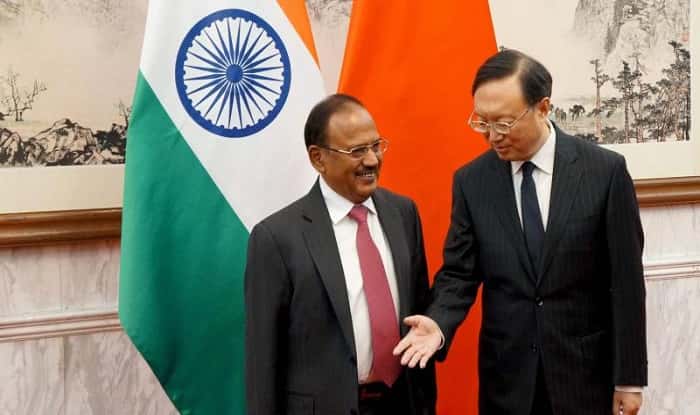
The April 13 meeting of National Security Adviser Ajit Doval in Shanghai with Yang Jiechi, former State Councilor and China’s special representative for the border talks, proved futile and Doval was given the usual Chinese verbal runaround by Yang.

File photo of National Security Advisor Ajit Doval with Chinese diplomat Yang Jiechi. (Photograph: PTI)
(National Security Advisor Ajit Doval with Chinese diplomat Yang Jiechi)

The dilemma India faces in this special representative scheme is two-fold. Doval has no familiarity with the Mandarin language and is at a disadvantage because Yang can at any time lead the Indian NSA to believe that there‘s progress but when it comes to formalising what was discussed, like laying down some basic principles of negotiation, he can always take a step back saying the Indian misunderstood what had been said. This is an old Chinese negotiating trick based on the Chinese language that Chinese officials insist on using.


If Delhi responds by having its Mandarin-speaking diplomats as special representative, as when Shivshankar Menon, who preceded Doval in the NSA post, also doubled up as the chief negotiator, then India ends up ceding negotiating turf. The third way—of learning a trick or two from the Chinese and turning the tables on them—by having Indian interlocuters negotiate only in Hindi or Tamil or some other Indian language, is not a ruse that has possibly ever occurred to MEA and the Government of India and, in any case, is not followed.


So what will Swaraj and Wang talk about? Swaraj, of course, will try and get Wang to agree to withdraw China’s objection at the United Nations to designating Mahmood Azhar and his JeM as international terrorist organisation. In return, Wang will naturally ask that Delhi play ball on Xi’s Belt and Road Initiative, specifically be less obstructionist on the China-Pakistan Economic Corridor. Is this fair exchange?

Can Mahmood Azhar be equated to CPEC?
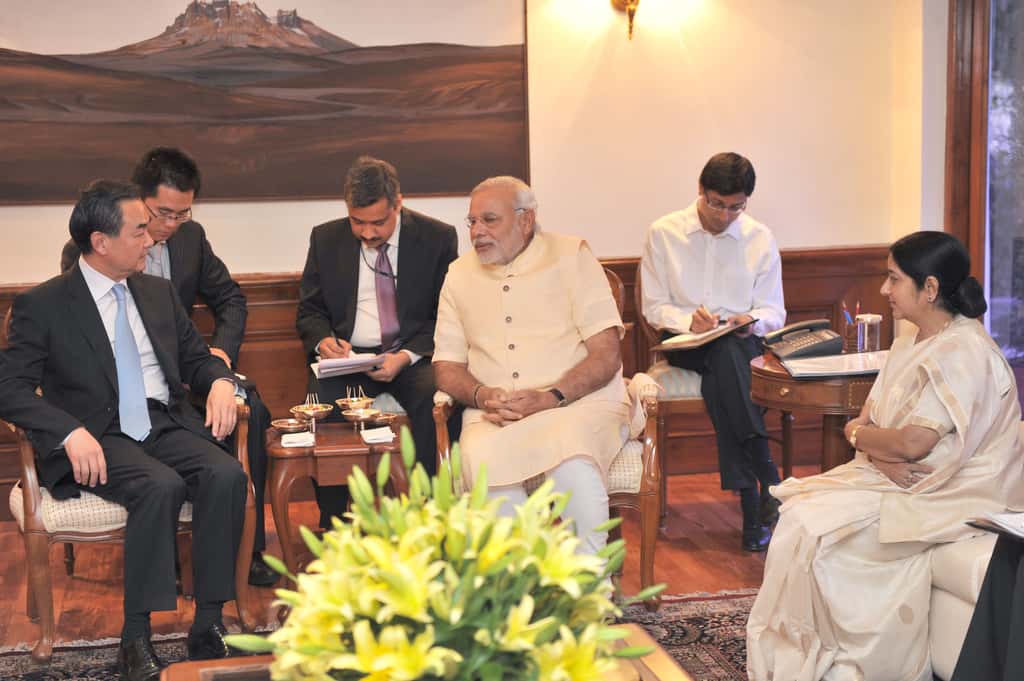
Minister of Foreign Affairs of the People’s Republic of China Wang Yi meets Prime Minister  Narendra Modi and Minister for External Affairs Sushma Swaraj in New Delhi, on June 9, 2014. (Photograph: PIB)
(Chinese Minister of Foreign Affairs Wang Yi meets Prime Minister Narendra Modi and Minister for External Affairs Sushma Swaraj in New Delhi, June 9, 2014)

By the Modi regime’s reckoning, perhaps, yes. After all, it has been repeatedly pacified by Beijing with odds and piffles. Recall that Modi, instead of threatening to end the unequal trade that has resulted in a gross balance-of-payments problem for India, was happy in a previous summit with Xi’s permitting Indian pilgrims to access the Kailash-Mansarovar mountain via the Nathu La Pass-route!


So what will Sitharaman do? She is likely to, pro forma, bring up the staple of international terrorism and that’s where it will rest, leaving Pakistan untouched.

General Wei could demand India gets out of the Bhutan-Sikkim junction altogether, which the Indian defence minister, hopefully, will deflect.

But Sitharaman is in no position to negotiate ways and means of stabilising the security situation in that area in the context of India’s pathetic infrastructure void – the complete absence on the Indo-Bhutanese side of pucca roads and communications and logistics net that the Indian Army chief General Bipin Rawat has time and again publicly voiced deep concern about. The Chinese PLA is well aware of India’s weaknesses and, therefore, of the fact that India cannot militarily implement the shove beyond the push witnessed in that standoff at Dok La last summer.


Sure Beijing is presently caught in a web of uncertainty about how the trade war, now in the nascent stage, with the United States initiated by President Donald Trump will proceed, and Xi will not want to push Modi into going hyper-nationalist on security, or with regard to India’s $50+ billion trade deficit. But this should be small comfort to the Bharatiya Janata Party government which, far from living up to its ‘nationalist’ billing, will have to fight off the twin-charge that it has, on the one hand, appeased China and, on the other, reduced India to the status of a U.S. client, and this as the country races headlong into the 2019 general election season.

[Published in BloombergQuint.com April 22, 2018, at https://www.bloombergquint.com/opinion/2018/04/22/dancing-with-the-dragon ]


Posted in asia-Pacific/Indo-Pacific, Asian geopolitics, Bhutan, Central Asia, China, China military, civil-military relations, Culture, Decision-making, Geopolitics, Great Power imperatives, guerilla warfare, India's China Policy, India's strategic thinking and policy, Indian Army, Indian ecobomic situation, Internal Security, MEA/foreign policy, Military/military advice, Pakistan, Pakistan military, SAARC, society, South Asia, Terrorism, Tibet, UN, United States, US. | 6 Comments

Is the Indian military more sovereign than the Indian government?

Image result for defence minister sitharaman at the 2018 defence expo, chennai javascript:void(0)ai -- pictures

[Defence Minister Nirmala Sitharaman at the Defence Expo, Chennai, April 11, 2018]

Defence Minister Nirmala Sitharaman is proving to be a one-person wrecking crew for India’s aspirations to emerge as a significant designer-producer of military goods, including capital weapons platforms (combat aircraft, warships, artillery and armour).

Public figures, especially politicians, should be warned that it is safer to be perceived a fool than open one’s mouth and prove it.  Sitharaman who is careening from one self-made disaster to another has done just that, opened her mouth. Recall that recently she had appointed a so-called Defence Advisory Council or Board or something, to counsel her on technical matters related to her brief, which initiative blew up in her face when it was pointed out that two of the eminences she had sought to place in it were US citizens! I had warned in a blog at the time of her appointment as defence minister  about her past employment with Price WaterhouseCooper and BBC, and hinted at what this may portend for such decisions as she would be called upon to make in MOD. In which context, may be this was not all that great a slip after all considering what she said in Chennai yesterday at the 2018 Indian Defence Expo.

The amateurish minister, apparently bent on dishonouring the office she holds and plunging the Modi government into still hotter political waters than it is already in owing to just about everything in the country that can go wrong, going wrong for it, asserted that the armed services were free to source their requirements from anywhere in the world and that the government was not in any position to compel them to buy Indian.

Here’s her quote in extenso for readers to judge: “When I am promoting Indian exports, Indian manufacturing, I am also telling the forces to procure domestically as much as possible. I would want to draw  a thin line between the government’s enthusiasm to make sure the production capabilities are such that they meet international standards and are export-worthy and the other side of the line where the Army, Navy, or Air Force make their decision on what they want, what combination of equipment they want and in that that combination if an India produced item fits in well. I can only go that far and not further, just as they can only go that far and not further without compromising each other’s interests. I can’t imagine prevailing upon them. We will only want them to give space to local manufacturers and buy indigenous products.” (For the quote see “Can’t force ‘Made in India’ arms on military: Nirmala”, Times of India, April 12, 2018)

Astonishingly, what the defence minister thus  proclaimed was that the Indian military was more sovereign than the Indian government, that the armed services are entirely free to decide the armament they want, write up the specifications — derived from brochures of Western arms companies, such as to fit foreign weapon systems, and go ahead and indent for them, forcing the government to buy it for them, while completely ignoring the government’s policy aim of achieving arms self-sufficiency for the country and undermining the investments in thousands of crores of rupees in building up India’s defence industrial wherewithal and design-to-delivery capability in the public and private sectors.

Did Sitharaman clear this quite extraordinary policy pronouncement with Prime Minister Narendra Modi? If she did, it means that Modi has signed off on this line of thinking, and that India’s status as an arms dependency is now formally cemented, with the message telegraphed clearly to foreign countries and their arms industries that India will hereafter buy anything military as long as its armed services can be prevailed on to first ask for it from the government. And how easy is that to arrange? You can bet the services headquarters will be racing with each other to dust up their wish lists for presentation to the Defence Minister, hoisting Sitharaman with her own petard. And the foreign arms companies will be just as quick off the blocks to find their marks among the senior officer cadre in the three Indian armed services who will favour this or that armament and induce their services to demand them as “urgent requirement” of course, as minister Sitharaman has advised.

What then of the Modi initiative to train Indian defence attaches and task them to sell India-made military goods to countries they are posted in? How’s this to work then? Which demented developing state will buy military equipment made in India that the Indian military turns up its nose at? Conversely, won’t the biggest selling point for a genuinely India-designed and made weapon systems be that the Indian armed forces — one of the largest in the world — are using them in vast numbers? But so basic an aspect of the arms trade has escaped Modi, billed as a “prime marketeer”. He may as well close up the Indian defence industry shop.

Sitharaman’s “thin line”, moreover, is more confusion confounded because all that the three services need to ensure when articulating their armament demands identifying the items and the sources from where these are to be procured, she said, is that they not “compromise” each other’s interests, the larger national interest of incentivising an indigenous defence industry to grow and flourish by first selling its wares to the Indian military  be damned!

This is the denouement ‘Make in India’ was headed towards and was so predicted in my writings and in my posts on this blog. But even a professional skeptic such as I didn’t foresee the brazen-ness with which this government means to drive the nascent Indian defence industry into the ground with not even the proverbial fig leaf for cover.

Or, Sitharaman believes in magic! How else to explain why she believes that the Indian defence industry does not need the massive orders from the Indian military channeled deliberately by the government to it in order for it to first set itself up as a viable and going concern that can thereafter as effectively and efficiently meet the Indian armed services’ requirements as service an export market? Or, does she believe that the Indian defence industry is already on par with the US, Russian, French, British and Israeli defence industries, and needs no help whatsoever from the government? Even if she believed this was the case, this invitation to foreign arms suppliers for an open season in India is absolutely incomprehensible, considering that even the US does not permit its military to source its armaments from wherever it may choose; it has to meet exacting Congressional standards that insist on preference be accorded American defence majors. Apparently, the muddle-headed Sitharam thinks India is more advanced than the US, or at least far richer to be able to afford her/Modi governemnt’s follies.

This is a devastating development, one that the ignorant and security-wise iliterate  Indian media and commentariat will not pay sufficient attention to. But it is certain it will growingly be a political issue that the opposition parties will gladly prepare as a noose to tie around the BJP government’s neck.

If the usual clarification is not forthcoming from  MOD, it means the above is a fair reading of  Sitharaman’s pronouncement, and that a new, infinitely more regressive, arms procurement metric is being established as the norm. It bodes very ill for the country (but is harbinger of goodies for defence and MOD personnel in the defence procurement loop because they will now be courted by foreign countries as never before).

Sitharaman and Modi will go down in history for all the wrong reasons as ultimately dim-witted leaders without the strategic mind or wit to do the right thing by the country.  If this is not to happen, the Prime Minister will be well advised to disavow Sitharaman’s statement, pronto, and — if she has to be retained to save face — to shunt her out to some nondescript ministry where if she can’t help, she can do no harm either.


Posted in arms exports, asia-Pacific/Indo-Pacific, Asian geopolitics, civil-military relations, corruption, Decision-making, Defence Industry, domestic politics, Europe, Geopolitics, Great Power imperatives, India's strategic thinking and policy, Indian Air Force, Indian Army, Indian democracy, Indian Navy, Indian Politics, Israel, Military Acquisitions, Military/military advice, United States, US., Weapons, Western militaries | 22 Comments

What aircraft is this RFI for?

Image result for pics of IAF chief and staff

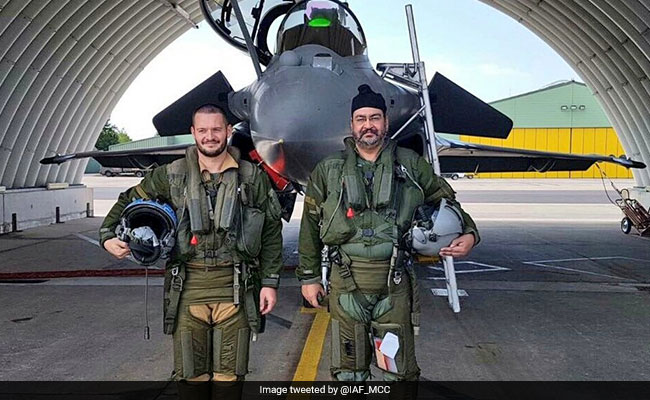
(ACM BS Dhanoa before a Rafale sortie)

An RFI for 110 combat aircraft was today issued by IAF without clarifying whether these are to be single engine or two-engine fighter planes. There re some technical criteria — altitude ceiling, etc. that mean nothing because most modern aircraft will meet them.  It goes on to say  that of these 82-83 aircraft would be single seat and the rest 2-seat trainer aircraft, and that the deal would  be on the basis of a strategic partnership model — with the foreign aircraft supplier collaborating with a capable Indian industry major to set up a manufacturing facility to produce 93-94 of the 110 aircraft in India, including supply chains in-country, and the remaining 16 aircraft bought off the shelf. This will mean that any aircraft producer in the world that has a single engine or 2-engine fighter plane to sell will now hightail it to Delhi.

So, what are the aircraft that will be on offer? To list the aircraft that fits this general bill the list will have F-16 (Lockheed), F-18 (Boeing) from the US, Gripen E (Saab) from Sweden, Typhoon Eurofighter (EADS) from Germany, Rafale (Dassault) from France, and Su-35, MiG-35 and the Su-57 FGFA from Russia. And had China been in the mix, it could have brought in its J-20!

There is method in the way the RFI is crafted. It (1) alienates no country or potential aircraft supplier  — the rescinding of the plan to buy 114 single engine warplanes  for Rs 1.15 lakh crores upended the schemes for the production in India of the F-16 that IAF doesn’t want, Lockheed was flogging, and which upset the Trump Administration; this RFI is a sort of corrective, (2) compensates for Modi’s buy of 36 Rafales from France for the same amount of money as was set aside for 126 of the MMRCA with transfer of technology, which justly drew flack and plunged the Modi government in hot water,  (3) reassures the IAF which has been squawking nonstop about depleting fighter squadrons in its fleet, & (4) kicks the decision to buy a combat aircraft way down the road and well after the 2019 general elections.

It is obvious the option IAF would prefer is to add 110 more Rafales. Dassault having pocketed $12 billion for 36 of these would be happy to sell the rest for another $20-$30 billion with TOT. And well connected Reliance Defence is already chosen as its strategic partner.

F-16, Eurofighter, and MiG-35 didn’t cut it in the MMRCA sweepstakes, their chances are unlikely to be revived this time around. That reduces the competition to the Russian Su-57 and Rafale. (Su-35 doesn’t count  because it is about on par with the Su-30MKI upgraded to the “super Sukhoi” configuration, inclusive of 3-D thrust vectoring nozzle, AESA radar, etc.).

But India has already invested some $300 million in the FGFA and as part of the collaboration deal can place its  aircraft designers at the Sukhoi design Bureau to pick design trends and new technologies. This will be useful in terms of the trained Indian designers being tasked to the AMCA programme.

As with TOT provisions in past contracts, Rafale TOT will come with the advanced technologies as “black boxes” — which is not helpful, and force structuring-wise will not fit in with a future coherent air orbat — of the Tejas Mk-2, AMCA, super Su-30 and FGFA.


Posted in arms exports, asia-Pacific/Indo-Pacific, Asian geopolitics, China, China military, Culture, Decision-making, Defence Industry, domestic politics, DRDO, Europe, Geopolitics, Great Power imperatives, India's strategic thinking and policy, Indian Air Force, Indian ecobomic situation, MEA/foreign policy, Military Acquisitions, Military/military advice, Russia, russian assistance, russian military, South Asia, Strategic Relations with the US & West, Technology transfer, United States, US., Weapons | 11 Comments

Advantage India

Image result for pics of Hanoi east asia summit

(12th East Asia Summit in Hanoi)

Why India needs to constitute and lead BRIS (Brazil-Russia-India-South Africa) — BRICS without China and the Mod Quad (India, Japan, Australia, Southeast Asian nations) — the Quadrilateral minus the United States

———-

THE UNITED STATES is a ‘fading power’, China is racing to replace it at the top, and Russia has the military wherewithal to stop either of them cold, but lacks the economic heft to make it on its own. Great power politics are thus in a state of flux more than at any time in the recent past. The goal for India, in this context, should be to cobble together coalitions to deny China the upper hand on its periphery, in the Indian Ocean region, and in Asia at large while rendering the role of the US less central to the security of Asian states.

The natural tendency of the US and China as proto-hegemons is to dominate whatever groups they are part of, with lesser powers having to sacrifice their own interests and concerns. Hence, it is imperative that ‘middle powers’ cobble together strong economic-cum-security arrangements organic to their regions, relying principally on their own individual and joint capabilities and prowess.


New security-related arrangements can be based on two existing economic groupings. There is BRIS—Brazil-Russia-India- South Africa, that is, the BRICS states minus China—and then there is the Quadrilateral minus the United States, or modified Quadrilateral or mod-Quad, consisting of India, Japan, Australia and a group of Southeast Asian states, which can collaborate with the US to ring fence and hamstring China without making the American contribution central to the group’s collective security aims and activity.

Greater intra-BRIS and intra mod-Quad parity will mean a higher level of trust, a more equitable style of functioning, and greater policy latitude and freedom of action or strategic autonomy for member states. It will result in better coordinated BRIS and mod-Quad actions with their formidable collective economic, trade and military capabilities restraining China, while making the US redundant. As the country common to both BRIS and mod-Quad, India will be pivotal to the success of both. Indian governments in the 21st century have, however, been timid, eager to reinforce the country’s status as ‘responsible state’ that is rising without disturbing the international order.

For BRIS and mod-Quad, China is a useful adversary, considering that most countries fear it, and almost any move directed at chipping away at Chinese power and advantage, strategically discomfiting it, will bolster their own security. It will require the ‘weaponising’ of these coalitions by making cooperative security as much a shared objective as free trade and economic cooperation. The combined GDP of BRIS in 2017 was $6.6 trillion, about half that of China and a third that of the US. By 2022, the BRIS figure is expected to grow to $8.8 trillion. What BRIS lacks in economic heft relative to China, it can make up by controlling the Asian behemoth’s economic fate. BRIS states control immense resource-rich frontages on three oceans—Atlantic, Arctic and Indian—and on the Eurasian landmass, including Central Asia.

This is no mean leverage for BRIS states individually and jointly to wield against China. With only limited openings—and that too contested— on the East Sea and South China Sea, China finds itself in an unhappy position for an exports-dependent nation: its trade traffic has to negotiate adversary-controlled seas. Moreover, US President Donald Trump’s imposition of tariffs on steel imports will victimise India as also Brazil. It has already led Latin American countries to look to Asia for trade partners— an opportunity the Narendra Modi Government cannot afford to pass up to stiffen a trade front to counter Washington’s moves. For this purpose too, the BRIS configuration can come in handy. With BRIS opposed to hegemonism everywhere, it can balance China and the US and become a force for peace and order in the world and a military and economic counterweight to either of them. It will boost the international standing of Brazil, India and South Africa in case of the UN Security Council expansion and/or restructuring.

The mod-Quad of India, Japan, Australia and the Southeast Asian nations, on the other hand, is an obvious geopolitical construct, interweaving the economic and security interests of the littoral and offshore states on the Asian ‘rimland’ first envisaged by the American geostrategist of the mid-20th century Nicholas Spykman as sufficient to contain any heartland power. The mod-Quad is a trillion dollar club with Japan, India, ASEAN and Australia boasting of collective 2017 GDP of $10.8 trillion, each of whom fears China. So what will elicit a positive response to the mod-Quad concept are two things: The ‘over-stretched and under- resourced’ American armed forces, according to US Defense Secretary James Mattis, and evidence of Washington’s reluctance to militarily tangle with China in disputes involving maritime borders in the South China Sea and the Senkaku Islands claimed by Japan.

The US withdrawal from the Trans-Pacific Partnership has only confirmed the worst Asian fears about an unreliable America. Geographically more distanced from China, Australia senses greater foreign policy space and latitude for itself, but in its 2017 Foreign Policy White Paper, the country has voiced concern about an ambitious China and the gradual military pullback of the US from the Indo-Pacific region.

China’s military pressure on India, Southeast Asia and Japan is felt on a daily basis and security cooperation is a matter of self-protection. Except, each country has a different payoff matrix with China to contend with. Even so, the shared concern for national security and sovereignty means that the nested military capabilities of the mod-Quad are easier to mesh into an informal collective effort. India, for instance, has ongoing naval cooperation with most of these states and Japan, and can sign agreements on naval and air force basing arrangements with other Southeast Asian states— especially Vietnam, the Philippines and Indonesia— of the kind signed with Singapore to assert the freedom of navigation rights in waters through which pass 80 per cent of China’s oil and 11 per cent of its gas imports from the Gulf. Moreover, the Indian Navy- initiated Indian Ocean Naval Symposium and the annual Milan Exercise for the Bay of Bengal nations are embryonic security cooperation platforms.

In the Sino-Indian context, were it not for the doubts and scepticism about India’s resources and capabilities entertained by those within the Indian Government, India would have long ago embarked on ventures to strategically discomfit China. A mere listing of some options that Delhi has so far foresworn will hint at their potency and potential for bridling China: Transferring Brahmos supersonic cruise missiles and medium (700 km) range Agni-1 ballistic missiles on a priority basis and in bulk to Vietnam, the Philippines and other Southeast nations to neutralise the artificial island bases China has conjured out of coral and cement in the South China Sea, formalising relations with Taiwan, equating Kashmir with Taiwan/Tibet, activating the Tibet and Uyghur-East Turkestan freedom ‘cards’, and cultivating Mongolia as an Indian military outpost. China cannot up the ante as it has already shot its bolt, done its worst, and because there are more states on its periphery fearful of China than there are neighbouring countries that want to stick it to India. Moreover, a poorer India with less to lose can be more risk-acceptant and prosecute more disruptive policies confident that Beijing, with lots more at stake, will not chance escalation.

The fact is China cannot command the sea lines of communications in the East Sea, the Indian Ocean, or the confluence of the Atlantic and Indian Oceans. It cannot control the extended littoral, and cannot risk the situation getting out of hand in the South China Sea. And the wealth-producing Chinese sea-borne trade is at the mercy of potentially adversarial states, which serves as a guarantee of China’s good behaviour.

With BRIS shoring up the land and Indian Ocean fronts, China will be rendered manageable for the mod-Quad, making any US role as security provider unnecessary. This will be organic security at its best, with regional states as the main stakeholders.

——————–

Published in the Open Magazine, March 30, 2018, http://www.openthemagazine.com/article/comment/advantage-india


Posted in Africa, asia-Pacific/Indo-Pacific, Asian geopolitics, Australia, China, China military, Culture, Geopolitics, guerilla warfare, India's strategic thinking and policy, Indian Air Force, Indian Army, Indian ecobomic situation, Indian Navy, Japan, Latin America, MEA/foreign policy, Military/military advice, Northeast Asia, Relations with Russia, Russia, society, South East Asia, Strategic Relations with South East Asia & Far East, Strategic Relations with the US & West, United States, US., Vietnam, Weapons | 8 Comments

FGFA back in the reckoning?

Image result for pics of Su-57

(Su-57s in flight)

Defence Minister Nirmala Sitharaman will be visiting Russia for 5-6 days starting April 3.  Talk is swirling about the minister reviving the now up-now down FGFA (fifth generation fighter aircraft) programme with a formal contract to proceed with essentially buying the Sukhoi-57 with some small modifications. This in any case is what Moscow hopes will happen. It is also a means of mending relations with Putin’s Russia because, let’s be clear and realistic, without Russian assistance and continued friendship India’s strategic prospects are bleak.

This comes after the fiasco of the Rafale deal where the CCS approval happened in early 2018, a good three years after Prime Minister Narendra Modi stunned everyone including the French by acting as Santa Claus bearing gifts for the struggling Dassault company and the French combat aviation sector with his announcement for the buy of 36 Rafales off the shelf. This was a god-sent deal because Paris had until then failed to rack up any sales for this aircraft. After the recent state visit by Emannuell Macron Dassault is more confident than ever that the contract for 36 planes will be stretched to an eventual offtake of three times as many Rafales but at a unit price higher than Rs 670 crore!! This is a bonanza France will treasure. What the Modi regime has got in return is airy-fairy stuff — promises of high-technology, solar alliance, etc. the sort of thing Delhi has always been a sucker for. Bu the high cost factor means India cannot fool around with the kind of idiotic deal for the museum piece — F-16, let alone as warm up, as some screwy commentators have been suggesting, for the still bigger lemon in the US fleet, the F-35, that other than its information fusion-situational awareness technology is an absolute disaster because all it relies on is BVR, which is small consolation indeed.

IAF brass has mightily resisted the Russian FGFA for reasons that are jejune at best — with complaints they invariably manufacture any time a Russian aircraft hoves into sight — insufficient stealth, under-powered, and the perennial — spares and servicing problems, complaints that are based on flying a prototype. But faced for reasons of economics with buying a Russian aircraft to get the numbers up, they have thrown a curve ball, and asked for the Su-35 as interim solution to the indigenous Indian FGFA project. And to further mess up things and, perhaps, also to perhaps try and collaterally kill off the Tejas LCA. This didn’t happen because, mercifully, this wonderful Indian designed fighting machine has finally gained traction both within the air force — with Mirage 2000 sqdn pilots who flew it reporting that it handles better than the French item and predecessor to the Rafale that they fly — and with the “nationalist” BJP government, which would have had egg on its face and lots worse had they followed the Vayu Bhavan advice and restricted its production. If there’s Tejas, where’s the need for any foreign single-engine aircraft? The Sukhoi stable has no such plane to sell.

But why the Su-35 when the far more advanced Su-57 is available at around the same price of $100 million per aircraft? And compare this cost with that of each Rafale of Rs 670 crores that India is forking out.

Sitharaman will sign for the S-400 anti-aircraft system — which is NOT for ballistic missile defence, but nevertheless affords comfort to some in the govt as part of the tiered missile defence complex around the Delhi National Capital Region, along with the homegrown Prithvi BMD. But it is FGFA that, one hopes, she’ll finally and irrevocably plonk for and end for once and for all this open-ended saga of a future structure of IAF. Of course, for the money, Sitharaman should make sure of two things: that (1) Indian aircraft designers along with Russian-speaking IAF fliers are from the word go seconded to the Sukhoi design bureau to absorb the latest design techniques and technologies for inputting into the AMCA (advanced medium combat aircraft) project , and (2) that a full-scale spares production is set up in the Indian private sector so the usual snafus regarding nonavailability of spares, which has poisoned the attitude of many IAF pilots to Russian hardware, is obviated.

With FGFA in the IAF stable, the future Indian air orbat firms up as follows: Tejas Mk1A-Mk-2, AMCA, FGFA, with the Su-30MKI upgraded to “super Sukhoi” configuration acting as the bridge between the present and future force.  The pivot for the success of such a force depends centrally on the Tejas produced in large numbers, something HAL can manifestly not manage. Whence the need that I have long urged for the transfer of Tejas technology in toto by DRDO/ADA to Indian private sector companies — Tata, Mahindra and Reliance to also wean these firms away from the imported aircraft syndrome, with the incentive provided them to export a part of their production from get-go.

Posted in arms exports, asia-Pacific/Indo-Pacific, Asian geopolitics, civil-military relations, Decision-making, Defence Industry, domestic politics, DRDO, Europe, Geopolitics, Great Power imperatives, India's strategic thinking and policy, Indian ecobomic situation, MEA/foreign policy, Military Acquisitions, Military/military advice, Relations with Russia, Russia, russian assistance, russian military, society, South Asia, Strategic Relations with the US & West, Technology transfer, United States, Weapons | 12 Comments

Another MOD document that means little?

Image result for pics of defenceminister nirmala sitharaman at defence production facilities

(Defence Minister Nirmala Sitharaman presenting an indigenously designed and produced carbine to Home Minister Rajnath Singh)

MOD released for public scrutiny and for potential stakeholder comments from industry a draft Defence Production Policy (DProdP) 2018 on Thursday, March 24. It was met with less enthusiasm than weariness by private sector firms who have gone through such rigmarole previously to be excited. After all, the Defence Procurement Procedure 2016 remains unimplemented. So what chance that the DProdP will meet its deadline of 2025 for realization of its amply ambitious aims of making India one of the “top five countries in Aeropace and defence industries”, self-reliant in development and manufacturing” of  17 leading conventional weapons systems, including fighter aircraft, medium lift and utility helicopters, warships, land combat vehicles, autonomous weapons systems, missile systems,  gun systems, small arms, ammunition and explosives, surveillance systems, electronic warfare systems, communications systems, night fighting enablers, reaching an annual turnover level of Rs 1,70,000 crores or $26 billion in “defence goods and services” including, presumably, Rs 35,000 crores in arms exports and also, as the document says, “making India a global leader in cyberspace and AI systems”?

The document seems like the Five Year Plans that the erstwhile Planning Commission  churned out, which had only passing relevance to reality. Will the DProdP 2018 be another MOD document that means little and achieves even less?

Not mind you, that these aims cannot be achieved. They can, but not if the Government of India does not (1) first announce a termination of the arms imports option for the armed Services, and (2) stop favouring Defence Public Sector Units (DPSUs) and Ordnance Factory Board (OFB) units with “ïnfusion of new technologies/machineries in OFB/DPSUs to enable them to take up advanced manufacturing/development of futuristic weapons and equipment” except as capital-intensive, high-value, cutting edge technology centres that private sector companies, big and small, can access without much ado to sharpen their own patented technologies and design, development and production  competencies.

The suspicion that little will change on the ground and there will be only niggardly execution of the grand plan envisaged by this document is heightened by the importance that continues to be accorded OFB/DPSUs. This is most evident in the thing the document is mum about and which will entirely change the defence production dynamic — ways to bring in the economies of scale which alone will enthuse the private sector and prompt huge Foreign Direct Investment. There’s no mention anywhere in the 15-page DProdP 2018 document (accessible at makeinindiadefence.gov.in/Defence%20Production%202018.pdf ) that the insidious practice of orders in small tranches will be ended. Central to make private sector companies compete for defence contracts is the necessity that they be guaranteed a large production run so as to make their investment in manufacturing infrastructure financially viable. This is not possible if orders are given for 20-30 of the item at any given time with no guarantee that the same company will win the production contract for the next tranche of the same item on the lowest tender (L1) basis.   L1 is at the heart of why no private sector company is interested in setting up  an entire assembly line, and why the public sector HAL or Mazgaon Dockyard Ltd invariably end up bagging production contracts. Working on the basis of cost+profit, they don’t care if they are tasked to produce 20  aircraft or 200. For them it is the same thing. This is why the DProdP 2018 will make no damned difference to the essential defence procurement system in place, and why there will be no great change in the way things are done.

The drafters of the DProdP 2018 still haven’t learned the reason why India is self-sufficient in strategic armaments technology areas of atomic energy, missiles and space, but is an abject dependency in basic conventional weaponry — it is because the former programmes are run in technology mission mode, are outcome/result-oriented and not hung up on the correct process and procedures. It does away with idiotic requirements related to L1 procedures that end up oxygenating the economically unviable DPSUs/OFB units. There’s desperate need for all defence manufacture to be conducted in technology mission mode basis as I have been arguing. Nothing else will work.

What this document should have done was propose that for all major weapons and weapons platform contracts (aircraft, warships, missiles, tanks) the competition will be for, say, 300 Tejas LCA, or 20 warships of a class (rather than an order for 4 warships of this or that class), produced in blocks of 50 aircraft, with each block technologically upgraded, so the weapons systems inducted into service will always have a large and fresh tech-wise in-date fighting component. Then you will find genuine competition with, say, L&T going up against Mazgaon to produce conventional Project 75i submarines, etc. Short of this reform of large contracts, nothing will change. Only the HALs, MDLs on the Indian scene will end up monopolizing the large contracts, with the private sector relegated to picking up such job-work as the DPSUs/OFB deign to pass onto them.

The biggest joke is the reference in the document to global leadership in artificial intelligence and autonomous (or robotic) weapons systems. There are already small companies doing stellar work producing ingenious technology in the Cyberabad-Bangalore belt that could become leaders in the AI and robot regimes, but they will not be given the chance to succeed by the DRDO labs and DPSU/OFB-inclined MOD whose commitment to MSMEs — the references to MSMEs in the document notwithstanding, as full-grown Indian version of the German mittelstand — as the seedbed of advanced tech in the country, is thin to nonexistent.  Much of such plans are ridiculously paper-bound, especially because three decades into the IT age, India still does not have a “fab”– a fabrication plant to produce high-end semi-conductor/Integrated Circuit chips, and the country is hostage to, and its entire communications network compromised by, reliance on Chinese and US SCs/ICs. And, we are talking about becoming global leaders in these and other high-tech fields!!

And minus a formal end by the government/MOD of arms imports, foreign arms suppliers will continue using India as the tail-end of the commercial life and production runs to squeeze out the last bit of profit from manufacturing  dated and obsolete armaments that their own militaries have phased out or are phasing out (to wit, French Scorpene subs, American F-16/F-18 aircraft).

So, no, the DProdP 2018 means nothing, only a lot of hoo-ha masking the retention of the same old system of defence procurement. And what of all the 2025 dreams? Will anyone presently in the government at the political and bureaucratic levels still be around then and be held accountable for non-implementation of the policy, and non-realization of its stated aims?

Posted in arms exports, asia-Pacific/Indo-Pacific, Asian geopolitics, civil-military relations, corruption, Culture, Decision-making, Defence Industry, DRDO, Geopolitics, Great Power imperatives, India's strategic thinking and policy, Indian Air Force, Indian Army, Indian ecobomic situation, Indian Navy, MEA/foreign policy, Military Acquisitions, Military/military advice, Missiles, Nuclear Weapons, satellites, society, South Asia, Technology transfer, United States, US., Weapons | 8 Comments

Emperor Xi And The Kowtow Imperative

Imperial China had no Foreign Ministry; there was only the Ministry of Rituals. Its job was to judge the importance of the country seeking consideration and decide the level of kowtow – the elaborate show of obsequiousness, the series of bows, kneels, and touching the forehead to the floor, that would be required of its emissary seeking an audience with the Emperor.

At the 19th Party Congress the 5th General Secretary of the Chinese Communist Party and the country’s President – Xi Jinping, instead of identifying his successor for a smooth transfer of power five years hence, decided he liked life in the Zhongnanhai too much to leave, and removed the rule limiting the tenure of general secretary-cum-President to two terms or 10 years. It is an internal coup staged by Xi to all but anoint himself Emperor supported by the People’s Liberation Army – the power behind the throne – and controlled by the Central Military Commission that he continues to head.

Xi has thus upended the leadership succession system put in place by the ‘great helmsman’ – Deng Xiaoping, who had suffered at the hands of Chairman Mao Zedong, his ‘Gang of Four’, and the Cultural Revolution they let loose in the 1960s when he was humiliated, forced to ride a donkey with a dunce cap on his head.

Deng had reformed the system so China would not have a dictator again. A rich and powerful China has a dictator again in Xi.

Complete with a compilation of his ideas and quotations to guide party cadres in the manner Mao’s ‘little red book’ did in a poor, backward China.

What Does Emperor/Dictator Xi Portend For India And Its Environs?

Nothing very good, alas, considering how cravenly the Modi government is giving in to Beijing with officials and ruling party members being instructed to not participate in events marking the Dalai Lama’s 60th year of exile. The lack of resolve to stand up to China is reflected in the events in the neighbourhood that Delhi has done nothing to obviate. China’s India policy is anchored in developing Pakistan as the counter. This has limitations primarily because Pakistan is too small, too economically insignificant, and too fractured to be a stable partner. But with the China-Pakistan Economic Corridor $46 billion (CPEC), China is afforded a presence in the Indian Ocean with the warm water port of Gwadar which, besides giving its restive Western provinces, especially Xinjiang and Tibet (Xizang), an opening for direct sea trade, establishes China’s role in the Indian Ocean, what with the seaward base in Djibouti on the Horn of Africa, and control of the Hambantota port in Sri Lanka.

Signage for the China Overseas Ports Holding Co. is displayed on a building wall at Gwadar Port in Gwadar, Balochistan, Pakistan. (Photographer: Asim Hafeez/Bloomberg)

China’s strategy on the CPEC or Sri Lanka – or the other countries in South Asia and its littoral which are under contestation – is less about trade, more about geo-strategically crowding India out of the Indian Ocean region per “wei qi” principles.

Wei qui is the traditional Chinese board game where the object is to occupy as many squares on the board as possible to leave the opponent no space to move, and thus eliminate his policy options.

Consider how methodically Xi has gone about capitalising on the alienation of states adjoining India.


Landward, Nepal is the big prize where under the Unified Marxist-Leninist Party (UNMP) Prime Minister KP Oli has made clear his intention to play India off against China to get the best deal for his country. There’s recent history of Delhi invariably overplaying its hand, trying to coerce Kathmandu into drafting a Constitution for the country giving a significant political role for the Terai-region habitants of Nepal, called Madhesis, who are of eastern Uttar Pradesh-Bihar ethnic stock, by arranging a ham-handed Madhesi blockade that prevented essential supplies of foodstuff and petroleum reaching the interiors of the land-locked country. It turned the Nepali people against the Nepali Congress Party (NCP) government of Sher Bahadur Deuba, and the Oli regime taking over. The mercurial Prachanda, who led the Maoist rebellion against the state for many years and is now mainstream, decides who rules.

Prachanda has thrown his support to Oli, and between them, China has locked Kathmandu down on its side.

In Sri Lanka, the China-friendly Mahinda Rajapaksa and his Sri Lanka People’s Front party (SLPFP) having swept the local election, are calling for new elections, something Prime Minister Ranil Wikremesinghe’s government has pre-empted by ramming through a law that disallows the Sri Lanka President from calling elections on his own. This law may have had President Mangala Sirisena’s covert support considering he won the presidential poll against Rajapaksa, among other issues, because of the latter’s policy that put the country in hock to China.

Ironically, it is the Wikremesinghe regime which ended up leasing the Humbantota port to a Chinese company for 99 years because of Colombo’s inability to service the debt incurred on its modernisation.

If SLPFP is voted to power then Sri Lanka, as Rajapaksa’s son Namal told the Nikkei Asian Review, will revert to relying on Beijing.

Shift focus to the Bay of Bengal, and one finds India losing ground there as well.

  • The recent contest to wrest control of the Dhaka Stock Exchange went China’s way because, well, it offered more money for its shares.
  • India hasn’t helped its cause eastward in Myanmar where the Indian project to develop the Kalidan port complex has not taken off because of the usual inter-ministerial turf war and bureaucratic bungle in Delhi, even as China has raced to build the north-south infrastructure for the oil pipeline and Kyauk Pyu port, and bought 70 percent control of it.
  • And, most disturbingly, the Modi regime has failed to prevent the China-leaning Abdulla Yameen Gayoom from unlawfully extending his rule in the Maldives even as the leading opposition leader Mohammad Nasheed begged for Indian intervention to head off Yameen and Delhi did nothing. The payoff to China will be an atoll where it will erect in no time at all where construction is concerned, as is its wont, a warship berthing complex, and even a submarine pen.

Xi’s ‘belt and road initiative’ is cover for setting up a string of regimes on states surrounding India and headed by strongmen financially beholden to China. For instance, the Sri Lanka Foreign Minister Mangala Samaraweera has charged Rajapaksa of siphoning off $18 billion, presumably, of Chinese credit to offshore accounts in Dubai and Seychelles and, perforce, will do his bidding.

So, owing to Delhi’s strategic myopia, political inattention, and just plain ineptness China is strategically ensconced to India’s immediate north in Nepal, immediate west in Pakistan, immediate east in Bangladesh, and to the immediate extended east in Myanmar, and on its oceanic doorstep in the Maldives, Hambantota, and Kyauk Pyu.

The next time Prime Minister Modi seeks a meeting with Xi, who knows, he may be required to kowtow.


[Published in BloomberQuint March 9, 2018, at https://www.bloombergquint.com/opinion/2018/03/09/emperor-xi-and-the-kowtow-imperative]

Posted in arms exports, asia-Pacific/Indo-Pacific, Asian geopolitics, Bangladesh, Bhutan, China, China military, civil-military relations, Culture, Decision-making, Defence Industry, domestic politics, Geopolitics, India's China Policy, India's strategic thinking and policy, Indian Army, Indian ecobomic situation, Indian Ocean, Maldives, MEA/foreign policy, Myanmar, Nepal, Pakistan, Pakistan military, SAARC, society, South Asia, South East Asia, Sri Lanka, Tibet | 14 Comments