A Liability Called Rafale

Illustration by Tanmoy Chakraborty

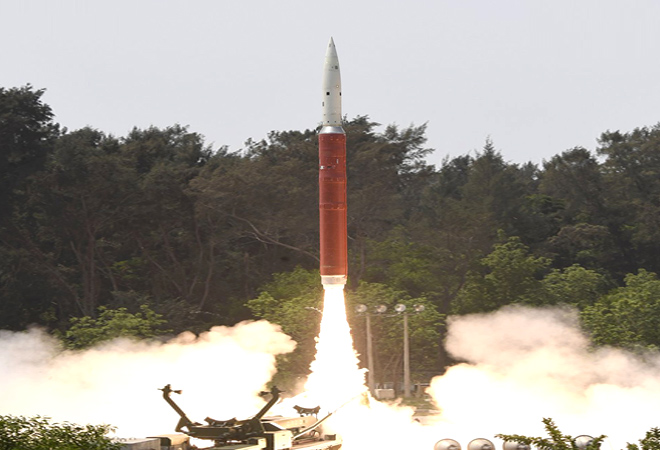
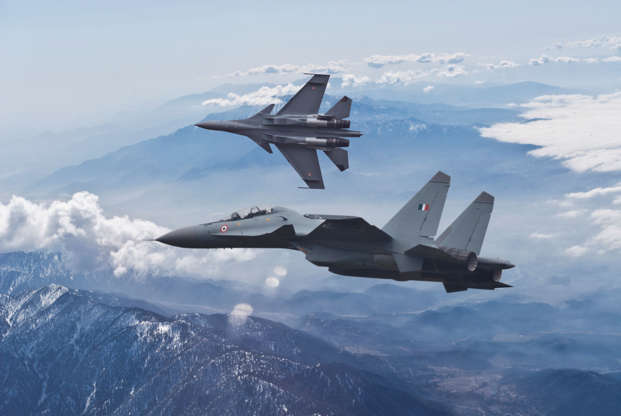
A fully loaded Rafale is only as capable as the Su-30, MiG-29 and Mirage 2000. The talk of Su-30/Rafale for distant nuclear delivery against China is a joke.

Per current plans, by 2025 and with the induction of the 36 Rafales bought in flyaway condition, the IAF will have between 272 and 312 Su-30MKIs or 17-20 squadrons upgraded to the ‘Super Sukhoi’ configuration, more than 90 Jaguars or five squadrons, more than 60 MiG-29s or four squadrons, and over 50 Mirage 2000s or three squadrons-totalling 34 squadrons of 4.5 generation aircraft. Seven squadrons of the indigenous Tejas Mk-1A and Mark-2-also 4.5 generation-replacing MiG-21 for short-range air defence means an IAF force profile of 41 squadrons (by mid-2030s).

So, what’s wrong with this force structure? Other than Jaguar for low-level strike and Tejas, the Rafale has, with full ordnance loading, the same operational range and capability as the Su-30, MiG-29 and Mirage 2000. These are all medium multi-role combat aircraft (MMRCA) which, given range constraints, can be optimally fielded against Pakistan alone and in border affrays against China, but have zero strategic reach and worth. So, the talk of Su-30/ Rafale for distant nuclear delivery against China is a joke. This fits in with the IAF’s thinking and conduct as a tactical adjunct in the region of superior extra-territorial air forces (Royal Air Force in colonial times and the US Air Force in the immediate post-1962 war period and, perhaps, in the future). Whence the service’s emphasis solely on short- to medium-legged aircraft with no interest whatsoever in acquiring long-range strategic bombers, such as the Tu-22 ‘Backfire’ (first offered in August 1971) or the more lethal Tu-160 ‘Blackjack’, either of which could long ago have been purchased or leased from Russia. It would have enlarged the IAF’s operational/ mission envelope and firmed up the manned, recallable vector for nuclear as well as conventional deterrence of China. The IAF has had no bomber after the phasing out of the medium-range Canberra.

Until the April 2015 Rafale announcement by Prime Minister Narendra Modi, the erst­while defence minister, Manohar Parrikar, correctly favoured the option of quickly and economically augmenting the fleet of Su-30s-rated the best fighter aircraft in the world. It had several merits. For the price of one Rafale, the country would have had two Su-30s and Hindustan Aeronautics Ltd, Nashik, which assembles this aircraft, would have had a contract to produce more of them. The ‘Super Sukhoi’ version of the Su-30, more­over, meets the Rafale level of on-board data fusion capability. The upgrade of the Su-30 is, therefore, a critical need, except it is now imperilled by the Rs 59,000 crore down pay­ment for the Rafale, which leaves little funding for anything else.

The Rafale’s only other attribute is the exorbitantly priced Meteor air-to-air (A2A) missile, whose effectiveness is exaggerated. Even the most advanced A2A missiles have limited ‘kill zones’. The certainty of tracking, identifying, targeting and hitting enemy aircraft diminishes markedly beyond 50-80 miles. Worse, with so few Rafales and such high investment, the IAF will be loath to deploy them in war because every Rafale lost would mean over Rs 1,600 crore down the drain and, proportionately, a seriously attrited force.

Besotted by Western-origin aircraft, the IAF had hoped to use the initial order of 36 Rafales as a wedge to procure 90 more. That ruse being blown, it has indented for 114 new type single-engine MMRCA. With Donald Trump turning up the pressure, the 1960s vintage, museum-ready F-16 is likely to be the gap filler. It will pose no danger to the Pakistan Air Force that has been operating this plane for 30-odd years, but will fritter away resources and exacerbate an already hellish logistics problem for the IAF, created by the unmanageable diversity of aircraft in its inventory, each requiring its own expensive maintenance infrastructure.


Posted in arms exports, asia-Pacific/Indo-Pacific, Asian geopolitics, China, China military, civil-military relations, Culture, Decision-making, Defence Industry, domestic politics, DRDO, Europe, Geopolitics, Great Power imperatives, India's China Policy, India's Pakistan Policy, India's strategic thinking and policy, Indian Air Force, Indian ecobomic situation, Indian Politics, MEA/foreign policy, Military Acquisitions, Military/military advice, Missiles, Nuclear Policy & Strategy, Nuclear Weapons, Pakistan, Pakistan military, Relations with Russia, Russia, russian assistance, SAARC, society, South Asia, Strategic Forces Command, Strategic Relations with the US & West, Technology transfer, United States, US., Weapons | 26 Comments

Review of ‘Staggering’ in the Journal of Contemporary Asia

Undergraduate international relations (IR) students know IR theorists try to make sense of the world by imposing an ideological order. This exercise is dominated by the often contentious dichotomy between realism and liberalism. It is widely agreed in IR circles that realism underlies the international system and remains dominant. Nowhere is this more apparent than in the USA, where US ruling elites, despite their repeated assertions of high-minded liberalism, implement hard-nosed realist policies.

Bharat Karnad has long argued that India must embrace a nationalist/realist orientation. Karnad critiques Indian foreign policy from a doctrinaire realist perspective. He believes India will not play its rightful role as a world power until it ditches its longstanding malaise and embraces a total make-over based on doctrinaire realist principles. He asserts that “At the heart of the failure of India’s foreign policy after Jawaharlal Nehru is that a succession of prime ministers, including [Prime Minister Narendra] Modi, have viewed international politics from the vantage point … of a ‘subordinate state’” (398). To overcome this subordinate mindset, India must systematically apply the three essential realist principles of nationalism, hard power, and national interest. Karnad is a professor at the Centre for Policy Research, and like any good think tanker, does not simply make a theoretical critique, but provides his reader with a series of detailed policy proposals to address the problems he identifies.

I previously reviewed Karnad’s Why India is Not a Great Power (Yet), when it was published by Oxford University Press in 2015. Staggering Forward is a continuation of his realist effort with a specific emphasis on India’s current prime minister and the policies of his government. This reviewer does not embrace many of Karnad’s hard-core realist principles yet finds this book refreshing and challenging, nevertheless. Karnad is an original thinker not afraid to go outside the usual academic comfort zone. He enthusiastically presents his thesis and policy recommendations and challenges the reader to take him seriously.

It is easy to agree with Karnad that since India emerged from 200 years of colonial dominance in 1947 it has yet to come into its own. It remains in the thrall of great powers, most particularly the USA, China and Russia. India’s government professionals, whether diplomats, military officers or civil servants have not completely embraced the notion that India can go it alone, without the patronage of a great power.

Karnad asserts that India has for too long been obsessed with the wrong enemy, devoting too many diplomatic and military resources to its rivalry with Pakistan. As the subcontinent’s dominant power, Karnad believes that India should make the concessions necessary to normalise its relationship with Pakistan and that doing so would free the country to address the challenge presented by the rise of China. It is clear that India and China will be locked in a protracted rivalry in the decades to come and that India has to gear up to meet this challenge.

Karnad is no friend of India’s Congress Party and the left. He sees Modi’s Bharatiya Janata Party as the saviour of India. That said, he is no friend of Modi’s Hindu nationalism and its extremist agenda. He supports a right of centre party not in thrall to its thuggish elements. Karnad’s assessment is that religion and politics do not mix and that India cannot move forward unless it embraces its tolerant “composite culture,” and establishes friendly relations with Pakistan and the world’s Muslim states based on mutual respect.

Karnad recommends that India break free from its “subordinate mindset” and assert its independence on the world stage. He is particularly critical of India’s relationship with the USA and advises India to reject US overtures to enter into a “strategic relationship,” preferring that the nation devise its own partnerships to provide a security regimen for Asia that no longer relies on US patronage. Karnad devotes considerable space to detailing what he views as US duplicity regarding India. Karnad argues that India “needs least of all … the assistance of a dysfunctional, unreliable and receding America” (391). While he may be a bit too simplistic in his assessment of the USA and its prospects in a post-Trump era, Karnad’s longing for an assertive country that stands up to power, defends its own national interests and does not accept coercion from powerful states is well made.

As a realist, Karnad believes a nation state cannot play its rightful role in the world without a strong reservoir of hard power. Like his realist compatriots he believes hard power is based on a strong and capable military backed by a strong economy. Thus, Karnad sees military solutions for all manner of problems. He rejects India’s Nehruvian-Gandhian antecedents to embrace the assertion of military power to secure and defend Indian national interests, and when necessary, to coerce other states to fall into line behind Indian policies. This leads to a hawkish set of recommendations for a muscular India. He wants the military to focus on self-sufficiency in weapons production, updating India’s nuclear weapons arsenal, entering into co-operative military relationships with Asian states ringing China to prevent Chinese hegemony in Asia, and restructuring the Indian military to enable credible force projection not only in the Indian Ocean region but throughout Asia.

Highly critical of what he views as India’s outdated and outclassed military, Karnad asserts that India is far behind China militarily and will not catch up any time soon. This, he argues, leaves India no option but to embrace nuclear weapons. He urges the Modi government to toss aside US proliferation concerns and undertake a thorough modernisation of India’s nuclear forces. He is aggressive in wanting India to make it clear to China that “first use” is on the table and that India is prepared to use tactical and strategic nuclear weapons to deter and defeat Chinese military aggression. If all of this is not troubling enough, his most disturbing recommendation is to support the provision of nuclear weapons for Taiwan, South Korea and Japan as a means of proving a credible Asian security system no longer reliant on the US nuclear umbrella.

Like other die-hard realists, Karnad sees no credible role for human rights concerns in India’s foreign policy. Over the course of the book Karnad calls for India to ignore human rights abuses by the governments of Iran, Russia and Myanmar, for example. He asserts that attention to such abuses will interfere with India’s cultivation of close ties. Whereas liberals would critique this approach as a willful sacrifice of India’s soft power advantage, Karnad seems unconcerned, claiming that India’s long-term reliance on its civilisational soft power assets is overrated.

Most policy analysts and policymakers are more nuanced than Karnad is in this book. While hawkish, Staggering Forward, which clocks in at a lengthy 476 pages, includes such a huge array of ideas that readers from differing ideological perspectives are likely to find validity in some of them.

That said, Staggering Forward is overly long. The purpose of the book is to convince the reader of the urgency of making policy corrections and to embrace Karnad’s realist corrections. This could have been done more effectively if the book were shorter. In many ways it is a didactic work and, as such, could have made its points forcefully while being succinct. Instead, Karnad relies on repetition, stating his points numerous times at different points throughout the book. There are instances where Karnad showers the reader with details, most particularly on arms production and technology and nuclear weapons. Much of this information is not particularly relevant or interesting to the general reader. It is “too far down in the weeds,” and not really necessary to make the point.

That said, Karnad is a dynamic and original thinker who deserves to be taken seriously. Indian policymakers and analysts of India need to read the book, give it the attention it deserves, give serious consideration to its specific policy recommendations and provide thoughtful critiques.

Posted in arms exports, asia-Pacific/Indo-Pacific, Asian geopolitics, Central Asia, China, China military, civil-military relations, Decision-making, Defence Industry, domestic politics, DRDO, Geopolitics, Great Power imperatives, India's China Policy, India's Pakistan Policy, India's strategic thinking and policy, Indian Air Force, Indian Army, Indian democracy, Indian ecobomic situation, Indian Navy, Indian Ocean, indian policy -- Israel, Iran and West Asia, Iran and West Asia, MEA/foreign policy, Military Acquisitions, Military/military advice, Myanmar, Nuclear Policy & Strategy, Nuclear Weapons, Pakistan, Pakistan military, Russia, SAARC, society, South Asia, South East Asia, Strategic Forces Command, Strategic Relations with South East Asia & Far East, Strategic Relations with the US & West, Taiwan, United States, US., Vietnam, Weapons, West Asia | 7 Comments

What will it take for India to see reason?


Image result for pics of modi and trump

On January 2, 2019 US President Donald Trump slammed Pakistan for “housing” America’s enemies and for doing nothing for the $1.3 billion it used to receive as aid which he had earlier terminated. Because every bit of anti-Pakistan spouting by Trump is celebrated by the Indian Press as if it is some great big gong given India by Washington, surely it must have been unprepared for Trump saying virtually in the next breath that he looked “forward to meeting the folks from the new leadership in Pakistan [and] we will be doing that in not-too-distant future”. That a Trump-Imran Khan meeting is in the works was confirmed by the Pakistan Foreign Office.

The Modi government, however, was undoubtedly taken aback when, on this same occasion, he showered contempt and derision on India’s $3 billion plus development assistance over the last few rears to Afghanistan that, among other things, saw libraries being built and stocked in Afghan educational institutions. It is activity he summed up as Delhi funding a “library”. “You know what that is? That’s like five hours of what we spend. And, we are supposed to say ‘Oh, thank you for the library.’ I don’t know who is using it in Afghanistan.” MEA was left impotently raging against Trump’s unfair take on India’s contribution.

The fact is Trump will not be satisfied short of Delhi defining its engagement in Afghanistan by deploying boots on the ground as part of the coalition effort to contain the Taliban forces, the aim of defeating them on the battlefield having been given up long ago. Because this won’t ever happen, India will always be at the receiving end. Except Trump’s barbs reveal the US’ long term objective of courting Islamabad at the cost of Delhi, something Modi, his PMO and MEA seem unable to reconcile to, and the still larger meta-strategic goal of “balancing” India’s power by arming and sustaining Pakistan by rendering it ever more pliable that they won’t even acknowledge.

Making allowance for Trump’s allergy to reading anything, including policy briefs — whence his remark about the Afghan library, and to generally winging it on instinct and impulse, the issue that Prime Minister Narendra Modi even at this late date will be compelled to ponder is just how much American insult and policy waywardness is too much for the Indian national interest to bear, and should yesterday not have been soon enough for this country to finally assert itself in its own backyard? Underlying these concerns are Modi and the compromised Indian officialdom’s desire to get close to Washington at any cost. including self-respect.  This when Trump’s actions on a daily basis prove why the US cannot be trusted and  is an immensely unreliable partner.

Does the PM, moreover, not realize India’s position as the central pillar of a security architecture, leave alone southern Asia, in Asia at-large? And that if the approaches to the subcontinent are to be protected, the entry of interloper countries — whether it is the US, Russia or China, into South Asian affairs, especially  Afghanistan, have to be resisted? And because such entry is usually in the guise of “peace” initiatives, that these have to be undermined? But this requires a concert of the countries in the region and coordinating actions with Imran Khan’s regime, which thus becomes a necessity.

The opening has been offered by Imran Khan with his ‘Kartarpur corridor’ (KC). It only remains for Delhi, rather than seeing it as a terrorist/Khalistani/ISI  trap, to convert it into a strategic opportunity. This won’t happen if the PMO, the NSAB and just about every agency supposedly consulted by Modi is filled with Doval’s select friends and veterans  from the spook-world of RAW, IB, MI, etc. The result of such monopolizing of the prime minister’s time by persons who have spent their time in the shadows is predictable and is on display. Modi’s political gut said he should run with Imran’s KC proposal, described by him as the coming down of another Berlin Wall. But under pressure of contrary advice he turned around, and in the process doused Islamabad’s enthusiasm.

Rustam Shah Mohmand, among the more perceptive practitioners — he was Interior Secretary and ambassador — and analysts in Pakistan, feels much the same way. Afghanistan, he writes, “should not be a battleground for proxy warfare. Both India and Pakistan must begin to explore avenues for cooperation in Afghanistan. Regional countries must create an environment for the US to pull out all its troops within a time frame. The insurgency will abate only when foreign forces have left the country.”

https://tribune.com.pk/story/1880080/6-road-map-peace-afghanistan/

Pak COAS General Qamar Bajwa has time and again offered an olive branch, and talked of the sheer instability engendered by extremist Islam as the principal threat to Pakistan. This threat has at its core the Daesh/IS element now raising a presence in Jammu & Kashmir. Indeed, Mohmand  is of the view that, with the US military solution only strengthening the Taliban hold on Afghanistan, the fear of the daesh establishing itself in that country is what’s driving Russia and China to seek a coalition government in Kabul headed by the Taliban. Moscow apprehends as Beijing does that Daesh will soon infiltrate their territories with Muslim populations, and the Daesh standard will be borne aloft by discontented Tatars and Muslims in Russian Caucasus, and by Uyghurs.

If this is a fair reading of the situation in Afghanistan, and it seems to be, then it makes ample sense for India  and Pakistan to join in supporting a coalition-run Afghanistan, while attempting to whittle away at the influence wielded by the US, China and Russia both with Ashraf Ghani-led Kabul and the Taliban, and for Delhi to call a summit of India, Iran and Afghanistan to agree on a cooperative agenda and ways of pushing it. After all, with Chabahar Tehran is, willy-nilly, in the game. This is an eminently doable task. Particularly because even the Taliban are appreciative of the Indian projects such as the Zaranj-Delaram highway, perhaps, for the wrong reasons — they can more easily transport raw opium — the main source of revenue — for processing in laboratories on the Iran border for onward transmission to the West and other markets. In any case, most of the Taliban will happily respond to a joint peace move by India, Iran and Pakistan than depend on the merciless ministrations of extra-territorial powers with uncertain outcomes. Further, the Taliban have no truck with the Daesh, and will gladly fight them if sufficiently incentivised, and which financial inducements Delhi can readily offer (because the economic health of Iran and Pakistan do not permit them to).

But when has Modi shown any real strategic vision and, importantly, inclination for a regionally inclusive policy that involves trusting Pakistan to do the right thing for itself, the region, and India? In the context of Modi’s supping with Xi and hugging Trump, which has fetched India little and has not weakened China’s or America’s overarching resolve to keep India down by diminishing it, Delhi’s ignoring the potential and possibilities of an India-Iran-Pakistan entente — the ‘triple entente’ for a new age, is egregious.

Posted in Afghanistan, asia-Pacific/Indo-Pacific, Asian geopolitics, Central Asia, China, China military, Culture, Decision-making, Great Power imperatives, India's China Policy, India's Pakistan Policy, India's strategic thinking and policy, Indian ecobomic situation, indian policy -- Israel, Iran and West Asia, Internal Security, Iran and West Asia, MEA/foreign policy, Military/military advice, Pakistan, Pakistan military, Russia, SAARC, society, South Asia, Strategic Relations with the US & West, US., West Asia | 1 Comment

What’s different about US foreign policy and diplomacy in the Trump era

The talk by Dr Jon Dorschner, former US diplomat who pulled time in the Delhi embassy and is currently Professor of Political Science at the University of Arizona, Tucson, and the Q&A session that followed, on 21st December, 2018,  at the India International Centre, New Delhi, hosted by CPR, were particularly interesting. These sessions on the topic — ‘What’s different about US foreign policy and diplomacy in the Trump era’ were enlivened by Dr. Dorschner’s honesty and candour.
The videos available on the net:
1. Talk:
2. Q&A:
Posted in Afghanistan, asia-Pacific/Indo-Pacific, Asian geopolitics, China, China military, Decision-making, Defence Industry, domestic politics, Europe, Geopolitics, India's strategic thinking and policy, Indian Ocean, Iran and West Asia, Japan, MEA/foreign policy, Military Acquisitions, Military/military advice, nonproliferation, Northeast Asia, Nuclear Policy & Strategy, Pakistan, Russia, russian military, society, South Asia, South East Asia, Strategic Relations with the US & West, United States, US., Weapons, West Asia, Western militaries | Leave a comment

India’s Net Loss In 2018 From Geopolitical Shifts

Published in my ‘Realpolitik’ column in Bloombergquint.com 

——————-

Geopolitical developments are a double-edged sword. These can be seen as opportunities to capitalise on with a view to strengthening a relationship or turning an adversary into a friend, or they can be wasted and a historical partner, as a result, can be alienated, and primed to make common cause with a rival, or reinforce the animosity of a foe. All strategic concerns of great powers and would-be great powers, such as India, as a rule, have at their core keeping the neighbourhood pacified. India’s record in this respect has, alas, not been stellar. Delhi’s big brother attitude has rankled. Barring Bhutan, no adjoining state or country in the middle-abroad, has had other-than-ambiguous or troubled ties with India. The tenure of the Bharatiya Janata Party government, in this regard, has been no exception, which is an ironic outcome of Prime Minister Narendra Modi’s strenuous diplomatic efforts to serve his widely advertised “neighbourhood first” policy.

That said, the geopolitics in South Asia in 2018 have become more conducive to India’s interests.

India’s Net Loss In 2018 From Geopolitical Shifts

Pushback To China’s Belt And Road

President Abdulla Yameen, owing to his Bonapartist tendencies, persuaded the people of the Maldives to turf him out in the last general elections and install in his place the gentler, more democratic-minded, Mohammad Solih. Solih, much to Delhi’s delight, immediately announced a return of his country to its traditional India-friendly posture and, on his first trip abroad, was rewarded in Delhi with Modi’s trademark hugs and a check of $1.5 billion, perhaps, as a down payment on the debt Yameen ran up with Beijing. This has ended the traction China’s Belt and Road Initiative or the “maritime silk route” was gaining in the southwestern Indian Ocean, which was further compromising India’s security grid in this watery expanse. This is a plus.

Prime Minister Narendra Modi attends the inauguration ceremony of  Ibrahim Mohamed Solih, in Male, Maldives on Nov.  17, 2018. (Photograph: PIB)
Prime Minister Narendra Modi attends the inauguration ceremony of Ibrahim Mohamed Solih, in Male, Maldives on Nov. 17, 2018. (Photograph: PIB)

In the same oceanic quadrant but nearer India’s peninsular tip, Sri Lanka has proved a difficult nettle for India in recent times to grasp. The latest political turmoil in this island-nation was triggered by President Maithripala Sirisena’s ouster of Prime Minister Ranil Wickremesinghe on the charge that the latter was involved in an assassination plot against him, and led to the appointment of the China-friendly Mahinda Rajapaksa to the PM’s post. It was, however, a decision reversed inside of a fortnight by the Supreme Court, leading to Wickremesinghe regaining his chair and India breathing a sigh of relief. Whether Sirisena’s paranoia will subside enough to allow peaceful coexistence with Wickremesinghe is still an open question.


Amidst this political game of musical chairs, grave geostrategic damage has, however, been done to India’s security interests by Colombo’s inability to service its multi-billion dollar debt to China. Beijing converted that into a 99-year lease of the Hambantota port.

So, however friendly a Sri Lankan dispensation in the future, the Indian Navy will be hard-put to impose the supposed secret condition in the Hambantota deal that no Chinese naval vessels can dock and replenish there in wartime.

Signage for Hambantota Port in Sri Lanka. (Photographer: Atul Loke/Bloomberg)

China’s plan has suffered drawbacks with Myanmar, Thailand and Malaysia, who have shelved or curtailed the more ambitious BRI infrastructure projects.


If the Maldives and Sri Lanka are taken out of the BRI scheme, the Chinese military, on its part, will not have landfall between the synthetic islands it has created mid-channel in the disputed South China Sea and Djibouti on the Horn of Africa and in Gwadar on Pakistan’s Baluch coast. It will require the Chinese Navy to negotiate the narrows of the Malacca, Lombok and Sunda Straits that India is in a position to control.

Further, the understanding with France for its naval and other forces to use Reunion Island in the southern Indian Ocean and Base Heron in Djibouti will enable India to mount close surveillance and otherwise crowd out Chinese military assets, other than its northwestern quadrant, in the Indian Ocean.

China’s Military Entry Via BRI

The definite military angle to the China-Pakistan Economic Corridor, in effect, allows a Eurasian land power for the first time in history to access the all-year warm water port of Gwadar on the Arabian Sea – an aim Britain, the dominant power of the 19th Century, successfully prevented the expansionist Czarist Russian Empire from achieving, and which effort was at the heart of the so-called ‘Great Game’ that so agitated India’s colonial overlords of that era.


The troublesome aspect of CPEC is not only the increasing military-industrial collaboration between China and Pakistan, but the fact that, under the guise of protecting its labour and construction paraphernalia, almost an army division worth of Peoples’ Liberation Army troops are already deployed in Baltistan. This could be the kernel of a permanent Chinese military presence in Pakistan-occupied Kashmir and hence in the subcontinent. This is no small matter for India to worry about because hereafter the Indian military will have to factor into its operational plans Chinese and Pakistani armies, air forces and navies coordinating their actions in any affray with India.

SamaDana, Not DandBhed With Pakistan

It is for the overarching geopolitical reason of denying China a toehold in Pakistan that the Bharatiya Janata Party government reacted positively to Prime Minister Imran Khan’s peace overture of the ‘Kartarpur Corridor’ with Prime Minister Narendra Modi referring to this project as the breaking of another “Berlin Wall”.

Embedded video

ANI

@ANI

: Prime Minister Narendra Modi says on , “kisne socha tha ki Berlin ki deewar gir sakti hai. Shayad Guru Nanak Dev Ji ke aashirwad se, Kartarpur ka corridor sirf corridor nahi, jan jan ko jodne ka bahut bada karan ban sakta hai”

But instead of moving forward and resuming dialogue that Pakistan has been seeking, Delhi, for no apparent reason, settled down to its usual truculence. The trouble is, governments in independent India have, from the beginning, lacked an appreciation of strategic geography. This is strange considering this was the prime imperial legacy the departing British left us with, which didn’t form the backbone of India’s foreign policy.

Geographic imperatives suggest that India’s overarching strategic objective should be to regain for India, in cooperation with the other subcontinental states, the unified military-strategic and economic space lost in 1947.

This simply can’t be done without Pakistan first being co-opted by any and all means. True, smaller states abutting India—Nepal, Myanmar, Bangladesh, Sri Lanka, Yameen’s Maldives, and even Bhutan—are discovering the advantages of extracting benefits from Delhi by cultivating Beijing. This is par for the course.


It is also true that allowing Indian Sikhs easy access to Kartarpur is a public relations success for Islamabad and may be part of the Pakistan Army’s asymmetric warfare by other means. After all, the North-America-based Sikhs For Justice, a forum pushing for a ‘referendum’ by Sikhs all over the world on a separate state of Khalistan carved out of the Indian state of Punjab, is courted by Pakistani authorities. However, even if the SFJ follows through on its malign intent with Pakistani help, it cannot grow beyond being a nuisance at most.


This only emphasises the importance of turning Pakistan around. India has tried to overawe Pakistan with its military superiority, diplomatically beat it with the terrorism stick, and to economically pressure it by permitting only truncated trade. None of it has worked.

Maybe it is time to wield generosity as a political tool to win over Pakistan and, by the same means, the rest of the neighbourhood, because the strategic gains of doing so are immense.

Time to try Chanakya’s ‘sama’ (compromise, agreement) and ‘dana’ (grants, material aid, assistance) rather than remaining stuck on using ‘dand’ (economic sanctions, violence and military threats) and ‘bhed’ (stirring up domestic trouble) that has only fetched rancor and ill will?

Over-Tilt To America

And finally the Modi regime, in a sense, has outsourced its strategic security to the United States, hoping America’s supposed military strength in the Indo-Pacific region will be a backstop to India’s armed posture. To curry Washington’s favour, Indian governments in the twenty-first century of every political stripe—headed successively by BJP (under Atal Bihari Vajpayee), Congress (led by Manmohan Singh), and again BJP (helmed by Modi)—have done everything, including accepting limitations on India’s strategic capability growth by not resuming thermonuclear testing and shelving the intercontinental range ballistic missile programme to genuflecting to Washington over the H1B visa issue.

It has hurt the country’s strategic prospects by alienating Iran by falling in with the American designs on Iran and reducing the off-take of Iranian oil and gas.

It imperils India’s presence in Chabahar and connectivity to Afghanistan and Central Asia. Elsewhere, it has irked Russia and risked the warfighting capacity of the Indian armed services that are equipped to the extent of 70 plus percent with Russian hardware.

Prime Minister Narendra Modi with the President of Iran, Hassan Rouhani and the President of Afghanistan, Mohammad Ashraf Ghani, during the Trilateral meeting, in Tehran on May 23, 2016. (Photograph: PIB)<a href="https://www.facebook.com/sharer/sharer.php?u=http://pibphoto.nic.in/photo//2016/May/l2016052383745.jpg"><i><br></i></a>
Prime Minister Narendra Modi with the President of Iran, Hassan Rouhani and the President of Afghanistan, Mohammad Ashraf Ghani, during the Trilateral meeting, in Tehran on May 23, 2016. (Photograph: PIB)

All this in return for what? For promises of dated defence technology, such as the antiquated F-16 combat aircraft? Because there surely has been no give on the U.S.’ part on anything else. Indeed, if anything the Donald Trump administration has tightened the H1B screws on the Indian information technology industry.

Moreover, given the disadvantages accruing from the over-tilt to America, skepticism about its reliability and credibility as ‘strategic partner’ should have long ago begun informing Indian policies. This has still to happen.

In the context of the impulsive and unpredictable Trump, who has systematically dismantled the U.S. international security and trade infrastructure—by dissolving the Trans-Pacific Partnership, weakening the North Atlantic Treaty Organization, withholding joint military drills with the South Korean forces, withdrawing abruptly from Syria and Afghanistan and, in the face of Chinese provocations, urging Japan to buy American armaments in lieu of U.S. military support—Delhi continues to depend on Washington to pull India’s chestnuts out of the China-fueled fire. Really?

Posted in Afghanistan, Africa, arms exports, asia-Pacific/Indo-Pacific, Asian geopolitics, Central Asia, China, China military, Culture, Decision-making, Europe, Geopolitics, Great Power imperatives, India's China Policy, India's Pakistan Policy, India's strategic thinking and policy, Indian Air Force, Indian Army, Indian ecobomic situation, Indian Navy, Indian Ocean, indian policy -- Israel, Iran and West Asia, Indian Politics, Iran and West Asia, Japan, Maldives, MEA/foreign policy, Military Acquisitions, Military/military advice, Myanmar, Nepal, North Korea, Northeast Asia, Pakistan, Pakistan military, Relations with Russia, Russia, society, South Asia, South East Asia, Sri Lanka, Strategic Relations with South East Asia & Far East, Strategic Relations with the US & West, Technology transfer, Terrorism, United States, US., Vietnam, Weapons, West Asia | 6 Comments

India not walking Modi’s big talk

Image result for pics of modi in asia

[Modi at the 10th East Asia Summit]

The recent G-20 Summit offered Indian Prime Minister Narendra Modi the occasion he has frequently used to bolster his political standing at home. Except, while the domestic audience lapped up the Indian media coverage attending on his umpteenth such outing, in the real world of global power politics the Indian prime minister, sans hard power and/or hard cash to wield, was reduced as usual to a prop by Donald J. Trump, Xi Jinping, and Vladimir Putin. But Modi did in Buenos Aires what he has done in similar circumstances in the past – tried to make India relevant by seeming to be part of clashing coalitions. Thus, he met with Putin and Xi in a threesome to ballyhoo the prospects of the RIC (Russia-India-China) group before turning around and joining Trump and the Japanese Premier Shinzo Abe to extol the strategic virtues of Japan-America-India or “JAI”.

By not clearly indicating which side of the authoritarian-democratic divide India is on Modi hopes to firm up India’s standing as the balancer in the fluid global correlation of forces. This would be fine if the country was up for the great power game which it is not. Unlike other big powers India is not adept at realpolitik requiring an agile foreign policy and does not have a military clout with distant reach in support. This begs the question: Why has India with its size, strategic location and resources failed in the new Century to have impact?

India cannot become great only because of these attributes. It requires a leader with a powerful national vision, iron political will, and the ruthlessness to implement it by disrupting the extant balance of power and the extant balance of power in order to compel the world to deal with India on its own terms.

There was hope, now belied, that Modi would be such a leader. He has not articulated anew vision nor charted a new course but has doubled down on the retrograde policy of bandwagoning with the United States to ‘balance’ China in the Indo-Pacific region while distancing the country from old friends, such as Russia and Iran. By giving away free what could be sold dear, the Modi government finds it cannot wring concessions out of anybody. India signed the Logistics Exchange Memorandum of Agreement and the Communications Compatibility and Security Agreement Washington desired and lost the leverage accruing from permitting contingent access to Indian bases, etc. or from playing ball on this or that issue in return for substantively furthering the country’s vital national interests. It permitted China unbalanced trade and finds it cannot easily reverse it.

Instead, Modi has made common cause with Washington in pressuring Tehran by reducing India’s off-take of Iranian oil by a third, and expensively retrofitting Indian refineries to handle Saudi crude, and alienated Russia by facilitating the US attempts to replace it as the principal arms supplier even though the American technology on offer is dated (F-16 versus Akula-II class attack submarine, for instance).And the US promise of collaboration on advanced military technology has produced nothing. Now India is facing the music for Modi’s gullibility.Washington has allowed Delhi just a 138-day reprieve on the CAATSA sanctions to zero out its oil purchases from Iran, and only a conditional waiver for its buy of the Russian S-400 air defence system. And, disregarding Modi’s fevered pleadings to desist from doing so, Trump shut down the H1B visa channel for Indian techies to work in the US and seriously hurt the $200 billion Indian IT industry.And Beijing allows grudging access to the Chinese market while China opens  the Indian bazaar for its goods, small openings at a time.

The problem is more serious. Modi seems unaware of the geostrategic costs of surrendering India’s foreign policy space, freedom and flexibility. Defence Minister Nirmala Sitharaman, for instance,declared without a trace of irony that “there’s no contradiction between strategic autonomy and strategic partnership”! That this overly-friendly attitude to America, which to-date has fetched meagre results, could lose India its access to the Iranian port of Chabahar, for example, and endanger its larger strategic plans of consolidating its presence in the Gulf and rail and road connectivity to Afghanistan and Central Asia as  counter to China’s Belt and Road Initiative, of pincering the Pakistan and Chinese navies operating out of Gwadar, and generally of hindering the enlargement of the Chinese military footprint in the Indian Ocean apparently concerns Modi little, but having the armed forces bully a lowly Pakistan has priority.

The truth is the Indian government has not walked Modi’s big talk.  India’s ‘Neighbourhood first’ policy can’t get over the Pakistan hump. Its ‘Act East’ policy is limping along. The build-up of military cooperation with the Southeast Asian nations, especially Vietnam, is slow-paced and lackadaisical, the freedom of navigation patrols by Indian warships in the disputed waters of the South China Sea infrequent, the annual summits with the Japanese Premier Shinzo Abe notwithstanding, the security links with Japan are in the doldrums with the Indian defence bureaucracy sidelining Japan’s flagship project it is willing to subsidise concerning transfer of the entire production line of the  Shinmaywa US-2 flying boat, and Australia’s admission to the Malabar naval exercise remains barred by Delhi.

Elsewhere,the development assistance Modi promised the Central Asian Republics is floundering for want of an efficient delivery system. And all this while China is racing ahead to cement its domination of Asia. The odd “success”, such as Indonesia handing over Sabang port in Sumatra for eventual Indian naval use, highlights a receptive milieu should India care to capitalize on opportunities.

—–

[A version of the above piece entitled ‘Indian foreign policy not walking Modi’s big talk’ published 24 December 2018 by the East Asia Forum, Australian National University, Canberra, at  http://www.eastasiaforum.org/2018/12/24/indian-foreign-policy-not-walking-modis-big-talk/

 
Posted in Afghanistan, arms exports, asia-Pacific/Indo-Pacific, Asian geopolitics, Australia, Central Asia, China, China military, Culture, Decision-making, Europe, Geopolitics, Great Power imperatives, India's China Policy, India's Pakistan Policy, India's strategic thinking and policy, Indian Air Force, Indian Army, Indian democracy, Indian ecobomic situation, Indian Navy, Indian Ocean, indian policy -- Israel, Iran and West Asia, Iran and West Asia, Japan, Latin America, MEA/foreign policy, Military Acquisitions, Military/military advice, Northeast Asia, Pakistan, Pakistan military, Relations with Russia, Russia, russian assistance, SAARC, society, South Asia, South East Asia, Strategic Relations with South East Asia & Far East, Strategic Relations with the US & West, Technology transfer, United States, US., Vietnam, Weapons, West Asia | 2 Comments

Slowing down the Chinese juggernaut

Image result for pics of china military

Wrote this piece for the BBC Hindi Service, 24 December 2018. Its translation featured at https://www.bbc.com/hindi/india-46659574


The most that even powerful countries think they can realistically do against a relentlessly assertive China eager to displace the United States as the predominant power in the world is, as Richard Haass, a former head of Policy Planning at the US State Department, has written is to  “manage” relations with it.  This is no great revelation to the Indian government which has been in the business of managing its neighbour since the humiliating military defeat in the 1962 Himalayan War when Delhi finally gave up the ghost of “Hindi-Chini bhai bhai” and the even grander aim Prime Minister Jawaharlal Nehru entertained in the years straddling independence of an India-China concert to oversee the affairs of Asia.

But the relationship management task is growing more onerous by the year simply because Beijing has so honed its game, is so strategically driven, and agile in its policies and posture and has such a wealth of resources to deploy to winning friends and influencing targeted countries, it continually advantages itself. Pitted against this seemingly unstoppable force is a whole bunch of countries on the Asian littoral and in the Indian Ocean, the weaker among them finding it hard to resist the Chinese promises of rapidly erected quality infrastructure financed by easy credit. It is “debt-book diplomacy” of a high order that no rival of China in the Indo-Pacific region is able to match – not Japan, and even less India.

It is quite another matter, however, that as Sri Lanka has discovered with the Humbantota port, the high-cost of the project and the resulting troubles with servicing debt has ended in a 99-year lease of this facility to a Chinese shipping company. The lesson is stark and is being quickly learned. Thus, Myanmar, Malaysia, and Thailand have shelved or curtailed infrastructure projects involving Chinese loans. Even in Pakistan, which thinks of the prospective China-Pakistan Economic Corridor as a boon, more and more people worry about the debt trap their country may be stepping into.

Just as important to Beijing’s design of achieving supremacy, other than an economic stranglehold, is the military objective of getting around what Chinese strategists call the “Malacca dilemma” – the necessity of protecting 80% of its trade transiting through the Indian Ocean having to negotiate the “chokepoints” of the Malacca, Lumbok and Sunda Straits which, the Indian Navy based out of the country’s eastern seaboard and the Integrated Command in Port Blair in the Andaman and Nicobar chain of islands can effectively control. This explains the frantic search for harbours and oceanic frontages, except such acquisitions can mitigate the problem somewhat without really solving it. Hence the Chinese investments in north-south road and rail projects to access all year warm water ports through Kyaukpyu on the Bay of Bengal in Myanmar and Gwadar on the Arabian Sea in Pakistan.

So what can be done to, if not stop, than to slow down the Chinese juggernaut?  There is actually a military containment solution.  The littoral and offshore states and India have to coalesce into a security group that can operationalize a hard strategy.  India has military access to Duqm in Oman, the French base ‘Heron’ in Djibouti on the Horn of Africa, Seychelles, Maldives, and Trincomalee in Sri Lanka. It now has to speedily develop the Sumatran port of Sabang and the Vietnamese base of Na Thrang on the central Vietnamese coast offered Delhi, for Indian naval use and as a beefed-up electronic intelligence-gathering station run jointly with Hanoi to capitalize on its line of sight on the Chinese Navy’s main base at Sanya on Hainan island.

This chain of military bases have to be complemented with continuous and rigorous exercising with the host, local and regional navies to send the message to Beijing that whatever concentration of forces it can manage on either side of the three straits, they will face difficulties. And India has to prioritize the transfer of the Brahmos cruise missiles in bulk to Vietnam and every other country that expresses a desire for it. It is the surest way to tie down the Chinese South Sea Fleet and the secret ‘’Fourth” fleet for the Indian Ocean. And it will make the countries disputing China’s monopolizing the South China Sea more confident of deterring the Chinese Navy than if they lacked such strategic impact armament

This is a far better coalition-based maritime strategy to dissuade China from exercising its superiority on the undelineated 4,700km land border, the so-called Line of Actual Control, than the “theatre switching” strategy the Indian government is betting on, which, frankly, is unworkable.  Indeed, one manifestation of Beijing’s confidence that it can take care of India’s maritime counter and still press the Indian forces landward is the rapid conversion of satellite air fields into mainline bases with the updating of the necessary infrastructure and the augmentation of its air force and missile batteries in Tibet. India, in response, seems to get nothing right. It is leisurely raising a single offensive mountain corps and then fluffing it by establishing it along the strike corps model for the plains, rather than equipping it with light tanks!

The joker in the pack is the unpredictable Donald J. Trump’s America. The abrupt withdrawal of US forces from Syria and Afghanistan and the departure of General James Mattis from the Pentagon ought to give the Narendra Modi government and other Asian regimes who have to-date unthinkingly depend on the US for their security, pause. Trump, who has downgraded the North Atlantic Treaty Organization, watered down military cooperation with South Korea, and is inclined to sacrifice the interests of US allies and partners without notice to be in good nick with President Xi Jinping, only reinforces America’s dismal track record post-1947 of hurting friends and fellow democracies, and cannot be trusted.

The Indian government forgets the cold-bloodedness with which, as recently revealed by declassified documents, the Democratic Administration of President Jimmy Carter heeded Dengxiaoping’s counsel in the late 1970s that for the sake of “stability” and to incentivize Islamabad to assist the US effort to fight the Soviet occupation of Afghanistan, Washington should allow China to nuclear missile arm Pakistan. Recall the iconic photograph of Carter’s National Security Adviser Zbigniew Brzezinski posing with an AK-47 at the Khyber Pass?

Posted in Africa, asia-Pacific/Indo-Pacific, Asian geopolitics, China, China military, Decision-making, Europe, Geopolitics, Great Power imperatives, India's China Policy, India's Pakistan Policy, India's strategic thinking and policy, Indian Air Force, Indian Army, Indian ecobomic situation, Indian Navy, Indian Ocean, Japan, Maldives, MEA/foreign policy, Military/military advice, Myanmar, Nepal, nonproliferation, North Korea, Northeast Asia, Pakistan, Pakistan military, SAARC, South Asia, South East Asia, Sri Lanka, Strategic Relations with South East Asia & Far East, Strategic Relations with the US & West, United States, US., Vietnam, Weapons, Western militaries | 4 Comments

So, what now, Modiji?

Image result for pics of trump and modi

(At the ASEAN summit in Manila)

Love to repeat what’s become my favourite line — I TOLD YOU SO!

Immediately after his nomination by the Republican Party as its presidential candidate I had written that once in the White House, Donald Trump would be so self-centered and concerned only with advancing America’s narrow interests that Delhi should pragmatically prepare to get out of its traditional policy of leaning on big powers — the Soviet Union pre-Cold War end and in the new century, the US —  for the country’s strategic security,  and begin relying on itself and its national resources for its own protection because it will be compelled by the emerging circumstances to do so anyway. And hence, that Trump’s election would be a good thing because, finally, the value of self-reliance, especially in arms and national security, will be appreciated. (“Why Donald Trump is good for India”, Open magazine 20 July 2016,  http://www.openthemagazine.com/article/politics/why-donald-trump-is-good-for-india and also posted on this blog).

Such tocsins that I sounded have, however, gone unheeded. Now that Trump has dumped on the Narendra Modi regime and other friendly states, leaving them high and dry, perhaps, some one in PMO, MEA, government will. The prompt is the decision by the President abruptly to withdraw the US military from Syria and Afghanistan. Defence Secretary, James Mattis, objected and resigned. He was the only man standing between India and Trump’s whimsicality.

So, consider the situation now: In Afghanistan, the Modi government suddenly finds it has lots of now hollow promises about sustained US commitment to realizing a Taliban-mukt Afghanistan and no US boots on the ground to achieve it. India has lost the military cover under which Delhi was running its own Afghan Taliban links. Oh, sure, Trump will leave a few Special Forces units in Afghanistan (and in Syria) to prosecute counter-terrorism( and anti-IS) actions, but for all intents and purposes the US has abandoned Afghanistan, leaving the Kabul government of Ashraf Ghani  in a lurch, and the Pakistan-leaning sections of Taliban in that country ascendant. In the last such Taliban rule by the one-eyed Mullah Omar, terrorists professing the Kashmir cause hijacked an Air India flight to Kandahar leading to capitulation by the previous BJP government and the sheer humiliation of External Affairs minister Jaswant Singh handing over Azhar Mahmood to the Taliban.

With the Taliban-run Afghanistan once again available as a base in-depth, Inter-Service Intelligence of the Pakistan Army will be in a position to marshal that country’s vast terrorist resources in terms of religiously motivated manpower.  Whether Indian intelligence agencies in league with other outfits can prevent such a denouement is doubtful. In the main because the sections of the Afghan Taliban, whose members also join up opportunistically with the Pakistani Taliban that Indian intel have cultivated over the years, are incapable of outfighting on two fronts — against the more rabid Taliban in Afghanistan and the Pakistan army in Pakistan. But India would have to keep a hand in in Afghan affairs by sustaining the friendly Taliban in the field. However, the best diplomatic bet for a solution is the underway Russian initiative for peace in Afghanistan.  Nov 8 meeting hosted in Moscow by the Russian Foreign Minister Sergei Lavrov had invitees from United States, India, Iran, China and Pakistan, and the five former Central Asian republics, and hailed the meeting as an opportunity to “open a new page” in Afghanistan’s history. India’s role, insofar as can be made out, was just to mark its presence.

The Afghan escapade pulled by Trump meshing with his Syria decision was justified via twitter thus: “Why are we fighting for our enemy, Syria, by staying & killing ISIS for them, Russia, Iran & other locals? Time to focus on our Country & bring our youth back home where they belong!” In other words, the Islamic State core fighting forces and leadership, who are supposed to have bolted with a full load of hard currency and gold from their Syrian and Iraqi strongholds, are readying to renew jihad against darul harb (non-Islamic world) but Washington wants no part of it. Except this fight can seep into the Kashmir dispute. How?

Because Hindu India oppressing Muslims is a cause Islamists from all over can readily rally around. What with Adityanath and his hate Muslim-antics in Uttar Pradesh providing almost a pluperfect basis for the already active Islamic State, J&K branch, to base their war against the Indian state on. And because, an effete Indian state would seem to be an easy target for an IS-led international movement hungry for success after its thrashing in their West Asian redoubts by the combined military might of US, Europe, Iraqi forces loyal to Baghdad, and assorted Arab states, with the Saudis in the van, and Turkey seeking to lead this campaign. Indeed Recep Erdogan, with a subconscious motive of reclaiming the Ottoman domain in some sense has, in fact, been handed the helmsmanship of the fight against IS rump by Trump who has decamped from the region along with the US forces. With Ankara so elevated and Turkey’s intimacy with the powers that be in Islamabad (read Pakistan army) set aside the cold vibes Erdogan encountered when he visited Delhi and broached the topic of mediating on Kashmir, he may not be altogether averse to channeling the IS fighting horde, via a facilitative Talibanized Afghanistan, into Kashmir.

How does Modiji expect to deal with this onrushing train when his policy is tied to the rails of ‘strategic partnership’  with a completely unreliable and untrustworthy America? We will nevertheless hear from the Carnegie-Brookings crowd, including its leading lights here and in nearby countries via op/eds in Indian newspapers who will twist these developments and Trump’s wayward policy into a pretzel to argue that Delhi should tie India even closer to the US to reap strategic rewards, when the time actually is nigh for India to begin securing its future by itself.

At the heart of this policy mess is the fact that Indian politicians and the Indian government invariably make a hash of reading the United States correctly. In the main because, like Modi and everybody else in policy making circles, dependency on external players is instinctive, laced with  personal profit, aspirations, and desires that are made to fit inconvenient reality.  In this case, it has resulted in India giving in to Washington on every issue, playing the doormat, and making no substantive move to incentivize the states on China’s periphery to join together in shoring up our individual security by collective means. “Look East, Act East”, in the event, is just another slogan to be trotted out the next time a summit takes place in those parts or a head of state from there comes visiting.

India has much in its corner. It has military access to Duqm in Oman, the French Base Heron in Djibouti, Seychelles, Maldives, Trincomalee in Sri Lanka, Sabang in Indonesia and Na Thrang on the central coast of Vietnam, and the Indian Navy has worked up these and other maritime neighbours in its Indian Ocean Naval Symposium into a cooperative mood, but where’s the follow up action? What’s the point of these bases on distant shores if no Indian military forces are ever posted there?

Inaction always has cost. Tajikistan offered the Farkhor air base in Ainee for India to refurbish and to operate a squadron of IAF Su-30s out of. Had this squadron been immediately posted to Ainee soon after an Indian task force in the early 2000s had lengthened the runway to handle heavier aircraft and redone the tarmac — all with Indian monies, India would have had a military grip on China’s flank. Instead Delhi waited, displaying its usual lassitude, and IAF did nothing to prod the Manmohan Singh government into approving such deployment and, voila!, the Russians returned in this decade militarily to recover Ainee for their own use as a forward base. So now if Delhi  invokes its original understanding with Dushanabe, Moscow may, depending on whether relations with India are frosty, exercise a veto.

This is how every extra-territorial military initiative that Delhi mounted has ended. In the maritime domain, for instance. Mozambique’s request to the Indian government to found a navy for that country equipped with phased out Indian corvettes and frigates and led by Indian Navy officers remains unaddressed from the time it was first made in the year 2000. That’s the sort of urgency the Indian government shows for anything remotely strategic! The Indian people’s dream of India as a great power is wrecked by such care-less attitude and sheer disinterest in doing anything worthwhile.

Posted in Afghanistan, Africa, asia-Pacific/Indo-Pacific, Asian geopolitics, Central Asia, China, China military, civil-military relations, Culture, Decision-making, Defence Industry, domestic politics, DRDO, Europe, Geopolitics, Great Power imperatives, guerilla warfare, India's China Policy, India's Pakistan Policy, India's strategic thinking and policy, Indian Air Force, Indian Army, Indian Navy, Indian Ocean, indian policy -- Israel, Iran and West Asia, Indian Politics, Internal Security, Iran and West Asia, Maldives, MEA/foreign policy, Military/military advice, Pakistan, Pakistan military, Relations with Russia, Russia, russian assistance, SAARC, society, South Asia, South East Asia, Sri Lanka, Strategic Relations with South East Asia & Far East, Strategic Relations with the US & West, Terrorism, United States, US., Vietnam, West Asia | 9 Comments

Going into 2019, India’s defence challenges are shocking

India’s military is woefully underprepared to fight future wars and there’s little focus on equipping our armed forces with cutting-edge tech


The Indian armed forces, by habit, prepare to fight yesterday’s wars.

Not one of the services has a forward-looking plan for capability build-up for conflicts of the future, which will feature proactive and defensive cyber warfare wherewithal and Artificial Intelligence-driven robotic systems cued to assigned tasks by a multitude of space- air-, land- and sea-based sensors passing real-time intelligence on the enemy force disposition that are able to assess operational situations and even concert with other friendly ‘warbots’ in the field to attack the target(s).

Most such systems have progressed beyond the testing stage and are on the brink of deployment in the more advanced militaries. In India, there’s not a hint of any thinking about robotic warfare, and even less of robotic warfare systems being designed and developed. A basic rover to handle/disarm live munitions/improvised explosive devices is about the extent of our achievement in the military robotics field.

Rather, the Indian military remains committed to World War II-era genus of weapons platforms — tanks, artillery, combat aircraft, aircraft carriers, in the main and then they are nowhere near cutting-edge, technology-wise. This is evident in the force modernisation plans.

The army has the replacement of the venerable T-72 tank with the newer Russian T-90 tank as priority; the air force wishes to induct the French Rafale multi-role combat aircraft in large numbers. Except, 36 of these aircraft that have actually been bought are too valuable to commit to action and too few to muster operational clout; and the navy is so besotted by aircraft carriers that to afford them the country is compelled to make do with fewer, smaller, fighting ships (frigates and destroyers) and a thinned out presence in the Indian Ocean (unless the naval budget is increased manifold, which’s not on the cards).

Most such backward-looking schemes are deemed adequate because the political class and the military brass, quixotically, cannot think of danger beyond Pakistan, this even though China — the only credible threat — looms spectre-like. Thus, Pakistan is the adversary the Indian Air Force mentions to justify the Rafale buy and bungs in a nuclear bombing role for it to overawe the media and the people.

Likewise, the Indian naval chief assures the country in a Navy Day newspaper supplement that his force is superior to its Pakistani counterpart. The army chief on his part, when not advising Pakistan to become more secular if it wants to live in amity with India, warns of more “surgical strikes”. With the Pakistan bogey so much on the military’s mind, who has time for the real world?

Meanwhile, the Narendra Modi government, in lieu of any actual expenditure of scarce funds, gives the impression of buttressing the country’s defence effort with the periodic announcements of the Defence Acquisitions Council (DAC) approving purchases of major armaments costing thousands of crores. However, because the DAC’s approval is about the first step in an onerous process that involves a lot of bureaucratic grind, little that is announced comes down the arms pipeline quickly, and military modernisation schemes, such as they are, mark time. Consider this: In the period October 2017 and October 2018, total capital buys worth Rs 86,030 crore were cleared by the DAC, but no contract was signed.

This is part of the pattern from when the erstwhile defence minister Manohar Parrikar boasted of the DAC clearing Rs 3 lakh crore worth of military procurement in the first three years, with only a small fraction of the sum actually translating into weaponry with the forces. Of course, the tortuous defence procurement system is to blame but no government has sought to simplify and streamline it — perhaps, because it serves the purposes of the vested interests that continue to grow fat on arms deals or through ‘Make in India’ schemes of ‘screwdrivering’ hardware from imported kits.

This essentially leaves India exposed in the basic binary areas — nuclear and conventional. Nuclear security has traditionally been the Indian government’s blindspot, with nothing being done to resume underground tests and augment capabilities. This even as established nuclear powers induct new thermonuclear weapons and delivery systems, a trend likely to accelerate now that the 1987 Intermediate Nuclear Forces Treaty banning nuclear missiles of 500-5,000 mile range from being deployed in Europe is defunct.

Meanwhile, the Indian military doggedly acquires short-legged aircraft, like the Rafale, not strategic bombers such as the advanced ‘Backfire’ Tu-22M3M or the more lethal ‘Blackjack’ Tu-160M2, invests in tank forces long after they are of any real use, opts for aircraft carriers vulnerable to supersonic cruise and hypersonic guided missiles, and struggles to raise its first offensive warfare-capable mountain corps to take the fight to China on the Tibetan Plateau and spurns light tanks as its main equipment.

———

[Published in MoneyControl.com, Dec 19, 2018, at https://www.moneycontrol.com/news/trends/current-affairs-trends/opinion-going-into-2019-indias-defence-challenges-are-shocking-3308251.html


Posted in arms exports, asia-Pacific/Indo-Pacific, Asian geopolitics, China, China military, civil-military relations, Cyber & Space, Decision-making, Defence Industry, DRDO, Europe, Geopolitics, Great Power imperatives, India's China Policy, India's Pakistan Policy, India's strategic thinking and policy, Indian Air Force, Indian Army, Indian Navy, Indian Ocean, MEA/foreign policy, Military Acquisitions, Military/military advice, Nuclear Policy & Strategy, Nuclear Weapons, Pakistan, Pakistan military, Pakistan nuclear forces, Russia, russian assistance, russian military, society, South Asia, Technology transfer, United States, US., Weapons | 7 Comments

Persona over Policy — ‘India Today’ reviews ‘Staggering’ – and my response

Image result for pics of modi and trump

Karnad’s critique of Modi’s foreign and security policies stands out as an important broadside from a prominent political commentator.

At the very outset, Karnad correctly argues that Modi had represented a potential break from India’s recent lacklustre past under the previous regime. Modi seemed to embody a clean image, a leader who was decisive and would bring about the much-needed reforms across the board. Few, if any, of these promises, Karnad argues, have been realised. Worse, stemming from his ideological convictions or because he is beholden to the foot soldiers of the Rashtriya Swayamsevak Sangh, Modi has given free rein to highly divisive forces within the Indian society. Apart from this dubious domestic stance, Karnad argues, Modi has engaged in much fanfare on the foreign policy front, but has failed to produce commensurate results.

Karnad attributes a good deal of these shortcomings to certain features of Modi’s alpha male personality, traits that he apparently shares with a number of other nationalistic and populist leaders across the world. Whether or not one accepts the premises derived from this form of popular psychology, there are at least some superficial similarities that he does share with a number of other nationalist leaders ranging from Donald Trump to Recep Tayyip Erdogan.

Some of Karnad’s criticisms of Modi’s policies, whether or not they can be traced to his personality, are clearly on the mark. Among other matters, he faults Modi for his failure to devise a coherent strategy for dealing with India’s principal long-term adversary, the People’s Republic of China (PRC). More to the point, he takes Modi to task for his preoccupation with Pakistan, a country that poses a far more limited threat to India’s critical national security interests.

The other charges that are levelled against Modi’s foreign and security policy choices seem to stem mostly from his ideological leanings. For example, he is overly critical of what he deems to be Modi’s inordinate fondness for the United States at the cost of a tried and tested relationship with Russia. Elements of Indian elite opinion across the political spectrum do share this view. However, they, along with Karnad, fail to recognise the obvious: in the present global order, Russia is, at best, a partial power and is structurally incapable of wielding the clout of the erstwhile Soviet Union.

Karnad also returns to one of his favourite hobby horses: why India should have pursued thermonuclear weapons and how the US-India nuclear agreement has, for all practical purposes, undermined that goal. Yet, it is far from clear that India needs a thermonuclear deterrent to keep its principal adversaries, Pakistan and the PRC, at bay. On the contrary, it can be argued that the acquisition of a thermonuclear option may actually undermine the strategic stability in the region.

Finally, Karnad remains an ardent proponent of an indigenous defence base for India and so has harsh words for the country’s willingness to import a range of advanced weaponry. The quest for domestic defence capabilities, no doubt, is admirable. Yet, surely, Karnad must be aware that its limitations did not emerge under the Modi regime. Hardly a single homegrown weapons system seems to have been produced in a timely or cost-effective fashion.

These quibbles notwithstanding, Karnad’s critique of the Modi government’s foreign and security policies stands out as an important broadside from a prominent conservative political commentator. Accordingly, it is an assessment that is worth heeding.

(Sumit Ganguly is a Distinguished Professor of Political Science and holds the Tagore Chair in Indian Cultures and Civilizations at Indiana University, Bloomington)


Review at https://www.indiatoday.in/magazine/up-front/story/20181217-persona-over-policy-books-1404604-2018-12-08

Bharat Karnad’s response to the above review:

It requires pointing out that Ganguly’s description of my treatment of the subject as “uneven” betrays his own desire to side with his adopted country, the United States, and to have his country of origin, India, join with it in countering China and to buy “advanced weaponry” from. If I have an ideological leaning it is towards hard realpolitik and agile policies untrammeled by sentiment or the personal proclivities of leaders, and the need for India to assume its role and responsibility as, potentially, the heftiest balancer of international power, forces, and interests in the world today. Whence the case made in the book for not leaning over-much on America’s side, or alienating old friends, Russia and Iran, to please Washington.

As regards his slamming India’s indigenous defence industrial capability with his remark that the mainly public sector-led campaign has to-date produced little worthwhile in time or within cost misses out on the model I have explicated in this and previous books and in my other writings that the indigenization effort would be better led by a capable, profit-minded, and exports-driven private sector. Except, the US defence industry is hardly a great example for anybody to emulate, considering that the US has squandered in excess of a trillion dollars to produce an absolute disaster of a combat aircraft — the F-35 Lightning-II, and that too more than a decade past its deadline. The US Air Force has grounded the plane for faulty design and performance, and the ‘C’ variant of this aircraft with the US Navy can barely manage 15% serviceability rate. And mind you, this is supposedly the world’s leading aerospace company we are talking about, one that over the last 100 years and more  has produced over 150 types of combat and transport aircraft. Now pit the F-35’s problems against the 4.5 generation Tejas light combat aircraft, designed and produced in the country that has survived despite the unhelpful attitude of the Indian government, proven weaknesses of a defence public sector unit such as HAL and the Indian Air Force’s visceral antagonism to anything home-grown. To wit, IAF’s shameful role in the 1970s in killing off the successor aircraft, the Dr. Raj Mahindra-designed Mark-II of the redoubtable HF-24 Marut, thereby setting India on the course to importing aircraft and becoming an abject arms dependency. The Marut, it may be recalled, was the first supersonic jet fighter to be designed and manufactured outside of North America and Europe, which took to the Bangalore skies in 1961. It provides a very different perspective, doesn’t it?


Posted in asia-Pacific/Indo-Pacific, Asian geopolitics, China, China military, civil-military relations, Decision-making, Defence Industry, domestic politics, DRDO, Europe, Geopolitics, Great Power imperatives, India's China Policy, India's Pakistan Policy, India's strategic thinking and policy, Indian Air Force, Indian Army, Indian ecobomic situation, Indian Navy, Indian Ocean, Indian Politics, Internal Security, MEA/foreign policy, Military Acquisitions, Military/military advice, nonproliferation, Nuclear Policy & Strategy, Nuclear Weapons, Pakistan, Pakistan military, Relations with Russia, Russia, SAARC, society, South Asia, Strategic Relations with the US & West, United States, US., Weapons | Leave a comment