While the national interests of India and the United States overlap a little, Prime Minister Narendra Modi and President Donald J. Trump are personally in sync. This last is, perhaps, because they are alike — self-centered, autocratic, and relentless in playing to their political bases. So drama attends on any cooperation they can muster, especially in the foreign policy field because differing geographies dictate divergent approaches, tactics and strategies.
Dealing with the mercurial Trump is like traipsing through a minefield. He threatens termination of trade and US military presence abroad to get his way. He perceives India as a soft target and is ranging on it, complaining about unbalanced trade, Indian software companies exploiting the H1B visa regime, Delhi’s delay in activating the Logistics Exchange Memorandum of Agreement that will permit US forces to use Indian bases, and about India’s reluctance to manufacture under license the 1970s vintage F-16 fighter aircraft outfitted with new doo-dahs and designation (F-21). Trump’s bargaining method is to insist the other side meet his demands or face pain. It has fetched him success with NATO allies (anteing up $400 billion in additional defence spending) and China (removing $75 billion in tariffs).
To prevent Trump tilting against India, Modi’s strategy is one of placating the US with periodic buys of non-lethal, defensive, capital military hardware – P-8I maritime reconnaissance aircraft and C-17 and C-130J transport planes, Sikorsky SH-60 Seahawk anti-submarine warfare helicopters (a contract for 24 of these rotary wing aircraft may be signed to mollify Trump), or outdated weapons systems (M-777 howitzer) that don’t occasion controversy abroad or scrutiny in the US Congress. However, far from softening Trump’s attitude, it has strengthened his belief that he can keep pushing because Delhi has nothing to pushback with – a view Modi apparently concurs in. How else to explain that in the last four years vis a vis the US there has been no give and take, just give and more give on India’s part?
Toting up the pluses and minuses and weighing the outcomes, a dispassionate assessment shows meagre returns on Modi’s policy. On Pakistan-sourced terrorism – the PM’s signature tune, the US has limited itself to making anti-terrorism noises at the Financial Assistance Task Force and other forums amounting to ineffectual posturing because it is not followed up by hard pressure on Pakistan and China. This pressure the US won’t impose because it needs a helpful Islamabad to extricate itself militarily from Afghanistan. For the same reason, Delhi’s longstanding request for “raw intelligence” on Pakistan-based terrorist gangs has been denied, with only “processed”, meaning appropriately diluted, possibly doctored, information being onpassed to Indian agencies.
Further, despite Modi’s pleas, Trump is closing down the H1B visa regime, virtually eliminating the comparative low labour cost advantage of the $181 billion Indian software industry, and is pressing India to lift restrictions on US agricultural commodities and dairy products. With respect to the Indian government’s perennial hope of collaborating in advanced military technology development, the 2012 Defence Trade and Technology Initiative set up for the purpose has not resulted in even a single project. Delhi fails to appreciate that America won’t transfer in-date technology for love or money or disturb the military balance in South Asia it helps sustain.
And what of the shared geostrategic objective? The US is determined to avoid armed conflict with China at all cost. In practical terms, therefore, for India there’s little beyond arms sales and simple military exercises. The annual Malabar naval exercise, for example, graduated to joint fleet air arm maneuvers only in 2019, its 24th year. But huge diplomatic energy is expended in the “dialogue” process – frequent Modi-Trump meetings, 2×2 summits, etc.. If dialogueing mattered all that much, the Indo-US “strategic partnership” would be flying.
High time India explored an alternative security coalition organic to Asia of “rimland” states and offshore countries to strategically hamstring China. Such as a modified Quadrilateral involving the littoral and maritime assets-rich India, Japan, Australia and a Southeast Asian group of Vietnam, Indonesia, Philippines, Singapore and Thailand, an arrangement that would minimize an unreliable America’s role.
———
[A truncated version of this article with the title “Buying peace with useless arms” is published in The Week, issue dated March 1, 2020]
Heart sank when soon after his appointment as the first Chief of Defence Staff, General Bipin Rawat talked of the CDS in India working to a different tune than its counterparts elsewhere especially with his hint that he would adopt a collegial mode of decisionmaking with the Services’ Chiefs of Staff. This suggested a familiar mode of operations where the Service Chiefs would exercise their veto whenever their service interest was “compromized”.
So, it was a pleasant surprise to find General Rawat, moving very fast to embed the CDS system in the system of systems, announce three seminal developments. That these are three issues I have elaborated and analyzed at length, and fiercely advocated over the years, most recently in my 2015 book Why India is Not a Great Power (Yet), is particularly gratifying and indicates how ideas, through a process of osmosis, get injected into policy deliberations and get to the implementation stage.
Firstly, is the imperative of inter se prioritization; Rawat has made it the CDS’ prerogative. Deciding between the three Services’ expenditure priorities was always icky business given that the Defence Ministry shied away from its responsibility for choosing the programmes to fund from among competing demands and military requirements. Interestingly, Rawat has by way of curtain raiser selected, correctly, to emphasize the Indian Navy’s sea denial mission, i.e., submarines, over the sea control role performed by the aircraft carrier. And he has nixed the third carrier in favour of the Project 75i submarine and the nuclear powered hunter-killer subs, which together will cost the country a pretty penny. And this is in the face of an aviator, Admiral Karambir Singh, heading the navy. It speaks as much for the CNS’ foresight as Rawat’s long view and both need to be commended. The real test of Rawat’s design for an integrated military will be if he successfully pushes for the rationalization of the armoured-mechanized component of the land forces to obtain a single composite strike corps supported by several independent armoured brigades with the surplus manpower and war materiel from the demobilized two strike corps shifted to outfitting two additional offensive mountain corps for a total of three such formations for the China front.
Second, Rawat’s (and presumably Modi government’s) expressed need is for external bases. Such bases in the extended Indian Ocean region are absolutely necessary to ensure that China’s presence is always at India’s sufferance, meaning that India can keep out the Chinese Navy from “India’s lake” if that, at any time, serves its purposes. Have elaborated on the need for India to have forward presence in the oceanic proximal expanse — in North and South Agalega (in Mauritius), northern Mozambique (where India has a radar station), on Gan Island in the Maldives, Chahbahar in Iran, Trincomalee in Sri Lanka, Singapore and Na Thrang in central Vietnam, and to explore with Philippines basing options at Clark’s air force and Subic Bay, and to permanently deploy a naval flotilla in the South China Sea constantly patrolling those waters, rather than bulk up the Andaman Command. Further, Rawat also hinted at beefing up the military-use infrastructure in that area, like lengthening the tarmac in Campbell’s Bay to take Su-30MKIs which should be accorded priority. Because once the base infrastructure and prepositioned stores and fuel depots are up, rotating naval surface combatants and strike aircraft will be easy.
And finally he talked of a “Peninsular Command” as a theatre command headed by a naval C-in-C, realizing in the process the geography-dictated notion of a unitary military operational space that I have long advocated. This is to follow the air defence command he means to establish by 2021 and five other theatre commands that are to be set up by 2022. This will streamline military planning, operations and operational logistics and thin down the manpower now positioned in 19 odd top heavy commands.
It is a pity Rawat has not so far been persuaded by the larger national benefits accruing from compulsory military service for the youth segment. It will not only help tackle the impossibly difficult pensions problem — which will not be resolved by raising the retirement age for several categories of skilled personnel that he has argued for. What will, other than compulsory service, is the army reverting to 7 years colour service with no pension but a handy monetary reward (of rupees one crore or more). Compare this with the permanent drain on the exchequer owing to pensions for the lifetime of soldiers that may be for as many as 40 years after retiring from service. There’s, in the event, no escape from the deluge of military pensions other than by the means mentioned above. The sooner Rawat gets down to accepting it the better it will be for the country. It will essentially require our shortsighted politicians to not look on the armed services, the army in particular (and, even more, the para-military forces) , as easy employment generators.
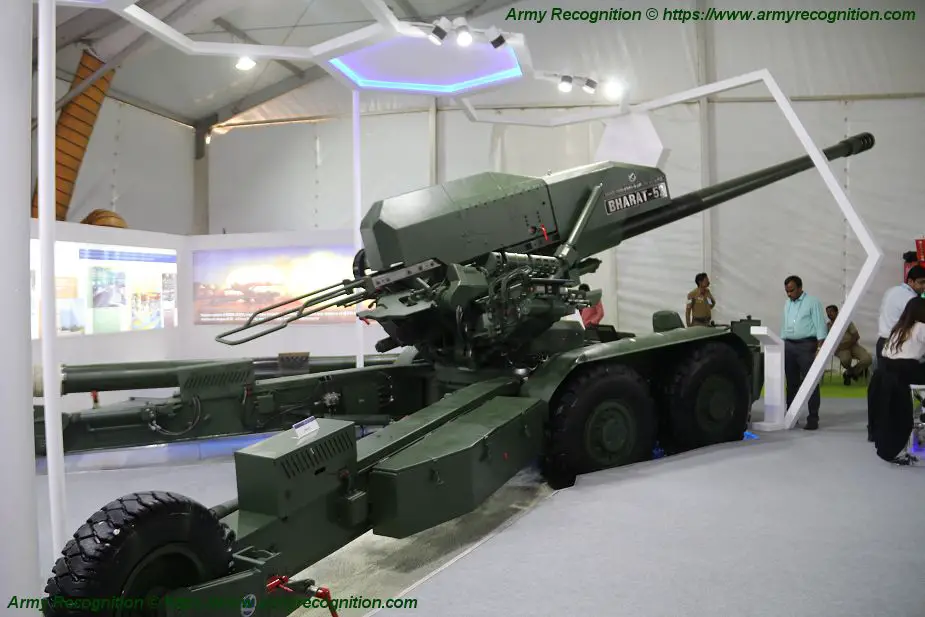
[Bharat Forge’s 155mm 52 calibre artillery displayed at Defexpo 2020]
Defexpo 2020 ended its run at the swanky new exhibition ground, created especially for the purpose by the UP government in Lucknow, drew praise. A UP minister declared it a great success on the basis that some 200 MOUs were signed compared to just 40 during the previous version of the Expo held in Chennai in 2018. The minister needs to dunk his head in a bucket of iced water to wake him up to reality. MOUs mean next to nothing. Literally thousands of MOUs have been signed in the last decade, but the foreign direct investment in defence ventures is still almost zero.
But those who participated — and there were more than 200 of the most important Indian and international companies that displayed their wares or tried to cut deals for them, complained that having built the tremendous fair ground infrastructure, the Adityanath regime fouled up in a crucial area — in providing powerful telecommunications coverage to facilitate bulk data transmission for instantaneous displays on screens, laptops and especially smart phones which defence industry representatives these days use to conduct business. With no smart phones working — the telecom service coverage being nonexistent around the trade fairground or so spotty as to be useless any way, the Defexpo was a disaster. As a throwback to paper usage, interested customers demanded brochures, physical documents, and the like that have long since become passe’ and which no self-respecting company rep lugs around anymore! In short, Defexpo 2020 was a communications fiasco. It could have been averted by the UP government installing a bunch of microwave comms towers all round the defexpo grounds.
Strange that no media outlet reported on this astonishing snafu! This even though print and electronic media were present in strength what with prime minister Narendra Modi, defence minister Rajnath Singh and UP chief minister Adityanath attending along with their retinues of PMO, Defence Ministry and Department of Defence Production babus and other hangers-on.
What was, however, a success was the confidence in evidence of Indian private sector military hardware producers who exhibited extraordinarily advanced, streamlined and sophisticated products. Foreign experts and company reps were impressed particularly with the sleek gun systems — Bharat Forge’s 155 mm 52 calibre long range gun, and this company’s ultra-light weight howitzer weighing a ton compared to the next lightest, which is a 3-4 tonner! The price too is something no foreign gun supplier can match — Rs 15-20 crore per piece for the 155 mm gun versus Rs 50-55 crores for an imported gun. A former Israeli general called it the “best gun of its kind in the world!” The Bharat Forge ultra-light weight howitzer with soft recoil technology, ideal for mountain ops, was likewise available to the army when the Modi government opted several years back for the American M-777 howitzer instead in a “government-to-government” deal. In other words, Modi chose to please Washington than put teeth in his own “Make in India” programme upped by Bharat Forge to the much higher value “Made in India” — design to delivery. It cost the country multiples for an old gun system when the locally designed, developed, tested and proven new generation piece was available for the taking.
The other product line that drew oohs and aahs from foreign visitors was, surprisingly, the stall of Adani Defence & Aerospace featuring a range of 7.62 mm assault rifles, machine guns and light machine guns manufactured in a unit in Gwalior set up with 49% equity partner — the Israeli company IWI. This unit has been established to meet current and future Indian demands, and for export. This was such strikingly modern stuff it left many an expert observer goggle-eyed. Obviously, the Adani majority partnership helped the defence ministry plonk for an initial order of 41,000 Adani assault rifles, an item the public sector Ishapore ordnance factory has struggled mightily for years to design and develop.
So the army’s need for two of the biggest and most basic goods — artillery of all kinds in mobile and towed mode can be locally met with the Bharat Forge guns that together with L&T’s K-109 Vajra form a formidable battery, and the military’s requirements of basic infantry weapons by the Adani assault rifles, etc.
If the army means what it says about going increasingly indigenous, a third item — the tank too can be fully home supplied. The Avadi DPSU produces the Arjuna main battle tank which the Indian government, if it was serious about its professions about advancing the Indian defence industry factory, should designate as the only equipment to outfit the country’s armoured formations (with the Russian T-72s/90s under phase out) and restrict the purchase of tanks to the Arjun MBT.
That will leave the field clear for an Indian light tank developed by mounting the Bharat Forge 105mm gun on a light tank chassis that Mahindra, with its expertise in armoured combat vehicles that also impressed at the Lucknow Defexpo, can easily design and produce. What will thus obtain is a 45 ton light tank to equip the first two Divisions of the mountain offensive corps under raising, with two more mountain corps hopefully in the offing, to adequately meet the contingent Chinese threat ex-PLA-occupied Tibet. Kirloskar can perhaps be roped in to design and develop a high torque engine for this light tank to operate optimally in the thin air at Himalayan heights. It is the sort of consortium approach, coupling the different competences of Indian firms that Bharat Forge, Mahindra, and Kirloskar can pioneer in the private sector.
Such consortia can, moreover, offer capital weapons platforms outputted within contracted time frames and cost parameters in deals that the imports-besotted defence ministry simply cannot refuse, and the defence public sector units are inherently incapable of matching.
The new standard for career advancement in MEA is now clearly laid down: the success achieved by Narendra Modi’s mass interface with NRIs on foreign tours, particularly to Western countries (US, UK, Australia, et al) and which events, featuring host country notables, are seen by the PM as affirming his personal worth and standing in the world. The ambassadors lucky enough to be posted to countries where they were asked to manage these circuses have been uniformly rewarded. Modi’s interaction with “students” of the Tsinghua University in Beijing mightily helped S. Jaishankar to occupy the Washington ambassador’s post the latter craved and which, in turn, and with a little help from friends in the US government, eased his passage into the Foreign Secretary’ chair. Likewise, Navtej Sarna, who as High Commissioner to the UK impressed Modi by pulling off the massive assemblage of NRIs at Wembley Stadium with British PM David Cameron in attendance in November 2015 was promptly dispatched to the US as ambassador to work the NRI crowd there, which efforts eventuated in the “Howdy, Modi!” event in Houston last year, benefiting his successor Harsh Vardhan Shringla now promoted as Foreign Secretary. True, Rajiv Gandhi installed his favourite PK Kaul, ex-IAS, former cabinet secretary, and paid-up member of the “Kashmiri mafia” that surrounded his mother Indira Gandhi, as ambassador to the US in 1986. But success in arranging big events with a lot of hoopla has only now become a unique standard for promotion to FS-ship. As far as IFS officers are concerned, they have to be in the right place to cash in. That and pure luck with the timing of the PM’s tours!
But why this digression on the MEA promotions policy when the topic is the restructuring of MEA? No reason at all except to put down a marker (because by itself the topic of which diplomats make it to the top and why doesn’t deserve a separate post)!
An administrative shakeup or a reshaping of the decision making schematic is usually undertaken by a government when it finds the previous system failing to deliver. With substantive success in the external realm ranging from thin to scarce in the past 6 years, the Prime Minister, hoping for better results, has approved this restructuring to turn things around. But because in the Modi dispensation Modi alone matters, the contribution by careerist babus, including the incumbent external affairs minister, is limited to filling in the details of policies laid down by the PM. This fact won’t alter with the changes that have been rung in. What will is the process with more people involved in it. The restructuring may just muddy it up some more. How?
Well, the new scheme supposedly emulates the decision making system in corporations with “verticals” in well defined issue areas — cultural diplomacy, trade & economic diplomacy, policy planning & research, Africa, Europe, Indo-Pacific, international conferences, development partnership administration, new and emerging strategic technologies (NEST), etc. But look more closely and this rejigging exercise that has been in the works for some time now, appears to seek to remedy a problem faced mostly by senior ambassador-rank echelon whose members, at the additional secretary-level, found themselves with time on their hands and very little to do. But this was like elsewhere in the rest of the Government of India where Joint Secretaries run the show. The Joint Secretary-level officers are the sword arm with Secretaries being the public face, taking credit for things going right and the blame for things going wrong usually being carried by Joint Secretaries. The Additional Secretaries (ASs) in the middle in this setup end up twiddling their thumbs.
So, essentially the new MEA scheme is make work for ASs. They are being asked to “direct”, be directors of, the policy verticals which means what exactly, especially in the context of Jaishankar’s ambitious idea — taken from the American system — of placing mid-level diplomats in various line ministries — defence, trade and commerce, economic affairs, etc.? This raises questions about the basic problem even the unstructured MEA, with little presence outside its own ambit, confronted, namely, the remarkably small numbers of diplomats in service, just 930 or so. This is so small a figure, it barely surpasses the size (850) of the Singapore foreign service or that of New Zealand (885), a country with a population of 4.8 million (a figure equaling the population of just South Delhi!). Compared to Japan’s diplomatic corps in excess of 6,000 officers and, even more, China’s with 7,500 diplomats, and America’s 14,000, India’s foreign service is so dwarfed it is laughable to consider India and these latter countries as being in the same game. And yet the Indian government expects that somehow — perhaps by some tantra or magic, this small number of personnel available to MEA will be able to produce the outcomes their gigantic counterparts in Japan, China, and the US do. This is madness.
The Modi regime can restructure MEA all it wants, can experiment with this or that, but short of actually enlarging the Foreign Service ten-fold for a start, the results will still be the same — pitiable. That the annual intake into IFS tops off at 35 officers tells it own sad story. Then there’s the problem of entrant level quality. Civil services generally, and the IFS is no exception, have over forty years now stopped attracting the best and the brightest in the country with college graduates, who choose not to go abroad, understandably gravitating towards business schools and entrant level corporate salaries many times that earned by newbie babus and, even more, by the huge responsibility they are asked to shoulder in the very early stages of their careers with commensurate rewards and advancement of career prospects to follow. Other than transnationals, with more and more Indian companies having presence in foreign countries, senior positions abroad are almost a matter of course. So why would any bright, right thinking, young adult want to be a diplomat when he can do so much better in the private sector and hop, skip and jump to high positions — something simply not possible in government service wedded principally to the seniority principle, with merit and performance as secondary factors? Tumhara time ayega. Tees saal baad, ayega!
Of course, GOI has always had the option of increasing the size of the Indian Foreign Service. This it hasn’t done because of severe opposition from the Service itself as it wants to retain its “elite” status, which is equated by it to remaining small-sized. Why no government has thrust the IFS enlargement decision down the throat of the Foreign Office regardless is a mystery even though the fact of a small and fairly ineffective diplomatic presence being a foreign policy liability has long been acknowledged by the government. Sure, such enlargement plans would require a very large entrant intake and correspondingly large training institutions, such as the Foreign Service Institute, etc.
In the event, collateral entry in massive numbers is the short-term and medium-term answer. To-date the only conspicuous posting in this stream is of a politically connected journalist (who after a stint as media man to President Kovind) was appointed AS in MEA to polish up the Modi government’s public relations (PR). Whether he succeeded in his remit (of improving the perceptions of the Modi regime) is uncertain, but he is now being asked to help promote the country’s cultural diplomacy fronted by ICCR (Indian Council of Cultural Relations). Except, like Policy Planning, ICCR has been good only for providing the Foreign Office with parking slots for officers who wanted to stay on in Delhi pending appointments to better diplomatic stations (than the ones allotted them)! So much for cultural diplomacy.
PR is relatively easy stuff. Not sure if any collateral entrant has been accommodated in any really important position within MEA. This brings up the crucial matter of why manifestly successful persons from the high flying technology sectors or from trade and industry would want to enter MEA using this channel? What job satisfaction could they expect to derive in a situation where IFS(A) officers will be lording it over them and who will, at every turn, try to show them down? After all, one of the reasons the collateral entry scheme has not really taken off is owing to the resistance of the IFS(A) cadre which fears losing ground to technically sound, problem-solving minded, business managers, engineers, and the like, who would do a great job of bringing development assistance projects under the Development Partnership Assistance programmes in Afghanistan, Africa, the immediate neighbourhood, and Central Asia in time and within costs, and who have proved their druthers outside the confines of government and experienced real world problems and solved them (in contrast to UPSC selectees who have known nothing other than serving in government). One can see why such people would be perceived by careerists as threat whose influx in large numbers and regularization in service is to be prevented by any means and at all cost. The intention of IFS officers is to preserve their seniority, perquisites and promotion prospects which, of course, will be disturbed by the collaterals should they want to make a career of it, as some of them might, whence the determination to keep out the interlopers, failing which to minimize their flow into MEA and, in any case, to deny them a receptive and helpful eco-system lest they show success in endeavours where they failed.
The fixing of seniority, etc to ease IFS’ ill will towards collateral entrants have not been addressed by the Department of Personnel & Training or the GOI. It is easier to reconcile the lateral entry of 60-odd officers from other services who have joined the MEA because the presumptive condition is that these other service-wallahs will after short stints or eventually return to their respective cadres, services and ministries, hence, will not mar the promotion prospects of the IFS(A) officers, and therefore can be tolerated.
The seriously troubling matter facing GOI is regarding the collateral entrants. How to get top drawer talent, especially from the technology sectors (artificial intelligence, cyber, bio-engineering, genetically modified foods, quantum computing, robotics, experimental physics, etc.), in particular, into MEA to man the NEST vertical, for instance. There may be the occasional IIT-ian or engineer in the ranks of the IFS but it is unlikely these officers, given the pace of transformative technological change, will have kept up with the cutting edge in their engineering/scientific fields. This renders them as a cohort just as useless as the generalists bulking up the IFS in assessing technology trends, the country’s proven strength in these and allied spheres, etc., and puts them at as much disadvantage when negotiating with, say, Chinese and American diplomats specializing in these fields, as their generalist colleagues. It is the sheer disparity of knowledge and competence that will do in India’s national interest. And what India will end up with is a regular production of unequal treaties that MEA will get GOI to sign on. Realistically, the country will be faced with serial iteration of the 2008 “civilian nuclear cooperation” deal with the US-type of transactions that gut India’s sovereignty and the national interest.
Jaishankar, Modi’s pointman in MEA, will not resolve these issues because as an IFS(A) veteran he will do nothing to hurt his cadre. The MEA collateral entry scheme will, in the event, continue to attract only pliant journalists, media commentators, thinktankers, and such other generalists, who have failed to make a mark. Consequently, MEA is destined to remain grossly undermanned and institutionally incapable of carrying out an activist and comprehensive diplomacy on a global scale of the scale and intensity Modi has apparently in mind.
It is almost de rigueur for a newly appointed military Chief of Staff to ritually make certain statements, for instance, about the supposed readiness of his armed service to fight a “two-front war”. General Manoj M. Naravane, however, displayed a disarming confidence in making them. Asked how he planned to do so, he said the “dual task formations” would switch between confronting Pakistan in the west and taking on China in the north and northeast. “In case of simultaneous threat from both directions,” he elaborated, “there would always be a primary front [where] the bulk of our forces and resources will be concentrated [while] on the other front, we will adopt a more deterrent posture.” Trouble is, the military considers Pakistan the primary threat and accordingly invests in, and deploys, its resources.
A real two-front war-fighting capacity would require India to have unlimited financial resources to afford a comprehensively capable military, self-sufficiency in arms, and the industrial muscle for surge production of all military hardware, nuts and screws up, to quickly fill voids in military stores and lost equipment. But for an army with reportedly only 10 days of ammunition expended at intense rates of fire, Naravane’s is a remarkably sanguine assessment based on flawed assumptions. Namely, that war with China will be limited and unfold linearly and along expected lines, that the terrains in, and weaponry and skill sets required for, the two fronts are similar, and that Indian troops are versatile enough to fight the Pakistan army in Kashmir one day and be airlifted to tackle the Chinese army in the Himalayas the next.
Such views are propagated essentially to preserve and legitimate the existing dated and dysfunctional force structure. Combat arms within this structure constitute vested, often clashing, bureaucratic interests that have reached a modus vivendi they do not want disturbed. Thus, modernising and maintaining three-armoured strike corps with heavy tanks as spear head account for a large chunk (19 to 26 per cent) of the defence budget and, owing to funding constraints, is at the expense of three desperately needed specialised offensive mountain corps. Stuck in plains/desert warfare concepts, shifting resources to, say, Russian T-14 light tank-equipped mountain corps able to take the fight to China on the Tibetan Plateau is opposed even if it means ineffectively working the T-72s from their redoubts on the high-altitude northern Sikkim plains where, on any given morning, 40 per cent of them are unable to cold start.
“Fighter mafias” run major air forces, including the Indian Air Force. In IAF, they phased out the bomber component in the 1970s after the medium Canberra bomber ended service. Short and medium range combat aircraft, however, have been bought pell-mell from every imaginable foreign source. It has obtained, in the process, a fleet without any strategic reach or clout, and so diverse it is nightmarish to upkeep in peacetime, what to speak of in war. In fact, Soviet Union’s offer in 1971 of the Tu-22 Backfire strategic bomber, which would have been a ready delivery system for the Indian nuclear bomb tested and acquired three years later, was spurned and MiG-23BN selected instead. Since the mid-1990s, the Russian advanced intercontinental range Tu-160 Blackjack bomber available for the asking has likewise been ignored. Indeed, dog in the manger-like IAF even prevented the Indian Navy from securing the Tu-22 and the strategic bombing role it had discarded, leaving the country with aircraft optimally usable only against Pakistan.
So, India finds itself in the sorry situation of “cavalry generals” and fighter jocks inflating the negligible threat from Pakistan, skewing the government’s procurement and other military priorities, and using the two-front war scenario to justify this system that has obtained for the country a severely limited, financially ruinous war-fighting capability, increased vulnerability to China and imperilled national security. Such distribution of military attention and resources may suit the government of the day. Whether it serves the national interest is another matter.
This is what someone high-up in the S Jaishankar-led Ministry of External Affairs admitted to a newspaper after the unpreventable debacle at the Paris meeting of the Financial Action Task Force (FATF) on January 23: “It was a bit surprising the way US, UK, France, Germany, Australia, New Zealand and even Japan, all of them favoured Pakistan. There is a strong case against Pakistan, as has been since it was put on the grey list, it it was geopolitics at play…seems the changing geopolitical environment helped Pakistan.” (https://indianexpress.com/article/pakistan/changing-equations-in-region-help-pakistan-get-relief-at-fatf-meet-6232408/). That by end-2020 Pakistan will be well out of FATF is also something that has been all but communicated to Islamabad, this even though it has so far complied with only 7 of the 27 conditions but has been “deemed” by FATF, for reasons not clarified, as having met 17 of them.
What is astonishing is that seasoned Indian diplomats, with Jaishankar in the van, are surprised that geopolitics is why so many of the Western countries and Japan that the Modi government has assiduously courted over the past 6 years have turned on Delhi and are now parroting the Chinese view that Pakistan should be rewarded for taking some actions to limit its support for anti-India terrorist gangs (LeT, JeM) active in Kashmir, to curtail the funds channeled to them and to close down the ISI-sourced terrorist money laundering operation generally. It shows just how clued MEA is to the verities of international relations! It is embarrassing the depths to which Indian diplomacy has plunged.
What is geopolitically obvious to every country in the world is apparently invisible to the Modi regime — that Pakistan having made itself pivotal to a solution in Afghanistan is now in a position to dictate how it wants to be treated where the niggling matter of its use of terrorism against India is concerned. Modi, Jaishankar, et al really believe that to the US and the West (with Japan as honorary member) the Pakistan army’s deployment of the LeT and JeM cadres in J&K is more important than Islamabad’s utility to them as the sole conduit to the Taliban! America, of course, sets the agenda with the European states and Japan following it like lemmings. The context is that Trump (like Modi), with little by way of success in his foreign policy bag but facing impeachment and a re-election process, desperately needs to show that it was his Administration that disengaged the US military from its fruitless and expensive thrashings about in Afghanistan — to date costing the US over a trillion dollars! However, to advance this aim Pakistan’s help is crucial.
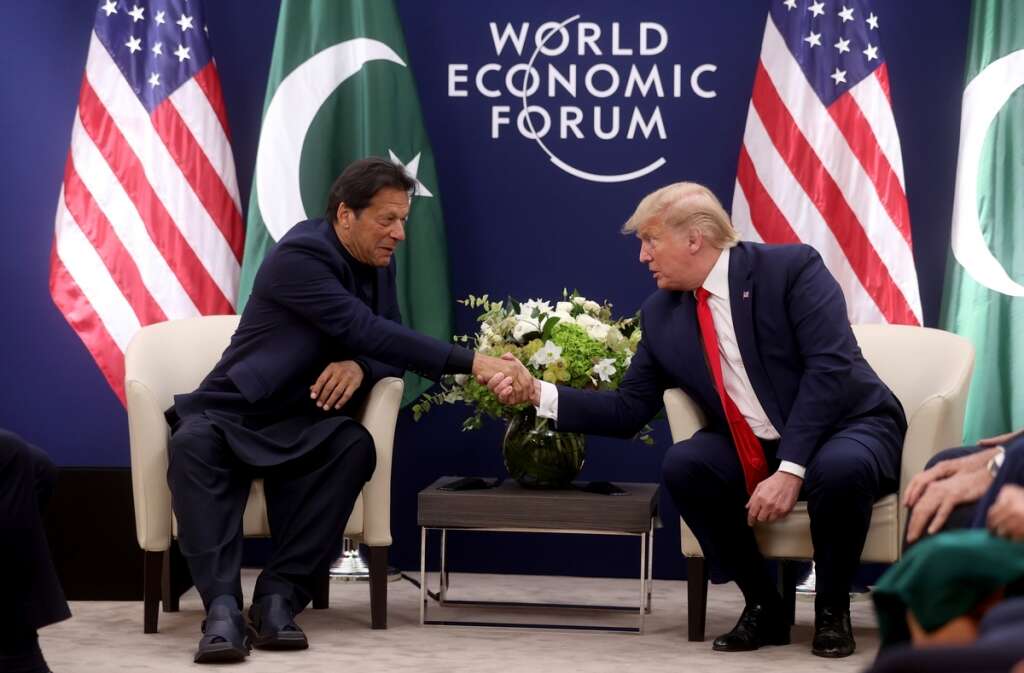
Islamabad has long recognized the leverage it, therefore, has with the US as long as Afghanistan remains on the boil. But its leaders have often lacked the nerve to play the leverage game, which deficiency is now corrected. The result is that like its mentor China (on nonproliferation), Pakistan is glorying in its position on Afghanistan as a stoker of the problem and as an unavoidable part of any eventual solution which will be delayed as much as is earthly possible by ISI whatever the nature of Imran’s promises of assistance to Trump. That the Imran Khan government is preparing to play this high stakes game at this stage is not little due to the PM appointing as his Special Assistant for national security, Moeed Yusuf, a Washington thinktanker well versed both in geopolitics and regarding Washington’s pressure points, who hitherto had offered clinical counsel through his op-eds in Pakistani newspaper. We can expect more such adroit diplomatic maneuvering by Pakistan and success, and egg on the face of India’s leaden-footed diplomacy.
It is the Indian government’s willful policy blindness to Pakistan’s geostrategic significance to Washington, among other things, as lever to keep India in place and to extort the decisions it desires from Delhi, even in the absence of any US military embroilment in Afghanistan, that makes Modi’s search for “decisive” US-qua-FATF action against Pakistan at once futile and even tragic. Other than revealing the longstanding brain-freeze of the Indian government (that predated Modi regime) when dealing with the US and the West, on the one hand, and China on the other, the fact that it cannot even read the reality correctly, is sobering considering that it can so easily change, obtain and control a new reality were the country’s foreign and military policies not so instinctively and habitually subservient and skewed.
We know why Delhi kowtows to the US and the West (green card, and other considerations in kind, for progeny and relatives of diplomats and senior civil servants manning the Indian policy apparatus), but why does Modi genuflect before China even as Beijing repeatedly kicks it in the face, with FATF being only the latest instance? Hard to make sense of Modi’s bending backwards to make Xi happy unless it is his deep sense of inferiority and hopelessness that he projects — as Indian leaders before him have done — about India’s will and ability to stand up and hit back and, therefore, deciding preemptively to give up, not be in the big power game at all. It is the diplomatic version of the coronavirus sourced from the Chinese city of Wuhan, the site of the Modi-Xi summit and the “Wuhan spirit” that the Indian PM has evoked ever since.
There’s always the thoroughly compromised Jaishankar to offer explanations and rationales, and whose utterances, a former senior foreign service colleague of his dismisses as mere “justifications” of Modi’s policy tilt of the moment.
[Fountain Ink, a monthly published from Chennai, asked 10 persons in public life and, in its words, “from different stations with varied experience [to briefly answer a set of questions about] what time has wrought, how each relates to time and goings-on, of what gnaws at them even if their own individual lives are on an even keel and what inspires them.” The responses were collated and published in a piece entitled “The Story of us”, in this periodical’s January issue, at https://fountainink.in/reportage/many-eyes-many-stories. My take is reproduced below.
—————-
As a think-tanker, I have tried my damndest to influence Indian foreign and military policies specifically and the national security policy generally, with my contrarian hard power-realpolitik views. This I have attempted to do over the last 35-odd years via appointments in government and constitutional bodies (as member of the 1st National Security Advisory Board, and as adviser, defence expenditure, to the 10th Finance Commission), through books and writings, consultations with political leaders and with armed services’ chiefs and their senior advisers, and through lectures at the National War College, Army War College, Naval War College, College of Air Warfare, College of Military Engineering, College of Defence Management, and other senior military training forums, by participating in seminars and conferences, and by reaching directly to the people via public lectures, videographed talks on the net, and the less frequent TV news shows and newspaper op-eds.
Despite the severe flux in global power politics and the international correlation of forces the essential inertness of the Indian government’s thinking and policies (through the decade) was simply astonishing.
India’s inert foreign policy is the bane of this country and prevents it from exercising its prerogatives and becoming a great power. Consider that Indian policy switched from leaning on the Soviet Union during the Cold War decades to tilting in the new millennium towards America. It started with the Narasimha Rao regime and continued unaltered in the Atal Bihari Vajpayee, Manmohan Singh and now Narendra Modi governments, notwithstanding the ideological differences between the left-of-centre Congress party and the right-of-centre BJP.
The trouble is whatever their rhetoric, no leader or political party seems convinced about India’s big power bona fides, but seems united in seeing the country as a secondary, subservient, power that can only rise without giving offence to rivals (China) and on the backs of friendly great powers. Whence India’s “creeper vine” foreign policy, which is geared to winding India around some big power as support in order to rise like the creeper vine that needs a pole, a tree, or a lattice to climb.
It is a tragedy starkly illustrated by the persistent scandal of importing arms, making foreign defence industries wealthy and affording supplier states diplomatic leverage, rather than trusting in indigenous talent and capabilities, which are abundant and of high worth and readily available especially in the private sector. So, as far as I am concerned, it has all been lose, lose, for India, ensuring the country remains in the new century what it has been for long—a middling power of little real consequence.
It has been frustrating to see piddling states like North Korea and even Pakistan display the guts and gumption to be disruptive—which is what I have long argued India should be to earn the world’s respect, instead of what it has been doing—acting “responsible”, pleading to join clubs (UNSC) and cartels (MTCR, NSG) on their terms, treated with disdain, and getting sidelined and kicked in the shins for its troubles.
I have become more impatient, not less, with age, impatient for India to amount to something in my lifetime which, sadly, won’t happen.
On the personal level, it is pleasing to see my many books and views that have consistently advocated ways to make India a great power by pursuing this status the old fashioned way—by unwillingness to compromise on expansively defined national interests, by the wise use of national resources and, in Bismarck’s famous phrase, by blood and steel, being appreciated in policy establishments and strategic enclaves at home and abroad.
Unfortunately, starting with Nehru our leaders have sought great power the easy way—as entitlement, by popular international acclaim, and by pushing abstract goals, like India becoming a vishwa guru (whatever that means)!
The vibe I get from the decade is of little meaningful change in India’s national security policies and plans. India seems to be steadfastly marching in place and getting nowhere fast. As the Queen said to Alice in Lewis Carroll’s Wonderland, if you don’t know where you are going, any path will get you there.
As an Edmund Burkean conservative, the hopes and expectations I had for a diminished role of government in national life and in the lives of the people (that Narendra Modi promised) have not panned out. As a realist strategist, I am appalled at how diligently our leaders and the government have frittered national resources and squandered opportunities to raise India’s stock as an independent nodal power and China’s premier rival in Asia and the world.
Despite just about everything going wrong and the country stagnating, I still have absolute conviction that India will make good, become a great power in spite of the government, not because of it. In fact, the political class and the government are, I have come to believe, the biggest liability for the nation, a millstone round the country’s neck, relentlessly dragging it down.
[Aruna Sundararajan, ex-IAS, former Telecom Secretary: Being feted for what, exactly?]
It is no exaggeration to say that almost the entire senior echelon of managers — technical and generalist — manning the state apparatus — ranging from the technocratic elite in the Department of Atomic Energy, DRDO, etc., Joint Secretary-rank officers on up of the Indian Administrative Service, the Indian Foreign Service and allied services, to senior military personnel, constitute a Fifth Column, a cabal of insiders, determined on tripping the country up at every turn as it struggles to rise, make a mark, in the world. The tragedy is they do this because of their godawful belief that they are doing right by India! With Government insiders like these, India does not need enemies.
Right now we are seeing just how, with the help of telecom ministry officials and other insiders, the Chinese are set to win a contract for 5G telecommunications system, even as these insiders have tamped down brutally on a bevy of indigenous private sector companies who have earned commercial success and are tech-innovation leaders, having obtained international patents and Intellectual Property Rights in the most advanced and edgy communications hardware and software spheres that constitute 6G!!!, and who are only pleading for a fair chance and an even field to compete with Huawei, which will be denied them. This is, no thanks, to the role of this 5th column comprising latter day Mir Jaffers, seths of Murshidabad who bankrolled Clive’s successful campaign at Plassey, and Mir Sadiqs (the original Gudu Khan who as Mir Sadiq became prime minister in Tipu Sultan’s government and betrayed his king; opening the gate on the Kaveri River of the Seringapatnam fort to the East India Company army of Indian mercenaries laying siege, leading to the annexation of the ‘Carnatic’ in May 1799 after the 4th Anglo-Mysore War).
It is the same cabal that has made India abjectly dependent on foreign arms suppliers, all but killing off the homegrown Tejas light combat aircraft, its derivative the advanced medium combat aircraft, and the Arjuna main battle tank.
Re: Indian government’s love for Chinese 5G. It is a denouement, notwithstanding, massive evidence available from all over the world that Huawei is a cyberwar front for the Chinese People’s Liberation Army, and allowing Huawei 5G and related hardware in any manner or form and even by way of the peripheral systems route into India, would be to essentially “open the gate” to the enemy. This development, moreover, is despite Prime Minister Narendra Modi’s initiative prompted by the Swadeshi Jagran Manch’s championing of indigenous 6G technology that derailed the decision made several months back by Department of Telecommunications (then headed by Aruna Sundararajan, IAS) to sign the 5G contract with Huawei.
The consolation is there are still the proverbial handful who oppose Huawei from the inside, but apparently without much effect. There’s Dr VK Saraswat, Member of Niti Ayog and former Science Adviser to the Defence Minister and head of DRDO, whose frustration runneth over. To wit, his take on the soon to be underway 5G trials conducted by DOT-National Cyber Coordination Centre (NCCC) and the “dangers of allowing Huawei to participate in them.”
“Government should appreciate the fact”, wrote Saraswat in a January 6 note to Smita Purshottam, who retired as ambassador to Switzerland and is an uncommon IFS officer in that she passionately promotes indigenous technology and chairs the non-profit SITARA (Science, Indigenous Technology & Advanced Research Accelerator, https://www.sitara.org.in) doing yeoman work to prevent India getting swamped by imported tech, “that once HUAWEI participates in the trials [it] would lead the show and we will not be in a position to bring out the features which could be the hidden security risk as HUAWEI will field the sanitised version [to which] our surveillance teams will not have access to all the layers of hardware and software.” “Once they lead the trials and come [up] trumps technologically which is most likely then Indian [private sector] service provider[s] will have strong reason to overlook the indigenous solution and pitch for HUAWEI” he added. “To save the situation” he recommends that “a very strong team of [Indian] cyber security experts be constituted to go through the fielded software, including the source code, and [that the] hardware be cleared by critical criterion testing team. “[Unless this is done] I am afraid”, Saraswat concludes, “that we are in trouble.” This advice has so far not been taken by the Modi government.
But why would private sector telecom service providers prefer Huawai? Because it is the cheapest. And how is it the cheapest? Because of China’s built-in financial support as subsidies to capital goods exporters. And because of Huawei’s special connection to PLA leading to Xi Jinping making clear to Modi the last two times they met that the success of Huawei 5G in India would be the metric by which bilateral relations will be judged. Huawei is able to sell its 5G cheap because, according to Purshottam, the Chinese companies underbid “by as much as 70% [to] drive our companies out.” “The history of Indian telecom [in 3G and 4G]”, she writes, is to “allow Huawei and other Chinese companies a foothold, they underbid and takeover” the market, a cycle that is set to be repeated with 5G.
With Huawei 5G in, PLA cyber warriors will be sitting pretty and in a position to eavesdrop on all communications, including the most secret by penetrating the nuclear command and control links and the military network, generally and, when required, to disrupt at will all Indian economic and banking activity by making electronic financial transactions go haywire. It is the jeopardy the Chinese 5G will get India into that moved Purshottam to write a letter on 5 January to retired Lieutenant General Rajesh Pant, who has taken over as chief of the National Cyber Coordination Centre. Purshottam does some plain speaking. Because it is important, this letter is reproduced in full below:
“I am writing to you in great concern regarding the decision to allow Huawei to participate in 5G trials. We were under the impression that Government of India was fully aware of the security concerns resulting from the presence of any Chinese or even foreign company in sensitive 5G networks. It is therefore not understood on what basis this decision has been taken. Governments around the world have banned Huawei and Chinese telecom equipment vendors, because of China’s extensive cyber-espionage activities and also because China’s proclaimed Military Doctrine centres on Information Warfare and the control of information networks. They have already seized control of many telecommunications networks in India.
“5G will enormously increase the danger to Indian national security with Chinese control of this advanced telecommunications network. 5G will enable Artificial Intelligence to run without hindrance, collecting and weaponizing Data gathered from Indian activities. There are umpteen military applications of these synergized technologies with China leading in digitisation and intelligentization of Warfare. The Chinese aim to become Number One in 5G and AI.
“We are opening ourselves up to enormous security risks akin to the Himalayan blunder of 1962. At least we were able to recover from it but we will never recover if we allow Chinese control of our telecommunications networks. This is a terminal decision which will adversely impact the lives of the Indian people and their security for decades to come.
“There is a budget proposal to fund indigenous development of 5G technologies. This should be expedited as India has many capable indigenous companies with 5G technologies. 5G is not one technology but a composite of many. Many Indian companies possess the know-how in these areas. They need Government support to develop the missing technologies and also assurances regarding markets.
“There is no demand except from the vendors for 5G technology as yet in India. Our industry hasn’t reached that level, and compromising our national Security so that some kids can download faster movies is not a viable trade-off. We must develop our own technology.
“We request you to ensure India’s National Security and convene an all India meeting of Industry and Government so as to reconsider this decision and ban Chinese companies from India’s networks. 5G must be deployed with indigenous equipment. The task must not be given to agencies which have betrayed India’s interests in the past, or frittered away taxpayers’ money on foreign consultancies. The funding should be given to a specially created entity along the lines of the Delhi Metro involving security and defence forces, Industry and Government. This is too critical to be given to agencies which have no proven record of successful execution of indigenisation or Make in India. History will not forgive us for taking a wrong decision on this vital, critical issue. The advice of experts close to the Chinese Government must not be heeded.”
The irony is that among those Purshottam refers to as “experts close to the Chinese Government” is Arogyaswami Paulraj, former Indian Navy officer, who designed and developed the APSOH sonar which became the Fleet sonar of the Indian Navy, founded CDAC, etc, left for Stanford University in 1990 and there invented MIMO (Mulitiple input, multiple output) technology that has revolutionized telecommunications, holds 80 patents, founded several cutting edge tech companies, including Aruba networks that marries Artificial Intelligence elements to WiFi networks for data analytics, sold these companies and got immensely rich. Entirely inattentive to national security concerns, Paulraj contends that Chinese 5G is the fastest route for India economically to come up to speed in the telecom sector. As to why India needs to be in the 5G forefront when the potential capacities of existing 3G and 4G systems remain unused, Paulraj does not say. Several questions arise: With the US banning Huawei 5G why is Paulraj pushing it on India? What does he get out of doing so? And what are his connections to China?
But because in Modi’s world anybody with an American stamp of “success” cannot be wrong, Paulraj’s counsel is gospel. Or, as a SITARA member MJ Shankar Raman,who owns the Sahasra Solutions software company, heard one of the top insiders say, “We should not be too nationalistic and foolish.”
The assassination by a killer drone of Iran’s Pas Daran (Revolutionary Guards) chief, Major General Qassem Soleimani, on the express orders of the US President Donald J. Trump is the sort of historical blunder that will rank with President George W Bush’s initiation of war against Iraq in 2001 to takeout President Saddam Hussein on the blatantly false charge of Baghdad readying nuclear weapons. The Bush decision set fire to West Asia, and completely destabilized an already volatile region that Saddam had kept a lid on by strongarm measures.
Saddam was the hinge on which West Asian peace rested. He had for several previous decades somehow managed to balance the interests of the sunni and shia communities in Iraq, and maintain order, often by bloody means, something both the Saudi led sunni bloc and the Iran-headed shia bloc grudgingly acknowledged. That order was upended. Now Trump’s murder of Soleimani is likely to start a spiral of violence and targeted strikes against American military presence and US economic interests in the Gulf, in Iraq where shias predominate, and generally in the extended area stretching from the Red Sea and the Gulf of Hormuz to Central Asia in the north, Pakistan in the east, and Syria and the Levant in the west. As it is, the Iraqi parliament is on the verge of voting for a resolution asking the US to get out of Iraq.
Hugely respected in the region as much for his political acumen and military expertise as for his understanding of the religio-ethnic dynamic in greater West Asia, Soleimani founded the al-Quds force for action in Iraq after the US military intervention there. Deployed against what Tehran considers the greatest danger to Islam — the US-Israeli combine, and also to fight the spurious caliphate of the murderous al-Baghdadi, the al-Quds force and the Kurdish paramilitary force, Peshmerga, were primarily responsible for reducing the Islamic State to nothing, which actions were discreetly supported by Saudi Arabia — the ostensible guardian of Mecca. The real reason why the people by and large held Soleimani in high regard was because of his physical courage; he led from the front.
It is very possible that with Pakistan getting dragged into the melee with likely attacks on US targets mounted by Iran-backed elements in that country, India will be asked by Washington to not only share intelligence — and in case Pakistan becomes too hot for the US forces to stage military missions out of, to permit American military units to operate out of Indian air force and army bases along the border with Pakistan. In Jaishankar-Rajnath Singh’s recent 2×2 summit with the Pompeo-Esper duo in Washington, the American side was eager particularly to activate the Logistics Exchange Memorandum of Agreement (LEMOA) that will allow the US military the use of Indian facilities for, among other things, anti-Iran operations.
Permission under LEMOA will be demanded by the US because, with the general elections coming up, Trump will be compelled for political reasons to up the ante — meeting an Iranian counter thrust with a bigger strike — rather than to cool down the situation by making some sort of friendly gesture and even reparations to Tehran in terms of say, weakening the US-led sanctions regime. With much of Islamic Asia, including Pakistan, now unwilling to be any part of this action-reaction sequence, the only two countries on Iran’s flanks — Russia standing aside for the nonce before jumping onto Tehran’s side should America escalate with too much force — are Turkey to the west and India to the east.
Erdogan began building bridges to Iran with his visit to Tehran in January 2014 that was hailed by the Iranian foreign ministry, “As two neighbors and Muslim countries, ….enjoy[ing] many commonalities and many cooperation opportunities”. Indeed, before meeting with Trump in Washington in November last year, Erdogan had hosted a controversial Iranian diplomat who had a hand in an attack on certain Jews in Buenos Aires. So it is improbable that Ankara, which is already on the outs with the US owing to Erdogan’s purchase of the S-400 air defence system, will allow the NATO base at Incirlik to be used for air or any other activity against Iran. That leaves India exposed to US pressure.
One of Narendra Modi’s major claims of foreign policy success is his supposedly warm personal relations with Trump. It has so far fetched absolutely nothing for India and all the country has to-date witnessed is a one-way relationship where Modi keeps trying to please the US with unending concessions and deals for military hardware but receives no consideration whatsoever in return. With a confirmed America-firster — Jaishankar in MEA, moreover, the advice offered Modi is to give the US more and more even if it gets India less and less in return. His natural aptitude for hard bargaining that Modi boasted about is nowhere in evidence, at least not in terms of any substantive strategic gains and economic benefits. What benefits anybody can point to are mainly negative ones, meaning things like US restrictions on India techie movement could have been more severe, limitations on imports of Indian manufactured goods more onerous, etc.!
At the heart of the worry about India getting engaged, willy-nilly, in American initiatives hurtful to Iran, is that Modi, like most Indian politicians, is a proven sucker for praise and flattery, and Trump’s laying it on thick will be irresistible to the Indian PM. One need only recall the “Howdy, Modi!” Houston event and how elated Modi seemed when Trump rained accolades on him, to gauge the dangers ahead.
It may be best for the Modi government to, for once, do the right thing and preempt any approaches for help by Washington, by wagging its finger and asking the US and Iran to refrain from doing anything to escalate tension and, as a well wisher, to suggest to Washington that it make amends, by easing economic pressure on Tehran as prelude to negotiations for ending the long US-Iranian diplomatic impasse. It may be the way to regain for an over-US tilted India room for diplomatic manouevre, some slight self-respect and, perhaps, even an affirmation of shared interests with Iran.
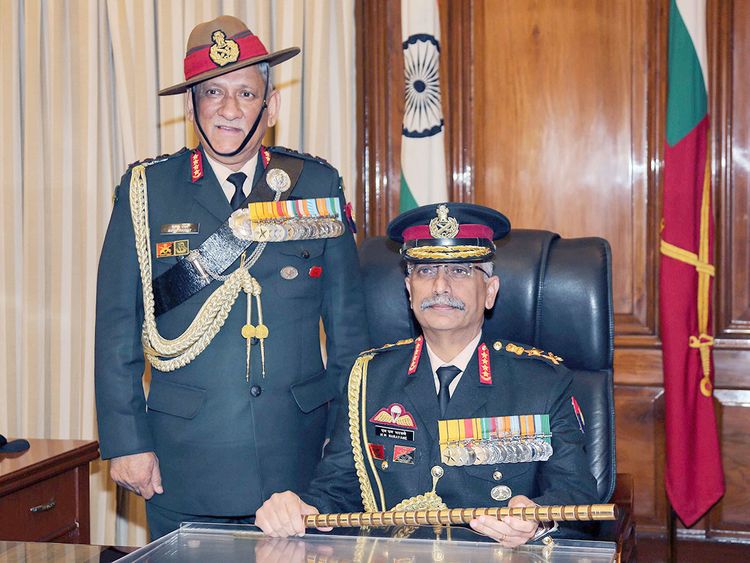
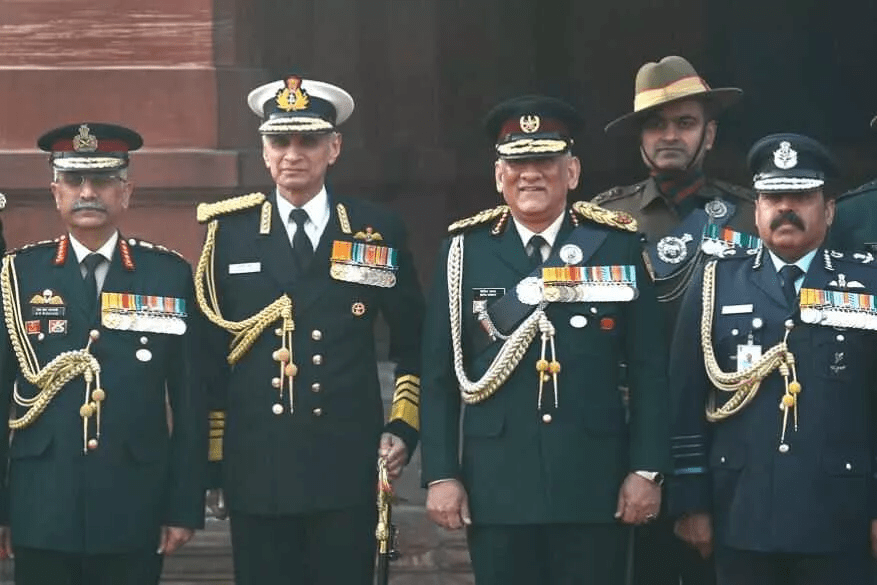
[CDS General Rawat, and three Chiefs of Staff — Naravane, Karambir Singh, and Bhadauria]
A book review by me published in India Today, Dec 30, 2019 issue
Anit Mukherjee, The Absent Dialogue: Politicians, Bureaucrats, and the Military in India, Oxford University Press, 2020.
———-
Civil-military relations in India are sensitive, tense, fraught with dread, and involve three parties – the armed services on one side and the tag team of politicians and bureaucrats on the other, tussling on eggshells. In this fandango, more effort is expended in turf battles, ego-status hassles, and furthering sectional interests than in working cooperatively to obtain speedy results. Enjoying superior position, the tag team mostly has its way, leaving the military to make do with what’s offered. Reduced almost to an afterthought, national security is not served well.
There is so much so seminally wrong with the existing system of national defence, it is hard to know where to start or whom to blame for the mess. In this book, Anit Mukherjee, a former armoured corps officer turned academic, identifies the villain — by his lights the “absence of dialogue” between the three players. But it is too pat an answer. Nevertheless, by addressing the problem of military effectiveness in terms of the lack of dialogue on weapons procurement, jointness, officer education, promotion policies and defence planning, he usefully pulls together information and insights based on interview research to highlight the ills plaguing the system that are widely known and have long been recognized as stumbling blocks. (A list of senior retired and serving military officers, bureaucrats and civilian experts who were interviewed is appended.)
A persuasive case is made that the extant state of civil-military relations is because there is no credible existential threat, “low salience [of defence] in electoral politics”, and because there is no real incentive to change. And that status quo is preferred because it preserves for the military its functional autonomy and for the babu-dominated politician-bureaucrat nexus the entirely satisfactory system of “power without accountability”. It is this context that the author fleshed out by tracing the state of civil-military relations through the tenures of the prime ministers to-date.
Jawaharlal Nehru established the system of overarching and disabling civilian control which may be democratic India’s strength and also major military weakness because generalist bureaucrats have tended to gum up the works. Civil-military relations reached heir apogee during the Indira Gandhi era when political involvement at every stage led to smooth inter-agency and inter-service coordination culminating in the successful 1971 Bangladesh war. The lesson that hands-on role by leaders is key, however, stays unlearned. The power balance tilted towards the military during the Rajiv Gandhi years when the showy army chief General K. Sundarji held sway. In the wake of controversial military operations (Brasstacks, Sri Lanka) and the Bofors scandal, the bureaucracy reasserted itself. In this milieu, disruptive institutional innovations are not countenanced.
The Committee on Defence Expenditure geared to curbing military spending did not survive the VP Singh interregnum because the armed services and the ministry of defence (MOD) bureaucrats alike found it “inconvenient”. In similar vein, a powerful Chief of Defence Staff (CDS) recommended by the Kargil Committee is unlikely to be realized with the Narendra Modi government favouring the Naresh Chandra Committee’s concept of a defanged four star CDS .
The absence of technical expertise and domain knowledge in MOD is the real scandal here, and Mukherjee dilates on it. He makes the telling point that uniformed officers are as much generalists as civil servants because the formers’ experience and professional training is so narrowly tactical they, like civilians, muddle along, unable to cope with the minutiae of technology trends, geopolitical developments, and the strategic scope and scale of effort needed for modern national security planning.
What the author misses out on is the crucial matter of political leaders shirking responsibility. Instead of setting goals, prioritizing threats and expenditure programmes and tasking bureaucrats and military to implement decisions, they rely on babus to, in effect, make them. This is the source of all the troubles, resulting in overbearing defence civilians, languid pace of decision-making, and a raft of seemingly irresolvable problems bedevilling India’s national security policy.