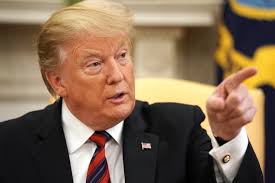
[Trump: Do it!]
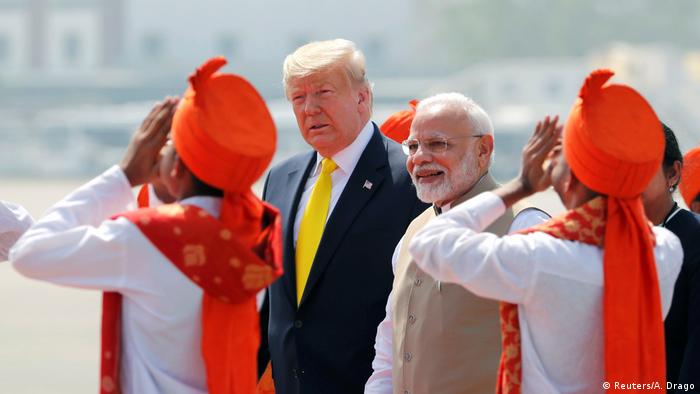
On April 4, Prime Minister Narendra Modi revealed on twitter that he “Had an extensive telephone conversation with President @realDonaldTrump. We had a good discussion, and agreed to deploy the full strength of the India-US partnership to fight COVID-19.” The PM apparently considers it a matter of great honour to be conferring with the American head of state on almost anything, and loses no time in letting this be publicly known. The reason Trump had called was to ask Modi to expeditiously release for export to the United States hydroxychloroquine that the Indian government may have stocked up on. In response, the PM reportedly told Trump that his government will consider his request but first examine the consequences of releasing this drug for sale to the US.
Trump is convinced this anti-malaria drug has a future as an anti-corona medicine. He has also to remedy a situation that may see his political goose being cooked because he had initially dismissed the C-virus as a scare conjured up by the Liberal establishment opposed to him. His medical advisers, however, are unanimous in warning that this chemical compound is unproven as solution for COVID-19, and that it is highly toxic when not used under strictest supervision. Whether Americans, despite being adequately warned, ingest this drug as a prophylactic on the basis of their President’s advice and die in vast numbers, is US’ concern. What India has to worry about is whether Delhi will ship off this medicine to the US, leaving India high and dry if hydroxychloroquine is discovered, on the off-chance, to actually be a panacea for the corona crisis. With respect to corona, India is still at the low end of the COVID-19 curve largely because of a near complete lack of specialized mass testing. For all any one knows, the corona may have already afflicted five or ten times as many Indians as the 4,000 patients under care. Five lakh testing kits are only this week arriving, ironically, from China. Even so, in the context of the 1.3 billion population, the disease, it may be fair to conclude, is still in its nascent phase with herd-contagion and spread in the country still to take-off and when it does infections may peak in the next two months or so. Thus, prudence suggests Modi should be cautious, not go overboard in emptying out the country’s stock of hydroxychloroquine for America’s benefit.
Except the option of not sending supplies of this drug to the US is now denied Modi who, in any case, has shown himself to be a little too fearful of alienating the US and otherwise too eager to please Washington. This tendency is what the US and Trump have to-date exploited. Two days after his conversation with Modi, Trump disclosed to the Press just what transpired in that phone call to the Indian leader. It turns out that far from pleading with Modi, Trump had demanded India forthwith sell to the US its holdings of the anti-malarial drug, or face punitive action. “I spoke to [Modi] Sunday morning, called him, and I said, we’d appreciate you allowing our supply to come out”, said Trump. “If [Modi] doesn’t allow it to come out. That would be OK. But of course, there may be retaliation. Why wouldn’t there be?” And retaliation, he hinted, would be that old staple — tightening the screws in the ongoing bilateral trade deal negotiations.
Consider Trump’s proprietorial reference to “allowing our supply to come out”. Does this mean that the US government through its embassy and/or via American pharma companies, their subsidiaries or middlemen agencies have already bought off a lot of India’s hydroxychloroquine stockpile, and having done so are only awaiting the Modi government’s approval for air-freighting it to America? Whether or not this quinine-containing drug is the answer for COVID-19, India will need it, besides malaria, to treat ailments like rheumatoid arthritis, etc. and so keeping a biggish stock of it to meet domestic need makes sense. In any case, it is India’s sovereign right, by way of husbanding its own resources to tackle a pandemic to negate any commercial contracts that spirit away important drugs from the country. The question is will Modi exercise this right, or succumb to American pressure?
Meanwhile, because of America’s marked dependence on China for pharmaceutical and medical products Beijing has Washington over the barrel. Indeed, as a March 4 commentary in Xinhua,the official Chinese news agency, put it, China can send the U.S. to “the hell of the novel coronavirus pandemic” by banning exports of all medical supplies.
It is not just Trump, but US’ attitude vis a vis India generally, that is really at issue here. I have been warning (in my numerous books and in writings over the past two decades) about Washington seeking to imprint US interests and concerns on India’s policies, starting in the new Century with the 2008 civilian nuclear deal and, in the Modi era, with the foundational accords (LEMOA, COMCASA, BECA) that have transformed India into a subsidiary ally. It is a goal successive Indian governments (under Atal Bihari Vajpayee, Manmohan Singh, Modi) have helped Washington realize. These regimes have acted on the flawed premise that an aspiring India can ride to great power status, as I keep harping, by kowtowing to extant great powers — US and China, in the main. It has only earned India kicks up its backside, but Delhi has not been disabused of this view. Then again, if our leaders display no self-respect, it is hardly to be wondered that India will continue to be treated with utter contempt which, incidentally is now reserved, as many West European states find, exclusively for America’s allies and friends.
The worm is, however, turning in Europe at least. Emmanuel Macron in France is leading the charge on shaping an autonomous European identity, policies and even a European military freed from the impedimenta of treaty ties to the US. Germany, the economic giant of Europe under Angela Merkl too has finally decided that enough is enough. The apparent breaking point has been reached with the Trump Administration “confiscating” 200,000 Thailand-made masks ordered by Germany, and arm twisting a German pharma research company reportedly on the cusp of a corona vaccine breakthrough to surrender exclusive rights to it to US companies. It moved the German Home Minister, Andreas Geisel, to equate such actions with “piracy” and to add that “This is no way to to treat transatlantic partners. Even in times of global crisis, we shouldn’t resort to the tactics of the Wild West.”
With treaty allies like Germany being treated with such insensitivity, India can expect only worse. But the Indian government doesn’t get it, perhaps, because Modi (like his predecessors in office) instead of being driven by ‘India First’ imperatives, is casting about, as always, for a safety line from the US which, however, works and has always worked solely on the ‘America First’ principle.
![Migrant workers crowd up outside a bus station as they wait to board buses to return to their villages during a 21-day nationwide lockdown to limit the spread of coronavirus, in Ghaziabad, on the outskirts of New Delhi. [Anushree Fadnavis/Reuters]](https://www.aljazeera.com/mritems/Images/2020/3/29/d895f90e4eef410a8f1a36a436a07a1a_8.jpg)
![A view of Mumbai's Bandra-Worli sea link over the Arabian Sea as seen during a 14-hour lockdown to limit the spread of coronavirus. [Francis Mascarenhas/Reuters]](https://www.aljazeera.com/mritems/Images/2020/3/22/f9bf7982d94a472ab13b0f302212b256_8.jpg)