It is a unique moment in time when the United States, the presumed numero uno power in the world, has literally lost its strategic moorings in the extended Indo-Pacific (from the maritime end) and in Eurasia (from the landward side). The Hormuz War that began with imperial insouciance is limping towards not just a humiliating terminus, but by physically driving the US military from the Gulf region, leaving its ultra-vulnerable petro-allies up a tree. US President has already ordered Iraq to be vacated of all American military presence. Elsewhere, with some 42 US military bases in the extended area rendered inoperable by pinpoint Iranian missile/longrange drone strikes aided by Chinese satellites in low earth orbits, Pentagon is wondering if it is worth America’s while to re-invest billions of dollars to rebuild them.
In other words, US’ military presence is being speedily zeroed out. And the most America will be able to do in the future is get up an expeditionary armed presence with only carrier-based air and limited land forces transported to theatres in crises by escort ships in naval Task Groups. It means an extremely curtailed offensive US punch that’s unlikely to be able to ward off even so small an adversary as the thin-land-strip bound Houthis in Yemen. In the event, it will be fun to see Asim Munir’s Pakistani troops engage the Houthis in combat (vide the Mecca pact)
This is an extraordinary reduction of a supposed super power to a mere bystander in West Asia in so short a time . It will lead inevitably to a diminished American interest in Asia at-large. The trend was evident to Tokyo which nearly simultaneously announced the building of four new missile and rocket testing sites, and that Japan was considering nuclear-powered attack submarines as the answer to offensive Chinese, Russian and North Korean naval activity in proximal waters.
In Europe, the situation is similar, for different reasons. There Vladimir Putin’s Russia, despite the difficult time it is having in subduing a fiesty Ukraine, finds itself favourably placed against the US with Trump buying Russian diesel just so Americans don’t vote their pocketbooks and hand over control of the US Congress to the opposition Democratic party in the coming mid-term November 2 elections, and overnight convert Trump into a lameduck occupying the White House. Even the lesser prospect of the Democrats capturing the lower House, the US House of Representatives, will in any case result in much the same thing by way of a legislative deadlock. In this deal, Putin secured from Trump a promise to pressure Ukraine into holding off from striking deeply-located Russian energy installations. It has left Kyiv, like the US’ Middle Eastern allies and partners, open to unreciprocable attacks and the Ukrainian president Volodymyr Zelensky fuming about Trump’s backdoor “smokescreen” oil deal.
Angry European NATO states which, were compelled by Washington to cutoff their dependence on Russian oil, which grievously hurt their economies, now find the US turning around and buying Russian diesel! This is particularly galling because, encouraged by Trump to invest in strengthening Ukraine’s military muscle, find themselves having to carry unaffordably fuller loads, and also to face Trump’s wrath for dissenting from his new policy of obtaining peace in Ukraine on Russian terms. The European rebuttal was prompt and has taken various forms. The UK welcomed Zelensky with unpreecedented ceremonial pomp, starting with a one-on-one meeting with the British monarch, King Charles. France and Germany are seriously considering a separate “European NATO” alongwith its own nuclear strike forces, and industrial supply chains uninterruptible by the US or China.
In other words, the US finds itself — by its own moves — distanced from its friends at both the European and Asian ends. It is a situation strategically advantageous to India, if only Messrs Modi and Jaishankar grab the opportunity and aggressively leverage the four foundational accords to obtain an absolute and permanent waiver for India from all economic and trade sanctions, what with the US Congress recently empowering Trump to impose 100% tariffs on states buying Russian oil! But what we see is only Jaishankar’s clever word play: India is not a middle power, but “a power in the middle”! Yea, OK, so what do you propose to do in that role, with that position?
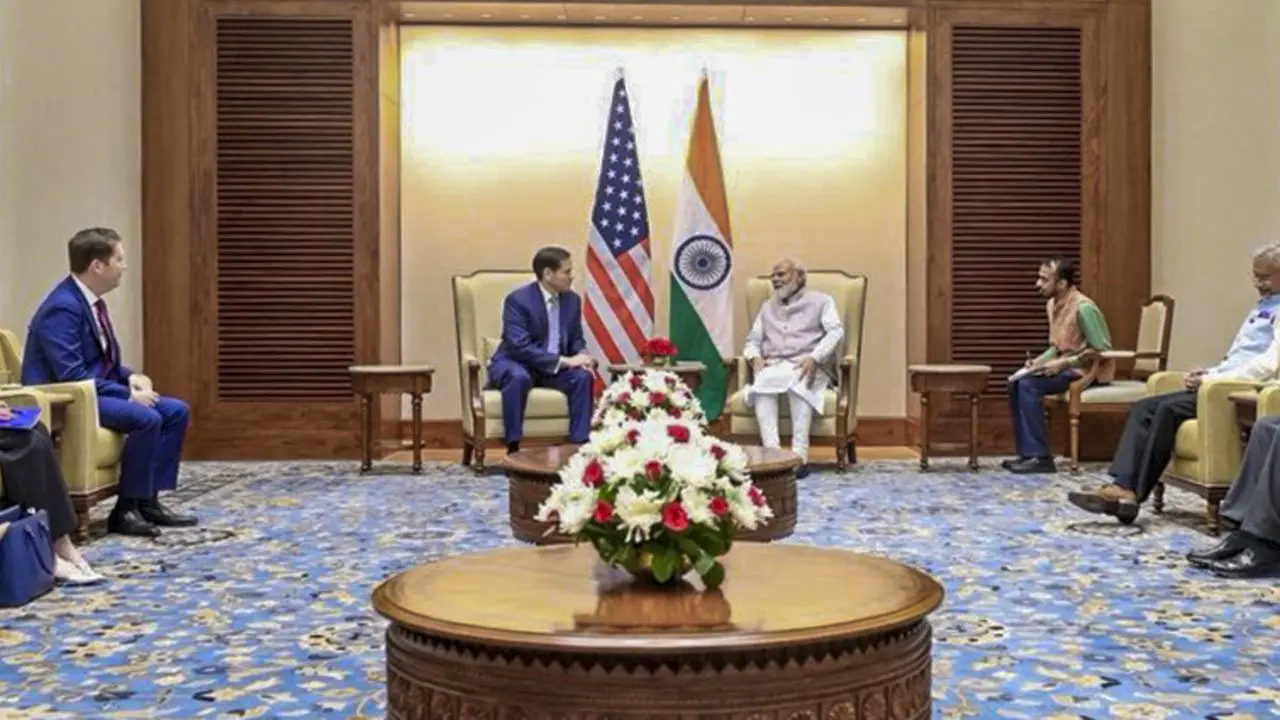
The US Secretary of State Marco Rubio is visiting Delhi this weekend with the idea of getting India to commit to gradually reducing — this is a bit rich! — its energy dependence on Russia — a goal that Jaishankar should reject outright before demanding that Washington hereafter keep India permanently off the tariffs hook on the pain of voiding, for a start, all Indian logistics support for the US military in the Indian Ocean. This is transactionalism, so let’s give it to the US president in trumps. Straight talk is always best because the woolly-sounding stuff (“I think the U.S. and India have a very, very consequential relationship, and it’s only going to get better”) that commerce minister Piyush Goyal routinely voices creating confusion that India-US bilateral relations can do without.
Jaishankar will hopefully avoid taking the usual beggar’s stance by pleading for H1B visas, etc. that he normally does when, by closing off all immigration avenues, the Trump Administration has settled on a policy of actively discouraging Indian talent flow. The Indian government has to begin showing some national self respect, for God’s sake.
Rubio is also likely to push Elon Musk’s Starlink venture in India. According to mainstream US media, Musk is spending over $300 million of his own money in a media blitz of fake and AI-doctored TV ads to win support in the November elections for Republican candidates and, in the bargain, to shore up Trump politically. In the event, Rubio’s Starlink sales pitch will be a quid pro quo. Rubio hopes to convince the Indian government to let Musk’s Starlink company into the country bypassing security and other vetting protocols.
Starlink has some 10,400 LEO satellites virtually blanketing the earth providing, other than mobile telephony, continuous 24/7/365 look-down-look see surveillance and internet services to its customers. Musk has exploited this capability to switch-on, switch-off, access to Starlink customers, as per his mood swings. Thus, Ukrainian and Russian military users have found their uplinks to Starlink LEO satellites disrupted at will by Musk, who in this way dictates developments on the Ukrainian battlefield and the course of that war.
Surely, the Modi government is not unaware of the danger this prospectively poses India’s security if Starlink is allowed in. The Indian armed services plugging foolishly into this system would be in desperately deep trouble, and for obvious reasons. In case, Starlink is restricted only to an Indian civilian customer base, inclusive of corporate and financial/trade clients, the country will still be opened up to spreading through those channels all kinds of disinformation- electronic penetration programmes conceivably mounted by the US government and intelligence agencies.
In this respect, the Indian government is perhaps mindful of the US State Department’s efforts to dissuade Canada and many European allies and partners from participating in the Oct 7-8 conference hosted by EU DisinfoLab, a Brussels-based nonprofit group which, among other issues, discussed “USA as a FIMI threat: acknowledge, adapt, push back.” FIMI is an acronym for “foreign information manipulation and interference.” It means that European states are taking measures to prevent the dissemination of destabilising US Government-sourced disinformation campaigns. So, when Rubio pitches for a Musk license, Jaishankar should shrug it off with the usual excuse about the need to follow due process, etc., and thereby keep Starlink hanging until Musk loses interest. After all, the Modi government has already denounced him for “not willing to follow India rules”.
The turndown of the Starlink proposal will also require the rejection of the license application of Eutelsat — the LEO communications system owned majorly by the French government, in which Bharti Enterprises has bought 17.88% equity, and whose case in Delhi is fronted by Bharti’s Sunil Mittal. Bharti-Mittal are a minor player in this setup and will in no way control what Paris can mobilise this system to do. Sunil Mittal should be suspect (and the other Indian funders) because he serially drags in Trojan Horses to undermine the nation. Recall that in 2016 he did this in the thinktank business by rounding up Indian corporate monies to fund the Delhi branches of Washington-based thinktanks that aim to align Indian policy with US interests by influencing the thinking of the Indian government (See my “India’s Foreign Policy: The Foreign Hand”, Open Magazine, April 28, 2016, at https://openthemagazine.com/voices/indias-foreign-policy-the-foreign-hand). These short-sighted no-good corporate “leaders” are loath, however, to invest in Indian thinktanks because they think they already have the Indian government under their wing!
The Modi government should encourage other Indian business houses and combines to invest in LEO communications systems to compete with Mukesh Ambani’s Jio Reliance, which is expected to have a constellation of 1,650 satellites up and running by September 2027. So, where’s the need to approve either Starlink or even Eutelsat, which will be like putting the country’s neck willingly into foreign nooses? The country can do very comfortably without Musk’s Starlink and Mittals’ Eutelsat. In this context, Rubio’s scheduled meeting with Mukesh Ambani is a bit concerning. Trump’s man may try and inveigle Ambani into cutting a deal with Musk, or even seek his help in securing a license for Starlink — all, of course, for a consideration (what, after all, are a few billion to a trillionaire?)! Ambani should beware of how he may be thus compromising himself and the country.
Jio satellites and any other private sector LEO systems that may be put up, in anycase, should be allowed to function only within an ironclad operating system with an Indian government and military having override on every aspect of its technical functioning so that these can never be used in any way against India. The Indian companies running these LEO systems will, however, have to be incentivised to offer their services to other countries in the subcontinent, the Indian Ocean Region, Southeast Asia, and in Central Asia, enabling them to quickly emerge, to begin with, as regional rivals to China’s 368-satellite strong LEO system.
The Modi regime has already done harm by permitting Google, Amazon, Facebook-Meta, et al, to mine India-generated data — invaluable to train their Artificial Intelligence systems and models, and to construct huge water and power gulping data centres that pose both environmental and security hazards. It is a neat trick perfected by American companies to have their Indian-origin CEOs glad-hand the Prime Minister and come away with large and consequential deals without any Indian control and at the expense of the country’s sovereignty and national security. This should not be allowed to happen.


