
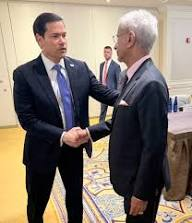
[Marco Rubio and Jaishankar in New York]
Xi meets with Trump, comes away with a $30 billion tradeoff (exchanging lists of products neither side would impose tariffs on), does not budge an inch on any issue — not on Artificial Intelligence, or the Hormuz Strait War where Chinese satellites help Iran target American bases in the extended region, resulting in 42 high value frontline US bases in the region being rendered inoperable. And, there were no big deals to rescue American agriculture for soya beans, pork, etc. Nor was there any commitment by Xi to unrestricted supply of rare earths magnets the US defence industry cannot do without. Talk of having the adversary by the balls. And because Trump knew that Xi could not be cornered with the threat of tariffs and economic sanctions, and that he holds the whiphand and can coerce Washington at will on any number of fronts, refrained from making an issue of the Chinese offtaking Russian oil and gas in massive quantities and, in a sense, propping up Russia economically. Their much advertised meeting was a big success for Xi, and a big bust for Trump.
Next, take the Hormuz War. Not only has Iran survived a sustained and horrific US aerial onslaught that destroyed infrastructure in that country worth, by some accounts, in excess of $30 billion over the last 6 months of a war that Trump expected to win inside of a week, but turned the tables on America.
First, the Pasdaran (Revolutionary Guard ) Command began missile and drone strikes on Israel and, more importantly, on US military bases located all over the Gulf region, and then collaterally extended the hostilities to arbitrarily hit city centres in UAE and elsewhere as warning shots of how Tehran could just as easily bring down the Gulf economies grown fat by styling themselves as financial havens and holiday resorts run by millions of expat workers. Sobered up emirs and sheikhs ran squealing to Trump and pleaded for Washington to cease and desist from attacking Iran, lest they become casualty.
The US expenditure of interceptor weapons/missiles at intense rates of counterfire to keep out Iranian missiles. moreover, ended up mostly exhausting American Patriot-3 and THAAD missile stocks, just as the aerial bombardment of Iran had denuded the American arsenal of A2G (air-to-ground) weapons, until now when the US military finds itself in so dire a situation, a former Supreme Commander, NATO, General Wesley Clark called it a military “reduction” of the United States. His view is borne out by the Trump Administration’s announcement of a full military withdrawal from neighbouring Iraq, leaving all of the Gulf, Israel excepted, free for Iran openly to lord over.
Second, Iran claimed all of the Hormuz Strait as sovereign space, installed a virtual toll booth for the oil traffic and, even after Trump reacted by ordering a counter-blockade, dared the global oil traffic to risk passage. The implicit Iranian threat spooked Lloyds of London so much, the shipping insurance rocketed, and the traffic through the Strait plunged 95%, to a few small ships feeling their way along the Omani coast. The US reaction of a counter-blockade blocked nothing — its aircraft carriers and escort flotillas on station to enforce the blockade, staying safely out of Iranian missile reach — off Israel’s Mediterranean coast or way east in the Indian Ocean and, in any case, they have had no great effect.
Third, Iran was supported by the shia Houthi rebels in two ways. Advancing Houthi columns recently captured the port city of Mokha on the Red Sea and, for good measure, siezed Dhubab, the Hanish Islands, and Perim Island, consolidating their hold on Yemen’s west coast. Nearly simultaneously, they destroyed a part of the Saudi East-West pipeline connecting the oil-rich Nejd with the Red Sea port of Yanbu with accurate long range missile fire, instantly cutting off the alternative route for Saudi oil exports, and bottling up its oil traffic and revenues at both the Hormuz and Red Sea ends. It indicated just how comfortably the Houthis can disrupt Gulf politics, discommode the House of Saud, and coerce Trump — as they did in May 2025 into signing a ceasefire deal that has kept wary Americans off the Houthis’ turf!
It is in this context of looming diplomatic and military humiliation that Trump issued his hair-raising threats of “annihilation” of Iran at the United Nations that, in the circumstances, sounded vacant and nonsensical, while driving a stake through the heart of the UN’s main peacekeeper role. Tehran shrugged it off, and instead revived the peace plan Trump had signed early in the proceedings.
Meanwhile, the US Congress passed a bill empowering Trump to impose 100% tariffs on countries importing Russian energy. It will do nothing to soften the impact of Iran’s victory or America’s military humiliation. The deployment of a third aircraft carrier to the area, not withstanding, the US, according to many accounts, has fought its last fight, and is in full retreat from West Asia. And the Gulf states, with Saudi Arabia in the lead, are flouncing around trying to find someone, anyone, to offer them a measure of protection, and turning eventually to the poor man’s security providers and perennial Western hirelings — Turkiye and Pakistan (vide the August 7 Mecca Joint Defence Agreement). This, even as the ruling Sauds under Crown Prince Mohammed bin Salman, ever apprehensive of a military coup, hang on to power by dividing and playing off different sections of the security forces against each other, and by recruiting Asim Munir’s troops as palace guard for personal security.
This brings us to India. India has shown no spine in dealing with powerful countries, does not exercise the leverage it has against them, and is willing to go along to get along — the template of its foreign policy. It genuflects before Washington without being prompted because that’s an institutional reflex, and displays no resentment whatsoever to being treated badly and, by Trump, with contempt. As regards China, Delhi acts even more “wimpy” (to use the late K Subrahmanyam’s words), walking as if on eggshells when dealing with it. When the desperately needed response I have long been propagating is for Delhi to threaten to junk the “One China” notion that India long ago mindlessly accepted, and begin preparations for fullscale diplomatic recognition of Taiwan as a sovereign entity. And, if the “One China-2 systems” idea is to be retained in India’s China policy, to condition it strictly on Beijing accepting a “One India” policy — the “One India” encompassing all of the erstwhile territory of the “princely kingdom” of Jammu & Kashmir, including the principalities of Gilgit and Hunza and all of Baltistan, including the Shaksgam Valley Ayub Khan had no business gifting to China in 1963. S Jaishankar and MEA literally quiver with fear at just the thought of such an option, so there’s no possibility of Modi taking such a tack. When Xi can get away by treating India like dirt, why should he change?
Indeed, why would Trump reform his stance either, when his insulting behaviour and abrasive posture with respect to India and Modi fetch him what he desires? The small show of defiance by the Prime Minister in the contretemps over Sindoor in 2025 merely emphasizes this point. In the context of the new US law that will see tariffs inevitably imposed on Indian goods shipped to America as punishment for India buying Russian energy — how much tariff is for Trump to decide, Modi in his September 30 telephone conversation with the US President, did not warn Trump that if tariffs are, in fact, levied and the Indian economy is hurt, India would respond by immediately voiding the four foundational accords that permit US forces in-theatre to refuel, re-provision and to repair warships at Indian bases. This is what I mean when I talk about Delhi not using its leverage.
A Modi apprehensive of crossing Trump, merely agreed with the latter that “bilateral cooperation in trade, defence, energy, critical technologies and other areas of mutual interest” would continue. And, he reaffirmed India’s “commitment to advancing the India-US Comprehensive Global Strategic Partnership” when, to use an American phrase, it amounts “to a hill of beans”. If this Partnership really mattered, would Washington not ensure that the flow of GE404/414 jet engines that the IAF/Defence Ministry in their lack of strategic wisdom selected to power the indigenous 4.5 generation Tejas 1A, Mark 2, combat aircraft, for instance, was uninterrupted? But this partnership does not matter and Delhi is afraid of causing America pain (by sidelining the 4 foundational accords, withdrawing from MTCR, etc).
With the supply of the 404s/414s callibrated to obtain Delhi’s compliance with the US security and trade imperatives, the Tejas is being pushed down the drain even as the Indian government scrounges around to find the 70 billion Euros for the useless French aircraft that Edward Luttwak, the renowned strategist, described as “the non-stealthy and non-advanced Rafale fighter that nobody wants.” The French, he noted, “desperately need [to sell it] to save their once-thriving Dassault firm, which has fallen on hard times because of its current offering” — the Rafale! Correction! Dr. Luttwak — an undiscriminating Indian Defence Ministry and the Indian Air Force want it!!! What suckers!!
Thus, for the Modi regime, trade and defence involving China, America and also France, merit the same modus operandi — India gives and the China, US and France take, and take some more. Hence, before his meeting with the US Trade Representative Jamieson Greer couple of days back, the Commerce Minister Piyush Goel — who ought to take lessons from his Chinese counterpart, for instance, voiced hope that a trade deal was round the corner. But Greer told the press after the meeting that an agreement was actually very far from the finish line. It would appear there is a standing order for all cabinet ministers to spout optimism lest not doing so derail relations with America. This, even as Jaishankar’s by now constant and irritaing wailing at the UN and elsewhere about Pakistan and terrorism finds no audience in Washington, or anywhere else. Doing something decisive to disincentivise Islamabad from giving into its terrorist impulses by forcefully snatching and integrating parts of Pakistan-occupied Kashmir everytime Munir orders a terrorist act (was a strategy detailed in my blog preceding Sindoor), however, is not in Modi’s scheme of things as the eventual conduct of Op Sindoor proved. It seems, Delhi’d much rather nurse reasons to keep rhetorically beating up on Pakistan because it cannot muster the guts to take on China or America, or even France.
And, that’s the truth.


sir as per some media reports trump is planning to resume strikes on iran post mid term elections , what do u think are the chances of he doing this post election pressure is off ?
Depends on whether the Republican party wins the November elections
What if Trump loses the Mid Terms. Will he hold back from attacking Iran.
Regards, Gautam M. Koppikar
Trump is unlikely to again start heavy hostilities against Iran, whatever the Nov election results
As the ole Democratic Slogan in 1992 went “Its the Economy Stupid”
The two pillars of Foreign Exchange, Generic Pharma exports and Back Offices Services, both rely on China and the US, respectively. The former for 90s of API and drug starter chemicals and the IT services with their US Clientbase have yet to have any major diversification beyond North America, with some traction in UK, and very little in Western Europe given the language barriers for Indian Professionals.
Hence the prostration.
@professor, it seems India has not yet not figured that India is under rule of epstein type of network even before India got independence.
Till the time someone does not take this network down, India will not survive because that’s the aim of this network.
All your ministers and many business houses are working for this network.
Mr. Karnad
In defense of the govt.
My sense is that the US relationship is still very profitable in real monetary terms for India despite the insulting treatment meted out by the US administration including tariffs and H1B restrictions and purchasing defense equipment from unreliable suppliers in the US as you have pointed out.
AS LONG AS INDIA CONTINUES TO HAVE SURPLUS from US trade, we cannot expect much pushback as you are hoping for. Once those surpluses start becoming trade deficits , then I believe you will start seeing pushbacks from the govt. of the day.
We also forget that India is in a strategic dilemma as they have all these US dollar reserves and our banks and business people prefer to be associated with the US banking system. **Another important thing that people have missed is the fact US Ambassador Sergio Gor met Reserve Bank of India Governor Sanjay Malhotra this year. I wonder what was he trying to accomplish by this meeting. perhaps just to check if India was heading towards de-dollarization or discourage India from de-dollarization ??
We are kind of stuck and trying to do the best out of a bad situation.
Greetings Professor,
Whenever I raise the similar argument of interdicting the americans by pulling out of the 4 agreements(something which I have learnt from your earlier work of course), I am countered by the possibility of economic sanctions that may be imposed upon Bharat. ‘We are in many ways dependent on the American financial systems, internet services, server services etc and so rubbing the Americans off the wrong way is not wise!’, so the argument goes.
What may be an effective counter to such an argument? That we must absorb such sanctions and make our own systems? Or that American MNCs simply cannot ignore the enormous market that we offer which we should use to our leverage?
Jai Balochistan,
Jai Hind!
Build up own comprehensive capability and show the will to absorb sanctions
But we dont have much leverage vis a vis Washington as well China as we dont control any component of supplychain even IT services which was one of the critical component of Indian economy will be decimated by AI we simply cannot match US or China in terms of capex required to build frontier models.Even attempts at manufacturing requires significant land and beaucractic reforms even some limited defence manufacturing we have managed to achieve recieves strong resistance from our own armed forces.The lackadaisical attitude towards AI can be guaged from RBI governors statement its akin to putting a nuclear bomb on our services industry.If we dont reform and change our approach i am afraid we will just become an importer of tokens and be slaves to dicatates of US and China
Declare retaliatory tariffs on america. Also start asking private sector and public institutions to stop using AWS ( Amazon Web Services). AWS earned roughly 2 billion dollars in revenue last year. We already have Mr. Adani making headway in data centre technology , so taking AWS wouldn’t hurt us much. Trump’s US is least bothered about Indian security. There are reports of a US startup (possibly Trump’s shell company) supplying drones to Pak Army.
Stand you ground Modi-ji and swing one in Uncle Sam’s face !
Professor….thank you for your work. My question is , can the chinese damage our economy by cyber attacks , considering that our economy is exceedingly digital. Can you write an article on this as there is very little credible information about this issue
Dr Karnad , this article argues that the Chinese have solved the “Malacca dilemma”. What is your take ? https://www.semafor.com/article/10/06/2026/china-has-resolved-its-malacca-dilemma
Greetings friend.
While professor is always the better person to answer any question on this platform, I would like to take the liberty of trying my hand at answering yours. I am currently working on a research on similar lines and thus, my answer may help you.
And while helping you, perhaps Prof Karnad shall be kind enough to help us by giving his inputs!
The logical alternative to the Malacca Dilemma is Iran -> Caspian Sea -> CAR -> China. There are some bottlenecks to this route.
So, I think the Malacca remains important and the ‘Steel Curtain’ remains a useful tool for us. The USA is anyway looking for a G2 so it is us who need to develop the capability and show the will to INTERDICT the Chinese (Please recall Prof Edward Luttwak’s work on strategy)
I think, we should focus on the following to ensure that CAR is not a viable option for the Chinese, “EVER”
These are my two cents sir/ma’am. Hope it helps. Please feel free to give your input as well!
Jai Balochistan,
Jai Hind!
Correct, the BRI and other diverts with transportation-carriage limitations will not help China to escape its greater reliance on Malaca and the other Straits (Lombok, Sunda)
@BharatKarnad
Professor Karnad, are there any updates regarding your upcoming title? When can we expect it to be published? I’m looking forward to getting a signed copy.
Professor why are ‘realist’ Americans hesitating to use nuclear weapons on Iran??
Because they are “realists”!
Why what will be the consequences?? In my opinion Iran is important to china and russia to keep us military weakened .but not that important directly for their national sovereignty. Iran is more dependent on chinese and russian satellites.