
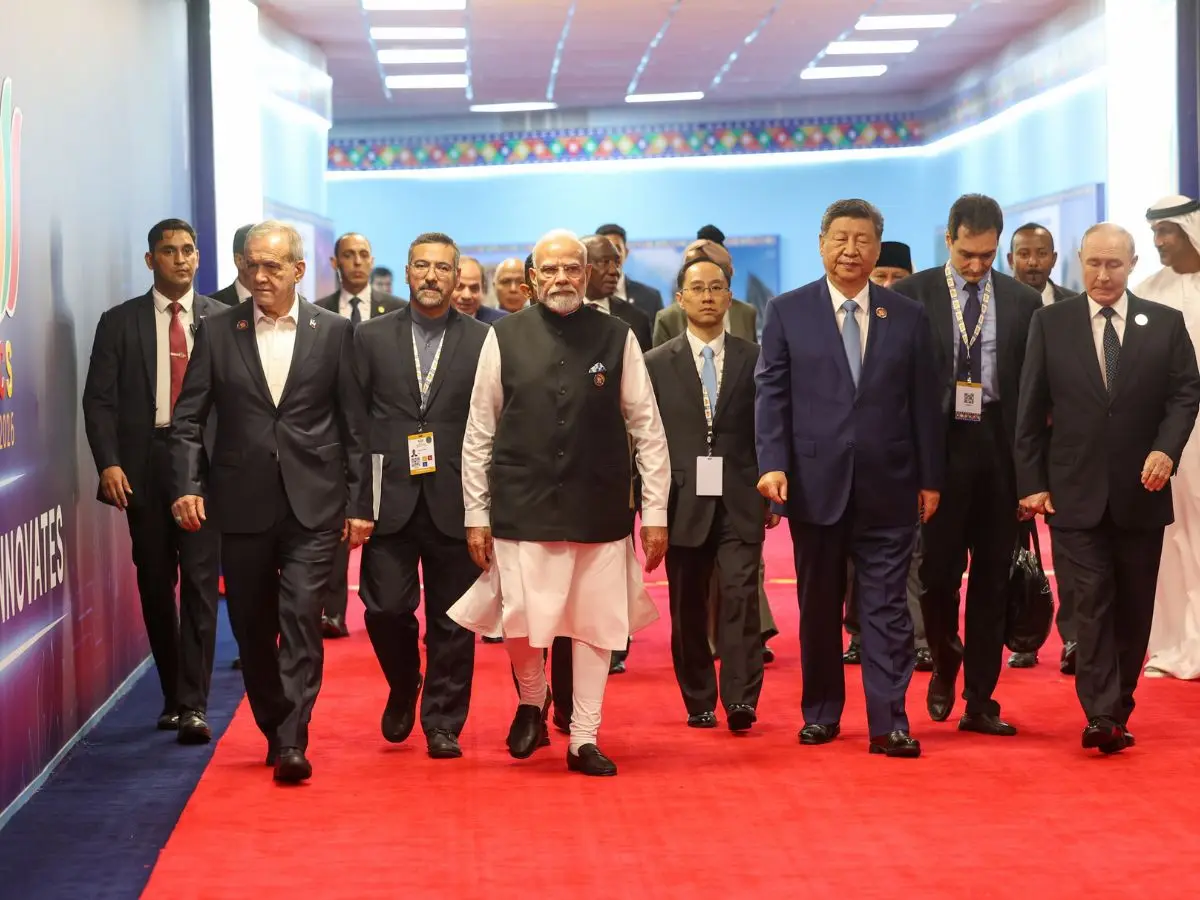
The 18th BRICS Summit India hosted to mark the 20th anniversary of the Group’s founding was taken note of in the US and the West in a manner the earlier Meets in India (in 2012, 2016 and 2021) were not, because it showed a glimmer of real shift in the global “correlation of forces”.
Look at the photo (above). It projects the leading foursome at the Delhi Summit — Iran President Masoud Pezeshkian striding purposefully alongside Modi, Xi Jinping of China and Vladimir Putin of Russia, representing a collective, and its resolve not to be pushed around by America. It is a resolve that serves more than just the interests of the 11 member states and 12 partner countries of BRICS, and hints at a core of a system in embryo that could, in fact, emerge as an alternative to the US-dominated order and, locally, as an elbow in the face of the Mecca Joint Defence Agreement (Saudi Arabia, Turkiye, Pakistan) conceived as a Sunni alliance to contain shia Iran.
A resilient supply chain mentioned in the final BRICS Summit communique, and the reconciling of different positions on the Hormuz War, etc. was all very good. But what stood out to me — trivial though it may be, was that at the “gala dinner” at the Bharat Mandapam, everyone was subjected to vegetarian food — symbolically important in requiring mostly meat-eating visiting heads of state/government to eat ghas-phoos or go hungry (and raise toasts with coconut water or whatever?!) — a small first step in recovering national self-respect by imposing on official guests our norms! The pity is that the Modi government did not follow up by compelling them to also eat with their fingers! Alas, the chopsticks wielding Xi, perhaps getting wind of what was in tow, escaped Delhi before this meal! (Recall that the first UK Prime Minister of Indian origin, Rishi Sunak, in 2022, at the first meal for his cabinet and party leaders at 10, Downing, served South Indian vegetarian stuff on plantain leaves and no cutlery in sight!). If foreign leaders have become adept at returning Modi’s bear hugs with gusto, they will take no time to learn to flex their digits to push whatever fare is put before them down their gullets!
Even more encouraging was the initial response by the Modi regime to the US Congress enacting a law empowering US President Donald Trump to levy 100% tariffs on countries sourcing energy from Russia. Pat came the response from Delhi that it acts solely in the interest of “1.4 billion Indian people”, implying it will continue buying Russian oil and gas to run its economy. It was absolutely the right tack to take. Except, there are no signs the Indian government has pushed and prodded Indian exporters to find alternative markets should access to the American market be cut off. Rather, the official Indian stand despiritingly is that it will scurry around, as before, to seek Trump’s favour (“waivers” to this law), failing which, it will do what? Wag its tail, and fold once again?
Donald Trump’s growingly dangerous and whimsically wayward foreign and military policies have placed the United States singularly on a slide. When a US President takes the UN podium to threaten “annihilation” of a member-state — Iran, as he did the day before yesterday, the utility of a world body set up to mediate conflict becomes suspect. Even its traditional allies are desperately distancing themselves from Washington. The Canadian Prime Minister Mark Carney, particularly bullish in rejecting American overlordship — his stirring speech at the Davos World Economic Forum — “If you are not at the table, you are on the menu” that sounded the warning in the summer for states feeling vulnerable with the US — an ally/partner, turning predatory, offered at the UN a competing idea to rally around.
“It’s not wishful multilateralism which defends only the status quo, nor a cold realpolitik that dismantles the status quo altogether,” he told the media at the U.N. “And the alternative that Canada and many others are pursuing is values-based realism.” It is not clear what “values-based realism” means in practice, exactly, and whether it is a cover for Ottawa to collapse back into the American lap. But his rejection of “wishful multilateralism” certainly seems a dig at Delhi’s clamouring for a multilateral regime without working to realise it by way of laying down the groundwork. Carney is doubtless rising as the unchallenged leader and spokesman of the so-called “Middle Powers” group with his jaw-jutting straight talk of a kind Modi and Jaishankar studiously shy away from.
At the Delhi summit, Xi in his meeting with Modi called for an objective and rational “strategic” perception that a Chinese analyst explained as meaning the two sides should treat each other as opportunities rather than threats. This concept, incidentally, is a bit lower in the Chinese diplomatic lexicon than the basic level “strategic partnerships”. Higher up in the order are “comprehensive strategic partnerships”, which China has established with numerous countries including Brazil, France, Indonesia, Egypt and Saudi Arabia. Still higher levels refer to “comprehensive strategic cooperative partnerships”, such as the formulation regarding Pakistan of an “all-weather strategic cooperative partnership”. At the top is the “comprehensive strategic partnership of coordination for a new era” uniquely so far only with Russia, expressly to stymie the US and the West.
India-Russia-China can form a formidable strategic wedge to loosen the US hold on the international levers of power. But is Delhi capable of not treating Xi’s soft talk as a license for Beijing to keep doing what it has done to undermine Indian interests? The skepticism arises from India’s unwillingness to pull its notions of multilateralism away from China or, what Carney warned was the US-dominated “status quo”. India’s co-sponsoring the so called P4M (Partners for Multilateralism, International Law, Peace & Prosperity) was politically correct, but failed to provide it any real traction. P4M is initiated by the European Union, Canada, and Kenya with India, Australia, and Barbados as co-sponsors.
I mean, External Affairs minister S Jaishankar, in his address to the UN General Assembly, did not connect his “4F” concerns — fuel, food, fertiliser and finance, with the “frameworks and guardrails” on Artificial Intelligence, and with respect to the maritime chokepoints that he hinted at, and failed to articulate what these should be. Indeed, any movement on AI and chokepoints require the US and China to be on board. But there’s no incentive for Xi to give ground, for instance, on AI — a field where the US has a definite (Nvidia) chip edge, for example, and to agree on a shared “vision” that Trump mooted in his talks with the Chinese leader in Washington.
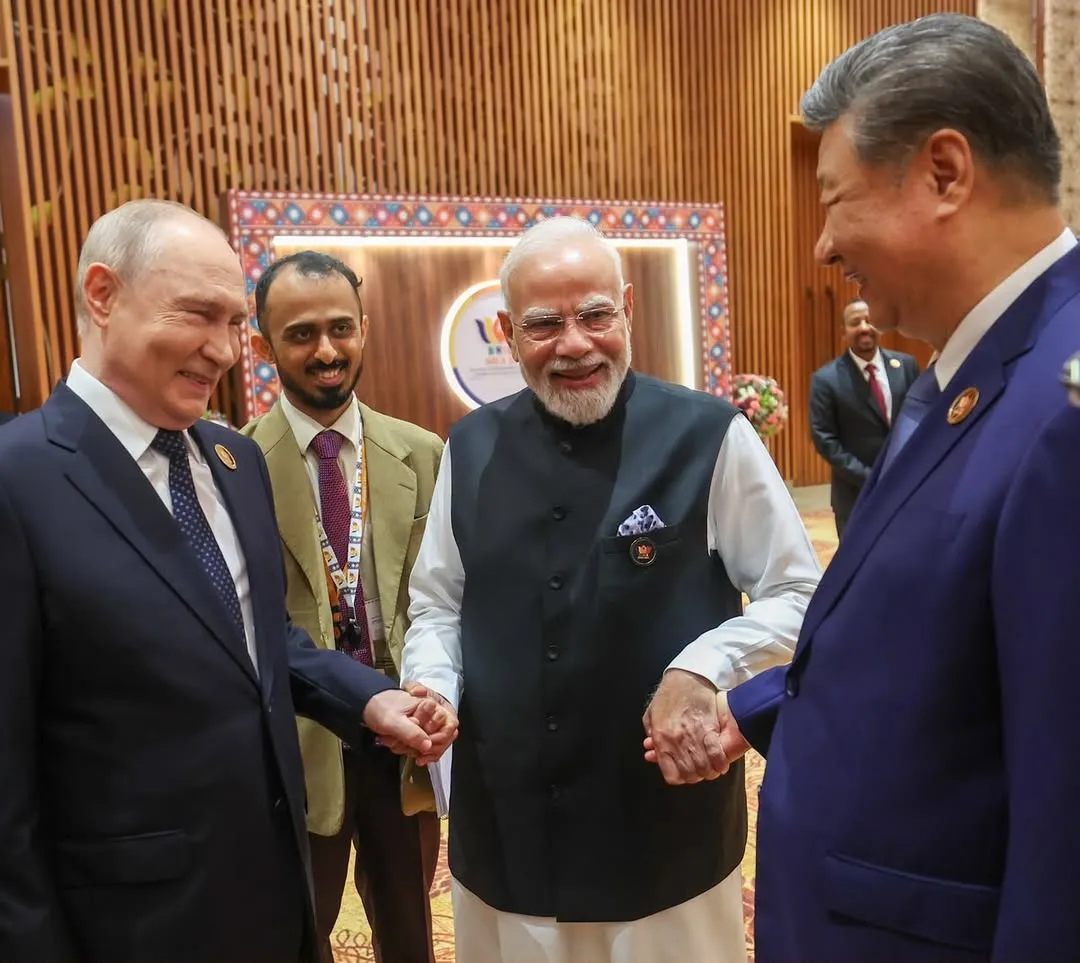
Xi is on top in the underway negotiations with Trump in Washington, which is intended by Beijing formally to cement China’s position as not just the equal of America, but as the prime adjudicator of global trade with its monolopoly supplier stranglehold on rare earths and rare earths magnets, base chemicals for pharmaceutical industries everywhere, etc. with the distinct capacity to twist Trump’s arm and not just obtain a beneficial deal for China, but to use it as the basis for a G2 of China and the US at the apex of whatever global system may emerge from the current churn in international affairs. Except, this dyad will be as dangerous, dreadful and demeaning to India (and BRICS generally) as the present US-led system.
But the Modi government shows no stomach for a serious disagreement and fight. With anyone! But it wants to be a leader! In fact, it seems to have lapsed into the appeasement mode by agreeing on a deal for some 60 US Javelin anti-tank missiles, near worthless pieces of junk even in its light weight FGM-148 version, with a coproduction deal to follow. The Javelin is in no metric superior to the indigenous DRDO Man-portable anti-tank guided missile (MPATGM) and the Nag ATGM, except for a minor differential in weight with regard to the MPATGM! This transaction was fast forwarded by the army also because, yes, the new army chief, General Dhiraj Seth, is a tank man!
And again in appeasement mode, Delhi has succumbed to US pressure and is preparing to let the CIA team of 6 Ukrainian saboteurs led by an American Special Forces agent, Matthew Aaron VanDyke, apprehended in March this year by Indian authorities whilst assisting insurgent elements and stoking secessionism in Manipur, Mizoram, and other points in the Indian Northeast, go scott free by paying a small penalty of Rs 2.5 lakhs on a technical point of “illegal entry” into the country!
Washington is keen to spirit them away before they spill more beans on their subversive activities. But why are VanDyke and his operatives being allowed legally to get away rather than subjecting them to the legal processes of the kind faced by the RAW operative, Gupta, who was hauled up in a US court, declared guilty, and is serving time in an American jail for supposedly planning the assassination of the Khalistani troublemaker active in North America, Gurpatwant Singh Pannun? Shouldn’t VanDyke in particular face the gravest national security charges, and be imprisoned to indicate the gravity of his criminal acts?
In realpolitik terms, VanDyke’s criminality, moreover, will be a lever to affect the release of Gupta to Indian custody, as an exchange. And Delhi should also seek, as part of this deal, a verifiable assurance and undertaking from Washington that its agencies will hereafter strictly police the US-based Pannun group — ‘Sikhs for Justice’ engaging in terrorist activity in Punjab. And, for the six Ukrainians, Delhi ought to cut a separate deal with Kyiv. The CIA has for too long operated nearly at will in India without the Indian state doing much about it. Time the Modi regime acted in the national interest, for a change.


Mr. Karnad
You are right about Carney since the Canadians have taken a small step of opening up their market to Chinese electric vehicles recently. this will potentially cause grievous harm to US automakers in Canada.
regarding the orange man’s verbal diarrhea about annihilation, i suspect he knows he is in for a very difficult time after potential losses in midterm elections since he will practically be a sitting vegetable in the office and secondly the Iran war has caused grievous harm to US military industry as well as reputational damage, so in his mind he has put away diplomatic niceties as it serves no good purpose for him.
On a side note: I find these type of forced fed vegetarianism, adding the tilak and the garland on foreign guest and Indian dance forms extremely distasteful whenever these foreign guest arrive. We need to be more formal and business like as a country.
Greetings professor.
So, your observation in the book staggering forward does not stand anymore? You had argued that since American foreign policy based on balance of power is different from that of Chinese Tianxia, clash is likely.
While indirect clashes have surfaced, you hinted that a direct confrontation is possible, so far as i understood.
Do you think thats changed now?
Regards.
No, not at all. The Tianxia system is, as Beijing believes, on an unavoidable collision course with the US and the West-led order. Nothing has happened by way of international developments to-date, including Xi’s attempts at cutting a deal with Trump, to change Chinese thinking. Recall Suntzu’s famous dictum about defeating an enemy WITHOUT fighting.
Chinese have never tried to ‘cut’ a deal with anyone when it comes to their sovereignty and geostrategic interests since mao zedongs time.
and secondly I think us is the one which currently believes in tianxia system . Main tensions between us and china are about trade economy and technology. Has nothing to do with chinese territorial ambitions.
am I wrong??
The Chinese Communist regime has cut deals all the time with states it considers more powerful than China.
The way VanDyke affair is going tragic. Indian decision makers have turned India into a banana republic. Wonder what leverage americans have on them.
What is their to wonder bro ?
Politicians,Bureaucrats, everyone one of them is a sellout.
leverage is useful for people with morals or objectives ,
these people have none.
Its just sad to see that even after a thousand years of colonisation, we haven’t learned out lesson
All these are mere optics nothing else. China and India both have a very high degree of mutual mistrust towards each other and it’s not going to change in the foreseeable future.
“India-China boundary has never been formally demarcated on the ground. Delimiting stretches of the boundary, even the less contentious ones, would be a historic first, requiring political agreement on the principles to be followed. Delineation comes next: it is a cartographic exercise in which maps are drawn based on the delimitation agreement. Demarcation is the final step, involving the physical marking of the boundary on the ground, including the installation of boundary pillars and fencing.”
An excerpt from the following article;
https://www.indiatoday.in/magazine/cover-story/story/20260928-india-china-relations-the-new-equation-2997443-2026-09-18
It seems Van Dyke and the Ukrainian terrorists he has been training have been sent out on bail. I wonder how the government would’ve reacted if it has been a Pakistani terrorist. Why the distinction between western and Pakistani terrorists?
Prof. what do you think is the reason for releasing Van Dyke? Some right-wing podcasters(JD) are saying that senior govt officials have said that this is a quid pro quo arrangement under which Indian govt. may get some prisoners transferred to india.
Possible. Hope the RAW agent, Gupta (or whatever his name) jailed in the potential Pannun-hit episode is included in the exchange.
@Professor Karnad- Gupta whom you are referring to is an international narcotics dealer. He was the contact man of RAW in the USA to arrange the hit on Pannun. Gupta’s handler was a novice RAW agent Yadav (on deputation from BSF).
Yadav conducted the whole communication with Gupta regarding the aforementioned potential hit. Yadav has been charged with a few criminal cases in India so, that his deportation to U.S can be put into cold storage.
@Professor Karnad- Error in my previous comment. Extradition of Yadav to U.S not deportation.
Greetings professor.
A request from you.
Could you please do an article on Mayanmar and how we should solve the challenge it poses and prevent it from being used as a US-China battleground which it has become?
Pakistan and Bangladesh do not come even close to the challenge the Mayanmar situation poses for our national security, so far as I understand.
Jai Balochistan!
Jai Hind!
Greetings Professor,
At uni, I had a convo with a Ukrainian refugee. He said that bleeding on the side of the West is a way to prove civilizational similarly to West and not just russian .
many non Western societies suffer from a subaltern complex toward the West.
They crave Western recognition so deeply that they volunteer to fight Western proxy battles, what Ukraine is doing while absorbing the devastation.
Looking at our own cold war with China,
I see that dual-pronged trap: one fight is strictly our sovereign territorial defense,
but the other frontier feels like being groomed into an offshore frontline for American containment.
Xi has strategic feat was insulating China from ever acting as cannon fodder
Even rich states like Saudi Arabia and the UAE spent decades trapped in security architectures where they fought other people’s’ wars