
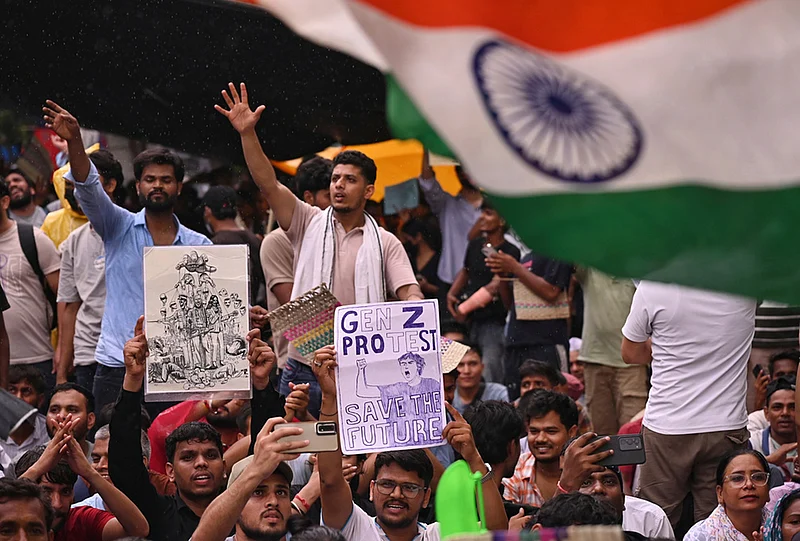
Prime Minister Narendra Modi finally felt the political earth move underneath his feet. He discarded his cloak of hubris, ate a plateful of crow and, as demanded by the protesters at Jantar Mantar, booted out the education minister, Dharmendra Pradhan. The highs that BJP achieved with great tactical maneuvering in West Bengal a few short months earlier was followed by the lows of a leaden-footed lathi response to the Cockroach Janata Party’s marshaling of youthful anger and angst at traditional politics and politicians playing with their future. It revealed Modi as victim of his own hype as the Man of the People. After all, who cared if threshold examination papers were regularly leaked — 150 leaks in the past decade alone per a TV report, examinations cancelled, the lives of millions of young adults disrupted, and those culpable within and outside the government left off with a tap on their fingers?
Nothing is so injurious to a carefully curated political image than its being mocked by GenZ that Modi had hoped would strengthen his continued hold on the country, sporting cockroach masks. A reminder that cockroaches are hard to stamp out. A friend who was previously an ardent Modi-bhakt texted me in some sorrow and with a bit of wit: “Modiji’s image has a great fall. All the king’s publicists, all the king’s spinners, cannot put the aura back again.”
Yes, it is the aura that Modi has now lost — the aura of invincibility. No, it doesn’t push him down into the ranks of the Rahul Gandhis and the Akhilesh Yadavs of the political world — callow dynasts heading their respective ‘parivar-vadi’ parties, who proved once again what they have always lacked: Political presence and heft, and the foresight to see trends before they emerge into a full blown storm rather than trying to ride it once it breaks. So, Modi has nothing to fear from such competition — rivals only in name.
But what he is undoubtedly mindful of and now possibly fears is the treacherous road ahead that may be carved out by the impromptu leadership of the “Cockroaches” around Abhijeet Dibke, which having tasted political blood seeing the mighty Modi buckle under pressure, are settling down to decide what to do next, how to use the mass mobilising power of social media they discovered they have, to address the hopelessness of their generational cohort — the largest of its kind in the world.
One thing’s for sure, this movement is not motivated by the offline and toothless do-goodingness of an Anna Hazare. But, from what is discernible from the inchoate spoutings of Dibke and the others, there is desire for real change in how the government works and for whom, starting with an utterly transformed education sector. There are too many politicians in the lucrative “education business” for them to allow any seachange. Change, in any case, may be preempted for two other reasons: Either Dibke et al will be coopted by the establishment, or the cockroach movement will peter out as is more likely as the thousands of protesters get back to home ground and the grind reminiscing, as they grow older, how they once held Delhi hostage, the thrilling moments amounting ultimately to nothing. But Modi could very well trip on “cockroaches” in the future if Dibke’s Movement fashions itself into a people’s forum that demands and monitors government’s accountability.
Predictably, the Modi government expects that its punitive lashout with fast track courts, new laws and heavy fines will do the trick. They won’t. Because if laws on the books alone were a measure of a law abiding country, India would top the list. India has every conceivable law but is a lawless country. Because all the laws the citizens are subject to are selectively applied, depending on the dispensation of the day and on the traditional subcontinental principle of “jiski lathi, usekee bhains” which people understand only too well. Because “law and order” in India is still only a Western/colonial veneer.
Meaning, Akhilesh Yadav can permit “goondas” to run around plying their trade one day, only to have Adityanath run bulldozers over “encroachments” the next. Which is why losing power in elections is so dicey, dangerous, and fatal for those living off the political fat of the land, and elections are do or die struggles. One can overnight become an enemy of the state! More mundanely, with every law known to man in the books, the government and its functionaries follow and implement them in a disinterested sort of way, with violations of the law and the prevailing rules routinely permitted for political reasons, or for a consideration. Until something really bad happens when some police or other agency, finding itself in the public eye, springs into action usually with more vehemence than sense, amidst public mutterings of dastardly persons “taking law into their own hands”.
Modi, it may be recalled, had promised to re-make India in 2014 when he was elected the first time with a huge majority and had the people’s mandate to pretty much re-do the system. He responded by getting his gang of babus led by PK Mishra as PPS (Personal Private Secretary to the PM) who had helped him run Gujarat to the centre, and otherwise carrying on as if India was only a bigger Gujarat. It didn’t work also because of his innate belief in incrementalism as a gradualist, as a Statist who is convinced the Government is the solution. Far from a revolutionary, he is only another variety of sarkari businessman. Recall his words: “Business is in my blood.”
Sure, he rearranged some furniture of governance in Delhi — straightened some administrative procedures and lines of communications and, more visibly, erected modern buildings in place of the 1940s style blocky Stalinist architecture lining the Rajpath, and built infrastructure — highways, railways, ports along the coast, and airports, and pumped lots more electricity in the grid. And the deposit of government subsidies directly into bank accounts of the poor did lift, as is advertised, over 300 million people out of abject poverty, shutting down the biggest scam — the sustained siphoning over decades of public funds by officialdom up and down the line.
These are commendable achievements.
But it is still like putting lipstick on a pig. Because the massive Nanny state remains, it is still an impediment to doing business, a hindrance to industry, and sits astride the commanding heights of the economy studiously gutting private sector attempts at an economic breakout that potentially could generate employment at a level and pace the government can never match, if only the latter eases off on the controls. And this even as the Finance Minister periodically hints at the next generation reforms just round the corner, except that corner seemingly never gets turned by the Modi government. If much of the corpora of laws, rules and regulations left behind by the British in 1947 are still current, what does it say about how much things have really changed in the government’s functioning? And, in its attitude to the people it is supposed to serve? Which last concern was at the heart of the cockroaches’ protest.


“built infrastructure — highways, railways, ports along the coast, and airports, and pumped lots more electricity in the grid. And the deposit of government subsidies directly into bank accounts of the poor did lift, as is advertised, over 300 million people out of abject poverty, shutting down the biggest scam — the sustained siphoning over decades of public funds by officialdom up and down the line”.
Highways – four and six lanes finished in 2012, of course expanded inwards, subsidies direct into accounts – brainchild of Adhar started by MM Singh, and if high development why no jobs? And lifting people out of poverty then why 700 million on subsidized and free food?
The heart of the problem is not paper-leaks or incompetent ministers , it is the production and financing of technical education in this country. Remember we have roughly 2.3 million NEET aspirants(people who want study medicine) and only 140,000 medical seats. Last Year roughly 10,000 seats were added , if we continue to add 10 thousand seats each year then it will take roughly 216 years to reach 2.3 million seats.
its called 5th generation warfare. Sir
stallling india’s progress and harming our growth without using any soldier or arms just using social media and brainwashing our public
mods of prominent indian subreddits are p@kis.
Instagram influencers are parroting P@k propaganda just for some money
top media anchors, judges, actors are ISI agents
Greetings sir.
People have now created something called ‘Ethanol Janta Party’. Next they will create is ‘AI Janta Party’ etc.
In sociology, we call these protests ‘Trans Autonomous Zones’.
Sir, do you think now CIA will try to create disturbance in the region as done in other south asian countries? It is being completely shrugged off but our honourable spokesperson of the MEA, when asked, did not completely deny foreign interference.
Was it just a diplomat’s dodge sir?
Regards,
Jai Hind!
Refer my earlier comment on the “safety valve”.
Need more Bharat Karnads-speaks his mind bluntly and fearlessly. His write up reminds of the 19th century Danish tale from which originated the idiom “Emperor has no clothes”.
Few things here which are undigestable for me. One is, where did this guy Dibke come from? Like suddenly a nobody creates an account and it’s famous. More like a joke you create a CJP and then every journalist, from print to media, from right to left, every social media commenter is taking its name as if some real legitimate political party impacting the wider nation.
How was this allowed to happen in the first place? Wasn’t IB supposed to keep track of who was rising and gaining influence on social media, along with the networks surrounding them?
Wangchuk has been protesting against the govt for as long as I have known him and nobody cared, but suddenly social media is flooded with only one thing the protest.
I don’t see how and I cannot say why right now. But to me it feels more of an IB doing.
Remember 2016, when we witnessed the rise of Kanhaiya Kumar and the JNU group, with celebrities visiting and the entire media establishment focusing on them?
Nobody is taking his name nowadays.
This can be called India’s first Instagram protest. People are there making videos just for the reach.
Content creation is becoming a trendy and easy way to make money, and more and more Indians, from Tier 5 to Tier 1, are entering into it.
If I am a content creator, I would say or speak anything that would get my videos traction and would end up making me money. Therefore, my income is depending on the algorithm, and I will create videos on whatever topic the algorithm pushes.
I may have no knowledge about the topic. Heck i might not even understand what i am saying. The Creator just gets infront of the camera and speaks the script that is given to him by the script writer. The topic and the script is picked entierly on the basis of what would get me more views.
So, if the algorithms of a foreign platform can drive that big of a protest and set that big of a narrative, then most Indians who are dumb are going to be influenced by it. We are essentially giving too much power to these foreign platforms.
And what stops the CIA or anybody else from creating an anti-government narrative using it during elections?
All of it is very concerning.
Absolutely. There’s no question that those who are ill-disposed towards this country are going to try and catalyse a “colour revolution” out of the cockroach protest. But that hasn’t happened because the protest was “contained”. The people’s anger and sentiment against the government for letting the leakages happen was real, and there has to be a safety valve for public discontent to surface. Wisely, this valve was allowed to function.
On a lighter note “We should also start a “No Rafale party” or as famous on defence forums “Kaveri Janta Party” agitation in Delhi.
Hunger strike will be taken by both Brahma Chellaney and Bharat Karnad Sir, until demands are met. Burger and Samosas will be handle by me.
Demands:-
1.Fund Kaveri with billion dollar and also buy a flying test bed.
2. No Rafale order, only indigenous Tejas and AMCA
3. Stopping introduction of screw driver platforms from Nibe, Adani and giving preference to Solar, Kalyani, SSS.
4. Immediate JV formation with Japan for their Seaplane.
5. There are many, final one make Bharat Karnad Minister of Defence😅
Until demands are meet both will sit on indefinite hunger strike.
Thankyou. GOI/MOD/MEA will happily endorse the “indefinite hunger strike” bit! It will, for age reasons, remove some critics of foreign and defence policies!
Greetings Professor, some strategic doubts
Looking at the US-Saudi nuclear negotiations, one cannot help but see the irony. It was India’s May 1974 test that effectively aborted Nixon’s post-Yom Kippur promises to Egypt and Israel, altering the proliferation trajectory of the Middle East. Now, with the US entertaining Saudi domestic enrichment, Washington is willingly returning to that 1970s precipice of proliferation.
It begs a repetitive but vital question about our own nuclear history: if the Indian establishment had the strategic spine to reject the CTBT in 1996 and weather the 1998 sanctions, why the total collapse into the 123 Agreement in 2008? Where the people in charge sold out or just dumb ?
The most lasting legacy of that 2008 deal seems to be exactly what you have warned about: Beijing instantly re-hyphenating the subcontinent by pouring nuclear infrastructure into Karachi in retaliation for our 2008 NSG waiver.
We might see the same in middle east with Iranian speeding their n-programme and aligning with bejing while USA helping saudi to hyphenate the region in same manner as SE Asia .
Looking forward to your insights.
Opposed from its beginning the 2008 N-civilian cooperation deal. Why Manmohan Singh staked his PMship on it is hard to know. But Jaishankar as Joint Secretary (Americas) in MEA and lead Indian negotiator, did a bangup job of surrendering India’s strategic options alright.
Professor , You never seem to mention the wiki-leaks regarding the money trail .
The 2011 WikiLeaks cables published by The Hindu detailed that Nachiketa Kapur, a political aide to Congress leader Satish Sharma, demonstrated “two chests containing cash” to a U.S. diplomat. This aide confirmed they were part of a larger ₹50 crore to ₹60 crore fund that the party had assembled to purchase the support of MPs for the trust vote. Furthermore, the aide claimed that four Rashtriya Lok Dal MPs had already been paid ₹10 crore each to ensure they voted the right way on the floor of the Lok Sabha.
Why don’t we see these financial mechanics in your broader writings? Connecting the dots isn’t difficult for your readers. Highlighting the fact that the govt. had to assemble sum of ₹50 to ₹60 crore to survive a confidence motion caused by the 123 Agreement speaks volumes regarding the nature of deal.You might know who was funding behind the scenes for the aggrement.
On the middle east front, Do you see Iranian Proliferation soon ?
I stick to my areas of expertise — foreign and military policies. My posts only occasionally stray into domestic socio-political developments and are necessarily narrow in scope.
The modal BJP supporter is quick to say “remember not long ago bomb blasts where a regular affair in Mumbai and Delhi unlike it is today” and attribute it to the current government. In your assessment how much of this is attributable to considerable reform of the security apparatus that has been initiated under PM Modi? as opposed to a combination of progress in technological surveillance and intelligence and some reforms initiated after the Mumbai attacks etc?
Likely, the latter reason.
Hello Dr Karnad, based on your statement above (my posts on domestic socio-political developments are narrow in scope), please allow me to offer my take:
India has an over capacity of humanities and social sciences programs. They hardly teach any life skills or offer any practical value. The result – woke movements and outrage.
These departments are 100% dependent on tax payer funding as they cannot support themselves. Japan and Australia in recent years have slashed funding for these programs. in favor of STEM and vocational programs.
Another point – unemployment is very high in India today, a major failure of Modi sarkar. Four-lane highways and ghost airports didn’t help. We are just importing from China and investing in over-inflated stock market (“SIP ka top-up karaale”) Every other country has reverted to Industrial Policy to protect key industries and jobs.
China values Saraswati (Thousand Talents). India is a speculators’ paradise. Just check the global university rankings.
One last point is keeping out foreign social-media platforms like FB, Instagram and X, like China did. They are increasingly used as destabilizing tools. I really hope another George Fernandez will come to throw out these players. Many advanced countries have recently banned social media for teens.
After the 2011 Tahir Square protests, Egypt took the drastic step to move its capital. That’s how grave this issue is.
India need not move its capital but can draw lessons and prepare for it in future.
A third of Indian undergraduates are enrolled in arts. Meanwhile engineering and technology together account for barely an eighth.
It’s a terrible idea – this obsession/overcapacity in humanities. France ran this experiment sixty years ago. It literally ended a presidency.
Universities being invaded by people with nothing to do there
Sir, I think modi has tried to push the development agenda but execution was poor, unemployment and paper leaks have been perennial issues in this country back then it was being said that political instability and coalition politics are biggest obstacles in India’s development which was addressed by Modi, the leaders like dipke who is a proxy of kejriwal and backed by congress are opportunist at best and can’t create any change. The cjp movement also has communist vibe.
do you think all this is linked to fcra bill and pattern is same as nepal ,Bangladesh and elsewhere ?
The FCRA Bill is a blunderbuss, its provisions often used to still public debate. What’s needed is a legislative rifle that can target channels that divert CIA/other foreign intel funds into India.
@Professor Karnad-
https://thediplomat.com/2024/05/the-inevitability-of-indian-spies-in-australia/
When even Indian intelligence agencies are so active in the West.
Do you really think India has the capability to stop CIA funds coming into the country?
Perhaps one the biggest weakness that Indian democracy has is lack of term limits for the top job at the center and the states. With a term limit of 2, the incentive to hold on to power beyond ones utility will be removed and dynastic politics will end.
GOI’s response to the earlier protest against UGC discriminatory one sided rules which was turning into a protest against reservations when contrasted with it’s response to this latest so called “cockroach” protest is telling.
By brutally suppressing the previous protest through intimidation and preemptive arrest and letting this current group take over from the earlier lot BJP has ensured to kill the anti reservation heat that was building up against it. So I am not sure GOI has been humbled by this current protest and it’s aftermath. I believe it has simply chosen to take the smaller hit rather than loose the game all together.
Greetings professor.
Sorry, but i have an unrelated question.
Will you or could you, based on what you have had in mind, republish the book “Strategic Sellout: Indian-U.S. Nuclear Deal” in the near future? I have been trying to find it but I am unable to do so on the internet.
Regards,
Jai Hind!!
I’ll try with the original publisher again.
professor what is more important to win wars? Political will to fight or military capabilities(technology) or are both equally important?
If china believes in unrestricted warfare, do you think it’s adversaries should also start doing so. Example- cia has a history of doing proxy war in Latin America
First, foremost and always — the WILL!
Wish Modi took his slogan Minimum govt max governance seriously he would avoided this situation.He was on the right track when he delivered that strong speech criticizing the babus but he never followed it up by revoking or ammending article 311
Because, as he explained recently, likening civil servants to the limbs of state they are “not nails” that can be sheared off!
i never understood the incentive for politicians being protective about babus afterall Its they who would end up facing music while the babus face no consequence the only reason I can think of is babus can also influence electoral outcomes
Yes. But babus are useful in arranging all kinds of extra-curricular benefits!
you had previously mentioned a Australian defence aviation expert in your previous blogs. could you refer his name as his posts were informative and good to read .
Dr Carlo Kopp
Professor do you see the Russia-Ukraine war expanding to a wider conflict dragging Europe in it in the near future?
No
Professor how do you see The Turkey-KSA-Pakistan joint defense agreement, is it actually substantive or just a boondoggle? Would NATO’s article 8 contradict the agreement for Turkey?
Refer the new post that I am writing on the topic
Professor, how do you envision the future global order? Given the diminished trust in America’s global leadership, despite its technological superiority, are we entering a G0 world characterized by the absence of a clear global leader? In such a power vacuum, would nations revert to fundamental, “dog-eat-dog” principles, where larger entities assert dominance over smaller ones, until a new global hegemony emerges? With the ardent rise of nationalism and right-wing ideologies, coupled with the erosion of democratic values in economically and diplomatically influential nations and the weakening of global democratic institutions like the UN and WTO, are we consequently heading towards a dark age?
India should welcome a G-Zero world, and the end of the old certainties of UN, WTO. I have long been advocating Delhi giving the extant order “ek aur Dhakka” to topple it! And, when was the international order not dog-eat-dog?