
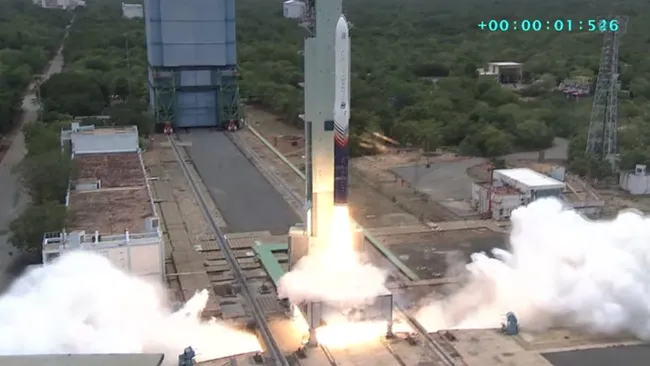
[Vikram-1, ignition!]
“This is a 100 percent designed in India rocket, a 100 percent made in India rocket, built by 100 percent Indian people, for India and for the world,” the 35-year old Pawan Kumar Chandana, founder CEO of Skyroot Aerospace, crowed about Vikram-1, after the first private sector rocket with all carbon composite airframe and 3-D printed liquid rocket engine for the final 4th stage, hit orbital speed of 28,000kms per hour, and injected several small satellites, including one of its own, a nano earth observation satellite, and a robotic arm package by another startup to collect space junk) into precise orbits. Chandana promised “high cadence” — meaning more frequent launches in the future to collect data, validate and improve design, and gain credibility in the global market for small satellite placements in Space. Modi demanded as many as 50 launches annually — exceptionally high from the government’s and ISRO’s perspective. Except, Musk’s Starlink launches a couple of low earth orbit satellites PER WEEK!! So if Skyroot means to challenge Starlink, Chandana and his team will have to up their game!
Vikram-1 epitomised a wholly “MADE in India” product — entirely designed, developed and produced in the country — and look where it it has got India!! A success in first attempt at orbital launch — something Elon Musk failed to do with his Falcon series! With a 1,000-strong workforce averaging 28 years of age, trained in-house, and led by Chandana who, had he remained in the heavily bureaucratised ISRO, would have still been a junior grade engineer instead of heading a billion dollar company! Instead of preventing highly motivated young engineers from frittering their talent, ISRO would be well advised to encourage the more venturesome amongst its staff to get out and become tech leaders for the larger good of the country, and to do the extra bit to help set them up for success. After all, not every young ISRO engineer has in him a budding entrepreneur; most are in government agencies for lifetime job security. But, even so, only 5% of the Skyroot workforce is of ISRO origin — so why the panic?
Further, this is the time to challenge Skyroot, which is on a high, to get into the hypsersonic regime for military rocket and missile systems — because it has all the tools, and to begin lifting low earth orbit satellites for the likes of Reliance Jio which means to have a constellation of some 1,200 LEO satellites to have a complete Space-based communications net, launched at a high rate.
Chandana’s “100%” claim, however, should clang like large Ayodhya temple bells in the ears and leave a mark on the brains of Prime Minister Narendra Modi and Defence Minister Rajnath Singh who, rather than helming “MADE IN INDIA” policy based on weapons systems of purely Indian design and manufacture, have been pushing the tired old policy of “Make in India” making it seem as if India had achieved something great and was delivering extraordinary results by SCREWDRIVERING — an apt description for license manufacturing, all manner of useless military hardware of foreign origin that are growingly redundant in the warfare of Artificial Intelligence-driven drone-quantum-cyber age! License production is no great shakes, there’s NO pride or creativity in it. It is the basic entry level stuff the ghastly Public Sector defence industry has stagnated in from the start in the late Sixties!
It is after the indigenous HF-24 Marut and its successor, HF-71/72 were shelved, that HAL began ASSEMBLING variants of the Mig-21 aircraft, MiG-27s, Jaguars, and the Su-30MKIs — some 3,500 aircraft in all, including 14 most high-value foreign fighter aircraft types, WITHOUT even a bit of reverse engineering or patenting or innovating anything! Like other DPSUs, HAL has a Zilch, Zero record! The ONLY indigenous innovation of note was the DARIN (Display Attack Ranging Inertial Navigation) avionics suite for the Jaguar low level strike aircraft, which HAL-DRDO developed but India did NOT benefit commercially from, why? Because the contract drafted and signed by the Defence Ministry reverted all rights and patents for improvements of the original avionics and onboard tech by India to the supplier of the original nav-attack system, Marconi-Elliott Avionics Systems Ltd of Britain, that’s why!
Without showing even this iota of innovative spark, generally the same shameful pattern of innumerable other DPSUs, lemming-like, bolting together military hardware from imported CKD (complete knock down) kits and SKD (semi knock down) kits, followed. Thus, the Avadi Heavy Vehicle factory, for instance, has been mechanically putting together first the British Vickers-Armstrong tank — “Vijayanta” and, later, a succession of Soviet/Russian tanks, including now the T-90 Bhishm’s, and soon the Sprut light tank (?) — Bye! Bye! Zorawar LT, and armoured personnel carriers and, only as a sideline, the locally-designed Arjuna main battle tank (because the army prefers Russian tanks that Arjuna, incidentally, beat handily in every test trial, in every weather condition and terrain from the high deserts of the Aksai China to the Thar in Rajasthan)!! It is a pattern repeated ad infinitum by all DPSUs — the reason why I long ago labelled the defence public sector units useless and a national drain on scarce resources (including at a seminar called by the DPSU labour unions in Bengaluru, many moons ago). Needless to say, the complicity of the armed services in this wretched state of affairs is marked!
Modi took the credit for the success of Skyroot Aerospace, and deservedly so. The fact is — and I have said this on umpteen occasions, there has been no other Prime Minister with so sure and remarkable an instinct for technology, something his record bears out, given his successes in digitalising governance (without however, as mentioned in previous posts, ridding the system and processes of bureaucratic interference and widespread corruption). He disregarded the advice, he confessed, during his congratulatroy call to Chandana, against taking “the bold step of privatising the space sector but he kept going”. Calling the Skyroot’s rocket launch a “defining moment” he added: “It shows government has to have complete faith in India’s youth and give them work.”
Fine, Modiji, so why doesn’t your government take the equally bold step I have been urging of transferring most conventional weapons procurement to the private sector that can be relied on to produce higher quality military goods more efficiently than the DPSUs? If you trusted Chandana and his cohort to produce the goods, which they did in trumps, why are you and Rajnath Singhji against having private sector majors — Tata, Mahindra, Godrej Aerospace, L&T to open competing production lines for India’s own Tejas combat aircraft — a facility accorded them with the follow-on aircraft — AMCA (advanced medium combat aircraft, when they first need to cut their teeth on Tejas production)? And, why is your government seeking a German diesel submarine for billions of euros for the navy when, by navy’s own account, it developed the nuclear powerered ballistic missile subs of the Arihant class alongwith L&T? Why is the entire conventional inventory of weapons the armed services are still procuring from the public sector and abroad, not being farmed out instead to the Indian private sector to produce — which they are entirely capable of doing, and to do so without the lassitude shown by the Mazgaon Dockyard Ltd DPSU that failed to bring the Scorpene production in on time and at cost? Worse, it is being rewarded for its manifest deficiencies by also getting the contract for the HDW 214 project!
And by favouring the GE 404/414 engine for the Tejas, instead of investing in and handing over the entire Gas Turbine Research Establishment to the private sector to revive and realise the Kaveri jet engine, and to produce a power plant with a consortium approach used for AMCA which many leading companies were willing to undertake, your government has guaranteed the end of Tejas — with Washington turning off the engine supply at will, as has already happened. Had you banked on the private sector to deliver the engine 5 tears ago, Modiji, the Tejas’d have had a home-grown jet engine by now and escaped the malign clutches of external powers working to advance their interests, not India’s. It is a conclusion that holds just as well for France, whose promised cooperation to get the Kaveri over the ‘hot section’ and other bumps, proved to be a sham, a ruse to delay and eventually to sell the IAF its old and antiquated M88 engine which, predictably, the air force has fallen for.
How does any of this make sense, Modiji, with what you really believe, assuming Skyroot was in your mindscape not a flash in the pan?
And finally, Mr Prime Minister, the talent in the country does not require you or the government to “give them work” as you put it. They have it in them to do what they want to do. Rather, the young do need the government to trust and believe in them, and in their talent — which you say you do, and to give them the “opportunity”, their head to experiment, to innovate, to create, to patent new technologies and, per chance, to fail, and otherwise to surge the country forward. All the government really needs to do in the situation, dear Modiji, is for your regime to do the irreducible minimum — make venture capital available and such capital intensive infrastructure, like launch pads for use, but otherwise to get out, and stay out, of their way!!


Sir,
I want to ask something which is off – topic-
There is an old interview of Netanyahu in which he highlighted the nuclear danger posed by Iran and Pakistan to whole world.
It seems that Israel is trying to neutralize the nuclear danger from Iran by actively facilitating and pushing America into war with Iran without caring about any collateral damage to America
By same analogy, will Israel use india for it’s own purpose to neutralize the nuclear threat from Pakistan ?
It seems that in future Israel wants a full blown war between india and Pakistan which ends with nuclear exchanges so that international community takes away Pakistan nuclear weapons. It doesn’t care if india receives collateral damage in this.
Is Mossad infiltrating into RAW, India media ecosystem, government and rss also ?
Aren’t we too close to Israel —to the point where it could be dangerous for us ?
Ex CIA agent John Kiriakou has explained Israel dirty tricks in details in many interviews.
Please answer my questions in detail sir. I think we will be trapped in a very dangerous situation.
What do you mean “use India”? Isn’t a non-nuclear Pakistan in India’s interest?
still I will say funding is the main problem. This govt is hell bent on looting from poor and middle class to give to rich and in destroying scientific temperament of the nation. Hence whether private or public sector doesn’t matter.
After modi came to power in total tax revenues of Central govt 50-55 percent came from corporates and wealthy and rest 40-45 from the poor and middle class. Today that revenue share is exactly opposite. This is the crux of all issues in our country
“something his record bears out, given his successes in digitalising governance” ” – This is very inaccurate. Man Mohan Singh started the biometrics based Adhar Card project in 2009 which formed the basis of digialization which was the aim of Mr. Singh. The first 100 Adhar Cards were distributed in 2010 in Maharashtra, Mr. Modi was the CM of Gujarat, he took a big jab at Adhar Card and said this was to legitimaize the infiltrators (read Muslims from Bangladesh). He also tweeted that this was a political gimmick. His BJP went to the Supreme Court to stop the Adhar Card but somehow did not obtain stay order on the issuance of the Adhar Cards. By 2014 when Mr. Singh lost the election millions of Cards were issued.
Realizing he would loose the momentum and will loose the opportunity to jump on the bandwagon and claim credit, he instructed BJP lawyers to wind up soon without pursuing vigorously. In Dec 2017 Supreme Court upheld the Adhar Card and cited Rajiv Gandhi who during the 1985 Orissa drought had said unfortunately only 15 paisa out of 100 reached the beneficiaries and the Adhar Card will make each and every paisa reach the beneficiary . From there on the Modi govt siezed on this opportunity and started claiming the digitalization as his own without acknowledging it was Man Mohan Singh’s brainchild and his ultimate aim was digitalization.
Mr Modi and BJP have stolen credits of all the past governments. In November 8th 2023 issue THE ECONOMIST ran an article headlined “Narendra Modi and the art of claiming credit” -Below are excerpts:
“If it’s election season in India, it’s time for giveaways. At a rally on November 4th in Chhattisgarh, one of five states holding elections this month, Narendra Modi, the prime minister, announced that a pandemic-era scheme to provide 5kg of free grain a month to 800m of India’s poorest people would continue for the next five years. As someone who had grown up in poverty, Mr Modi said, it was his sacred duty to care for the poor.
No doubt. But it was also his legal obligation. The National Food Security Act (NFSA ), passed by the previous, Congress-led, government in 2013, entitles poor Indians to monthly rations of 5kg of wheat and rice at subsidised rates of 2-3 rupees (2-4 cents) per kilo. Mr Modi’s “announcement” was pretty much a restatement of that legal reality. This provides a good llustratrion of his political method. He and his Bharatiya Janata Party (BJP) are brilliant at claiming credit for things, justifiably or otherwise.”
Frankly, it is disingenous for the Economist to argue that Modi has claimed credit for the successes of previous regimes. Isn’t this pretty normal in any democracy? (Trump claiming responsibility for +ve economic indices the Biden Admin left behind — decreased debt exposure, low inflation, etc?). True, Aadhar was started during Manmohan Singh’s time. But its extension, and other significant achievements — the UPI, direct subsidy transfers to the poor with new bank accounts that Modi pushed for — the chief means of lifting 300 million out of poverty, Rupay, etc. and visibly more and better infrastruture — highways, airports, railways — surely these can’t be wished away, and were no part of the Congress party’s record in office.
Email from Lt. General Anil Chait (Retd), former Chief of the Integrated Defence Staff
Dear Mr Karnad
1. Absolutely -Skyroot needs to be complimented. What an achievement.
2. As a part and investor in the defence and space eco system, I still do not see the demand which can spur the growth in sync with our enthusiasm. While the roadmap is clear, concrete outcomes to shape the implementation strategy needs more assurance.
3. This capital intensive and high-risk domain demands proof of repeated success to establish credibility for generating assured revenue. We hope that the target of building one rocket every month and its successful deployment occurs
Best wishes
Anil Chait
Email from Lt General A.K. Singh (Retd), former GOC, I Corps & Lieutenant Governor, Andaman & Nicobar
Anil makes a valid point. How do we ensure assured success (orders) after a product has sufficiently proven itself, that remains the key. No amount of policy pronouncements or the seminar circuit is an adequate substitute. ‼️
@BharatKarnad
Professor Karnad
Sir, this is a little off-topic, but I wanted to ask for your perspective on the protests currently taking place in Delhi.
Do you see these protests as being genuinely centered on education reforms and student grievances, or do you think they have evolved into something broader perhaps even an attempt to challenge or weaken the Modi government or to say a regime change operation, similar to how protests eventually developed into political movements in Nepal and Bangladesh?
One thing that seems to have broad agreement, even among people with differing political views, is that the Education Minister has lost a great deal of public confidence and that many believe he should step down. However, I’m more interested in the bigger picture. What do you think the likely end result of these protests will be? Will they lead to meaningful reforms in the education system, remain a limited issue, or develop into a wider political movement?
Who knows what motivates CJP’s founder Dibke? I don’t.
I have been to the protest sir and I promise you, no one in jantar mantar does!
cia and deep state funding, same pattern as nepal , bangladesh and elsewhere
One Interesting thing is that Mr. Modi is the Minister In-Charge of Department of Space . I think for similar success to be replicated in Defence , Mr. Modi should become the Defence Minister in the next Cabinet Reshuffle and implement the same set ideas in MOD that he did in DOS. I think he will straighten out the ministry once he sees the malaise and rot present there.
Greetings sir.
No question here but just want to share the joy of this good day and amazing achievement by our brother in ‘space’.
American surveillance sats have been invited by T Rehmaan sahab in Bng through starlink. It is time, we commercialise this and:
It is a good day in the Bhartiya story and I am happy. Thanks for the post sir.
Jai Hind!
Email from Col. Ajai Shukla (Retd)
ON THE DANGERS OF REPLACING PUBLIC SECTOR MONOPOLIES WITH PRIVATE SECTOR ONES
We are assuming (falsely) that the private sector is inherently more effective and productive than the public sector. Therefore, giving guaranteed large scale orders to the private sector, rather than to the public sector, is (falsely) seen by us as a panacea that will unlock all those development successes that are proving elusive for the public sector because of their intrinsic incompetence, laziness and structural flaws (false assumption).
Where we are correct, is in the belief that public sector monopolies on weapon systems development deny those agencies — whether the DRDO, DPSUs or the successors to the OFB — suitable incentives to spur on the development of high tech weaponry. But then we go wrong in concluding that the solution lies in replacing public sector monopolies with private sector ones. The private sector companies entering defence systems development are as self-serving and predatory as any in the public sector. They skillfully marshal the “proven failure” argument to ensure future monopolies come to them, not to the public sector. But, at the end of it all, just as it is the lack of competition for the public sector, it will be the lack of competition to the new private sector entrants that will enable them to manipulate the system and get away — for lack of any alternatives for MoD decision makers.The solution lies in institutionalising ferocious competition that brings in all aspiring weapon systems developers and forces them to compete on a relatively level playing field. I say relatively because the public sector advantage that stem from their having come into the game earlier, can never be accurately gauged or compensated for. But if the private sector is that much more efficient and capable then the public sector dinosaurs, they should be able to find a way forward. And what the private sector skilfully avoids is any discussion of their advantages vis-a-vis the public sector in decision-making, deployment of funds and human resource management.
LET THE GAMES BEGIN!!
bharat karnad
To: Ajai · Wed, Jul 22 at 9:39 AM
Ajai,
I am confounded by your argument! DPSUs don’t measure up by any metric. Because unlike in the private sector which is driven to maximise profits by cutting down on waste and unproductive labour practices,among other things, and there is accountability for projects, the public sector works on govt time fuelled by the carreerist “chalta hai” attitude of the babu, the management protected by Article 311 of the Constitution, and the workforce by cushy deals that labour union deals have extracted from the govt. This does not mean talent and merit is missing in DPSUs — most of the American defence majors who have set up shop in India have recruited from among the DPSU workforce. But that innovation is rarely rewarded in the bureaucratised setup. Reason for Chandana and others escaping ISRO to start Skyroot. And Chandana is not an exception on the start-up scene.
A solution for the “ferocious compeition” you seek was outlined in my 2015 book — Why India Is Not a Great Power (Yet). It proposed, as you may recall, dividing the DRDO labs, the Ordnance factories, and all DPSUs into two nearly capability-wise equal complexes to be led by the two most versatile and proven industrial houses — L&T and Tata, who would be free to trim the fat in the managerial ranks and the workforces of these organisations, and to compete for all military procurement — with the armed services required to source their requirements only from one or the other of these defence-industrial complexes. It will bring in economies of scale in a big way and optimise use of resources. Moreover, when bidding for military contracts from these two complexes, the concerned service would be mandated to give greater weightage to the bid with the larger indigenous tech component even if it isn’t L1. It will build in an incentive for rapid indigenisation, because to continue losing bids because of its higher foreign component and, performance-wise, marginally higher tech, will not make commercial sense. Incidentally, both complexes will be in on every procurement programme, and the govt will fund development up to the prototype stage. The selection is when the indigenous element becomes crucial.
WHY WILL THIS NOT WORK?
Regards,
Bharat
Response from Ajai Shukla:
Ajai Shukla
To: me, Cc: arun, and 37 others · Wed, Jul 22 at 1:04 PM
WHY WILL THIS NOT WORK?
FIRST OF ALL, I am really happy to debate this in an open forum with Bharat Karnad, who is one of the few defence analysts who debate contentious subjects without name-calling or ascribing false motives to discredit his opponents. More power to your pen, Bharat!
My first point is that the argument about the public sector being a “proven failure”, while the private sector and foreign OEMs still have to “prove their incompetence” is no longer valid. Defence development and manufacture was opened to the private sector in 2001. The Tata’s, Mahindra’s and L&Ts of the world have had more than 15 years to prove their worth. Are we going to wait another decade or two before they come up with a suitably hi-tech defence platform? I can guarantee you that if today the AMCA project is handed over to two consortiums — one a public sector consortium led by HAL and the DRDO and the other a private sector-led consortium led by any private company of your choice — it is the public sector that is likely to come anywhere close to delivering. All that the private sector has proven so far is its ability to argue about the equity that the government has already sunk into the public sector. But the question remains: Are we going to deal with an existing reality or are we content to hide behind the argument of “historical injustice”?
But regardless of the expense, we will have to address the private sector complaint about a level playing field. And so: Enter the private sector. But it will have to compete. No more arguments about institutional prejudice.
And while we are right to point out the many failures of the public sector, let us also bear in mind that it deserves credit for most of our successes in the fields of defence and security: the space programme, the missile programme, many radar programmes, complex command and control systems for the nuclear deterrent, airspace management, naval fleet control, not to forget electronic warfare.
Secondly, Bharat’s idea is an interesting one: to divide up the public sector into two competing consortia, each one led by a private sector giant that is expected to bring in management reform and result-orientation to the bloated public sector through measures such as “trimming the fat from the workforce”. All I will say is: Good luck with that, going by the Tata management of Air India ever since its takeover.
Warm regards to all,
Ajai
Colonel Ajai Shukla (Retired)
Editor
Gambit Analytics LLP
Reply to Ajai Shukla:
On Wed, 22 Jul 2026 at 15:35, bharat karnad <bh_karnad@yahoo.com> wrote:
Re: Karnad — Furthering the debate on defence production with Ajai Shukla
Since many of the arguments and debating points that we have touched upon will be clarified as time goes by, let us study this systematically.
I propose that you and I collaborate on tracking developments and decisions in the acquisition/development of two critical systems that India has no choice but to take to their logical conclusions: the AMCA project and Project 75-India.
Let us glean inputs from as many sources as we can, beginning with the learned and experienced addressees of this email. We could comment on them, or make recommendations, especially on critical issues relating to technological development. Bharat and I could post on both our blogs — Security Wise and Broadsword — comments that strike us (or readers/visitors) as important.
Those who prefer to give their inputs in private can rest assured that we will maintain confidentiality. We are good at protecting sources, having done so for so many years.
We could start by preparing a list of key development issues that we will track, but this can only be a preliminary list. We can add or subtract subjects and issues as we go along.
If nothing else, we would all learn from this exercise.
Regards,
Ajai
Colonel Ajai Shukla (Retired)Editor
Gambit Analytics LLP
Sounds good, Ajai.
Ajai ji AMCA is complete waste of resources. AMCA has already been replaced by missiles which can do job much better than AMCA. Yes, we definitely need jets and we need Su-30MKI ONLY. Upgrade it with Virupaksha radar, carbon composite frame, EWS and equally VERY importantly its engine AL41F/51F. Without engine upgrade, Su30 will not reach its true potentials.
Food for thought, why stealth fighters are waste of resources.
***Unlike conventional radars, which transmit radio waves and analyse the reflected signal to detect targets, quantum radar seeks to exploit the principles of quantum illumination to identify objects that are extremely difficult to detect using traditional microwave radar systems. If successfully developed, the technology could provide India with an additional layer of defence against fifth-generation stealth fighters, low-observable unmanned aerial vehicles and future sixth-generation combat aircraft.
Stealth aircraft such as China’s J-20 and the F-35 Lightning II achieve survivability by minimising their Radar Cross Section (RCS) through specialised airframe shaping and radar-absorbent materials. These techniques significantly reduce the strength of radar echoes returning to conventional surveillance and fire-control radars, making long-range detection considerably more difficult.
Quantum radar seeks to address this challenge through a fundamentally different sensing principle. The concept relies on generating pairs of quantum-entangled photons. One photon, known as the signal photon, is transmitted toward the target, while its entangled partner, the idler photon, is retained within the radar system.***
Project 75-I (TKMS right?) Having multiple platform results in higher resources wastage. DRDO has developed AIP and there is no need to go for different sub. we should be sticking to same platform.
too many mistakes happening MQ9, apache.
Russia needs India and we can exploit this by acquiring 100% tech from them and supply them weapons.
Sanctions are good for India. let them come 🙂
Private sector the world over rarely invests in high risk ventures.
The US has TriLabs (Los Alamos National Laboratory, Lawrence Livermore National Laboratory and Sandia National Laboratories). Even Bell Labs was operating more like a public sector company during its glorious era.
China has this giant military-industrial complex — it can be argued that Huawei, their ‘Bell Labs’, is a PLA venture. Contrary to what we are told, China’s public sector still employs 28% of its work force. It is difficult to identify which is a private company and which is a PLA offshoot.
India’s public sector may be bad, but R&D wise, it shines in comparison to our private sector — just check our domestic IT/software companies and their (lack of) innovations. Or our pharma patents.
We get excited over a successful tech start-up here and one there. Ajai is one of those with no such delusions. We should learn from China’s public-private tango — and how it funds its universities and knowledge sector, which they learnt from the west.
The private sector invests whether in R&D or production wherewithal when they espy profit. It doesn’t as yet see the profitability of R&D. That will change once the reward structures are changed as also the military’s procurement custom.
Right sir.. 96.8% of venture capital funding in India went into delivery services, maid services and financial services. Because reward structure is always better in these areas.
—
Zomato today is worth more than HAL, Tata Motors, and Marico.
World’s Fastest Deliveries Ignite an Investment Frenzy in India
I don’t think fpv drones will be relevant/useful in pakistan india war.
fpv drones/loitering munitions will relevant/useful in stalemate type trench warfare like russia-ukraine war
India pakistan conflict will be 2-5 days intense war fight then stop due to West pressure. not stalemate trench warfare for 3-4 years like ukraine russia
so in 2-5 days intense war between india pak we need rocket force to cause unacceptable damage to pak so that they don’t dare commit t3rrorist attack again..
Solution We need ISR satellites and Rocket force..
1)300-400 ISR satellites
2)7000-10000 cheap mass produced like baracuda 500 cruise missiles(~500km range)
Pak will be decimated in the first 3/5 hours of engagement no headache of rafale, Su shot down or pilot capture..
WE NEED ROCKET FORCE ASAP TO CAUSE MASSIVE DAMAGE WITHOUT ENTERING PAKISTAN…
Pak will be decimated in the first 3/5 hours of engagement no headache of rafale, Su shot down or pilot capture..
Our rocket force should have
1) LRLACM/Nirbhay (long range subsonic)
2)BRAHMOS (supersonic)
3) PINAKA 1,2,3,4 (MLRS)
4)Pralay. BM04 (ballistic)
5)baracuda 500 ( cheap short range subsonic)
Currently we are missing baracuda 500 ( cheap subsonic). THIS IS THE MOST IMPORTANT PART
US is urgently buying 57 000 strike missiles Family of Affordable Mass Munitions (FAMM) program
Caught your recent podcast (the one calling India the most risk-averse nation despite superpower vibes). Solid points, but I gotta push back.
Why slam the caution so hard? Building India into a properly developed beast by 2040-47 first — strong economy, tech, manufacturing — feels like the smart play. Once that’s locked in, we can actually dominate without crumbling or begging others. Rushing risky moves now seems dumb if we’re not fully ready.
Like you said about Malacca and like we can turn it into hormoz and all other things like that base in Mauritius and all that nuclear in Vietnam and Phillipines and other things.
You critique every call, but this “develop first” path looks strategic to me, not just fear. Thoughts? Is it flawed or just too slow?
The fundamental mistake the Indian state made from the start and continuing with to this day is what I have detailed in my 2015 book Why India is Not a Great Power (Yet) as the “correct sequencing” problem. Nehru onwards, Indian leaders have believed that India should first become an economic power before becoming a military power, while most other great powers have first made themselves security-wise impregnable before rising as economic powers (the US excepted owing to the protection of oceans on two sides and weak states to the north and south). This wrong sequencing has meant that nearly 80 years after independence, India is neither an economic power, nor a military power!
Thanks for the reply on the sequencing problem. You’re right that India has spent decades putting economic growth ahead of becoming militarily impregnable, and ended up strong in neither.
I want to ask something different, and I want to keep the pieces separate. Zionism is one model of a long-term civilisational and political project. The Jewish community built a coherent strategy around identity, narrative, influence and continuity that has delivered results far beyond their numbers. India has never seriously attempted anything like that for itself.
Separately, there is the problem of Islamic radicalisation and the jihadi agenda that still operates through Pakistan, along with the much older political project of turning India into a Muslim-majority land. That ambition has existed for centuries and keeps finding new forms. But always crushed by people like the Rajputs and Chhatrapati Shivaji and Sambhaji.
On top of that is China’s steady, multi-decade push to claim Arunachal and other territories as its own.
So the real question is this: How should India protect itself from both the radicalisation threat and the territorial pressure, while also working to reunite the lands that were historically part of us — in the same patient, consistent way China advances its claims? And like how much we try to manage Pakistan the thing still is that they are based on only one vision of Islamic majority India, there isn’t any solution to pakistan other than its total destruction.
And related but separate: Indians are already one of the largest and most successful diaspora groups in the US, yet the much smaller Jewish community has far deeper and more consistent influence inside Washington and on actual US decision-making. How do you see that gap, and does India need a different approach to building that kind of indirect power?
Would genuinely like your thoughts on this.
Look Pakistan is what it is. Don’t overblow its importance, and get on with life! The truth is NRIs in America push US interests, not so with American Jewry which is four-square behind Isreal — right or wrong!
Karnad laments… “India is neither an economic power…”
Lol!
The irony of this is because of the rabid majority community he is from are the only reason why this is so.
Not sure why you would call yourself a mister, TWICE!!
Confused maybe?
Jai hind!
Emeritus Professor Karnad Your reading of this https://substack.com/@arnaudbertrand/note/c-282305759? Do you think the GOI is aware of this?
I simply don’t know how much the GOI and MEA factor Xi Jinping’s observations about his country into their calculations and policy.
there is no need to know. What should be known no matter what is without STATE investment in BASIC education and healthcare for your population no country will progress. If we do it everything else will fall in place. Not a single economist or mahapurush can say otherwise.
Emeritus Professor Karnad You only answered the latter part of my question to you, not the former part of my question to you!
Abc Enjoy being a frog in the well!
what frog in the well?What will happen by people reading Mr xi jinping’s book ? Will they stop their territorial claims? Obviously not. They lack the ruthlessness of the Americans and the russians doesn’t mean they won’t go to war what they seen as their sovereignty and geostrategic interests. Remember this thing in mind! We have already paid that price once in 1962. Hence we should focus on our problems rather than judging people by their words instead of actions.
@Abc- I agree with you Xi Jinping or any other leader for that matter can write whatever in any book or article without believing even a word of their writing.
However, territorial claims are nothing unless backed up by hard actions. Amit Shah also claimed about taking Aksai Chin in the Parliament. Is India capable of doing it?
China of 1962 was very different from the present day China. Infact China is the only U.N security council’s permanent member, whose army has zero combat experience.
Russia now is in its 5th year of conflict with Ukraine. U.S is always involved in direct or indirect conflicts globally. Its sidekick Britain always follows Uncle Sam. France through its mercenaries unit (French Foreign Legionnaires) remains active in conflicts across Africa.
China for all its big claims and bullying of Taiwan hasn’t even managed to initiate any insurgency movement in it’s favor across Taiwan.
Even after winning the 1962 war against India they gave back most of the territory back to India. Chinese are no fighters. India has nothing to fear from them.
@Gaurav Tyagi your last point that chinese are not fighters is not true. They always have shown the political will to fight against Americans and soviets. And have always focused on the bigger threats. Had our leadership focused on china after our nuclear weapon test pakistan would have long been deterred. Thing is no govt has done solid reforms and massive state investment in education and r&d and have focused on domestic politics and cope and denial regarding china and pakistan. Which is what trump is doing now. By the next us election Paul krugman has predicted in one of his articles it will already be too late for us to catch up with china . India currently to be honest is being run by leaders without any vision or goals despite so much insults and threats by trump. We need meiji era like reforms right now or God knows what will happen.
@Abc- Tell me how many or which wars China has fought since the advent of this century, a time frame of last 26 years?
Regarding India, the least said the better. As per me the only capable Prime Minister the country had till now was the late Narsimha Rao because he pioneered the opening up of the economy resulting in creation of jobs and a huge number of middle class segment in the country.
I live in China and visit India often so, I am in a very good position to judge both the countries and I have no hesitation in saying that India is way behind China in every sphere of human development index and I don’t see it ever catching up with China forget surpassing it.