
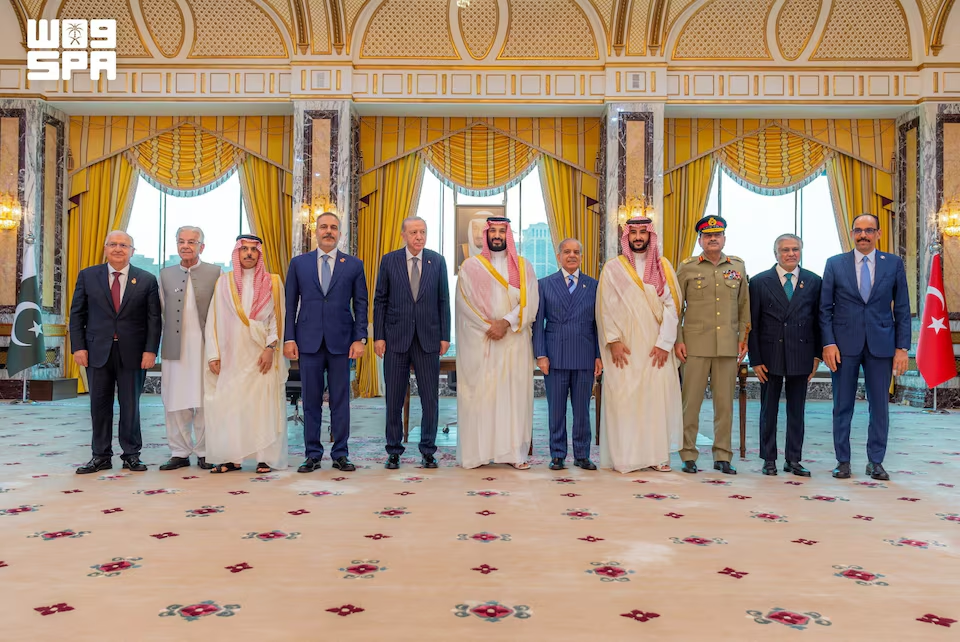
[Turkish President Tayyip Erdogan, Saudi Crown Prince Mohammed bin Salman, Pakistan’s Prime Minister Shehbaz Sharif, accompanied by Munir, et al]
The grand sounding Mecca Joint Defence Agreement (MJDA) revolves around Article 5 concerning mutual defence — attack on one, will be considered an attack on all — a straight lift of the NATO obligation. The Turkiye President Tayyip Erdogan called it an attempt at “collective deterrence”. The Saudi deputy minister for public diplomacy, Rayed Krimly, explained that “The agreement does not represent any intention to build a military axis or a sectarian/religious bloc”, nor is it linked, he said, “to nuclear ambitions or an arms race, but rather to building sustainable, self-reliant capabilities”.
Riyadh hinted, moreover, that Egypt and other states may join this group in what the MJDA countries hope is a Sunni military alliance in embryo to contain Shia Iran and its collaborators — the Houthis in Yemen, and Hezbollah in Lebanon. This even as Iraq and Bahrain with large Shia populations have kept out. And another Muslim cluster is poking its head around the corner led by UAE, which seeks a conciliatory approach to Tehran and a wider extra-regional footprint by cooperating with out-of-area non-Islamic states. Such as India.
Indian commentators, who know little and understand less, are purveying alarmist nonsense about the MJDA. But this Mecca pact does not have the “legs”to hurt India, because an inimical Saudi Arabia and Turkiye would still be using the Pakistan armed services and, if nothing else, this is one threat the Indian military will happily deal with anytime!
But barely was the ink dry on the defence pact than the MJDA was tested, and it failed! Riyadh’s mortal enemy, the pesky Houthis attacked Saudi targets with drones. Near simultaneously, the Saudi refinery at Jazan on the coast processing some 400,000 barrels of Saudi oil daily was wrecked, as were the Jubail gas facilities, and the Red Sea port of Yanbu. And all the world heard was a deafening silence, reminding everybody that the Mecca accord is a sum of zeroes.
The three main actors, albeit in a new organisation of the Mecca group, will replay old, even traditional roles they long ago mapped out for themselves. Riyadh is the financier — it has oodles of money, oil, and little else. Ankara wants to push itself into Turkiye’s Ottoman role as caliph and adjudicator of Islamic affairs, and as armourer of Muslim states with its defence industry making huge strides, producing highly regarded drones in particular and, lending Saudi Arabia and Pakistan, even if by association and distantly, linkage to NATO (because Turkiye anchors the eastern end of the Atlantic alliance). But the Saudis, Turks and Pakistanis are each equally malleable and in hock to America — the reason why Washington is patronisingly indifferent to MJDA. And Pakistan is the usual South Asian menial, offering a bunch of hired hands — doing a job the Saudis and Turks won’t deign to do — actually fight anybody and if needs be, die!
After all, Riyadh isn’t forking out the dollars to Pakistani soldiers to just mount ceremonial palace guard and restore order after putting down some small time revolt by Palestinians residing in the kingdom as happened in the 1970s and 1980s. The Saudis would expect them to go out in the field, take on the ruling family’s enemies. One can’t put it beyond Field Marshal Asim Munir to actually send his men in harm’s way, but it will rebound on him domestically once the ramifications roll in. But a detachment of the Pakistan army in Riyadh’s employ affords diplomatic visibility and even leverage besides being a small nice source of hard currency for that country. For the officers, JCOs and other ranks lucky enough to spend some downtime in the Nejd, while being well remunerated, it is a bonanza — like the UN peacekeeping tasks the Indian army is overjoyed to carry out. And, this is important, for Pakistan Air Force pilots, in particular. It will afford them the opportunity to fly modern combat aircraft the Saudis and the Turks have — Typhoon Eurofighters and even F-35s (that Erdogan is getting from the US as a NATO member). And this aspect where the Saudis transfer their air force assets to Pakistan for use against India is a possibility, but a remote one, considering Prince Salman is also keen to invest in India and have an economic partnership with it.
Still, it could overall be a happy outcome for our neighbour. But not if Riyadh demands the Pakistanis interpose themselves between the realm and the Houthis, say. And then they’ll find that it is one thing to lounge around in Saudi palaces, quite another to get into kinetic ops against a foe that neither the US or the Saudis singly or acting jointly have been able to get the better of.
There’s the long running speculation, now again in the forefront, moreover, about what it is that Riyadh’s monies, which financed China’s transfer to Islamabad of nuclear weapons, missiles and related technologies, courtesy Beijing’s secret policy of “friendly proliferation” supported and sustained by three US Administrations — Democrat Jimmy Carter’s, and Republican Ronald Reagan’s and George Bush’s, actually bought for Saudi Arabia. Would it translate, in a Saudi death struggle, into Riyadh’s finger on Pakistan’s “Islamic Bomb”? Unlikely, but it is the sort of possibility that Islamabad keeps indirectly fuelling just to string this Arab monarchy along.
But there’s simply no doubt about one thing, that the Saudi Crown Prince Salman hopes to exploit the civilian nuclear deal he has signed with the Trump Admin to create a trained nuclear cadre of scientists and engineers who, with the help of Pakistani technical and material help that Islamabad may be more willing to share, could convert the knowledge of the physics and engineering involved in nuclear power plants into techniques to construct a Bomb. This is transparent enough.
Incidentally, the Saudis have secured a better, less intrusive, but a more extensive nuclear deal, inclusive of uranium enrichment tech with Trump than the purely punitive one that has grievously hurt the Indian nuclear security interests, which S Jaishankar, as MEA official, negotiated with the George W Bush regime 20-odd years ago!
But now, it gets interesting. Israel is shifting its military and Intel focus principally to Turkiye. With Pakistan looming seriously as a nuclear spectre via the Saudis, and Israelis seeing US domestic politics turning against it and Washington turning into a thoroughly unreliable ally, Tel Aviv will likely decide it has to zero out the risk it faces, and begin planning again for strikes, covert or otherwise, among other targets, Pakistani nuclear personnel, facilities and weapons storages, etc.
Indira Gandhi, to India’s great misfortune, literally at the proverbial 11th hour, aborted the planned Israeli strike mission against the Pakistani nuclear complex at Kahuta that was to be staged out of Indian military bases in early 1982, which I first revealed — and detailed in my books. Former Israeli Military Intelligence Chief, Major General Aaharon Yaariv, had disclosed the attack plan to me. This happened when I was in Israel during the Israel-Lebanon War in the summer of 1982. Islamabad thereafter and, especially under Parvez Musharraf and since, repeatedly approached Tel Aviv on bended knee, to reassure the Israelis that Pakistan would never, not ever — Allah promise! — let its N-bomb be used against them, and would they please, please, spare their N-facilities and nuclear weapons stores! Tel Aviv kept that option in abeyance.
With MJDA, the Pakistani nuclear threat to Israel is resurrected, and Mossad can be expected to engage it. How? Let’s see!


Isn’t it quite curious Mr. Karnad that despite India being on Israel’s side despite putting up a neutral show , the Iranians and especially some of their unofficial media representatives like Mr. Seyyed Marandi, have not criticized India despite India providing weapons supply to Israel and if their so called fellow islamic brothers in pakistan makes a wrong move the same Mr. Marandi never lets off Pakistan and attacks it with a dignified taunt ..only for pakistani social media users to hound him. .
to me it indicates that iran wishes to have cordial ties to india and is looking beyond this war as this new so call islamic nato pact has kind of opened up the sunni-shia rift..
That’s absolutely correct. Also because India ranks second with Pakistan and Iraq with Shia Muslim populations in the 20-24 million range. Indian shias are enormously nationalistic whom Tehran has long cultivated resulting, post-1979 and Shah’s reign, in warm bilateral relations despite frictive issues that arise now and then.
Israel will outsource the work to India. Expect a lot of future killings in Pakistan attributed to Indian intelligence agencies “unknown gunmen”
Sir, what could be the chances of this “alliance”, being pushed by America to increase leverage against Iran? If anything, this seems like an anti-Iran pact, pushed by america, with Saudi and Pakistan already in bed with the Americans and Turkey structurally constrained by its membership with NATO.
At most an inconvenience, because Pakistan dare not upset Iran and have a third alienated front simultaneously to deal with!
Email from Dr V Siddhartha, former senior official in the Office of the Science Adviser to Defence Minister
V Siddhartha
Tue, Aug 11 at 11:19
…what would be the regional reaction (if any) were India to say — in response to an instigated question at a regular MEA briefing:
“We are still studying the ramifications of the Pakistani membership of the MJDA. But doctrinal reciprocity would allow India to construe an attack on India by one to be an attack on her by the others, individually or collectively”.
VS
Sid,
That would set the cat amongst the pigeons, won’t it? And possibly have the MJDA and the Islamic world, generally, and the US and Europe as well, hopping mad and wary!
Except, this is GOI we are talking about — it simply doesn’t have the vision, the will, and the steel to go expansive on N-deterrence.
Bharat
Professor, Emirati royals seeded BCCI bank in ’74, which narco trade profits hijacked for the bomb. Saudis only arrived in the late ’80s, paying Islamabad to broker the Chinese DF-3 missile deal.
On turkish drones, they are dogshit in warfare, their lack of capability in Electronic warfare and network centric warfare makes them useless in conflict
Israeli can’t bomb them but will try for logistics and personnel sabotage and decimation, if they decide to indulge in this, but their next three years plan seem to focus on Syria and turks more
Israel’s main concern is with N-weapons with any Islamic state – an existential threat
No. Israel main concern is hegemony in west Asia. Iran had started nuclear weapon program to use it as a leverage against lifting of us sanctions which they did in 2015 obama deal. Thing to see it if us will leave its hubris and respect and help it’s allies. Russia and china have been better allies to iran and north korea regarding weapons and technology. Us thought keeping bases is enough. If china does not accept g2 us will invade latin American countries OR there has to be structural changes in their foreign policy if us wants to remain the global hegemon!
Sir, the targeting of Pakistan by Israel could pose significant challenges for India. Israel might leverage India as a strategic base/launchpad or manipulate Indian political dynamics to serve its interests, potentially leading to unforeseen consequences, including Indian casualties, as observed in this US-Iran conflicts. Furthermore, once established within the Indian political framework, there is a risk of this influence being exploited for other broader, potentially detrimental, objectives.
Look, if by “unforeseen circumstances” you mean N-weapon use then you are looking at the other end of the binary I have described — a war of annhilation versus limited wars of manoeuvre India-Pak have indulged in to-date. India will be hurt, but the exchange ratio suggests, Pakistan WILL become extinct (as a social organism) — as detailed in my Nuclear Weapons & Indian Security. The Pak army has too much to lose to risk this denouement
Greetings professor,
I have a different view on the matter and would like to know what you think of it?
I think, the best way to ensure that the Belt and road initiative falls flat on its face is if Bharat manages to deny the Chinese the Caspian sea and subsequently the CAR(A big task but looking at the geography, the only logical solution i can see. We have managed to begin to think of cutting off malacca afterall!).
I agree that this cannot happen without a sino-russian divorce which logically only Bharat can orchestrate(Considering the rail network the Russians have offered, they are planning for the divorce. They do not want to repeat the mistake they did with the Mao and Gorbachov divorce) but does not have the resources and simply, disappointedly, the iron and the will to execute it at the moment.
I think, it is equally important to not let the Chinese fill the power vacuum so created by op epic mistake in west asia. So, why not use the MJDA as an opportunity to create Bharat’s own loose military alliance and officially enter the geo-politics of West Asia?
The members can be:
We do not need to go the full hog like a collective defence pact, the idea of which is anyway farcical. However, we can use this architecture for training exercises and forward deployment of our naval assets + Invest in tech collabs to create UMVs which is now the need of the hour for all countries.
This grouping or alliance will help us achieve the following:
Do you think this is a workable solution?
Happy independence day of Balochistan and Bharat!
Regards,
Jai hind!
Something like this scheme is jelling. Good you included Cyprus!
Already mentioned in the third point under the members sub heading sir.
Jai Balochistan,
Jai Hind!
We cannot have geostrategic ambitions without credible protection of our sovereign territory where we have already failed. That’s the reason why us has pivoted back from Asia pacific to Latin America and arctic and are building goldem dome. Reason: chinese bri and chinese and russian lead in hypersonic and FOBS weapon. My frustration with us is even after losing in iran will us give their advanced offensive technologies to countries having disputes with china or will continue with appeasement.
You seem to be caught up on US mil hardware — it’s not that great
Our best option against china should be nuclear arming vietnam and others as you have suggested
The chinese have shown no real fighting credibility yet sir/maam @ABC.
Bharat afterall is a battle hardened country with the best sub conventional warfare capability, a fighting navy(Chinese navy on paper is strong but afterall, is yet to break out of the first island chain. Until that happens, Chinese mettle cannot be understood) and a strong demography which the chinese lack.
Our use of strategic weapons in op sindoor was not bad either. Through a tactical missile like Brahmos, we had managed to achieve strategic gains and thus, dominate pakistani airspace in 78 hours or less!(I agree with Professor that we should have taken over haji pir but credit must be given where it is due! America has not achieved one strategic goal it had set to achieve against Iran despite the heavy bombing and the stand in campaigns they had begun. They claim to have achieved air dominance but what kind of air dominance is it which comes at the cost of 46 aircrafts, 3 AWACS, 13 MQ9 Reapers and 3 Chinooks. I am new to military affairs so please explain this to me.
Now, USA must either accept a powerful iran and leave the middle east or send in ground troops and spill blood.).
Perhaps, in the above grouping, we can also invite Somaliland to join in. This will give us direct entry into horn of africa.
Also, this kind of geostrategic thinking will force our hand to do the necessary economic reforms and invest in a strategic weapons ecosystem… maybe push for a Strategic bomber in the next 5 years(But that had been gutted by the rafael deal. I hope this deals falls apart. I dont want this to go through).
Economic reform can be translated into greater numbers in Brahmos, Nirbhay,Pralay, Agni,Kusha,sagarika and surya missiles which are one of the best in the world! Skyroot’s success can translate to a cheaper version of the kind of hypersonics we need to deter Chinese misadventure + invest in deterrence at a distance. Also, invest in the necessary drones – Sheshnaag , Ghataks, etc.
I understand that we are lagging behind in many aspects but we are not as bad as we think either. I think, we can be superpower in the time to come provided we take the right decisions. Now that it seems that we are finally waking up to the reality of life(except maybe the air force. it has yet to wake up), i think we should support the effort to the best of our ability.
Let us be critiques and not cynics @ABC. A ‘bloody minded realist’ that you claim yourself to be must understand the difference.
Sure, nuclear arming vietnam is a good solution. But so is arming the free tibet movement, which has finally picked up. With China upping the ante in arunachal pradesh, it gives us good cause to do do!
Jai Balochistan,
Jai Hind!
@inquitisivelyenchanting. Why shall china show real fighting credibility if they can grab territory without any war? How can a country fight war alone? They have focused on building national power and they are are getting the fruits of their investment
@ABC,
You hold on to territory through force. There is no way around it. It is something quite basic!
War is the ultimate test of the will of a nation/will to protect a nation’s national interest and ambition as written by our very own in his book ‘Staggering forward’. It is literally one of the first ideas he presents in the book.
Thus, a country must have the stomach for a fight. That is the basis of ‘Will to power’!(Nuclear weapons and Indian Security, last chapter)
Chinese can claim the moon for all I care. Can they hold onto their claims? Philippines!!!!!!, is giving them problems for god’s sake!. Chinese have managed to hold onto Aksai chin because we are yet to display our will to take it back by any means necessary. I think it is time the SF re-executes operation param vijay in which, we categorically displayed the Chinese our ability of cutting off Xinjiang from the mainland!! (Nuclear weapons and Indian security)
The americans have managed to remain numero uno for all these years because they have spilled blood. Not my words, Shri Vijay Gokhale ji’s. So, to think that war/force is not necessary TO HOLD TERRITORY and claim superpower status is not a sound argument. (The public rant over Chinese take over of taksing in arunachal pradesh is only believable when solid evidence comes to light. I have not seen any. If you can show me, I will be happy to take a look).
Another example.
China is preparing to Blockade Taiwan’s SLOCs since the us iran war has proved how costly offensive takeover of an amphibious country can be. But, the porcupine strategy prepares Taiwan for such a contingency. They have played war games to counter the blockade – https://www.reuters.com/world/china/taiwan-simulates-countering-chinese-maritime-blockade-tabletop-drill-2026-06-25/
No doubt the Chinese have risen to be a juggernaut of an economic power. But, I will call them a superpower only when they manage to display the military teeth needed to be called one and more importantly, are willing to spill the kind of blood Americans and the Russians have spilled.
Take care friend!
Jai Balochistan,
Jai Hind!
@inquisitivelychanting that’s another thing that india does not consider — chinese grabbing 2000 Sq km of indian territory an act of war. As tsun zu said victorious warriors win wars and then go to fight battles
Professor, this may be off-topic and perhaps even a bit dystopian, but I am curious if you envision the future of warfare involving humanoid robots. Some time ago, the Chinese exhibited these robots at a gala that displayed such deft, athletic, and nimble movement, leading one to consider whether the next logical step(security wise) would be to place guns in their hands.
Absolutely, yes! And humanoid warfare is only a generation away
Professor, the way the Chinese are hosting athletics of humanoids(I mean come on!), i would say it is only 30 years ahead.
And Bharat would be the first victim of humanoid terrorism. All the Chinese have to do is release 400 of them, armed with guns, through the Nathula pass recently opened.
Sorry, could not hold my apprehension back!
But, you are right to worry.
Dr Karnad, Like Pakistan , Israel is also vulnerable when it comes to its own nuclear arsenal. Israel has one major nuclear reactor in Dimona and it is well within Pakistani capabilities to take that out or help others taking it out. Iran I believe came close to taking it out in the recent war. Pakistani pilots can easily take it out from bases in Jordan, Egypt and even Syria (if need be) considering Israel only bombs countries like Syria and Lenanon and Iraq who do not have any competent airforce like Pakistan. What will be Indian position if Pakistanis take out Dimona do you think ?
No, Pakistan has no distant strike capability.
But Pakistani fighter jets working out of Egypt or Iraq or Syria can wreck havoc inside Israel, right?
Really? Egypt? It has begged off MJDA!
Professor, how does the unmanned AI powered fighter jets like the Turkish ‘Bayraktar Kizilelma’ and the American ‘Fury’ by Anduril compare to the current 5th gen fighter jets?
Kizilelma and Fury are better than any current fighter flying. Reason why India should concentrate on developing the single engine armed drone with Kaveri engine with 81kN thrust. (You have anticipated my next post!)
Dear Professor Karnad,
I read your recent blog post on BharatKarnad.com regarding the Mecca Joint Defence Agreement. Your realist dismissal of the pact as an empty political container—and your point that it might inadvertently prompt Israel to take out Pakistan’s nuclear assets—was characteristically sharp and refreshing amid the prevailing media alarmism.
Given your long-standing critique of New Delhi’s lack of a coherent grand strategy and its historical fixation on a lesser threat like Pakistan, I would highly value your expert perspective on a deeper structural trend that seems to be unfolding along India’s frontiers.
It appears that India has quietly abandoned the passive, traditional defensive cliché that “land once lost is lost”. Instead, the state seems to be pivoting toward an Asymmetric Forward Doctrine fueled by massive infrastructure geometry and calculated patience.
I would be grateful for your analysis on two specific fronts:
The Squeeze on PoJK: On the western flank, India’s approach to Pakistan-occupied Jammu and Kashmir seems to have completely shifted away from traditional kinetic operations. By keeping 24 legislative seats vacant by design, leveraging the stark developmental contrast between Srinagar and an economically suffocated Muzaffarabad, and letting the internal structural contradictions of Pakistan do the heavy lifting (such as the violent civil unrest over the 12 refugee seats), New Delhi seems to be executing an irreversible, asymmetric long game. Is this slow, institutional strangulation a viable roadmap to eventually step in and absorb the territory under the banner of a humanitarian/constitutional intervention when the Pakistani state apparatus inevitably fractures?
The Forward Geometry in Aksai Chin & The “Black Swan” Strategy: On the northern frontier, the operationalization of the high-altitude Mudh-Nyoma Airbase (sitting just 23-30 km from the LAC) alongside all-weather tunnel networks demonstrates that India is heavily mirroring China’s forward logistics. Strategic analysts have suggested that India is not looking for an immediate war with a stable Beijing, but is systematically positioning its military assets to exploit a future “Black Swan” event—such as a major internal political breakdown or economic crisis in China.
Given your views that the Indian military must shed its “neutral gear” and focus entirely on countering Chinese hegemony, do you believe this forward infrastructure push gives India the realistic positional advantage required to successfully exploit a future crisis in Beijing and reclaim Aksai Chin? Or do you view this “infrastructure deterrence” as merely another reactive posture that fails to project actual offensive power?
Thank you for your tireless work in pushing for an unapologetic, realist policy compass in Indian national security. I look forward to your thoughts.
Warm regards,
These moves and measures are welcome, of course. But they are mainly holding actions/policies not ones meant to challenge China on the LAC, leave alone to recover lost territory. The steps in the west against Pakistan are fine, then again it is only Pakistan!
Dear Professor Karnad,
You noted in your response: “These moves and measures are welcome, of course. But they are mainly holding actions/policies not ones meant to challenge China on the LAC, leave alone to recover lost territory. The steps in the west against Pakistan are fine, then again it is only Pakistan!”
I completely agree with your diagnosis. If we measure strategy purely by proactive kinetic thrusts, New Delhi is indeed running a defensive, risk-averse holding game, while fixating on an economically spent Pakistan as a minor distraction.
However, looking past the current political hesitation, the ultimate question remains: How else do the lost territories actually come back to India?
If Aksai Chin and PoJK are to be recovered, it will not be through an immediate, aggressive military march that risks an uncontrollable nuclear escalation trap. Instead, isn’t the real utility of these “holding policies” to establish an irreversible positional advantage for when the adversary structurally fractures from within?
By pouring concrete at forward bases like Mudh-Nyoma, layering high-altitude air defenses, and maintaining legal vacancy for PoJK, India is creating a permanent, weaponized launching pad. We are not expecting a stable Beijing or a cohesive Islamabad to hand the land back. Rather, this heavy infrastructure ensures that when Pakistan’s internal crises force a structural border retreat, or when a future “Black Swan” political or economic shock bogs down the central command in Beijing, the Indian military is already on the doorstep to instantly change the map before the world can react.
If traditional military adventurism is off the table for a risk-averse democracy tied to global supply chains, isn’t digging in with heavy infrastructure and waiting to exploit a structural leak in the enemy’s center the most viable, realist path to actually recovering lost land?
Warm regards,
Recovering territory from China is NOT adventurism
Dear Professor Karnad,
Point taken. You are absolutely right—recovering territory from China is NOT adventurism; it is a fundamental sovereign obligation and a core requirement of national deterrence. Calling the reclamation of our own land “adventurism” simply adopts the timid, risk-averse vocabulary that the bureaucratic establishment uses to justify its inaction.
If we drop the defensive excuses and accept that a clash with an expansionist Beijing is inevitable, India must dictate the terms of the opening salvo rather than passively waiting behind a wall of “holding policies.”
To look at the raw military execution of this strategy today, I want to ask you:
The Tactical Target: Given China’s current logistical depth, which specific sector along the LAC should the Indian military prioritize for a proactive, pre-emptive cross-border thrust to seize territory and establish hard bargaining leverage?
The Industrial Fallout: If India initiates this necessary challenge, what immediate, drastic steps must New Delhi take to insulate our frontline capabilities against a Chinese raw-material and electronic supply-chain blockade?
The Nuclear Escalation: How do we structurally manage the conventional escalation of this offensive to ensure Beijing is deterred from leveraging its nuclear asymmetry?
If we are to transform our forward infrastructure from a defensive shield into an offensive weapon, what does the immediate practical playbook look like?
Warm regards,
Refer my solution for LAC: forward deployed 2-tiered short fuse N-deterrent (detailed in my Staggering Foward)
good morning sir…can u please tell the strategic reason and national interests for which we have to fight china ?..
Read my books! If that’s too much to ask, read my posts in the china category in this blog.
I mean, even strong leaders like Nehru and Indira froze when it mattered instead of going full hog. When you go for the smash, you shouldn’t back down; you should commit to the action. Otherwise, it breaks your entire OODA loop.
Even Modi never fully exploited Operation Sindoor to the hilt. They just seem satisfied with some imaginary win where “the message has gone through,” but in real terms, as a country, we neither gained any real territory nor resources. So what’s the point?
Mr. Karnad ,
Would it be fair to say that given India’s strategic geographic location, China has serious unsaid anxieties about India eventually charging a toll on their commercial shipping similar to Iran. and therefore they continue to pressure India on the northern eastern borders in the “HOPE” (keyword) that their anxieties do not come true ?
Similarly pakistan now has anxiety of operation sindoor repeat because India has breached the mental threshold of targeting pakistan punjab in operation sindoor and therefore they are trying everything on diplomatic front with usa and other middle eastern nations with all kinds of defense partnerships in the “HOPE’ (keyword) that Sindoor does not get repeated ?
Right on both counts. But, if Delhi plays hardball — a big IF — doubt that anything C & P do, will ameliorate their situations!
what do you think north korea will do professor if trump use tactical nuclear weapons on iran?
Trump won’t use NWs — yet another bluff! Iran’s N-travails is why Nkorea withdrew from NPT and prioritised NW development! In a
Bangladesh to be included in Islamic NATO?
Yes. So, nothing.
Professor, How does Shield AI’s X-Bat compare to the Kizilelma and the Fury? Is it superior to these two platforms? It does have VTOL capability so it can be forward deployed without the use of traditional infrastructure plus it is specifically built around coordinated swarm technology(Hive Mind)
There’s been no flyoffs, so who’s to know?
@BharatKarnad
Professor How would you assess Shivshankar Menon’s overall contribution to India’s foreign and security policy, particularly during his tenure as Foreign Secretary and National Security Adviser?
Shivshankar Menon had described the 2013 Depsang crisis as an example of successful Indian diplomacy because India managed to restore the status quo without allowing the confrontation to escalate. But the lesser-known part of the episode is that India reportedly agreed to remove a structure at Chumar as part of the settlement, and Menon personally intervened with Yang Jiechi shortly before the Chinese withdrawal.
In your assessment, was Depsang genuinely a diplomatic victory for Menon, or did India effectively trade away something in another sector of the LAC to secure China’s withdrawal? And, looking back after Galwan and the subsequent deterioration of India-China relations, do you think Menon’s strategy of managing the border while preserving the broader relationship with China was fundamentally correct?”
India has had NO diplomatic victories vis a vis China to-date.
India is not only diplomatic failure but also strategic failure. giving up kailash hills was supposed to be not even an option in any negotiation. even some people are of view negotiation should not have been done. India had element of surprise, galwan was big setback for China, India should have struck hard and even take Tibet as union territory of India.
Tibet should be declared Indian union territory even now. 😀
Professor,
Not even Galwan? I have read your posts on it but Shri V Gokhale in his book Long game claims that Galwan was a great example of CMF and a diplomatic victory over China.
Gen Naravane says China was PUSHED BACK FROM THE OCCUPIED POSTS, something the Chinese never do.
What do you think of these two observations?
Regards,
Jai Balochistan,
Jai Hind.
You believe that, you’ll believe anything. Study the terrain and topography of the fingers on Pangong Tso north shore they drew back from, and the Kailash heights we came down from, and decide! Gokhale and Naravane have to be in sync because they are “partners in crime”!
Thank you sir.
Jai Balochistan,
Jai Hind!
1,934 crore for two mq9 drones (iran shoots them down like flies), while on indigenous tapas we spent barely 1,700 crore for full development even accounting for their constant change in requirements and objectives.
Only around 390 crore from internal budget was spent on Cats warrior by HAL.
Who doesn’t know in the world that these american drones are a shit? Can’t we see the blatant corruption right in our face? It does absolutely nothing to help our own base capability, we do not need to do this under the stuff.
These Navy brass and people connected to brokers like vivek lall orchestrating such a sellout deal should be tried for outright treason and thrown in a dark cell for hollowing out our forces.
It is unbearable and outright in our face.
professor I have seen in many western/American reports , think tanks saying that us thought that if china opens economically it would slowly transition to democracy. Which idiot economist or adviser said this nonsense to sucessive us administration’s? Economic growth depends upon distribution of wealth , state investment in education and r&d. it has nothing to do with democracy or dictatorship, it depends upon the leader in charge. Or do you think Americans actually started believing their own propaganda of exceptionalism due to their establishment ‘s politicization of their victories in WW2 and Cold War? What is the reason for them always having accommodation for china? Even when the chinese made it clear since mao zedong’s time that they don’t believe in the 8dea of American hegemony??