Fooling around [with the charkha!]
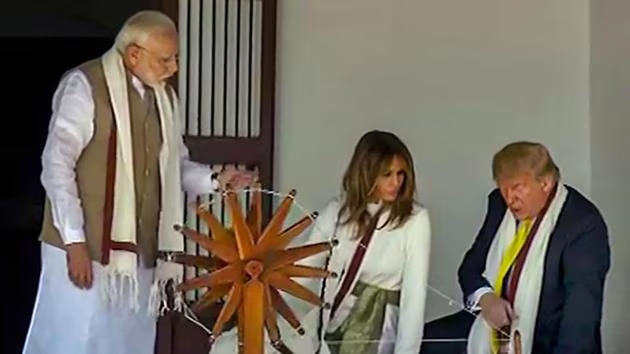
Get Donald Trump in an unfamiliar setting, have him him do things he hasn’t done, and there’s a good chance he’ll end up being a li’l puddy cat. Like when he (along with his wife, Melania) was given a charkha to handle, on his last visit at M.K. Gandhi’s ashram (or something in Gujarat).
But the G-7 June 15-17 summit at the French riverside town of Évian-les-Bains near the Swiss border with casinos and other pleasure domes, is not a place for Prime Minister Narendra Modi to risk a one-on-one meeting with the US President, who is only too familiar with Europe and is so at ease in these surroundings that he has used them in the past to harangue and belittle his European counterparts.
Modi is there at the French President Emmanuel Macron’s invitation, who is ever so grateful that the Indian government saved the French aerospace industry one more time by shelling some $43 billion for the vintage Rafale fighter aircraft without any real tech transfer! This Indian money will come in handy now that the tripartite 6th generation future combat aircraft system programme involving France, Germany and Spain, is formally terminated.
Macron’s agenda for the conference is expected to feature global trade imbalances and the two ongoing wars — in Ukraine and Hormuz. In the context of the European Union generally deciding to counter China’s uncontrolled exports push by possibly imposing tariffs and putting up other barriers to Chinese merchandise, Modi should have no problem in piling on China, wagging a finger at it, or whatever else the G-7 collectively undertake to do by way of curtailing Chinese imports. In India’s case, the imbalance is so great it is getting to be criminal to not just shut down at least the merchandise imports. And please, no scurrying around for Chinese investments which don’t come without strings attached.
Where the conflict zones are concerned, Modi better be cautious. Delhi already has egg on its face by joining the British initiative to send a naval task force to the Hormuz Strait and the Gulf of Oman to enforce “freedom of navigation”. It is a good thing nothing has come of it, or India would have been on the hook. Moreover,Tehran is already much stressed without India joining the West in belabouring it some more. Especially because it is not Iranian shore fire that hit the Palau-flagged ship but US guided munitions, that killed three Indians in the crew on June 8th. (Palau is a small archepelagic nation in the Pacific.)
Because Iran matters geostrategically to India as it offers the North-South trade route through the port of Chabahar, which is still India’s best bet to open up the landward trade links to Afghanistan and Central Asia and westwards to Russia and Europe, and as competition to China’s Belt & Road Initiative (BRI). Because the other project India is part of — IMEEC (India-Middle East Europe Corridor) also to rival the BRI in the extended region is, in the aftermath of the war in Hormuz, unlikely to come to fruition before the 2040s.
Moreover, when peace arrives — however that happens, the Indian Navy has to have a presence on Gwadar’s western flank that the PLA Navy is itching to develop into a major resupply base for its ships it hopes permanently to station in the Indian Ocean west of Malacca, Lombok and Sunda. There’s, in other words, too much for India to lose should Modi choose the wrong side, when sitting on the fence serves Indian interests best. Isn’t this how “strategic autonomy” works? The trouble is Delhi tilted perceptibly towards the US and Israel and to UAE, when it did not have to.
Of course, Israel is a seperate case and our close connection with the Jewish state cannot and should not under any circumstances be weakened. Here India has an opportunity to thread the needle by maintaining a policy of repose, reacting to nothing that either Iran or Israel does, in the hope that at the end of the conflict Tel Aviv, with strained relations with the US, will need India’s anchor support, even if that means tolerating Delhi’s overtures to Tehran. But shia Iran will need recultivation because Delhi’s siding with UAE — India’s prized Arab and sunni pivot in the Gulf, crimped ties with Tehran.
The point to make is this: At the end of the Hormuz war, Trump’s America will hightail it out of the region, Israel and UAE will firm up a front against Iran, even as the Ayatollahcracy survives, propped up by the Revolutionary Guard Corps that proved to the world their country’s resilience and sturdiness under intense US fire. This is no small outcome because it has convinced even the most rabid of the “regime change” crowd in Washington that “bombing the f..k” (Trump’s words) out of Iran is easier said than done. For India, it is an object lesson on how a middling country can stand up to big power bullying.
Consider a situation in which India faced the kind of intense American military attention that Iran suffered but successfully thwarted: Would India and the Indian government, which seemingly specialise in folding at the first hint of trouble or pressure, as has repeatedly occurred, be able to put up as brave and solid a front???
Anyway, back to Evian! Jaishankar and MEA are doubtless urging Modi to prepare for a closed door meeting with Trump. That’s BAD advice, unless Modi desires Trump to once again make a monkey out of him in France, this time. The fact is no mainstream leader, let alone Modi, can have the better of Trump simply because for the US President even the friendlist encounter is an occasion to show who is boss! Recall, the handshake grudge matches Trump regularly engages in with Macron (which may again be seen at the G-7 summit)? And because Trump glows in exhibiting lack of restraint, especially at such showcase conferences and delights in picking on some leader or the other to kick around. And who can say it won’t be Modi who, in the European setting, will stick out like a sore thumb?
Sindoor is a recent enough experience for Modi to be wary of any move to pitch him into a Trump meeting that the US ambassador Sergio Gor too seems to be pushing, from behind the curtain. If Sindoor taught the Indian government anything it is to not signal or otherwise inform Washington of moves it may intend to make, and to keep its thinking on issues to itself. Not that US intelligence will not have a fair idea of what’s cooking in MEA and at the PMO — after all no system is more “penetrated” than the Indian one, and then at the top most levels.
At Evian, actually, Modi has very little of substance to say to Trump, and vice versa. If so, then why step in wittingly into a situation where, with the world media looking on, Trump says something once again about how he saved India from a Pakistani thrashing, or whatever spin of the monent he wants to give it, even as Modi stands there dumbstruck, unable to counter with a telling riposte about Trump as usual not knowing what he is talking about, or something more insulting. This is as likely as not to happen because Pakistan-US relations are currently enjoying high summer. Pakistan’s Prime Minister Shehbaz Sharif told The Sunday Times (of London) that Pakistan’s serving as a mediator in the U.S.-Iran war is “one of the shining moments in our history.” And former Pak ambassador in Washington Masood Khan chirped in, saying. “We are in seventh heaven and on cloud nine and it’s intoxicating. I’ve had a long diplomatic career and I have never seen Pakistan on such a high pedestal.”
The fact of the matter is the Modi government has already compromised national interests on the Free Trade Agreements with the US (and Europe), as regards energy by limiting buys of Russian oil, and by not reacting at all to Trump’s tariff war or his egregious insults that he has not stopped periodically hurling at Modi and, therefore, at India.
Modi should instruct Jaishankar to tell the US side that the Indian leader cannot spare the time because his appointments book for the Evian summit is full. It will send a much needed message to the Trump Administration not to take India for granted, and that Delhi is not America’s handmaid.


iran won the war and had upper hand hence it should have been deciding where to hold peace talks and on what conditions and topics. Instead they accepted pakistan because china supported it. Does Iranian state does not understand our problems with pakistan and china?
I think there is no need to send any message to trumps america and to treat them as an adversary like pakistan and china. And invest in domestic education and R&D. America has this obsession of imposing Monroe doctrine or vassal state like they do in Europe and Latin America in Eurasia. What they forget is asian countries are civilizational states and even those who are apprehensive of china won’t ally with us at the cost of respect and sovereignty. But the us establishment does not understand this even after loosing so many wars in asia(korea,vietnam,Afghanistan,iran)
They are now literally targeting Indian ships, yet our Prime Minister responds to Trump. In fact, I want him to go there and be humiliated even more; a hurt ego might ultimately work to India’s benefit, since he is a narcissist.
Interestingly, Trump’s messaging never targets Modi directly; it targets Indians as a group. As a fellow narcissist, he seems to understand that attacking Modi personally would only hurt his ego and make him more resistant.
Give lectures to modi about indigenization, but don’t release the long awaited “Book” to sincere audience and no updates too 😦 (No offence, I am your Well-Wisher).
What can I say! It is not an excuse, but at 78 I am struggling to finish “the book”
Please take your time, You are still very energetic and intellectual inspiration at 78!
Professor, why did the Americans fire two Hellfire missiles at a defenseless oil tanker? Wouldn’t seizing the vessel or using some other non-kinetic response have been a better option? Was the strike intended to send a message?
USN wanted to show its blockade works
Email from Dr V Siddhartha, former Science Adviser to Defence Minister
V Siddhartha
Fri, Jun 12 at 11:12 AM
… concur.
The catch is that the Ambani-Adani led conglomerates bank-rolling the BJP are telling Party-Modi (in that order)
“Yeh izzat-vizzat bekaar heh. Hamme hamare markets vaapus dil-vaado, buss”.
And there is not one policy-influencing bureaucrat — or party-person — who does not have children/close relatives in the U.S.
VS
When the US side is already openly voicing they wont allow india to be a second china, I wonder what that entails in the light of the fact that they already even have an issue with India becoming too much of a major power compared to even pakistan in this small region. Where does the line of curtailment even begin since being like china can have thresholds below where china is today and it could be different in different sectors too bringing the aggregate threshold even lower due to interlinkage effects.
I don’t know much about geopolitics or economics as my income is through video game content creation, but the idea of curtailment is so openly put into words with their prior actions as context, that it feels like one upsmanship, low cunning, and zero sum insecure calculations will guide the US state policy about India. Sure, the economic ties are deeper but that’s the business community of the states that would pressure the state even if india embraced a watered down version of its dhimmitude. As a layman, I don’t understand why keeping the US in such good humour is so important for us even now, though maybe it is more complex.
keep your friends close and enemies closer. According to bloomberg india had become second largest supplier of western tech to russia. Despite that neither biden and trump has been too harsh on india based on us economic power there country enjoys in this world. To become completely self reliant will take time since modi hasn’t invested in education and r&d since the last decade and loves to beg foreign countries. But currently it is wise to keep quiet. China too kept quiet when their journalists were killed in their embassy belgrade.
plus us economic power is going to increase only by the end of this century. They have a demographic advantage over china and russia.
Professor
Jaishankar in finland conference spoke that it was usa which told us to buy russian oil, it was an order, a slip of tongue told us the truth.
All the hysteria around russian oil and strategic autonomy was american decision to start with and we faced media backlash from west at same time, what a ostrich decision making we have.
There are no words for such tomfoolery.
https://www.indiatoday.in/india/story/us-blockade-violation-wont-be-tolerated-rubio-to-jaishankar-after-india-protests-attack-on-ships-2926204-2026-06-13
This is highly arrogant behavior by the Yankees. There are ways to stop ships rather than firing lethal weapons on them.
India should ideally deploy its navy to escort their ships and openly declare retaliatory action against anyone targeting their vessels, of course this is just wishful thinking on my part.
Indian establishment is very docile and compromised to take any hard measures.
Perception of power is no good substitute of actualhard power
Professor, Saab has offered India the Gripen E with full technology transfer and a proposal to manufacture about 80% of the aircraft in India. If the government has already decided to move away from Tejas and go with a foreign fighter, do you think the Gripen E would be a better choice than the Rafale?The biggest advantage I see is that the Gripen deal could help build a domestic aerospace ecosystem through local production and technology transfer. At the same time, the aircraft depends on a U.S.-made engine, which could create long-term dependence on American approvals and supply chains. The Rafale, meanwhile, comes from France with a UNSC veto and more influential than Sweden.
Assuming that the GOI has already made the decision to scrap Tejas which option do you think makes more sense for India?
Cheaper than Rafale, but neither Rafale nor Gripen is as good as the Tejas option. The SAAB 80% TOT is like anyother deal — no critical tech! Useless.
Professor, hasn’t SAAB stated that it is willing to offer 100% technology transfer for the Gripen E?
Don’t think so.
Professor,
How long do you think before this Iran-US deal goes down the drain ?
Actually, it’ll last because Trump has ended US involvement, come what may,
meaning whether or not Tehran sticks to any of the understandings in the so-called
agreement to be announced later this week