
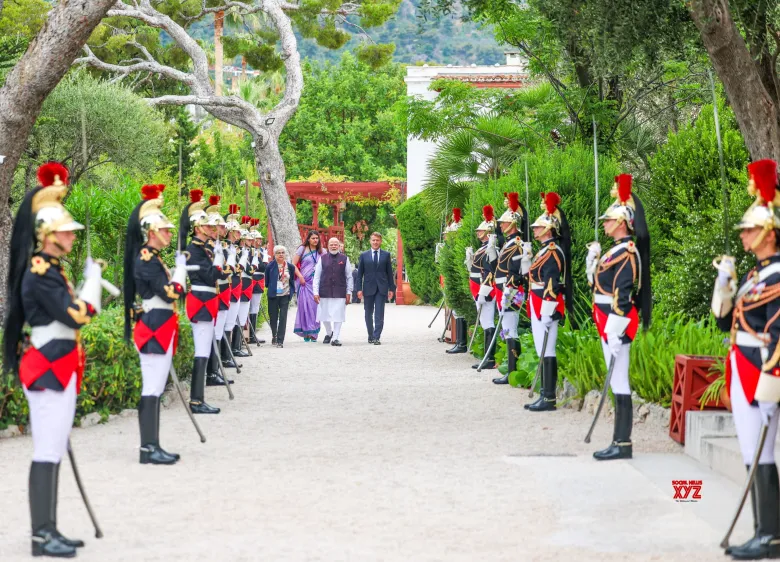
[Ceremonial welcome for Modi in Nice, France]
Earlier today, the meeting between Prime Minister Narendra Modi and the French President Emannuel Macron in Nice in southern France did not result in the usual giveaway deal — a characteristic of Indian foreign policy in the new millennium. That there was no mention of Delhi plonking $43 billion for the useless Rafale, came as a relief.
May be, Modi finally understands that using arms buys as a foreign policy means of winning small consideration from the US and states in Europe, exacts really high costs, beggars the country, and in no way helps India technologically in any meaningful way.
But old habits of mind die hard and Rafale may still be bought but not in the numbers the IAF wishes. Indeed, it seems the advice from the highest levels of the joint military was heeded by the PM, and it is that if Rafale must be bought then only 40-60 more of the 4.5 generation Rafale combat aircraft — the same generation as the indigenous Tejas, be purchased. The argument ostensibly made was that if the full complement of 114 aircraft is obtained from Dassault, it’d mean buying more platforms than equally exorbitantly priced weapons such as the Meteor air-to-air missile, each of which costs Rs 60 crore! A fully loaded Rafale’d cost a head-turning Rs 1,000 crores!!! And given the Indian Air Force’s dubious record to-date of losing aircraft on the very first day of any operation, several thousands of crores of rupees could be lost in the first half hour of any conflict! It’d appear a case made this way is not easy to refute. How many Rafale will actually be bought depends on whether France relents on “source codes”, which are software instructions for the design know why. In the case, of the avionics suite, for instance, the source codes are contained in the Interface Control Document (ICD).
The reason Delhi has stiffened its stance and is pushing Paris on this issue is because two other offers are on the table — Russia’s complete with tech-transfer, including source codes, for its 5th generation fighter — Su-57E, and Sweden’s for its Saab 4.5 gen Gripen E. The Gripen is being peddled as a cost-effective and cost-efficient alternative and, in utility terms, as falling somewhere between the Rafale and the Tejas. Indeed, the differences in the figures provided by Saab regarding the comparative unit price and the operating cost are staggering. According to the Swedes, a single Gripen may cost anything from $85 million to $140 million compared to $300 million for a Rafale, and while the Gripen costs between $4,000-$10,000 per hour to operate, the counterpart expenditure for Rafale is $14,000 per hour! Do your arithmetic and you find the lifetime cost of having Rafales in the fleet, could well send the country into the poor house.
Not sure what the operating cost of the Su-57 is, but it is nowhere near Rafale’s. Besides, India can purchase as many as three Sukhoi-57 multi-role fighters for the price of one Rafale. But none of these foreign aircraft can beat the Tejas on any metric were its production to be scaled up and, as recommended by this analyst over some 15 years now, the private sector given a parallel contract for its production to rival the one given the defence public sector unit, the hopeless HAL, which can’t produce a thing on time or at cost.
Combat aircraft are pricey items and, in this age of drones, an unaffordable luxury. But the Indian government which is otherwise fiscally responsible, apparently gets into a brain freeze when confronted by the hardware demands of the IAF in particular — or why else would it approve previous payouts for Rafale?
Here’s the secret why, gleaned after soundings at the highest levels of the military. Modi believes France and Israel are the countries India should tap for military goods, that this will help “diversify” the sources of military supply, and as alternative to the US and Russia. In our system, what the PM wants the country gets, even if it is manifestly the worst option!
And further, it also matters what Modi’s two ministers with some say in such purchases believe. The Defence Minister Rajnath Singh is the “old time politician” who thinks Russia is a reliable supplier and the country should stay with it. Hence, we have the Su-57 in the running. And external affairs minister S. Jaishankar — surprise! surprise! pleading for US-sourced stuff — the F-35 (?) and for endless buys of P-8Is, and the C-130Js and C-17s transporters.
Then there’s the fact of Rajnath Singh beginning to command respect in the military also for his siding with and supporting the armed services in their endless tussles with the Defence Ministry bureaucrats. No small thing! A senior officer reflecting the prevailing sentiment, said this: Rajnath may not be a Parrikar, but he has our back. The late Manohar Parrikar, an IIT engineer with a problem-solving mindset and forensic skills in evaluating comparative offers of expensive foreign armaments leaned, incidentally, towards augmenting the numbers of the Su-30MKI (that I had advocated and still do) rather than going in for the Rafale. Parrikar was by far the best defence minister India has had and, for his cost-saving efforts, was shifted back to Goa as chief minister!


the problem is with bjp rss govt only. I have now realized there goal is to destroy scientific temperament in this country. These are not mistakes or corruption. They are like what the Qing dynasty was in china.
Greetings professor.
Sorry for the question on civil service as a career option for me. This isn’t the place for career counselling. I was in a foul mood that day.
Thanks for being honest as always!!
Three questions come to mind
Thanks and regards
Jai Hind!!
@BharatKarnad
https://x.com/Neetivaan/status/2066137804078490061
Lol professor here you are advocating for Tejas and indigenous jets and here we have such import bahadurs
as per Vishnu Som a denmark born defense journalist, Tejas Mk1A and Mk2 will be obsolete and India should join FCAS So,
He says that “the amount spent in Tejas progaram (Mk1A + Mk2) is avoidable as they will be obsolete even before they are in service. He is simping hard for FCAS, it looks like he wants India to join FCAS even if we have to shut down all our programs.
Basically let’s kill Tejas just liked we killed Marut
“Parrikar was by far the best defence minister India has had” – no wonder he was shunted to save BJP in Goa’s faction-ridden politics.
Same with Rajeev Chandrasekhar- too good for samosa economy.
Email from Smita Purshottam, IFS (Retd), founder head of SITARA (Science, Indigenous Technology and Advanced Research Accelerator)
Smita Purushottam
Tue, Jun 16 at 1:58 PM
That we are even contemplating buying it despite OP Sindoor and refusal to integrate it with our own weapons park says it all.
Dr S. Jaishankar needs to be sacked effective immediately. All of his children are US citizens and clearly there is a conflict of interest.
Interesting article.. Still a lotta money, but I can understand the argument in having decent numbers in the stable until a more potent Fifth Gen platform can take shape.
So if India goes ahead with the Rafale-lite option, what’s going to be the fate of the engine deal? Or is Russia going to include engine technology as part of its generous Su-57 tech transfer?
Feels like a massive spend in sustaining this hamster wheel of a defense ecosystem. How can India get more bang for the buck if it’s forking out insane monies on procurement? Even the Pentagon has started looking at an alternative procurement framework, by looking at Drone Tech from Silicon Valley – where these new age firms dont expect an advance commitment on R&D spend from DoD.
That’s actually the way India should go too. But too many vested interests…
Should a seperate and independent Drone command be created – one that drafts its own policy, has its own Air Defense ecosystem? Headed by a Joint Civilian (Industry) and Former Military? One that could eventually be integrated with the main arms of the military after reaching a certain maturity. Orders will directly be placed with vendors, weapons platforms will be owned and operated by the command directly.
Granted it will create overlaps and redundancies, but only an independent command devoid of multiple vested interests can flourish..
Seperate drone command? No.
I also hate rafale but Su57 is garbage.. Sir..
Su57 is so bad Russian air force don’t want it. Its so bad Russia cant us it it in Ukraine which has no air force.
F35 is good but it has US baggage
Only option is Tejas and AMCA. we must invest all our resources and energy on this
And, yes, F-35 is down 60% of the time!
10 year old data Sir, F35 has higher availability rate.
I dont like US otherwise F35 is the best 5th gen fighter right now. Nothing comes close
F35 is the reason US b0mbing Iran at will. F35 is the reason Khamenei is d3ad.
meanwhile Su57 cant even enter Ukraine.
F-35 has also trouble with its engine, and is still hard to maintain and keep in frontline service.
India has no good options right now, as explained by Group Captain(Retd) Ajay Ahlawat in the Vaad podcast. 1. Tejas keeps getting delayed due to technical reasons. They are having integration issues with the radar and the ECM module. 2. Su-57E apparently has Chinese avionics. Plus the sanctions. 3. F-35 is not for sale. 4. Gripen has an American engine. By 2030-2035, India will lose 10 squadrons. Even if tejas starts working, we will only be inducting them at a rate of at best 24/year. It’s like we have got 10 shitty options and we have to pick the least shitty one. It’s entirely our fault, of course. Pure systemic fault, from the bureaucracy to the politicians to the Air Force to HAL. Well played everybody!
Even If F-35 WAS on sale, India should stay on the very opposite pole from any possible purchase of JSF. F-35 is an overly ambitious program, with less than 40% availability rate, highly network dependent (data cloud controlled by US) and closed sourced so forget about integrating our own weapons.
Not to mention the possibility of software kill switch controlled by USA, as acknowledged by Danish MP Rasmus Jarlov, who is highly familiar with Denmark’s Defence Forces and Operations.
F-35 is the TEXTBOOK definition of hangar queen.
I totally accept that the F-35 has many challenges. I never said that we should go for it.
1. It is a hangar queen
2. It comes with strings attached
And Russia has transferred more technology than anyone else.
India exports roughly 300 billion dollars in goods and services to the US. It is by far the largest export destination for India. By contrast, India exports 5 billion dollars worth of goods and services to Russia. Russia is good as a security partner, and USA is critical as an economic partner. If India can maintain its economic relationship with the US without surrendering its sovereignty, that would be the ideal scenario. Therefore, the Modi Govt is trying to swap out Russia for Israel and France so we get to keep selling to the West. And throw some crumbs to the US once in a while in the form of some C-17s and C-130s
I, for once, am a strong supporter for Indian-Russian strategic partnership. Fact is, Russian back channel support and their equipment have saved our butt, time after time.
Just in case anyone has forgotten how critical Russian partnership is for us, here are some handful incidents to brush up everyone’s memory.
Safe to conclude that I won’t be mad if India chooses 150+ highly customised SU-57 MKI as a placeholder until AMCA MK2 with indegeneous engine arrives post FY2042+
Constructive comments are welcomed.
India needs Su 30MKI with AL-41F (or 117s) engine and also India should invest in AL-51F engine with no baggage (no royalty or buying parts).
Su30MKI is the only jet India can confidently localise 100% (including engine) if they put their will to it.
Amazing track record and with AL-51F engine, it will be unbeatable (IAF should really evaluate AL-51F and DRDO/HAL should put their efforts to localise it)
Order 2 batches of 900 each.
2nd batch have composite skin, whatever we have learned from Tejas and AMCA, use in it.
DROP Tejas/AMCA/Rafale/Su57/F35 or any other (no) options
Focus on one platform and make it the best. Economies of scale will kick in, if 900 X 2 is ordered.
Pilot training will be easier, upgrades will be cheap and fast. Many many benefits.
HAL should handover assembly to IAF, as IAF needs trained crew to maintain, so it will be logical for IAF to assemble, to get trained crew who themselves assembled them
and they can continue to maintain the jets.
Also, IAF should handover helicopters to army and focus on jets of about 120 sqd.
Professor
The manner in which Trump has glazed Modi today(beautiful man remark), I bet he is gonna do something bad within a week. The nation will suffer as usual.
Professor, maybe I figured it out. Trump’s sudden G7 ‘glazing’ of Modi isn’t about trade or tariffs,
the Yankees are softening us up so they can get a permanent naval base on our western front.
The 5th Fleet base in Bahrain just suffered complete operational paralysis.
With the new US-Iran MoU demanding they pack and move out of Iran’s ‘proximity,’ their only options for a deep-water HQ are Oman, the Pakis, and India.
What do you see as the larger game the US is playing with military positioning in the region?
Forget the MRFA fighter jet debate for a second, the real question is whether India is about to be drafted as the new anchor for the U.S. Navy.
Permanent base in India unlikely. USN and USAF are already given Pasni on the Makran coast by Munir to develop
Well said ,Sir.
Why not dump Rafale altogether ?
Just buy meaningful Su57 and make up for the shortfall in squadron strength with Ghatak UCAV with Kaveri dry engine which has reached certification and fully indigenous.
Atul
Iran gets $300 Billion and gets to keep its Missiles. Oh will this country ever learn.
The report claimed that the F414 engine, initially expected to cost around ?70–80 crore per unit, is now being offered at nearly three times that figure.
Dear Mr. Karnad,
In your recent analysis on the MRFA tender and the decision to possibly restrict Rafale purchases to only 40-50 aircraft while favouring the Su-57E, I wanted to seek your views on a key development.
Russia has now offered full Intellectual Property rights and Technology Transfer (ToT) for the advanced Izdeliye 177S engine (roughly in the 157 kN thrust class) for the Su-57. How does this engine stack up against the offerings from France (Safran) and Japan (around 147 kN class) in terms of thrust-to-weight ratio, reliability, maintenance, and future scalability?
Additionally, I have heard that India has made significant progress and mastered most engine-related technologies in recent years. In this context, does the Russian ToT package on the Izdeliye 177S provide meaningful additional value, or would it be better to focus on further indigenising the Tejas Mk2 / AMCA engine programmes while limiting foreign platform buys? Would this engine deal make the Su-57E the clearly superior choice overall?
Appreciate your insights as always.
Best regards,
The Kaveri is the future on the Tejas-AMCA platform. But Su-57E with source codes, etc is a better buy than the Rafale, by a mile