
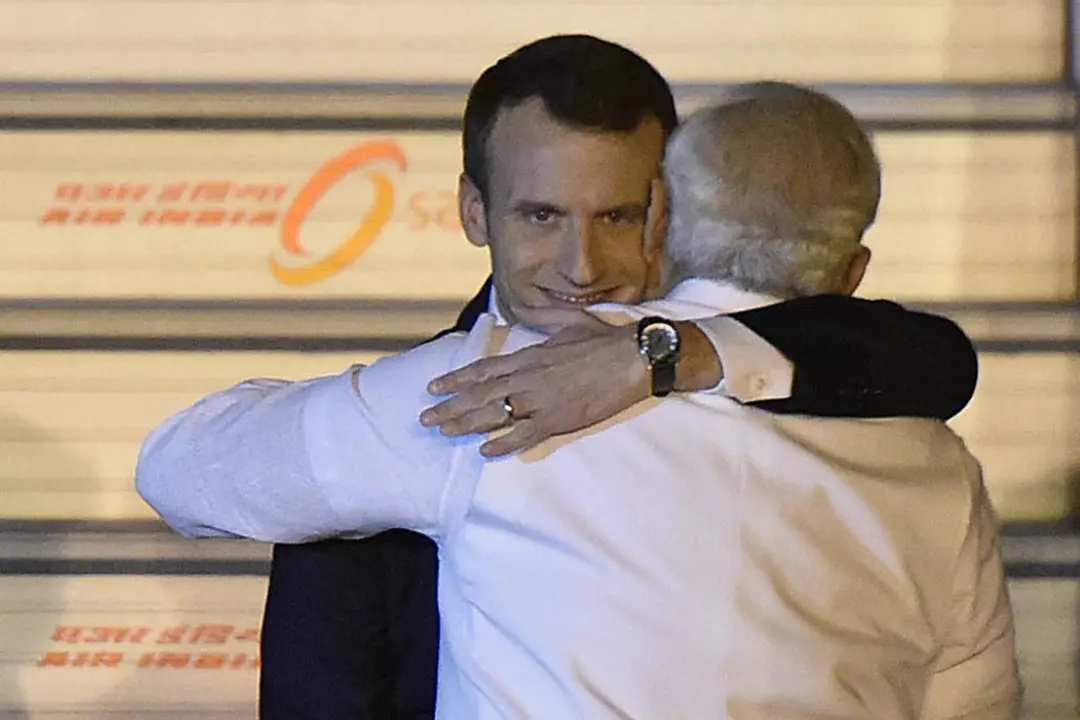
[Modi embracing a calculating French President Emmanuel Macron]
The stormy after-effects of the US war on Iran so far have slowed the oil and LNG traffic from the Gulf to a crawl, decelerated the country’s exports and the economy, and disrupted global trade. The exchange rate hit the Rs 100 to a single US$ mark, and Rs 100 is also, what a newspaper headline a few days ago screamed, the cost of a litre of petrol had exceeded. The conservation of hard currency reserves being the government’s primary concern, Prime Minister Narendra Modi, looking sombre, advised the people the week before last to abjure foreign trips, conserve gasoline, and to return to the frugality of the restrictive COVID regimen of working at least two days of the week from home. BJP chief ministers promptly took to public transport with media contingents recording such gestures at economising, and the traffic visibly thinned on the roads.
The country seems to be heading into dire economic straits, with plunging indices. As one of the largest imports consuming countries in the world, its hard currency reserves of some $689 billion (as of end-May) are depleting fast, but just sufficient, other than debt servicing, for less than 10 months of imports at the current rate of consumption of everything ranging from capital and consumer goods to energy. Worse, net Foreign Direct Investment that the government had hoped to ride to good times plummeted by 96% in just one year, from $10 billion in 2024 to $353 million last year, compelling Delhi to make nice with arch enemy China, and to ease the flow of predatory Chinese capital into the country. So, even as China screws India economically, militarily, and diplomatically, India has to grin and bear it! To salt the wounds, Nature too is playing hookey — the Monsoons are expected to be off by 60%, meaning by end-2026, the country could be on the ropes, food-wise as well. And by 2027, with catchment areas running low, water rationing?
In this desperate situation just when the people are getting down to the familiar belt-tightening measures, what are the government’s priorities? There are the anomalous announcements by the government of two starkly wasteful defence deals worth $53 billion. Of this sum the Dassault Company of France is pocketing $43 billion for 114 obsolete 4.5 generation Rafale fighter aircraft (that by this combat plane’s end-phase could end up costing the country upwards of $100 billion at current value), and the German firm Thyssen-Krupp Marine Systems (TKMS) another $10 billion for six HDW 214NG diesel submarines — the de-rated export version of the advanced HDW 212 in service with the Kriegsmarine (German navy). And the Indian army not be left behind has underway a huge T-72 modernisation programme!
The difference is while Dassault has refused to part with sensitive source codes, the Indian government has said it’d be satisfied minimally with just the ability to integrate Indian designed weapons and avionics encased in the Interface Control Document (ICD). The ICD manages the communications between sensors, weapons, Electronic warfare and other on-board packages. But the French refuse to transfer even this, knowing fully well that the IAF, longtime on their hook, will prevail with the Modi government, and they’ll have India buy the Rafale with no pretence at tech transfer. Meaning, the threats issued by the defence ministry that without the ICD Delhi would walk away from the deal, are fake, all noora kushti! And that Modi is going to hand France the sort of monies it needs to invest in the development of its 6th generation aircraft (Système de Combat Aérien du Futur). (The programme to produce such an aircraft jointly with Germany and Spain, has fallen through because of the French reluctance to share source codes. So at least, Paris is consistent!)
Germany has agreed to transfer all technology of the HDW 214 for the ironically named Project 75India, because there will be nothing Indian in it! Indeed, the French Naval Group that had competed for this same deal, offering a slightly advanced variant of the Scorpene already in the Indian fleet, was upset with TKMS for agreeing to offer India the source codes, arguing that this would only set up another competitor (like TKMS did with South Korea and Turkey)! But Original Equipment manufacturers need not worry, this is the Indian miltary they are dealing with — they will talk atmnirbharta all the government wants but when it comes to putting down money, they will jump at any rinky-dink item any Western firm produces, and it is the Indian government they are dealing with, which believes in subsidising innovation in foreign countries and upkeeping Western defence industries, and not in backing Indian talent and industry! That’s atmnirbharta in practice.
The problem is these defence purchases, especially of the Rafale is problematic in the main because manned aircraft are, modern warfare-wise, already EXTINCT. Surely, the Indian air force, navy and army are not unaware of the lessons from their very own Op Sindoor experience a year ago when it was proved beyond contention that it is the system (defensive in India’s case, and offensive in Pakistan’s) that matters, NOT the weapons platform. The outcomes of the Brahmos supersonic cruise missiles hitting targets in Pakistan on May 7 would have been the same with Tejas firing it rather than the immensely more expensive Rafale or Mirage 2000. For God’s sake, an escorted Airbus A320 rigged up to trigger a Brahmos from well within Indian territory would have had the same results! And it was the integrated Indian air defence system of radars and SAMs of varying range and anti-aircraft guns that on May 7-9 kept out Pakistani missiles. And it was the arrangement — the system — of the Pakistani JC-10 operating in radio silence, firing the Chinese P-15Es A2A missiles from within home airspace and directed to targets by the Swedish Erieye airborne warning and control system that surprised and shot down, sequentially, an IAF Rafale, MiG 29, and Su-30MKI. These aspects were mentioned in my blog posts from that time.
But if their own experience counts for nothing, perhaps, the Indian armed services can pick-up pointers from the war in Ukraine. Ukrainian drone and autonomous weapons systems are playing havoc with the Russian forces in the Donbas region. The cheap, compact but lethal Ukrainian drones brought the mighty Russian army’s mechanised/armoured columns to a grinding halt, compelled Moscow to ground its frontal aviation, even damaging/destroying a third of the Russian strategic air force — some thirteen Tu-22M3 bombers parked on the flight lines in widely separated bases, with daring day-time raids (on youtube for all to see!), and sank several major surface combatants, including the flagship, Moskva, and a conventional submarine anchored in Sevastopol, such that now the Russian Black Sea Fleet survives only in name.
Nearer home, a tough and resolute Iran absorbed all that the US threw at it and then proceeded to have its way in the Hormuz in the face of a stalled American military effort. It is attacks by the Iranian Shahed-136 drones and long range missiles hitting Saudi refineries and the main LNG processing plant in Qatar, that led to the regional oil economies shutting down and the Gulf states pressuring the US to end the fight. To add insult to American injury, the most advanced US nuclear powered aircraft carrier, Gerald Ford, stationed off Israel, was hit by Iranian missiles and quickly retreated to the safety of Greece or some such faraway place, off-theatre, for “repairs”.
And, by way of hard currency outgo, there’s the $500 billion worth of goods Modi-Jaishankar have agreed to buy from the US — a promise the visiting US Secretary of State Marco Rubio extracted from them last week. Of course, international economics doesn’t work this way, but just add the costs of the Rafale and TKMS contracts plus $500 billion in buying something, anything from the US, and soon India’s reserves will look like Pakistan’s.
In the context of a sinking Indian economy and a generally bad international political scene that Delhi apparently is unable to get a handle on, the Modi regime has nowhere explained why the country is being thus beggared, why such extraordinary expenditures on Rafale and HDW 214 are considered necessary, and why the IAF and Indian navy are being indulged when more economical, indigenous, alternatives are available and known to the Defence Ministry (and detailed in my books and writings, and in posts on this blog).
What can India do with the $53 billion that will be saved by junking the Rafale and HDW deals?
So, one more time, I will outline the alternatives that will spur defence industrial growth in the country and ought to be the solution. Rather than peddling license-produced products to the Global South, with this solution defence minister Rajnath Singh will be in a postion soon to crow about genuinely Indian designed and produced armaments and weaponry in foreign militaries.
Rafale is entirely redundant to need, and India and the IAF would be better off without it. If aircraft are mere launchers of weapons from safe, standoff range — which in truth is all that manned aircraft my be called on to do in the future, then Tejas — exactly the same 4.5 generation aircraft as the exorbitantly-priced Rafale, is fine. It may be prudent, however, to accelerate the manufacture of Tejas Marks 1A and 2 by asking the private sector firms tasked with producing the advanced medium combat aircraft (AMCA) to set up assemly lines to roll out the Tejas variants for IAF use and export. It will thus be an integrated programme to develop and showcase wholly indigenous aerospace talent and technologies for incorporation into drones of all types for all aerial missions, and into space-based systems (for sub-orbital warfare, for instance).
But this won’t happen.
In the event, the inescapable conclusion is that IAF and those in the government supporting the Rafale deal are doing so with the intent to kill off the Tejas-AMCA line, as they did in the mid-1970s when they approved buying the British Jaguar aircraft and finished off the home-grown HF-71/72 multi-role combat aircraft. Because where’s the money to payoff foreign companies and financially support Tejas and AMCA? The Jaguar deal was struck during the Morarji Desai-led Janata Party interregnum (following Indira Gandhi’s Emergency) and the commissions and the loot in train were parceled out to everyone in the procurement loop, a major portion of it going to the then defence minister, Jagjivan Ram (proof of which was published, incidentally, in the Surya magazine edited by Maneka Gandhi, presently the BJP MP from Sultanpur!)
And because DRDO and DPSUs have proven limitations — inefficient, ineffective, low labour productivity and with a long record of bringing NO project they undertake in on time and within cost, it is time for a profusion of new companies manned by young and eager tech innovators to be given the opportunity to lead the design and development efforts and for the private sector majors (Tata, L&T, Godrej Aerospace, Mahindra Aerospace, Bharat Forge, et al) to compete on a commercial-penalty basis with the DPSUs to manufacture the new, freshly Indian designed armaments incorporating every new technology our innovators can think up, and realise. That way lies “MADE in India” and a true atmnirbhar Bharat.
Re: HDW 214. Yes, Indian submariners exult at the metallurgy and structural engineering that permitted the HDW 209 in service still to pull off steep dives and quick ascents from the depths without a creak! But that was in the 1990s. Today, L&T can produce micron tolerances to weld together titanium double-hulled nuclear-powered ballistic missile firing submarines (SSBNs). In fact, it is precisely such capabilities that make nonsense of the navy’s claim that India’s hand needs to be held by Germans in Project 75i. To repeat for the umpteenth time, the preferred course should be for the navy to just buy the design for the HDW 214, and certain select technologies, like optronic masts, etc. from anywhere — tech the country lacks. L&T has the capacity to convert a design into an engineering plan and proceed with the project. According to industry sources, India could buy the HDW 214 design for a mere Rs 500 cr instead of coughing up Rs 70,000 cr for the entire package, when most of the technologies in it are already in the country. Further, the NG (New Generation) in the name is there because of the German Air Independent Propulsion (AIP) system for longer endurance. Except the AIP system designed by DRDO and jointly developed with L&T and already successfully shore-tested, is actually in the same timeframe per estimated use schedule as the German one that will be affixed on the 214. Meaning, an Indian sub could go out to sea with the indigenous AIP system in the time the HDW 214 begins its production run here. Buying the whole German package means India buying technology the country already possesses, as already stated. Does that make sense? With respect to the select technologies, secure it from foreign vendors, but this time begin by reverse engineering these items right away. Contract upcoming engineering firms for the reverse engineering tasks.
Is it anybody’s case that L&T cannot weld together technology-wise the far simpler conventional sub when it is producing the immensely more complex SSBN systems at a clip? How come so straightforward and obvious a take on indigenous tech-industrial capability is not evident to the Indian Navy or, worryingly, the Indian Defence Ministry and the Indian government????
And, in any case, how is the above path not preferable to India, in fact, remaining a perennial arms dependency?


.@BharatKarnad, Professor, china has already introduced two decrees (834 & 835), especially no. 834, which is violent for Indian assemblers to screw driving anything which they were usually bringing the parts from China and assemble it in India.
https://www.ndtv.com/business-news/chinas-new-export-curbs-threaten-india-electronics-manufacturing-global-supply-chain-11543822
Main problem is our so-called imperial education system, which is producing no skills in the market and nowadays, it is also been observed that IIT graduates are doing worthless UPSC for “job security” for becoming some over-glorified clerk for government.
You had already suggested that private firms like Tata, Adani, L&T, Mahindra will produce fighter aircraft and upcoming project to get rid of dependence on western obsolete tech which is being provided in billions of dollars, Adani is still producing or screwdriving Israeli made harop drones, which we have already seen action in OP sindoor (where are locally produced Rustom, archer, Tapas?) but addressing elephant in the room,
Dr. karnad, my question is that “will GOI buy anything from our private firms apart from screwdriving foreign products” as mentioned above because these private industries are still but the not most are plaguing with the same issues as talent and skill problem and secondly, most important is production line. Nobody will be investing a huge amount for getting none or negliable orders from GOI, army, navy and especially our beloved IAF. They don’t even have confidence to buy even our own product like Tejas (which is going down like HF-24 Marut’s way) and these above fellows are very much exult to procure 4.5 gen Rafale from french without any source code. {now it’s confirmed that GOI and IAF are preparing last rites for Tejas}.
I am not sure when or what will induce GOI and our military to cut the arms umbilical
Sir what is the way forward? A distinct pattern has emerged: we pursue capable platforms relevant to current requirements through baby steps, but by the time these platforms are finally realized, they rarely offer a decisive strategic advantage. Our current R&D expenditure stands at just 0.64% of GDP. In contrast, when China was a $4.5 trillion economy, it was already investing 1.6% of its GDP into R&D. Furthermore, while leading global economies maintain a 70:30 private-to-public R&D spending ratio,here in India it is complete opposite. Indian corporations largely fail to treat R&D as a critical future investment. Without comprehensive structural reforms heading into the 2030s, we will remain caught in a cycle of chasing contemporary technology while the rest of the world moves on to next generation.
There’s also the problem of just when an indigenous product is coming on stream, foreign suppliers who had until then barred the export of that technology, suddenly rush in with their items which then are procured. It is an active disincentive to Indian innovators and capitalists. I pointed this out in my 2015 book Why India is Not a Great Power (Yet)
@BharatKarnad
Why not just ban imports? This radical step will put an end to the whole damn issue. Then start mass auditing the ministry of defence, the Black hole of Indian finances.
Immediate arms import stoppage is what I have long advocated. It will push the country into making its own. As we did with missiles and nuclear weapons
The idea that a Western AEW&C (Swedish Saab Erieye) can seamlessly “quarterback” a Chinese fighter (J-10CE) and a Chinese Beyond Visual Range (BVR) missile (PL-15E) while the fighter maintains total radio silence is technically contradictory, the data transfer and encryptions are way off for each of them.
Link-17 is a solid tool for giving Pakistani pilots a localized common operating picture. But the idea of a Swedish radar directly guiding a Chinese missile off a silent Chinese jet reads like a techno-thriller, not an engineering reality.
This may be a technical mystery. But the three elements in this episode worked as they did.
Professor the world is moving towards unmanned 6th gen fighter jets with US and China on the cusp of developing them – don’t you think spending resources and time on the manned AMCA project now is a boondoggle? The 5th gen bus has already left instead we skip AMCA completely and focus on an unmanned 6th gen fighter jet, we have already developed a Ghatak UCAV prototype surely that must help.
Absolutely, yes. Hence I wrote in the post: “It will thus be an integrated programme to develop and showcase wholly indigenous aerospace talent and technologies for incorporation into drones of all types for all aerial missions, and into space-based systems (for sub-orbital warfare, for instance).”
Sir, where does India stand in the domain of cyber warfare and offensive software capabilities? Agencies like CIA have developed soft wares such as weeping angel – capable of remotely controlling cars and turning tv speakers into microphones, Israel has technologies like Pegasus, Lavender, and the infamous Stuxnet which altered the rotation of Iranian nuclear centrifuges making their products useless. Given that India has one of the world’s largest IT industries and produces a vast number of CS graduates, how do our cyber capabilities compare on the global stage?
I haven’t heard of any such programme but that doesn’t mean it is not there. Comparing cyber warfare capabilities, I’d safely guess India is not in that league
Wikileaks: CIA has tools to snoop via TVs
Stuxnet: The world’s first cyber weapon
Pegasus
Off topic but do you think after Israel is done with Iran Pakistan is next in line? Is that necessarily a good thing – having foreign powers in our neighborhood and using India as a launchpad?
There are no good solutions for the Pakistan problem. The best I could come up with is in my writings — be punitive on terrorism, but otherwise incentivise the Pakistan army to make peace and partake of a South Asia co-prosperity sphere!
What about promoting and funding rebel movements in Afghania, Sindh and Balochistan once these fighters stablish footholds there – we highlight the ill treatment of these minorities globally like how West does with Iran and India too. And then influence their media(specially social media) and present to the common public of these regions – Baloch, Sindhis and Pashtuns why Iran, India and Afghanistan respectively are a better choice for them – A page out of the British/American book.
I suspect GOI may be doing some of this
Very low probability unless the entire system is overhauled and a new generation of officers, graduating from institutions like Indian Military Academy and Officers Training Academy, rises to senior leadership positions with a stronger hard-power mindset. Even the training at IMA and OTA should be reviewed. A more assertive strategic posture, where India sees itself as a power capable of operating beyond its immediate borders when necessary, should be encouraged. The notion that India should never think in terms of power projection needs to be re-examined.
This becomes even more important in the current environment(Iran conflict), where India often struggles to influence events affecting its core interests. I do not necessarily mean deploying armed forces abroad, but rather studying, developing, and building the capabilities required for expeditionary operations, strategic reach, and power projection when circumstances demand it.
There should also be a serious audit of land holdings and assets owned by senior bureaucrats, military officials, and retired generals. Accountability must be visible, and where wrongdoing is proven, examples should be made through lawful action.
For starters, the government can accelerate the digitization of land records. Land and real estate remain among the largest repositories of undeclared wealth and opaque financial activity, and greater transparency would help improve accountability.
Mr. Karnad
governments/armed forces around the world take certain decisions on certain direction of their defense industry which will never a have a sound logic . examples are physicist such as Hsu and professor Postol have argued that missile defense are not as effective as they claim yet armed forces around the world try to acquire theses systems at exorbitant cost. We have already witnessed this in the recent Iran war. So in this trend India is not really special.
As for your previous arguments in your past writings for Pakistan being co-opted or incentivized , I am not sure this would be effective or the country wants to be co-opted by India . if this were to be the case then US could have co-opted Cuba or Venezuela decades ago without having to resort to other measures or for that matter China would have co-opted India as it is 5 times bigger than India in economic power.
I suppose the best solution for the Pakistan /Bangladesh nuisance is the difficult and extremely violent Chechen solution that the Russian army undertook but is Indian society really ready for making huge sacrifices and fight a dirty/nasty war with violating every level of human rights in these wars ? I am not so sure at this stage..
PS: As much as Ukraine is putting up a heroic defense with drones, the ground reality is that Russian army is wiping out their bloodlines and with Ukraine having a much lower population , any kind “so called victory” at best would be a pyrrhic victory for Ukraine ..
I am also sure that money should not be wasted on air defence. Pakistan is a nothing burger. Against China our AD will not stand. Re: cooptation — we haven’t tried it. Moreover, deal with the Pakistan army, not the transient politicoes who do not matter. Have advocated buying whatever the companies owned by Pak military produce — that’s a powerful incentive China cannot counter. In the past, We bought sugar from Mian Nawaz’s sugar mills, and it worked!
Buying what the Pak Army produces is a really interesting strategy . Like buying Fertilizer, Cement, Food Products from Fauji Foundation. Possibly even invest in the real estate projects that have military links.
Prof Karnad
Do you think the Shahed drones compare favorably with what India has? IAI Herons, Ghataks and the ilk?
They have fought toe to toe with whatever the American military threw at them, whixh isna commendable performance.
As good
@BharatKarnad sir , since now India is going to export bhramos to Vietnam now, though late but don’t you think our leadership is going in right direction but with less risk and assertiveness for national interest like the Chinese do.
Even if we are spending alot on missiles and radars , what about intelligence, what the solution to the recent Pakistan’s development of underground pathways like the Iranian has? Aren’t these poses threat as Pak feared our precision strike and deterrence to terrorist camp, but with underground pathways we lose this advantage, so even if china should be major concern , how to establish ourselves to chip off these miniature and pinchful acts of Pak..?
Well, excavating tunnels deep underground, etc costs a lot of money. Pakistan can afford only small bits of it to store its nuclear missiles.
Timing of this your post coincides with the announcement of possible more US tariffs. Begs the question, how long can India or any nation tie their fortunes to a master who makes them dance to his will?
The US wasn’t this brazen before, or at least didn’t appear this way publicly. Trump-2 definitely has put brakes on India’s good times with the US. If this aint a wake up call, then there will never be one again.
Begs the question, should there be a rethink on the very structure of the Defence framework and the institutional decision-making bodies?
This is India’s real growth story;
https://www.indiatoday.in/business/story/before-sebi-order-rajesh-exports-already-raised-eyebrows-for-years-fraud-corporate-inflated-revenue-2922356-2026-06-05
Comments by the readers explain the whole game;
989XXXX954 Today Why Godi portraying this as a great achievement of SEBI? This guy Rajesh is found in photograph with Mr Modi, when he was not even CM of Gujarat. LIC, which is a government institution have invested 10% of its money in this company. The fraud amount of 15 lakh crores is 1/3(one-third ) of the total Indias export. So even India’s export which is shown as 40+ lakh crores is actually less than 25lakh crores. So now try to understand the bigger picture. The friendship help to get investment from LIC, and with that no one this fraud company purchase other bigger company…he made his money and will disappear because his friend is in control of everything in the centre. Godi report the real truth and exposes the real culprits
Vinayak Today @989XXXX954 : Good point . If this company’s export numbers are fudged that means India’s merchandise exports have also been inflated over a 5 yr period . We can only wonder how many other companies are involved in similar activities . We must also keep in mind there was a sudden spike in merchandise exports after covid , most of it may not have been genuine.
Professor
with daily night time skirmishes , Americans have created a lebanon like situation with Iran where low level hits are being made routinely, the fire threshold has been brought down, It doesn’t seem they plan on going away as you suggested in last few articles.
professor assuming us with japan south korea get involved in a war against china over taiwan. What role can india play? Should we send troops??
No
Greetings professor.
I am preparing for the civil services with the goal of joining of IFS. I hope you are aware of the absolute joke of a paper the prelims this year was!!
And on top of this, when I hear diplomats like Raghavan sir, I see a defeatist attitude when he says that ‘We can’t change our neighborhood’. Well, we can geostrategically rebalance it like all powers do. Example, US geo strategically rebalanced south America by doing absolute resolve. We are not a pole today only because of the things we don’t do. We simply REFUSE TO PUNCH OUR WEIGHT.
For instance, why are we trying to diplomatically engage Mayanmar? The country is in the middle of a civil war and is now a chinese vassal state which only contributes to destabilize north east. Isn’t it a military problem now? Pakistan I understand can be co opted. But Mayanmar I don’t think so.
My question is this. Is it still worth preparing for the exam? When all I have to do is REBALANCE relationship with the Chinese( over Bharat’s national pride) and tow the American line, what’s the point?
Pleaze guide me sir. I really want to know.
Thanks and regards,
Jai Hind!!
Judgement call! Make it!
Dear Dr Karnad, In North and East Asia, there are four nations who are willing to fight for greater glory and national rejuvenation. These are Japan, Vietnam and the two Koreas. Japan is the common enemy of all these three countries countries considering she tried to conquer and colonize all these three countries during the Second World War. Can somehow Vietnam after purchasing Brahmos from India be able to deter Japanese mighty military? Whom should India support in a future possible conflict between Japan and Vietnam ?
Vietnamese Brahmos are vs China
@Professor Karnad- Vietnamese economy is heavily interwoven with the Chinese one. Loads of Chinese have moved their factories there primarily due to cheap labor in Vietnam as compared to China secondly to escape the ‘Made in China’ tariffs from the Western block.
Vietnamese establishment has even removed the reference to the 1979 war with China from the school text books there.
Vietnam will never confront China militarily.
Dear Dr Karnad, Japan is re-arming but to reach China they would have to face the Koreans (both of them maybe but North in particular). Vietnamese will not be far behind as everyone fears and hates the Japanese mighty military in that part of the world. Vietnamese people hate and resent the Japanese most because of Japanese colonialism. Who you will between here ?
Where’s the need to choose?
@BharatKarnad Professor, I wouldn’t be surprised if the French develop an Airbus Military Transport Aircraft specifically for transporting ‘NEET – UG’ question papers. And the MoD wholeheartedly going ahead with the purchase
Haha
Professor
Seeing the strikes that iran has been making for the last week, Why is it leaving out UAE and Saudi this time and striking other nations.
Saudi A and UAE were hit the first time around. This time it is widening the target sets in the region to emphasize their equal vulnerability
Professor, one question itching me :
Is Washington executing a Modern Monroe Doctrine pulling major military strength back to the Western Hemisphere while outsourcing regional dominance to allied powerhouses? We see this in their current push to install Israel as the Middle East enforcer.
If this strategy holds, what is the next target zone, and who are the candidate powerhouses Washington will try to set up in other regions?
Yes. Though Israel is too small to hold the fort