
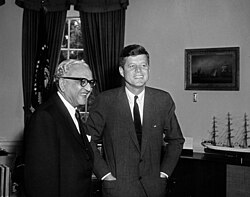
[MC Chagla with Senator John F Kennedy, likely 1958-59]
Today’s Hindustan Times story about the appointment of the BJP politician Dinesh Trivedi as High Commissioner to Bangladesh mentioned several interesting things of import to the conduct of Indian foreign policy in the future. It “sends a message of accountability” to Foreign Service officers, the report said, adding that Trivedi’s is only the first of such postings of “heavy weights to the neighbourhood”, indicating that “the era of an ambassador for good times is over”.
It is hard to read this story and not see it as a severe indictment of the Indian Foreign Service (IFS), whose members, per this report, are manifestly not political or otherwise “heavyweights”, act as if not “accountable” to the political executive, and are in a diplomatic career mostly for “the good times”, in other words, to make whoopee!
But first the man: Trivedi is a workaday politician — of no great stature or accomplishment. But he was useful to the ruling party because of his past connections to Chief Minister Mamata Bannerjee’s Trinamul Congress in West Bengal, and appointing him was a way of needling her. Met Trivedi once at a usual Delhi dinner party and all I heard, when I was within earshot, was of his glorious achievements as Railways Minister in Manmohan Singh’s government, when actually his greater success lies in jumping from party to political party, being yet another “Aaya Ram, Gaya Ram” of Indian politics. He doubtless speaks Bangla bhasha, and has an appetite for Hilsa fish to match. But that’s not why Indian diplomacy may be looking up!
Trivedi’s prospective High Commissionership suggests the Modi dispensation is finally becoming more imaginative in its diplomatic outlook and practice. It was reported somewhere that the veteran journalist, M.J. Akbar, was also in the running for this job. It’s a pity he didn’t make it. As a dyed-in-the-wool Bihari, an eloquent Bangla speaker, and an ardent Indian nationalist, Akbar would have opened up lines of communications among other sections of the Bangladeshi society, to the mostly Bihar-origin Muslims labelled “Pakistani” — victims of a double Partition, who eke out an existence on the margins, and would have made for a more effective plenipotentiary. You never know whom India might need in a crisis on our eastern flank!
I venture the view, entirely without evidence, that this positive turn in Indian diplomatic method happened despite, and not because, of a retired Foreign Secretary as External Affairs Minister (EAM).
But this is not so much an innovation as a return to the early days after Independence when Jawaharlal Nehru, Prime Minister and concurrently EAM, barring the nepotistic appointments of his sister Vijayalakshmi Pandit as ambassador successively in Washington, London, and Moscow, none of the public figures heading the embassy in Washington, MC Chagla during Nehru’s time, and later Nani Palkivala during the Morarji interregnum apart, were particularly distinguished or shone as India’s representative. But Nehru established the principle of Indian diplomatic presence in major countries being helmed by political appointees. However, he failed to sustain this policy because the first Director-General of the Ministry of External Affairs (MEA), Girija Shankar Bajpai, prevailed on the Prime Minister to permit ICS/IFS to occupy the ambassadorial posts.
Political appointees are politically connected and personally known to the Prime Minister appointing them, as career diplomats are not. This makes a difference in how and with what commitment the PM’s agenda is furthered — something careerist diplomats schooled in hierarchical interaction and bureaucratic processes, cannot do. This is, perhaps, what is referred to in the news story as lack of “accountability” of the IFS. The political appointee knows that his job is co-terminus with the PM’s — a tremendous incentive to realise as much of the PM’s policy as possible in as small a period of time as possible.
The careerist, however, feels no urgency because the next posting awaits, may be as, Foreign Secretary! Jaishankar did it! Of late, this direction has been reversed; the trend now being to install a retiring Foreign Secretary as ambassador in Washington. Presently, Vinay Kwatra is holding fort who, the talk is, will be replaced by his successor and current FS, Vikram Misri. But if Kwatra has apparently disappointed because he was unable to trigger a Trump rapprochement with Modi, can Misri be expected to fare any better? After all, what inducements can be offered a person who made it to FS, and then ambassador to the US to excel? And more, it is not as if any careerist IFS officer has any intimate knowledge or familiarity of the social milieu he is operating in, in Washington, or that the Indian ambassador has any special reach to the top echelons of the “plum book” political appointees in any given Administration. And there’s the rub!
On the other hand, a Chagla or a Palivala did have a social reach into the American policy Establishment, into the rarefied Georgetown circles. The IFS man, KS Bajpai, in the mid-1980s did to an extent too because he successfully mined his schoolboy past in the elite St Alban’s school in Washington when his father, Girija Shankar Bajpai, of the Indian Civil Service (ICS), was Churchill’s “political agent” in the wartime Washington of the 1940s and, as such, advanced the British PM’s agenda of blunting the pressure by US President Franklin Roosevelt on London to immediately confer independence on India. Roosevelt felt that an independent India would more enthusiastically partake of the Allied war effort. In the event, Churchill, thanks to Bajpai, won out!
Not to go into that controversial part of MEA history (which is detailed in the book I am writing), but in major Indian embassies, this is the score of political appointees as ambassadors compared to ICS/IFS types who have hogged all significant ambassadorial posts. In the US, of the 29 Indian ambassadors so far, only 7 were non-careerists; in the Soviet Union/Russia of the 25 ambassadors, only 6; in China of the 27, only 2; in the UK of the 30 High Commisioners, 12; in France all ambassadors were ICS/IFS; and of the 27 High Commissioners/Chargé d’affaires to-date in Pakistan only 2-3 were non-careerists.
No country has proven the positives of political appointees as ambassadors than the United States. Of the 37 US ambassadors/Chargé d’affaires in Delhi since April 1947, 18 were/are political appointees. Notable among them being Chester Bowles, Congressman & Governor of Connecticut; Sherman Cooper — US senator; Ellsworth Bunker, businessman & US President Truman’s confidante; the economist John Kenneth Galbraith and the sociologist, Daniel Moynihan, both Harvard professors; Kenneth Keating US Senator; William Saxbe US Attorney General; Robert Goheen president of Princeton University; John Hubbard, president of the University of Southern California, Frank Celeste, Governor of Ohio, Robert Blackwill Senior adviser to President George W Bush, David Mulford — investment banker and international president of Credit Suisse, Tim Roemer Member of the 9/11 Commission, Richard Verma, assistant secretary of state, Kevin Juster, international head of global investment firm Warburg Pincus, Eric Garcetti – Mayor of Los Angeles (2nd largest city in the US), and now, Sergei Gore — senior adviser to President Trump.
Little wonder the Indian government has been awed, even overwhelmed when dealing with such politically well connected US ambassadors, and why America has always had an out-sized impact and influence on Indian foreign policy and the government’s decisionmaking generally! Because as political appointees they can and often do make end-runs around the US State Department, and speed things up by talking directly with the US President.
It was because politial appointees are in a position to get things done with access to the boss back home in mind that I recall pleading with political bigwigs in Delhi in the 1980s for the appointment of Nusli Wadia as the Indian ambassador to Washington. The Pakistani embassy in the US then, as always, had success with its narrative, what with its special line to the Pentagon and the White House. Islamabad profited hugely from trumpeting, among other things, the alleged mistreatment by the Indian government of the Muslim minority in the country, etc.
My point simply was this: Appoint Nusli Wadia, head of Bombay Dyeing Company and, incidentally, the grandson of the founder of Pakistan, Mohammad Ali Jinnah, as the Indian ambassador in Washington, and instantly see the Pakistani embassy shrink and the ambassador shut up. Wadia installed in the embassy at Massachusetts Avenue would have dampened the Pakistan embassy’s ardour for creating a ruckus, affording India the diplomatic edge it has never had in dealings with the US.
Naturally, my pleas went in one ear and out the other!


 Security Wise
professor I don’t agree with this. I have realized that russia china and usa are not great powers. They are great HEGEMONS. And each of them talk about idealogy just to keep the rest of the world brainwashed. And their foreign policy is decided by their military commanders. and economic power.
usa- freedom , human rights, manifest destiny
russia- indivisible security,
china- indivisible security(to keep american influence out of asia) one china policy
india will not gain anything even if there is trump rapprochement with modi. China has dettered usa in Asia pacific. And trump is imperialist not transactionist.
the thing is russia usa china are in a race to the bottom.
@Abc- The world was, is and never will be conflict free. As the dialogue in Matrix part-1 movie goes, “You humans are a virus and destroy everything”
Our species cannot co-exist peacefully. Example- Hitler almost exterminated the Jewish race during the Second World War yet, Jews instead of being emphatic towards Palestinians are committing all sorts of atrocities on them.
GOI should appoint you Sir, as the Indian ambassador to China. A Chinese once mentioned to me that its’s good for us that Indian government doesn’t implement the suggestions of Mr. Karnad.
Good Morning sir,
You mentioned two criteria for success of ambassador- 1. connect with his leader and 2. Contacts in the country of assignment.
Which is more important among the two?
I ask because I sometimes think if we can appoint Subramanian Swamy in the US mission (his contacts in USA are of no match); but he may not fulfill the other criteria (connect with the leader)
Professor Karnad please check this out;
https://www.indiatoday.in/world/us-news/story/american-scientists-disappearance-death-national-security-concerns-fbi-probe-nasa-2899215-2026-04-21
CIA is notorious for carrying out assassinations globally. Seems the shoe is on the other foot now. Who do you think can be behind these so called mysterious deaths?
Professor, there’s been a noticeable cluster of industrial accidents worldwide in a short span:
Given how closely these events have occurred, do you think it’s possible they could be orchestrated, if yes then by whom?
Look, you can find a pattern anywhere and a conspiracy everywhere.
I doubt if it is an orchestrated series of events
The Korean Air Force applied the Accounting Officials Responsibility Act, which holds officials accountable for property damage caused by intentional or grossly negligent acts, and ordered Senior Lieutenant A to compensate 878.71 million Korean won.
Can we expect this kind of accountability in India?
In our dreams!
Appointing Mr. Wadia would have been a brilliant move! Even from the point of view of improvement in US-India trade links, who knows. Why are we so not strategic?
should modi have voiced concern after trump shooting recently? Your opinion?
No
professor you said modi called you for consultation in 2014. Had you said him to increase govt investment in education and research and development?
Even the Qing dynasty were not advanced but they did not surrender without a fight. Why is modi govt hell bent on doing such thing?
Alas, no. I focused on China as primary and permanent geopolitical adversary, Pakistan as nuisance, the US as unreliable and untrustworthy partner, and Russia as a forthcoming but fitful friend.
you have contacts in the govt I believe now. Can’t you say today?? Even after trump shock there has been no hint of atmnirbharta since the last year?
One can only speculate why this is so.
Professor,
Will coming world be more like cold war where china and usa will compete using proxies and all but no direct Kinetic action or it will be a more like pre 1914 multipolar world possibly seeing hot action between usa and china ( like happened between britain and germany)and probably world war 3 ?
No kinetic, like 1st Cold War
professor what strategic aspect does the russian federation sees in india that they help us so much which the Americans can’t see?
Landward China threat and access to the IO
another question. Does subramanian jaishankar understand the difference between geostrategy and geopolitics?
can we do a security arrangement with pakistan without solving the kashmir issue currently like the chinese did with us in the 1980s and 1990s border agreements without solving border issue?
No. Because Pakistan insists it is a ceasefire line. The reason why, I argued in my Sindoor posts, for a declared policy of gouging last parts of POK for acts of terror to bring home to GHQ, Rawalpindi, the cost of their so-called “strategy of a 1000 cuts”. And why, when on May 9th 2025 India had achieved air dominance, the Indian army should have swung into action with army units from Uri, Mandi, and Poonch, converging on and capturing the Haji Pir Salient with Special Forces cutting off the Pak army formations within the Bulge from the main field army outside of it by closing the cauldron on the north-south Uri-Poonch line. Instead, India immediately accepted a ceasefire Pakistan offered, which it had rejected when India offered the same after the cruise missile strikes on Muridke and Bahawalpur on May 7th!! And we are left hearing Defence Minister Rajnath Singh again and again say we stopped of our own volition — which was exactly the problem!
Professor looking back at the USA/Israel – Iran conflict is it possible to degrade the nuclear capabilities of a country to null so that it is practically considered a non-nuclear state, if yes then can such an operation, at least in theory be mounted on Pakistan by the GOI? After all in spite of the losses the IAF did gain air superiority in ops Sindoor.
professor should india use bio weapons by covert means in china if GOI not going for first use nuclear weapon doctrine? To what extent shall morality play role in national security?
NFU
Professor,
Is great Nicobar project realisation of our strait of hormuz?
We can do Hormuz even w/o the Nicobar consolidation
Okay! Then great Nicobar project is worth it or not in your opinion?
Of course, the Nicobar interdict needs beefing up
professor why is govt eyeing “partnership” for 6th gen fighter jet?? Does iaf even know difference between platforms(power projection) and capabilities(war fighting) We can’t even fix pakistan.
Who do you think has been the most strategic military expert of our country in GOI since independence??
Home J Bhabha — intiator of both the nuclear (weapons) programme and the missile programme. (For the latter, see my Nuclear Weapons & Nuclear Weapons).
Professor Karnad, is there truth to the “declassified CIA document” saying Raja Ramanna was the man who advised Mrs Gandhi not to take out Pak nuclear sites, referring to the aborted Indo-Israeli operation you have spoken frequently about? Ref: https://timesofindia.indiatimes.com/india/how-the-father-of-indian-n-bomb-stalled-strike-on-pak-nuclear-sites/articleshow/48765997.cms
Arihan Krishna, editor Lok Panchayat Magazine
As a colleague on the 1st NSAB, Ramanna conceded as much to me.
https://indianexpress.com/article/india/pakistan-navy-assists-indian-vessel-stranded-in-arabian-sea-provides-emergency-supplies-10673411/lite/
I’m not a naval expert but this sure sounds a bit embarassing. Great that Pak Navy came to rescue but I remember some Retd. Navy officer in one of the replies to your posts was proposing Indian Navy escort ships through Hormuz. It seems Indian Navy can’t even conduct missions in the Arabian sea, are we that afraid ?
professor your opinion on unrestricted warfare book of china. There were reports that hikvision cctv camera in india had backdrops for sending video to pakistan? Are chinese so shameless that instead of just giving military help they are using these things? How shall india tackle this?
China is into “unrestricted warfare” (see the book by this title by two senior PLA colonels)
then bioweapons should be used or developed by india
After oli , now nepal balen shah is also claiming lipulekh as Nepali territory. No government will back down on this claim . This much is clear now . What should india do ?
Professor,
In your writings, you have suggested that India should arm Vietnam with nuclear-tipped missiles as a payback to China arming Pakistan. While I agree with your reasoning but I believe that Japan would be a better strategic choice in this case, here’s why –
1.For the first time since World War II, Japan is moving away from its strictly pacifist stance under Article 9 and adopting a more proactive defense posture. Failing to engage Japan at this time would mean missing a rare strategic opportunity with a nation undergoing such transformation.
2. Japan is deeply embedded in the western camps and is widely regarded as a reliable partner by the US and its allies. Any nuclear cooperation involving Japan may be perceived with greater tolerance compared to other regional actors. Consequently, India may face a lower risk of reprisals or sanctions, especially given that some Western analysts including Kissinger have already anticipated Japan’s eventual nuclearization.
3. Japan is symbolically a better choice if the action is meant as a ‘payback’ to China for arming Pakistan. Given its historical role in China’s “century of humiliation”; closer military alignment between India and Japan would send a stronger geopolitical signal than a similar arrangement with Vietnam.
4.Japan has consistently been a key strategic partner for India, contributing significantly through technology transfers, infrastructure development, economic assistance etc. This established trust and cooperation arguably make Japan a more dependable partner.
5. I agree with your broader recommendation that India should help build a coalition of Asian rimland and offshore states to balance China’s influence. However, I believe Japan should play a central role in such a framework. What’s your take?
The argument I made in my 2018 book ‘Staggering Forward’ was to ride on the assassinated Shinzo Abe’s great love and regard for India into making his country India’s main strategic partner by building on his offer of the Shinmaywa U-2 flying boat tech. Delhi lacked the strategic sense then to capitalise on that offer, and still does.
after reading your 5 points I think you are saying india should put the fire but should take no responsibility 🤣
professor don’t you think we should give nukes to countries on china’s periphery after india gains conventional parity with china? After all border clashes with china increased after vajpayee said china is the reason for india’s nuclear test but did not do the right military reforms after that and then later GOI signed agreement US just to maintain minimal credible detterence against Pakistan. Why did vajpayee said it publicly?
Read my books!
Professor, do you believe the theory that Epstein had ties to Mossad and that prominent U.S. figures were compromised through visits to his island in a way that they could be exploited which resulted in US doing Israel’s bidding in Iran? Or are these narratives largely conspiracy theories?
Some truth, but mostly “conspiracy theories”!
Professor, given Pakistan’s development of low-yield nuclear weapons/tactical nukes in response to India’s “Cold Start” doctrine; if it were to deploy such weapons in wartime it would represent a major escalation and significantly heighten the risk of a full-scale nuclear confrontation, Professor, if Pakistan were to use nuclear weapons against an advancing Indian formation – even on its own territory would that effectively grant India a free hand to respond with nuclear weapons of its own of any magnitude, or could such an exchange remain confined within the so-called Indo-Pakistani sub-nuclear space and it would still not count as first use, since it was not on Indian territory?
what are you trying to question??
If Pakistan nukes it’s own territory to take out an Indian formation inside Pakistan, how would India respond?
Professor, What do you think about possible india germany project 75 I submarine deal with transfer of technology?
Refer my previous posts on Project 75i diesel sub