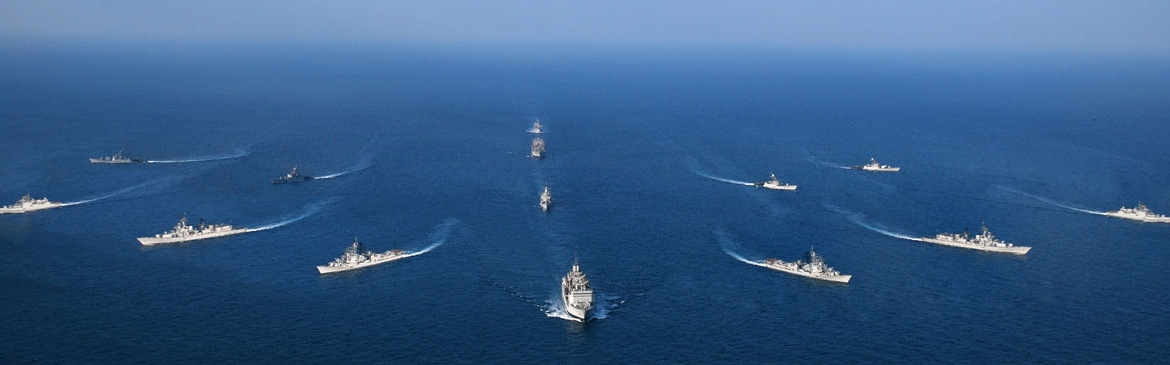
[Manoeuvring Indian warships]
Admiral Arun Prakash is among the more thoughtful military Chiefs of Staff the country has had. The other day he addressed the problem created by Iran asserting its leverage and setting up what’s virtually a toll booth in the Hormuz Strait. He posed the issue correctly, in an op-ed (“The strait of high stakes, where law and leverage collide”, Indian Express, April 11, 2026), as involving a clash between maritime history, convention and law supporting freedom of navigation (and hence international trade and commerce, etc.) and a coastal state’s imperative to close a strategic waterway in war and attendant crisis. Given the economic stakes for India — the potential pinching of its “jugular vein”, and its good relations with all the protagonists in this edition of the Gulf War — US, Israel, and Iran, he voiced his incomprehension at the Modi government avoiding a mediator role that Pakistan grabbed.
But, the good admiral shied away from tackling the harder issue about whether the Indian Navy would risk asserting the country’s maritime right to ply the Hormuz waters in defiance of Tehran’s closing it other than for a consideration ($2 million per vessel as transit fee) and, in the process, its ships possibly braving an Irani strike. Tactfully, he recommended “quiet diplomacy”, something right up S Jaishankar’s street!
Prakash’s view that India’s being in good standing with the three combatant powers somehow conferred on New Delhi the status of mediator is questionable. In the main because Bharat sarkar is yet to recover from the trauma of the US President Donald Trump gleefully and repeatedly rubbing Prime Minister Narendra Modi’s nose in the dirt (on Sindoor, as recently as three-four weeks ago) and otherwise displaying disdain for India (while Munir and Pakistan luxuriate in the praise that Trump and recently US Vice President JD Vance heaped on them for their peace efforts). And, more pertinently, because Pakistan’s diplomatic position as caretaker of Irani interests in America since 1979, to say nothing of the shared border, the Islam factor, and its close ties to China (which supplied Iran with arms and intelligence), had Islamabad in a better place anyway for mediation.
The Admiral’s op-ed appeared before Trump announced a US blockade of what is virtually an Iranian blockade! But the former development compounds India’s problem. It is clear though that Delhi does not think the Indian Navy is capable of running the US blockade and safely escorting Indian oil/LNG carriers through the Hormuz Narrows, or of risking engagements with either or both the US and Irani forces, because of the uncertainty over Indian movements being deemed “hostile passage”, reacting badly. This is a conclusion reached because any inclination on the part of the government to order Indian warships to escort Indian flagged vessels through the Strait proper — not as is being done to-date of escorting ships once they reach the open sea, would have been reflected in Prakash’s piece.
Trump, according to many, has painted himself and the US into a corner by imposing a blockade with some 26-odd warships and ancillaries — not enough for a leak-proof barrier. What isn’t clear is how stiffly or loosely the blockade will be conducted. But what is certain, given its past record of diffidence, is that Delhi will curl up deeper in its shell, and do nothing even as the energy and urea flows from the Gulf states and Iran — the lifelines for the Indian economy and agriculture, stay severed. Sure, MEA will have its people go off hither and yon, instruct its embassies everywhere to scour the diverse markets for any excess oil and fertiliser and, of course, such forays will meet with some success as New Delhi waggles $ under everyone’s noses.
In the context of institutionalised Indian inaction, it is curious CNS, Admiral Dinesh Tripathi, called a three day “apex level” conference starting yesterday involving naval theatre commanders and such, but to discuss what, exactly? News stories trumpeting the conference were opaque on this issue, with an Indian Navy statement that talked of this and that and a whole bunch of issues relating to the Service. The only relevant mention in it referred to the significance of the Meet “in the light of swift naval deployments to safeguard India’s energy security, amidst the ongoing conflict in West Asia with convergence of multi-national forces (MNFs) in the Indian Ocean Region.” It would appear from this that the FOCINCs are NOT mulling independent IN actions to force the two blockades — the seaward one by the US, and the landbased one by Iran, but rather seeking to join in some kind of MNF effort.
The collectivist approach as cover, I suspect, is the Modi government’s way of avoiding taking America or Iran head-on, and is based on the hope that China, perhaps, will take the lead, do the heavy lifting. Because unlike Delhi, Beijing has formally rejected the US blockade, asserting its right to trade independent of US restrictions with any country in the Gulf it pleases, including Iran. In effect, Xi Jinping is daring Trump to stop Chinese-flagged oilers mid-sea, have American sailors board the vessels, and sequester the vessels. As a former commander of the naval element in the US Central Command, Admiral John Miller, wondered if the US “would want to force that blockade against Indian and Chinese-flagged vessels, for example” especially if “they bring a warship as an escort [for protection because]”, he warned, that that would amount to a casus belli (cause for war) and America would be “into a different scenario”.
The Indian government’s standard risk-averse attitude, however, has ruled out the Indian Navy’s running the blockade solo, even though, as Miller indicated, it would have created a dilemma for the US Navy of getting tactically embroiled with its Indian counterpart. It cannot be that Modi and Jaishankar were unaware that India could have got away with running the US blockade because of what was at stake for Washington — the four foundational accords — GSOMIA, LEMOA, COMCASA and BECA the two countries signed that permit US forces to use Indian military bases and other resources, like on-shore provisioning and repair services, etc.
But the specific problem for India is this: Trump is politically damaged — always the butt of incessant public ridicule at home and abroad, he is now subjected to scorn and derision as well not least because Iran, despite a sustained US-Israeli aerial bombardment campaign that resulted in enormous destruction, remained unbowed and because, as a commentator said about the peace parleys in Islamabad, without winning the war, America cannot set the terms of peace. And Tehran’s standing up to him, moreover, has put him in a bind and thrashing around for some face saving way out. Trump’s mood cannot be any darker also because the man he modeled himself and his MAGA politics on, the autocratic Viktor Orban, lost his shirt in the general elections in Hungary.
It is precisely why a frustrated Trump could hit out, and the blockade is his gambit to show the world he can seriously unsettle it. On the other side, the Pasdaran-dominated Iran is just as determined to make the Hormuz energy traffic profitable. In this situation, Modi is relying on Jaishankar’s dormouse policy of giving offence to no one and attempting diplomatically to ease past the two blockades by negotiating free passage from both sides for its carriers. So far, Indian ships have been allowed transit by Iran on a case-by-case basis and without having to pay the toll. But the log jam of ships on either side of the narrows is such, it will be a long time before the situation returns to normal. Whether or not Delhi succeeds in easing the passage for Indian bottoms, the country is staring at oil and urea shortages and the cascading ill-effects in train on its economy.
If the status quo continues and the blockades hold for any length of time, Modi may be compelled to choose between making enemies of Tehran and alienating Washington. Upsetting the Trump Administration appears the better choice because America, in order to realise its policy strategically to contain China cannot do without India, and Delhi can use the enormous leverage it has of threatening to trash the foundational accords to get what it wants, while Iran can, strictly speaking, do without India as it is not existentially necessary for Tehran to have Delhi on its side.
Except Trump has time and again proved that an always cowering Modi and India can be humiliated without cost to the US, and that the BJP regime with a foreign policy prizing the America connection, will not exercise the heavy leverage it has. Because Trump feels free to take India and the Modi regime for granted, and his ambassador, Sergio Gor, to shout from the rooftops that all the US really cares about is not trade, even less US technology transfer that Messers Modi and Jaishankar daydream about, but rather to use India’s location and military assets and resources in the Indo-Pacific against China. Not tightening this tourniquet against Trump also means that Delhi is prepared to sacrifice its Russia links and the North-South connectivity project enabling Indian trade to access Afghanistan and Central Asia and Europe through the Irani port of Chabahar, conceived to rival China’s BRI and maritime Silk Route.
The irony is that Trump, as is his wont, will likely cut a separate deal with Chinese President Xi whenever they meet, and Tehran will try and win Beijing’s goodwill as well by allowing China’s oiler fleet safe passage, leaving a “sad sack” India, as usual, flumoxed and flailing simply because it does not have the will effectively to prosecute its policy of “strategic autonomy” that it formally swears by.


@BharatKarnad
Well,Professor Karnad has been recommending his nuclear weapons and Indian security to all of us, and this book is a key source for his essays.
However, people were complaining that it’s priced very high around 10,000 on Amazon(and it got sold out too).So here is a website and link where you can get your own copy for 2,700.
https://collegestreetbook.com/store/history-culture/nuclear-weapons-and-indian-security-the-realist-foundations-of-strategy-bharat-karnad/
This is the first edition. They have posted some pictures of it, and honestly, this might be the last copy left of this exceptional collector’s edition book.
trump won’t be able to cut a deal with xi jinping.
Things like ‘equal respect’ ‘cooperation ‘ are not there in American DNA or else don’t you think china would have accepted G2 which Obama had offered a decade ago.? Trump will say china to stay away from Latin America and carrabean nations and arcic ocean but china will see it against their sovereign right.
but china has built credible deterrence in Asia pacific. So us will not risk war.
If russia fills the gap by selling weapons to Asian nations do you think there will be another sino russian split??
Modi government doesn’t have a policy of “strategic autonomy”.
Professor China has once again begun renaming places within Arunachal Pradesh, even as both governments claim that relations are improving following the Galwan clash and the resumption of direct flights between the two countries. Beijing, however, maintains that these actions do not impact bilateral ties.
My questions are:
https://east-turkistan.net/aksai-chin-eastern-ladakh-is-a-part-of-india-not-china/
Greetings Professor.
The Chinese are playing it well sir. They can get and give what they want from and to the IRANIANS through the Caspian sea and yet, they made sure that one or two vessels pass from strait of hormuz as a signal of defiance. That was indeed well played!!
Now that NSA Doval sir talked about ‘Will of the people’ as a part of modern warfare strategy, maybe this is the moment when we show it.
BLA recently attacked pakistani coast gaurd only signalling more attacks to come to further destabilize Pakistan.
Maybe Bharat should do a show of force too in south asia to assert itself in the region like we did between 1970 and 1980s? A tactical assault on the Chinese in the LAC as they have been speaking beyond their lane on Arunachal Pradesh? Rangpur corridor and Chittagong tract expansion? A special forces operation to cut off Quetta from Pakistan? The thermonuclear test we all have been waiting for? Russians did it with SAMART!!!
Your thoughts professor?
Thanks and regards.
Jai Hind!!
Where’s the political WILL to do any of the things?
While I agree with you that lack of political will is indeed one of the problems, isn’t there a risk aversion with the foreign service too?
So far as I understand sir, IFS diplomats should too make such recommendations to our political leaders. Your discussions with his excellency Raghavan suggested me that our diplomats, unfortunately don’t see use instrument of force as one of the diplomatic tools as say Lavrov does or Kissinger did.
Your thoughts?
Jai Hind!
It is the will of the political leadership that is paramount. IFS,IAS, etc are servitors. While Lavrov is a career dipomat and hence stodgy, Kissinger was a Harvard U prof and imaginative.
Excellent analysis Professor,Recently, Chinese Foreign Ministry spokesperson Guo Jiakun told a media briefing that Zangnan is China’s territory, and China has never recognised the “so-called Arunachal Pradesh” It is entirely within China’s sovereignty to standardise the names of some places in the Zangnan region,” Guo said, defending Beijing’s move to publish six batches of names for Arunachal Pradesh.
What should india do?
Should we bilaterally or with russia as mediator settle border issues with china by recognising it’s sovereignty on akshai chin and our sovereignity on arunachal pradesh ( if possible).
Or Should we throw away no first use nuclear doctrine in dustbin and make a first use nuclear doctrine that any attempt to take indian territory will allow india to use nukes on mainland China.
We should do what I have been saying we should do for a very long time: Start by rejecting the ‘One China’ principle, begin questioning the annexation of independent Tibet in 1949, show Tibet in a different colour in all official Indian maps to indicate its separate status, lead a global campaign in the UN and elsewhere to protest China’s “cultural genocide” in Tibet of the Tibetan people, recognize Taiwan’s sovereignty and, most importantly, make the LAC a live military theatre with forays to recapture Indian territory along the disputed border to mirror PLA activity.
professor what is your opinion on another sino russian split? If russia fills the gap by selling weapons to asean and others cause us will be busy in their golden dome. China has dettered usa in Asia pacific according to me.
Russia and China are not close
FU is what I recommended in my last book (‘Staggering Forward’) but only and exclusively against China.
Why not FU against pakistan? Suppose we have a 100 percent intelligence that pakistan is going to use nukes against us then doesn’t it make sense that we use first?
Hate repeating the obvious, again & again. But Pak will not FU coz of the extremely adverse exchange ratio
Professor you have repeatedly said that we should co opt pakistan and our military should not focus on 2 front war.
I hope you remember we were ready to solve kashmir issue in 2007. Even after that they did 26/11. Now don’t say we should look at other internal factors in pakistan. We should always view pakistan as a distinct adversary.
what makes you think if we solve kashmir now they won’t attack again if there is war between india and china? Pakistan will never give up ties with china and neither can we force it even if we are ready to co opt them!
what is your opinion?
Sorry, no time to repeat. Read!
Read more and talk less, @Aditya Batra. Stop hogging the comment space
Mr Jaishankar attended today a Japan lead meeting of AZEC plus nations. Working together with Asian nations and negotiating access to Hormuz with Iran could be an option. It may be the only option if Iran does not blink to US blockade. Trump has indicated resumption of dialoge in couple of days.
What Mr Karnad has mentioned here about India joining a multinational force for clearing Hormuz Straits, something that US dearly wants and UK has hinted it will do with its mine sweepers in the region, is deeply concerning. One hopes GOI does not go down that path, especially at a time when Trump is steadily loosing allies in Europe. Spain and Italy both have broken with him and Israel on this war.
One wonders if Pakistan will allow Iran to use Gwadar port which is just an hour’s drive from Iran border to trade goods. If China insists It can be easily done under the garb of central asian trade which passes through Iran. Iraqi ports are also an option that Iran has. It’s oil export is not possible in volume but it can still generate revenue from transit fees to pay a part of gov expenses untill there is a deal with US..
Professor
Regarding the decisiveness you advocate for, have you seen any institution in our country that actually rewards that spirit at the macro-bureaucratic level?
I have met a few individuals who possess it — officers in the army, men with absolute clarity, kinetic courage, and zero tolerance for bureaucratic hesitation. But the system seems structurally designed to filter them out before they can dictate national posture, replacing them with the ‘dormouse diplomacy’ you rightly critique.
Mr. Karnad
A couple of thoughts on the India Russia and Russia China relations:
-India Russia relations : the issue is the manner in which the Indian govt. decided to cutback on the Russian oil to help with the US tariff situation indicates that the “will to resist pressure” is lacking in the govt… this would certainly not sit well with the strategic planners in Russia if even if they wish to collaborate with India due to the Chinese factor
-Russian- China relations: here I am afraid history will repeat like the times of Prince Alexander Nevsky when he decided to collaborate with he Mongol empire to stave off the west. As you are aware Prince Nevsky is a celebrated hero in soviet and Russia. During recent Ukraine war, some Russian historians have evoked the times of Prince Alexander Nevsky as a motivation.
China would be like the modern Mongol empire in this case. . I suspect Indian strategic planners may be well aware of this historical precedent and not much they can do other than watch this helplessly..
russia is not scared of china. They don’t need india’s help. The thing is russia can only help us military tech wise. But we as country need to create jobs in manufacturing consumer good infrastructure. Here the chinese have captured everything. That’s why Russia was asking for RIC. But if we strengthen economic ties with china more after joining RIC then they will coerce us economically more like asean .
what we need is a govt with a vision who thinks about next generation not just next election and invests in primary education for the starters. This the semi literate Modi has made sure will not do and coerce the state govts which do their job. Although this is nothing new about BJP.
We need a leader like emperor meiji or lee kuan yew. Then our country can achieve something.
just see the education metrics in an Islamic theocracy like Iran and a secular democratic India .
Greeting sir,
Though there is a general consensus that President Trump works in gross self interest, why isn’t India exploiting it. Indian governments since independence have been accused of misusing government agencies; cant we unleash their force on Trump properties in Pune, Gurugram, Kolkata and Mumbai?
My intuition says that he is so insecure about his business interests that he will come running for conciliation.
Trump’s no fool, when it comes to real estate. All the “Trump” properties in India are owned by Indians but bear his name for which he charges millions of $! That’s called licensing a name!
professor your opinion on bioweapons?
Bad
SIR,TOPOGRAPHY OF HIMALAYA DO FAVOURS INDIA.DO WE PLAY IT SAFE? LETS SAY A LIMITED WAR BREAKS OUT?THEN WHAT?
1.CHINESS AIRFORCES BASES IS AT HIGHER LATITUDE,THEY WILL FLY WITH DISADVANTAGE DUE TO THIN AIR.
2.TIBET IS A PLAIN COLD DESERT.ANY DEFENDING FORCE IS AT DISADVANTAGE.THEY ARE EXPOSED TO INDIAN AIRCRAFT,ATTACK HELICOPTERS AND SAM.INDIA POSITIONS ARE AMONG NATURAL FORTIFIED POSITION.
3.INDIAN AIRCRAFT AND ATTACK HELICOPTERS CAN FLY FROM LOWER ALTITUDE WITH FULL WEAPONS AND HAVE THE HELP OF MOUNTAINS AS NATURAL MASK.TERRAIN MASKIMG WILL BE NIGHTMARE FOR ANY BASE OF TIBET.AWACS CAN SEE,BUT ATTACKING IS HARD DUE TO MTS.
4.INDIAN FORCES ARE ACCLIMATISED IN MOUNTAINS.
SIR AM I MISSING SOMETHING??
Nope
Theoretically you are right but do you think there’s any political will in India to confront China and liberate Tibet? I can give you in writing that till the time this planet earth 🌍 exists. No Indian politician will dare to give the green signal for such an operation.
professor in an blog when usa left Afghanistan u said we should do proxy warfare in xinjiang?
There were reports even pakistan isi was targeting Chinese projects in Afghanistan. If it’s true what punishment do you think china will give pakistan?
China cannot do w/o Gwadar
Japanese “Self defence forces” showing—pardon the french, they have more balls than the vishwaguru force !
https://www.reuters.com/world/china/china-calls-passage-japanese-warship-through-taiwan-strait-provocation-2026-04-17/
Professor, what is your thoughts on recent development about IAF’s MTA deal.
Govt is about to spend nearly 1 lac crore to purchase MTA aircrafts.
Lockhead Martin with the partnership of Tata Defence & Embraer with Mahindra Defence are in the row of Bidders
IAF MTA Deal Stresses Vital Himalayan Landing Capabilities Alongside 60% Indigenous Content for Superior Airlift Fleet | Defence News India https://share.google/SwxaF5g6VjMxugJSS
Your Thoughts ?
Why does the BJP regime invariably pursue a foreign policy that always prizes the American connection?
Yea, a bit of mystery.
For the benefit of your readers, please demystify this puzzle in one of your future columns! Thank you.
India and Russia formalized the RELOS allowing each to station up 3000 troops,10 aircrafts, 5 warships on each other’s territory.
Professor, what’s the significance of this in new world order?
Was surprised by it at this time. But a good thing
Greetings Professor!!
Could you please write a blog on:
How effective and wise such military alliances/agreements are.
Which other countries should we sign such agreements with. Maybe Philippines and Japan?
Whenever you get the time sir. I am just a 28 year old enthusiast. Please don’t scold me for it :))
Regards,
Jai hind!!!
Do we have the resources and support from any of our so called friends, Will either Russia or US support India in such a campaign to retake Aksai Chin or even in a diplomatic blitz to highlight Tibbet issue?
Nope
Greetings professor!!
America has not cut out and run yet. Based on the following:
1. The humiliation of the USA by Chinese as a form of a veiled challenge by bringing up th Thucydides Trap.
2. Iran willing to show resilience and cut underwater cable which will hurt the American companies in the gulf.
3. The apparent failure of offensive deterrence. And, this may not be recovered even if USA does Cuba’s regime change.
4. Russia’s nuclear tests and exit out of START Treaty.
Here are my questions:
1. Will the Americans strike Iran again? There are reports which confirm that this has again become a serious conversation. Infact, there are conversation around sending in troops and getting uranium out!!
2. Vijay Gokhale sir said that Israel will emerge as the new power of the middle East. So, apart from defence logistics support, how else can we contribute to the relationship?
3. Considering that China is a strategic military threat to india, do you agree with the new revival of the old argument that we must do some rebalancing with China? Can they be trusted? I don’t think so!!
Your thoughts?
Thanks and regards,
Jai Hind!!
1) Yes 2) Israel has been dominant since ever and Gokhale has just discovered this? 3) Any “rebalancing” ag with China will be at India’s expense and is unacceptable
Thanks for the prompt reply sir.
My apologies, let me quote vijay sir exactly. He said, ‘Israel will be the dominant power of the middle East after this. But it will be an insecure power since Turks, Saudis, Egypt and kurds will see greater interest in curbing Israel’s power in the region’.
Israel is the master of C4ISR and they are willing to share this technology with us in exchange of defense logistics.
What else do we have which we can offer Israel for a stronger relationship? I don’t think there will be much left of Iran once the Americans and Israelis are done with them so Chabahar, which was never really functional, now will be gone.
So, for a strong Israel Bharat relationship, what can we offer them?
Regards,
Jai Hind!!
A formal nuclear linkup!