
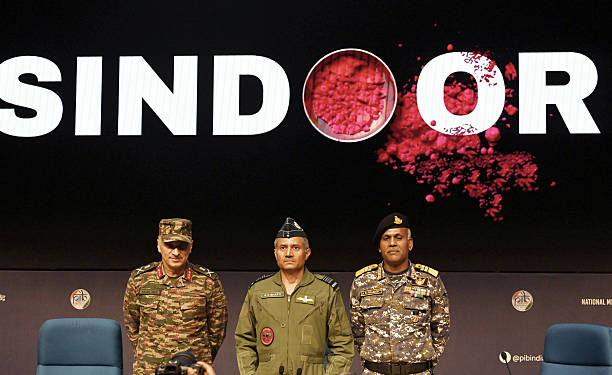
On the Op Sindoor anniversary, much is made rightly of India’s air power prowess that laid Pakistan low a year ago. The standout performance of the Integrated Air Command and Control System — a complex of airborne and landbased radars and other sensors linked to ballistic and cruise missile batteries, drone systems and even the old time anti-aircraft guns, worked beautifully, in providing excellent situational awareness, and both an effective defensive shield and a base for the offensive punch, and ought justly to be celebrated.
The record of the Indian Air Force per se, however, was wanting on May 7, 2025 — when it flew blindly into an Erieye-J10-P15 ambush and lost 3 high value combat aircraft — a Rafale, a Mig-29 and a Su-30, dimming the performance of the Brahmos striking terrorist markazes in Muridke and Bahawalpur, but was stellar when on May 10th early morning missiles launched from standoff range and various platforms hit their mark. It made nonsense of Pakistan’s less than credible warnings over the past three decades of a nuclear strike in case India conventionally struck anything in its Punjab heartland.
But the occasion could have done with some serious pondering of the extraordinary missed opportunity on May 10th when, with air dominance achieved, the army could have, and should have, swung swiftly into action. Special Forces should have sliced off the Haji Pir Salient on the Uri-Poonch line, permitting infantry units, supported by armour and artillery, from the garrisons in Uri, Poonch and Mandi to converge on the Bulge to destroy Pakistani forces in the cauldron, and capture this piece of territory for good. It would have instantly shut down the main ISI channel for infiltrating terrorists into the Srinagar Valley, and shortened the Uri-Poonch link to just 60 kms (not the 260 km detour and lots of time it takes to go around the Salient).
The LOC’s ceasefire line status would, moreover, have endowed the Indian action with absolute legality and, more significantly, laid down a policy — and a warning to GHQ, Rawalpindi, habited by “Field Marshal” Asim Munir and his cohort, that any terrorist event that LeT or other jihadi elements staged in J&K or anywhere else in India would result — as certain as day follows night — in the cleaving off of large portions of Pakistan-occupied Kashmir and their assimilation into the Indian Union, until nothing remained of POK but the name! It would have incentivised Islamabad to give up terrorism as an asymmetric means of wafare, and to formalise the international border on the new LOC.
But the army, CDS, Defence Ministry, GOI, whatever else they planned, they did not for cashing in on any opportunity to capture large parts of POK territory. So, in terms of planning a decisive war in the fortnight between April 22 — the day of the Pahalgam massacre and May 7, 2025 — D-Day for Op Sindoor, it was a wash. Instead, India jumped to comply with the first Pakistani request for a ceasefire that came its way on May 9th, when Indian forces were in a position to do virtually anything they wanted with regard to rearranging the Line of Control!
Incidentally, while the Indian armed forces planned for no contingency to take Haji Pir or anything else for that matter, just such an operation was outlined in my April 30, 2025 post — Capture of Haji Pir Salient and Skardu — eminently doable, is what the Indian military’s goals ought to be for the retaliatory actions — a whole week before the onset of Sindoor!! In its aftermath, the Defence Ministry and the military were left (and still are) justifying their reluctance to score really big by singing the virtues of “restraint” and “responsible” behaviour, and Rajnath Singh by issuing warnings of India doing more the next time around!
The Indian military’s intent on hewing strictly to the political directive, was fine. But surely, should it not, as self-respecting armed services, have nevertheless planned, prepared, and gotten the garrisons in Uri, Poonch and Mandi and other proximally situated forward units on the LOC ready to exploit any opportunity and, at a moment’s notice, to initiate a lightning fast operation to take Haji Pir, which was there for the taking?
Is it anybody’s case that Prime Minister Narendra Modi would have upbraided the military and hauled up a general or two for DISOBEYING his express instructions and capturing Haji Pir? Few political leaders are Winston Churchills. They know less than nothing about military matters but will happily feast politically on any military successes that come their way. After all, when is an election not round the corner?! This basic fact of life is apparently not appreciated by the Indian military, which once again strove manfully to do little, and succeeded!


I urge you to write blogs to say govt to increase investment in research and development. I don’t know what joy and happiness does GOI get to beg for tech transfer and visas which is not required, even from Russia, if govt just pours money in our institutions and let our people do the job.
Professor, General Upendra Dwivedi revealed that Indian side deliberately avoided strikes on terror camps during namaz hours. Citing “Sabka malik ek”. Do you think that was the right thing to do ?
Countries like Japan south korea Vietnam which rank higher than india in any indicator their leaders are coming to india, only to waste their time I believe. If we miss these opportunities then I think we will remain punching bag till 2049
@BharatKarnad
Greetings Professor Karnad
Sir, I think that during Operation Sindoor, the mission objectives were made very clear. The primary aim was to strike terror-related targets, and I do not believe that anyone in the IAF or the Indian Armed Forces wanted the conflict to escalate into a prolonged land war with Pakistan, such as the kind of situation involving Haji Pir that you mentioned.
From what I understand, the intention was to carry out a limited and precise operation while avoiding a wider military confrontation. Neither side seemed interested in allowing the situation to deteriorate to a level where it could spiral into a major conventional conflict,and then ultimately into a nuclear weapons exchange in the subcontinent
AM RKS bhadauria the former IAF chief also talked about the same thing in this conversation with sandeep
I would like to know your views
All I-P ops since Kargil happened under the N-overhang. So, what’s new?
@BharatKarnad
Sir, are there any updates regarding your upcoming title?
Can we expect it by the end of this year?Please pardon me I’m just a little impatient lol.
Struggling to finish
Is that the new title Bharat? (^v^).
Sorry not sorry.
@BharatKarnad
Professor, according to you, how symbolic was the strike on Nur Khan Airbase in Rawalpindi?
In my view, the strikes on Nur Khan Airbase and PAF Base Shahbaz had a much bigger impact on the Pakistani psyche compared to the strikes on Bahawalpur or Muridke.Considering the fact that the Strategic Plans Division (SPD) headquarters, which oversees Pakistan’s nuclear assets, is located very close to the base, it seemed the IAF wanted to send a message by targeting that particular area.
Also, one should not forget the severe damage reportedly inflicted on Jacobabad and PAF Base Bholari. At Bholari, reports claimed that an AEW&C asset was knocked out and that a PAF squadron leader was killed, something later acknowledged publicly by PAF Air Marshal Masood Akhtar.
But what do you think about the Nur Khan strike, especially considering its proximity to the SPD headquarters?
I have read your articles on Op Sindoor, Professor and I agree that the exchange ratio is such that Pakistan will not use tactical nukes even if India marches armored columns into the Punjab heartland. But does India have the forces to undertake a ground campaign to take territory, or is the Haji Pir really such an easy target? Because of Galwan we had to move assets to the Chinese border from Jammu. On top of that, the ill-advised agniveer has led to manpower shortages. We have seen Russia and Israel getting stuck in wars of attrition. You had also mentioned in one of your previous articles about Gen Sundarji’s brassstacks. When the Pakistani general said that if India planned to cut Pakistan by the waist, then the Pakistanis planned to cut India’s jugular. What about the possibility of them opening a diff front perhaps? or maybe China using that opportunity to apply some pressure at the LAC?
Of course, all these are possibilities that have to be factored in.
Agree with your analysis but still operation sindoor was a major escalation from previous responses. Do you think even this will deter pakistani terrorist attacks now ? Because the pakistani army might have done propoganda that they won but they know the reality.
Sindoor crossed a certain threshold that the Pakis did not expect, yes. But it was a spot action not a decisive op
Email from Dr V Siddhartha, former Science Adviser to Defence Minister
V Siddhartha
Thu, May 7 at 7:52 PM
…Why do you want any part (“slice”) of PoK in/with India? It means looking after at least one+ million more impoverished, radicalised Ms — we have enough of them in our part of J&K.
VS
VS,
Without hiving off POK territory at a time, how else can the Pakistan army be disincentivised from bannering the Kashmir issue and use of terrorism? Or, obversely, how can Islamabad be incentivised to formalise the LOC as border and end the dispute for once and for all?
Bharat
Professor,
With respect, your suggestion implies a dangerous shift in military objectives midway through the conflict.
The May 7 strikes were executed under a strict political mandate that did not include follow-up ground operations. The subsequent SEAD and DEAD missions were not a prelude to an invasion, but a necessary response to the Pakistani drone volley, designed to control the escalation matrix and neutralize enemy strike capabilities.
History shows that deviating from initial strategic objectives leads to mission creep and protracted debacles, a fact highly evident in the ongoing Russia-Ukraine and Iran conflicts.
Moreover, launching a solitary operation to capture the Haji Pir salient would have created a logistical and defensive nightmare post-capture. If such territorial acquisitions are to be planned, they cannot be isolated; they must be executed across multiple fronts along the western sector to ensure strategic dominance and effective overall conflict management.
That’s the point isn’t it? Whatever the original aims of a milop, the armed forces have to capitalise on opportunities that arise in the turns of a war. And once the LOC is straightened on the Haji Pir, it would have eased the consolidation of presence and logistics on the entire Uri-Poonch Front. And, protracted? How, why? Indian airsuperiority would have prevented Pakistani force concentration. In fact, with Haji Pir in our grasp, the terrorists and their minders too would have been at a serious disadvantage in infiltrating the Srinagar Valley.
Professor,
There is a distinct line between tactical flexibility and strategic opportunism. Utilizing a fleeting battlefield advantage to unilaterally alter the territorial objectives of the war risks hijacking the overarching political mandate of punitive deterrence and escalation control.
Furthermore, air superiority does not equate to total battlefield paralysis. Pakistani artillery units across PoK remained largely un-neutralized. Consolidating our presence in the Haji Pir salient would have funneled our infantry and armor directly into pre-registered kill zones, turning a clean operation into a costly war of attrition.
Regarding the ISI’s proxy network, history dictates that closing one artery(Haji pir) does not shut down the theater. The adversary is highly adaptable, and the infiltration pressure would simply shift to other vulnerable sectors like Kupwara, Machhal, or Rajouri.
Ultimately, if permanent territorial realignment is the objective, it cannot be achieved through an isolated, reactive land grab. Such a shift requires synchronized operations across the entire western front. With the operationalization of specialized strike units like the Bhairav battalion, India now possesses the capability to execute such comprehensive, border-wide operations, making a localized push into a single salient a sub-optimal strategic choice.
1) The opportunity was not “fleeting”. By 0300 hrs on the morning of May 10th 2025 air dominance was in place. It afforded Indian land forces the freedom for unhindered mobility. True the Pakistani artillery was still in place, but their positions, I assume, were tracked and could have been neutralised by Indian aircraft, missiles or drones. Sure, Haji Pir Bulge is mountainous territory and would have required large numbers of mountain infantry, but we had that. Mountain terrain also means the Pakis would have had a hard time reinforcing their forces within Haji Pir from rear bases. Hope you don’t need reminding that the “territorial realignment” you talk of is not of an international border but of a ceasefire line in an ongoing dispute legally permitted to be altered by military means. And it didn’t require the “synchronization” of ops — whatever you mean by it — across the entire western front. And Haji Pir would have been no small gain and taking it would have been optimal strategic achievement with the potential to seriously alter GHQ, Rawalpindi’s thinking, and not a suboptimal tactical choice. And that’s the trouble also with the Indian military: It has failed time and again to distinguish the plain tactical from the strategic-tactical in the context of the limited wars the country has fought.
Professor,
You make a fair point regarding our air power capacity to suppress enemy assets. On paper, taking Haji Pir would have been a significant tactical prize.
However, the fundamental issue with a localized, single-feature operation is that it invites a reciprocal response. If we capture a salient in isolation, the Pakistan Army will inevitably seize a vulnerable pocket of our territory elsewhere to restore parity. This creates a perpetual cat and mouse game of land trading that does not alter the strategic calculus; it only shifts the coordinates of the stalemate.
To implement your vision of permanent territorial realignment, the land grabbing operations in vulnerable features must be synchronized across the entire Western Command. A localized push without theater-wide mobilization and offense during Op Sindoor would have led to strategic overextension. At that moment, we simply did not have the resources massed to sustain a front-wide offensive and absorb the subsequent escalation.
The paradigm is shifting. With the operationalization of the Bhairav battalions and the new Divyastra artillery divisions, India now possesses the specific strategic capability to execute such a comprehensive realignment. If we are to fundamentally rewrite the LoC, we now have the tools to do it decisively across the whole front, ensuring dominance rather than risking a tit-for-tat land grab.
Political will in future to implement this strategy is questionable matter.
Do not want to belabour this, but “overextension”? How? The existing units in Uri, Poonch and Mandi would have been more than sufficient, with Pak access cutoff by the Special Forces on the Uri-Poonch Line — the new LOC, which could then have been rapidly reinforced by Corps assets and reserve. This was doable, and we missed it. Bhairav, Divyastra, etc are just new names for slightly reconfigured but extant capabilities
Email from Colonel Ajai Shukla (Retd), defence columnist and former CO, 4th Horse (Hodson’s)
Fri, May 8
That’s a truly hilarious last line!
Thanks for sharing.
Colonel Ajai Shukla (Retired)
Further from Dr Siddhartha:
V Siddhartha
Fri, May 8 at 1:24 PM
Reur: “… how can Islamabad be incentivised to formalise the LOC as border and end the dispute for once and for all?”
For what it is worth, I assess that now China sees its all-weather, all-domain commitment to Paki as a drain on her (China’s) primary strategy to be peer (at least) to the U.S. in the Pacific, including in the Southern Hemisphere. So, we should convey to China that she should pressure civilian-Paki to publicly propose to India to make the LOC the border — an offer that China knows we cannot refuse — and that if she (Paki) does, China would make huge grants to Paki to enable her to write-off all her debts, The US and EU would applaud.
VS
Sid,
Your view that Beijing can be persuaded to do what you suggest is based more on hope than on trends in Chinese policy. That Pakistan is a drain on China’s resources is now conceded by many Chinese experts. But it is a leap from there to suggest Beijing will surrender the Pakistan lever it has sedulously nursed over decades to contain India. Beijing has resources enough to deal with an already weak US spiralling downwards, now and in the future. So, realistically, Zhongnanhai has no earthly reason to make it easy for India. And Beijing, unlike Delhi, does not hunger for encomiums from the West either.
Bharat
Very well said Professor Karnad. China will never resolve its border issue with India forget about them telling Pakistan to do it.
@BharatKarnad
Slightly off topic, but Dr. Karnad It seems in April Ukraine captured a Russian position using just Drones and Ground Robots ! No Humans beings used in the battle field!! . Here we are fighting communal riots with tanks whereas tectonic changes taking in the nature of warfare.
Quite right!
The success or failure of any initiative should be determined based on specific parameters. So what parameters should we use? These are my thoughts.
1. Number of terrorist activities: The evidence from South Asian Terrorism Portal (SATP)suggests a sharp decline in terrorism activities post Operation Sindoor. However, the same portal also suggests that UPA was far more successful in curbing terrorism than NDA (All deaths due to terrorism in India:- 2004- 2980; 2013-873; 2014-1012; 2023-460; 2025-657; 2026 (till May 02)-116)(Source: https://www.satp.org/datasheet-terrorist-attack/fatalities/india. J&K specific deaths and division of deaths into civilian, security forces and terrorists are also available)
2. Influence of Pakistan Army: The influence of Pakistan Army and its head Field Marshal Asim Muneer is probably at an all-time high. The Pakistani armed forces have sold the myth to their populace as well as to most of the world that they were successful in the combat. Hence, they have managed to sign SMDA with Saudi Arabia; come in the good books of Trump and possibly secured military deals worth billions. At least the upgradation of Azerbaijan deal from $1.6 billion to $4.6 billion is confirmed. Azerbaijan managed to integrate the Nagarno-Karabakh region recently, something India has not successful till date wrt PoK.
3. Economic impact: From a pariah state, Pakistan has become the mediator of the 2026 Iran war. It is simultaneously courted by USA and China and is able to access IMF bailouts. KSE has increased 60 percent YoY since the cessation of operations and defense exports have increased. On the other hand, BSE has declined by 3 percent YoY and India’s economy has been negatively impacted by USA tariffs that are partially the outcome of India’s refusal to credit Trump with the ceasefire agreement. Ironically, the ceasefire was first announced by Trump on Truth Social so the announcement of the ceasefire agreement reflects at least a communication failure on the Indian side.
As Pakistan has suspended the Shimla treaty, India had the legal right, and I would say duty, to liberate any part of PoK, including, but not limited to, Haji Pir. Not doing anything on those lines and censoring the reporting of aircraft losses by the domestic press, while allowing foreign press to do the same in India, has not added to India’s credibility. Taking everything into consideration, India likely won the war on the field but lost it in the press rooms and diplomatic gatherings.
Professor,
You said that in a nuclear exchange ( in war games ) pakistan will cease to exist as nation and india will lose 2 cities.
But whereas various studies such as Science advances 2019 suggested that india might lose 130-270 major cities leading to medieval level setback.
Gross exaggerations
Another missed opportunity. We have long proclaimed our interests to be the net security provider in the IOR. With 20+ Indian flagged commercial ships and 1000+ sailors stuck in the gulf. With rationing of gas and a real pinch to Indian wallets – we failed to protect our interests and enforce FON in the gulf – in Indian interests. Escort missions and a warning to anyone firing on Indian vessels would have given a message to one and all that there is indeed a power next door willing an able to preserve its interests.
What good is it to have 140+ capital ships, if it is not to protect vital Indian interests?
Professor,
Pakistan is likely to induct a fifth-generation fighter aircraft before India. A Pakistani official confirmed to Janes Information Services that PAF pilots have already been training in China since June 2025. Their training program is running while their infrastructure is being built. Meanwhile, India’s AMCA project is still years away. If this gap continues, what steps should India take to respond strategically?
If you have been reading this blog, you’d know that I believe the days of manned aircraft are over
There are reports of backchannel diplomacy with pakistan professor. Is modi mad or evil that he let sacrificed so many lives in kashmir since the last decade just for this?? They are saying it is for crisis management during next “war” But modi could not do it in 2016 when chinese help to paksitan was not that much?
Back channel or any other channel of comms is good at all times with adversaries and proto-adversaries
Professor do you think if there is war between india and china pakistan will attack india by chinese weapons even if we make peace with pakistanis today?
Nope!
@BharatKarnad
https://x.com/DRDO_India/status/2053069194749706652
DRDO just tested An “Advanced Agni Missile” with MIRV.They did not specify whether it is A5 or A6 or what is the range just this tweet.
Professor if i may request can you pls pen down a blog on this
@BharatKarnad
Sir do we possess thermonuclear warheads?
Cause some defense analyst are claiming that it was tested with 4 MIRVs of 200 kilotons each
GOI claims we have them. I have argued, however, since the failed fusion S-1 test in 1998 that unless openended hydrogen bomb testing is resumed, the country cannot credibly claim thermonuclear weapons status. This view is now supported by Americans, like Ashley Tellis, who negotiated the 2008 N-deal.
@BharatKarnad
Obviously, it needs to be tested. I have read about the S1 fizzle, but Chidambaram and Anil Kakodkar said it worked.
What’s the point of having an 8,000 km MIRVed missile with a very low CEP if it only carries 20-kiloton fission warheads?
Professor why doesn’t India engage with Ukraine to acquire drone warfare data and tactical insights? Ukraine has become a global leader in cost-effective and highly lethal drone and FPV warfare, even outperforming NATO forces in military exercise. The vast amount of battlefield data accumulated over the four years of war would be invaluable – to train our own AI drone models on. Low-cost drones would fundamentally reshape the economics, tactics, and logistics of warfare, especially along our mountainous and rugged borders with Pakistan and China.
There’s an ongoing coop program with UKR. Ukrainian gas turbine engines, for instance, power our old CODOG and newer CODAG warships.
https://www.bbc.com/news/articles/cj9pem481rwo
Professor Karnad, do you think Russia is feeling the strain of the war now, which is in it’s fifth year or this is just the propaganda of the Western media as part of psyops?
Putin has announced an imminent end to the UKR war.
@Bharat Karnad- And herein lies the paradox as per rough estimates approximately 20% of the Ukrainian territory is in Russia’s control. Will Putin agree to return it back to Ukraine? I don’t think so.
Why then will Ukraine accept the ceasefire agreement?
Russia occupies over 80% of the 4 oblasts constituting the Donbas region, as of today
professor due you think our govt is making the mistake,thinking that after the iran war us will take revenge from China by giving strategic technologies to all countries having disputes with china?? Do they even know that us has always acted in self interest and has the most consistent foreign policy ever or was it that their govt/pentagon were in illusion that having american military bases in foreign soils was enough to deter their enemy that is why us has not given enough tech to their allies even when china has done harm to us interests??
was iran war was really because due to israel dragged them or the Americans did not do a proper war appreciation? Your opinion?
@BharatKarnad
Professor, as yesterday marked the 28th anniversary of the 1998 tests, I wanted to ask this question.
It is widely believed that India tested five devices: one thermonuclear device, one fission device, and three sub-critical devices.
Officially, the Government of India says that the sub-critical tests were conducted for research and industrial purposes. However, is there any possibility that such designs could be converted into low-yield tactical nuclear weapons in the 1–5 kt range for the Indian military?
Especially for use against Pakistani battlefield targets in a retaliatory scenario if Pakistan were to use tactical nuclear weapons first (though that itself seems unlikely due to the escalation risks and exchange ratio).
Would like to know your thoughts on this.
The low yield tests were tacnuke designs
@BharatKarnad
professor according to official sources the s1 device had a designed yield of 200 kilotons.
But what was the true intended yield and capability
some said that it was a boosted fission device and not thermonuclear
Can you please tell something about this
The S-1 planned yield was for a staged device in the 200-250 KT range, but it failed.
Sir, over the years the Indian armed forces have procured defense equipment from a wide range of countries — including the US, UK, Russia, Sweden, Israel, Germany, and others and this diversification is increasing even further today. However, this may not necessarily be advantageous, because modern warfare increasingly depends on interoperability and Integrated Network-Centric warfare, where a strong C4ISR capability can act as a major force multiplier. Given that we do not even possess the source code or full control over many of these systems, do you think India is at a significant strategic disadvantage? And as warfare becomes more technology-driven and interconnected, is this disadvantage likely to grow further?
Yes, hugely
professor are there people in the indian military whose job is to think about new disruptive technologies and work on that which the pentagon calls offset strategy. Or is it that since 1990 every govt has focused on counter terror ops and not taken care of it. Was something like that there before 1990??
Professor China recently admitted to helping Pakistan during ops Sindoor, what should be the appropriate retribution for that? Why doesn’t GOI recognize Taiwan as an independent country?
and why is that some plus like bhel and beml have so much capabilities to build heavy equipments but drdo isro hal not able to do??
Different roles — DRDO is an R&D org; the other are DPSU for defence manufacture
@Bharat Karnad
Greetings Professor
Unrelated to the Sindoor blog.
With the expiry of US sanctions waiver on Chabahar port, India is exploring options such as temporary transfer of ownership + negotiations to salvage the project. If India is forced to abandon this project, what would become of our Central Asia strategic outreach (If any)? Will our engagement with this region now be just funneled through the heavily Chinese patronized SCO?
Thank you
This is a real worry. Not sure GOI is considering the strategic ramifications of Chabahar loss
Well, well Prof. Karnad, you expected the Indian Army to do its job? How can you be so unreasonable? Our Military is unique. It will hold peace talks with the PLA while our PM talks war for strictly electoral purposes.
Then we have PM’s friend Trump.🙄
Greetings sir,
It is always inspiring that a fellow Indian is thinking in so much detail about how military operations could have been better.
Operation Sindhoor has equated the Indian Army with Pakistan’s (atleast in the eyes of major powers). Capturing land parcels even if very small could have punctured the Pakistani narrative. Lack of incentive for risk taking can be the reason for hesitant attitude of Indian Generals.
Can the template- ‘Benefits of appointing non career bureaucrats as ambassadors’ fit in context of Indian Military? Maybe the office of CDS has failed to bring fresh air as expected. Do we need lateral entrants for combat strategies? They will get paid only when the pre defined tasks are completed.
Well, look, advanced democratic systems — the US, UK, etc, have strategic experts advising govts/ministers and are brought in on short term tenures. Have suggested India should do the same.
@BharatKarnad
Good evening Professor,
I hope you are doing well. Today marks the 24th anniversary of the Kaluchak massacre, one of the most horrifying terrorist attacks carried out against military families in India’s history.
As you know, three Lashkar fidayeens first hijacked a civilian bus and then stormed the Kaluchak Army camp in Jammu in May 2002. What makes the attack especially tragic is that a large number of the victims were women and children the families of soldiers serving the nation. Even today, the brutality of that massacre remains deeply disturbing. May the souls of the victims rest in peace.
I Have 2 questions and wanted to ask you about the strategic and political situation surrounding that period, particularly in the context of Operation Parakram.
Q1)
By the time the Kaluchak massacre occurred, India had already mobilized massive forces under Operation Parakram following the Parliament attack. From what I have read, lakhs of troops had already been deployed along the border under General S. Padmanabhan’s leadership, and major strike formations including the 1st Strike Corps were reportedly prepared with plans involving thrusts into areas such as the Shakargarh Bulge.
Given the scale of the mobilization and the public outrage after Kaluchak, what exactly went wrong from India’s perspective? Why did the political leadership ultimately decide against launching a conventional retaliatory strike despite the military buildup already being in place?
I would really appreciate your perspective on whether Operation Parakram exposed weaknesses in India’s conventional deterrence posture at the time.
Q2)
I also wanted to ask specifically about the nuclear dimension of the crisis.
I remember reading that after India considered conventional retaliation following the Kaluchak massacre, Pakistan responded with strong warnings implying that it was prepared to escalate, including possible nuclear use if Indian forces crossed certain thresholds.
To what extent did Pakistan’s nuclear signaling actually influence Indian decision-making? Did India genuinely believe there was a credible risk of tactical or strategic nuclear use, or was Islamabad primarily relying on nuclear bluff and psychological deterrence?
I would be very interested to hear your thoughts on how Indian strategic planners viewed the situation internally during that period
Regards
Pakistan overstates the N-dimension (as Sindoor proved). Re: The other issues my memory is fuzzy. But refer my writings at that time — I did op/eds in Asian Age, etc.
professor I have a feeling us will betray japan during war with china or it could be that sanae takaichi’s statements on taiwan were under American influence?
but I can’t see us going to war with china based on their current capabilities.They won’t be able to control the escalation ladder. So why is us not coming clear on taiwan?
after us had started talks with talilban they should not have spent 7-10 years there and should have focused on go dome which they are doing now?? Your thoughts?
Yes, Asian states should not rely on the US, or any other power, my pet theme over the last 40 years!
I have a feeling china will trick usa in the taiwan issue. And then quietly nuclear arm brazil or cambodia. Your opinion??
Nope
and why is sergey lavrov and putin getting so nervous about trump us visit? Are they underestimating russia’s power?
Hello doctor,I read your book and found your idea of nuclear arming all of chinas neighbour to be very interesting. I was going to write a letter to all my states m.p could you please give me some pointers soni could explain it to them why it would be in India’s best interest to nuclear arm china Neighbors and why the indian deep state refuses to take bold steps.
Well, just write to your state MPs to say what you are saying: That this is the only way to strategically contain China, stabilise peace in Asia, and pay China back for nuclear missile arming Pakistan.
@BharatKarnad
Professor, good evening.
I highly suggest that you please check out this podcast, especially the first 15–20 minutes, where the discussion on the Indo-US nuclear deal and the 1998 Pokhran tests becomes extremely fascinating.
Anil Kakodkar speaks in considerable detail about the Pokhran-II thermonuclear test and strongly maintains that the device performed as intended. According to him, the thermonuclear yield was around 45 kilotons, but the design yield was intentionally moderated in order to avoid excessive destruction to nearby villages and civilian areas around the test range. He further argues that the combined yield data from the series of tests matched the expected calculations and that the scientific readings validated the success of the experiment.
What made the conversation even more interesting was when the interviewer brought up the long-standing criticisms and doubts raised by K. Santhanam and P. K. Iyengar regarding the thermonuclear device’s actual performance. Kakodkar responded quite directly, stating that the instruments and diagnostics deployed by him and R. Chidambaram under BARC showed readings that, according to them, conclusively demonstrated the success of the test. He contrasted this with the measurements and interpretations coming from DRDO-linked instrumentation associated with Santhanam’s side of the debate.
The entire exchange felt significant because this controversy has continued for decades and still shapes discussions about India’s thermonuclear credibility, deterrence posture, and strategic doctrine. Since you are unquestionably one of the important voices connected to this broader strategic and nuclear discourse, I genuinely wanted to know your views on the matter.
Fact: Kakodkar is a mech engineer, not a physicist and had no role inconfiguring the fusion device. I’d take the word of a PK Iyengar, who started the thermonuclear project over Kakodkar’s and especially over that of R Chidambaram — a man of few principles and little integrity.