
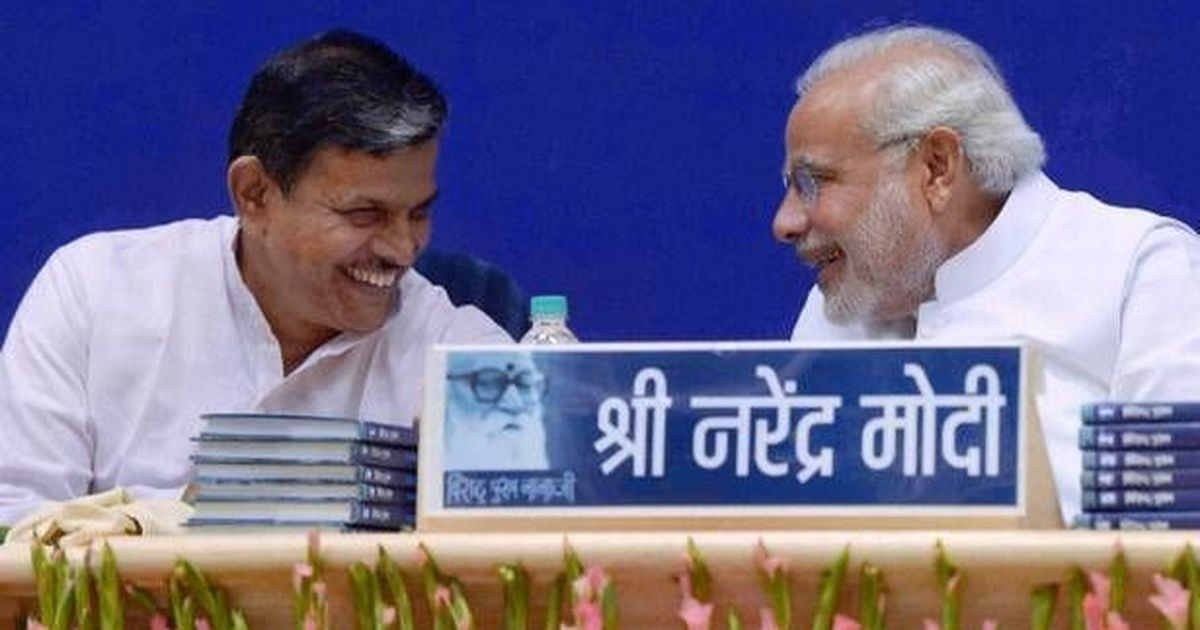
[Hosabale and the Prime Minister]
Dattatreya Hosabale, General Secretary of the Rashtriya Swayamsevak Sangh (RSS) is in the news for suggesting that dialogue with Pakistan be resumed. The statement was met by hosannas from many quarters — other than the Wagah candlelighters, veterans of the Establishment and the like celebrating the event, and welcomed by Islamabad as a “positive call”. In a sense, it marked the approval by the RSS of the Track 2 meetings to-date — four of them since Op Sindoor between retired Indian and Pakistani generals and diplomats. Breaking the ice is never very difficult. Put any Indians and Pakistanis together for any reason and they get along like a house on fire! (Wrong metaphor?)
But this turn in Hosabale’s thinking reminds me of his visiting me at the Centre for Policy Research along with another RSS functionary, sometime between May 16, 2014, when the general election results were declared, and May 26 when Modi was sworn in. They did not reveal the reason for seeking the meeting. But because The Hindu — which likes to think of itself as the “newspaper of record”, had around then published an op-ed speculating the likely appointments in the new dispensation, and mentioned me by name as being considered for the post of “adviser, strategic affairs”, I surmised that Hosabale had scouted me. In the time spent with him, relations with Pakistan dominated the discussion.
I suspect I may have marred my prospects by saying that to conserve national resources for the fight against China, India needed to (1) obtain a pacified neighbourhood, including a friendly Pakistan, with a policy of economic inducements to bind adjoing states to the Indian economy — the first step for the country to attain genuine great power status, and (2) generate trust, in the main, with Pakistan without in the least imperilling national security by removing all nuclear missiles from the western border and rationalising the army’s three Strike Corps into a single composite Corps, and transferring the freed up assets to the China front. And I indicated, these steps in no way prevented India from taking punitive measures in PoK and against Pakistan for any terrorist incidents. These are themes I flogged for a long time. The army has done what I long counselled — hollowed out two of the Strike Corps by deploying their armoured and mechanised units to Ladakh.
Importantly, it is a good thing that the RSS and Hosabale apparently have rethought the value of a rapprochement with Pakistan, and the Indian government maybe rejigging its policy. After all Prime Minister Narendra Modi began his tenure by inviting to his swearing-in ceremony on May 26, 2014, the heads of governments of all adjacent states, including Pakistani Prime Minister Nawaz Sharif. And, a year later, he impulsively broke his return journey from Afghanistan, in Lahore, on December 25, 2015, travelled by road to Nawaz’s estate in Raiwind, partook of the PM’s grand daughter’s wedding and, on meeting her, touched Sharif’s mother’s feet — a gesture that, right there and then, sentimentally disarmed millions of Pakistanis.
It was then the ISI doubtless decided it had had enough of all the bhaichara stuff, and arranged for the terrorist attack in Pulwama on 14 February 2019, souring bilateral relations. The IAF launched a reprisal air raid on Balakot 12 days later. It is another matter that if the idea was to send a strong deterrent message to GHQ, Rawalpindi, the IAF erred by choosing the wrong tactics and weapon. It sent a single aircraft to fire Spice2000, an Israeli precision guided munition, rather than a squadron-strength IAF complement in waves dropping 500 pound bombs to deep-crater not just the Jaish-e-Mohammad training camp but to wipe out that entire hilltop for every satellite to pick up and the media to broadcast.
The ties went further south with the selective gunning down of Hindu tourists in Pahalgam on 23 April last year. This time, it was the Indian army’s turn to foul up. It missed the opportunity to exploit the air dominance achieved (with standoff missile strikes) by 0230 hrs on May 10, to snatch the Haji Pir Bulge. It’d have initiated a new strategy of territory for terrorism — hacking off parts of Pakistan-occupied Kashmir for absorption into the Indian Union for every terrorist incident. The LoC being a ceasefire line, as General Parvez Musharraf reminded us many moons ago, international law allows either side to the dispute to change it by military means! Mindful of the military flubbing it on two successive occasions, Rajnath Singh and various generals on the Sindoor anniversary threatened more dire outcomes for Pakistan “agli baar”. That agli baar never comes.
Pakistani terrorism, although a nettlesome problem cannot be allowed, however, to cloud India’s meta-strategic goal of achieving unitary strategic space in South Asia and for the region to emerge as an extendable economic “co-prosperity sphere” that I have advocated. It is the only way for India to resolve the terrorism issue, and become a meaningful player on the world scene, and for South Asia to transform into a peaceful region. The country is too big to continue to be content with small fights and iffy successes.


For being meaningful player in the world scene there is no other option but state investment in education and research and development if private sector not doing.
or could it be that GOI is planning something like israel and us? Strike pakistan during middle of negotiations. But should be done with proper war appreciation!
Unlikely. GOI and the military don’t have the balls to do anything surprising, unexpectedly!
@BharatKarnad
Recently General Naravane wrote this on his twitter channel
“The hallmark of civilisations have been long periods of peace where humankind has flourished interrupted by short but intense periods of conflict. The path to peace was and is, through negotiations to arrive at a just settlement that meets the aspirations of the people. Jai Hind”
Do you support the general professor cause if we look into the comment section majority of the people in the comments were abusing the general calling him a coward and thanking god that he retired
I am not a warmonger, but I also believe that eternal peace with Pakistan is unlikely to be possible under the current circumstances.
At the same time With due respect to General Manoj Mukund Naravane, he has served the country as the Army Chief and is fully entitled to his views.
I think it is important to consider what C. Christine Fair wrote in her book Fighting to the End: The Pakistan Army’s Way of War. It is one of the best books for understanding the psyche of the Pakistani military establishment.
One of the central arguments of the book is that the Pakistani military establishment is structurally built around hostility toward India. She explains that Anti-India sentiment is not just a temporary policy choice for them it has become deeply embedded in their institutional identity and strategic thinking since their creation.
That is why many people remain skeptical about the idea that lasting peace can simply be achieved through sporting events, cultural exchanges, or Track-II diplomacy alone. Dialogue sounds good in theory, but history has repeatedly shown that every major peace initiative eventually runs into the same problem: the Pakistani Army’s strategic obsession with India.
I am quite aware that “Ghazwe hind” and “Hindu Lala” all those theories are nonsense
People-to-people contact is fine, and ordinary civilians on both sides naturally want peace and stability. But believing that decades of hostility, cross-border terrorism, and military confrontation can be resolved merely through goodwill gestures feels overly optimistic.
I would like to know your views
It is one thing rhetorically to fight to the end. Quite another thing for the Pak army actually to do it, which it hasn’t so far done!.
My views are there in all my writings. No point repeating, and repeating….
@BharatKarnad
Absolutely, your argument about having three strike corps being excessive makes sense. I am glad the Army appears to have moved toward a more balanced approach. A strong composite force equivalent to one and a half traditional strike corps should be sufficient to repel any major Pakistani counterattack.
though i still sometimes wonder what would have had happened if the indian military had gone ahead with Sundarji’s plan i.e Op brasstacks and cut pakistan along the rahim yar khan axis
At the same time, the money and assets saved should be invested in integrated rocket forces and the mass production of Pralay, Prithvi, and other short-range tactical missile systems. We need them in large numbers.
But why remove nuclear-tipped missiles, Professor?
I am aware that we can still strike countervalue targets from central India. However, will they remove theirs if we remove ours?
Why have destabilising forward deployed N-SRBMs when rear-area based MRBMs can take out any Pakistani target?
Email from Dr V Siddhartha, former Science adviser to Defence Minister
V Siddhartha
Mon, May 18 at 10:21
Re: “…. It’d have initiated a new strategy of territory for terrorism — hacking off parts of Pakistan-occupied Kashmir for absorption into the Indian Union for every terrorist incident. “
With those “slices” will come the residents of the area: More Ms — with a genetic predisposition to civic violence, if not terrorism (that cannot any longer be blamed on/attributed to Paki) — to pacify/look after. We have enough of those in our-K. Surely you do not want that?
VS
Sid,
You have brought up this point earlier as well, and rightly so. But without a territory-for terrorism strategy, we box ourselves into doing nothing, providing no disincentive or even serious deterrent to the Pakistan army. Sure additional Muslims is a major problem, but is it worse than having a live border on the LOC?
Bharat
Further from Dr Siddhartha
Mon, May 18 at 10:53 AM
Reurq: “….. Sure additional Muslims is a major problem, but is it worse than having a live border on the LOC?”
Of course it is!
Any such part will be permanently on the Wests’ (and China’s) “watch list”. Even a police-arrest of an impoverished M-thief in Indian-absorbed PoK areas will have our entire ex-JNU ecosystem, and the West’s Think Tanks — aided and abetted by newly-catalysed Arundhati Roys — to scream even louder, to the delight and sub-rosa instigation by China. Witness current M-intractability on even simple civic issues right here in Bangalore; in our NE — not to say on the B’desh-Bengal border.
VS
So, if it is a democracy problem at root, then the sooner all the institutions and laws, etc. that promote, reinforce and consolidate the separateness of Indian Muslims, are done away with the better. Surely, Modi and BJP will be supported by the majority if laws to this effect are rammed through Parliament.
But about the pressures and the squawkings of the West on religious freedom and so on, it is for the GOI to ask them to shut up on the pain of…, which it doesn’t do because links with the US, UK, Europe are believed essential and necessary to the country’s progress. See how China quelled any Western talk of, and pressure re: cultural genocide of the Tibetans, Uyghurs, et al, even when Beijing couldn’t have done without the US and European markets.
To wit, Shakespeare (in Julius Caeser): “The fault…is not in our stars, but in ourselves, that we are underlings.” Or, act as underlings!
If the idea was to eventually Balkanise Pakistan, then why support economic engagement with it now? Or do you believe that strategy is no longer realistic?
Look, the balkanisation of Pakistan-thinking arose from ISI pushing the jihadi separatists. If economic cooptation fails we can always turbocharge the other options.
Still further from Dr Siddhartha:
V Siddhartha
Mon, May 18 at 12:33 PM
… Wanted: A Second Republic. Nothing less will serve. VS
Sid,
France has cycled through 4 republics, the current one is the 5th. Germany fortunately ended their experiment with the Third Reich. In Asia, South Korea since 1988 is in its 6th Republic phase. You are right, India needs a revamped Second Republic. But there are too many vested interests, too deeply dug in, to permit a new system to emerge.
Bharat
“The weak suffer what they must, while the strong do what they can.” — Thucydides
As always, the forever realist Mr Karnad makes very practical and logical argument.
First and foremost both the countries ought to put a perpetual stop to inciting people in name of religion and jingoistic nationalism. Both are aware they are in no position to change the border so why not make peace and make money benefits of which can filter down to their people.
kashmir issue has nothing to do with what you mentioned. Read history books and see evidence.
Having read your books, Professor, basically the Manmohan-Musharraf deal
What India wants from Pakistan
1. Stop supporting cross border terrorism.
2. Accept LoC as border and move on.
3. Do a trade agreement to closely integrate with the Indian economy so in the future, we have more leverage in case they deviate. Currently our only economic lever is Indus Waters Treaty.
What Pakistan wants from India
1. Kashmir
Currently, it is in China’s interest to keep india distracted on the western front. Pakistan feels emboldened by its alliances with China, Turkey and Saudi and India’s supposed isolation to not have to compromise on Kashmir at this point.
For India, the only way out is to undertake radical economic reforms and grow to a 10 trillion dollar economy. Currently China looks at India the way India sees Pakistan. Messy, corrupt, incoherent. If India gets serious, China will also want a modus vivendi with India then, and Pakistan will also soften. Currently any negotiation will not yield any result favorable to India.
But Indian polity is too status quoist for this.
Email from Lt Gen Arun K Sahni (Retd), former GOCINC, SouthWest Command
Tue, May 19 at 7:14 PM
Dear Bharat,
Loved this piece. Economic entanglement in South Asia should be the larger vision.
Indo Pak dialogue without positive overtures from them is iffy. More so with Bangladesh in their pocket as of now.
Best Wishes
Arun Sahni
Professor,
I have a hypothetical question: given the advent of advanced satellite tracking for naval assets and the proliferation of hypersonic weapons, will we see the eventual abandonment of the aircraft carrier? In other words, might navies transition from moving platforms to massive, stationary, and highly fortified structures (such as oil rig-sized oceanic airfields) positioned permanently at sea?
Additionally, regarding your op sindoor post year ago stating that Pakistani AWACS provided missile guidance: their upgraded Link-17 Sky Guard lacks the bandwidth and low latency required for such an action. Furthermore, to establish a true sensor-to-shooter loop, they would need a modulator to bridge their Link-17 with China’s XS-3 or DTS-03 systemshardware they currently do not possess. While they did utilize a multi-link gateway to hand off the location of the smaller jets, the actual kill tracking must have been executed by the JF fighter’s onboard radar.
Wonderful work by Dr Karnad. However you are ignoring the basic premise of RSS and BJP. They need Islamophobia at some level to win elections consistently. Pakistan is part of that narrative as Pakistan (alongside Bangladesh) needs to be projected as the “enemy other” by the BJP/RSS to consistently win elections. Your idea of a “South Asia economic sphere” led by India is not aligned with this reality.
But, surely, Islamic radicalism fostered in Pakistan and Bangladesh that fans RSS and BJP’s Islamophobia, is not fiction.
And neither is Hindu radicalism practiced and preached by BJP/RSS in India.
https://www.indiatoday.in/india/story/abhijeet-dipke-cockroach-janata-party-how-cji-remark-sparked-a-gen-z-movement-indias-newest-political-party-launched-2914516-2026-05-20
Hello Dr Karnad.. please consider inviting Defense experts from your circle to write guest posts on this blog.
It will be nice to see this space hum with diverse views. Just my two cents.
Those who care to ventilate their views do so, on various platforms
Does not this “South Asia economic sphere” need intercountry vested intestes across political , social and cultural dimensions..
RSS and sangh ecosystem is averse to these .. so unlikely they be incentivised into buying this !!
Perhaps. But does the sphere not fit in with RSS’ ‘Akhand Bharat’?
I’m a big fan and have always considered you my guru on these subjects but this is probably the one big point where I seriously differ. There’s no coopting Pakistan, it’s been tried plenty already, and at this point even if it magically became possible in spite of their existential visceral hatred of us – I (and many others) don’t even want it anymore.
The only solution now is to properly and comprehensively demolish them in a final definitive war to settle this existential conflict and resolve all unsettled agendas of Partition once and for all – which is the inevitable conclusion we’ve been putting off for 79 years. Take back PoJK (or at least the less radicalized & demographically compromised Gilgit Baltistan which is absolutely strategically vital, along with select strategically and/or civilizationally significant parts of “Azaad Kashmir” like Haji Pir, Kishanganga Bulge, and Sharda Peeth), high Hindu population % districts of Eastern Sindh which should have gone to India (and some of which were even briefly held and administered by India after ’71), and the Akhnoor Dagger & Shakargarh Bulge (including Kartarpur Sahib for the Sikhs) in West Punjab.
Pair this with all conventional and sub-conventional means necessary to assist BRAS and TTP in tearing away Balochistan and Khyber Pakhtunkhwa from Pakistan; along with either direct action or revival/fomenting of movements to see through the separation of Sindh and Saraikistan (the poor, backward, and culturally distinct Southern part of Punjab) as well. Leaving just the defanged and landlocked North Punjab as “Pakistan.”
Once this is done, India will be much more free to focus on growth and will be able to permanently shift most of its forces and focus to China as many often suggest. And a key part of dealing with China also involves your very old and bold suggestion of developing deep ties with – and arming to the teeth – various East Asian countries (including Brahmos, Ballistic Missiles, and even Nuclear Weapons tech).
OK! As we go about this, how do we deal with Pakistan’s two main patrons — China and the US?
But then, you yourself said that Hamid Gul considered us buzdil (cowards) for continuing to engage in talks. So how do we break that perception? If they genuinely hold that view, won’t they keep attacking or pressuring us because they see Hindus as weak? It also becomes a more complex issue when India has a large Muslim population, separate personal laws, and organizations such as Jamaat and Deoband, which critics often describe as socially conservative. Taliban draws ideological inspiration from the broader Deobandi tradition.The standard politically correct response, in my view, is often to ignore these concerns and hope they disappear on their own. If that approach is considered the only acceptable one, then political leaders should be transparent about what they believe the long-term solution is, rather than avoiding the discussion altogether.
Say it loudly that its better we convert to Islam or Christianity as the culture will remain the same anyways
Go back to what I wrote Gul had told me: India is buzdil (cowardly) because it will not take hard actions or fight to a decision
That depends on the specific contingency/situation that arises and which of the two nations is involved (could be both too) – there obviously isn’t a single “catch-all” solution to every possible contingency. But I have also yet to see a single “problem” or contingency raised in this context which is an absolute deal-breaker that India wouldn’t be able to counter or handle. As you have always taught us, India has the strength & options, it just needs to have balls and intent – if India is a pushover, it’s only by choice.
The perception within sections of the Pakistani establishment, represented by figures like Hamid Gul, that India is a buzdil qaum needs to be decisively broken. Pakistan’s strategic culture has long been shaped by assumptions about Indian restraint. India should focus on keeping Pakistan strategically off balance, exploiting diplomatic, economic, and political leverage whenever opportunities arise, much like China does with its rivals. We should also be willing to pursue incremental pressure whenever opportunities present themselves, particularly in ways that expose weaknesses within the Pakistani military establishment. Our actions should aim to undermine the credibility of the Pakistani military, both domestically and internationally, while forcing Pakistan into a reactive rather than proactive posture. Merely highlighting what India sees as Pakistan’s moral failings is unlikely to have much impact, as such criticism is often dismissed or absorbed without consequence. In my view, actions that impose tangible strategic costs are far more effective in shaping perceptions and behavior. The objective should be to establish a regional order in which Indian primacy is accepted as a reality. Only after closing this chapter can India devote its full attention to the larger strategic challenge posed by China.China did same with us in 1962 Pakistan deserves a 1962 where they will never be able to look straight at India.
Defanging Paksitan will put China as well US on notice about India’s intent and capability