
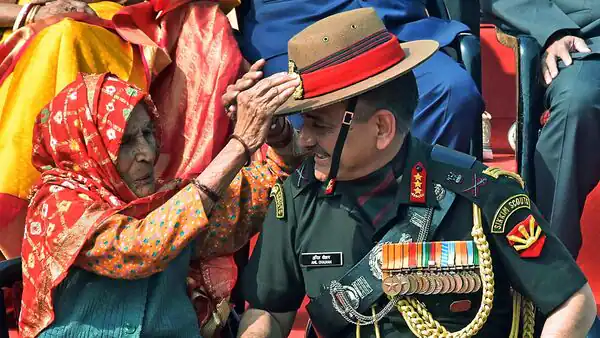
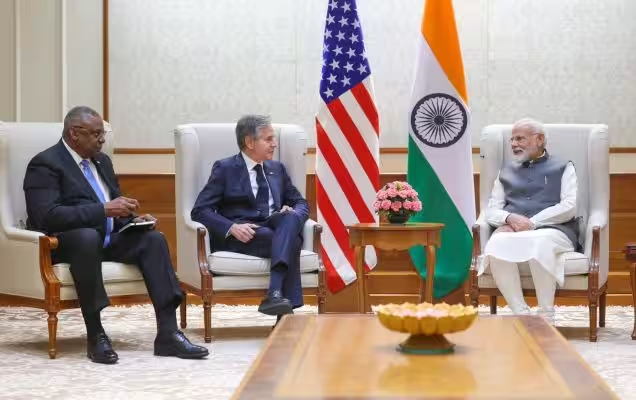
[CDS, General Anil Chauhan, seeking blessings!]
Finally, the Modi government ended the smouldering resistance within the military by notifying the Inter-Services Organisations Act (ISO). I had suggested some 20 years ago to the KC Pant-chaired government committee studying higher defence reorganization and reforms, that whatever the CDS/integration/jointness scheme the committee decided on, it should be imposed on the armed services by government dictat because sending it to the three services for their viewpoints would be to consign it to the trash heap. But it was sent to the services and it delayed the realization of an integrated military because, simply put, the services chiefs had too much at stake, and too much to lose to not try and prevent it by any and all means.
Whether again a time lag will be allowed to develop by Modi between the Act and its coming into force with the actual announcement of the independent theatre commands is a matter of conjecture. Hopefully, there’ll be no footdragging at the Services headquarters end, and its full and complete implementation will follow immediately.
What isn’t clear from newsreports though, is what’s to become of the Services Chiefs of Staff and their respective establishments, and whether this most frictive issue has been resolved?
One of the main reasons why the Chief of Defence Staff system did not quite takeoff is because while General Bipin Rawat was appointed the first CDS in December 2019, there was no system for him to head — it was all Chief, and no Indians! What power and authority accrued to Rawat was what he scratched around to obtain — in the early days he was assigned a single room in the South Block basement and virtually no staff! The CDS at the time was an accumulation of lesser roles and decisionmaking authority — the minimum the Services chiefs thought they could dispense with while retaining most of the meaningful bureaucratic turf for themselves, as a means of slowing down, even stymieing, armed services integration without being accused outright of stalling the process. And that was the big problem — there was no CDS system to REPLACE the separate loci of power in the military when Rawat was installed as CDS. Has that big wrinkle been ironed out?
With the (ISO) law backing the theaterisation initiative, the armed services chiefs will find it more difficult to hold back Chauhan, assuming he is driven to achieve what he was tasked to do, because he now wields the whip hand.
It is reported that Chauhan set up a whole bunch of committees and what not, to address the various aspects, of integration and theaterisation. This is all very well, but it also suggests that no singular road map has as yet been marked out, otherwise the government would have announced that as well. This is bad news because it again provides elements within the ancien regime who hate to see major organisational change, leave alone genuine transformation, the time and the inclination to try and use the interstices in the existing system to delay actual theaterisation by obfuscating matters, raising extraneous issues at every turn and, generally, preempting a fast-paced race to the end-state.
At the heart of the problem is, and has always been, the unwillingness of the services chiefs of staff to surrender any turf whatsoever. Alone among the major militaries of the world, the Indian armed services are still run on the pattern the pre-Second World War British military was: Strictly separate services. This means the service chief in India is the administrative head of the service, the planning head, the procurement head and every other head and, the role they most covet, the operational head of the service. The separate service standard was junked by Britain owing to the exigencies of fighting the Second World War when far flung Allied theatre commands became a necessity and were expeditiously installed.
India has never fought a long war, and the armed services have not the faintest idea, clue, or experience, of what that would entail. No conflict India has been in since 1947 has lasted more than 12-13 days! And hence, the inefficient, wasteful and triplicating separate services setup endured because it was never really tested by sustained warfighting. In the event, the three services could get away — when it came to military jointness — by arguing that the small steps reluctantly taken would get the military there, and that there was, in any case, no need for it, as the air force stationed an officer at each of the army’s commands, etc. as if that made up for anything, least of all rational expenditure of manpower and financial resources in peacetime as much as in war. Economising is apparently the main motive for the ISO; it is as good if not better than any other reason, as long as the purpose of integrated commands is served.
But, let’s get the sequence right! First, comes integration under CDS, next comes theaterisation. Often in the media, the two are synonymous, or conflated.
With the ISO, CDS is now formally elevated as the single source of military advice to the Prime Minister and the Government of India, unlike the confusion the PMs in the past faced when having to make sense of three services chiefs advising different things on the same subject. Hopefully, it also supersedes the existing farcical system where a babu, the defence secretary, is responsible for the country’s security! It is also reported that the 17 separate theatre commands are to be rationalised into three integrated operational commands: the Lucknow-based command for the China front, the Jaipur command for the Pakistan front and an Oceanic Command set up in Karwar. There’s little else on the topic in the public realm.
If the models of military integration in the more advanced countries are worth emulating then integration should ensure, to the extent possible, that a theatre command has fighting platforms in all three mediums. CDS should be solely responsible for war planning, force structuring, budgetary allocation, and procurement.
For a subcontinent-sized country, moreover, three operational commands are too few. More reasonably, given the vast expanse of the Indian Ocean — and with the Indo-Pacific concept in mind — the single Karwar command makes little sense. A more effectively distributed military power would be two Peninsular commands — East (Vizag) also encompassing the Myanmar land border, and West (Karwar), inclusive of the formal land border with Pakistan (upto Gurdaspur), with a smaller Udhampur-based integrated command for operations on/across the Line of Actual Control in J&K. It will reflect India’s emerging concerns where Pakistan is no more than a tertiary threat and deserves proportionate attention. That’s a big swing from the present when the bulk of all forces are, detrimentally for India, Pakistan-oriented.
A Third, Kochi-based, Southern Command should be the land-based air heavy element, permitting two of the three aircraft carriers the navy has decided unwisely to invest in, on station in the east and the west, and earning their keep by deploying deep out in the Indian Ocean basin in the arcs southern tip of Western Australia -Southeast Asian straits — Sunda, Lombok, Malacca, and Simonstown-Gulf. An adversary venturing nearer shore can be dealt with adequately by landbased air.
Because China assumes primacy as India’s main and only strategic, aerial, maritime and landward threat, the length of the China front under one command is asking for trouble. Two of them — China Front East and China Front West with the territorial division east and west of Lucknow with HQs located as forward-based as possible, seems a more prudent solution considering the different terrain specificities and appropriate fighting platforms — high altitude desert in the west, mainly mountains-valleys in the east (except on the northern Sikkim plains). And the Strategic Forces Command should be retained hopefully, manned by a specially trained nuclear cadre of officers — something Pakistan Strategic Plans Division has done from the word go.
To summarize: 1 Strategic Forces Command, 3 peninsular commands, 2 landbound anti-China commands plus the minor LOC command (for Pakistan contingency), and 5 support commands — special forces, logistics, cyber-elint, transport, military infrastructure (merging into it the Border Roads Organisation), for a total of 12 integrated commands. This is a far better, more efficient, more practicable use all-round of fighting and support assets.
And, what are the services chiefs of staff to do? As in most other advanced militaries, they will be administrative heads of their armed services responsible for and, in charge of, overall facilitation of the integrated operational commands and career management of the officer cadres, officer and family welfare, retired servicemen affairs, Agniveer programme, etc.
The entire force integration enterprise will pivot on how the transition is affected, and the reward structure and promotions scheme put in place to accommodate it. This is going to be the diciest part. Just to indicate the degree of difficulty: How to come up with an equalization metric to judge, say, 6 months on a warship, 8 months in a Rashtriya Rifles counterinsurgency unit in the Srinagar Valley, and 1 month (for a pilot) on an active ALG (advanced landing ground) in Ladakh, for the purposes of promotion to next higher rank in an integrated command?




 Security Wise