[Bloodied US troops — in retreat from Afghanistan]
The Americans have thrown in the towel; its military will soon slink out of Afghanistan. US President Joe Biden, over-riding Pentagon’s objections, announced the evening before the pull-out of all American troops from the “endless” Afghan war by September 11 because, he explained, “We cannot continue the cycle of extending or expanding our military presence in Afghanistan hoping to create the ideal conditions for our withdrawal, expecting a different result.” This is how the punitive US intervention to avenge the 9/11 attacks on the twin Trade Towers in New York closes, as ignobly as America’s cutting and running from Syria, Iraq and still earlier from Vietnam. And no amount of dressing up this fact by Secretary of State Anthony Blinken in his sudden dash to Kabul — “the partnership is changing…[it] is enduring” — will hide the truth of a beaten America and its military hightailing it out of Afghanistan.
It proves once again that the US does not have the staying power to prosecute long wars, that once engaged, the mounting deaths of American soldiers (some 2,500 to-date) and escalating costs (well in excess of $ 1.2 trillion over 20 years) of fighting a difficult war in distant battlefield begin taking their toll. All it needs is a highly motivated and resilient foe, strong of will even if minimally armed — as are the Afghan Taliban and earlier as were the Viet Cong, to slowly suck the spirit out of the armed intruders. And notwithstanding the ultra-advanced weaponry and battlefield support systems of the US expeditionary military in Afghanistan, the US forces — Washington lately realized — simply don’t have it in them to defeat the Afghan Taliban. Hence, Biden’s scoot option.So much for the reliability in crisis of the US as partner and ally! This is a warning to Asian states and to Prime Minister Modi, NSA Ajit Doval, S Jaishankar and his crowd in MEA and the Indian military brass seeking solidification of the American connection.
However, it was the leader of the opposition, Republican senator Mitch McConnell who accurately described the situation in Afghanistan post-Biden’s decision. “We’re to help our [Taliban] adversaries ring in the anniversary of the 9/11 attacks”, he said, “by gift wrapping the country, and handing it right back to them.”
It is likely the Taliban will assume the reins of government in Kabul. But it is also a possibility that such a denouement may not obtain anytime soon for several reasons. The Uzbek group controlling northern Afghanistan under the warlord, Colonel Abdul Rashid Dostum, with a private army of some 40,000 Uzbeks, has never liked the Taliban and will not accept their writ. Also the area that was once the foremost Afghan guerilla leader the late Ahmed Shah Massoud’s home ground — the Panjsher Valley — is where the ethnic Tajik Afghans reside and where the Taliban don’t hold sway. Both the Uzbek and Tajik ethnic provinces of Afghanistan, on the other hand, support the present regime of President Ashraf Ghani — Delhi’s longtime partner. Then there are the shifting interests of four other players in the Afghan mix — Pakistan, Russia, China, Iran and India.
From the time of the Soviet occupation, Pakistan was the US umbilical that materially sustained the Afghan mujahideen fighting the Russians; which mujahideen of Pashtun stock then signed on with the Taliban led by the one-eyed Mullah Omar, until it was forcefully overthrown by the US. Thereupon the Taliban returned to what they were best at doing — waging an asymmetric war, now against the American military in the new millennium. The problem for Pakistan is that the backwash from this episode led to the “Kalashnikov culture” with attendant availability of small arms and ammo seeped into Pakistani Punjab and into tribal areas in Waziristan, etc recently “pacified” by the army. The Tehreek-i-Taliban Pakistan (TTP) emerged from these elements and has attained a certain critical mass, with its influence spreading farther and deeper in the countryside.
TTP’s activity has paralleled the rapid growth of the even more reactionary Islamist group — the Tehreek-i-Labaik Pakistan (TLP), which the Imran Khan government outlawed April 13 — perhaps at Pakistan Army’s prompting. This after the Imran dispensation had conceded many TLP demands, including one that won’t be realized — cessation of diplomatic relations with France for its anti-Muslim measures (banning hijab, etc.). The ban on this outfit resulted in its cadres assaulting leaders, organizing ‘chakka jams’ and shutting down most cities a day later (April 14). But the larger official intent was to prevent TLP from undertaking its threatened Long March on Islamabad to impose targeted mass pressure on the government to meet still more problematic demands.
As usually happens in such circumstances, the tendency will be for outlier, ideologically disparate, outfits such as TTP and TLP arrayed against the Pakistani state, to forge tactical and logistics links to assist each other in realizing their slightly different agendas. Then there are fellow travellers in this extremist-Islamic bloc in Pakistan, such as Lashkar-E-Taiba/Pasban-E-Ahle Hadis and Jaish-E-Mohammed/Tahrik-E-Furqan, which are militant on the Kashmir issue and on the frontlines of the anti-India front, but are being held back by Islamabad which does not want these groups to precipitate terrorist incidents in J&K that, besides pushing India and Pakistan into another cycle of mutual recrimination and possibly low level hostilities, will once again drag Pakistan to the brink, tipping the country from the ‘Grey List’ into the UN Financial Action Task Force’s ‘Black List’. This will automatically trigger lethal sanctions and sink Pakistan economically for good. The direction in which this is headed was signalled by the UK government two days back, for the first time, including Pakistan in a list of 16 states identified as assisting terrorists.
To add to this roiling mess are the ongoing activities of freedom fighters in Balochistan and the stirrings of rebellion among the minority shia community who suffer the sharp end of sunni hate, and have had enough. This especially involves the Hazaras and other shia communities who constitute a majority in Gilgit, Hunza and Baltistan, where public protests against Pakistan’s sunni excesses have mobilized the local people, and which condition of popular alienation the Imran government and the Pakistan army are in mortal dread of.
Russia intiated its own forum to achieve peace in Pakistan, the one that left out India. Moscow’s interest is in seeing that Taliban form the government in Kabul, because of the belief that this is the only way to contain and limit this menace to Afghanistan. Russians have always feared that should the US military remain in Afghanistan, some of the Taliban fighters who are driven out will begin reaching the Caucasus region and once there will radicalize Russia’s southern tier. China too sides with Russia in that it too is afraid of the Taliban influencing the restive Uyghur population of Xinjiang. Beijing rather trusts Pakistan to continue to manipulate the Taliban factions and to tamp down on this danger. The strategic interests of Iran, on the other hand, in several aspects, overlap India’s interests and those of the Ghani government, and of the Uzbek and Tajik groups — in that Tehran doesn’t want an extremist sunni regime ensconced in Kabul and, if it is somehow installed, then Iran will be inclined to do whatever is necessary to undermine it. This makes for a shared Indo-Iranian interest and for Delhi to begin preparing at a minimuman an arms pipeline, as in the past, to these opposition groups.
That leaves India with a menu of options — not all of them clearcut or without risk. Depending on whether the secret UAE-facilitated back-channel diplomacy with Pakistan delivers a modicum of peace, meaning that Islamabad conveys it is reconciled to the Constitutional change of status for Kashmir, etc., Delhi can callibrate its moral and material support for the Ghani government, strengthen its old links to the Tajik and Uzbek factions, provide such covert help to TTP and Baloch fighters as furthers India’s national interest, and cooperate with Tehran in propping up the Ghani government for as long as it lasts, and then to upkeep an all-effort insurgency against the Taliban faction that assumes control in Kabul.
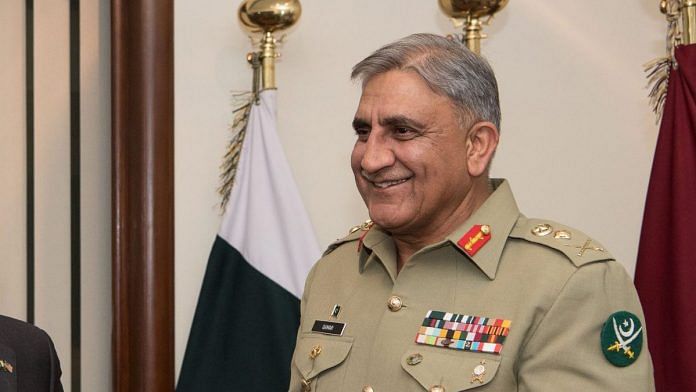
In this context CDS General Bipin Rawat’s worrying yesterday about the US-NATO withdrawal from Afghanistan creating “a vacuum” hints at the Indian government’s diffidence in dealing with an unfolding situation where India has lost none of its cards. This view is in contrast to his counterpart Pakistan COAS General QJ Bajwa’s “welcoming” US military pullout. Whatever the Modi regime thinks is lost with the US militarily out of the picture, Washington, Beijing, Moscow and Islamabad need to be made to appreciate that India — if it plays its cards right and that’s a big if considering Delhi increasingly takes its cues from Washington — has the power to be, if not the decisive actor, then a spoiler in any political arrangement in Afghanistan that doesn’t take India’s interests fully into account.
Q.1 There seems to be no breakthrough in the marathon 13-hour military talks that took place between the Indian and Chinese corps commanders last week. In fact, they did not even issue a joint statement this time around. Why was that the case?
A: The 11th edition of the talks between the Indian and Chinese theatre commanders ended as most of the earlier ones had done – without any progress at all. This was so, perhaps, because the two sides were asserting, in different ways, their respective positions that neither party was prepared to back down from, minimizing the prospect of negotiation by compromise.
Q.2.The PLA has not agreed to troop pullback from the contentious areas which include PPS 15,17 and 17A in the Hot Springs-Gogra-Kongka La areas where they have a sizeable troop presence in the rear areas. Nor are they willing to de-escalate in the Depsang area. What does this indicate?
A: It shows clearly the PLA’s intention to not withdraw from advantageous positions it is holding on to in terms of the Indian patrolling posts you mention and at the Y-Junction on the Depsang Plains while, at the same time, getting the Indian army to back down from terrain features benefiting it.
Q.3.The question repeatedly being asked is why the gains accrued by occupying the Kailash range and Trishul Heights were frittered away for a disengagement to take place in north bank of the Pangong Tso lake and not for concessions in the Depsang Plains?
A: This is the point I have been making from the time the Indian SFF first occupied he Kailash range heights in September 2020 last year that the one thing the Indian army should not do is surrender these high points for any reason but rather that the SFF and other units should strengthen and consolidate their hold of these favourable points.
Q4. From all indications it appears as though India is inclined to agree to the Chinese terms in Hot Springs and the Depsang Plains or so one would surmise by the interviews given to the media by the Northern Indian Commander where it seemed as though he were attempting to disassociate himself from this problem claiming the problem in the Depsang Plains predates April 2020 and therefore will is not part of the current round of negotiations So, are we willing to concede around 18 kilometers of territory occupied by the PLA?
A: This is a ridiculous stance for the Northern Army commander, Lt. General Yogesh Kumar Joshi, to take of disavowing whatever happened before he assumed his post and, even more astonishing, that he says he is responsible ONLY for what has occurred in the field AFTER he took over. The army commander, in other words, is willing to take “credit” for the linked withdrawal of the SFF-Indian Army troops from the Kailash Range heights and the PLA from Fingers 4 to 8 on the northern shore of the Pangong Lake – which has hurt the army’s relative military positioning vis a vis the PLA in that sub-area, but is quite content to have the Chinese stay put on the Gogra-Hot Springs and at the Y-Junction on the Depsang. And that, owing to his acceptance of the latter situation, he and his Command have signalled that they will NOT do anything to recover the nearly 1,000 sq kms of Indian territory thus lost, de facto, to the PLA. This sort of reticence should earn Lt. General Joshi, at a minimum, removal from service, unless these are the express orders from the Army Chief General MM Naravane who in turn, factually reflects the directive from Government of India to avoid a re-triggering of hostilities at all cost.
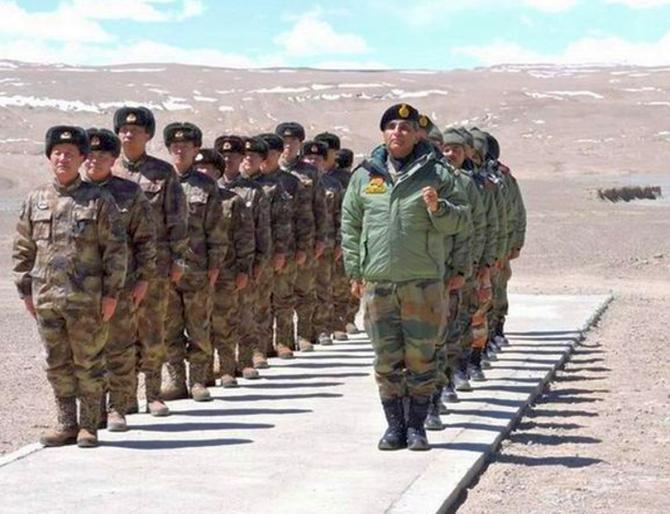
[Disengaging on the Pangong Lake]
Q5. Of course the government’s stand is that what was of priority for them was to ensure that the eye to eyeball troop confrontation between the two armies on the banks of the Pangong Tso lake be halted as this could lead to an escalation. With China being the aggressor, why should the Indian government / army have been so afraid of a confrontation?
A: This does not make sense. Why would the Indian Army be afraid of eye-balling the PLA on the Pangong and elsewhere in eastern Ladakh? After all, it is precisely an aggressive posture telegraphing that the Indian Army is quite prepared to give as good as it gets that will give PLA commanders and Beijing pause for thought.
Q6. Several defence analysts point out that it is obvious that the Chinese were not willing to disengage further because India has no leverage space with them and therefore it is unlikely they will reduce their troop concentration in eastern Ladakh. If that is the case, what will the consequences of this be for India?
A: India has no space to leverage PLA withdrawal because the Indian government and army have been remiss all these years in not proactively strengthening the vulnerable Indian posts or building up supporting infrastructure in selectively prioritized areas, such as Sub-Sector North, adjoining the strategic Karakorum Highway critical to both China and Pakistan because this Highway – GS 219 has a branch – China-Pakistan Economic Corridor, diverting south at the Karakorum Pass.
Q.7. Are these commander level talks trying to arrive at some settlement around the April 2020 incursion without addressing the entire border problem. Why did the government agree to sector by sector negotiations in Ladakh rather than negotiate it as a whole. By agreeing to do so, India has fallen into a trap laid by the Chinese. Why were negotiations not conducted across the entire area?
A: These mil-to-mil talks are a waste of time – have always been –and merely afford China an excuse to do nothing at the political level – Special Representatives level — which is where a solution will be hammered out.
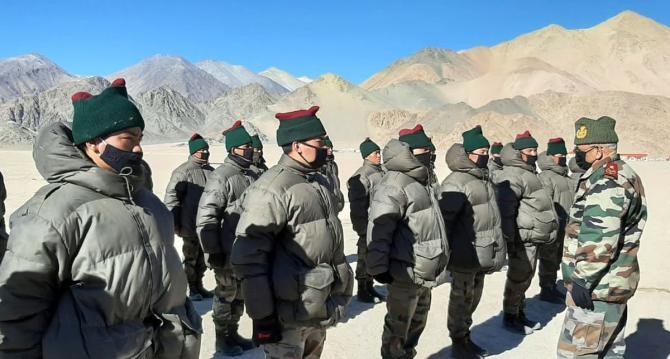
[CDS General Rawat interacting with troops in Ladakh]
Q.8 While Indian government has gone overboard on stating that there have been no Chinese incursions on Indian territory, a US military commander Admiral Philip Davidson has blown the lie on the Indian government face by stating that the Chinese PLA has not withdrawn from several `forward positions’ which they have occupied. This statement was not contradicted by the Indian government?
A: All the US Indo-Pacific Commander Admiral Davidson has done is repeat what I for one have been saying since the PLA armed incursions came to light in June last year. Nothing big there, unless it is to point out that the Indian government and media take something coming out of America more seriously than they do what’s being openly said by informed analysts here.
Q9. Does the statement of Admiral Davidson not contradict Minister of Defence Rajnath Singh’s statement in Parliament that we have made no concessions to the Chinese?
A: Of course, it does (if you lend Davidson’s words weight)
Q 10. India seems to have foregone their grazing rights in the Demchuk area with this land being occupied by Chinese Tibetan graziers. Ladakhis continue to complain against this but the Indian government has failed to take any action on the ground?
A: The record of Ladakhi graziers taking their herds to the Depsang Plains is strong evidence for India’s negotiating position, except it is now trumped by the PLA simply establishing their presence – something the local administration, Indian government and army should long ago have proactively done.
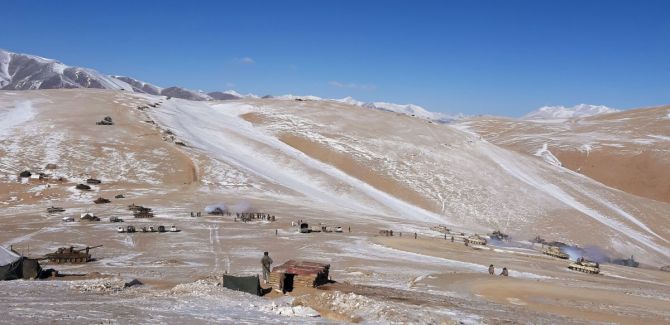
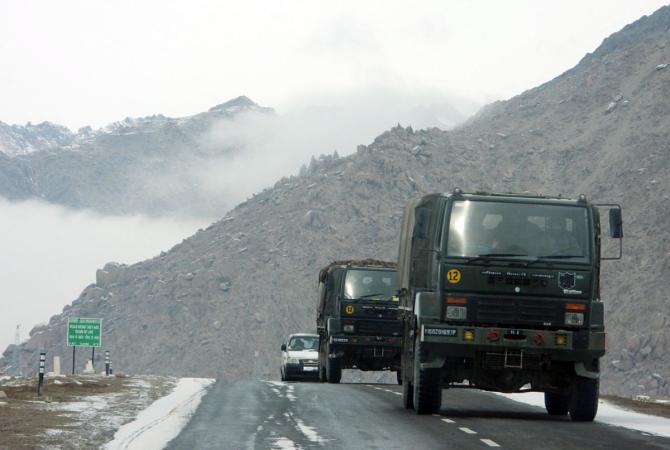
[Logistics fetching up]
Q11. Why has the issue of the massive failure intelligence failure highlighting the Chinese PLA build up not been acted upon?
A: The Indian government wakes up after the fact when it can do nothing, or rather lacks the will to prosecute military actions to reverse these adverse PLA-driven developments. Which ought to make everybody wonder what good, if anything, our numerous civilian and military intelligence agencies do
Q12. The fact that the Indian government is willing to make massive concessions means they understand that this is not going to impact the mood in the Indian army. India seems to have a history of making concessions whether it be in Tashkent of at the Simla Agreement. Which country cedes so much territory with no assurances on the ground?
A: The Indian Army brass is very much in sync with the GOI’s thinking and happy for the government to make concessions to China just so long as they do not have to actually fight the PLA.
Q13. Would it be correct to say the 35-year old treaty of the maintenance of peace and tranquillity along the LAC has been trashed to the dustbin of history. China wanted to teach the Indian political class a lesson for making claims that Aksai Chin and POK were all part of India and in response to their redrawing of Indian maps making such claims?
A: The peace and tranquility accord signed was a sham from the start, because it was a way for the Indian government, intel agencies and the military to avoid reorienting fully to the only credible threat India faces, namely, China.
Q.14. Would it be correct to state that our present leadership is more interested in playing to the domestic class rather than in pursuing policies that suit India’s geo political needs?
A: Not sure what you mean by “domestic political class”. Surely, no section of Indian society wants a dishonourable peace with China; and geopolitics has perennially been India’s overarching strategic weakness.
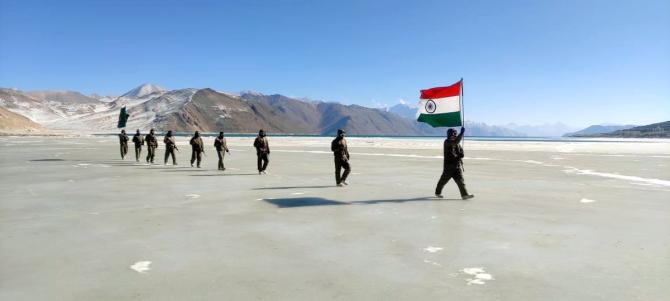
[Showing the flag on the frozen Pangong Tso]
Q15. In 2013, when the Chinese moved into Depsang Plains, India took a diversionary chunk of territory in order to get them to negotiate. Why was no attempt to put pressure on the Chinese this time around.
A: Two reasons: No political will, with Prime Minister Narendra Modi conflicted about how much to alienate President Xi and imperil the supposedly good personal relations the two have cultivated and the possibility of massive Chinese infrastructure investment. And inadequate military capability with the Pakistan-fixated army reluctant to commit its resources more fully to the extended China front.
Q.16. It seems to me that there is no hope of returning to status quo ante of April 2020? Is it correct that all the new buffer zones that have been created post April 2020 are now on the Indian side of our patrolling points?
A: By and large, true.
Q.17 To come specifically to the Gogra Hot Spring area, so you see any concessions?
A: Chinese, unlike Indians who can’t see beyond their noses, act always with the long view in mind. So, no, PLA is unlikely to concede on Gogra and Hot Springs, or remove its blockade of the Y-Junction in the Depsang.
For thirty years now I have been writing about the reasons why India needs to have heavy healthy scepticism when tackling the US, and why Washington’s record has earned it a high level of distrust. Except four successive governments under Narasimha Rao, Atal Bihari Vajpayee, Manmohan Singh and, since 2014, Narendra Modi, entirely unmindful of this history, have acted as if India is America’s peon.
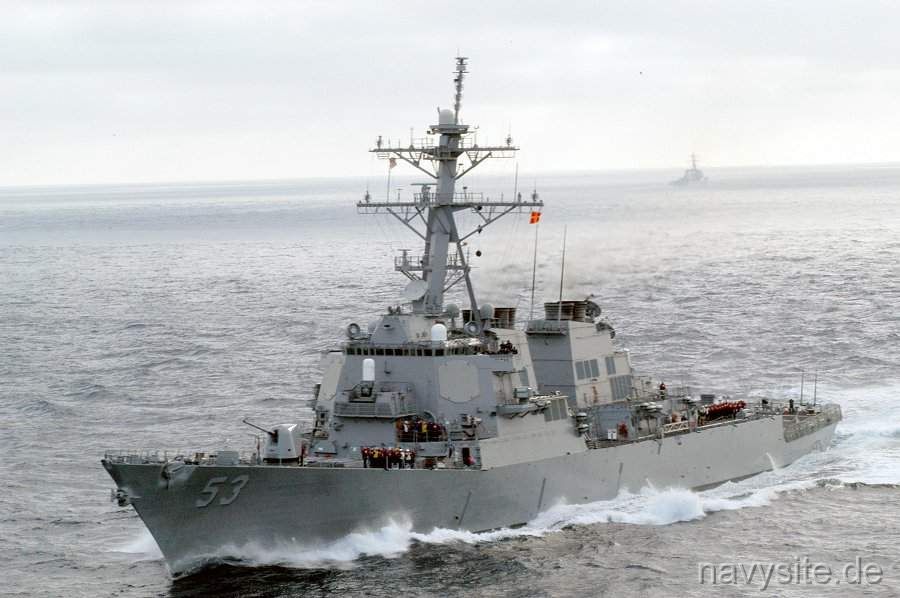
Given the high level of institutionalized US-leaning policy tilt of the Government of India spurred by a bunch of factors, such as most senior Indian diplomats and military officers having their children in America, being part of the American thintank (Carnegie, Brookings — now under another guise, Aspen) circus in Delhi pushing the US policy line, etc that I have been warning about, I am not at all surprised the Indian government is surprised by the US Navy alerting the world to the fact that one of its ships, USS John Paul Jones, an Arleigh Burke-class missile destroyer (DDG-53), had willfully violated Indian maritime territory, and sailed through the waters close to the Lakshdweep Islands without so much as ‘by your leave’, as courtesy demanded. It is as much this sailing as the egregious statement that followed about the ship asserting its right of untrammeled transit issued by the US government that is cause for worry.
The Indian Navy’s Information Management and Analysis Centre (IMAC), Gurgaon, tracking Jones in its eastward path from the Gulf area, was aware it had transgressed into Indian territory but did not raise a stink about it. India did not contest, and was not contesting, this ship’s passage. So why did Washington feel the need to make a public hullabaloo about this ship being on a Freedom of Navigation Patrol (FNOP), implying that by word and/or deed Delhi, in some sense, opposed it? That the FNOP reference also mentioned China, whose claims in the South China Sea and in the Taiwan Strait are regularly flouted by US carriers groups, flotillas, or single ships, makes this incident even more curious.
If India — America’s supposed ‘strategic partner’ in containing China, is equated by Washington, with China, then what does it say about where India stands vis a vis the US in the larger geostrategic game that’s afoot?
The US is not a signatory to the 1982 UNCLOS (UN Convention on the Law of the Sea). But, like every other international treaty-multilateral agreement within its eyeshot that the ridiculously shortsighted and idiotic Indian government, at the MEA’s behest, signs blindly without thinking about its longterm ramifications, the country once again finds itself holding the shortend of the stick. Delhi got quickly on board the UNCLOS without waiting for the US to first sign. Why was this last important? There’s the unresolved matter of the largest island, Diego Garcia, in the Chagos Archipelago claimed rightfully by Mauritius, a claim India has from the start backed. When Britain vacated the space ‘east of Suez’ in the 1970s it handed over Diego Garcia to the US, which promptly built a very imposing naval and air base on the island, complete with nuclear submarine pens, ship repair facilities, and vast storage tanks for oil and depots for prepositioned stores to sustain major military deployment in the Indian Ocean.
The prickly issue is two-fold: One, as it did elsewhere — partitioning India, for instance — Britain departed the area but not withhout doing prior mischief. It had no right to detach Diego Garcia from the rest of the island group, and even less right to transfer it to the US without Mauritius’ concurrence, which’s what it did. So, how’s the US presence on this island to be treated when America has no legitimate right to be there in the first place? India is well within its rights to treat the US presence on Diego Garcia as illegal, and act on this basis. And two, the US disrespects Indian claims off Lakshdweep extending some 220 kms out to sea as India’s Exclusive Economic Zone per UNCLOS that the US wants nothing to do with even as its representatives Secretary of State Anthony Blinken and Biden’s NSA Jake Sullivan crow about all countries needing to heed a “rule based order”! What’s that again?! So the US means to follow only those rules that serve its purposes, in which respect how is it different from China?
China signed this treaty on the same day as India did in December 1982. Except, as its shenanigans in imposing its nonseniscal ‘nine-dash’ exclusive claim line — which is ultra vires of UNCLOS provisions indicates, Beijing signs pieces of paper without intending in the least to respect them. This is in contrast to India’s attitude which signs damnfool agreements all the time and then, boy scout fashion, follows them not just in the letter but also in the spirit — doubly hampering the country’s pursuit of national interest.
Obviously, the sailing by DDG-53 was to rub India’s nose in the dirt and to let the Indian government know that the US will do damn well as it pleases torpedoing, in the process, even pretensions to sea-based order UNCLOS promotes and which the US champions in the South China Sea.
This puts the Narendra Modi regime in bit of a political pickle. Already buffeted by Congress party’s charges about corruption attending on the Rafale deal and anti-corruption provisions missing from the contract with the French company Dassault Avions, it now has to put up or shut up where the US is concerned. Modi must miss his fellow-Alpha male leader Trump in the White House with whom he had cultivated a working relationship. With the Biden Administration, the Modi government has had to face one insult and slight after another. Various US agencies have slammed his government for human rights abuses, pushed India down the list on the religious freedom count and Freedom House has rated India as only a “partially free” country, imposed counter-tariffs to hurt Indian exports, etc. This is bad enough.
But for the US to treat India as potential strategic impediment in the same class as China, is something else altogether. It undercuts Modi’s entire foreign policy centering on the US that has been vigorously pushed by the external affairs minister S Jaishankar, who as Foreign Secretary shephered the four foundational accords and earlier in his career as an MEA babu negotiated the completely unequal 2005 nuclear civilian nuclear cooperation deal that, by barring future testing, froze Indian nuclear weapons technology at the low yield fission level.
The operative part of these developments is this: The next time IMAC begins tracking US Navy ships and finds one heading towards Indian waters, Indian Naval ships will have to be ready to impose the UNCLOS rule of law to keep them out. The crunch will come when that US ship simply disregards Indian naval warnings, then what? What exactly will the Indian ships do in response — fire a missile across the bow of the American ship as a warning? What if the US ship counters by firing a salvo to miss the Indian naval ship(s), will the Indian ship(s) be ordered to escalate proceedings? Should the Modi regime and Indian Navy not be ready and prepared for such contingency?
If, on the other hand, the Indian government and Navy again do nothing, or plan on doing nothing, how can they respond differently if a Chinese warship does exactly the same thing? Meaning, the US ships are setting a precedent for other navies to violate Indian territorial seas at will. Already, India and Indian government have been shown up — nothing new here! — as weak, willing to take guff from anybody, because they are too spineless, too unwilling to court risk, to up the ante. To restate an old saw — with friends like the US, who needs enemies?
Look at the faces of the resting Naxal fighters in the pic above. What do you see? Weather-beaten, battle-scarred, lean and emotion-less faces, their sensibilities deadened by survival tensions and battle fatigue. These are young people just past adolescence, fighting for a cause they believe in but with resigned fatalism etched into their personas betraying no hope or expectation they’ll survive for long, but damned if they are not going to give it their all before going down!
It is such youth who followed Che Guevara and Fidel Castro into the Sierra Maestre mountains in Cuba before springing the revolution on Fulgencio Batista’s military junta in 1959, and were part of the anti-colonial force of the FLN (Front de Liberacion Nationale) seeking freedom for Algeria. They constituted the sharp edge of the Viet Cong, undertaking the most dangerous missions against US MACV (Military Assistance Command, Vietnam), and formed the most lethal element of Pirbhakaran’s Liberation Tigers of the Tamil Eelam (LTTE) that slam-banged the Sri Lankan military and almost singlehandedly drove the Indian “peace-keeping force” out of Sri Lanka.
And it is the Naxals led by their young charismatic commander in the Pirbhakaran mould, Madvi Hidma — “Area commander, People’s Liberation Guerrilla Army, Battalion No 1, of the Dandakaranya Special Zonal Committee of the Communist Party of India (Maoist)”, who could be the reason for the new Spring for Naxalism in the country, set as he is to head the party’s Central Military Commission that oversees all guerilla activity against the Indian state.
One thing the Indian government cannot allow to happen is for Hidma to grow his legend as Lord of the Red Corridor stretching from Andhra Pradesh, Maharashtra, Chhatisgarh, Jharkand, Bihar to the borders of Nepal — the route China uses to keep the Naxals amply supplied, besides support equipment like communications sets, satellite phones, and other paraphernalia, with Kalashnikovs and unlimited stock of ammo, needed to sustain a successful rebellion. Indeed, his reputation grows in tandem with the bounty on him announced by the State, which has inreased from Rs 25 lakhs a few years ago to Rs 40 lakhs now. The trouble is this: As any guerilla war primer will tell you it is the growing legend of a fighting leader that, more than any other factor, drives an insurgency. Think Che’ in Bolivia! Such a leader is the magnet drawing new recruits to the cause, an endless line of impressionable youngsters, and not just from the impoverished tribal hinterlands of Bastar, who have nothing to lose. Here can’t get the words of Janis Joplin’s counter-cultural anthem from the Sixties out of my head — ‘Freedom is just another word for nothin’ left to lose”! It is to the jefe maximo’s standard that the young will rally until Hidma’s repeated successes ensure that if the Naxals cannot prevail over the Indian state, they cannot be defeated either.
The core problem is the ‘Special Forces’ sent to overcome this menace, who are special only in name. Look at the pic of SF troops at their ease, below:
[Anti-Naxal Special Forces at ease]
What do you see? Well shod and accoutred, well-armed, fairly content SF troopers, each with a hint and more of belly that comes from eating well, being looked after well. It can be safely surmised from one look at such SF (in real life and pics) that they are about as capable of prosecuting decisive anti-guerilla actions as a bunch of pot-bellied Delhi traffic cops parachuted into the Sukma forests (where Hidma cut his teeth) would be!
What’s the problem? Well, for one thing, Hidma’s strategic mindset and tactical nous.
But, let’s start with the immediate situation the government has at hand. Hidma ordered his outfit to wipe out a platoon plus of SF troops — 22 killed, 30-odd injured — an action on April 3 in the forested badlands around Bijapur in Chhatisgarh state that resulted in four of his own cadre dead. This was an excellent outing in terms of exchange ratio, especially considering the Naxals also augmented their arsenal by 14 SF weapons and 2000 rounds of ammo — not a small haul for the guerilla! But, mindful of the Indian state’s perennial weak spot, he also instructed his fighters to capture at least one SF trooper alive as bargaining card. Hence, SF Constable Rakeshwar Singh Manhas is now a Naxal prisoner. Soon enough Hidma communicated, besides Manhas being in his custody, the demand for an official appointment of a mutually acceptable ‘mediator’. And Manhas’ photo in custody has been flashed by media outlets. What the Naxals have in mind to negotiate with, and to get out of, the Indian government, is not as important as how they have always operationally enjoyed the upper hand in the first place.
The Naxals are obviously aware of New Delhi’s ignoble record of capitulating to public pressure. The last time this sort of thing happened was when another BJP government, this one led by Atal Bihari Vajpayee, allowed Indian Airlines flight IC 814, ex-Kathmandu, to proceed unmolested to Kandahar in Taliban-run Afghanistan as demanded by the jehadis who had hijacked the flight on 24 December 1999. Vajpayee did so under pressure from hundreds of family members of the passengers on this flight gathered outside the 7, Race Course Road compound, streaming tears, hollering before TV cameras for their safe return. The government muffed another chance of bringing this sorry event to a close at Amritsar by failing to take measures to disable the plane when it landed for refuelling, presumably because Vajpayee’s commitment to save the lives of the passengers superceded the national interest and the anti-terrorism principle of never, under any circumstances or for any reason, negotiating under duress with terrorists, leave alone giving into their demands. It led to the release of Mahmood Azhar and a decade and more of heightened jehadi activity in J&K, which burnished India’s reputation as a soft-state led by soft-headed leaders who can be pressured into doing anything.
With this episode no doubt in mind Hidma has made his demand with Minhas as hostage. As if on cue, Manhas’ daughter and wife publicly and tearfully pleaded with the Indian government for their father’s/husband’s safe return. But all the brave words by Home Minister Amit Shah about a “befitting reply” and such other mush apart, the Indian government is once again up a creek without a paddle.
The main unit featured in this debacle is Central Reserve Police Force’s COBRA (Commando Battalion for Resolute Action). Methinks, some wise guy in the Home Ministry in 2009 when the battalion was being raised, thought up this fearsome name and then configured an appropriate acronym around it! It only underscores the reality that no one in the Indian government (or, going by the record, even in the Indian military) quite understands what ‘commando’ actually means other than as an appelation for some armed unit or the other in spiffy black dungaree uniforms, purple berets, equipped with special weapons to acquire which some babu must have signed off on.
The word commando is of Boer War (1899-1902) origin where the British rulers in South Africa discovered that the Dutch Boers (settlers) they were fighting were making monkeys out of the British forces in the field by operating in self-sufficient small units (the Boer called commando), which were agile, struck fast and hard and then melted away, and left immensely disruptive/destructive outcomes in their wake. Winston Churchill first used the word commando for the British Special Forces (Special Boat Service, Special Air Service, etc.) he established during the Second World War, which he hoped would function like the original Boer units. It is in this sense the word has since come into common usage.
So, who is Madvi Hidma and why does he terrorize the COBRA so?
[Commander Madvi Hidma — armed and in the field]
Hidma, it turns out, has built his reputation on the backs of the COBRA kind of rank-incompetent SF tasked to deal with the Naxals. Some 9-10 years ago I recall being asked by a paramil to contribute an article for their annual journal, or some such thing. I wrote then that they were going about it the wrong way in fighting the Naxals. Having solicited the article, the paramil brass, as far as I know, left it unpublishesd!
What I roughly remember writing, in essay form, was this:
(1) There’s by now ample evidence from all over the world of how effectively to neutralize guerillas.
(2) It requires a commando force that can operate in extremely small groups, living off the jungle, and entirely untethered from the logistics supply chain, in complete radio silence, armed with minimal weapons holdings — knives, and at most small arms with silencers and limited ammo for relatively soundless elimination of the guerilla opponent.
(3) The commando groups are best deployed in designated areas on the basis of as extensive as possible intel gathered from local informants and surveillance mechanisms and technical sensors, about the size of the guerilla force active in that grid area, about their kit, gender constitution of the group, their movement patterns, and the villages identified as sympathetic to the Naxals.
(3) Such commando groups should be out in the field for six months at a time, followed by 6 months off and conducting themselves in a non-splurgy manner with cover of decent jobs in distant cities that only allow for short home visits, etc. — precautions so as to not arouse curiosity among the local people.
In the field, they work incommunicado, and remorselessly to track and hunt down the guerillas following tell-tale signs (camp sites, cooking fires, etc) and execute them unarmed combat style or by knife, rarely using the silenced small arms for the kills, with the kill list prioritizing leaders and would-be leaders. Nothing is more demoralizing for the cadre than to have regular attrition in the leadership ranks.
Moreover, fighting and dealing with a foe who is just as mobile and fearless and with no set method in operations of warfare as themselves, is the most difficult thing for the guerillas to handle.
(4) The best commando are recruited from among the same local unmarried youth pool the guerillas hail from, and who are familiar with the terrain and the local lingo. Except they are given specialized training in SF camps far away from their areas of ops. And, most importantly, they are rewarded handsomely with hefty remuneration and should the operative die in action, it should be seen to it that a rich life insurance package reaches his/her family through indirect means, so the families — who are always kept in the dark about the dead trooper’s exact work — do not, in turn, become targets for vengeful Naxals.
The above is a bare sketch of how the entire anti-Naxal commando set-up ought ideally to function. How actually and amateurishly the COBRA, et al work is illustrated by the April 3 massacre. Let’s briefly deconstruct this event from newspaper reports.
Intel is received by COBRA of a top Naxal leader, possibly Hidma, holed up in the vicinity of a triad of villages — Jonaguda, Jeeragaon and Tekalgudum, located in an elongated U with their backs, as it were, to the hills.
No effort is made to validate and verify the intel so received, which is difficult to do any way given that the villagers are more in simpatico with the Naxals than with the police and the paramils, and in any case are Mao’s water in which the guerilla fish swim.
A force of some 1,700 security personnel is mobilized for a combing operation of this entire area on April 2. There’s no encounter, they find nothing.
Unbenownst to the COBRA SF-led contingent, Hidma had in days previous both cleared the three villages of its residents to avoid needless loss of life of locals which caring and thoughtfulness, in the aftermath of incident, will have won him goodwill and confirmed his standing with the locals. And, he brought in some 350 Naxal fighters from the extended area for this operation, and hid them — how? There’s his genius.
This last activity — the movement of such a large number of Naxals converging on the 3-villages vicinity is not detected by any police or COBRA or any other intel agency — that’s how effective they are!
On April 3, some 450 personnel detached from the larger 1700-strong anti-terrorist group that combed that sub-sector the day before, and now presumably on a mission to capture or kill Hidma, proceed towards these villages, and walk la di-dah fashion with eyes wide open quite literally into Hidma’s trap.
How this fairly large SF contingent advancing in dispersed mode, entirely missed the armed Naxals hiding in the approaches to the villages suggests just how careless and unconcerned these paramil troops were sauntering in, and why they simply did not expect the surprise attack by the Naxal fighters, who began firing at them from the rear over ground they had just traversed even as they faced Naxal fire from the sides and the front.
Once the SF bulk force was well inside the cauldron, for the Naxals it was a free fire zone with raking AK-47 fire, or picking off of the paramil troopers in the middle individually.
Even as this fire duel was underway, Naxals began closing the wide open side of the U — the fourth side — to prevent the trapped police from escaping, using this entry-exit channel.
In the intense exchange of fire the COBRA-led SF had no chance; the ratio of the dead and injured on the two sides reflects it — 55 SF to 20 Naxals for an attrition rate of 2:1 disfavouring the SF.
The obvious conclusion is these COBRA and other groups, far from displaying any commando skills or specialized training, were remiss in not following even common sense rules when engaging with the enemy in known Naxal-infested territory. They did not do the obvious thing of carefully and thoroughly vetting the intel on Hidma, and then equally deliberately moving through the lightly forested jungle landscape towards the villages, which action — had it been diligently carried out — would have ended up revealing the hidden Naxals which, in turn, might have sparked firefights but on a far smaller scale, with next to nil SF dead or casualties if the first ragged SF line advancing towards Jeeragaon had done their job professionally. Instead, confident that Hidma and his cohort were unaware of the fate awaiting them, the paramils advanced without sanitizing the approaches, and met their end.
The reason no state police or paramilitary organizations have a genuine commando is because nobody wants the onerous job of living off the land and tracking and hunting down the Naxals. Most paramil SF on anti-Naxal duty have to have their hot rations — daal-chawal fetched to them by a long and conspicuous logistics line, which also arranges vehicles to carry them in trucks to the edge of the jungle for them to disembark and fight. Such police forces are thus tied to the roads, leaving the rest of the countryside without proper connectivity as the domain for the Naxals to put down roots, indoctrinate the local people, and create a sympathetic and supportive milieu for them to operate in. So while the Naxals are kept well informed by the grateful local people about police movements and other relevant developments on their home ground, the grid for their potential ops is totally terra incognita to the SF troops armed with spotty intel when not fed straightforward misinformation as a lure in this instance.
It is also true that most of the troops selected for SF do not meet particularly rigorous standards and because they are mostly married men having children, are risk averse in extremis, and simply do not want to court any danger.
This is in sync with, and reinforced by, the risk-minimizing mindset of the top paramil leadership, which does not care to reside in the countryside or to lead from the front. This is because the top paramil ranks are exclusively officered, not by the force’s own officer cadre, but by officers on rotation from the Indian Police Service, most of whom acquire minimal policing skills and competence on the job over the years that are not always of high quality. Most such IPS officers, moreover, do not have their heart in the hard and dangerous job of fighting Naxals. After all, IPS officers are those who failed to get into the Indian Administrative Service, and usually have a chip on their shoulder. In any case, they are not hands-on managers of the counter-insurgency effort needed to make successes out of the anti-Naxal campaigns.
An example of a truly effective anti-insurgency commando are the units France fielded in Algeria in 1958-59 — the ‘commandos de chasse’ (hunting commando) with Algerian Arabs comprising some 60% of this force, who were so ruthless and bloodyminded in their actions, especially in the Arab quarter of Algiers — the casbah — that their killing sprees caused so much popular revulsion in France it compelled President Charles de Gaulle to announce Algeria’s freedom.
No Indian commando unit can ever function or be anywhere as effective and efficient in eliminating the Naxal threat as the French commando in Algeria were when tackling the FLN. But there has to be that level of intent and commitment to find from among the tribal people in the red corridor — like the Kuka Parey group of Valley Muslims the state funded in Jammu & Kashmir 20 years ago, whose members were the perfect foil for the cross-border jehadis — who believe in India enough to fight for it.
Absent such option, Naxalism will wax and wane but the Indian state will continue to fail to stamp it out. And Naxals will be the news fodder on the days they achieve spectacular success or, more routinely, when they blow up a culvert here or a transport carrying police with expertly engineered IEDs (improvized explosion devices) there, or when these police — innocents in Naxal-land — step on expertly placed mines on jungle paths, and get blown up.
To divert the attention of the public from their continuing failure to tackle Naxalism, the senior police leaders occasionally deploy helicopters borrowed from the air force to drop their “commando” in some wretched jungle clearing or the other, where the troopers will shoot up some trees and make a show of force, even as the no doubt amused Naxals — invisible to these police, watch on, itching to fire on the easy targets that the whirlybirds offer, and whose use only ends up directing the Naxals to the area where their vulnerable targets have dismounted and can be found!
What the government and the forces fighting the Naxal threat have to bear in mind and reconcile to is this reality that the young, recklessly bold, and highly motivated Naxal fighters are the only true commando in the field; and that subduing them is beyond the ken of the spurious commando proliferating in the state and central police.
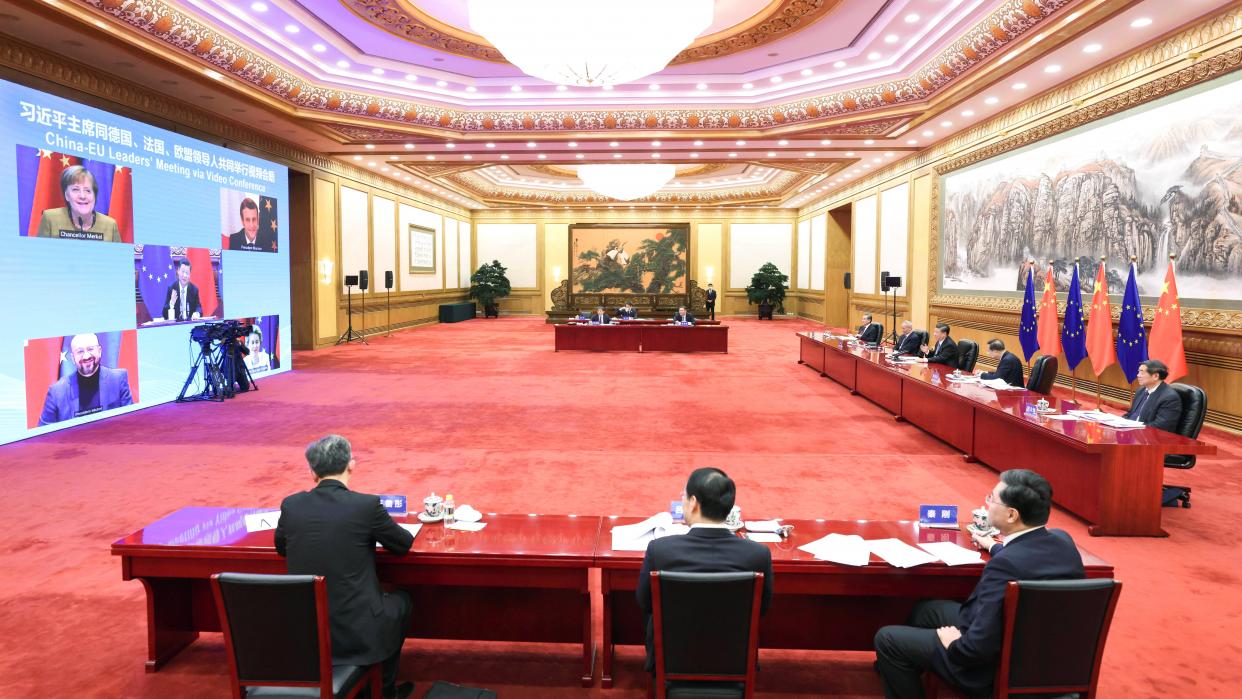
[The Dec 30, 2020 Virtual summit of Xi Jinping with European Heads of State]
Human rights is the new ideological divide in the coming Second Cold War. The confrontation between the Western Capitalist world and the Eastern (Soviet Union and China) Communist bloc was the centerpiece of the First Cold War that ended with the demise of the Soviet Union in 1992-93, with the free market-capitalist ideology coming out on top. It was around the time that China having got the measure of the US-dominated international system and benefitted from Chairman Dengxiaoping’s reforms which incentivized Western capital and manufacturing industries to set up shop in China and to gain from low labor costs and state subsidised infrastructure, such as ready-to-occupy factories and industrial parks (such as Shenzen outside Hong Kong) with nearly free supply of water, electricity, etc. and, at the demand end, unfettered access of Chinese manufactures to the wealthy American market, led to China’s rapid emergence in the new millennium as the workshop of the world, and its equally rapid rise up the economic rank-order of countries.
China did not abandon Communism. Rather, its imaginative leadership, starting with Deng, coupled the capitalist get-go spirit and native entrepreneurship with socialist state control that strengthened the Chinese Communist Party’s grip on Chinese society until now when, under the leadership of President Xi Jinping, it is no liberal haven but is economically firing on all cylinders even with a pandemic raging all over the world that US scientists now claim is due to the novel corona virus engineered as a biological weapon that escaped the confines of a government lab in Wuhan.
Human rights was not an issue in Sino-US relations during the Donald J Trump presidency. The focus then was more on strongarming China into leveling the playing field where bilateral trade was concerned, and closing down Chinese access to American technical research in a host of cutting-edge knowledge areas, ranging from nano tech to bio-electronics, high speed computing to data fusion, robotics to artificial intelligence, wherein Chinese high-tech companies, when not stealing classified research through cyber means disregarded intellectual property rights (IPR) and simply replicated high-end products and processes for its own market and for export. And it promulgated laws that compelled foreign companies, seeking to set up manufacturing hubs in China, by law to transfer their proprietory technologies whole to their Chinese partners — usually some Chinese state agency or the other in private sector guise. Alongside, the Chinese also helped its investors to buy off advanced technology Western companies and soon the Chinese tech sector not only got up to speed on the entire range of technologies but also pushed China into the forefront of tech-wise competent countries.
European firms were as much victims of China’s predatory economic and trade practices as American companies. But because Trump made a show of beating down China by himself and because he had sufficiently riled EU capitals by badtalking NATO and poisoning the cross Atlantc partnership generally, the rift between Europe and the US widened and China quickly exploited it. In end-December 2020 in a virtual China-EU summit there was agreement on cross investments, which is now on hold. This because the new US President Joe Biden, in the old presidenial mould, sought to revive a collegial relationship with Western Europe. And secondly, Xi’s China, a little too full of itself, began brazenly to, on the one hand, treat its minorities, especially the Tibetans in Tibet and Uyghur Muslims in Xinjiang with criminal harshness — ethnocide campaigns, concentration camps, etc, showing absolute contempt for human rights, certain its wealthy trading partners would rather make money off China than make an issue of mistreatment of these peoples and, on the other hand, to aggrandize disputed territories on land ( Ladakh, Bhutan) and sea (South China Sea, Senkaku/Diaoyu Island chain).
With the US-European consensus on dealing with China solidifying, the Biden Administration in continuation of the Trump line, has challenged Beijing on a host of issues, making it clear that a hard push was coming. Thus, for instance, China’s soft power arm — the so-called Confucius Institutes that the Chinese government had funded and set up on numerous university campuses in the US and Europe, are being shut down. Ostensibly, these institutes were there to spread Chinese language and culture; except they actually functioned as distant police posts of the Chinese state — keeping tabs on Chinese students, reporting on their public anti-China utterances, and even functioning as facilitators for the shanghai-ing of advanced research carried out on these campuses, among other nefarious activities.
The line between the two blocs was formally drawn at Anchorage in Alaska March 18 where the US Secretary of State Anthony Blinken and the Chinese foreign policy chief Yang Jiechi got into a slanging match with a lot of finger-wagging at each other, with the latter — referencing the January 6 insurrection in Washington DC, the institutionalized ill-treatment of Blacks, violence against Asian-Americans and minority communities in America, newly promulgated laws in various states within the US to make voting difficult for these people, all of which renders nonsensical the theoretical democratic rights enjoyed by all Americans — telling Blinken that China will have none of the Yankee notions of democracy and human rights. And by way of an ‘in your face’-measure, Beijing announced the elimination of elected government in the erstwhile British colony of Hong Kong. Beijing then upped the ante, responding to US sanctions on Chinese Communist party notables of Xinjiang held responsible for the excesses against the Muslim Uyghurs and on the export of Xinjiang-grown cotton — an economic lifeline for that province, by counter-sanctioning US officials and unleasing a domestic campaign against buying Western goods.
Sino-US relations were, in any case, headed south fast. The US Navy is reviving a separate fleet for the Indo-Pacific — the 1st Fleet, and increasing its freedom of navigation patrols in the contested waters of the South China Sea. US Secretary of Defence Lloyd Austin’s recent swing through Asia, other than to find a way out of the Afghan imbroglio, was to firm up a pan-Asian coalition against China. More active than ever before, the Chinese Navy is now using swarming tactics with supposedly civilian vessels to crowd out fast patrol boats and corvettes of the navies of the Philippines and Indonesia, and of Japan around the Senkakus.
These are large geopolitical developments. But underlying them is the human rights and democracy divide alluded to earlier. China and its main strategic partner, Russia, make no bones about their polities not giving a damn about individual rights and freedoms. The West led by the US, on the other hand, make a fetish of them and, ignoring the fairly deplorable state of affairs at home, seek hypocritically to make these issues something of a litmus test. It is hard to impress anyone with such blatant two-faced policy that amounts to using the relative low state of human rights and slide in democratic order as a means of harrassment and diplomatic pressure.
It is in this melee that India finds itself gingerly traipsing around the edges. The problem for the Indian government is this: It cannot credibly claim that excesses are not routinely committed in the country against religious minorities (Muslims), and Dalits and the other lower castes, that the National Register of Citizens in the borderlands of Assam and in the Northeast is not an inherently discriminatory device to select people for conferment of citizenship and the benefits that accrue from such status, or that the Indian State is becoming more illiberal in terms of freedom of expression, and less tolerant of criticism. The US-based Freedom House has accummulated evidence, collated data, and based on this trove of information concluded that India is slipping badly in the democratic sweepstakes. It formally downgraded India from a “free” country to “partly free” — which is really bad considering just how much the Indian government invests in India’s democratic status to finagle all manner of considerations from the West, and specifically in the fight against China. And what must have really hurt the Prime Minister was its assessment that “The changes in India since Modi took charge in 2014 form part of a broader shift in the international balance between democracy and authoritarianism, with authoritarians generally enjoying impunity for their abuses and seizing new opportunities to consolidate power or crush dissent.”
India’s plunge down the freedom list will be diplomatically used to pressure countries such as India sensitive about their ‘democratic’ credentials. Modi’s India has reacted to such slippage by threatening to have its own human rights commission evaluating developments in the US and other countries in the West. This is no bad enterprise to launch to keep discussions with Western governments on an even keel. The ability to counter US/European charges of disrespect for human rights, etc in India by trotting out the obvious patterns of discrimination against “foreigners” and coloured minorities of all stripes makes for a handy cudgel to hit back with. But if the Modi government is really serious about such a counter then an Indian human rights council or commission will have to be constituted as a permanent body that looks everywhere, keeps tabs on all countries. And it will have to publish reports on a regular basis with facts marshalled in an orderly fashion accompanied by sober analysis. Considering most Indian official agencies are a mess, the prospects of such a thing working are dim.
Absent such an institutional counter, the Indian government can do little else than hope that the official soft-peddling of criticism will suffice in pushing the human rights abuse issues to the background in bilateral dealings with the western countries. It can also try and divert attention by making common cause with the West in reprimanding Asian and other countries falling short on democratic and HR metrics. This has obvious dangers that India is now facing with Delhi going a little overboard in admonishing the military junta in Myanmar, for instance. This is bound to have negative repercussions for India and tighten China’s stranglehold on that country. Shedding its initial caution on the displacement by the military junta in Myanmar of the Aung San Suu Kyi-guided government, it suddenly turned around and came out publicly and shrilly against the increasing violence in Yangbon. Instructed by the Jaishankar-ministered MEA, the Indian permanent representative at the UN Security Council, threw India’s support behind the US position and a neighbour under the bus. Rather than limiting himself to urging “maximum restraint” on both sides — which “evenhanded” stance the Myanmarese junta would have appreciated, he formally condemned the military’s violence against the Myanmarese people, no doubt much to Yangbon’s annoyance and Beijing’s delight. It instantly earned India a place in the junta’s doghouse. One wishes Modi’s MEA had left the treatment of Aung San Suu Kyi, et al alone and said nothing at all. Crucifying a neighbouring state for democratic shortfalls sets India up for precisely the kind of political shellacking it has sought to avoid on the receding democracy-front. Because it will not prevent India from being roasted by the American and European do-gooding agencies. So why deliberately shove your hand into a beehive as Delhi has now done on the Myanmar issue and be surprised at being stung?
This sort of unthinking policy to win a reprieve from the US only hurts India’s national interest while increasing the American leverage on Indian foreign and military policies. Myanmar is but a symptom of the larger malaise afflicting the country in the external realm where between China, relentlessly pushing its advantage, and the US, just as strongly motivated to enlarge its “democratic” camp by hook or by crook, India becomes the passive subject of assault by both sides.
The Modi government would be better advised, and India better off, if with China on his mind, Modiji rethought the path he is set out on of aligning closely with Washington — a line that Jaishankar is pushing hard, and instead worked to recover India’s “strategic autonomy”. Regaining such autonomy will not in any way prevent the country from cooperating militarily and otherwise with the US and other interested states to hogtie China. What it will preclude is this tilting to the US position on any and everything as a policy reflex that potentially has high cost in the short, medium and long term. China will try and screw India at every turn for any reason — just because it can, to extract advantage. The Modi government is now ensuring that the US too will punch India around, also because it can and because it wants Delhi to toe its line.
But unlike in the 1950s when India got up everybody’s nose, in the Second Cold War that’s beginning, there’s no Krishna Menon in our ranks rhetorically to skewer China for its genocide in Tibet and Xinjiang, or show up America for its democratic pretensions, and otherwise dance expertly around the human rights minefield. Krishna Menon was a “pain in the ass” for everybody and no one did more harm to the Indian military and the cause of national security than he. But he was also the only Indian diplomatically feared by everyone for his waspish tongue and “take no prisoners”-debating style that frequently reduced those he targeted into angry incoherence.
On his return from Dhaka, where he’d be immersed in Bangladeshi goodwill that comes from the flowering of very good relations with an adjoining fellow-South Asian country, Modiji should contemplate the equally good returns that are there for his taking if only he shakes the hand of friendship proffered by the main man in Pakistan, army chief, General Qamar Javed Bajwa, and ends, once and for all, the intra-mural and squably India-Pakistan relationship — an ongoing absurdity.
Just how absurd is reflected in the fact of two Punjabi Jats, a Bajwa leading the Pakistan Army, and a Sidhu (Air Chief Marshal Zaheer Ahmad Babar) the Pakistan Air Force! While not rare, it is uncommon, in Pakistan for Punjabis converted to Islam however long ago, or recently, to retain their original family names. That the families of the current Pakistani COAS and CAS have managed to do that suggests the resilience of old social identities even under pressure to conform to newer realities. And should someone care to dig deep enough these two broods would, I reckon, find their Sikh cousins across the border. [Could the General, I wonder, be related to my best friend from school days, Harjit Singh Bajwa, a brilliant engineer officer who, but for brain cancer cutting him down in his prime, would almost certainly have made it as one of the youngest to reach Rear Admiral rank in the Indian Navy?]
Cousins of different faiths living side-by-side was not uncommon in old India. My late mother-in-law originally from West Punjab — a ‘Malik’ and native of Miani, Sargodha District, was fond of recalling from her childhood days the ‘Malika-da-darwaza’ (Gate of the Maliks) beyond which lived the community of Maliks — Hindu families on one side of the mohalla street, Muslim Maliks, on the other side, with children running in an out of homes on either side and adults doing the normal to-ing and fro-ing while preserving prejudices and practising their respective religious restrictions! Thus, it was quite normal during each other’s festivals for the Hindu and Muslim Maliks — keeping in mind mutual sensibilities –to exchange gifts of food in the raw form — wheat, rice, vegetables, dry fruit, etc., to allow the usually same dishes to be cooked and eaten according to different norms. She remembered Hindu Maliks having a separate set of crockery for when their Muslim relatives visited them!! This may seem ridiculous, but that was the way it was.
Such snatches of sentiment cannot, however, figure, other than tertiarily, in the calculation of national interest, in which respect, the India-Pakistan tangle is an especially hard nut to crack. Still, as I have argued in my books and other writings, the recovery, even if in a loose form, of the unitary subcontinental space for longterm strategic stability and economic progress is an inescapable geopolitical imperative, whatever the naysayers among the religious right, the military and strategic enclaves, and the media commentariart, on either side may say.
Except, Gen. Bajwa has indicated his willingness to take the Pakistan army out of the nyet camp and give peace a chance! In his March 17 address on the second day of the first ever International Security Conference in Islamabad — which the Pakistani policy establishment hopes to see emerge as counterpart forum to the Raisina Dialogues in Delhi, made a straight forward pitch for peace and why India and Pakistan need to go beyond the mindless hostility their relations are mired in.
But what did Bajwa say? And why shouldn’t what he — at the apex of the singularly powerful army and central pillar of the Pakistani state, said be taken seriously as it needs to be? The good thing is that the Modi government has eased up on its relentless demonizing of Pakistan, a process begun with the UAE, as mediator, urging the two sides to talk out the differences. Modi visited Dubai and was feted, and I had written then that the special consideration shown him — permission to build a temple, promise of investment in India, etc. — were a means for the Emirates to develop leverage, and which lever was now used. The Directors-General, Military Operations, of both sides talked in late February and agreed strictly to keep the peace on the LoC, and Modi then made conciliatory moves (Covid vaccine, etc). This was the appetizer.
One, while deeming the resolution of the Kashmir dispute as central to peace in South Asia, and asking Delhi to “create conducive environment” in J&K he, unlike Prime Minister Imran Khan, made no mention of the restoration of Article 370 and the status quo ante as pre-condition.
This leaves the field clear to revive General Parvez Musharraf’s scheme that Prime Minister Manmohan Singh almost accepted in 2007 as template for an amicable agreement. It will, in effect, freeze the existing territorial division of the erstwhile princely state of Jammy & Kashmir, with the fig leaf of a joint mechanism to oversee Kashmir affairs put in place. It will be a salve for Pakistan’s amor propre but not change the reality on the ground in that while Kashmiris on either side will be free to travel to the other side, they will require their identity papers to be stamped/registered at the border posts thereby reinforcing the territorial separation and sovereignty principle. Pakistan benefits because it gets to keep, besides Pakistan-occupied Kashmir across the Neelam River, the “Northern Areas” — Gilgit, Hunza, and Baltistan, now crucial to CPEC, and India retains Jammu, the Valley, Ladakh and the Saltoro Ridge. There was no talk of “self-determination”, perhaps, because a referendum in Baltistan could see the shia majority opting for India!
The chief positive of this Musharraf scheme is that the Pakistan army is fully on board, which fact, minimizes the value of such opposition to this compromise as may be voiced elsewhere in the Pakistani society
Two, Bajwa extolled “rule-based” order, one that, he said, may help India and Pakistan to escape “the acrimony and toxicity of the past”. Because the rule-based order mechanism most agitating Pakistan is the UN FATF (Financial Assistance Task Force), which tracks money flows to terrorist organizations and outfits — a great many of whom are located in Pakistan. That country has been on the FATF Grey List for a long time and barely avoided being heaved into the Black List which would have automatically triggered killer economic sanctions — the one thing Pakistan simply cannot afford to have happen. True, Pakistan has been protected by the US and the West, but should Islamabad fail to end its financial and other support to the terrorist gangs masquerading as social welfare organizations, its protectors may feel compelled to bring down the boom. That could write finis to Pakistan’s trade and attempts at economic development. A shrinking economy will mean a bigger slice of a progressively smaller economic pie for the Pak military, or a smaller slice of a flatlining economy — in either case, the Pakistan army takes a hit. What this means is that the Pakistan army will err on the side of extreme caution before deploying terror — an asymmetric means of warfare it has had considerable success with against India in Jammu & Kashmir. In other words, Pak-sponsored terrorist incidents may no more be on the Pakistan army’s menu. At least for the nonce.
Three, Bajwa said that Pakistan intended to leverage its geostrategic location to become “a bridge between civilisations and connecting conduit between the regional economies.” Note, he thus implicitly acknowledged India’s standing as a civilizational state, along with China, and how he expected Pakistan to be the medium, a way station, for transactions of all kinds between “West Asia” and “East Asia”.
And finally, and most importantly, the General stated that “despite the rising security challenges” Pakistan was not involved in an arms race and its “defence expenditures have rather reduced instead of increasing”. It is an indication that GHQ, Rawalpindi, now believes that Pakistan (1) has conventional and nuclear capability sufficient for any contingency featuring India, and (2) does not need to react to India’s military build-up against China, even though some of these new dual mode capabilities can be switched to the Pakistan front. In other words, the Pakistan army has reached satiation in terms of the national expenditure directed to service the military’s needs.
Incidentally, the basic point underlying Bajwa’s offer of peace is the fact that the Pakistan army no more considers India potent, primary, national threat. Relying on China to back it materially in an unexpected crisis with India, GHQ, Rawalpindi is more sanguine and at peace with itself than ever before in terms of dealing with India. But Bajwa’s predecessors — Generals Raheel Sharif and Ashfaq Kayani had repeatedly declared to the media that the danger to Pakistan was not anymore from India but from terrorists operating inside the country. That this was not iterated by Bajwa suggests the Pak army thinks it is beginning to get the better of such unfriendly outfits as Tehreek-e-Taliban Pakistan, and the Baloch freedom fighters roiling the internal security situation within the country. This from Pakistan’s point of view is a great improvement.
But to revert to Bajwa’s desire for amity, the main course in the rapprochement process will ultimately be the deal hammered out by the diplomats. A lot of the negotiating work has already been done, and the MEA and the Pakistan Foreign Office need only dust off the notes, memoranda and files from 2007. The dessert would be Modi and Imran meeting, ideally, on the occasion of the first match, in Delhi or Lahore, in a resumed cricket series when the entire subcontinent would have tuned in, signing the peace accord, then proceeding to the stadium for a little “chai pe charcha” as the ball is bruited about. Thereafter, the two leaders can repair to their respective corners to await the announcement of the shared Nobel Prize for Peace which last (per this script), is certain!
Writing this post a few hours before the US Defence Secretary Lloyd Austin touches down in Delhi and begins his meeting with Defence Minister Rajnath Singh. Washington has already indicated the line it will take to compel the Indian government to do what it desires, namely, cancelling the S-400 air defence system deal with Russia.
Austin will use the one-two punch — the soft left jab followed by a hard right, to use an old boxing metaphor.
In both instances — the jab and the right cross will be attributed to US Senator Robert Menendez of the Senate Foreign Relations Committee who, here, is playing the villain. The soft jab is the supposed US concern with Human Rights violations in India, and Austin’s opening will be with the senator’s statement that the Defence Secretary will “raise democracy and human rights concerns in your discussions with the Indian government” and how the Indo-US “partnerhip” “is strongest when based on shared democratic values [which] the Indian government has been trending away from…”.
This has to be countered by Rajnath Singh telling Austin in as clear a language as the defence minister’s MEA minders can muster that the Biden Administration would be better advised to look inward and work on addressing the reasons for the breakdown in the democratic order in the United States — as mirrored in the insurrection by religious bigots and ideological exremists — and how this is endangering the lives of immigrant communities in America, and why the Indian government fears Indian immigrants may be next in line for such victimhood. And further — to give the dose of the same democratic medicine to the Biden Admin — that Delhi will be closely monitoring the developments in the US.
Next, Austin will use Menendez’s threat of sanctions if India does not resile from the S-400 deal, to indicate that President Biden’s hands are tied were the US Congress, in fact, to use this Russia contract as the prompt for harsh action against India. “If India chooses to go forward with its purchase of the S-400, that [](Countering America’s Adversaries Through Sanctions Act] will clearly constitute a significant, and therefore sanctionable, transaction with the Russian defence sector under Section 231 of CAATSA. It will also limit India’s ability to work with the US on development and procurement of sensitive military technology. I expect you to make all of these challenges clear in conversations with your Indian counterparts,” Menendez apparently wrote to Austin on the eve of the latter’s visit to various Asian states.
Far from acting intimidated, Rajnath Singh, in the best Uttar Pradeshi tradition of responding to a threat with a counter threat, should tell Austin in no uncertain terms that this isn’t the Cold War period of the 1950s, and in the fight against China the US needs India as much, if not more — and stress this last — than India needs the US, and so while the US Government is free to take whatever actions it deems fit, the Indian government in service of its national interests WILL not let an external power dictate which country it wants to cultivate, or what it buys from where by way of armaments and military goods. And that Austin better understand what the exchange here is. And if the US government follows through on the CAATSA threat issued by the likes of Menendez , Washington should expect an equal and opposit reaction from India — for starters the voiding of the four foundational accords, and the potential loss of the Andaman-Nicobar staging area that the US Air Force, for one,has been eyeing with considerable interest. And that India’s Quad cooperation, that much is being made of, is also at risk.
Here Rajnath should not listen to the habitual queasy appeasers and collaborators should the S Jaishankar-led MEA advise conciliatory language. MEA have already spoiled the situation for the country vis a vis China, and if given the chance, will make India grovel before America, China and any other country that begins throwing its weight about.
The best results are obtained and respect won with the US when plain language is used, one without obuscation or any hint of mealymouthedness that could be misread by Austin and his advisers as a tendency to flinch — something they can exploit.
The trouble with Delhi has always been it doesn’t hold to the true North on a compass of national interests. Time for Rajnath and for Prime Minister Narendra Modi to understand and appreciate that the manner of correctly dealing with the Americans has not been learned by MEA or government interlocuters dealing with Americans, and to remind Austin and the Pentagon what’s at stake.
Results of the Austin trip will show if the Modi government caved in, or stood its ground.
US Secretay of State Anthony Blinken and President Biden’s National Security Adviser Jake Sullivan]
The leading members of the new Joe Biden Administration — US Secretary of State Anthony J Blinken and National Security Adviser Jake Sullivan will, for the first time, touch base with Yang Jiechi, director of China’s Office of the Central Commission for Foreign Affairs, and Chinese Foreign Minister Wang Yi in Anchorage, Alaska, on March 18. This meeting will be in the wake of the virtual summit last Friday (March 12) of the head honchos of the Quadrilateral — Narendra Modi, Joe Biden, Yoshihide Suga and Scott Morrison, and of Blinken and US Defence Secretary Lloyd Austin’s visit to Tokyo and Seoul scheduled for March 16-17. That China agreed to this first meeting being held on “American turf” is considered an aspect of the U.S. approaching China, per the White House Press Secretary Jen Psaki, from a “position of strength” and “in lockstep with our allies and partners.” This suggests that the issues the Quad partners are supposedly in “lockstep” on were at least notinally discussed at the Quad virtual summit.
The main achievement of the virtual summit, however, was elsewhere, in the agreement on the division of labour to get the Quad’s Covid-19 ‘vaccine diplomacy’ to outmatch China’s global efforts, underway. According to this schemata India will use its production facilities to produce the vaccine at a fast clip at low cost, the US will facilitate the transactions with due regard to intellectual property rights, etc for Indian pharmaecutical companies to mass produce the latest remedy in the field — the Johnson & Johnson one-shot vaccine and otherwise prepare it for speedy world-wide distribution, Japan will financially underwrite such commercial deals as are involved in joint manufacture, and Australia will pitch in with assistance in vaccine delivery systems.
Other than on the vaccine, the four leaders also decided to cooperate on what was referred to as “critical and emerging technology” areas, chiefly 5G telecommunications technology sector. China has taken the lead in terms of commercializing 5th-generation equipment but now finds itself stymied by a whole bunch of previous customer countries rejecting Huawei (and other Chinese company-produced) gear out of the reasonable security fear about deeply embedded electronic bugs prospectively activated by the their PLA masters that could hold hostage the communications networks of various countries. While there was a reference to strengthening India’s defence industrial base, there was no specificity about the US sharing any sensitive military technology with India, or any such thing. In the event, this issue is likely to go the way the DTTI (Defence Technology and Trade Initiative) has gone over the last 20 years, which is no where!
Blinken and Austin’s discussion with the Suga government will, logically, be around two issues: the increased presence of Chinese warships and fishing trawlers in the contested waters off the disputed Senkaku (Diaoyu for the Chinese) Island chain The numbers of Chinese vessels of all kinds in this East Sea area tripled in the period 2012-2020. The other issue concerns the protection provided by the Japanese Maritime Self-Defence Force (MSDF) to the US Navy’s 7th Fleet staging out of Yokohama, and US Air Force combat aircraft operating out of Japanese bases. This more proactive use of the Japanese military muscle was made possible by the “reinterpretation” ordered by the previous Japanese prime minister Shinzo Abe in 2014 that led a year later to the famous ‘Article 9’ of the country’s ‘peace Constitution’ being stretched to legalize this more offensive use of Japanese forces.
What the Suga regime will want to be reassured about is the extent to which Tokyo can depend on US naval and airforce assets attached to the 7th Fleet to buttress Japanese MSDF activity in defence of its Senkaku interests against the Chinese PLA Navy (PLAN). The Japanese government will want to work out a very clear understanding with Blinken and Austin about what exactly to expect by way of American military support and help should the simmering crisis with China begin to boil. The tension will be between what Tokyo would ideally like with respect to maximal deployment of US forces and what the Biden Administration is actually willing to commit to in the context of Washington’s less combative attitude to Beijing now than when Donald Trump was in the White House.
The Blinken-Austin duo’s conferring, across the Sea of Japan, with the South Korean regime of Moon Jae-in would be of a completely different character. Unlike the Suga cohort seeking more intensive US engagement on the Senkaku dispute, the high American officials will be wanting an iron-clad promise from the Moon Jae-in government to not be tempted, or get lured, by the North Korean leader Kim Jong-un’s play for rapprochement at the expense of the US thinning out its militaryforces from South Korea. It is a deal that a large section of the South Korean population pining for, if not reunification than, normal relations, support.
What transpires in the Blinken-Austin rounds with Suga’s and Moon Je-in’s representatives is the baggage Blinken and Sullivan will carry to Anchorage in their meeting with Yang Jiechi, the top Communist Party man and overseer of China’s foreign policy who, incidentally, outranks foreign minister Wang Yi. But what is the Biden template for the US’ China policy?
President Biden in his address to American diplomats at the State Department on 4 February ahd this to say regarding China: “We’ll …take on directly the challenges posed by (sic) our prosperity, security, and democratic values by our most serious competitor, China. We’ll confront China’s economic abuses; counter its aggressive, coercive action; to push back on China’s attack on human rights, intellectual property, and global governance.” This would have been encouraging had it not been for the wishy-washy stuff that followed. “But we are ready to work with Beijing when it’s in America’s interest to do so”, he explained. “We will compete from a position of strength by building back better at home, working with our allies and partners, renewing our role in international institutions, and reclaiming our credibility and moral authority, much of which has been lost. That’s why we’ve moved quickly to begin restoring American engagement internationally and earn back our leadership position, to catalyze global action on shared challenges.”
A month after Biden’s speech, Blinken in his first address (March 3) as boss to an audience at the State Department, embroidered the President’s statement. “Our relationship with China”, he declared, “will be competitive when it should be, collaborative when it can be, and adversarial when it must be….The common denominator is the need to engage China from a position of strength.“ This could well be the mantra that the other Quad foreign ministers S Jaishankar, the Australian Marise Ann Payne, and the Japanese Toshimitsu Motegi and their governments will readily subscribe to as well. In the main, because it allows each individual Quad state an awful lot of slack in defining when their country needs to be competitive, collaborative or adversarial! It also reflects and reveals the greatest weakness of the Quad. It relates to Washington’s opting out on any issue dear to the other three individually or collectively. Thus, without the military resources of the kind that the US can muster being available, the remaining Quad states could find themselves left high and dry in a contingency or crisis involving China.
In any case, the Biden Admin is moving cautiously. Referring to the proposed meeting with Yang Blinken clarified that “This is not a strategic dialogue. There’s no intent at this point for a series of follow-on engagements. Those engagements, if they are to follow, really have to be based on …tangible progress and tangible outcomes on the issues of concern to us with China.” These “issues of concern” over which the two sides have, according to the White House Press Secretary Jen Psaki, “deep disagreements” are, specifically, China’s “coercive and unfair economic practices,” the “crackdown in Hong Kong”, and “human rights abuses in Xinjiang”; and more generally America’s “concerns about challenges [China] pose[s] to the security and values of the United States and our allies and partners”. Psaki talked “about areas where we can cooperate, of mutual interest” without spelling out these areas but hinted that these may have to do with upholding “the rules-based international system and a free and open Indo-Pacific.”
And in this regard, Blinken stated that “China is the only country with the economic, diplomatic, military and technological power to seriously challenge the stable and open international system — all the rules, values and relationships that make the world work the way we want it to.” He then referenced the Pentagon “task force” constituted by Biden to “work quickly, drawing on civilian and military experts across the department to provide within the next few months the recommendations to Secretary Austin on key priorities and decision points so that we can chart a strong path forward on China-related matters”. This task force is to be chaired by Ely Ratner, a longtime Biden aide installed as Defence Secretary Austin’s adviser, who prefers the competitive (rather than the collaborative or adversarial) approach to China. This may or may not be reassuring to India.
What the Modi government will definitely be more wary of is the Biden Administration’s strident tone on two other sets of issues — trade & economic policies, and democracy and human rights. As regards the first set, Blinken reiterated the Trump line on domestic investment, in-sourcing and employment generation. “Our approach” will involve, Blinken said, fighting “for every American job and for the rights, protections, and interests of all American workers.” So, say Good Bye to the prospects of Washington encouraging US companise to invest in India or to move their manufacturing facilities to this country! And stressing on Biden’s favourite theme, Blinken talked about “Shoring up …democracy [as] a foreign policy imperative“. “Otherwise”, he added, “we play right into the hands of adversaries and competitors like Russia and China, who seize every opportunity to sow doubts about the strength of …democracy. We shouldn’t be making their jobs easier.“ But, he repeated Trump’s line against foreign interventions by the US but in a slightly different guise. “We will not promote democracy through costly military interventions or by attempting to overthrow authoritarian regimes by force” he added. “We’ve tried these tactics in the past. However well-intentioned, they haven’t worked. They’ve given ‘democracy promotion’ a bad name, and they’ve lost the confidence of the American people.”
As far as as India is concerned it leaves a great many foreign policy balls up in the air not least that matter about whether and under what conditions the four Quad countries will join in pursuing competitive, collaborative or adversarial strategies vis a vis China. This will be the great sticking point on which the Quad could render itself immobile. And then there’s the question of how long it will be before the Biden Government, prompted by the progressive element in the Democratic party led by the likes of Congresswoman Pramila Jayapal, will make Kashmir and the eroding respect of the Modi regime for human and democratic rights the rock on which the ship of Indo-US relations will crash. There are enough signs already that that point will not be long in coming and, in any case, a clash is inevitable in the context of the Modi government’s reaction to the negative Western assessment of Indian democracy.
The US-based Freedom House last week downgraded India from “free” to “partially free” status. And the V-Dem Institute in Sweden deemed India less an “electoral democracy” than an “electoral autocracy”. Apparently, Modi has been hurt to the quick because in his travels to America and elsewhere in the West in the past few years, he has basked in the glow of massive electoral victories at home. This is reflected in Jaishankar’s waspish reaction over the weekend. Per news reports this is what he said: “You use the dichotomy of democracy and autocracy. You want the truthful answer — it is hypocrisy. Because you have a set of self-appointed custodians of the world, who find it very difficult to stomach that somebody in India is not looking for their approval, is not willing to play the game they want it to be played. So they invent their rules, their parameters, they pass their judgments and then make out as though this is some kind of global exercise.”
These are fighting words and the BJP government better be prepared for even closer scrutiny and criticism of its record on the human rights front by Washington involving US Congressional Hearings on the subject of a democratically sliding India. Jayapal and others will be in the forefront of pressuring Modi regime onto the right and narrow path they deem democratic and that could mean, you guessed it, sanctions in some form or the other even if Biden himself would be loath to go this far considering how alienating India could lose America strategic traction in the Indo-Pacific. Still the Western democratic purists may decide that this price is worth paying.
Then what do you reckon the Indian government will do? Because such things as attempts by Washington to win brownie points with Delhi, like including India in the US-hosted talks for peace in Afghanistan as rival to the Russian-led negotiating effort from which India is excluded, won’t help.
China’s approach to conflict resolution is unique. It works because it is surrounded by countries militarily weaker than itself and/or unwilling to up the military-political ante. First step: It uses force to change the status quo on the ground. Second step: the new territorial fait accompli is then legalized spuriously by some “law” or new rules and regulations the Xi regime issues to endow this initial status quo-changing action with post-facto legitimacy. Step Three: Beijing then uses this new territorial reality and supporting laws, etc. to demand that the victim nation adjust to the new reality on the ground so obtained by the Chinese military, and exercise restraint for the sake of order and stability!
The Xi cohort has had considerable success with this approach because the victimised states fall into the trap of accepting the new ground reality and doing what’s asked of them.
China has repeatedly pulled this three-step , besides eastern Ladakh, in South China Sea and in the East Sea. In the context of the supposed “disengagement” in Ladakh that, incidentally, has left the People’s Liberation Army units still in place on the Depsang Plains and in control of the Y-Junction, the Chinese Foreign Minister Wang Yi was at his oiliest.
Deliberately disregarding the fact that successive Indian governments in their desperate desire for peace on the disputed border have taken Beijing at its word, studiously followed Chinese instructions, accepted Chinese pre-conditions, and engaged in endless fruitless discussions at various levels,including at the Special Representative-level involving Indian NSA, Ajit Doval, designed to wear out the other side, Wang on the occasion of the National People’s Congress adopted an avuncular tone at a media event last Sunday. “It is important the two sides manage disputes properly” he said, “and at the same time expand and enhance cooperation to create enabling conditions for the settlement of the issue.” Having spouted this nonsense he then revealed that Beijing had neither moved from its original stance nor in its intention to impose its expansive claims on India. He used his reference to the Galwan incident last summer to say that “the right and wrongs at (sic) what happened at the border area last year are clear, so are the stakes involved.” He akso asserted China’s commitment “to settling the boundary dispute through dialogue and consultation” but without compromising its claims because “we are resolved to safeguarding our sovereign rights.”
But apprehensive about India finally responding more consequentially to Chinese provocations in South Asia such as its deep inroads into Pakistan, Nepal, Sri Lanka, and even Bangladesh, by transferring Brahmos supersonic cruise missiles and other armaments to Asian states (Philippines, Vietnam, Indoensia, etc) contesting Chinese claims in the South China Sea, and firming up purposive partnerships in the Indo-Pacific — such as the Quadrilateral, a concept that falls owing to the proven unreliability of the US as partner but which the Modi government seems anamoured with, Wang warned of the negative impact of the Indian reaction on Sino-Indian friendship! Love such gall!! “China and India are each other’s friends and partners, not threats or rivals”, he averred. “The two sides need to help each other to succeed instead of undercutting each other. We should intensify cooperation instead of harbouring suspicion at (sic) each other.”
Obviously, Wang and his foreign policy team in Zhongnanhai are convinced the Indian government is a fool and will, once again, play it, and do China’s bidding. And, who is to say, they are wrong? After all, the Indian forces — steered “expertly” by the China Study Group (CSG) and MEA — withdrew post haste from the high points on the Kailash Range without requiring the PLA to reciprocate in like terms, didn’t they? The PLA pullback eastwards from Finger 4 to the Sirijap plains on the Pangong Lake shoreline can almost instantly be reversed by motor-mobile Chinese troops using metalled roads to reoccupy all the Fingers up to the Indian Dhan Singh Thapa post on Finger 3. Will the Indian Special Frontier Force commando be able to as quickly regain, unmolested, the highpoints on the Rezang La-Rechin La Ridge?
Then again, the geniuses in CSG and MEA didn’t discern the historic pattern (outlined above) in the Chinese policy in Ladakh and evidenced elsewhere as well. Like in the South China Sea. Had they done so and alerted the Indian military, the latter’d have been better prepared for, and not been surprised by, the PLA moves in eastern Ladakh in April-May 2020. So now mull over what Wang said vis a vis the South China Sea.
“Countries in the region and around the world in recent years can all see clearly that the factors for instability and security risks in the South China Sea come mainly from outside the region,” Wang said, referring to the US naval ships, including nuclear aircraft carriers, loitering in the sea expanse within the ‘9-dash line’. Such American sailings almost dared the Chinese Navy to do something and thus establish an operational baseline. The Chinese Navy did not rise to the bait. Instead Wang lied saying China and ASEAN had reached common understanding on maintaining peace and stability in the South China Sea. The truth, however, is that there is no understanding and agreement that Beijing itself has not repeatedly violated. It did not deter Wang from charging the “the US and some other Western countries” with thereby creating “instability in the region”.
In a similar situation with regard to the Senkaku (Diaoyu) Island chain in the East Sea, he responded to Japan’s concerns about a new Chinese law permitting its Coast Guard to fire on ships not respecting Chinese territorial claims on the sea by assuring Tokyo that that law was not targeted at any particular nation, especially not Japan.“The key to Sino-Japanese relations is to have perseverance, and not to let short-term events cause disruption,” he clucked soothingly.
The prompt for Wang’s statements was seemingly US President Joe Biden’s promise to beef up US military presence and security arrangements involving traditional allies and partners in the Indo-Pacific, and the upcoming virtual meet Washington has scheduled with Narendra Modi, Yoshihide Suga, and Scott Morrison, heads of government respectively of the three other member states of the Quadrilateral — India, Japan, Australia, a loose grouping Wang has dubbed the ‘Indo-Pacific NATO’. “An improvement in Sino-Japanese relations”, Wang concluded, “would be mutually beneficial for our people and regional stability and peace. It should not be taken for granted and we should treasure it.”
It is clear what Delhi must do. As I have long maintained, assuming that strategic mindset and sensibility are absent in the Indian government, members of the CSG and MEA should stop taxing their little heads and simply emulate China strategically, do what Beijing does which is this:
Step 1: Stop talking about how the Indian army CAN occupy vantage points along the Line of Actual Control, including sites well inside Chinese claim lines, and task the army to do precisely that, without losing time, in short, surrepititiously occupy these strategically located high points.
Step 2: Play up the 1962 Resolution of Parliament, which has force of law; better still, legislate a new law — call it ‘Restoration of Territories Act’, to sanctify all actions, steps and measures implemented to restore the India-Tibet border as existed in 1950 when the PLA invaded and occupied Tibet, and voice the country’s determination to implement bother the letter and spirit of this law, and call out Beijing to respect Indian sovereignty and to not heedlessly jeopardize the traditionally warm and friendly relations between the two countries by resorting to any precipitate actions leading to the breakdown of peace, etc. and here MEA can do what it does best — wax abstract, rhetorical, whatever. In Mandarin.
Step 3: Accelerate the buildup of infrastructure and forces on LAC buildup, and enlarge the system of provisioning and logistics system to enable sustained warfighting. After all, now with two offensive mountain corps (I and XVII) in the field a far larger, longer and stronger supply chain becomes necessary.
Step 4: Forward deploy nuclear-tipped short and medium range Agni ballistic missiles in Ladakh theatre as tripwire in case a conventional Chinese military advance gains traction. And pre-warn beijing about the Agni missiles and talk of them as a like response to the augmentation of Chinese SRBMs and MRBMs on the Tibetan Plateau — the densest such concentration outside the Fujian coast opposite Taiwan.
Step 4: Quite literally dump bunches of the Brahmos supersonic cruise missiles on priority basis on the militaries of all countries disputing Chinese claims on the South China Sea, including states that have not sofar been active/aggressive in advancing their claims — Brunei and Malaysia. And make the deals for the Brahmos unrefusable by making them available at low to very low “friendship prices”. This will require the tripling and quadrupling of Brahmos missile production. This can be facilitated by handing over the job to the more productive and efficient private sector. And along with these missiles should be sent, as per the deals, Indian army artillery teams to operate and service these Brahmos batteries and to train host country crews
As advocated in my 2018 book (‘Staggering Forward’), this single measure of bulking up littoral and offshore Southeast Asian states with the Brahmos missiles will “narrow the seas” to the Chinese Navy’s detriment and the advantage Beijing thinks it has gained by constructing new islands out of coral reefs, sand and cement mid-channel will be instantly neutralized. Because now Chinese warships passing through these narrower waterways on either side of these ersatz islands will be easy targets for the coastal Brahmos batteries of numerous nations. It will have the effect in crisis of bottling up the powerful Chinese South Sea Fleet in its Sanya base on Hainan Island.
Step 5: While all this is taking place, Delhi should take the offensive in bewailing the record of Chinese aggression and its history of inhumane activities, including the ‘ethnocide’ of the Tibetan people in Tibet and, in recent years, the Uyghurs in Xinjiang, and take their case to the International Court, etc. At the same time, MEA should weekly enjoin Beijing to not let any of this spoil bilateral ties, and to even out the playing field for Indian companies in the Chinese market.
Step 6: Ask of Chinese companies what Beijing asks Western companies in China to do — sell in the Indian market but only on the condition that they transfer the technology-set whole — designs, source codes, and process and manufacturing technologies to Indian government certified Indian commercial entities. And not permit them to escape this obligation by doing what Huawei is trying to do now after the imports of its 5G system was banned. Correctly reading the atm nirbharta campaign as a sham — the Huawei India head says the company would be happy to jointly manufacture all its 5G telecom equipment in India by transferring its “production nodules” to an Indian firm — which is another way of saying — screwdriver tech. No way, Jose!
Such are the sort of steps India must implement to take the game to China on the pain of being driven from the Asian strategic field altogether. But will the Indian government, even in these dire circumstances, do any of this? Nah!
2021 is India’s turn to chair and host the BRICS (Brazil, Russia, India, China, South Africa) summit. These are annual meetings held in rotation by the heads of government of a group that was self-consciously knitted together as counterweight to the US and West-dominated multilateral organizations and as peer influencer of global affairs. That more details about the 15th summit are being withheld suggests there is trepidation within the Indian government.
Prime Minister Narendra Modi is hoist with a dilemma. Of course, he would like to convey the impression to the world that, under his management, all’s well with India, and to use this event to project normalcy. Except there is a serious downside, especially with the Chinese government cock-a-hoop about getting the better of India in the underway military disengagement agreement in Ladakh and with President Xi Jinping preparing to grandstand at the BRICS forum on Modi’s turf!
Consider this. Delhi’s summit announcement was almost instantly welcomed by the Chinese Foreign Ministry as an occasion “to consolidate the three-pillar cooperation” that China is committed to. The “three pillars” being “policy and security”, “economy and finance” and “culture and people-to-people exchanges.” With a strong military and economy, Beijing expects to continue dominating BRICS. To prevent the Indian government from backsliding on the summit decision that Beijing believes helps China’s international standing, Qian Feng, director of strategic research at the elite Tsinghua University, harped on the contradictions in Modi’s foreign policy. He pointed out to Global Times, a Chinese Communist party-controlled newspaper, how India uses BRICS to both “enhance its status as a major power and participate in global governance” and to “better balance the country’s diplomacy” tilted towards the US-run Quad. Had India conspicuous gains to show from this forked stance, Modi would have won Beijing’s respect for “riding two horses” at the same time. Alas, the Indian government seems unable to get atop either horse!
This much is clear from the conversation last week between foreign minister S. Jaishankar and his Chinese counterpart Wang Yi on the partial de-escalation in Ladakh. While there was pullback of forces in the Pangong Lake area, with the Indian Special Frontier Force troops vacating the heights on the Kailash Range, the issue of the Chinese People’s Liberation Army (PLA) ending its blockade of the Y-Junction on the Depsang Plains to prevent Indian patrols from accessing the strategic Indian territory northwest-wards of it, was not even on the agenda. Far from restoring the status quo ante the Ministry for External Affairs was aiming for, it amounts to India, in effect, ceding some 1,000 sq kms to China. It is a situation Beijing means to perpetuate, and was the reason for foreign minister S. Jaishankar’s calling his Chinese counterpart Wang Yi last week. Except Wang did not relent even a bit, sticking to Beijing’s position that the bilateral relations should not pivot on resolving the border dispute! All the give has been on Delhi’s part, leaving India militarily worse off than before the disengagement began.
The problem is India’s perennially timid approach that has freed-up a hard-nosed China to pummel India at will. Meanwhile, to silence even a squeak of protest from Delhi about the territorially skewed military disengagement, Beijing has dangled the carrot of increased investment, hoping it will also deter a frustrated Modi from choosing hard options, such as arming states on the Chinese periphery with Agni rocket systems and nuclearized Brahmos cruise missiles as a belated tit-for-tat gesture for China’s equipping Pakistan with nuclear weapons and delivery systems. Absent such Indian counter-mesures Xi and his cohort feel confident of having their way with the usual soft-headed Indian leadership.
It is time to arrest India’s strategic drift by weaponizing BRICS and the Quadrilateral comprising the four Indo-Pacific powers – India, Japan, Australia and the United States. In the first instance, by pulling the BRIS states in this group into a loose security coalition to contain an over-ambitious China of which Russia too is apprehensive. And, in the second case, by forging a modified quadrilateral – ‘mod Quad’, by getting a bunch of capable Southeast Asian nations, such as Vietnam, Indonesia and Philippines fronting on the South China Sea to replace the US; and easing the latter into its traditional role as an extra-territorial balancer. Donald Trump’s presidency proved just how unreliable an ally America really is. President Joe Biden’s “Indo-Pacific czar”, Kurt Campbell, is reinforcing that posture by voicing his opposition to militarizing any conflict with China. The strategic logic of BRIS and Mod Quad is that countries proximal to China with the most to lose have the biggest stake in containing this menace.
So, what to do with the upcoming BRICS summit? Tweak it by downplaying the affair and ensuring Xi is not accorded any special treatment. Further, under no circumstances should Modi seek a one-on-one meeting with the Chinese supremo; MEA should hum and haw if the Chinese request one. The idea is to undermine the half-risen BRICS edifice and simultaneously to raise the stock of the security-oriented BRIS – an idea whose time has come and which Modi should explore with Presidents Vladimir Putin of Russia, Jair Bolsonaro of Brazil and Cyril Ramaphosa of South Africa.
If a meeting with Xi becomes unavoidable, Modi should remind him that the principle of reciprocity requires Beijing to accept the ‘One India’ concept, inclusive of the erstwhile princely state of Jammu & Kashmir, including Gilgit, Hunza and Baltistan, in return for Delhi not disavowing the ‘One China-two systems’ concept, and to demand genuine autonomy for Tibet – the original basis for India’s acknowledging Chinese suzerainty over this ethnically and historically distinct nation that has been subjected to “ethnocide” using means Beijing now deploys against the Muslim Uyghurs in Xinjiang.