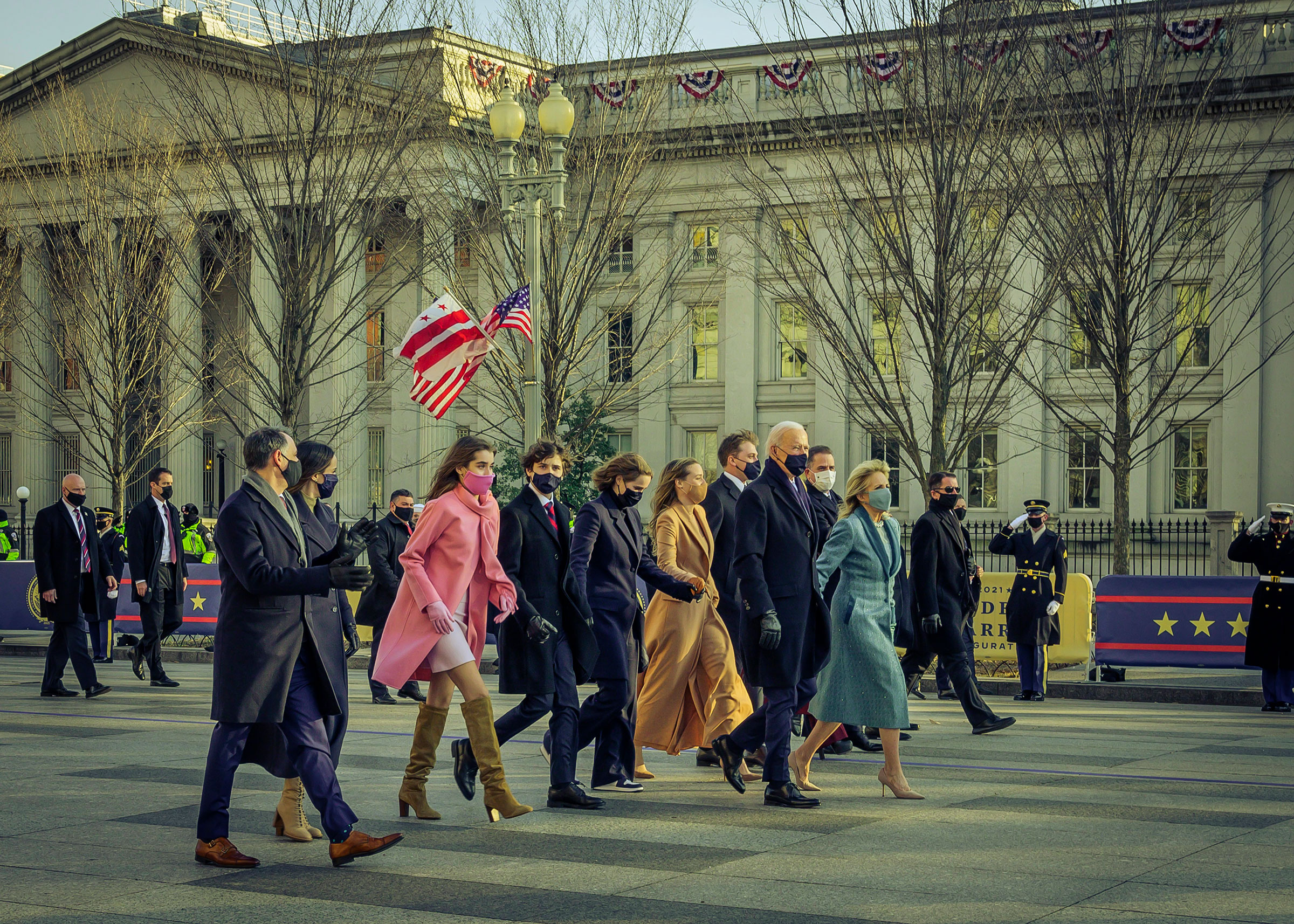
[Biden and family walking down Pennsylvania Avenue after the President’s swearing-in ceremony]
Times of India newspaper in its Friday feature — ‘Times Faceoff’ — in which experts with opposing views debate an issue, the former Foreign Secretary Shyam Saran and I had differing perspectives on the topic ‘Will Indo-US ties improve under the Biden Administration’. It was published in today’s edition, at https://timesofindia.indiatimes.com/articleshow/80560705.cms
————————-
Every time there’s a change of government in the United States, there is kneejerk reflex here. The incoming Administration is judged trivially by how many Indian-Americans are appointed to high positions. Because President Joe Biden has over 30 of them in important posts compared to Donald Trump, who had less than a dozen, Biden is deemed good for India! More seriously, the theme of two partner democracies, their values and visions in sync, cooperating to strategically constrain China is trotted out. But things aren’t that simple.
American politics is historically divided into two schools and “styles” — paranoid and liberal. The former is angry, nativist, and exclusionary; the latter more open-minded, inclusivist and inclined to engage with the outside world, and are represented by Trump and Biden, respectively. Usually, US policies reflect aspects of both corpora of thought. Thus, Biden is as intent, as Trump ever was, for instance, to revive the industrial base at home and generate employment by getting American and international companies that sell their goods in the US to relocate their manufacturing plants to America, and to incentivize “in-sourcing” as a means of preventing well-paying jobs in high-technology sectors from migrating abroad. This means that for Biden easing up on the H1B visa channel benefitting Indian techies that the Narendra Modi government has been pushing is not a priority; legalizing the status of 11 million undocumented workers in the US, mostly from Latin America, is.
The democratic fellowship thesis, moreover, works better as rhetoric, not when Indian and US national interests clash. Sure, the four actions by the Biden Administration targeting China – inviting the Taiwanese envoy to the inauguration, confirming Trump’s deal with Taipei for 100 Harpoon anti-ship missiles and a bunch of mobile extended range land-attack missiles plus reconnaissance and surveillance drones and sensors worth $4.6 billion, deploying a nuclear aircraft carrier task group to the Taiwan Strait and the South China Sea, and labelling the Chinese pogrom against the Muslim Uyghurs in Xinjiang “genocide”, are reassuring. Intended or not, they distract Beijing from focusing on Ladakh.
But juxtapose these moves against the new defence secretary retired General Lloyd Austin’s call for “strategic patience” with China and similar conciliatory noises emanating from elsewhere in the Biden Administration and the conclusion is unavoidable that because the US has lots to lose in actual military hostilities, it may indulge in show of force but will happily fight the Chinese to the last Indian, the last Taiwanese, or the last Japanese. At least Trump was honest in advertising America’s unreliability as ally or strategic partner when he counselled Tokyo to have its own nuclear arsenal and to fight its own fight with China for the disputed Senkaku Islands.
Following that logic, an Indian inventory of tested and proven high-yield thermonuclear armaments obtained by resuming nuclear tests coupled with the threat of contingent first use will permanently neuter the China threat. And, transferring strategic-warheaded missiles to countries on China’s periphery as belated payback for Beijing’s nuclear missile arming of Pakistan in the 1980s, will effectively secure the Asian littoral and offshore ramparts. Except, the Biden foreign policy aims to further non-proliferation goals, which will prevent India from doing any of this, and to realize the Comprehensive Test Ban Treaty, which will result in Washington pressuring India to sign it. As India has all but abjured nuclear testing courtesy the 2005 civilian nuclear deal with the US, Delhi is half way there already; whence cajoling it to walk that last mile won’t be difficult.
After all, the US knows the Indian government buckles easily under flattery or pressure and Indian negotiators habitually give up a lot in return for little as long as India is patted for being a “responsible state” and the carrot of an albeit non-veto permanent seat in the UN Security Council is dangled.
The danger, however, is greatest on the Human Rights front because the charge of Muslims and Dalits being systematically discriminated against in India resonates with Biden’s thinking about empowering the hitherto disenfranchised minorities and the underclass in America. The influential Democrat Congresswoman Pramila Jayapal, whom foreign minister S. Jaishankar refused to meet with last year, has frequently flagged the issue of human rights abuses by Indian government agencies. Laws in BJP-ruled states relating to beef eating, “love jihad”, etc. are grist for her mill.
Indo-US relations are heading into a squall, the Indian government better batten down.
Joe Biden’s razzle-dazzle inauguration as US President — Hollywood out in full force, the fireworks — is harbinger of normalcy, which was distinguished by its absence in the last four years of Donald Trump’s occupation of the White House when American policy, because impulsive, and often whimsical, became unpredictable enough to destabilise the world. While a return of normal is, therefore, to be welcomed, for Indo-US relations it meansWashington’s reverting to traditional balancing act however much the incoming American Administration might protest there’s no going back to a rehyphenation of India and Pakistan in the US scheme for South Asia in the future.
If there was any doubt, it was removed by retired Lieutenant General Lloyd Austin, the US-Secretary of State-deignate at his confirmation hearings in the US Senate yesterday. Pakistan, he asserted, “is an essential partner in any peace process in Afghanistan [and] will play an important role in any political settlement in Afghanistan.” Further, indicating he has bought fully into Islamabad’s position he commended Pakistan for taking “constructive steps to meet US requests in support of the Afghanistan peace process. Pakistan has also taken steps against anti-Indian groups, such as Lashkar-e-Tayyiba and Jaish-e-Mohammed, although this progress is incomplete”. He added, as an afterthought, that “I will encourage a regional approach that garners support from neighbors like Pakistan, while also deterring regional actors, from serving as spoilers to the Afghanistan peace process.”
This warning to Delhi against interfering in the so-called peace process in Afghanistan couldn’t be clearer. This is the reason why I had said in the last post that NSA Ajit Doval’s recent semi-secret trip to Kabul would evince US demands for an explanation. Here the Afghan Vice President Amrullah Saleh’s straightforward take on Doval’s quick turnround flight to confer with the Ashraf Ghani regime, that he “Had a pleasant meeting with NSA Ajit Doval of India. We discussed the enemy. It was an in-depth discussion”, may initiate a contentious discussion with the US.
By way of a sop to Delhi, Austin in a pro forma fashion mentioned he “will press Pakistan” to prevent its territory from being used by militants or other violent organisations” and said he would continue to build relationships with Pakistani military to “provide openings for the United States and Pakistan to cooperate on key issues”.
In my December 12 post (“Panda panderers at State and Pentagon”) I had flagged just why Austin, the four star general who retired as commander-in-chief, US Central Command in-charge of the US military in Afghanistan, and soon to be US Defence Secretary, owing to his long association during his theatre command with General Qamar Bajwa and his cohort, would naturally tilt towards Pakistan.
Austin also indicated that punitive measures against Pakistan would be off the table, saying “many factors in addition to the security assistance suspension may impact Pakistan’s cooperation, including Afghanistan negotiations and the dangerous escalation following the Pulwama attack.” It is hardly to be wondered then that Islamabad is ecstatic with these new developments, with high Pakistani officials talking about the situation for the first time “advantaging” Pakistan and, hence, moving quickly to setup a formal high-level meeting with the now suddenly more empathetic regime in Washington.
What’s important to note is that the “head in the sand” approach of the Indian media resulted in no major newspaper or outlet reporting Austin’s testimony at his confirmation hearings. One can only hope the Indian embassy in Washington and Modi’s MEA are not, likewise, in ostrich mode, and are aware about just how bad things can actually get for Delhi, and have begun working on counters. Such as repairing the frayed relations with Moscow and cultivating Russia as counterweight on priority basis. And keeping India’s hand warm in Afghanistan’s affairs in the manner that Doval has been doing, and include in the menu for the Ghani government ramped up transfers of military hardware — longrange guns, ammunition, and attack helicopters.
For starters, America at the UN Financial Assistance Task Force meetings in Paris will be less insistent about getting Pakistan on the ‘Black, list’. So the pressure on General Qamar Bajwa’s GHQ, Rawalpindi, to ease off on cross-border terrorism will be considerably lessened.
Much worse, Austin has articulated a more cautious approach to Asia, calling on the US government to show “strategic patience” with China. So, it is not just India, but all of America’s traditional allies and strategic partners — Japan, South Korea, Philippines, Singapore, and even Indonesia which’s on the cusp of partnering the US, who need to worry, because accommodating Beijing could mean Washington cutting myopic narrowly self-serving deals with Xi Jinping.
The immediate effect of these new wrinkles in US policy will be the definite activation of India’s two fronts. Not sure the Modi government is prepared for it.
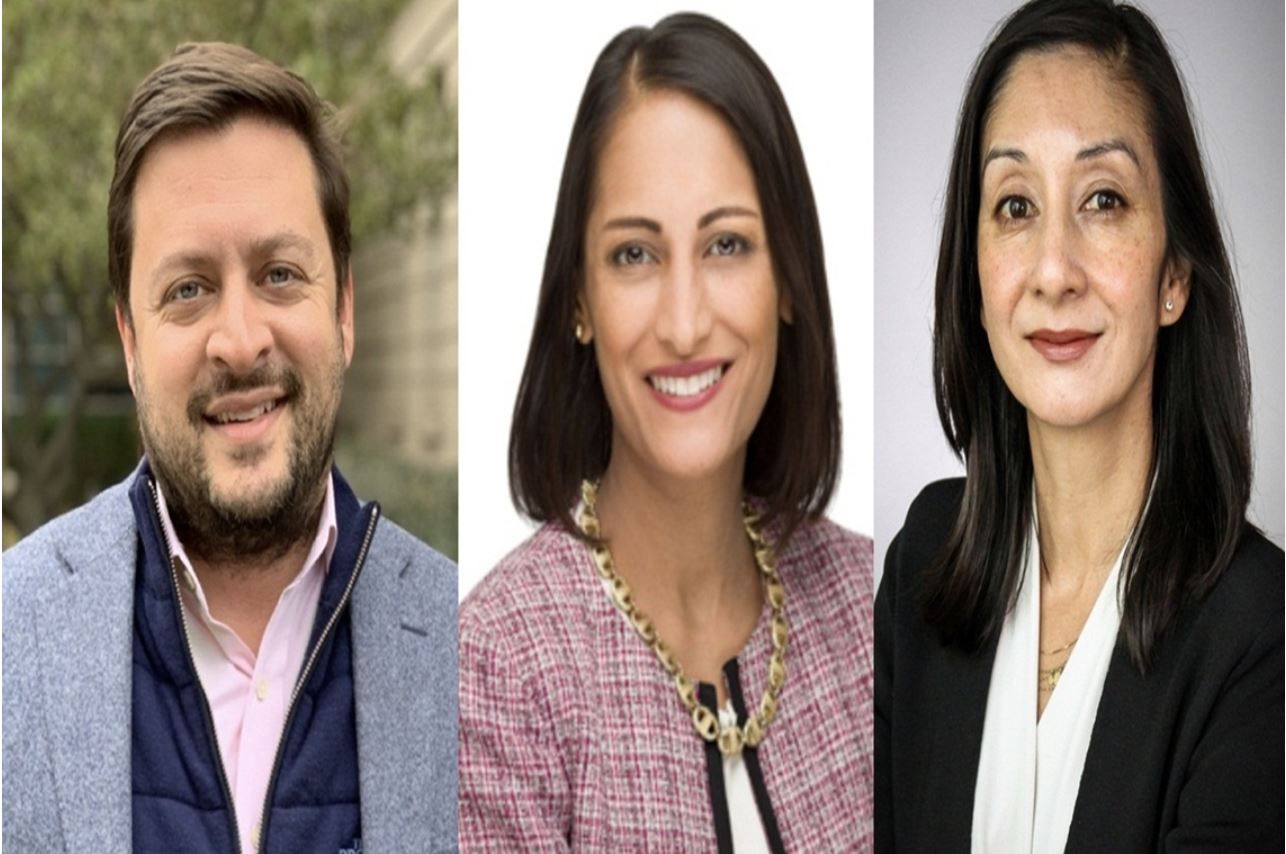
[Tarun Chhabra, Sumona Guha, Shanthi Kalathil 0n Biden White House staff]
Joseph Biden takes over as the new US President tomorrow. It won’t be long before the ridiculous South Asian media and, in particular, Indian newspapers, TV channels and the like, begin tom-tomming the appointment on the Biden White House National Security Council staff of former US foreign service officer Sumona Guha as Senior Director, South Asia, and Tarun Chhabra from Georgetown University as Senior Director for Technology and National Security. Elsewhere, Shanthi Kalathil, a journalist, takes over as Coordinator for Democracy and Human Rights and another ex-diplomat who resigned during the Trump tenure — Uzra Zeya is set to be Under-Secretary of State for Civilian Security, Democracy and Human Rights.
Two women of Kashmiri origin too have found a place in the senior ranks of the incoming Democratic party dispensation. Sameera Fazli, who led the Biden-Harris economic transition team will be Deputy Director of the National Economic Council and Aisha Shah will move over from the campaign staff to be Manager Partnerships in the White House Digital Strategy unit.
These appointments will be hailed as a diplomatic boon for India when the record of Indian-origin US admin staffers suggests they are usually more critical of, and severe on, India than other Americans. Realistically what’s in the offing is that this country’s interests are going to get it in the neck!
Here’s why. The Modi dispensation’s greatest vulnerability is that it is tough on India’s Muslim minority community, and that it finally did what previous Indian governments had shied away from doing, namely, ridding the Constitution of Article 370 bestowing special status within the Union for Jammu & Kashmir, thereby finally and fully integrating Kashmir into the country. Moreover, it permits all Indians to enjoy the same reasonable rights of domicile and residentship in Kashmir as Kashmiris who have settled down in other Indian provinces do.
Donald Trump’s Islamophobia that virtually saw the gates to the United States closed to all Muslims was in sync then with the Modi government’s internal political and electoral leanings. This removed the troubling trifecta of issues of human rights, religious freedom and treatment of minorities that Modi’s “Friend Barak” had flagged during his Republic Day foray some five years ago, and which has perenninally been the source of discord between Delhi and Washington, from contention. Because during the Trump presidency these issues were missing from the bilateral agenda, it enabled the kind of personal bonhomie between Modi and Trump. The Modi regime could brush off the occasional embarrassment of, say, the US Commission on Religious Freedoms putting India on the watch list only because the Trump White House didn’t give a fig about Muslims generally and even less about how they were treated in distant India as long as the Modi regime kept placating Washington with its default option of buying more and still more Lockheed C-17s and C-130J transport planes for the Indian Air Force and Boeing P-8Is for the Indian Navy in a series of multi-billion dollar deals that kept the US defence industry humming.
The situation has turned over. Consider this: There will now be a laser-focus on human rights issues by the Biden Admin that had so far been ignored. This incidentally gells with Biden’s domestic agenda of catering more fulsomely to his black, Latino and immigrant sections of the American society. Guha at the centre of Biden’s South Asia-related foreign policy initiatives will begin coordinating the separate human rights initiatives that Kalathil in the independent human rights agency and Zeya at State Department and their staffs will in the next four years, at a minimum, put together. These will be measures to pressure the Modi government into backing off from its illiberal stance on minority rights and to go easy on pet Hindutva themes — cow slaughter, love jihad, etc. — the sort of exotic issues that readily catch Washington’s eye.
All the diplomatic tap-dancing by foreign minister S Jaishankar around these sensitive subjects won’t impress these more worldly-wise Indian-origin types in Biden’s advisoriate much.
Biden will stick to Trump’s China policy contours for the nonce if only because the rightwing ‘insurrection’ staged at the Capitol last week has Washington establishment agog. Moreover, his priority to get speedy US Senate approvals for senior appointees to his cabinet, and to undo and reverse a whole slew of Trump’s executive orders will keep the new President preoccupied for the better part of the next six months. So Biden is unlikely to pay India much attention other than as the latter impacts Afghanistan, and here what transpired during NSA Ajit Doval’s recent quick trip to Kabul will evince US interest. This six month window also affords the Modi regime the time to clean up its human rights act.
Vice Pesident Kamala Harris notwithstanding, what will not happen is that the switch will suddenly be thrown for India to benefit from a gush of high-value US military technologies, etc. Fact is Chhabra, liaising across the corridor with Guha, will be just as stingy on allowing high-technology transactions with India. This has been the US establishment posture since Reagan’s days in the mid-80s when the ice was broken and the then Defence Secretary Caspar Weinberger on his trip talked of India being given open access to US military technologies only for Delhi to discover that the promised flood was but a trickle and then India had to jump through the hoops for it. This is still the case.
Indeed, the US may, in fact, demand from Delhi a whole lot more on the human rights front and trade concessions beneficial to America than is politic for Modi to give. Indeed, with Biden echoing Obama’s ‘in-sourcing’ mantra, the likes of Fazli will flesh out incentives to US companies to shift their manufacturing base and capital investments from China, not to India, but back to the US. And because, like in everything else, the Indian government maintained a tardy pace of reforms that has not to-date motivated global investors to move heavy monies into India or to set up their production hubs here, the window of opportunity that was open for awhile during the Trump interregnum has closed.
The aim of the unprecedented declassification and release of a policy paper by the White House only days before Trump’s departure — ‘US Strategic framework for the Indo-Pacific’ laying out the American policy for Asia was, presumably, to lock Biden into China Trump’s policy. Minor details aside, Matt Pottinger, who drafted this document and was Trump’s main in-house adviser on the Indo-Pacific, expects that Guha, et al will, for instance, conceive, as his paper does, India as “a counterbalance to China” and incline towards building the Indian military up just so it is able “to effectively collaborate with the United States”.
Considering Modi has given no indication of letting go of the close relationship developed with Russia over the decades anytime soon, what does this mean? Well, the tension will come to a head sooner than later when the Countering America’s Adversaries Through the Sanctions Act provisions kick in. India will likely be sanctioned for buying the Russian S-400 air defence system in the face of some quite considerable push from the US against it. The Guha-Chhabra team will insist on the Trumpian condition of India needing to ease itself away from that particular contract. That won’t happen, so it will leave bilateral relations up in the air.
Incidentally, for the same wrong reasons there is elation on the other side of the Radcliffe Line as well. Pakistani media are glowing with reports about Pakistani-origin Americans as Biden appointees. The most significant among them is Salman Ahmed as head of Policy Planning in the US State Department. In policy importance terms, Ahmed outranks Guha and all the other Indians. There’s also Ali Zaidi, who will assume the post of Deputy Adviser on Climate to Biden.
The worst case for the Modi government will be if the Guha-Zeya-Kalathil emphasis on human rights and Kashmir segues with Ahmed’s thinking on the subject, and Aisha Shah from the White House expertly uses the social media possibly to needle Modi. Further, “cross border terrorism” will resonate even less with the Biden government than it did with the Trump Admin for the reason that no one on the US side will be other than reluctant to conflate terrorism with Pakistan. To top it all, Delhi will be pressed to sign the Comprehensive Test Ban Treaty — something Obama had continually stressed. With Biden set to continue with so many of Obama-era policies, South Asia will be no exception.
These developments at the America-end combined with the Modi-Amit Shah duo sticking fast to their position at the India end will mean bilateral ties going south fast.
[Troops of 59th Division of the XVII Mountain Offensive Corps on patrol]
News reports reveal that I Corps, one of the three strike corps, has been redeployed to the eastern Ladakh sector to conform with COAS General MM Naravane’s public declaration that “China is the primary front”. I should feel elated that my nearly 30-year long advocacy of converting the bulk of the three Strike Corps (I, II and XXI) into Mountain Offensive Strike Corps (MOSC) is beginning to be heeded.
As Adviser, Defence Expenditure, to the (Tenth) Finance Commission (1992-1995) chaired by former Defence Minister, the late K.C. Pant, I had proposed, in a classified report, that the three strike corps be reconfigured, in the main, into a single “composite corps” of armoured, mechanized, mobile air defence and self-propelled artillery units with several independent armoured brigades as army reserve, which’d be more than adequate for any conceivable Pakistan contingency. The usable war materiel and manpower resources thus freed up, it was suggested, be shifted to raising three MOSCs for the overlong, thinly-manned, China front. I had pitched this as both an economy and force optimization measure, enabling the otherwise defensively arrayed Indian Army to, for the first time, actually take the fight to the Chinese People’s Liberation Army (PLA) on the Tibetan Plateau. It is a theme I have been plugging away in my books and other writings ever since.
As presently constituted, the three strike corps are way in excess of need because, realistically, they can only be fielded and then only for shallow, meaningless, penetration in the desert sector because the west Punjab plains in Pakistan are too built-up and criss-crossed with irrigation canals and ditch-cum-bund defences — tank traps — to permit Indian armoured and mechanized formations easy or rapid ingress. The only justification for even two strike corps is if their exclusive focus is on ‘Sialkot grab’-kind of operations that I originally envisaged (in my 2002 book — Nuclear Weapons and Indian Security) and which the armoured forces have reportedly adopted — whether as principal objective or not, is unclear.
Obviously, the troops from the Mathura-based I Corps presently pulling duty in counter-insurgency Rashtriya Rifles units in J&K — as the first scheduled for conversion — have come in handy speedily to increase the force strength in eastern Ladakh. They haven’t arrived in theatre from the plains, so acclimating to a higher altitude is a bit less onerous. Behind this move possibly is the concern to forestall PLA’s offensive action, if not in the dead of winter, then as soon as the snow melts starting in April. Transporting the jawans from their J&K sites is the easy part; they’d still have to go through, albeit shortened, acclimatization procedures to be able to handle operational tasks. The time it takes to acclimate the average soldier from the plains, in a phased manner, to fight at high altitudes is some three months without the use of thermal chambers, etc.
I Corps undergoing conversion to an MOSC for permanent deployment in Ladakh will permit the newly raised XVII MOSC based in Panagarh to become a fixture on the Sikkim-Arunchal front. [So why were the Corps HQrs located in Panagarh? Perhaps because the considerate army brass decided the senior staff of that MOSC needed to be near the comforts of Kolkatta than far away in the desolate expanse of Sikkim, Bhutan, and Arunachal the formation is meant offensively to defend!] While this is better than not having a second MOSC at all, it still leaves the Central Sector with high passes and more difficult mountainous terrain bereft of meaningful forces to counter the PLA should it choose to make a breach there. A Third MOSC will not only fill this gap but also provide offensive-ready forces to back up I Corps in Ladakh and XVII Corps in the east. Considering how quickly China is enveloping Nepal with Chinese railways prospectively connecting Kathmandu to the Lhasa-Qinghai mainline, with a feeder track already extended to Xigatse on the border, this may in any case be the prudent thing for the army to do.
The Central sector is largely manned by the paramilitary Indo-Tibetan Border Police (ITBP). Hardy in many respects and originally trained as Special Forces by the US Army Ranger teams in the wake of the 1962 War, the nature of the ITBP led by Indian Police Service officers, has over the years been blunted. It is treated by the Home Ministry as yet another paramilitary — a’la Central Reserve Police Force, and assigned jobs like quelling the Naxal rebels in the “red corridor”. In the event, the ITBP simply lacks the military grit and resilence and, even more the fighting motivation of, say, the frontline Special Frontier Force filled with Tibetans from the exile community, who preempted the PLA from occupying the Chushul heights in the Kailash Range last summer, by getting there first and thereafter held off the Chinese from dislodging them.
I Corps as MOSC is a good development. Hopefully, Naravane will formally begin the process of rationalizing the existing, entirely skewed and inappropriate Pakistan-front heavy force structure in right earnest. A third MOSC is desperately needed. Going in for an entirely new raising, however, is a prohibitively expensive course of action. Far more economical would be to, say, convert XXI Corps as well.
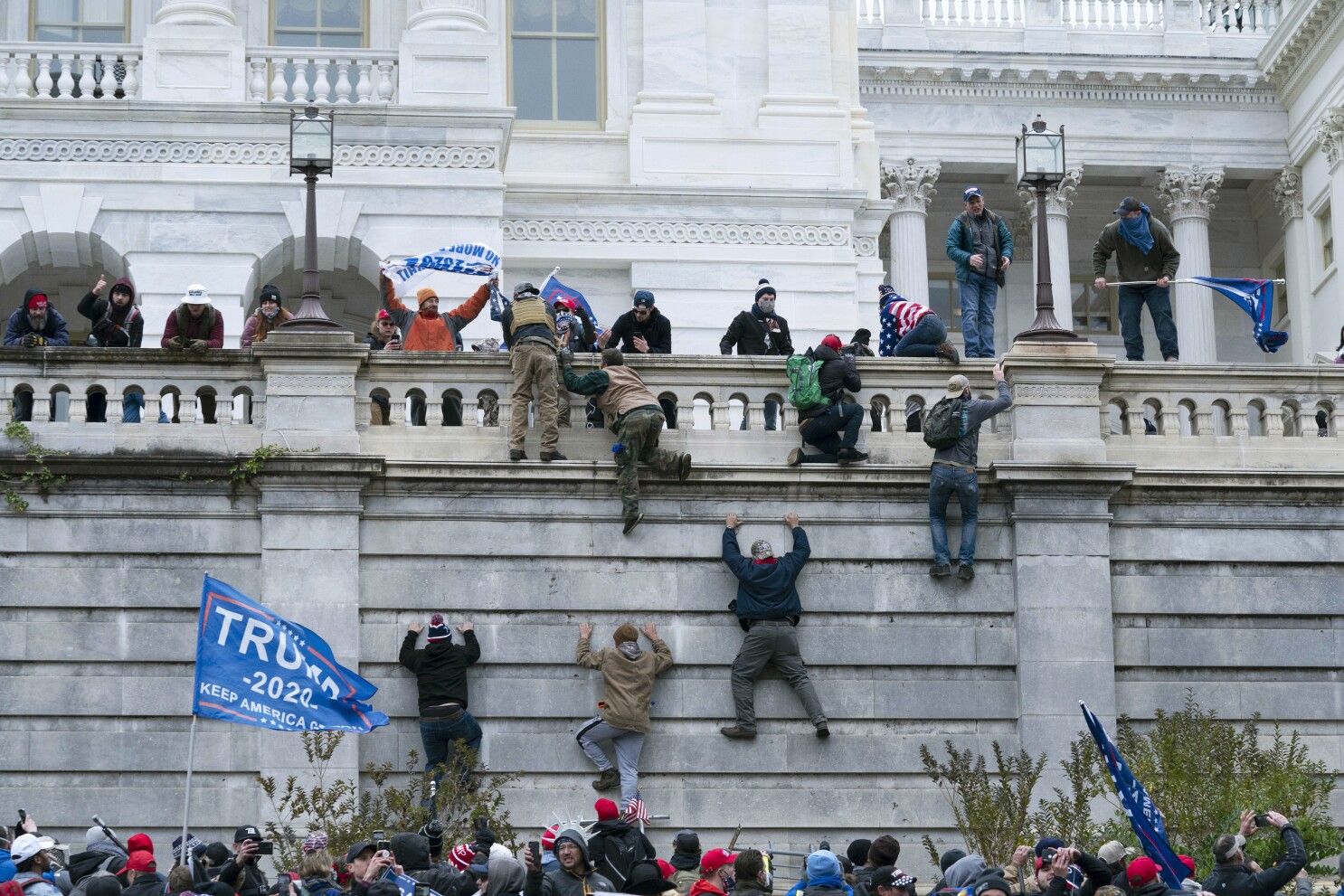
[Trump insurrectionists scaling wall of the US Congress]
Writing this at three in the morning, January 6, 2020, I see rednecks from all over the United States streaming onto the Capitol Hill in Washington DC, intent on having the November election results reversed! Wilfully incited by the outgoing knucklehead of a President, Donald J Trump, they stormed the Capitol building housing the two houses of the American legislature which are involved in the formal certification of Joe Biden’s election victory. They streamed past paralyzed police and the paramilitary, National Guard, et al, who by and large are standing around doing nothing, perhaps, because the 30,000-strong mob was doing Trump’s bidding. So much for American democracy, a supposedly liberal system, in action!
Having witnessed such instances of breakdown of democratic norms on numerous occasions during my some 14 odd years spent in that country, I have long maintained that, while democracy as a system is inherently delicate and fragile everywhere, American democracy more than most others is always teetering on the brink of breakdown, hanging on for its dear life by its fingernails. And that US’ over-zealous profession of democratic values should, therefore, not be taken seriously. And I am not saying anything about institionalized racism in the US, most conspicuously targeting the black population in that country.
There is never any shortage of political drama in the US. It is rivetting reality television! Have been up all night watching what is deemed an “insurrection” unfold on CNN. In all my writings, I have always urged the Indian government to show US interlocuters the proverbial finger anytime they bring up the matter of India needing to up its game where the integrity of the democratic process and respect for human rights is concerned. As first order of business this morning, the External Affairs Ministry should wag a finger at Washington, as the latter does when there are riots and other disturbances in India. The MEA spokesperson should unctuously demand that the US government protect the democratic verdict and improve its democratic system. This’d be the appropriate thing to do considering how American agencies routinely meddle in the internal affairs of developing countries, including India, lecturing them on how a good demcracy ought to work. The US Commission on Religious Freedom, it may be recalled, recently put India on notice for violations.
Indeed, watching the mayhem in Washington on TV the former US President George W Bush likened America to a “banana republic”. Let India never again be lectured then on freedom and democratic functioning by a banana republic without the Indian government asking it formally, and diplomatically, of course, to shutup! Erdogan’s Turkey — an autocracy if there’s one — has already stuck a knife in Washington’s side by asking it to protect its democratic tradition!
To see the rule of law sidelined by security officers shrugging their shoulders and letting these crazed yahoos try and exert their will on the US Congress is to be reminded of Indian state and central police, time and again, standing aside and allowing rioters to do their thing undisturbed, simply because the law breaking is orchestrated by minions of the concerned Prime Minister or Chief Minister. Rajiv Gandhi let murderous mobs kill Sikh citizens at will on the streets of Delhi in 1984. And state police in Gujarat, Maharashtra, UP and in other states have frequently acted as bystanders as the Chief Minister’s supporters ran riot.
My initial experience of law & order breakdown in the US was during my first summer there (1968). I saw on TV Chicago Police go absolutely berserk, literally smashing the heads of young people protesting America’s involvement in the war against Vietnam. The scenes were so bloody and heartrending, it shocked my then fairly innocent sensibilities. Nine years later, I found myself on Ground Zero, as it were. It was during the 1979 Iran hostage crisis. I was on a sidewalk just outside the UCLA campus early one Fall evening and found an Iranian on the ground being mercilessly kicked in the stomach and head by two young goons. I was still about 20 feet away when I came upon them. They stopped, turned and started walking threateningly towards me. Two feet away, one of them asked angrily if I was an “I-RANEAN”. I responded that I wasn’t whereupon they turned and left!
As I tried to help the bloodied Iranian on the ground to sit up I saw not 8 feet away an LA Police patrol car parked with 2 policeman inside it. They hadn’t moved to prevent the beating of this grad student. I shouted out to them to help me get this grievously hurt person to the UCLA medical school hospital down the road. The dismissive response from one of them was: “Do it yourself!” before they drove off. I somehow managed to do that with the help of two other students. It occurred to me in a flash then just how gossamer thin the law & order pretensions of the US really are; and have been skeptical ever since. My eyes glaze over and I instinctively stop listening when Americans, high and low, talk of their “democracy” as a beacon of anything, least of all hope, in the world.
In the last 40-odd years of attending international seminars and conferences I have been struck by a trend that’s hard to miss. It involves Indian-origin academics, retired Indian diplomats and military officers, and India-based academics and thinktankers, who have the opportunity to speak their mind untrammelled by official Indian Government restrictions and to convey to Western, especially US, audiences India’s core national interests and why these often clash with Washington’s preferred policy, but don’t do any of this. Instead, they usually say things soothing to American ears.
Often times, I have found myself over the last three decades to be the lone Indian voice, airing views contrary to what’s being said, by all the other participants, Indians who have in their careers held high government positions included. Initially I was perplexed. Now it gets my goat.
If the image is consistently projected in US policy circles and among the Western intelligentsia by these Indians and NRIs that India is sympatico with whatever the US is doing in the international arena, then it roots certain expectations in the American policy milieu. As a result, not unreasonably Americans, even those who ought know better, end up believing that Delhi is departing from the mutually accepted script and working against US interests even if India is acting in its own best interests. When US policymakers find Delhi not acting as is expected they slide over to the punishment mode. Whence the sanctions that India has often faced in the past. Most recently in the period post-1998 nuclear tests. In the soon-to-end Trump presidency, for instance, it congealed into an attitude that was more punitive than transactional. In the Biden Administration US foreign policy is likely to revert to America’s liberal do-gooding instincts, albeit in a muted form after two decades of military activism and interventions, which in the George W Bush years led to the overthrow of Saddam Hussein, and the start of the unending cycles of extremist violence and instability in West Asia and turmoil world-wide sourced to militant Islam that the world has experienced ever since. Talk of good intentions breeding evil.
But why do Indian-origin types feel the need to suck up to Americans? The IT software techies, engineers, doctors and other ‘professionals’, are happy beavering away at their jobs and are not really in the policy swim. The bulk of the Indian community limits itself, when convenient, to attending ‘Bollywood nights’ and “Howdy Modi” sort of political circuses should these come to town as a way of keeping engaged with the ‘old country’ in which, otherwise, they have neither interest nor stake. Their sole focus is on keeping the ‘family reunion’ provisions in their resident visas open to enable them to cart more of their relatives to America. They look to the the Indian government to be helpful in this regard.
Then there’s the growing lot of NRIs on liberal arts faculties in various American universities/colleges, the more conspicuous among them lecturing Delhi, in line with Washington’s commitment to nuclear nonproliferation, human rights, containing China, etc. on the perils of nuclear proliferation, the non-desirability of India building up a strong thermonuclear deterrent, and of fielding intercontinental ballistic missiles, and going with nuclear first use, on the benefits of strategically partnering the US in the Indo-Pacific, and the virtues of respecting minority rights, the special status of J&K, and of retaining a liberal social order. Individuals in a sub-section in this group involved in security studies strive to make a reputation for themselves by replicating concepts and ideas developed by Indian civilian strategists and passing them off as their own in US academic quarters, secure in the belief that no American analysts reads books by Indian strategists anyway! All these academics adhere closely to the offcial US policy line on the issues they advise Indian governments on because not doing so would stunt their careers. Ironically, their writings are then quoted by Indian analysts and media to make the case for a small, inoffensive, nuclear deterrent, for India becoming a cog, in effect, in the US military machine in the Indo-Pacific, etc.
Then there are the US-born and reared Americans of Indian ethnic origin — such as Richard Verma, the sometime US ambassador in Delhi, who are Indian only in their looks but otherwise, unsurprisingly, entirely American in their outlook. The shared Indian looks frequently leads Indian government officials mistakenly to expect a more empathetic hearing than they get. Indeed, I have found in semi-formal interactions with US officials that the US-born Indians among them are the loudest in decrying India’s policies and in challenging Indian policy predicates. The reverse is just as true. The Washington policy circles expect these ethnic Indians placed in South Asia -related positions to have some special insight into India’s foreign and other policies when actually they are no better clued into what’s happening in Delhi and in the states than their average white counterparts. I recall a conference hosted several years ago by the National Defence University in Washington DC on the sidelines of which the hosts arranged for me to meet with the US National Security Council Staff. At this meeting in the Excecutive Office Building adjoining the White House, the head of the South Asia section, Nisha Agarwal, who was later elevated in the Obama Administration to be Assistant Secretary of State for Southern Asia, was the most vocal in slamming the Indian government for not delivering on the 2005 civilian nuclear deal, on not being as receptive to US’ strategic initiatives in Asia, etc. She put on this show possibly to show her colleagues how hard she could be on India — apparently a litmus test that Americans of Indian origin in the US government have to pass!
A more dangerous lot comprises retired Indian diplomats, especially ambassadors posted to the US, who while in service “cultivate connections” and, after retirement, ease into numerous thinktanks and university faculties around Washington, DC. They produce little of any intellectual or even policy worth but remain in circulation spouting innocuous stuff except on occasions when they have to “sing for their supper” and come out strongly against India’s nuclear buildup or some move by Delhi on the domestic harmony & peace front. These persons are problematic because they are taken seriously by the US policy establishment as having their fingers on the pulse of Delhi (or at least the MEA) and what they say is used by those critical of India for their own purposes. Not to name and shame anyone, but one such diplomat was successively a Fellow at Brown University, “practitioner-in-residence” — whatever that means — at the Rockefeller Foundation-run Bellagio Centre in Italy, Global Fellow at the Wilson Center in Washington, and professer offering a course in Sino-Indian relations at Columbia University in New York city, all this without producing a single research paper or any other policy-relevant writing of note, leave alone a book!
More intriguing still is a new stream — of retired Indian military officers who seek a place in the American sun! Many, many, moons ago at a conference called by the then US Pacific Command in Hawaii, the person who was the most vociferous in rejecting India’s nuclear assertiveness was a retired Vice Chief of the Army Staff. To my dismay, he put on a similar show at a conference called by Wilton Park — a thinktank of the British Foreign & Commonwealth Office. Wilton Park is a vast estate in Buckinghamshire that was used in 1946-48 to “re-educate” World War Two German officers who were prisoners of war! Such “exposure” was parlayed by this Indian General into a year-long stint at the Center for International Security and Cooperation at Stanford University. Since then many more ex-Indian military officers have climbed aboard this gravy train, translating one-off appearances at academic conferences into consultancies with various US agencies, etc.
The more intellectually inclined among them hanker for placement in thinktanks and at universities. I remember some 20 years ago a one-star officer approaching me for advice about what to do and how to go about securing a sinecure at an American institution. By then he had written a book and I suggested he could become a strong proponent for a meaningful Indian military aggressively championing India’s national interest. He knew better. He did the exact opposite and it worked! He spent time at leading security thinktanks in the US run by the Pentagon by essentially tailoring his message to suit his American audiences. More recently, a retired army colonel whom I had respect for has found a second career as a reporter covering Ministry of Defence for an Indian newspaper on which he has piggybagged a third career as lecturer at a US university. Without at all considering the downside of India losing its leverage with Russia and Iran, its role as balancer of power in the international system, US’ record of unreliability as strategic partner, or the better geostrategic options that are available he now argues, as do others within and outside the government, for India to link up militarily with the US in the Indo-Pacific as a means of ringfencing China.
The reason why so many retired and serving Indian government and military officials canoodle with Americans is simplicity itself . It is the same reason why young Indians try desperately hard to somehow find their future in America — it is a damned nice place to live in with none of the daily aggravations of life even in Indian metros! There’s material plenty, life is good, the universities provide unmatched education, the work place ethos is easy even as it is stressful because there are no time-grade promotions (as enjoyed by the civil services here) and only peformance in the job counts, and entrepreneurship and innovative thinking are rewarded. Of course, there’s a glass ceiling but this is melting away for Indians who with their technical expertise and English language proficiency, by and large, find it easier to get along and go along (in comparison to, say, students from China) and are elbowing their way to the top in corporations and other organizations.
Small wonder the whole broad band of civil servants and diplomats manning the top echelons of the Indian government move heaven and earth to ensure their progeny are educated in the US and settle down there or elsewhere in the modern and ‘secular’ West. The flipside of this parental interest in doing good by the children is, as I warned in my 2018 book (‘Staggering Forward: Narendra Modi and India’s Global Ambition’) the rise of a distinct Fifth Column within the Indian policy establishment. It peddles and pushes the US policy line without a twinge of conscience, convinced it benefits India too. Its activity is supported in terms of public outreach by a number of American thinktanks — Brookings, Carnegie, Aspen — who have set up shop in Delhi financed by Indian monies! ( I wrote about this in Open magazine in April 2016 — ‘India’s Foreign Policy — The Foreign Hand’, https://openthemagazine.com/voices/indias-foreign-policy-the-foreign-hand/ )
All the Delhi chapters of the American thinktanks studiously plug and propagate the policy line of the Administration of the day. It is an activity in which a bunch of retired Indian diplomats, serving and former secretaries to the government and senior military officers — all the people, in fact, who whilst in government favoured siding with the US, participate. There is now a counterpart presence in Washington of an Indian thinktank — the Ambani-funded Observer Research Foundation (ORF). This would be a welcome development, except far from creatively articulating for the Beltway denizens India’s vital interests and explaining why these on many important issues collide with US interests, ORF Washington seems to be in the business of doing the same thing the US thinktanks do in India but with a slight twist. It embroiders US policy schemes acceptable to the ruling party in Delhi (going by the op-eds in Indian papers — because there’s little else — by its head)! So, what good it does India is anybody’s guess.
One cannot blame aspiring Indians for seeking a better future abroad or Indian officials for wanting the same for their kids, because the Indian system is too stultified to offer the youth brighter prospects at home. Prime Minister Narendra Modi is among those who has been hugely influenced by America and the “good life” it offers its people. At the core of his government’s ceaseless efforts over the last six years to keep the H1B visa channel open to Indians is precisely his fatalistic acceptance of the fact that the Indian system cannot be changed. Not, as he once promised, by him anyway.
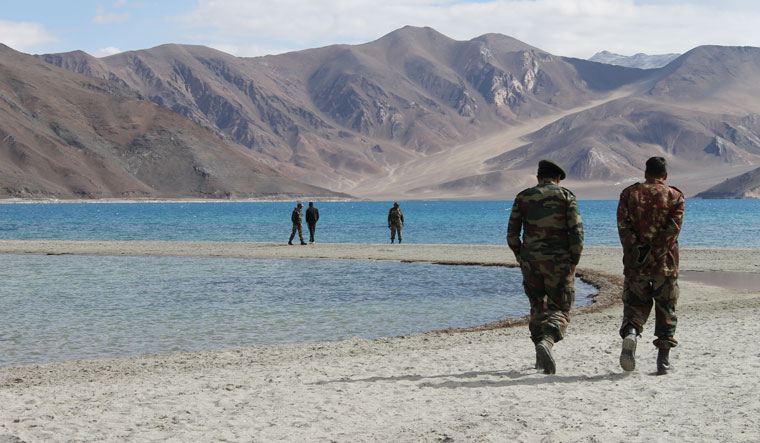
Ever since the first reports of Chinese transgressions into Ladakh emerged in early May, experts had been warning India was staring at a formidable security threat.
The fatal clash in Galwan that left 20 Indian soldiers dead and the subsequent troop buildup in the region had led to fears that the LAC could become an ‘active’ security zone for Indian security forces like the LOC has been.
The fact that India and China have not made much progress in disengagement talks means the standoff in Ladakh could continue into the New Year. Unlike periods of tension with Pakistan—such as during Operation Parakram that followed the attack on Parliament in 2001—the trajectory of the Ladakh standoff is hard to predict given China’s strategic heft and goals and motivations. China’s strategic ties with Pakistan, by means of the China-Pakistan Economic Corridor, have been linked to the current standoff in Ladakh by some analysts, given Ladakh’s proximity to Pakistan-occupied Kashmir. Beijing has committed to investments of over $60 billion in Pakistan as part of CPEC to develop infrastructure in Pakistan to make the country a hub for Chinese imports and exports.
To make sense of the direction where the India-China standoff is heading, THE WEEK reached out to two eminent strategic commentators: Bharat Karnad and retired Lt General Vinod Bhatia.
Bharat Karnad is emeritus professor, Centre for Policy Research, New Delhi. Vinod Bhatia, an Indian Army veteran, is currently director of the Centre for Joint Warfare Studies.
Why have attempts at resolving the Ladakh standoff not yielded results?
Karnad: Because of two contrasting negotiating styles. The Narendra Modi government is in a hurry for a final solution of the border issue and willing to compromise. The Chinese negotiating style, on the other hand, considers time an ally. So the proceedings are prolonged, its position maintained without compromise or concession, in an attempt to wear out the patience of the adversary in the hope he will fall in eventually with Beijing’s demands.
Bhatia: There has been a constant effort by both China and India to resolve the ongoing situation by dialogue at military, diplomatic and political levels. On account of hardened positions, the resolution will be a laborious and lengthy process. Peace and tranquility along the LAC are in the interest of both nations. However, post Galwan, there is a total lack of trust. We should give it time as we have the requisite resilience to ensure an effective response to China’s aggressive behaviour.
Is the long-term Chinese plan in Ladakh related to its interests in Pakistan?
Karnad: There are two aspects to this. China wants India to vacate the heights on the Kailash Range around Chushul occupied by Special Frontier Force units while consolidating its hold over Fingers 4 to 8 on the Pangong Tso. Whatever the inducements offered, under no circumstances, should Delhi agree to climb down from the Rezang La ridge and the tops above the Spanggur Gap. The other thing is China’s reported revival of the so-called ‘1959 Line’ by firming up its control of the area beyond the Y-Junction. The Chinese objective clearly is to distance the Indian armed forces even more from the Xinjiang Highway, which is China’s lifeline to its other western province, the Karakoram Pass and CPEC.
Bhatia: I think we went wrong in discerning China’s strategic intent initially. China’s forward deployment along the LAC is a part of Chinese ‘military coercion’. China cannot afford any threat to CPEC, as CPEC is central to China’s dream One Belt, One Road (OBOR) initiative. China would also like India to endorse this initiative.
How important is the status of Depsang in the event of a resolution of this standoff?
Karnad: The blockade of the Y-Junction on the Depsang Plains is crucial and has to be lifted by India, by forceful means, if necessary. Because by preventing Indian troops from patrolling the Indian-claimed area north and northwest-wards, it pretty much permits that entire ‘sub-sector North’ in Indian Army’s parlance—some 975 sq kms in all—to slip into China’s possession.
Bhatia: Depsang is definitely critical to our operational interests as occupation by China threatens the Shyok-DBO-Karakoram road. China will like to play this card to coerce India to seek concessions at other places and, more importantly, threaten Siachen as a collaborative strategy along with Pakistan. However, our occupation of operationally and strategically important heights along the Kailash ridge on the South Bank of Pangong Tso has given India an advantage at the negotiations. India aims at ‘status quo’ ante as of April 20 and continued peace and tranquility, ensuring equal and mutual security.
Is there a basis for fears of a two-front war against Pakistan and China?
Karnad: Realistically, a two-front war is less of a possibility; the more worrisome thing is the Modi government agreeing to withdraw Indian forces an “equal distance” as part of a “comprehensive” accord. Such an agreement will seriously handicap Indian forward units, because the PLA, availing of a dense network of border roads, will be able quickly to rush and occupy strategic locations presently in Indian hands even as the Indian units struggle, owing to still-thin border infrastructure.
Bhatia: China has always been a long-term threat. Recent China’s arrogance and aggressive behaviour now indicate an immediate-to-near-term threat, with the probability of manifesting as a China-Pakistan collaborative threat in the conventional (warfare) domain. India will need to ensure peace through military preparedness. A two-front war is a reality. India should also look at like-minded nations to negate the China threat; ‘bind to balance’should be a good way forward. India should also reset and refresh its China policy. However, the reset policy should be pro-India and not anti-China, despite the anger and anguish caused by China’s betrayal yet again.
How much will US policy change with respect to India once a Biden administration takes over?
Karnad: There will be changes. The Biden administration, unlike the Trump dispensation, will emphasise human rights issues: Kashmir, Hindu-Muslim tensions and other social issues. This will alienate the Modi government and likely poison India-US relations enough to make uncertain such US assistance as Delhi would have otherwise relied on in a confrontation and crisis involving China.
Bhatia: The Biden administration’s policy too will be dictated by US interests. There are a congruence and convergence of interests of India and the US, especially where China is concerned. In a post-COVID-19 world order, India will be a global leader and hence the US will need India as the ‘balancing power’ as the balance of power shifts from West to East.
Subramaniam Swamy, Rajya Sabha MP, has long been a fixture of the Delhi scene and never out of the news. If he is not playing the Scarlet Pimpernel in Indira Gandhi’s Parliament-held-hostage drama during the Emergency, he is exposing the Gandhi Family for some corruption or the other, his latest target being Sonia and Rahul Gandhi in the National Herald case involving dummy companies and suspicious property transactions. At all times his contacts in the Enforcement Bureau and the Intelligence Bureau keep him supplied with photocopies of “documents” supporting his charge that he can wave at television cameras and still the hearts of those he has accused and their effort to take him to Court because, it turns out, he is well-versed in law.
Swamy has held various posts in numerous governments, including as Minister for Commerce and Industry in Chandrashekhar’s (1990-91). Usually he was considered a nuisance and, in US President B. Lyndon Johnson’s phrase, kept inside the tent to piss out rather than that he remain outside pissing in (!), and fobbed off with minor sinecures on the Planning Commission, Standards Commission, etc. Through out his time in and out of government he cultivated contacts who kept him abreast of what was happening at any time in the corridors of power. He exploited this insider information to prop up his reputation as the stormy petrel of Indian politics, eager and ready for a political donnybrook with anyone, any party, any institution at any time. So when not pillorying the Congress party he is publicly roasting his own ruling Bharatiya Janata Party’s (albeit, media cell) for “going rogue” as he did three months ago supposedly for mounting “personal attacks” on him. ( https://www.indiatoday.in/india/story/subramanian-swamy-accuses-bjp-it-cell-of-running-a-campaign-against-him-1719522-2020-09-07 ).
However, for iconoclasts, he is an absolute delight, showing particular talent for being a god awful pain-in-the-butt for the government of the day and its durbaris. Have been acquainted with him for over 30 years now and never failed to admire his chutzpah (gall in Hebrew), and his sheer talent for effrontery. How can one not like a man whose intent is to wreck whatever political dispensation is supreme in Delhi at the moment, and who wears his crustiness and don’t-give-a-damn-attitude and not so thinly-veiled contempt, especially for those holding power, on his sleeve? This even though his overarching ambition is actually to run the government and to set it on the right course. What that course could be is hard to say considering the fluidity of his views! But being erudite, he is normally persuasive when making his point.
It was, therefore, a shocker to read a fortnight back his article attacking Russia for not being India’s “friend”. (See his “Russia is not a friend”, Sunday Guardian, 31 Oct 2020 ( https://www.sundayguardianlive.com/news/russia-not-friend-india ). Not sure what it is that has got Swamy riled. But the case he makes is so incoherent I can scarcely believe he penned it. Having already confessed my admiration for him I will carefully deconstruct his argument because he carries weight with many in the BJP.
Take Swamy’s 1st line of argument. He writes: “For China, Russia was a trusted friend and a patron of the communist parivar from 1949 to 1960. Then at China’s weakest moment in 1960, faced with a gigantic collapse of the ill-conceived Great Forward Movement and a huge famine, when between 16 to 32 million Chinese died due to starvation, Moscow ordered the withdrawal from China all its industrial projects, its blueprints, and technical staff, resulting in the collapse China’s industrial sector….To collapse this project, the Soviets led by Khruschev cancelled all the industrial projects that were being implemented to modernise China, and also withdrew all the experts along with the blueprints sent to China….Not only did the Great Leap Forward become a disaster for agriculture, but industry got stunted, and because of terrible drought about 16 million to 32 million died in the ensuing famine in 1960-61.”
So Russia’s NOT being nice — more countries shouldn’t be nice — to China is held against Russia’s being India’s friend? This doesn’t make sense and, if anything, suggests why India should have Russia in its corner. If Swamy means by this reference to show up Russia as an unreliable partner, then the burden of proof rests on him to prove, to show, that it has faltered as a friend. This he hasn’t done. The fact is starting in the 1950s the Soviet Union helped set up heavy industries in India, including the Bhilai steel plant and, in the wake of the 1962 War with China, increasing ideological alienation from Mao’s China led to Moscow offering 12 ready-to-fly supersonic MiG-21s along with the licensed production rights for this aircraft and its jet engine. These Russian offers were in the context of a grateful Indian government accepting them less because Nehru was a communist camp follower than because Washington promised than failed to get the US Steel Company to set up the Bhilai plant and, post-1962, failed to provide the supersonic F-104 fighter aircraft transferred to Pakistan that Delhi had sought, offering instead the transonic, low performance, ‘Freedom fighter’ — the Northrop F-5. The record shows the Soviet Union-Russia has supplied its latest military hardware; if there has been a spares problem with them it is because the Indian armed services and Defence Ministry never bothered to segue their requirements with the Russian spares procurement protocols as Indian military stalwarts admit.
Consider Swamy’s 2nd line of argument: “The transition of Russia has been amazing. First there was the Czarist monarchy called Russia, which the royalty ruled from St Petersburg as capital. Then there emerged through a revolution led by Lenin the Bolshevik state, and after Lenin’s death was followed by Joseph Stalin’s communist Soviet Union with its capital in Moscow. Today there is Putin’s Oligarchic Russia being ruled from Moscow. These the government formations spanned a century since 1920.But the bottom line has remained the same—a government led by dictatorship, which is expansionist, an oligarchy and headed for bankruptcy.”
The monarchist/totalitarian antecedents of the Russia state is, astonishingly, wheeled out to support Swamy’s case of Russia being an uncertain ally to China! This is non-sequiter-ish, at best and, in any case, how does it matter to India’s national interest what kind of a state Russia is? Even so, Swamy uses this to also buttress his contention that the US will make for a better partner!! This last view is built on the common belief that democracies get along better with other democracies. Which’s fine in rhetoric but is irrelevant when it comes to the hard business of inter-state relations when considerations of the national interest kick in. Hence, a democratic America finds that authoritarian states are more malleable and relations with them less complicated. It explains Washington’s marked historic partiality for unfree countries usually run by generals. Thus, Pakistan has always been the preferred US partner in South Asia, not India.
Then there are sideline declaratory references by Swamy with no proof or historical evidence adduced for them either, such as: “Nehru was fooled into thinking that leaders in Moscow were permanent friends, but in fact we Indians were more like “Pavlovian dogs”, that is, those who complied on signals from Moscow.” When actually, Nehru, the quintessential upper class Englishman (who unself-consciously told Malcolm Muggeridge in a 1958 BBC interview that he was the last Englishman to rule India!) was contemptuous of Russians — if not of Russia whose leap into the status of an industrialized state inside of a generation he hoped to replicate in India, referring for instance to the shabby clothes his Russian interlocuters wore. And pray, Mr Swamy, which Indians, and when and where have salivated like “Pavlovian dogs”? And, more amusingly, Swamy’s view that “Indian patriots suspect that Netaji Subash Bose, Lal Bahadur Shastri, Deendayal Upadhyaya, and Sanjay Gandhi were assassinated by the KGB to ensure secure entry into the top positions for Nehru, Indira Gandhi, and Sonia Gandhi.” And how “clinching proofs are kept in frozen vaults in tight fisted Russian archives”.
Sanjay Gandhi is classed a “patriot” alongside Netaji, Shastri, Upadhyaya, uh?!! What?!! That the chief goon of the Emergency is so elevated must spin some heads! An awful lot of the “tight-fisted Russian archives” are actually already available in published form as the Mitrokin Archives. And there are, indeed, mentions in them of Indian leaders of the Communist party stripe beholden to Moscow and even some Indira Gandhi-appointed ambassadors to the USSR reacting, as Pavlovian dogs are supposed, to at the first hint of financial consideration and largesse coming their way.
Swamy’s 3rd line of argument is that “the Russians act according to the interests of China. That is, Russia is a ‘junior partner’ of China. Russia, according to Putin’s 23 October 2020 statement, ‘could enter into a military alliance with China’. Since India purchased the S-400 air to surface rocket attachment for jet fighters in 2018, India has been increasingly relying on Russia for weapons. India appears to have accepted Russia as a de facto mediator in the conflict with China since 18 April 2020 in Ladakh.”
Logically, how does the 2nd contention that India is increasingly buying Russian arms follow from the 1st about Russia being China’s “junior partner”? It doesn’t.
Another Swamyism: “In 1972, the US changed its two-decade-old stand and voted to admit China into the United Nations and invited it to take the seat of permanent member with a veto at the UN Security Council. China was greatly benefitted by the US granting it the Most Favoured Trade Clause, thus opening US markets to China, and for Joint Ventures to enable China to produce with its cheap and captive labour, and accelerate Chinese GDP at more than 10-12% growth rate for a decade. China soon rose from 9th position in GDP ranking to second position by the year 2000.”
How this point in any way strengthens Swamy’s view that the US is a great friend of India, is anybody’s guess. But Swamy needs reminding that the US Security Council seat was first offered India by both the US (John Foster Dulles) and Russia (Khruschev) but Nehru in a fit of strategic stupidity wanted it occupied by China instead! Moreover, had Indira Gandhi in 1966 radically overhauled the over-bureaucratized socialist apparatus of the Indian state and opened up the Indian economy as Johnson Administration had advised her to do — and which Dengxiaoping did in China in 1979, India too could have benefited from open access to, and trade with, America and emerged as the global source of low cost consumer items.
Here’s another unconnected remark by Swamy that makes an unclear case more opaque. “Currently, Sino-Russian trade has more than doubled” He writes. “Russia’s central bank has increased its Chinese currency reserves from less than 1% to over 15%. Germany is no more the principal supplier of industrial plant and technology to Russia. China is! Action is taking place in multilateral forums such as BRICS, increasingly sophisticated joint military exercises, and pooling of influence with countries such as Iran. The S-400 missile system built by Russia and sold to India has Chinese electronics. This has alienated the US, which was about to sell advanced military hardware to India, but has put it on hold because US cannot risk Chinese or Russian espionage in India on advanced US weapons systems.”
Well, yes, Russia is increasingly beholden to China to keep it economically afloat but only in the neo-colonial sense of China denuding the Russian Far East (Siberia) of all its natural resources — wood, minerals and oil to keep its industries going. However, his assertion that the Indian purchase of the S-400 has alienated the US and stopped it from selling Delhi “advanced military hardware” is questionable. Of course, Washington is upset that India purchases military goods from Russia, but there’s nothing that the US can do about it. However, what is the mysterious “advanced” hardware that Swamy is hinting at? Surely not the F-21 fighter aircraft — a ridiculous makeover of the 1960s’ F-16 plane because that’s at the top of Washington’s arms sales agenda. So it must be the improbably expensive EMALS (Electro-Magnetic Aircraft Launch System) for aircraft carriers that is costed at one billion dollars and which the US Navy finds too pricey. It is sought to be sold to India for $2-$3 billion! The last one heard, the Indian Navy, fortunately, was in the right mind to reject it.
After pursuing all the above uniformly unsustainable lines of argument to a dead end, Swamy finally rounds in on his main theme. “India has to make a choice: Either we partner US strategically”, he states, “or Russia and China together. If we have a conflict with China, Russia therefore cannot be trusted, nor if we do, will the US trust us. Hence, this dream of isolating China by trusting Russia is short-sighted. Russia is no more, if ever since 1992, a friend of India in the sense of standing up with India against China. India”.
In the hard realpolitik perspective, India shouldn’t care who it sides with — even if it is the devil — just so long as this tilt helps its cause. The US, Russia and China are all equally out to further their particular regional, international, and geostrategic interests at the expense of every other country, including India. For Swamy to think that the US is somehow different in this respect is to be delusional. Still he should be aware that the Sino-Russian linkup is not going at all smoothly, and that Putin’s Russia has always been aware and apprehensive of China’s designs on Siberia, and acted to counter it. That India is a piece in this strategic game versus China is as true as the fact that Delhi uses and can continue to use its relations with Moscow as leverage to, on one hand, extract more from Washington, and on the other, to muddy up Beijing’s strategic calculus and keep Xi Jinping uncertain and on the hop — the reason why Xi is now holding the PLA on a tight leash in Ladakh. Besides, Swamy a little too readily assumes the former KGB agent Vladimir Putin and the Russia he leads can be China’s willing plaything, and obviously underestimates the political-military weight Moscow packs in its conditional concert with China.
Swamy’s solution that while “India in a border war with China, does not need allies. But if China expands the war arena with India, then of course the Quad arrangement with Vietnam, Sri Lanka, Indonesia and other nations can form a grand alliance” does not mention the US, and closely resembles the geostrategic architecture of littoral and offshore states organic to Asia conceptualized by me in my 2018 book (Staggering Forward: Narendra Modi and India’s Global Ambition) as the “modified quadrilateral” or “Mod Quad” of India, Japan, Australia, and a group of Southeastern nations, inclusive of Vietnam, Indonesia and the Philippines.
There may be more to Swamy’s crotchetiness though. In his eighties now, the 1939-born politician’s ambition remains unfulfilled and unfettered as is his frustration with not achieving his goal. Despite being mollified by the BJP regime and personally by Modi, Swamy now and again voices his desire to be appointed Finance Minister. ( https://www.theweek.in/news/india/2019/05/29/is-subramanian-swamy-upset-with-bjp-over-lack-of-recognition.html ). But why would Modi want a proven curmudgeon and malcontent in North Block when a pliable Nirmala Sitharaman is there to take his dictation, not make waves? So Swamy knows he doesn’t have a sporting chance and therefore hasn’t quailed from taking potshots at Modi that few on the country’s political stage would dare do. Like when Swamy talked about the “war like” situation on the Line of Actual Control in Ladakh this past summer. When someone asked him why he was reticent about using his alleged contacts in China to defuse the situation, Swamy retorted, per ‘Janta Reporter’ of 13 June, that “If Namo does not want to use my economic expertise why would he want [to do so] on China?” (See http://www.jantakareporter.com/india/subramanian-swamy-advised-by-seer-to-show-his-anger-to-pm-modi-bjp-mp-makes-stunning-revelation/293717/ ) Why indeed.
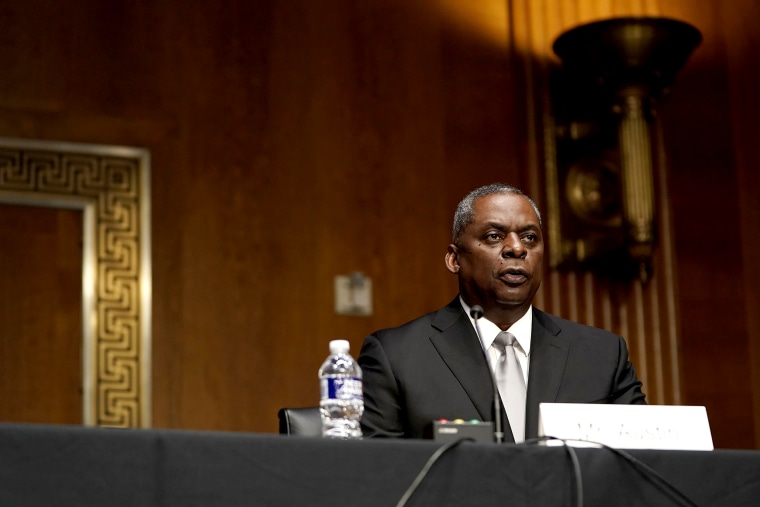
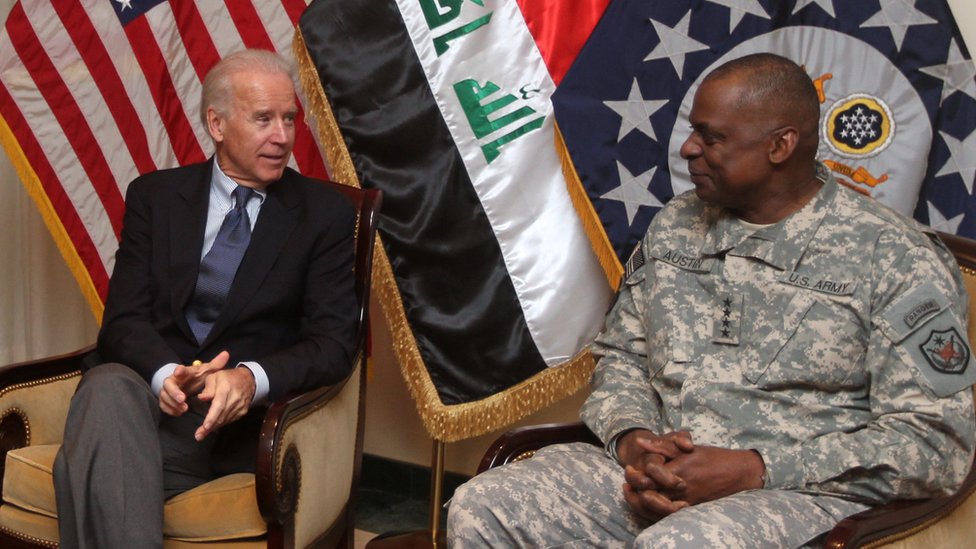
[US President-elect Biden and US Secretary of Defence-designate General Lloyd Austin]
The US President-elect Joe Biden is on the horns of a dilemma. Trump went so far in painting China as the comprehensive threat to America, the West and the liberal world order at-large that doing a 180-degree policy turn and begin canoodling with Beijing is not possible. But, equally, Biden is concerned that Trump had made a collective response to arrest China’s uncontrollable rush to great power status difficult by hollowing out the North Atlantic Treaty Organization (NATO), which has put that European alliance in a weaker position to handle a re-energized Russia under Putin. But Moscow, in turn, out of economic necessity as much as strategic calculation, is getting intimate with Xi Jinping’s China.
A potential Sino-Russian duopoly on the Eurasian landmass would separately encourage belligerent behaviour by Russia in Europe and by China in Asia. This threat is what ought to give Biden and his advisers conniptions. Especially because after two decades of futile wars that it has lost in Afghanistan, Iraq and in West Asia in general, the American people are in no mood for more military adventures or even peacetime deployment of US forces abroad.
It has left the US President to-be, Biden, with few, politically safe, options. The way out, the incoming Democratic party Administration figures, is for the US to not take on China frontally in Asia or Russia in Europe but to rely on America’s traditional allies to do the heavy lifting using NATO at one end, and its strategic partners, principally India, Japan and Australia, to keep China tethered, at the Asian end. Such a policy has the advantage of minimizing US’ commitments and costs.
Antony Blinken, the Secretary of State in-waiting, speaking to an American-Indian audience on Nov 23, before his nomination to become US’ chief diplomat was announced, articulated just such an approach. “We have a common challenge which is to deal with an increasingly assertive China across the board, including its aggression toward India at the Line of Actual Control, but also using its economic might to coerce others…to its advantage, ignoring international rules to advance its own interests, asserting unfounded maritime and territorial claims that threaten freedom of navigation in some of the most important seas in the world,” he said, during a virtual panel discussion on ‘US-India Relations and Indian Americans in Joe Biden Administration’.
“We have to sort of take a step back and start by putting ourselves in a position of strength from which to engage China so that the relationship moves forward more on our terms, not theirs,” Blinken said. “India has to be a key partner in that effort,” he added. “Unfortunately, right now by virtually every key metric. China’s strategic position is stronger and ours is weaker as a result of President Trump’s failed leadership,” he stated. “Put another way, this is really about us in the first instance, the competitiveness of our own economy and workers. The strength of our own democracy and political system, the vibrancy of our own alliances and partnerships. And of course, the assertion of our own values, all of which President Trump has done so much to undermine,” Blinken complained. He elaborated further, saying “During the Obama-Biden administration, we worked very hard to establish India as a key contributing member of the Indo-Pacific strategy. And that includes India’s role in working with like minded partners to strengthen and uphold a rules-based order in the Indo Pacific, in which no country, including China can threaten its neighbours with impunity.” “[India’s] role”, he averred, “needs to extend even beyond the region as vast as it is to the world at large…We would work together to strengthen India’s defence, and also add to its capabilities as a counterterrorism partner.”
In other words, Biden’s Washington will want India to be a frontline state in US’ great power confrontation with China and, military-wise, to contribute substantively. Blinken held out the usual inducements. Aware of how much Indian leadership hankers for a permanent seat on the UN Security Council, Blinken played up to Delhi’s craving. “In a Biden administration”, he asserted, “we would be an advocate for India to play a leading role in international institutions and that includes helping India get a seat on a reformed United Nations Security Council.” And knowing as well that Washington can get Delhi to eat out of its hands by merely making noises associating Pakistan to terrorism, he stated that “On the question of terrorism, specifically”, the incoming administration will “have no tolerance for terrorism, in South Asia or anywhere else: cross border or otherwise.” ( https://www.livemint.com/news/india/antony-blinken-india-has-to-be-a-key-partner-in-engaging-china-from-position-of-strength-11606201539220.html )
In tune with such Biden-Blinken views, the US Secretary of Defence-designate a retired Vice Chief of the Army Staff (2013-2016) General Lloyd Austin, responded by saying the right things. Austin suggested, for instance, that where China is concerned, the US should show “strategic patience”. Considered an officer with a fairly nondescript career record and an intellectual lightweight by those who are professionally familiar with him, he is unlikely to be disruptive and hence is considered a safe choice by Biden. Austin’s nomination relieves the pressure on Biden from his core constituency to appoint the first black man as boss of the Pentagon to reflect the fact that minorities constitute some 40% of the US armed forces. Given that most US Defence Secretaries in the past have been persons of renown, the nomination of a not particularly distinguished Austin was bound to be controversial. Biden has tried to nip the criticism of Austin’s selection in the bud by unprecedentedly taking to the pages of the Atlantic magazine to explain and justify his selection.
Recalling the General’s career, especially commanding a Division in Iraq where he exhibited a great deal of tact when dealing with leaders of various Iraqi factions, Biden writes about Austin serving as a “statesman”, about how he “oversaw the largest logistical operation undertaken by the Army in six decades — the Iraq drawdown” and, how as head of Central Command, he “executed the campaign that ultimately beat back ISIS” by “helping to build a coalition of 70 countries [working] together to overcome a common enemy.” Whatever Austin’s virtues, it will not help India any.
The problems that India will soon face — and the Modi government better be prepared for a much changed policy milieu in Washington — are two-fold. One, it will not take much for US’ “strategic patience” that Austin advises to convert to strategic reticence in militarily tangling with China. Just the first small crisis — such as as a FONOP (freedom of navigation patrol) by US warships challenged by the Chinese Navy in the South China Sea, or by an American carrier task group running into a Chinese naval flotilla in the Taiwan Straits, should do. Secondly, before his appointment as Vice Chief, Austin was Commander-in-Chief, US Central Command that includes Pakistan and Afghanistan in its operational ambit, but not India, which finds itself in an area that the Hawaii-based Indo-Pacific (previously Pacific) Command is responsible for. Austin is hence a known commodity to GHQ, Rawalpindi, but a stranger to Delhi. This could mean that the Indian government will be at a decided disadvantage in personally dealing with the new American Defence Secretary, even as Islamabad finds it easy to get its message across to Austin.
India may find a more sympathetic State Department but a less welcoming Pentagon, even as the reverse could be true for Pakistan.
In any case, the basic security situation India faces will remain unchanged from the last four years of Donald Trump’s presidency. India will have to fight China mostly on its own — in line with the Biden-Blinken policy of urging US’ Asian strategic partners to fight their own wars, singly or collectively, the best they can against an ambitious Chinese military itching for a fight. In the coming hostilities in eastern Ladakh and/or elsewhere along the Line of Actual Control it will, in the event, be foolish for the Indian government and armed forces to expect the US military to wade into hostilities alongside Indian troops against Chinese forces, or for the American ‘First Fleet’ — that is soon to come into being — to be in lockstep with the Indian Navy in a China-sourced contingency west of the Malacca Strait.



 Security Wise