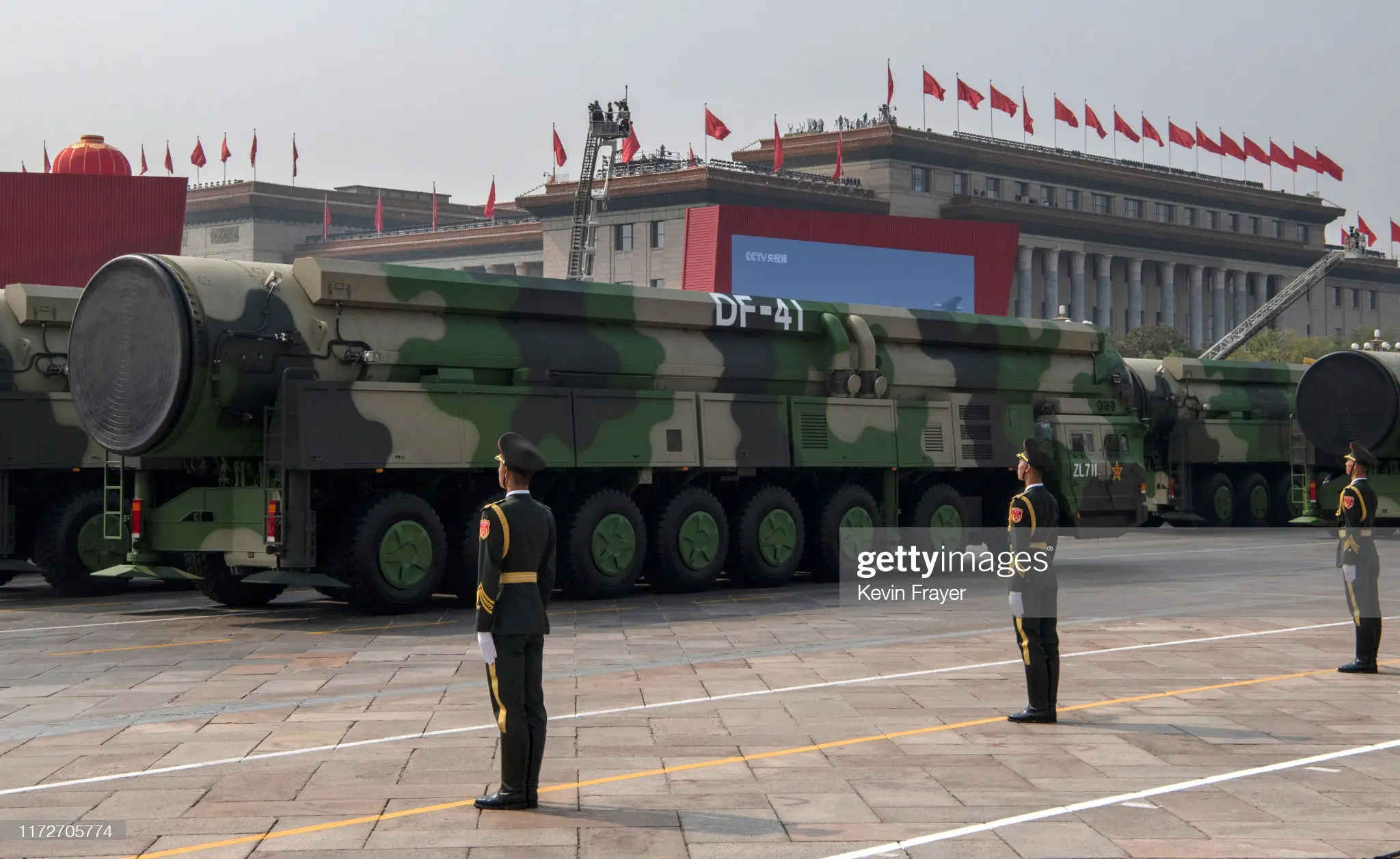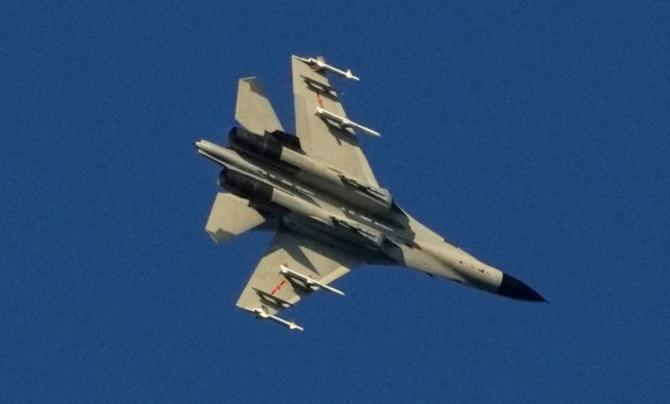
[On parade, the Chinese Dong Feng (East Wind)-41 ICBM, with 8-10 MIRVed thermonuclear warheads]
This interview for Def-Talks, conducted by Aadi Achint, is a sort of “stream of consciousness’ session where I range far and wide, but with the aim of counterpoising the official views and the opinions of just about all the members of the media/Press commentariat who do little more than embroider the government line of the day. It may be accessed below.
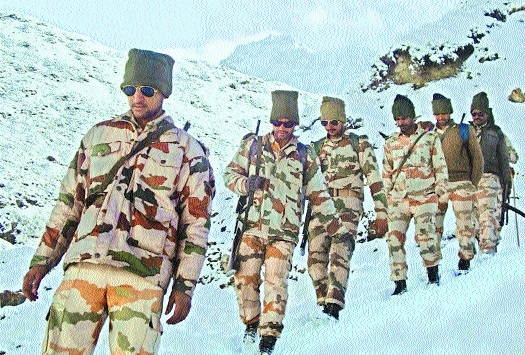
The August 15 issue of a pink paper announced to the consternation of many that the Narendra Modi government is considering handing over the 3,488 km long disputed border with China to the paramilitary Indo-Tibetan Border Police to manage. The main reasons adduced for such handover is apparently “to avoid border conflicts” and, even if belatedly, to realize the “one border, once force”-concept approved by the last Bharatiya Janata Party regime in 2004.
The deep ingress into, and occupation of sizeable Indian territory by China — in excess of 1,000 sq kms in the area northeast of the Y-Junction abutting on the Xinjiang Highway, has not only not been acknowledged by New Delhi but is something Defence Minister Rajnath Singh continues studiously to ignore. He spares no occassion, in fact, to promote the fiction, for instance, that not an inch of Indian ground has been annexed by the People’s Liberation Army. The newsreport also disclosed that ITBP has 180 border outposts, with 140 troopers stationed in each of them, for a total of 25,200 deployed on the LAC. And that two years ago, an additional 47 ITBP border outposts were sanctioned — 34 in Arunachal Pradesh, the rest in Ladakh. (https://economictimes.indiatimes.com/news/defence/govt-examining-plan-to-give-lead-role-to-itbp-along-lac/articleshow/93562475.cms)
This little bit of kite-flying by Home Ministry bureaucrats is because they see it as an opportune time to wrench control of the LAC from the Indian army and Defence Ministry, and expand their turf. After all, their minister, Amit Shah, is the second most powerful man in the country and the Prime Minister’s only political confidante. What he can be made officially to desire is pushable as long as a good case can be made for it to Modi who will, however, need some convincing. Modi can be expected to be uneasy. His last two initiatives in the national defence field have not been the successes he was expecting. Resistance from within has all but stalled the process of integrating the military services, and the Agnipath-Agniveer programme has drawn political flak and sparked countrywide protests in the unemployables-rich BIMARU (Bihar-Madhya Pradesh-Rajasthan-Uttar Pradesh) belt that is also electorally consequential. And, 2024 general elections are just two short years away.
The late Jaswant Singh’s son, Manvendra Singh, who left the ruling BJP for Sonia-Rahul Gandhi’s Congress to improve his political prospects — talk of scampering on to a sinking ship! — in a recent article ( https://theprint.in/opinion/dont-give-itbp-lead-role-at-lac-it-will-weaken-local-command-mha-mod-turf-war-is-hurting/1087732/ ) contended correctly that Home Ministry’s taking charge of the live China border will result in duplication of costs and procurement systems, and both weaken the logistics and force management on the LAC and, by implication, needlessly complicate an already fraught problem of sustaining a credible deterrent presence on the Himalayan heights.
But the more worrying aspect of such decision is the intention behind it. Could it be a prelude to Modi cutting a deal with the Chinese President Xi Jinping wherein the precondition — “restoration of the status quo ante”, i.e., the return of all the land the PLA has to-date occupied/absorbed in exchange for normalcy in bilateral relations that external affairs minister S Jaishankar has repeated ad infinitum is junked, China gets to keep what it has annexed and India, well, lumps it? Meaning, Delhi accepts the Chinese terms and the new territorial normal, including the LAC drawn expansively on the Chinese 1959 claimline imposed by Beijing in Ladakh, in the Dok La trijunction area and elsewhere? Such a “compromise” will also require the Indian government, as per the Chinese demand, to reiterate the “One China” principle.
What’s the basis for the above conclusion?
For one thing, the Ministry for External Affairs/Government of India has not to-date ever placed the Tibet and Taiwan issues on the same political plane as Kashmir, the whole of which Beijing has never ackowledged as part of India. Thus, as far as Beijing is concerned, there are two claimants to the erstwhile Princely Kingdom of Jammu & Kashmir, and the portion consisting of Gilgit, Hunza, Baltistan and the other principalities (Chitral, Nagar, etc) falling within the ambit of “Northern Areas” and illegally in the possession of Pakistan, is Pakistan’s, with Pakistan, moreover, having a legitimate claim on Indian J&K as well. The Xi dispensation right up to the 2020 Galwan River clashes kept turning the knife in India’s side by initiating the China-Pakistan Economic Corridor (CPEC), for example, without at anytime referring to the 1963 Ayub Khan-Zhouenlai accord which specifically mentioned the indeterminate status of J&K pending a final settlement between India and Pakistan. This, at a minimum, required Beijing to secure Delhi’s consent for CPEC as it passed through Kashmir territory claimed by India. But no such diplomatic assent was sought from Delhi, and China proceeded to treat the Northern Areas, implicitly, as integral to Pakistan through which it could construct the CPEC highway via the Karakorum Pass to Gwadar and related projects.
India, in the mean time, continued to respect Chinese sensitivities and unreservedly backed the concept of “One China”. This as Taiwan opened an embassy in Delhi masquerading as a “Trade mission” and sought, even if obtusely, diplomatic recognition. (Indeed, it was rumoured during the brief rule by Chandrashekhar as Prime Minister, Nov 1990- June 1991, when the country’s economy was in dire straits and the country’s holdings of gold had to be flown to the vaults of the Bank of England in London as collateral for loans, that Taipei would gladly take care of India’s then external national debt totaling some US$8-$10 billion for permission to fly the Taiwanese flag on its mission, which offer was rejected!). In any case, in 2003 Prime Minister Atal Bihari Vajpayee during his state visit paved a policy path that internalised the Chinese terms, losing India the little leverage it had left, by accepting Tibet as part of China (in return for Beijing accepting Sikkim as a state in the Indian Union)! The offending Joint Communique reflected MEA’s traditional passive-frightened attitude to China and matching negotiating skills! It is a document the Chinese embassy gleefully reminds the Indian media of. Finally riled enough to take offense, the MEA only relatively recently stopped talking of ‘One China’ and then did not come out swinging by equating ‘One China’ with ‘One India” inclusive of all of Pakistan-occupied Kashmir — a policy I advocated in in my 2015 book Why India is Not a Great Power (Yet). Worse, the Indian government has been traipsing around the issue of Taiwan and India’s growing ties with Taipei — economic, trade, technological and military, without tipping over into recognizing Taiwan as a separate and distinct entity whose sovereignty Beijing needed to be mindful of.
So, how does all this tie in with Home Ministry’s ITBP-LAC gambit? Unfortunately, the loosely worded Indo-Tibetan Border Police Act, 1992, enacted in 1996, describes the task of ITBP (like that of the other paramilitary organization — Border Security Force) as “ensuring the security of the borders of India and for matters connected therewith”. In effect, it makes these paramils, theoretically at least, the equals of the army. It may help buttress Home Ministry’s legal arguments for putting the ITBP in harm’s way on the frontlines on the LAC. But because this paramil is nowhere as well equipped or organized for warfighting, and lacks the requisite ethos for combat as the army is, the ITBP units will be an impediment and hindrance to the army, which even though handicapped in other ways, will have to take care of business. So, if the ITBP is manifestly operationally incapable, how does it help to position it in the van to take on the Chinese group armies?
The answer is in the newsreport unveiling this damnfool idea. It suggested that having the ITBP on the LAC would reduce the possibility of military conflict. In most countries, paramilitaries are tasked to police/monitor settled, clearly demarcated, and internationally recognized borders. The border with China is not delineated whence territory on either side of the disputed LAC is up for grabs. Except, whenever opportunity presents itself the Chinese People’s Liberation Army grabs Indian territory; on the other hand, the Indian army doesn’t reciprocate by taking over parcels of real estate on the Chinese side. Beijing’s standing instructions to the PLA, in the event, are apparently to stake claims on Indian territory patrolled by Indian soldiers, occupy any land devoid of an Indian military presence, and to exploit the Indian army’s disposition policy by capturing areas/posts from where Indian units are usually withdrawn during winter because the absence of a network of border roads, communications setups, storage depots and other support infrastructure, makes it impossible to prop up a forward presence in strength.
The Pakistan army elements occupied the posts on the Kargil heights vacated by Indian troops in high winter and precipitated a limited war in 1999. And it led the PLA to annex strategically important territory in the general area of the Y-Junction on the Depsang Plains, and on the Galwan and elsewhere and to confront the surprised Indian army with a fait accompli. It is the sort of territorial aggrandizement the Indian army usually makes no attempt to forcibly try and reverse. Now that the PLA is well settled in these formerly Indian areas, Beijing is looking forward to capturing more territory and not to restoring previous conditions as pleaded by Jaishankar. If in these circumstances the Modi government wants to avoid military hostilities, whom would they rather have on the LAC facing the Chinese — the Indian army, which is apt when pushed to shove back, or the paramilitary ITBP officered by persons from the Indian Police Service and with little real warfighting capability?
In the wake of the 1962 war, the ITBP was orginally raised as Special Forces, trained by US Rangers for enemy rear area operations and bulk-manned by Tibetan youth from the exile community who would be motivated to do maximum harm to PLA lording it over their homeland. Over time, the Tibetan strength in this paramil dwindled and ITBP became just another Home Ministry-controlled police unit recruiting from all over and deployed in roles it had no business playing. Such as “aid to civil”, fighting Naxals in the Red Corridor, or doing more quotidian jobs, like security duty at airports, etc. But then this is what the IPS leadership of the ITBP is most comfortable doing, and fits in with why some in the Modi government, who are not keen on having armed confrontations with China, would would want an inoffensive police-type oufit out there on the LAC!
In any case, just how unconnected to field reality the IPS officers leading ITBP are may be judged by the statements made by its sometime Director-General, Sanjay Arora, a policeman from Tamil Nadu cadre. He is reported by Press as saying “Our preparation on LAC is fantastic” and that the ITBP “is ready for any eventuality” and by way of a nugget of wisdom adds that “China is a country like us”!! (See https://www.aninews.in/news/national/general-news/our-preparation-on-lac-is-fantastic-ready-for-any-eventuality-itbp-dg20211115202607/ ). It is hard to know what to make of Mr. Arora other than that he is given to hyperbole and is completely ignorant of the adversary his force may face. Lucky for him, he was recently shifted from ITBP and made Police Commissioner, Delhi, and will not be helming the paramil when PLA initiates live action!
Controversy has been triggered mostly in air force circles by my last post regarding the IAF leasing the upgraded and advanced ‘White Swan’ variant of the Tu-160 Blackjack strategic bomber, specifically over whether Air Chief Marshal Arup Raha actually said India would be going in for this aircraft.
I leave it to the readers of this blog to see and hear the former Air Force Chief’s mentioning the need for a “bomber” in his keynote address at the First edition of the Chanakya Dialogues and, in the interaction session, his response to my direct question about the leasing of the White Swan from Russia, and decide if he indirectly confirmed that such a deal was in the works.
See The Chanakya Dialogues | VISION 2035: AEROSPACE CAPABILITY OF INDIAN ARMED FORCES | ACM ARUP RAHA at
‘It is only when Beijing sees a country with an infirm political will such as India that it acts up as the PLA has done in eastern Ladakh.’
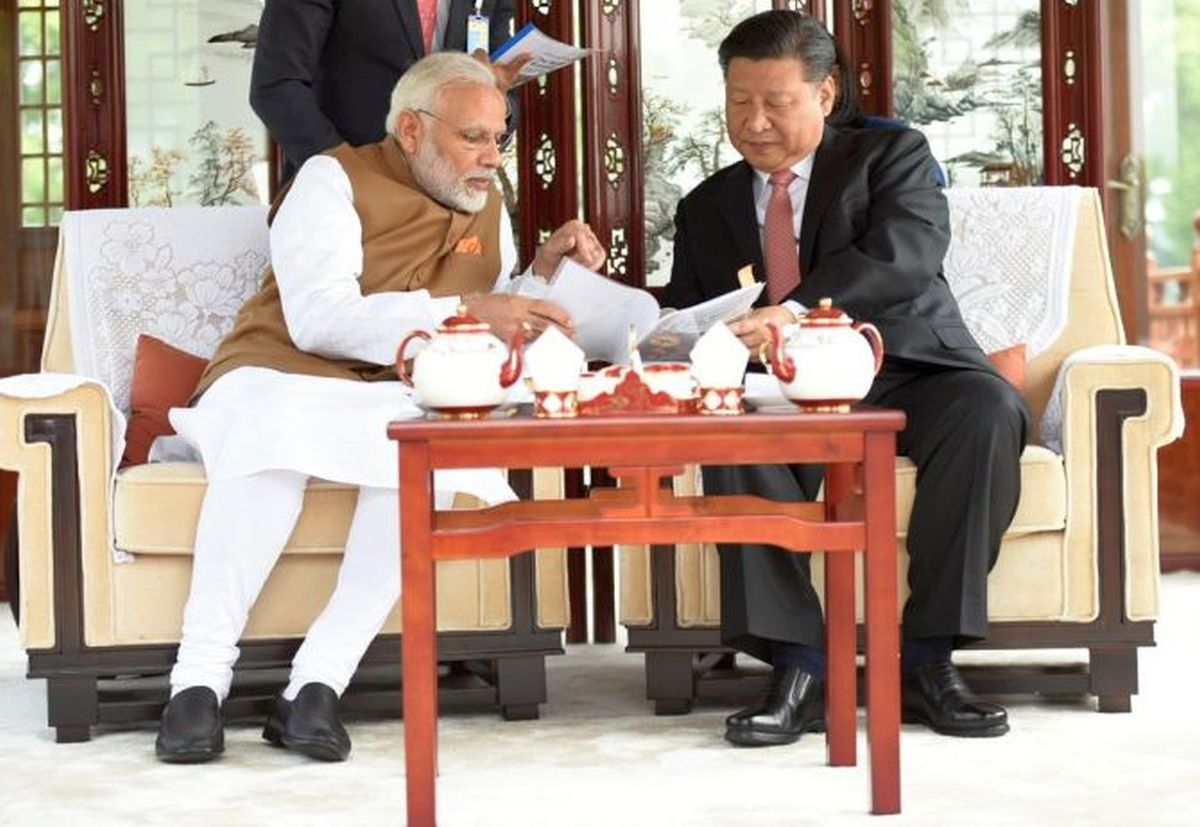
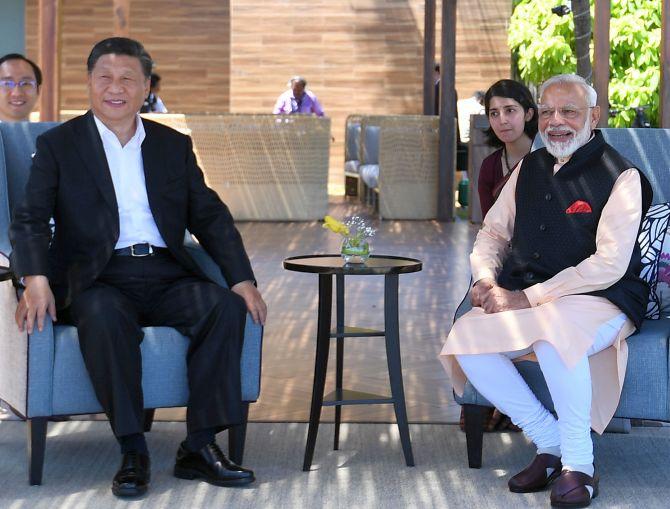
IMAGE: Prime Minister Narendra Damodardas Modi with Xi Jinping, general secretary of the Communist party of China, in Wuhan, April 28, 2018.
Will Nancy Pelosi’s visit to Taiwan have a domino effect across the world?
Can India use its fallout to turn the tables to its advantage against China?
Bharat Karnad, Emeritus Professor at the National Security Studies at the Centre for Policy Research, the New Delhi think-tank, discusses the possible outcomes of the Pelosi visit.
“The Modi regime has so far done little to punish China by way of cutting off Chinese access to the Indian market in the hope that this show of moderation will dissuade Beijing from resuming offensive military activity in Ladakh and Arunachal Pradesh,” Dr Karnad tells Rediff.com Senior Contributor Rashme Sehgal.
———–
The biggest takeaway for India from the Pelosi visit and the subsequent belligerent display of Chinese firepower against Taiwan should be that China can be contained. Are there lessons India needs to learn from this?
I have always maintained that China is less (strong) militarily than it projects itself and when challenged by a resolute adversary usually thinks better of it and either does nothing or, as in the post-Pelosi trip Taiwan case, lets off steam ex-post facto.
It is only when Beijing sees a country with an infirm political will such as India that it acts up as the PLA has done in eastern Ladakh.
It is obvious that Xi Jinping does not want to precipitate matters till the Chinese Communist party’s 20th congress in October and he succeeds in getting an unprecedented third term. The stakes are too high for him, but will he find different ways to get back at the US? Is that likely in the near future and what form will that take?
The results of the 20th party congress are a foregone conclusion. Xi has strengthened his support among the key elements of the State, especially the PLA by cultivating the base and installing leaders/commissars/commanders of his choice in strategic posts.
The question is can Xi get punitive without hurting China’s interests? He can’t. The access to US technology and talent is already closed off. But despite tariff increases, America is the richest market that it (China) simply cannot afford to lose.
So other than a symbolic gesture here, a fired-up confrontational rhetoric there, and continued fire drills and combat aircraft flights crossing the median line and offering the barest provocation in the Taiwan Strait, Beijing will do nothing.
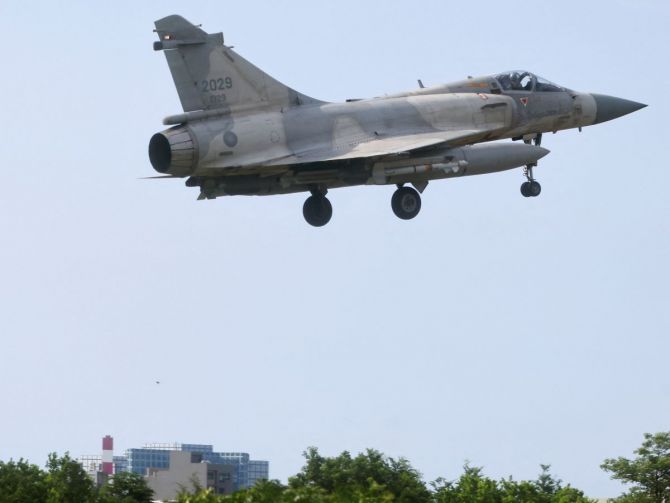
IMAGE: A Taiwan Air Force Mirage 2000-5 aircraft lands at the Hsinchu air base in Hsinchu, Taiwan, August 7, 2022. Photograph: Ann Wang/Reuters
Some experts believe if China receives a rebuff in Taiwan, Xi will seek to scale up China’s international status by seeking a military victory against India. Is this likely to happen? Is India ready to meet such a challenge given that the Chinese have been strengthening their positions on the Indian territory they took over in 2020?
Xi will get China into even deeper trouble if he thinks he can vent domestic pressure building up because he did nothing to prevent Pelosi from visiting Taipei as he had promised, by initiating hostilities against India.
The Modi regime has so far done little to punish China by way of cutting off Chinese access to the Indian market in the hope that this show of moderation will dissuade Beijing from resuming offensive military activity in Ladakh and Arunachal Pradesh.
When this assumption is proved wrong. Modi will be forced to take conspicuously strong economic measures to severely restrict bilateral trade of nearly $126 billion in 2021 heavily favouring China.
It is in India’s interest that China continues to be engaged with Taiwan and the US, so as to decrease the likelihood of a Chinese attack. By October, winter will have set in the upper Himalayas, will that decrease the likelihood of a Chinese attack on Ladakh/Arunachal Pradesh?
For the reasons adduced above, there’s no possibility of China militarily acting up anywhere along the disputed border anytime soon.
IMAGE: A People’s Liberation Army Air Force aircraft flies over the 68 nautical mile spot, one of mainland China’s closest points to the island of Taiwan, August 5, 2022. Photograph: Aly Song/Reuters
If we tie up the knots, is the recent US arms deal with Saudi Arabia and the UAE, the killing of al-Qaeda leader Ayman al Zawahiri and Pelosi’s visit, all part of a concerted US attempt to reclaim its leadership in the global arena?
You assume that the US is capable of expertly manipulating developments and juggling various policy balls in Arab West Asia, Israel, India, Iran, China, Taiwan when, in reality, like India, it is in the business of dousing this or that bushfire as the occasion demands.
There’s no hard strategy as such because as Henry Kissinger famously said America is too wealthy, too powerful, to need to plan or even strategise!
Nancy Pelosi’s visit factored in the fact that economic conditions in China are not so good and China being an export driven economy will not be in a position to face economic sanctions.
That’s what most effectively deters a mercantilist China — the threat of the loss of markets.
Some experts believe QUAD has not created the kind of momentum expected from it.
True. But was it ever really expected to? It is precisely the reason why I advocated in my 2018 book — Staggering Forward: Narendra Modi and India’s Global Ambition, that a better geostrategic arrangement to serve Indian interests is for India to securitise two schemes — a modified quadrilateral or Mod Quad with the US, retaining a role of the extra-territorial balancer it has always performed but otherwise replaced in the Quad by a group of capable Southeast Asian States, including Vietnam, Indonesia, and the Philippines, and BRIS (Brazil, Russia, India South Africa) — BRICS minus China.
BRIS will work because Russia is as keen as the US in ensuring India is enabled to balance China’s growing power in Asia and the Indo-Pacific.
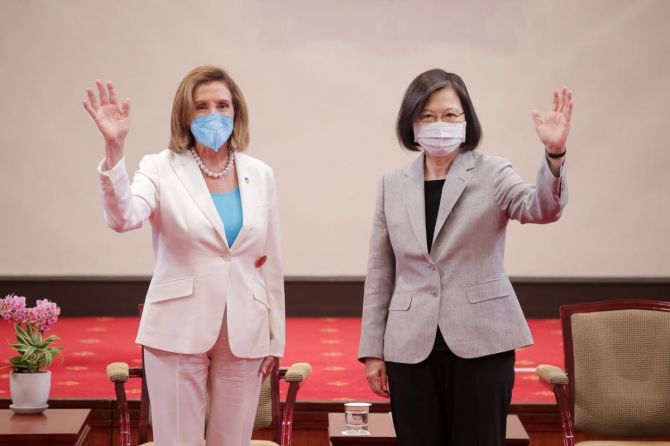
IMAGE: US House of Representatives Speaker Nancy Pelosi, left, with Taiwanese President Tsai Ing-wen. Photograph: Kind courtesy Tsai Ing-wen/Twitter
Will growing tensions between China and Taiwan affect the supply of semi conductor chips given that Taiwan is the largest producer of these chips in the world?
China is setting up its own very large fab units to produce high calibre chips.
In the period it will take to erect these facilities, it has to rely on TMSC and other Taiwanese chip producers because it cannot anymore get them, nor the chip manufacturing wherewithal from the US.
Already we are witnessing a major conflict raging between Russia and Ukraine. Given global warming etc, is this the time to precipitate more military action in the eastern hemisphere?
Global warming will exacerbate the tensions between the developed North and the developing South with mass migrations from climate-affected countries of Asia, the Maghreb and sub-Saharan Africa, and Central and South America to the more prosperous nations of Europe and North America.
The Indian Air Force seems to be getting over the strategic hump, perhaps with a little push from the PMO, and will soon acquire the advanced and upgraded version of the Tu-160 Blackjack called the ‘White Swan’. This transaction, after the S-400 and help in hypersonic weapons technology, confirms Russia’s status as the sole supplier to India of prime military technologies (even if for a hefty price!).
This was disclosed in a throwaway line about a “bomber” being acquired by IAF, which was preceded by a generous acknowledgement — “Mr Bharat Karnad will be happy to know”, by the former CAS, Air Chief Marshal Arup Raha. He was delivering the keynote speech yesterday at the first edition of the ‘Chanakya Dialogues’ hosted by the Chanakya Foundation in New Delhi. On further questioning by me, he confirmed that the aircraft in question was the Tu-160.
By way of another casual remark, he also indicated that a nuclear-warheaded version of a hypersonic glide weapon may soon be on the way. No doubt it is an armament that will be carried in the White Swan’s weapons bay.
It will reverse the obdurately tactical and theatre-level orientation of the IAF brass for 70-odd years. It resulted in August 1971 in the IAF rejecting the Tu-22 Backfire bomber offered the Air Marshal Sheodev Singh Mission by the Soviet Defence Minister, the legendary Admiral of the Fleet, Sergei Gorshkov. Moscow had not reckoned with the obstinately nonstrategic mindset of Air Chief Marshal PC Lal — regarded, incidentally, as a great leader by the IAF!– and his cohort running the service at the time. Indeed, Gorshkov was so certain the IAF would jump at this offer he had a squadron of this bomber aircraft painted with IAF roundels and parked on a military base outside Moscow for flight to India. Nonsensical reasons were offered for this plainly idiotic nyet decision by IAF — the pilot needed to be winched up into the cockpit, the aircraft, ex-Bareilly, would not reach cruising altitude before crossing into Pakistan, etc. Pakistan! — for God’s sake, with no hint of China as the obvious threat to neutralise with this bomber and this, mind you, at a time when the Bangladesh War was in the offing and China had already threatened to intervene if India moved militarily against Pakistan! So what did IAF choose instead? MiG-23BN — no joke!! Worse, the IAF, dog-in-the-manger like, not only did not want the Backfire for itself, it later prevented the Indian Navy from buying this aircraft for maritime surveillance, fearing the Navy was trespassing on its turf by expropriating the strategic bombing role. (These and other details first revealed and analysed in my 2002, 2nd ed 2005 book – ‘Nuclear Weapons and Indian Security.’)
Post-1974 and India’s possessing very basic 12 kiloton gravity nuclear bombs, the Tu-22 would have been a credible recallable manned option as nuclear deterrent before India obtained in the late 1980s the first of the Agni land-based missiles. The Tu-22 could have been replaced with newer versions of the aircraft, including the latest, most advanced, Tu-22M3, and would now have comprised a more compelling two-pronged air vector in the nuclear triad along with the Tu-160.
It is always heartening when something one has ardently advocated over the years begins to take shape, becomes reality. [For the case made for a genuine strategic bomber, and this aircraft in particular, see pages 335-336 in my 2015 book –‘ Why India is Not a Great Power (Yet)’.] The negotiations with Russia are apparently in the final stages for securing on lease six – a third of a squadron — better than nothing! of the supersonic, fly-by-wire, 4-man crewed Tu-160. It will leave the frontline Russian fleet with 29 of these aircraft, because only a total of 35 ‘White Swans’ have been built. Published material suggests the White Swan Tu-160 (the equivalent of the American B-1 strategic bomber) has a 70metres/second climb rate, max speed of 2,200 km/h and cruising speed of 960km/h, unrefueled range of 12,300km, and combat radius of 7,300km.
One version of the bomber runs on hydrogen fuel, which may be right up Prime Minister Narendra Modi’s plan for converting the country to a hydrogen economy. Though for reasons of fuel/fueling aspects, the aircraft India leases will likely stick with the variant run on enhanced aviation fuel.
To show off its astonishing endurance, the Russian Air Force staged a Murmansk to Venezuela sortie in 2008 (to show support for the regime of Left-leaning President Nicolás Maduro Moros at a time when the Obama Administration was tightening the sanctions screw on it), and in 2010 a 23 hour patrol covering 18,000 kms over the Russian landmass.
The options and possibilities this bomber offers should make the mouths of IAF warplanners and operations guys water. Preparatory planning should begin for nuclear targeting by the White Swans of the most distant Chinese targets — Beijing!, with the more critical, but relatively proximal, targets, such as the Three Gorges Dam and its system of downstream dams and the Lop Nor nuclear weapons complex in Xinjiang left, if necessary, for the Su-30MKIs to take out. The Sukhois can be embarked from Tezpur/Kalaikunda in the one case, and the Ainee base in Tajikistan available to IAF, in the other.
The problem IAF will have is in basing the Blackjack. The Bareilly base — which ran the Canberra medium bomber and the MiG-25 Foxbat high-altitude surveillance aircraft, won’t do. Bareilly is too near major and satellite PLAAF airfields on the Tibetan plateau in the central sector of the LAC, not to pose risks to the White Swans based there. A base in southern central India will be the safest and best option considering the “long-legged” Tu-160 will still be able to hit deep inside China, and have IAF air defence/interceptor aircraft out of a string of air bases in northern India as protective tier.
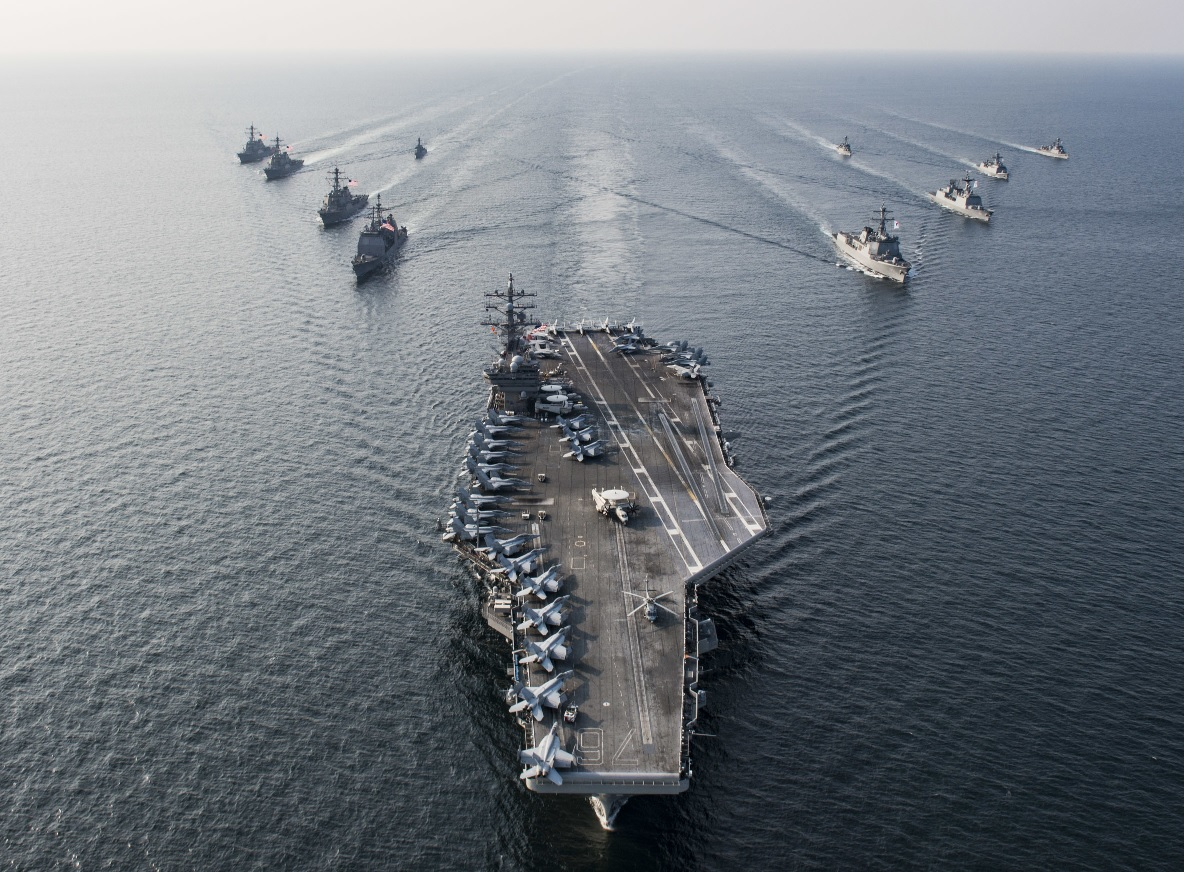
[ US Navy’s USS Ronald Reagan aircraft carrier strike group]
There are some very nervous people in Washington and Beijng, each wishing the other side regains good sense in time and backs down. The person who will decide the direction the latest Taiwan crisis will take is the powerful Speaker of the Lower House of the US Congress — the House of Representatives, Nancy Pelosi, a plucky 80 + year old California Congresswoman, who has always been a drama queen. She means to pay the Taiwan a visit. The Biden Administration tried to deflect this political venture by asking her to postpone her visit for the nonce on some trumped up reason or the other, not cancel it. This would save both America’s face and China’s and put off the crisis to another day.
Till last heard, Pelosi will have none of it; her trip is on. She revealed to the media that the Biden Administration fears the aircraft carrying her could be be ambushed, shot down by Chinese combat aircraft in the air corridors cleared for her flight to Taipei. This assumes that Beijing will, in fact, follow through on its promise of severe response in case Pelosi disregards the “One China principle”, proceeds on her Taiwan goodwill mission, and precipitates a crisis. While it will prove that Beijing’s huffing and puffing wasn’t all bluff, the shooting down of Pelosi’s aircraft will quickly ratchet up the crisis to a flashpoint.
The US military is rounding into business. The USS Ronald Reagan aircraft carrier strike group left Singapore July 27, heading towards Taiwanese waters, no doubt to be on hand to, among other things, provide Pelosi’s plane, which will have US aircraft ex-Guam for protecton, augmented fighter escort if needed for her flight into Taipei, and otherwise to be in the van of the US military units in the area in case President Xi Jinping decides he has too much to lose domestically by allowing the American leader to carry on unhindered after instructing his regime to make so much hoo-ha about it, and orders the PLA air force and PLA navy into action.
A tense General Mark Milley, Chairman, US Joint Chiefs of Staff, flanked by the Commander-in-Chief US Indo-Pacific Command, Admiral Chris Aquilino, in Sydney to attend the 24th Indo-Pacific Chiefs of Defense Conference, said: “We will do what is necessary to ensure a safe…conduct of [Pelosi’s] visit…I’ll just leave it at that…what that results in we’ll have to wait and see.”
This is too delicious a strategic crisis to ignore, It pits America against China in a test of wills with the prospect of only one side coming up tops. It is a test case of future confrontations in Asia. On two previous relatively recent occasions, China thought better of it and withdrew. In response to PLA’s firing surface-to-surface rocket and missile barrages, President Bill Clinton in 1995 ordered the USS Chester Nimitz carrier strike group into the Taiwan Strait. In 2007 the USS Kitty Hawk strike group loitered in the same Strait without eliciting any Chinese response. That Beijing reacted so strongly this time around, thereby deliberately and with forethought raising the ante, suggests that Xi and his military commanders in the Central Military Commission are confident that the PLA forces, much improved, can take on the US.
How will this crisis pan out? There are only two possibilities,
Pelosi decides this is all too much and scrubs the Taiwan trip handing Beijing a political victory it will milk to the max reinforcing. in the process, China’s tendency, in General Milley’s words, to “bully or dominate” other nations. The fiasco will further erode what credibility America has left as ally and strategic partner, and showcase Washington’s unwillingness to stand up to the emerging Asian behemoth, and likely provide not only Taiwan, but also Japan and South Korea, with more motivation to acquire nuclear weapons and, security-wise, become independent of the US.
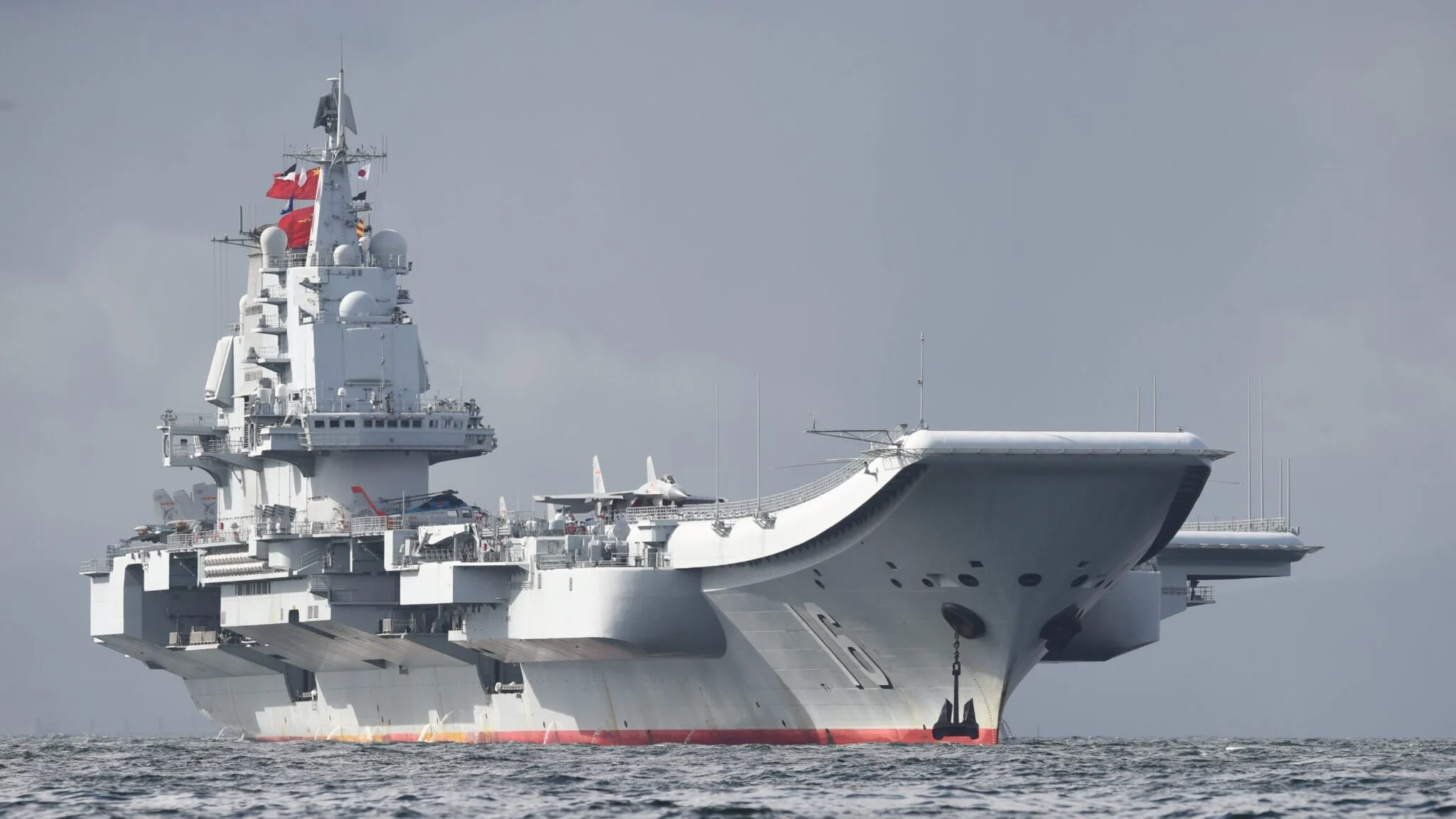
[Liaoning in the Hong Kong waters]
The second possibility is that Xi will recognize that all the Chinese angst and vituperation against Taiwanese secessionism and American provocation is not going to raise the fighting quality of the PLA forces, and any hostilities may prove to the world what many already suspect that China is not a peer rival of the US, that the Chinese navy’s shiny new aircraft carriers — Liaoning and the Shandong (sans aircraft!), for instance, are like the rest of the PLA, paper tigers, good enough only to scare, say, India with!
In this confrontation with so much riding on it, there will be a winner. My money is on China getting cold feet because, by my reckoning, PLA, PLAAF, PLAN are still 20 years away from being America’s military equal.
‘This reluctance to respond forcefully to Chinese PLA provocations and outright aggression has as much to do with Prime Minister Modi personally, as with the institutional mindset of the MEA or even the Indian Army.’ ‘They are scarred by the 1962 War and are still cowed by China.’
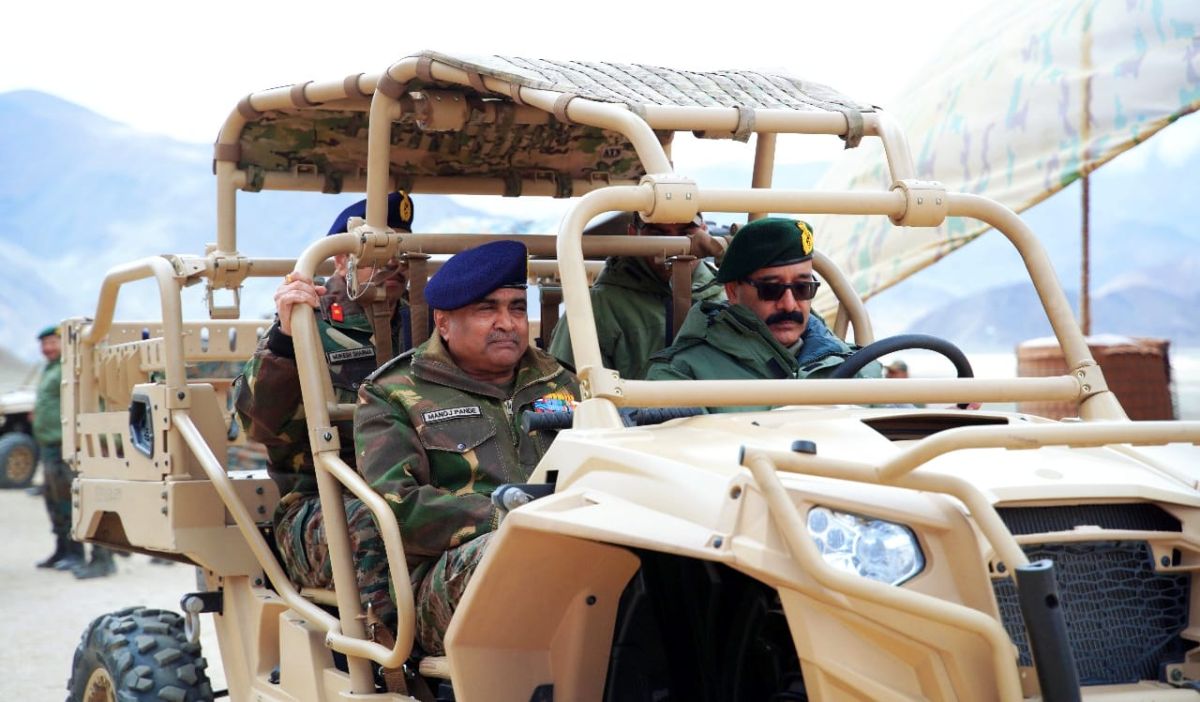
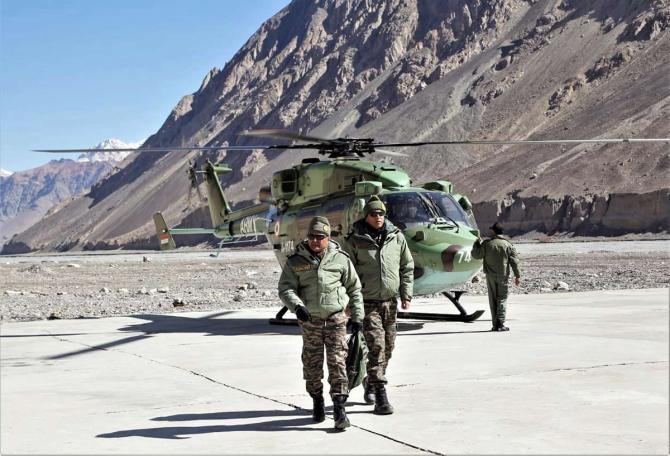
IMAGE: General Manoj Chandrasekhar Pande, the chief of the army staff, on his visit to Ladakh in May. Photograph: ANI Photo
Dr Bharat Karnad, Emeritus Professor at the Centre for Policy Research, the New Delhi-based think-tank, analyses why there has been a muted Indian response to the Galwan clashes which took place between Indian and Chinese troops two years ago.
“Let’s be clear: It is Modi, and Modi alone, who is responsible in toto for India’s foreign and military policies. External Affairs Minister S Jaishankar is just the medium and has no say in these matters other than overseeing their conduct and implementation; and army generals have even less of a role,” Dr Karnad tells Rediff.com Senior Contributor Rashme Sehgal.
Two years after the Galwan clashes, there is an accusation by some analysts that China continues to steadily encroach on Indian territory and has taken over almost 4,000 km of Indian territory. How far is this assessment correct?
Given the 24/7/365 surveillance via various sensors, including those mounted on Indian and friendly foreign satellites, it is unlikely India has lost territory to this extent since the Galwan incident.
That said, the 1,000-odd sq kms in the area northeast of the Y-Junction on the Depsang Plain the PLA occupied much before the clashes on the Galwan river remain in China’s possession.
A large part of this Chinese deployment has reportedly been in the Depsang Plain. This continues to be a dangerous development given that the Chinese aim to build a connecting road up to PoK.
The significance to India of the territory China now occupies is that this traditionally Indian area is alongside the arterial Xinjiang Highway that branches off southwards at the Karakoram Pass to constitute the China-Pakistan Economic Corridor.
This territorial loss means the Indian Army is blocked from moving northwards from Daulat Beg Oldi to apply military pressure at the conjunction of the PLA-Pakistan army interests on the Karakoram Pass, and thus threaten the CPEC.
This is what the Chinese People’s Liberation Army intended with pre-emptively capturing that swath of land.
The Chinese are building another bridge over the Pangong Tso lake to improve their logistics in countering our troops positioned there.
The Chinese plan obviously is to have redundancy in connectivity by building a number of roads, shunts and bridges linking the northern and southern shores of the lake under their control.
It enables them to consolidate their logistics infrastructure, and launch a concerted military action on either shore at a moment’s notice.
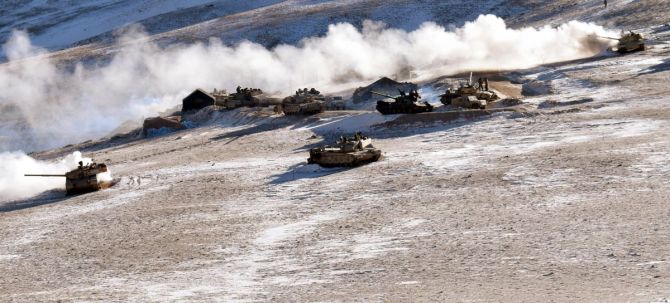
IMAGE: Indian and Chinese troops and tanks disengage from the banks of the Pangong Tso lake area in eastern Ladakh in February 2021. Photograph: ANI Photo
We have had 15 rounds of border commander talks since April 2020, but there is little talk of a reversion of positions to status quo ante pre April 2020 when these talks first started. Analysts believe we are back to the 1959 position.
The periodic field commanders’ meetings are a waste of time and of no real account other than affording these uniformed folks some downtime with tea and samosas!
I long ago suggested that the Indian Army should not partake of these conferences the PLA does not take seriously.
I had warned precisely of such a denouement at the very beginning of this confrontation in eastern Ladakh.
It was Pollyanna-ish of the Indian government, in any case, to expect China would ever agree, for any reason, to the restoration of the status quo ante.
Why is there no White Paper on these talks providing the public at large details about what was discussed and what were the lessons learnt from the tragic death of our 20 soldiers on the night of June 15-16, 2020?
There’s no White Paper because it will have very little to report other than that China has not, and will not, move an inch from their proclaimed 1959 claimline which, by the way, Beijing never formally resiled from.
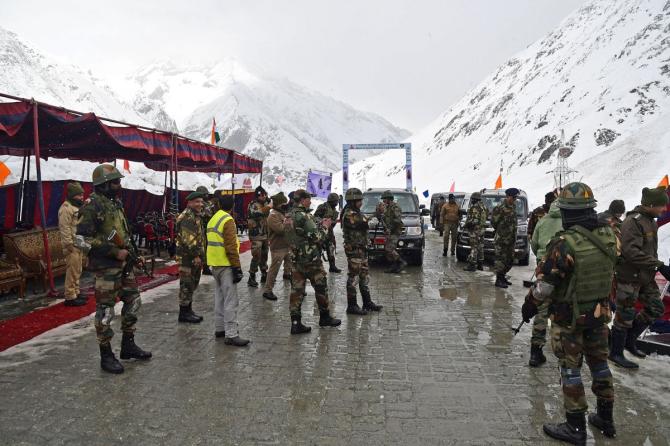
IMAGE: Indian Army soldiers stand guard at the Zojila Pass. Photograph: ANI Photo
Nor is there any clarity from the government or the army about what led the Chinese army to occupy Indian land. Or is this just a Chinese continuance to continue with their objective of ‘salami slicing’?
The PLA is into ‘salami slicing’ of Indian territory with a definite design (such as blocking Indian access to the Karakoram Pass). Such activity is not purposeless.
Why has the government’s response to China been so muted in contrast to the chest thumping that goes on each time something happens along our border with Pakistan?
This reluctance to respond forcefully to Chinese PLA provocations and outright aggression has as much to do with Prime Minister Modi personally, as with the institutional mindset of the MEA or even the Indian Army.
They are scarred by the 1962 War and are still cowed by China.
In retrospect, what exactly was discussed between Prime Minister Modi and President Xi Jinping at their 18 meetings prior to this standoff? Can this be seen as another betrayal by the Chinese as happened in the case of Jawaharlal Nehru in 1962?
Look, the Chinese negotiating tactics are always to first delineate the border as per historic claims and then to change the status quo on the ground to conform with those territorial claims.
The rest is artful waffling and stretching the negotiation in time and space to hope that the other side loses patience and gives in.
Zhou Enlai in the 1950s did offer Nehru a territorial swap — recognition of the McMahon Line in Arunachal Pradesh for Indian acceptance of the Aksai Chin the PLA had built the Xinjiang Highway through.
That was not a bad deal for Nehru to have accepted then. He didn’t.
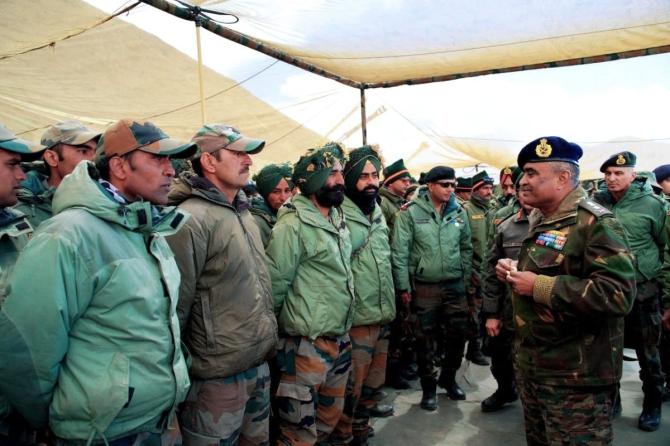
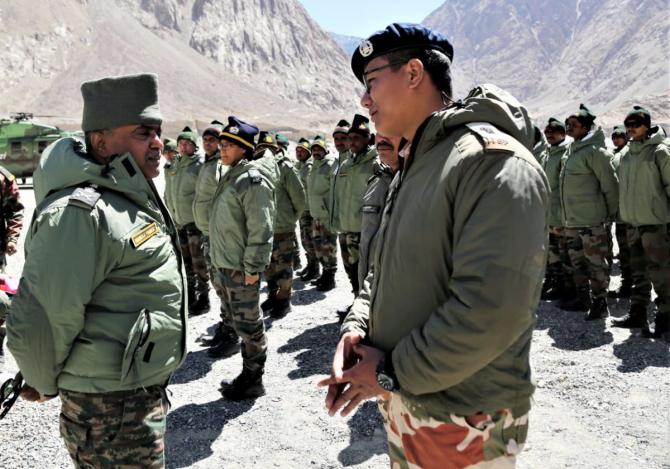
IMAGE: General Pande interacts with Indian troops posted in Ladakh. Photograph: ANI Photo/Indian Army twitter
Was it a prudent decision to have given up the Kailash Range getting little in return? What is our actual position today in Hot Springs and the Depsang Plain?
It was the biggest strategic blunder the Modi regime committed by agreeing to withdraw the Special Frontier Force unit from the heights in exchange for paltry returns — the PLA’s drawing back eastwards a bit from the terrain feature Finger 3 on Pangong Lake’s northern shore.
Again I had warned against this unequal deal.
IMAGE: Prime Minister N D Modi and Xi Jinping, general secretary of the Chinese Communist party and president of the People’s Republic of China, at their informal summit in Mamallapuram, October 12, 2019. Photograph: Press Information Bureau
Trade with China continues to grow with India hardly being in a position to stop its dependence on Chinese imports. Is there any serious attempt to curtail Chinese imports?
Indian imports in trillions of rupees from China are growing by nearly 50% annually, and the repatriation of profits in billions of dollars in hard currency by Chinese companies is keeping pace.
It is among the bright spots in the current Chinese economy and something Beijing would not like to disturb.
Reason why the PLA is pretty quiet in Ladakh even in the summer military campaign season.
Delhi can change this situation in a trice, but percieves Chinese exports to India as negotiating leverage with Xi Jinping, which it is loath to give up.
Is it not time for the political leadership to come forward and take charge instead of leaving this issue to the generals especially given the fact that China has changed the goalposts?
Let’s be clear: It is Modi, and Modi alone, who is responsible in toto for India’s foreign and military policies. External Affairs Minister S Jaishankar is just the medium and has no say in these matters other than overseeing their conduct and implementation; and army generals have even less of a role.
Just how nonexistent gun violence is in Japan can be guaged from the astonishingly lax security provided the former Prime Minister Shinzo Abe. There was no security cordon worth the name — with the few tasked with protecting him, apparently standing around the place unconcerned, letting the assasin approach from the most open and vulnerable entirely unsecured area behind Abe. The manifestly unprofessional Japanese security police are blameworthy, of course. But the fact is the use of guns is entirely unknown in Japanese society (except by the yakuza — the criminal underworld, who gun down each other). Even so, there was just ONE gun use-related death in Japan last year compared, say, to some 15,000 deaths in India (and according to CNN, 45,000 in the US)!
The loss to Japan of Abe is immeasurable and on several counts. First, he ended the era of apology, of 70 years of Japanese remorse, for World War Two excesses, which China relentlessly milked. The Nanjing wartime massacre was perennially used as a moral cudgel to beat up on Japan and to extort from Tokyo hundreds of billions of dollars in reparations post-1945 in the form of cash, grant-in aid and assistance, massive investments to build up the Chinese economy, and of technology transfers. Think Shinkansen Japanese high speed rail technology that the Chinese ingested, developed further, and applied to now field, perhaps, the largest high-speed railway network in the world! No more bowing and scraping to Beijing, Abe decreed, leave alone paying China exactions!
Secondly, and with more long lasting effect that had China sweating with fright, he spearheaded the successful effort to get the Japanese Diet in 2014 to reinterpret the non-belligerancy clause — Article 9 — in the so-called ‘peace Constitution’ imposed by the US, which prohibited Japan from arming itself with offensive weaponry, to now permit the government more flexibility in the use of the Japanese Self-Defence Forces, preemptively if necessary and in support of allies and friendly states. Considering the absolute unreliability of its ally US’ extended deterrence, it paves the way for Japan sometime in the future to go in for nuclear weapons. This, from India’s perspective, will be a very good thing to happen.
But most importantly, Abe conceptualized the ‘security diamond’ — later formalised into what is now the Quadrilateral of Japan, India, Australia and the US. He did so publicly in a 2007 address to Indian Parliament, indicating at once just how much significance he attached to having India as one of the four pillars of a collective security scheme he was putting together to secure Asia’s future and blunt China’s coercive edge.
His immense respect, regard, love and warm feelings for India were for intensely personal family reasons. Shinzo Abe was the scion of a powerful political dynasty with pre-War roots founded by his maternal grandfather, Nobusuke Kishi, who was the economic czar of the Japanese puppet regime of Manchukuo that the imperial Japanese government established in the 1930s to colonize eastern China. Kishi barely avoided being branded a war criminal by the post-War International Military Tribunal in Tokyo — the Asian version of the Nuremberg Trials, which decided to imprison/hang a dozen of the senior most Japanese wartime leaders. Of the eleven judges on the Tribunal, only the Indian judge, Justice Radhabinod Pal, refused to return a guilty verdict on the Japanese leaders, earning for himself and for India eternal gratitude of the Japanese nation. Indeed there’s a monument to Justice Pal at the controversial shinto Yasukuni Shrine in Tokyo where the war dead are venerated, and which temple Abe made it a point as PM to visit (as few of his predecessors in office had dared to do). Kishi’s career revived in the 1950s; he founded the Liberal Democratic Party and as Prime Minister led the country for three years, 1957-1960. His father, Shintaro Abe, was a leading member of LDP and foreign minister in 1982-1986 and was among the first to evince substantial Japanese interest in strong ties with India.
The fact is Shinzo Abe was the strategic brain and the driver of the Quadrilateral — the one person most responsible to try and get the disparate interests of the four pillar countries of the Quad to mesh. US President Barack Obama’s “pivot to Asia” and Washington’s interest since in containing China through such an arrangement was in no small measure due to Shinzo Abe’s private and public Quad advocacy and persistence in pitching this arrangement as a much needed strategic and economic counterweight to the emerging colossus in Asia and the world — China. Moreover, the successful policy of Japan joining India to provide quality infrastructure buildup on concessional credit terms but minus potential debt traps to African countries to compete with China’s Belt and Road Initiative, has made inroads and manifests Abe’s foresight.
His keenness to make India a hefty maritime power eventuated in his offering India the US-2 multi-role flying boat — inarguably the finest such fighting machine in the business, complete with its manufacturing technology and processes that included the shifting of the entire Shinmaywa design and production capacity and plant to India, to set this country up as the sole producer of this aircraft in the world. In a pinch, Abe would have gladly arranged the funds to subsidize this entire deal. But then the Indian Navy stepped in, rejecting the aircraft deal in a mindboggling show of such utter shortsightedness as to make the decision reckless, bringing into question that Service’s basic intent and institutional mindset. No explanation was available from the Defence Ministry other than that the deal exceeded the Navy’s requirement of 12 such aircraft!!
This when there’s no better weapons and transport platform anywhere with potential for immediate strategic impact in the Indian Ocean region, and good for all sorts of maritime ops ranging from island defence, anti-piracy action, dropping Indian Navy’s marine commando on a dime in the vast oceanic expanses for any purpose, shutting down contraband trade by interdicting smuggler vessels/dhows, to anti-ship strikes besides the more mundane roles ferrying crews to oil rigs, search & rescue missions, etc.. As the sole manufacturer of this plane, moreover, the prospect was for all countries with seaward exposure lining up to buy ithe US-2.
The point to make is the Modi government could have reversed the Navy/MOD’s idiotic — there’s no other word for it — decision and plonked for the Shinmaywa transaction as a readymade building block of an indigenous arms industry that the Prime Miister has been talking about from his earliest days as PM. But there was no one, not a single person anywhere in the extended Indian government’s security apparatus and in the military or even the Coast Guard, with a small fraction of the strategic sense of Shinzo Abe to see the merit in this deal and to seal it! (Instead, the billions of dollars in Japanese funds are being invested in Modi’s vanity project — the Shinkansen high speed Mumbai-Ahmedabad rail link, which after all these years of construction is stuck, unable to acquire some piece of land.)
Indeed, the rejection by the Indian Navy of the US-2 available on the most favourable terms imaginable ranks with the Indian Air Force’s even more incomprehensibly foolish rejection (first detailed in my 2002 book — Nuclear Weapons and Indian Security) of the Tu-22 Backfire strategic bomber that was offered by the Soviet Union as far back as August 1971 to top off, as it were, the Treaty of Cooperation and Friendship signed at the time that made the unhindered prosecution of the Bangladesdh War possible, notwithstanding the US attempt at military coercion (USS Enterprise aircraft carrier Task Group in the Bay of Bengal). If the legendary Admiral of the Fleet of the Soviet Navy, and Defence Minister, Sergei Gorshkov, was the man who failed in his efforts to gift the Tu-22 longrange strategic bomber to the Indian Air Force — think how this would have beefed up the Indian nuclear deterrent vis a vis China, it was Shinzo Abe’s proffered gift of the US-2 the Indian Navy turned down earlier in the new millennium. Talk of spurning gift horses!
And this is the Indian military that aspires to be strategic, and wants to be taken seriously as a strategic force? And this is the Modi government that hopes to carry strategic weight in international councils, make India a power of strategic consequence? Really?
Little wonder then that the Indian government under Modi, as under previous prime ministers, remains as stubbornly unstrategic as the Indian Navy and the Indian Air Force, and has simply not risen to the scheme that Shinzo Abe articulated and, other than bilateral and multilateral naval exercises (Malabar) and endless jaw-jawing at ministerial and foreign ministry official levels, has done nothing of note in operationalizing the Quad or, over the years, realizing a hard Indian and collective Asian response to China’s interminable provocations and acts of belligerance. This trend is something Abe no doubt regretted to his last day.
What to speak of military countermoves, the Modi government refuses to curtail Chinese exports to India touching Rs 7.02 trillion in 2021-2022 — a 45% increase over the previous year! And Chinese firms operating in India are repatriating profits totaling billions of dollars without much let or hindrance. So, the situation is Beijing, military-wise, slapping India silly but below an all-out conflict threshold, and is rewarded with letting its companies make outlandish profits! How could things be any better for Xi? Why would China want to change the situation even a bit?
Let me illustrate the problem. The Modi government has got up the gumption, finally, to at least do innocuous things that Manmohan Singh regime didn’t do because Beijing frowned upon them. So recently HH the Dalai Lama was felicitated on his 87th birthday by Modi, and his trip to Ladakh is being facilitated by the government. This is fine. But Beijing studiously takes no notice of Indian concerns about Pakistan’s sponsorship of terrorism and is bent on easing that country out of the Financial Action Task Force’s Grey List, and will likely succeed the next time FATF meets in Paris. It continually burnishes Pakistan’s military capabilities with top-end advanced radar and avionics suites for its PAF’s JF-17 fleet, and augments the Pakistan Navy with Type 054 frigates (Taimur and Tughril) with sophisticated sensors and anti-ship and anti-submarine weapons. It is also hellbent on somehow completing the CPEC (China-Pakistan Economic Corridor) to take a stranglehold on the Baloch coastline radiating east and west from the Gwadar port. Further, despite the Pakistan army’s reluctance, one hears Beijng has succeeded in armtwisting Islamabad into stationing a Chinese security force in Pakistan to protect Chinese engineers and expat CPEC labour force. This force can become a nucleus of an expeditionary Chinese formation inside Pakistan that India may have to contend with, and is a troubling development. And in eastern Ladakh, it launches taunting aircraft sorties that have repeatedly flown over Indian posts and deep into the Indian side of the Line of Actual Control. This is the context in which Beijing publicly berates Delhi for bilateral relations taking a dive.
The Modi regime. meanwhile, rather than instructing the Indian forward air defence units to shoot down any intruding aircraft as warning to China and to show India’s willingness to escalate, swallows these insults, and is content with the army and IAF’s inaction. On the diplomatic front the Modi dispensation is just as passive. It hasn’t reacted by, say, the PM inviting the Taiwan ambassador (passing off as trade representative) for tea at 7, Race Course Road, and the external affairs minister S. Jaishankar or even the NSA Ajit Doval initiating a chinwag in Taipei as an incentive for Xi Jinping to order the PLA to vacate the 1,000 sq kms of Indian territory it has occupied on the Galwan and in areas northeast of the Y-Junction on the Depsang Plain. So India’s image in the Chinese mind as an easily intimidated dormouse around a snorting and stomping dragon, is cemented, motivating still more outre Chinese behaviour.
The irony is the strategic space in southern Asia is daily becoming less receptive to Chinese interests — a situation Delhi should speedily exploit. Consider Sri Lanka – not too long ago a leading Chinese outpost. President Gotabaya Rajapaksa’s fleeing from his official residence in Colombo in the face of protesters breaking through the security cordon means an end to the Rajapaksa family government that over the last decade reduced Sri Lanka to penury, not little owing to the debt racked up with China to fund rank unprofitable projects in the Rajapaksa home ground around Humbantota, including modernizing the port that sees little traffic. Wisely, the Modi government has been generous in routing energy supplies to that country and opening multi-billion dollar lines of credit to enable essential purchases of foodgrains, etc. But Jaishankar & Co. in MEA have to ensure that whatever the agreement signed with the new Colombo government, it should ruthlessly require the ditching of accords with China that permit Chinese naval and other forces to access Sri Lankan bases or to stage out of them, and to begin zeroing out the Chinese economic presence from that country. The question is will Delhi move rapidly and with great resolve to help Sri Lanka become independent of China for good to India’s strategic benefit?
The despiriting reality, however, is that while India has been presented with ample opportunities to strategically discomfit China, Modi has not availed of them because, for some unfathomable reason, whenever Beijing hoves into view the Indian government seems to get cold feet. The sturm and drang that Modi so effortlessly summons to beat up Pakistan, rhetorically and otherwise, turns to jelly when confrontng China.
In the event, is it even fair to expect that Modi will suddenly shake off his apprehensions and the deep down unwarranted fear of China to tackle Beijing boldly, for a change donning Shinzo Abe’s mantle, and taking up where his good friend left off, as leader getting up an Asian coalition to pin China down?
Amongst a host of idiotic policies the Indian government followed until at least the turn of the Century was to shun arms exports. High-minded reasons were trotted out — India, a moral and responsible state, couldn’t possibly be in the dirty business of selling arms, etc. Never mind that we were onpassing small arms, ammo, 105mm field guns, and so on — but on a small scale — to friendly states and countries in the neighbourhood.
There were more practical reasons, however, that KC Pant, defence minister in Rajiv Gandhi’s cabinet in the mid- to late-1980s, alluded to. He once told me of the issue he was then wrestling with relating to, yes, “commissions”, bribes, call it what you will, that needed to be liberally handed out to all manner of people up and down the procurement systems in potential customer countries who had shown interest in this or that piece of Indian-produced military hardware. It is a mirror image, incidentally, of the tandem system of defence sales-bribes worked by foreign arms suppliers pushing multi-billion dollar arms deals to the Indian military. Names like Bofors, HDW, AugustaWestland have passed into lore, symbolizing the extraordinary levels of corruption that are endemic to big arms contracts. The evidence of corruption has upended governments (Rajiv Gandhi’s), implicated armed services’ chiefs of staff (Air Chief Marshal ‘Bundle’ Tyagi) and otherwise made the public aware of the seedier aspects of arms transactions, including, allegedly, the government-to-government deals such as the one that fetched the Indian Air Force the French Rafale combat aircraft.
So the question is, if bribing is de riguer and almost a standard operating procedure in the arms business, how’s the Indian government formally to account for the taxpayer’s money thus spent even if in a good, national, cause of making friends and influencing countries by selling them arms and, by the by, generating revenues and giving a fillip to the indigenous arms industry? Such was the dilemma Pant struggled with. He also wondered about nut & bolt issues involved, such as whether a separate sales agency needed to be set up in the Defence Ministry, but worried that civilian officials and military officers manning it would, on the one hand, be hamhanded in the delicate business of bribe giving and taking that could blow up in the Indian government’s face and, on the other hand, whether these Indian arms sales personnel would have enough integrity not to pocket some of the hard currency commission-funds that would have to be set aside for this nefarious purpose! In other words, some kind of ‘black budget’ outside parliamentary and other scrutiny of the kind, say, RAW, the external intelligence agency, operates.
Thank God, the Indian government (in the Modi years) has matured in its thinking, entered the real world, and authorized the defence manufacturing units to sell their wares, however they are able to do so, with the necessary diplomatic/military and other assist from Delhi easing the way to the extent possible. Defence Attaches in Indian embassies, expressly tasked to “sell” Indian-made military goods, do the early spadework, and the Indian defence public sector units follow up, what with the government urging a ramping up of exports to amortize the enormous public investment in the DPSUs.
The DPSU Hindustan Aeronautics Ltd (HAL) knew, once the Tejas light combat aircraft had reached prototype stage, that it had a winner on its hands. The showcasing of this 4.5 generation Indian designed and developed delta wing supersonic fighter aircraft in air shows starting with the one in Bahrain in 2016, in Dubai in end 2021 and, most recently, in Singapore in February this year, was followed a month later by five LCAs from the Sulur squadron deployed to an international air war exercise (Cobra Warrior 22) conducted by the RAF in Britain involving many advanced air forces. All this has has padded Tejas’ reputation as a fast, agile, and highly maneuverable and modern combat aircraft. Moreover, with a competitive price advantage it has obvious attractions for countries with limited means or limited needs. After Bahrain, over a dozen regional air forces showed interest. Air force chiefs from several of these interested countries, including from Central Asia, have flown the LCA and are admirers of the plane’s handling characteristics.
For starters, Malaysia, after a fly-off, has indented for 18 Tejas (with 18 more as possible future buy). It beat the far costlier Russian MiG-35 and the South Korean FA-50, the manifestly less capable Chinese L-15 & JF-17, the Turkish Hurjet still only a prototype, and the Italian Leonardo M-346 trainer jerryrigged to pass off as a fighter/attack LCA M-346FA but minus an AESA (active electronically scanned array) radar, which’s standard equipment on Tejas. (The Leonardo LCA features a mechanical scanning radar.) Should the deal for Tejas be sealed, it will highlight an ongoing policy of military cooperation. In 2017, a complicated deal was hammered out involving the transfer to IAF by Malaysia of all 12 MiG-29Ns in its employ in exchange for Indian HAL spares and assistance to upkeep its Su-30s fleet — an arrangement that apparently built up trust between the two air forces.
Impressed as much by its quality as by its relatively economical cost, Egypt has a more ambitious Tejas programme on its mind. The Egyptian Air Force wants to produce this aircraft in their own country to meet a much larger requirement of 70-odd aircraft. HAL’s sweetener is a package deal involving Tejas LCA technology transfer and a parallel assembly line for the Dhruv utility helicopter. It was too good a deal for Cairo to refuse. In any case, the successful culmination of the Egyptian Tejas programme will be an ironic counterpoint to the joint project with Egypt mooted by Jawaharlal Nehru to produce a “nonaligned” combat aircraft. India was tasked to produce the airframe which it did — the HF-24 Marut; Egypt failed to develop an appropriately powered jet engine, leaving the IAF to manage with a flying-wise fine fighter plane but with an underpowered, make-do, Orpheus jet power plant taken from the Gnat.
Argentina is in the market for 12 LCAs and has sequestered some $700 million for the deal. The only other planes in the race are the Russian MiG-29 and MiG-35 and the Chinese JF-17, which no one wants. The niggle here is Britain — its 1982 Falklands War animus still simmering — has vetoed the sale of Tejas because it has British components, in the main, the Martin-Baker zero-zero ejection seat system and the Cobham radome of composite materials for low observability. But HAL has conveyed assurances that it has designed and is well on its ways to testing and producing an indigenous zero-zero ejection seat system as also a quartz radome. Further, the Argentinian insistence on tech-transfer in any case is easily met.
The trio of Malaysian, Egyptian, and Argentinian Tejas deals located on three different continents should hopefully spark an interest in this aircraft in the rest of Asia, Africa and Latin America.
The fly in the ointment, however, is this: Does HAL have a large, ready to go and comprehensive after-sales service setup? This is a void HAL better fill up fast as priority because the LCA sales will amount to a frustrating nought if the Malaysian, Egyptian and Argentinian Tejas end up being grounded or fail in flight because of local perceptions of bad spares support and servicing flaws/failures by the supplier firm as happened with the HAL supplied Dhruv helicopters to Ecuador. That pioneering venture to prise open a new market soured because of Ecuadorian dissatisfaction with the spares and after-sales service, which were blamed for the crash of 4 of the 7 Dhruv helicopters delivered between 2007 and 2009. Quito scrapped that contract.