Xi Jinping’s Third Term: What it means for India — Chanakya Dialogues

The Chanakya Dialogues were conducted by the Chanakya Foundation on Nov 12, 2022. In this particular session the discussion ranged from Chinese perceptions of India, Xi’s 2-track India policy, ways to tackle the China threat, to the sort of half-cocked atmnirbharta programme now underway. At https://www.youtube.com/watch?v=3Lq_Id6WHBQ

Posted in arms exports, asia-Pacific/Indo-Pacific, Asian geopolitics, Central Asia, China, China military, civil-military relations, corruption, Culture, Cyber & Space, Decision-making, Defence Industry, Defence procurement, DRDO, Europe, Geopolitics, geopolitics/geostrategy, Great Power imperatives, India's China Policy, India's Pakistan Policy, India's strategic thinking and policy, Indian Air Force, Indian Army, Indian ecobomic situation, Indian Navy, Indian Ocean, Indian state/administration, Indo-Pacific, Intelligence, MEA/foreign policy, Military Acquisitions, Military/military advice, Missiles, North Korea, Northeast Asia, Nuclear Policy & Strategy, Nuclear Weapons, Pakistan, Pakistan military, Relations with Russia, Russia, satellites, society, South Asia, South East Asia, space & cyber, Strategic Forces Command, Strategic Relations with South East Asia & Far East, Strategic Relations with the US & West, Technology transfer, Tibet, Trade with China, United States, US., war & technology, Weapons | 15 Comments

Cathartic Transitions in Pakistan

[Bajwa with senior-most officers, Pakistan Army]

Just returned from a trip to Singapore and, especially, Cambodia which I had longed to visit and where I beheld the largest religious monuments of any kind in the world — the magnificence of Angkor Wat, built in early 12th Century by the Khmer emperor Suryavarman II in his capital of Yasodapura, and was immediately reminded of AL Basham’s book — The Wonder That Was India [note the past tense] I read as an undergrad at the University of California that tracked the rise of the Chola and Srivijaya empires in littoral Southeast Asia, and the still earlier Indic influences in that part of the world.

There it was hundreds of acres of temple complexes of at once enormous size and delicacy, celebrating the pantheon of Hindu gods and their many avatars — Shiva, Vishnu and Brahma (the temple dedicated to the last named being restored with the help and technical assistance of the Archaelogical Survey of India) but now with Buddha figures installed in them, and unending temple walls filled with friezes and engravings depicting the Ramayana, with one of the panels showing, as our mischief-minded but well informed guide, who identified himself as a “Hindu-Buddhist-animist”, slyly pointed out Sita sitting on Ravana’s lap having apparently succumbed to the irresistible charms of the Sri Lankan king! There was even Hanuman beer to quaff down with our meals.

Even as one ruminated over the lost glory, a conclusion I had reached in my book — Nuclear Weapons and Indian Security, was strengthened, that India’s decline began when it stopped expanding territorially, and that it was territorial expansion that sourced the rapid spread of Hinduism and Hindu culture and values in maritime Asia, including China and Japan, and is why ‘Greater India’ happened. Juxtapose such history with statements by present day Indian leaders claiming India never coveted or occupied foreign lands, and you see the problem! Defence minister Rajnath Singh being only the latest neta to mouth such inanities.

Anyway back to the quoutidian concerns of South Asia!

Every few years when an army chief in Pakistan deigns to vacate his post, the country lapses into a succession crisis. There’s another such catharsis afoot in Pakistan today with the imminent announcement of the name of an officer to replace the current chief General Javed Qamar Bajwa who demits office by end-November. In the order of seniority — which means little, the list of possible successors features Lt General Syed Asim Munir Ahmed Shah — the army’s Quarter Master General and former head of Inter-Services Intelligence (ISI), Lt General Sahir Shamshad Mirza — GOC, X Corps (Rawalpindi) and ex-Chief of the General Staff (CGS), Lt General Azhar Abbas, current CGS and former commander X Corps, Lt General Numan Mahmud, President of the National Defence University and ex-GOC, XI Corps (Peshawar), and Lt General Faiz Hameed, GOC, XXXI Corps (Bahawalpur) and ex-chief, ISI. 

If one is a betting man, the odds line up particularly against Faiz Hameed. It is unlikely Hameed will make it for several reasons. He loudly owned up to helping the Taliban defeat the US in Afghanistan and finds himself in the doghouse vis a vis Washington, and those whom the Americans detest have their prospects automatically dimmed in Islamabad. Worse, Hameed publicly tagged his future to the deposed Pakistan Tehreeq-i-Insaaf party PM — Imran Khan Niazi, himself hoisted into the kursi with ISI help, whom Bajwa has accused of propagating a “false narrative” about the Pakistan army (that it interferes in domestic politics and, surprise! surprise! plays favourites!!). For these reasons Bajwa unceremoniously removed Hameed from ISI and dumped him in Bahawalpur. As a consequence, the latter has, as the saying goes, a spitball’s chance in hell!

The recent pattern of elevations would suggest the seniormost officer who is to be passed over is given an extra pip and appointed Chairman, Joint Chiefs of Staff Committee — a post presently held by General Nadeem Raza. So the 18th Chairman, JCSC, will likely be Asim Munir Shah. With Hameed out of the picture, the race is then between Mirza, Abbas and Mahmud. Abbas as CGS has the insider’s odds on his side. But my intuition says it will be Mahmud who gets the nod because he is in a relatively innocuous post where it is difficult to make enemies and, therefore, seems politically to be the safest. This is no small metric considering Nawaz Sharif in 2016 chose Bajwa, who was Inspector General, Training and Evaluation, as army chief over corps commanders senior to him. Bajwa’s antipathy to Imran notwithstanding, the PTI head has raised such a stink over the next COAS’s selection that while picking Imran’s choice, Hameed, is out of question, Prime Minister Shabaz Sharif, in consultation with Bajwa, may alight on Mahmud as the least objectionable candidate. This last is important because COAS’s appointment has to have President Arif Alvi’s consent, and Alvi is Imran Khan’s acolyte.

Unfortunately for Pakistan, its prime ministers have often chosen their memesis as army chiefs. Zulfikar Ali Bhutto picked Zia ul-Haq, so down on the seniority list, he wasn’t even in the original “summary” the defence ministry drew up. And then at Bhutto’s insistence, Zia was included in the seniority list with reluctance by the departing COAS General Tikka Khan. As Tikka Khan told me when I visited him at his Rawalpindi home in December 1982 when he was under “house arrest” — Bhutto’s weakness was he was partial to flattery and loved flatterers. Aware of this, Zia as GOC II Strike Corps, Multan, laid it on thick when Bhutto visited his command headquarters. There, per Tikka, Zia quite literally kowtowed to Bhutto, even swearing personal loyalty to him with his hand on a copy of the Quran! Tikka recalled, with choicest Punjabi abuses, how hard he tried to dissuade Bhutto from choosing Zia, warning him of “qayamat”! Some years later Nawaz Sharif like wise selected Parvez Musharraf who, after his coup d’etat rather than hang him, as Zia did Bhutto, exiled him to Saudi Arabia.

So, it is hard to tell which officer on the short list catches Shabaz’s fancy and why, and with what ultimate result.

But let’s be clear just how extraordinarily high the personal stakes are. It means instant power and riches to the officer who is selected. Bajwa and his family members, for instance, have for no apparent fault of theirs (!) become billionaires in the 6 years of his tenure with proliferating property and prized land acquisitions in choicest locations in the West, in Dubai and, of course, in cantonment towns within Pakistan! The surprise is Bajwa’s tax returns, leaked to the media, reveal this!

Posted in Afghanistan, asia-Pacific/Indo-Pacific, Asian geopolitics, China, civil-military relations, corruption, Culture, Decision-making, domestic politics, Europe, Geopolitics, India's Pakistan Policy, Indo-Pacific, Intelligence, Internal Security, Islamic countries, Japan, Pakistan, Pakistan military, SAARC, society, South Asia, South East Asia, Sri Lanka, United States, US. | 1 Comment

Modi-Jaishankar accept China’s annexation of Indian territory as fait accompli?

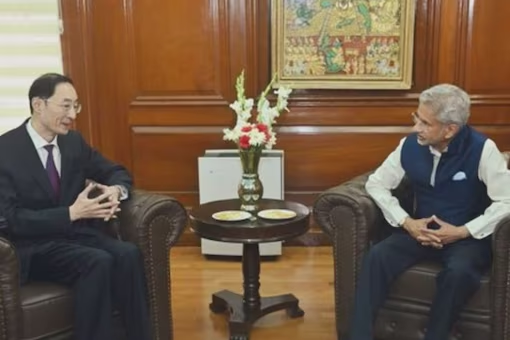
[The departing Chinese ambassador, Sun Weidong, and Jaishankar]

Sun Weidong, China’s ambassador who is returning to Bejing, surely did not expect the Indian External Affairs Minister, S. Jaishankar, to crown his stint in New Delhi with an Indian policy turn that the Xi Jinping regime had long hoped for but could not in its wildest dreams have imagined would be gifted to it on a platter, on an unmemorable occasion, and without China having to pay a price for it. As far as the Chinese government is concerned, what Jaishankar did not say — which in this case is far more significant than what he, in fact, said, removes all the hurdles to normalization of bilateral relations that were stuck in the glitch created by the Chinese People’s Liberation Army’s (PLA) surreptitious takeover in recent years of over 1,000 sq kms of Indian territory in eastern Ladakh, mostly in the Depsang Plains. In an otherwise protocol dictated meeting October 25 in which a departing foreign envoy is bid farewell by the host foreign minister, the sort of event in which nothing of import usually ever happens, Jaishankar made Sun’s and Beijing’s day!

So, what did Jaishankar not say that may have bad consequences? According to media reports, the Indian foreign minister emphasized that normalcy would return to bilateral relations on the basis of “peace and tranquility” being re-established in the disputed border regions. There was no hint anywhere of Jaishankar forcefully iterating the specific condition India has so far insisted on — restoration of the status quo ante! And even if he did mention it in passing, not making a hoo-ha about it is just as revealing. It is very likely the absence of this phrase or its emphatic repetition, will be interpreted by Beijing to mean that New Delhi has accepted China’s grabbing of vast tracts of Ladakhi real estate as a fait accompli. One can expect Sun to have sent a note to Zhongnanhai mentioning this Indian concession, something Chinese interlocuters in the future will bring up as a principle-setting precedent to dismiss the notion of restoring to India its territory, and to make the point that the two countries should put the unpleasantness of PLA-initiated hostilites in eastern Ladakh behind them, and get on with the business of the Indian consumer doing what he is good at, namely, buying plenty of Chinese goods and manufactures to keep Chinese industries humming and making an already prosperous China wealthier.

Even as Sino-Indian tensions were asimmer, Chinese exports to India of capital machinery and intermediate goods (such as pharmaceutical ingredients) this year surged to a record high of nearly $90 billion even as Indian exports to China shrank by 36.4% and the balance of payments got further skewed. In the current two-way trade of some $125 billion, India’s take was a little more than $25 billion. It is a one-sided wealth-transfer trend the Modi government has done next to nothing to reverse.

Defence Minister Rajnath Singh the other day talked of completing what he called the “Kashmir mission” in the foreseeable future of taking back Pakistan-occupied Gilgit and Baltistan. He justified it in terms of a Parliamentary Resolution. Curiously, Parliament’s 1962 Resolution, still standing, that requires the Indian government to fight and to do whatever else is necessary to recover “every inch of Indian territory” lost to China since before the 1962 War, is conveniently forgotten by the Modi regime.

Annexation of Indian territory began, it may be recalled, with parts of Aksai Chin through which the Chinese built the Xinjiang Highway amalgamated into Chinese-occupied Tibet that the Indian government became aware of only in 1958! Prime Minister Jawaharlal Nehru had rationalised India’s ignorance of such offensive Chinese carryings-on by saying it involved land “on which not even a blade of grass grew”. A similar appeasement-minded outlook appears to be congealing around the need to cut deals with Xi’s China that will, unfortunately, allow the Indian government formally to accept a China that is territorially expanding at India’s expense, but free up strategic policy space and resources to, presumably, belabour Pakistan!

One is not sure what to make of the Modi government’s obsession with reducing an already much reduced Pakistan. No country is more seriously tanking financially, politically and socially than Pakistan. Any dim-witted politician would take to heart Napoleon Bonaparte’s advice to not interfere when an adversary is making mistake after mistake, seemingly intent on taking himself down. With General Qamar Javed Bajwa apparently serious about detaching the Pakistan army from the snakepit that is Pakistani politics, but Imran Khan, disqualified from fighting elections on corruption grounds, just as focussed on bringing matters to a head with his underway “long march” on Islamabad with its potential for exacerbating domestic fissures and faultlines to the point of endangering the Pakistani state, that country is in for a rough ride. It is a situation, Imran expects, will compel the Pakistan army to either takeover the reins of power for another round of martial law rule, or comply with his demand to dislodge the Muslim League (Nawaz) government of Shahbaz Sharif and order elections which, he expects, his Pakistan Tehreek-e-Insaaf party to win. Any which way this mess gets sorted out, Imran is confident he won’t lose.

The only thing guaranteed to get the warring elements within the Pakistani nation to forget their differences are revelations of actions by the Modi-Doval-Jaishankar trio to weaken Pakistan. (In this respect, India’s squeak-by win in the T-20 World Cup opener in Melbourne hasn’t helped!). So, stand down!

Posted in asia-Pacific/Indo-Pacific, Asian geopolitics, Central Asia, China, China military, civil-military relations, corruption, Culture, Decision-making, domestic politics, geopolitics/geostrategy, India's China Policy, India's Pakistan Policy, India's strategic thinking and policy, Indian democracy, Indian ecobomic situation, Indo-Pacific, Internal Security, Islamic countries, MEA/foreign policy, Military/military advice, Pakistan, Pakistan military, society, South Asia, Tibet, Trade with China | 11 Comments

‘Xi will wait for the Modi government to make the reconciliation moves’

Interview published in Rediff News October 20, 2022, https://www.rediff.com/news/interview/rashme-sehgal-xi-will-wait-for-india-to-make-reconciliation-moves/20221020.htm

——-

Bharat Karnad, emeritus professor in national security studies at the Centre for Policy Research, the think-tank in New Delhi, discusses the implications of Xi Jinping being re-elected for a third term as China’s leader for India and the rest of the world.

“The Chinese leadership considers the Galwan surprise a great tactical military success, and wants to wallow in it,” Dr Karnad tells Rediff.com Senior Contributor Rashme Sehgal about the screening of the Galwan Valley footage where Indian and Chinese troops fought in June 2020 at the Chinese Communist party’s 20th party congress in Beijing on Sunday.

With Xi Jinping in all certainty getting a third term as general secretary of China’s Communist party this weekend and a likely third term as president of the People’s Republic of China in March, what does this mean for India and for the world?

More of the same. Meaning, that he will wait for the Modi government to make the reconciliation moves, which will not happen. Because Foreign Minister S Jaishankar has expressly refuted Beijing’s statement that normalcy was returning to Sino-Indian relations. He reminded the Xi regime that the territorial status quo ante had to be first restored before normalcy can have a chance.

For the world, Xi’s third term means aggravation of the Sino-US rivalry. With Washington and European countries rolling out a number of punitive anti-China laws to deny Chinese goods easy access to their markets, prevent it from stealing/hacking advanced technologies and disrespecting Intellectual Property Rights, and to reduce dependence on China for critical stuff, like semi-conductors, and on Chinese supply chains supporting their industries, and with (United States) President Joe Biden promising militarily to curtail Chinese moves at forcible Taiwan reunification, the military competition in the Indo-Pacific is set to become sharper.

Some weeks ago it was suggested that a palace coup had taken place and Xi had been sidelined. But obviously, this news was incorrect.

The politics of Zhongnanhai (the government complex in Beijing where the major leaders of the Chinese Communist party live and work) has always been difficult to read. But it is usually safe to disregard rumours of dire events happening behind its walls.

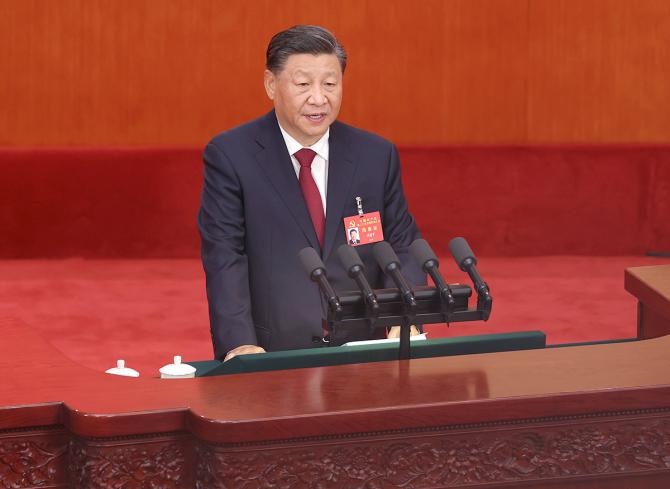
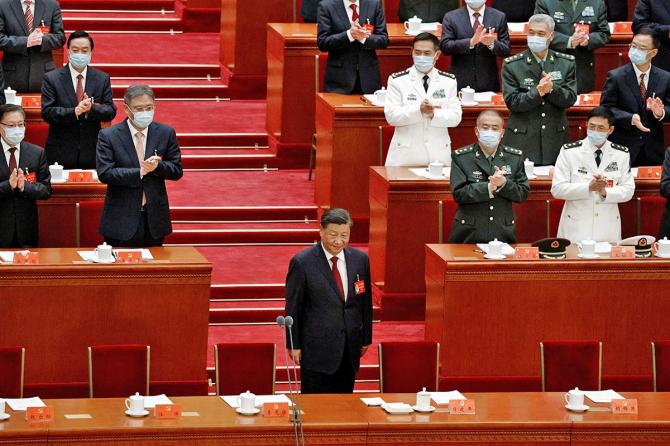
IMAGE: Xi at the opening ceremony of the 20th party congress on Sunday, October 16, 2022. Photograph: Thomas Peter/Reuters

Xi has harnessed an aggressive nationalism which he claims will see the cultural and military rejuvenation of China. How far will he succeed in this objective?

With the Chinese armed forces afforded large budgets and a relatively free hand, Xi Jinping in his first two terms had already gone some ways towards turning China into a garrison State. His statements at the Communist Party Congress suggest he is doubling down on firming up the China ‘fortress’. In other foreign policy areas, like in the programmes of strategic outreach, for example, he has had mixed results. While many of the projects in his Belt Road Initiative (such as the China-Pakistan Economic Corridor) have stalled, the Chinese presence in the western Pacific centering on the Solomon Islands has met with considerable success.

Xi’s goals can be achieved by creating a fighting military machine. Its force, albeit, was tested two years against India in Ladakh in which the Chinese more or less have achieved their objectives.

As usually happens with the Indian military and government, they had no clue about the stealthy Chinese advance onto the Indian side of the Line of Actual Control and generally about the forward area buildup in eastern Ladakh. So when the PLA went overt with their tactical offensive on the Galwan river, they caught the Indian army and MEA with their pants down. It has forced India on the defensive.

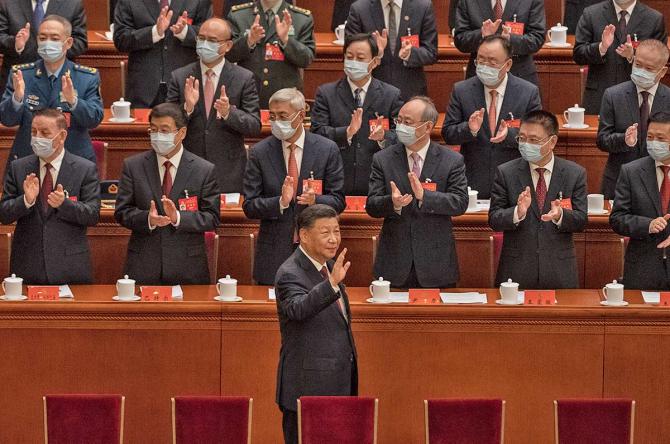
IMAGE: Communist leaders applaud Xi at the party congress on Sunday, October 16, 2022. Photograph: Kevin Frayer/Getty Images

The Galwan Valley footage was shown at the opening of the party congress in Beijing on Sunday. What does that indicate?

The Chinese leadership considers the Galwan surprise a great tactical military success, and wants to wallow in it.

India put up a challenge to the Chinese army in Doklam in 2017, but ever since the Chinese have built up a vast infrastructure of roads and helipads claiming this entire area as their own. Do you see them blockading Indian forces in this area?

Tackling the PLA in the contested trijunction Doklam area has always been problematic because it also involves Bhutan. Powerful sections within Bhutanese ruling circles that Beijing has cultivated over the years want a rapprochement even if that riles New Delhi. That particular Bhutanese view seems to be that if ceding a bit of territory here and there to China generates goodwill, it may be no bad thing.

With Russia involved in the Ukraine war and with the US focus shifted to this conflict, the Quad no longer enjoys the kind of primacy in its mental bandwidth as was the case earlier. This is bound to benefit the Chinese who are free to carry out aggressive actions in South Asia.

It isn’t as if the Quad was ever operationalised or was militarily active. India, the US, Japan and Australia have all seen it as more of a loose political-military arrangement to discomfit China. Besides, the Ukraine imbroglio is a land-based contingency while the Indo-Pacific is a maritime theatre of conflict. The two require quite different sets of wherewithal and capabilities. So the US/NATO focus on the Donbas region that Russia wants to annex will only marginally affect its efforts in the Indian Ocean, the South China Sea or the East Sea.

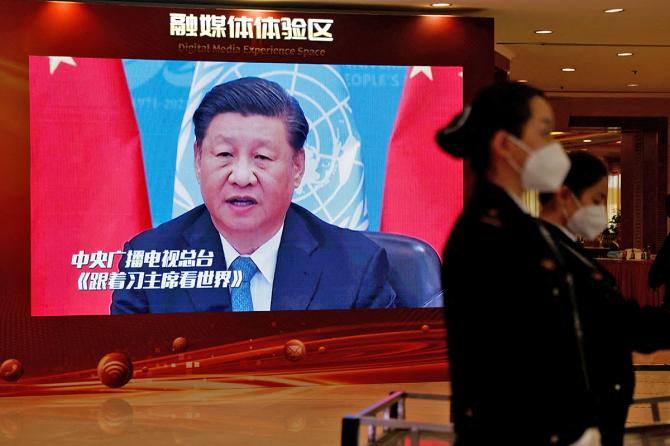
IMAGE: A telecast of the deliberations at the Communist party congress for journalists covering the event at a hotel in Beijing, October 19, 2022. Photograph: Tingshu Wang/Reuters

Will Xi continue to issue periodic warnings against Taiwan or do you see any likelihood of a future attack?

A Chinese invasion of Taiwan is far from imminent. After all, Russia’s setbacks in Ukraine have got Xi and the PLA thinking that, maybe, attacking Taiwan is not such a great idea! However, attempts at reunification are possible in the middle to distant future (20-50 years). But by then Taipei will likely have secured nuclear weapons for itself, making it immune to any Chinese adventure.

Why has there been such complete capitulation in China. Did Xi not face any opposition at all?

What capitulation? Xi always controlled the PLA and the other levers of power. So there was never any serious contender for power on the scene.

Is Xi going to see any breaks at all in his quest for Chinese supremacy as the number one power in the globe?

All trends and indices suggest that while it will be a hard slog for China to ascend to the numero uno status, it will always be a force to reckon with in Asia and the world.

How do you see the US response to these developments?

Well, the US and the West are taking all the measures necessary to prevent China from having an easy run to the top. Washington realiSes it made a mistake by helping China become a powerful trading nation and industrial power — the manufacturing hub of the world. In the future, it will try with its European allies and Japan and Australia to retard China’s relentless progress.

Posted in asia-Pacific/Indo-Pacific, Asian geopolitics, Australia, Bhutan, China, China military, civil-military relations, Culture, Decision-making, Europe, Geopolitics, geopolitics/geostrategy, Great Power imperatives, India's China Policy, India's strategic thinking and policy, Indian Air Force, Indian Army, Indian Navy, Indo-Pacific, Japan, MEA/foreign policy, Russia, russian military, society, Strategic Relations with South East Asia & Far East, Strategic Relations with the US & West, Taiwan, Tibet, Trade with China, United States, US., Western militaries | 1 Comment

The new CDS and the problems with the Agenda

[The new CDS, General Anil Chauhan]

After a long hiatus and endless speculation, the country finally has a Chief of Defence Staff and successor to the late General Bipin Rawat — General Anil Chauhan. Like his predecessor in this post, he is a Gurkha officer and, more importantly, a native of Pauri Garhwal — an origin they fortuitously share with the National Security Adviser, Ajit Doval. The Pauri Garhwali fellowship aside, Chauhan’s time as Director-General, Military Operations during the Balakot strike operation that was, in reality, more a “political” and “public relations” stunt than a military success, may have earned him plus points at the PMO and appointments, after retiring as the Eastern Army commander, as Military Adviser to the National Security Council that Doval oversees and now as CDS and, concurrently, Secretary, Department of Military Affairs (DMA), and Chairman, Chiefs of Staff Committee. (The DGMO’s brief during the Balakot op would have been to keep the army primed for hostilities in case Pakistan followed up the chase by its F-16s of the Indian strike aircraft in scoot mode with army action.)

Chauhan seems a run-of-the-mill careerist type who got lucky (in terms of political connections). He has no paper trail in terms of writings, public speeches, etc. that would clue us to the views he holds on military and national security matters and, even less, about what he means to do. It is obvious that when Rawat was anointed CDS, Modi-Doval had no road map on armed forces’ integation and theaterisation of commands, and Rawat felt free to voice some very definite but wrong-headed views. Such as the air force as a support service, expeditionary forces as unnecessary and, not for the right reasons, aircraft carriers as unaffordable luxuries. They ended up stiffening the resistance to his initiatives from the get-go. Chauhan while publicly more circumspect is reported by “government officials” as saying that there have been enough “discussions” already and “it is now time to move forward” on implementing theaterisation of commands, his priority.

But realization of theatre commands assumes that all three armed services are on the same page and, moreover, that a certain level of integration of the services has already been achieved — neither of which is true! Indeed, the air force chief, Air Chief Marshal VR Chaudhari preempted the constitution of the ‘Air Defence Command’ by announcing on October 4 the establishment of a new and separate operational stream within his service — the so-called Weapons Systems Branch headed by an Air Marshal-rank officer to control all of IAF’s surface-to-air missile and surface-to-surface missile squadrons and fleet of surveillance and attack drones! And, doubling down, he stated plainly that his service’s air power doctrine cannot be compromised, and added that theaterised commands would only complicate operational and other decisionmaking by adding another layer to it! So, whatever Chauhan has in mind to do, the IAF is not on-board.

But what’s the thinking in his parent service — the army. Consider the views of two retired officers, Lieutenant Generals Raj Shukla, whose last two postings as Commandant, Army War College, and head of the Army Training Command in Shimla, presumably afforded him the time to mull over issues in some depth, and Satish Dua, a former Chief of the Integrated Defence Staff and GOC, XV Corps in J&K.

While conceding that “integrated theatre commands are an important structural correction”, Shukla in a somewhat confused and confusing Hindustan Times op-ed of Sept 30, considered them remnants of the “industrial era”, and hinted at “parallel pathways” to jointness courtesy “digital integration, tri-service clouds, Artificial Intelligence-enabled combat frameworks” which, he claimed, would produce “superior” “military autonomy” than theatre commands (but is military autonomy the objective of military integration?), before lurching sideways to urge General Chauhan to make “an immediate, accelerated and ambitious turn to the seas, even as we fortify our combat posture” on the disputed land border with China.

Delving into the challenges facing Chauhan, Dua’s op-ed on the same day in the Times of India was less futuristic and more hopeful that the new CDS will “carry forward” Rawat’s “endeavour”, further the cause of “civil-military fusion”, and prepare the system for “multi-domain warfare” by utilizing the DMA. He regards theaterisation as a means of using “existing resources for an optimised combat effectiveness”, which he admits will be no easy task to realize. But he advises Chauhan to take “strong decisions” if he finds “unanimity” among services chiefs missing meaning, apparently, that he should hold Air Chief Marshal Chaudhuri’s feet to the fire, ride roughshod over the IAF’s objections to the air defence command, while ensuring that this “transition” is “smooth”. How the CDS is to do all this, Dua doesn’t say.

Shukla’s and Dua’s writings — and one can refer to a bunch of other similar articles by serving and retired military personnel on the subject of jointness-integration-theaterisation, are symptomatic of the problem. It is all airy-fairy stuff. Everybody knows where to go but no clear-cut ideas of how to get there.

Some 20 years ago at an army symposium in Bangalore I presented a paper that envisaged four stages leading to forces integration — cooperation, coordination, jointness, integration. I said then that the Indian armed services are stuck in the first stage of cooperating, willy-nilly, during crisis and war, and that coordination some time happens if, say, NDA coursemates from different services decide to work closely outside usual channels in an emergency, and that the last two stages of jointness and integration are thresholds realistically so far beyond realization as to be mere abstractions! Into the third decade of the new millennium, little substantively has changed.

A major restructuring of armed forces is not a joke, or indulged in on a political whim. It requires a singularity of vision and, ideally, years of serious and sustained study and inter-services discussions, and interactions at the services HQ-level, in-depth reports from in-house and diverse external sources — informed analysts, academics, thinktanks and management consultants that explore the technology trends and management imperatives, different models of military manpower usage, systems of procurements and budgetary allocations, experiences of military integration in other countries, and involves fleshing out of alternative schemes of jointness and the costs of such transformation, and finally wargaming and practical exercises to test and validate the alternative schemata of operational wartime and peacetime decisionmaking to see what works best. That’s how the most effective mix of military and nonmilitary elements and the meshing of different decisionmaking. command and control designs, can be discovered and armed services restructured in the most effective way. As far as I know, none of this has happened and yet the country is embarked on a major reordering of its armed forces.

Surely, the Modi government can’t be very serious about military integration and theaterisation of commands, because as things stand now the underway efforts seem like passing political fancy. But two moves would still make a difference even if the ground is inadequately prepared for such overhaul. Because more time cannot be wasted on the preparatory work; it will have to be the trial and error method. The Prime Minister has, firstly, to be the principal stakeholder in this exercise and use the whip against the military pooh-bahs and laggards undermining/delaying the process. This may involve firing reluctant services chiefs of staff and retiring principal staff officers in Services headquarters. And secondly, and more importantly, he has to invest Chauhan with the necessary authority — the CDS cannot be the first among equals; in a military milieu that won’t work. He has to be a five star officer — a Field Marshal/Admiral of the Fleet/Marshal of the Air Force, who outranks everybody and whose orders and instructions the services chiefs can ignore or resist at their peril. Absent these steps, Modi may as well whistle for theaterisation.

The Prime Minister may care to learn a lesson or two from the American experience. In the US, President Harry Truman and Secretary of War Henry Stimson took ownership of the unification plan and were the political piledrivers, who pulverzied the objections of the military, especially the senior service — the US Navy, and brusquely dismissed the parochial fears of the Admirals of renown — the Chester Nimitz’s and the Arleigh Burke’s, who had gained fame in the Second World War and opposed military unification. There was also no great body of studies and reports leading to the military integration and the emergence of the Pentagon in Washington, DC. There was but a single design for unification outlined in a short paper authored by a single person, not a committee — Stimson’s adviser and confidante, a man named Ferdinand. The trial and error method here led to an exercise in rectification and a second defence system overhaul in the 1980s — the Goldwater-Nichols Act.

Posted in asia-Pacific/Indo-Pacific, Asian geopolitics, China, China military, civil-military relations, Cyber & Space, Decision-making, Defence Industry, Defence procurement, Geopolitics, geopolitics/geostrategy, Great Power imperatives, India's strategic thinking and policy, Indian Air Force, Indian Army, Indian ecobomic situation, Indian Navy, Indo-Pacific, Intelligence, Military/military advice, Missiles, Pakistan, Pakistan military, South Asia, Technology transfer, technology, self-reliance, United States, US., Weapons | 6 Comments

Technology & War, Understanding strategic threats, Chinese influence ops in India

This TEDx talk, recorded in July 2022, on the above subject of “Technology & War” may be of interest

Two more recent (Aug 23 and Sept 13) talks on DEF TALKS regarding ‘Understanding strategic threats to India’ and on ‘Chinese influence operations in India’ below

Posted in arms exports, asia-Pacific/Indo-Pacific, Asian geopolitics, Central Asia, China, China military, civil-military relations, Culture, Cyber & Space, Decision-making, Defence Industry, Defence procurement, disarmament, domestic politics, DRDO, Europe, Geopolitics, geopolitics/geostrategy, Great Power imperatives, guerilla warfare, India's China Policy, India's Pakistan Policy, India's strategic thinking and policy, Indian Air Force, Indian Army, Indian ecobomic situation, Indian Navy, Indian Ocean, Indo-Pacific, Iran and West Asia, Islamic countries, Israel, MEA/foreign policy, Military Acquisitions, Military/military advice, Missiles, nonproliferation, Northeast Asia, Nuclear Policy & Strategy, nuclear power, Nuclear Weapons, Pakistan, Pakistan military, Pakistan nuclear forces, Relations with Russia, Russia, russian assistance, russian military, SAARC, sanctions, society, South Asia, South East Asia, space & cyber, Special Forces, Sri Lanka, Strategic Forces Command, Strategic Relations with South East Asia & Far East, Strategic Relations with the US & West, Technology transfer, technology, self-reliance, Terrorism, Tibet, Trade with China, UN, United States, US., Vietnam, war & technology, Weapons, Western militaries | 21 Comments

Why Putin Is Threatening A Nuclear War

Rediff News  interview of Sept 24, 2022 on the Ukraine crisis reproduced below, and at

https://www.rediff.com/news/column/dr-bharat-karnad-why-putin-is-threatening-a-nuclear-war/20220924.htm

‘When the war against Ukraine that Putin started is not going the way he was expecting it to and his military options are getting onerous, a bit of nuclear sabre rattling is what he hopes will turn things around for him and Russia.’

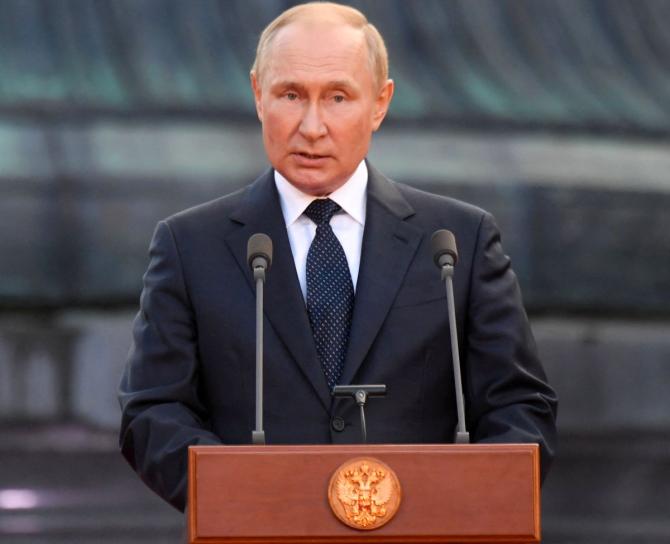
IMAGE: Russian President Vladimir Putin delivers a speech during an event marking the 1160th anniversary of Russian statehood in the city of Veliky Novgorod, Russia, September 21, 2022. Photograph: Sputnik/Ilya Pitalev/Pool via Reuters

Is President Putin’s frequent sabre rattling on the use of nuclear weapons a sombre warning to Western countries? A genuine threat? Or is he simply bluffing.

Dr Bharat Karnad, emeritus professor in national security studies at the Centre for Policy Research, the Delhi think-tank, and a national security expert explains the chain of developments taking place following the Russian invasion of Ukraine.

“No one in Moscow expected Zelenskyy and the Ukrainian people to react the way they did nor anticipated that the US/NATO would set up an arms supply line enabling Ukrainian forces,” Dr Karnad tells Rediff.com Senior Contributor Rashme Sehgal.

Why is President Putin resorting to frequent nuclear sabre rattling? Are these threats creating the desired fear in the West as Putin would like to believe?

When the war against Ukraine that Putin started is not going the way he was expecting it to and his military options are getting onerous, a bit of nuclear sabre rattling is what he hopes will turn things around for him and Russia.

But it is not having the effect he expected in the main because a 75-year-old nuclear use taboo is hard to overcome, particularly because conventional military setbacks in Ukraine and that too of Russia’s making, don’t seem serious enough provocation.

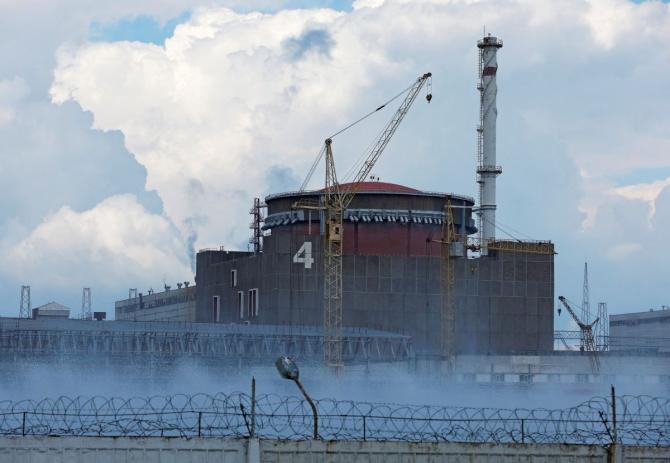
IMAGE: A view of the Zaporizhzhia nuclear power plant outside the Russian-controlled city of Enerhodar in Ukraine’s Zaporizhzhia region. Photograph: Alexander Ermochenko/Reuters

How is Nato indulging in ‘nuclear blackmail’ of Russia? Is the territorial integrity of Russia being threatened as Putin claims?

Well, the context is this. The informal understanding of the 1994 Budapest Memorandum that promised joint US-Russian-UK security guarantees for Ukraine in return for Kyiv giving up its Soviet-era nuclear arsenal, was that Ukraine would remain outside NATO. Moscow believes this was violated by the moves underway to fast-track Ukraine’s membership in NATO.

And that once inside the NATO fold, Ukraine could invoke nuclear protection clauses of the alliance — which Moscow interprets as ‘nuclear blackmail’, to prevent Russia from achieving its objective of annexing the Donbas-Crimean flank to the Black Sea.

Crimea was forcibly absorbed by Russia in 2014.

According to Putin, this flank, with an ethnic Russian majority, that connects Crimea and Donbas to Russia, but outside Moscow’s control would imperil its access to, and render it vulnerable from, the sea and therefore constitutes a security threat.

Are these warnings being issued by President Putin so that Western countries stop their escalation of weapon supply to Ukraine?

Certainly, the US/NATO supply of armaments, especially precision-guided munitions (PGMs), to Ukrainian forces have frustrated Russian plans for rapid armoured thrusts to take the Donbas region.

Whether threats of use ‘of all available means’ will prompt the US to terminate the military supply pipeline is doubtful — the strategic gains from keeping Russia thus militarily engaged in Ukraine and progressively weakening are too substantial to forego.

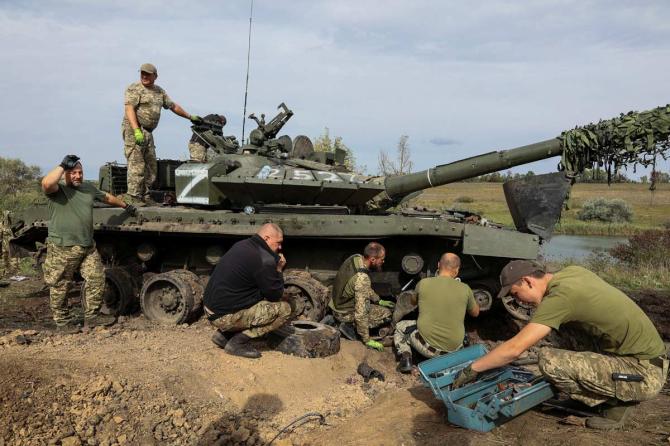
IMAGE: Ukrainian soldiers repair a Russian tank captured during a counteroffensive operation near the Russian border in the Kharkiv region. Photograph: Sofiia Gatilova/Reuters

During the recent Modi-Putin interaction in Samarkand, President Putin told Prime Minister Modi that while Russia was keen to end the fighting, the Ukrainian leadership did not want to negotiate a peace settlement. How far is that perception correct?

Hard to know what the truth is when faced with conflicting Russian and Ukrainian accounts.

The facts are these: Russia annexed Crimea in 2014 without much Ukrainian resistance.

Moscow believed that for the same reasons Kyiv would not hugely oppose the Russian takeover of the Donbas.

Except, Ukrainian President Vlodoymyr Zelenskyy was unwilling to cede this territory as well to Russia with or without a fight. So both in a sense are right!

With the kind of reverses the Russian army has faced recently in Kharkiv and with there being no cessation of weapon supplies to Ukraine so far, do you see Russian reverses on the battlefield on the rise and if that is indeed the case, will there be a likelihood of Putin resorting to the use of nuclear tactical weapons in the future?

The use of tacnukes is not likely for reasons of the nuclear taboo already mentioned. But Putin is, perhaps, using such threat of use by way of a Russian doctrinal innovation, namely, the principle of ‘escalate to de-escalate’.

Meaning, make the threat of tacnuke use real and imminent enough to raise fears in Washington about the situation spiraling into a strategic exchange, and thus compel it to pressure Kyiv into halting hostilities and into some kind of accommodation with Moscow.

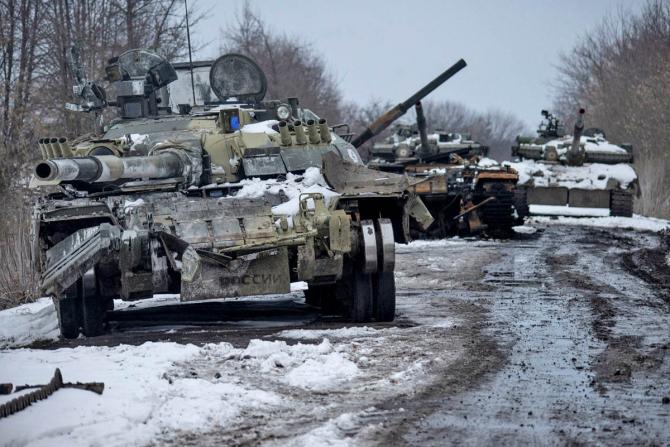
IMAGE: Destroyed Russian tanks in Ukraine. Photograph: Irina Rybakova/Press service of the Ukrainian Ground Forces/Handout via Reuters

The world is also interested in getting a clearer picture of what is happening at the Russian-controlled Zaporizhzhia nuclear power plant, with its six reactors, making it the largest nuclear power station in Europe which is being operated with the help of Ukrainian workers.
Each of Zaporizhzhia’s reactors would cost $7 billion to replace, and with fighting going on around the plant experts do not to rule out a Chernobyl-like disaster.

Zaporizhzhia could be another Chernobyl. Then again not.

Putin, perhaps, has in mind to use the threat to strike this massive nuclear power station as a hostage to ‘good’ behaviour by Washington and Kyiv. But such tactics are risky because any radioactivity leakage as a consequence of a hit on it could affect the Russian hinterland too because radioactive clouds could easily float across and drop down as rain and infect the Russian countryside or urban areas.

But the reported missile attack on a hydroelectric plant just 300 metres from the nuclear reactors at another Ukrainian nuclear power station in Yuznoukrainsk in southern Ukraine could be a signal to the US and NATO that Moscow’s nuclear use threat is ‘not a bluff’.

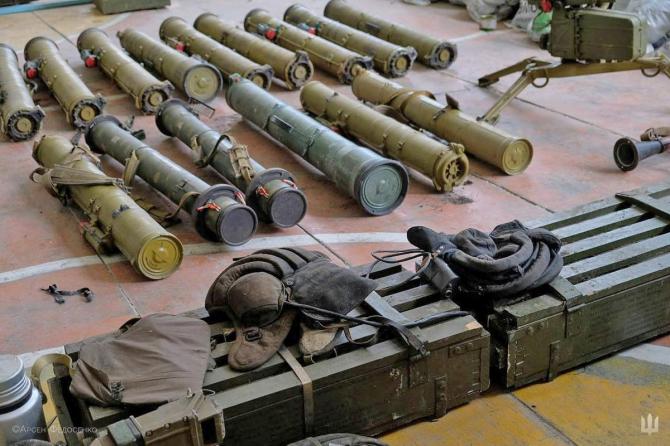
IMAGE: Russian grenade launchers captured by the Ukrainian armed forces during a counteroffensive in the Kharkiv region. Photograph: Press service of the Commander-in-Chief of the Armed Forces of Ukraine/Handout/Reuters

The holding of a referendum set to take place in Donetsk, Luhansk, Kherson and Zaporizhzhia over the weekend provides an interesting subtext to the ongoing developments. Why is this referendum being held in the first place?

The referendum ordered by Putin in these areas is retroactively to endow the Russian actions to annex the Donbas region of Ukraine with a veneer of legitimacy and as a means of showing popular support for the Russian campaign of ‘reunification’. And also, just may be, as a means of blunting Western calls for Russian reparations for the destruction visited upon Ukraine by the war.

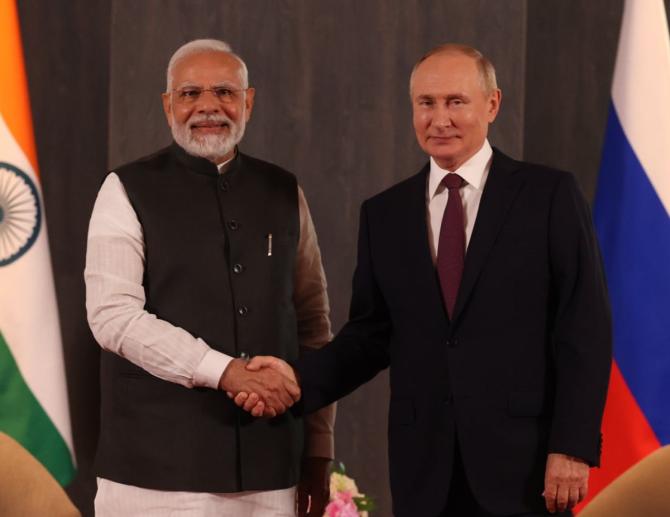
IMAGE: Prime Minister Narendra Modi meets Russian President Vladimir Putin on the sidelines of the Shanghai Cooperation Organisation in Samarkand, September 16, 2022. Photograph: Kind courtesy @narendramodi/Twitter

Has the Ukrainian invasion proved to be a major miscalculation on the part of Russia?

Yes, because no one in Moscow expected Zelenskyy and the Ukrainian people to react the way they did, nor anticipated that US/NATO would set up an arms supply line enabling Ukrainian forces to fight without worrying over much about whether their stocks of guns, ammo, artillery and PGMs to sustain such a fight, would last and for how long.

Moscow also miscalculated about just how much of a public relations disaster this war has been.

While Zelenskyy and the Ukrainian people are seen as heroic in resisting aggression, Russia and its military are seen as bumblers, with much of the world perceiving the conflict as an avoidable misadventure.

It is bad news when even friendly states, such as India and China that Moscow had hoped would sit on the fence, think it best to distance themselves from Russia.

Posted in arms exports, China, Europe, Geopolitics, geopolitics/geostrategy, Great Power imperatives, Military Acquisitions, nuclear industry, nuclear power, Nuclear Weapons, Relations with Russia, Russia, russian military, United States, US., war & technology, Weapons, Western militaries | 7 Comments

A Grand bargain — a Ladakh DMZ for McMahon Line, is absent. Jaishankar’s peace on a piecemeal basis benefits China.

[Jaishankar: Making the wrong point?]

The one thing tried and tested diplomats are not supposed to do is use wrong words that convey or signal the wrong message, and provide ammunition to the adversary.

In the wake of the verified pullback (begun Sept 8, completed Sept 12) by Indian and Chinese PLA troops from the Gogra and Hot Springs areas of Ladakh, the external affairs minister S Jaishankar said this yesterday, to quote him in toto: “You have heard me speak many times about the border. I don’t think I would say anything new there today, except I would recognise that we had disengagement at P[atrolling]P[oint]-15 and the disngagement as I understand was completed and that is one problem less on the border.”

The inelegance of his statement [sure, it was extemporaneous, but diplomats are supposed to be able to think on their feet and, at all times, speak carefully] — repetition of words (engagement) and wrong construction (“new there” — where?; “new” about the “border” is, perhaps, what he meant to say) apart, what the minister said is disturbing, more so in light of the MEA spokesman’s statement of Sept 9 elaborating on the short press release issued a day earlier.

Take the most important point in the MEA statement, that India and China will “cease forward deployments in this area in a phased, coordinated and verified manner, resulting in the return of the troops of both sides to their respective areas.” What are the “respective areas” being referred to here? The area to which Indian units have retreated to are, of course, in India. But so is the “area” the PLA troops have got back to!

Thus, the Indian government has implicitly accepted a Ladakh remapped by China! Worse, another point in this MEA statement commits India to ensuring that there will be no attempt unilaterally to change the new “status quo” that’s obtained. A third important point promises talks to “resolve the remaining issues along LAC and restore peace and tranquility in India-China border areas”, including the PPs 10, 11, 12, 13, presumably, along the same lines. With the PLA controlling the Y-Junction — the entry point, as it were, to the Depsang Bulge adjoining the Xinjiang Highway, Indian units cannot access these areas.

The question to ask the Modi regime, therefore, is this: Has it first of all accepted the Chinese 1959 claim line? This latest agreement would suggest it has. It means New Delhi, in effect. has formally renounced India’s historic border with China. China has offered the solution of a buffer zone to be implemented piecemeal — as a means of separating the two armies and avoiding hostile encounters of the 2020 Galwan kind. One such partial buffer zone was earlier established with the Tibetan exiles-manned Special Frontier Force units climbing down from Rezang La, and other posts on the Kailash Range heights in exchange for the PLA withdrawing from the Finger 3 terrain feature on the northern shore of the Pangong Tso. That was a bum deal.

Now another swath of land running across Gogra and Hot Springs too is a buffer. Once fully negotiated, Beijing hopes the buffer zone would stretch all the way from the Depsang to the Pangong Lake. In fact, senior army officers indicate that the PLA commander at the recent 16th session of the corps level army commanders’ meeting communicated that China may consider vacating the Depsang Plains in return for India accepting such a buffer zone. The former Northern Army commander, Lt Gen HS Panag, too hints that such an arrangement may be in the works. (See https://theprint.in/opinion/no-war-no-peace-in-pp15-but-china-wants-more-in-depsang-plains-charding-ninglung-nala/1129023/ )

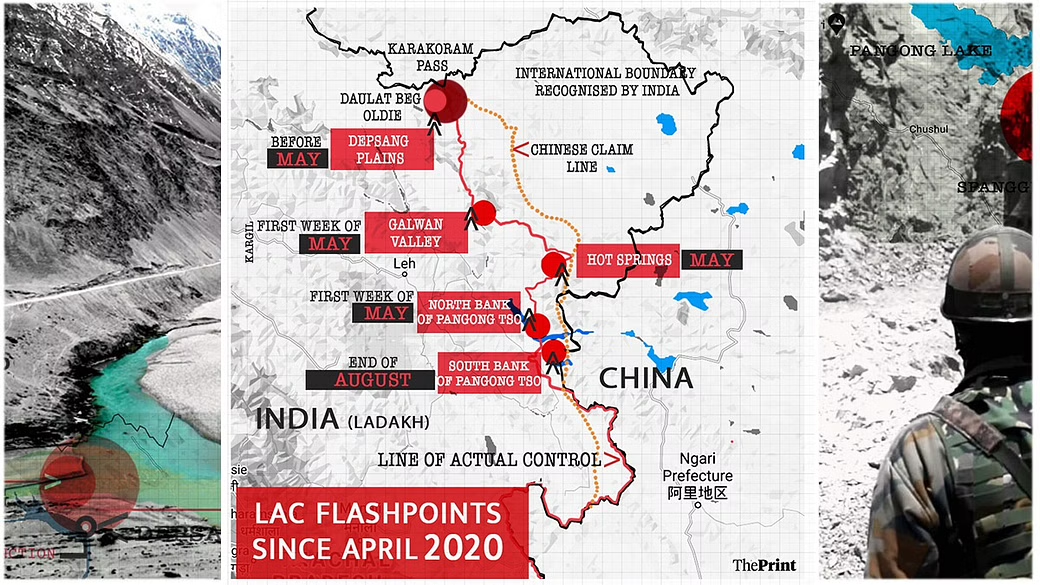
Presently, there are three claim lines — one that India has historically recognized as the Sino-Indian boundary (and so identified in the map below). The second line is the 1959 Chinese claimline (dotted yellow line) incorporating the entire mass of territory in northeastern Ladakh and Indian Aksai Chin totaling some 1,000 sq kms. And the third line is the Line of Actual Control (in red). Except there is a belt of Indian territory between the second and the third lines the Chinese have intruded into and are negotiating about. They would like to see this in-between territory converted into a Depsang to Pangong Tso buffer zone, in effect, a de-militarized zone (DMZ) a’la the 38th Parallel in Korea delineated for military reasons by US President Harry Truman, the Soviet jefe maximo, Josef Stalin, and British Prime Minister Winston Churchill at the post-WW II Potsdam Conference in July 1945.

[Map of contested Ladakh & Aksai Chin. Source: The Print]

It is in this context, that Jaishankar’s comment of “one problem less on the border” merits concern. Look at the map again. Would any government sign away India’s sovereignty on so large a piece of national territory without making a case for it, and participating in informed debates within Parliament and outside just because the Prime Minister needed to create a conducive milieu for his meeting with Chinese President Xi Jinping at the Shanghai Cooperation Organization summit in Samarkand?

The Chinese are seemingly working on the principle what’s mine is mine, what’s yours is also mine barring what you are ready to fight for, and India on the basis that whatever I can get from China is fine. Over the years,this fairly lax Indian attitude has enabled a mostly peaceful, because stealthy, takeover of Indian territory by the Chinese until the territorial creep led to the 2020 Galwan encounter, when the two forces began eye-balling each other over territory between Beijing’s 1959 claim line and the LAC in eastern Ladakh.

With India having lost so much territory already, the Modi government would ideally like China to agree on the LAC as border. Except, this requires a restoration of the status quo ante that Jaishankar has been iterating for a while now. But the Chinese, realizing that New Delhi can be pushed around easier than they had earlier assumed, have made it amply clear they are unwilling to ease their stranglehold on the Y-Junction and permit Indian access to the Depsang Plains short of India signing off on an extended DMZ that will prevent the Indian army from militarily exploiting proximity to the Xinjiang Highway or endangering the China-Pakistan Economic Corridor branching off at the Karakorum Pass.

Jaishankar may well argue that the territory lost to the Chinese in earlier years was owing to a force majeure situation — China’s marshalling an irresistible force. But if the argument is that this piece of Indian land has been under Chinese occupation since the mid-1950s when they built the Xinjiang Highway through it and an inattentive New Delhi let the PLA gobble up that part of Aksai Chin, and that realistically, India is not now nor will ever be in a position to get it back, then the issue becomes what is India getting for, in effect, accepting Chinese sovereignty over it?

There’s no sign of Jaishankar countering the Chinese proposal for a DMZ and India’s reconciling to Chinese sovereignty over the 1,000 sq kms of captured territory in northeastern Ladakh by demanding that Beijing recognize the McMahon Line in the east, as part of a grand bargain — a solution, incidentally, first offered by Zhouenlai to Jawaharlal Nehru in the Fifties and again by Dengxiaoping to Rajiv Gandhi in the 1980s. Such a final solution for a vexed border dispute would make sense, and not be difficult for Modi to sell to the Indian people. But there’s no such grand bargain on the anvil, which makes this particular deal in Ladakh more onerous.

The most alarming possibility is this: After firming up its Ladakh end, China will begin moving on Arunachal with a view to detaching the Tawang District where the main Tibetan Lamasaries are located, and which the Chinese call “southern Tibet” in the hope that here too New Delhi can be strong-armed into striking a territorial deal on Chinese terms. In that case, there will be war, the outcome of which though uncertain potentially favours the PLA, which is advantaged in every way. It may not be a military disaster for India on the scale of 1962, but could dent the army’s reputation in lots of ways.

It is precisely such a denouement that MEA may be worried about and why it is trying to distance itself from it. For instance, Jaishankar’s Ministry has already begun putting out commentaries via retired diplomats commentating in the media that it was the army commanders at their parleys in Chushul who hammered out the deal for the disengagement in Ladakh, without once hinting that the said army commanders negotiated strictly per MEA script and instructions. (See https://asiatimes.com/2022/09/disentangling-india-china-himalayan-standoff/ )

Still, it boggles the mind that the Indian government is party to realizing peace on the LAC on a piecemeal basis, which serves China’s purpose. By not linking negotiations regarding the western theatre (Ladakh) to developments in the eastern sector (Arunachal Pradedsh), Beijing can stretch out the negotiations concerning the LAC indefinitely — the tactics it has successfully used so far. This is not in India’s interest.

Modi has to see the wisdom in insisting that the deal is for all of the disputed border, or there are no negotiations at all, and let the local conditions then dictate whether there will be hostilities or not. But in that case, and looking holistically at the bilateral relations, New Delhi will have to begin ramping up punitive actions, trade sanctions, etc to slowly but conspicuously begin closing off the open access to the vast Indian market the Chinese Companies have so far availed of. Modi has to communicate to Xi that either China agrees to have all round good relations without the distraction of a militarily live border, or India prepares for all-round hostility, and that there’s no middle ground.

Posted in asia-Pacific/Indo-Pacific, Asian geopolitics, Central Asia, China, China military, civil-military relations, Decision-making, domestic politics, Europe, Geopolitics, geopolitics/geostrategy, Great Power imperatives, India's China Policy, India's strategic thinking and policy, Indian Army, Indian Politics, Indo-Pacific, MEA/foreign policy, Military/military advice, Northeast Asia, Pakistan, Russia, society, South Asia, Tibet, United States, US. | 27 Comments

‘China Wants To keep India On The Hook’

Interview of Bharat Karnad published in Rediff News, September 12, 2022 08:54 IST at

https://www.rediff.com/news/interview/bharat-karnad-china-wants-to-keep-india-on-the-hook/20220912.htm

‘This was Indian land the PLA advanced on and occupied.’
‘The Chinese then ‘negotiated’ a pullback of their troops a small distance on Indian territory even as Indian jawans draw back further into India from the forward position.’
‘An apparently satisfied Indian government says this is a great move for peace! How great is that for China!’

IMAGE: September 11, 2022: Army Chief General Manoj Chandrasekhar Pande on his visit to Ladakh to witness Exercise Parvat Prahar. General Pande was briefed on operational preparedness by commanders on the ground. Photograph: ADG PI – Indian Army/Twitter

“This is only a shallow disengagement conceded for immediate political gain, namely, Modi’s presence at the SCO heads of government meeting,” Dr Bharat Karnad, the national security expert at the Centre for Policy Research, the New Delhi-based think-tank, tells Rediff.com‘s Senior Contributor Rashme Sehgal.

“It is neither a permanent withdrawal nor the harbinger of a more enduring arrangement and, even less, a first step in the process of formally delineating a boundary which does not serve Beijing’s purpose,” he adds.

How far can the present Gogra disengagement be seen as a positive step, breaking of the gridlock as it were, or is it being done keeping the SCO meet in mind?

This disengagement, while good in itself in that it reduces the possibility of armed units of the two sides coming quite literally to blows with proximal patrolling, is essentially a Chinese attempt to see the Shanghai Cooperation Organization (SCO) summit mid-September pass off without incident.

It also seems like a placatory or even an incentivising move to ensure Prime Minister Narendra Modi attends the heads of government meeting.

Beijing continues to claim that the April 2020 status quo is a result of India’s illegal crossing of the Line of Actual Control and is therefore not acceptable to China.

This is the offensive negotiating strategy Beijing has always adopted in a nutshell — claim that because it is India that has intruded into Chinese territory, it is Indian troops that need to vacate all the land they have illegally occupied or encroached upon, thereby reinforcing its claims on Indian territory.

And because, the MEA/Indian government never asserts its own position in equally blunt manner, in the optics of this confrontation, it is India that ends up looking like the aggressor!

Will this disengagement which incidentally only involves only the going back of 50 troops on both sides lead to greater de-escalation of troops or is this only another ploy by the Chinese?

The first thing to keep in mind is that this withdrawal by both sides is happening on Indian territory!

This was Indian land the PLA advanced on and occupied. The Chinese then ‘negotiated’ a pullback of their troops a small distance on Indian territory even as Indian jawans draw back further into India from the forward position.

An apparently satisfied Indian government says this is a great move for peace! How great is that for China!

In any case, this is only a shallow disengagement conceded by the Chinese for immediate political gain, namely, Modi’s presence at the SCO heads of government meeting in Samarkand.

It is neither a permanent withdrawal nor the harbinger of a more enduring arrangement and, even less, a first step in the process of formally delineating a boundary which does not serve Beijing’s purpose.

It is better to keep the dispute on simmer, bring the situation occasionally to boil, and keep India on the hook,

IMAGE: Indian and Chinese troops and tanks disengage from the banks of the Pangong Tso lake area in eastern Ladakh, February 16, 2021. Photograph: ANI Photo

The Depsang Plains area remains a critical flashpoint. This area has seen massive deployment and buildup of Chinese troops since May 2020. Do you see any signs of this being resolved.

No. Because the capture of the Depsang Bulge is critical in military geography terms to the People’s Liberation Army holding on to — and thus denying to India — the vast border frontage northeast of the Y-Junction, on the northern shore of the Shyok river and adjoining the southern Tibet area through which passes the Xinjiang Highway (GS 219).

The significance here is that the GS 219 bifurcates at the Karakoram Pass to become the arterial China-Pakistan Economic Corridor terminating in the warm water port of Gwadar on the Balochistan coast.

Were India to retake this sub-sector on the Line of Actual Control, it would have a stranglehold on the highway — the lifeline to Xinjiang, and the Karakorum Pass, which China will not allow.

Hence, the PLA will never pull back from its foward position in the Depsang Plains.

IMAGE: General Pande interacts with officers and troops in Ladakh. Photograph: ADG PI – Indian Army/Twitter

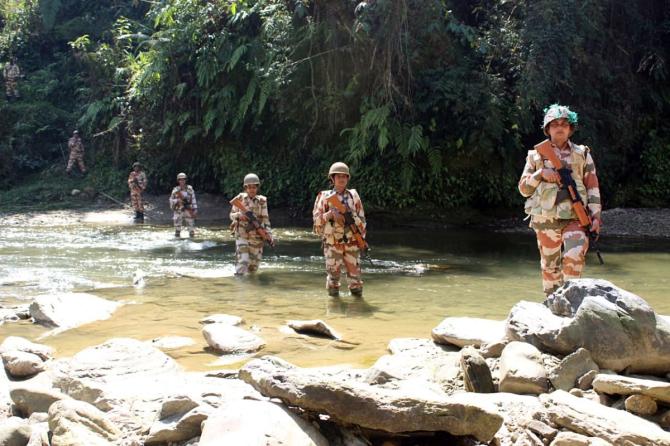
The Chinese army continues to block the Indian Army to their traditional PPs 10,11,12,13 since April 2020 having moved 18 km inside what India considers to be its own territory…

Because all these patrolling points are in the area northeast of the Y-Junction pivotal, for reasons alluded to in my response to the previous question, to the PLA and China.

The basic problem for India has always been to hold the nearly 500 km-long line — Daulat Beg Oldi-Demchok in the Depsang Plains, in which mission the army has manifestly failed, losing ground over the years in small parcels until now when the PLA has annexed and absorbed some 1,000 sq kms in this whole sub-sector.

If Modi-Jaishankar (Prime Minister Narendra Damodardas Modi and External Affairs Minister Subrahmanyam Jaishankar) somehow get President Xi Jinping to agree to a ‘restoration of the status quo ante‘ involving this piece of territory, it will be a very tremendous diplomatic feat.

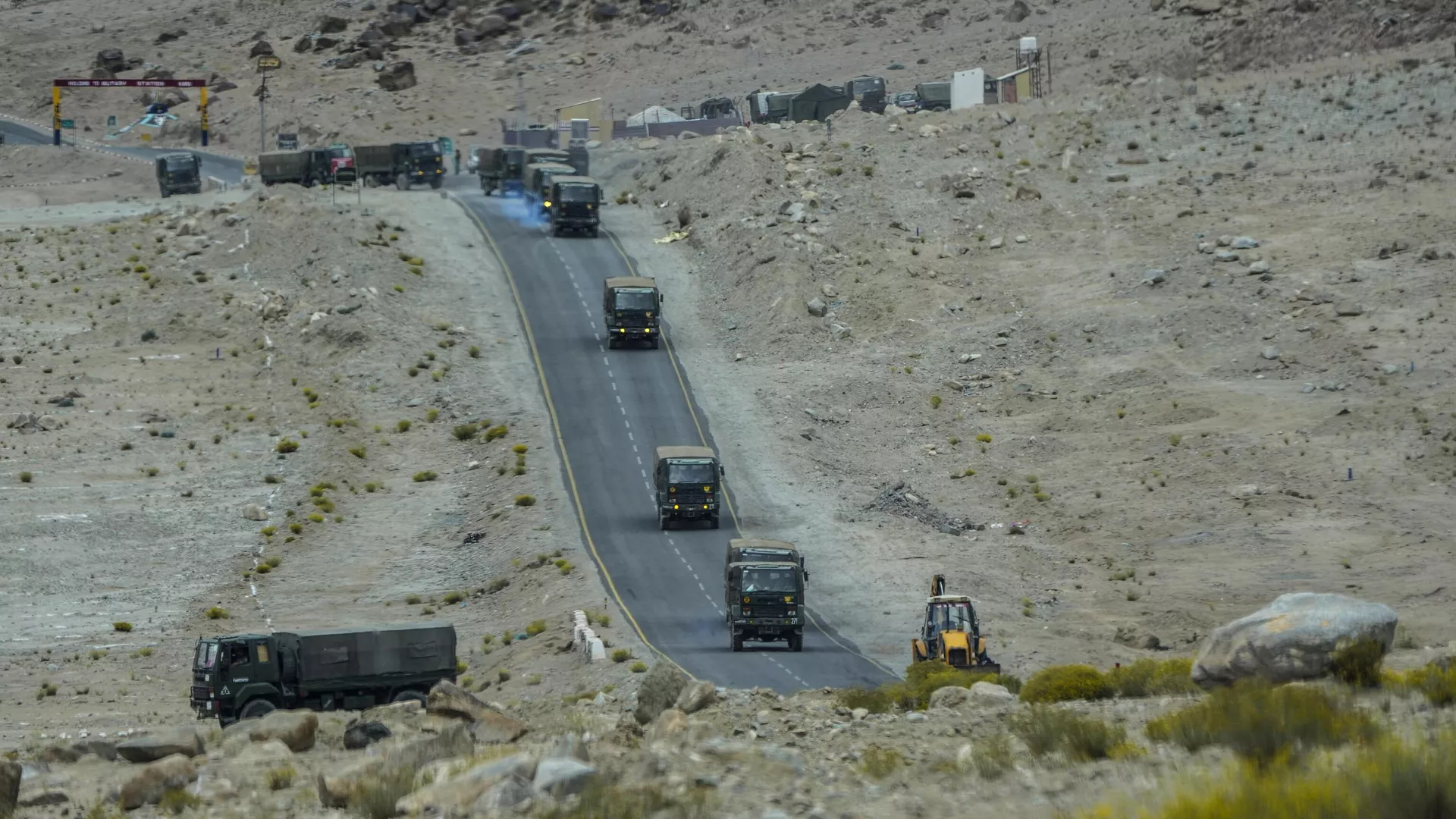
The Chinese have built massive infrastructure in eastern Ladakh which includes a key bridge in the Pangong Tso area. Also, they have doubled the deployment of fighter aircraft in the Eastern Ladakh sector.
What has our response been to this?

The Pangong bridge constructed on the north shore to connect their garrisons in the Khurnak Fort area to Moldo will cut the PLA forces’s transit time from one to the other area from a couple of days to only a few hours.

And the PLA Air Force bases have gone up from three to 30 in the southern Tibet region, and increased deployment from some 30 combat aircraft to reportedly as many as 300 combat aircraft.

The IAF’s response, insofar as what can be made out, is the occasional aircraft sortie along the southern Pangong Lake shore with extreme care taken to offer the PLAAF no provocation. This is in reaction to the PLA Air Force combat aircraft flying well beyond the Line of Actual Control into Indian territory almost at will and unmolested by IAF.

IMAGE: Indian and Chinese troops and tanks disengage from the banks of the Pangong lake area in Eastern Ladakh in February 2021. Photograph: ANI Photo

China is not at all happy to see the growing closeness developing between Japan and India on military matters including conducting joint military drills and advancing their security relationship.

I have always maintained that China and the PLA are spooked by two countries: Vietnam, who gave the PLA a bloody hiding in 1979 when they deigned to invade northern Vietnam to, what else, ‘teach Hanoi a lesson’ and instead were taught one.

It was an embarrassing defeat and the PLA hightailed it out of the battle areas.

And the other is a militarised Japan.

The ‘rape of Nanjing’ and the horrors committed against the Chinese population by the Japanese imperial land forces have so seared the Chinese consciousness, Beijing still has nightmares.

And so I have long advocated that India should do every thing possible to stoke these Chinese fears.

It ought to urge Tokyo rapidly to build up militarily — a process already initiated by the late prime minister Abe Shinzo, and offer strategic nuclear cooperation with Japan in whatever form (and to Taiwan).

And nuclear missile arm Vietnam as payback for Beijing’s equipping Pakistan with nuclear missiles.

Posted in asia-Pacific/Indo-Pacific, Asian geopolitics, Central Asia, China, China military, civil-military relations, Culture, Decision-making, Geopolitics, geopolitics/geostrategy, Great Power imperatives, India's China Policy, India's strategic thinking and policy, Indian Air Force, Indian Army, Indian ecobomic situation, Indo-Pacific, Japan, MEA/foreign policy, Military/military advice, Missiles, nonproliferation, Nuclear Policy & Strategy, Nuclear Weapons, Pakistan, Pakistan military, Pakistan nuclear forces, SAARC, South Asia, South East Asia, Taiwan, Tibet, Vietnam, Weapons | 13 Comments

Ek dhakka aur do – topple the NPT regime, skewer China!

[The Chinese delegation at the 2022 NPT RevCon]

It was only appropriate that Russia, the country that proved just how foolish and ridiculously naive Ukraine was to trust the trio of the United States, Russia, and Britain and surrender its share of the erstwhile Soviet Union’s thermonuclear arsenal, courtesy the 1994 Budapest Memorandum on Security Assurances, prevented a consensus “final document” from emerging at the 10th edition of the five-yearly UN Non-Proliferation Treaty (NPT) Review Conference (RevCon).

This conference periodically to assert the primacy of the NPT regime, delayed for a couple of years by the COVID pandemic, began in New York August 1 and concluded August 26. Considering how relations between Russia and the US are heading south, the Russian action, in effect, kicked the RevCon into life support, bringing the future of the NPT itself into question. Russia did so to protest the reference in the draft paper to the alleged Russian attacks on or near the Zaphorizhzhya nuclear power station. Many European states felt that even an accidental strike could create a Chernobyl-like nuclear catastrophe. In other words, Moscow used an issue unconnected with nonproliferation to damage the NPT regime. And, a damned good thing to happen from India’s strategic point of view!

As observers at these RevCons, Indian diplomats dish out the usual disarmament pablum produced by the DISA (Disarmament and International Security) Division in MEA. Just as well that nothing, if anything, of note was said by them because otherwise it’d have been reported at least in the Indian Press (even if no other media takes notice). The correct thing for Delhi to have done from the time of the first RevCon in May 1975 was to give it a miss. And it should have been followd up by boycotting the subsequent RevCons to signal India’s unhappiness with the global nuclear order lorded over by the five “NPT recognized” weapons states — the US, Russia, UK, France and China. Instead, while not being a signatory to the NPT and therefore not bound by its rules, India has acted all along as if it is a bonafide member of this treaty that was, incidentally, originally designed by Washington in the Sixties to keep India from crossing the nuclear weapons threshold!

Delhi is in the forefront of the worldwide nonproliferation effort just so it is in America’s good books, eager to burnish its image as, what else, a “responsible” state. To be perceived as such has required grave compromises to be made by various Indian governments. Such as refraining from selling and exporting entirely indigenously developed technologies related to the Bomb and to 220MW heavy water-moderated light water reactor-based power plants. China should long ago have been paid back in kind for its policy of nuclear missile arming Pakistan in the early 1980s by transferring nuclear-warheaded Prithvi and later Agni ballistic missiles and Brahmos cruise missiles to countries on China’s periphery. It is an option I have been advocating from 1998 and my time in the (First) National Security Advisory Board, but which is now getting shut down because the Indian government seems intent on shackling itself to the do’s and don’ts of the Nuclear Suppliers Group — an offshoot of the NPT, and entry into which group, ironically, is subject to a Chinese veto!

The 2008 civilian nuclear cooperation deal with the US — negotiated as I keep reminding everyone, by the then Joint Secretary (Americas) in MEA and now foreign minister, S Jaishankar, furthers Washington’s twin nonproliferation goals of ensuring that India sticks by the “voluntary moratorium” on nuclear testing announced by Atal Bihari vajpayee in May 1998, which capped the Indian N-weapons tech at the simple fission 10-20 kiloton level. Except, without new and open-ended nuclear tests, the Indian strategic deterrent will be minus proven thermonuclear weapons (because the fusion device tested in the 1998 tests was a dud). This deal was supposed to enable India access to US N-tech. Except, India never really needed US civilian nuclear technology in the first place what with Trombay having mastered all three fuel cycles (uranium, plutonium and thorium). But this rationale provided the Manmohan Singh government with political cover for signing the deal which actually is a strategic liability. Especially so, considering Manmohan Singh’s promise of “20,000 MW by 2020” was predicated on India buying multi-billion dollar Westinghouse AP 1000 reactors that the US Atomic Energy Commission refused to certify as safe! None of this matters now, because the aim of successive governments Narasimha Rao’s onwards was less to buy anything from the US than to pacify Washington by deliberately keeping India a sub-par nuclear weapons state.

A government that means to push India into global reckoning as a country that will get to the top by any and all means, and only abide by treaties and conventions it negotiates has, to-date, not emerged. Instead of putting the fear of God into the P-5 and the big power NPT managers that either India gets what it wants or it will strive to bring down the whole UN caboodle, and particularly the unfair and inequitable NPT-based international nuclear order, like the barrage of explosive charges (in a 9-second TV spectacle last Sunday) did the illegal 30-storey structure in Noida, India talks big, acts small and helps the US and the West perpetuate the status quo.

If Modi wants to change things, do right by India, and pitchfork the country into the ranks of meaningful powers — if only as a spoiler on the world scene, he can and should break out of the system of self-restraint and, firstly, resume nuclear testing; secondly, waste no time in ignoring the NPT-NSG restrictions and onpassing nuclear weapons technology and N-power reactors — perhaps as a package! — to Vietnam, Indonesia, and Philippines and whoever else wants it, and is willing to pay for it. These two actions will instantly destroy the NPT order, and begin seriously to unravel the UN. North Korea with its regular nuclear and missile tests has long offered provocations, as do the nuclear buildup plans of the P-5 with the US, Russia and China in the lead. This development, by the way, directly contravenes Article VI of the NPT mandating nuclear weapons stockpile reductions by the Five NPT-acknowledged powers in return for the rest of the 191 members of this treaty regime foreswearing the Bomb.This is a very good reason to torpedo the NPT.

The plea here then is for India to be disruptive like China is. Ambassador Fu Cong at the RevCon, extolled the virtues of “self-defence” while Chinese strategic forces are on an overdrive to achieve the 2,500 thermonuclear weapons/warheads strength by 2030 — a deterrent size and timeline laid down by President Xi Jinping. In other words, China, unlike a discombobulated India that takes its nonproliferation pledges seriously, is determined to be the equal of the US and Russia in this and every other respect. Meantime, Modi’s India appears content to be bested by Pakistan, its 150 nuclear warheads/weapons beaten by 160 Bombs in the latter’s employ.

Thirdly, India should needle China all it can and on every issue that riles Chinese sensibilities. Thus, India should be in the forefront of publicizing the UN report accusing China of gross human rights, genocidal, abuses of Uyghur Muslims in Xinjiang using tactics honed by the PLA in Chinese-occupied Tibet, and repeatedly urge Beijing to respect the nationalist urges of the Uyghurs seeking an independent East Turkestan, and get under the Chinese skin that way. Simultaneously, Delhi should with much fanfare and public hoo-ha celebrate Taiwan and support international efforts to solidify that country militarily and symbolically even offer Taipei “strategic weapons technology”– not that Taiwan needs any help in crafting nuclear weapons of its own . Taiwan’s own N-weapons programme was compelled by the US into a state of dormancy, but if activated can produce a weapon inside of 3-6 months. In the interim, India can offer Taipei some 2 dozen warheads as deterrent for fitting into the nosecone geometries of Taiwanese mssiles. This measure combined with Delhi’s publicly disavowing the “one China” paradigm on the basis of China not respecting the “One India” concept encompassing all of Jammu & Kashmir, including Pakistan-occupied Kashmir and Baltistan, and the principalities of Hunza, Gilgit, Chitral et al in the “Northern Areas”, will put the fat on fire.

And, finally, what will it take for Prime Minister Modi to shut down Chinese access to the Indian consumer market where Chinese companies continue to make a killing? And why does his government continue to ease the rules for Chinese firms? Like the exemptions the Finance Ministry announced for Chinese companies yesterday exporting green energy tech and components to India? Would it take another round of military clashes in Ladakh or in Arunachal? Why are Jaishankar and his MEA promoting the idea of Modi’s meeting with Xi on the sidelines of the Shanghai Cooperation Organization summit to be held mid-September? Is Modi really all that much of an innocent, and has no clue about what’s what with Xi and China? And that the PM’s interest in somehow restoring a pre-Galwan clash-like normalcy to his personal relations with the Chinese supremo and to bilateral relations, cannot be realized without hurting India?

Posted in asia-Pacific/Indo-Pacific, Asian geopolitics, China, China military, Culture, Decision-making, disarmament, Europe, Geopolitics, geopolitics/geostrategy, Great Power imperatives, India's China Policy, India's Pakistan Policy, India's strategic thinking and policy, Indian Air Force, Indian Army, Indian ecobomic situation, Indo-Pacific, MEA/foreign policy, nonproliferation, North Korea, Northeast Asia, nuclear industry, Nuclear Policy & Strategy, nuclear power, Nuclear Weapons, Pakistan, Pakistan military, Pakistan nuclear forces, Relations with Russia, Russia, SAARC, sanctions, society, South Asia, South East Asia, Strategic Relations with South East Asia & Far East, Strategic Relations with the US & West, Taiwan, technology, self-reliance, Tibet, Trade with China, UN, United States, US., Vietnam, Weapons | 41 Comments