
[EAM S Jaishankar with US Secretry of State Anthony Blinken]
Podcast with Arihant on the Samvaad forum at https://www.youtube.com/watch?v=ytKuuleGBtI
May be of interest.
[EAM S Jaishankar with US Secretry of State Anthony Blinken]
Podcast with Arihant on the Samvaad forum at https://www.youtube.com/watch?v=ytKuuleGBtI
May be of interest.
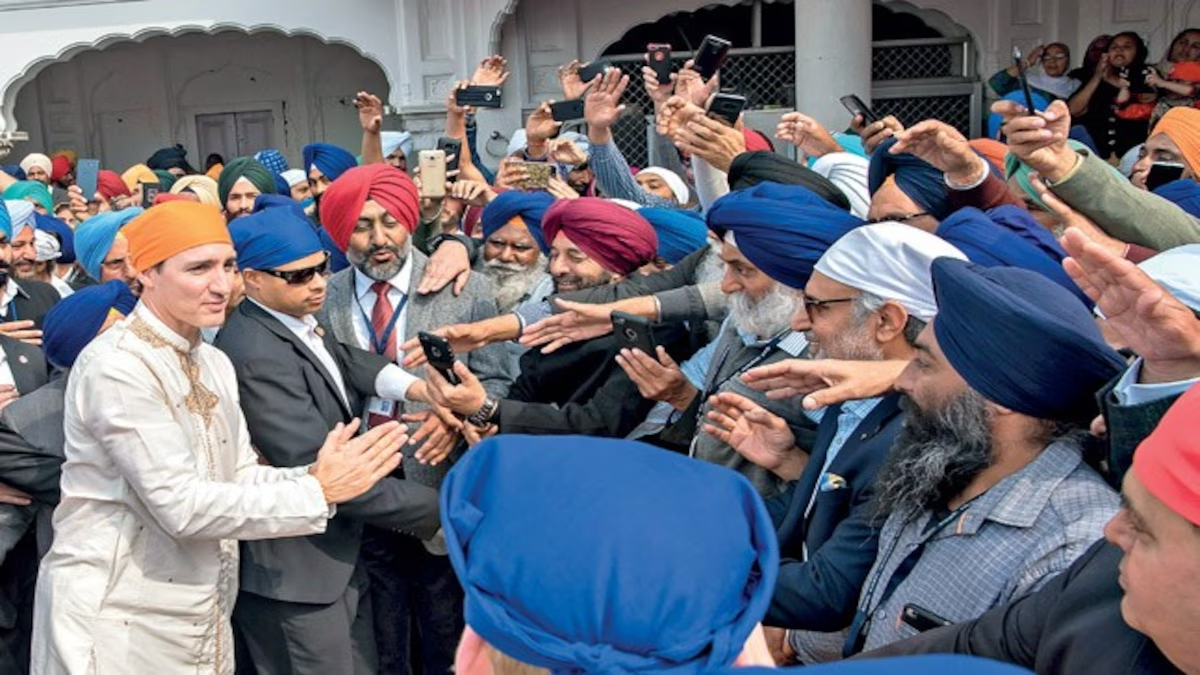
[Justin Trudeau seeking Sikh votes]
A Sept 23 Washington Post story (https://www.washingtonpost.com/world/2023/09/23/targeted-killing-canada-india-nijjar/) regarding the killing in Canada of the Khalistani terrorist Harmeet Singh Nijjar quotes a “former senior U.S. intelligence official” as saying “This is Modi looking at the world and saying to himself, ‘The United States conducts targeted killings outside of war zones. The Israelis do it. The Saudis do it. The Russians do it. Why not us?’ And none of the [nations] we just mentioned pay much of a price.”
The above-quoted American intel officer was honest. But India’s case for extra-judical, extra-territorial killing of Nijjar, the terrorist — assuming it is at all true — is far beefier than the instance of an Indian PM ordering the elimination of an outlaw. If Indian government is proven to have a hand, then it is in good company because India will merely have emulated these other countries, with the United States in the lead, who quite routinely bump off not only terrorists in their safe havens — think Osama bin Laden — but foreign individuals they deem a threat or an obstacle to achieving their foreign policy goals. Recall in this respect the cold-blooded assassination of Dr Homi J Bhabha because Washington apprehended he was getting India the A-bomb. A timed explosive placed in the cargo hold of the Air India Mumbai-Geneva flight AI 101 carrying Bhabha blew up in January 1966 on the slopes of Mount Blanc.
An US Central Intelligence Agency operative, Robert Crowley, who later headed clandestine ops for the agency confessed to carrying out this “kill” that along with Bhabha took the lives of hundreds of innocent passengers. But the Indian government made no fuss about this act of assassination-sabotage, nor was anyone held responsible, even though America’s hand in the death of their chief has ever since been the talk in Trombay circles. It became a precedent-setter for other countries. Israel, for instance, has regularly done away by various means numerous Iraqi and Iranian nuclear scientists.
Assassination as a diplomatic tool is of ancient origin and in the policy toolkit of most leading countries. “Holier than thou” states, such as Nehruvian India, refrained from deploying it, and were victimised. Things may have changed in the Modi era, by how much is not clear. There is still institutional reluctance to go after terrorists who do the nation serious harm while living abroad.
The good thing is not only has New Delhi not been apologetic about its stance on the Nijjar issue, it has taken the offensive in painting Canada as a facilitator of terrorism, which it is, in that it indiscriminately lets in Khalistani terrorists-criminals-gangsters and compounds the problem for everybody by letting them openly pursue terrorist aims of reviving an extinguished secessionist movement in Punjab from their refuge in Canada, UK and the US.
The Indian external affairs minister S Jaishankar is in the US for the next 8-odd days. He will hopefully take the natural step of declaring Canada an epicentre of international terrorism. If Pakistan harbouring a variety of Islamic extremists has been hauled up in the UN, FATF, etc why should Canada get a free pass just because it justifies terrorism promoted in Indian Punjab by Khalistanis it has welcomed as something protected by free speech? India has all the evidence it needs for crucifying Ottawa’s complicity as aider and facilitator of terrorism.
How fertile a ground is Canada for these Khalistani terrorists? Whole swaths of Canadian territory are today overrun by these militant Sikhs — as has been reported in the Canadian Press and media — engaged in illegal enterprises from running drug and crime syndicates, suspicious nightclubs, to murdering each other for any of a host of reasons — which is the likely cause of Nijjar’s mafia style execution, for the control of the lucrative gurdwara businesses dotting the Canadian landscape on that country’s eastern and western seaboards.
As regards the Canadian government’s complicity: How about Nijjar being allowed entry into Canada on a passport saying ‘Ravi Sharma’ and, who instead of being returned by the first available flight, was offered refugee status by the Canadian immigration authorities obviously under Ottawa’s instruction to admit into the country any and all Sikhs claiming political persecution irrespective of their criminal/terrorist background, or even a red alert Interpol notice as was the case with Nijjar. If Canada is politically unwilling to act on an Interpol red alert because the Liberal Party ruling with a slim majority can ill aford to upset its coalition partner — the Khalistan-leaning New Democratic Party of Jugmeet Singh, can it be relied on to respect any other international law? In the event, how is Canada different than, say, Pakistan, where too state agencies provide anti-India Islamic terrorists succour, residence, and legal and physical protection?
Nijjar was no workaday plumber peacefully propagating the Khalistan cause on weekends at his gurdwara as Ottawa would like the world to believe, but the head of the dreaded Khalistan Tiger Force committing atrocities, and charged with several murders and bombing of a cinema house in Punjab — information long ago transmitted to the Canadian government. Col. Amarinder Singh, then chief minister of Punjab reveals he gave a list of 16 Canada-based Khalistani terrorists to Justin Trudeau when he visited India in 2018, which fetched only Canadian inaction.
It is important in terms of what I flagged in the previous post about the US and the West using Khalistan as leverage against India that, it is now reported by New York Times, Trudeau based his allegation of India’s role in Nijjar’s death on signals intelligence onpassed by the US. So the Biden Administration is here playing a bit of double game — encouraging Ottawa to stick with its accusatory stance while informing Delhi that India enjoys no “exemption” from whatever punitive action Washington may decide on at an opportune time when the Modi regime does not jump when the White House asks it to.
Then again there are different yardsticks to gauge violation of law. If an assassination is carried out by the US, UK, Australia, it presumably is okay; not so much if it is done by other countries. The Washington Post story referred earlier, picked up this point. “U.S. officials have long argued”, it notes, ” that these and other operations bear little resemblance to the actions of states like Russia, noting that U.S. operations involve extensive legal review, assessments of an imminent threat and determinations that a capture or arrest of the suspect in question are not possible.” These rationales, the story concludes, “often ring hollow overseas.” And for good reason because the US and the West fail to acknowledge that other countries who may decide on assassinating a terrorist, say, may do so after they have exhausted all the available legal remedies and their patience has run out, and that such extra-judicial kills are not ordered for fun, or for the heck of it but because the host nation that is supposed to apprehend the terrorist, does not. The dossier given Ottawa was full of evidence to nail Nijjar, and yet the Trudeau regime deliberately did nothing. And now it is squawking because Nijjar got his just deserts, and the US, the most brazen perpetrator of extra-territorial mayhem, is harrumphing about it?
Risbly, Trudeau in New York brought up rules-based order. “We’re not looking to provoke or cause problems” he explained. “We’re standing up for the rules-based order.” So, India is expected to follow the rules while Canada is free to ignore them? This is the attitude that has spurred Delhi’s contempt for Canada, which Modi tried hard not to show on his face but failed, when he perfunctorily shook hands with Trudeau at the G20 summit.
Still, however Nijjar was got rid off, it will send a salutary message to other would be Khalistani terrorists that there’s nowhere to hide. Combined with the measures to expropriate their properties in Punjab, it should have the desired chilling impact. Gurpatwant Singh Pannun, the so-called “General Counsel” of the Sikhs for Justice — a thinly veiled peaceful front for the terrorist Khalistan movement, for instance, is the first one to thus lose his properties. He is supposed to be a “sleeping” partner in several commercial enterprises, which also should be on the radar of the NSA Court.
It will help to snuff out the Khalistan issue for good if combined with property expropriation, Artificial Intelligence and face-recognition technologies are used, as has been suggested by many, to identify Sikhs in Canada indulging in violent protests targeting Indian diplomats, consular offices and the High Commission in Ottawa, and to revoke their PIO (persons of Indian origin) card and permanently ban their entry into India. These moves should be well publicised by Indian diplomats in Canada and the effect of all these actions is bound to deflate the publicity-seeking Khalistanis, and thin out the crowds supporting their cause. And finally, the entry of Sikh Canadians into Punjab during state or general elections should also be prohibited because, if the previous elections are a guide, they are the source of much violence and corruption, as they used strongarm methods to try and get elected their slate of sympathizers, which is something India cannot afford to see happen.
But officially condoned or sponsored assasination is a sovereign imperative of a state to protect itself. Like the US, India too needs a law to legitimize such kill operations, a law that the Indian government then makes the world aware of both as a deterrent and by way of providing legal cover and protection to RAW agents and their affiliates. It is precisely the absence of such a law that led to KPS Gill’s special Punjab Police commando who stifled the Khalistan movement in Punjab with exemplary ruthlessness being targeted by Human Rights advocates and social do-gooders in the post-insurrection phase that led to many among these anti-Khalistan fighters facing the ignominy of prison sentences committing suicide — a denouement Gill to the very last never forgave the Indian government for.
So, a priority is for the Modi Government to draft and pass such a law legalizing the dispatching of terrorists with “extreme prejudice”. It can be subsumed under the “Self defence” Chapter VII, Article 51 of the UN Charter. So that extra-judicial and extra-territorial punishments carried out to quell terrorism and in the furtherance of state objectives are openly and legally permissible. China has passed its sovereignty law that legitimates Beijing’s decisions, policies and practices. India needs such a law to provide the legal undergirding to shrug off the pressure from the overly legalistic US government.
[After first uploading this post, someone sent me a notice about a 2004 book referencing Canada’s emergence as spawner of international terror that makes the point I have been making about Canada as epicentre of international terrorism: The book is by Stephen Bell — ‘Cold Terror: How Canada Nurtures and Exports Terrorism Around the World’ (John Wiley & Sons Canada Ltd., 2004, 2007)]

[Canadian Sikhs demanding Khalistan]
“Khali stan”, I recall the late Khushwant Singh guffawing, “is the vacant space between the ears of some Jat Sikhs safely settled in Canada, America and Britain!” He had in his hand a map he had secured from somewhere showing a supposed sovereign Sikh state carved out of the Indian Union in what is Indian Punjab but with a corridor to the sea, mirroring the equally ridiculous “corridor” Mohammad Ali Jinah sought in 1947 to connect the two wings of Pakistan!
With or without this corridor, ‘Khalistan’ is a quixotic concept first mooted by Master Tara Singh-led Shiromani Gurdwara Prabhandak Committee in the heyday of Partition politics leading upto independence in 1947. It has even less to do with recovering Maharaja Ranjit Singh’s realm that mostly stretched west and northwestwards from Lahore to the gates of Kabul and was amalgamated in British India after the two Anglo-Sikh wars of the mid-19th century had reduced that kingdom. The British cleverly coopted the youth of Sikh yeomanry into the British enterprise by claiming for them as for other similarly placed ‘Kulak’ communities of the Indian subcontinent (such as Punjabi mussulmans) “martial race” status and recruiting them in droves into the colonial army.
The departing British played a whole lot of mischief but even they saw just how ridiculous and geographically impracticable this Sikh nation concept was and, certain sections within Whitehall apart, urged the Sikh leadership to unite with India. In the main, because Jinnah’s claim for separate nationhood for India’s Muslims was at least based on the religio-cultural cleavage between Islam and Hindusim. Whence the Qaid’s famous remark in 1946-47 to the visiting Field Marshal the Viscount Montgomery, Chief of the Imperial Defence Staff, to the effect that you expect the Hindu and the Muslim to live together when “one venerates the cow and the other eats it”? The link between Hindus and Sikhs, however, is as it is said between teeth and gum, and how it was the social norm until not too long ago for Hindu families to have at least one son take “amrit” and adopt Sikhism — a religion the founding gurus, especially Guru Gobind Singh, conceived as the protector arm of Hinduism to deal with Mughal excesses. Inter-marriage between Hindus and Sikhs, therefore, was commonplace in Punjabi society. It is the aggressive attitude Jat Sikhs in particular took as their calling card and which animates the Khalistan promoters today.
It may be recalled that the renewed calls for Khalistan in Punjab began to be heard once again in the 1970s when the Indian government, in order to make the army more representative, decided on halving the Sikh component from 10-12 % to around 5%. 10-12% of the Sikh male youth population constituted a fairly large percentage of the potential military labour market and made for the relative prosperity of the landed peasantry in Punjab. It is the 5-6% of the Jat Sikh sections, who could not anymore be accommodated within the army, that took to the Khalistan movement as essentially an employment generation scheme, just as many in the Muslim middleclass saw Pakistan and moved there.
The DG, Punjab Police, the late legendary KPS Gill, in fact, put to work precisely the militant Jat Sikh mentality to counter Jarnail Singh Bhindranwale and his motivated horde that ran amok in the 1980s. Bhindranwale was the political monster the Dr Frankenstein in Indira Gandhi had created in Punjab to undercut former Punjab chief minister Zail Singh and his cronies! All this is what Gill, whose daughter married a Hindu, recounted to me about how he had contained the extremist Khalistanis. He did this over an extended evening in his Z-security covered house in Lodi Estate while polishing off an entire bottle of Black Label without any slurring of speech at the end of it, displaying an amazing level of tolerance for liqour. I asked him to write it all down, which he did in an eye-popping chapter — “The Dangers Within: The Internal Security Threats” in a seminal collection of essays I edited — ‘Future Imperilled: India’s Security in the 1990s and Beyond’ published by Penguin in 1994. Among the essayists was also General Khalid Arif who ran the Pakistan Army even as fellow Ariani and Jullundar native, General Zia ul Haq, ran Pakistan.
Gill narrated his use of an attribute of Jat Sikh mentality of feeling easily aggrieved against the Bhindranwale crowd, who had let loose a reign of terror against the nationalist Sikhs in the Punjab countryside. He told me in that evening of reminiscences — a sanitised version formed the essay in the book — how he visited each family of nationalist Jat Sikhs who were terrorised by the Khalistanis, and asked them to offer up recruits for a special commando force to be formed within Punjab Police. He promised the youngmen who saw their fathers and mothers killed, and sisters raped and killed, “before their eyes” by the Bhindranwale Khalistani extremists, that they would be appropriately trained and would have the opportunity and the official license to hunt down and kill those who had visted attrocities on their families “like dogs”. Nothing is so central to Jat Sikh mentality, Gill told me, than to avenge a personal wrong. These Punjab Police commando had absolute freedom and they used it ruthlessly and bloodily to eliminate the Khalistanis — literally “one by one” until the relatively few who remained ran, hid and survived, finding refuge in Canada and the US. It broke the back of the Khalistan movement in the country. But prophetically, Gill warned that the Khalistani element had NOT been pulled out “root and branch” from Punjab because he was prevented by Delhi from doing so. And, that there were enough sympathizers who had gone “deep underground” or were being nursed by ISI in Pakistan, with a small, vocal group in Canada and Britain where their numbers provided the Khalistan movement visibility and the electoral and political clout to keep it going in foreign lands.
I remember visiting Mississauga, a suburb of Toronto dubbed the “the capital of Khalistan” in Canada in the mid-1980s. By 2011, Canadian census indicated, there were 23,995 Sikh residents, some 25% of the population of that township. Some estimate that the Sikh population figure today has gone up to 50,000! Notable Sikh communities have since grown in other suburbs in the Greater Toronto region — Stockdale, Rexdale, Malton, etc.. There are equally large Sikh enclaves, such as Surrey, in the western Canadian province of British Columbia, where the Canadian government alleges a Gurdwara head and well known Khalistani — Hardeep Singh Nijjar, was “assasinated” by Indian agents, and in response kicked out Pawan Kumar Rai identified by Ottawa as “head of Intelligence” in the Indian High Commission. Nijjar is an extremist who entered Canada on fake visa and papers! How was he allowed into Canada? Then again, how did the Indian immigration permit him to get out of India in the first place? The Modi regime reacting in double quick time declared Rai’s opposite number here non grata and asked him to to leave the country immediately.
It is this issue that reportedly led to a very frosty meeting of Modi with the Canadian PM Justin Trudeau on the sidelines of the recent G20 summit. Trudeau is a dynastic politician, whose father Pierre Trudeau was the fashionable “new age” leader who was prime minister in two stints (1968-1979, 1980-1984) for over 15 years and in a sense bequeathed the Liberal Party leadership to his son — a phenomenon not unknown in Indian politics! Justin Trudeau understands the electoral logic of courting Canadian Sikh votes and has always been solicitous of Khalistanis within the Canadian fold. The Canadian government’s attitude to Sikh terrorists in their midst is a farce. The Royal Canadian Mounted Police took forever to find the Sikh extremists hiding in plain sight responsible for blowing up over the Atlantic Air India flight AI 182 enroute Mumbai via London in June 1985, and then they were let go with light prison sentences. And this for the cold-blooded murder of 329 passengers on-board. But how this Anglosaxon quartet (US, UK, Canada, Australia) moaned, groaned, swore vengeance against Moamar Gaddafi and eliminated him in 2011 for, among other things, the supposed bombing of the New York-bound Panam Flight 203 with only 270 passengers over Lockerbie, Scotland, in December 1988! And these are the governments hyperventilating about the shooting down of Nijjar?
The trouble Justin Trudeau has created for the Modi regime is this: He revealed that he had initiated an investigation into the potential Indian government role in Nijjar’s elimination after consulting with the US and British governments. The fact is it won’t be long before Ottawa squarely and formally blames New Delhi for the killing. And then what? The Biden Administration will be as “principle”-bound as the Conservative party government of Rishi Sunak to support Trudeau. Economic sanctions may not follow, but Washington will dangle it over Modi’s head like a Damocles’s sword — a pressure point to get Modi to do what Washington wants. Sure enough the British and Australian governments too followed in wagging their fingers at India, and reminding India to make good on its liberal professions! And Canadian pension funds who have made a pretty penny out of investing in Indian banks (like Kotak Mahindra) and companies will be ordered or feel compelled to withdraw the billions of dollars they have in equity, and lose out big time.
This is the downside I have been warning about with regard to Modi’s policy of cultivating the US and the West. It can at any time come back and bite India. The shortfalls in a still maturing Indian democracy will always be held against this country and used as leverage. In the instant case, the West-based Khalistanis are a venomous lot and some opponent faction likely killed Nijjar — a pattern long established in intra-Sikh politics of Punjab. These terrorist outlaws will do everything in their power to provoke and have their governments act punitively vis a vis India by mobilising public opinion — which is easily done everytime a local, state, or federal election rolls around, which is all the time in Canada, UK and the US. It is unlikely Ottawa will investigate the often violent gurdwara politics in Canada for Nijjar’s demise when it is much easier and politically beneficial for Trudeau to cast aspesions on India.
The Indian government has to not only strongly refute and rebuff Western governments but also make it absolutely clear to Ottawa, London and Washington that Khalistani Sikhs can happily shout and scream all they want, but if they cross the line in attacking Indian diplomats and diplomatic premises and agitate violently for a sovereign state of Khalistan, they do so at their own risk. But that Delhi will happily help anybody — if Ottawa wishes — to carve out a Khalistan in Canada where there’s lot of space available for such venture. And, moreover, that India will brook no Khalistan activity in Punjab or anywhere in India and, like it or not, the more rabid and risk-acceptant among the Khalistanis should prepare to pay a heavy price. Expropriation by the state of their valuable agricultural land and other wealth in Punjab presently held as “benami” properties, etc being only one such measure.
To end on a joke, because for some Sikhs in the “gurdwara business” in North America, “Khalistan” has always been a shrug and wink away from being a full-fledged money-making racket. I remember writing in 1983-84 about Ganga Singh Dhillon and his separatist cause in the US being funded by American intel agencies, which report was publicly picked up and commented by Prime Minister Indira G (few months before her assassination). The jovial looking Ganga Singh, who was banned in 1981 by the Indian government from travelling to India, got in touch with me and, on our meeting, reduced me to helpless laughter. “Arrey, Paji”, I vividly recall him saying in his thait Punjabi English, “You are blaming CIA, DIA, next you’ll blame PIA!”
Global Express (New Indian Express) podcast hosted by Neena Gopal, recorded yesterday, uploaded today with Lt Gen Anil Ahuja (Retd) and yours truly

The Narendra Modi government apparently does not know when it is ahead, and why not to retard the country’s rise by a self-inflicted wound that may appear trivial — such as changing the name of the country — but is not.
The Modi government is reportedly threatening to do something recklessly foolish that will leave everyone befuddled, scratching their heads in incomprehension. In the instant case, it is the Modi regime’s prospective re-branding of India as Bharat. Of course, I was quite happy that the country was being named after me, but disappointed to learn from the official spoilsports — S Jaishankar and Co., who rather warily explained to the Press that it is the alternative moniker for the country mentioned in the very first line of the Constitution — “India, that is Bharat…”, etc. Then Sanjeev Sanyal, economic adviser to the PM, educated us TV newswatchers on history stretching back to God knows when and the birth of the “Bharati empire” originating in present day Haryana, and whatnot. All this was informative and enlightening, but I still felt a little uneasy, my immediate concerns being practical.
My unease was with the name Bharat, my name and touted as possibly the country’s as well. Years of my early adult life spent in California had accustomed me to Westerners, even well meaning ones, routinely mangling my name. Scouring my memory, I cannot recall a single American from among my friends, fellow students, girl friends, class mates, project colleagues, and professors in all my years as an undergrad and grad student at the University of California and, later in life, professional acquaintances and, generally, lay people I met over the decades in Western countries, getting my name right. Despite extended personal tutorials from me the most the best among them could manage was a variation of “Baharat” (with empasis on RAT pronounced as in rat, the rodent). My friends, showing less patience, just called me “Brat” (with the snarky among them suggesting this abbreviated form fit my personality better)!
The trouble Westerners have with this word is because the aspirated “bh” is missing from the English language — look up the Oxford Dictionary (and, as far as I know, from any known European language)! Therefore, try as hard as they might, Westerners invariably will mispronounce it. Beyond a point, I discovered, it was futile to correct them, and even less to badger them to get it right. Asians — Arabs, who also can only say Baharat, but Chinese, otherAsians in the Sinic sphere, are in many respects worse, and I could never, and still cannot, make out whatever they call(ed) me (in seminars, conferences, etc) and short of being directly addressed or tapped on the shoulder, I always fail(ed) to respond.
This post is a cautionary one for the “President of BAHARAT” — whatever that is, who is set to dine with G20 dignitaries and fated hereafter — if the name sticks — to hear Western pooh-bahs standing up to give a toast and tripping right away on the word and, amidst much embarrassment among natives of this land present on the occasion, generally making a mess of the intended goodwill, as well!
It is obvious that prompted by the RSS, the change of name for the country from the G-20 platform was a trial balloon sent up by Modi. Many foreign delegates getting an invitation from the Rashtrapati Bhavan to the high dinner may have done a double take, wondering if by mischance their planes had landed in the wrong, but for some reason dressed up, country and they were missing out on the G-20 confab happening in India. If it was a balloon, it has fallen flat. Best to keep Bharat for domestic consumption where it belongs and makes sense, and then only in domestic political discourse. Because commercially some have taken this name changing move seriously enough for wags to twitter that Indigo airline, for instance, would be rebranding itself as ‘Bhago’! In other words, ‘Bharat’ will be the butt of unending jokes. Not to mention the enormous cost — as in literally tens of billions of dollars to advertise the change worldwide, and on all mastheads, crests, on government stationery, etc., only for non-South Asians to mutilate it any way.
INDIA is an extraordinarily evocative historical name derived from the word Sindhu that was persianised to ‘Hindu’ as Sanyal mentioned. Recall why the legendary leader of the XIV Army, Field Marshal William Slim, considered the greatest field commander in the Allied ranks in the Second World War, when offered the post by Nehru of Commander-in-Chief, India, declined saying that Pakistan was no more a part of the India his army would have to protect. But that’s a historical piffle compared to the fact that over several millennia literally millions of peoples everywhere, and especially in the modern era, have been familiar with ‘India’ and relatively few with ‘Bharat’. Reviving an ancient name for the country for the heck of it, or to get back to cultural roots, is all very well as an RSS-BJP hobbyhorse until it runs up against reality, and then it will be an incalculable diplomatic and all-round disaster.
A Bloomberg story mentions the economic cost to the country that Modi did not factor into his decision to overnight demonetise high denomination currency notes. The political, diplomatic, and economic costs of the name change will be unimaginably higher. For one, as has been pointed out, Pakistan, presently in the depths of despond, could rightly claim India as its name, as a co-successor state to British India, and make a new and fresh start, at our nomenclatural expense, ride on the goodwill and visibility India has generated over time even as we curdle in our own reduction to ‘Bharat’, and this when the country is set to make an economic leap. American and Japanese companies and Saudi and UAE sovereign funds are keen on investing massive amounts of monies in India. Will they be as enthused to do so in Bharat?
There is universal goodwill and name recognition attached to ‘India’ that Indians have benefitted immensely from. Think IT. India is an incomparable and unmatched supernumerary brand. Pettily then, does Modi really want to cut off the I.N.D.I.A political opposition’s nose to spite India’s face by promoting ‘Bharat’? Wouldn’t it be better if he approaches the Election Commission to reject the INDIA name for the opposing coalition gunning for him in the 2024 general electionsr?
The Harvard development economist Lant Pritchett has called India a “flailing state”. A key attribute of such a state is that it often does not know why it is doing what it is does (or, why else would it flail?). In any case, such a state often ends up hurting itself, its cause. In this context, what’s worse than a deep, irreparable and self-inflicted wound than changing the name of the country just when it is finally taking off? It is nothing like changing the Indian Navy’s flag — removing the St George’s cross from its ensign. No one has quite explained why such a formal name change is necessary or even right other than as an RSS-Modi brainwave of the moment that the country can well do without.
Let Bharat remain the common currency in the realm of internal politics and in the language of cultural discourse. But, otherwise, let India be India. “India” carries heft, has a full history behind it, and the name resonates expansively worldwide. It is ludicrous to give up so much for relatively so little. Let it be. Let India just be.
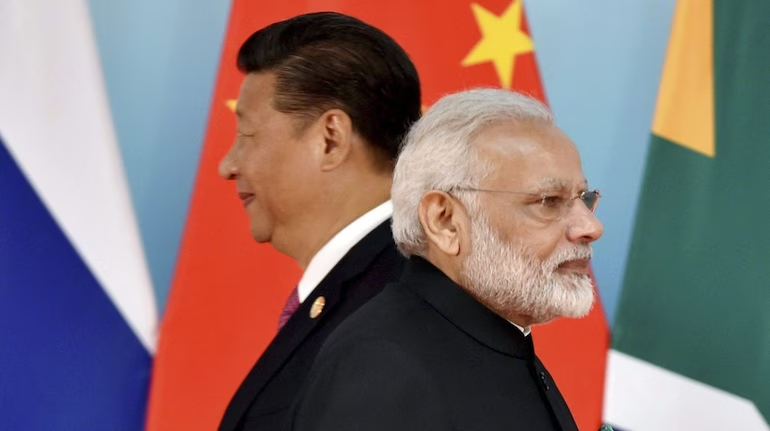
[Modi & Xi]
New Delhi is all decked up in Indian calender art aesthetic — an eyesore to many. The G-20 summit will crown the many ministerial meetings on numerous subjects (energy, terrorism, etc) held in the past few months, imaginatively, in different cities all over the country to showcase regional cultures and artifacts. These meets were well received. The summit hosted by India scheduled for next weekend (September 9-10) follows Narendra Modi’s chairing the Shanghai Cooperation Organisation (virtual) summit in July this year, and is expected to be the highpoint of the Prime Minister’s “be everywhere” diplomacy. To be seen is to be recognised, and the G-20 Meet has been targeted by Modi as the event that elevates him to the pantheon of the ‘Big 4’ (the other three being Biden, Putin, Xi).
So, trust the Chinese President-for-life, Xi Jinping, to rain on Modi’s parade. And then pour odium on it.
At the Johannesburg BRICS (15th) summit, Modi and Xi met on the sidelines and vowed speedily to disengage forces on the disputed border. However, the military level talks at the Lieutenant General and Major General fora, predictably, got nowhere with the PLA unwilling to move from its blocking position on the Depsang Plains and permit Indian forces to patrol Indian areas. Half a week later, Beijing issued its “standard map” that showed all of Arunachal and Aksai Chin within China. The release of the map on the eve of the G-20 summit was less because it said anything new by way of China’s expansionist revisionist territorial claims than as an “in your face” insult to Modi guaranteed, Zhongnanhai hoped, to provoke a lot of negativity in the host nation, roil the atmosphere, and pitch Modi’s big moment into the ditch.
The Chinese map has upset countries across the board. The Southeast Asian nations on the South China Sea littoral protested the sea expanse covered by the 9-dash line as an abomination, as Delhi had done the Chinese notions of the Line of Actual Control. Beijing did not spare its quasi-ally Russia either. Notwithstanding an accord signed around 2002-2003 to share control of the disputed Bolshoy Ussuriysky Island at the confluence of the Amur and Ussuri rivers, the map shows the entire island as Chinese territory. 1969 witnessed armed contestation for this island.
Xi followed up this show of his regime’s tactless intemperance by first hinting and then confirming he would not be attending the Meet. With Russian President Vladamir Putin too pulling out as he had done from the BRICS summit, Xi’s decision was a gut punch to Modi’s plans for showcasing this big bash with all the world leaders in attendance, as curtain raiser to next year’s general elections. India has not used Modi’s participation in various summits as leverage, as Xi and Putin have routinely done. Our PM seems happy to go to anyplace he is invited for anything.
Not satisfied with dumping on India, Xi’s minions presently meeting in a resort in Manesar (outside Delhi) with other G-20 counterparts to stitch together a consensus document by September 6 for release as Joint Communique at the end of the confab on September 10, the Chinese reps prevented common views form emerging on other contentious issues. The Ukraine war is the principal issue widening the rift within the G-20. Sergey Lavrov, the Russian foreign minister standing in for Putin at the summit, has demanded that his country’s viewpoint be reflected in the document if there’s any mention of the Ukraine conflict. The US and the West are just as adamant in desiring that Moscow and Putin be held accountable for the supposed human rights excesses perpetrated by the Russian military. Having earlier wagged a finger at Putin — “This is not an era for war”, Modi finds what he considered a fairly innocuous remark to have snowballed into Russian suspicions of Delhi increasingly doing things to please Washington. It has motivated Moscow to stick by its demand even more. Xi backs Putin and between them will highlight by their absence, that China and Russia may be outnumbered at this forum, but that Modi is a prevaricator and unreliable as partner — the very conclusion, ironically, the US and the West have been urging Delhi to avoid giving the impression of because of its noncommital stance on Ukraine!
The condition of no give by either side on Ukraine has been compounded by a similar chasm growing between the two sides on the “carbon peaking” matter. Except here India, China and the Global South are nagging the US and the West for bigger investments in technologies, schemes, and financial outlays to “green” the environment. Absent a consensus, the final document will have no definite financial commitments by Western countries nor timelines to achieve carbon emission minimization standards, with China, more eager than India, to hold the West’s feet to the fire on these Climate matters.
But Xi did more, stabbed Modi deep in his back. Beijing has taken umbrage — and this is particularly hurtful to Modi because he planned to make “Vasudaiva Kutumbakam” — all the world is one family, that he has evoked time and again all over the world, at the Indian government’s making this the underlying theme of this G-20 summit. The Chinese have rejected this sanskrit phrase-concept whole, and asked that it not be mentioned anywhere in any Summit document! Of course, Modi has repeated it endlessly to emphasize the core of his approach to inter-state relations, stressing a uniquely benign view of the international system, and of India’s role in it. Beijing, however, wants none of it, because it sees in this construct a competitor to China’s own Tianxia system of “order under the heaven” and, being strategic minded, fears that universalising and legitmating this idea would diplomatically advantage India. Modi may reiterate the phrase in his G-20 address but, if Beijing succeeds, it will have no G-20 agency.
Combine this with the possibility that the G20 “sherpas” in Manesar will fail to paper over the division on a host of issues, and we have the very real possibility that there will be no Joint Communique — which hasn’t happened in G20 summits in recent memory, and will be perceived as something of a debacle for Modi who has so far adroitly straddled the divides.
However the summit turns out, India’s non-reaction to China’s cartographic aggression which will be seen as symbolizing India and Modi’s timidity will be the subject of hushed talk between visiting heads of government and their retinues. China is the common concern of great many countries, and especially Asian states on the frontlines facing an inordinately assertive proto-hegemon.
So, what should Modi and the Indian government do to recover for the country a bit of its elan and to repair its reputation that China has tarnished?
Firstly, treat Xi’s stand-in — Premier Li Qiang with the barest protocol and no red carpert, and absoultely no ceremony, with, perhaps, an Under-Secretary at the China Desk in MEA if not someone even lower in the ranks, to greet a disembarking Li, and his plane parked in some remote part of Palam airport. Secondly, Modi should avoid any contact with Li and barely recognise his presence at the summit, and in the inevitable photograph of the summiteers, place him in the last row at one end!
Thirdly, and this is the big deal — something the Indian government has apparently not learned after dealing with Beijing going on 70 years — fight cartographic fire with like fire. Having issued the map, Beijing proceeded to goad Modi and India. The map, Beijing claimed, was no big deal and advised India not to “over-interpret” it, in other words, not to get worked up about it. Whether this injunction against over-interpreting referred to the map itself or to the fact of its release, insultingly, on the eve of the G-20 summit, was not clear. In either case, it was a resounding public slap to Modi’s face — after all it is the Indian PM who has been solicitous, doing the running after Xi gig (and not the other way around). The Ministry of External Affairs reacted in the worst possible way — its spokesman called such map changing shenanigans an “old [Chinese] habit”, thereby derating the significance of the event. After all, if something is called an “old habit”, the person or entity charged with it is painted as a cantankerous sort of acquaintance bent on mischief whose bad behaviour is tolerated because, well, he can’t help himself! It is thusly that Xi has staged his repudiation of the Modi regime and its desire for an amicable border solution.
With the offending Chinese standard map showing Arunachal and Aksai Chin as constituent regions of China, India should during the two days of the summit upload a map of Asia showing Tibet in a colour different than the one for mainland China. And likewise depict Taiwan as an independent country, keeping in mind that Beijing vehemently protested the visit August 8 by three Indian retired Armed Services Chiefs of Staff to Taipei. It is Xi’s Taiwan sensitivity that Delhi needs to trample on. Hereafter, the ‘One China’ concept, moreover, should be no part of Indian foreign policy at least not until Beijing hews to the ‘One India’ concept inclusive of all Pakistan-Occupied Kashmir and Northern Areas, which idea Modi should articulate, perhaps, at the plenary session of the G20 summit
Whether anybody in the PMO/MEA/GOI likes it or not, the tension Xi has deliberately stirred in Sino-Indian relations will be Banquo’s ghost at the G-20 grand dinner.
Actually, the map is only the latest show of China’s contempt for India, and Modi in particular. Recall how Atal Bihari Vajpayee, Morarji Desai’s foreign minister, visiting Beijing in February 1979 was greeted — the PLA pointedly launched its military operation against India’s friend — Vietnam. But the Vietnamese being Vietnamese the irregulars that first came into contact with the advancing PLA Group Army were actually quite enough to teach the Chinese a lesson — they so bloodied the lead PLA formations, the great helmsman, Dengxiaoping, who recognized the drubbing for what it was, simply declared victory and got the PLA the hell out of Vietnam! It is a solution the Indian military can’t even dream of.
[Chandrayan approaching moonscape]
Trust the ridiculous public sector Doordarshan to screw it up. Just as the lander got to within metres of the moon’s surface, instead of focussing the cameras on the approaching lunar surface captured by the onboard cameras, you had the DD idiots focussing their cameras on a simulated picture! Is there no end to Doordarshan’s lack of professionalism?
This massive coverage/visual snafu by the Doordarshan fools was compounded by having Prime Minister Modi speaking from — and going on and on a bit, from Johannesbrg, rather than having the cameras staying and relooping the Vikram camera sequence with the puffs of moondust as the lander’s qaudrupod feet settled on the moon. The PM could always have spoken a little later after the people had seen again and again the camera capturing the actual lunar touch down. It is time that in future Space missions private sector TV companies are allowed to report live from the control room than leave history in the making to be visually botched by the still amateurish Doordarshan.
That said, the mission was spectacularly successful also because it highlighted ISRO’s penny-wise, pound-wise approach of getting the most from the monies invested in the Chandrayan mission. What NASA does for billions of dollars, ISRO achieves for tens of millions — that is the cost differential that can’t be beat. The Chandrayan success also stands out even more in the context of the failure of the Japanese Hakuto-R moonlander in April this year, and because of the Russian Luna 25 mission, in a hurry to beat Chandrayan-3 to the lunar South Pole, that was victimised by the short cut it opted for. Instead of transitioning through a succession of progressively lower elliptical orbits before detaching the lunar module, it tried hardbraking from a height and crashlanded to Moscow’s embarrassment.
India has signed the Artemis accords (initiated in October 2020) when Modi recently visited Washington — the country becoming the 27th signatory of an agreement that has established “rules of the road” for Space ventures. With Russia and China forming their own group for cooperating in, and coordinating, their Space activities (that Pakistan, for instance, wants to join), there is now a democracy versus autocracy schism in Space exploration. This competition doesn’t augur well for anyone. Because remember, India’s geosynchronous orbit satellite injecting/deep Space launch rocket system is based on the Russian cryogenic engine design whose transfer the US did everything in its power to derail, even pressuring Moscow to desist from handing over ready rockets and associated technologies to ISRO.
The most consequential decision Modi made, which has brightened the prospects of India emerging as a truly substantial Space power, is to privatise much of the Space sector. Considering the quite extraordinary leap by young high-tech companies that have come up in the field in the last ten years — Agnikul Cosmos, Spaceroot (which won an international NASA competition for moon rover), Bellatrix, Pixxel, Satellize, Dhruva Space, et al, setting up their own launch and satellite design and production facilities, and augmenting the big corporates already in the business of helping out ISRO — L&T, Godrej Aerospace, etc., the public sector giant will soon be given a run for its money. And India will gain massively. In the ISRO-led Space ecosystem, some 500 small and medium companies are producing stellar technologies economically.
Once India acquires economies of scale in all aspects of Space technology, it will be unbeatable in that no country, least of all those from the West, will be able to compete on cost-proven quality terms. It is an edge the country needs to preserve (for launching low earth orbiting satellites, in particular) and a capability that needs continuous enhancement — a job private capital can help throttle up by investing hugely in Space tech companies and startups.
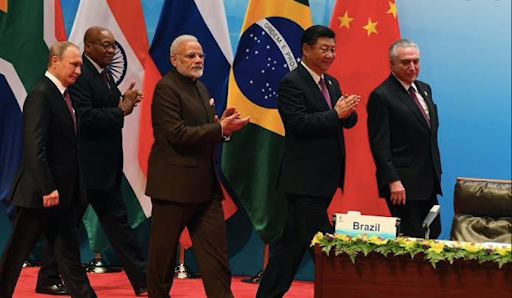
[BRICS Summiteers]
The two-day 15th BRICS (Brazil, Russia, India, China, South Africa) Summit will be held in Johannesburg, South Africa starting tomorrow (Aug 23) and is a featured event in the busy international calender for many reasons. One of its members, Russia, has been embroiled in a conflict with Ukraine over territory habited by Russian-speaking people who have been fighting a secessionist insurgency with Kyiv for a couple of decades now and which fact, Moscow asserts, strengthens its claims on the said Donbas region in eastern Ukraine. Russia has territorially gained what it wanted and is now sitting tight, letting the Ukrainian forces bash their heads against the 20 km-wide mined and otherwise fortified defensive barrier Russia has consolidated since late 2022. But President Vladimir Putin will be absent because there is a warrant out for his arrest for crimes against humanity (in Ukraine) that South Africa, as host and a signatory to the law, can in theory enforce. The Russian leader apparently doesn’t care to risk an incident and will send his usually imperturbable foreign minister Sergei Lavrov in his stead.
The Brazilian President Luiz Inácio Lula da Silva, Lula in short, is an anomaly in that he is an avowed socialist at a time when Leftist leaders the world over are becoming extinct! He replaced the rightwing Jair Bolsonaro, being re-elected but this time because of his more tempered socialist rhetoric. Indian Prime Minister Narendra Modi remains ensconced in India for the same reasons that other conservative politicians have found traction elsewhere in the world — there being a general disbelief among voters that the state is the solution to country’s problems. (It is also the reason why the I.N.D.I.A bloc in Indian domestic politics is facing so much skepticism. Just curious, but can a political party call itself INDIA under the law, because commercial entities are barred from using ‘India’ in their company or product names? Strangely, the BJP-led NDA government has not sought a ruling from the Election Commission on this inappropriate name-issue by a gaggle of opposition parties because it is clear the name is a political ploy at confusing the voter — Can voting for INDIA be against India? Someone in Rahul Gandhi’s coterie apparently first thought of using India as acronym and then came up with the convoluted words to fit it! Clever but is it legal?)
Other than the BRICS Five, 50 other leaders, are expected to attend the events “as friends of BRICS”, with discussion being directed by the host country towards considering the subject — “BRICS and Africa”, and how the organization can help African countries in their economic betterment and development programmes.
The main issue for the summiteers to sort out is whether to expand BRICS into, what many conceive it — with China in the van, as a counterweight to the Western bloc of nations led by the United States with its own First World views of reality. Many countries — 40 so far, have shown an interest in joining, with 23 of them even submitting formal applications. The sudden spurt in BRICS’s popularity may be because there’s the potential of its emerging as a major economic and trading bloc, and who wants to be left out of that? Already, BRICS accounts for 42% of the world’s population and 23% of the global wealth (GDP). Anil Sooklal, South Africa’s ambassador-at-large for Asia and the BRICS, speculated that one of the chief reasons for the popular demand to join is because “countries are being forced to take sides” on the Russo-Ukrainian war. “Countries in the South don’t want to be told who to support, how to behave and how to conduct their sovereign affairs”, said Sooklal. “They are strong enough now to assert their respective positions.”
In other words, BRICS and BRICS enthusiasts in the Global South and the non-West international community at large, are coming round formally to adopting India’s attitude to the ongoing conflict best expressed by the external affairs minister, S Jaishankar, in 2022 at the Globsec Forum in Bratislava. ‘Europe has to grow out of the mindset’, he declared, ‘that Europe’s problems are the world’s problems, but the world’s problems are not Europe’s problems.’ This is, perhaps, the statement with the greatest clarity that Jaishankar has issued during his tenure so far as foreign minister. Such plain speaking, as I have always advocated, is exactly what is needed when dealing with the US and the European states. Because there’s no ambiguity, there’s no likelihood of wrong interpretation and misunderstanding, and so India for the first time won respect and diplomatic leverage, and the more obvious ways of pressuring New Delhi ceased. It has left the country free to pursue its interests as it sees fit whether in purchasing energy or armaments from Russia and, in the bargain, winning Moscow’s appreciation. The global village saw what happened and decided what’s good for India is good for them as well!
This is the first instance actually of India showing leadership and staking a substantive position other countries have come to rally around.
Regarding the expansion of BRICS, which China is pushing for, India has every reason to be suspicious. New Delhi has not opposed an expanded BRICS but is insisting on fleshing out in detail the admission rules and conditions, and the metrics to decide an aspirant member’s observer status and, in time, full membership. For instance, Turkey, Saudi Arabia and UAE all want to join BRICS. Having Riyadh and UAE, with whom India has established warm relations, in the outfit may be no bad thing. Except, these two Arab states are getting close to China, and also subsidising Pakistan’s financial profligacy and propping Islamabad up, perhaps, to ensure their supposed access to its ‘Islamic bomb’. Prospectively, a Saudi-UAE-China group would be a major headache for India and even pose a strategic problem. As would an Islamic bloc, should relations turn sour, of Turkey-Saudi-UAE supported expediently by China. India has to be mindful of such possibilities and propose a semi-permanent cadre of ‘observer status’ countries for consideration to full membership in, say, ten years time — a sufficient period to judge how these states behave and, more importantly, how and what BRICS issues they side with China on.
It always makes sense to be apprehensive of Beijing. China has time and again used bilateral and multilateral fora to talk around Indian interests, reduce them, and make monkeys out of Indian leaders, starting with Jawaharlal Nehru. Modi too burned his fingers by trusting President Xi Jinping and imbibing a little too much of the Wuhan and the Mahabalipuram spirits than was safe.
The other major issue that will be bandied about is the de-dollarisation of the global economy, which is a strategically sensible thing to realize. Freeing the Indian economy from the grasp of the US dollar would endow Indian foreign policy with more latitude than it has enjoyed to-date, and help to conserve the country’s hard currency reserves. New Delhi is already setting up channels for trade in local currencies, such as the rupee-dirham transactions for trading in energy with the UAE, and hoping that de-dollarised trade can be regularised with other friendly countries in the neighbourhood as well. Intra-BRICS trade in local currencies or in currency other than dollars would give this alternative trading scheme a huge kick-start. And the recently established New Bank — a BRICS institution, would be the facilitator. But again the proverbial ‘fly in the ointment’ is China. The Asian Devevelopment Bank with majority Chinese equity is an economic creature of Beijing. One would hate to see this happen with the New Bank. Here the monied Arab states would offer a real alternative to China’s capitalisation of this bank. May be ‘observer’ status, with promise of conversion to full BRICS membership, for Saudi Arabia and UAE can be bartered for seed funding of this bank.
More strategically, Modi should hold private and personal discussions with Lavrov, Lula, and Cyril Ramaphosa with securitising BRIS (Brazil, Russia, India, South Africa) with a view to blunting China’s hegemomic agenda. In my 2015 book — Why India is Not a Great Power (Yet), I made the case for such an informal military cooperation arrangement that will create a quite extraordinary air-naval security net covering the Indian, Pacific and Atlantic Oceans (Indian peninsula-Simonstown-Rio de Janeiro) entirely free of Western involvement, expectations and encumbrance. Time to push, this more potent, ‘secret’ agenda! Because Modi has to bear in mind that China is India’s main and only credible threat. This is the real value add-on.
Whatever happens in Johannesburg, Modi and his team better prepare to play hardball and not allow Beijing to roll over Indian interests. Again.
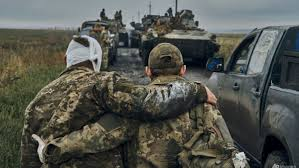
[Ukrainians in an unequal fight]
Until yesterday, the Western media reported how the Ukrainian counter
offensive was galloping along, steadily pushing the Russian troops eastwards,
and how it was just a matter of time before the lead Ukrainian elements would
break through the three-tiered defensive barrier the Russian began putting up
in the autumn of 2022, and head for Melitopol and Berdyansk on the Sea of Azov.
How having thus affected a disjunction between the Russian forces holding the
northeastern and eastern ends and the others the south, the Ukrainian army
would exploit the tactical successes to widen the breach and, also imperil
Russian-held Crimean Peninsula and the upper part of the Russian-controlled
Donbas region, and pose a danger to the Russian ports and bases on the Azov
coast.
And then, all of a sudden, everyone in the West — governments, thinktanks,
media, seem to have run smack into the reality wall. For the first time today
the leading propagators — New York Times, Washington Post, Reuters, AP, CNN,
et al, of this American line of the Ukrainians winning that was always more
wishful thinking than hard facts, began singing a different tune. They reported
glumly that the Ukrainians had in fact made little or no progress in their
counteroffensive, that their advance is, for all intents and purposes, over
what with the Fall rains approaching that would turn much of the countryside
into slush.
Sure, Ukrainians may still create a sensation here and there by having
drones strike Moscow buildings, or missiles sink Russian warships in the Black
Sea. But on the ground, the Ukrainians are essentially stuck where they are
presently, failing to make even a dent in the Russian barrier of mines,
trenches, tank traps, anti-tank munition pits, and drone-launching posts along
what’s now the new 1,000 km long eastern border of Ukraine.
Except, this virtually impenetrable barrier erected roughly on the line
Kupiansk-Bakhmut-Donetsk-Vuhledar-Kherson was firmed up by the summer of 2022,
that is within 4-5 months of Putin initiating the “special military
operation” that began in the Donbas region with a lax and liesurely
advance by Russian armour which stalled because of the fight in the Ukrainians
the Russians did not expect. It nevertheless achieved Putin’s war aim of
annexing the eastern Ukrainian “oblasts” with Russian-speaking people
— Donetsk and Luhansk, which provided a land bridge linking Crimea and the
Russian mainland, and will help Russia to consolidate its absorption of these
parts of Ukraine claimed by Moscow.
True, this was Putin’s Plan B. Plan A went spectacularly wrong on the very
first day of the war on February 24, 2022. The Russian combined arms operation
featuring fighter-bomber aircraft, parachuted Spetsnaz Special Forces, and a
fleet of assault and transport helicopters were supposed to quickly capture the
Antonov airport on the outskirts of the Ukrainian capital, take Kyiv, install a
friendly government there, like the one in neighbouring Belarus, which would
then cede the Donbas belt to Russia. Except, the Ukrainian National Guard unit
posted at the airport hunted down the Russian paracommando, shot up a whole
bunch of the incoming assault helos with Igla manpads, and deterred Russian
Su-25 close air support aircraft from making low-level bombing/strafing runs by
accurate anti-aircraft fire.
In fact, by end-March 2022, Moscow having gained most of what it wanted
offered a peace deal to Ukraine in negotiations held in Minsk and in Istanbul
which Kyiv initially accepted, but later rejected under American pressure. As
far as the US is concerned, Ukraine offered an opportunity to mire the Russian
military in an unwinnable war, isolate it in the international community,
weaken it economically, and hurt its image and military reputation (as it did
by helping the Afghan mujaideen — with Pakistan’s assistance — run the
Russian occupation troops out of Afghanistan in the 1980s). Whence the US-NATO
policy of arming Ukraine to the teeth such that it would become a
“porcupine” — hard for Russia to swallow. The trouble is a porcupine
is more suited to defence than offence!
But considering what the Russian objective was, all this massive arming of
Ukraine — some $47 billion worth of arms transfers in the past one year alone
with more to come, even F-16s by this year end, will make not a whit of a
difference, because of one singular Ukrainian deficiency that Kyiv cannot
speedily rectify, namely, disparity in the military manpower strengths.
Russia’s population is 144 million versus Ukraine’s 44 million; the former
has 900,000 men under arms and two million in reserve, the latter 209,000
serving and 900,000 reservists. As of April 2023, Ukraine’s war toll
was 15,500-17,500 killed in action and 109,000-113,500 wounded. Moreover, 23.8
million Ukrainians sought refuge in neighbouring countries, a good
portion of this lot being youth avoiding military service. With Russia
imposing attrition warfare, Ukraine has so depleted its manpower resources, it
is anybody’s guess how much longer it can hold out. And no, there’s no question
of US-NATO landing troops to fight Ukraine’s war. This was clear from the
beginning, but US-NATO’s cynical policy of fighting to the last Ukrainian is
literally coming true! There’ll soon be no Ukrainians to fight the war!
The absence in Ukraine of a sizable military age manpower pool is so
elementary, but fatal, a weakness, Washington, in its eagerness to stick it to
Russia, predictably missed it.
Ukraine’s war woes apart, its President Volodomyr Zelensky’s extraordinary
wartime leadership is awe inspiring. What he has excelled in is in consistently
besting the Kremlin on the public relations front. His exploitation of the international,
especially US media, is exemplary in that it created this phantom prospect of a
victoriuos Ukraine out of thin air and then sustained it with his government’s
adroit image and influence management.
But, as I mentioned in my first post on this blog at the outset of this
conflict, nothing but nothing was going to prevent Russia from achieving its geostrategic objective of annexing the Donbas corridor. This the Russians did last year. They have been in a holding pattern ever since. There’s good reason why the US, NATO (and China) have quailed at the possibility
of tangling with the Russian army. It is slow to get going, but once it does
there’s a relentlessness to its efforts that no military can match. That’s why
America would rather Ukrainians do the fighting. After all, what does
Washington have to lose except more Ukrainians?
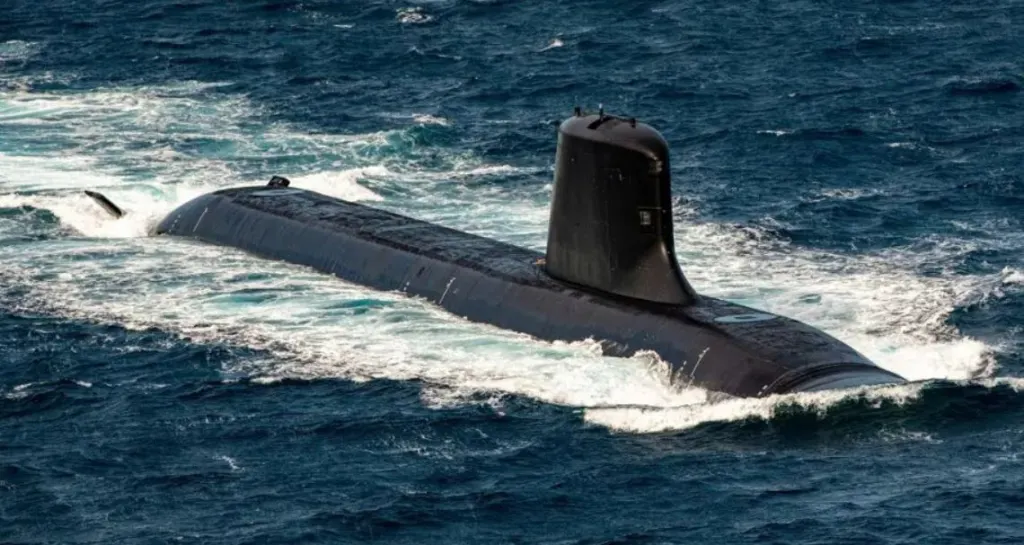
[French Barracuda-class SSN]
The mystery of the draft joint communique featuring mention of the deal for three “Scorpene” submarines and 26 navalised Rafale aircraft, which mention went missing from the final document issued at the end of the state visit to France by Prime Minister Narendra Modi, is now solved. The reason was that there were too many submarine technology-related points that needed additional technical-level talks to sort out.
Still, President Emmanuel Macron will be exceedingly happy with the sweetheart deal he managed to secure from Modi, and the French ‘Naval Group’ overjoyed. Naval Group is successor to DCNS (Direction des Constructions Navales S).
The French Company on its website welcomed the “announcement regarding the extension of the Indo-French partnership and the objective to explore more ambitious projects to develop the Indian fleet and its performance. Mazagon Dock Shipbuliders (sic) Limited (MDL) remains our natural partner.” “This decision is a testimony”, it continued, “of the Indian Navy’s trust in the industrial cooperation we have established, and”, without flinching at the irony of it, reaffirmed “the success of the transfer of technology achieved under the P75 programme for six submarines, which were built entirely in India by MDL. The ‘Make in India’ policy in the service of Indian sovereignty (“AatmaNirbhar”) has been at the heart of the P75 programme, as well as other activities developed by Naval Group and its Indian industrial partners to provide the Indian Navy with the most modern naval defence technologies.” The CEO of the Naval Group Pierre Eric Pommellet, on his part, added that the deal would “further strengthen our 15-year submarine building cooperation, which is a major element of the Indo-French strategic partnership developed over the past decades. Naval Group and its partners will be fully mobilised to meet the expectations of Mazagon Dock Shipbuilders Limited and the Indian industry to fulfil the needs of the Indian Navy”. ( https://www.naval-group.com/en/naval-group-welcomes-announcement-made-indian-and-french-authorities-regarding-extension-indo )
Let’s consider why Paris is elated, Naval Group exultant, and the success claimed for the “transfer of technology” entirely bogus.
At the time of commissioning in January this year of INS Vagir — the fifth and penultimate conventional sub of the Scorpene-class license-produced at the Mazgaon Dockyards Ltd (MDL), the Chief of the Naval Staff , Admiral Hari Kumar, praised the fast paced sub production — Vagir being the third such vessel inducted in the last two years, and referred to this achievement as “the coming of age of India’s shipbuilding industry, and the maturing of our defence ecosystem.” “It is also a shining testimony”, he added “to the expertise and experience of our shipyards to construct complex and complicated platforms.”
Not sure what the naval chief was talking about when he brought up the country’s shipbuilding industry and the maturing ecosystem because the Scorpene programme has added mighty little to the industrial capacity — unless the MDL DPSU’s penchant for screwdrivering things together is considered a great advance, and not an iota to the country’s atmanirbharta capability.
One wishes our armed services chiefs were more candid; if that’s not possible, at least not make misleading statements.
Facts:
1) Project 75 Scorpene project has suffered huge time and cost over-runs. It has taken ten more years than planned and cost nearly twice as much.
2) Project 75i — a supposedly indigenous project featuring a creative melding of the best design and operational attributes of Western (German HDW 209, French Scorpene) and Eastern (Russian — Foxtrot, Kilo) submarines the Indian Navy has experience of, is delayed by 10-15 years. The delay is due to the navy’s inability to setttle on specifications — single or double hull, diving depths, etc.
3) With the Scorpene project ending and 75i yet to get going, the navy needed a bridging solution and decided an additional three units of the Scorpene would do.
4) Except, the French Company DCNS it had originally contracted with, now Naval Group, has terminated the Scorpene line, and professed itself unable to provide the SKD/CKD kits for MDL to assemble — NOT MANUFACTURE, the three additional Scorpenes.
5) Instead, the French firm offered, and navy quickly accepted, an adapted, conventional, version of its Barracuda nuclear powered attack submarine (SSN). And the Defence Ministry nominated MDL to assemble the three boats. This despite Defence Minister Rajnath Singh’s public commitment that there will be no production contractors by “nomination”. Meaning, for any production contract there will be competition. That’s how much Rajnath Singh’s words matter.
6) The Barracuda design could, however, be shrunk only so much. Compared to the Scorpene’s hull diameter of 6.3 metres and displacment of 1,650 tons, the adapted Barracuda’s is 7.2-7.5 metres, and 2,500-2,800 tons respectively. Barracuda SSN displaces some 5,300 tons. In other words, the three new ‘Scorpenes’ contracted for are NOT Scorpenes, only better.
7) That’s fine! Except, this upgrade also means rocketing unit cost. The navy acquired the six original Scorpenes at roughly Rs 6,000 crores each. The new “Scorpene” — adapted Barracuda, will cost Rs 11,000 crores per boat. That is almost double the cost — and this, mind you, is just the ‘base price’. There’s no hint anywhere of progressively lesser cost as would be expected for subsequent submarines after the first one!
7) Because it is a new submarine, the old Scorpene manufacturing jigs and wherewithal at MDL will have to be discarded for far more expensive replacements for conventional Barracuda sub assembly.
8) The French don’t have an operational AIP (Air Independent propulsion) system for increasing the range of submarines. So these conventional Barracudas will have to be equipped with the DRDO-designed and developed AIP which, incidentally, is good to go — what a relief! It will necessitate structural changes and, prospectively, yea, additional tens of millions of Euros in French pockets. (The first of the Scorpene subs, INS Kalvari, is coming in for refit in 2025, and will be equipped with the Indian AIP system.)
9) And, a shocker, really?! There has been NEAR ZERO transfer of submarine technologies over the years by DCNS (Naval Group) to MDL. The sixth and last of the Scorpenes to roll out from MDL assembly line by 2024 will have LESS THAN 3%, yes, THREE PERCENT by value of indigenous technology– relatively trivial stuff like cables, mounting lugs, hatches, and minor electrical equipment.
And all along the Government of India, the Ministry of Defence, and the Indian Navy have been trumpeting the Scorpene programme as furthering the country’s indigenous submarine design and production capability. Who is responsible for drafting such one-sided contracts? Will anybody in the navy and defence procurement loops in the Indian government be held accountable for this fiasco? Of course not. But wait…
10) The deal for three new mislabelled Scorpenes — derated Barracudas, will likewise have ZERO transfer of technology. But worse, why the doubled cost?
11) Well, because, Naval Group has to amortize their costs for developing the Barracuda SSN — absolute imperative now, especially after the Australian navy abruptly cancelled the contract worth 50 billion euros for six of this SSN in September 2021, and ruptured relations with France, an ally. The Aussie navy apparently belatedly realised it preferred the US/UK offer of an AUKUS nuclear sub. French Foreign Minister Jean-Yves Le Drian called it “A stab in the back”. Macron recalled the French ambassador from Canberra. The French feathers were unruffled only after the government of Anthony Albanese agreed in June 2022 on a “fair and and equitable settlement” of 555 million euros (US$ 584 million) with Naval Group, that ended the decade-old Australian deal for the Barracuda SSN. That still left much of the invested costs unrecouped because the French Navy indented for only six, with the first joining service in 2022. But there came India to the rescue of foreign defence industries once again!
12) May be, there is some secret understanding that Modi reached with Macron for the French Alternative Energies and Atomic Energy Commission ( Commissariat a’ l’energie atomique et aux energie alternatives) and Naval Group to part with the technology for the 150MW miniature nuclear reactor powering the Barracuda SSN for our own indigenous SSN project. Is there such a deal? This is something many retired naval persons have been bandying about for a while. Should it actually materialize, then all this expensive farce about submarine tech transfer, etc may be worth it. But knowing the French and how they have dealt with India over the past 65 years from when IAF bought the Fuga-Mysteres in the Fifties, don’t hold your breath! There may be, to mangle metaphors, dross at the end of the tunnel, not gold!
13) But August 1st is when Defence Ministry will open the bids for Project 75i — and there are two parties in the contest: MDL partnering Naval Group, and the Indian private sector Larsen & Toubro (L&T) partnering Navantia, the Spanish ship building firm. And one can predict that MDL will likely bag the contract. Why? Because of its lower bid. But why will MDL’s bid be lower? Because MDL as a defence public sector unit has had periodic “capacity enhancements” worth thousands of crores of rupees over the years, courtesy Defence Ministry, most recently, for Rs 300 crores. These, as far MDL is concerned, are part of the sunk costs it need not factor into working its bid. MDL-Naval Group, will, in effect, produce the same Barracuda in additional numbers, three already contracted for in Paris by Modi, with six more as Project 75i! Neat, nah?
And because MDL will cross-subsidize, particularly the labour costs which make up 17% of the submarine production cost, and come up with the lower bid to win the Project 75i contract. After all, MDL and Defence Ministry do not have to answer for such investments — it is the people’s, Indian tax payer’s, money. And who gives a damn how it is spent?
On the other hand, a private sector firm’s investment in design and production infrastructure has to be profitable because the management is accountable to its share holders, and it has to be factored into the contract costing before making the bid. Money borrowed by the government on sovereign terms is for MDL free money. For a private sector company credit comes at hefty interest rates. Even so, notwithstanding the institutional hurdles, L&T has made a success of manufacturing the strategic Arihant-class nuclear powered ballistic missile firing submarine. But it may lose a patently unfair contest for Project 75i sub rigged by the government for MDL to win. It is the same MDL, by the way, that has been run by retired Vice Admirals and produced many conventional submarines — German HDW 209s and French Scorpenes, with absolutely nothing to show by way of cumulative capability for design and technology innovation.
How can India become self-sufficient in military hardware if the far more productive and technology-wise innovative private sector is thus deliberately hobbled and frozen out of the competition?
But, why reform the existing procurement system? Carry on as usual, let foreign defence companies — poor rich things! — make money at India’s expense. India is rich and can upkeep a dozen foreign defence industries, as it has been doing over the past 40 years. And, Hey! DPSUs — MDL, et al — carry on screwdrivering and delaying the prospects of an “atmnirbhar Bharat”! And GOI, do continue making the same mistakes!
13) Then again, the CNS at the Vagir commissioning was honest enough to declare that “a fully Aatma Nirbhar” navy will NOT be realised before “2047”! ( https://pib.gov.in/PressReleasePage.aspx?PRID=1893036 )
So, “what me worry”, why the hurry?!


