
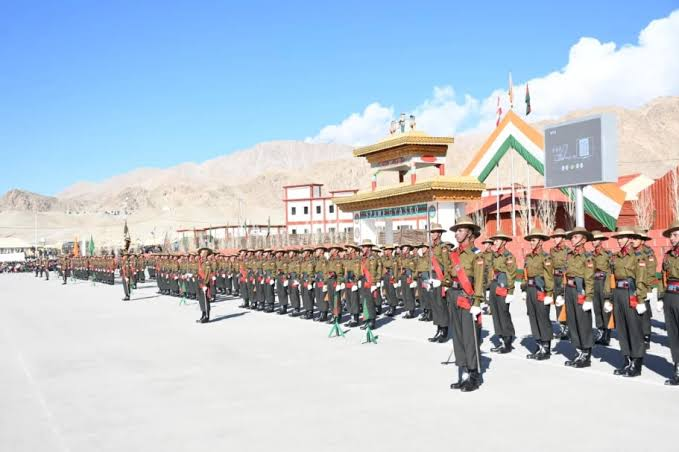
[Ladakhi agniveers in Leh — passing out ]
When the Agniveer programme was initiated in June 2022, I had warned that the dearth of jobs and the politics of pensionable sarkari naukri, would lead to the Modi regime being pressured into turning the short-termers into pensionable servicemen. This is happening.
In my post of June 16, 2022 (Agnipath: Seminal Reset Now, But More Problems Later — https://bharatkarnad.com/2022/06/16/agnipath-seminal-reset-now-but-more-problems-later/ ) I had stated that as the 4-year term of the first batch of Agniveers nears the end, “Discontent will spread fast among [them] once they realise their job prospects are as bleak as ever. The frustrated among them, now trained to use small arms and chemical explosives, may choose to use these newly acquired skills for criminal, even insurrectionary, purposes and emerge as a major law and order-qua-internal security problem for the country. Or, and this is more likely, political pressure will begin brewing – grassroots up, almost from the programme initiation stage, especially in the population-dense, voter-rich, Uttar Pradesh and Bihar, where the Agnipath intake can expect to be the largest – to convert the four-year contracted tenure of the Agniveers to 15-year military service with pension.
This is the usual end-state of all supposedly ‘temporary’ government workers ranging from clerks, school teachers, safai karamcharis to anganwadi helpers.” I had then wondered if “there [is] a politician alive who will be able to resist such pressure,….? And, lo and behold, the army will become more bloated, and the defence pensions budget more distended.” There isn’t, and they will be.
This aim is sought to be achieved by the introduction of a wrinkle — a new pathway to permanent service. The 25% of a cohort was to be retained in service on merit considerations anyway, and will be. The rest now have the option of getting back in via the normal rcruitment channels. Per General NS Raja Subramani, Chief of Defence Staff, only 30% of Agniveers have seen service in operational areas and because tested in difficult situations will, presumably, have the edge in making it to the select 25%. That leaves 75% being let go because, well, they are not upto scratch.
How, in the event, does it make sense to return the latter group of men back into the services by the back door, so to say, without qualitatively harming the military? These developments also suggest that the Modi government has given up on economising on the pensions bill as most Agniveers, one way or another, will make it to the permanent rolls.
What is also disturbing is the permission being considered for the Agniveers in service to marry. It is impolitic to dictate social imperatives. But if the goal is to obtain a force of short-termers, why blunt its prospective edge by allowing these recruits to also enter married life, when the original precondition was to have them young, unmarried, and to have greater operational sharpness?
The British Indian Army — the predecessor to the Indian army, had many fine traditions and norms. One of these required subaltern officers to ask their commanding officers for permisson to marry, which was invariably denied or held in abeyance until the officer had reached senior Captain/Major rank or so. This ensured that young officers did not flinch when leading their men into action by thinking about wives and children they were leaving behind. It is an institution worth bringing back to stall the trend of families planning marriages for their sons/daughters the moment they are commissioned, and assured lifetime job security. Or, in this case, once they are picked as Agniveers!
If the Agniveer channel is now the sole means of recruitment into frontline regiments, the positive aspect is that it has been opened to the peoples residing in the border areas to afford them a stake in the country’s security — a very good thing to happen too, resulting in the natives of Ladakh, hopefully, exclusively recruited to fill the the Ladakh Scouts Regiment. The recruitment actually needs to be further localised for operational efficiencies. Thus, the Nubra Guards (first formed by local volunteers in the 1947-48 Kashmir ops that became the nucleus of the Ladakh Scouts) could be revived, as a unit attached to the Ladakh Scouts but with a slightly different military/sub-regimental identity. It will do wonders in stoking patriotic sentiments of the people in the strategic Nubra and Shyok Valleys on the LAC, and in other such sets of valleys with similar socio-cultural traits. This could be the start for more such Scouts units manned by young men from the high mountains used to operating in the thin air at high altitudes.
The danger, of course, is that as time passes these specialised border units will be opened up to recruits from other regions and the plains, and what the country may end up with are more of the nearly operationally useless Indo-Tibetan Border Police type of units — originally featuring Tibetans from the exile community and Ladakhis that, thanks to the Home Ministry seeking control of more and more armed formations, resulted in having Biharis, Oriyas, et al into the ITBP ranks defeating in a sense the purpose of this particular unit in the first place. The plainsmen, not naturally endowed with the lung power to traverse the mountainous terrain at speed, say, end up making the ITBP just another paramil, good only for performing the relatively innocuous “watch and ward” tasks.
ITBP is a cautionary tale of a paramilitary, set up for a specific and specialised military purpose, having the political ground shifted from underneath its feet, first, by having completely incompetent Indian Police Service officers monopolising the top ranks, imbuing a once fine force with the dheela-dhala police ethos (corruption, included!), and then by having the youth from the plains join it!
———–
What now with the US?
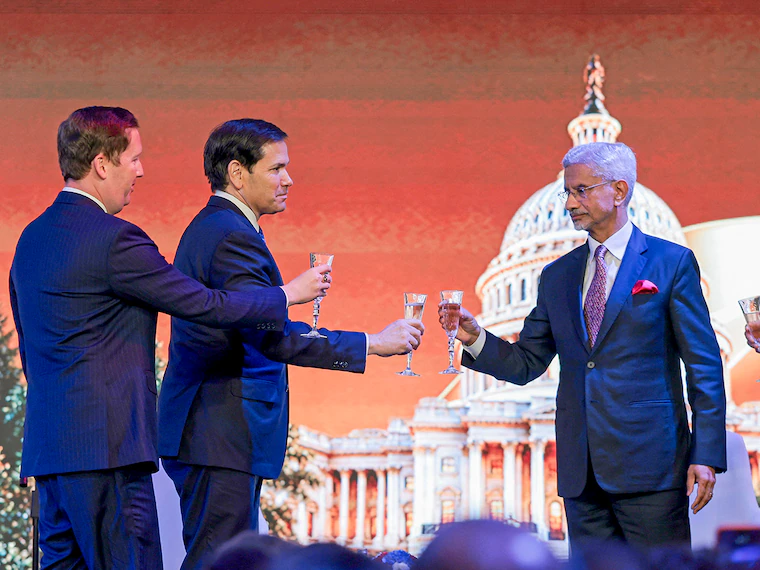
[Drink up! Jaishankar with Secretary Rubio and US ambassador Sergio Gor]
The American people kicked MAGA and Donald Trump to the curb in the midterm elections. It will ease the situation for India say many commentators in the media. The truth is less palatable. The Democrats taking over the US Congress actually means a greater headache for Delhi. Because there will now be more censorious attention being paid to the state of Human Rights, religious freedom, SIR, and what not, in India — the Congressional efforts likely led by Indian-origin Democrat politicians who have got elected in the anti-Trump landslide, and feel the political need to show off their American patriotism by dumping on India, adopting anti-India stances. It is a motive that animates the Pichai’s and the Nadella’s of the Western corporate world as well.
There was always a cost to Prime Minister Narendra Modi’s US policy, that his minister, S Jaishankar, heartly supported, to personalise bilateral relations by keying on those at the Washington apex. The perils of such an approach became clear when President Donald Trump smashed Modi and India in the mouth during and after Op Sindoor because he found in Asim Munir, his favourite Field Marshal, just the compliant diplomatic tool he needed to manipulate the region. Jaishankar’s attempts to establish a personal relationship with Marco Rubio likewise did not work, because in the several meetings they had, he conceded nothing but kept India in line.
Rubio will soon depart the US State Department because he sees his future as US President. He will be concentrating on his campaign in the Republican Party to win nomination as its presidential candidate in the 2028 general elections. Modi burnt his fingers by believing in Trump, except his supposedly great and good buddy (“Howdy, Modi!’ — “Namaste, Trump!”), turned on him and targeted India every which way, including 100% tariffs on its exports.
Neither Modi nor Jaishankar, despite all their bearhugs, fawning, and tippy-toeing moved the needle even a little bit! Rather, Trump and Rubio were more convinced than ever before that however much humiliation was heaped on Delhi, there would be at most a period of hurt silence, little else. This too has come to pass. Witness how, unlike the Canadian Prime Minister Mark Carney, who read the unfolding political events across the border correctly and decided to wait out Trump and the mid-term elections to get a better trade deal with Washington, the Modi dispensation was herded by the US government into drafting an agreement that, in hindsight was unnecessarily hurried, and may not be all that benign the commerce minister Piyush Goyal has hinted, it is. We don’t know the contents of the draft-deal. The fact that Delhi could have secured better terms if only Delhi had bided its time, is not in doubt.
Now Modi and India find themselves in a pincer of US politics. The Democrat majority in the US Congress will home in on India, nitpick its many anomalies and weaknesses in its democratic functioning. And there is Stephen Miller now installed as the White House Chief of Staff, who wears his dislikes on his sleeve and drips contempt for countries like India. That means Delhi will hereafter get no hearing in the White House (unless Trump’s sons are promised more “Trump Towers” to make money off). And there certainly will be no American give on the H1B visa and other issues of interest, especially because, as suggested in previous posts, Modi is not inclined to use the military/strategic leverages the country has of twisting the 4 “foundational accords” such that it compels Washington to at least shuffle its feet, if not squeal. And, India will soon become part of a large vat of states Trump/Miller can stir up trouble in/with, without costing America anything.
Talk of the main figures in Modi’s personalised foreign policy exiting the scene, one by one. The great Japanese Prime Minister Shinzo Abe was assassinated in July 2022. Trump has overnight become an after thought intent on creating as much chaos as is possible so long as his personal and family wealth and that of his cronies in his cabinet and outside, grows! Modi’s other close buddy, Benyamin Netanyahu is out and in his place is the former Israeli Defence Force Chief, General Gadi Eisenkot, who is trying to stitch together a ruling coalition of his liberal-Zionist Yashar Party with Arab-dominated parties in Israel. Whether there’ll be the same level of understanding and intimacy with Tel Aviv under a new dispensation, is hard to say. But there’s no doubting the slew of shared strategic interests — including distancing from the US, that can only strengthen Indo-Israeli relations, put them on a higher plane. But Delhi has to push for this objective; it won’t be handed on a platter.
It is time the Modi government gave up its policy of relentless cosying up to the US, Chinese, and European governments, and pallying up with the likes of Elon Musk and his Starlink, at the same time as it distances itself, albeit gingerly, from Russia, in the futile hope it will gain traction for India in the West, which it won’t. It has to begin looking out for itself, and doing hard, strategically disruptive, things to narrowly promote the national interests in the face of forceful pushback by these very same powers, who seek primarily to keep India down.
And Modi has to prepare the country for the harsher times ahead by, for instance, proliferating strategic weaponry to states on China’s periphery — yes as PAYBACK, and retooling his atmnirbharta policy to achieve genuine self-sufficiency rather than expecting that license production will get the country to where it wants to go which, again, it won’t.


