
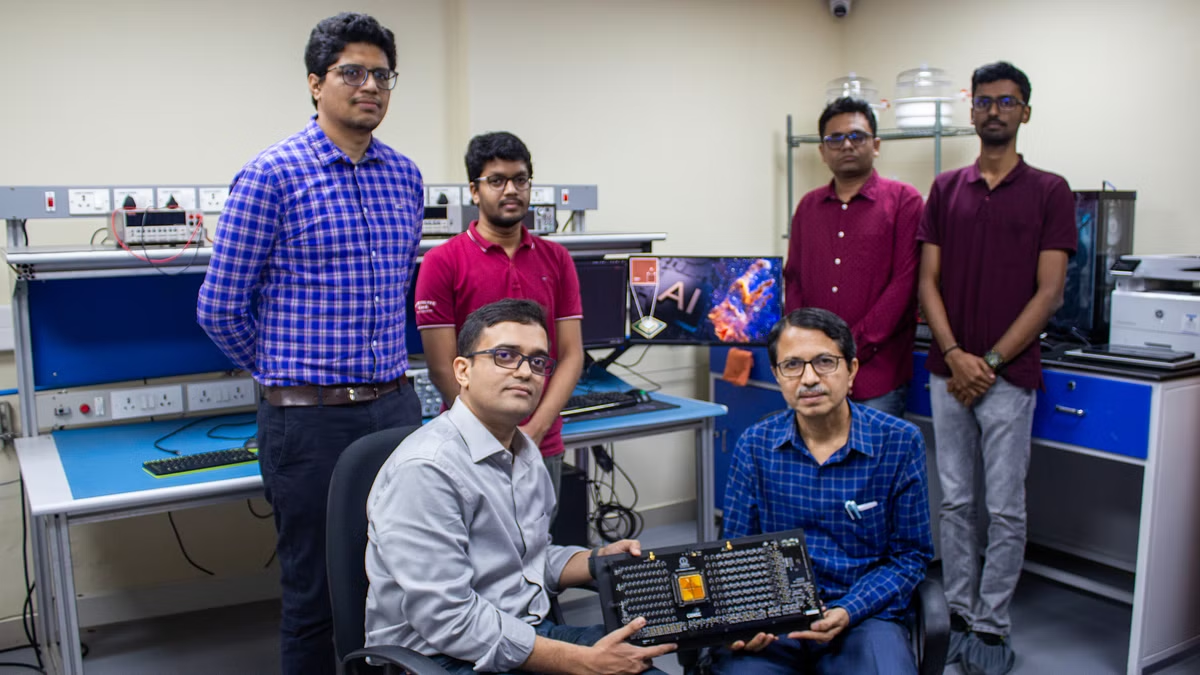
[The IISC team: seated in front: Sreetosh Goswami (left) and Navakanta Bhat (right). Standing behind (from left to right): Deepak Sharma, Bidyabhusan Kundu, Santi Prasad Rath, and Harivignesh S ]
The Security Wise Blog is doing something unprecedented — reproducing below an article published elsewhere. It is an account of a technological breakthrough in the field of ‘molecular kinetics’ announced September 11 and written up in accessible language by the Indian Institute of Science (IISc) for TechXplore and is available at https://techxplore.com/news/2024-09-neuromorphic-platform-significant-efficiency.html. It is featured here to give this phenomenal indigenous tech innovation the widest possible exposure.
The ‘integrated neuromorphic chip’ or ‘brain on chip’ that is expected to accrue from the R&D by the project team headed by Professor Sreetosh Goswami, combined with normal desktop computers will actually amount to an immensely more economical alternative to the still nascent Quantum Computing technology!!
The development of this tech innovation was revealed in a technical paper published in the reputed international British journal, Nature. The reference is: Sreetosh Goswami, Linear symmetric self-selecting 14-bit kinetic molecular memristors, Nature (2024). DOI: 10.1038/s41586-024-07902-2. www.nature.com/articles/s41586-024-07902-2
This Centre for Nano Science & Engineering at IISC, Bengaluru, is funded by the Indian taxpayer through MEITy (Ministry of Electronics and Information Technology). What the Modi government needs to ensure is that Goswami and his team — Deepak Sharma, responsible for “the circuit and system design and electrical characterisation, Santi Prasad Rath handling synthesis and fabrication, Bidyabhusan Kundu tackling the mathematical modelling, and Harivignesh S crafting bio-inspired neuronal response behaviour” are incentivised in every possible way to remain and conduct more research in India.
Because the neuromorphical chip has myriad uses, including military, the Indian armed services will be well advised to do something unusual for them — touch base with this IISc team to see how they can fund practical military applications for this chip. Because the molecular film concept was developed in collaboration with Stanley Williams of Texas A&M University and Damien Thompson of University of Limerick, Ireland, there is every likelihood the team members will now be tempted by universities and chip companies in the US and Europe to work for them. The reason why GOI needs to do whatever is necessary to keep these young IISc scientists and engineers in India is, therefore, obvious.
Indeed, for further development of the chip, it may be best to get Indian private sector Companies to join up with IISc, rather than channel the project into the “brain dead” public sector realm (DRDO, etc.)
————
The TechXplore article:
Neuromorphic platform presents significant leap forward in computing efficiency
by Indian Institute of Science

Researchers at the Indian Institute of Science (IISc) have developed a brain-inspired analog computing platform capable of storing and processing data in an astonishing 16,500 conductance states within a molecular film. Published today in the journal Nature, this breakthrough represents a huge step forward over traditional digital computers in which data storage and processing are limited to just two states.
Such a platform could potentially bring complex AI tasks, like training Large Language Models (LLMs), to personal devices like laptops and smartphones, thus taking us closer to democratizing the development of AI tools. These developments are currently restricted to resource-heavy data centers, due to a lack of energy-efficient hardware. With silicon electronics nearing saturation, designing brain-inspired accelerators that can work alongside silicon chips to deliver faster, more efficient AI is also becoming crucial.
“Neuromorphic computing has had its fair share of unsolved challenges for over a decade,” explains Sreetosh Goswami, Assistant Professor at the Centre for Nano Science and Engineering (CeNSE), IISc, who led the research team. “With this discovery, we have almost nailed the perfect system—a rare feat.”
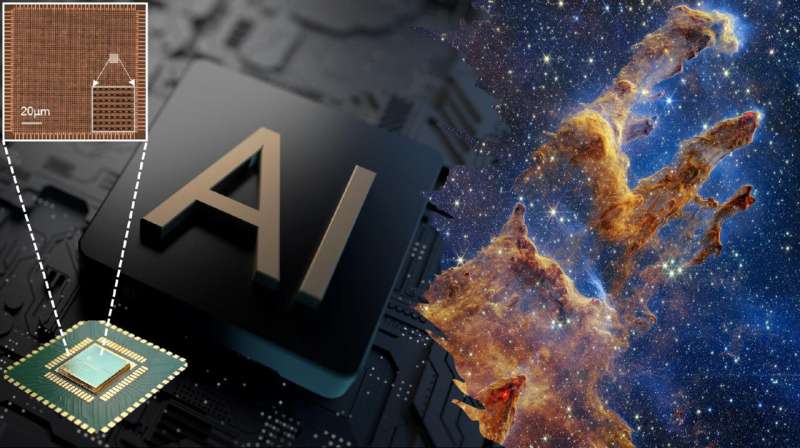
The fundamental operation underlying most AI algorithms is quite basic—matrix multiplication, a concept taught in high school math. But in digital computers, these calculations hog a lot of energy. The platform developed by the IISc team drastically cuts down both the time and energy involved, making these calculations a lot faster and easier.
The molecular system at the heart of the platform was designed by Goswami, Visiting Professor at CeNSE. As molecules and ions wiggle and move within a material film, they create countless unique memory states, many of which have been inaccessible so far. Most digital devices are only able to access two states (high and low conductance), without being able to tap into the infinite number of intermediate states possible.
By using precisely timed voltage pulses, the IISc team found a way to effectively trace a much larger number of molecular movements, and map each of these to a distinct electrical signal, forming an extensive “molecular diary” of different states.
“This project brought together the precision of electrical engineering with the creativity of chemistry, letting us control molecular kinetics very precisely inside an electronic circuit powered by nanosecond voltage pulses,” explains Goswami.
Tapping into these tiny molecular changes allowed the team to create a highly precise and efficient neuromorphic accelerator, which can store and process data within the same location, similar to the human brain. Such accelerators can be seamlessly integrated with silicon circuits to boost their performance and energy efficiency.
A key challenge that the team faced was characterizing the various conductance states, which proved impossible using existing equipment. The team designed a custom circuit board that could measure voltages as tiny as a millionth of a volt, to pinpoint these individual states with unprecedented accuracy.
The team also turned this scientific discovery into a technological feat. They were able to recreate NASA’s iconic “Pillars of Creation” image from the James Webb Space Telescope data—originally created by a supercomputer—using just a tabletop computer. They were also able to do this at a fraction of the time and energy that traditional computers would need.
The team includes several students and research fellows at IISc. Deepak Sharma performed the circuit and system design and electrical characterization, Santi Prasad Rath handled synthesis and fabrication, Bidyabhusan Kundu tackled the mathematical modeling, and Harivignesh S crafted bio-inspired neuronal response behavior. The team also collaborated with Stanley Williams, Professor at Texas A&M University and Damien Thompson, Professor at the University of Limerick.
The researchers believe that this breakthrough could be one of India’s biggest leaps in AI hardware, putting the country on the map of global technology innovation. Navakanta Bhat, Professor at CeNSE and an expert in silicon electronics led the circuit and system design in this project.
“What stands out is how we have transformed complex physics and chemistry understanding into groundbreaking technology for AI hardware,” he explains. “In the context of the India Semiconductor Mission, this development could be a game-changer, revolutionizing industrial, consumer and strategic applications. The national importance of such research cannot be overstated.”
With support from the Ministry of Electronics and Information Technology, the IISc team is now focused on developing a fully indigenous integrated neuromorphic chip.
“This is a completely home-grown effort, from materials to circuits and systems,” emphasizes Goswami. “We are well on our way to translating this technology into a system-on-a-chip.”


 Security Wise
Thanks for providing critical context. I shall forward to DNSA. We should write to PMO also?
SITARA@ — For you to judge. DNSA is under NSA and NSA is in PMO, so….
Sir, what a brilliant insight and incredible source of information you have! You have a remarkable knack for finding the needle in the haystack…… You are truly a gem, sir—much respect and love to you from the heart.
I also recall you mentioning a similar groundbreaking breakthrough by Sankhya Labs a while back in your blog here in 2021:
https://bharatkarnad.com/2021/05/18/murky-carryings-on-of-babus-in-dot-and-its-wireless-planning-and-coordination-wing-aimed-at-torpedoeing-indigenous-5g-technology-and-modis-telecom-atmnirbharta-programme/
Back then, I tweeted to Smita Purushottam Ma’am from SITARA to forward your 2021 article to the PMO. Unfortunately, I’m not sure what came of it, but I strongly believe that the work you and Smita Ma’am are doing is invaluable. You’re providing an immense service to the nation by bringing such critical information to the public and provoking our scientific community to believe—yes, we can do this…we are not behind any developed country…and we can create
I also recall your emphasis on 5G and the Tejas network (if I remember correctly). It was goog to see Tata eventually acquire Sankhya Labs, ensuring that it’s in good indian hands, at least if not in Govt
Given the lack of government interest and red tape and babu giri in some of these crucial indigenous innovations, can’t we approach ethical companies like Tata or L&T to take on such projects? After all, we’ve seen their commitment to national growth. Unfortunately, I wouldn’t place the same trust in RIL or Adani for projects of this caliber.
Once again, sir, thank you for your incredible work in bringing this to light. It’s creating waves in our scientific community and beyond.
Kumar@ — a small error: Tata acquired Tejas Networks. Saankhya Labs is doing well, onits own.
As someone who is currently pursuing engineering from a premier engineering college of india such developments do inspire me too take up research field as a career in future.
What message do you have professor for the youth of this nation when you see such advancements.
Well, do get involved. We need more engineers with problem-solving mindset in strategic thinking for the country. But, be warned, it is a rocky road!
wait rocky road in what sense are you talking about the low level reserach laboratories, equipment, quality of research or the indian government and sarkari babus are themselves a big hindrance in the path of scientists.
pls elaborate
As an engineer, you may be better off with pvt sector defence Cos.
Professor,
Like you say, it is the private sector that has to commercialise this, not the public sector. But the eco system for the private sector to invest is just not there in India. There are some sparks like Ola Electric that are just coming up. But the Indian private sector has a long way to go. If this is a good idea, it may have a better chance to flourish outside India. That would likely be the sad reality! Let’s see how this goes.
When I read this article and the sentiments in some of the comments, there is a great deal of nationalistic fervour, pride and the underlying frustration! But what will make an idea like this take off is its commercial success, not nationalistic fervour. And unfortunately in India, that’s pretty hard to come by! But change is happening. Let’s see how long it takes!
Another factor to consider – in a developed economy like the U.S., I am increasingly of the view that there is many times the support of the deep state in the rapid rise of certain companies (the rapid rise of Palantir seems dazzling for example – it seems to have the backing of the CIA). RNA technology got the support of the U.S. government and we got nice boosts for Pfizer and Moderna. There is a billionaire class that promotes certain companies. Will India have such backing for its companies and ideas? We have to wait and see.
@BharatKarnad professor recently pakistan has been creating a lot of noise that in few years they would acquire 5th generation j31 jets from China is this possible for a tiny little poor nation like pakistan.And is our MOD sleeping.
do you see the possibility of a 5th generation plane in Indian Air force arsenal by the end of this decade amca,f35,su57 or super rafales?
Professor asking out of curiosity as i just read about the israeli yom kippur war and operation wrath of god you met the famous major general aharon yariv one of the most daring officer of idf. Were u a student or a journalist and where in israel did you met him?
Was covering the Lebanon War for the Hindustan Times
sir i have read why india is not a great power yet(2015) currently reading india nuclear policy(2008) planning to read the 2005 and 2018 book too
here i find another old book from you future imperilled i am curious to know that what have you explained and wrote in the 1994 book?You are the author so the best person to ask
it details a geopolitical rimland-dominant security architecture organic to Asia opposing the heartland power — China. Incidentally, it is the scheme being followed by the Indian govt from Vajpayee’s days. It has Israel and Japan anchoring the two ends, India as the power fulcrum, and littoral-offshore southeast Asia as the bulk provider.
looks interesting is it available and still in the market?
Nope, out of print. But a used copy is available on amazon.in at https://www.amazon.in/Future-Imperilled-Indias-Security-Beyond/dp/0670855154/ for Rs 900/-
good evening sir…can u please provide the book ..nuclear weapons and indian security a a low cost edition…because it is showing 9000 rupees in amazon sir
agree even i have the book on my reading list
sir it’s a request
Please see past correpsondence. Hopefully, a new and augmented edition of the book will be published by 2026.
.@BharatKarnad, Professor, Recently I found out that your book Strategic Sellout Indian US nuclear deal is available on Google books:-
https://books.google.co.in/books/about/Strategic_Sellout.html?id=4U2r77PtR-IC&printsec=frontcover&source=gb_mobile_entity&hl=en&newbks=1&newbks_redir=0&gboemv=1&gl=IN&redir_esc=y#v=onepage&q&f=false
But, this is only 120 pages preview, neither available full in Google books for soft copy format.
can you do something about this problem? Because, publisher may be having full soft copy to sell if you gives him permission (as a Co author) to pentagon press to display as soft copy on their website for general public to purchase. (If possible)
if the preview is available then publisher might have published in soft copy format long back ago.
Or, If I could get a hand on used version of this particular book?
for needful please.
I’ll post your request to the owner of Pentagon Press, the publisher.
Thank you very much Dr. Karnad.
professor in why india is not a great power yet you talk about a SSBN base in rambili Andhra pradesh for india SSBN fleet
if I am a chinese war planner i would launch a decapitation strike against this base hampering india second strike capability as Russians threaten to launch against french and British SSBN
Doesn’t this scenario give nightmares to the folks sitting in MOD/GOI
Well, no, because the Rambilli naval base has underwater waterways cut into the cliffs to come into port w/o surfacing
that’s good because when alarm is raised that a strike on the base is for sure all the SSBN have to immediately depart with their sea weapons to launch location in the ocean
am i right?
Thanks professor for the suggestion. I have just placed the order for used copy of ‘Future Imperilled’. I was long searching for this book. Just finished reading ‘Maritime Strategy and Continental Wars’ by Rear Admiral K.Raja Menon. Am now starting ‘India’s Nuclear Policy’. I was able to bag last copy of ‘Strategic Sellout’ too from the publisher as it too has gone out of print.
these technocrats/ scientists need to be physically protected. We do not want another Taiwan act on Semi conductor complex , Chandigarh.
sir what was the role of apj abdul kalam in indian nuclear program did he designed the warheads or physics package or his expertise was in delivery system like agni missiles?
i am a bit confused about his contribution to the indian nuclear weapons programme.
He had no role whatsoever with regard to nuclear weapons. But he headed the Integrated Guided Missile Porigramme that produced the first delivery systems — Prithvi and later the Agni’s.
as someone who is currently reading india Nuclear policy the 2008 book should I also buy the 2005 book nuclear weapons and Indian security will it add to my knowledge or both are almost same
suggestion please professor
Nuclear Weapons and Indian Security is immensely more detailed and has far more ‘long view’ aspects to it, and is far more historically comprehensive than India’s Nuclear Policy
Professor,
Given the current geopolitical environment, it looks like the U.S. will try and contain both China and India. The Chinese economy is not doing well, people have figured out its GDP is much lower than published, and it is expected to stagnate like Japan or worse. In this situation, it is natural that the U.S. needs India less and will feel the need to contain it and not make the same mistake it made with China in aiding its rise.
So, we have delays in engine procurement for aircrafts, and tanks and helicopters. There is also talk of a bait and switch by Germany on submarines for P75i. India is proceeding trying to partner with western countries, but the west is under the U.S. thumb, which is now trying to contain India. It is likely that countries like Germany, France and Britain will deceive India under U.S. direction.
On the other hand, India does not have robust propulsion technology in pretty much all areas – air, land and sea. And Indian private companies spend a pittance on R&D even today. So the outcome seems pretty obvious. India will be a constrained power. For a decade or two at least. Unless China becomes a bigger threat to the U.S. And the collective west requires India more for its economic growth.
So what should India do? Be insidious on the China-U.S. front so that the U.S. needs India more, grow the Indian economy for leverage to negotiate with the West, and weaken the U.S. in a manner similar to its own insidious games in Bangladesh, Pakistan, Myanmar etc.
In the emerging great power contest, between the U.S., China, India and Russia, there will be no love lost between the U.S., India and China. Russia will be the swing state between India and China. India will be the swing state between the U.S. and China.
But one thing is clear – if India is to rise to great power status, it has to spend more on propulsion technology and make things happen on its own rather than depend on other countries.
what a keen and apt insight ! I really liked it.
🙏🏼. I just hope France is a nation which has an interest to partner with India as it has had its share of issues with the U.S.
” … processing are limited to just two states …” –
Gee, in the Soviet era (1960s vintage) the Russians had tried and experimented with 3 states (i. e, instead of of (0,1) coding to use (0,1,2) arithmetic for sampled system. I do not have much technical information on that, but wisely the West did not follow up. and to my understanding since that led nowhere and complicates computation.
Anyway, this TechXplore article is gobbledygook in my utterly limited exposure to science and technology – it is simply half-baked and an attempt for getting funding from external sources for their research. It will be assessed in due course by IEEE experts for sure to deserve its merit in science and technology. Until then (which could be some years) I would say, GOI should hold their breathe to go for it.
One thing is for sure, you do not go for “many states” coding for sampled data as any first year student in electronics will know that every step in digitization leads to error, and you will be working with “corrupted” sampling input in your system. In any case matrix operation is unstable with higher dimension of matrix. Amazingly, this article is devoid of digitization error when it plots Fast Fourier Transform vs hardware output of the signal observed.
I hope. I am wrong in writing my views here and I beg your pardon!.
wow IISC ,I’m preparing for GATE 2025 exam to get admission in IISC VLSI branch. Got motivation to study hard again.
Thanku, Mr. Karnad
@BharatKarnad as currently the geopolitics have changed in indian neighbourhood do you see pakistan and china giving nuclear weapons to bangladesh and shoudn’t we plan for a premptive attack if such a thing happens?
unlikely
Our hands are full Rohan. As Dr Karnad has put it last week, we are busy with the two front and the Indo-pacific (as dictated by our three theatre commands). Lets face it, we do not have enough resources to spare for Bangladesh given our commitments to above mentioned theatres.
i am not talking about invading or making a separate command i was saying if limits are crossed by bangladesh we should be prepared to strike their nuclear facility if they ever plan to make nuclear weapons in future.
because already our strategic forces command is busy against pak,china nuclear warheads are divided we cannot tolerate a 3rd nuclear enemy
We are not Israel dear Rohan. Please don’t judge geopolitics based upon what some YouTubers have to say about our Moreover I believe Any pre-emptive attack on Bangladesh will ensure the Bengali Muslims become our permanent enemies. They will then host Pakistani or Chinese based and will certainly aid North East terrorists. This will be a security nightmare for India then.
@BharatKarnad sir i am curious to know what is the cost exchange ratio between China and india Nuclear war.Out of 500 weapons how many warheads has china separated for india based on your research
@ BharatKarnad professor i hope your are doing fine because you were not responding to the previous comments maybe you are a little bit busy.
Professor can you please provide the link of “sialkot grab” article that you wrote in army college journal i want to read that but not able to find it anywhere on the internet
Rohan@– ‘Sialkot grab’ scenario was developed in my book Nuclear Weapons & Indian Security to wage conventional war without tripping the nuclear wire. Army war college asked me to excerpt it for their Journal, a step reportedly to formalizing this as war option in better use of armoured forces.
cenario
ohk so that’s in the book
professor how can i contact you through email
what is your ID
Dear Dr Karnad , If I am a Pakistani general what I would like to do is instead of Kashmir, I would have loved to pick up a large chunk of Gujarat and the Gujarati coastal ports as these are the real life blood of the Indian economy. Also Gujarat is relatively unguarded militarily and don’t have proper defences.
OK. ut Pakistan will never ever have more than barely enough to defend itself!
@BharatKarnad Professor is their any significant difference between nuclear weapons and indian security(2002 edition) and (2005 edition)?Which one would you prefer to me please help me in picking up one of the above
The 2005 edition updates to cover the first year and half of the Manmohan Singh era.
@BharatKarnad Excuse me professor i found out that a fake amazon page was selling staggering forward like the author name was different on amazon page but book cover had your name “BHARAT KARNAD” i checked the ISBN number it was correct but the page numbers in the description was incorrect it was only 96 pages whereas stagerring forward is some 506 pages
Please confirm whether this is authentic or a scam how to verify that the book is yours only and not someone’s else
obviously the 96 pager is fake.
@BharatKarnad
Good evening professor I hope you are doing fine
professor as recently in the media china has tested and icbm maybe the dongfeng 31 capable of carrying 1 megaton warhead and they have done it after historic 40 years last time they did dongfeng 5
Do you see this as a opportunity for us to go ahead and finally test Agni6(10000km hopefully)and K5 missiles for our ins aridhaman
is even Agni 6 ready or developmental stage
Would love to know your opinion
As I have been advocating for some 25 years now, India’s missile priorities from the start should have been ICBM capability1st, IRBM 2nd, down the
our resourcesline. instead, we reversed the order and wasted our resources.
excuse me professor can you please explain how does that even matter whether we develop a short range (SRBM)missile first or intercontinental(ICBM)
china too had developed 1500km range missiles first in 1960s then they went ahead with icbm
does reversing the order has some disadvantages
what is your logic here
If I have to explain the obvious, then I have failed
@sir ..
do u have any info about this-
https://www.scmp.com/news/china/military/article/3280348/china-sends-deterrent-message-missile-intercept-test-near-indian-border
sir how can i connect you ..??
I am currently working full-time in the IT field, specializing in AI and data field . However, I have a deep and growing interest in foreign policy and international relations, and I have been following your work closely. I greatly admire your insights and expertise in this area and would love the opportunity to learn from you.
Although I am not formally trained in IR or foreign policy, I gained considerable exposure to these topics during my civil service preparation, where I chose Political Science and International Relations (PSIR) as one of my optional subjects. This background has provided me with a strong foundation in topics like nuclear policy and foreign relations, and I am eager to build on this knowledge under your guidance.
I would like to offer my assistance to you in a pro bono capacity as a research assistant or intern, working on projects related to IR or foreign policy. While I work full-time, I am fully committed to dedicating my time outside of professional hours to contribute meaningfully to your research or any ongoing projects.
@BharatKarnad prof anil kakodkar one of the scientist involved in pokhran 1998 said in a ndtv interview that shakti1 200kt device was deliberately scaled down to 45kt because they didn’t wanted to damage the nearby khetolai village do you buy this arguement or are they trying to hide something.
would love to know your thoughts
This is the nonsense Kakodkar, his ignoble predecessor R Chidambaram, et al have been peddling post- S1 (thermonuclear test) failure on May 11, 1998. The all’s well thesis has been authoritatively disproven by illustrious nuclear stalwarts, such as PK Iyengar, AN Prasad, et all. It is all there in my Nuclear Weapons and Indian Security, 1st and 2nd eds (2002, 2005) in great detail, and Iin my India’s Nuclear Policy (2008), and in Strategic Sellout (2009).
@BharatKarnad
So you are trying to say that the device was never scaled down it was a fully 200kt designed warhead that was intended to be put on missiles
all this scaling down and saving a village story was just another nonsense manufactured by people like chidambaram and kakodkar after the tests
please correct me if i am wrong
The failed 2-stage device had planned yield of 250KT
@BharatKarnad
well sir this is really surprising because even Dr Santhanam(the whistleblower) who was the first person to say that the device was a dud and i believe him said that the device was intended to produce 45kt and it gave some 20-25kt only
like everyone is saying that the device was scaled down if and here you say it was a 250kt device if you could clear this whole mess
Sir any source of this 250kt design theory any article or something?
Already done that.
@BharatKarnad
but where sir is there any book or article which tells about this particular event
if yes then which one ?
want to read about this
You’ll have to troll through statements by scientists, et al.
@Bharat Karnad professor with due respect to the scientists and all the men involved in the nuclear programme. If a weak nation like north korea with not so many intelligent scientist with just a fest tests (6 only)can claim that it can build a credible tested proven 300kt-400kt weapon. WTH is wrong with us then why couldn’t we get the 200kt weapon correct. Are our men and scientist behind north korea in capabilities?
No, but renewed testing is what’s desperately needed and this the Indian govt does not have the guts to order
is their any visionary leader that you know who has the guts to order. Rahul or Yogi adityanath
Don’t know enough about either of them to be sure they have it in ’em!
@Bharat Karnad
professor in America their STRATCOM(Nuclear force command) commanders ask their scientist every year to prove that the American warheads will work like they test 10percent(something like that) of their material and weapons every year regularly so that their W88 will be credible because they are not satisfied.Summary is that they have the freedom to question their scientist and ask.
Now to my main query
Do the officers of strategic forces command(army generals,navy admirals)not have the courage to question the Indian government and say it on their face that we are not satisfied with the 200kt s1 failed device and want a proven device.
are the officers even allowed to question and raise concern?
US Strategic Command is manned by a nuclear specialist cadre of officers. Have been pleading for such a cadre but there’s no such in the Indian military. Most officers in our Strategic Forces Command are in rotational posting and have NO expertise whatsoever. So while SFC CINC can question the efficacy of the N-weapons they are handed, no one to date has. So essentially India is stuck with is an arsenal of questionable provenance and performance — with the supposed thermonuclear weapon an unproven entity.
sir as I am reading your books and getting to know about the reality of our country and this system.It’s just disappointing whether it is nuclear topics defense research or bearaucracy we failed in everything
professor a very basic question
Why do we Indians take everything so much lightly for granted is it in our blood
What is the core problem of Indian people if you could answer in few words
Come up wirh answers yourself Yours may be as right an explanation as any
@BharatKarnad professor i was just watching a IDSA lecture in which you said that r chidambaran laid a deadline that not testing the nuclear device again is valid only for 10 years that is 1998-2008 and here we are 16 years late.
chidambaran also said that we do not need testing anymore isn’t this contradiction was he lying then in 1998 or now
Chidamabaram talked about the 10-yr limit in 1996; changed his tune post-1998 tests.
what is the status of tapas uav is it formally shelved by armed forces? As we are going to import mq 9 reaper . Is tapas going the marut way?
Apparently.
@Bharat Karnaf professor what warhead configuration on missile is more lethal in terms of blast area and pscyological effect on adversary.
hitting a high value target with 5-200kt weapons
or hitting the target with 1megaton(1000kt) weapon
would love to know your opinion
@BharatKarnad
professor do the Iranians have the capability to make N-weapon
or these claims of 80 percent enriched uranium is a lie
Iran is getting to the threshold.
so if a decapitation strike is launched by us,israel in response to this oct1 missile attack what consequence will it have
The fact is Russia is not militarily in a position to play interference and China won’t do it. And Iran by itself cannot cope. So,…
@BharatKarnad
professor on the basis of this October 1 200 ballistic missile attack on israel do you see an Israeli strike on Iran’s nuclear facility in netanz,esfahan imminent or the Israelis will show some restrain and not escalate knowing that they also are vulnerable and iron dome is not 100 percent successful.
What are your view on this topic ?
@BharatKarnad professor when our scientist claim that we can correct the shakti 1 thermonuclear design(200kt) weapon using computer simulations what is wrong with that idea i mean israeli weapons are also boosted devices they have done even lesser tests then us
and isn’t boosted fission weapon more effective then pure fusion weapon
please correct me if i am wrong
First, there is nothing like “pure fusion” in nuclear physics books or anywhere in the scientific literature. Fusion experiments on earth are designed (and successfully experimented) via the conduit of fissions which lead to extremely high temperature (origin of terminology “thermo”) bringing nuclei close enough to fuse – the only exceptions in the universe where fission is by-passed for fusion of nuclei to take place are in the stars where giant gravitational and magnetic forces are present pulling the nuclei close together to fuse for “nuclear fusion”.
“.. they have done even lesser tests then us ..” – where do you get this sort of information? May be so, but others have tested from where the Israelis have their knowledge, so there would be no need to repeat.
“… using computer simulations …” – you need to ask those who claim that to clarify what they precisely mean. I have no clue how “computer simulation” could come into play in the context.
@BharatKarnad
Sir in why india is not a great power yet you advocate again and again the importance of Vietnam.
Now who actually won the sino-vietnamese war because on the internet the answer is quite different some say china some say Vietnam.
Please clarify
Vietnam did, and other than the Chinese and China-sympathisers, no one doubts it.
https://thediplomat.com/tag/vietnam-nuclear-weapons/
@BharatKarnad professor according to this article assuming it is correct they claim that during 1980s the Soviets gave missiles to Vietnam only missiles they were planning to give Nuclear warheads also as to contain china to south China sea only surprisingly Vietnam refused during that time because they did not wanted to anger china by hosting Soviet warheads and wanted normalisation of relations with the chinese and later on Vietnam signed CTBT and other nuclear weapons test ban treaties.
Now I am not expert but this scenario is completely opposite to what you have said in your books like nuclear weapons and Indian security,podcast and interviews like you have said that Vietnam has declared 1000 years of war with the Chinese.If indian government were ever to give warheads to Vietnamese after seeing the current chinese agression would they accept it.
Please clarify these two completely different scenarios
Vietnam’s “1000 year war’ with China sentiment and unwillingness to go nuclear are not mutually exclusive.
@Mr. Karnad, wake up and smell the coffee. Vietnamese establishment is very close to CPC. Umpteen number of Chinese manufacturing units have moved to Vietnam 🇻🇳. Vietnam or for that matter any South Eastern nation will never initiate any war with China so please bury your outdated doctrine. No one is going to buy it.
Of course, no SE Asian nation will “intiate” war aginst China. But how about China initiating war against them?
@ Mr. Karnad- China is in no position to initiate war against anyone. The moment they dare to the whole western block will impose such severe sanctions on it that the already badly damaged Chinese economy will collapse completely so don’t make your audience laugh by suggesting such an impractical move. Till now they couldn’t do a jackshit about Taiwan inspite of blowing so much hot air 😆
@BharatKarnad
professor I was reading your 2008 book India’s nuclear policy
When a country launches a land based weapon(icbm,irbm) usually it is picked up by the adversary radars for example US through its satellite network will get to know that Russians have launched a missile on the US from Russian land.
What about SSBN s because they can be anywhere in the world in any ocean for example if US were to launch a strike on china from Indian Ocean can’t china mis interpret it as a strike by indian SSBN arihant
How do countries distinguish with sea based weapons
Satellites pick up submerged submarine launches when the missiles break water.
That i understood sir but which country launched like if our arihant launches from Pacific chinese satellites pick up the launch and then how will china decide who has launched India or US
Every ship/sub and missile-type has its own signature.