This was a June 2, 2025 discussion on Sindoor and its fallout between the two principal discussants hosted by ‘Ignition’ forum under the aegis of the Shiv Nadar Foundation. It may be of interest because Raghavan reflects the MEA’s viewpoint and perspective to a fault! This Ignition event was held at the Westin Hotel in Gurgaon.
[WARNING: I misspoke on the 1965 War — India had 14 DAYS of ammo and spares, when Pakistan was left with only 4-5 days when the ceasefire was called! Sorry about this, it happens in a live discussion!]
[A properly trim General Asim Munir getting his Field Marshal’s baton from a glum-looking PM, Shebaz Sharif, and an effusively servile, President Asif Ali Zardari — a revealing pic of the investiture ceremony posted by Dr Moeen Pirzada, a Pakistani journalist ]
Some critical bit of information on Op Sindoor has come to hand. The success of the Pakistan Air Force in innovatively using its ex-Chinese JC-10C platform, the PL-15 air-to-air (A2A) longrange missile, and the ex-Swedish Saab 2000 AEWACS (airborne early warning and control system), in bringing down an IAF Rafale outside Bhatinda on May 7, went to Pak army chief General Asim Munir’s head.
Brimming with an excess of confidence, he vaingloriously guaranteed Prime Minister Shehbaz Sharif and senior members of his cabinet that he “would sort out the Indians in 48 hours!” 48 hours!! As promised by Munir, the initiation of his plan for an aerial attack by missiles and drones on important IAF and Indian strategic nodes, was scheduled for 0100 hours May 10.
Unfortunately for Munir, his boastful declaration in Islamabad was picked up by Indian intelligence. And an ambitious counter-plan for a slate of surprise, simultaneous, mass attacks on critical targets was prepared. A combination of Indian fighter aircraft firing Scalp air-to-ground (A2G) missiles and the Brahmos supersonic cruise missiles, and land-based Brahmos went in a little past midnight May 10, and preempted the Pakistani plan. The devastation caused by the Indian attacks spelled the end to Munir’s fanciful strike scheme, resulting in Director General, Military Operations, Pakistan army, Lieutenant General Kashif Abdullah, who had haughtily turned down the Indian DGMO’s offer of ceasefire after Indian missiles had struck Muridke and Bahawalpur on May 7, now called his opposite number Lieutenant General Rajiv Ghai, waving a white flag.
But, how did this happen?
Because the first wave of missiles destroyed the carefully chosen and strategically crucial target — PAF’s central command, control and communications (C3) centre — the nerve centre of the Pakistan Air Force, housed at the Nur Khan air base in Chaklala, outside Rawalpindi, home also to Pakistan’s Strategic Plans Division — the country’s nuclear secretariat. The PAF, it turns out, had no redundant communications setup.
With the entire C3 hub in ruins, the communications links to all the principal PAF air bases hosting combat aircraft, missiles and drones, disappeared as well. These bases were further attrited by the waves of Indian missile and airborne A2G attacks on the bases (Sukkur, Bholari, Jacobabad, et al). The low level air defence SILLACS (Siemens Low Level Air Control System) in Sargodha, it would appear, was separately struck as well.
There was a touch of the usual intra-mural oneupmanship — a feature of all India-Pakistan interactions, in the quiet jubilation at the Indian end, and much satisfaction at Munir and the Pak ‘establishment’ being “sorted out”!
Incidentally, the attack on PAF’s C3 hub at Chaklala collaterally took out a C-130 transporter parked 100 yards away on the tarmac, and the A2G Scalp attack decimated one of the six Saab 2000s parked in the hangar at Bholari. These night time strikes permitted the Pakistanis to clean up the debris at all these stricken airbases before dawn. Two JF-17s may also have been hit.
So, how did the PAF get the Rafale?
The Indian strike sortie comprised the lead Rafale that was to fire its weapon and a buddy Rafale 150 kms to the rear, flying at a higher altitude, and using its radars to scan and surveil the Pakistani airspace to find targets. After finding an appropriate target, the target info was to be transmitted to the lead Rafale for it to engage the enemy. Except, the PAF strike triad, getting inside the IAF sortie’s OODA (Observe, Orient, Decide, and Act) Loop, oriented to target and fired before the Rafale pilot could cue to his target. A second can make a world of a difference. That Pak A2A missile brought down the IAF plane.
What is difficult to understand is why the Spectra electronic warfare system on the Rafale failed so miserably in picking up the PAF’s strike triad before the latter homed in for the Rafale kill? Indeed, the Rafale pilot apparently had no reaction time — his radar spotted the incoming PL-15 when the latter was just 50 kms away and moving in fast. 50 kms afforded the IAF pilot just over TWENTY NINE seconds — just enough time to activate his ejection seat and to land safely.
The Spectra EW system in the Rafale was ballyhooed as extremely advanced tech and was supposedly the standout feature of the French aircraft developed by two French companies — Thales and MBDA. But let Wikipedia describe Spectra: “Thales Spectra EW — Système de Protection et d’Évitement des Conduites de Tir du Rafale (literally: System of Protection and Fire Lines Avoidance of the Rafale) or SPECTRA is a fully internal electronic warfare system jointly developed by Thales Group and MBDA France for the Dassault Rafale. The full SPECTRA integrated electronic warfare suite provides long-range detection, identification and accurate localisation of infrared homing, radio frequency and laser threats. The system incorporates radar warning, laser warning and missile approach warning for threat detection plus a phased arrayradar jammer and a decoy dispenser for threat countering. It also includes a dedicated management unit for data fusion and reaction decision.” The SPECTRA system also consists of two infrared missile warning sensors. Whew!! Impressive, right?
So, what happened??? Well, SPECTRA did NOT work. And the Indian taxpayer paid Rs 64,000 crores for this junk???.
Munir, in the event, got his Field Marshal’s pips in the main because, after the shooting down of the Rafale, Pakistan impressed every one, and with China and the Chinese media leading the cheering section — JC-10s in the PLAAF, for instance, sported six Rafale decals as kills on the sides of their cockpits (!), and won the military narrative and the regional and international media’s attention. Still, it was for a glaring defeat that Munir becomes Field Marshal?
This is a big IF, but shouldn’t the Indian military have asked Modi to ward off Trump’s pressure for “peace”, and immediately pivoted to a ground offensive to take Haji Pir, and exploited the air superiority achieved by Indian missile strikes by early light, May 10? With Haji Pir in the bag, there would have been no Pakistani pretence of victory, and Munir would have gotten the boot. It would, moreover, have forcefully and permanently rearranged the Pakistan army and government’s thinking about Kashmir, as I had argued when advocating the capture of Haji Pir in my April 30 post. We had large enough forces, including armoured elements, in Uri, Mandi and Poonch to affect such a move.
Did any service chief, any senior military man, alert the Prime Minister the morning of the strikes that such an opportunity had suddenly opened up, and that annexing Haji Pir in POK was at once possible and legally permissible? And, that India need never go back to restoring the status quo ante? I believe not.
This opportunity, alas, may never come again because China will be sure to help plug all the “gaps” revealed by Sindoor in Pakistan’s military capabilities and armed posture
The trouble is the Indian military has never been very nimble and, like the Indian state, can’t seem to walk and chew gum at the same time.
It is as if the Indian government and its media/commentariat echo chamber, have only now — post-Operation Sindoor and, apparently, for the very first time, discovered that it is a cruel, unforgiving, harshly transactionalist world out there! Not a single friendly leader that Modi hugged and cultivated and, to please whom he bought billions of dollars worth of exorbitantly priced armaments from for the Indian armed forces and rescued their defence industries from insolvency at the expense of the indigenously designed and developed weapons systems and a funds-starved Indian defence industry, returned the favour by standing four-square behind him and India.
Or, offered to join in campaigning internationally to put Pakistan in the dock! The fact is MEA will be hard pressed to collect a political consensus to push Pakistan once again into the ‘Grey List’ of the Financial Action Task Force tracking the funding channels benefitting terrorist gangs. Just for context, at, no time, was Pakistan ever in danger of making the ‘Black List’ — not even at the height of the US-led “Global War on Terror” in the wake of 9/11. Because, that would have permanently damaged Pakistan economically, which the US and Western camp will, under no circumstances, permit.
In the event, other than lending a polite ear, it is unlikely the seven Parliamentary teams sallying forth to the various capitals of the world will be able to convince any country of note — but of what?? That Pakistan harbours/nurses Islamist terrorists? No one doubts that. That India was in the right to strike at Pakistan in retaliation? Who contests that? So, what’s this public relations exercise about, other than affording the selected MPs some time in more salubrious climes?
But let us define the setting.
From the moment the Indian missile attack went in and the Muridke and Bahawalpur targets were hit on May 7, and the latest round of India-Pakistan hostilities was on, the main thing that happened was that Pakistan’s nuclear bluff was called. It proved what I have maintained for over three decades in my books and writings — that Pakistan is in no position to trip a nuclear exchange, and that there was a vast nuclear overhang for India to exploit conventionally. But the Indian government and military — listening to the nonsense of nuclear flashpoint and what not emanating from the US and the West, have stayed their hand and encouraged the Pakistan army to believe it is more powerful than it really is, and that it could freely indulge in costless needling of India.
Still, all any body heard from abroad once Indian missiles hit home, were calls for restraint by New Delhi, but there was zero international political support for the job India had undertaken to suppress Islamist terrorism originating in Pakistan. And this mind you, when New Delhi believed it had a cut and dry case — Pakistan-sponsored terrorists killed Indian tourists in Pahalgam after ascertaining their religious identity, and India retaliated with a view to imposing penalties on the Pakistan army for running the terrorist show.
Restraining India seemed to be the objective of almost all Western countries that Modi had hoped would hurrah him along on his mission to snuff out Islamist terrorism. Foreign minister S Jaishankar’s preparing the diplomatic ground in the interim period between Pahalgam and Sindoor for the Indian military reaction, met with no success, only borderline moralising! It goaded a plainly upset Jaishankar, who saw his diplomatic handiwork of several years of a policy of clever-talking unravel in Europe, to reject such official standoffishness on the Pahalgam issue. India wants “partners, not preachers” he harrumphed, missing out on the delicious irony that not too long ago, it was Modi sagely advising Presidents Vlodomyr Zelensky and Vladimir Putin, about this not being “an era for war” — a message fecklessly conveyed also to Israel with Gaza on its hands.
Far from securing any backing from Kyiv and Moscow for Modi and India, now it was New Delhi’s turn to get the mealy-mouthed treatment from everyone in sight! Should we be surprised? Such are the perils of being sanctimonious about war. Not appreciating that war is only another instrument of statecraft and that India, in fact, has used it in the past to advance its interests, can result, as in this instance, in its coming back to bite us in our collective arse! Every country that has had to put up with India’s “moral high ground” pronouncements, is enjoying this moment of India’s discomfiture. If this is not schadenfreude, I don’t know what is.
It raises the bigger question: Why did the Indian government act as if it was entitled to international support, to universal accolades, for attacking terrorist strongholds inside Pakistan? After all, everyone is aware that India always shies away from delivering a decisive blow as it did in Sindoor, that it does not really have what it takes to subdue even a minor foe, what to talk of terrorism. And that India and Modi are more talk than action. This being the case, is India worthy of respect from anybody? Manmohan Singh was far worse — he sat mumbling, and did nothing after 26/11 in 2008.
The lamentations in print and on television — boo hoo! — by the lot of high-strung TV hosts and media commentators about India’s abandonment by the big powers, and the world not really giving a damn about what India was doing or not doing vis a vis Pakistan as long as New Delhi did not escalate matters, mask an unpalatable truth. The international community has about had it with the periodic eruptions in the subcontinent, featuring the same tired cycle of terrorism, blood-curdling rhetoric followed by military actions and reactions with negligible effect that the jingoistic press and media on either side, hyperbolise with unbelievable claims and counter-claims, followed by an abrupt end to hostilities, and a return to the status quo ante, with the original problem remaining largely unaddressed!
How is any of this serious stuff? Because even as a pantomime a 3-day “war” amounts to silliness.
Having taken the offensive, India should have done something hefty as a follow-up to hitting Muridke and Bahawalpur. Like permanently wrenching the Haji Pir Salient and/or Skardu from Pakistan’s grasp, and promising more such territory-grabbing ventures in the future as response to terrorist incidents, until little is left of PoK with Pakistan. Because India did not opt for an intense land war and failed to cut off big slices of Pakistani territory, the Pakistan army gloried in India’s incapacity to do any such thing or even to impose huge costs. It has, in fact, incentivised General Asim Munir to persist with his policy of deploying terrorists in Kashmir — the next terrorist incident is not far round the corner, daring India to do its worst — which GHQ, Rawalpindi, believes it will be able easily to handle as it has done so many times in the past. On the other hand, India’s campaign of taking out the terrorist leaders residing in Pakistan one or two at a time, is obviously not a deterrent enough.
But given its institutional tendency to do everything by half-measures, the Indian government finds itself once again between and betwixt — and in something of a military and political jam. Why?
Firstly, because Trump — with whom, according to foreign minister Jaishankar, Modi has a “personal relationship”, turned rogue and the tables on India. Unbidden, he intervened as a “peace maker”, and decreed an end to the India-Pakistan clash. Such tactics ran into a wall on the Russia-Ukraine Front. With India, predictably, Trump had instant success. Modi buckled under immediately and, just like that, New Delhi accepted a 3rd party — US — role in the affairs of India. And, 30 years of Indian diplomatic effort — a good part of it managed by Jaishankar with the 2008 nuclear deal as its crowning achievement, to de-hyphenate India and Pakistan in the policy matrices of a whole bunch of Western countries New Delhi considers important, went down the drain.
The Modi government tried to wipe the egg off its face for succumbing so easily to the barest American pressure, by futilely challenging the Trump thesis that Modi and Sharif had approached him to mediate — a blatant lie, of course. The MEA pointed out, with chronological referencing, that it was the Pakistan army’s Director General, Military Operations, who called his Indian counterpart on May 9 about a ceasefire, which was not formally accepted until the next day. Even if Trump was irrelevant to the situation, the question is, why was the Pakistani offer of ceasefire accepted at all?
Because even then India could have restored some self-respect by insisting, that its military would stop when New Delhi decided Pakistan had been punished enough, that is after, say, Haji Pir was in Indian hands — however long it took to accomplish that, and that it was not for the US or any third party, without any locus standi in the matter, to dictate anything. The end-state of this to-ing and fro-ing suggests the ceasefire was accepted because of the firman from Trump, which incidentally fits in with the timeline!
The issue then is Trump’s firman to stop firing, which Shehbaz Sharif speedily accepted. Why was it issued when it was? Was it because by May 9, it became clear to Washington, as it did to Munir & Company, that with their amply depleted stock of missiles, if India continued with the pace of missile firings that peaked on May 10, Pakistan would have no option other than to wave the white flag? Indeed, according to Dr Moeen Pirzada, one of the better informed telejournalists, that point of surrender would have been reached by Pakistan by May 12 at the latest. (See https://youtu.be/gLt6MFzLdkQ). If Dr Pirzada had this information, how come RAW or Air Intel/Military Intel did not? And if they did, and had conveyed it to the Modi regime, then things turn darker. But the Indian military’s calling it a day just when the enemy is on the point of giving up, is also part of an old pattern. Recall that India announced a ceasefire in the 1965 War when Pakistan had run down their stocks of spares and stuff to one week’s supply and the Indian military still had 14 days worth left (according to the Indian Official History of that war).
In this context, it is not clear what to make of Rajnath Singh’s statement that the stoppage of hostile actions is just a pause. If this means India suddenly igniting another round, hey, …. we’ll wait and see. For my money, it means nothing — just another emission of hot air.
By May 9, however, the international media line was established by the maddeningly impulsive Trump who, displayed the special brand of viciousness he reserves for his supposed friends. He not only repeated his claim that he had engineered the ceasefire by invitation, but embarrassed Modi some more by doubling down on his revelation that he had used trade as lever to get Modi in line, with nary a mention anywhere of the Pakistani terrorist incident that had sparked the Indian response in the first place, which would have laid the blame for Pahalgam at Islamabad’s door. So, this is the story our circumambulating MPs will try and squelch. Except, these trips are not worth the money being spent, because their arguments will sway no government.
All this is significant only because Modi, now in his 3rd term as PM, has put so much store by intimate relations with America as a means of displacing Pakistan in Washington’s affections and in the US’ security architecture in Asia — a ridiculous venture considering Pakistan, as I keep pointing out, is indispensable to America — its selling points being its comprehensive weakness and manipulability — qualities that Islamabad has, time and again, cashed in on. Until now when it is not the nuclear overhang that saves Pakistan from condign Indian punishment but Washington standing in the way. And India has lacked a strong leader to ward off American pressures.
Does Modi want to make India bend to Washington’s every whim, as Pakistan happily does? Not that the Indian government has not done so repeatedly in the last 30 years, but it will have to become more conspicuously subservient, in the manner Islamabad is. That is how Trump likes it. This is surely not what Modi desires for India.
In that case, Modi has, for starters, to reverse what Piyush Goel, the Commerce Minister, has done by agreeing to all sorts of provisions in the draft Free Trade Agreement with the US inimical to Indian national interest, that is replicating the disastrous FTA he has obtained with the UK, where British companies will be allowed to bid for all Government of India contracts amounting to hundreds of billions of dollars annually, and is a deathknell for Indian industry. Modi should simply junk the proposed FTAs with the US, and with its sidekick, UK. And take it from there.
And Modi has to begin straight talking with Trump and without the usual frills. This has so far not happened. May be the PM has to bear the late Henry Kissinger’s warning in mind when dealing with the US, and especially Trump, that to be America’s enemy is dangerous, to be America’s friend is fatal!
Then there’s the Indian military’s performance.
The “three day” war, besides its joining the annals of military absurdity, has brought into question the lead service in Op Sindoor, the Indian Air Force’s competence in air operations. IAF’s coordinated effort with the army to put up an air defence wall against Pakistani missiles, however, was a great success and immensely laudable. In contrast, the radars attached to the Chinese HQ-9 and HQ-16 surface-to-air missiles (SAMs) on Pakistan’s side proved a damp squib — they picked up no Indian incoming.
However, in air ops, it was a different story. In the very first hours of the operation a number of IAF combat aircraft were shot down — the question is: Which aircraft and how many? Pakistan claims downing five Indian fighter planes — 3 Rafales, 1 Su-30 and 1 Mirage 2000. The IAF/GOI have been quiet on this subject, suggesting that the claims may not all be a figment of Fizaya’s imagination. The IAF’s operations in-charge, Air Marshal AK Bharti, cannot brush of such catastrophe as the usual “losses” in war. Rafales were shot down for sure, otherwise the Rafale squadrons would not have been grounded after that first awful day apparently for fear of losing more aircraft.
Much worse, the IAF is so fixated on manned aircraft, it did not foresee the exorbitantly priced French Rafale as a fading asset in the coming age of longrange missiles. And, much, much worse, it did not anticipate how the Pakistan Air Force would innovatively use its Chinese and Swedish assets — the J-10C medium multi-role fighter, its consequential longrange weapon — the Chinese P-15E air-to-air (A2A) missile, and the Saab Erieye AWACS. Why did no one in IAF focus on such use of Chinese assets by PAF? Isn’t it the Air Intelligence’s job — assuming it has any sources in Pakistan independent of other intel agencies, to intimate what the PAF was up to, and for the Ops directorate to factor in this intel for action with adequate countermeasures before sending up the Rafales to do Beyond Visual Range combat, or did everybody really expect that there would be the old style dogfights?
Moreover, high attrition rates seem by now to be an IAF standard — recall the first day of the Kargil conflict — 2 aircraft went down — a helicopter and a Mig-21. And we were told then that, that was because the IAF had not practised combat operations in the mountains! With one of the two live fronts entirely mountainous, what air war actually was the IAF preparing for?! What excuse will Air HQ come up this time around for losing however many high value aircraft in Sindoor. Will they at least show some slight humility, even professionalism, and conclude, albeit belatedly, that Rafale was redundant to need, and that the indigenous Tejas would have done just as well as a weapons carrier — and what matters is the A2A radar-guided Meteor missile. And that, this missile integrated with Tejas would form a more cost-effective combo than the Rafale-Meteor tandem. And if the French missile firm, MBDA, is reluctant to mesh the Meteor with Tejas, France can be told to take their 36 Rafales and shove it. And, in any case, one would expect the IAF to terminate importing this over-hyped plane to meet its so-called Medium Fighter Aircraft requirement, when Tejas is available.
Not sure why the IAF and the Indian government are so squeamish about cornering a supplier country-France/company- Dassault Avions, and demanding they — the sellers — do what we — the buyers, customer — want, and have us routinely take dictation from them, as is the case at present.
If the air chief ACM Amar Preet Singh doesn’t initiate such professionally necessary moves, one hopes there are enough sensible people in the Prime Minister’s Office to put an end to India buying more Rafale for any reason — the least of them to meet the IAF’s extremely questionable medium fighter aircraft requirement. Especially, with the home-made Tejas, also a 4.5 generation fighter aircraft, that will fare better as well in war and can be mass produced by parcelling out big Tejas production contracts, as I have been pleading for years, to private corporations to compel the defence public sector unit — HAL, known mainly for shoddily screwdrivered aircraft to, for the first time, face competition. In a fair competition, HAL will be beaten to a pulp by L&T and/or Tata. (I am not mentioning the Defence Ministry under Rajnath Singh because as defence minister he has revealed himself as too much in thrall to the babus to push anything genuinely strategic for the country.)
And, no, Lockheed’s salivating at replacing Rafale in the IAF fleet with the F-35 with Trump’s help, and the assistance of many serving IAF officers and a load of retired Air Marshals, will hopefully only remain an American dream. Because the F-35, an even more calamitously bad combat aircraft, will be the worst sort of nightmare in Indian service. The IAF’s reputation, already in a dive, will be impossible then to rescue — what to talk of the hit the Indian treasury will take. Modi should tell Trump — No, thankyou, keep the F-35 to yourself. The trouble lies in Modi’s inordinate desire to please America, to be in Trump’s good books, and that’s the joker in the pack.
There are many in the higher reaches of the government and the military, who disrespect Russian military hardware. The effective layered air defence provided by the S-400 must has rattled them a bit. Along with the locally-produced Akash surface-to-air missiles (SAMs), the air wall shut out the Pakistani missiles — reason why Indian airbases and military facilities were not hit in any big way, and not for want of Pakistani forces desperately firing off ordnance at them.
Not too long ago, an insufferable NRI type visiting India — Mukesh Aghi, “President” of some non-government entity called “US-India Strategic Partnership Forum”, declared that India should “play a pivotal role in rebuilding America” and to “Align yourself with what Trump is trying to achieve, which is America First”!!! One can but pray that Aghi’s agenda is NOT Modi’s agenda.
Perhaps, the PMO, MEA and every other agency of the Indian government should hang big boards in their offices saying “AMERICA IS NO ONE’S FRIEND, TRUMP IS NO ONE’S BUDDY” — a line from one of my posts after Trump’s election in November last year. And to craft India’s foreign and military policies accordingly.
1) President Trump said a little while ago that ‘We stopped a nuclear conflict. I think it could have been a bad nuclear war. Millions of people could have been killed.’ Were India and Pakistan, in your assessment, truly on the verge of atomic Armageddon last week? Or is it typical Trumpian overstatement?
A: It is the usual Trumpian hyperbole. The nuclear swords were nowhere near being unsheathed as the US President makes out. It is in his interest, however, to vastly exaggerate his role as ‘peacemaker’, considering he has been frustrated in Ukraine and Gaza, so Op Sindoor was a godsent for him.
2) CNN reported that US Vice President Vance, Secretary Rubio and White House Chief of Staff Wiles were alerted by intelligence on Friday that compelled the US to get quickly involved in resolving the India-Pakistan crisis after initially shrugging off any involvement. Apparently, the ‘intelligence’ was about an Indian airstrike coming perilously close to breaching one of Pakistan’s nuclear storage sites. Could we have done so considering both India and Pakistan have a list of each other’s nuclear sites, precisely to avert that dire possibility?
A: Indian missile attack on Chaklala — HQ Strategic Plans Division — Pakistan’s nuclear secretariat, may have been a wakeup call. But the ops cell of SPD is situated underground which the Indian missile could not have, and was not, designed to penetrate. The message sought to be conveyed to Pakistan was the seriousness of India’s intent. Whether its was so accepted is questionable.
3) If this information to the White House came from the Pakistanis, could it have been truthful? Could it have been classic ISI deception designed to alarm the Americans, get them involved in finding a resolution and get them to persuade the Indians to call a cessation of hostilities especially when Pakistan is in no economic condition to continue a long war?
A: Sure, it is quite possible the Indian attack on Chaklala (and also allegedly on targets in the Kirana Hills where there might be some nuclear testing facilities) was exploited by Islamabad to get the Americans to step in to stop the proceedings. But that is not the reason for the American intercession. The fact is the US cannot afford to let Pakistan go under, or to suffer grievous harm because it is at once the most pliable and the most critical ally in Southwestern Asia which it simply cannot do strategically without. It is this fact of international life Messers Modi, Jaishankar and the MEA seem not to appreciate with their futile attempts to try and replace Pakistan with India in America’s strategic calculus. Islamabad knows its value, its indispensability, to the US and the West generally and, therefore, keeps pushing the envelope. In the event, if India ever girds up its loins to militarily wrench important areas of POK from Pakistan, it will have to do so in the face of active American opposition. Understand that!
4) Should India have accepted the offer of a ceasefire when its military objectives were incomplete?
A: No. But then it does not seem the Indian government and the military had any LOC-changing, POK territory-grabbing, objective in mind for Op Sindoor. And a golden opportunity to exercise the option of making a lasting impression on the Pakistan army was lost. More so because Pakistan had opened the doors for Indian actions to grab vital pieces of POK when Islamabad announced it had “suspended” the 1972 Shimla Accord, which legitimised that ceasefire line — the LOC as virtually a boundary. The chance was thus missed to rationalise, i.e., to straighten, the LOC as I had advocated in my ‘Security Wise’ Blog of April 30, by capturing the Haji Pir Bulge at one end, and even Skardu at the other end to link up with the Indian control of the Saltoro Muztagh to the Siachin Glacier.
The short point is, a military operation has to impact an adversary’s thinking and mindset in the manner desired. Had Haji Pir and/or Skardu been taken, the message would have gone out not just to General Asim Munir and his cohort in the Pakistan army but to the Pakistani people that every terrorist incident in India would lead to substantial loss of territory in POK. This would have proved a powerful motivation for GHQ, Rawalpindi, to give up its use of terrorism as a successful tool of asymmetric warfare against India.
5) Do you think India had no option but to accept the ceasefire because the government would not want to displease Mr Trump?
A: Have never understood the tendency of the Indian government, whether under Manmohan Singh and now Narendra Modi, to bend its knees to Washington. It is, by now, a reflex Indian policy. Think of the leverages India has that the government does not use. Its geostrategic location and resources. Without India’s help and assistance the US policy of containing China in the Indian Ocean with India’s position astride it, and in Central Asia with its geographic reach to the north, is null and voided. And what about the “access to the Indian market” economic leverage? No economy, not the American, not the Chinese, can do without selling to India, peddling their wares to Indians. The government scrupulously avoids using it against the US and China, or in the context of the Free Trade Agreements being negotiated left and right. It is hardly a surprise that India, far from getting respect, has a burgeoning reputation for its timidity and for being a sucker.
6) Or was a ceasefire okay with the government and military because 1. We had achieved militarily more than what we set out to especially during days two and three of the conflict, and 2. Because the nightly drone attacks from Pakistan had scared and unnerved the unprepared-for this population in north Indian cities?
A: Of course, the Indian people have no experience of war, are easily rattled, and are jingoistic only upto the point nothing happens in a crisis! If this is a given, surely, the government would have factored this aspect into its calculations before embarking on the punitive drone and missile strike mission. And what great results have been achieved with these hits on Pakistani targets, pray? Indeed, if anything, the damage is so easily repairable, the Pakistani government, army and people are already celebrating the ending of the 3-day “war” as a great win for Pakistan! If anything Sindoor has led to elation in Pakistan as to how well its military handled India.
7) As one of India’s premier national security experts, what is your assessment of Operation Sindoor?
A: Sindoor served as a symbolic gesture more than it achieved a substantive aim. What, after all, was the purpose of the minimal military actions we saw unfolding in realtime? It is not at all clear. Will it prove a deterrent for the Pakistan Inter-Services Intelligence (ISI) from mounting terrorist actions in the future in J&K and elsewhere? Of course not, especially with the restoration, for all intents and purposes, of the status quo ante. So, what was it all about? Sure, as I suggested in my Blog post of May 7, a psychological barrier has been breached with the strikes on the campuses of the Lashkar-e-Tayyaba in Muridke and of the Jaish-e-Mohammad in Bahawalpur. But the effect should not be overstated. Because the Pakistani authorities had vacated both areas of people the day before the Indian missiles struck, suggesting the Pakistan army had intelligence on the incoming Indian attacks. Still, strikes on Pakistan’s Punjabi heartland is a threshold crossed.
8) By striking a wide number of terrorist targets in the first round on Tuesday night and military airfields in consecutive rounds on Wednesday night/Thursday night, did we inflict enough punishment on the ISI and the Pakistan army for the horrific Pahalgam attack?
A: No. Sindoor has caused some deaths and material losses, true. But the destroyed physical facilities can be quickly rebuilt, And youth schooled in little else but Koran in extremist-run madrassahs provide a steady and unending supply of jihadis and mujahideen. So net result: Sindoor will make no difference whatsoever to Pakistan’s attitude to Kashmir or to use of Islamist terrorism.
9) What surprised you most about Operation Sindoor?
A: I was surprised by just how restrained the Indian military effort actually was in contrast to the rhetoric following the Pahalgam massacre on April 22, when Modi talked of “unimaginable consequences”. So were any of the Indian strikes during Sindoor unimaginable? I was astonished, as well, that the government and the military did not prepare for swift and telling actions to oust the Pakistanis, at least, from the Haji Pir Salient that offers the ISI with the main infiltration routes into the Srinagar Valley from south of the Pir Panjal Range. One would have thought the time lag between Pahalgam and Sindoor would be used to get the forces ready for capturing Haji Pir. It was captured by 1 Para in the 1965 War only to be returned at the Tashkant talks in exchange for Chhamb that the Indian army lost. (Except, Chhamb was lost again to the Pakistan army in 1971, this time for good.)
10) Did any aspect of Operation Sindoor disappoint you?
A: Absolutely everything except the symbolic hits on Muridke and Bahawalpur, for the reasons detailed above.
11) Do you believe Marc Rubio’s assertion that India agreed to discuss all issues with Pakistan at a neutral venue? Would External Affairs Minister S Jaishankar and National Security Adviser Ajit Doval, who Rubio interacted with, given the Americans such an assurance? Has the Trump administration restored the hyphen with Pakistan that vexed India’s leaders and diplomats for years?
A: There’s some confusion about what it is the Jaishankar-Ajit Doval duo agreed with the US Secretary of State Marco Rubio on. According to retired dipomats, who may or may not be plugged into the official loop, that “neutral site” was accepted on ambiguous terms. That does not detract from the fact that New Delhi wilted under American pressure. Whatever the truth, the fact that the Modi regime accepted the US as an intermediary establishes a bad precedent that Pakistan will capitalise on in the future both because it formally defines America as an enforcer against India, and because it re-hyphenates India and Pakistan — a giveaway which is a manifest diplomatic disaster. One had hoped that South Asia had left behind the hyphenation phase for good.
12) In a sense, does this conflict redefine war, when adversaries don’t cross their territory, but hurl swarms of drones and missiles at each other? Can such a stratagem be limited in its duration and geographical spread?
A: Yes, in fact, this is medium-term future war in embryo. Weapons with lethality and range will be more important than platforms, like combat aircraft. This future will transition soon to Artificial Intelligence-driven autonomous weapons systems slaved to fused information dissemination systems aided by quantum computing with the ability to surveil and prioritise target sets, in effect, to war solely by machines. Such wars were first imagined by HG Wells in his 1898 book — the War of the Worlds! Except, Wells’ adversary were Martians invading the earth!
13) Do you believe India achieved its objective — of punishing the terrorists and their sponsors — this time more than it did in 2016 (the surgical strikes) and in 2019 (the Balakot air strikes)? Unlike those two military events where evidence was rather inconclusive and sparse, there is enough photographic and video evidence this time to satisfy sceptics.
A: With the hysterical TV, press and social media coverage, where are the skeptics? The few of us, saying “Hang on! Look at the evidence” are drowned out. Not sure what great effect the 2016 response to the Pathankot attack, had. Further, as analysed in my wriings, the 2019 Balakot operation was a sheer failure with the Israeli SPICE 2000 GPS-guided bombs overshooting the target, and a farce even, with the IAF MiG-21 pilot, Abhinandan, captured the next day, returned, and given a gallantry award for getting shot down!
14) Will such forceful military action get the terrorists and their sponsors in the ISI and Pakistan army to end their campaign of murder and mayhem? Or is that highly unlikely given that using terror to hurt India is a long established Pakistan military doctrine and not one the ISI/Pakistani army will renege from no matter what India’s actions? The terrorists may lie low for a while before resuming their sinister campaigns.
A: Pakistan lost nothing in Sindoor for its army to change its mind about the utility of terrorism as an asymmetric weapon to keep the Indian government and military unsettled. Why would they give it up?
15) Prime Minister Modi just declared that future terrorist attacks will be dealt with militarily, like the one we saw last week. This seems like a directive from the Mossad stylesheet. But Israel bombing weakened neighbours is very different from India taking on Pakistan each time — God forbid — terrorists strike in the Kashmir Valley, especially as some Indian defence observers have pointed out there is near parity between the two militaries. Is this new ‘doctrine unrealistic with the possibility of continued and sustained actual military confrontation like we have not seen and the possibility of this going off message in an extremely dangerous way?
A: Please don’t compare Modi’s list to Mossad’s modus operandi, which is nothing as catholic! Israelis never leave anything they start half done.
16) Since the ISI and the Pakistan army won’t call off their beasts, what options does India have to prevent horrific acts of terror like Pahalgam 22/4?
A: If the Indian government won’t use the incidence of Pakistani sponsored terrorism to territorially diminish POK, there is no disincentive whatsoever to ISI to divert from its strategy that has pushed India to the wall.
17) What has been the fallout of Operation Sindoor in Pakistan in your opinion? This entire episode, beginning with the Pahalgam attack, was seen by Pakistan-watchers as a gambit by Asim Munir to shore up his own and the army’s battered-by-Imran Khan image? That the Pakistanis would once again see Munir and the army as the only guardians of national interest, able to protect them, against India. Has that illusion been shattered by India’s deep strikes into Pakistani territory? Why do you think the Pakistan military failed to thwart India’s attacks?
A: Whatever the other fallout, the Pakistani military, surely, would worry about just how porus and ineffective its air defence systems proved in preventing Indian drone and missile salvo firings. Otherwise, the Op Sindoor worked out according to their script!
18) What about the Chinese presence in this 72-hour war? Beyond the anodyne statements asking India and Pakistan to observe restraint, was China a not visible participant in this conflict by transmitting satellite-conveyed observational intelligence to GHQ Rawalpindi and, of course, by pitting Pakistan’s Chinese weapons against India’s Western origin armaments.
A: China visibly gloated — did anybody notice the self-satified smirk on the face of the Chinese government spokesman when he advised retraint? Its client, the Pakistan Air Force, in particular, professionally combined its Swedish Saab Erieye AWACS to spot IAF aircraft as targets in Indian airspace, the small numbers of the Chinese J-10C fighters armed with the apparently deadly Chinese long range PL-15E air-to-air missile (A2A), flying in passive mode until cued to the target by Erieye, and firing on Indian aircraft for very good effect. There was no comparable IAF performance. Indeed, after the first day the Rafale was grounded along with its much touted Meteor A2A missile with the supposedly largest kill-cone of any A2As of some 65 degrees. This grounding suggests a Rafale was shot down by a Pakistani PL-15 over (Bhatinda? in) Indian territory, and why the IAF did not want to risk another such Pakistani hit.
19) What does the almost direct Chinese involvement in the 72-hour war augur for future conflicts with India? Could the Indian Army confront a two front situation in the future, and how could we overcome it?
A: The lesson Beijing would have learned is that there is, cost-benefit wise, no better option than to keep the Pakistan military supplied copiously with its most advanced armaments, certain that in hostilities with India these would be used for maximum effect. And that this, in turn, would burnish the image and reputation of Chinese-built military hardware in the exponentially growing international arms bazaar and increase its arms exports, besides showing up India and its military as not even the equal of Pakistan.
20) Was the rapprochement of October 2024 with the Chinese a mistake? Why did we reach out to the Chinese after four years of asserting how badly the India-China relationship was? What, in your assessment, was the reason for this? Was it the uncertainty of dealing with the Trump administration that led us to this folly?
A: Prime Minister Modi and the external affairs minister Jaishankar should answer this. Sure, in Trump’s world it is good for India to have relations with China as policy leverage. But considering that the status quo ante on the disputed border with China as of 2020 has not been restored and China has made no concessions elewhere, such as in trade and investments and, on the other hand, Trump has time and again succeeded in making Modi look like a chump who can be pressured into doing whatever Washington wants, including buying, as is strongly rumoured, military hardware including the hopelessly bad F-35 “so-called 5th gen” warplane. The fact is whatever the policy the Indian government is pursuing is not working. How much more evidence do they need?
21) 60 years ago, Britain negotiated a ceasefire between India and Pakistan after repeated skirmishes in the Kutch. A couple of months later, India and Pakistan fought a brutal war. Could we see a replay this year, especially with an ambitious and unpredictable general at the helm of Pakistan’s army? Will Pakistan use this pause in battle to rebuild its arsenal with Chinese help and perhaps some part of the billion dollar loan that the IMF had just given Islamabad (who is to know, right?)?
A: Look, it is clear the $1.3 billion IMF loan was the means to influence Islamabad into accepting the termination of Sindoor. There’s another $7.4 billion tranche of credit awaiting clearance. So, GHQ, Rawalpindi, will do nothing until that second lot of money is in their hands before letting the ISI allow the LeT/JeM cadres, now grouped under ‘The Resistance Front’, to once again launch terrorist acts in J&K, and possibly elsewhere in India. If Modi is to be taken at his word, this will mean many more Sindoors, hopefully, with different results!
The usual, unsatisfactory, inconclusive end to Sindoor. And that too inside of three days of start of military operations! What is equally surprising is how quickly we accepted US mediation, unless the entire Op Sindoor was planned on the basis that after a few days of slinging things around in which the Indian military would be permitted to do as much damage to the Pakistan military as possible, the US would step in with the arm twister of IMF credit of $1.3 billion, to bring Islamabad in line.
In the Deccani Hindustani lingo of my childhood in Dharwad, the Op Sindoor was all padenga, padenga, phoos!
The public rhetoric of our leaders in the aftermath of the April 22 Pahalgam massacre promised something very big — recall Prime Minister Narendra Modi talking of “unimaginable” consequences for Pakistan. So were small time exchanges of drone and missile strikes for three days unimaginable?!! There were NO plans to take the Haji Pir Salient or Skardu in the Northern Areas, or to do anything remotely aggressive other than striking Muridke and Bahawalpur — which broke through the system of self-inhibition, the “psychological factor” that I referred to in the previous post, and showed some political will, established a precedent, and injected a bit of credibility into the Indian threat to treat any and every terrorist incident hereafter as casus belli, “cause for war”. This was fine, but not good enough.
“Saab Erieye AWACS patrolling silently J-10C fighters flying in passive mode PL-15E missiles—the export PL-15E, the domestic variant with over 300 km reach and Mach 5 speed—locked in and fired The Rafale didn’t even know it was targeted until the missile was 50 km away. At that speed, the Indian pilot had 9 seconds. Not enough to react. Not enough to survive.”
The IAF presence over J&K was sparse in 2 of the 3 days. Why?
“Because every time a fighter lifts off, Pakistani radars pick it up. Because the Erieye sees what Indian radars can’t. Because the PL-15 launches from outside Rafale’s threat envelope. Because the Rafale, once India’s silver bullet, has been turned into a $250 million sitting duck.The IAF now flies 300 km behind its own borders.”
It’d be only right to note that while a spendthrift IAF invested in prohibitively priced weapons platforms, like the Rafale, the PAF invested in the “kill chain” inclusive of a few J-10Cs, Saab AWACS and mostly long range A2A ordnance. (With respect to the Rafale refer https://www.epw.in/journal/2024/41/perspectives/strategic-autonomy-national-security.html.) Recall how the Rafale was ballyhooed by Air Chief Marshal BS Dhanoa, CAS at the time of the failed 2019 Balakot strike who, not too long ago rued the fact that he did not have the Rafale for that action.
A highly regarded retired Air Marshal reminded me not to take the stories of US support for PAF’s claims for the IAF Rafales downed except with the greatest skepticism. Absolutely true that the US defence companies are mighty keen to have the Trump Admin push the far more useless and expensive F-35 on Modi’s India and IAF. Even with that caution in mind, PAF’s choices in expenditure are still commendable.
Also because, the PAF has initiated a new method of air warfare with an adjoining country — combat aircraft staying well back in their own air space, firing longrange air-to-air (A2A) and air-to-ground (A2G) weapons with exceptional support. Except, Rafales cost $250 million each. The fleet of 36 is now depleted. This is of larger consequence than the damage done by Indian missiles to frontline Pakistani airstrips and air defence systems. Sindoor has definitively proved that Rafale is an overhyped combat aircraft.
If all the IAF meant to use the exorbitantly priced Rafale for was as a standoff weapons platform, then wouldn’t the Tejas, as I have always been advocating, been as good an aircraft to trigger longrange A2A and A2G missiles, at a fraction of the cost? Will the Indian Ministry of Defence and the Modi PMO even at this late date not rethink the Rafale deal that is in the works to meet IAF’s spurious medium fighter aircraft requirement for nearly 100 Rafales to cost additional thousands of billions of US dollars in hard currency? And will the IAF at least now do the nationalistic thing, save the country a treasure trove of hard currency, and save its flagging reputation, and finally throw off its yoke of imported aircraft and opt for the Tejas instead??? More will be be revealed about the Rafale in the Sindoor ops in the days to come. Time for the IAF, for its own good, to begin distancing itself from this aircraft. (There are very good reasons why no other other major air force opted for this aircraft as my innumerable posts on the Rafale in this blog, suggest.)
Within hours of the announcement of the ceasefire this evening, the Pakistan army frontline units on the LOC opened up with artillery in the Poonch and Rajouri sectors of J&K. This is the Pakistan army the Indian government expects to be actually deterred by the Indian military threat of striking the Punjab heartland, especially in the wake of India being militarily in good condition to capture Pakistani territory in Pakistan-occupied Kashmir, but did not? And, this is the Pakistan army that is expected to foreswear terrorism as a tool of asymmetric warfare that has had the Indian army on edge in Kashmir for the last two decades? Well, Good Luck! (Even without the Koran-spouting General Asim Munir, who might become the first big Pakistani casualty.)
The Indian government and military seem to be so caught up in the cycle of petty military actions and outcomes, apparently forgetting Modi’s and defence minister Rajnath Singh’s exhortation to the nation to “Think Big, Act Big!”
Attacks launched at 1:44 AM this morning on nine terrorist targets within Pakistan and Pakistan-occupied Kashmir, including headquarters of the Lashkar-e-Tayyaba in Muridke outside Lahore and of the Jaish-e-Mohammad in Bahawalpur, both located in the Punjab heartland of Pakistan, are significant.
Significant, chiefly because a huge psychological barrier has been breached by the Indian government with precision guided munition strikes, to minimise collateral damage. This strike is something of a climacteric in that the Indian military will henceforth consider militarily engaging with Pakistan in a more frontal manner.
Per a statement by the Indian Ministry of Defense, the actions were “focused, measured, and non-escalatory in nature”; “No Pakistani military facilities” were targeted and “demonstrated considerable restraint in selection of targets and method of execution.”
The Pakistani government was, perhaps, distracted by the announcement of a major air drill scheduled for today that accounted for the massed presence of air assets strung along the border leading to the Pakistanis letting their guard down somewhat. It helped mask the execution of the first phase of Sindoor.
Islamabad first claimed downing two IAF aircraft, upped it to three aircraft, and a little later five Indian planes. On the face of it, these claims are an exaggeration; but a couple of drones may have been shot down. The ball is in General Asim Munir’s court. Depending on what’s struck by Pakistan’s in-coming, the 2nd phase of ‘Sindoor’ will be implemented.
For reasons not readily discernible, India has been inhibited in the past in using its marked conventional military edge against Pakistan. It has not fought “wars” with Pakistan to a decision, as happened in 1971. Inconclusive conflicts, and the reluctance of the Vajpayee (BJP) and Manmohan Singh (Congess) regimes to mount harsh and sustained military retaliation after terrorist strikes on Parliament — the symbol of India’s sovereignty in 2000, and on Mumbai in 2008, encouraged General Headquarters, Rawalpindi, to actually believe Pakistan is the military equal of India. And, worse, that India run by “lalas” (the usual Pakistani denigration of Indians) don’t have the stomach for a fight, etc further stoking the myth of “martial races” that the Pakistan army has a large stake in.
The Modi government has finally broken through the Indian state’s own system of self-deterrence, of inhibitions, by striking terrorist havens deep inside Pakistan, giving proof of its intent to physically demolish facilities and installations within Pakistan being utilised in the until now successful use of terrorism as asymmetric warfare, and going well beyond hunting down individual terrorist leaders, which programme too will continue. After all, the Hydra-headed monster needs to have its heads cutoff everytime a new set of heads are sprouted, in the manner Israel has contained Hamas and Hezbollah.
Sindoor has also signalled that India is prepared to escalate if the Pakistan army wants escalation — the choice of the escalatory level being Munir’s to make. The Pak COAS is under the pump. He can believe his own army’s well entrenched advertisements about itself and Pakistan, and choose to go disproportionate. He could order counter strikes on military targets within India, which will surely draw swift and heftier Indian conventional response at every turn. It should rightly open up the possibility of Indian military actions — which hopefully the army is preparing for, to take the Haji Pir Bulge, or even Skardu. This action-reaction sequence could lead to Munir contemplating what Pakistani strategists and commentators have a little too readily, albeit rhetorically, evoked — the nuclear button. Except, in their telling in a nuclear exchange “Hindu India” is destroyed but, magically, the “Land of the Pure” is spared damage!
Munir has no alternative other than to back down. After his vituperative Koran-spouting performance before an audience of Non-Resident Pakistanis the other day, that will mean losing face. But better a lost face, or even a rationalised LOC with Haji Pir and Skardu in Indian hands, than one’s own country lost as irradiated ruins. The fact is Pakistan’s threat of nuclear first use is manifestly silly besides being suicidal. Having brought the proceedings to this pitch, GHQ-R can do little else now than say nothing and lump it. Especially because no one is buying Pakistan’s case of Pahalgam as a “false flag” Indian operation, etc. Had it been otherwise, it would have registered at the UN Security Council meeting yesterday where Pakistan, a temporary member, found other member states openly voicing skepticism about Pakistan’s view.
Still, a Pak army chief mouthing the kind of Gazwaihind-nonsense that Munir did suggests, he is more likely to be deposed by a cabal of sensible corps commanders, prompted by Washington, Riyadh and UAE than that he will be left free to inflict even worse damage on his own country. Munir may want to go down as a ghazi. His fellow generals are unlikely to follow him, faced as they are with no good options but with every incentive to retire to their ill-earned farmhouses!
[And could we have a bit better informed media — PLEASE! Or does the Indian public have to learn from blah-blahing ignoramuses about “Pashtun regiments” in the Pakistan army; so, what next “Sindhi” formations marching through the Cholistan Desert to occupy India to fulfill Munir’s fevered dreams?!!]
[A PAF (ex-Chinese) F-7P taking off from possibly the Lahore-Islamabad motorway]
It is despairing to hear and see a string of former generals, RAW, IB officials and the like, prodded by television hosts, daily emitting a lot of nonsense and hot air about what the Indian military may be planning to do, or should do, without anybody coming up with any definite ideas of how the Indian military should proceed. The contemplated Indian retaliation is, of course, for the heinous killings of domestic tourists on the Baisaran meadow in Pahalgam April 22 by terrorists from the Lashkar-e-Tayyaba (LeT) and Jaish-e-Mohammad (JeM) groups operating under a newly created and secular sounding nom de guerre — The Resistance Front (TRF).
The situation reminds me of the competitive “yellow journalism” of the mid-1890s one has read about, practised by two American media barons of that time — William Randoph Hearst running the New York Journal and Joseph Pulitzer the New York World, each trying to out-do the other with sensational headlines and coverage of the Cuban rebellion against Spanish colonial rule, that eventually prompted US President William McKinley to intervene in Cuba. The story goes that Hearst hired a famous illustrator, Frederick Remington, to provide sketches of the action in Cuba. Remington reached the island state during a leantime and wired back that nothing much was happening in Havana, only to have Hearst famously instruct him to stay put, saying “You furnish the pictures, I’ll furnish the war”!
Whatever any one says everyone, including China and the US, wants a fight and the situation is being media primed to deliver it, if only to see what Modi will do. The irony, of course, is that Modi’s rhetoric about “This is not an age for war” that he freely ladled out to Russia and Ukraine, Israel and Palestinians, has come back to bite him. For too long Indian leaders have gotten away with moralising about war only to have war or threat of war on our borders reveal them as poseurs. Jawaharlal Nehru got his comeuppance in the 1962 War. It remains to be seen if Pahalgam will be a climacteric for Modi.
Except, a lot of time has been wasted by the PM and the MEA trying to drum up international support for prospective Indian retaliatory actions which, by the way, has not been forthcoming. As reported in the media, the Indian government failed to insert a bare mention of “Pahalgam” in the UN security council resolution. It shows up the meagre returns on Modi’s activist diplomacy.
India does not need anybody’s permission or support to retaliate harshly against Pakistan for its asymmetric terrorist warfare undermining national security. Get on with planning and successfully executing punitive military actions to capture the Haji Pir Salient and Skardu (described below in broad brush terms) and don’t stop until these geostrategic goals are achieved — even in the face of international opposition. The trouble is India has never shown the spine to stand up for itself and its interests.
The Indian media is not actively promoting war, it is true, but is doing the next worst thing — speculating inanely about what India may be planning to do. Something is bound to occur because, well, Prime Minister Narendra Modi is caught between — in the circumstances — his moderate rhetoric, “India will identify, track, and punish every terrorist, and their backers” and his more bombastic, almost Trumpian-sounding but inherently vaporous threat, of visiting something “unimaginable” upon Pakistan. Rising to the bait, Bilawal Bhutto, following in his grandfather’s footsteps, promised a river of blood should India deny his country the Indus waters — slightly scaled down rhetoric, I suppose, compared to then Foreign Minister Zulfikar Ali Bhutto’s thundering on about a “thousand year war” with “Hindu India” at the UN in the wake of the 1965 War.
General Asim Munir, Pak COAS, has suddenly gone silent after his incendiary speech, in the Zulfikar vein, to well-heeled nonresident Pakistanis (NRPs) last week at an event in Islamabad — a counterpart of the annual Indian jamboree — “Jan Pravasi divas” except with anti-Hindu/anti-India venom, befitting a progeny of a backwoods mullah from UP who ventured a hijr across the Radcliffe Line. There were copious quotations from Koran — which apparently Munir is well versed in. The better educated among the NRPs sitting on sofas were plainly bemused, some of them even managed to look appalled, by their slightly unhinged-sounding army chief holding forth in recognizably “butlerish” English.
But there was more drama in New Delhi yesterday when Modi, in a meeting with the armed services chiefs of staff did something the latter did not expect. Cleverly, he not only shifted the onus and responsibility of choosing an appropriate retaliatory response for Pahalgam on to their professional shoulders — a decision that rightly is in the political domain and for him and his cabinet alone to make, but also of its success or failure.
Apparently, the TV cameras were allowed into the room after the PM had authorised the military brass to do what they think best. Because, the CDS and services chiefs looked sort of ashen, perhaps, because they suddenly found their metaphorical plates piled high with too much “political” stuff, besides having to alight on a set of significant military actions. It is the proverbial hot potato a politically adept PM has tossed to them.
No matter what happens or does not happen by way of the usual slow to get started Indian retaliatory reaction and Pakistani riposte, Modi wins (in terms of domestic politics). He can point to the armed services chiefs being afforded the freedom to choose whatever military actions they thought would have impact; should they succeed, he will be praised for respecting the military and doing the right thing in leaving it to the professionals to garner success. Should the chiefs fail in their choice of telling action, or worse there are operational snafus and failure looms, or still worse — an Abhinandan sort of embarrassment recurs except this time there’s no return of pilot(s), the CDS and the service chiefs will get hung by their lanyards. But Modi will be in the clear, even if he is met with derision and, internationally, loses face.
Our chiefs of staff and military commanders, the great Sagat Singh (as GOC 17 Mountain Division beating the Chinese PLA into submission in 1967 and retaining the Nathu La Pass, and as IV Corps commander helilifting his units across the Meghna River to ensure the “surrender in Dacca” in 1971) aside, have been conspicuously hamhanded in conceiving and conducting actual offensive operations. To wit, the failed 2019 Balakot aerial strike misorganised by IAF. It will be interesting to see what the CDS and the armed Services chiefs come up with this time that will have a salutary effect on the pesky but professional Pakistan army, considering they are working with Modi’s carte blanche.
Assuming all the commotion created by the two sides has not dissipated the tension, and the situation is being propelled towards some kind of reckoning, there’s consensus at least that India cannot any longer be subjected periodically to excesses by Pakistan-sponsored terrorists, that this cycle has to be broken, and a price imposed on Pakistan.
Unfortunately, the less visible option Modi would have liked to chose is what he voiced — identifying, tracking, and punishing the terrorists, and their backers, along the lines of apprehending Tahawwur Rana. That will take a few years. This is so because the Indian government has gotten into a bad habit of reflexively bending its knee to US, China, any big power. And because US President Donald Trump, who says he is “running the world”, declares that India and Pakistan would resolve the tensions in their relations amicably and without ruction, and also because US Vice President-cum-India’s damaad, JD Vance, has urged a “responsible solution”. OK, then!
But the Indian military chiefs have been hoist by Modi with the popular demand for retribution. Because holding the Indus Water Treaty “in abeyance” means nothing. Abeyance is not abrogation. It merely means in practical terms that India will be more forceful, first, in exploiting the three eastern rivers — Ravi, Beas and Sutlej, before turning its sights on the three western Rivers — the Indus and its two tributaries — Chenab and Jhelum. So, denying Pakistanis even “a drop” of any of these waters is not a practical proposition in the here and now, and cannot be engineered out of thin air in the near or even mid-term. Constructing the dam infrastructure and system of subsidiary dams, etc on the eastern rivers to divert them fully to flow through India — assuming it is at all, practicable, will take India some two decades to realise. In all this time, the western river waters will be available to Pakistan. So, that is hot air and gas, and won’t silence the Indian public baying for blood.
Many militarymen have taken to writing, and most of them end up waffling, having little to offer. For instance, take the former army chief General MM Naravane. The title of his piece — “Pahalgam attack deserves retaliation, India can borrow from US, Israel playbook” (https://theprint.in/opinion/pahalgam-attack-deserves-retaliation-india-can-borrow-from-us-israel-playbook/2600084/) promised more than the article delivered. “Let [Pakistanis] be on tenterhooks for a while till they start jumping at shadows”, he advised. “Meanwhile, we must build up global support through political, diplomatic and military channels of communication, for our retaliatory measures for when (not if) it happens, which could be in multiple domains, both kinetic and non-kinetic. It is time for India to bare its fangs and not fall prey to calls for restraint, or third-party assurances. India can always borrow from the US or Israeli playbook and draw support from international law which allows for such responses.” There was no elaboration on what aspects of the Israeli and US “playbook” Naravane wishes the Indian armed forces to replicate. In short, hot air!
Lt General HS Panag (Retd), the former Northern Army commander, is more no-nonsense in his analysis and recommendations. So, I was surprised that he set no definite goals for the incursion he recomends across the LOC (https://theprint.in/opinion/dont-act-hastily-keep-pakistan-on-the-edge-then-strike-decisively-repeatedly/2600446/). Like Naravane, he is against India “hastily blowing the war bugle”. Fine, India is doing just that, taking its time. Next, Panag suggests prosecution of “a short and intense limited war below the nuclear threshold [to] be exercised preemptively when the adversary least expects it” with the aim of pushing back the LOC “0-15 km to threaten strategic objectives before nuclear weapons come into play [and for] All launch pads used for facilitating infiltration [to] be captured.” This, he argues, “would force Pakistan to sue for peace as the China-Pakistan Economic Corridor would come under threat.”
Good he mentioned the “0-15 km” depth to which he’d like Indian forces to penetrate into Pakistan-occupied Kashmir. Considering that almost all of Pakistan army’s cantonments and concentration areas are near the international border and the LOC, debouching from them will be easier for Pakistani army units to affect than for Indian army formations which have to travel longer distances with their trains of equipment. Panag, apparently, just wants an advance across the entire LOC front with no specific purpose in mind. In the event, instead of a “limited war” we may have a replay of the 2002 disaster — Operation Parakram, with all the eyeballing ending in a bored mutual withdrawal after Vajpayee called it a day. The worst that can happen with Panag’s sketch of a plan is the Indian army will be stuck at the Zero end of the “0-15km” depth he plans to occupy! So, no that won’t do.
Pravin Sawhney, a former Major (Artillery), who publishes a defence monthly, contends problematically that the Pakistan military (1) “will outmatch Indian military in a war by a convincingly huge margin”, (2) “has much stronger strategic level which directly impacts the operational level of war”, (3) has the battlefield edge owing to the Chinese Beidou satellite constellation it relies on in cyber warfare and in munition guidance and, more generally, in electronic warfare, air defence, drones, and owing to induction of certain Artificial Intel systems, courtesy CENTIAC (Centre of Artificial Intelligence and Computing) under the Pak Air Force, which also enjoys a better pilot to aircraft ratio.
Actually, by my assessment, the only real military edge Pakistan enjoys is in the quality of its fighter pilots. This has historically been the case.
The hot-headed Pakistanis have afforded us strategic opportunity. Time to exploit it. Reacting to India’s changed stance on the Indus water treaty, Islamabad announced a “suspension” of the 1972 Simla Accord, rendering the Line of Control (LOC) in J&K a live ceasefire line that can be changed by either side using military means to advantage itself. In this context, does it not make sense for the Indian army to cross it to achieve certain specific aims?
The first thing to do is to put the Indian army’s holding formations on alert along the international border from Gujarat to Gurdaspur to threaten imminent action at anytime anywhere across it.
Having thus nailed the Pakistan army to static defence and inviting it to risk moving additional units to the LOC, the Indian army can take the Haji Pir salient last captured by Indian 1 Para in the 1965 War but returned to Pakistan for Chhamb that the Indian army lost to Pakistani forces (and lost it again in the 1971 War, for good).
The Haji Pir Salient (HPS) is a fat thumb sticking into India, and integrating it into the Indian J&K is eminently doable. There are only so many defensive forces the Pakistan army can push into the salient. Engaging them from three sides, with Special Forces pinching off the salient on the Uri-Poonch Line with this line quickly reinforced and firmed up with induction of Indian forces, will compel the Pakistani forces inside the salient to fight, to fight to get out of the encirclement, or to face destruction in detail. Remember any territory lost across a ceasefire line remains lost. HPS could be a cauldron, a killing field. An Indian Haji Pir would at once rationalise that part of the border and cutoff the easy south-of-Pir Panjal route used by ISI to infiltrate its jihadis into the Valley, as they did the LeT/JeM cadre into Pahalgam.
A similar lightning foray can be made in the far north to take Skardu — HQ, Forces Command, Northern Areas, Pakistan army some 40 kms across the LOC. Skardu in Indian hands will rationalise the line of control to the Saltoro Muztagh and India’s Siachin Glacier, and weaken a Sino-Pakistani linkup in the area proximal to the Shaksgam Valley gifted by Ayub Khan to China.
Hard geographic-geostrategic objectives-endpoints have to be articulated for any operations the Indian military undertakes; just advancing on a broad front across the LOC as Panag recommends ill-serves the cause Modi has set the Indian armed services. Capture of Haji Pir and Skardu are the sorts of consequential actions the military brass tasked with doing something of lasting and visible effect, should prioritise.
By the way, there’s not a spitball’s chance in hell that either or both of these operations will trip the nuclear wire primarily because it is disputed territory across a ceasefire line. Secondly because Pakistan becomes extinct in an all-out N-war. And thirdly, because the pampered Pakistan army officer cadres have too much to lose and cannot afford such a nuclear exchange, all their threats being so much hollow posturing that Western thinktanks and their ilk inject with credibility to advance American interests in South Asia.
But, there are two things, the Modi government and the Indian military simply cannot allow to happen once the action starts. Firstly, India should under no circumstances succumb to pressure from Washington, Beijing, UN or anybody else and stop its operations short of taking Haji Pir and Skardu and otherwise substantively altering the Line of Control. It is this LOC alteration that will have a permanent effect on GHQ, Rawalpindi, and profoundly reorder its thinking, outlook and approach to J&K. Asim Munir and fellow-believers can keep rehashing the “Two Nation Theory” in the aftermath of Haji Pir and Skardu in Indian hands, should the General survive such Indian successes.
The fact is, after suspending the 1972 Simla Accord, Pakistan is in no position to stop India from hugely changing the LOC!
The terrorists have been identified, their antecedents ascertained, and the J&K Police Intel presently are involved in tracing the family connections, if any, of the above four attackers in Pahalgam who killed 26 tourists. The fact that Home Minister Amit Shah rushed from Delhi to Srinagar — even as Prime Minister Narendra Modi decided instantly to not cut short his state visit to Saudi Arabia, is the surest sign that no instant retaliation is in the offing. Because there’s simply no established system of instant retaliation. So the latest terrorist incident will be treated as sui generis and by the time investigations are completed, conclusions reached and the nature of punitive action decided on, the zest for a hardbitten response will have dissipated.
Predictably, “high level meetings” in Srinagar and in New Delhi have followed and, for all intents and purposes, little else will happen in the near time. That’s for sure, except more yacking.
Several generals featured on television news programmes talked of a menu of options available to the army and the government. To be realistic they are referring to the physical wherewithal for action — equipment, etc. It does not, however, amount to actual and ready plans for retaliatory action or ready target sets to be distributed to strike teams. There are no such plans to choose from and no prepared list of targets to go after, or set up for counterstrike/elimination. There was no instant retaliation after the December 13, 2000 terrorist attack on Parliament — the symbol of India’s sovereignty when even the US the usual pressurer of India to do nothing, expected an Indian reaction. Or after the seaborne attack on Mumbai in 2008, when US pressured the Manmohan Singh regime to do nothing. So India’s not reacting is, unfortunately, quite normal.
The Pahalgam incident is, of course, a Pakistan army-ISI operation propelled by COAS Munir’s notice soon after he took over from General Qamar Bajwa that the Pakistan army would give up its “passivism” on the border. That should have sounded the tocsin and the intel agencies and the state and central police agencies as well as the army ought to have gone on alert, which did not happen. Munir’s speech in Rawalpindi a few days ago, where he reiterated the basis of the “Two Nation” theory and Pakistan’s claims on J&K should have set our antennae whirring. This Pahalgam massacre that followed, marked a revival of terrorism with a bang that caught the Indian state unawares and flatfooted.
The ISI chose a strange time for a terrorist strike though. The US government arranged for the 26/11 terrorist attack planner Tawwawur Rana, a Canadian citizen, to be repatriated to India. Vice President JD Vance is visiting the country and this terrorist strike will, therefore, stay in his mind and when he returns to Washington he is likely to be amongst those who will argue with Trump for facilitating or, at least not hindering, an Indian military strike deep enough inside Pakistan to blow up, say, the LeT HQrs at Muridke — because that’s the level of response that is now called for. But, it is doubtful the Indian government will muster the boldness for such response. The former Pak foreign minister, Mahmud Kasuri, recalls in his memoirs that after the 26/11 attack, US senators John McCain and Lindsay Graham visited him to sound him out on the possible Pakistani reaction to India mounting a retaliatory strike against Muridke. Naturally, he hinted to the Americans that the action-reaction sequence could escalate to the nuclear level. That apparently dampened any enthusiasm the Manmohan Singh regime had for striking Muridke, and that was the last anyone heard about a like response.
Sure, in recent times, several terrorist leaders have been assassinated in Pakistan, But these are apparently not salutary enough for Munir and his gang who seem determined to stir things up because he calculates that Pakistan has less to lose in comparison to India with a healthy economy, etc. And that this fact alone should deter New Delhi from mounting a harsh response. The threat of Pakistan initiating nuclear weapons use is the stock backup card, Munir thinks, will work.
Have long maintanied and detailed in my books why the N-threat by Pakistan is hollow — the exchange ratio does not play out in GHQ, Rawalpindi’s favour. This scenario has been gamed so many times in so many locations and the results are the same: For the loss of two Indian cities, Pakistan will cease to exist, in the Spenglerian sense, as a social organism. Moreover, I have argued, it will never be allowed by the generals to get to that stage because such a war will zero out the 30% of the Pak economy controlled directly or indirectly by the army/military which has allowed Pakistani officers to live out prosperous retired lives. So, there’s great incentive for them to not cross the nuclear rubicon — reason why I have contended India can actually afford to conventionally escalate, to up the ante. That requires the Indian government to hold its nerve, and that is a big ask.
Further, as a cradle of Islamic terrorism, Pakistan is in the crosshairs also of the US Nuclear Emergency Support Teams (NEST) comprising Special Forces trained to take out terrorist state nuclear arsenals such as the Pakistani nuclear inventory. Something that special units within the Israeli Mossad are geared to do as well. May be it is time the Indian government actively cooperated in particular with Israeli agencies to contain this threat.
Modi’s statement from Riyadh could result, as in the past few years, in covert operations to bump off this or that Lashkar-e-toiba operative or field commander residing within Pakistan. But such plans take time to evolve and execute.
In the mean time a durable solution has to be considered. Assuming the Kashmiri youth in the Valley have jobs, gain from tourist traffic and generally don’t want to risk the attention of the army’s Rashtriya Rifles/Intel groups, and like the above identified perpetrators of the Pahalgam killings, are foreign born and, in any case, staged out of Pakistan/POK, then the Israeli border solution suggests itself as the remedy. It is a bloodyminded but high-tech solution worth pondering: An electronic wall of sensors — movement sensors, thermal imagers, audio sensors along the length of the LOC activating high rate of fire machine guns placed in overlapping arcs of fire along the border. Anyone trying to sneak in from the other side will immediately cue the machine guns in that area to range in on the intruders for immediate targeting-to-kill. In other words, these machine guns slaved to banks of sensors promise automaticity of fire response and almost certain death to intruders. This is what Israel created on the Gaza border, but were surprised when the Hamas countered it — which they were able to do only because the Israeli security forces were lulled into complacency. As were the Indian security forces in J&K today.
The machines guns firing first, for humans to ask questions later is, perhaps, the tandem the Indian government agencies need to implement. You intrude, you get shot. Good solution.
Sure enough, US President Donald Trump did what he promised he’d do — upset everyone’s economic applecart, including America’s. His “reciprocal tariffs” across the board on every country trading with the US makes no economic sense. But he is delusional enough to believe that disrupting the world trading order will somehow find America at the top at the end of a period of turmoil that he has loosed on the world. All the US Treasury Secretary had to say (to CNN) was that, instead of instantly retaliating, the affected countries should “take a deep breath” and do nothing, certainly “not escalate” by imposing more tariffs on American goods and commodities.
In one sense, it may be seen as the last gasp of a creaky old great power making its exit with a bang!
Charged by the Trump Administration of imposing an average tariff of 52%, the counter US tariff on India is 26%. China’s figures in the same categories are 67% and 34% over and above the 10% already imposed on Chinese exports to the US. America’s Asian partners are not spared. Japan’s 46% tariff rate draws 24% tariff; and corresponding figures for Israel are 33% and 17%, South Korea’s 50% and 25%, and Taiwan’s 64% and 32%. It proves, what I wrote in a post a few months back, that Trump is no one’s buddy and America is no one’s friend.
Taiwan is almost equated with China for tariff punishment, which is curious considering US Defence Secretary Pete Hegseth said in a ‘secret memo’ to the Pentagon brass disclosed by the Washington Post, that preventing Chinese takeover of Taiwan was the priority even if this means “assuming risk” in Europe. This last premise owes much to Trump’s pally relationship with President Vladimir Putin and his willingness to throw Ukraine overboard if that secures — and this plays on Kremlin’s historic apprehensions about China — a US-Russian entente to stop China — perceived as the more onerous threat to both the US and Europe.
Actually, such a concert serves India’s strategic purposes well, and New Delhi should stoke this policy tendency in Washington and Moscow as much as it can. With the US and Russia militarily stretching China in the east and the west on the Eurasian landmass, Southern Asia and the subcontinent will get less attention from the PLA, which’s in India’s national interest.
Yes, but what about Taiwan? With extortionist tariffs, whether intended or not, crippling the Taiwanese industry and economy, Trump has happily ensured, writes ‘Typhoonmax’ — a reader of this blog in response to the previous post, that China need never “invade Taiwan i.e. [Trump’s] tariffs will probably encourage the Taiwanese to cut a Hong Kong style ‘one China two systems’ type reunification deal with Mr Xi.” Exactly right, and the Goumindang (KMT) opposition party of the late Generalissimo Chiangkaishek that for a very long time ran the “nationalist” government in Taipei, may facilitate such a transition because, well, it too claims Taiwan is part of China it hopes to once again rule!
Such a denouement would be bad for India, because strategically, this’d permit Beijing the luxury of taking its eye off Taipei and redeploy its military forces now massed on the Fujian coast, to its “Western theatre” — Tibet and Xinjiang where Chinese strategists espy the most potent threats not just from India, owing to the disputed border, but also from Tibetan and Uyghur (in Xinjiang) secessionist sentiments and from the spread of Islamic terrorism.
The insurmountable problem for India — no great revelation this — is the phenomenal rise of China. Any visitor to China — and I have visited that country several times, cannot but be astounded by its spectacular and visible economic and technological growth. Shanghai is an obvious showcase for everything that’s gone right for China. Looking at Pudong from the Embankment in Shanghai is verily to see the future. Haven’t been there — but Thomas Friedman in the New York Times column, has talked up the newly constructed Huawei campus in Pudong as the centre of technological advances for the world.
Experts who have studied China’s rocketing rise attribute it to the Communist rulers from the beginning investing in STEM disciplines — science, technology, engineering, mathematics primary school level up, when Jawaharlal Nehru was building the “new temples” of India — the Bhakra Nangal Dam, etc. but in the education sector, the IITs and IIMs that have produced the feedstock for the US and West European economies — providing efficient engineers and managers for their burgeoning post-World War Two economies. It was a lovely fit. But Nehru paid no attention to primary schools in the countryside and in the cities and to raising the quality of education provided. So these “schools” other than remunerating the “teachers” who pocketed their pay and went home, offered such absymally bad education, virtually no formal education, they became assembly lines for producing rank illiterates, who joined mofussil “colleges” and graduated in illiteracy, and then hankered for sarkari jobs, and once in them lowered the quality of governance! It was, in effect, an unvirtuous cycle of scam sustained on public monies. But surely, Nehru did not intend all this to happen. But in a manner of speaking, he did encourage precisely the seeding of the urban talent pool groomed in IITs/IIMs for technology serfdom, different only in degrees from the indentured labourers from eastern UP, Bihar, and Tamil Nadu the British colonial government shipped off to run England’s lucrative plantation economies in the Indian Ocean (Sri Lanka, Mauritius, Seychelles) in the Pacific (Fiji) and in the Caribbean (Trinidad and Tobago). It made the Indian state and society incapable of technology creation and innovation on mass scale. Upskilling this sea of illiterates to service an AI-laced technological future is plainly beyond the Indian state’s capacity. What happens now? Who knows!
But sticking with the coolie stream seems to be still a policy priority. Look at the disproportionate political-diplomatic capital expended by the Modi regime in opening the H1B visa (and equivalent) route for swarms of would be IT coolies! The fact is IITs and IIMs have not produced technology inventors and innovators. All that the great software factories of Bengaluru and Cyberabad — Infosys, Wipro, TCS, et al, make money out of is by writing code — their bread and butter — which is glorified coolie job, that is now being done better and immeasurably faster by Artificial Intelligence. May be Indian engineers will become skilled in wielding the AI to, what else, get work abroad.
But the troubling and worrying question is this: Is there any original software written in India? The minister in-charge realised this only a couple of days back that there’s none! Even more where’s a ‘Deepseek’ kind of revolutionary technological invention? China seems to have these inventors and innovators coming out in droves. They are adding high-octane fuel to the already astounding pace of progress by that country. India is near zero in this realm of technology creation what with a bureaucracy-heavy state system configured to squelch innovation and technolgical advancement. For all the rhetoric — look at the state of tech MSMEs in India. And then look at the prime tech entity in govt sector — DRDO, the screwdrivering specialists, and one begins to appreciate how badly off the country really is in this sphere! Clearly, the necessary technology creation/innovation ecosystem is absent in India. But, how is it that the even more, bureaucracy-wise, turgid “state socialism with capitalist characteristics” ideology and system in China is now the source of endless and astonishing new technologies?
It may be because, as I have repeatedly mentioned on this blog over the years, Indian culture. It has refined the science of abstraction — most famously in conceiving the mathematical symbol “zero” and the decimal system. Great kings and empires in India, however, created no monuments of practical use. There was no tradition of science application. The zero and the decimals did not fetch the natives of this land engineering advances. It had to go via the Arabs to Greece and to spread to rest of Europe for its engineering possibilities to be actualised.
The Chinese culture on the other hand was high on the applications of knowledge — they invented just about anything one can think of — paper, paper money, gun powder, seisomograph, wheelbarrow, compass — oh-look up Wikipedia! And the merit-based civil service — the Mandarinate! Ruling dynasties were known by the massive public works they constructed — the Great Wall started in the 7th Century BC and built over the next 2,000 years — think of it!, the Grand Canal on the Yangtze River and associated system interlinking rivers, the oldest of these dating back to the 5th Century BC! Indian kings and that lot left behind nothing to remember them by — oh, sure, Taj Mahal, what good did that do for the people? In fact, the only enduring public work one can think of by an Indian ruler is what’s come to be known as the Grand Trunk Road built by Sher Shah Suri in the 16th Century, connecting Kabul to Bengal.
There’s a reason Indians are culturally attuned to not being good at creating anything practical from the knowledge they have — the caste system, which looks down upon those who work with their hands. I remember Sam Pitroda telling me in the late 1980s that he hails from a family of carpenters — work that won his father no respect. He somehow made it to America where working with his hands he designed electronic switching systems and got patents that made him rich! So culture, in effect, has been an obstacle to modernity, to the establishment of a flourishing industrial sector even. Of course, the caste restrictions are breaking down, and it is a good thing too, but not fast enough to make a difference. The other aspect encouraged by the British was to make servants of Indians who for a small but regular pay would do anthing for the firangi, serve anyone for a consideration! The Raj turned Indians into servitors, yes, and also dependents with the state portrayed as maibaap. Hence arose a nation of servile babus, from the ICS at the top to everyone down to the lowliest sweeper — who looked for security in his regular monthly pay. This was also the main reason for the military labour in the Mughal times shifting over to serving the East India Company and later the British Indian Army. There was nothing ‘martial’ about any of it.
China was never weighed down by such cultural impedimenta. It however needed a Communist apparatchik to release the brakes on the people’s aspirations — and this the great helmsman, Chairman Dengxiaoping, did with some common sense directives to unshackle the Chinese genius for craftsmanship and commerce, and build up the economy that way. Of course, he had America helping out by opening up its market and transferring military tech to firm up the PLA — all this as part of the Cold War game of turning the power balance against the Soviet Union. In the sheer mass and the drudgery of the Communist system in China, Deng’s successors still found that the country needed to catch up with the tech front rankers. So, the next thing they did was fast-forward the process by simply getting the very best brains from all over the world via its “Thousand Talents” programme which has spawned its adjunct — “Thousand Young Talents” programme for Chinese youth which is now advancing the economy with technology inventions and innovations.
And here’s India, which has yet to find its Deng.
I may have mentioned this but one of the pioneer theorists of quantum computing and one of the really heavyweight algorithm writers who once worked in our nuclear programme and then in the soul-crushing confines of CDAC (Centre for Development of Advanced Computing), Indore, took up the offer from an elite Chinese University after he failed to find Rs 3 crores here at home to set up a centre for algorithm writing. Mind you, he approached, I know, everybody from the highest in the govt and IT industry but got nothing from them except hot air and pat on the back. The Chinese so valued him, he was given his own newly established centre to run manned by the best and the brightest among Chinese STEM students for him to train. His annual remuneration package? $1 million (in hard currency) as virtually pocket money + beautiful house in the elite part of town + expenses! This was some 10 years ago. He may be making multiples of that money now and has the satisfaction of seeing his work manifested in high-tech devices and technologies. May be it is coincidence, but it is after he shifted there that China launched the first operational quantum tech satellite in the world!
But, I digress!
Sure, there’s no comparison between India and China. Each country has had to work through its set of problems. The Indian government works on the principle that there’s all the time in the world to do things, the slower, more evolutionary, the better — a legacy of the Indian freedom movement leaders being mostly lawyers working the margins of legal minutiae and comfortable with the system the British left behind that produced more paper than good decisions or good governance. In China, the revolutionaries with their peasant vigour uprooted the old system more thoroughly, and gave themselves a chance.
Realistically speaking, India is no match for China economically and technologically, and will never be because there’s no hint of radical reforms animated by an Elon Musk-ian type of “move fast, break things”-approach to making over the government and the improbably sluggish Indian system generally. So, besides hoping for a fruition of the Russian-US nexus strategically to contain China, is there anything India can do to brighten its prospects at a time when Trump — whom Modi painted as his good friend, has dumped on India? The Modi government, as has been suggested, can ease the entry of Chinese companies — the tech leaders in their fields — to set up factories in India with Indian investors, and repatriate profits but with the proviso that inside of 3-5 years all the components that go into the product lines would be manufactured here.
But economic cooperation should be no reason not to try and do China in, in terms of aiding and abetting two causes — those of a “Free Tibet” and of an independent Uyghur East Turkestan Movement, and in strategic military field by proliferating Brahmos supersonic cruise missiles to Southeast Asian countries and Agni SRBMs and MRBMs at “friendship prices” along with any other Indian produced military hardware, excluding nothing. That’s what secret understandings between states are for!
The greatest flaw in the Indian institutional strategic mindset is that it is not strategic, because it is too set along linear lines. If India trades with China, it cannot also undermine it in various military ways, etc. China believes in just the reverse– that good economic relations is no excuse for not screwing the adversary in every other respect. The twain don’t meet, and is the reason why the Indian government learns nothing and the country is supine, keeps getting it in the neck everytime.
One other lesson the Indian government refuses to learn. Trump has done India a favour by proving once again that he doesn’t care for India any more than he worries about — name any country, Uruguay! But the tariffs have done us one big favour — it is showing the way for Modi to “free marketise” Indian agriculture — get the Indian State out of the farmer’s life and business, scrap the minimum purchase price for agricultural produce, etc., and he can blame America for holding India’s feet to the fire! Once they become competitive, these same wealthy farmers (from Punjab and Haryana) who sit on well-fed dharnas at the slightest pretext and are as far removed from the subsistence agriculturists all over the country, as China is technologically from India, will thank Modiji for allowing them to find markets in the far corners of the world. This is potentially the only gain!
But, much worse, may be in the offing. Trump may cajole or coerce Modi into buying high-priced, ridiculously useless military hardware, like F-35 combat aircraft. Buying more C-130s/P8Is/C-17s is one thing. The Modi government, which made a humungous mistake by buying Rafale, will compound it many times over if it goes in for the F35 — it will be 100s of billion of dollars (in life time cost) down the gutter. It will, mark my words, spell the end of the indigenous Tejas programme — 1A, Mk 2, AMCA, the end of the IAF as a serious force, and of India as an independent and sovereign variable in the global balance of power system.



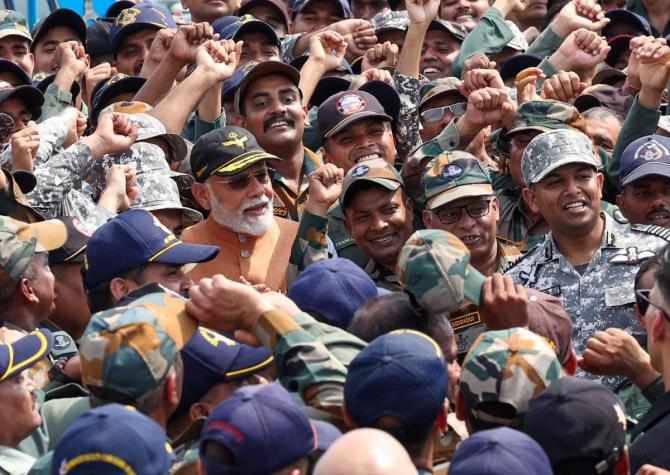


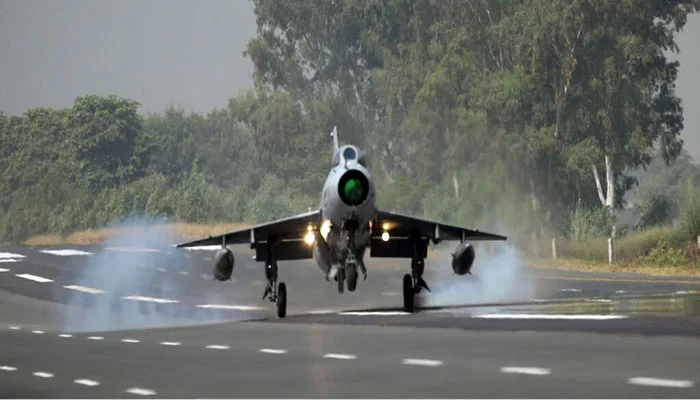
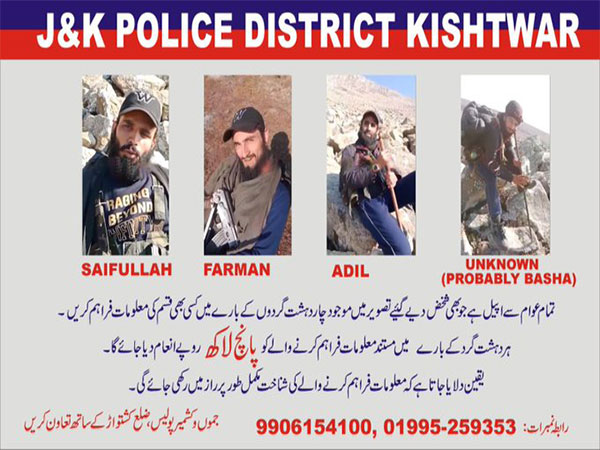
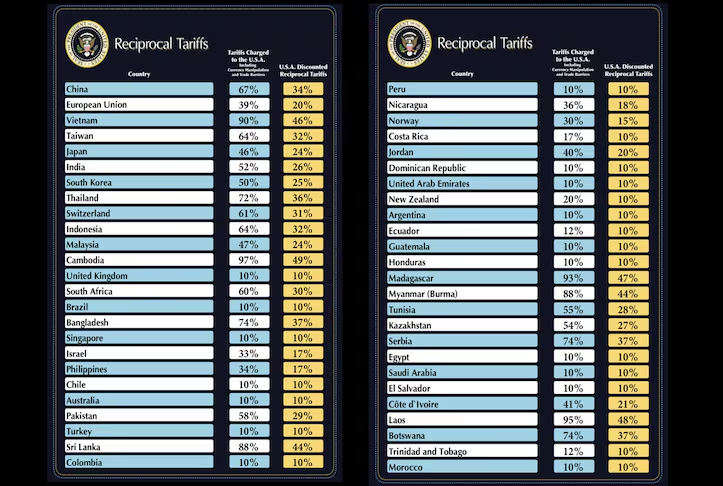

 Security Wise