This CHAKRA podcast “Why Trump Turned on India & Why It Backfired: The Sandeep Unnithan Show” was recorded on Aug 29, 2025 with Sandeep Unnithan.
It was an hour long recording trimmed to fit a half-hour slot!
This CHAKRA podcast “Why Trump Turned on India & Why It Backfired: The Sandeep Unnithan Show” was recorded on Aug 29, 2025 with Sandeep Unnithan.
It was an hour long recording trimmed to fit a half-hour slot!

[Making a point — Modi with Putin & Xi in Tianjin]
Narendra Modi and Donald Trump are hewn from the same narcissistic-autocratic Alpha leader cloth. And their clash may be pictured as between two tough mountain goats in a hard head-butting bout, neither backing down, and each trying to push the other over the cliff.
Trump was being Trump when, his hopes of the Nobel Peace Prize dashed by Modi’s refusal to support the nonsense about the US President’s role in ending Op Sindoor, he raked the Indian PM over the coals. He obviously expected that imposing 50% tariffs on India would lead to a chastised Modi folding, a’la Zelensky, and suing for peace. And, having shown up the Indian leader as his vassal, he’d then respond by magnanimously announcing a reduction of tariffs to the 25% level to Modi’s great relief! That didn’t work. Next, he had Peter Navarro, his Trade representative whom fellow economists call “stupid” and worse, try and exert pressure on New Delhi by ramping up the rhetoric about Ukraine being “Modi’s war” and India a “laundromat” for Russia’s ill-gotten monies. That didn’t work either, leaving the US Treasury Secretary, Scott Bessent, who had berated India for buying Russian oil, to tone down the invective by telling Fox News that “at the end of the day we will come together.” Nope, that isn’t happening!
Instead, the next thing that actually happened was India walked out of the Free Trade Agreement negotiations (as Navarro tells it), and Modi betook himself to Tianjin for the Shanghai Cooperation Agreement summit to talk things over with Putin and Xi Jinping. But not before first flying into Tokyo, there to sign a ramped up defence cooperation agreement with Japan, and publicly to support Japanese claims on the Senkaku Islands in the East Sea disputed with China — an “in your face” move that must have rocked Xi and his team back on their heels. Because they surely expected a cowed down Modi to be more malleable. So, for the first time in his tenure as prime minister — and for the first time, in fact, since whenever, that an Indian leader showed spunk and spine. That he did so before entering the lair of the dragon, is particulary commendable.
One so wishes Trump had mistreated Modi in this manner in his first term, just so the country was spared the ensuing spectacle of the leader of a proud country acting like a servile and obsequious nobody in the court of Trump. Still, now with Modi humiliated he reacted as he should have done all along — standing his ground, and telling Trump and Xi Jinping where to get off!
The most interesting thing to happen in Tianjin, incidentally, was outside the conference hall. Modi and Putin, it is said, spent a whole hour together inside the latter’s posh armoured vehicle, before reaching the summit site. Whatever they talked about, they seemed at the end of their closed interaction inside Putin’s car — no doubt swept clean of Chinese listening devices, and not anywhere outside where their conversation may have been picked up — to have a spring in their step as they walked in seperately to be greeted by Xi. Bet, it wasn’t just niceties they exchanged!
It is good to see the Indian PM with a chip on his shoulder for being treated shabbily, and publicly at that, by the US President. I had said in my 2018 book ‘Staggering Forward: Narendra Modi and India’s Global Ambition’ that Modi’s “creeper vine foreign policy” of wrapping itself around America, would NOT turn out well for India. It turned out even less well for Modi, personally, especially when he had invested so much political capital in building Trump up as his “good friend” and India’s relationship with America, as special — an enterprise hurrahed along by retired diplomats, generals, JNU academics, and lay media commentators. All these people, not surprisingly, beseeched Modi in op-eds in the wake of his breakup with Trump, to grin and bear the personal hurt, and for India to absorb the tariff pain, and generally to behave like a nation of Gungadins!
Shame! Shame!
What is galling is why the government never got its story right, off the gate, on the Russian oil at the centre of this brouhaha. At the Bratislava Forum early in the year, foreign minister S Jaishankar said that India was buying oil from Russia at discounted rates at Washington’s behest. More recently, petroleum minister Hardip Puri told BBC that India’s decision to buy Russian energy was for purely commercial reasons — it was available cheap. So, which is it, because it matters? Apparently, Jaishankar was being more candid. But he also revealed that New Delhi was happy doing first Biden’s and later Trump’s bidding, and buying oil just because at that time the international oil price stability served the interests of the US and European states who needed diesel and other refined oil products that they previously secured from Russia directly. In fact, so convoluted is the energy politics that the diesel produced by the Reliance refinery in Jamnagar from processed Russian crude actually makes up some 15% of the Ukrainian requirement of diesel! So, would India not be hurting Kyiv’s war effort by stopping Russian oil purchases?
To return to Tianjin, as if to cement the fracture in relations with the US, Modi in his formal speech at the summit, said: “India and Russia have a special and privileged partnership. In the most difficult and testing times, India and Russia have always stood by each other,” and added that India “eagerly” awaits Putin’s visit later in the year. With respect to China, Modi was straightforward. “Our cooperation is linked to the interests of 2.8 billion people of our two countries”, he asserted. “This will also pave the way for the welfare of all humanity. We are committed to advancing our relations based on mutual trust, respect, and sensitivity.” Not to be outdone in sentiment, Xi referred to the world “undergoing rapid transformations and international instability. China and India are the two major Eastern powers and the most populous countries in the world…We uphold”, he declared, “strong commitment: advancing the unity and revival of developing countries and promoting human progress are important strategies. As good friends and partners who support each other, integrating and uniting should be the right path for China and India.”
Under assault from Trump, it indicates a certain solidifying of the RIC (Russia-India-China) grouping, which effect will spill over in the economic realm into a strengthened BRICS, with Brazil, like India, smashed with 50% tariffs. Brazil has, remained defiant, with President Luiz Inácio Lula da Silva ensuring that his predecessor, Jair Bolsonaro, charged with treason, whom Trump tried to save by threatening tariffs, will be tried in court. Indeed, Lula is fortifying the military guard around Bolsonaro lest he try and escape, perhaps, with American (CIA) help.
What Trump has unwittingly achieved is solidarity of all the major non-NATO countries that together will be too much for a receding power like America or even the US+NATO to handle.
What Modi has to now ensure is that India does not lose the leverage it has gained with the US and China. He will have to resist the pleadings from the corporate world and the internal leanings of the MEA under Jaishankar, to reach an understanding with Trump. The US President finds himself up a creek and there’s no reason to rescue him by having the Indian governement climb down from its principled position.
There’s the deal for 113 GE 414 jet engines, for starters. Modi can drive a hard bargain by demanding that GE hand over source codes to India — a demand that should be made with the French firm, Dassault Avions, as well for the source codes for the ridiculously expensive 4.5 generation Rafale and Rafale-Marine aircraft, on the pain of rescinding the deals for them. It is the French, we must remember, who not too long ago admonished Thyssen-Krupp for promising to furnish India with the source codes for the HDW 214 diesel submarine with Air Independent Propulsion for the Indian navy’s Project 75i. (More on these deals, hopefully, in a future post.)
With regard to the US and China, moreover, India has to conduct its foreign policy nonlinearly — something China and America have always done expertly with India. Thus, because US healthcare depends on generic drugs produced cheaply by Indian pharma companies, their import is exempt from Trump’s tariffs. Jewelry, leather goods, etc are not exactly great things for India to export and the fact that they are tariffed, well, what the heck they may be routed into the US market via third countries. The consumer goods, let Indian manufacturers find alternate markets in Africa and Latin America for them by producing them more cheaply than China does. Hey, that’s the marketplace logic. Swim or sink! The Modi government has also instantly to diplomatically stop opening H1B type visa doors for would be Indian techie immigrants to the US, West European states, and Australia that they prefer to go to. There are cultural resistance movements in all these countries against Indians in their midst. It reflects on the country that so many want to escape it.
RIC and BRICS are fine by way of balancing the US economically and politically. But China too has to be balanced, but militarily and here BRIS (Brazil-Russia-India-South Africa) and Modified or Mod Quad (India-Japan-Australia and the US replaced by a group of Southeast Asian countries) should be diligently pursued, and loose and informal securitised dyads and triads of, say, India-Japan-Australia, India-Japan-South Korea, India-Indonesia-Philippines, India-Vietnam-Philippines, etc — as I argue in my next book that I am currently finishing, will provide precisely the overlapping military protection for regional and sub-regional countries without the impedimenta of formal alliances, etc.
Shouldn’t Modi, at least now, after seeing India getting kicked with tariffs, and the closing of H1B visa channel and restrictions on entry of Indian students — because both he and Jaishankar have been going round over the years preaching “labour mobility” to advanced countries who are not listening anymore, do what he has long promised but not delivered — “Reform, Perform, Transform”? Or, is it forever to remain just a slogan?
With digitisation successfully implemented, has the Prime Minister ever wondered why the government portals dealing especially with licenses are always not working? Because this is how the babus make money? And why are the babus still permitted discretionary power — a means of generating bribes? And why are there so many licenses to open and conduct business, any way? And why are so many paper documents needed in the digital age for bureaucratic oversight? Where, in fact, is the “ease of doing business” that the government keeps boasting about?
And what happened, PMji, to getting the government out of the business of business? Why not, in this respect, start by privatising the defence public sector units? You corporatised them, good. Now let them go to the market for capitalisation, sell shares, as L&T, Mahindra Godrej Aerospace, et al, do, and have them compete for military contracts instead of, as happens now, the Department of Defence Production in the Defence Ministry, in sweet heart manner, channeling contracts to the hopeless and resources- wasting HAL, Mazgaon Dockyard, etc.
Please, Modiji, pay attention to these aspects of administration. Artificial Intelligence can remove the need for most of these armies of peons, clerks, section officers clogging up the system. Let AI take over these roles, allowing you to drastically prune the central government — which would lead, in its train, to the shrinking of state and local governments.
But efficient and effective AI requires that the mountains of laws, rules, regulations, to simply be discarded whole — these are the remnants of the British Raj. Time they were given the heave ho. And with the government bringing in Constitutional Amendments left and right, why not do the country and its people the ultimate service of removing Article 311 in the Constitution that provides lifetime security of employment to government employees, chaprassi on up, as a means of sprucing up the government?When public servants know that their continued employment depends on their effectiveness and efficiency in office, they will perform and, voila!, the Indian society will be transformed!! No Indian Prime Minister then would have to go on bended knees to foreign leaders to offtake employable youth to avoid an explosive social powder keg from developing at home.
These reforms and such steps are what will push India into the great power category by 2047. Looking to the US, China or anyone else for help and assistance which, in any case, will be unavailable, is not going to get India there.
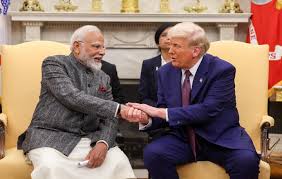
[Modi and Trump in Feb 2025]
People ask if I feel vindicated with Trump and the US turning on Prime Minister Narendra Modi and India, and heaping insult on humiliation with a 50% tariff that’s the highest imposed on any country. There’s something to be said after all about the satisfaction with saying “I told you so!” But I have been saying so for decades, and satisfaction wears off quickly to be replaced by frustration at the amateurs in Delhi trying to play in the realpolitik major league and being nowhere up to scratch.
The desperate diplomatic lunges by NSA Ajit Doval towards Moscow is to be followed soon by the country’s leading pusher of good relations with America at any cost — even India’s sovereignty — S Jaishankar, our esteemed external affairs minister (EAM).
(Incidentally, IFS officers in MEA, I am told, are surprised and appalled by the extent to which Jaishankar is pushing the “give in to Trump”, “buy peace with Trump” lines, and by how much he is willing to compromise the national interest.)
Meanwhile, Xi Jinping sits pretty in Zhongnanhai watching, as is every Asian government and regime, India getting kicked around by Trump with a mewling response from New Delhi. This even as China is the biggest importer/buyer of Russian oil and gas via direct pipelines to the energy sources in Siberia and suffers no proportionate tariffs because, well, Beijing can deny exports to the US of rare earths magnets critical to many US weapons systems. So we have, as someone noted, the deliciously surreal scenario of a country withholding supply of something to another country needing it to fight the supplier state! But Xi is a cool hand at this game. And must be licking his chops awaiting Modi’s state visit — the first in 7 years when he too can turn the tourniquet, seek a modus vivendi on the LAC on Chinese terms, which, in any case, the PLA has snatched on the ground.
Or, for that matter, what do you think Putin’s treatment of Jaishankar would be when he visits Moscow to once again seek support now that Trumpian America has kicked India to the curb? And why he’d be met with a mix of barely concealed contempt, condescension and not a little schadenfreude, even as Putin too would happily turn the screw, but more silkily. Russian oil might become dearer for a start!
Modi’s response to Trump’s relentless attacks is to say he is prepared to “pay a heavy price. [And] India is prepared to pay a heavy price.” Brave words and fine, but a predictable and nearly useless response other than as a warning to the Indian people to tighten their collective belt for the leaner times ahead. Because, all it will do is to motivate Trump and to an equal degree Xi, and even Putin/Peskov/Lavrov in Moscow to see just how far the US can push India around, or to put it differently, what Modi’s breaking point is, if there’s a breaking point.
But the question is how did Modi get India into this position? Obviously because, advised and prodded by Jaishankar, he gave every indication that he’d walk the extra mile in placating and pacifying Trump, and preparing to move all the country’s eggs into America’s basket, leaving the country overly vulnerable. Except Trump understands how he’s relatively placed with the other leaders. With Putin and Xi, he knows he can’t do other than play it straight. Modi, he realises is a clinger, with a policy of clinging to any passing coattail, and can be dealt with abruptly and with a dismissive attitude.
Modi is not a Luiz Lula da Silva of Brazil nor a Claudia Sheinbaum of Mexico, a Berkeley PhD in energy management and hence clearly an intellectual overmatch for Trump. Lula shot down Trump with his gringo-jibe, and Sheinbaum has been, as the online political magazine, Politico, described her, “icy cool”, refusing to rise to his bait, but taking actions beneficial to both countries. Like hammering the drug cartels. Trump therefore finds nobody to bully except Modi. And because he finds Modi cowed, the Indian PM can expect yet more bullying, and still more after that next bout, until Modi stands up and and says no more!
But, where and who can Modi turn to now — Kremlin? Dusting off India’s attribute as a geostrategic leverage against both the US and China is the best bet. But, perhaps, on stiffer terms. And Modi will take himself to Beijing and deal with Xi from a much weaker position. He may not get kicked in the face as he bends his knee, as he was by Trump, but he won’t come away with consideration either.
Things however have got to such a pass, it has now become personal. Here Modi is up a creek. He has always acted the inferior with Trump — and that’s the way the latter likes it. The US President has seen all Europe and the Asian Far East Asian allies accept his economic diktats. And everybody’s on board to humour his conceit as a peacemaker and win the Nobel Peace Prize to match the one awarded to President Barack Obama in 2009 for doing nothing more strenuous by way of peacemaking than delivering a speech in Prague. Quite literally! So why not double down — and this is a piece of advice to the Nobel Peace Prize Committee — on the joke they authored: Hand the damn thing to Trump keen on besting Obama at every thing, and let’s be done with it!
Azerbaijan and Armenia appreciate the joke only too well as their leaders have accepted Trump’s invitation to sign a peace accord in the White House to buttress its present occupant’s supposed peacemaking reputation! The chances are that Trump does not know where either of these countries is, or what peace it is which he has allegedly mediated and over what (Nagorno-Karabakh, an Armenian Christian enclave that’s been virtually ethnically cleansed of Armenians in the wake of the war between them in 2020). But these are details, and unimportant! It is the peacemaker role he was robbed off by the Indian government refuting his involvement in Op Sindoor which, in Trump’s imagination, he had ratcheted all the way up to a near nuclear exchange!! One can see how compelling that narrative might have been to the Nobel Committee in Stockholm had it an iota of truth in it, which the Indian government, spoiling it for Trump, said there wasn’t. General Asim Munir, quick to spot an opportunity to massage Trump’s ego, had Islamabad write an official note thanking the US President for his fictional “peace-making” intervention, and won Trump’s confidence. As easy as that! And then followed Trump’s venomous actions against India, ensuring some four decades of painstaking diplomacy, of building up India-US relations, of getting India over the hump of its deep down and well merited distrust of America, went up in smoke.
The upside is Modi may be cured of his unrequited love for Trump and America and, if the PM has any sense, he may care to put Jaishankar out to pasture as well, in the main because he is associated principally with fleshing out the US tilt in Indian policy that has proven to be such a monstrous disaster. Because, as long as he is still pulling the strings in the MEA, there will be no movement toward equilibrating the Indian foreign policy between Asia-minus China, Russia, EU and the US with BRICS, the security-related BRIS (BRICS minus China) to militarily balance China without America that I proposed (in my 2018 book — Staggering Forward: Narendra Modi and India’s Global Ambition), and with the same objective in mind, a Modified Quadrilateral (India, Japan and Australia) with the US in this group replaced by a bunch of Southeast Asian nations — so that a loose overarching security architecture does not have to depend on an unreliable and untrustworthy America. (An analog of this seems to be what President Emanuel Macron of France has in mind for an exclusively European defence system.)
Alternative security arrangements, more organic to Asia, need to be conceived and considered by the Indian government and the military, because to continue to bank on any external power for strategic security against China is to set India up for more surprise and humiliation in the future of the kind it is suffering at Trump’s and America’s hands.
Ultimately, it is a matter of national self-respect and goes beyond Modi or any other Indian leader of the day. Modi may be willing to stomach Trump’s obloquy; but the nation cannot bear to be so deliberately dishonoured.
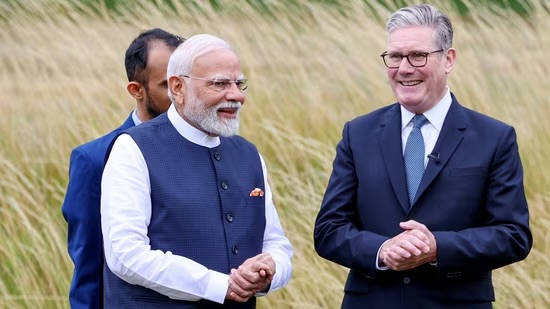
[Modi and UK prime minister Kier Starmer]
When Sir Thomas Roe presented himself in the Mughal Emperor Jehangir’s court at Agra in 1614 as the ambassador of Elizabeth I of England, he did so on the condition he would not observe the rituals of paying obeisance — all the bowing and scraping, to the Badshah. But Roe was an effective enough salesman to have his social transgressions tolerated, because in next to no time he came away with a royal firman permitting the English a trading post in Surat. Apparently, Jehangir didn’t think much about allowing the firangis an economic toehold on the subcontinent. Had he foreseen that small measly presence being parlayed by Britain in time and by strategem into the Raj – the crown jewel of its worldwide empire and the Pax Britannica that followed, he might have had second thoughts. But early 17th century was not exactly Marshall McLuhan’s global village, and inconceivably long distances and a remote kingdom “saat samandar paar” seeking to buy spices, etc. would have been seen as affirming the status of the “Great Moghul”. So Jehangir may be excused his inflated sense of self-importance, and ignorance of geostrategics.
But, what is Prime Minister Narendra Modi’s excuse for gifting India’s sovereignty to Britain 411 years — read that again, four hundred and eleven years — later, this time in the digital realm and, once again, by way —what else— of a trading arrangement? Now it is not spices but sovereignty over source codes and the ever-growing mountains of accumulated and aggregated uniquely Indian government data that foreign countries covet, and the sovereignty over which the Indian government has agreed to surrender to Britain as part of the Comprehensive Economic & Trade Agreement (CETA). So what Modi has sacrificed, in effect, is the country’s digital security and sovereignty.
Seeing the wide, self-satisfied, smile of commerce minister Piyush Goel as he signed CETA even as his British opposite number smirked (or did I imagine that?) like the Cheshire cat in Alice’s Wonderland, whose smile remained even as the feline disappeared, it is plain that neither Goel nor the so-called trade “experts” in his ministry have even a smidgeon of understanding of what “digital sovereignty” is, or comprehend the enormity of what they have so breezily given away. But giveaways, as I have time and again mentioned in my books and other writings, are an Indian government standard. So, what’s new? Goel is a minion of little importance, but he took his tasking orders from the PM. So it is Modi who has to answer for imperiling and compromising the nation’s digital future.
Ironically, around the time Goel was claiming a “gold standard” for CETA and asserting that no sensitive sector was compromised — by which he just meant agriculture, GM foods, Modi in his Varanasi constituency was waxing eloquent about swadeshi and dilating on the global economy, which he said, faced “multiple uncertainties and an atmosphere of instability. In such a scenario”, he declared, “countries across the world are focusing on their own interests”, before exhorting everyone to “remain vigilant about our economic interests.”
Either, Goel has not got the message, or he is doing his master’s bidding. If it is the latter then it suggests that neither Modi, nor anyone else in the vast Government of India, quite has the hang of the digital world, and how the PM’s talk of zealously protecting India’s “economic interests” and his minister’s making India-generated data about everything (every little digital transaction, digitized bank account data and digitized bits of personal information of a billion and 400 million Indians however gathered) a universal commons, as it were, where any country can graze and mine data for its purposes, are contradictory policies. And with Goel & Co. formally conceding access to Indian “government data” and opening up government procurement to the British, will the European Union, the United States, Japan, and whichever other country seeks a free trade agreement be far behind in demanding similar consideration?
Indian government procurement contracts at the central, state, and local levels worth some $750 billion annually are now opened to bidding by foreign companies — a more deleterious development for local industry cannot be imagined, but here we have the Modi regime permitting it! This subject has been dealt with in previous posts.
This post is about the two other issues: First, digital sovereignty, and secondly, the quite astonishing negotiating error of not including major streams of transfer of India’s wealth to America by the Commerce Ministry when negotiating an FTA with the Trump Admin. After all, what is trade but the transfer of wealth from one country to another.
But first, digital sovereignty. It has two components — “source codes” and “digital data”. Source codes refers to the software behind all goods and services. “The most surprising giveaway”, write Smita Purushottam and Parminder Jeet Singh in an op/ed — “What has been missed is India’s digital sovereignty”, The Hindu, Aug 2, that everybody in government ought to read, “is on India’s sovereign right to seek ex-ante access to the source code for foreign digital goods and services, even for those deemed sensitive.” (Ex-ante, is a Latin phrase denoting predictions and forecasts about future events, and with reference to CETA means that India cannot insist on source codes for anything the country may buy from the UK even though software is integral to nearly all products and services.) This, as Purushottam and Parminder point out, is “a 180-degree turn away from [India’s] steadfast stand in the World Trade Organisation”.
The source code issue in defence is exemplified, for instance, Dassault Avions refusing to part with the source codes from the Rafale combat aircraft that the Indian Air Force and navy have bought at enormous expense to the exchequer (at last count exceeding $35 billion). No source codes means India cannot integrate its missiles to this combat platform. Why has the Modi government not insisted on source codes as part and parcel of the multibillion dollar deals? Perhaps, Paris was aware for many years that New Delhi was prepared to cutout the source code issue from its FTAs , as now proven by CETA. Who knows?
Purushottam is a former Indian ambassador to Switzerland and founder of a remarkable little organisation — SITARA (Science, Indigenous Technology, Advanced Research Accelerator), comprising a team of domain expert volunteers in the forefront of pushing indigenous technology to an Indian government and military inclined, at the drop of the proverbial hat, to “buy foreign”. I know of no other diplomat who, in retirement, has done more substantive work in the nationalist cause. And Parminder is arguably the leading expert on digital sovereignty in the country. Their views are known to the government. Both of them should have been an inalienable part of the Commerce Ministry teams negotiating the FTAs, but are not.
Incidentally, the US, recognizing that security, regulatory and law enforcement imperatives require source codes, reversed its stand on source code prohibitions. Washington likewise backtracked on “granting equal and non-discriminatory access” to government data (which in an earlier era represented “government transparency”) to foreign countries in its FTAs. The Modi government, in its wisdom or lack of it, has taken an exactly reverse tack to what America has done even when such modified position grievously hurt the national interest.
But the Modi regime — flowing against the current — reversed itself , for no sensible reason, on the source codes and access to government data issues thereby centrally endangering India’s digital sovereignty and, principally, national security. It has created a new vast vulnerability from what was an extraordinary position of strength — its massive government data bank generated within India that the UK and other foreign countries will now be able to exploit at will. “It is incomprehensible”, write Purushottam and Parminder “why India with intention to become an Artificial Intelligence (AI) super power” would accept in principle that government data “is not a sovereign resource.” Facilitating easy foreign access to this data will, they warn, “erode India’s competitive advantage” in using its own data to create Indian AI products. Such as its own large language models. And further, that foreign states with access could easily weaponise the massive Indian information bank against India.
After all Artificial Intelligence is nothing more than machines discerning patterns in mountains of data — the larger the data pool the better, at phenomenally high compute speeds, to provide options to the decision maker in the corporate world, government, and the military.
Providing further evidence that Goel and his Commerce Ministry babus are a bunch of reckless dunderheads, they agreed to further consultations with the UK government on “free flow of data” and “data localisation” — the two most contested issues in the AI field, and denotes they write, “a dangerous regress and visible vulnerability” with regard to the country’s long held positions. Again, the US as the leader in the AI field along with China, has withdrawn from propagating these issues, even as India heads blindly into digital bondage because, as Purushottam and Parminder also point out, FTA texts will end up defining the global digital order. In this situation India can opt for the Western big-tech-oriented digital architecture or preserve its digital autonomy and sovereignty — it cannot do both at the same time. And once in, and the deeper India is entangled, the more difficult it will be for the country to extricate itself.
As in the foreign and military policy spheres, in the digital area too the Indian government has so far blundered along, keeping its head above water by being “reactive”, with no “clear road map” of where it wants to go. This policy path of not knowing where to go and how to get there is a liability dragging down the country. Per Purushottam and Parminder what is desperately needed is the formulation of “a full-fledged digital security” and “digital industrialization” policy, which alone will enable the government to negotiate from a strong position and to “create the space to become a digital super power” rather than remain a “digital colony”, which is what FTAs like CETA will end up doing.
—————
But, alas, the national interest is hostage to the tender mercies of the generalist diplomats and civil servants running the show, even as Modi believes he is doing so! In the recent past, it obtained for the country the 2008 nuclear civilian cooperation deal negotiated by the generalist joint secretary and now minister, S Jaishankar, that strangled India’s ambitions of becoming a hefty thermonuclear weapons power until such time as the country gets a government with the will and the gumption to resume open-ended high-yield thermonuclear tests in the face of American opposition, and repays China for its nuclear missile arming of Pakistan by nuclear missile arming every country on the Chinese border. And now we have these generalist IAS-wallahs and their ilk screwing things up things fatally for India and complementing Jaishankar’s surrender of the country’s thermonuclear security by surrendering its digital sovereignty as well, all without flinching.
But not content with undermining India digitally they are now ensuring, under Goel and the aegis of the Modi dispensation, that India slips into the status of America’s economic vassal. Or, why else would the instructions go out from the PM’s office to every ministry to make lists where concessions can be made, and products and services can be bought to reduce the trade deficit with the US? The Modi regime behaves like a mangy dog with its tail between its legs when approached by a bigger one making noises.
If with respect to digital security and sovereignty, the Commerce Ministry had better learn from Messrs Purushottam and Parminder and recover the lost ground fast, with respect to the nitty gritty of negotiating with Trump’s trade reps, the country’s interest would have been better served had they heeded Ajay Srivastava’s advice. Srivastava, a 1989 batch trade officer, left the comforts of a sarkari job to start a think tank — Global Trade Research Initiative (GTRI), which is doing yeoman service for the nation. In a Reuters story published by Business Standard, May 26, Srivastava revealed the fundamental flaw in Minister Goel and his Commerce Ministry’s strategy of limiting the negotiations to what Washington desires, just trade where India has a $44 billion surplus, a figure that has got Trump hot under his collar.
But this is only the visible part of the trade imbalance iceberg. What the Indian side has not done, Srivastava reveals, is bringing to the negotiating table the US revenues generated in India for the American education, digital services, financial activities, intellectual property rights payments, Hollywood, Netflix and entertainment industry, royalties, and defence sales sectors, which when added up would turn the tables all the way around, and show a $35-$40 billion US surplus. More than enough for India legitimately to justify imposing higher tariffs on these unaccounted American export sectors and activities the “massive earnings” from which, Srivastava says, “do not show up in the narrow goods trade statistics. When you factor them in…the US…is sitting pretty.”
Srivastava deconstructs the “the non-trade” figures of the US trade surplus with India thus: Indian students payout to American universities in Fiscal 2025 is $35 billion ($25 billion in tuition and $10 billion in living expenses); Tech giants — Google, Meta, Amazon, Microsoft, et al earn from India some $15-20 billion, American Financial Institutions and Consultants earn another $10 -$15 billion, and Global Capability Centers that create and innovate new technologies, services, and products for the American majors take in $10-$15 billion, and IPR payouts in pharmaceuticals, et al amount to $1-$1.5 billion. All this adds up — at the highest end of the revenue scale to some $86.5 billion. (Not sure why in the Reuters story Srivastava pegs this transfer of Indian wealth to only $35-$40 billion when it is more than twice that amount!)
So, how come the geniuses led by Goel in the Commerce Ministry, and other resident economic geniuses in the Government of India (in the PM’s panel of Economic Advisers, for instance) missed such a vast amount of wealth being yearly shuffled off to the US right before their eyes? Talk of being robbed blind. Shouldn’t Modi demote Goel to Animal Husbandry or something lesser and send the generalist babus assisting Goel responsible for this ridiculous situation, packing?
It is a situation where the Modi government is cringy and fearful of the next Trump strike, when the figures show that, far from India being on the defensive — something the Indian government reflexively adopts in any interaction with the US and the West, the Modi regime should be on the offensive in the trade negotiations with the Trump Administration, and talk of raising tariffs on US imports to equalize the transfers of wealth.
But will Modi, even at this late stage, do what’s beneficial for the National Interest and scrap any talk of any more buys to placate Trump, and stand up to Washington or, will he, as is likely, do as he has done repeatedly — cave in to every big power in sight — to the US, China, and whoever else next comes before him?
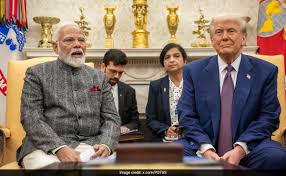
[Modi’s February 2025 visit with Trump]
The perils and pitfalls of getting close to America and Trump were obviously not studied in any seriousness by the Indian government before Narasimha Rao began the movement in the early 1990s towards a US-tilted foreign policy — the dangers of which I have been warning incessantly about in my books and other writings. This skewed policy took wing with Manmohan Singh’s regime when his chief negotiator S Jaishankar, then MEA joint secretary (americas), fetched for the country the most disastrous one-sided nuclear cooperation deal (2008) imaginable that killed off India’s chances of ever emerging as a muscular thermonuclear weapon state. That policy flowered even more with Modi starting in 2014 with S Jaishankar again, this time as minister Sancho Panza, that has resulted in a policy of multi-billion dollar arms buys to gain American friendship that resulted in all sorts of vintage weapons and platforms (M-777 howitzers, C-17s, C-130s) in Indian inventory at huge cost, and has landed the country in such a sorry pass that these days Trump seeks by choice to beat up on Modi and India in lieu of anyone else to bully and badger!
Readers of this blog may have noticed the recent flurry of articles and op/eds by the country’s media commentariat (featuring retired foreign secretaries, diplomats, and such) suddenly discovering how perfidious America can be — something that I have been sounding the tocsin about over a very, very long time. The media has been party to popularising the view that Donald Trump in his second term would come through for his “friend” Narendra Modi and help India reach the “viksit Bharat” goal which, incidentally, is still the delusion driving the country’s foreign policy. After being slapped silly and mercilessly taunted by Trump, it is still not certain Modi will take umbrage. Or, to put it another way, how much more outrageously and offensively would Trump have to behave for Modi to respond? Because it is not just Modi who is being denigrated but also India, or is the Prime Minister unaware of this?
The confusion and perplexity at this adverse turn of events is mirrored in the actions of Modi, Jaishankar, and the MEA-NSC lot that had laid such great store by Piyush Goel and his commerce ministry babus reaching a “mutually beneficial” Free Trade Agreement (FTA) with America, little anticipating that the Indian government was rushing headlong into a tariff ambush Trump was laying for them. That Trump’s intention from the start has always been more than tariffs was plain enough — it is to make America’s European and Asian treaty allies and strategic partners, especially India, also its economic vassals. Economic vassalage, Trump and his advisers have determined, would be easiest to impose on Modi’s India considering how the Indian PM and his foreign minister, Jaishankar, have sought to ingratiate themselves, in big ways and small, to Washington and the West generally since 2014.
The immediate impact of 25% US tariff on Indian exports is bad enough, exceeding the 15% rate arbitrarily imposed on Japan, and 19% on Philippines and Indonesia in Asia. It is the Indian contracts for Russian oil and military equipment that are going to draw the biggest penalties and these imposts will amount to tens of billions of dollars. The grander aim appears to be, proverbially, to kill two birds with a single stone, i.e., to collapse the BRICS combine in which India, China and Russia are prominent members. BRICS, potentially an economic giant, is seen as the greatest danger to the US retaining its economic status as the ‘numero uno’ power. His fear is that BRICS is large enough, has the most dynamic economies of the world, to do serious damage to America’s standing if it also leads the charge in de-dollarising international trade. India’s rupee-rouble energy and defence transactions, and China’s preference for trading with Southeast Asian nations in its own currency — yuan, is for the US a red flag.
But to undermine BRICS, the US first seeks to reduce the strong alpha male-strong man leadership of the leading countries in this grouping — Putin, Xi, Modi, Luiz Lula da Silva, and Cyril Ramaphosa in the eyes of their domestic audiences. Putin is nearly immune to Washington pressure. Xi holds the promise of a state visit to Beijing that Trump wants as leverage for the US to not behave outrageously towards China. In fact, such is Xi’s command over Trump, and Washington is so eager to please Beijing, the Taiwan President Lai Ching-te was refused a transit through the US to visit the only three Latin American states that recognise Taiwan — Paraguay, Guatemala, and Belize. And this mind, is the America the Modi regime had all along hoped would act in terms of India as bulwark against China! Ramaphosa was insulted in the White House with Trump creating a controversy out of thin air by talking of “white genocide” of South African farmers. The South African, in turn, mocked Trump’s understanding of anything, leave alone anything related to Africa, and South Africa in particular. The recently elected President Lula in Brazil, however, took the fight to America. Calling Trump’s tariff threat “blackmail”, Lula, doubling on the provocation, declared that “the gringo will not order this president around.” Suitably elated with their man showing brass, Brazilians have responded by increasing their popular support for their presidente.
Contrasting Lula’s or even Ramaphosa’s strong reaction to a deliberately insulting Trump to Modi’s, who caved in instantly to Trump’s “request” (by the US president’s own account) and ended the Sindoor hostilities, is to realise just how little America really thinks of Modi and India, and contrarily how much Lula’s telling Trump where to get off has raised Brazil’s profile in the world at a time when European states and Japan are falling over themselves to prostrate before the US President. In fact, if as Viktor Orban, the Hungarian Prime Minister and arguably the leader with the keenest personal insight into Trump, said that the EU’s conceding a 15% tariff rate was the consequence of Trump having the European Commission chairperson, Ursula von der Leyen , who negotiated this deal, “for breakfast”, then by his reckoning, the Trump Administration surely made a lunch out of the Indian minister Goel and his commerce ministry bumblers, and more centrally of the Modi government. But is there even a squeak out of New Delhi other than Rajnath Singh’s unconvincing rebuttal on Sindoor in Parliament to Trump’s unending insults?
What is unfolding is a tragedy for India masquerading as power play. The next time Trump talks of his “friend” Modi, New Delhi should be prepared for another American strike! The fact is the US President and his advisers have concluded that Modi is an easy mark and India a pliant enough state for Trump to crown his tariff war with success by arm-twisting India into America’s economic fold. Because manipulating Ramaphosa, Lula, Xi and Putin is deemed a more onerous task.
I mean, would Modi even remotely consider setting Trump and the US right by, say, freezing all defence acquisitions from America, informing Boeing about a stop to offtaking its passenger aircraft by any Indian airline, creating difficulties in the case-by-case consideration of any American request with regard to the four foundational accords? And, mull not offering Washington leverage by ending all talk in official channels of H1B visas for Indian techies (who will take care of themselves)?

[Jaishankar & other SCO foreign ministers with Xi presiding]
India is tending irrefutably downwards in the external realm, perhaps, for the first time in Prime Minister Narendra Modi’s 11 years in office to-date.
The fiasco of Op Sindoor May 7-10 was the curtain raiser. I had wondered in a post on the mystery of no deaths other than that of family members of the Terrorist Azhar Mahmood in the Indian strikes on Muridke and Bahawalpur on May 7. That was cleared up early by foreign minister S Jaishankar’s revelation that Islamabad had been pre-warned about the incoming missile attacks on Muridke and Bahawalpur along with an assurance that no military facilities would be struck, and that this was a pre-offer to GHQ, Rawalpindi, to “stand down” after the attacks went through. And how in the wake of the effective May 10 missile and drone barrage, as it were, it was the Pakistan military that sought a ceasefire. (https://www.youtube.com/watch?v=KiVNgeKrm-E)
This raises the legitimate question: whether Jaishankar, who is tasked with implementing Modi’s policies re: US — to get close, and China —to give no offence, wasn’t being too clever by half. Jaishankar who apparently prides himself on knowing the American system decided he’d win some brownie points with Washington by alerting the Trump Administration to the M-B strikes before Islamabad was contacted. It boomeranged on India in two ways.
Firstly, Pakistan military, confident that the Indian armed services would be lax, not expecting a hard Pakistani response because New Delhi had given the game away (with its warning of specific targeting) saw it as an opportunity, using the Saab2000 AEWACS and the Chinese satellite guidance, to take down a few unsuspecting IAF aircraft. And also confident that with the US government put in the know by New Delhi, the Indian response even to the takedown of IAF planes — which in Asim Munir’s mind evened out the exchange and the Pak military’s ego was salved, would be limited. This proved to be the case. Why else, if the Indian government felt that it had militarily the upper hand, would it accept Pakistan’s offer of ceasefire May 10 considering Pakistan had hit back and its narrative was gaining traction worldwide at India’s expense? Recall that not a single country supported India’s actions.
Secondly, by informing Washington first, or at all, Jaishankar had set Trump up for an easy boastful diplomatic romp, and the Modi regime for a fall. Not one to miss out on hyperbolicising the “nuclear” aspect of any conflict, especially one that can be given a religious colouring an India-Pak, Hindu-Muslim, skirmish and trumpeting his own exaggerated role in defusing a flashpoint. He is so desperate for a Nobel Peace Prize — remember he wants to match Obama, who won the prize for nothing more than a single peace speech in Prague— surely, in his blunderbuss fashion Trump has done more!!
Short of broadcasting it through PIB, the Modi government had made the restricted nature of India’s Pahalgam retaliation amply clear, once it broached the topic of Indian strikes to the Trump Admin. So, any follow up actions by the Indian army to capitalise on the situation were ruled out, given that there was no offensive warlike disposition of the army, in any case.
What then was the whole Sindoor episode about other than to polish up Trump’s fictional narrative to boost his Nobel chances??? The government put out that Modi was steaming in frustration with Trump for stealing his thunder, by taking undue credit for shutting down any Indian military escalation as Washington claimed was the case when, other than, the intra-mural (as I called it) motivation to show up Munir for his puerile “48 hour” threat with the Indian May 10 missile attacks, nothing else was on the cards.
What this episode revealed was Modi’s low standing with Trump because of the latter’s conviction that the Indian PM would not publicly and personally refute his claims’s of his alleged central role in ending Sindoor. And further, that the Indian leader would swallow the insult of Munir’s notable welcome at the White House without in any way damaging the prospects of the Free Trade Agreement with India under negotiation, or hurting the general direction of bilateral relations. Again, Washington was proved right. Because commerce minister Piyush Goel, was gung-ho about an FTA, lining up India for concessions and economic giveaways, including $750 billion worth of annual Indian central, state, and local public procurement that, following the FTA lead with UK and EU, will permit American firms to bid for — driving a stake through the heart of Indian industry.
But Indian-origin —who else? — Washington Beltway think tankers are demanding more. Of India! One of them wants the Modi dispensation to reciprocate years of what he calls America’s “strategic altruism” with more giveaways. Perhaps, the American altruism includes Zbigniew Brzezinski — President Jimmy Carter’s NSA’s policy of encouraging China’s proliferation of nuclear weapon and missile technologies to Pakistan starting in 1979, continued by the incoming Reagan administration, in return for Pakistan army ISI’s staging the CIA’s mujahideen operation to undermine the Soviet military presence in Afghanistan. Just, may be, Jaishankar’s attitude resonates with such advice and India is returning love and bouquets for Trump’s brickbats!!
But shouldn’t the PM be concerned with the “practical” advice he has been getting from his foreign minister, Jaishankar, on how specifically to handle Washington and Trump, in particular? Japan, America’s closest ally in Asia, for example, decided to cancel the scheduled 1st July 2×2 meeting of foreign and defence ministers, to protest Trump’s tariffs and his pressuring Tokyo to increase its defence spending to 5% of GDP. And then here’s Modi’s India, pushed by Jaishankar, revealing plans for a surprise attack on Pakistani heartland, and expecting not only that Washington would be simpatico with the Op’s anti-terrorist slant, but would back it in the venture, entirely misreading the historically strong US commitment to Pakistan, and Trump’s special love and longing for tough-talking generals and in Munir’s case, a self-appointed “Field Marshal”. And more, the Indian government is preparing to “open up” India for American business — as reward for the Trump Admin doing what? Courtesy Jaishankar, for showing up Modi as a weak-kneed leader, and for getting political-diplomatic mud on India’s face. And for the Indian military — not known for being offensive-minded, reinforcing its reputation only for small time actions against a small time foe?
At the other end, there was Jaishankar’s trip to Beijing ostensibly to attend the SCO foreign ministers meet. But his being in the city for several days before the start of the conference led, as a Taiwan-based Indian academic noted, in snide Chinese media reports of India seeking to mend its relations with China and preparing in effect to do what it does best — kowtow! Indian industry’s shortages of rare earths materials and base chemicals for its pharmaceutical factories and electronics components for its telecommunications manufacturers, and the troubling matter of an active Chinese military role with its Beidou LEO satellite constellation the PAF plugged into during Sindoor, and China’s successful forays in winning over the states neighbouring India — Nepal, Sri Lanka, Bhutan, Bangladesh and, of course, Pakistan, are all seemingly concerns inducing New Delhi to cry Uncle! And for Jaishankar to go cup in hand to his counterpart, Wang Yi.
This dependence on China was engineered by MEA fixated on warm relations with China over decades. After all, what does the Indian Foreign Service officers believe their remit is?? It is apparently not to think strategically, whether in economic or military terms. Because if economic strategies were their concern, they would have long ago warned the Indian government to incentivise the production of electronics components and base chemicals and such, and urged setting up a rare earths refining capacity. Just to make clear, rare earths minerals are available everywhere in lesser or larger quantities — so mining and refining becomes ultimately a costing exercise — what is the country willing to pay for getting indigenously-produced rare earths, that’s the question. In Jaishankar’s MEA calculus, rare earths and base chemicals from China constitute an economic option — no more informed than the Chawri Bazar trader who imports some lampshades! Meanwhile, the Chinese leadership and state were busy cornering not just the global rare earths market by taking ownership of mines and unmined reserves in Africa, Central Asia and South America, but also the manufacturing jobs, and leading the charge on cutting edge science and technology, especially the defining technology of tomorrow — Artificial Intelligence, to boot.
Meanwhile, a decade plus into his job, Modi is still mulling over whether and how much to de-bureaucratise the economy! And ease up on the land, labour and taxation laws to allow investment flows in the manufacturing sector to flood in.
So, how about military strategics? Well, the less said the better I still have the then Foreign Secretary K Raghunath’s words ringing in my ears when I asked him in an NSAB’s session with MEA in 1998 about India’s alighting on a tit-for-tat measure — and I have recounted this interaction umpteen time on this blog and in my books, of nuclear missile arming countries on China’s periphery with nuclear weapons — an albeit belated response to Beijing’s cold blooded equipping of Pakistan with the same along with the transfer of all requisite technologies and designing expertise, even as the US rode shotgun on this illicit commerce. And all that the wretched MEA babu had to say to the NSAB was that reciprocal action was “NOT A PRACTICABLE SOLUTION”!!!
Did anyone in Zhongnanhai caution Chairman Dengxiaoping against such n-proliferation when he embarked on his “Nuclearising Pakistan” actions because it was not befitting “a responsible state”? Or, did anyone in Washington cry halt! when the US first proliferated to Britain and later France, and still later permitted France to nuclear-wise help Israel get over the weapons hump? Or, anyone in Kremlin stop Khrushchev from sending in the mid-1950s nuclear weapons and missile materials, technologies, and experts to China to beef up Communist bloc solidarity?
It falls then to the “responsible state” theming MEA to successfully canvas AGAINST India doing what all the major countries have done when proliferation served their national interests — PROLIFERATE to do in the enemy, the more recklessly the better to have the intended effort. Would Beijing be acting the way it does now with India had New Delhi grown a bit of spine and transferred entirely indigenously developed weapons technologies and expertise to states seeking absolute security against China?
Guess who stops India now from doing the same? It is Modi’s fear of the US and China, and the efforts by MEA personages, like Jaishankar, to bolster that fear to ensure not only that India does NOT use the self defence provision — Article 51 of the UN Charter to onpass sensitive N-tech to friendly countries bordering China, but actually to hamstring the country by pushing it towards shackling itself with still more constraints. Such as membership in, say, the Nuclear Suppliers Group, the MEA craves as they have already done vis a vis missile technology by having India sign the Missile Technology Control Regime, join the Wassenaar Agreement, the Australia Group, et al. These are MEA personnel seeking to curry favour with Washington and European governments because their children all reside in the US and the West. A former IFS man and Congress party apparatchik Mani Shankar Aiyar reckoned that over 95% of senior Indian diplomats’ progeny are so placed! Senior Indian military officers too have been part of this game for some 30 years now.
Everybody in the Indian government seems to be up for sale. Who in the Indian government can an Indian citizen anymore trust to do well by the country?
US ambassador John Galbraith during the Kennedy years confessed that a cabinet decision would be communicated to him for a bottle of Scotch! This was the Sixties. Today the price has gone up and is in the form — not of secret offshore accounts — that’s passe’ — but of sons and daughters of officials being taken care of by “scholarships” to Ivy League universities, jobs with Western companies, and resident visas. Talk of a “bikauu” (purchasable) Third World Indian government bureaucracy!
India’s ultimate foreign and military policy tragedy is that foreign interests have always driven them. If, in the early years Nehru relied on the Mountbatten-Blackett duo, in the main, to shape the external policy and national security outlook and approach, today we have our own leaders, diplomats, secretaries to the government and the lot, and senior military officers channeling India into the American/Western dependency trap, while mouthing the “strategic autonomy”-“Nonalignment 3.0” claptrap
Why not just hang a placard — “India for SALE”?
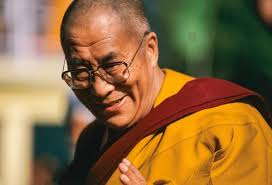
[His Holiness, the 14th Dalai Lama]
This has been a bad year for Prime Minister Narendra Modi and, therefore, for India and Indian foreign-military policy.
First, the reelection of Donald Trump to his second term as US President isn’t panning out the way Modi had hoped. It seems the Indian PM mistook the American’s transactionalist statecraft for the kind of personalised diplomacy Modi thinks he is good at. Op Sindoor proved that the PM had got it all wrong — and this was the second big shock. Far from reining in General Asim Munir on the terrorism issue, Trump pressured India into pulling out from a conflict that was moving towards an end favouring Delhi, to save Pakistan from a serious military situation and Munir his job. And far from reacting badly, we have foreign minister S Jaishankar moseying over to Washington to reassure the US that “our defence partnership is today truly one of the most consequential pillars of the relationship” and for the US defence secretary, Pete Hegseth, to indicate what such a partnership really means: “complete several major pending US defence sales to India”. Rajnath Singh, supportive of Hegseth’s understanding, asked the latter to hurry up and deliver Apache attack helicopters! In other words, Modi’s India is willing to eat crow to remain on America’s side, and help its defence industry along by buying all its old hardware but expensively, even if it results in the blighting of the prospects of the indigenous Tejas, AMCA and the Light Combat Helicopter, for starters.
The third bad turn of events is upon us — the likely announcement on his 90th birthday by His Holiness, the 14th Dalai Lama — the embodiment of the Buddha on earth, of his successor by “reincarnation”. He has already declared that his reincarnation will be announced even if by means of “emanations” and that the 15th Dalai Lama would be a “free land” born Tibetan, which rules out China the nearest thing to George Orwell’s authoritarian, heavily policed, state of “1984”. The emanations path suggests itself when the Dalai Lama has to be found even as the current one is alive. “There have been notable instances of recognized emanations in recent times within the Nyingma and Sakya schools of Tibetan Buddhism”, writes Kelsang Aukatsang, the Dalai Lama’s representative or ambassador to the US, leading to the recognition of “a 13- or 14-year-old, [to] transmit [Dalai Lama’s] wisdom [to], and ensure continuity in spiritual leadership. This would also resolve the long-standing issue of an interregnum—the often decades-long gap between the death of a Dalai Lama and the maturity of his recognized reincarnation.”
“Interregnums are often precarious; throughout Tibetan history, regents of young Dalai Lamas have faced challenges in maintaining authority” says Aukatsang. “Such gaps in leadership have historically led to factional infighting, financial mismanagement, weakened central authority, political instability, and increased vulnerability to external threats.” Another important reform to ease the succession crisis that is possibly up for consideration, he explains, “is the creation of a council charged with implementing the Dalai Lama’s written instructions on succession. This body should include representatives from the four major schools of Tibetan Buddhism—Nyingma, Kagyu, Sakya, and Gelug—as well as Bon, Tibet’s indigenous, pre-Buddhist tradition. By establishing such a council and clearly outlining its mandate, the Dalai Lama would address a critical gap, as there is presently no formal mechanism to ensure that his succession guidelines are carried out, or by whom. This council should report to the Gaden Phodrang Trust. A diverse, credible council would offer both transparency and expertise for what is likely to be a complex and contested process as well as guard against mounting efforts by the [Chinnese Communist Party and [President] Xi [Jinping] to co-opt this sacred tradition for political ends.”
A furious Communist China which, has indulged in skullduggery in extremis, wants to control the agency of the Dalai Lama in order to establish full and complete control over the Tibetan population and crown its 70 year long campaign of Tibetan genocide, by reducing the spiritual head of Tibetan Buddhism to a Chinese Communist Party apparatchik. It is insisting that only Beijing has the authority to appoint the new Dalai Lama and, in fact, proposed the “golden urn” path to selecting the next Dalai Lama by drawing the name from among several candidates. This method was used only once, to select the 11th Dalai Lama.
Except, as Aukatsang reveals, “Any possibility of finding common ground with the Chinese leadership on the issue of succession was shattered in 1995, when China hijacked the reincarnation process of the 10th Panchen Lama, the second-ranking religious figure in Tibet. The Chinese government abducted the legitimate 11th Panchen Lama, then just 6 years old, and his family, installing a state-approved replacement. The real Panchen Lama has been missing ever since, making 2025 the 30th year of his enforced disappearance.” ( https://foreignpolicy.com/2025/07/02/dalai-lama-reincarnation-china-tibet-relgion/ )
After deeply mulling the relevance of the institution in the modern day of the Dalai Lama to Tibetans, to Tibet, to Buddhism, and to the world, and whether he shouldn’t end it — because China’s grip on Tibet is only strengthening, His Holiness decided to everyone’s relief that there would be a successor. Because he said of the overwhelming demand from his advisers — the high lamas, the Tibetan exile community in India numbering some 85,000, and [bcause of] representations by Buddhists and Buddhist organisations in the Himalayan region, and by “Mongolia, Buddhist republics of the Russian Federation, and Buddhists in Asia including mainland China.” These constituencies of the Dalai Lama could be mustered for a response to a question someone might ask — as Joseph Stalin did when there was talk of involving the Pope in peacemaking during the Second World War: “The Pope! How many divisions has he got?”
In all the three bad turns enumerated above, it should be apparent to all that it was the Indian government that brought them on, and is responsible for them.
And this bad record it seems will continue. Consider the uneasy silence of the MEA and the Indian government on the issue of recognising the 15th Dalai Lama when his reincarnation is announced by the 14th. Is it a prelude to India capitulating? Beijing has already made it plain that it would look askance at New Delhi siding with the Tibetan Government in Exile, because it claims the installation of the 15th Dalai Lama is central to its “One China” principle.
Considering what’s at stake, it is a glorious opportunity for Prime Minister Modi to prove he is no pushover and that he cares less whether Xi and Zhongnanhai would be troubled and upset with India’s support for the institution of a free Dalai Lama in a free India, and if that means the Chinese People’s Liberation Army acting up on the 4,700 kms long disputed border, well, the Indian military is up for it!
It is an opportunity for Modi and the Bharatiya Janata Party regime to reverse the worst foreign policy mistake India made during Jawaharlal Nehru’s time of ceding Tibet without a fight, of pulling back from covertly supporting the Khampa rebellion in the late 1950s, and thereafter doing everything possible to help elevate Communist China. In 1955-56, it generously handed over the UN Security Council permanent seat vacated by Chiangkaishek’s Taiwan and offered to India by both the US and USSR, over to Mao’s China and, in a similar fit of self-abnegation, Atal Bihari Vajpayee, even more weak-headed and weak-kneed than Nehru, in 2003 approved and facilitated China’s entry into the World Trade Organisation! India has been Beijing’s favourite diplomatic, economic and military punching bag.
But what can a punching bag do other than Nothing?
Is everybody’s punching bag what Modi wants India to be known as? If not, then there’s a strategic opportunity staring him in the face. First, loudly declare the Indian government’s whole-hearted support for the “sovereign status” of the 14th Dalai Lama and the Tibetan government in exile in Dharamsala, and, for the 15th Dalai Lama — whenever that reincarnation is announced.
Next, boldly issue a demarche to the Xi regime that India resiles wholly from the previous one-sided acceptance of the “One China” concept. But that New Delhi might re-consider the “One China” principle ONLY IF the Chinese government formally recognises the “One India” principle, inclusive of the erstwhile “princely kingdom” of Kashmir, inclusive of all of Pakistan-occupied Kashmir and the principalities of Hunza, Nagar, Yasin, Koh-Ghizer, Punial, Chilas, Darel, and TangirHunza in the greater Gilgit-Baltistan region, and the Shaksgam Valley gifted illegally by Ayub Khan to China in 1963. And make these exchanges public.
The simple bargain: China can have “One China” if India gets recognition from Beijing for “One India”. And it should be made amply clear that this “One China” DOES NOT INCLUDE TAIWAN — a separate entity, with which India could establish formal diplomatic relations.
The Indian government needs to end — the lily-livered poufs inhabiting the China Study Group, the apex body that habitually misshapes the country’s China policy, permitting! — India’s policy of unilateral giveaways, and declare that hereon bilateral relations with China will be on a strictly reciprocal basis. You do something, India will return it in exactly the same measure. And that means New Delhi doing an — Om Ganeshesynamah! on transferring, overtly or covertly, strategic/nuclear warheaded missiles, including the Brahmos supersonic cruise missiles, to any country on China’s border which wants absolute security for itself! This move is entirely legal under the Self-Defence Article 51 of the UN Charter.
Revenge, as US President Richard Nixon said, is “a dish best served cold”.
Putting steel in India’s China policy will, moreover, automatically alert the US, Europe, the world to a changed India, raise its stock and standing and, in Asia, where India does not command much respect, increase the desire to strategically partner it in forming a strong bulwark against Beijing’s hegemonistic tendencies. It will be the first time, Modiji, that India would really amount to something.
It is time India, Mr Prime Minister, walked its talk. Your government cannot keep yakking about terrorism and Pakistan — seemingly the full time occupation of Jaishankar and his MEA, even as China makes trouble for the country every which way without Delhi responding in any form. There’s no reason to fear China — it has more troubles than it acknowledges, and its military is good, but mostly on paper. It has never been lately tested in operations. The Indian army is, if nothing else, an operationally blooded force — faced live fire for the last 70-odd years, in insurgencies in the northeast, in Kashmir. The PLA, in contrast, has NOT been in battle since it was hammered by the Vietnamese irregulars in 1979 — even before the regular Vietnamese forces took the field!
[And, Mr Prime Minister, would you please dissolve the wretched China Study Group? Because there’s no greater national security liability.]
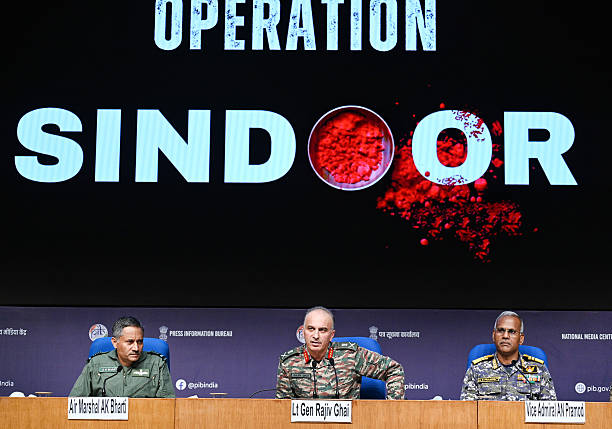
The statement in the Press today that made a splash was by the Indian Defence Attache, Jakarta, Captain Shiv Kumar, Indian Navy (https://www.hindustantimes.com/india-news/op-sindoor-losses-due-to-restrictions-on-hitting-military-targets-navy-officer-101751204975610.html). It was in reply to the issue of five downed IAF aircraft in Op Sindoor — three Rafales, and one each of Su-30MKI and MiG-29, raised by Tommy Tamtomo, Vice Chairman of the Indonesia Centre for Air Power Studies at a seminar on “Analysis of the Pakistan-India Air Battle and Indonesia’s Anticipatory Strategies from the Perspective of Air Power”. The Pakistan Air Force actions were part of its Operation Bunyan-um-Marsoos.
“India lost a lot, but Pakistan also lost a lot. Maybe more than India,” Tamtomo said at the seminar before disclosing that PAF losses were six fighter jets, two AWACS aircraft and a military transport plane.
Tamtomo’s figures of IAF and PAF losses were no doubt conveyed to Jakarta by the PAF, which has a close relationship with the air force of Indonesia — not just a fellow Muslim majority state but, population-wise (242 million), the largest Islamic state in the world, and verily Dar al-Islam.
Captain Kumar admitted the downing of IAF aircraft without confirming the numbers of aircraft lost, and attributed these losses to “the constraint given by the political leadership to not attack the military establishments and their air defences…No military installations, no civil installations, nothing which was not connected to terrorists was to be targeted,” he added. “After the loss,”, he explained, “we changed our tactics and went for their military installations. We first achieved suppression of enemy air defences (SEAD) and destruction of enemy air defences (DEAD)… and that’s why all our attacks could easily go through using surface-to-air missiles and surface-to-surface missiles…On May 8, 9 and 10, there was complete air superiority by India,”
It is revealing that even as the defence ministry spokesperson declined to comment on Kumar’s supposedly controversial remarks, the Indian embassy in Jakarta likely prompted by the MEA piped in, saying, what else, that Captain Kumar was quoted “out of context”. It went on to elaborate that “The media reports are a mis-representation of the intention and thrust of the presentation made by the speaker. The presentation conveyed that the Indian Armed Forces serve under civilian political leadership unlike some other countries in our neighbourhood. It was also explained that the objective of Operation Sindoor was to target terrorist infrastructure and the Indian response was non-escalatory.”
Unwittingly, the Jakarta Embassy put its finger on the nub of the issue — the instructions of “the civilian political leadership” which the IAF scrupulously followed apparently to its detriment.
Before examining the IAF’s part in this Sindoor fiasco, let us consider the political leadership’s role which, in this case, means Prime Minister Narendra Modi’s role. Nothing, of course, is known about how and why Modi articulated the instructions as Captain Kumar has relayed them, and whether the PM consulted any outside experts or merely told his cabinet of noddy-heads, and that was that. If he did ask the defence minister Rajnath Singh and foreign minister S Jaishankar for their views, what if anything meaningful might they have chimed in with?
There was almost a fortnight between the Pahalgam killings (April 22) and the first day of Sindoor (May 7) so there was more than enough time for all the parties involved in decision making in Delhi to deliberate deeply before alighting on the punitive military response. In lieu of any real information or even leaks to the media, one can only speculate about what happened. So, permit me to indulge in speculation.
The terrorist attack was the provocation. Reasonably the retaliation would involve striking back at the terrorist groups — Lashkar-e-Tayyaba, Jaish-e-Mohammad, the usual suspects. It was a really tremendous decision by Modi to not restrict the strikes to Pakistan-occupied Kashmir but to hit the LeT and JeM bases at Muridke and Bahawalpur — across the international border, thereby establishing an important and necessary precedent for the future. It was a response that had been contemplated for a few decades before Modi got up the nerve to finally order it. Fine!
The strikes went home, but obviously the Pakistanis had intel/forewarning, because they had emptied the madrassahs in these terrorist centres of people. It is a mystery though why the chief JeM villain, Masood Azhar, was in the know but his family was not informed, whereupon there was that very public lamenting by Masood about his loss.
The important thing to wonder is what Modi expected to happen by way of a Pakistani response. Was he really briefed by RAW (?), Jaishankar (?) or someone else to believe that immediate post-strikes on M&B there would be no Pakistani miltary reaction? Not even after Director General, Military Operations, Lt Gen Rajiv Ghai’s call to his Pakistani opposite number, telling him about the very limited intent behind the hits on just the terrorist bases, and Major General Kashif Abdullah’s brusque and abrupt ending of that conversation?
It is clear that the Indian army was on alert but did not expect to go into action because there were no hard preparations whatsoever for any ingress into POK or across the international border and, CNS Tripathi’s statements about ships on station and his force’s readiness to rattle some Pakistani naval teeth, notwithstanding, the Indian Navy was not really expecting to blockade/blowup Karachi — harbour, city, or whatever.
Why was this so? Why did no one in the government or in the armed services, expect a military response? Could it be because the government was assured that the Pakistan military would swallow its pride and lump it? If so, by whom?
Or, was it the view in government, perhaps Jaishankar’s/MEA’s, that with so transparent and forthcoming an approach, the Pakistan military would be deterred from reacting “disproportionately” for fear of creating ruction with the US, etc.
That doesn’t however explain why if the Indian armed forces were on alert to thwart an angry reaction, the IAF — and this is where the CAS, Air Chief Marshal AP Singh, has some explaining to do, the Indian fighter planes were patrolling the border on a chowkidari mission without a clue about the Saab 2000 Erieye AEWACS (aerial early warning and control system) surveilling the Indian air space, tracking the Indian aircraft, and cueing the Pakistani JC-10s for the kills with the longrange PL-15Es fired safely from standoff range well within Pakistan.
The $ million Question: Where were the IAF’s radar mounted Embraer ERJ145 Netra AEWACS to monitor Pakistani air space and pick up on encrypted electronic signals passing between the Saab and the JC-10s? Obviously the Netras were altogether absent from the order of battle, why so? No Netras is why the Indian aircraft were flying in buddy formation, one behind the other, with the plane in the rear scanning the enemy air space. If so, then how is it that none of the buddy aircraft picked up on PAF’s loitering AEWACS or even the JC10s.
In this situation, it was natural that the PAF would capitalise on the opportunity — intimated by Ghai’s call to Abdullah which signalled to GHQ, Rawalpindi, that the Indians were not up for a full-fledged conflict, thereby setting up the unsuspecting IAF aircrft nicely for the kill. But after the first Rafale or whatever went down, why did the Air Ops under Air Marshal AK Bharti not instantly pull back the IAF patrollers deeper inside the country to avoid the easy targeting by the enemy, and reconsider how to neutralise the Erieye for starters. And how come the next four combat aircraft were downed in quick succession in like manner? Isn’t there a communications system linking aircraft to ground control and to each other — so how come none of the pilots in the aircraft downed later were aware of what was coming at them? And how come the IAF Ops centre couldn’t figure out the information fusing between the Saab, JC10s and the PL15Es, and how innovatively the PAF was using its assets?
Bharti’s statement at the May 11 media briefing that “We are in a combat scenario; losses are a part of combat. The question you must ask is if we have achieved our objective of decimating the terrorist camps. The answer is a thumping yes” was self-serving to say the least. Because the real question to ask is whether the downing of 5 combat aircraft — let’s take Tamtomo at his word, valued in excess of a BILLION DOLLARS worth the destruction of a few measly buildings in Muridke and Bahawalpur?
Sure, the strategic strikes on May 9 midnight-May 10 morning earned the IAF air dominance, OK. But what did the Indian military do with it? Why did the army do nothing with the open skies other than adhere so strictly to Modi’s orders that Ghai and Co. at the MO Directorate forgot they could use the freedom from aerial hindering by PAF to push for some real territorial gains — Haji Pir, etc as I have detailed in my previous posts, which would have radically changed the Kashmir reality.
But to return to the Prime Minister’s thinking: Surely there’s no equal to him on the political scene in his ability to read the politics of the country. But while he may have good common sense instincts, surely, he would have benefited from someone/anyone in the miltary, or from outside, telling him to drive the wedge when he could into POK.
And, by way of a lesson for the PM for the future: Decide your initial objective but warn the military that what follows after the first shot is fired is entirely their outlook, their business to see to the end, and for them to not do nothing while awaiting further instructions — but to rush through once the door is flung open!
The civilian control of the military is commendable, but once in war the control has to be ceded to the military. A war cannot be run from 7, Race Course Road. Not mind, that the Indian military would have done much with the control, had it been ceded to them in Sindoor. It is too passive-defensive-reactive a force by habit of mind to do anything of note in war
At the heart of the problem India has always had with Pakistan and China is this: While India in a fight always behaves, for no good reason, with an elevated sense of purpose, propriety and self-imposed restraint, the attitude of a scrappy Pakistan in particular is that it is in a knife fight. Guess what happens every time?!
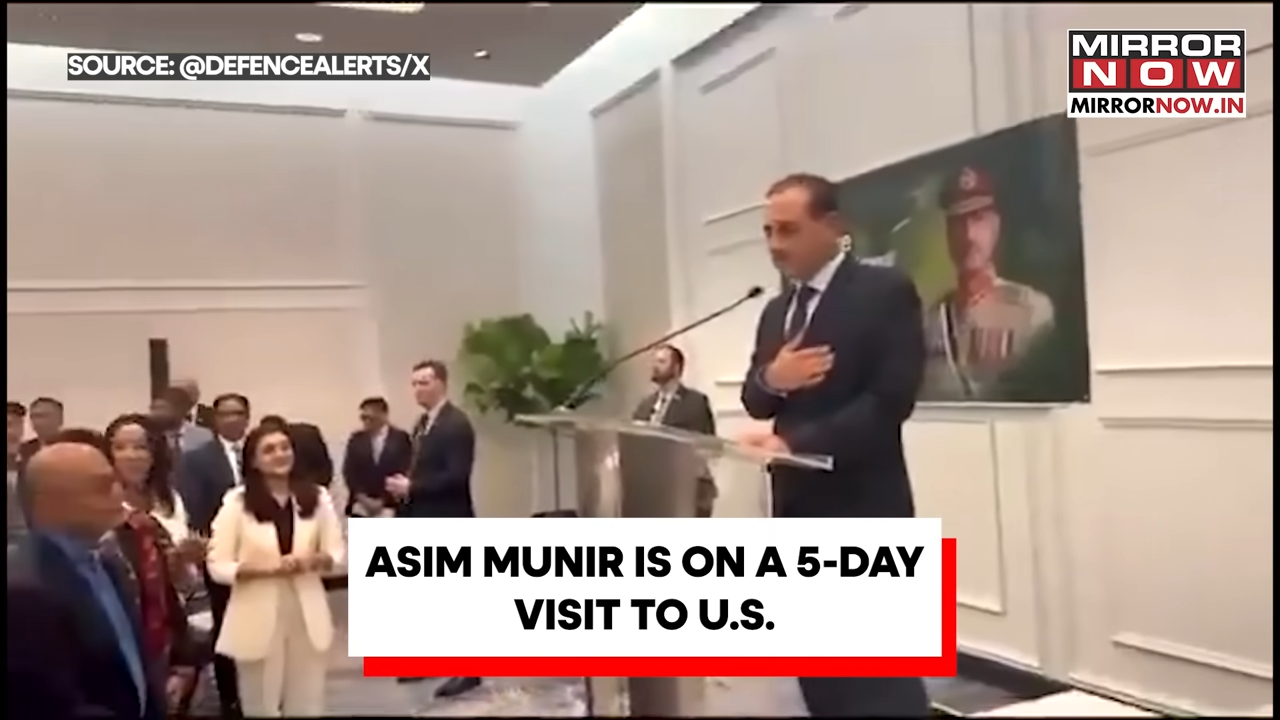
Asked yesterday about requesting Israel to hold off attacking Iran in order to get a peace initiative going, US President Donald Trump replied that he could make such a request but it is difficult to ask “the winning side” to stop! [‘The Source’ with Kaitlin Collins, CNN, June 20, 2025]
Now extrapolate that comment to his intervention May 9-10 in the India-Pakistan clash that Trump insists he ended, but complains he has not received the publicity or the credit for! — and what can one conclude? Essentially, that by America’s reckoning India was NOT WINNING — or why else, by the Trumpian logic, would Modi stop the Indian military operation when he did?
Indeed, why did India end its actions as soon as Trump came on the scene? Prime Minister Modi’s and external affairs minister S Jaishankar’s weak, flustered, and entirely unconvincing reactions that successfuly striking the important Pakistan air force bases, including the PAF command, control, communications hub at Nur Khan in Chaklala, was in fact the sole strategic objective, having achieved which the Indian government had no further interest in prolonging the “war”, is laughable. Surely, there was more planned than just these aerial attacks. What could those plans be? Perhaps, “kabaddi tactics” — army lingo, as a former theatre commander told me, for taking some terrain features across the LOC? But Sindoor was bereft of even such small actions.
Or, just may be, Trump’s call put Indian military plans — whatever they were — on hold after the aerial strikes, as the Indian PM scrambled — almost a reflex tendency of the Indian government in the new millennium, to please and pacify the US President by ending Sindoor right there and then.
Except, it spelled a tragic end to what could have been game-changing developments, including a deliberate hiving off of, say, the Haji Pir Salient, a significant portion of Pakistan-occupied Kashmir territory that could have been executed with a Division-size force, with the Pakistani forces inside the Bulge aerially bombed into pulp with Indian air dominance, for the Indian army units to mop up.
Such an end would have left the Pakistan army high and dry — an entity for the Pakistani people to mock — after all could General Asim Munir have declared a great victory as he did after Sindoor, with the Indian tricolour flying over Haji Pir? Munir, far from awarding himself the Field Marshal’s baton might have seen his “superiors” in the Corps Commanders Conference — all graduates of the Pakistan Military Academy, Karkul, handing him — a parvenu from the Officer’s Training School, Mangla, his backside on a platter, and an ignoble retirement. Instead, he lunched with Trump, heard the US President tell him (according to BBC News in Urdu) how “honoured” he [Trump] was to meet him, and to say “I love Pakistan” and, satisfyingly, saw a re-hyphenation India and Pakistan. He returned home with his celebrity as the Prophet’s own — the Man who would realise Gazwa-i-Hind, burnished!
And all because, as usual, the Indian leadership lacked the strategic sense and understanding to push for the military advantage staring them in the face! This has happened many times in the past, most egregiously, when Indira Gandhi terminated the 1982 operation that would have led to the Israeli Air Force, staging out of Jamnagar and Udhampur, bombing the crap out of Kahuta, with the underground weapons complex at nearby Golra then under construction, and ending the Pakistani nuclear weapons programme and aspirations for good. But the likes of PN Haksar and other advisers prevailed, and Indira G called off the action — for fear, get this! – of negative international opinion! That Israeli op had planned on IsAF F-16s dropping precision bombs and F-15 flying escort (combat air patrol), and would have worked as did the previous such Israeli action in 1981 that took out the Osiraq reactor complex in Baghdad.
Now consider an alternative scenario and outcome: Prompted by US intel and US Central Command CINC army General Michael Kurilla that Pakistan is too useful to the US to allow it go down, Trump calls Modi, say, the evening of May 9th. Aware of the missile strikes planned for midnight, the Indian PM commits to nothing. By 1000 hrs May 10th the situation is clear — missiles have taken out most of the major Pakistani air bases and radar complexes (such as Sargodha) and no coordinated PAF air activity is now possible. Such actions as the PAF can still muster would be from satellite fields without the infrastruture to sustain heavy actions. So, India achieves air dominance over Pakistani skies.
Assuming the Indian air force had anticipated this turn of events and a cued-in army had instantly begun probing actions by 1200 hrs and full push into the Haji Pir area by 1600hrs. All this would have happened after Trump called again, by when Modi would have stalled the White House by simply not getting on the phone — very busy with engagements, etc, after all the PM has a country to run that is multiple times more complex than the US, so very busy! Meanwhile, the US Kh-11 satellites and their humint penetrated deep inside GOI would have alerted Trump that the Indian army would take Haji Pir. A desperate Munir-Shehbaz would call Trump for help. Trump would find Modi not coming to the phone — again, very busy! By May 15-16, with IAF raining down bombs and Indian 155mm howitzers continuously pounding the Pakistani army formations inside the Haji Pir Bulge for the previous 5-6 days and the Indian army taking care of details, the Haji Pir, in this shock Indian action would have been vacated of any Pakistani presence, or would have had a “bag” of Pakistani army POWs.
So, finally when the PM would reach a phone, he could explain to Trump how he was busy, among other things, propitiating the Lord God of Odisha, Lord Jagannath, etc and gone into great detail about Odisha culture and so on, and bored Trump to tears. It would have completely thrown off Trump, mystified him no end, and upended his talking points. And Modi would explain to Trump the new reality on the ground — Haji Pir in J&K and how all was well with the world. And alert Trump to the fact that in case of future terrorist incidents, more parts of POK would similarly, automatically, and permanently be annexed and absorbed, and quote the relevant sections of international law on ceasefire lines, to stress the legitimacy of Indian military actions!
The US President’s relaying any idiotic Pakistani nuclear threat could have been met with a quiet dare to Munir to just try it. That would have done it for Munir, Pakistan, and American interference in Kashmir affairs. The trouble is India never finishes the job. At Simla in 1972, with 93,000 Pakistani POWs as leverage, Indira G could have enforced a victor’s peace — and wrenched all of POK including Gilgit Hunza and Baltistan from Pakistan, and formally settled the border on this new line stretching all the way from Gurdaspur to Skardu and points north. But the Indian PM succumbed to Zulfiqar Ali Bhutto’s sweet words and promises.
In Sindoor, taking Haji Pir would have incentivised Islamabad — on the pain of losing more and more of its POK in this manner, to formally accept the new LOC established as the international boundary. And ended the two-front nonsense the Indian military is so preoccupied with that it ignored for five decades the very real China threat until Galwan in 2020 knocked some sense into them — the previous major faceoffs in the Depsang Plains and in Dokla in 2017 apparently ringing no loud alarm bells.
Instead, what’s the scene post-Sindoor? Trump is publicly and playfully contemptuous of Modi, Munir lunches at the White House, the CDS futilely accounts for the Indian aircraft lost on May 7th, and the Defence Secretary, Rajesh Kumar Singh refers to Trump’s invitation to Munir — not Shehbaz Sharif — and the General’s running the show on the other side of the Radcliffe Line — as “an embarrassment” as if that is some great revelation!
Slim Pickings, ain’t it? This when India could have had so much more if only the Indian armed services were more on the ball and geared to grabbing military opportunities on the battlefield by their forelocks, and the Indian leaders had shown more self-respect, held their nerve, and brushed off Trump’s pressure. That, incidentally, would certainly have drawn regard and respect from Trump, who is in awe of strongmen, alpha leaders, who stand up to him. Recall how Kim Jong-un of North Korea tamed him, and Putin has him on a leash. And why he called Munir to the White House and, insultingly as an afterthought, also invited Modi — who thankfully had the good sense to decline. This last was the only good thing the Indian PM did post-Sindoor.
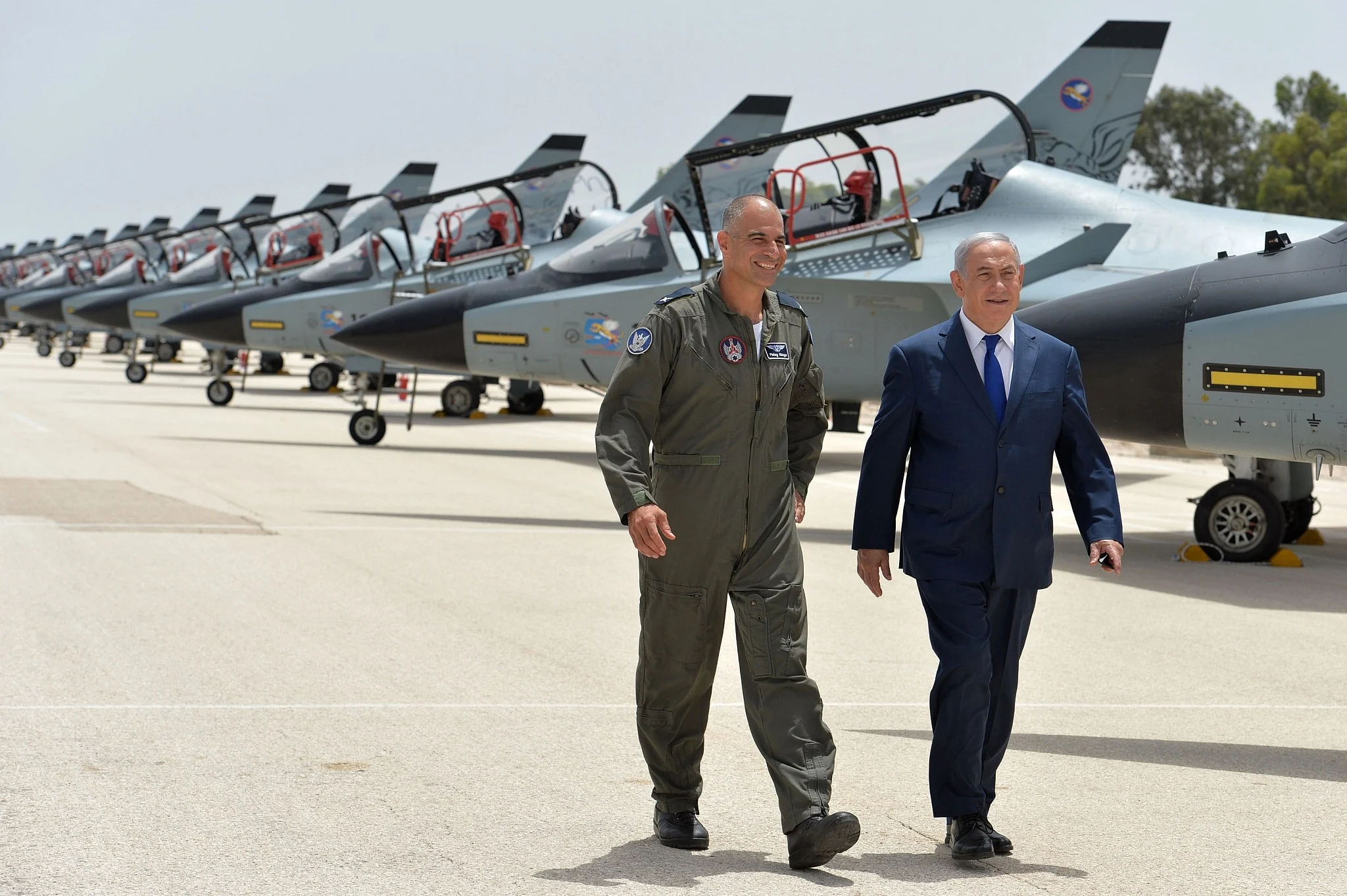
[Israeli PM Netanyahu & IsAF planes on flight line]
US President Donald Trump forbade Israel from striking Iranian nuclear sites. Because he wanted credit for a nuclear deal with Tehran he was in the process of negotiating. Netanyahu told Trump during his April visit — nothing doing, forcing the US government to pullout Americans from the region. In the face of American opposition, Israel unleashed a devastating series of air strikes very early this morning that may not have taken out the deep — half-mile deep underground centrifuge uranium enrichment facility at Fordow in the mountains near Qom, for lack of both the big deep earth penetrator bomb and large bomber aircraft to carry and drop it. US’ nonparticpation meant Israel did not have this combo of decisive weapon and delivery system.
But the strikes may have hit the secondary centrifuge plant at Natanz, other N-installations in Isfahan, ballistic missile factories, and longrange missile batteries as well. Not a country to leave a job half done, separate IsAF sorties decapitated the Iranian nuclear program and military leadership — killing the chief nuclear scientists and engineers and military authority, including Major General Mohammad Bagheri, Chief of Staff of the Iranian defence forces, and Major General Hossein Salami, chief of Pasdaran — Islamic Revolutionary Security Guard. The aerial war is being complemented, moreover, by Mossad activity on the ground inside Iran to neutralise, among other things, Iranian air defence systems, in a combined operation called ‘Rising Lion’. Interestingly. Rising Lion is open-ended with Mossad and IsAF acting in tandem to denature the Iran threat, once and for all.
Switch to Sindoor situation May 10. Air-to-ground strikes with long range missiles fired from Indian airspace — mainly Brahmos and Scalp, had afforded India near complete air dominance with the destruction of the C3 (command, control, communications) hub making coordinated air activity by PAF nearly impossible. The Indian army, at that point, should have pivoted smartly to a land offensive to, at a minimum, capture and reclaim Haji Pir in the disputed territory of Pak-occupied Kashmir. Of course, the Indian army had not prepared for any such “strike and annex” operation — the Indian military never prepares for capitalising on any half-chance offered on the battlefield, and of course it was not nimble enough to mobilise and push with the forces in the Uri, Mandi, Poonch subsectors to take the Salient in Pakistani hands, which has been a thorn in India’s fight against terrorism.
Instead, the next thing we see is the Indian Director General, Military Operations, for no good military reason — unless he was instructed by the Modi government to do so, accepting a Pakistani request for ceasefire! Sure, the fact that the Modi regime reacted so bitterly against Trump’s claiming success for ending this “three day” farce of an India-Pakistan “war”, suggests Prime Minister Modi was indeed arm-twisted into ending hostilities. The US has made no bones about just how close it is to Pakistan and why it is indispensable to American plans for the region. The retiring commander-in-chief, US Central Command, General Michael Kurilla, spelled it out — he praised Pakistan as a “phenomenal” partner in the fight against the Islamic State Khorasan.
The duo of Modi and Jaishankar seem, however, not to be convinced by something Washington daily broadcasts — that Trump is for “America First” and would kick NATO and Asian allies and partners aside if that served his purposes. They really believe India can close in with America and displace Pakistan. What does Kurilla know! So, we witnessed the jaunts at Indian taxpayer’s expense by MPs to faroff points to convince disinterested countries that (1) terrorism is bad, (2) Pakistan is terrorism Central, and (3) that India had won Sindoor! As far as I can make out, these trips, some to Islamic countries, had zero impact — Shashi Tharoor’s mellifluous verbosity, in particular, not making the slightest dent in Washington or New York.
The difference — and the real story here — is that while the Israeli PM Benjamin Netanyahu, claiming self-defence, attacked Iran and attacked again, even as Tel Aviv fights with Hamas in Gaza — the classic 2-front situation, and shrugged off US attempts at intervention, Modi gave into Trump without much coaxing and called off Sindoor before it had accomplished anything of note. And this when for Israel, US is a lifeline — for India, only a provider of resident visas for family members of senior GOI and military officers! The poor Chief of Defence Staff General Anil Chauhan was left handling the detritus of the Indian government’s buckling under. But, by his own reckoning, was just hitting Pakistani air bases the sole objective of the Operation by which outcome Sindoor is to be judged? That’s what Jaishankar said in Europe! How does it make any military sense to take out Pakistani air defence (SILLACS in Sargodha, etc) and PAF activity, and follow up with doing NOTHING?
It has always been a wonder to me just how quickly the Indian government and establishment folds at the merest hint of US/Western pressure — its own stated policy and the national interest, apparently of no account. This basic weakness at the heart of the Indian system is why India will remain forever — a middling power of little consequence.
It is not just Modi, Indira Gandhi, to remind everybody, was the one who called off — at the very last minute — the Israeli airstrikes in 1982 that were to be staged out of India that I have detailed in my books and in posts on this blog, to bomb Kahuta, and thus taken a nuclearised Pakistan off our concerns. We neither do the job ourselves, nor allow good friends to do it! What we do, however, is pretend and pretend some more about how Great and Good India is, even as a lowly, bankrupt, Pakistan regularly gets up our collective nose.
But, by way of compensating for lack of political will and fortitude to stand up for the national interest, and for genuflecting before Trump, Xi, anybody else, the Indian government keeps denuding the country’s treasury to fund wasteful procurements of useless combat aircraft — more Rafales or F-21s, Su-57s, more this and more that, most of this stuff that the Ukraine War has proved is obsolete, just to give the impression India has a great military — a military that rarely takes the initiative to do anything meaningful on the battlefield, is asked to do nothing meaningful, but merely to look good with new and shiny weaponry!

 Security Wise