Modi should not miss the opportunity to rid Maldives of Yameen NOW

Image result for pics of Maldives police

(The arrest and bloodying of Maldives opposition leaders)


The BJP government of Narendra Modi will rue not ousting Abdullah Yameen in Male now when it has the opportunity, the Maldivan opposition and people, and just cause on its side for doing so. That country’s supreme court has ruled Yameen’s imprisonment of the opposition party — Malidives Democratic Party (MDP) leaders illegal, a judgement that ipso facto voids the trumped up charges against Yameen’s political adversary and India’s friend — Mohammad Nasheed. It shows that between the political opposition and the Maldivan people, they have had enough of the idiosyncratic and authoritarian Yameen, who seems intent in depositing Maldives into China’s lap.

Nasheed has been vocal in propagating from his exile in Sri Lanka India’s right to replace Yameen, if necessary by forceful means.  In fact Nasheed has gone so far as to say that Maldives is in “Ïndia’s ocean” and that China has no role in it, and definitely not in his country. This reference to Ïndia’s ocean is a response to a Chinese admiral who some years back warned that “The Indian Ocean is not India’s ocean”.

Yameen  has been a thorn in India’s side and has for the last few years played Modi for the idiot he thinks the Indian Prime Minister is. Every time the situation reaches a crisis point — the last time recently when he ordered the police physically to bar the opposition members of Parliament from voting against his proposal to lease some atolls in his country to China, which would have ended that particular political pro-China initiative, he gauges Delhi’s reaction and just when he thinks the Indian govt may act, moseys over to Delhi. He did this and made peace with Modi. It is not certain what assurances the Indian PM was given by Yameen, but Delhi ended up doing nothing. Naturally Yameen has grown bolder, and has indicated he would disregard the court’s ruling and, Trump-like, change the political complexion of the supreme court by appointing his friends to the Court to ensure there are no legal challenges to his reign of terror hereafter. He is thus setting himself up as President for life of Maldives and China’s pet poodle in the region. If this isn’t provocation enough for Delhi, it is hard to know what is.

It is time for India to sort things out and for Modi to reassert India’s prime interest in having a friendly Maldivan regime at any cost — meaning without Yameen and his PPM anywhere in the picture. Yameen ought to be removed permanently from the scene. But Modi seems to be falling into the familiar do-nothing mode — the calling card of MEA and Indian diplomacy; perhaps concerting with the US to see what can be done. This is the WRONG THING for him to DO. He should without further ado immediately order a brace of frigates with a MARCOS contingent embarked on them to move post-haste to the Maldivan waters, disembark the MARCOS with full authority to disarm the Maldives police and what forces that country has and, along with a unit of army’s paracommando if needed, arrest Yameen and family and leadership elements of the corrupt ruling Progressive Party of Maldives (PPM), fly in Nasheed on special aircraft from  Colombo into Male, and hand over power to him. The Indian forces can remain to assist the new Nasheed dispensation purge the local administration, police, and forces of Yameen  and PPM sympathisers. And as a first order of his business ensure that all agreements with China are summarily scrapped.

There’s no time to lose. MEA’s habit of slow and ponderous  pondering can be left to after this commando action to forever remove the Yameen threat from Male. Modi is increasingly being seen especially in the external realm as clinging to the US apronstrings, fulminating against Pakistan, but talking and amity and peace with China, when the priority should be to consider China the main threat and take it head on. Xi, like his predecessors in office, is good  at pursuing Sun Tzu’s favourite tactic of playing up strengths and hiding weaknesses. West of Malacca, China should be made to actually feel the heat of its being on India’s turf. This India has never done.

This is how the international power game is played, not liaising with some big power or the other to see what’s the best way out of an increasingly difficult situation for India. Should Modi fail to act for any reason at all and permit Yameen to stay on, India may as well kiss Maldives good-bye and prepare to see a full-fledged Chinese naval base a stone’s throw away from the Indian mainland. It will be an ironic denouement considering all the brouhaha over Gwadar and the fact of a self-confessed “nationalist” BJP government being in power and Modi in command.

The question is: Is Modi alpha-male only for show, and at the hustings, or will he also act to protect India’s security and strategic interests?


Posted in asia-Pacific/Indo-Pacific, Asian geopolitics, China, China military, civil-military relations, Culture, Decision-making, Great Power imperatives, India's China Policy, India's Pakistan Policy, India's strategic thinking and policy, Indian Air Force, Indian Army, Indian Navy, Indian Ocean, Maldives, MEA/foreign policy, Military/military advice, Pakistan, Pakistan military, society, South Asia, Special Forces, Sri Lanka, Terrorism | 8 Comments

An inadvertently wise defence budget!

Image result for pics of jaitley -- budget

(Jaitley with defmin Sitharaman by his side)

India’s defence allocations in the 2018-2019 budget of Rs 2,95,511 crore, saw a meagre increase from Rs 2,74,114 crore last year, with  Rs 99,563.86 crore set aside for the capital stream, 80% of which sum will be consumed by “committed liabilities”, meaning to service the procurement contracts already signed for, and Rs 1,95,947.55 crore for revenue expenditure (day-to-day running and payroll costs). (The rocketing pension allocations have a separate budgetary dispensation.) It will have the armed services twirling their collective mustachios in anger. The armed forces had hoped for a bloc commitment of Rs 26.84 lakh crore (in excess of $400 billion) for the next five years to ensure their modernization plans proceeded smoothly rather than fitfully as they are fated to do now.

The 13th Defence Plan had projected, Rs 12,88,654 crore as the capital outlay, and Rs 13,95,271 crore as the revenue spend. Both the defence five-year plans and the 15-year long-term integrated perspective plan are formulated to conform to the defmin’s “operational directives” but, as newspaper reports have noted, like the 10th (2002-07), 11th (2007-12) and 12th (2012-17) Plans, it too is unlikely to be approved by Finance Ministry.
If the armed services have a reason to feel neglected, consider what would happen if their expenditure plans are fully funded. The country will be stuck with a World War 2 vintage order-of-battle — the same old hardware — more tanks, APCs, artillery, air defence guns, tracked guns, etc. , which remains determinedly uncued to changes in the cyber regime, and in the evolution of small lethal drones that can be maneuvered in swarm to take out individual tanks — large unmissable targets, and defeat vast tank armies with equal ease, small, guided, submersible drones to sink warships, and hard-flying drone-projectiles to destroy by collision, combat aircraft. The Indian military seems completely innocent of these technology trends, and the Indian government without, apparently, a smidgeon of technology trend-spotting expertise, merrily funds or doesn’t whatever the armed services put before it.
So, the taxpayer has to ask himself: Is less harm done, less monies wasted. by not having a large defence budget than giving into “nationalistic” impulses and seeing the scarce national financial resources being grossly misused, as always, on propping up useless, dated genus of hardware?
In a sense, the Modi government has to be commended for holding its nerve and not trying to win cheap applause with increased defence spend — because surely there will now be uninformed calls from the opposition ranks led by the Congress party for surge funding of unnecessary goods the military  would love to buy.
Resources are not the problem, what is is the Indian military’s mindless prioritizing of usually shortlegged weapons platforms and the like, and generally its  spendthrift ways. And short of a single, integrated, command structure there will be no structural mechanism for inter se prioritization of the three Services’ demands and requirements, and the country will always be shortchanged in terms of not getting the security it pays for.
So, yes, Finmin Jaitley tripped in doing the right thing without quite knowing why! But the good that comes from even inadvertent developments is no bad thing.
Posted in asia-Pacific/Indo-Pacific, Asian geopolitics, civil-military relations, Decision-making, Defence Industry, domestic politics, DRDO, Europe, Geopolitics, Great Power imperatives, India's strategic thinking and policy, Indian Air Force, Indian Army, Indian ecobomic situation, Indian Navy, Indian Ocean, Internal Security, Military Acquisitions, Military/military advice, society, South Asia, Weapons | 5 Comments

Hurt China in its soft under-belly

Image result for pics of sihanoukville port

(Sihanoukville, main port of Cambodia)

Indian foreign and strategic policies suffer from perennial weaknesses. One of them is the Indian government’s/MEA’s lack of what the great geopolitical theorist, Sir Halford Mackinder, called “the map reading habit of mind”.  That’s why India’s foreign policy is usually bereft of a geopolitical frame and undergirding. Further, even when there is a glimmer of geostrategic understanding visible in a stance, it is voided by the tardiness in following up on policy initiatives. For example, the country’s “Look East” policy first enunciated by PM Narasimha Rao in the early 1990s remained just “looking” for some 30 years — a very long time for the policy to lose steam. Only in the last years of the Manmohan Singh regime did the pace pick up in this respect but fell short for want of boldness. Well into the Modi era, Vietnam and Indonesia, repeatedly pleaded for the Brahmos supersonic cruise missile but the invariably frightened Indian government didn’t get up the courage to sell it to them because of the fear of Chinese reaction. Indeed, there’s still some uncertainty about the Brahmos deal to Vietnam. But in his penultimate year in office (of his first term), Modi has finally mustered the vision to do something truly strategic for a change.  He is fully into courting Cambodia. To wrench Cambodia and Laos out of China’s grasp would be to hit Beijing in the gut — because these two states constitute China’s soft under-belly.

Look at the map. Vietnam is viscerally anti-China and so are, in varying degrees, the other ASEAN states on the South China Sea. Land-bound Laos and Cambodia on the littoral are the exceptions. Cambodia is of particular importance to Beijing because of its frontage on the Gulf of Siam (Thailand). Without access to this frontage on the South China Sea , the Chinese Navy would have no friendly landfall anywhere in Southeast Asia in war time. It would make difficult sustained maritime operations by the Chinese Navy even in this sub-region — with Hainan as the nearest base. That’s why China has been so solicitous of the Cambodian strongman Hun Sen. Except now Hun Sen will stay on after the other regional leaders have departed to enjoy some  special treatment — a State Visit just for him with all the pomp and ceremony Delhi can dial up to impress him. If the bait is half-way big and juicy enough he will bite because there’s almost palpable  interest in Pnom-Penh to get out from under the Chinese tutelage. And if Cambodia is detached from China, Laos will come unstuck from China soon enough. Vientiane, like Pnom Penh, has played a canny game, balancing between the benefits of the ASEAN and its connection to the West and the offers of Chinese subsidies, investments and trade concessions that have kept his country above water.

It is significant that all the heads of state/government of the ASEAN agreed to be co-chief guests at the 2018 Republic Day celebrations, suggesting that there is now a collective consciousness among the ASEAN group about the perils of being in hock to China economically or being vulnerable, security-wise, to Beijing which plays with a heavy hand.  India is avidly sought as the alternate power node that can also provide security and free up the policy options for all of them.  It is an opportunity not to be missed. The likelihood, however, is that India will once again miss it. Because MEA’s delivery mechanism is faulty in the extreme — but that’s for another post!

What can Modi offer Hun Sen and, by extension, to Thongloun Sisoulith of Laos? Assistance to restore the Angkor Wat Temple complex is an ongoing Indian programme, but it is old school, encompassed by Modi’s rhetoric of India’s civilizational reachout to Southeast Asia, etc, and lacks the bite. This approach in the 21st Century, moreover, has severe limitations. What Hun Sen will appreciate are things like a programme to modernize the Cambodian railways and roadways, and to help build east-west telecommunications connectivity, all of which can be subsumed under the ‘Ganga-Mekong’ Plan envisaged during Vajpayee’s time. This will have to be done at India’s cost, and which grant-in aid will be a worthwhile investment. Pnom-Penh could be afforded an additional $5 billion credit line to import capital goods from India — which will boost the country’s manufacturing sector and open a new market for it, with the understanding that these goods will be moved to- Cambodia on Indian bottoms, thereby giving a fillip to Indian shipping companies. And India should undertake to re-equip the Cambodian armed services and to train their select officers and JCOs on a regular basis  at Indian military institutions here.

What Modi should ask for in return is the kind of logistics agreement India recently signed with Singapore that allows pre-positioning of naval and military stores and the use of the Sihanoukville port on the Bay of Kampong Som by the Indian Navy — the only deep water port in Cambodia and, use of the airport in the port area for use by Indian Air Force Su-30 fighter squadrons. It will be a deal that Hun Sen might readily agree to because it will principally show India’strategic intent, and lend him some breathing space vis a vis Beijing. And it will be reassuring to other ASEAN states, especially to Laos to the north. China will probably respond with increased aid, credit, etc. but it won’t overcome the desire of the Cambodians and Laotians to escape Beijing’s suffocating embrace.

By thus making the first cut on the Chinese umbilical to Southeast Asia, Delhi will signal its determination to counter China at every step and to establish an enduring Indian presence in these parts. Will Modi do any of this? His record does not hint that he will because, he says, he so hates doing anything disruptive.


Posted in arms exports, asia-Pacific/Indo-Pacific, Asian geopolitics, China, China military, Decision-making, Defence Industry, DRDO, Geopolitics, Great Power imperatives, India's China Policy, India's strategic thinking and policy, Indian Air Force, Indian Army, Indian ecobomic situation, Indian Navy, Indian Ocean, MEA/foreign policy, Military/military advice, Myanmar, society, South Asia, South East Asia, Strategic Relations with South East Asia & Far East, Vietnam, Weapons | 17 Comments

Fairy tales about the “Indian” F-16

Image result for picso the F-16 block 70

(Block 70, F-16)

A pink paper carried a startling bit of news suggesting that Lockheed Martin had readied a variant of its frontline F-35, in service with the US military and allied air forces, for offer to the Indian Air Force.   https://economictimes.indiatimes.com/news/defence/lockheed-proposes-making-custom-built-fighter-jets-in-india/articleshow/62580903.cms

But scroll down the story a bit and one sees the catch.  Vivek Lall, head of Lockheed,  India, is talking about the Northrop Grumman APG-83 AESA radar with supposed 95% commonality with the radar on the F-35, being on the F-16 Block 70 pitched to India. This feature has led Lall to purposely obfuscate issues and try and sell the F-16 as another version of the F-35. To tweak that old saw some, sticking small tusks on a pig doesn’t turn it into a dangerous warthog.

As I long ago warned in my posts, Trump very early talked about retaining at least 25% of the F-16 production in the US itself — mainly to fulfill his promise to keep manufacturing jobs in America. The last F-16 inducted in the US Air Force was in 1997. And , it is in the interest of Lockheed to replace as fast as possible all F-16s in the US — whether in USAF or in the various state Air National Guard (of which George W Bush was a member — his rich and influential Pappy and former President, George HW Bush, having arranged this safe posting in the Texas unit than see his son risk his neck in the Vietnam War) with F-35s. This essentially means that the supposed 2,000-odd F-16s in the US are not going to be there to be serviced by the aircraft spares and assemblies produced in India.

That should at a stroke eliminate a big chunk of the incentive for India to manufacture this late-Sixties vintage — 50 year old — combat aircraft that will be ready to move right off the Indian assembly line and into museums or the junk yard. (This last was the denouement faced, incidentally, by the underpowered Marut HF-24, which were flown out of HAL premises straight to IAF aircraft graveyards!) That’s the reason why Lockheed is canvassing furiously with the Trump White House to relent on this issue of keeping part of the F-16 production in its plant in Forth Worth.

In any case, with the F-16 phasing out of the USAF, America’s traditional allies and partners too will hanker for the successor F-35, which Lockheed will happily undertake to replace as well. This will motivate Lockheed to open more assembly lines for the F-35 to meet the rush demand from foreign customers. So, where exactly is the “international market” that Lockheed is promising for the Indian-made F-16 and for its spares, etc.??

It surely is not merely enough to “make in India”. There has to be a market for whatever is produced here by foreign companies beyond what the Indian market can offtake. In this context, what to make of the song and dance that Lockheed, the Pentagon, Ashley Tellis, the US thinktanks — Carnegie, Brookings, based in Delhi and in Washington, and the army of F-16 pluggers in the Indian media make about India becoming part of a “global supply chain”??

Sure, the period to replace the F-16 in the fleets of numerous air forces with the F-35 will stretch over the next 10-15 years at most. But the Blk 70 entering IAF will stay on for 40-50 years from the year of its entry into the fleet — should this happen — by, say, 2022. Is it anyone’s argument that this old crone of an aircraft can realistically serve until 2060-2070, when advances in air defence technologies, evident since the late 1980s, are already making manned combat flying a frightfully dangerous undertaking, and by 2030 will make it extinct? Like the Dodo bird. Or, the dinosaur.

It provides further proof, if it was needed, that the Indian military, like the Indian government and its agencies, including DRDO, are not perspicacious spotters of technological trends. Or, India wouldn’t be in the mess it is now.

Meanwhile, the wily Fiza’ya (Pakistan Air Force), which has operated the F-16 for the last 30 years, will be desperately hoping the GOI-IAF combine afford it the opportunity to make a meal of the prospective Indian F-16 contingent. Meanwhile, the contempt PLAAF, that is bidding fair to achieve parity with the USAF with its unending series of new aircraft, especially the J-20, that it seemingly effortlessly rolls out of it aircraft design bureaus and factories, feels for its Indian counterpart will be reinforced.

So, what’s new?

Posted in arms exports, asia-Pacific/Indo-Pacific, Asian geopolitics, China, China military, civil-military relations, Decision-making, Defence Industry, DRDO, Europe, Geopolitics, Great Power imperatives, India's China Policy, India's strategic thinking and policy, Indian Air Force, Indian Army, Indian ecobomic situation, Indian Navy, Military Acquisitions, Military/military advice, Pakistan, Pakistan military, society, South Asia, Strategic Relations with the US & West, Technology transfer, United States, US., Weapons | 5 Comments

Su-30 — back in favour?

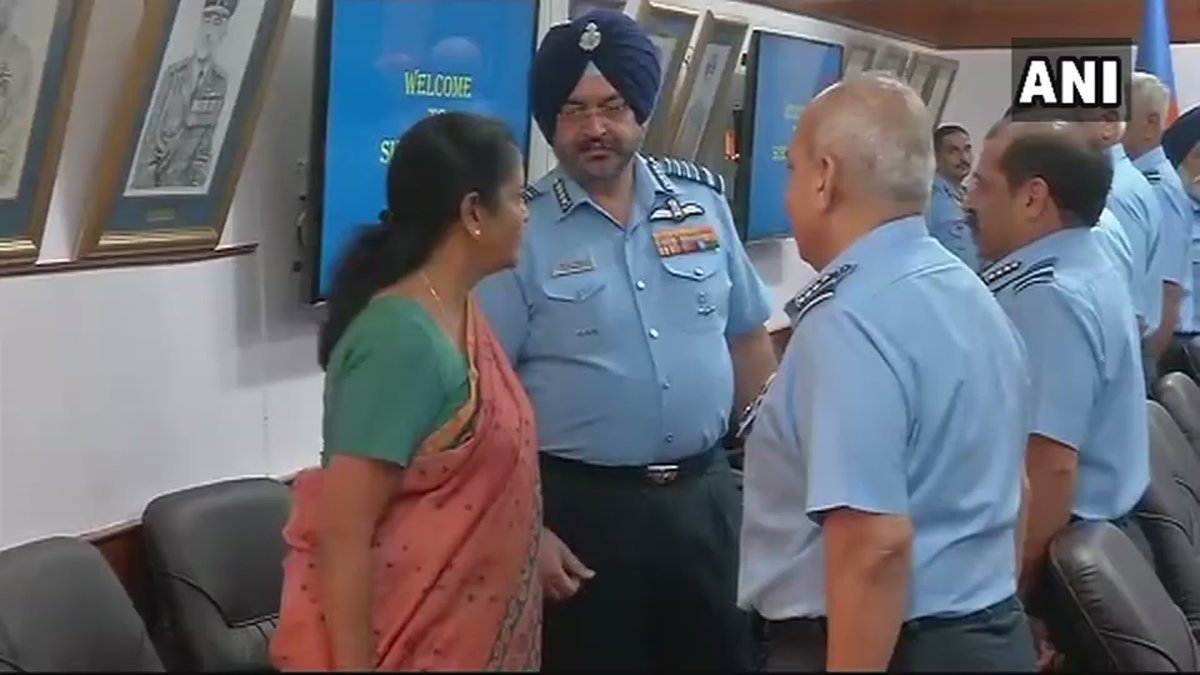
(Sitharaman at Air HQrs with CAS Dhanoa and senior commanders of IAF)

Defence Minister Nirmala Sitharaman is, at her instance, going to fly in a Su-30 MKI tomorrow. Whether it is just a joy-ride, or an indication of the govt going with this plane as an answer to the urgent need to augment fighter squadrons, is not known. But there are signs that the Modi regime is finally reconciling to reality and the extreme scarcity of financial resources, especially in the period leading up to the 2019 general elections, when the state treasury is sought to be properly husbanded and marshaled for domestic social welfare programmes to maximally impress the electorate.  So, acquisition of the Swedish Gripen E, as also consideration of the Sixties’ vintage Lockheed F-16 Blk 70, has been pushed out of the picture (for now at least). And the finalization of the Rafale deal is also being put off.

It just so happens, as I have been advocating — look up all the posts over the years on this topic — that the Su-30 is at once the best fighter aircraft anywhere and the most cost-effective solution considering India has a 272-strong fleet already and produces it under license. One assumes the GOI will scrape up the monies to upgrade this entire fleet to the “Super Sukhoi” configuration with a new, more powerful, engine, better, more advanced, avionics, and an AESA radar to switch missions mid-sortie, from A2G to A2A and back. And the upgrade project will be for about a third of the cost of the Mirage 2000 upgrade programme. The bulk of the Sukhois will be upgraded at HAL, Nasik

IAF may consider the Su-30 a make-do solution. Were it not for its institutional tilt favouring Western combat aircraft, Vayu Bhavan would have long ago realized and appreciated the Super Sukhoi as an excellent solution to fill up the air orbat with a really superb aircraft.

This decision was also probably prompted by signals from Moscow that the relations were in difficult straits and hurting and a deal like this was needed to affect a recovery.


Posted in arms exports, asia-Pacific/Indo-Pacific, Asian geopolitics, civil-military relations, Decision-making, Defence Industry, DRDO, Europe, Geopolitics, Great Power imperatives, India's strategic thinking and policy, Indian Air Force, Indian ecobomic situation, Military Acquisitions, Relations with Russia, Russia, russian assistance, society, South Asia, Strategic Relations with the US & West, Technology transfer, United States, US., Weapons, Western militaries | 10 Comments

What’s the problem with Indo-Israeli relations?


Image result for pics of netanyahu and modi

Many moons ago — in 1994 in fact, in my first book  — ‘Future Imperilled: India’s Security in the 1990s and Beyond’ (Viking-Penguin), in the lead chapter,  I had detailed a geopolitically ambitious security architecture for India anchored at the two ends of Asia, in the “tech savvy” Israel and the economically-muscular Japan, with India as the natural pivot able to switch forces and resources east and west, with the Southeast Asian littoral on the South China Sea that I had identified as China’s “soft underbelly” and the front where India needed to begin its pushback against China. 24 years later, that scheme is being realized, albeit fitfully. The blame for the tardiness in obtaining this geostrategic design is, however, entirely Delhi’s owing to the Indian government’s default option — which tendency first became apparent during Narasimha Rao’s tenure — of looking to America for solutions, rather than getting on with the strategic business of the country and furthering one’s interests in the most aggressive way possible by itself.

Around 2000, I had written  a paper for presentation at a Conference at the University of the Negev, which event was cancelled owing to the initiation of the 2nd Palestinian intifada (2000-2005) virtually on the eve of the conference. This paper advocated a meshing of Indian and Israeli defence industries with, in broad terms, India providing the main market and part of the investment for development of high-tech armaments and miltech, and Israel its design and development skills and competencies and a transfer of its production wherewithal to manufacture conventional military bulk goods — infantry weapons, artillery, tanks etc. fully to India to meet the needs of the two countries, and for export to states in Africa, Asia and Latin America. I had argued that such a combination would result in the emergence of one of the most formidable integrated military-industrial complexes in the world, besides serving the strategic purposes of the two countries.

My advocacy of such a Combine led, around 2002 or so, to the Israeli Home Minister Uzi Landau, and the head of Mossad on a Delhi trip, visiting with me. Intrigued by my concept, Landau promised to give it serious consideration. A year later and during the trip to Delhi by Israeli PM Ariel Sharon I asked about this proposal but it hadn’t progressed much in Israeli policy circles. Fast forward another 2 decades and there’s finally the first small move in this direction with the Indian govt now insisting that Israeli companies manufacture in India 60% of what they sell to the Indian armed forces. There’s a bit of coercion here. But one would have thought Tel Aviv would have long ago  recognized the merits of transitioning from a seller-buyer relationship to strategic co-production ere the Modi regime forced its hand.

What got the BJP govt to act was the dissatisfaction with a growingly transactional relationship — that I have pointed out in my previous posts — where the benefits were mostly one-way, with Delhi mainly forking out the funds and even in collaborative projects DRDO left with missile back end work, not the high-value stuff at the front end concerning the target seeker and propulsion tech on MRSAM and LRSAM projects, for instance. It is the sort of thing that I had warned wouldn’t last long.

It is in this context that Israeli PM Benjamin Netanyahu touches down in Delhi with Modi at Palam to receive him. Hugs and genuine warmth between the two principals will make for a feel-good occasion and trip by the Israeli leader, whose delegation also packs movers and shakers of that country’s corporate world who have turned Israel into the “start-up nation” of lore, and who will be urged by their government to strike deals with their Indian counterparts and otherwise begin establishing Israeli presence on the Indian high-tech scene.   This is all fine.

Except, one of the basic hurdles — other than the problems mentioned above — is the reluctance of Israeli (and other foreign) techno-entrepreneurs and investors from setting up shop in India, owing to the obstacle course of laws, rules and regulations they have still to run, and which the Modi regime has not smoothed out, including the little matter of foreign investment restrictions of 49% equity holding. Without controlling interest, no foreign company will want to have to do much with India, especially if it also involves bringing in cutting-edge technologies, Netanyahu’s and Modi’s rhetoric notwithstanding.

Military R&D is capital intensive business, India is solvent, boasts of  a large market for Israeli products — but the Indian government doesn’t follow-up on commitments and promises it makes to foreign leaders. This will likely again derail whatever Modi and Netanyahu may formally decide to achieve.

Posted in Africa, arms exports, asia-Pacific/Indo-Pacific, Asian geopolitics, Decision-making, Defence Industry, DRDO, Geopolitics, Great Power imperatives, India's strategic thinking and policy, Indian Air Force, Indian Army, Indian ecobomic situation, Indian Navy, Indian para-military forces, indian policy -- Israel, indian policy -- Israel, Iran and West Asia, MEA/foreign policy, Military Acquisitions, Military/military advice, Missiles, society, South Asia, Technology transfer, Terrorism, United States, US., Weapons | 9 Comments

India-Israel Relations

A panel discussion aired January 11, 2018 on the Rajya Sabha TV programme — ‘The Big Picture’ with former diplomats Virendra Gupta & Ashok Sajjanhar. KV Prasad of the Tribune (Chandigarh) and myself.

Posted in arms exports, asia-Pacific/Indo-Pacific, Asian geopolitics, Decision-making, Defence Industry, DRDO, Geopolitics, Great Power imperatives, India's strategic thinking and policy, Indian Air Force, Indian Army, Indian ecobomic situation, Indian Navy, indian policy -- Israel, Intelligence, Internal Security, Israel, MEA/foreign policy, Military Acquisitions, Missiles, society, South Asia, Technology transfer, Terrorism, United States, US., Weapons, West Asia | 3 Comments

Challenges for Defence Forces

Panel discussion on “Challenges för Defence Forces” on the Rajya Sabha TV programme — ‘Security Scan’ broadcast December 28, 2017, featuring retired VCAS, Lt Gen Philip Campose, Saikat Datta of Asia Times and myself.


Posted in arms exports, asia-Pacific/Indo-Pacific, Asian geopolitics, China, China military, Culture, Decision-making, Defence Industry, domestic politics, DRDO, Geopolitics, Great Power imperatives, India's Pakistan Policy, India's strategic thinking and policy, Indian Air Force, Indian Army, Indian ecobomic situation, Indian Navy, Indian Ocean, Military Acquisitions, Military/military advice, Missiles, Pakistan, Pakistan military, society, South Asia, Special Forces, Strategic Relations with the US & West, Technology transfer, United States, US., Weapons | 1 Comment

Tough US Stand on Pak: Implications

Panel discussion aired January 8, 2018 on Rajya Sabha TV programme ‘India’s World’, with former Foreign Secretary Shashank, ex-High Commissioner to Pakistan TCA Raghavan, and yours truly.

Posted in Afghanistan, asia-Pacific/Indo-Pacific, Asian geopolitics, Central Asia, China, China military, civil-military relations, Culture, Decision-making, Geopolitics, Great Power imperatives, guerilla warfare, India's Pakistan Policy, India's strategic thinking and policy, Indian Army, Internal Security, MEA/foreign policy, Military/military advice, Pakistan, Pakistan military, society, South Asia, Special Forces, Terrorism, United States, US. | 9 Comments

Quo vadis CDS?


Image result for modi reviewing troops

Defence Minister Nirmala Sitharaman has righted a wrong and done her bit to restore to the military some equity and sense of pride. Referring here to the October 2016 note issued by MOD that equated the status of a 2-star rank officer of the armed services to that of Principal Director in MOD, with repercussions down the line. That this decision to thus downgrade Major Generals/Air Vice Marshals/Rear Admirals was taken by Manohar Parrikar well into his tenure as defence minister suggests he was not paying attention. Or, alternatively, that he was happy to be led by the nose by the ICS/IAS-wallahs who ever since 1947, after getting a reprieve from prime minister Nehru who once seriously considered dismantling the colonial-era ICS and starting anew,  have relentlessly upped their relative status and benefits at the expense not just of the military services but also other, even technical, All India Services.

It is a good thing that this Parrikar decision has been reversed. But it only highlights what the Modi government has failed to do — install the Chief of Defence Staff system that all major, more advanced, militaries long ago adopted. Parrikar, soon after assuming office, had assured the public that a decision would be made soon on CDS and that it was a priority. Time passed, and there was no CDS. But a committee under retired Lieutenant General DB Shekatkar was set up by Parrikar to look into this and other matters relating to defence and national security. It, in effect, endorsed the recommendation of the Naresh Chandra Committee on national security set up by the previous Congress Party dispensation. Considering it was headed by a bureaucratic “ustad” — Chandra, a former, defence, home, and cabinet secretary (!) whose ability to run circles around politicians to the benefit of the IAS had attained legendary status in babu circles, this committee produced a classic non-decision — appointment of a 4-star officer as CDS without changing the extant system. In practice this would have meant the Integrated Defence Staff HQrs changing nomenclature-wise into CDS but everything else remaining the same. It was a clever, very clever, ruse — worthy of Chandra’s ustad status, to keep both the IAS and the current armed services chiefs happy, and the situation unchanged. The civil servants’ headlock of  the military was retained. And, as far as the armed services were concerned, so was the supremacy of the chiefs of staff. In the existing system, the chief of staff  is both the administrative and operational head of his armed service — whence his enormous power — power and authority that no service chief would voluntarily surrender to a genuine, full fledged, CDS. Consequently, the 4th 4 star would be the junior most minus any power, authority or standing, able to do nothing and, for all intents and purposes, will be only a figurehead, not the single point adviser to government on all matters relating to defence and the armed services as the post signifies. Unfortunately, the Shekatkar Committee did not articulate its CDS recommendation in any way different than the Chandra Committee.

This is the reason why deposing before the Committee on Higher Defence Organization chaired by Rajiv Gandhi’s Defence Minister, (now late) KC Pant, (with also now late Air Cmde Jasjit Singh as Member-Secretary) set up during Vajpayee’s time (in the very early 2000s), I had pleaded for the imposition of the CDS system on the military along the lines the original “unification” of the US armed services (with the much later Goldwater-Nicolls Act “plugging the loopholes”) was imposed by the strong willed President Harry S Truman. Truman, incidentally, dismissed several carrier admirals who dared to oppose his political decision. US Navy was the senior service and resented allowing army, army air force  (later the separate US Air Force) parity– no small show of political grit in the wake of the successes of the US aircraft  carriers in the Pacific War against the great Imperial Japanese Navy.

I had warned the Committee formally, and Mr Pant privately, that if the CDS was not imposed and the services chiefs were approached for their opinions, this reform would sink without trace   — and I had specifically mentioned the Indian Air Force in this regard. The army is for it because as the senior service it expects to monopolize the CDS post. The navy is too small to matter and on paper has no strong views on it. It is the IAF which is convinced that with army in the fray it will always lose out to the army candidate and will have the mortification of a landlubber deciding the fate of the air force. All the Armed Services, however, are loud in proclaiming their support for CDS! The Pant Committee chose to ignore my counsel, and as I had forewarned, the whole thing panned out exactly as I had foreseen, as also the way the institutional resistance to the concept stacked up. CDS is still no-go for IAF, and will remain so unless a strong leader thrusts the CDS down the entire MOD caboodle, including and especially the IAS manning its top echelons, even if this means sacking any civil servant and chief off staff opposing the development. Because, necessarily, a CDS would end the anomaly — a completely idiotic one that, under business rules of the government, Defence Secretary is responsible for the defence and security of the country!!!

Alas, Modi is not that leader in the main because, his public stance apart, he is contemptuous of military officers generally because of such trivial issues as their anglicised ways, including having a drink or two in the evenings in the Mess. Senior officers who dealt with him when he was Gujarat CM tell stories about his dismissive attitude towards them, and his snarky comments to the effect that they are unavailable for dialogue and discussion after eight, etc. Assuming the PM can spare some time from his preoccupation with winning the 2019 general elections, Modi would be well advised to get over his unwarranted prejudice against the officer cadre of the armed forces, dispassionately study the issue, and use his common sense to alight on the CDS system to replace the mess that the country has in the present structure of the 3 Services and their fraught relationship with MOD. He can then instruct Sitharaman to green signal CDS for a system transformation — because independently the defence minister is too much a political light weight to do anything this substantial on her own.

Posted in asia-Pacific/Indo-Pacific, Asian geopolitics, civil-military relations, Culture, Decision-making, domestic politics, Great Power imperatives, India's strategic thinking and policy, Indian Air Force, Indian Army, Indian Navy, Japan, Military/military advice, society, South Asia, United States, US. | 1 Comment