
A panel discussion aired January 11, 2018 on the Rajya Sabha TV programme — ‘The Big Picture’ with former diplomats Virendra Gupta & Ashok Sajjanhar. KV Prasad of the Tribune (Chandigarh) and myself.
A panel discussion aired January 11, 2018 on the Rajya Sabha TV programme — ‘The Big Picture’ with former diplomats Virendra Gupta & Ashok Sajjanhar. KV Prasad of the Tribune (Chandigarh) and myself.
Panel discussion on “Challenges för Defence Forces” on the Rajya Sabha TV programme — ‘Security Scan’ broadcast December 28, 2017, featuring retired VCAS, Lt Gen Philip Campose, Saikat Datta of Asia Times and myself.
Panel discussion aired January 8, 2018 on Rajya Sabha TV programme ‘India’s World’, with former Foreign Secretary Shashank, ex-High Commissioner to Pakistan TCA Raghavan, and yours truly.

Defence Minister Nirmala Sitharaman has righted a wrong and done her bit to restore to the military some equity and sense of pride. Referring here to the October 2016 note issued by MOD that equated the status of a 2-star rank officer of the armed services to that of Principal Director in MOD, with repercussions down the line. That this decision to thus downgrade Major Generals/Air Vice Marshals/Rear Admirals was taken by Manohar Parrikar well into his tenure as defence minister suggests he was not paying attention. Or, alternatively, that he was happy to be led by the nose by the ICS/IAS-wallahs who ever since 1947, after getting a reprieve from prime minister Nehru who once seriously considered dismantling the colonial-era ICS and starting anew, have relentlessly upped their relative status and benefits at the expense not just of the military services but also other, even technical, All India Services.
It is a good thing that this Parrikar decision has been reversed. But it only highlights what the Modi government has failed to do — install the Chief of Defence Staff system that all major, more advanced, militaries long ago adopted. Parrikar, soon after assuming office, had assured the public that a decision would be made soon on CDS and that it was a priority. Time passed, and there was no CDS. But a committee under retired Lieutenant General DB Shekatkar was set up by Parrikar to look into this and other matters relating to defence and national security. It, in effect, endorsed the recommendation of the Naresh Chandra Committee on national security set up by the previous Congress Party dispensation. Considering it was headed by a bureaucratic “ustad” — Chandra, a former, defence, home, and cabinet secretary (!) whose ability to run circles around politicians to the benefit of the IAS had attained legendary status in babu circles, this committee produced a classic non-decision — appointment of a 4-star officer as CDS without changing the extant system. In practice this would have meant the Integrated Defence Staff HQrs changing nomenclature-wise into CDS but everything else remaining the same. It was a clever, very clever, ruse — worthy of Chandra’s ustad status, to keep both the IAS and the current armed services chiefs happy, and the situation unchanged. The civil servants’ headlock of the military was retained. And, as far as the armed services were concerned, so was the supremacy of the chiefs of staff. In the existing system, the chief of staff is both the administrative and operational head of his armed service — whence his enormous power — power and authority that no service chief would voluntarily surrender to a genuine, full fledged, CDS. Consequently, the 4th 4 star would be the junior most minus any power, authority or standing, able to do nothing and, for all intents and purposes, will be only a figurehead, not the single point adviser to government on all matters relating to defence and the armed services as the post signifies. Unfortunately, the Shekatkar Committee did not articulate its CDS recommendation in any way different than the Chandra Committee.
This is the reason why deposing before the Committee on Higher Defence Organization chaired by Rajiv Gandhi’s Defence Minister, (now late) KC Pant, (with also now late Air Cmde Jasjit Singh as Member-Secretary) set up during Vajpayee’s time (in the very early 2000s), I had pleaded for the imposition of the CDS system on the military along the lines the original “unification” of the US armed services (with the much later Goldwater-Nicolls Act “plugging the loopholes”) was imposed by the strong willed President Harry S Truman. Truman, incidentally, dismissed several carrier admirals who dared to oppose his political decision. US Navy was the senior service and resented allowing army, army air force (later the separate US Air Force) parity– no small show of political grit in the wake of the successes of the US aircraft carriers in the Pacific War against the great Imperial Japanese Navy.
I had warned the Committee formally, and Mr Pant privately, that if the CDS was not imposed and the services chiefs were approached for their opinions, this reform would sink without trace — and I had specifically mentioned the Indian Air Force in this regard. The army is for it because as the senior service it expects to monopolize the CDS post. The navy is too small to matter and on paper has no strong views on it. It is the IAF which is convinced that with army in the fray it will always lose out to the army candidate and will have the mortification of a landlubber deciding the fate of the air force. All the Armed Services, however, are loud in proclaiming their support for CDS! The Pant Committee chose to ignore my counsel, and as I had forewarned, the whole thing panned out exactly as I had foreseen, as also the way the institutional resistance to the concept stacked up. CDS is still no-go for IAF, and will remain so unless a strong leader thrusts the CDS down the entire MOD caboodle, including and especially the IAS manning its top echelons, even if this means sacking any civil servant and chief off staff opposing the development. Because, necessarily, a CDS would end the anomaly — a completely idiotic one that, under business rules of the government, Defence Secretary is responsible for the defence and security of the country!!!
Alas, Modi is not that leader in the main because, his public stance apart, he is contemptuous of military officers generally because of such trivial issues as their anglicised ways, including having a drink or two in the evenings in the Mess. Senior officers who dealt with him when he was Gujarat CM tell stories about his dismissive attitude towards them, and his snarky comments to the effect that they are unavailable for dialogue and discussion after eight, etc. Assuming the PM can spare some time from his preoccupation with winning the 2019 general elections, Modi would be well advised to get over his unwarranted prejudice against the officer cadre of the armed forces, dispassionately study the issue, and use his common sense to alight on the CDS system to replace the mess that the country has in the present structure of the 3 Services and their fraught relationship with MOD. He can then instruct Sitharaman to green signal CDS for a system transformation — because independently the defence minister is too much a political light weight to do anything this substantial on her own.

The Indian government and its agencies, including the armed services, have been so infected by myopia and the supposed Pakistan threat that, as I have argued for some 40 years now, no one in an official post in Delhi seems to have even a semblance of military, leave alone strategic, common sense about him. Thousands of crores of rupees are wasted every year in modernizing and maintaining an antique order-of-battle replete with 2nd World War genus of armaments ranging from tanks to combat aircraft that are short-legged to boot and useless for sustained warfighting outside of an operating radius beyond Pakistan. And yet no effort has ever been mounted to adjust to reality of China — the menace it poses growing literally by the day even as India’s actual fighting capability to take on the PLA diminishes. This is because the bureaucratic interests of the various combat arms supercedes the national interest, and the armoured/mech Generals in the Indian Army simply won’t allow a more rational redistribution of resources from the three strike Corps for the plains/desert to raise a total of three new offensive mountain corps (or six new mountain Divisions), even though this is the only way the country can obtain a sizable force capable of fighting on the high-altitude desert of the Tibetan plateau, and prevent the PLA from its one-point plan of rolling downhill and around built-up areas to as far into Indian territory as their integral logistics can carry them. The critical thing here is the redeployment of resources — the offensive mountain corps cannot be an additionality to the present orbat, which is what turf-extending, empire-building, generals would like to see happen, but replacement for the three strike corps reconfigured into a single composite armoured/mechanized corps with a number of independent armoured brigades as the switchable element will be more than adequate for any Pakistani contingency, assuming there’ll ever be another running war on the western front. That provocations such as the 2001 attack on Parliament and the 2008 Mumbai strike went unanswered suggests that once nuclear weapons swing into view the option for a measured and deliberate response goes out the window.
[On each of these two occasions, the Indian Air Force had the wherewithal for sharp, instantaneous, surgical retaliation in the punitive mould — which would have been the correct response — but professed its inability to launch one. It encouraged GHQ Rawalpindi to believe, it can get away with such pinpricks. Has this situation changed in the era of “surgical strikes”? Not really. It is one thing to react to some terrorist action with a Special Forces op 1-2 kms inside PoK. Quite another thing for a large formation to venture across to register a telling level of destruction and damage. So instant aerial retaliation is still the only counter and one to be prosecuted with urgency and dispatch literally moments after a major terrorist provocation accompanied by Delhi announcing to the world the fact of the underway/ongoing air strikes and the incident/event that triggered it to make clear India’s punitive intent. But for this there has to be ready continually updated strike plans and target coordinates and a designated unit practising such attack sorties and ready to scramble and be airborne within moments of the incidence of the terrorist act. There’s no such preparation afoot, as far as I’m aware. This means that there’s no automaticity of response, and the wheels start churning only after the terrorists have had their say, and by the time the retaliation sortie is ready enough time will have elapsed for the usual sections in govt to have second thoughts, and for Washington to insert itself to save Pakistan by advising India to be the “responsible state” that it is!!]
This is generally what my classified report to the 10th Finance Commission, India, recommended, and which along with other recommendations were accepted in toto by the PV Narasimha Rao’s Congress Party government in 1995. When General VK Singh was COAS he had called the GOCs of Indian Mountain Divisions deployed on the LAC for a symposium in Nainital where again I made the above case in extenso — something I have been doing over the last 30 years at every army-military forum that has afforded me the opportunity.
Finally, the Army under General Bipin Rawat has decided to concentrate on the China front by investing in the building of the logistics infrastructure along the LAC complete with shunts, etc. to enable massive mobilization of the necessary forces quickly on any point along the front. This has been long overdue. Can he possibly get the cavalry generals to agree to pruning their beloved fleets of tanks and APCs during his remaining years in office? That will be absolutely great. It would be a truly stupendous achievement if he were to get the Modi government to stamp his 13th Capital Acquisition Plan as the sole and unalterable template for the short and medium-term future at a minimum. The prompt for this refocussing is reportedly the Doklam crisis, which proved a few of us who have long maintained that China is the proverbial paper dragon right, even as the MEA has long been convinced the Indian army is a paper tiger.
But this would only be a partial solution. The real farsighted action would be for Rawat to begin reordering the force structure in line with the focus on the China threat; free up the requisite resources by demobilizing 2 strike corps and reassigning the resources to raising two additional mountain corps. That’s the sort of realignment that should have been done soon after the 1971 War when what miniscule threat there was from Pakistan had evaporated. But better late than never. It is unlikely though the Modi regime will be happy with such orientation away from Pakistan which, for domestic political reasons, is a electorally expedient foe because it segues in nicely with the Hinduist agenda of the Indian Muslim as the other and internal security suspect of choice.
The fly in the ointment may be the new Foreign Secretary-designate, the Mandarin-speaking Vijay K Gokhale — another of the China Study Group-wallahs, always ready to back down ere China sneezes. Hopefully, his new more assertive avatar will take over as FS come end-January.
(Sitharaman and Jaitley)
When Nirmala Sitharaman, ex-JNU, ex-Price Waterhouse Cooper, ex-BBC, was appointed Defence Minister by Prime Minister Narendra Modi, some believed it to be an inspired choice. Others were more skeptical, aware that as a junior minister with not much to show as commerce minister, Sitharaman’s leapfrogging over senior BJP honchos to occupy the important ministerial slot was more symbolic than a substantive move and, so, alas, it has proved. She simply lacks the self-confidence and/or understanding and/or instinct/insight to do the right thing. But she’s up in sensing the extant political balance of power within the Modi cabinet where Arun Jaitley — the most powerful person in cabinet outside of Modi — rules the roost. For Modi, Jaitley is a sort of a talisman — the man who first broke up the consensus forming in the ruling BJP around Sushma Swaraj — LK Advani’s choice — by siding with Modi formally at the Goa session of the party that met to announce the party’s PM-candidate for the 2014 elections. Jaitley has had a particularly deleterious effect on defence of the country in his two stints in MOD in the last nearly four years.
It has recently come to my notice that the reason Manohar Parrikar was eager to return to Goa, other than to be a bigger fish in a smaller pond — or, contrarily to get away from Delhi was, because of his frustration with not being able to do the things that’d have progressed Modi’s ‘Make in India’ programme to achieve arms self-sufficiency by carrying out procedural innovations. As he reportedly told a friend of his something to the effect that “If I can’t do what needs to be done what’s the point in my being defence minister?” The grit in the machine that Parrikar was most upset about was Modi’s decree, at Jaitley’s suggestion, that any defence programme involving expenditure beyond Rs 1,000 crores had to be cleared with the Finance Minister. Under the cover of fiscal control, it provided Jaitley with a veto over almost all defence and national security decisions because very few MOD programmes come in under that low ceiling for the defence spend.
It is this veto Jaitley has used to push his own — but more likely — the PM’s agenda to do with the politically sensitive matter of providing the Modi funders/friendlies, ahem,… favourite “crony capitalists” (whose names are well known) with zero defence industrial experience and near zero manufacturing wherewithal and workforce, the opportunity to get in on the lucrative “defence industry” business. The government may argue that this move creates many more defence industrial-capable entities in the economy. But it puts a spoke in the wheel of companies — Tata, Mahindra, L&T, etc, that had the commercial foresight to invest in, and be part of some of the most sensitive and advanced military projects, without any expectation of raking in the moolah by riding on the coattails of a friendly political dispensation in Delhi.
It is the strategic partnership model articulated in the Defence Procurement Policy 2016 that Parrikar had sought to tweak to allow established companies that had proved their druthers in various strategic programmes with direct involvement, or on the basis of Defence Public Sector Units (DPSUs) outsourcing the most advanced parts of their projects to private companies because they themselves know they are incapable and too inefficient to bring these projects in on time and within cost as the established companies have routinely proved they can do. NSA Doval is in-charge of the strategic systems development programmes and in the know of all this, but is doing nothing. Or, is not in a position to do anything.
Just a month short of the formal decision that would have institutionalized a more economically sensible strategic partnership model for defence production, Parrikar was sent back to Goa, Jaitley was reappointed to also collaterally handle defence, in which capacity he went ahead and junked Parrikar’s innovation and completely reversed course, reverting the procurement process to the lowest bidder (L1) scheme that has been the bane of the defence industry and absolute disaster — the single source of despair for the country seeking a modicum of arms independence. It reinforced the old creaky system in which MOD/Department of defence production bureaucrats go back to relying on DPSUs, because doing so is the safe, fallback option, and favours the buccaneering buckaroos who because they have nothing more than passing acquaintance with specialized defence production, are free to underbid, win contracts, and leave the military treading water because, sure as hell, they can’t produce the advanced hardware in the designated time frame and for the price they quoted to win them the contracts. Further, these newly founded ventures in the business to suck at MOD’s procurement teats, could be L1 winners without any financial basis. Thus, a certain newish corporation set up by a crony capitalist had a turnover of Rs 1,000 cr last year but would be allowed to bid for a contract worth Rs 50,000-60,000 crores! How’s this possible. Well, here the recommendation by the Committee headed by former DRDO chief VK Atre has come in handy. It pegged the minimum turnover of Indian strategic partner at Rs 4,000 crores. This last figure plucked out of thin air? No, because that was the turnover of the DPSU — Mazgaon Dockyard Ltd of the previous year! In the event, with a little bit of imaginative accounting the turnover of Rs 1,000 crores can be stretched to the Rs 4,000 crore level enabling this new crony company to bid. So what will accrue is that these new firms without a clue will flounder for ages just to get going even as the established defence majors in the country are left without contracts and custom, and their facilities lie fallow. Talk of the scale of national waste and the sheer disincentive to Indian companies contemplating investment in the defence industrial sector who have to contend with a system slanted to deliver the goodies to DPSUs and the cronies!! Whereupon there’ll be interminable delays and the familiar armed services rants about unmet urgent requirements will inevitably follow and thereafter the pleas to the government to meet them with, you guessed it, arms imports — of the one-shot Rafale kind that the country pays an arm and a leg for without a trace of technology transfer or any other permanent benefit to the country!!
So, this is the PERMANENT UNDERWAY DEFENCE PROCUREMENT situation and scandalous. But no govt to-date has addressed it. It drains off hundreds of thousands of crores of rupees annually that PMO, Finance Ministry, MOD are complicit in, which the media, the Parliament, the Indian people are completely unaware of. Pity that the correctives sought to be introduced into this system by Parrikar were cut off .
So, where does Ms Sitharaman fit into this circus? Well, you heard of the “mukhota” (mask). In the previous BJP govt. Vajpayee was supposedly the mukhota and, depending on who was speaking, Advani or NSA Brajesh Mishra, was the arch manipulator. Where Sitharaman is concerned it is Jaitley at the MOD controls — she runs frequently across to the North Block, quite literally and, when this is inconvenient, telephonically, clearing virtually every defence decision with him.
In other words, Jaitley is the real Defence Minister who, in turn, defers to the great Wizard residing at 7, Race Course Road, and at the master control with the political override button. Except Modi — the ultimate “political animal” is mostly preoccupied with Amit Shah with winning the next slate of elections (state, 2019 general) and doesn’t do too much micro-managing, trusting that the guidelines verbally issued to Jaitley will be strictly followed.

This post is being written a day before the final phase of the state elections in Gujarat. It is an election that is already giving the ruling BJP a fright and the results on Dec 18 may show Prime Minister Narendra Modi’s slipping hold on his home-state and, perhaps, the country. However the Gujarati voters will it, it is safe to say that Modi reached his political apogee sometime back and now he may be declining.
Political punditry is not my forte. However, there are uncanny resemblances between Modi and the US President Donald J Trump. The similarities in their ‘strong man’ political trajectories are hard to miss and analyzing them, incidentally, is what I have done in a whole chapter in my next book that I am half way through writing. Notwithstanding their origins and social backgrounds from the two ends of the wealth and societal spectrum, it is astonishing just how much they have in common with each other, including their authoritarian temperaments, position in their respective firmaments as the sole source of policy ideas often voiced without much forethought or expert inputs, down to their love of twitter to communicate with millions.
Political developments relevant to these two heads of government in India and the US too seem to be running in parallel. Trump has just been pulled down several political pegs by the election of the opposition Democratic party candidate for the US Senate, Doug Jones, from the President’s own Republican Party-dominated state of Alabama, where he had canvassed vigorously for his party’s nominee.
This is not unlike what is transpiring in Gujarat where the BJP may win but by a much reduced majority and reflect poorly on the PM’s supposed vote pulling power and set the scene for the 2019 general elections in which Modi will be running scared. In the main because, he squandered the popular mandate he was afforded in 2014 for radical system change, which he will find hard to explain to the people. He coined more slogans, and implemented measures (demonetization, GST, etc) that do not begin to address the root of all problems, and the continuing rot, in the country — the existing apparatus of state manned by generalist civil servants accountable to no one. Worse, his promise of job generation has not panned out, the economy is lurching from bad to bad (if not to worse, which’s a relief), the public life of the nation during his tenure has steadily coarsened with Modi unable or unwilling to rein in the unruly, often murderous, Hindu fringe mobs taking life, running amuck. The electorate is becoming impatient with the PM’s talk, and more talk, of change but with little evidence of it on the ground where BJP’s claims of ridding the country of corruption is contradicted by petty officials reaching out for their cut. His flagship ‘Make in India’ policy is such a welter of confusions it will end up further entrenching India as an arms dependency, except now it will be Washington controlling the drip.
The difference is that while little was expected of the crass, almost juvenile, Trump other than that he’d curse out his opponents and lift the tax burden on fellow billionaires — something he may or may not be able to deliver on, much was anticipated from Modi, just as showy and shallow, perhaps, but a political animal all the same to Trump’s political amateur.
These two will be seen in retrospect, to have had much less enduring effects than when they started out in their respective tenures. Modi’s failure is especially unfortunate because — his rhetoric (“The government has no business to be in business”) apart he never was the flag-bearer for principled rightwing conservative ideology — something India desperately needed to balance Congress Party’s Nehruvian socialism — a cover for dynastic rule in the country, and to have someone as a rightful successor to the great Rajaji (C. Rajagopalachari) and (the PM’s namesake) Mody, albeit Piloo.
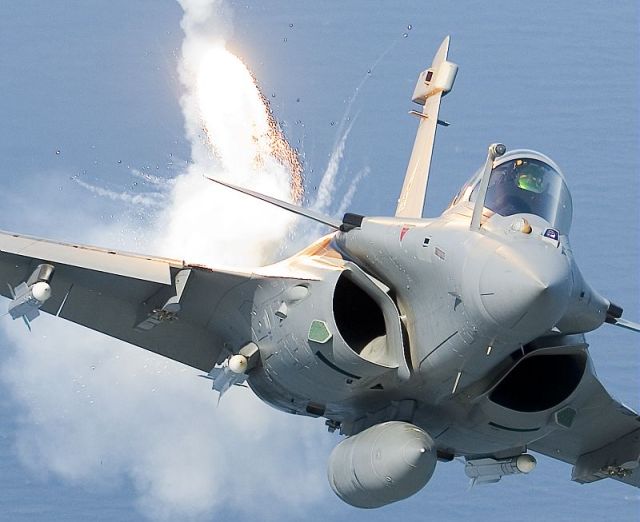
(Rafale)
The Indian Air Force has a proud 70-year record of BONE-HEADED acquisition decisions. Among them (1) the purchase of the under-powered British Jaguar DPSA at the expense of the entirely indigenously-designed but supposedly “under-powered” Marut HF-24 Mk-II (aka HF-73) and, in the process, registering a collateral kill — as intended — of the indigenous Indian combat aircraft industry for nearly two generations (until an indigenous capability was revived from zero baseline with the Tejas LCA; (2) preferring the MiG-23 BN rather than a squadron of the Tu-22 Backfire bombers painted with IAF roundels that were ready to take-off for India had the Air Marshal Sheodeo Singh mission in the early summer of 1971 made the decision to take it as the Russians were urging it to; (3) No Tu-22, so no follow-on aircraft to the medium range Canberra bomber, and hence, disastrously, the complete elimination of the bomber from the IAF fleet; a decision not corrected by leasing the Tu-160 Blackjack; (4) the contretemps over inducting the Tejas LCA and derivatives in large numbers as the main bulk aircraft and, most recently, (5) the Rafale buy.
Because IAF has been so critical about all the things ostensibly wrong with the Tejas, may be we should put the inordinately expensive Rafale combat aircraft, that makes no cost-benefit sense whatsoever, under similar scrutiny, and see all the things structurally and otherwise wrong with this French item.
Let’s focus in this post on the canards on the Rafale. Canards are the rear horizontal wings in normal planes that are moved forward to near the nose for better aircraft control and hence featured in some combat aircraft like this French plane. It can contribute to lift, replacing the horizontal stabilizer and, therefore, reducing overall drag.
So, what’s the problem? Unlike the Su-30MKI — IAF’s front line advanced air dominance/air superiority fighter, which also sports canards, but uses its 2-D thrust vectoring nozzle for braking operations, the Rafale uses its canards. Using the canards thus generates enormous stress and strain on that part of the aircraft frame and can lead to stress fracture in the canards and result in cracks. Not sure if the IAF flew the Rafale, during the MMRCA test trials, in a sustained fashion over months in summer to see how the aircraft stacked up against the competition. Had they done so, they’d have witnessed the canards starting to fall apart. Combat aircraft experts give it 2-3 months of regular takeoff and landings in the hot tropical conditions of the subcontinent, for this problem to become apparent. Then what?
Replacing fractured and disabled canards is not an easy thing and when the entire fleet is so afflicted, as it will be, the IAF will have more of the Rafale down, resting in their airconditioned hangars than pulling duty in the skies. Soon, because it cannot be used too intensively or extensively, it will be reduced to another grand and expensive piece of hardware that, in terms of actual ready use, cannot reasonably be counted in the air order-of-battle. So much for the Rafale’s low down-time and quick-turnaround capability!!!
IAF doesn’t see this awful problem heading its way — and that’s par for the course. But the plane’s producer, Dassault, must be licking its chops in anticipation, because every canard repair and refit will require the aircraft to be ferried to the company’s production line in France. One can safely assess the additional costs of this major structural flaw over the aircraft’s lifetime for the 36 Rafales to be in billions of Euros. As Government of India is clueless, it will do what — grin and bear it?
Won’t the IAF then complain about a degraded fighter force and about not enough fighter aircraft in the air? Of course, it will but only to pitch in for more Rafales in the belief that one horrible mistake deserves a cascade of the same mistake!
Incidentally, thanks to the intervention by the IAF in the design stage of the LCA and insistence on a canard on the Tejas — a movement headed by an ex-test pilot Air Marshal M. Matheswaran, who retired as Deputy Chief at HQ Integrated Defence Staff, the entire project was delayed by several years. The insertion of the canard in the original design required a major reworking of it, and the ultimate decision by its designers, who knew better but tried to humour its customer, to do away with it, cost the project time and hurt the LCA delivery schedule. These delays were then used by the IAF and Matheswaran in particular, and an ignorant/illiterate press and media, in general, to slam the Tejas.
This same Matheswaran after retirement was recruited by HAL as “adviser” for the LCA programme — why is not clear. He since jumped ship to something lots more lucrative — a sinecure with Anil Ambani’s Reliance Defence that has signed up with Dassault for offsets to produce some knick-knacks that will go into the IAF Rafales to be manufactured — minus any transfer of technology — wholly in France. Neat!
[Addendum: A Reliance Defence rep got in touch with me Dec 11, 2017, morning to say that Matheswaran, in fact, departed the company a year back, and that he had thereafter joined SAAB India, which he no doubt reckoned stands a good chance — if IAF can help it — in its “single engine” aircraft race. This only proves my point. The Reliance rep also informed that other than some Rafale components, his company is into mainly producing with Dassault, a Falcon exec jet, as news reports have previously reported.]

(Rafale)
Indian Express first carried a story Sept 18, 2016 justifying the purchase of 36 Rafales announced in Paris by PM Narendra Modi 17 months earlier because of its supposedly strategic role as nuclear weapon delivery system, http://indianexpress.com/article/india/india-news-india/behind-rafale-deal-their-strategic-role-in-delivery-of-nuclear-weapons-3036852/ . On Nov 27 instant, Economic Times in its Blogs carried a piece saying much the same thing — except it dealt, in the main, with the theme of the Rafale procurement process being “clumsy” without it being “corrupt”. (https://blogs.economictimes.indiatimes.com/et-commentary/rafale-procurement-process-has-been-clumsy-but-is-it-crooked/ ).
True, Rafale is tasked by the French Air Force for the N-role, but the distance it has to negotiate to Moscow isn’t relatively much, being the same that Mirage V was meant to do on a one-way suicide mission because that’s all its range permitted at a time in the mid- to late 1960s when France had little else to make its ‘force de frappe’ credible. Rafale is different in that it has the range to go to Moscow and back and in European conditions may be considered “strategic”, but it cannot be so labeled in Indian conditions unless all that the Modi govt has in mind for its use is Pakistan because, for certain, it can perform no useful strategic function against China. But was the Rafale buy at the unit cost of some $250 million — clean i.e., w/o any weapon — merited just for N-delivery against Pakistani targets when the IAF has the Jaguar low level strike aircraft for this job, and the Su-30MKI, which with aerial tankers and buddy refuelers for the last leg, for strategic nuclear bombardment deep inside China?
The Su-30MKI — a medium range air superiority/air dominance combat aircraft, I have long argued is not a genuine answer for long range nuclear targeting, whence the desperate need for a genuine high-alt strategic bomber, the Tu-160 Blackjack, that the Russians were always ready to lease to India, as a manned recall-able option in the triad. It was a case I had made to CAS Charley Browne some years back in person and retailed in ‘Why India is Not a Great Power (Yet). Browne shot it down saying that while lease costs were fine, the operating costs were too high and would be a drain on IAF’s resources. (For the cost figures, etc. refer above book.) But a Rafale carrying N-weapons is economical? This is an example of short-sighted financial resources management.
The nuclear role conjured up for the Rafale, it’d appear, was an afterthought of some not so bright denizen of the PMO and purveyed through the media, because of the flak Modi was receiving for the hasty, ill thought-out Rafale deal.
The fact is Rafale may barely survive the AD environment over Pakistan. Across Tibet, it is a dead duck, and will have even less chance anywhere deeper in China mainland where the layered AD defence is so intense the US Air Force feels it will have to deploy its full might of the B-2s to register success.
And even then, it will not do much good. Because China PLAAF now has operational a few photonic or quantum radars — with these replacing the older surveillance, tracking, and targeting radars in layers doing frontline duty. Incidentally, Russia and China have a massive lead in quantum hardware — communications, radars, etc. over the US, and the word is out that the US’ latest lemon F-35, inclusive of its on-board radar, is already defunct because it has been mapped out by the Russian and Chinese photonic radar. Wonder, if that’s the reason why the US is growingly keen about selling the completely useless F-35 to the IAF and has confidence the Indian govt can be prevailed upon to buy it. So much for India’s reputation for buying junk.
Quantum radar, in any case, means definite death for so-called stealth aircraft. In any case, stealth is a mis-used word because even without quantum radars, the stealthiest of the present day aircraft can be easily detected by low frequency radars — the old World War Two kind!
And finally if Rafale is actually being considered as a nuclear delivery platform, what’s the talk that IAF is exploring the acquisition of a handful of the latest version of the Backfire Tu-22M3 from Russia — which makes more sense than Rafale but is not as good an option as the Tu-160 — all about?
Rajya Sabha TV panel discussion in ‘India’s World’ programme on the subject of China at India’s backdoor in the IO. It was broadcast yesterday evening at 10PM.


 Security Wise