

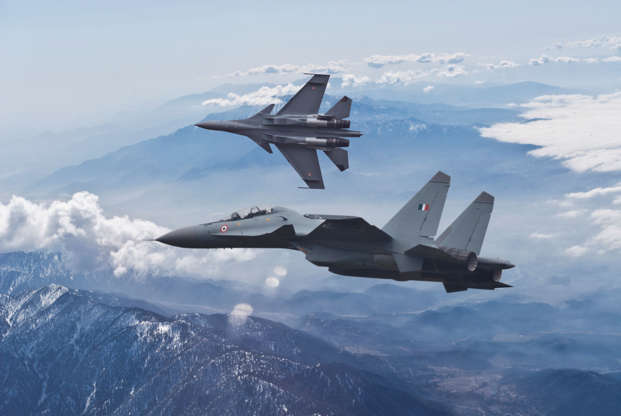
[IAF Mirage 2000s taking off]
There’s been quite a bit of criticism of the Balakot retaliatory strike, particularly about the ruling Bharatiya Janata Party “politicizing” India’s small, but fairly ambiguous, tactical military success. There’s still no definite evidence about whether any telling damage was, in fact, done. In the absence of authoritative information, which will trickle out, not to worry, the people have had to make do with political bombast and election rhetoric and a whole lot of speculation. One of the more intriguing accounts has hinted at a trilateral operation — an Indo-Israeli-American effort that worked tickety-boo. In this version, the Israeli Delilah cruise missile was the weapon of choice, not the S-2000 glide bomb released by IAF Mirage 2000s, with a huge loiter capability, and guided by satellite and AWACS-based sensors stealthily to the target before plunging down unannounced through the roof of the crammed terrorist hostel to blow up a couple of hundred JeM cadres and assorted other huns sleeping secure, perhaps dreaming of the 72 houris doing a lap dance around each of them after they attained shahadat in action against the Indian army and paramils in Jammu & Kashmir. http://www.openthemagazine.com/article/defence/the-israeli-connection.
Israel’s role is plausible. That the US was in on it is harder to buy considering just how many agencies of the US government, Intel and military try to muscle in on even the smallest flyswatter action in order to claim credit for its success. Which is to say that the US involvement of the kind here outlined would have leaked out before the Indian Mirages had trundled off the tarmac. Washington leaks like a giant sieve (or else Trump wouldn’t be in the sort of trouble he finds himself in). Then again, post-Balakot Washington has begun presssuring the Modi govt to sign the third and final foundational accord — BECA (Basic Exchange and Cooperation Agreement) that supposedly will allow Indian military assets to utilize geospatial info of the kind found useful in the Balakot action.Well, whatever.
But where’s the problem with Modi taking a bow for Balakot and seeking to portray himself as a leader who can make hard decisions and to contrast himself with the UPA era PM, Manmohan Singh, who did nothing after the ISI goons struck Mumbai 26/11 in 2008 and, more cheekily, with Atal Bihari Vajpayee who also did nothing after Pak-sponsored mujahiden attacked Parliament in 2000? If he portrays himself to the voters as a decisive leader who can rein in the terrorist menace by any and all means, then it is only fair that he make political capital out of it, deserving every last vote he is able to draw on this account.
What we can do without is the type of provocations of the godman and political tyro, Adityanath, running Uttar Pradesh. Having no administrative clue about how to govern the state other than issuing a one-line directive to state officials to haul up troublemakers (the musclemen propping up the opposition) and, his regime’s favourite strawmen — the minority muslims, the Yogi is a mortal danger to the BJP. “Modi’s sena”, in the event, seems to be something Adityanath is running in his home state. It has nothing to do with the Indian army.
That brings us to AFSPA (Armed Forces Special Powers Act) — the law that protects all military men carrying out their duties, including the shooting of rioters and secessionists in Jammu & Kashmir. In its election manifesto Congress Party has promised to water down the AFSPA. But making this law toothless by introducing more layers of civilian control, etc., not only scales up the legal risk faced by jawans but also exposes them to the perils of shoot and scoot urban guerillas. Is this what Lieutenant General DS Hooda (retd), former commander, Northern Army, and military adviser to the Congress Party advised Rahul Gandhi to do? His public view that AFSPA needs to be reviewed leaves one with a sinking feeling.
The more irksome stands by the erstwhile J&K chief ministers, Omar Abdullah and Mehbooba Mufti, are almost a goad to the Indian state to act strongly against the very thing they are protesting against — the doing away with Articles 370 and 35A in the Constitution. The former said that whether this is done or not, the state should revert to its semi-sovereign status with its own flag and prime minister. The latter has opined that removal of these offending provisions would end up negativing the original accession decision by the Maharajah, and turning J&K into another Palestine. Such is their hubris and they have so completely misread the reality that they actually think Delhi can be coerced and compelled to simply hand over the state to their tender mercies, or into becoming a party to its spinning away into a sovereign orbit of its own! But who in the Indian political landscape has the will to run a steamroller over these Articles, so even the remotest rationale for a semi-sovereign Kashmir is voided for good?
Have long argued that at the root of the Kashmir trouble are these Articles that a muddleheaded Nehru government, having taken the dispute to the UN and internationalized it, tried to make the best of a bad situation it had got the country into by putting lipstick on a pig with these constitutional guarantees reeking of liberal conceit, meant more to assuage the international community than the local Kashmiris.
Time is nigh, I have said, for a final solution to the Kashmir problem by ridding the Constitution — by any and all means — of these Articles and, simultaneously, changing the demographic balance of the state by colonizing the LoC with army stalwarts. Troops retiring after their colour service should be allotted land along the border or in other parts of the province and a stake in protecting them. Removal of 35A will open up the sale of properties to Indians and steadily increase the flow of people from the hinterland. In the same vein, the state’s agricultural economy, instead of orienting its flow of produce to across the Neelum River should be enabled with rear area cold chains, etc. to service the vast Indian market southwards instead.
We cannot any longer have a Constitutional mandate for secessionist activity, which is what Articles 35A and 370 in fact are, and also complain that Pakistan exploits the sentiments of separateness fueled by these Articles, or that the Kashmiri leadership keeps the secessionist tinder conflagrated.
Have always commended the ‘Battle of Algiers’ as a model for wrenching out the jihadis root and branch. The use of Special Forces for deep penetration of Kashmir society and ruthless pacification is the answer. 70 years of fooling around has got us to the stage where the local leaders, who have grown fat and prosperous on the Indian paisa think they are doing India a favour by their province being part of India when any talk of secession, or of degrees of separation from the Union would draw death penalty . Indeed, once Articles 370 and 35A are gone, any such talk will in any case be automatically treasonous, and so dealt with. There’ll, in fact, be need for harsher army measures, whence the imperative is actually to tighten and strengthen AFSPA (by removing all loopholes that permit the questioning by civilian entities of any armed forces actions and activity), thereby according frontline troopers doing their duty fuller, more absolute, legal sanction and protection.





 Security Wise