CDS; reliance on locally-made products — does Modi mean for national defence?

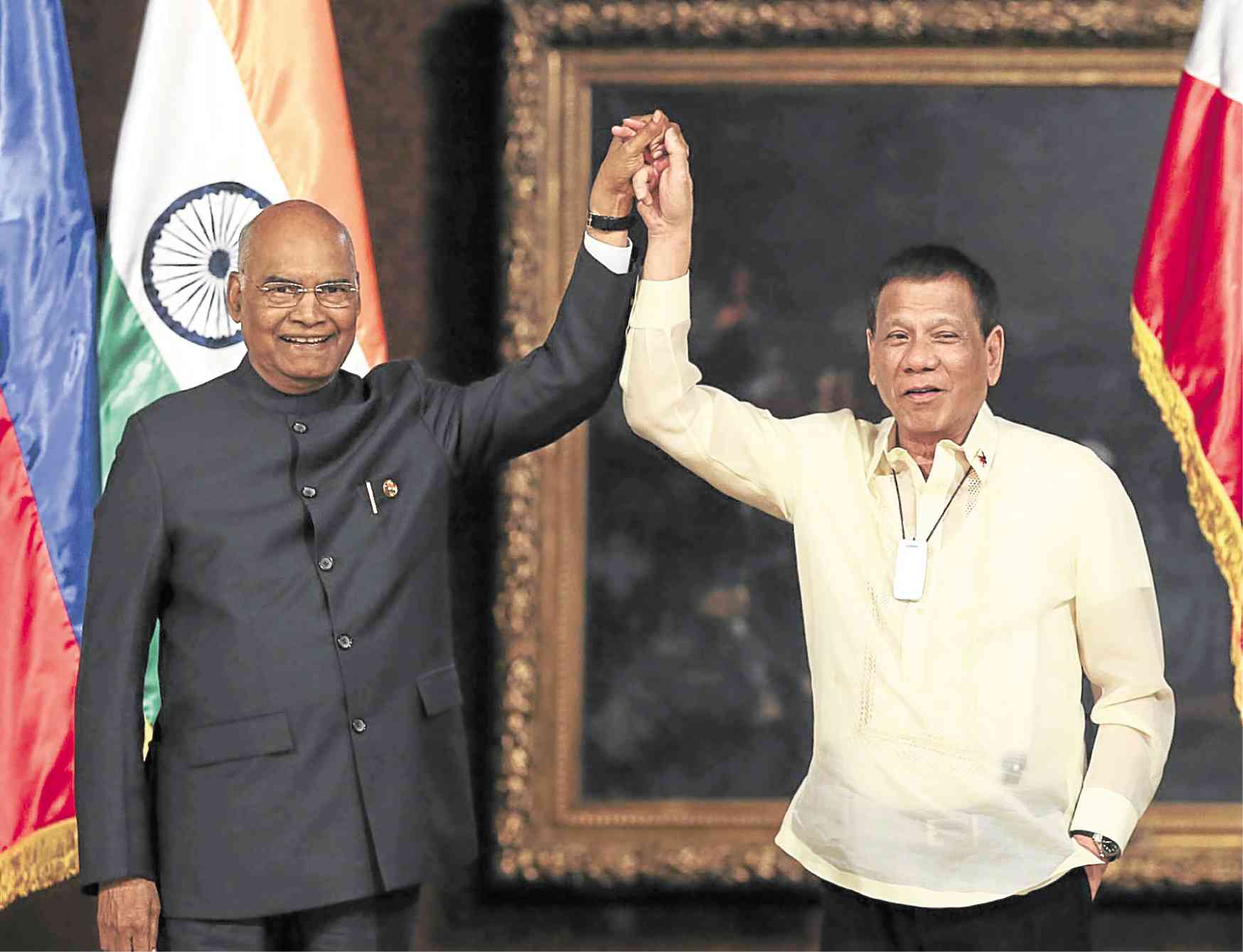
(Armed services chiefs meeting Modi at the Red Fort — Aug 15, 2019)

Sometimes Prime Minister Narendra Modi comes up with pleasant surprises. There was the announcement in his address from the Red Fort ramparts about the chief of defence Staff (CDS). And the other was an exhortation to trust in locally-made products village-level up. Presumably, this applies to the Indian armed services as well who have, over the years, loudly voiced the indigenization mantra but, in practice, reluctantly supported home-grown defence R&D projects and outright rejected the hardware (Tejas light combat aircraft, Arjuna main battle tank) that resulted from them in order to protect their import options.

A CDS system has been in the works for the better part of forty years with every passing flag rank officer in the three armed services expressing a need for it, but those from the Indian Air Force in particular also offering caveats and urging a go-slow. Why so? No great secret this, because IAF has always feared that as the senior service and the one most directly involved in border clashes and counter-insurgency operations and, therefore, more in the public eye than either of the other two Services, the Indian Army would end up monopolizing the CDS post. The IAF is a large enough force for its opposition to CDS to not be ignored by any government. The Indian Navy, on the other hand, is too small to matter and other than extolling the virtues of a CDS, tactfully, kept itself out of the fray. So the CDS issue got strung out over the differences between the army and air force.

Post- Kargil border conflict, a high-powered Committee chaired by the late K. Subrahmanyam stated in the clearest terms that the absence of a CDS led to the slow and sketchy reaction and build-up to action of the Indian military to the capture in Spring 1999 of the Kargil heights by the Pakistan Army’s Northern Light Infantry. Some years later, during the Vajpayee interregnum a committee with Subrahmanyam in it and chaired by former defence minister KC Pant was constituted to look at the Higher Defence Organization. It too recommended establishment of a CDS structure for singular military advice to the government of the day. Too often, Prime Ministers and Defence Ministers, seeking the military’s counsel in a crisis, usually got advice favouring the Service the current Chairman, Chiefs of Staff Committee, was affiliated with. But because the Chairman was a rotational post and did not outrank his fellow chiefs, his advice to the government was as often disputed by the other Services chiefs, leaving the government in its normal state of confusion. In this system, naturally, not only was an optimized military solution or decision difficult to obtain, and if made it was by happenstance, but the spurned chief ensured his Service’s role in coordinating military actions was half-hearted, and left something to chance.

Deposing before the Pant Committee I referred to how military “unification” was achieved in the US chiefly by President Harry S. Truman imposing the integration plan drawn up inside of three weeks by, no not a committee, but by one man — a chap called Ferdinand, adviser to Truman’s confidante, friend and Secretary of War, Henry L. Stimson. As a consequence, the Chairman, US Joint Chiefs of Staff-system came into being.

There is an anecdote worth retailing here to emphasize just how a strong political leader can cow down an equally strong military leadership opposing his moves. This is important: Truman took ownership of the Ferdinand Plan and hearing murmurings of dissent against it in the senior Service, the US Navy, called a meeting of frontline admirals — Chester Nimitz, Arleigh Burke, et al, who at one end successfully prosecuted massive fleet actions in the Pacific theatre against the Imperial Japanese Navy, and at the other end fought off German submarine wolf-packs and mounted the famous Atlantic and Murmansk convoys conveying American war materiel to European Allies and to Soviet Russia. Striding into the big hall where the beribboned admirals were seated, Truman simply said that he had heard that his unification initiative had attracted opposition and, in the event, he said, those who were against it should step up and resign right there and then! Stunned naval brass headed by Nimitz said nothing, and Truman signed the unification order for implementation soon thereafter.

I suggested to the Pant Committee that the PM impose a CDS on the military because such radical structural change in the higher defence organization could not be realized by consensus, and that under no circumstances should the government ask the Services’ chiefs for their views. Alas, an over-cautious Pant and his Committee recommended just this, eventuating in a dissenting note from the then Chief of the Air Staff, whence the matter was once again consigned to the cellar.

It is a very good thing that the Prime Minister publicly announced his CDS decision — so there’s no chance of back-pedaling. As Modi spoke the TV camera panned to show the relief on the face of the CAS, Air Chief Marshal BS Dhanoa, because now the decision to veto the CDS decision was taken abruptly out of his hands. The IAF will have to lump it and Dhanoa will be spared incoming fire from his air force colleagues and predecessors who had derailed such moves in the past.

The question arises: What kind of CDS system does the PM have in mind? The CDS secretariat in-being has been in existence for over two decades now in the form of the Headquarters Integrated Defence Staff. That’s a functioning body and not a problem. But how far will the process of integration go? Will the separate and purposely not co-located theatre commands of the three Services numbering some 19 Commands in all be pared drastically to a more manageable, say, ten military Commands, including the already (if inefficiently) integrated Andaman Command? These Commands could be Northern, Western, Central, Peninsular, Eastern, Space, Cyber, Special Forces, Transport and Logistics/Maintenance, with Northern, Western, Peninsular and Eastern being comprehensively-capable Theatre Commands and Space, Special Forces, Transport and Logistics supportive Commands. Common sense suggests that in such a scheme Peninsular, Cyber and Andaman Commands be headed by the navy, Space, Northern, Transport and Eastern Commands by the air force, and Western, Special Forces and Central Commands (the last also a reserve holding and hence numerically the largest Command able to deploy/switch its forces as required between theatres) by the army, and the Logistics/Maintenance Command with its chieftancy held in rotation. (Why such a distribution of Service responsibility will be discussed in another post, another time.)

The stickiest issue for Modi will be who to appoint the first five star Chief of Defence Staff in the rank of Field Marshal and equivalent — Marshal of the Air Force and Admiral of the Fleet (because the CDS will necessarily have to outrank the services chiefs of staff if the whole exercise is not to be reduced to an impractical mess). In this context, the selected CDS will have to be an officer who has shown foresight, displayed vision (which two attributes presume a certain level of intellect), and exhibited tact. US Chief of Army Staff General George C. Marshall when confronted with choosing the Supreme Commander Allied Forces, Europe, to lead the war effort against Nazi Germany advised President Franklin D. Roosevelt to appoint Dwight D. Eisenhower and not a “fighting General” like George Patton or Omar Bradley, because of his proven organizational skills — something Modi should keep in mind when nominating the CDS.

So, the trick question — who among the extant service chiefs or among all the three star-rank officers below them in the three Services has a professional record manifesting the skills to get the most out of diverse oganizations and will make the best CDS?

———–

Modi in his Red Fort address to the nation spoke about trusting in locally made products. Does he really believe this? If so, why hasn’t it been evident in his government’s major military procurement decisions all of which without exception have settled on or are inclined towards imported armaments and foreign military-use systems? The score card on this count is irrefutable: the French Rafale combat aircraft (and Swedish Gripen and American F-16 in the wings), the US Apache attack helicopter, Russian T-90 MBT, prospective Spanish, French, Russian, or German involvement in the Project 75i diesel submarine programme, etc.

To claim, as the armed Services do in their own defence, that no indigenously designed and developed weapon system meets their operational standards, is a lot of bull. Arjuna MBT has beaten the T-90 hollow in all test trials in different terrains and weather conditions. Tejas is a beautiful 4.5 generation fighting platform given short shrift by IAF when it could fill the IAF fleet and be the basis for future derivative combat aircraft of all kinds and meet the Service’s light, medium and heavy fighter-bomber requirements. Arihant-class “boomers” — nuclear powered longrange ballistic and cruise missile-firing submarines (SSBNs) are of indigenous design, developed and manufactured at home, and yet, if navy is to be believed, we need foreign design and technology for the technologically simpler and less demanding conventional submarine — when all that is needed are specific technologies, such as electro-optic masts, AIPS (Air Independent Propulsion System), and cavitation and other noise reduction. And why Apache when there’s the HAL’s attack helicopter and Kamov 226 utility helos when there’s Dhruv?

Once the armed services know they cannot opt for foreign hardware, they’ll perforce commit heart, mind, and resources to indigenous armament projects with enormous export potential to Africa, the immediate neighbourhood, Southeast Asia, Central Asia and Latin America. These are military products with a ready market. From having the shameful tag as the world’s largest arms importer, India could become a very consequential exporter of arms.

Modi is supreme leader with no rival on the horizon within his party or elsewhere in the Indian polity and can do anything he wishes. He made the decision for CDS. Following on his reference to indigenization he should now declare that his government will not anymore permit armament imports, that’s it, khalas, no foreign military goods. This decision will unleash precisely the “änimal spirits” he says he wants to see driving the Indian economy, generating new technologies, and jobs by the millions in Medium and Small Scale Enterprises — India’s mittelstand — at the cutting edge of this national effort.

And, oh, yes, he will also need to get HAL, Mazgaon Dockyard Ltd and other “white elephant” defense public sector units, who have dragged the Indian defence industry into the mud, out of the frontline of defence industry and get the more productive and efficient Larsen & Toubro, Godrej Aerospace, Mahindra Aviation, Bharat Forge, and even Reliance Defence centrally into the game. Private sector companies driven by the profit motive are the future and answer to India’s defence problems.

As a Gujrati with “business in my blood” as Modi put it, the Prime Minister should see clear to doing these above things. He has wasted five years on his romance with the bureaucracy and the public sector. Time to wake up, Mr Modi, and do what’s right for India because you politically can and because no matter how much time you think you will have in power, it could all change in a trice!

Posted in Africa, arms exports, asia-Pacific/Indo-Pacific, Asian geopolitics, Bangladesh, Bhutan, Central Asia, civil-military relations, Culture, Cyber & Space, Decision-making, Defence Industry, domestic politics, DRDO, Europe, Geopolitics, Great Power imperatives, India's strategic thinking and policy, Indian Air Force, Indian Army, Indian democracy, Indian ecobomic situation, Indian Navy, Indian Ocean, Indian Politics, Maldives, MEA/foreign policy, Military Acquisitions, Military/military advice, Myanmar, Nepal, Russia, russian assistance, russian military, SAARC, society, South Asia, South East Asia, Special Forces, Sri Lanka, Technology transfer, United States, US., Vietnam, Weapons | 17 Comments

Kashmir, Hong Kong, Huawei, and Indian infirmities

Attendees walk past a sign for Huawei Technologies at the MWC Shanghai 2019 trade show on June 27. Photo: Bloomberg

[Building a Fully Connected Chinese Intelligence world alright!]

Soon after trashing Article 370, the first instinct of the Modi government was — no guesses here — to conciliate. S. Jaishankar, the external affairs minister and designated batter whenever China or the US hove into view, was sent off running to convince Beijing that this move did not threaten China’s interests, and to offset the effects of pleadings by his Pakistan counterpart Shah Mohammad Qureishi who had hightailed it to the Chinese capital to drum up support. But with Modi having previously described the abrogation as a purely “internal” matter, where was the need to reassure or explain a move to obtain a more perfect Indian Union to the eastern neighbour with no locus standi on the Kashmir issue other than as an annexer by stealth of India’s Aksai Chin territory (the Maozedong regime in the mid-1950s expropriated an eastern portion of this region to build the Highway connecting its western Xinjiang province to the mainland through Chinese-occupied Tibet), and as acceptor of a gift in 1963 of another, contiguous, part of the same Aksai Chin that China coveted by an Ayub Khan eager to court Beijing’s patronage vide the Sino-Pakistan accord. In this context, the Zhongnanhai had the gall to say that revoking Article 370 impugned Chinese sovereignty! Instead of reacting strongly to such ridiculous statement followed by equally silly advice urging Delhi to show restraint because, according to Beijing, the situation was fraught in the region, Modi dispatched Jaishankar to apply balm and seek understanding. Rather, shouldn’t the MEA have publicly reminded China about the unrest in Hong Kong and about sustained Chinese actions unsettling the South China Sea and told Beijing, in so many words, to mind its own damned business?

Despite the gravest affronts and provocations to India’s territorial integrity and sovereignty over the years, Delhi has steadfastly refused to come out with its own ‘One India’ Doctrine and to equate it straightforwardly with the ‘One China’ principle Beijing insists all countries respect. Either China accepts all of the territory of the erstwhile “princely kingdom” of Kashmir, including Gilgit, Hunza, and Baltistan, and every last square inch under occupation of the Forces Command Northern Areas, Pakistan Army, as inalienable Indian territory, or India treats Tibet and Hong Kong under differentiated Chinese control, and Taiwan a fully independent and sovereign country, as very separate national entities. This is the sort of hard choice no Indian government has ever offered the hard-headed authoritarian rulers of Communist China. Indian governments from Nehru’s days have unfortunately sought China’s friendship and repeatedly got kicked in their teeth for their trouble. The Modi regime just as frequently and haplessly invokes the “Wuhan spirit”, urging “sensitivity to each other’s core concerns”, and allows Beijing to pile insult on injury (with its media arm, Global Times, warning that integrating Kashmir with India raises doubts about India’s credentials as potential permanent member of the UN Security Council — a status China enjoys — it must never be forgotten — because Nehru gifted it to Beijing, when international circumstances conspired to have both the Soviet Union and the US in the mid-Fifties wanting India to take the seat vacated by Chiangkaishek’s Taiwan!).

If Beijing has toyed with India in the diplomatic field, it has just as successfully played India for a sucker in the trade realm, mounting serious pressure on the Modi government to relent on security considerations and permit Indian telecommunications market leaders — Vodafone Idea and Bharti Airtel, with their architecture based on the Huawei 4G gear, to upgrade to that Chinese Company’s 5G equipment, and also to keep relying on other Chinese-origin manufacturers such as ZTE. Huawei, incidentally, was funded and nursed to maturity by the People’s Liberation Army and almost all Chinese telecom Companies have such PLA and Chinese intelligence linkages. The only apparent reason Modi did not succumb is because of the Trump Administration’s counter-pressure to bar Huawei 5G from the Indian scene, and not because the Indian government concluded on its own that for the country’s communications grid to pivot on Huawei systems would be to drag the Chinese dragon dressed up as an attractive Trojan Horse right into the centre of India’s communications hub, thus creating untold cyber security vulnerabilities.

If this wasn’t the case, why were Vodafone and Airtel allowed to go in for the Huawei 4G in the first place? This, mind you, was in the face of a public campaign launched at the time — among other writings that warned against such buys, see my innumerable posts on this issue at the time — opposing the entry of key Chinese telecom technology and highlighting the almost farcical assurances the Manmohan Singh government accepted from Huawei that, security-wise, its goods were clean, posed no dangers and that the technology checking centre it proposed setting up at the Indian Institute of Science, Bangalore, would adequately address India’s anxieties. It is another matter that no such centre ever came up, Airtel and Vodafone plonked for the Huawei 4G, and India’s capacity to resist Chinese cyber attacks that PLA has indicated will be in the van of its military offensives, was instantly undermined.

According to a recent Report authored by NK Goyal, President of the Association of India Communications Multimedia And Infrastructure (CMAI) “The malware/ backdoor can be made possible either in the equipment supplied initially or upgraded/modified by software later on, hence the risk. It’s really hard to find a security hole unless one know[s] exactly where to find it. A backdoor could be hard-coded into the silicon on a Huawei chip, then activated remotely, potentially opening with a few keystrokes the contents of an entire network to the Chinese military.” After warning about the official tendency of the Department of Telecommunications (DOT) and the Indian government generally to pooh-pooh the very real cyber dangers posed by the Chinese telecom technologies, the Report warned that in the process of trying to find “evidence of spyware” in “all our phone/computer chips, and in the Artificial Intelligence who-knows-where”, India shouldn’t get stuck with buying and installing Chinese-origin equipments embedded with electronic bugs, viruses to disable whole networks and backdoors to tap information. After all, Goyal concludes logically, “China is leading the world in spying on its citizens: Can we possibly imagine that they’re not planning on spying on us?”

The Modi government is embarked on the same blundering path that Manmohan Singh opted for, by not completely closing off the Indian 5G market to the Chinese telecom giants. Learning nothing from the past and ill-informed about the longstanding Chinese intent and efforts at subversion, a Committee headed by the Principal Scientific Adviser — a biochemist with little knowledge of cyber warfare-related telecom technologies, will reportedly soon recommend that Chinese equipment be included in the 5G rollout. This committee, per revelation by Smita Purshottam, only consulted with the telecom Companies who are hand-in-glove with Chinese equipment suppliers. Purshottam retired as our Ambassador to Switzerland and now heads SITARA (Science, Indigenous Technology & Advanced Research Accelerator), an organization dedicated to promoting indigenous technology at all levels in every sphere of national life, and particularly in the defence sector,

But returning to Purshottam’s point, it makes commercial sense for Airtel and Vodafone with Huawei 4G, for example, to upgrade cheaply to Huawei 5G than switch over to qualitatively matching or better Indian-developed technologies and systems, national security be damned! This Committee supposedly took enormous care to ignore Indian Companies (such as Saankhya Labs) fully capable of designing and manufacturing 5G and even 6G hardware and software, for which technologies they already have patents and hold Intellectual Property Rights! So it is reasonable for Purshottam to argue that India “leapfrog to 6G”, while also indigenously designing and producing 4G and 5G telecom systems for the extant Indian market and for exporting to developing countries who will be receptive to purchasing Indian technology. The African Union headquarters, for example, not too long ago discovered that the Chinese had hacked its classified communications network. Such a policy of fully indigenizing Indian telecom for national deployment and as export revenue earner will generate employment and act as “massive multipliers” consolidating India’s position in the forefront of telecommunications tech. This is now an imperative also because, according to Purshottam, 80% of “India’s sensitive networks…are already in Chinese hands, thanks to the Department of Telecommunications’ irresponsible handling of a strategic asset — our telecom networks.” Capture of Indian 5G, she avers, will “exponentially magnify” Beijing’s capacity for “cognitive communications [which linked to Artificial Intelligence] means we are surrendering control over unknown realms” to a belligerent adversary nation.

Worse and astonishingly, the Modi government is taking the same approach to de-indigenizing the telecom sector and forcing end-users to rely on foreign imported hardware and software, as it has done in the defence field where, willy-nilly, it is promoting armament imports even as the soaring Modi rhetoric exhorts ‘Make in India’ — sadly, a thinly veiled programme for screwdrivering and license-producing US, Swedish, French, Russian, Israeli military-use systems!

Purshottam discloses how this deplorable imports-fixated official mindset and procedures and procurement system-in-place prevailing in the defence field is being replicated in the telecommunications sphere. It is an approach involving (1) Chinese companies subsidised by Beijing being allowed “ruthlessly” to “underbid Indian Companies in telecom tenders”, (2) DOT refusing to release outstanding dues amounting to over Rs 1,000 crores owed to Indian Companies, (3) “one-sided discriminatory” bank guarantees being demanded of Indian telecom companies, and none from Huawei and that lot, and (4) Indian Companies being thus forced to “run around the world seeking expensive certifications”. By such means Indian Companies were ruled out of the running to supply 4G tech. (Refer Smita Purshottam’s eye-popping Aug 13 op-ed in Financial Express at https://www.financialexpress.com/opinion/telecom-networks-the-changing-face-of-conflict/1673863/ )

Come another Independence Day, and tomorrow we will all once again hear Modi, the Prime Minister, with rapt attention as he lists the achievements of his government. But look deeper, and one sees that so little has changed. As a nationalist and promiser of “maximum governance, minimum government” he is presiding over the worst excesses of empowered bureaucrats, not empowered people. The country, as a result continues to reel, its economy continues to plunge, but an unaccountable government continues happily to splurge monies the nation doesn’t have on imports and more imports, even as the benefits of transferred wealth and millions of high-paying jobs in defence and telecom sectors are enjoyed by Western defence majors, and China is helped to root telecom monopolies in India. If this is nationalism, then it is of a type I’m unaware of.

Posted in Africa, arms exports, asia-Pacific/Indo-Pacific, Asian geopolitics, China, China military, corruption, Culture, Cyber & Space, Decision-making, Defence Industry, domestic politics, DRDO, Europe, Geopolitics, Great Power imperatives, India's China Policy, India's strategic thinking and policy, Indian Air Force, Indian Army, Indian democracy, Indian ecobomic situation, Indian Navy, indian policy -- Israel, Iran and West Asia, Indian Politics, Intelligence, Internal Security, Israel, MEA/foreign policy, Military Acquisitions, Military/military advice, Russia, russian assistance, SAARC, society, South Asia, Strategic Relations with the US & West, Taiwan, Technology transfer, Terrorism, Tibet, UN, United States, US., Weapons, West Asia | 9 Comments

Article 370 is finally history; now need to stiffen national resolve to brush off US (and other Western) pressure

NC president Farooq Abdullah, PDP chief Mehbooba Mufti and leaders of other mainstream parties at an all party meeting in Srinagar on Sunday. 	(Photo: H.U. Naqash)

(J&K leaders apprehending historic change)

The most offending and offensive Article of the Indian Constitution — Article 370 has finally been rid off (and automatically also Article 35A). Good riddance! Why there was so much hesitation for so long by ruling parties across the board (including the BJP government under Atal Bihari Vajpayee) in deboarding an Article described in the Constitution as “temporary” is beyond understanding and cannot be explained except as political calculation routinely taking precedence over the national interest. It only kept fueled the legal fiction that J&K was separate from India and, hence the impression that was abroad, that it was negotiable.

This is the first substantive good and correct step relating to national security that Prime Minister Narendra Modi has taken in an otherwise bleak 5-year record in office of seemingly endless series of misconceptions of national security, and equally serious misreadings of the regional and international reality, resulting in patently wrong foreign and military policies and diplomatic missteps that have progressively weakened India and its geostrategics. But re: 370 Modi has done the right thing, and has to be lauded for it.

(All the gassy rhetoric in Rajya Sabha about J&K, as a consequence of the tabling of the’Reorganization Bill’, soon turning into another Palestine, or a South Sudan, or an East Timor, or whatever…is nothing more than fear-vaping by the opposition who, odds-on bet, know nothing about any of these places mentioned, leave alone their histories, whence their facile forebodings.)

There were a lot of historical tid-bits revealed by some of the speakers in Parliament, especially the RSS ideologue and BJP nominated MP Rakesh Sinha, most importantly that Lal Bahadur Shastri contemplated trashing 370 in 1964 not long after Jawaharlal Nehru’s death in May that year. But one must be aware of the political thinking behind Nehru’s decision to stop the Indian Army’s push to Muzzafarabad and thereafter to fully recover what is now PoK, which was followed by his most unfortunate decision to take the issue to the UN. But as Subramaniam Swany rightly pointed out in the debate as regards the latter move, Nehru did so in 1949 without his Cabinet’s approval, leaving the door open for the Modi government legitimately to withdraw the issue from the UN and reversing 70 years of international interference and frustration for India!

But Nehru had, at that time, made a defensible political decision. The situation was this: With the India Army poised to retake PoK, Sheikh Abdullah told Nehru that were he to recover PoK, the Mirpuri-dominated population of that region aligning with the competitor Muslim Conference party would, in an election, vote against siding with India and create trouble, but that he, a “democrat” would ensure that his National Conference party would vote to stay with India. It convinced Nehru to terminate the military recovery of PoK and even to take the matter to the UN where, per Mountbatten’s advice, the Security Council would quickly decide in India’s favour; in thee event, killing two birds with a single stone. Nehru the gullible bought into this perfidious design of Britain. (Much of this is supported by archival material, see Prem Shankar Jha’s book — ‘Kashmir 1947’.)

The scrubbing of 370 has, among its other virtues, a realpolitik reason. By making Ladakh a Union Territory, Delhi can cultivate the shias of the Kargil region in order to influence the Hazara shias and the still majority shia population of Gilgit and Baltistan (G&B) in PoK — areas hosting Pakistan Army’s Forces Command Northern Areas. This will create a sort of shia equipoise in the larger erstwhile Kashmir territory vis a vis the dominant sunnis among the Punjab mussalmans of Mirpur (Mirpuris) and the Srinagar Valley, and making life that much more politically difficult for Pakistan in G&B.

But Modi will now face a Trump suddenly beholden to an Imran Khan who promised to ease the retreat of the US-led International Security Assistance Force from Afghanistan by persuading the Taliban to hold off as the US military cuts and runs. Part of the Trump-Imran deal was renewal of American pressure on Delhi to allow US or other international mediation, as Islamabad has publicly announced, to preempt which Modi hurried through with throwing out Art 370 and related impedimenta.

How will Modi hold up under Washington’s full court press — because Trump will have to show his hand before Imran (read GHQ, Rawalpindi) delivers on the last mile, as it were? Besides brushing off pressure and threats of dilution of US commitments on the antique F-16-level technology etc that Modi seems enamoured by, the Indian PM will have to show that India means business. This last will have to be evidenced in the manipulation of the Indian hand in Afghan Taliban’s affairs. A section of the Afghan Taliban has been successfully courted and cultivated by Indian intel (just as it has done its sister outfit — the Tehreeq-e-Taliban Pakistan). These contacts will need to be activated to torpedo the US-Pak plan, to prove India cannot be ignored. But this will have to be done in tandem with making peace with Tehran, whom the Modi dispensation has seriously alienated, and to recommit to Chabahar and the connectivity projects linking up with Afghanistan, Central Asia and Russia.

This is obviously a tall order for Modi who has swung Indian foreign policy so far over to the American side, that it has eroding creds with Moscow. Meanwhile, Xi of China sits on the sideline like the wily giant panda ready to put its weight behind the winning move. Absence of geostrategic foresight is why and how India has thus further empowered an already strong China. This is what all my warnings over the years were about. Now, Modi is in a double squeeze and Trump will only hope he will cry “Uncle (Sam)”!

Posted in Afghanistan, arms exports, asia-Pacific/Indo-Pacific, Asian geopolitics, Central Asia, China, China military, Culture, Decision-making, Defence Industry, domestic politics, Europe, Geopolitics, Great Power imperatives, India's China Policy, India's Pakistan Policy, India's strategic thinking and policy, Indian democracy, Indian Politics, Intelligence, Internal Security, MEA/foreign policy, Military Acquisitions, Military/military advice, Pakistan, Pakistan military, Relations with Russia, Russia, SAARC, society, South Asia, Strategic Relations with the US & West, Technology transfer, Terrorism, UN, United States, US., Weapons | 9 Comments

Payoffs post-Trump-Imran meeting

(PAF’s 2-seater F-16D)

The dust has not quite settled on the little matter of Prime Minister Narendra Modi requesting Donald Trump, per Trump, to mediate on the Kashmir dispute. Because, in the face of foreign minister K Jaishankar’s “categorical denial” in Parliament regarding any such request, the US President’s Special Assistant Larry Kudlow asserted before TV cameras that “the President does not make up things”. [ https://www.youtube.com/watch?v=iriKCIeiF0U ]

So, no one’s any nearer to knowing what actually transpired in Osaka and what it is that Modi said to the US President, 20 days later, to prompt Trump’s offering himself to Imran and the world as potential arbitrator. And, oh, yes, all the usual retired diplomats — foreign secretaries and the like, and the entire lot of lesser commentators, who until now vociferously backed Modi’s policy of cultivating America as a central pillar of Indian foreign policy, suddenly discovered the US cannot be trusted!

Imran returned home a hero having consolidated Pakistan’s status — surprise! surprise! — as the indispensable front line state the US desperately needs to zero out its military presence in Afghanistan at any and all cost, along with a goodies bag for the Pakistan armed services, which indubitably is the first tranche of upfront payoffs — a $125 million package to retrofit 12 PAF F-16Cs and six two-seater trainer version F-16Ds with the technologically updated Pratt & Whitney F100-PW-229 jet engine with 79 kiloNewton dry thrust and 129.7 kN with afterburner. Most likely, senior PAF officers accompanying the COAS General Qamar Bajwa, who was part of Imran’s delegation, wangled the EEP (Engine Enhancement Program) version.

The P&W website reveals the EEP as incorporating advances in such areas as turbine materials, cooling management techniques, compressor aerodynamics, and electronic controls, from the F-22 Raptor’s turbofan engine and from the propulsion system in the latest American combat aircraft F-35 jet power plant, thereby increasing the “Depot maintenance interval” of the warplane from 4,300 to 6,000 hours or, to put it differently, from 7 to 10 years, while easing upkeep procedures and reducing the lifetime costs by almost a third. In other words, PAF is well on its way to at once refurbishing its entire F-16 fleet, lengthening its life, and making it more affordable.

Again by design and, perhaps, to suppress any hard reaction from Delhi, the US insisted on placing 60 Lockheed representatives in Pakistan (whether on PAF air bases, is not clear) constituting a Technical Security Team (TST) to monitor the end-use of these revamped F-16s. Except, a Pentagon official told Indian news agency, PTI, that the Americans would be there to also, as he put it, protect the engine technology, presumably from being onpassed to China — one of the usual channels Beijing has used over the years to access US technologies. Pakistan, for instance, shipped an F-16 for Chinese engineers to study and reverse engineer its many technologies when it was first inducted into PAF in 1982 and, likewise, moved the high-performance, silenced, rotor system in the US helicopter that crashed during the 2011 American Operation Neptune Spear to take out Osama bin Laden, to China for a decent amount of time before returning the damaged ‘copter to America.

The fact is even with Americans exercising physical oversight of the revamped F-16s, there’s no way they can prevent these aircraft from being flown to satellite air fields ostensibly on routine exercise either for the Chinese aviation designers and engineers to closely inspect them there, or to embark them on offensive sorties (assuming the TST is really there to deter such uses, which is doubtful).

Curiously, at the same time as the F-16 deal was announced in Washington a couple of days after Imran’s departure, the US Defence Security Cooperation Agency issued a statement saying that India had asked to buy spare parts and test equipment for IAF’s C-17 transport planes, and that it “is seeking personnel training, among other things, “for an estimated cost of $670 million.” India, it added, “needs this follow-on support to maintain its operational readiness and ability to provide Humanitarian Assistance and Disaster Relief (HA/DR) assistance in the region…[and] will have no difficulty absorbing this support into its armed forces.” Both the press releases announcing the F-16 upgrade and the the Indian buy of C-17 support, iterated that these sales “will not alter the basic military balance in the region.” 

And, outside of hightailing it out of Afghanistan, that’s the entire US strategic game plan and objective isn’t it — to maintain by whatever means and at all cost “the basic military balance” in the subcontinent? It is also apparently China’s. Because, such military balance encourages Islamabad to continue engaging in cross-border terrorism, keeps India distracted with the Pakistan bogey and unprepared and incapable of diverting the limited resources to tackle the more substantive China threat, even as Washington and Beijing are free to carry on with their big power struggle to gain ascendancy in the Indo-Pacific while exploiting, in separate and similar ways, the squabbling India and Pakistan for their own purposes.

The pity is the Modi government (and the section of the Pak-phobic Indian media) are so blinded by their hate as to miss seeing the larger Sino-US strategic scheme in play to keep India down.

Posted in Afghanistan, arms exports, asia-Pacific/Indo-Pacific, Asian geopolitics, China, China military, civil-military relations, Decision-making, domestic politics, Geopolitics, Great Power imperatives, guerilla warfare, India's China Policy, India's Pakistan Policy, India's strategic thinking and policy, Indian Air Force, Indian ecobomic situation, MEA/foreign policy, Military Acquisitions, Military/military advice, Pakistan, Pakistan military, SAARC, South Asia, Strategic Relations with the US & West, Technology transfer, Terrorism, United States, US., Weapons | 22 Comments

Trump lied but what’s the truth? (Augmented)

Image result for pics of trump and modi

Below is US President Donald J Trump’s controversial quote in extenso pertaining to his offer of personal mediation to resolve the Kashmir dispute. This was in his exchange with the Pakistan prime minister Imran Khan presently in Washington ostensibly to “reset” Pakistan-US relations:

“I was with Prime Minister Modi two weeks ago [at the G-20 Summit in Tokyo] and we talked about this subject (Kashmir). And he actually said, ‘would you like to be a mediator or arbitrator?’ I said, ‘where?’ (Modi said) ‘Kashmir’ Because this has been going on for many, many years. I am surprised that how long. It has been going on (for long).”

“I think they (Indians) would like to see it resolved. I think you would like to see it resolved. And if I can help, I would love to be a mediator. It should be….we have two incredible countries that are very, very smart with very smart leadership, (and they) can’t solve a problem like that. But if you would want me to mediate or arbitrate, I would be willing to do that. So all those issues should be resolved. So, he (Mr. Modi) has to ask me the same thing. So maybe we’ll speak to him. Or I’ll speak to him and we’ll see if we can do something.”

Obviously and, as he is known routinely to do, Trump invented the lie on the spur of the moment to burnish his image as potential peacemaker — that Modi asked him in their Tokyo meeting if he would be “mediator or arbitrator” on the Kashmir dispute. But just as he time and again trips over his own lies, he did so again in his very next bunch of statements, when he stated that for him to mediate Modi would have “to ask” him to do that. Trump apparently warmed up to that idea of mediation after Imran iterated the old Islamabad line of the Kashmir problem needing a US intervention to be resolved, whence the American leader’s prospective lunge for that peace-maker role with his declaration with the royal “we”: “We’ll speak to him [Modi]” before immediately moderating it to “I’ll speak to him [Modi] and we’ll see if we can do something.”

Now, whatever else Prime Minister Narendra Modi may be he is not politically daft and, considering how much of a live-grenade issue Kashmir is, simply couldn’t have said anything of the kind attributed to him by Trump. But was there a reference to Kashmir in his tete-a-tete with Trump that led the latter to concoct a story around? It would appear so.

Based on the fact of Delhi, over the past two decades and especially during Modi’s tenure, incessantly squawking to Washington about Pakistan’s nefarious hand in Kashmir affairs, one can reasonably surmise that the Indian PM brought up Kashmir in their talk by way of, perhaps, a throwaway complaint and may have added for good measure that were Pakistan to butt out, all related problems would be promptly resolved. So, when Imran brought up Kashmir, Trump probably impulsively responded the way he did, in part because while Modi’s grasp of the English language is adequate, it is not nuanced and so any passing reference to peace in that region may have been interpreted by Trump — who in any case hears what he wants to hear rather than respond to something that was actually said — as some sort of invitation to him to arbitrate. The US President’s ability to spot Kashmir on the map of the world may be suspect but he was free with his views about what prevails there. With Imran looking on, scarcely believing what he was hearing, Trump described the Kashmir situation “as bombs everywhere, bombs all over the place… it’s a terrible situation”! ( https://www.youtube.com/watch?v=jff2Cp7vLjg ) How does that sit with the Indian government and with Modi who has staked so much of his foreign policy on making India revolve around US interests?

Sure, the US State Department sought to douse any political fire in India that Trump’s statements may have started by quickly endorsing the Indian government’s line of any resolution of the Kashmir dispute necessarily being through means of bilateral negotiations. But Trump’s ham-handed attempt only highlights the ever-present danger of Washington somehow insinuating itself into the dispute resolution process, which the Indian government willingly disbelieves until a televised event such as this happens.

I have for a long time now maintained that Modi is doing just about every thing wrong with his policy of unilateral friendship and strategic concessions vis a vis the United States. Much of this is due to his unrequited enthusiasm, even love, for America and things American that blinds him to the serious cost of his approach — a steady erosion of the national interest. But Trump extemporaneously also made clear his dichotomous view of the world when, in referring to Afghanistan, he said that the US would not any more play “the policeman” of the world — meaning that he was “extricating” US forces from that country, but added that if he wanted to he could end the Afghanistan war in no time at all by killing “10 million” people, by using weapons of mass destruction, such as thermobaric bombs (fuel air explosives). In other words, he set up the US as either playing the global policeman or using WMD! And this is the American President, also with his curious views on Kashmir, that Modi is banking on to assist him in furthering India’s interests?

There’s lots Modi can do to right his policy of tilt. He can begin by resisting the temptation to show of his English language skills and speak to world leaders, and particularly Trump, only in Hindi (even better, in Gujarati) in which he’s more fluent. It will also put the foreign leaders off their game — a strategy routinely used by the Chinese nomenklatura and perfected by Maozedong’s premier, Zhouenlai. It is a diplomatic method studiously followed by North Korea and other countries that have successfully dealt with the US and the West generally.

Native languages as diplomatic tool is something MEA has never used, leave alone exploited, to the country’s advantage. Because in head-to-head exchanges between leaders, the one using other than English is always at an advantage. For instance, were Modi to carry on diplomatic business only in Hindi or Gujarati — albeit inconveniencing foreign minister K. Jaishankar with only street-level acquaintance with Hindi and none at all of Gujarati — foreign interpreters/note-takers helping out their leaders will be hard put to get it right. So when aide memoirs/diplomatic notes are shared the Indian note will naturally have precedence. This is precisely the tactic Chinese interlocuters have traditionally used to baffle foreigners, and to obtain the diplomatic edge. President Vladimir Putin too speaks only in Russian in his formal exchanges even though he has a better handle on the English language than Modi.

Posted in asia-Pacific/Indo-Pacific, Asian geopolitics, China, Decision-making, domestic politics, Europe, Geopolitics, Great Power imperatives, Indian democracy, Indian Politics, Internal Security, MEA/foreign policy, Pakistan, Russia, society, South Asia, Strategic Relations with the US & West, Terrorism, United States, US. | 7 Comments

Amateurs Inc.

Image result for pics of Modi and trump
[An overjoyed Modi in a clinch with Trump]

It is by now a historic habit for India to miss opportunities, avoid contestation and, when absolutely pushed, lose from a winning position, in the main, because we can’t seem to keep our heads or our wits about us. This is as true for cricket as international affairs. At Old Trafford the supposedly famed top batting order collapsed with, on paper, a doable run chase to realize. In the external realm the Indian government for over two decades now, and helmed in the last five years by Narendra Modi, has likewise shown negligible strategic sense and intent, not appreciated the country’s many strengths nor leveraged them, and finds itself in reality collared by both Washington and Beijing, confused only about which side to appease at any given time and with what (making capital buys here, compromising on trade there, or offering some other concession.

Those who claim and believe that all this tilting, bowing, scraping and fawning is for show and that the alleged masters of the strategic game, namely, the firm of Modi, Jaishankar & Doval, is manipulating all comers to India’s advantage ought to be alerted to the fact that this Indian trio has fared worse on the realpolitik scale than the two predecessor regimes in the new Century, and have proved themselves amateurs going up against US and China — the most prominent and ruthless practitioners of hard realpolitik with a long record of success. Indeed, there’s not a single instance of an Indian foreign policy feint, initiative, measure or move of Modi’s in the last half decade and counting that surprised, offended, or pushed Washington and/or Beijing on the defensive– a simple metric to judge whether Delhi is doing something right by upsetting everybody equally. In fact, far from racking up any noticeable positives or substantive gains for the country, the Modi regime’s attitude, performance, and policies have smacked of gullibility laced with unwarranted complacency that it is doing great, and that persisting with whatever line it has been following so far is best.

Look at the recent record. Delhi countenanced a year of US tariffs on Indian steel and aluminum before responding weakly in kind, and then softened the blow by cleaving in half the perfectly legal imposts under WTO provisions on Harley-Davidson motorcycles coming into India only because every time Trump opens his mouth he raises this issue, making it some sort of benchmark for bilateral trade. Elsewhere, the US International Commission on Religious Freedom socks it to India, the terrorism-funding Sikhs for Justice Forum is permitted to indulge in activities in the US to reignite the Khalistan cause in Indian Punjab, India is frozen out of the Afghanistan peace talks at Pakistan’s behest, and the visiting US Secretary of State Mike Pompeo warns India, as Kipling had the tommies tell Ganga Din, to “put some juldee” in de-friending Iran and severing its arms supply links to Russia lest the boom of economic sanctions under the 2006 Iran Sanctions Act (ISA) and the 2017 Countering America’s Adversaries Through Sanctions Act (CAATSA) respectively, be lowered. He made it clear that the waiver of sanctions was temporary, meant to afford time to Delhi to zero out imports of oil from Iran, and of armaments from Russia. And on Delhi’s push-for issue — the H1B visa, Trump has decisively shut this channel down!

But knowing how much Indian leaders crave a shabash from Westerners, Pompeo interspersed his fingerwagging with praise for the Modi-Jaishankar duo for turning off the Iranian oil spigot in India and, flushed with the US success in achieving this outcome, which is completely unfair to India and antithetical to its larger geostrategic interests of accessing Russia-Europe, Afghanistan and Central Asia to balance the spreading Chinese influence via Chabahar port, he urged Delhi to sign on to an equally inequitable “fair trade” as the US sees it, which will do in the Indian economy. It entails, among other things, an eased up flow of US agricultural commodities into India at the expense of the Indian farmer, allow US companies generating consumer data to retain it in servers abroad, stricter intellectual property rights enforcement to cripple, say, the Indian pharmaceutical companies specializing in reverse-engineering cheaper formulations of expensive drugs marketed by Western pharma majors which has proved a boon for affordable healthcare the world over, including America, blocking Huawei and China out of the Indian market for 5G systems for the sake of “security stability”, without any Indian official refering to just about every bit of telecom and computer hardware and software purchased from the US and the West being similarly packed with as many, if not more, electronic bugs, back doors and Trojan Horses.

However, the safest, most secure, option of relying fully and comprehensively on locally designed and produced 5G systems which Indian companies with advanced technological capabilities (such as Sankhya Labs) can easily design and develop in- country, but which capability remains unused because, ironically, the BJP government headed by Modi that bills itself as “nationalist” does not trust anything Indian! Just as the Indian armed services want to have nothing to do with home-designed goods even though the 5th generation Tejas light combat aircraft out-performed the Rafale for mountain ops (in so basic a thing as a cold start at the Leh air base, for instance), and the Arjun main battle tank beat the Russian T-90 hollow in all the rigorous test trials conducted in different terrains and altitudes. What more do India-produced weapons systems have to do to prove their mettle? Oh, yes, they cannot generate commissions for middlemen and funds for the party in power!

It is in this socio-cultural context, that Delhi entertains a constant stream of, when it is not senior American officials from the Pentagon and US Commerce Department, then American and Western defence industry representatives and arms salesmen, all of them stressing the virtues of India switching from the hardy Russian military equipment to the delicate American and European hardware that require kid treatment to operate at even reduced efficiency levels. To wit, French Mirage 2000 and Rafale combat aircraft and their requirement of airconditioned hangars. The US with much less need of Indian custom but able to muster lot more pressure on the Modi government is determined to sell the 1960s vintage F-16 hung out with bells and whistles to impress a Third Wold military and a new and alarmingly bulbous midriff that makes nonsense of its stealth claims. Even if the IAF resists, will Jaishankar, who came straight to the foreign minister’s chair from canvassing for this aircraft as an employee of Tata Corp keen to manufacture this plane under license, do other than counsel Modi to green-signal this project? And, in the event, will the current CAS, BS Dhanoa, or his successor (Nambiar, AOC-in-C, Western Air Command or some one else) have it in him to offer his resignation to stall such procurement?

It is another matter, that this ‘Make in India’ F-16 project mocks the very purpose of the PM’s ídea to make India self-reliant in arms with what — a fourth generation minus fighting platform long past its sell-by date? But this is precisely the arms imports path charted by Nirmala Sitharaman, who as Finance Minister has continued from where she left off as defence minister, by making provisions in the 2019-2020 budget for the military services to obtain foreign armaments at will on the specious basis that the armed forces need quality weapons. Implicit in this view is the belief that anything designed, developed and produced in India is second rate. She never applied her mind, and neither has the PM or anyone else in the Modi government, to setting up the private sector as a competing supplier of arms by compelling DRDO to share the source codes for the Tejas warplane and the Arjun tank, for a start, with firms like L&T, Bharat Forge, and Mahindra Aerospace, et al with the will and the wherewithal to produce world-class military goods for the Indian services and for export from the get-go in order to provide the scale and to attract massive investments and ensure quality products. That’s the surefire way, pradhan mantriji, to set up employment and economic value multipliers, and to rejuvenate the slovenly defence public sector units and ordnance factories. Stories of just how bad DPSU products are, are legion. Just one example: Newly assembled Jaguars coming out of HAL sport leaking fuel lines!

But India’s reliance on imported guns, etc has a long history. As pointed out in my book ‘Staggering Forward: Narendra Modi and India’s Global Ambition’, Vasco da Gama reached Calicut in 1498, and some of his gunsmiths jumped ship and set up a foundry to sell guns to the Zamorin — they sold 400 of guns within a year but no indigenous industry ever developed in Calicut or anywhere else. But the same Portugese reached Canton in 1521, started the same arms trade, but within a period of 2 year the Chinese began designing and forging guns. A similar pattern emerged in Japan in 1654 where the Portugese arrived and sold guns and within 20 years Japanese guns exceeded European guns in quality. It also reveals why India remains poor and technologically backward and China and Japan are superior economies and powers.

Then again, when forced to rely on oneself India has produced the goods in the strategic sphere, ranging from nuclear weapons, accurate long range missile and even the Arihant-class “boomer” — a longrange ballistic and cruise missile firing nuclear powered submarine, for God’s sake, and the Indian Navy still thinks it needs to go in for yet another conventional submarine from abroad that will decant even more of the national wealth into foreign pockets and defence industries with its Project 75I, and the IAF still hungers for an augmented Rafale fleet and even antique American aircraft when from the Tejas template can be derived all manner of differently missioned combat aircraft.

All that is required is for Modi, Rajnath Singh and Sitharaman to sit down, think clearly, generate some slight foresight to see that imports will only keep India an arms and technological dependency, and that now’s the time for them to make the hard decision of banning all arms imports, getting the private sector into the defence business, and changing the parameters of the game so long skewed against the national interest. Because there’s nothing well-heeled foreign countries are more grateful for to the shortsighted Indian government and military than that they keep buying weapons systems, telecom equipment, etc from them even though India is eminently capable of making them all at home.

Posted in Afghanistan, arms exports, asia-Pacific/Indo-Pacific, Asian geopolitics, Australia, Central Asia, China, China military, civil-military relations, corruption, Culture, Decision-making, Defence Industry, domestic politics, DRDO, Europe, Geopolitics, Great Power imperatives, India's China Policy, India's Pakistan Policy, India's strategic thinking and policy, Indian Air Force, Indian Army, Indian ecobomic situation, Indian Navy, Indian Ocean, Indian Politics, Iran and West Asia, Japan, MEA/foreign policy, Military Acquisitions, Military/military advice, Nuclear Policy & Strategy, Nuclear Weapons, Pakistan, Pakistan military, Relations with Russia, Russia, SAARC, society, South Asia, Strategic Relations with South East Asia & Far East, Strategic Relations with the US & West, Technology transfer, United States, US., Weapons, Western militaries | 15 Comments

Strange GST slabs as they affect Development and Defence

India's Finance Minister Nirmala Sitharaman arrives to present the 2019 budget in Parliament, New Delhi, India July 5, 2019. REUTERS/Adnan Abidi - RC11D7AF71F0

[Finance Minister Nirmala Sitharaman on the way to presenting her first budget]

There has been only a notional increase in Finance Minister Sitharaman’s defence allocation. It may not be sufficient to deal with even the rate of real inflation, what to speak of price tags on military hardware that gallop at almost a geometric pace.

There’s one aspect of the general budget with impact on defence acquisitions that Sitharaman did not clarify — whether the amendment of the slabs in the existing Goods & Services Tax (GST) structure will be part of her effort to simplify and streamline it, which is what she promised in her budget speech, because of the glaring anomalies in the GST slabs that Arun Jaitley created. The sort of absurdities that resulted were flagged in my recent book ‘Staggering Forward: Narendra Modi and India’s Global Ambition’ (Pages 317-318). But here’s reiterating some of them.

The current scheme boasts of numerous and confusing rate-slabs often not aligned with the larger objectives. It was early recognized as being flawed, as they inflated the procurement costs all round. Putting all production machinery in the 28% GST bracket has meant, for instance, that if machinery is bought related to intermediate and capital goods for, say, Rs 100, with GST of 28%, Rs. 128 is lost right away by the buyer. With 3 years as payback period – the average age of a modern machine, where are the funds to invest even under the ‘Make in India’ rubric?

Similarly, if building infrastructure – roads, highways, etc. is a priority for the Modi government, shouldn’t excavators, road rollers, and so on have been in the 5% GST category? Likewise, as regards the Swacch Bharat Abhiyan, sanitaryware attracts 18% GST! Also consider the Jan Awas Yojna (for low cost public housing) – the doors, window frames, etc. that go into a house costing Rs. 2.5 lakhs under this Yojna has a GST component of 18%. In the event, won’t fewer houses be built for the same fund allocation?

In any case, the GST slabs of 5%, 12%, 18% and 28% are arbitrary. On what basis did Jaitley decide 5% for this item, 8% for that and 18% GST slab for ‘services’.

     Now ponder the GST effect specifically on defence production costs. Warships and aircraft are in the 5% slab. But the propulsion system in warships is pegged at 28%, army’s tanks are pegged at 28%, and 3-tonners – the trucks most commonly used to move troops, etc. was originally in the 28% category. Moreover, everything connected with the railways attracts 5% GST, anything connected with space is 0%.

Without the 28% GST more goods would be produced in the country, more people would be employed, the country’s wealth would grow faster and India will progress faster.

If 100 trucks get made now, without GST 128 trucks would have been manufactured, with more impetus provided for steel production, rubber production for tyres, and so on. Worse still is the working capital requirement. The GST rules mandate that an input tax credit can be claimed only when the next producer up the chain pays up. An aircraft is produced in 3 years, so the manufacturer of components, say, has to wait for three years to get paid.

Hopefully, Sitharaman will get round — sooner the better — to ironing out such GST kinks. The armed services will then be able to purchase more of what they want for the allotted quantum of funds. But, significantly, this kind of a wonky GST system ends up making arms imports cheaper because the global supply chains tied to major foreign armaments makers are not subjected to Indian GST.

Posted in arms exports, asia-Pacific/Indo-Pacific, Asian geopolitics, civil-military relations, Culture, Decision-making, Defence Industry, domestic politics, DRDO, Great Power imperatives, India's strategic thinking and policy, Indian Air Force, Indian Army, Indian ecobomic situation, Indian Navy, Military Acquisitions, Military/military advice, society, South Asia, Weapons | 3 Comments

North Korea in stronger position than India vis a vis nuclear weapons


[Kim Jong-un and Trump at Punmunjom on the DMZ, Korea]

“I never expected to meet you at this place,” a smiling North Korean supremo Kim Jong-un said to the US President, after he had induced the latter with the hinted promise of a quick deal to cross the line on the De-Militarized Zone (DMZ) and step into North Korea. “Big moment,” Mr Trump replied, a little lamely, “tremendous progress.”

There’s tremendous progress alright but mostly by Kim to compel Trump to back down, two steps at a time, from the forward position staked by his NSA, John Bolton, the main architect of a policy to denuclearize North Korea by force or through talks. Except, Washington discovered that talk of force merely prompted Kim to up the ante and promise nuclear reprisals if the US acted tough. It was a response that had sufficient credibility for Trump to sue for peace on North Korean terms. This much is evident from reports after the Trump-Kim meeting at Punmunjom in the De-Militarized Zone (DMZ) yesterday (June 30) that referred to the US being reconciled to letting Pyongyang keep its existing nuclear arsenal if the North Korean dictator agreed, in principle, to have his main nuclear complex and associated facilities periodically inspected by the Vienna-based International Atomic Energy Commission (IAEA).

Kim agreed to these terms after verifying the hydrogen bomb designs gifted by China through repeated testing of thermonuclear weapons. The fifth and sixth tests were of hydrogen bombs, with the last such underground explosion on 3rd September 2017 clocking in at as much as 270-370 kiloton yield — a genuine thermonuclear blast. So, before Kim agreed to safeguards on anything, he had ensured that his thermonuclear weapons inventory was physically proven and in fine fettle.

Contrast this with India’s negotiating strategy executed by the then MEA Joint Secretary S. Jaishankar, and now foreign minister, that secured for India an outcome that guarantees the country will remain a pretend thermonuclear power. This because the pre-conditions built into the 2008 civil nuclear cooperation deal are such they are actually an economic deterrent against Delhi resuming testing, thus reducing that option to a theoretical one which, Washington is certain, will never be exercised.

A major economic deterrent, for instance, is the supply of low enriched uranium fuel for the imported American Westinghouse AP 1000 reactors and the French Areva 1000 reactors costing tens of billions of dollars being instantly terminated if India tests again, resulting in electricity going off the grid and these reactors slowly grinding to a halt and becoming dead investments. One can see just how fearful any Indian government would be of violating the no-testing terms. This then is the strategic corner Jaishankar, with supposedly finely honed negotiating skills, pushed India into because he ignored the history of big powers intent on imposing their will being repeatedly frustrated by states, such as North Korea and to an extent even Pakistan, with the overarching will to forcefully advance their national interest and prepared to be seriously disruptive if they don’t get their way. With PMs and the governments since 2004 led successively by Manmohan Singh and Narendra Modi being content with Western flattery and with having their egos skillfully massaged, what is consolidated is India’s status as a large but hollow power that can be any super power’s handmaiden.

If North Korea proceeds down the road Kim has picked for his country, it is near definite that it will, by itself, have de-fanged the United States and so conspicuously that America’s residual will to assert itself in Asia for any reason will be zeroed out. Will India, with its billowing reputation for following the US, pack the same political punch as an otherwise lowly North Korea? No, and for the good reason that Pyongyang has the most destructive thermonuclear weapons and the ultimate adjudicator of interstate relations, at hand, even as India will be left brandishing its piddling fission bombs that scare nobody.

Posted in arms exports, asia-Pacific/Indo-Pacific, Asian geopolitics, China, China military, Decision-making, Geopolitics, Great Power imperatives, India's strategic thinking and policy, MEA/foreign policy, Military Acquisitions, Military/military advice, nonproliferation, North Korea, Northeast Asia, Nuclear Policy & Strategy, nuclear power, Nuclear Weapons, Pakistan, SAARC, South Asia, Strategic Relations with the US & West, United States, US., Weapons | 14 Comments

Making pre-concessions to placate the US

Image result for pics -- trump and modi in Tokyo G-20
[

[Abe with a “there he goes again”-look , a bemused Trump, and an earnest Modi, perhaps, repeating something the other two have heard many times before! — at the G-20 summit in Tokyo]

The most important meeting at the G-20 summit in Tokyo from India’s national interest point of view was the one Prime Minister Narendra Modi had with Russian President Vladimir Putin and Chinese President Xi Jinping. It was left to Xi to utter the substantive — that China, Russia and India take “global responsibility” for the downward-spiraling international economic situation and protect it against the vagaries of US President Donald Trump’s whimsical turns and about-turns, in the main pitching for new financial instruments and channels to prevent the trade and commerce of these three countries being held hostage by US policy of economic sanctions as first resort. While Delhi has apparently firmed up a Euro channel for hard currency payments to Russia for import of armaments, it does not want to be too vocal about thus bypassing US sanctions.

In response to Xi’s voicing the above meta-strategic economic concern, Modi, true to his growing “one-tune canary” reputation, tagged terrorism as “the biggest threat to humanity” and, by extension, put Pakistan in the dock, insisting that Moscow and Beijing join Delhi in convening an international conference to fight terrorism. It is such small successes the Modi regime seems to excel in. So, yes, Russia and China may well support such an Indian initiative because it means expending very little political capital while notching up IOUs with Modi. The PM apparently feels buoyed by his success in selling this line to the US, with Pompeo in an interview to an Indian daily talking about Washington doing “a 180-degree turn with respect to Pakistan” and referring to America’s role in pressing Islamabad on the UN Financial Action Task Force provisions. This sort of Delhi-pleasing gestures, as I have long maintained, mean little because the US is unlikely to let go of Pakistan or permit it to sink in a terrorism morass, certainly not until Pakistan remains the indispensable front line state for war against the Taliban in Afghanistan, and now the means of frustrating China’s plans for securing the Gwadar port on the Arabian Sea — the 21st Century version of the 19th Century Great Game in which Britain did all it could to stop Imperial Russia moving south across the Hindukush to acquire a warm seawater port, except now China replaces Russia and a whole bunch of Asian states, including India, and the US are in the place of Britain.

Meanwhile, the meeting of Modi, Japanese premier Shinzo Abe and Trump produced another variety of hot air — “sharing views” about joint efforts in the security, connectivity and infrastructure fields to counter the lure of China’s Belt & Road Initiative in Southeast Asia and offshore states in that region and in the Indian Ocean region generally. So even as China builds and rapidly consolidates its presence in the extended region, this threesome of democracies just talks, and talks some more!

Back home in the wake of US Secretary of State Mike Pompeo’s visit, foreign minister Jaishankar made public the fact that he stood his ground on the purchase of the Russian S-400 Air Defence system on the basis of “national interest”. This last came as great relief considering every right thinking person in Delhi is on tenterhooks every time he sits down to negotiate anything with the Americans — his tell-tale record of giveaways to Washington being too obvious to ignore. But then one recalls the Modi government’s announcement a fortnight before Pompeo’s trip of a buy of 10 additional P-8I armed maritime reconnaissance aircraft worth $3 billion to augment an existing fleet of 12 such aircraft already in Indian Navy service, and the unavoidable conclusion is that this purchase was a pre-concession made to the US to prevent Pompeo raising a stink over the S-400 and Iran.

So, how is the national interest served when the Modi-Jaishankar duo merely bought peace in the short term and forked out $3 billion for the privilege?

Posted in Afghanistan, Africa, arms exports, asia-Pacific/Indo-Pacific, Asian geopolitics, China, China military, Decision-making, Europe, Geopolitics, Great Power imperatives, India's China Policy, India's Pakistan Policy, India's strategic thinking and policy, Indian Navy, Indian Ocean, indian policy -- Israel, Iran and West Asia, Iran and West Asia, MEA/foreign policy, Military Acquisitions, Military/military advice, Missiles, Pakistan, Relations with Russia, Russia, SAARC, South Asia, South East Asia, Strategic Relations with South East Asia & Far East, Strategic Relations with the US & West, Terrorism, UN, United States, US., Weapons | 2 Comments

Modi Needs to Realise What’s Good for the US Is Not Good for India

With both the prime minister and his new external affairs minister, S. Jaishankar, tilting towards the United States, India’s status and stature in the world is all set to decline.

Modi Needs to Realise What’s Good for the US Is Not Good for India

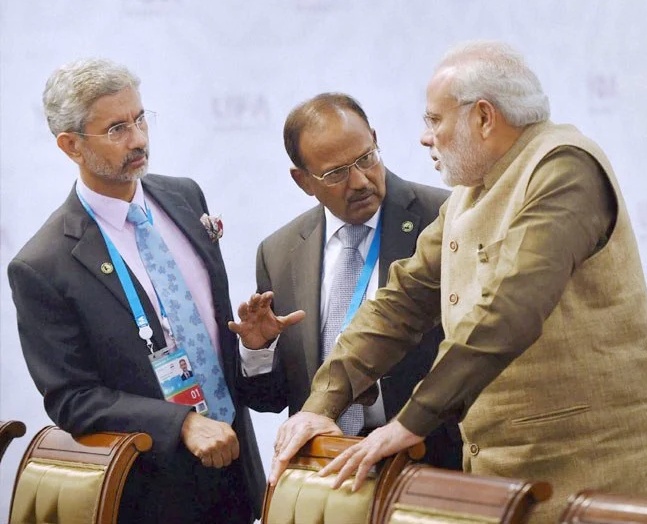
[Minister for external affairs S. Jaishankar, national security adviser Ajit Doval and Prime Minister Narendra Modi]

By Bharat Karnad

India has spent trillions of rupees since 1947 on education, social welfare programmes and defence. But, 70-odd years later, the country has the largest population in the world of ill-educated, unskilled, unemployable youth, certain health and socio-economic indices that are worse than those of some of the world’s poorest states, and a showy but short-legged and second-rate military dependent on imported armaments.

Yet look at India in macro terms using the somewhat dubious ‘purchasing power parity’ concept and it gets rated as a trillion-dollar economy. What explains this anomaly?

Tufts University political scientist Michael Beckley’s pioneering theory of international relations suggests that gross measures – such as population, GDP, defence budgets, size of armed forces, etc. – are less accurate in assessing the power of nations than “net” factors, such as how effectively national resources are converted into measurable and decisive political, economic and military capability and diplomatic leverage and clout.

In other words, it’s the outcomes that matter. By this standard, the more advanced countries of the West seem to be more efficient converters of their human and material resources into usable policy assets relative to India and other middling powers, or even China, which in this respect falls somewhere in between these two sets of states.

So analysing the outcomes of Narendra Modi’s foreign policy – which is a continuation of the Indian government’s approach and policy from the days of P.V. Narasimha Rao, Atal Bihari Vajpayee and Manmohan Singh – and of S. Jaishankar’s central role in crafting several crucial agreements in service of this policy, may be a good way of judging its success.

The distinctive feature of India’s external relations in the new century is the pronounced tilt towards the United States. Narasimha Rao worked to obtain a rapprochement in the 1990s, and Vajpayee agreed on the Next Steps in Strategic Partnership (NSSP). This culminated in 2008 with the civil nuclear cooperation deal with the US and, during Modi’s first term, in India signing two of the three “foundational accords” proposed by Washington – the Logistics Exchange Memorandum of Agreement (LEMOA) and the Communications Compatibility and Security Agreement (COMCASA). The third, Basic Exchange and Cooperation Agreement (BECA) for sharing geo-spatial information, is awaiting signature.

Jaishankar helped negotiate the nuclear deal and thereafter in his various posts facilitated and relentlessly pushed the foundational accords through the Ministry of External Affairs (MEA) and the Prime Minister’s Office (PMO). Briefly, what are these various agreements about and what do they say about Modi’s and Jaishankar’s thinking?

Senior functionaries in the Manmohan Singh government, it may be recalled, ballyhooed the civil nuclear cooperation deal with the US as all gain and no pain. They declared that the deal had left India’s nuclear deterrent intact, protected its weapon-grade plutonium producing capacity and preserved the option to resume testing in the future, and that imports of the 1000 MW light water reactors from abroad would obtain for the country “20,000 MW by 2020”. Remember this endlessly repeated mantra of Manmohan Singh’s to justify the accord?

[Then US President George W. Bush and Indian Prime Minister Manmohan Singh in New Delhi on March 2, 2006.]

The US, on the other hand, made no bones about its intent at a minimum to “cap and freeze” India’s nuclear weapons technology at the fission weapons-level achieved with the 1998 Shakti series of tests, and to prevent it at any cost from advancing to the thermonuclear weapons threshold.

The US government, however, happily joined the Manmohan Singh government in touting the energy rationale, especially because Indian purchases of the AP 1000 Westinghouse light water reactors would also revive a moribund US nuclear industry. As to what was actually accomplished in the negotiations was made plain soon after the nuclear deal was sealed by the chief US negotiator, under secretary of state for political affairs Nicholas Burns.

“To strengthen the nonproliferation system for the future, it just [made] every bit of sense to bring India into it and to do that in such a way that doesn’t strengthen its military arsenal,” explained Nicholas Burns in a 2007 interview to the Council on Foreign Relations in New York. “It allows [India] to put 14 of [its] 22 power reactors under safeguards and all future breeder reactors [a reactor that produces energy and weapons grade plutonium]. And within 25 years, I think 90%-95% of the entire [Indian nuclear] establishment will be fully safeguarded. So the choice [was]: Should we isolate India for the next 35 years, or bring it in partially now and nearly totally in the future? I think that [was] an easy choice for us to make strategically.”

Because of the deal, not only is India’s nuclear arsenal frozen at the elementary fission weapon stage – no amount of computer simulation and component testing can rectify the design flaws in the failed thermonuclear weapon design tested in 1998, leave alone produce a credible hydrogen bomb or fusion weapon the Indian armed forces can have confidence in without additional nuclear testing. Except testing is prohibited on the pain of the US imposing sanctions and terminating the deal. Also voided is India’s capacity for surge production of fissile material with most of the heavy water-moderated natural uranium-fuelled CANDU reactors shoved into the UN International Atomic Energy Agency (IAEA) safeguards net.

With the “islanding”, or separation of Indian weapons directorate, from the rest of the work in Trombay, moreover, the earlier cross-pollinating milieu of scientists and engineers from any field getting involved in solving difficult weapons-related problems that often resulted in innovative solutions, is lost and, with the no-testing regime in place, the best and the brightest have gravitated away from weapons work.

To add insult to injury, even the power reactors India is in the process of buying from the US and France are a risk on two counts. Of the 12 low-enriched uranium fuelled light water reactors India is seeking to purchase, six each from the US and France, the American Westinghouse 1000 reactor has not been cleared by the US regulatory authority for safety reasons.

In addition, the smooth functioning of these imported reactors is ensured only so long as India refrains from conducting nuclear tests. Should India resume underground tests, the supply of foreign fuel will be instantly and permanently terminated, the electricity sourced from these power plants will peter off, and the industries dependent on them will progressively close down, with untold effects on the economy. Further, the tens of billions of dollars expended in acquiring these reactors will become dead investment.

This is the economic deterrent against India resuming tests. And, by way of closing all weapon options, the deal decrees that the spent fuel from the foreign reactors can only be reprocessed in a specially constructed, IAEA-safeguarded, reprocessing unit put up at this country’s cost.

All this is Jaishankar’s handiwork. Why the nuclear deal is hailed as a great diplomatic victory for India and Jaishankar as a diplomat par excellence is a mystery, considering he gave away the store. The first responsibility of an official negotiator is not to undermine the nation’s sovereignty or cede even the smallest ground in this respect, and to protect and further the national interest to the maximum, and here Jaishankar defaulted.

The normal thing to do if something minor is conceded is to get disproportionate benefits in return. It is the sort of bargain Chinese negotiators routinely manage when dealing with the US. But what did India get in return?

This giveaway mentality is even more conspicuous in the so-called ”foundational” accords – LEMOA, COMCASA and BECA – that Manmohan Singh agreed to mull over and which Jaishankar pushed as ambassador in Beijing (2009-13) and, more centrally, as ambassador in Washington (2013-15), and finally as foreign secretary when the Modi dispensation formally signed LEMOA in August 2016 and COMCASA in September 2018.

Ponder this: LEMOA allows US military forces to stage military actions in the region out of Indian air, naval and army bases and, hence, willy-nilly embroil India in the US’s wars, and COMCASA will permit US intelligence agencies seamlessly to penetrate the most secret Indian communications networks, including the nuclear command and control links.

BECA under consideration, concerned with the digital mapping of the country, potentially provides the US militarily useful digitised Indian target sets – information that Washington can at any time pass on to friendly states (such as Pakistan, and even China) in crisis and conflict to serve its larger strategic-cum-geopolitical purpose of maintaining the balance in South Asia – the overarching US aim since the 1950s.

On the flip side, it will reinforce India’s dependence on the US for the digitised information related to targets in adjoining states. Again, in agreeing to become a virtual regional sidekick of the US, what did India get? Absolutely nothing, other than endless promises of advanced military and technology collaboration, for example, that so far have turned out to be so much hot air.

[Secretary of State Mike Pompeo, former US Secretary of Defence James Mattis and ex-foreign minister Sushma Swaraj and former defence minister Nirmala Sitharaman]

These accords obligating India to render assistance are particularly egregious considering they are entirely redundant. The Indian government was always in a position to contingently assist the US armed forces on a case-by-case basis if Delhi considered it politic and the costs of doing so were deemed bearable. It would have amounted to tremendous diplomatic and political leverage. Thus, US Air Force planes from the far east theatre refuelled in Mumbai before flying on to Kuwait during the 1992 Operation Desert Storm. There was no LEMOA then.

Communications compatibility, likewise, could at any given time be established between the fighting platforms of the two countries without COMCASA by plugging into jerry-built technical interfaces, like the UNIX system, used in the earlier versions of the Malabar naval exercises.

Such arrangements would have protected the country’s freedom of action and political manoeuvre, the integrity of India’s communications system at-large and of the software driving it. Most significantly, the country’s standing as an independent player on the international scene would have been enhanced. But mindless compromises and one-sided agreements seriously hurtful of the national interest have characterised the Indian foreign policy in the new millennium and Jaishankar’s diplomatic oeuvre, as it were.

One of the reasons India invariably gets the short end of the stick in negotiations with the US as the nuclear deal, LEMOA and COMCASA reveal is because Indian diplomats, like civil servants, are generalists and have no legal training, nor are they backed up in a sustained manner by legal experts. It disadvantages them against their American counterparts who, if not lawyers themselves, are supported by teams of legal specialists who conduct negotiations with an eye on the minutiae of legal rights, responsibilities and obligations that nations undertake in treaties they sign.

No wonder, then, that the MEA teams, including the one Jaishankar led when shaping the nuclear deal, relied on draft agreements originally produced by the US State Department as working text for negotiation, a pattern repeated in reaching an understanding on LEMOA and COMCASA. Under the circumstances, no prize for guessing which nation’s interests got served.

Prime ministers may set the direction of foreign policy but it is the professional diplomats who finesse and flesh it out. It is another matter that the political goal of bettering relations with the US is sought to be reached by turning away from “strategic autonomy”. Rao’s motivation to rebalance India’s foreign policy by leaning less on Soviet Russia at a time when it was falling apart was sensible. Vajpayee’s NSSP was devised as a step function to improve relations with the US but also to develop leverages. But it was Manmohan Singh’s partiality, in his own words, for “short term [benefit] maximiser” policies, that really greased India’s slide into a subsidiary partner status that Jaishankar cemented via the nuclear deal and LEMOA and COMCASA.

Until a really strong-willed Indian leader with a powerful national vision, and someone not besotted by, or beholden to, the US in any way emerges on the scene, India’s quest for great power status will be futile.

But why is Modi so pro-US? Other than the aspirational reason to see India become as materially prosperous as the US, it is a socialisation issue. Influenced by his long apprenticeship with the Rashtriya Swayamsevak Sangh and immersed in its socially conservative ethos and culture Modi, as detailed in my book Staggering Forward: Narendra Modi and India’s Global Ambition, is much influenced by the RSS norms lauding hierarchy with seniors and superiors given deference.

In the external realm this gets translated by Modi into deferring to his “superiors” – Trump and Xi Jinping and, by extension, India, to the US and China; his actions, perhaps, even conforming to some kind of international varna order and a social given. (Observe, in this respect, his interactions with Trump and Xi when he is fawning and eager to please, and contrast it with his meetings with African and other Third World leaders when his back straightens up, his chest is out, and he is correct and officious.)

[Prime Minister Narendra Modi with Chinese President Xi Jinping]

In this setting, the need for the country to retain its historical role as a power balancer in the international system and using its potential tipping weight to lever substantial benefits to India from the US, China and Russia (which still has the military muscle to stop the other two cold) has been ignored. But Jaishankar’s policy formulation, like Modi’s, excels in small politics as one of his service-mates stated, of siding with one state to counter another for the nonce, with a series of such small balancing acts amounting to nothing, nor fitting into any grand strategy or larger game plan.

But some of these tactical moves are beginning to tax the patience and goodwill of India’s more steadfast friends, and there’s bound to be adverse reaction. India’s growing military closeness to the US and its seeming compliance with Washington’s demand that it cut its reliance on Russian arms has already stirred Russian President Vladimir Putin, called the “apostle of payback” by former US Deputy Secretary of State William Burns and ambassador to Moscow, into selling Kamov utility helicopters to Pakistan as a warning to Delhi. More lethal and technologically sophisticated military hardware at “friendship prices” could be headed Islamabad’s way in the future. Should Moscow get really punitive, India would face the nightmare of a Russia-China-Pakistan nexus.

Egged on by Jaishankar, the Modi government’s short-term, short-sighted, policies to placate the US and turn around and try and pacify Russia will succeed only if Moscow, used to giant meals, is content with breadcrumbs from the arms sales table. The sideline contracts, such as the one for Russian shipyards to build two Grigoryvich-class frigates for the Indian Navy, are unlikely to be enough recompense for Moscow, or make up for its loss of multi-billion dollar transactions for “big ticket” military items.

Should things get out of hand, Putin could tighten the tourniquet by ending India’s lease of high-value weapons platforms such as the Akula-II class nuclear powered attack submarines – the sort of fighting asset the US will not loan India for democratic love, liberal values, or money. By way of perspective, the US is unwilling even to transfer conventional submarine technology it no longer uses, what to speak of in-date and advanced military hardware.

None of this apparently concerns the Modi-Jaishankar duo. But the Indian armed forces have to worry about whether the government will be able to resist the US unloading the antiquated 1960s vintage F-16 fighter plane dressed up in the new F-21 combat aircraft guise,  and the overpriced and unproven electro-magnetic aircraft launch system (EMALS) to equip aircraft carriers under construction in Kochi. EMALS is something the US Navy is leery of after testing it on the Gerald Ford-class nuclear-powered carriers and President Donald Trump has publicly rejected it. The Modi regime’s response to the US opposing its buy of the Russian S-400 air defence system reflects the confusion at the heart of its foreign policy.

India is being pressed by Washington to junk the S-400 contract signed with Moscow and to opt for the less effective, more costly and technologically inferior American counterpart – the medium range National Advanced Surface-to Air Missile System (NASAMS) or the fast reaction Patriot-3 missiles, instead. The offer of the NASAMS/Patriot-3 is on the one hand baited with the promise of the F-35 – the latest US combat aircraft that veteran American combat aircraft designers, such as Pierre Sprey, have damned as unable to fight or scoot out of trouble and, on the other hand, comes freighted with the threat of sanctions under the US Countering America’s Adversaries Through Sanctions Act.

Presumably advised by Jaishankar, Modi is attempting simultaneously to placate both Russia and the US  by proposing to also buy the redundant NASAM system. It is a solution that will at once send the defence procurement budget soaring, complicate the country’s air defence problem, put the country in a double bind by exposing it to disruption by two rival and competing suppliers at odds with each other, and fail to address the basic US fear of the S-400 radar getting insights into US-sourced combat aircraft.

The first two years of the Trump administration ought to have sobered up Modi, familiarised the MEA about the US president’s “art” of cutting deals, and convinced the Indian government to lower its sights where the US is concerned. None of this has happened.

[Prime Minister Narendra Modi hugging US President Donald Trump in 2017.]

While his first visit in June 2017 to the Trump White House – replete with Modi hugging a somewhat nonplussed US president – passed off without incident, the first bad signs appeared soon thereafter. The US withdrew from the Paris Climate Accord and Trump lambasted China and India as the main culprits for carbon emissions and atmospheric pollution. He threatened to charge India as a “currency manipulator” which would trigger its own set of economic sanctions, and slammed India’s tariff barriers against US goods, especially Harley-Davidson motorcycles, and American agricultural commodities.

More recently and to show he means business, Trump removed India from the Generalised System of Preferences permitting duty-free entry for Indian exports valued at $5.7 billion-$6.3 billion out of the total exports of some $55 billion to the US. Of course, Trump left some slack for the restoration of GSP as a bargaining card to finagle a slew of high-value military sales.

Accommodating the US on agricultural commodities would imperil the ruling Bharatiya Janata Party’s stock with the farmer community, which is in distress across the country, so that’s out. But the purchase of the seriously decrepit F-16, and of the F-35 as follow-on aircraft – which was what Lockheed Martin, the producer of these aircraft, first offered the Indian government nearly 15 years ago, may mollify Trump.

But on the matter closest to Modi – the H1B visa – Trump has slammed the doorson the Indian prime minister’s face. The US intake of Indian techies has been reduced, the processing time has been lengthened, and life has been made difficult for visa holders by eliminating work visas for spouses and the “family reunion” provision, the last liberally used by a generation of Indian professionals to bring their extended family members into the US as lawful immigrants.

Trump has almost incentivised foreign countries to be wary of the US. He has had no compunction in treating the US’s treaty allies and partners in Europe and Asia with the utmost disdain, admonishing, hectoring and insulting them in turn, calling their leaders names, pressuring them to reimburse the US for the costs of protecting them, and otherwise ordering them to toe the US line on everything, or else.

In the economic and trade spheres, Trump has been just as harsh towards friendly states, closing down the Trans-Pacific Partnership that was meant economically to compete with and constrain China, and forced a “fairer” US-Canada-Mexico [trade] Agreement down the throats of the US’s northern and southern neighbours, and then within hours of signing it nullified it by tweeting a message critical of it.

Modi, a believer literally in hands-on diplomacy, innocently thought that the hugs and embraces he bestowed on Trump would soften the US stance but discovered these had zero effect. With historical allies and partners suffering Trump’s lash, what chance does Modi reckon India has of being treated decently or getting reasonable deals?

Of course, Trump is transactional but his negotiating method is really quite simple and transparent, which Modi and Jaishankar haven’t got the hang of yet. He uses the US’s market clout, technological edge and diplomatic reach like a bludgeon. Trump does not give a fig for the niceties of diplomacy, for the usual diplomatic give and take, of compromise, of IOUs that can be encashed later – the stock-in trade of international relations.

As ex-US deputy secretary of state William Burns recently observed in an interview to New Yorker magazine, “In the Trump era, what’s happened is the [White House is] cavalierly disregarding that there are trade-offs at all and not even recognising them.” In other words, as far as Trump is concerned, success lies in taking a mile without giving an inch. There’s also no exchange of favours or concessions because for Trump each transaction is a singular, discrete event in itself with no connection to anything that preceded it or might follow it. Meaning, a foreign country accommodating the US in one forum or deal does not automatically merit Washington’s consideration in another transaction.

[US President Donald Trump does not give a fig for the niceties of diplomacy.]

Acting as if unaware of this reality, Jaishankar apparently has a plan to tackle Trump and his administration – the primary reason why Modi brought him into the loop at an elevated position in the first place. Jaishankar’s supposedly bulging phonebook of contacts in the US government and in Washington at large is expected to do the trick.

It will be of no avail because the Washington Jaishankar knew a few years ago as ambassador is not the Washington he will be visiting as foreign minister. Most of his contacts are out of the picture – eased off their sinecures in a purge of the US State Department that saw 74 career ambassadors resigning in 2017 alone or being shoved out the door. Senior positions in the State Department have remained unfilled, and its budget has been slashed by 30%. William Burns has called it “diplomatic disarmament”.

The pattern of Trump’s involvement in policymaking is that, without doing any homework or reading policy briefs, he alights on some position or the other and expects that the country of his momentary interest will jump to it. Trump’s all take and no give negotiating strategy unfortunately dovetails with the Indian government’s method as evidenced in its record of being all give and no take. After all, where’s the problem for the US if India, rather than engaging in hard negotiations, gives away what Washington desires for free – to wit LEMOA and COMCASA?

Even on issues where the differences have predated Trump and Modi, such as over Russian arms, Venezuelan oil and Iran, India has chosen to give in. Particularly disturbing is the marked decrease in the inflow of oil from Iran to avoid US sanctions, when a more self-respecting and strategic-minded nation would have immediately coordinated efforts with the other major importers of Iranian oil (China and Japan) to explore setting up an alternative payment channel to the dollar system.

Such a move would have strengthened the country’s energy situation and propelled India’s strategy for Afghanistan and Central Asia pivoting on the Chabahar port. Located on the North Arabian Sea and outflanking the Pakistani and Chinese navies ex-Gwadar, and landward constructing rail and road corridors to link up with the Russian Northern Distribution Network, it would have consolidated Indian trade, market access and civil and military cooperation with Russia, Afghanistan and the Central Asian Republics. Such a plan would also constitute a massive leverage, ensuring good US behaviour.

[Chabahar in Iranian Balochistan.]

Trump’s foreign policy decision-making for all practical purposes is restricted to himself, his whims and fancies and his Twitter handle, with the US secretary of state Mike Pompeo present there to realise his boss’s desires the best he can but, more often, to clean up after him. The only person Trump pays some slight heed to is national security adviser John Bolton. Except, the Indian embassy in Washington and the MEA have almost no ready access to him – NSA Ajit Doval’s getting through to his US opposite number during the Pulwama crisis was a one-off thing, covering up for Bolton’s contempt for India which took root, or so it is rumoured, at the UN when he was President George W. Bush’s ambassador. So, Jaishankar’s traditional diplomacy will draw a blank there.

The sure shot way of commanding Trump’s attention is by being disruptively combative – the method perfected by Kim Jong-Un of North Korea. It is one Modi has no stomach for and will never attempt. Trump’s initial threat against Kim was met with panache. He responded to the US leader’s threat of “raining down fire and fury” by calling him a “deranged dotard” and daring him to carry out a strike, revealing his own plans of firing nuclear missiles to take out the mid-Pacific US military island base of Guam.

A sobered up Trump quickly backtracked, and offered to meet. In the two summits – in Singapore in June 2018 and in Hanoi this year – Kim dismissed Trump’s call to denuclearise his country, demanding the US remove all its nuclear weapons from the region. It won Kim more than respect; “We are in love!” trilled Trump. All the hugging did not extract for Modi any similar reaction. The lesson to learn is that desirable outcomes are best reached by being immovable when the national interest is at stake.

Kim’s modus operandi is unlike Modi’s and, even more, Jaishankar’s. The Indian prime minister seems unwilling to accord primacy to India’s national interest above every other factor when transacting with the US. On this count, Jaishankar’s recent views and the manner in which he has dilated on foreign policy concepts that he has borrowed from others, do not inspire confidence. He has talked of “multi-alignment” proposed by Shashi Tharoor in his 2012 book Pax Indica without explaining just what he understands by it and how he expects to work it, given that the Indian policy during Modi’s watch has leaned so much to the US side. And he has referred to “issue-based coalitions” mooted in my 2015 book Why India is Not a Great Power (Yet),  talking of it as an instrument for “positioning” the country and not, according to him, for “balancing” regional and international power. This last is passing strange and begs the question: Positioning being a static notion, how will limiting policy manoeuvre further the country’s interests?

Jaishankar’s attitude clashes with these concepts, in the main, because they presuppose India having a free hand and a foreign policy unencumbered by the need to play second fiddle to any country, or to conform to US aims and objectives in the Indo-Pacific. Having tilted over so much to the US side, Modi and Jaishankar may soon discover that Trump will compel them to bend backwards some more.

India is already a much reduced presence in the world. Absent the strategic will and vision for the country other than, in essence, turning it into an American camp follower, India, in the next five years, will find its status and stature shrinking fast. At the heart of Modi’s foreign policy is the big worrisome question: Does the prime minister actually believe that what is good for the US is good for India?

———–


Published in The Wire, June 25, 2019, at https://thewire.in/diplomacy/narendra-modi-s-jaishankar-us-india

Posted in Afghanistan, Africa, arms exports, asia-Pacific/Indo-Pacific, Asian geopolitics, Central Asia, China, China military, Culture, Decision-making, domestic politics, Europe, Geopolitics, Great Power imperatives, India's China Policy, India's strategic thinking and policy, Indian Air Force, Indian Army, Indian democracy, Indian ecobomic situation, Indian Navy, Indian Ocean, indian policy -- Israel, Iran and West Asia, Iran and West Asia, Latin America, MEA/foreign policy, Military Acquisitions, Military/military advice, Missiles, nonproliferation, North Korea, Northeast Asia, nuclear industry, Nuclear Policy & Strategy, nuclear power, Nuclear Weapons, Pakistan, Pakistan military, Relations with Russia, Russia, russian assistance, russian military, South Asia, Strategic Relations with the US & West, Technology transfer, UN, United States, US., Weapons, West Asia, Western militaries | 14 Comments