India may be dragged into war against Iran

Image result for pics of General Soleimani

[General Qassem Soleimani]

The assassination by a killer drone of Iran’s Pas Daran (Revolutionary Guards) chief, Major General Qassem Soleimani, on the express orders of the US President Donald J. Trump is the sort of historical blunder that will rank with President George W Bush’s initiation of war against Iraq in 2001 to takeout President Saddam Hussein on the blatantly false charge of Baghdad readying nuclear weapons. The Bush decision set fire to West Asia, and completely destabilized an already volatile region that Saddam had kept a lid on by strongarm measures.

Saddam was the hinge on which West Asian peace rested. He had for several previous decades somehow managed to balance the interests of the sunni and shia communities in Iraq, and maintain order, often by bloody means, something both the Saudi led sunni bloc and the Iran-headed shia bloc grudgingly acknowledged. That order was upended. Now Trump’s murder of Soleimani is likely to start a spiral of violence and targeted strikes against American military presence and US economic interests in the Gulf, in Iraq where shias predominate, and generally in the extended area stretching from the Red Sea and the Gulf of Hormuz to Central Asia in the north, Pakistan in the east, and Syria and the Levant in the west. As it is, the Iraqi parliament is on the verge of voting for a resolution asking the US to get out of Iraq.

Hugely respected in the region as much for his political acumen and military expertise as for his understanding of the religio-ethnic dynamic in greater West Asia, Soleimani founded the al-Quds force for action in Iraq after the US military intervention there. Deployed against what Tehran considers the greatest danger to Islam — the US-Israeli combine, and also to fight the spurious caliphate of the murderous al-Baghdadi, the al-Quds force and the Kurdish paramilitary force, Peshmerga, were primarily responsible for reducing the Islamic State to nothing, which actions were discreetly supported by Saudi Arabia — the ostensible guardian of Mecca. The real reason why the people by and large held Soleimani in high regard was because of his physical courage; he led from the front.

It is very possible that with Pakistan getting dragged into the melee with likely attacks on US targets mounted by Iran-backed elements in that country, India will be asked by Washington to not only share intelligence — and in case Pakistan becomes too hot for the US forces to stage military missions out of, to permit American military units to operate out of Indian air force and army bases along the border with Pakistan. In Jaishankar-Rajnath Singh’s recent 2×2 summit with the Pompeo-Esper duo in Washington, the American side was eager particularly to activate the Logistics Exchange Memorandum of Agreement (LEMOA) that will allow the US military the use of Indian facilities for, among other things, anti-Iran operations.

Permission under LEMOA will be demanded by the US because, with the general elections coming up, Trump will be compelled for political reasons to up the ante — meeting an Iranian counter thrust with a bigger strike — rather than to cool down the situation by making some sort of friendly gesture and even reparations to Tehran in terms of say, weakening the US-led sanctions regime. With much of Islamic Asia, including Pakistan, now unwilling to be any part of this action-reaction sequence, the only two countries on Iran’s flanks — Russia standing aside for the nonce before jumping onto Tehran’s side should America escalate with too much force — are Turkey to the west and India to the east.

Erdogan began building bridges to Iran with his visit to Tehran in January 2014 that was hailed by the Iranian foreign ministry, “As two neighbors and Muslim countries, ….enjoy[ing] many commonalities and many cooperation opportunities”. Indeed, before meeting with Trump in Washington in November last year, Erdogan had hosted a controversial Iranian diplomat who had a hand in an attack on certain Jews in Buenos Aires. So it is improbable that Ankara, which is already on the outs with the US owing to Erdogan’s purchase of the S-400 air defence system, will allow the NATO base at Incirlik to be used for air or any other activity against Iran. That leaves India exposed to US pressure.

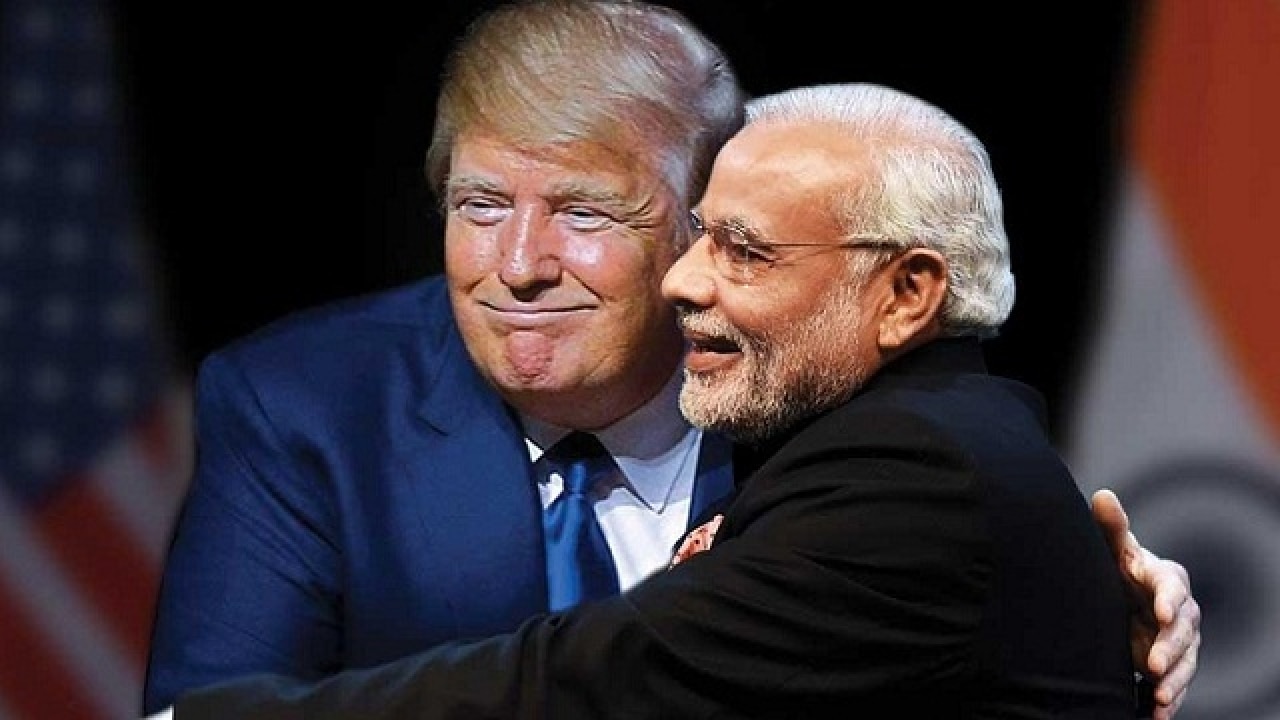
One of Narendra Modi’s major claims of foreign policy success is his supposedly warm personal relations with Trump. It has so far fetched absolutely nothing for India and all the country has to-date witnessed is a one-way relationship where Modi keeps trying to please the US with unending concessions and deals for military hardware but receives no consideration whatsoever in return. With a confirmed America-firster — Jaishankar in MEA, moreover, the advice offered Modi is to give the US more and more even if it gets India less and less in return. His natural aptitude for hard bargaining that Modi boasted about is nowhere in evidence, at least not in terms of any substantive strategic gains and economic benefits. What benefits anybody can point to are mainly negative ones, meaning things like US restrictions on India techie movement could have been more severe, limitations on imports of Indian manufactured goods more onerous, etc.!

At the heart of the worry about India getting engaged, willy-nilly, in American initiatives hurtful to Iran, is that Modi, like most Indian politicians, is a proven sucker for praise and flattery, and Trump’s laying it on thick will be irresistible to the Indian PM. One need only recall the “Howdy, Modi!” Houston event and how elated Modi seemed when Trump rained accolades on him, to gauge the dangers ahead.

It may be best for the Modi government to, for once, do the right thing and preempt any approaches for help by Washington, by wagging its finger and asking the US and Iran to refrain from doing anything to escalate tension and, as a well wisher, to suggest to Washington that it make amends, by easing economic pressure on Tehran as prelude to negotiations for ending the long US-Iranian diplomatic impasse. It may be the way to regain for an over-US tilted India room for diplomatic manouevre, some slight self-respect and, perhaps, even an affirmation of shared interests with Iran.
Posted in asia-Pacific/Indo-Pacific, Asian geopolitics, Culture, Decision-making, domestic politics, Geopolitics, Great Power imperatives, India's strategic thinking and policy, Indian Air Force, Indian Army, Indian ecobomic situation, indian policy -- Israel, Iran and West Asia, Indian Politics, Iran and West Asia, Israel, MEA/foreign policy, Military Acquisitions, Military/military advice, Nuclear Weapons, Russia, SAARC, society, South Asia, Strategic Relations with the US & West, United States, US., Weapons, West Asia | 21 Comments

The Usual Suspects

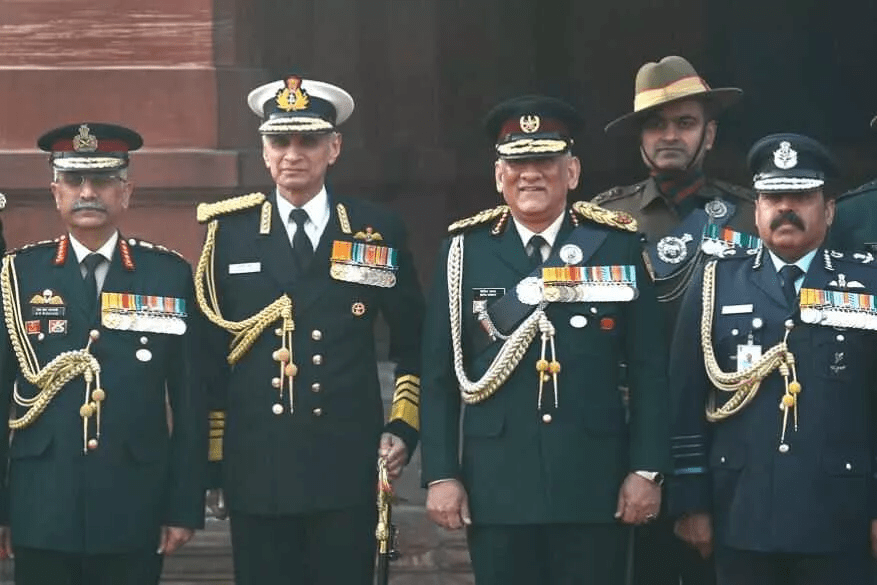
[CDS General Rawat, and three Chiefs of Staff — Naravane, Karambir Singh, and Bhadauria]

A book review by me published in India Today, Dec 30, 2019 issue

Anit Mukherjee, The Absent Dialogue: Politicians, Bureaucrats, and the Military in India, Oxford University Press, 2020.

———-

Civil-military relations in India are sensitive, tense, fraught with dread, and involve three parties – the armed services on one side and the tag team of politicians and bureaucrats on the other, tussling on eggshells. In this fandango, more effort is expended in turf battles, ego-status hassles, and furthering sectional interests than in working cooperatively to obtain speedy results. Enjoying superior position, the tag team mostly has its way, leaving the military to make do with what’s offered. Reduced almost to an afterthought, national security is not served well.  

     There is so much so seminally wrong with the existing system of national defence, it is hard to know where to start or whom to blame for the mess. In this book, Anit Mukherjee, a former armoured corps officer turned academic, identifies the villain — by his lights the “absence of dialogue” between the three players. But it is too pat an answer. Nevertheless, by addressing the problem of military effectiveness in terms of the lack of dialogue on weapons procurement, jointness, officer education, promotion policies and defence planning, he usefully pulls together information and insights based on interview research to highlight the ills plaguing the system that are widely known and have long been recognized as stumbling blocks. (A list of senior retired and serving military officers, bureaucrats and civilian experts who were interviewed is appended.)

     A persuasive case is made that the extant state of civil-military relations is because there is no credible existential threat, “low salience [of defence] in electoral politics”, and because there is no real incentive to change. And that status quo is preferred because it preserves for the military its functional autonomy and for the babu-dominated politician-bureaucrat nexus the entirely satisfactory system of “power without accountability”. It is this context that the author fleshed out by tracing the state of civil-military relations through the tenures of the prime ministers to-date. 

Jawaharlal Nehru established the system of overarching and disabling civilian control which may be democratic India’s strength and also major military weakness because generalist bureaucrats have tended to gum up the works. Civil-military relations reached heir apogee during the Indira Gandhi era when political involvement at every stage led to smooth inter-agency and inter-service coordination culminating in the successful 1971 Bangladesh war. The lesson that hands-on role by leaders is key, however, stays unlearned. The power balance tilted towards the military during the Rajiv Gandhi years when the showy army chief General K. Sundarji held sway. In the wake of controversial military operations (Brasstacks, Sri Lanka) and the Bofors scandal, the bureaucracy reasserted itself. In this milieu, disruptive institutional innovations are not countenanced.

The Committee on Defence Expenditure geared to curbing military spending did not survive the VP Singh interregnum because the armed services and the ministry of defence (MOD) bureaucrats alike found it “inconvenient”. In similar vein, a powerful Chief of Defence Staff (CDS) recommended by the Kargil Committee is unlikely to be realized with the Narendra Modi government favouring the Naresh Chandra Committee’s concept of a defanged four star CDS    .

     The absence of technical expertise and domain knowledge in MOD is the real scandal here, and Mukherjee dilates on it. He makes the telling point that uniformed officers are as much generalists as civil servants because the formers’ experience and professional training is so narrowly tactical they, like civilians, muddle along, unable to cope with the minutiae of technology trends, geopolitical developments, and the strategic scope and scale of effort needed for modern national security planning.

     What the author misses out on is the crucial matter of political leaders shirking responsibility. Instead of setting goals, prioritizing threats and expenditure programmes and tasking bureaucrats and military to implement decisions, they rely on babus to, in effect, make them. This is the source of all the troubles, resulting in overbearing defence civilians, languid pace of decision-making, and a raft of seemingly irresolvable problems bedevilling India’s national security policy.

———-

[Review at https://www.indiatoday.in/magazine/up-front/story/20191230-the-usual-suspects-books-1632416-2019-12-29 ]

Posted in arms exports, asia-Pacific/Indo-Pacific, Asian geopolitics, civil-military relations, corruption, Culture, Decision-making, domestic politics, India's strategic thinking and policy, Indian Air Force, Indian Army, Indian democracy, Indian ecobomic situation, Indian Navy, Indian Politics, Military Acquisitions, Military/military advice, society, South Asia | 1 Comment

A Decade of Regression and Squandered Opportunities

Image result for pics of modi stumbling

Prime Minister Narendra Modi’s stumble up the steps in Kanpur on December 17 was symbolic of the country staggering into the future instead of striding confidently into the third decade of the new Century. Most of India’s woes have been self-inflicted. The BharatiyaJanata Party government that came to power in 2014 promising a world of real and radical change – recall the rousing slogans “India First”, “Less government, more governance”, and “Government has no business to be in business”, has well into its second term delivered on none of them.  What it has produced is a country emerging as America’s poodle and as appeaser of China – India’s primary security threat and strategic, ideological, and economic rival in Asia and, at home, a relentless drive to polarize India along communal and religious lines for petty political gain that bids fair to rent the social fabric and engender lasting turmoil. 

Ironically, at the same time as the Modi regime rammed the Citizenship Amendment Act (CAA) through Parliament, a law apparently ultra vires of the Indian Constitution (Article 14) that set off deep social tremors all over the country, the neighbouring  Pakistan—Indian government’s favourite whipping boy, took the first strong steps towards liberal democracy and the rule of law. That country’s Supreme Court did the unthinkable – tried the coup de’atatist and former Pakistan Army chief, General Parvez Musharraf, for treason and sentenced him to death for violating the Constitution! Clearly, the two countries seem headed in opposite directions.

If the political situation is on the boil, India’s economic plight is alarming. Rising unemployment and a growth rate that many fear will soon subside to the socialist era “Hindu rate of growth” of 3%, means that millions of youth – the so-called “demographic dividend” that Modi earlier talked up, the bulk of them unemployable “educated illiterates” unattended by government skilling programmes, could combine with the violent street protests stirred by CAA, to render India truly ungovernable. Whether the disturbances remain on the front page or not, Modi’s cynical politics and widening resistance to it, are bound to exacerbate centre-state relations and further roil the economic prospects. This slide in India’s political and economic fortunes is mirrored by the Modi government’s failures in the external realm.

     As it is, by staying with a policy sourced from Narasimha Rao’s time, and continued by subsequent Prime Ministers – Manmohan Singh and now Modi, of getting close to the United States apparently at any cost, India’s freedom of diplomatic action and ability to leverage its contingent or “issue-based” support has eroded markedly. Playing off the US against Russia, Russia against China, and US against China to benefit India, is not easy when Delhi has already revealed its cards, namely, intimacy with Washington, estranged partnership with Moscow, and wary accommodation of China.

     With respect to America, Manmohan Singh mumbled (whence President George W. Bush’s half-jokey comment that he needed a translator when talking to the Indian PM). Chanting the mantra “20,000 megawatts by 2020”, he pretty much surrendered the country’s sovereignty by signing a civilian nuclear deal with the US that barred India from conducting new thermonuclear tests. 2020 is nigh, there’s no sign of the promised nuclear energy surge, but there’s the Indian strategic deterrent limited to proven fission bombs. It has put India in no position to ever challenge China’s proto-hegemony in Asia.  The only way India can throw off these shackles is to resume hydrogen bomb testing and leaving it to Washington to call off the deal. This the US cannot do because geostrategically it has no other friendly state that is also hefty and can help contain China, which is striving to displace the US as the predominant power. Indian leaders it would appear have no sense of the country’s inherent strengths or of the leverage it can wield if it has a mind to.  

Modi has proved that he is not the one to unshackle India. His innovation—if you can call it that is unrestrained embracing, and his deployment of arms purchases to achieve unambitious goals. Global leaders may have gotten used to his hugs and learned gamely to reciprocate. But their seeming effusiveness has not translated into enduring gains for India. His bonhomie with US President Donald J Trump has led to no give whatsoever on Washington’s part on any of the issues Modi has flagged. So every time Modi meets with Trump, he signs up for more P-8I maritime reconnaissance aircraft and transport planes – C-17, C-130, the staple buys. In return, for enriching the US defence industry, Modi asked for small things and got smacked in the face. He lobbied hard for a loosened H1B visa scheme to benefit Indian techies. It fetched a tightened immigration regime instead, forcing Indian companies –on the pain of loss of market — to invest in the US resulting in the reverse flow of capital and employment gain for America. Supplicating  for easier entry for its manufactured export goods, Delhi was pressed to ease restrictions on imports of American dairy and meat products.

All the talk of advanced military technology collaboration and transfers from Vajpayee’s time have begotten nothing except first Barack Obama’s and now Trump’s pressuring India to go in for the antiquated F-16 fighter plane decked out with shiny bells and whistles and a new moniker — F-21, and for its production line as well to service, other than the aircraft with IAF, a non-existent market. It is a project that’s likely to be furthered under the ‘Make in India’ programme that the Indian Air Force head Air Chief Marshal RKS Bhadauria has called a sham. It will add to the $14 billion worth of military hardware purchases from the US Modi has already committed to.

India’s relationship with America however one-sided, has complicated its ties to Moscow. A once steady friend is now openly flirting with Pakistan, promising it latest armaments, and handing over Mi-35 attack helicopters and, at the other end, forging strong military technology and manufacturing links with China. India is hit with a double whammy. Desperate to keep President Vladimir Putin in good humour, Delhi contracted for the S-400 anti-aircraft air defence system it didn’t really want but bought anyway as gap filler in India’s layered ballistic missile defence (BMD) which won’t work because there’s no technology anywhere that can fend off salvo firings by enemy states of missiles and rockets. India desperately wants the second Akula-class nuclear powered hunter-killer submarine. But Putin has tied it to other capital military deals such as the Amur-class diesel submarine for the navy’s Project 75i and, the more commendable 50 ton T-14 light tank for the army’s mountain offensive corps. With both the US and Russia angling to monopolize the Indian arms market at the expense of the indigenous weapons design, development, and manufacture programmes (such as the Tejas Light Combat Aircraft, its derivative Advanced Medium Combat Aircraft, Arjuna main battle tank) India’s national interest is gutted.

In bilateral trade with China of some $100 billion, India’s deficit is some $65 billion.  Seduced by Xi Jinping’s promises of investment in infrastructure and of imminent resolution of the long simmering border dispute, Modi has played footsie with Beijing. During his nearly six years in office there has been no Chinese investment nor a border accord, but there has been frequent summiting and partaking of the “Wuhan spirit” and, lately, the Mamallapuram spirit, which appear to be merely exchanges of vaporous rhetoric and nothing substantive on the ground to show for it. But Beijing has no complaints. It gets to keep its beneficial trade imbalance intact, and notwithstanding every assessment claiming the PLA-funded Huawei Company’s 5-G technology as cyber Trojan Horse, it remains in the running to outfit the Indian telecommunications system.Talk of being taken for a ride! But that’s not the half of it.

China is Pakistan’s sheet anchor and makes no bones about it. Besides financing the China-Pakistan Corridor (CPEC), Beijing is the champion of Islamabad’s causes and protector of its interests in the UN and other international fora. On December 16, in the latest such initiative, it moved a resolution in the Security Council to discuss the Kashmir issue, and has prevented the Financial Assistance Task Force from sanctioning Pakistan for sponsoring terrorism. Despite China’s manifest antipathy to India, Modi has refrained from using market access to trip up the Chinese economy, or in a belated response to Beijing’s dastardly proliferation of nuclear missiles to Pakistan, from arming the states on China’s periphery and in the South China Sea with nuclear and long-range weapons to strategically straighten out Beijing.

     In this decade of diplomatic shuffle, old friends with historic ties have been given the heave-ho, disrespected, and even discarded on Washington’s say so. Though central to India’s strategic plans for a presence in Afghanistan and Central Asia via the rail and road grid radiating northwards from Chabahar port that Delhi said it would fund, Iran has been treated as a pariah, the flow of Iranian oil has been drastically scaled back and energy reliance on Tehran cut from 13% to less than 2% in three years, and the Iran-Pakistan-India gas pipeline has been shut down for good. So cheap energy has been sacrificed for the pricey nuclear power that Manmohan Singh and now Modi are determined to buy by procuring exorbitantly priced reactors from the US, Russia, and France, courtesy the 2008 nuclear deal. In a similar fit of strategic short-sightedness, India has gone slow on intense military cooperation with Japan – the one country China is apprehensive about. It has even turned down Tokyo’s offer to transfer the production line of the US-2, the finest maritime multi-role aircraft in the world.

India in the last ten years has done little of note other than beef up its image as a foolish giant of a nation, at once gullible, exploitable, spendthrift and self-abnegating, fulfilling every big power’s wish as a friend or, as China would happily attest, as an adversary.

———-

[A shortened version of this piece appeared in my occasional ‘Realpolitik’ column in BloombergQuint.com, 28 December 2019, at https://www.bloombergquint.com/opinion/indias-foreign-policy-a-decade-of-regression-and-squandered-opportunities ]

Posted in Afghanistan, arms exports, asia-Pacific/Indo-Pacific, Asian geopolitics, Australia, Central Asia, China, China military, civil-military relations, Culture, Decision-making, Defence Industry, domestic politics, DRDO, Europe, Geopolitics, Great Power imperatives, India's China Policy, India's Pakistan Policy, India's strategic thinking and policy, Indian Air Force, Indian Army, Indian democracy, Indian ecobomic situation, Indian Navy, Indian Ocean, indian policy -- Israel, Iran and West Asia, Indian Politics, Iran and West Asia, MEA/foreign policy, Military Acquisitions, Military/military advice, NRIs, Nuclear Policy & Strategy, Nuclear Weapons, Pakistan, Pakistan military, Relations with Russia, Russia, russian assistance, russian military, SAARC, society, South Asia, South East Asia, Strategic Relations with South East Asia & Far East, Strategic Relations with the US & West, Technology transfer, UN, United States, US., Weapons, West Asia | 14 Comments

Surrendering strategic space, steaming into trouble

Image result for pics of jaishankar and rajnath singh with pompeo and esper

[Rajnath Singh and Jaishankar in 2+2 meeting in Washington]

The decisive section in the Joint Statement issued Dec 19 at the end of the India-US 2+2 Ministerial Dialogue in Washington related to Building an Enduring Defense and Counterterrorism Partnership. It has had some doozies in it. Clearly, the Modi government is so committed, as the Statement said, to ” a comprehensive, enduring, and mutually-beneficial defense partnership and to expand all aspects of their security and defense cooperation” that the price India will end up paying is apparently of little concern to Prime Minister Narendra Modi. It is like, as the Press has reported, the government’s willingness to ride out the unrest attending on the Citizenship Amendment Act for what the Modi-Amit Shah duo hopes will be long term political gains to them personally and to the Bharatiya Janata Party generally from deepening the communal-religious divide.

The section talks of realizing “the India-U.S. Major Defense Partnership (MDP)” with expanded “military-to-military cooperation” with the “new [annual] tri-service, amphibious exercise – TIGER TRIUMPH” involving the Indian Navy and, on the American side, the U.S. Indo-Pacific Command, Central Command, and Africa Command. Its intention is “to expand similar cooperation between their respective Armies and Air Forces” to supplement the yearly Malabar exercise. All this is no bad thing. Moreover, placing an Indian officer to liaison with U.S. Naval Forces Central Command, and inviting the US military to the 2020 MILAN multilateral naval exercise to support “capacity building efforts in the Indo-Pacific” is also fine. And, there are definite gains from an agreement to set up maintenance, repair and overhaul depots in India for aircraft — but for which planes would be interesting to know. Because these aircraft would have to be in large enough numbers to make the MROs a cost-effective proposition. But OK, so far so good.

Except, all the military exercising, forging service-to-service links, and MROs are essentially cover for the two things Washington has been desperate for: (1) the implementation of the Communications Compatibility and Security Agreement (COMCASA) for “secure communication capabilities between the Armed Forces, including the Armies and Air Forces” and (2) the Industrial Security Annex (ISA) facilitating the exchange of “classified military information between Indian and the U.S. defense industries”. Unfortunately, ISA seems designed by Washington to prevent Russian military hardware from being manufactured here under license.

COMCASA, I have long maintained, is an ‘Open Sesame’ for the US formally to penetrate India’s most secret communications grid, including the nuclear command and control net. It can then potentially interfere — if it isn’t able to do so already without the COMCASA, with the communications between the PM (the final nuclear firing authority) and SFC in any crisis.

Paying up tens of billions of dollars to Lockheed and America for the obsolete F-16/F-21 will mean Finance Ministry telling IAF there’s no money for the Tejas LCA programme. And Lockheed is all set to shift the F-16 assembly line from Fort Worth, Texas, to wherever Tata wants to set it up in India. As Tata, VP for global relations (or something), S. Jaishankar pushed the Modi government to buy the F-16. As our esteemed foreign minister he will be saying aye in a cabinet of rubber stamps when Modi brings the F-16 contract to acquire this decrepit old plane for the IAF up for approval. Quite a racket this.

To return to my main thesis, the separate private sector defence industry geared to buying military goods phased out by the US military will be facilitated by the ISA. This is because the US companies do not want their Intellectual Property Rights compromised by having the DPSUs that have produced Russian equipment, to make their products. It stretches the imagination to know what American tech is worth hiding in a 50-yer old F-16, given that its so-called “advanced” avionic packages will come as “black box” technologies for the lifetime of the plane’s production run that Tata and the Indian secondary chain suppliers will have no hand in producing anyway.

But this is only half of our troubles. With the US insisting on sealing defence industries producing their items, Russians too will feel, prestige bound, to argue that DPSUs outputting their more modern, newer generation, Su-30 aircraft, for instance, should be insulated against tech-stealing by Americans.

Where will this end? With two completely separate US- and Russia-sourced fleets, and US oriented private sector and Russian-aligned DPSUs, the Indian military will find itself in an operational quandary if Washington and Moscow also insist — which would be the next level of their gamesmanship — that Indian air force, naval and army bases too cannot have “their” weapons platforms operating from the same bases or use a common logistics infrastructure. This is madness. And India, by trying to be too clever by half — the late K. Subrahmanyam’s special card (sought to be played by his son, Jaishankar) — is stepping right into its own carefully constructed pagal khana.

Posted in arms exports, asia-Pacific/Indo-Pacific, Asian geopolitics, Australia, civil-military relations, corruption, Culture, Decision-making, Defence Industry, domestic politics, Geopolitics, Great Power imperatives, India's strategic thinking and policy, Indian Air Force, Indian Army, Indian ecobomic situation, Indian Navy, MEA/foreign policy, Military Acquisitions, Military/military advice, society, South Asia, Strategic Relations with the US & West, Technology transfer, United States, US., Weapons, Western militaries | 12 Comments

Head-banging on CDS

Image result for pics Lt Gen Naravane with naval chief karambir

[Lt Gen Naravane, Admiral Karambir and VCAS Air Marshal Arora on Navy Day]]

There’s a lot of head-banging going on in PMO over the Chief of Defence Staff (CDS) issue. With the economy plummeting and bad news marching in in battalions with another self-inflicted wound — the Citizenship Amendment Bill (CAB), which the Narendra Modi-Amit Shah duo decided is worth the short term costs — escalating turmoil, including unrest in Delhi, because it would beget perennial political payoffs in terms of polarizing the electorate along religious lines every time general elections and major state level polls come into view. There’s, however, a felt need to take the people’s eye off the extant troubles and on to some “achievements” the BJP government can showcase.

One such issue on the platter is CDS, a decision that’s acquired a certain urgency if the first person to hold this post, the current army chief General Bipin Rawat, who retires end of December, is to be the man. So there’s not much time. Rawat’s “elevation” has been rumoured for a while now. This appointment would be least disruptive because he is the senior most among the current serving chiefs anyway, even though a four star CDS isn’t much of an elevation and will not prevent the coming functional friction with the three services chiefs, including the successor army chief.

There are other options the PMO may be considering that military circles are agog about. Among these is appointing the Vice Chief of the Army Staff Lieutenant General Manoj Mukund Naravane, who is the presumptive COAS, as the first CDS. It will bring the next senior army man, Lt. Gen. Ranbir Singh, Northern Army Commander, into the succession picture. Except the navy head Admiral Karambir Singh and Air Chief Marshal RKS Bhadauria may baulk at serving under a junior — Naravane, as the “first among equals”. So, this too is problematic.

If the Modi regime shies away from making Rawat the first CDS, it may be politic, say many senior military officers, to appoint Admiral Karambir to the position as single source military adviser to the government. The present Chief of Naval Staff is a thorough professional, and a straight arrow. Especially helpful is the fact that Karambir is a naval aviator (helicopter pilot) and an air force brat to boot, his father being a retired Wing Commander. And so he’s a person who absolutely appreciates air power and will not shortchange the Indian Air Force, the fear of which motivated its 40-year rear-guard action against the establishment of the CDS system.

In fact, the IAF’s opposition to CDS is the cover behind which the government has advanced the idea of a 4-star CDS, and not a genuinely senior person as a (5-star) Field Marshal, something the civil bureaucracy has violently opposed and which development the political class too has felt queasy about (owing to the old fear about an all-powerful military officer staging a coup).

It will be interesting to see if Modi prefers a non-Rawat choice for CDS and who it will be.

Posted in Asian geopolitics, civil-military relations, Culture, Decision-making, Indian Army, Military/military advice, society, South Asia | 7 Comments

A space debris accord with US to clip India’s options

Image result for pics of space debris

[A pictorial representation of space junk]

According to NASA, space junk is a serious problem, and the figures (below) are daunting. To-date there are (1) some 500,000 pieces of space debris between 1 and 10 cm, (2) more than 21,000 pieces larger than 10 cm, and (3) more than 100 million pieces below 1 cm. Moreover, most orbital debris is within 2,000 km of the Earth’s surface, and the biggest concentrations of debris are found at 750-800 km. Only 7% of space junk is functional, and all debris is hurtling at speeds reaching 28,163 km/h (17,500 mph), putting in peril thousands of low and high orbiting satellites that are critical to the modern world. Satellites map, spot natural resources, collect weather and agriculture-related information, transmit all manner of data, and facilitate global telecommunications, not to mention their military uses (surveillance, target tracking, and weapon guidance over long distances).

There have so far been over 5,000 satellite launches, with decrepit satellites long past their use-by date orbiting uselessly and adding to the debris. “Atmospheric drag” naturally pulls the junk, like decommissioned low earth orbit satellites, into the earth’s atmosphere and burns them up on re-entry but this takes time and cannot be relied on to clear the debris fast. Other means have to be used to achieve this aim. Such as boosting the old geosynchronous satellites into higher “space graveyard” orbits in the 36,000 km belt above the earth.

Space debris problem needs addressing by all countries. So, why does an agreement on space junk that the Narendra Modi government is eager to sign with the United States dangerous for India’s national security interest?

Let’s consider the “Orbital Debris Mitigation Standard Practices” executive order that President Trump signed in 2018, which was updated this year. It is the likely template for the accord that the Indian government is about to sign with the US. Trump’s order has 5 objectives. The first one is to control debris larger than 5mm released “during normal operations” over 25 years — with normal nowhere defined — and require spacecraft/upper stages to be designed such as to “minimize”, preferably, “eliminate”, such release. The 2nd objective to reduce debris from”accidental explosions” and mandates engineering and probability assessment methods to judge a spacecraft’s propensity for such explosions,which figure will have to be less than 1 in 1000. Moreover, energy sources within spacecraft would have to be depleted, and propellant burns and compressed gas releases designed to avoid collision and consequent explosion. The 3rd goal is to select safe flight profiles and operational configuration to prevent these from adding to the debris. The spacecraft will, in the event, have to be designed to ensure the probability of collision with debris 10 cms and larger to be no more than 1 in 1000, and that it can survive hits by microastroids and 1 cm sized debris without hurting its post-mission disposal prospects.

The 4th objective is to mitigate post-mission disposal of satellites/space structures by, in the main, enabling direct re-entry, atmospheric drag enhancement measures, maneuvering to different orbits, and by direct retrieval within 5 years of mission completion, with these disposal measures attaining 0.9 level probability. The 5th objective is regarding “constellations” of 100 or more tiny spacecraft, with each needing to have a high disposal rate (of 0.99). Further, small LEO satellites and cubesats will have to be engineered for a lifetime of 25 years.

Some of these concerns are being taken up by the UN Committee on the Peaceful Uses of Outer Space (UNCOPUOS) but the bulk of the problems and solutions are as the US has stated them. If it was an entirely UN initiative, there’d be some merit in joining the talks. But what negotiation exactly have ISRO’s Space Situational Awareness & Management Centre (SSAMC) and MEA conducted outside of, and within the, 2+2 context, with the counterpart US agencies before the Modi government decided to sign this agreement? As far as one can make out, there may have been an exchange of notes and some perfunctory discussion, but no real interaction between technical experts of the two countries. This would mean that India has accepted the US standards in toto. The question to then ask is whether ISRO has the advanced technological and design competence to develop upper stages/spacecraft which meet American performance criteria? And if ISRO can’t meet them, America will, presumably, wield its favourite stick to beat India with — sanctions, as an agreement violator!

Such space debris agreement may well require India to share the engineering parameters of its spacecraft as well as their mission profiles (“operational configuration”, etc. — 2nd and 3rd objectives) with Washington. That would make ISRO products and missions an open book and preemptively close off even informal cooperation with DRDO to produce heavy lift ICBMs with larger payload carrying capacity of single weapons and MIRV-ed warheads.

The more troubling aspect is why sign a bilateral agreement that limits what India can and cannot do in space, when over 50 odd countries have satellites and will not be bound by any of its strictures? India can choose to be responsible on its own account and take care to design spaceware that does not exacerbate the space debris problem, even adhering to the US norms. But there was simply no need to sign an accord that binds India hand and foot. Compare China’s pattern of international behaviour. It never signs any bilateral or multilateral agreement until almost all other nations have signed it, and then uses its reluctance to sign as diplomatic leverage to get what it wants. India is invariably the first to get on the wagon and gets screwed in terms of the lost freedom of action and space for diplomatic maneuver. But trust Delhi to never learn from the past and to keep repeating the same mistakes.

Posted in Afghanistan, asia-Pacific/Indo-Pacific, Asian geopolitics, China, Culture, Decision-making, DRDO, Geopolitics, Great Power imperatives, India's strategic thinking and policy, MEA/foreign policy, Military/military advice, Missiles, Nuclear Policy & Strategy, Nuclear Weapons, satellites, South Asia, space & cyber, Strategic Relations with the US & West, UN, United States, US. | 6 Comments

BJP’s in-house strategist’s “strategically decisive India”

Image result for pics of ram madhav

[Ram Madhav]

T’is winter-time and all the established media houses and media wannabees schedule their elite outreach programmes to try and make themselves relevant to policymaking and policymakers, to wit the Hindustan Times Leadership Summit, etc. Just got back from a shindig arranged by WION TV network on “World Order: Talking Diplomacy” where the keynote speaker Ram Madhav, BJP General Secretary and in-house expert on foreign policy and presumably also strategy, dilated on the topic “Strategically Decisive India 2020”, which was a good reason to attend it.

Narendra Modi, he said, has added several “new dimensions” to India’s foreign policy. Elaborating further, Madhav said that the prime minister had (1) “shed romanticism” and the institutional “resistance” to engaging with other countries, which is judged by the number of visits by the PM and foreign minister; (2) adopted “practicalness”and proactiveness”; (3) de-hyphenated India and Pakistan, and compelled the countries of the world to take a “stand alone approach” to India; and, most importantly, (4) to the 5 panchamrit principles, he added, few more, namely, samman (respect and honour for Indians and India), samvad — “greater engagement with “people [abroad] who matter” that helped reshape the country’s image in the world and also involved effective “diaspora diplomacy”, “suraksha” (security for Indians and India) and “”samriddhi” — the cultural angle. As regärds the last, Madhav said Modi does not hesitate to to use Indian culture as a diplomatic tool, or as he put it, he “does not mind wearing culture on his sleeve”.

He then said — and this is a very ambitious formulation — that in the strategic realm, “India needs to have its own club”, that India’s leadership has to be asserted before it is accepted, and that the defunct SAARC and BIMSTEC type orgs won’t do because India cannot lead them. This club, he added, will have to “turn east” and India will have “to rise as leader in the Indo-Pacific”. The current international institutions, he averred, by way of filling in the background, cater to Europe and the West and not to Asia and the East. This fact, he implied, is what offered Delhi the opportunity to conceive of this club. Further, he attributed this new nomenclature of the Indo-Pacific, as replacement for Asia-Pacific, to Modi’s efforts during the Obama Administration. The question is, he observed, “How to make India central in the Indo-Pacific region”.

All these things are expected, per Madhav, to turn India into a strategically decisive country by next year!

In this region, moreover, managing China will, according the Madhav, require “skill” and the Regional Comprehensive Economic Partnership (RCEP) won’t be “comprehensive without India”and hence that Delhi can afford to wait until its conditions (in the main, insistence on the 35% value add in products sourced from the RCEP member states to prevent China channeling exports of finished consumer and capital goods to India via third countries) are met. RCEP being “äll about markets” it cannot do without the vast Indian market, he maintained.

Replying to a question about the religion-based Citizens (Amendment) Bill (CAB), he made the cogent point that it was based on the 1950 Assam Expulsion Act (AEA) that Jawaharlal Nehru promulgated which addressed the problems caused by Muslims from the then East Pakistan streaming across the border into India and upsetting the local ethnic composition and disturbing the peace, which pattern continued after 1971. And that CAB, like AEA, was necessitated by Partition of India along religious lines. Whence these Bills eased/will ease the absorption of Hindus, Sikhs and Christians expelled from, or pressured to leave, Pakistan, Bangladesh, but deny citizenship status to incoming Muslims, including the Rohingyas from Myanmar.

Finally, Madhav blamed the prevailing “market sentiment and climate” for the economic downturn in the country.

——-

This is a full slate of issues on which Madhav voiced his opinions. The points he has made helps us understand the way the Modi regime perceives the world, crafts Indian foreign policy, and sees its own successes. Let us broadly but briefly assess these claims.


With respect to the supposedly new dimensions of foreign policy introduced by Modi, one can take issue with many of them. It is easy to contend, for example, that eliminating policy resistance to engaging with the West was, in truth, originated by the Manmohan Singh government with its disastrous nuclear deal with the US and its drumbeat of pleas for admission into such tech cartels as the Nuclear Suppliers Group — both policy streams Modi has persisted with. However, Modi did pioneer the opening up to Saudi Arabia and the smaller Gulf states, until now when these countries have for the first time and in their national interest set aside religion as a factor to see a stable India as a long term market for their energy and as a safe investment destination. That it has thus marginalized Pakistan’s hitherto consequential role in this sub-region is a dividend that may or may not have been anticipated. And more, it is here in the Gulf area that the claim of de-hyphenation packs credibility with the Arab states closing in with India at the expense of Pakistan. Elsewhere though, Europe, US, and the rest of Asia faced with India’s reflexively anti-Pakistan attitude at every turn has only forced these countries to junk the standalone approach to India they may have adopted during the Manmohan Singh era when Delhi strove for the easing of relations, to naturally react by re-hyphenating these terribly squabbling South Asian states, much to India’s detriment.

Ridding Indian foreign policy of romanticism is fine but where’s the evidence of proactive measures? There has been a lot of tall talk about security cooperation with Indian Ocean states, countries of the Southeast Asian littoral, and with Japan but little that is concrete, unless one counts the Shinkansen 5E series high-speed Mumbai-Ahmedabad link that’s run into rough weather with the new Maharashtra chief minister Uddhav Thackeray withdrawing permission for its construction in that state, thereby grounding this flagship Indo-Japanese venture. Modi has not disturbed even little the old normal of the Indian government and MEA working at a maddeningly slow pace, reducing this government to all promise and no delivery on projects Modi has offered the host states on his frequent travels. The Kaladan connectivity project that was to plug Myanmar into the Indian economy is nowhere near completion some 20 years after it was initiated. The Development Assistance Programmes (DPAs) I & II in MEA with a brief to oversee timely and within cost delivery of Indian funded projects are a scandal, and has generated more ill will, doubt and distrust of India over the years in Southeast Asia, Indian Ocean area and Central Asia than any good they might have done. This perfectly deplorable state of affairs hasn’t changed an iota during Modi’s tenure. In this context it is hard really to see even a glimmer of success of Indian foreign policy vis a vis the developing world.

The panchamrit + 4 principles are fine on paper, but have created problems. For instance, the successful diaspora diplomacy is the spawn of samvaad. But in asking diasporic Indians to be national assets for their new countries it may have reinforced NRIs to become wielders of foreign influence in India, which in any case they were inclined to do. This is most evident in the India-origin Americans working to get Indian national interests more in sync with US policies.

The India-led club is a mite too ambitious a concept for Modi because his policy stance has so far oscillated between compromising with China and accommodating the US, something that makes nonsense about India’s pretend autonomy while making Asian states of the Indo-Pacific wary because it mirrors what they themselves are doing. In which case, what benefits do they gain from joining India’s club? Had India stood its ground and not surrendered leverage and turf on virtually every issue of contention with US and China, had Modi not backpedaled on the radical economic reforms he had promised in 2014, removed the dead hand of government from the economic sphere with rapid privatization of the public sector, incentivized skilling programmes and employment generation schemes on a war footing and otherwise propelled the growth rate instead of doing nothing and seeing the economy now tank, India presently a 2.73 trillion economy despite all the systemic restraints and constraints, would have achieved double digit growth, ensured the PM another two terms in office for certain, and set India up as a coming power.

It isn’t at all clear how absent any administrative reforms and radical economic overhaul, a strategically decisive India will emerge, much as all of us might want earnestly to believe that it would somehow do so even without any course correction.

If Modi carries on as he has done to-date, BJP will be lucky if it can put a lid on the growing discontent of the masses inevitably spilling out on to the streets. In this situation, BJP may not survive the 2024 general elections and Modi’s reputation is unlikely to remain untarnished. Madhav’s claims about an India club may then come back to mock Modi. I mean which nation would want to emulate India, or be led by it? And why?

Posted in asia-Pacific/Indo-Pacific, Asian geopolitics, Bangladesh, Central Asia, China, China military, Culture, Decision-making, domestic politics, Europe, Geopolitics, Great Power imperatives, India's China Policy, India's Pakistan Policy, India's strategic thinking and policy, Indian democracy, Indian ecobomic situation, Indian Ocean, indian policy -- Israel, Iran and West Asia, Indian Politics, Internal Security, Iran and West Asia, Japan, Maldives, MEA/foreign policy, Myanmar, nonproliferation, NRIs, Pakistan, SAARC, society, South Asia, South East Asia, Strategic Relations with South East Asia & Far East, Strategic Relations with the US & West, United States, US., Weapons | 2 Comments

Pussyfooting around the truth

Related image

[Jaishankar in Rajya Sabha]

External Affairs Minister S Jaishankar skirted around the truth with his professional diplomatic flummery in the Rajya Sabha yesterday. Asked about India’s chances about securing a permanent seat in the UN Security Council, he said ” “Well, I will hope soon.” But then realizing he had gone too far in raising hopes, quickly corrected himself in the very next sentence. “I am realistic enough to know”, he added, “that it is a long and patient effort. We are not lacking in patience and not lacking in our perseverance and we are not lacking in our aspirations. We will get that one day. I am very confident and it is progressing step by step.” Ah,”one day”. He should have been honest and replied “never”, certainly not if India under Modi (persisting with the policy of his predecessors) continues enthusiastically to subscribe to and support the current world order.

Why? Because it is mightily inconvenient to slice up the international power pie six ways, when the existing 5 powers have each a fifth of the pie. Which country among the present permanent five members — US, Russia, China, UK and France — is idiot enough to want diminution of its power and authority that the permanent UNSC status endows them with? Pleading pitifully for the sixth seat in the UNSC — a glorified talk shop, displaying “patience” and “perseverance” and seeking “to progress step by step” in this regard, won’t do it, and hurts India’s self-respect and amor propre, not that the Indian government seems to care, won’t do it.

What will, I have argued, is if India becomes so excessively disruptive of international norms and the extant system that the P-5 are compelled to accommodate it in their ranks,or face a breakdown in their carefully constructed global power edifice. The example to follow is Maozedong who simply ran roughshod over the UN and its “rule-based international order, repeatedly cocked a snook at it, drove the US-led UN forces south of the 38th parallel, fought General Douglas MacArthur’s army to an impasse on the Korean Peninsula, and then enjoyed the great fortune of having a Third World chump in Jawaharlal Nehru surrender a Permanent seat offered India to China, just so that country took its rightful place at the global apex!!

India, as a non-signatory, could have made a beginning by upsetting the global nuclear apple cart that the P-5 had cobbled together by ignoring the 1968 Nonproliferation Treaty and responded with alacrity to China’s clandestine transfers of nuclear materials, expertise, bomb designs and missile systems to Pakistan starting in the mid-1970s by shipping whole N-bombs to Vietnam and, in time, to other states on China’s borders who expressed a desire for such armaments. Recall that China invaded Vietnam in 1979 and got a bloody nose for its troubles, the aggressor PLA Group Army leading the charge actually being defeated by the Vietnamese irregulars who took to the field before the Vietnamese army could see action. Given its security context, wouldn’t Hanoi have appreciated such a gesture and permanently put the Chinese dragon’s tail in a twist in a way the Pakistani nuclear deterrent has done to India? And consider the strong message that Indian action would have sent Beijing, and the absolute parity in geomilitary terms that would have subsequently achieved for India. Instead, under Manmohan Singh, India finally succumbed to the NPT and signed the civilian nuclear deal negotiated by, who else, our truly — S Jaishankar, then a relative small fry — Joint Secretary (Americas) in MEA, and now the country’s foreign minister, no less. As a result of the N-deal the possibility of India ever securing credible thermonuclear weapons to match China was thus dashed.

The fact is it is still not too late for Delhi to activate this option. But then Narendra Modi, as he has shown, would rather be patted on his back by the West and China for showing restraint when anything nuclear and to do with Beijing are concerned, and be celebrated for India’s “responsible behaviour” than serve the hard Indian national interest.

——-

Jaishankar said one other important thing in Parliament — this regarding the Russian S-400 air defence system. It is  “very clear” to everybody, he declaimed that India took decisions on merits. “We will not be influenced”, he observed,”by other countries on what we do in terms of our national security and defence. If we have committed to the S-400 agreement, which we have, then other countries need to respect that decision.” Sounds nice, doesn’t it though? One little problem. He talked of the “merits” of weapon systems India buys from a slew of foreign countries as an explanatory variable.

Doesn’t this open up the matter of the Modi regime and F-21 — the venerable 50 year old “museum ready” F-16 fighter aircraft by another name which Jaishankar, in his capacity, incidentally, as head of the Tata Group’s global operations (or some such designation) pushed the BJP government to buy? Would Jaishankar in the cabinet when the decision comes up tout this aircraft’s “merits”, which other than permitting Tata — a haloed Indian company that has gone down the wrong path under Ratan Tata, to assemble it and rake in the money in cahoots with Lockheed Martin, has no real benefits. Unless you count the dubious gains from India from plugging into the US global value and production chain.

Jaishankar single-handedly negotiated the nuclear deal that finished off India’s nuclear ambitions. Who is to to say he, as foreign minister, won’t be equally persuasive — considering the direction in which prime minister Modi is leaning, in getting the Country to plonk for this perfectly inappropriate F-16 buy and kill off the indigenous Tejas LCA and its AMCA derivatives and what remains of the Indian Air Force’s fighting capability? When he does, we will be left pondering the “merits” of the F-16 in IAF colours he will no doubt reveal.

Posted in arms exports, asia-Pacific/Indo-Pacific, Asian geopolitics, China, China military, civil-military relations, Culture, Decision-making, Defence Industry, disarmament, Geopolitics, Great Power imperatives, India's China Policy, India's Pakistan Policy, India's strategic thinking and policy, Indian Air Force, Indian ecobomic situation, MEA/foreign policy, Military Acquisitions, Military/military advice, Missiles, nonproliferation, Northeast Asia, Nuclear Policy & Strategy, Nuclear Weapons, Pakistan, Pakistan military, Pakistan nuclear forces, Russia, society, South Asia, South East Asia, Strategic Relations with South East Asia & Far East, Strategic Relations with the US & West, Technology transfer, UN, United States, US., Vietnam, Weapons | 32 Comments

Time for Modi govt to turn the screws on China re: treatment of Uyghurs

Image result for pics of uyghurs detention camps in Xinjiang

[A Chinese Uyghur concentration camp in Xinjiang]

Narendra Modi practices realpolitik at home but gets cold feet and displays a flagging will against an overweaning adversary such as China to a point where it is not unreasonable to conclude he shows no understanding of it, leave alone knowing when to turn the screws on an adversary and to not so subtly discomfit it, and rally international pressure against it.

Beijing, in like situation, showed no hesitation in joining Pakistan to raise alarms in the wake of the abrogation of Constitution Article 370 about India’s mistreatment of, and human rights violations against, the supposedly hapless Kashmiris. This while its ambassador in Delhi proclaimed the need for both countries to be mindful of each other’s “sensitivities”. This policy of double-dealing double talk is normal for China, something Beijing has masterfully executed against a fear-wracked Indian government apparently so apprehensive of crossing Beijing that whatever the scale of provocation, it has chosen to ignore it and generally to subside gently into doing as China wishes.

What is also increasingly normal for Delhi is the shameful wagging of its tail at Xi’s China, which contrasts sharply with the Modi regime’s almost malevolent reaction to even the littlest burp from Islamabad. It shows up this country to the world – to use Mao’s favourite words for Nehru’s India — as “an imperialst running dog”, except that empire is now Chinese!

India and China are ideological rivals, and as such cannot, in theory, abide each other’;s political systems and ideologies. Nothing should be more distasteful to Delhi in this context than the open and systemic victimization of a whole people by a country with an authoritarian Communist dispensation. And yet, in the last 40 years and more India has not officially raised the issue of the cultural genocide in Tibet (referred to by Beijing as Xizang) against its Lamaist Buddhist population, and now against the Uyghur Muslims in the area traditionally known as East Turkestan (that China calls Xinjiang). It is another matter that both these territories — one forcefully annexed by the PLA in 1949, the other transferred by Stalin to Mao in the 1950s, were only tenuously connected to China, their historical linkages to the Yellow Emperor more Chinese pretence than actual historical fact.

Until the new millennium, Beijing was happy to let Xinjiang remain an economic and social backwater because it was strategically critical. Its vast arid expanse providing the perfect location for China’s nuclear weapons development and underground explosive testing complex at Lop Nor. But with 9/11 and the rise of radical Islam, which was manifested in stray incidents of Uyghurs knifing Chinese settlers, Beijing acted preemptively to nip the Islamic terrorist threat in the bud.

First it moved in a huge PLA presence with severe surveillance and policing measures and followed up some five years ago with an official campaign to eliminate this latent threat altogether by re-educating the Uyghur youth — the most likely recruits for Islamist causes. Over time this programme of re-education has taken the shape of a series of barbed wire-laced, high walled, high-tech detention centres in which over a million young men are presently incarcerated, undergoing what Beijing quaintly refers to as “vocational training”.

These “camps” using modern and heinous brain-washing techniques perfected during the Korean War of the early Fifties are supposed to help mainstream the Uyghurs into Chinese national life, but in reality divests them of their separate Muslim and ethnic identity. The so-called “China cables” recently leaked to the West are the first view of Beijing’s how-to manual for non-Uyghuring the Uyghurs by means that China successfully tested and used against the Tibetans in Tibet — a sustained programme of alienating the natives of these lands from their cultural roots, religion and traditions. Indeed, these concentration camps are a follow-on to Chinese laws that have made illegal even the vestiges of Islam in East Turkestan, including beards, worry beads, and Muslim names for children.

In July this year, 22 EU states wrote formally to Beijing to permit UN officials to inspect these crowded internment centres and to prevent the ill-treatment of the Uyghurs by the Chinese state. The methods Beijing has adopted to rub out Uyghurian sensibilities are so extreme, egregious and Orwellian, the UK Foreign Office has demanded in diplomatically acceptable language “an end to the indiscriminate and disproportionate restrictions on the cultural and religious freedoms of Uighur Muslims and other ethnic minorities in Xinjiang.”

It is the right time for Delhi to dig the spurs into China’s flank and demand that Uyghurs be treated humanely and their rights respected by Beijing. It would be the right sort of action to take at this time because it would mean diplomatically piggybacking on the pro-Uyghur UK and EU sentiment and initiatives. It will also be payback for Beijing’s complaining about Kashmiris being hounded by Indian security forces. There’s moreover no hypocrisy here. It is one thing to ask the Srinagar Valley Muslims to stay indoors in their own homes, quite another thing for an entire generation of Uyghurs and Tibetans to be locked up in vast prisons.

The Question is will Prime Minister Modi show some slight stomach, at a minimum, for a diplomatic fight with China? Will he muster the gumption to stick it to Xi on the human rights issue and mirror the Chinese ploy by simultaneously having his mouthpiece, Jaishankar, go against his grain and voice concern for the well being of Uyghurs and Tibetans who have suffered the historic misfortune of their countries taken over by a dastardly China, and instruct our ambassador in Beijing to speak unctuously of cooperation for the greater good of mankind or some such nonsense. Shouldn’t India, for once, stand up and be counted with other countries as supporters of minorities and their absent human rights in China?

Alas, as on so many other previous occasions, Modi will show no such enterprise for fear of diplomatically ruffling China’s feathers. He will thus miss out on an historic opportunity to do the right thing — mobilize international opinion against Beijing and shove China into a corner. More importantly, he will forfeit the chance to make the point that if the Uyghur populated Xinjiang is an internal security matter for China, Kashmir is even more so for India, and thereby publicly put Beijing on notice that two can play at this game. It may even win Modi some respect from Xi Jinping.

Posted in asia-Pacific/Indo-Pacific, Asian geopolitics, Central Asia, China, China military, Culture, Decision-making, Europe, Geopolitics, Great Power imperatives, India's China Policy, India's Pakistan Policy, India's strategic thinking and policy, Indian democracy, Internal Security, MEA/foreign policy, Nuclear Weapons, Pakistan, society, South Asia, Terrorism, Tibet, UN | 18 Comments

Modi: Not quite an Indian Trump

Image result for pics of modiand trump

[Modi- Trump]

Spent the last fortnight in New York lazing around doing nothing much. But couldn’t escape the newspaper coverage and press commentaries regarding India. Unfortunately for the Narendra Modi government 3-4 issues blew up at the same time — the dense, pea soup, pollution engulfing Delhi, the Indo-Pakistani novelist Aatish Taseer’s getting kicked out of India,which got conflated with the Supreme Court’s Ayodhya Ram temple verdict favouring the Hindu majoritarian point of view, and the gloom over India’s economic slowdown.

Each issue in its own way has marked Modi’s signal failure separately on the environmental, social, and economic fronts. Modi’s troubles, in fact, eerily parallel Donald Trump’s in the US. Cut from the same populist and nativist broad cloth, and sporting like psyches, the two find themselves in a rut of their own making. Trump because he successfully whittled away the power of the bureaucracy in Washington, DC, and now finds himself facing impeachment in no small measure because the bureaucrats have turned on him at his impeachment hearings for essentially ignoring them, and bucking the procedures and the laid down process. And Modi because he did just the opposite, trusted the permanent secretariat — the careerist babus to deliver on his agenda which requires a massive reordering of the apparatus of state and the government system, something he obviously has no stomach for and is simply beyond the ken of generalist administrators who are like canaries being asked to pull a plow. In other words, Trump is being dumped on for doing too much, being too disruptive, and Modi finds himself in doldrums for owing allegiance to the status quo and doing too little to reform the government system he presides over.

The two are also similar in their petty politicking for personal and partisan gains. This aspect is evident in Trump’s case in his ceaselessly vilifying his opponents, and in Modi’s for demonizing Indian Muslims and, by extension, Pakistan and adopting political postures injurious respectively to social harmony and peace prospects in South Asia. The two strongmen, moreover, are known generally to run their own brand of personalized diplomacy that at times seem quixotic and geared to making international splash than achieving anything tangible, leave alone lasting. Both of them in their psychological makeup are, as analyzed in my book ‘Staggering Forward’ narcissistic bullies, picking inevitably on weak nations abroad and weaker sections in their own societies (Muslims, immigrants) to make political capital. If Trump has his fortified border on Mexico, Modi has his National Register of Citizens in Assam and elsewhere.

Trump has strong views on environment and is in denial of the underway effects of climate change. He has followed through by simply pulling America out of the Paris Climate Accord and pretty much writing finis to this global effort. So Trump acts as he believes. Modi, on the other hand, has taken up the cudgels and is championing a global consensus on climate change. But between doing something to actually clean up the air, water and environment and keeping a domestic vote bank happy, he has opted to do the latter. Hence, with pollution assuming killer proportions the Indian PM has done less than nothing to pressure the state governments of Punjab and Haryana — the latter under BJP coalition rule into taking punitive action against stubble-burning farmers fanning the fires and the smoke that poison the air around Delhi. He has opted instead to have his cabinet colleagues scapegoat the Delhi chief minister Arvind Kejriwal for the persisting fatally dense smog. This is pretty rich! In other words, Modi is less a man of his convictions than is Trump.

And on the economic front, Trump has not shied away from using market access to hammer out skewed trade pacts to narrowly benefit the US and, at home, has thrown overboard the raft of confusing rules and regulations hindering the growth of commerce, trade and the economy. Meanwhile, Modi ballyhoos every small uptick in the country’s rank order on the “ease of doing business”-scale as his own special accomplishment even as the Indian economy is in reality taking a decisive turn for the worse, with decreasing exports, investments, and FDI flows, higher fiscal deficits, and a decelerating growth rate. Overseeing this mess is Finance Minister Nirmala Sitharaman whose idea of doing something meaningful is to call in corporate honchos to her office for advice without bothering to take notes or instruct her ministry officials to record the points made. Unless she has mimetic memory –which she doesn’t — all this valuable communication and advice from industrialists and senior corporate managers is reduced to so much prattle she pays no attention to. But she seems more intent on these occasions to have official photographers click away, producing pics for the media showing her beaming in the company of these experts and wealth producers while learning absolutely nothing from them.

Modi and Trump also have in common the fact that they are played for suckers by dictators. Trump hangs on every little word and friendly gesture by the North Korean supremo Kim Jong-un. Likewise, far from being skeptical about Chinese President Xi Jinping and his promises, Modi keeps extolling the Mamallapuram spirit (presumably a distillate of the ephemeral Wuhan spirit!) and cutting unfavourable deals with the US even as Trump treats him with disdain (as he does most foreign dignitaries), peremptorily rejecting the Indian leader’s invitation to be the chief guest at the 2020 Republic Day parade, and forcing Modi to make do with Jair Bolsonaro, the rightwing authoritarian Brazilian President who, like himself, has come to power on a wave of big promises and public adulation.

Posted in Afghanistan, asia-Pacific/Indo-Pacific, Asian geopolitics, China, Decision-making, domestic politics, Europe, Geopolitics, Great Power imperatives, India's China Policy, India's Pakistan Policy, India's strategic thinking and policy, Indian democracy, Indian ecobomic situation, Indian Politics, Latin America, North Korea, Northeast Asia, Pakistan, Pakistan military, SAARC, society, South Asia | 6 Comments