
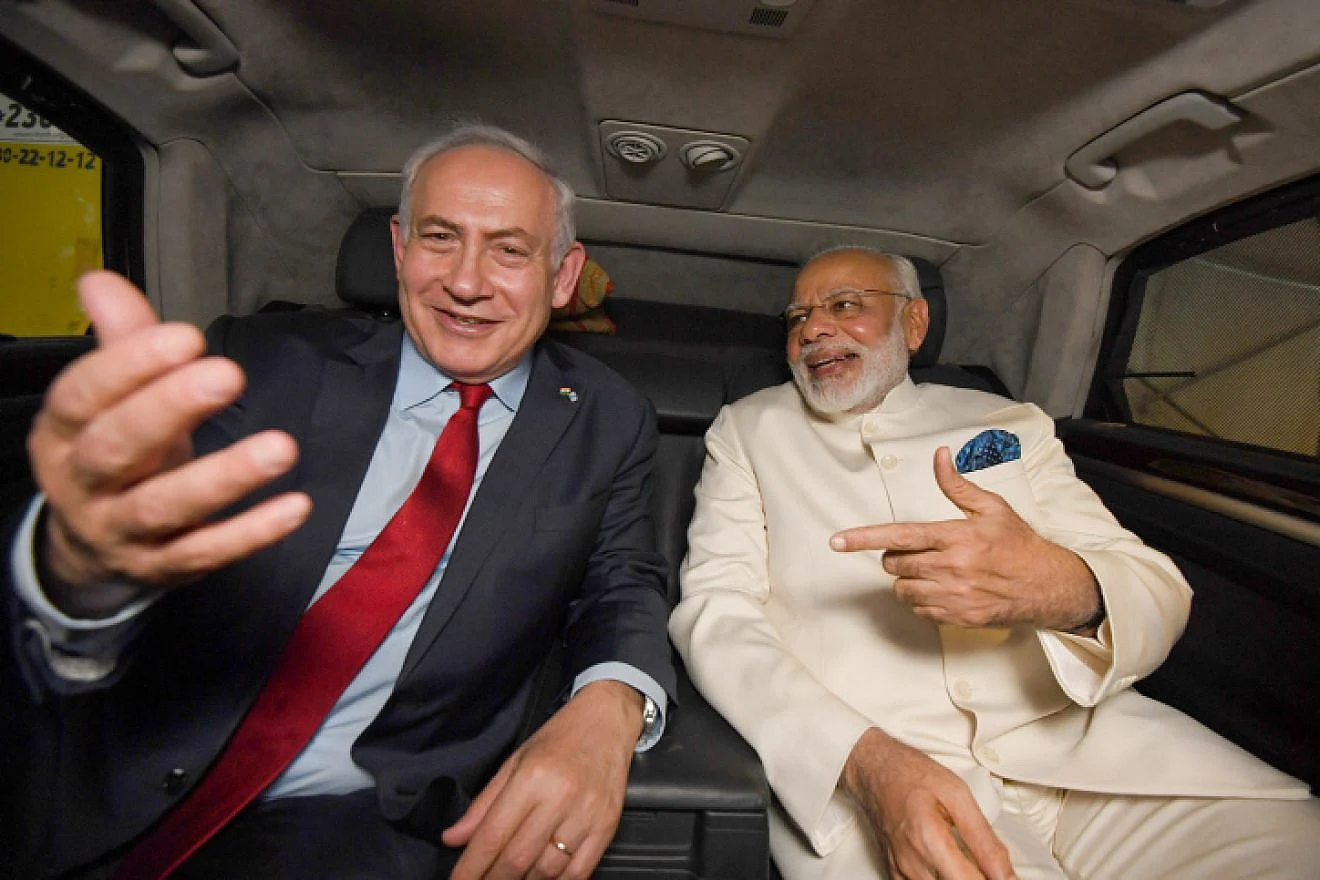
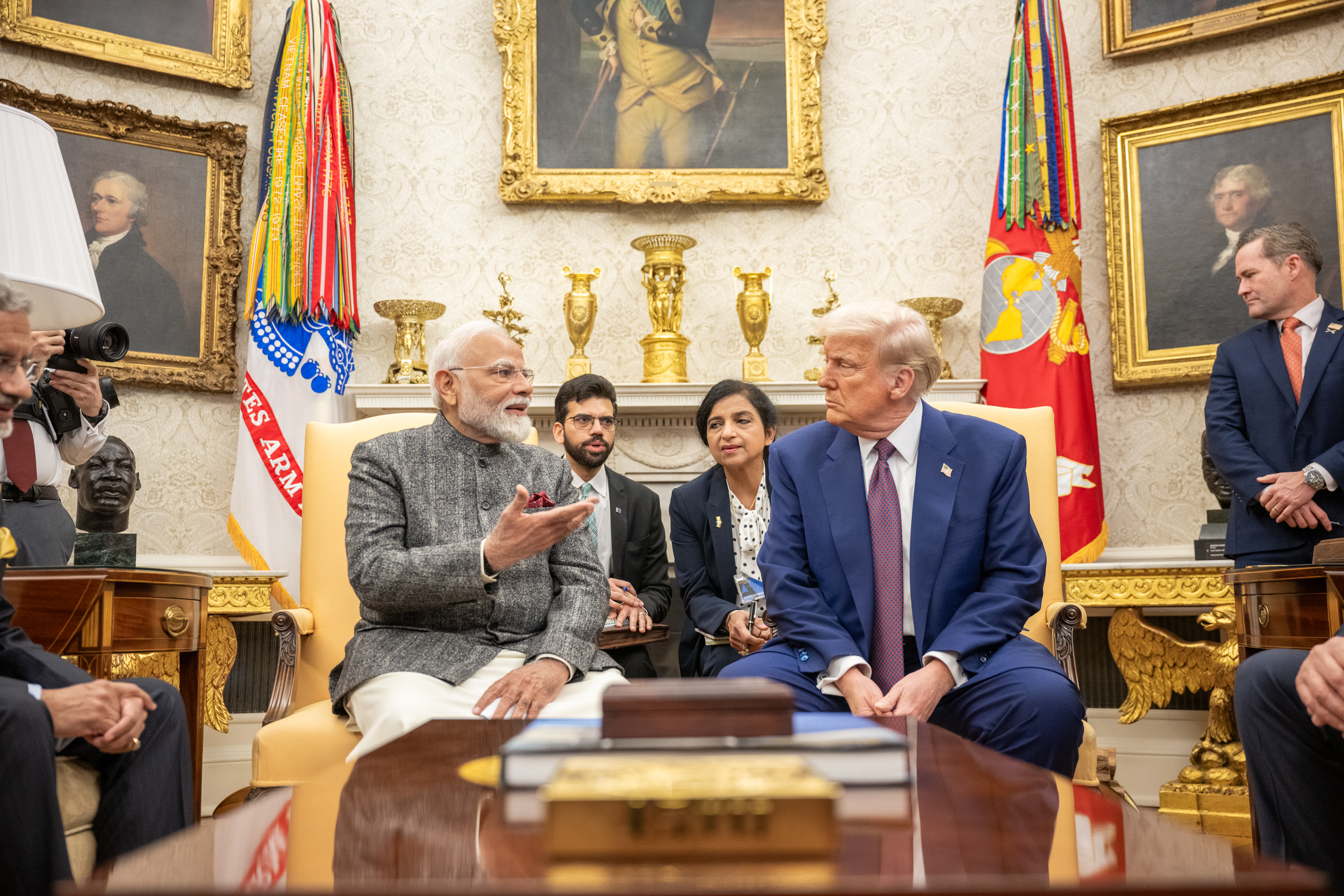
[Prime Ministers Benjamin Netanyahu & Modi]
After the visit by President Emmanuel Macron, India and France have just sealed what is officially touted as a “Special Global Strategic Partnership”. This is diplomatese for the fleecing of India, exemplified by the nearly Rs 4 lakh crore deal for the 4.5 generation Rafale fighter aircraft with the first 20 bought off the shelf, and some 90-odd of the rest assembled here by who else, HAL.
This defence public sector unit is to subscribe to a production scheme that starts at the 30% “indigenous” level rising to 60% by the end of its 30-year run. Even an otherwise weakheaded defence minister Rajnath Singh senses something is very wrong with the cost-product calculus, and has asked that the indigenisation level be upped but only to 50%. Hopefully, he means starting out, because Dassault Avions would be only too happy to reduce the end-level by 10%!
It did not occur to our respected defence minister or even Prime Minister Narendra Modi to tell Macron — that the contract will have to include ALL SOURCE CODES FOR EVERYTHING ON THE AIRCRAFT, INCLUDING WEAPONS, OR NO DEAL! Whatever the understanding to-date to buy this aircraft, it can be junked at any time. At a minimum, full and certifiable transfer of source codes should be the condition for the deal going forward. India holds the whiphand here, not France. Why is Delhi acting as a supplicant? It is Paris that wants India’s money, not the other way around. So Modi should INSIST on this! Nobody in the Indian government apparently appreciates just how much of a lifeline this deal is. For France!
While Modi misses no platform to blow his atmnirbharta trumpet, the head of Dassault — maker of the Rafale, Eric Trappier, has been equally determined in ensuring that his Company parts with no technology of any consequence in the Rafale deal, including source codes. Indeed, he severly and publicly reprimanded the head of the German firm, Thyssen-Krupp Marine, for promising source codes to India for the HDW 214 diesel submarine to get the navy’s Project 75i. He obviously fears Thyssen-Krupp will set a precedent for the rest of the arms suppliers, who have treated India as an endless source of sustenance, to follow. It is Trappier that the British weekly, The Economist, blamed for cratering the European trilateral 6th generation Future Combat Air System project, because he did not want to share the Rafale technologies with Germany and Spain as the tech base for the FCAS. So he is being consistent in not helping India become an independent fighter aircraft producer. But that is France’s problem.
The way the transaction has progressed it is as if Modi and Rajnath are nothing, the Indian government is zero and will bend to whatever the mighty Trappier and Dassault deign to SELL to the IAF! Thank you IAF leadership for doing France’s/Dassault’s work for them by projecting the Rafale plane as something the service and Indian security cannot do without — when that is about as hollow a claim as can be conjured up by a set of unscrupulous salesmen to a bunch of yokels! But, hey, Trappier has won out. India will pay a princely sum for a fast aging fighter platform and that too MINUS source codes. But let’s speculate a bit about what may be possible.
The 60% indigenisation level would be upped, and the timeline for it contracted to 3-4 years should Messrs Modi & Rajanth Singh sternly press Paris. But having staked a position, France is unlikely to budge but, should push come to shove, will agree — it is desperate to have this deal and the accruing bank balance to fund its own future programmes — to no indigenisation beyond 80%. Why 80%? Because the 20% level remaining with Dassault/MBDA for the most advanced Rafale tech, that will come as “black box” technologies, is what will hand Paris the “short leash” — the means of controlling the Rafale fleet and hence the IAF, and hence Indian military options for the lifetime of this plane in Indian service!
Except that will still leave India without the Rafale source codes which, in Indian hands, would help to fit, for instance, Indian-designed bombs, rockets and missiles and even avionics without Dassault/MBDA intervening to extract massive fees for integrating them into the plane.
This “mother of all defence deals” in terms of the sums involved, will empty out the Indian taxpayer’s purses to make a wealthy France, wealthier! This when, in pursuance of Modi’s atmnirbharta policy, such extraordinarily large sums in hard currency could have been invested in, say, additional production lines in the far more labour-efficient, process-wise effective, and product quality-wise better private sector for the Indian designed Tejas light combat aircraft in all its versions — 1A, 2, as a natural lead in to the AMCA (advanced medium combat aircraft) programme already allotted to the consortium of Tata, L&T, Bharat Forge, et al. This, perhaps, makes too much logic and sense for the Indian government.
But why the above preamble for a post on Modi’s Feb 25-26 trip to Israel? Because the Rafale deal with France is a cautionary tale for the sort of defence cooperation the Prime Minister should not enter into with Tel Aviv.
The strategic-minded Israeli Prime Minister Benjamin Netanyahu has already announced a 30-year timeline for his country to become fully independent of US support because he has judged correctly, as the Indian government seems incapable of doing, that relying on America even in the midterm could be perilous and it is a risk his country cannot and will not take. Keeping the Israeli economy afloat is the key.
India-Israel relations are in fine fettle and the sharing of intelligence and ways and means of fighting Islamic extremism and terrorism, and managing disputed borders, is by now fairly routine. But bilateral ties are ready for an upgrade. Logically, because Israel is the start-up nation of renown and creates and innovates technology as its staple, and because most such technologies are first deployed for use by the Israeli Defence Force in its security systems, it is necessary, Netanyahu has concluded, that his country find a reliable, ideologically resonant partner. An economically prospering and friendly India fits that bill. Indeed, the Israeli government is looking to explore the possibility of drawing India into more extensive defence cooperation, and Israeli defence and high-tech companies are seeking Indian investors and partners for joint programmes to sell in a global market.
These developments have germinated, I believe, from an idea I first conveyed to Uzi Landau — I have written about this in previous posts — in, if I recall correctly, 2002, when he was visiting Delhi as the Israeli Minister for Public Security. He had come over for a meeting with me at the Centre for Policy Research, along with Shabtai Shavit, who headed Mossad from 1989 to 1996. Among other things that we talked about, I suggested to them the obvious mesh of Israel tech muscle with Indian finance and large DPSU production infrastructure to manufacture traditional military hardware for consumption by both the Indian and Israeli militaries — from large items such as tanks, long range guns, to small arms and ammo and artillery shells. Economies of scale and lowered unit price would obtain. This could lead, I argued, to Indian financing of, and participation in, at all levels, with Israeli companies researching and developing cutting edge weapons systems and military software, and how such a partnership could free both states from the inconstant “friendship” of the US. They were intrigued by the 2-way defence/security bond I was proposing. I pitched the same concept to Prime Minister Ariel Sharon when he visited Delhi in September 2003.
The idea made its way through the Israeli government and got traction in the Indian government, fructifying in the 2006 deal between the DPSU Bharat Electronics Ltd and Israel Aerospace Industries (IAI) for joint design and development of the Barak 8 (or Barak LR) long range surface to air missiles (LRSAMs) to protect Indian aircraft carriers and warships. The first test firing of this ship air defence system was in 2010. By 2018, four Kolkatta-class destroyers had the Barak 8 protection. To date, India has invested between $1.4-$2 billion in this project. It led to extension of the project to meet the Indian army’s demand for area air defence, and yet another programme, this time to design and produce a medium range variant of this missile.
Indians may have wished for a fairer division of work. DRDO produced the dual pulse rocket motor for the 150 km range, mach 2 missile, and IAI the MF Star multi-function, surveillance, track, and guidance radar. Still, it is a successful enough partnership to whet the Israeli appetite for more such cooperative ventures. And that’s where matters stand.
If defence cooperation is not to stay stuck in the Barak 8 mode, it may be wise for Prime Minister Modi to take the lead in furthering this cooperation by broadbasing it with a proposal, as was originally envisaged, to have the production of Israeli conventional weapons platforms and small arms move at least partially from Israel to India, to benefit the Indian armed services as well as the IDF and for export, and to establish an India-Israel Defence Cooperation Council as the lead mechanism for the purpose, and to realise the larger agenda of meshing the two defence industries for the good of both the countries.
It will be a departure from the typical license production/screwdrivering projects the DPSUs undertake of second rate equipment, such as the Rafale. And it will involve the conjoining of the unique talents and strengths of the two countries. What may emerge is a very strong joint defence science, R&D, and industrial complex to power the ambitions of India and Israel, and as a player on the global scene. And it will cement a desirable embrace.



 Security Wise