An Alternate Agenda: Time for Disruptive Foreign and National Security Policies

The NSA To Beat All NSAs Thus Far... | Outlook India Magazine
Trimurti — Modi, Doval and Jaishankar]

In the run up to the 2019 general elections, the Centre for Policy Research published a compendium of essays by its faculty members — ‘Policy Challenges 2019-2024: Charting a New Course for India and Navigating Policy Challenges in the 21st Century’ for limited circulation and uploaded it to its website. It is available at https://www.cprindia.org/sites/default/files/Policy%20Challenges%202019-2024.pdf. These essays offered an alternative policy template for the incoming government to consider. I did not post my essay (with end notes) in this compilation on this blog ere now.

A year later and in the context of China’s annexationist policy on the disputed border and India’s continuing failure to deal with China, this piece has gained even more weight, methinks. It may be interesting for those of you eager to delve deeper into the subject, to compare and contrast my views with those of Shyam Saran, ex-Foreign Secretary, and honorary professor at CPR (also available at the above URL), which reflect the Establishment thinking.

Reproduced below is that piece.

———————-
Several mega-trends are visible in international affairs on the cusp of the third decade of the 21st century. After a trillion dollars spent on the 18-year old war with the Taliban in Afghanistan following a similar amount expended in Iraq and Syria, the US is drained of its wealth, stamina and will for military confrontations of any kind. A reactive and retreating America under President Donald Trump, besides generating unprecedented levels of uncertainty and anxiety, has accentuated the conditions of unusual flux in the international system.

Second, with the old certainties gone, traditional alliances (North Atlantic Treaty Organization), trading regimes (Trans-Pacific Partnership), schemes of regional peace (Shanghai Cooperation Organization), and technology and supplier cartels (Missile Technology Control Regime, Nuclear Suppliers Group, et al.) are all alike in disarray; their concerns are now matters of contestation with China staking claim to the pole position vacated by the US.

And finally, these developments are compelling major countries to try to protect themselves the best they can by handling things on their own, in coalition with other similarly encumbered nations, and by exploring new security/military cooperation agreements. There is particular urgency in Asia to blunt China’s hegemonic ambitions and preclude its domination from taking root.

State of Play

Unfortunately India finds itself on the wrong side of these trends in the main. This is because it has, in the new millennium, accelerated its efforts to join the very same nonproliferation regimes and cartels that had victimized it all along. Worse, by sidling up to the US and virtually outsourcing its strategic security to Washington, India’s historical role as prime balancer in the international balance-of-power set-up – courtesy its hoary policies of nonalignment and its latter-day avatar, strategic autonomy – has been imperiled. This is at a time when doubts about the US commitment to other countries’ security have increased along with the apprehensions of allies and friends. With security made a transactional commodity by the Trump administration, treaty alliances have been weakened, unsettling West European and Far Eastern states traditionally close to the US. [1]

India’s trend-bucking policy, in the event, will only cement the growing perceptions of the country as unable to perceive its own best interests and to act on them. Its downgrade, as a result of its more recent strategies, to the status of a subordinate state and subsidiary ‘strategic partner’ of the US means that India will have restricted
strategic choices. Its foreign and military policies will therefore lose the freedom and latitude for diplomatic manoeuvre that they have always enjoyed.

Thus, the 2008 civilian nuclear deal, for all practical purposes, signed away India’s sovereign right to resume underground testing and froze its nuclear arsenal at the sub-thermonuclear technology level (as the 1998 fusion test was a dud). Agreeing to the
Logistics Exchange Memorandum of Agreement and the Communications Compatibility and Security Agreement – the so-called ‘foundational accords’ – will, respectively, (i) permit the US to stage its military forces out of Indian bases and embroil India in its wars in the extended region, and (ii) to penetrate the most secret Indian communications grid, including the nuclear command and control network. The Indian government’s eagerness to cement the partnership is astonishing considering the trust deficit evident in a long history of duplicitous US behaviour and policies. [2]

By clinging to a feckless and demanding US, India’s profile as a fiercely independent state has taken a beating, distanced the country from old friends such as Russia (which is pivotal to balancing China and the US) and Iran (central to India’s geostrategic concerns in the Gulf, Afghanistan and Central Asia), lost the nation its diplomatic elan, and has seriously hurt vital national interests.

Placating China is the other imprudent theme that Indian foreign policy has latched on to. It has mollycoddled its most dangerous adversary and comprehensively capable rival in Asia with giveaways – such as non-use of the Tibet and Taiwan cards, refraining
from nuclear missile-arming states on China’s periphery as a tit-for-tat measure for Beijing’s missile-arming of Pakistan, giving the Chinese manufacturing sector unhindered access to the Indian market through a massively unfair and unbalanced bilateral trade regime, etc. On the other hand, it has treated Pakistan, a weak flanking country, as a full-bore security threat when, realistically, it is only a military nuisance. This strategy is at the core of India’s external troubles. It has practically incentivized Beijing to desist from peaceful resolution of the border dispute. It has also undermined India’s credibility and credentials as ‘security provider’ to and strategic partner of a host of Asian littoral and offshore states fearful of an ambitious and aggressive China, as well as complicated the country’s attempts at obtaining a tier of friendly nations around it as buffer.

A topsy-turvy threat perception has also meant a lopsided Indian military geared to handle Pakistan but incapable of defending well against China, even less of taking the fight to the Chinese People’s Liberation Army (PLA) on land, air and distant seas; it is also laughably unprepared for future warfare featuring cyber pre-emption, remotely controlled armed drone swarms, robotic weapons systems managed by Artificial Intelligence, space-based weapons platforms, and clean micro-thermonuclear bombs.

In the context, moreover, of a recessive foreign policy and a military that seems unable to wean itself away from imported armaments, it is almost as if the Indian government
and armed services have given up on national security. This bewildering state of affairs is in urgent need of drastic overhaul and repair.

Geopolitical Vision and Strategy

Strong nations in the modern era have transitioned into great powers not only through expansive national visions, but also, more significantly, by pursuing policies disruptive of the prevailing order and multilateral regimes they had no hand in creating. India in the 21st century, on the other hand, seems content with the existing international system, measuring its foreign policy success in terms of entry gained or denied in
congeries of international power (UN Security Council) and trade and technology cartels (Nuclear Suppliers Group, Missile Technology Control Regime, etc.). In other words, it covets a place at the high table on terms set by other countries. It is not a mistake made by China or the US (or, to go back in history, Elizabethan England,
Germany, Imperial Japan, the Soviet Union and now Vladimir Putin’s Russia). The Indian government is hampered by its mistaken belief that upholding the current regional and international correlation of forces and mechanisms of order, and stressing its soft ‘civilizational’ power, will make the country great. India with its many infirmities is in no position to undertake system disruption by itself. [3]

For India to rise as the premier Asian challenger to China and as the other economic-political-military power node in the continent in the shortest possible time – which should be the legitimate national aim and vision – requires a subtle but telling approach. It needs a doublepronged strategy. One prong should stress absolutely
reciprocal positions and policies. Thus, Beijing’s insistence on ‘One China, two systems’ should be met with a ‘One India’ concept. So, the non-acceptance by Beijing of all of Jammu and Kashmir (including the Pakistan-occupied portion) as inalienably Indian
territory should lead to formal recognition of and relations with Taiwan; it should also spark off New Delhi’s world-wide advocacy of a free Tibet and a free East Turkestan, and of campaigns against ‘cultural genocide’ and ‘ethnic cleansing’ in Tibet and Xinjiang. [4] And China’s nuclear missile arming of Pakistan should, even if belatedly, trigger India’s transferring strategic missiles to the states adjoining China on land and sea to ensure that, like India, China too is permanently strategically discomfited.

Hamstringing China should also involve metameasures to carve out separate, loose and specifically anti-China security coalitions from the two important groups India is part of. BRICS (Brazil-RussiaIndia-China-South Africa) is an entity dominated economically and trade-wise by China. This is something that arouses wariness in the other three
countries, which can be mobilized to form a smaller, informal, security-cooperation-minded coalition, BRIS (Brazil-Russia-India-South Africa). It will assist in hedging Beijing’s military options and affect China’s economic expansiveness. Likewise, the
US’s importance to international security has to be whittled away. The Quadrilateral (US-Japan-IndiaAustralia) proposed by Japan’s Shinzo Abe to contain China in the Indo-Pacific is problematic owing to the centrality accorded the capricious US. India could
propose a different set-up – a modified Quadrilateral or ‘Mod Quad’ with India, Japan, Australia and the leading littoral and offshore states of South East Asia, resisting China’s over-lordship and disputing its claims in the South China Sea, with a cooperative
Taiwan accorded, to start with, observer status.

This would at once define the strategic geopolitical face-off between ‘rimland Asia’ and a hegemonic ‘heartland’ China, and reduce the uncertainty attending on America’s security role (given that the US and China, owing to their close economic and trading links, are inseparable). Mod Quad will clarify the strategic calculi of member states, while encouraging the US to contribute militarily to the extent it wants to at any time but as an outside party.[5] BRIS and Mod Quad are extremely practicable geopolitical solutions to share the cost, divide the danger, and generate synergy from the wide-spectrum capabilities, singly and together, of the member states in these two collectives. At the same time, they would stretch China’s economic and military resources and minimize the consequences of ambiguity attending on the US role. These new arrangements adhere to the time-tested principle of vision shaping strategy but
geography driving it, which makes for cohesion and sense of purpose. BRIS and Mod Quad will enable their member states to be less inhibited in cooperating with each other to deal with the overarching security threat posed by China, but without the intimidating presence of the US (which, typically, pursues its own interests at the expense of any coalition it is a part of). They will instill in the Indian government’s external outlook an outcomes-oriented, competitive bent. It may result, for instance, in getting the east-west Ganga-Mekong connectivity project – as a rival to China’s north-south Belt & Road Initiative – off the ground. [6]

But BRIS and Mod Quad leave Pakistan out of the reckoning. Pakistan is strong enough to be a spoiler and, in cahoots with China, pose a substantial problem. More than 70 years of tension and conflict with India haven’t helped. For a lasting solution it is essential to break up the Pakistan-China nexus. The military palliative for terrorist provocations – air and land strikes – will only drive Islamabad deeper into China’s camp. A Kashmir solution roughly along the lines negotiated with General Pervez Musharraf in 2007 that Prime Minister Imran Khan has said Pakistan will accept, is a reasonable end state to work towards.[7] But India can lubricate such an offer with policies to co-opt Pakistan (along with India’s other subcontinental neighbours)
economically, by means of trade on concessional terms, and easy credit and access to the Indian market for manufactures and produce. This will obtain the goal
of unitary economic space in the subcontinent and lay the foundations for a pacified South Asia – the first step in India’s long overdue achievement of great power.

Such actions should, however, be preceded by several unilateral and risk-averse military initiatives (outlined later) to establish India’s peaceful bonafides and to denature the Indian threat that Pakistan perceives. Simultaneously, prioritizing strategic and expeditionary military capabilities against China and for distant operations jointly with friendly states in the Indian Ocean Region and in Southeast Asia will secure India’s extended security perimeter.

National Security Policy Priorities

Lack of money has never been the hitch. Rather, the problem has been and continues to be the misuse of financial resources by the three armed services with their faulty expenditure priorities. Intent on equipping and sustaining inappropriate force structures geared to the lesser threat, they have squandered the colonial
legacy of expeditionary and ‘out of area operations’. Consequently, they have shrunk greatly in stature even as they have increased in size.[8] Persisting with thinking
of Pakistan as the main threat long after it credibly ceased to be one post the 1971 war has resulted in an Indian military able to fight only short-range, short-duration, small and inconclusive wars. Indeed, so geared to territorial defence and tactical warfare are the Indian armed services that they have paid scant attention to strategic objectives and to the means of realizing them.

The political leadership, for its part, has shown marked lack of interest, and failure to articulate a national vision and to outline a game plan and strategy. It has chosen the easy way of relying on the armed services professionally to do the right thing by proffering the right advice – which they haven’t. Breaking the Pakistan-China nexus is an imperative. It requires the Indian government to first seed a conducive political milieu by making certain safe unilateral military moves. What the Pakistan Army most fears is India’s three Strike Corps; if this ‘threat’ is denatured, a milieu with enormous peaceful potential can be created. Considering the nuclear overhang and zero probability of the Indian government ever ordering a war of annihilation – which is the only time when these armoured and mechanized formations will fight full tilt – three corps are way in excess of need. They can be reconstituted and the resources shifted to form a single composite corps adequate for any conceivable Pakistan contingency. The rest of the heavily armoured units can be converted to airborne cavalry, and to light tanks with engines optimized for high-altitude conditions; three offensive mountain corps can thereby be equipped to take the fight to the PLA on the Tibetan Plateau.

The nuclear backdrop can likewise be changed for the better by India removing its short-range nuclear missiles from forward deployment on the western border and perhaps even getting rid of them altogether, because hinterland-based missiles can reach Pakistani targets with ease. These two moves made without demanding matching responses will cost India little in terms of security, establish a modicum of trust,
persuade Pakistan of India’s goodwill, and confirm China as the Indian military’s primary concern. It will hasten normalcy in bilateral relations.

Tackling China at a time when it is widening the gap with India in all respects necessitates India using the playbook the Chinese successfully used against the
US, that Pakistan has used against India, and North Korea against America, when facing an adversary with a marked conventional military edge. It means revising the nuclear doctrine to emphasise Nuclear First Use (NFU) and deploying weapons to make this stance credible. Emplacing atomic demolition munitions in Himalayan passes to deter PLA units ingressing in strength across the disputed border is one tripwire. Another is
to declare that any forceful Chinese military action that crosses a certain undefined threshold may automatically trigger the firing of canisterised medium- and longrange Agni missiles, now capable of launch-on-launch and launch-on warning. Additionally, the large numbers of Chinese missiles positioned in Tibet should be seen as the third nuclear tripwire. As there is no technology to reliably detect and determine the nature of incoming warheads, any missile PLA fires will reasonably have to be assumed to be nuclear-warheaded. Such a posture leaning towards action will create precisely the kind of uncertainty about the Indian reaction and response that will bolster its deterrent stance.[9]

Exorbitantly priced aircraft carriers are unaffordable and, in the age of hypersonic and supersonic missiles, a military liability. The Indian naval budget should instead
prioritize nuclear-powered ballistic missile-firing and attack submarines, and a surface fleet of multipurpose frigates. The Indian Air Force needs to radically cut the diversity of combat aircraft in its inventory, rationalize its force structure and streamline its logistics set-up. This will be facilitated by limiting the fleet to just three types of aircraft – the multi-role Su-30MKI upgraded to ‘super Sukhoi’ configuration in the strike and air
superiority role and progressively enhanced versions of the indigenous Tejas light combat aircraft for air defence, the follow-on Advanced Medium Combat Aircraft for longer reach and bigger punch, and lease-buying 1-2 squadrons of Tu-160M2 ‘Blackjack’ strategic bomber from Russia as the manned, recallable, vector in the country’s nuclear triad.

Politically, the most difficult policy decision for the government will be to resume nuclear testing. This is absolutely necessary to obtain tested and proven thermonuclear weapons of different power-to-yield ratios. India has got by with a suspect thermonuclear arsenal for 20 years. It is time India’s strategic deterrent acquired credibility.

————-

End-Notes


  1. An unreliable US, in fact, so concerns its NATO allies that the French defence minister Florence Parly in Washington asked a little plaintively,
    ‘What Europeans are worried about is this: Will the U.S. commitment [to NATO] be perennial? Should we assume that it will go on as was
    the case in the past 70 years?’ See ‘French defense chief questions US commitment to NATO’, AFP, RadioFreeEurope, Radio Liberty, 18 March
    2019, https://www.rferl.org/a/french-defense-chief-questions-us-commitment-to-nato/29829763.html.
  2. Bharat Karnad, Why India is Not a Great Power (Yet) (New Delhi: Oxford University Press, 2015), 187-219.
  3. For a detailed analysis of its various infirmities that preclude India’s becoming a great power anytime soon, see Karnad, Why India Is Not a
    Great Power (Yet).
  4. China sees itself as the main protector of Pakistan’s sovereignty and territorial integrity. Visiting Islamabad during the Pulwama crisis, the
    foreign minister Wang Yi declared: ‘No matter how things change in the world and the region, China will firmly support Pakistan upholding its independence and territorial integrity and dignity.’ See Sutirtho Patranobis, ‘China firmly with Pakistan, says Beijing as Islamabad
    raises Kashmir in top talks’, Hindustan Times, 19 March 2019, https://www.hindustantimes.com/world-news/china-firmly-with-pakistansays-beijing-as-islamabad-raises-kashmir-in-top-talks/story-5qM8HPgUQkl7ZwPCQEfh3O.html.
  5. Bharat Karnad, ‘India’s Weak Geopolitics and What To Do About It’, in Bharat Karnad, ed., Future Imperilled: India’s Security in the 1990s and
    Beyond (New Delhi: Viking, 1994), 19-20.
  6. Bharat Karnad, Staggering Forward: Narendra Modi and India’s Global Ambition (New Delhi: Penguin-Viking, 2018), ch. 4.
  7. Imtiaz Ahmad, ‘2-3 solutions available to Kashmir issues, says Pak PM Imran Khan’, Hindustan Times, 4 December 2018, https://www.hindustantimes.com/world-news/2-3-solutions-available-to-kashmir-issues-says-pak-pm-imran-khan/story-AOHvnIYCspm1mOqHp74K6I.html.
  8. Karnad, Why India is Not a Great Power (Yet), ch. 5.
  9. Bharat Karnad, ‘Shifting the Nuclear Security Focus to China’, in Lieutenant General A.K. Singh and Lieutenant General B.S. Nagal, eds.,
    India’s Military Strategy in the 21st Century (New Delhi: Centre for Land Warfare Studies and KW Publishers, 2019); Karnad, Staggering Forward,
    344-349.
Posted in Afghanistan, arms exports, asia-Pacific/Indo-Pacific, Asian geopolitics, Australia, Bangladesh, Bhutan, Central Asia, China, China military, civil-military relations, Culture, Cyber & Space, Decision-making, Defence Industry, domestic politics, DRDO, Europe, Geopolitics, Great Power imperatives, India's China Policy, India's Pakistan Policy, India's strategic thinking and policy, Indian Air Force, Indian Army, Indian ecobomic situation, Indian Navy, Indian Ocean, Indian para-military forces, indian policy -- Israel, indian policy -- Israel, Iran and West Asia, Intelligence, Iran and West Asia, Islamic countries, Israel, Japan, Maldives, MEA/foreign policy, Military Acquisitions, Military/military advice, Missiles, Myanmar, Nepal, nonproliferation, North Korea, Northeast Asia, Nuclear Policy & Strategy, Nuclear Weapons, Pakistan, Pakistan military, Pakistan nuclear forces, Relations with Russia, russian assistance, russian military, SAARC, satellites, society, South Asia, South East Asia, space & cyber, Sri Lanka, Strategic Forces Command, Strategic Relations with South East Asia & Far East, Strategic Relations with the US & West, Taiwan, Terrorism, Tibet, UN, United States, US., Vietnam, Weapons, West Asia, Western militaries | 14 Comments

Don’t miss this opportunity, Modiji, warn China of military action and execute it!

PM Modi takes Xi Jinping on a guided tour of Mamallapuram ...
Modi and Xi at Mamallapuram

China has risen to be a great power in part because its leaders have had the knack for never missing an opportunity to exploit a situation or kick an adversary when he’s down. For instance, Mao leveraged the support Nikita Khrushchev sought from China in his Kremlin power struggle with Georgy Malenkov, immediate successor to Stalin, and Foreign Minister Vyacheslav Molotov in the mid-1950s, for Russian transfer of nuclear weapons and missile technologies. And, always inclined from early in his reign to show up the “cocky” Nehru, Mao chose exactly the time when John F Kennedy blockaded Cuba for a showdown with Khrushchev over Russian missiles there in October 1962 to attack India.

It is the sort of ruthlessness and single-minded pursuit of power Indian leaders can apparently summon only against their political rivals at home. In the external sphere, they are ‘bheegi billees’ — timid and cautious, ready to take the counsel of fear. And it is fear and risk aversion that the China Study Group’s advice to Indian governments usually reeks of. CSG is the main shaper of the government’s China policy. In the present circumstances, its urging the Modi government to have the GOC, XIV Corps, continue parlaying with the Chinese sector commander, carry on with the buffer zone-concept that has compromized India’s territorial claims in eastern Ladakh, and otherwise seek refuge in interminable exchanges with the Chinese at various official levels, is not getting India anywhere, but who cares.

Consider the context China unexpectedly finds itself in. The US and the West are pretty much hanging up on Beijing on the trade and technology fronts. The Chinese economy is slumping. The corona pandemic, the new Chinese security law imposed on Hong Kong and President Trump’s desire to economically and security-wise scapegoat China for his re-election purposes, has led to America orchestrating an international campaign against China as the irresponsible spreader of the corona virus, ending Hong Kong’s special trading privileges, threatening economic sanctions, terminating Chinese investments in cutting edge technology companies in the US, and denying visas to Chinese citizens. Further, the US and the UK governments have banned the Chinese tech giant Huawei from the American and the British 5G telecommunications markets — a move that India too has wisely subscribed to, deployed two American aircraft carrier groups in the Philippine Sea — a proverbial stone’s throw away from the South China Sea and the Taiwan Strait, accelerated deliveries of advanced armaments to Japan and Taiwan, and asked its allies and friends to vote against a seat for China on the International Tribunal on the Law of the Sea, which the US Assistant Secretary of State State for East Asian and Pacific Affairs David Stilwell likened to “hiring an arsonist to help run the fire department.”

Vice Foreign Minister Zheng Zeguang called in the U.S. Ambassador Terry Branstad “to warn the U.S. sternly that any bullying and unfairness imposed on China by the U.S. will meet resolute counterattack from China, and the U.S. attempt to obstruct China’s development”, he added, unconvincingly, “is doomed to failure.”

One hopes, the Modi government has enough sense to vote with like-minded countries to prevent China from occupying a seat on the Sea Tribunal.

But to get to the more urgent point: With China rattled and besieged on all fronts and stretched militarily in the east and the west, it is in no position to engage in all out hostilities in Ladakh. Now is therefore the time, an opportune one, for Delhi to trash all the ridiculous understandings to-date, end talks at all levels, and to announce a time limit of two-three weeks, starting now, for the PLA to get the hell out of Indian territory. And, in this regard, to issue a clear and public warning to Beijing, and so communicate it to the world so that international pressure can be mobilized, that the Indian armed forces will undertake limited military operations using all conventional means at their disposal to vacate every last square inch of Chinese troops come what may, and at whatever cost. The PLA has to unconditionally and voluntarily restore the status quo ante that foreign minister Jaishankar has already formally demanded, or be forced to do so. The Modi regime should follow up with the facilitation of high paced preparations by the Indian military for war backed, as I have suggested in earlier posts, by moving Agni missiles to the theatre and ordering the Arihant SSBN on patrol to loiter in its launch area just in case and, at the end of the 2-3 week deadline, to initiate without ado the promised military actions. The international community will sympathize with India and press Beijing to get out and keep out of Indian Ladakh.

The Indian government has so routinely messed up on historic opportunities to make strategic good, it will be no surprise if Narendra Modi too fails to be decisive, and stays with his ridiculous public stance that China is not in occupation of any Indian territory, and hence that there is no problem of territorial aggrandizement that needs to be addressed. The CSG members will cluck in satisfaction that they have done well.

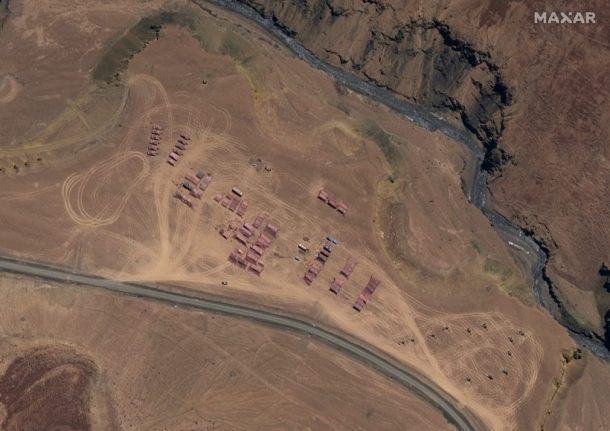
Except, Modi needs to be reminded that it was a private American company, Maxar, that first released commercially available satellite imagery showing deep PLA penetrations into Indian Ladakh, detailing the infrastructure buildup — intelligence that Indian satellites had long ago picked up and conveyed to the Indian government. The real scandal, in the event, is that Modi did nothing with this information and, ostrich like, stuck his neck in the sand, implicitly denying that his good and great friend Xi Jinping did anything wrong.

Not sure how Modi will live down this episode, but that’s his personal outlook. That India has had its territory so brazenly annexed without China suffering any cost whatsoever, will mean such intrusive adventures will be repeated every summer by the PLA. And Beijing will rely on the Indian PM to ex post-facto legitimate the LAC being thus steadily pushed India-wards.

Posted in arms exports, asia-Pacific/Indo-Pacific, Asian geopolitics, Central Asia, China, China military, civil-military relations, Culture, Cyber & Space, Decision-making, Europe, Geopolitics, Great Power imperatives, India's China Policy, India's strategic thinking and policy, Indian Air Force, Indian Army, Indian ecobomic situation, Indian Navy, Indian Ocean, Intelligence, MEA/foreign policy, Military/military advice, Missiles, Nuclear Policy & Strategy, Nuclear Weapons, SAARC, satellites, society, South Asia, space & cyber, Strategic Forces Command, Tibet, United States, US. | 26 Comments

A defriended Iran in China’s camp; and Delhi has no tipping point.

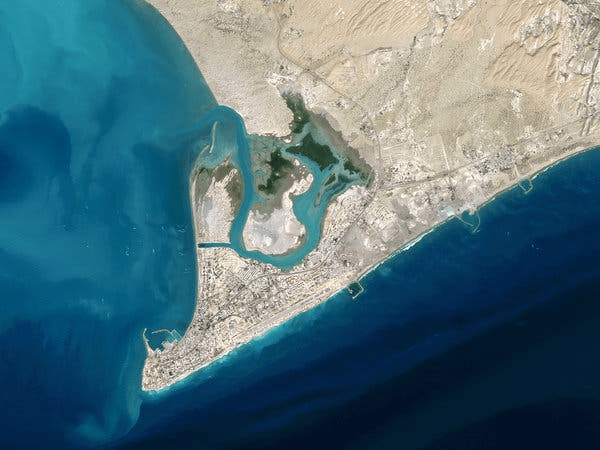
[Jask, located at the entrance to the Persian Gulf, would give the Chinese a strategic vantage point on the waters through which much of the world’s oil transits.Credit…Orbital Horizon/Gallo Images, via Getty Images]

Some 2-3 years back or so, I received an emailed letter from a Joint Secretary in MEA asking for what I thought India’s foreign policy priorities should be. It was perhaps a form letter sent out to others as well. I thought it was a bit late in the day for the Modi regime to ask for policy recommendations four years into its first term, and to me signaled an official acknowledgement that the earlier priorities — whatever they were — hadn’t worked. Nevertheless, I dutifully wrote back listing them with thumbnail justifications for each of them.

The list repeated the priorities I had, incidentally, put on a paper and handed to Prime Minister Narendra Modi in November 2014 the only time he had called me in for “consultation”. I was part of an odd assortment of analysts, MEA beat reporters, a television channel’s “strategic affairs expert”, an owner-cum-editor-in-chief, and such like. Each of us had 5-minutes and then were treated to the PM’s ideas about this and that but mainly his achievements in Gujarat. There were no official note-takers, no follow-up, and the whole thing was a waste of time.

In contrast was the session I had (along with one or two other analysts) with Dr. Manmohan Singh over breakfast in mid-September 2004 on the eve of his first visit to the US to attend the UN General Assembly meeting. It was a proper and meaty discussion with lot of exchanges and the prime minister asking questions. On the PM’s side of the table were arrayed, among others, the NSA, Mani Dixit, and his Personal Private Secretary, TKA Nair (ex-IAS, Punjab cadre), both busily taking notes. I remember urging the PM to speak to President George W. Bush when they met on the sidelines in Hotel Astoria in New York about the need for a fairer, more equitable, nuclear order, failing to realize which, to say, India would feel free to test again and do whatever else was necessary to beef up its nuclear security. I also suggested he reinforce this message to the US government by repeating it publicly while in that city.

Gratifyingly, Singh told Bush what I had suggested, and repeated these points in a speech delivered a day later at an NRI function on Long Island. Perhaps, alarmed by what Bush heard, Washington got to work and, in conjunction with the usual suspects at this end, quickly turned Manmohan Singh. By the time the PM next visited the US in July 2005 he had committed to the strategically disastrous civilian nuclear cooperation deal that furthered the US nuclear nonproliferation goals by, for all intents and purposes, prohibiting the resumption of nuclear tests by India. The deal was negotiated by the then Joint Secretary (Americas) in MEA — one Subrahmanyam Jaishankar. The relentless criticism by a few of us about the prospective deal during the time it was being negotiated in 2005-2008 was used by Jaishankar — so he let it be known — to temper the ask by the US negotiators. (Just how merciless and on-point the criticism was may be gauged from reading the op-eds and other writings in that period by the four of us — Drs PK Iyengar, former chairman Atomic Energy Commission, AN Prasad, former director BARC and head of the plutonium reprocessing unit, and A Gopalakrishnan, ex-chairman, Atomic Regulatory Commission, and myself compiled in a 2009 book ‘Strategic Sellout: Indo-American Nuclear Deal’). Considering Jaishankar gave away the store in the most one-sided deal imaginable, one wonders what he thinks he got from the Americans. And, of course, I wasn’t called for consultation by Manmohan Singh again.

To revert to the session with Modi at 7, Race Course Road, given the time constraints I only argued the importance of the country using its hard power strategically. And in the paper given to the PM, I listed what his foreign and military policy priorities should be, reprising in bullet points some of the themes featured in my writings and books, particularly ‘Why India is Not a Great Power (Yet)’ published a year later in 2015. The priorities included restarting open-ended nuclear testing, treating China as primary threat, using the Taiwan and Tibet cards and equating Tibet and Kashmir as leverage against Beijing, nuclear missile arming Vietnam and other Southeast Asian nations as a belated coercive counter to China’s deliberate transfer of nuclear weapons and missiles to Pakistan, and accelerated development of Indian air and naval bases in the Indian Ocean and points east (Northern Mozambique, North & South Agalega Islands in Mauritius, Trincomalee in Sri Lanka, Seychelles, the former RAF base on Gan Island in the Maldives, Na Thrang ion the central Vietnamese coast, etc) and particularly of relations with Iran as India’s strategic linchpin pivoting on the Chahbahar port.

Six years into his tenure and a year into his second term as prime minister, Modi has flapped around endlessly on terrorism and Pakistan, supplicated the Trump Administration on the H1B visa issue in the process encouraging Indian IT talent to be siphoned off to the US, signed the ‘foundational accords’, and tried to win some goodwill by buying high-value US military hardware, only to be rebuffed by Washington. The H1B visa was closed and there is little else to show for Modi’s hug and bumble diplomatic efforts. And he has tried to cultivate the Chinese supremo Xi Jinping with worse results. India got kneecapped in Ladakh. Modi is obviously a glutton for punishment because he is still pursuing a conciliatory China policy propelled by his own, strangely pacific, instincts where China is concerned backed by his MEA minion S. Jaishankar’s wrong advice.

It is clear the Indian government historically has had no clue about how to deal with China, and the Modi regime is as befuddled, relying as all previous regimes have done on the China Study Group/Circle to give policy direction. The CSG comprises a changing bunch of usually bumptious and blundering mandarin-speaking Sinophiles from MEA, intelligence agencies, and the military who are strategic dupes — latter day versions of Richard Condon’s ‘Manchurian candidates’ beavering away to advance Chinese interests. Modi has, however, compounded his and CSG’s mistakes of going overboard with China with his equally feckless policy of alienating almost all nations in South Asia and in the extended region, especially Iran. The result is a collision of policy streams that is sinking the Indian national interest with China emerging as the short and long term tactical and strategic beneficiary. It is almost as if Delhi had been taking dictation from Beijing!

Iran, the supposed linchpin of India’s Afghanistan and Central Asia policy, feels so defriended by India, so isolated, and so threatened by the US, it has not only economically signed on with China but has agreed to be its stalking horse in the Gulf. In 2008, the then head of the Iranian Navy Rear Admiral Habibollah Sayyari remarked at the opening of the naval base at Bandar-e-Jask that Iran was “creating a new defense front in the region, thinking of a non-regional enemy.” Doubtless, the non-regional enemy was America. Iran has now alighted on a military partnership with China to neutralize it.

Soon to be finalized is Tehran’s 25-year agreement that New York Times reports, will in furtherance of the Belt & Road Initiative result in China investing $400 billion in Iranian infrastructure, including the development of free-trade zones in Maku in northwestern Iran, Abadan at the confluence of the Shatt al-Arab river and the Persian Gulf, and on Queshm, a Gulf island; the build-up of that country’s 5G telecommunications network, and help to create Iran’s own Global Positioning System and even an Iranian version of the cyber Chinese Great Wall to control domestic cyber space and to keep the US and Western countries from waging cyber offensives.

In exchange, an energy starved China will be permitted to daily offtake 8.5 million barrels of oil — the minimum necessary output for Iran to remain a viable oil producer and, more significantly, to use the Iranian base at Bandar-e-Jask for its naval operations. Considering the location of Jask on the Hormuz Strait at the mouth of the Gulf, the Iranian and Chinese navies between them will be able to dominate maritime traffic to and from the Gulf and pose no end of trouble for the US 5th Fleet out of Bahrain. It may compel the US to speedily relocate its forces in the region to Duqm on the coast of Oman, being developed as a modern US military base, as a more secure berthing for its warships and army and air force contingents onshore. The current Iran Navy chief Rear Admiral Hossein Khanzadi’s exulting to Xinhua, the Chinese news agency, in the wake of a recent trilateral Iranian-Russian-Chinese naval exercise that “the era of American invasions in the region is over” will have added weight once the Sino-Iranian deal is signed and PLAN deploys its ships at Bandar-e-Jask.

The presence of the Chinese Navy in Jask will be still more problematic for India. Perhaps, one of the reasons Beijing chose it for naval positioning was because it was bothered by the prospect of the Indian Navy active ex-Chahbahar 76 nautical miles up the coast on Gwadar’s flank. With Jask, 157 nautical miles to the west of Chahbahar, in hand, and combined with its base in Djibouti, PLAN will be able to shut the Indian Navy out of the Gulf, or at least to force it to remain inactive and to practice extreme caution with regard to Gwadar. This is a beautiful Chinese strategic counter-move.

The situation is far worse for India because Delhi, under US pressure, has decelerated its project to develop Chahbahar. So while India has committed $500 million to it the absence of any real buildup may result in Tehran asking India to vacate Chahbahar altogether. That would be a tragedy beyond comprehension for India’s strategic interests in the larger region. Nevertheless, it is a real possibility because with Delhi failing to firm up comprehensive economic links with Iran in the last decade when it desperately needed friends and counted on India to come through by signing up for long term oil supply, etc and because Delhi began tacking ever more fully to the American wind that may cease at any time, the Rouhani regime in Tehran apparently feels it has no incentive to be nice to India. So to add to India’s mounting foreign policy problems, Modi has now, in effect, gone and lost Iran to China.

But there seems to be no relief anywhere else, certainly not in eastern Ladakh where, like the government, the Indian army too appears more eager to jaw-jaw with the Chinese than to prepare to fight the PLA if the Chinese refuse to withdraw completely from the Indian side of the Line of Actual Control in Pangong Tso and the Depsang areas, leave alone occupy the heights on the eastern bank of the Shyok River on the Galwan to protect the DSDBO Road. The PLA, moreover, is so well ensconced on the lake and at these two sites, the military level meetings — the 4th round is ongoing as I write this and, like the previous rounds, will also be infructuous — are meant to reach a dead end. These are exercises to test India’s military tipping point.

In this context, the Xi government seems to be almost daring Prime Minister Modi to order military action to evict the Chinese military from Indian land but is confident the Indian PM won’t do so. Xi, for his own reasons, is probably itching to find out what the PLA is capable of because if India can be easily cowed as the evidence shows it can be, intimidating lesser states in Southeast Asia and on the South China Sea will be easier game, even with US aircraft carriers in the vicinity. In this context, the speed with which the Indian army has adhered to the vague disengagement protocol suggests it is pretty slack and unwilling to force the issue on the ground.

Pangong Tso, the Galwan and the Depsang are far away from Delhi and the PLA’s dawdling on Indian territory would be enough provocation for a tough-minded Indian army chief and theatre commander to say enough is enough and initiate rapid and forceful actions to kick the PLA out of these areas and even annex some Chinese claimed land. Alas, India has long lacked such army chiefs and theatre commanders who will force Delhi’s hand by starting hard and sustained action to deflate China’s military pretensions and strategic designs. It would do India’s reputation a lot of good. Except, the Indian armed services give every indication of doing nothing, chancing nothing, in the hope things will somehow work out, but they won’t unless it is to advantage China.

Indeed, the Modi government seems so frightened of Xi’s China, it couldn’t even muster the courage to slam Beijing at the UN Human Rights Council meeting in Geneva July 2 for illegally absorbing Hong Kong. This forum, by the way, is routinely used by Beijing to bash India on Kashmir. Instead the Indian Special Representative Rajiv Chander on Delhi’s instructions mumbled this: “Given the large Indian community that makes Hong Kong Special Administrative Region of China it’s home, India has been keeping a close watch on recent developments. We have heard several statements expressing concerns about these developments. We hope the relevant parties will take into account these views and address them properly, seriously and objectively.” He didn’t even name China! And some of us expect the Indian government and army to forcefully kick the Chinese out of Indian Ladakh?

The truth is the Indian government seems to have no backbone, no point where its humiliation tips over into anger and use of force against China. Even indirectly threatening China by nuclear missile arming Vietnam — the only country to induce respect and wariness in Beijing, is an option tremulous and weak-minded Indian governments in the last 35 years, including the present one run by Modi, have eschewed. India thus enjoys a special status with Asian states who once looked upon it as ‘security provider’ — as a country beneath contempt.

Posted in Afghanistan, Africa, asia-Pacific/Indo-Pacific, Asian geopolitics, Central Asia, China, China military, civil-military relations, Culture, Cyber & Space, Decision-making, Europe, Geopolitics, Great Power imperatives, India's China Policy, India's strategic thinking and policy, Indian Air Force, Indian Army, Indian Navy, Indian Ocean, Intelligence, Iran and West Asia, Maldives, MEA/foreign policy, nonproliferation, NRIs, Nuclear Policy & Strategy, Nuclear Weapons, SAARC, society, South Asia, South East Asia, space & cyber, Sri Lanka, Strategic Forces Command, Taiwan, Tibet, UN, United States, US., Vietnam | 31 Comments

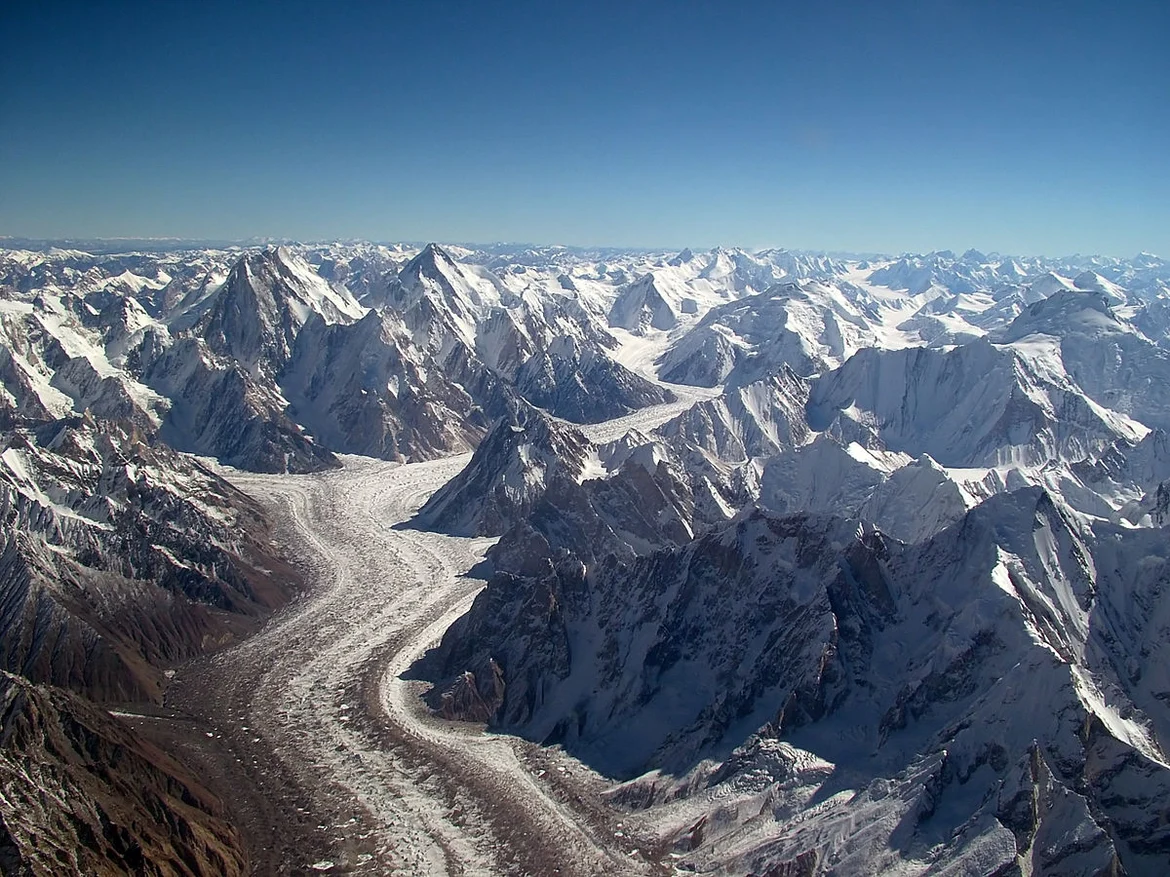
Surrendering a strategic choke-hold on the Karakorum

Across the Karakorams: India-China Dispute through the Centuries
[The Karakorum Range)


Retreating in the face of an enemy’s onslaught may be a tactical necessity. Withdrawing in anticipation of the situation getting sticky is inherently bad strategy but, as the record shows, it is one the Indian government reflexively follows when dealing with China. In eastern Ladakh, the Narendra Modi regime’s play safe-attitude combined with the army brass’ over-caution are allowing India’s main adversary and rival, China, to realize its expansive claims with minimum fuss. An undefined border – whatever the “peace and tranquility’ kind of agreements may say, permits military contestation and territorial gain-seeking. But it is Beijing that has shown the strategic foresight and the stomach to exploit it, leaving a disadvantaged India to always react, to scramble to recover lost ground.

     Maybe it is too much to expect the country’s political leaders and their handmaidens manning the apparatus of state – the generalist civil servants and diplomats with only passing knowledge of military affairs, to be mindful of, and learn from, the country’s own historical experience of dealing with China. It is inexcusable, however, for the Indian armed services to act innocent of the methods that fetched them success against the People’s Liberation Army (PLA) in the past.

     In September 1967, when India was still suffering from the trauma of defeat in the 1962 War, the 17 Mountain Division stopped the PLA cold. An Indian unit marking the disputed border at Nathu La with cantina wire was challenged by PLA troops, a scuffle ensued, the roughed up Chinese soldiers withdrew to their lines and then, without warning, opened up with heavy machine gun fire killing and injuring many Indian soldiers. Rearing for a fight, the redoubtable Major General Sagat Singh, commander, 17 Mountain Division, responded by having his artillery destroy a series of Chinese bunkers with accurate fire that had the PLA crying for talks. (The same Sagat Singh – the unheralded hero of the 1971 Bangladesh War, as Lieutenant General commanding IV Corps in an operation that he thought up on the spot, which was violative of his operational orders to stay put on the Meghna River, heli-lifted his forces across it for the dash to Dhaka.)

     Exactly twenty years later, the army under General Krishnaswami Sundarji, pretending to assess the time to mobilize forces in the northeast – Operation Chequerboard – began deployments. China took the bait, hinted at war, but the PLA found itself overmatched by speedy and massive Indian concentration — some 10 Divisions in all in Arunachal and Assam, three of them around Wangdung where there was trouble brewing. The Chinese once again beat a retreat and called for negotiations that eventuated in the 1993 ‘peace and tranquility on the border’ accord.

     Now fast-forward to summer 2020. The Indian government and army, having disregarded the intelligence generated by Indian satellites over the previous 8-10 months depicting considerable military activity and build-up by the PLA on the Indian side of the Line of Actual Control (LAC) in the area between terrain features – Finger 4 and Finger 8, on the northern shore of the Pangong Lake, upriver in the Galwan Valley and, ignoring the ‘no man’s land’, right smack on the LAC itself in the Gogra and Hot Springs areas, found themselves up a creek. The Indian and Chinese Corps commanders met June 6 to sort out matters. But on June 15 a detachment of the 16 Bihar Regiment went, boy scout fashion, to its doom. Intending to verify if the PLA had kept its promise and decamped from the Galwan, its members were bludgeoned by PLA troops wielding medieval era weapons (rods with embedded steel spikes, etc).

     Foreign Minister S. Jaishankar’s remonstrations and demand for the restoration of the status quo ante to his Chinese counterpart, Wang Yi, June 17 elicited a straight-faced, formal, claim over all of the Galwan Valley and a counter-ask that the intruding Indian soldiers get out of Chinese territory forthwith. To indicate it meant business, China as a coercive tactic also positioned two brigades of artillery and armour, in the Depsang plains, threatening to open yet another sub-sector front.

     The Indian soldiers, unaware of the PLA’s penchant for springing local surprises, such as initiating hostilities with machine gun fire at Nathu La in 1967, were unprepared for one when they faced a Chinese attack with nail-studded batons. In the larger context, despite hundreds of unresisted PLA incursions, incremental annexations amounting to a loss of as much 1,300 sq kms of Indian territory in the new millennium, and periodically presenting India with newer territorial faits accomplis that the Indian army and government by doing nothing have, in effect, accepted a reshaped map of Ladakh favouring China.

     In the event, the Indian army’s quickly putting a matching force (of two plus Divisions) in place has been of no avail because it did not rapidly go into action to vacate the Chinese occupation of Indian territory. It fell into the trap of trusting in the diplomatic method to get its chestnuts out of the fire. Except, the July 5 Special Representative level talks between national security adviser Ajit Doval and Wang Yi produced little other than an iteration of Chinese claims on the Galwan, a non-withdrawal in the Pangong Tso area, and acceptance of the newly conceived “buffer zones” at Gogra and Hot Springs encompassing the land between the two claim lines. But with the buffer zones obliterating the concept of ‘no man’s land’ separating the two sides all along the LAC, this border safety belt is exposed to surreptitious PLA takeover. Didn’t Messrs Doval & Jaishankar foresee the unnecessary “buffer zones” furthering Chinese designs? Apparently not, but this is par for the course.

     China’s Galwan claims are to counter a potential Indian threat from the DSDBO (Depsang-Shyok-Daulat Beg Oldi) road to the Xinjiang Highway (number 219) connecting to the China-Pakistan Economic Corridor (CPEC). That’s proactive Chinese geostrategics at work. In contrast are the Indian government and army. Having constructed the strategically-important DSDBO Road that permits support of the Indian military presence on the Siachen Glacier and potentially interdiction of traffic at the CPEC-Xinjiang Highway junction on the Karakorum Pass, they failed to take the most basic precaution of protecting it by occupying the heights on the mountain range on the eastern bank of the Shyok River running north to south, to pre-empt the PLA from dominating this road.

     Having messed up hugely, the Modi government and the Indian army – if they are not to permanently have mud on their faces – have no alternative but to ignore agreements and telephonic understandings if any, and expeditiously occupy the heights above the Shyok to safeguard the DSDBO Road,  and to waste no time in launching a limited, possibly intense, war to take back the Galwan fully and to recover Indian territory on the Pangong Tso at whatever cost. Anything less will, in practical terms, mean ceding these territories to China, imperilling the lifeline to Siachen, surrendering a potential Indian strategic military chokehold on the Karakorum, and reinforcing Beijing’s perceptions of India as a weak and pliable state it can safely mistreat.  

———–

Published as “The High Cost of a Loose China Policy” in my ‘Realpolitik’ column in BloombergQuint.com, July 10, 2020, at https://www.bloombergquint.com/opinion/the-high-cost-of-a-loose-china-policy

Posted in asia-Pacific/Indo-Pacific, Asian geopolitics, Central Asia, China, China military, civil-military relations, Culture, Decision-making, Geopolitics, Great Power imperatives, India's China Policy, India's strategic thinking and policy, Indian Air Force, Indian Army, Intelligence, MEA/foreign policy, Military/military advice, SAARC, satellites, society, South Asia, space & cyber, Tibet | 10 Comments

No real disengagement in eastern Ladakh

China-India border: Why tensions are rising between the neighbours ...
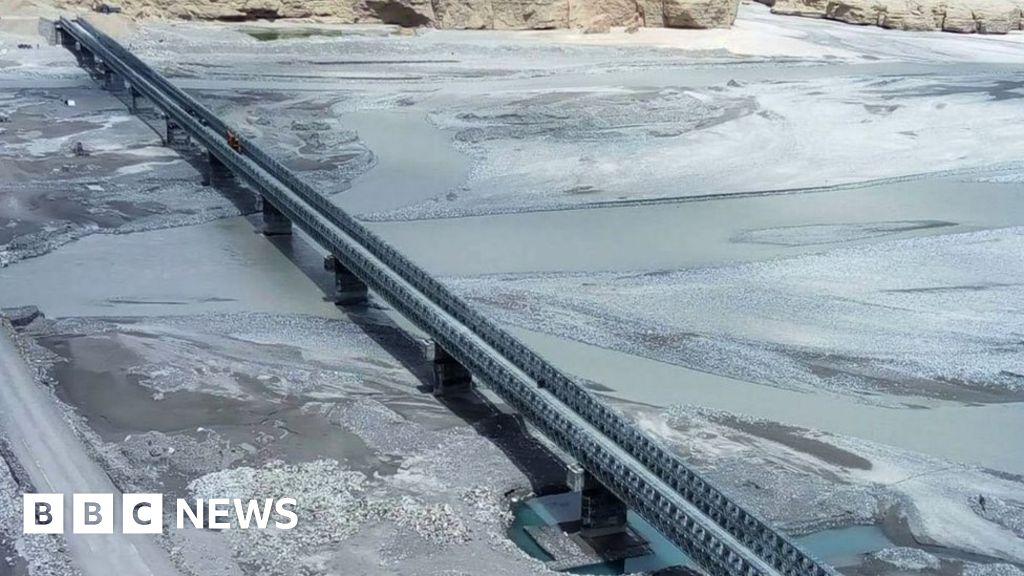
[Bridge over the Shyok]

Much is being unwisely made about several developments on the Line of Actual Control in eastern Ladakh.

One, that both the Indian and the Chinese armies are withdrawing some 2 kms from the Patrolling Position on the Galwan — the site of the barbaric PLA attack June 15 on an Indian patrol out to verify if the Chinese troops had left the area. This was promised by a Chinese Division-level commander, Major General Liu Lin, heading the South Xinjiang Military District, in his meeting June 6 at the Chushul-Moldo post with the GOC XIV Corps, Lt Gen Harinder Singh. It is the location where the Galwan River runs into the bigger Shyok River. Along the western shore of the Shyok running north to south is the strategic Depsang-Shyok-Daulat Beg Oldi (DSDBO) highway reaching the Karakorum Pass.

Satellite imagery shows the PLA has decamped from the bend up-river. It is very likely though that the Chinese troops up and left the area before the two sides agreed they’d do so because the seasonal snow-melt with freezing waters had swamped the PLA camp forcing the Chinese to get the hell back to their own lines on higher ground. Unless satellite images of that area when the Chinese actually departed indicate otherwise, this is what must be assumed by the Indian government to have happened. Delhi should not needlessly credit China with adhering to whatever was agreed upon in Chushul, when in actuality the flooding waters drove out the Chinese. Whence, it may be argued that it is only India that has really affected a pull-back of its presence on the Galwan. This is important because the Chinese government may be inclined to use the fact of the PLA troops being forced by an act of Nature to retreat as something they willingly undertook to do, and pitch it as a means of reviving mutual trust.

It leaves unclear what the Indian army hopes to do on the Galwan. Will it seek the cover of this minor disengagement to write off the chance of dominating the heights in strength on the ridge overlooking the DSDBO road by pleading deficiency in the logistics system? This seems to be the case because a news report refers to the difficulty of supplying such posts at 16,000 feet altitude the year round using the twin-routes via Zoji La and Manali? As an army source told a newspaper, “a semi-permanent habitat” presumably on this mountain range is not on the cards. ( https://indianexpress.com/article/india/lac-dispute-indian-army-troops-military-supply-chain-6490608 ).

In the event, the legitimate thing to ponder is this: If the Indian army misses the opportunity of permanently occupying the heights above the Shyok NOW, later may be too late. Because the PLA will surely preempt it by setting itself up on the ridge line. They have already signaled their intent to do so with their Galwan adventure. And because the statement issued in Beijing at the conclusion of the telephonic negotiation July 5 by the two Special Representatives — NSA Ajit Doval and the Chinese Foreign Minister Wang Yi articulates the basis for such prospective action by reiterating China’s claim on the entire Galwan Valley. The statement issued by the MEA, of course, makes no mention of it. But China will naturally go by its document, not Delhi’s.

Secondly, the two sides moving back at Gogra and Hot Springs, was the easiest action to affect in the main because PLA did not cross the LAC at these locations. But, strangely, these are the places around which the two sides agreed to establish what is referred to as “buffer zones”. Are such zones different from the ‘no man’s land’ separating the two armies that has always existed and if so, in what way are they different? And what’s the purpose of these buffers and why at these points only? Or, is the buffer zone concept an enlargement of the no man’s land to reduce the frequency of enemy incursions and prevent head-on clashes? It would make sense if this concept were extendable to the rest of the LAC. Such a buffer zone would be helpful at the Y-junction on the Depsang plains the PLA has occupied, preventing Indian troops from legitimately accessing Patrolling Point 14. This is a flashpoint China apparently doesn’t want to deactivate.

Finally, does the requirement for the opposing forces to move back 2 kms not apply to the Pangong Tso area? Because here the PLA are entrenched not only on the shoreline with a motorable road connecting the terrain features Finger 4 and Finger 8, but also on the top of these hills — on Fingers 4,5,6,7 and 8 — an expanse of territory well within India’s claimline that Indian troops regularly patrolled as of last summer, i.e., until the 2019 patrolling season. There’s not a hint from the Chinese that the PLA will be moving out from these parts that boast of some pucca structures. So, how will annexation of this territory by China be reconciled by the Modi government with Minister S Jaishankar’s demand of June 17 for an unconditional restoration of status quo ante? Or, is Prime Minister Narendra Modi tending towards accepting this new territorial fait accompli?

The only good thing to occur with respect to the Pangong Lake is that the Indian Navy is sending its armed patrol boats. Hopefully, they will be manned by its Marine commando (MARCOS) — the country’s finest, most capable, Special Force. It may be recalled just how successful the Marcos were when deployed during Admiral Vishnu Bhagwat’s foreshortened tenure as CNS in the mid-90s on the Wullar Lake in Kashmir. They ruthlessly shut off attempts at riverine infiltration by the Pakistan-based Lashkar jihadis. We can expect the MARCOS with some unusual tactics to keep the peace, stop the Chinese from messing around, and instill the fear of God in the godless PLA troopers. Hereafter, the contest for the Pangong Tso is bound to be more even.

All of which leads one to wonder if there’ll really be a meaningful disengagement in this region controlled by XIV Corps? Yes, some small de-escalatory steps have been taken, but as matters stand, the PLA is still where it is ensconced on the Pangong, and China has reasserted its claim on the Galwan Valley. This last means the Chinese armed units have not withdrawn any great distance from their forward positions and can renew their annexation offensive at any time of their choosing. This is not progress towards a peaceful resolution. If anything, it should convince the Indian army to redouble its efforts at cementing its presence, especially on the Galwan ridge, and not pull back too much its forces or the warfighting wherewithal hauled up there — the howitzers and air defence missiles in particular, that constitute a deterrent. These should be here to stay.

Posted in asia-Pacific/Indo-Pacific, Asian geopolitics, Central Asia, China, China military, civil-military relations, Culture, Decision-making, Geopolitics, Great Power imperatives, India's China Policy, India's strategic thinking and policy, Indian Army, Indian Navy, MEA/foreign policy, Military/military advice, Missiles, Nuclear Policy & Strategy, SAARC, satellites, society, South Asia, Special Forces, Tibet | 21 Comments

Prepare for limited war– Modi in Nimu, Ladakh

PM Modi reaches Leh to review security situation, interact with ...
Modi, after landing in Ladakh

Prime Minister Narendra Modi had four aims in mind for his quick turnaround trip to Ladakh — the scene of the fiercest Indian hand-to-Chinese nails-studded baton fighting that led to the loss on June 15 of 20 personnel of a battalion of the 16 Bihar Regiment, including its CO Lt Col Santosh Babu.

The PM sought to (1) show support for the forces deployed in this high-altitude battlefield, (2) reassure the Indian people who have been disappointed by the BJP government’s stupefied inaction in the face of the unexpected Chinese tactics and occupation of territory on the Indian side of the Line of Actual Control, (3) clean up his smudged nationalist image with optics showing him as a wartime leader on the frontline amidst Indian soldiers, and (4) signal President Xi Jinping that the cask of the Wuhan and Mamallapuram spirit has run dry, and were China to resort to further armed hostilities the Indian military would respond in kind. Whether this signal will be properly received and how Beijing will react to it, of course, remains to be seen. But at least and finally the PM conveyed his resolve and the army’s to stand their ground.

Except, and this is the troubling part, a senior army commander — it must have been one of the three senior most officers accompanying the Prime Minister — the Chief of the Defence Staff General Bipin Rawat, Army Chief General MM Naravane, or the General Officer Commanding XIV Corps Lt Gen Harinder Singh, undercut the ostensible thrust of Modi’s message by revealing to a newspaper the more limited type of operations contemplated by the Modi government and the army. “We have no intention of initiating any skirmish”, this officer is quoted as saying, “but any aggression from the other side will be fully repelled.”

This means India will undertake no military actions to remove the People’s Liberation Army units entrenched on the Galwan and the Pangong Tso in Indian territory, and right smack on the LAC at Gogra and Hot Springs, disrespecting the No Man’s Land separating the two sides on the Line from where the intruding PLA troops may or may not be evicted. But that the army will react in case there are further Chinese attempts to grab Indian land. This is to say that China gets to keep the territory it has already occupied at the first two sites and, for all intents and purposes, annexed. In this context, was Modi’s trip an eyewash to conceal the Indian government’s policy of not contesting the Indian territory expropriated by China? It fits in with the totality of statements issued by both governments in recent weeks. My worst fears (expressed in the May 25 post on this blog) have thus come true: Indian forces in eastern Ladakh were presented with a new territorial fait accompli which the Modi regime has accepted. Alas, this lonely Cassandra may, once again, be proved right.

Addressing the troops Modi said “The weak can never accomplish peace, the brave do.” This uplifting sentiment was undermined by an infirm grasp of international affairs and a somewhat shaky sense of history. “The age of expansionism” the PM declaimed, “is over, this is the age of development” and added “History is witness that expansionist forces have either lost or were forced to turn back.” That both these statements suggest just the opposite is apparent from the record of Sino-Indian relations and in the history unfolding in real time in Ladakh. A powerful expansionist China far from being punished and forced out of its ill-gotten territorial gains is, in fact, being rewarded by the victimized state (India) quietly reconciling to loss of territory. This impulse of China’s is manifested everywhere on its periphery — in the South China Sea where its Nine-dash Line encompasses almost all of this Sea, and now in the capture of India’s Galwan Valley and the Indian part of the northern shore of the Pangong Lake. This reality on the ground mocks Modi words!

To make it more farcical still, Modi chose on this occasion to channel his inner Donald Trump! Not once mentioning China by name in his address, he told the assembled troops that the enemy “has seen your fire and fury”, presumably at the June 15 Galwan clash, and received a strong, direct message. It may be recalled that in the wake of the threat of missile strikes by the North Korean dictator Kim Jong-un in August 2017, Trump warned North Korea that it “will be met with fire and fury and frankly power, the likes of which this world has never seen before.”

Modi rounded off with a trifle too high praise for the military, saying “You have proven time and again that the Indian armed force is mightier and better than everyone else in the world.” Such talk may bolster the spirits of the Indian mountain infantrymen who may be asked to fight at these forbidding heights. But the danger is that it may lull the military brass into their customary complacency. After all, if the Indian military is all that good, taking back the territory annexed by China should pose no real problems.

But to revert to the PM’s utterance about the inability of the weak to accomplish peace, unfortunately, it is India that is the weak party — its military, economic, diplomatic disparity with China too great to gloss over but too obvious for Modi to openly acknowledge. The sheer imbalance of power may leave India with dire options. Should China not peacefully vacate its occupation of Indian territory in toto, the limited war the Indian armed forces would have to undertake to roll-up and push out the aggressor PLA units will necessarily have to be backed by the threat of first use of nuclear weapons (the case for which is argued in extenso in my latest book ‘Staggering Forward: Narendra Modi and India’s Global Ambition’). 

Activating the nuclear arsenal by bringing into the theatre mobile Agni missiles as nuclear cover for conventional operations is unavoidable. It will test the mettle and the political will and nerve of the Prime Minister. Modi better not fail.

Posted in asia-Pacific/Indo-Pacific, Asian geopolitics, Central Asia, China, China military, civil-military relations, Culture, Decision-making, Geopolitics, Great Power imperatives, India's China Policy, India's strategic thinking and policy, Indian Air Force, Indian Army, Indian ecobomic situation, Indian Navy, MEA/foreign policy, Military/military advice, North Korea, Northeast Asia, Nuclear Policy & Strategy, Nuclear Weapons, SAARC, society, South Asia, Strategic Forces Command, Tibet, Weapons | 40 Comments

Not a Bang, but a slow leak of gas

34 Indian soldiers missing in Ladakh after India-China soldiers ...
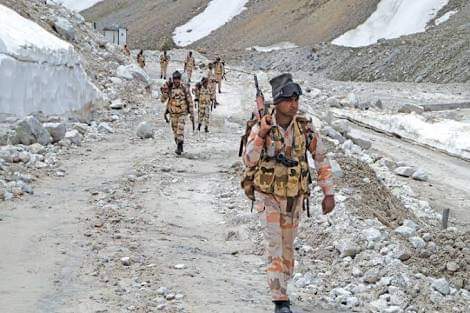
[An Indian patrol in Ladakh]

This is getting seriously worrisome. The media was primed to hear Prime Minister Narendra Modi finally speak about the national security crisis engendered by the bloody border clashes with China; a crisis that with every passing day growingly advantages Beijing. Instead, in his televised address this afternoon the country got more about the corona pandemic and his government’s steps to alleviate hunger of the poor — the hardest hit by it.

The armed confrontation with China is telling on the PM. Modi appeared thinner, deflated. It is as if Chinese President Xi Jinping’s move to expropriate Indian territory and zero out the possibility of an Indian military presence in locations (particularly on the Shyok River) potentially threatening the Tibet-Xinjiang highway (No. 219), has let the air out of the Narendra Modi balloon.

Perhaps, Modiji feels that not publicly addressing the fact of a realpolitik-driven adversary itching for a fight will somehow provide him greater purchase with Xi, keep the situation from spilling over into fighting, and allow him more time and negotiating space to persuade Beijing to call off its adventurism and restore the newly drawn Line of Actual Control (LAC) by the Chinese People’s Liberation Army (PLA) to its original alignment.

For all his rhetoric (lal ankhen jo dikhayega…etc) minus any mention of China, Modi is no fool. Hence for him to not make an almighty fuss about the brazen Chinese land grab and to act unconcerned, as if Xi’s turnaround and giving back the annexed Indian territory on the Galwan River and in the Pangong Tso area is round the corner, suggests the Indian PM is losing his grip on reality. Or, that he is massively misreading his supposed good friend Xi’s intentions (aided and abetted by the China-appeasers in the foreign service and by Minister S Jaishankar, who pulled time in Beijing as ambassador without knowing a word of Mandarin — talk of getting a runaround in the Forbidden City!).

In the event, Jaishankar’s attempts to lighten the mood by asking his opposite number, Wang Yi, to restore the status quo ante no doubt occasioned mirth in the Zhongnanhai. This because, in the wake of the bludgeonings of 16 Bihar personnel by the PLA, the Xi regime promptly justified its excesses to the world by claiming that the Galwan and the Pangong Lake are and have always been on its side of the LAC, and that the violence was triggered by trouble-making Indian soldiers trespassing into Chinese territory. So, there! The MEA, mealy-mouthed as ever, was preempted by Bejing spokesmen thus strongly making the Chinese case. Whether the Indian or the Chinese view is believed or disbelieved by the international community, what is certain is there’s no sympathy anywhere for India. What there is is the schadenfreude enjoyed by India’s neighbours who too often have felt Delhi’s heavy hand.

The plethora of news reports, especially on TV continue to give the impression of China quaking in its sandals now that the Indian army is entering the theatre in strength, and the IAF is placing Apaches, Su-30s, MiG-29s and Mirage 2000s at Leh and other satellite bases. Except, the IAF will have to fight outnumbered should hostilities begin, because PLAAF will switch a lot of its squadrons to this front.

The commentariat, for its part, appropriately featuring a covey of retired militarymen, diplomats, and the usual suspect columnists who started out by urging peaceful negotiation and sounding like MEA careerists, are inching towards more muscular options without any of them clarifying what that action should be and to achieve what end.

So the army is building up to near Division-level force strength in this sub-sector. But the PLA, expecting an Indian riposte, is already fielding brigade-sized artillery and armoured formations in the Depsang plains and beefing up its defensive positions in Chumar and elsewhere where they are emplaced in terrain-wise disadvantaged sites.

Meanwhile the marathon military-to-military talkathons continue at Chushul. The third round that began this morning is heading, as did the earlier ones, to an impasse. Delhi shouldn’t be fooled into expecting any outcome. The Chinese have always used these elongated negotiation sessions to tire out the opponent — not to reach a compromise solution. Decisive results will accrue, to paraphrase Maozedong, from the barrel of a gun, i.e., by a limited war at a minimum.

In this regard, there’s a debilitating belief as much within the government as outside that, if in real trouble, the US will help India out. Indeed, Trump’s pulling US troops out of Germany and the American Secretary of State Mike Pompeo’s taking notice of happenings in Ladakh have been widely interpreted as the US Cavalry preparing to ride to rescue Indians! In actuality, the US is diverting its land forces from their NATO stations in Germany to South Korea and Japan, and last week mounted a 3-nuclear carrier (USS Nimitz, USS Ronald Reagan and USS Theodore Roosevelt) operation with some 180 combat aircraft on board and an escort flotilla of two cruisers and three missile destroyers in the Philippine Sea to deter Beijing from pulling a Ladakh-like surprise naval stunt in the nearby South China Sea and the Taiwan Strait. This region is America’s focus, not Ladakh. So, if Delhi is waiting for America to take direct action, it may have to wait forever.

As I have been iterating from Day One, there was intelligence failure with Indian satellite information revealing the PLA build-up being ignored by the government for over a year. Lt Gen Kamal Davar, the first Director General, Defence Intelligence Agency, now hints at RAW — the first receiver of satellite data from DIPAC (Defence Imagery Processing and Analysis Centre) being remiss in not passing on this information to the army. (See https://www.thequint.com/voices/opinion/indian-army-veteran-comments-on-india-china-border-clash-galwan-intelligence-lapse-military). Whosoever is responsible for this particular glitch, such snafus seem par for the course.

I have also all long argued that India must embark on a military counter. The Indian army cannot limit itself to just a holding action in case the situation hots up, which is what it may be planning to do. It has to act to vacate Ladakh of Chinese aggression in toto, secure the heights on the range fronting on the Daulat Beg Oldi-Depsang highway and the Shyok River, and to create a hefty military presence on the Pangong and the approaches to Karakorum Pass. Unless India does this it will perennially be at PLA’s mercy. To avoid such a denouement, the western sector of the LAC hereafter will have to be treated as a live military theatre, and developed into a staging area for military action across the LAC and into Tibet by the Indian army and air force. India cannot launch substantial offensive actions into Tibet without having at least three offensive mountain strike corps equipped with 30-35 ton light tanks, a capability the army doesn’t possess.

Politically, there’s little doubt Modi is stepping into what may be a troubling period for him personally. The Ladakh fiasco has shown him up, to use the Chinese phrase, as a “paper tiger”, one that may scare Pakistan some but is a dormouse once the dragon hews into view. The Opposition led by Congress party are mercilessly skewering Modi and unless he shrugs off his diffidence and orders the army to roll-up PLA aggressor units at whatever cost, he will be stuck with the taint of 2020 much as Nehru had the ’62 albatross around his neck. Banning of Chinese apps, barring Huawei and ZTE from the 5G sweepstakes, etc. are small potatoes for a Beijing set to realize its longtime strategic dream of accessing the warm water port of Gwadar as the entrepot for its western provinces. The objective of keeping India as far away from the China-Pakistan Economic Corridor facilitating it is, therefore, a priority interest that China, by annexing Indian territory, has cemented. This is a military challenge India has to overturn — no two ways about it.

Trying the other day to do his bit to head off the bad notices his boss is attracting Home Minister Amit Shah only prompted a controversy. He messaged on Twitter that “At a time when the entire nation is united, Mr. Rahul Gandhi should also rise above petty politics and stand in solidarity with national interest.” This is a curious statement because, surely, the “national interest” doesn’t lie in everyone unquestioningly supporting Modi’s policy of military inaction. In the light of the PM’s June 19 statement which denied that the Chinese aggressed at all, it would mean that PLA’s annexing Indian territory is in the national interest! Say it is not so, Modiji.

Posted in asia-Pacific/Indo-Pacific, Asian geopolitics, Central Asia, China, China military, civil-military relations, Culture, Decision-making, domestic politics, Europe, Geopolitics, Great Power imperatives, India's China Policy, India's Pakistan Policy, India's strategic thinking and policy, Indian Air Force, Indian Army, Indian ecobomic situation, Indian Politics, Intelligence, MEA/foreign policy, Military/military advice, Pakistan, Pakistan military, SAARC, satellites, society, South Asia, space & cyber, Tibet, UN, United States, US. | 33 Comments

Occupying the heights

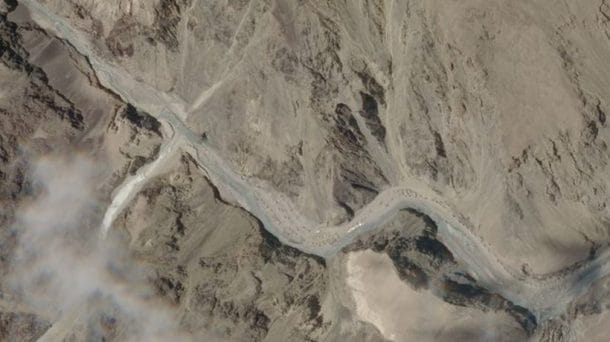
PLA post on the Galwan (Maxar Technologies via AP)
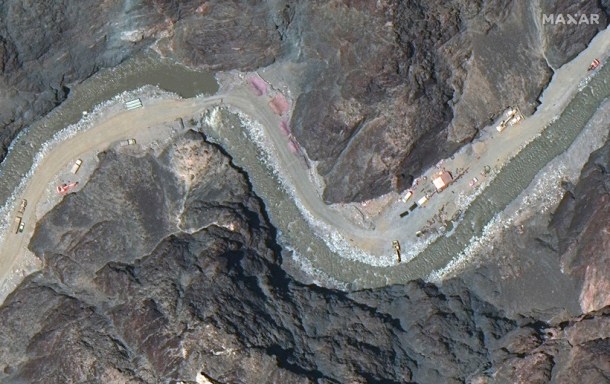
Patrol Point 14 (site of PLA clash with 16 Bihar) on the Galwan

PP 14 after PLA buildup
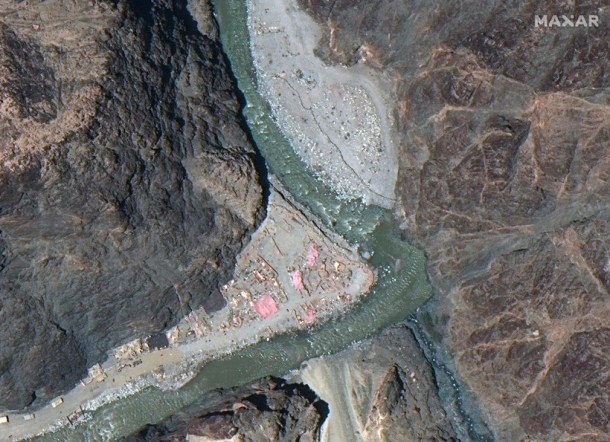
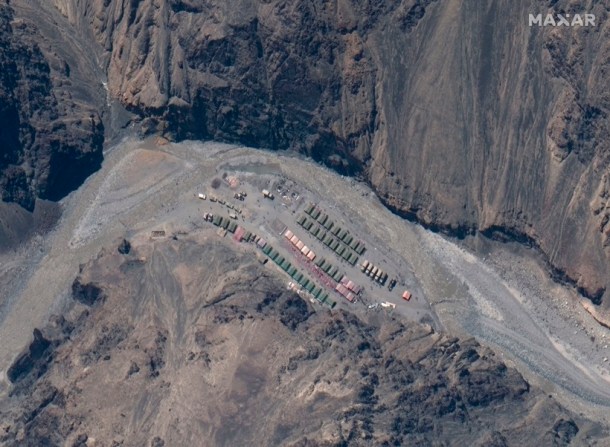
(PLA in the Hot Springs area)
Permanent PLA structures
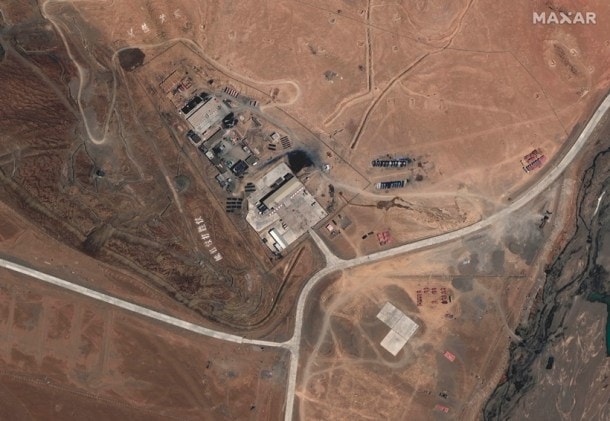
armored vehicles, flatbed trucks to carry them, etc. in a PLA bulit-up area

Ponder the satellite pictures above released by Maxar Technologies of the US for worldwide public information showing the scale and degree of military buildup within a very short period of time without any matching construction, elaborate facilities and presence in these contested areas by the Indian army. This is the context for the military drama unfolding in realtime in eastern Ladakh and the political drama in Delhi and Beijing.

But first a piece of good news. The Indian army is finally paying attention and doing the elementary thing of securing the heights on the Galwan to prevent the PLA from dominating the Depsang-DBO-Karakorum Pass Highway. The pity is they didn’t do it until goaded into action by this blog — because I know of no other blogger/commentator/analyst/expert, who urged this early and publicly. The failure to take so basic a precaution of controlling the heights to protect this highway — a national strategic asset, suggests a lapse in professionalism and a laid back attitude of the army and the government that the country can ill-afford. It permitted the PLA to get not just a toehold but a foothold.

Except now, Indian soldiers have reached the crestline of the mountain range on the Shyok at the Galwan River confluence. This was reported several hours back on Twitter by wolfpackIN, which bit of good news seems credible because the retired Northern Army commander Lt Gen HS Panag retweeted this message on his twitter handle along with an exclamation “Excellent!” Retired generals are usually known to keep themselves in the know of happenings in the army commands they once headed.

Having done this initial bit, the army better plan on staying at these heights indefinitely starting with the coming winter months and accordingly establish a hardy logistics system to sustain this armed presence on the heights above Galwan but also, as proposed in an earlier post, along the ridge line above the Shyok River to the Karakorum Pass. The cost of setting up a supply line for all-weather posts on the Galwan peaks with communications gear can be extended to reach other high points at marginal additions in cost. In any case, the financial investment — whatever its size –is a secondary concern. The primary focus should be to prevent the PLA from increasing its footprint.

India has already lost a good part of the Indian side of the Galwan and Pangong Tso area. Firming up an Indian presence at the heights will disincentivize the PLA from taking what remains of our territory in that sector. Because the almost base-area kind of buildup at these sites, as well as in the Hot Springs area means the Chinese do not mean to withdraw, no matter what. If the Chinese stay, so should the Indian army.

The rest is piffle, including the statements issued pro forma by Beijing and Delhi, such as the one by the Chinese government about the official exchanges to-date being “candid and in-depth” and how both intend to “earnestly implement the important consensus” reached by the two Foreign Ministers S Jaishankar and Wang Li in their June 17 talks over the telephone, and — an ugly turn of phrase this — “actively accommodate with the two military forces to implement the outcome reached” at the June 6 and June 22 military level meetings. Conforming to this theme, diplomatic underlings from the two countries yesterday (June 25) agreed to “sincerely implement the understanding on disengagement and de-escalation” along the LAC.

The military commanders for their part announced they too had arrived at a “mutual consensus to disengage” without agreeing either on the timeframe for such disengagement and, even less, its modalities. There are so many of these military and diplomatic forums the head spins especially because they all seem to end up furthering China’s interest even as Indian diplomats are left twiddling their thumbs on the sidelines. Thus, another such body — the Working Mechanism for Consultation & Coordination on India-China Border Affairs (WMCC), too went through its motions and spouted a lot of useless words.

Predictably, these exchanges have ended up with the MEA wagging its finger saying things like both sides should “strictly respect and observe” the Line of Actual Control, and the Chinese Defence Ministry warning in no uncertain terms that “China has sovereignty over the Galwan Valley region and the Chinese border troops have been patrolling and on duty in this region for many years.” Except China’s are fighting words and straightforwardly pose a military challenge to India to prove Beijing wrong. The Modi government, however, does not seem interested in picking up the gauntlet.

This is evident from the contrasting attitudes and approaches. The Indian government relies on peaceful resolution and MEA mouths diplomatese. The Chinese government, on the other hand, asserts its unmaintainable claim over the Indian territory it has brazenly occupied and which, for all intents and purposes, stands annexed through the instrumentality of the PLA.

Posted in asia-Pacific/Indo-Pacific, Asian geopolitics, Central Asia, China, China military, civil-military relations, Culture, Decision-making, Geopolitics, Great Power imperatives, India's China Policy, India's strategic thinking and policy, Indian Army, Intelligence, MEA/foreign policy, Military/military advice, SAARC, satellites, society, South Asia, space & cyber, Tibet | 19 Comments

Far from evicting the Chinese, India is throwing in the towel (augmented)

India, China troops have disengaged at Galwan, says army on clash ...
[Mountain supply]

Often the best thing for political leaders as well as generals, serving or retired, to do during volatile border crises of the kind India has on its hands is to resist the impulse to say something, anything, because their statements are usually overtaken by events.

The COAS, General MM Naravane, discovered no doubt to his discomfiture that a bare ten days after he talked about the two armies agreeing to, and being involved in, the process of “phased disengagement”, the situation erupted June 15 on the Galwan with the death by bludgeonings and drownings in the river of 22 Indian soldiers, including Colonel Santosh Babu of 16th Bihar.

The mystery around why these killings by Chinese soldiers using nails-studded batons and similar type of weapons even occurred when Article 6 of the 1996 Agreement with China absolutely permits the attacked to use sidearms and infantry weapons in defence, only deepened when the former army chief General JJ Singh told a TV channel June 19 that this was because the army strictly followed the government’s injunctions against the use of force, any force, on the LAC. He apparently believed the government’s list of no-no’s over-rode Article 6’s provision for resort to lethal force. Defence Minister Rajnath Singh’s announcement June 21 that forwardly deployed field commanders were now free to retaliate in kind at least proved General JJ Singh right in terms of the previous rules of engagement. However, it doesn’t explain why the army in any way felt constrained by them — unless one assumes that officers up and down the command were, like General JJ Singh, unaware of Article 6, and if they were so aware, didn’t want to exercise their right of just response, not even to save themselves.

Now that the government is on board Article 6, the question is has the army made sure to rapidly arm all jawans and officers on the LAC with compact steel spiked maces and flails and instructions for their express use preemptively if they sense Chinese intent? Because otherwise, our mountain infantrymen will be in no better position than when surprised by the adversary on June 15 evening, and the outcome will not be different or any less bloody.

If the army brass were wrong-footed by surprise Chinese action, Prime Minister Narendra Modi’s virtual clean chit to China in his televised declaration of June 17 about the status quo not being disturbed at all was astonishing, considering TV channels in the previous days were regularly flashing commercial satellite images showing substantial military infrastructure buildup (pill boxes, depots, troop hostels, even kraals for armoured vehicles), dug-in artillery pits, and occupation of the entire area between topographic features Finger 4 and Finger 8 on the Pangong Lake, and similar construction by the PLA, inclusive of a helipad, northeast of the site of the imbroglio on the Galwan River.

The Indian people watching TV news are, unenviably, left to either trust their eyes (visual satellited data) or believe the PM.

I have been saying since the beginning of this territorial tussle that the Indian government had the imagery intelligence from Indian satellites making passes over these contested areas for over a year now when the PLA first initiated its construction activity. A person at the senior most level dealing with national security in the government confirmed this. The conclusion: Even as he was completely in the know, Modi did nothing. Not sure why though. Could it be because he expected that his personal relationship with the Chinese President Xi Jinping would motivate the latter to keep the LAC quiet? And, now by not acknowledging the Chinese buildup on the Pangong Tso and in the Galwan area, he is still affording Xi the maneuvering space to, even at this late date, pullout without “losing face”?

Beijing has been preparing its annexation plans for awhile and seemingly didn’t care Indian satellites were conveying photographic evidence of PLA activity to Delhi. Xi, it’d appear, was confident Modi would not react violently. The reports from those who accompanied Modi to Wuhan suggest the Indian PM was particularly taken by Xi’s deft personal touches, such as conducting the Indian leader around his birthplace (near that Chinese city), etc. The result is Xi is playing Modi like a fiddle.

Xi’s conviction about Modi’s inaction in the face of provocation may also be because of the 2008 agreement binding Delhi to not rake up the matter of clarifying the LAC (alluded to in the preceding post) that the US-based Stimson Centre Chinese-origin scholar Yun Sun (not Sun Lun — my mistake!) based her analysis on. Yun concluded, in effect, that Delhi is cognizant of the latitude China feels it has in redefining the LAC, and it is this that China has exploited. When asked about this and Delhi’s response a very high official who served in the UPA government tells me there was no such agreement and, in fact, that clarification about the LAC was sought in 2010 and again in 2012. “We drew the conclusion quite early in 2003-4 when it was clear that China wanted ambiguity about the LAC”, he writes in his message, “that the only real answer was on the ground. Hence the 72 GS roads, two extra divisions, the mountain strike corps, the reopening of ALGs etc. But you know all this. The other responses were diplomatic, or narrative building etc.”

As to why the lowland and the heights on the eastern shore of the Shyok River fronting on the Daulat Beg Oldi/Karakorum- Depsang road were not secured once the alignment of this road was fixed a decade or more back, well, there’s no satisfactory answer. A senior military man in the loop advised that I needed “to understand both the dynamics of LAC and the terrain”. Given that the PLA doesn’t have a much easier terrain on its side, the Chinese seem to be able to better cope with geography and the vicissitudes of the LAC.

In this mess, however Modi anticipates this crisis to peter out, one thing is certain, China will not give up the Indian territory it has occupied nor surrender the physical assets it has constructed. In short, Beijing will not negotiate away the land it has acquired by proactive action in the Himalayas. This about draws the limits on Indian diplomacy. The sooner Modi government accepts this reality the more expeditiously it can approve military plans for evicting the PLA intruders , whatever it takes, because there’s no alternative. Especially because it wouldn’t want to be in a situation where commercially available satellite images will belie, at every turn, the comfortable fiction it may choose to flog about there being no Chinese aggression and occupation, and no situation that a bit of jaw-jawing with the Chinese won’t smoothen out. Beijing will be happy to talk but will not move out an inch.

A limited war, as I have maintained from the start, is the only way to vacate these areas of the PLA. It is also imperative a more proactive army establish soonest possible and at whatever cost a presence on the eastern shore of the Shyok River, and especially on the Galwan, Cheng-chenmo valley openings on the Shyok, whatever the difficulties of terrain and the LAC orientation in these areas.

The Chinese seem to appreciate that old saw about possession being nine-tenths of the law. What the Indian government and MEA understand about the country’s territorial integrity and sovereignty is anyone’s guess.

No doubt bent on cutting a deal, the Modi government urged the Army Commanders’ Conference to fall in line. It did, deciding to disengage across the board and to do so fairly rapidly based on the agreement reached by the Leh GOC Lt Gen Harinder Singh and the Chinese Maj Gen Liu Lin meeting in Chushul. Caution has been thrown to the winds. There’s no hint here of a proportionate withdrawal, with verification at each step that the PLA has pulled back as well. It will end up providing solace to Beijing and encourage it to get into the occupy, build-up, annex cycle that will leave India ever more vulnerable to Chinese military pressure.

Mark my words, the territory taken away by the Chinese will stay annexed. And this will be proven by commercial satellites a month hence which will show no change in the PLA force disposition on the Galwan and the Pangong Tso.

Posted in asia-Pacific/Indo-Pacific, Asian geopolitics, Central Asia, China, China military, civil-military relations, Culture, Cyber & Space, Decision-making, Geopolitics, Great Power imperatives, India's China Policy, India's strategic thinking and policy, Indian Air Force, Indian Army, MEA/foreign policy, Military/military advice, SAARC, satellites, society, South Asia, space & cyber, Tibet | 32 Comments

Is Modi ceding Indian territory to China?

Chinese Bring In Bulldozers, Disturb Flow Of Galwan River: Satellite Pics
Chinese earth-moving equipment damming the Galwan River


Prime Minister Narendra Modi’s statement to opposition leaders regarding the crisis in eastern Ladakh has confounded the already existing confusion. His declaration, without mentioning China, that “No one has forcibly entered into Indian territory, there is no intruder inside our border, nor has any Indian post been captured by anyone” is contradicted by commercially obtained satellite imagery featured in television news reports. These clearly show the accelerated Chinese military build-up between the hill features Finger 4 and Finger 8 on the northern shore of the Pangong Lake, and in the Galwan Valley — areas considered well within the Indian side of the Line of Actual Control (LAC).

Military-grade imagery from Indian satellites with sub-metre-resolution cameras and contact reports from the field indicating Chinese penetration in strength were available to the government from the beginning but apparently went unheeded.

The Prime Minister’s denial about the Chinese occupying Indian territory minimizes political troubles for himself and suggests he is reconciled to India losing these areas. This may be for two reasons. One, the army’s assessment that evicting the PLA from these areas would be an impossibly difficult task, could escalate to serious hostilities, and rupture his relationship with Xi Jinping that he has personally invested in.

And two, the profound blunder committed by the Ministry of External Affairs in 2008 by accepting Beijing’s condition that “clarification of the LAC” be no part of bilateral documents (as revealed in an article by Sun Lun, a Chinese-origin scholar at the Stimson Center in Washington, DC). It legitimates China’s expansionist activity in Ladakh and elsewhere on the indistinct LAC.

Sun Lun’s stunning revelation is a severe indictment of the MEA and its seemingly la-di-dah attitude to Chinese takeover of Indian territory which, by some authoritative accounts, amounts to 60 sq kms in the present crisis and some 1,300 sq kms in the new millennium. It fuels Beijing’s policy of creeping annexation predicated on the border dispute remaining unresolved and the LAC undefined.

The oft-repeated Chinese promise to negotiate a final solution at the Special Representatives level that successive Indian governments have been fobbed off with, in the event, is only a diplomatic ruse to buy time for the PLA to realize China’s territorial claims by incrementally pushing the LAC India-wards, and presenting Delhi every now and then with new territorial faits accomplis.

     The capture by China of Galwan is a strategic stranglehold because now PLA can interdict at will the traffic on the newly built Depsang-Daulat Beg Oldi/Karakorum Pass highway sustaining the Indian army presence on the Siachen Glacier. The army fouled up by not pre-emptively securing the valleys and the heights on the Shyok, Cheng-chenmo and Galwan rivers fronting on this highway when its alignment was firmed up over ten years ago.

It has left India with no alternative than forcibly evicting the Chinese from the Galwan, whatever the cost, as the army did Pakistani troops in 1999 from the Kargil ridge because they imperilled the lifeline to Leh. However, Modi appears disinclined to risk it.

——-


Published in the Deccan Herald, Sunday, June 21, 2020 , at https://www.deccanherald.com/opinion/is-pm-narendra-modi-ceding-indian-territory-to-china-851889.html

Posted in asia-Pacific/Indo-Pacific, Asian geopolitics, Central Asia, China, China military, civil-military relations, Culture, Decision-making, domestic politics, Geopolitics, Great Power imperatives, India's China Policy, India's strategic thinking and policy, Indian Army, Indian ecobomic situation, Indian Politics, MEA/foreign policy, Military/military advice, SAARC, satellites, society, South Asia, space & cyber, Tibet | 29 Comments