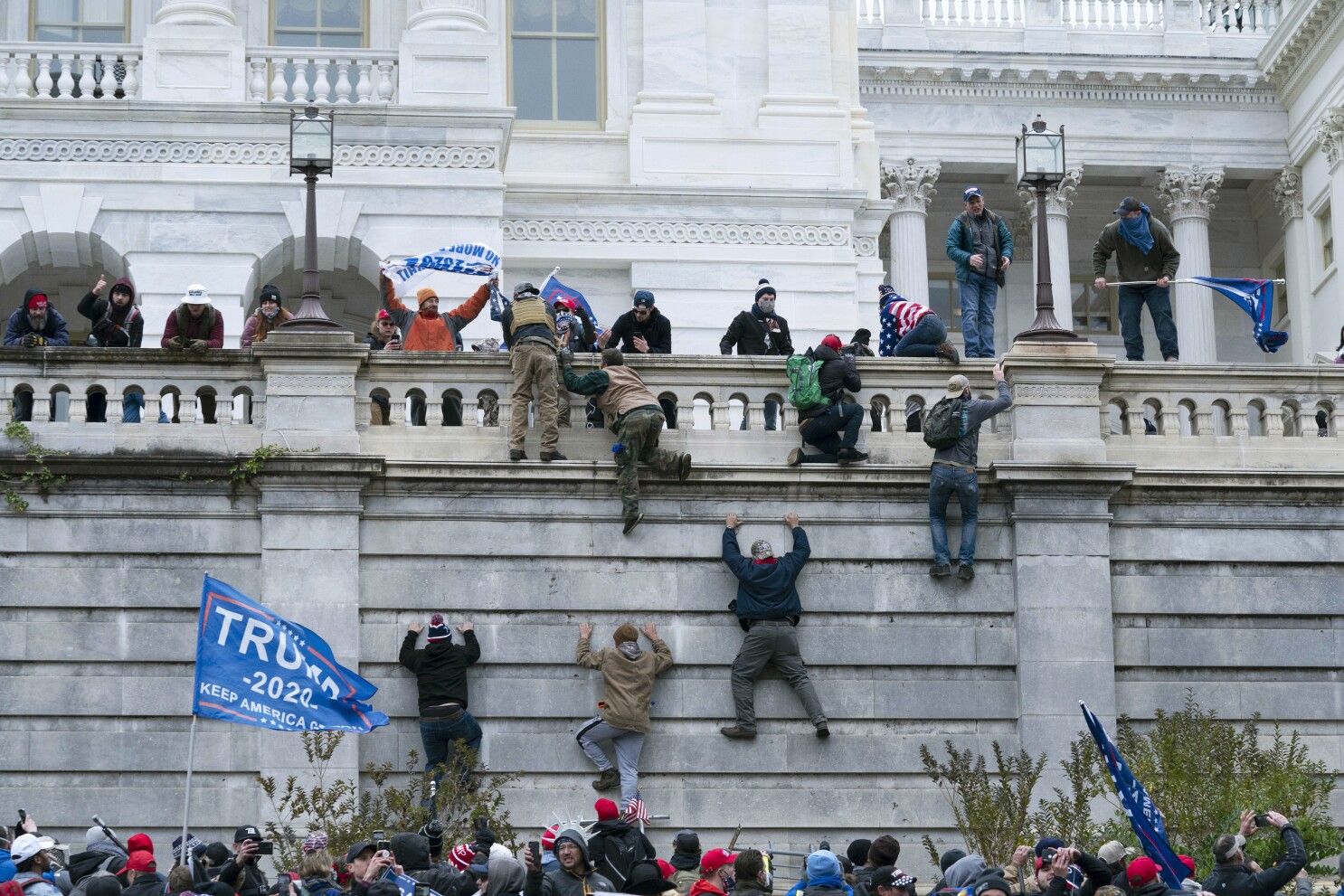
[Trump insurrectionists scaling wall of the US Congress]
Writing this at three in the morning, January 6, 2020, I see rednecks from all over the United States streaming onto the Capitol Hill in Washington DC, intent on having the November election results reversed! Wilfully incited by the outgoing knucklehead of a President, Donald J Trump, they stormed the Capitol building housing the two houses of the American legislature which are involved in the formal certification of Joe Biden’s election victory. They streamed past paralyzed police and the paramilitary, National Guard, et al, who by and large are standing around doing nothing, perhaps, because the 30,000-strong mob was doing Trump’s bidding. So much for American democracy, a supposedly liberal system, in action!
Having witnessed such instances of breakdown of democratic norms on numerous occasions during my some 14 odd years spent in that country, I have long maintained that, while democracy as a system is inherently delicate and fragile everywhere, American democracy more than most others is always teetering on the brink of breakdown, hanging on for its dear life by its fingernails. And that US’ over-zealous profession of democratic values should, therefore, not be taken seriously. And I am not saying anything about institionalized racism in the US, most conspicuously targeting the black population in that country.
There is never any shortage of political drama in the US. It is rivetting reality television! Have been up all night watching what is deemed an “insurrection” unfold on CNN. In all my writings, I have always urged the Indian government to show US interlocuters the proverbial finger anytime they bring up the matter of India needing to up its game where the integrity of the democratic process and respect for human rights is concerned. As first order of business this morning, the External Affairs Ministry should wag a finger at Washington, as the latter does when there are riots and other disturbances in India. The MEA spokesperson should unctuously demand that the US government protect the democratic verdict and improve its democratic system. This’d be the appropriate thing to do considering how American agencies routinely meddle in the internal affairs of developing countries, including India, lecturing them on how a good demcracy ought to work. The US Commission on Religious Freedom, it may be recalled, recently put India on notice for violations.
Indeed, watching the mayhem in Washington on TV the former US President George W Bush likened America to a “banana republic”. Let India never again be lectured then on freedom and democratic functioning by a banana republic without the Indian government asking it formally, and diplomatically, of course, to shutup! Erdogan’s Turkey — an autocracy if there’s one — has already stuck a knife in Washington’s side by asking it to protect its democratic tradition!
To see the rule of law sidelined by security officers shrugging their shoulders and letting these crazed yahoos try and exert their will on the US Congress is to be reminded of Indian state and central police, time and again, standing aside and allowing rioters to do their thing undisturbed, simply because the law breaking is orchestrated by minions of the concerned Prime Minister or Chief Minister. Rajiv Gandhi let murderous mobs kill Sikh citizens at will on the streets of Delhi in 1984. And state police in Gujarat, Maharashtra, UP and in other states have frequently acted as bystanders as the Chief Minister’s supporters ran riot.
My initial experience of law & order breakdown in the US was during my first summer there (1968). I saw on TV Chicago Police go absolutely berserk, literally smashing the heads of young people protesting America’s involvement in the war against Vietnam. The scenes were so bloody and heartrending, it shocked my then fairly innocent sensibilities. Nine years later, I found myself on Ground Zero, as it were. It was during the 1979 Iran hostage crisis. I was on a sidewalk just outside the UCLA campus early one Fall evening and found an Iranian on the ground being mercilessly kicked in the stomach and head by two young goons. I was still about 20 feet away when I came upon them. They stopped, turned and started walking threateningly towards me. Two feet away, one of them asked angrily if I was an “I-RANEAN”. I responded that I wasn’t whereupon they turned and left!
As I tried to help the bloodied Iranian on the ground to sit up I saw not 8 feet away an LA Police patrol car parked with 2 policeman inside it. They hadn’t moved to prevent the beating of this grad student. I shouted out to them to help me get this grievously hurt person to the UCLA medical school hospital down the road. The dismissive response from one of them was: “Do it yourself!” before they drove off. I somehow managed to do that with the help of two other students. It occurred to me in a flash then just how gossamer thin the law & order pretensions of the US really are; and have been skeptical ever since. My eyes glaze over and I instinctively stop listening when Americans, high and low, talk of their “democracy” as a beacon of anything, least of all hope, in the world.
In the last 40-odd years of attending international seminars and conferences I have been struck by a trend that’s hard to miss. It involves Indian-origin academics, retired Indian diplomats and military officers, and India-based academics and thinktankers, who have the opportunity to speak their mind untrammelled by official Indian Government restrictions and to convey to Western, especially US, audiences India’s core national interests and why these often clash with Washington’s preferred policy, but don’t do any of this. Instead, they usually say things soothing to American ears.
Often times, I have found myself over the last three decades to be the lone Indian voice, airing views contrary to what’s being said, by all the other participants, Indians who have in their careers held high government positions included. Initially I was perplexed. Now it gets my goat.
If the image is consistently projected in US policy circles and among the Western intelligentsia by these Indians and NRIs that India is sympatico with whatever the US is doing in the international arena, then it roots certain expectations in the American policy milieu. As a result, not unreasonably Americans, even those who ought know better, end up believing that Delhi is departing from the mutually accepted script and working against US interests even if India is acting in its own best interests. When US policymakers find Delhi not acting as is expected they slide over to the punishment mode. Whence the sanctions that India has often faced in the past. Most recently in the period post-1998 nuclear tests. In the soon-to-end Trump presidency, for instance, it congealed into an attitude that was more punitive than transactional. In the Biden Administration US foreign policy is likely to revert to America’s liberal do-gooding instincts, albeit in a muted form after two decades of military activism and interventions, which in the George W Bush years led to the overthrow of Saddam Hussein, and the start of the unending cycles of extremist violence and instability in West Asia and turmoil world-wide sourced to militant Islam that the world has experienced ever since. Talk of good intentions breeding evil.
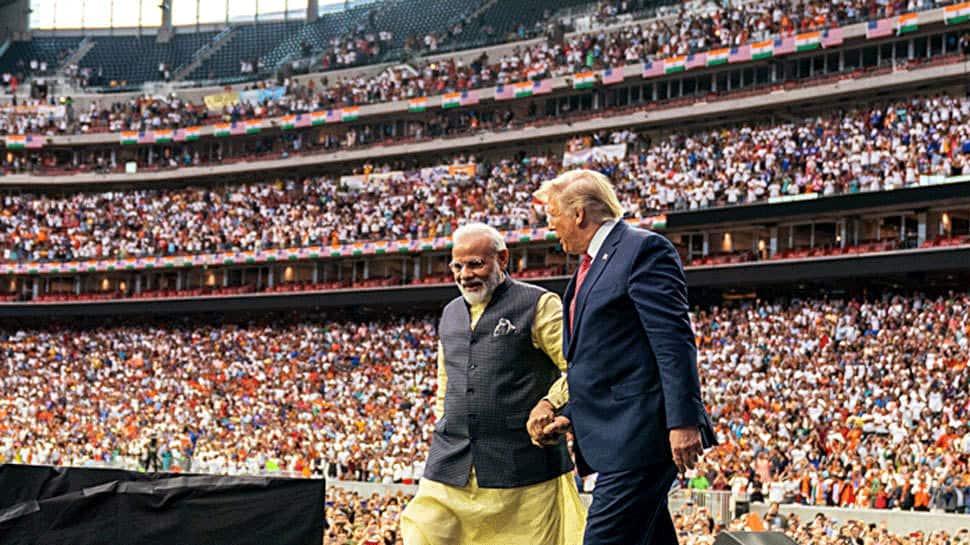
But why do Indian-origin types feel the need to suck up to Americans? The IT software techies, engineers, doctors and other ‘professionals’, are happy beavering away at their jobs and are not really in the policy swim. The bulk of the Indian community limits itself, when convenient, to attending ‘Bollywood nights’ and “Howdy Modi” sort of political circuses should these come to town as a way of keeping engaged with the ‘old country’ in which, otherwise, they have neither interest nor stake. Their sole focus is on keeping the ‘family reunion’ provisions in their resident visas open to enable them to cart more of their relatives to America. They look to the the Indian government to be helpful in this regard.
Then there’s the growing lot of NRIs on liberal arts faculties in various American universities/colleges, the more conspicuous among them lecturing Delhi, in line with Washington’s commitment to nuclear nonproliferation, human rights, containing China, etc. on the perils of nuclear proliferation, the non-desirability of India building up a strong thermonuclear deterrent, and of fielding intercontinental ballistic missiles, and going with nuclear first use, on the benefits of strategically partnering the US in the Indo-Pacific, and the virtues of respecting minority rights, the special status of J&K, and of retaining a liberal social order. Individuals in a sub-section in this group involved in security studies strive to make a reputation for themselves by replicating concepts and ideas developed by Indian civilian strategists and passing them off as their own in US academic quarters, secure in the belief that no American analysts reads books by Indian strategists anyway! All these academics adhere closely to the offcial US policy line on the issues they advise Indian governments on because not doing so would stunt their careers. Ironically, their writings are then quoted by Indian analysts and media to make the case for a small, inoffensive, nuclear deterrent, for India becoming a cog, in effect, in the US military machine in the Indo-Pacific, etc.
Then there are the US-born and reared Americans of Indian ethnic origin — such as Richard Verma, the sometime US ambassador in Delhi, who are Indian only in their looks but otherwise, unsurprisingly, entirely American in their outlook. The shared Indian looks frequently leads Indian government officials mistakenly to expect a more empathetic hearing than they get. Indeed, I have found in semi-formal interactions with US officials that the US-born Indians among them are the loudest in decrying India’s policies and in challenging Indian policy predicates. The reverse is just as true. The Washington policy circles expect these ethnic Indians placed in South Asia -related positions to have some special insight into India’s foreign and other policies when actually they are no better clued into what’s happening in Delhi and in the states than their average white counterparts. I recall a conference hosted several years ago by the National Defence University in Washington DC on the sidelines of which the hosts arranged for me to meet with the US National Security Council Staff. At this meeting in the Excecutive Office Building adjoining the White House, the head of the South Asia section, Nisha Agarwal, who was later elevated in the Obama Administration to be Assistant Secretary of State for Southern Asia, was the most vocal in slamming the Indian government for not delivering on the 2005 civilian nuclear deal, on not being as receptive to US’ strategic initiatives in Asia, etc. She put on this show possibly to show her colleagues how hard she could be on India — apparently a litmus test that Americans of Indian origin in the US government have to pass!
A more dangerous lot comprises retired Indian diplomats, especially ambassadors posted to the US, who while in service “cultivate connections” and, after retirement, ease into numerous thinktanks and university faculties around Washington, DC. They produce little of any intellectual or even policy worth but remain in circulation spouting innocuous stuff except on occasions when they have to “sing for their supper” and come out strongly against India’s nuclear buildup or some move by Delhi on the domestic harmony & peace front. These persons are problematic because they are taken seriously by the US policy establishment as having their fingers on the pulse of Delhi (or at least the MEA) and what they say is used by those critical of India for their own purposes. Not to name and shame anyone, but one such diplomat was successively a Fellow at Brown University, “practitioner-in-residence” — whatever that means — at the Rockefeller Foundation-run Bellagio Centre in Italy, Global Fellow at the Wilson Center in Washington, and professer offering a course in Sino-Indian relations at Columbia University in New York city, all this without producing a single research paper or any other policy-relevant writing of note, leave alone a book!
More intriguing still is a new stream — of retired Indian military officers who seek a place in the American sun! Many, many, moons ago at a conference called by the then US Pacific Command in Hawaii, the person who was the most vociferous in rejecting India’s nuclear assertiveness was a retired Vice Chief of the Army Staff. To my dismay, he put on a similar show at a conference called by Wilton Park — a thinktank of the British Foreign & Commonwealth Office. Wilton Park is a vast estate in Buckinghamshire that was used in 1946-48 to “re-educate” World War Two German officers who were prisoners of war! Such “exposure” was parlayed by this Indian General into a year-long stint at the Center for International Security and Cooperation at Stanford University. Since then many more ex-Indian military officers have climbed aboard this gravy train, translating one-off appearances at academic conferences into consultancies with various US agencies, etc.
The more intellectually inclined among them hanker for placement in thinktanks and at universities. I remember some 20 years ago a one-star officer approaching me for advice about what to do and how to go about securing a sinecure at an American institution. By then he had written a book and I suggested he could become a strong proponent for a meaningful Indian military aggressively championing India’s national interest. He knew better. He did the exact opposite and it worked! He spent time at leading security thinktanks in the US run by the Pentagon by essentially tailoring his message to suit his American audiences. More recently, a retired army colonel whom I had respect for has found a second career as a reporter covering Ministry of Defence for an Indian newspaper on which he has piggybagged a third career as lecturer at a US university. Without at all considering the downside of India losing its leverage with Russia and Iran, its role as balancer of power in the international system, US’ record of unreliability as strategic partner, or the better geostrategic options that are available he now argues, as do others within and outside the government, for India to link up militarily with the US in the Indo-Pacific as a means of ringfencing China.
The reason why so many retired and serving Indian government and military officials canoodle with Americans is simplicity itself . It is the same reason why young Indians try desperately hard to somehow find their future in America — it is a damned nice place to live in with none of the daily aggravations of life even in Indian metros! There’s material plenty, life is good, the universities provide unmatched education, the work place ethos is easy even as it is stressful because there are no time-grade promotions (as enjoyed by the civil services here) and only peformance in the job counts, and entrepreneurship and innovative thinking are rewarded. Of course, there’s a glass ceiling but this is melting away for Indians who with their technical expertise and English language proficiency, by and large, find it easier to get along and go along (in comparison to, say, students from China) and are elbowing their way to the top in corporations and other organizations.
Small wonder the whole broad band of civil servants and diplomats manning the top echelons of the Indian government move heaven and earth to ensure their progeny are educated in the US and settle down there or elsewhere in the modern and ‘secular’ West. The flipside of this parental interest in doing good by the children is, as I warned in my 2018 book (‘Staggering Forward: Narendra Modi and India’s Global Ambition’) the rise of a distinct Fifth Column within the Indian policy establishment. It peddles and pushes the US policy line without a twinge of conscience, convinced it benefits India too. Its activity is supported in terms of public outreach by a number of American thinktanks — Brookings, Carnegie, Aspen — who have set up shop in Delhi financed by Indian monies! ( I wrote about this in Open magazine in April 2016 — ‘India’s Foreign Policy — The Foreign Hand’, https://openthemagazine.com/voices/indias-foreign-policy-the-foreign-hand/ )
All the Delhi chapters of the American thinktanks studiously plug and propagate the policy line of the Administration of the day. It is an activity in which a bunch of retired Indian diplomats, serving and former secretaries to the government and senior military officers — all the people, in fact, who whilst in government favoured siding with the US, participate. There is now a counterpart presence in Washington of an Indian thinktank — the Ambani-funded Observer Research Foundation (ORF). This would be a welcome development, except far from creatively articulating for the Beltway denizens India’s vital interests and explaining why these on many important issues collide with US interests, ORF Washington seems to be in the business of doing the same thing the US thinktanks do in India but with a slight twist. It embroiders US policy schemes acceptable to the ruling party in Delhi (going by the op-eds in Indian papers — because there’s little else — by its head)! So, what good it does India is anybody’s guess.
One cannot blame aspiring Indians for seeking a better future abroad or Indian officials for wanting the same for their kids, because the Indian system is too stultified to offer the youth brighter prospects at home. Prime Minister Narendra Modi is among those who has been hugely influenced by America and the “good life” it offers its people. At the core of his government’s ceaseless efforts over the last six years to keep the H1B visa channel open to Indians is precisely his fatalistic acceptance of the fact that the Indian system cannot be changed. Not, as he once promised, by him anyway.
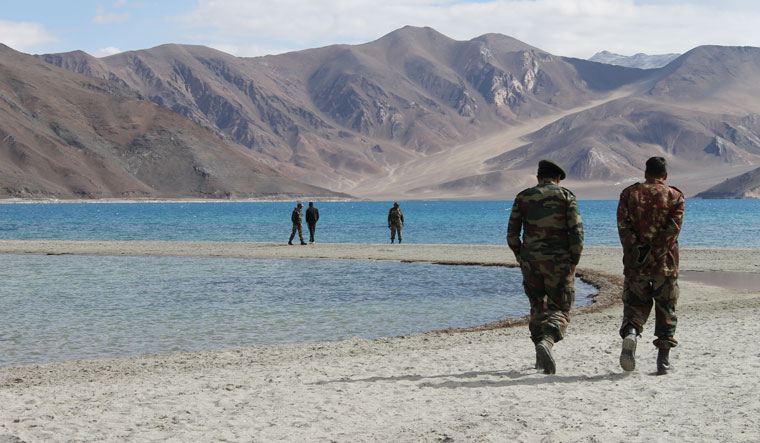
Ever since the first reports of Chinese transgressions into Ladakh emerged in early May, experts had been warning India was staring at a formidable security threat.
The fatal clash in Galwan that left 20 Indian soldiers dead and the subsequent troop buildup in the region had led to fears that the LAC could become an ‘active’ security zone for Indian security forces like the LOC has been.
The fact that India and China have not made much progress in disengagement talks means the standoff in Ladakh could continue into the New Year. Unlike periods of tension with Pakistan—such as during Operation Parakram that followed the attack on Parliament in 2001—the trajectory of the Ladakh standoff is hard to predict given China’s strategic heft and goals and motivations. China’s strategic ties with Pakistan, by means of the China-Pakistan Economic Corridor, have been linked to the current standoff in Ladakh by some analysts, given Ladakh’s proximity to Pakistan-occupied Kashmir. Beijing has committed to investments of over $60 billion in Pakistan as part of CPEC to develop infrastructure in Pakistan to make the country a hub for Chinese imports and exports.
To make sense of the direction where the India-China standoff is heading, THE WEEK reached out to two eminent strategic commentators: Bharat Karnad and retired Lt General Vinod Bhatia.
Bharat Karnad is emeritus professor, Centre for Policy Research, New Delhi. Vinod Bhatia, an Indian Army veteran, is currently director of the Centre for Joint Warfare Studies.
Why have attempts at resolving the Ladakh standoff not yielded results?
Karnad: Because of two contrasting negotiating styles. The Narendra Modi government is in a hurry for a final solution of the border issue and willing to compromise. The Chinese negotiating style, on the other hand, considers time an ally. So the proceedings are prolonged, its position maintained without compromise or concession, in an attempt to wear out the patience of the adversary in the hope he will fall in eventually with Beijing’s demands.
Bhatia: There has been a constant effort by both China and India to resolve the ongoing situation by dialogue at military, diplomatic and political levels. On account of hardened positions, the resolution will be a laborious and lengthy process. Peace and tranquility along the LAC are in the interest of both nations. However, post Galwan, there is a total lack of trust. We should give it time as we have the requisite resilience to ensure an effective response to China’s aggressive behaviour.
Is the long-term Chinese plan in Ladakh related to its interests in Pakistan?
Karnad: There are two aspects to this. China wants India to vacate the heights on the Kailash Range around Chushul occupied by Special Frontier Force units while consolidating its hold over Fingers 4 to 8 on the Pangong Tso. Whatever the inducements offered, under no circumstances, should Delhi agree to climb down from the Rezang La ridge and the tops above the Spanggur Gap. The other thing is China’s reported revival of the so-called ‘1959 Line’ by firming up its control of the area beyond the Y-Junction. The Chinese objective clearly is to distance the Indian armed forces even more from the Xinjiang Highway, which is China’s lifeline to its other western province, the Karakoram Pass and CPEC.
Bhatia: I think we went wrong in discerning China’s strategic intent initially. China’s forward deployment along the LAC is a part of Chinese ‘military coercion’. China cannot afford any threat to CPEC, as CPEC is central to China’s dream One Belt, One Road (OBOR) initiative. China would also like India to endorse this initiative.
How important is the status of Depsang in the event of a resolution of this standoff?
Karnad: The blockade of the Y-Junction on the Depsang Plains is crucial and has to be lifted by India, by forceful means, if necessary. Because by preventing Indian troops from patrolling the Indian-claimed area north and northwest-wards, it pretty much permits that entire ‘sub-sector North’ in Indian Army’s parlance—some 975 sq kms in all—to slip into China’s possession.
Bhatia: Depsang is definitely critical to our operational interests as occupation by China threatens the Shyok-DBO-Karakoram road. China will like to play this card to coerce India to seek concessions at other places and, more importantly, threaten Siachen as a collaborative strategy along with Pakistan. However, our occupation of operationally and strategically important heights along the Kailash ridge on the South Bank of Pangong Tso has given India an advantage at the negotiations. India aims at ‘status quo’ ante as of April 20 and continued peace and tranquility, ensuring equal and mutual security.
Is there a basis for fears of a two-front war against Pakistan and China?
Karnad: Realistically, a two-front war is less of a possibility; the more worrisome thing is the Modi government agreeing to withdraw Indian forces an “equal distance” as part of a “comprehensive” accord. Such an agreement will seriously handicap Indian forward units, because the PLA, availing of a dense network of border roads, will be able quickly to rush and occupy strategic locations presently in Indian hands even as the Indian units struggle, owing to still-thin border infrastructure.
Bhatia: China has always been a long-term threat. Recent China’s arrogance and aggressive behaviour now indicate an immediate-to-near-term threat, with the probability of manifesting as a China-Pakistan collaborative threat in the conventional (warfare) domain. India will need to ensure peace through military preparedness. A two-front war is a reality. India should also look at like-minded nations to negate the China threat; ‘bind to balance’should be a good way forward. India should also reset and refresh its China policy. However, the reset policy should be pro-India and not anti-China, despite the anger and anguish caused by China’s betrayal yet again.
How much will US policy change with respect to India once a Biden administration takes over?
Karnad: There will be changes. The Biden administration, unlike the Trump dispensation, will emphasise human rights issues: Kashmir, Hindu-Muslim tensions and other social issues. This will alienate the Modi government and likely poison India-US relations enough to make uncertain such US assistance as Delhi would have otherwise relied on in a confrontation and crisis involving China.
Bhatia: The Biden administration’s policy too will be dictated by US interests. There are a congruence and convergence of interests of India and the US, especially where China is concerned. In a post-COVID-19 world order, India will be a global leader and hence the US will need India as the ‘balancing power’ as the balance of power shifts from West to East.
Subramaniam Swamy, Rajya Sabha MP, has long been a fixture of the Delhi scene and never out of the news. If he is not playing the Scarlet Pimpernel in Indira Gandhi’s Parliament-held-hostage drama during the Emergency, he is exposing the Gandhi Family for some corruption or the other, his latest target being Sonia and Rahul Gandhi in the National Herald case involving dummy companies and suspicious property transactions. At all times his contacts in the Enforcement Bureau and the Intelligence Bureau keep him supplied with photocopies of “documents” supporting his charge that he can wave at television cameras and still the hearts of those he has accused and their effort to take him to Court because, it turns out, he is well-versed in law.
Swamy has held various posts in numerous governments, including as Minister for Commerce and Industry in Chandrashekhar’s (1990-91). Usually he was considered a nuisance and, in US President B. Lyndon Johnson’s phrase, kept inside the tent to piss out rather than that he remain outside pissing in (!), and fobbed off with minor sinecures on the Planning Commission, Standards Commission, etc. Through out his time in and out of government he cultivated contacts who kept him abreast of what was happening at any time in the corridors of power. He exploited this insider information to prop up his reputation as the stormy petrel of Indian politics, eager and ready for a political donnybrook with anyone, any party, any institution at any time. So when not pillorying the Congress party he is publicly roasting his own ruling Bharatiya Janata Party’s (albeit, media cell) for “going rogue” as he did three months ago supposedly for mounting “personal attacks” on him. ( https://www.indiatoday.in/india/story/subramanian-swamy-accuses-bjp-it-cell-of-running-a-campaign-against-him-1719522-2020-09-07 ).
However, for iconoclasts, he is an absolute delight, showing particular talent for being a god awful pain-in-the-butt for the government of the day and its durbaris. Have been acquainted with him for over 30 years now and never failed to admire his chutzpah (gall in Hebrew), and his sheer talent for effrontery. How can one not like a man whose intent is to wreck whatever political dispensation is supreme in Delhi at the moment, and who wears his crustiness and don’t-give-a-damn-attitude and not so thinly-veiled contempt, especially for those holding power, on his sleeve? This even though his overarching ambition is actually to run the government and to set it on the right course. What that course could be is hard to say considering the fluidity of his views! But being erudite, he is normally persuasive when making his point.
It was, therefore, a shocker to read a fortnight back his article attacking Russia for not being India’s “friend”. (See his “Russia is not a friend”, Sunday Guardian, 31 Oct 2020 ( https://www.sundayguardianlive.com/news/russia-not-friend-india ). Not sure what it is that has got Swamy riled. But the case he makes is so incoherent I can scarcely believe he penned it. Having already confessed my admiration for him I will carefully deconstruct his argument because he carries weight with many in the BJP.
Take Swamy’s 1st line of argument. He writes: “For China, Russia was a trusted friend and a patron of the communist parivar from 1949 to 1960. Then at China’s weakest moment in 1960, faced with a gigantic collapse of the ill-conceived Great Forward Movement and a huge famine, when between 16 to 32 million Chinese died due to starvation, Moscow ordered the withdrawal from China all its industrial projects, its blueprints, and technical staff, resulting in the collapse China’s industrial sector….To collapse this project, the Soviets led by Khruschev cancelled all the industrial projects that were being implemented to modernise China, and also withdrew all the experts along with the blueprints sent to China….Not only did the Great Leap Forward become a disaster for agriculture, but industry got stunted, and because of terrible drought about 16 million to 32 million died in the ensuing famine in 1960-61.”
So Russia’s NOT being nice — more countries shouldn’t be nice — to China is held against Russia’s being India’s friend? This doesn’t make sense and, if anything, suggests why India should have Russia in its corner. If Swamy means by this reference to show up Russia as an unreliable partner, then the burden of proof rests on him to prove, to show, that it has faltered as a friend. This he hasn’t done. The fact is starting in the 1950s the Soviet Union helped set up heavy industries in India, including the Bhilai steel plant and, in the wake of the 1962 War with China, increasing ideological alienation from Mao’s China led to Moscow offering 12 ready-to-fly supersonic MiG-21s along with the licensed production rights for this aircraft and its jet engine. These Russian offers were in the context of a grateful Indian government accepting them less because Nehru was a communist camp follower than because Washington promised than failed to get the US Steel Company to set up the Bhilai plant and, post-1962, failed to provide the supersonic F-104 fighter aircraft transferred to Pakistan that Delhi had sought, offering instead the transonic, low performance, ‘Freedom fighter’ — the Northrop F-5. The record shows the Soviet Union-Russia has supplied its latest military hardware; if there has been a spares problem with them it is because the Indian armed services and Defence Ministry never bothered to segue their requirements with the Russian spares procurement protocols as Indian military stalwarts admit.
Consider Swamy’s 2nd line of argument: “The transition of Russia has been amazing. First there was the Czarist monarchy called Russia, which the royalty ruled from St Petersburg as capital. Then there emerged through a revolution led by Lenin the Bolshevik state, and after Lenin’s death was followed by Joseph Stalin’s communist Soviet Union with its capital in Moscow. Today there is Putin’s Oligarchic Russia being ruled from Moscow. These the government formations spanned a century since 1920.But the bottom line has remained the same—a government led by dictatorship, which is expansionist, an oligarchy and headed for bankruptcy.”
The monarchist/totalitarian antecedents of the Russia state is, astonishingly, wheeled out to support Swamy’s case of Russia being an uncertain ally to China! This is non-sequiter-ish, at best and, in any case, how does it matter to India’s national interest what kind of a state Russia is? Even so, Swamy uses this to also buttress his contention that the US will make for a better partner!! This last view is built on the common belief that democracies get along better with other democracies. Which’s fine in rhetoric but is irrelevant when it comes to the hard business of inter-state relations when considerations of the national interest kick in. Hence, a democratic America finds that authoritarian states are more malleable and relations with them less complicated. It explains Washington’s marked historic partiality for unfree countries usually run by generals. Thus, Pakistan has always been the preferred US partner in South Asia, not India.
Then there are sideline declaratory references by Swamy with no proof or historical evidence adduced for them either, such as: “Nehru was fooled into thinking that leaders in Moscow were permanent friends, but in fact we Indians were more like “Pavlovian dogs”, that is, those who complied on signals from Moscow.” When actually, Nehru, the quintessential upper class Englishman (who unself-consciously told Malcolm Muggeridge in a 1958 BBC interview that he was the last Englishman to rule India!) was contemptuous of Russians — if not of Russia whose leap into the status of an industrialized state inside of a generation he hoped to replicate in India, referring for instance to the shabby clothes his Russian interlocuters wore. And pray, Mr Swamy, which Indians, and when and where have salivated like “Pavlovian dogs”? And, more amusingly, Swamy’s view that “Indian patriots suspect that Netaji Subash Bose, Lal Bahadur Shastri, Deendayal Upadhyaya, and Sanjay Gandhi were assassinated by the KGB to ensure secure entry into the top positions for Nehru, Indira Gandhi, and Sonia Gandhi.” And how “clinching proofs are kept in frozen vaults in tight fisted Russian archives”.
Sanjay Gandhi is classed a “patriot” alongside Netaji, Shastri, Upadhyaya, uh?!! What?!! That the chief goon of the Emergency is so elevated must spin some heads! An awful lot of the “tight-fisted Russian archives” are actually already available in published form as the Mitrokin Archives. And there are, indeed, mentions in them of Indian leaders of the Communist party stripe beholden to Moscow and even some Indira Gandhi-appointed ambassadors to the USSR reacting, as Pavlovian dogs are supposed, to at the first hint of financial consideration and largesse coming their way.
Swamy’s 3rd line of argument is that “the Russians act according to the interests of China. That is, Russia is a ‘junior partner’ of China. Russia, according to Putin’s 23 October 2020 statement, ‘could enter into a military alliance with China’. Since India purchased the S-400 air to surface rocket attachment for jet fighters in 2018, India has been increasingly relying on Russia for weapons. India appears to have accepted Russia as a de facto mediator in the conflict with China since 18 April 2020 in Ladakh.”
Logically, how does the 2nd contention that India is increasingly buying Russian arms follow from the 1st about Russia being China’s “junior partner”? It doesn’t.
Another Swamyism: “In 1972, the US changed its two-decade-old stand and voted to admit China into the United Nations and invited it to take the seat of permanent member with a veto at the UN Security Council. China was greatly benefitted by the US granting it the Most Favoured Trade Clause, thus opening US markets to China, and for Joint Ventures to enable China to produce with its cheap and captive labour, and accelerate Chinese GDP at more than 10-12% growth rate for a decade. China soon rose from 9th position in GDP ranking to second position by the year 2000.”
How this point in any way strengthens Swamy’s view that the US is a great friend of India, is anybody’s guess. But Swamy needs reminding that the US Security Council seat was first offered India by both the US (John Foster Dulles) and Russia (Khruschev) but Nehru in a fit of strategic stupidity wanted it occupied by China instead! Moreover, had Indira Gandhi in 1966 radically overhauled the over-bureaucratized socialist apparatus of the Indian state and opened up the Indian economy as Johnson Administration had advised her to do — and which Dengxiaoping did in China in 1979, India too could have benefited from open access to, and trade with, America and emerged as the global source of low cost consumer items.
Here’s another unconnected remark by Swamy that makes an unclear case more opaque. “Currently, Sino-Russian trade has more than doubled” He writes. “Russia’s central bank has increased its Chinese currency reserves from less than 1% to over 15%. Germany is no more the principal supplier of industrial plant and technology to Russia. China is! Action is taking place in multilateral forums such as BRICS, increasingly sophisticated joint military exercises, and pooling of influence with countries such as Iran. The S-400 missile system built by Russia and sold to India has Chinese electronics. This has alienated the US, which was about to sell advanced military hardware to India, but has put it on hold because US cannot risk Chinese or Russian espionage in India on advanced US weapons systems.”
Well, yes, Russia is increasingly beholden to China to keep it economically afloat but only in the neo-colonial sense of China denuding the Russian Far East (Siberia) of all its natural resources — wood, minerals and oil to keep its industries going. However, his assertion that the Indian purchase of the S-400 has alienated the US and stopped it from selling Delhi “advanced military hardware” is questionable. Of course, Washington is upset that India purchases military goods from Russia, but there’s nothing that the US can do about it. However, what is the mysterious “advanced” hardware that Swamy is hinting at? Surely not the F-21 fighter aircraft — a ridiculous makeover of the 1960s’ F-16 plane because that’s at the top of Washington’s arms sales agenda. So it must be the improbably expensive EMALS (Electro-Magnetic Aircraft Launch System) for aircraft carriers that is costed at one billion dollars and which the US Navy finds too pricey. It is sought to be sold to India for $2-$3 billion! The last one heard, the Indian Navy, fortunately, was in the right mind to reject it.
After pursuing all the above uniformly unsustainable lines of argument to a dead end, Swamy finally rounds in on his main theme. “India has to make a choice: Either we partner US strategically”, he states, “or Russia and China together. If we have a conflict with China, Russia therefore cannot be trusted, nor if we do, will the US trust us. Hence, this dream of isolating China by trusting Russia is short-sighted. Russia is no more, if ever since 1992, a friend of India in the sense of standing up with India against China. India”.
In the hard realpolitik perspective, India shouldn’t care who it sides with — even if it is the devil — just so long as this tilt helps its cause. The US, Russia and China are all equally out to further their particular regional, international, and geostrategic interests at the expense of every other country, including India. For Swamy to think that the US is somehow different in this respect is to be delusional. Still he should be aware that the Sino-Russian linkup is not going at all smoothly, and that Putin’s Russia has always been aware and apprehensive of China’s designs on Siberia, and acted to counter it. That India is a piece in this strategic game versus China is as true as the fact that Delhi uses and can continue to use its relations with Moscow as leverage to, on one hand, extract more from Washington, and on the other, to muddy up Beijing’s strategic calculus and keep Xi Jinping uncertain and on the hop — the reason why Xi is now holding the PLA on a tight leash in Ladakh. Besides, Swamy a little too readily assumes the former KGB agent Vladimir Putin and the Russia he leads can be China’s willing plaything, and obviously underestimates the political-military weight Moscow packs in its conditional concert with China.
Swamy’s solution that while “India in a border war with China, does not need allies. But if China expands the war arena with India, then of course the Quad arrangement with Vietnam, Sri Lanka, Indonesia and other nations can form a grand alliance” does not mention the US, and closely resembles the geostrategic architecture of littoral and offshore states organic to Asia conceptualized by me in my 2018 book (Staggering Forward: Narendra Modi and India’s Global Ambition) as the “modified quadrilateral” or “Mod Quad” of India, Japan, Australia, and a group of Southeastern nations, inclusive of Vietnam, Indonesia and the Philippines.
There may be more to Swamy’s crotchetiness though. In his eighties now, the 1939-born politician’s ambition remains unfulfilled and unfettered as is his frustration with not achieving his goal. Despite being mollified by the BJP regime and personally by Modi, Swamy now and again voices his desire to be appointed Finance Minister. ( https://www.theweek.in/news/india/2019/05/29/is-subramanian-swamy-upset-with-bjp-over-lack-of-recognition.html ). But why would Modi want a proven curmudgeon and malcontent in North Block when a pliable Nirmala Sitharaman is there to take his dictation, not make waves? So Swamy knows he doesn’t have a sporting chance and therefore hasn’t quailed from taking potshots at Modi that few on the country’s political stage would dare do. Like when Swamy talked about the “war like” situation on the Line of Actual Control in Ladakh this past summer. When someone asked him why he was reticent about using his alleged contacts in China to defuse the situation, Swamy retorted, per ‘Janta Reporter’ of 13 June, that “If Namo does not want to use my economic expertise why would he want [to do so] on China?” (See http://www.jantakareporter.com/india/subramanian-swamy-advised-by-seer-to-show-his-anger-to-pm-modi-bjp-mp-makes-stunning-revelation/293717/ ) Why indeed.
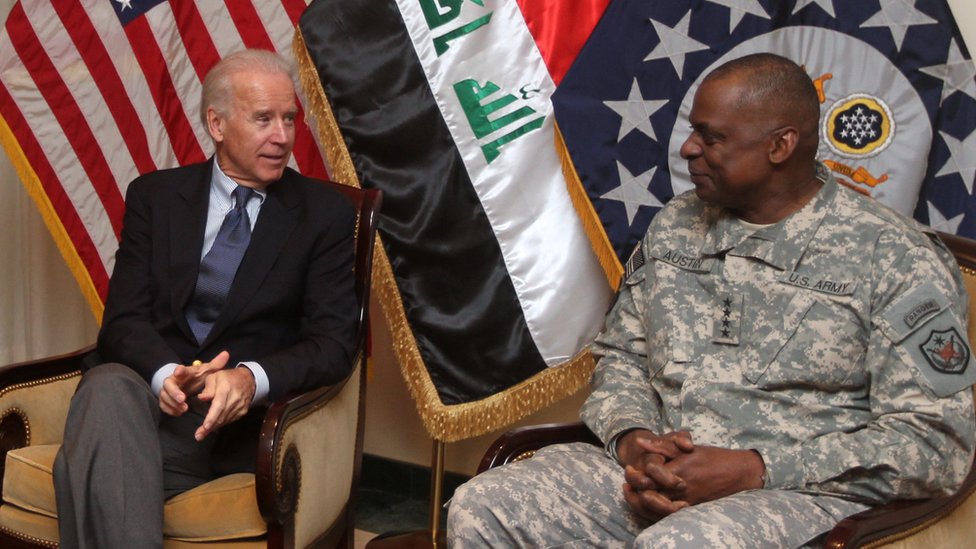
[US President-elect Biden and US Secretary of Defence-designate General Lloyd Austin]
The US President-elect Joe Biden is on the horns of a dilemma. Trump went so far in painting China as the comprehensive threat to America, the West and the liberal world order at-large that doing a 180-degree policy turn and begin canoodling with Beijing is not possible. But, equally, Biden is concerned that Trump had made a collective response to arrest China’s uncontrollable rush to great power status difficult by hollowing out the North Atlantic Treaty Organization (NATO), which has put that European alliance in a weaker position to handle a re-energized Russia under Putin. But Moscow, in turn, out of economic necessity as much as strategic calculation, is getting intimate with Xi Jinping’s China.
A potential Sino-Russian duopoly on the Eurasian landmass would separately encourage belligerent behaviour by Russia in Europe and by China in Asia. This threat is what ought to give Biden and his advisers conniptions. Especially because after two decades of futile wars that it has lost in Afghanistan, Iraq and in West Asia in general, the American people are in no mood for more military adventures or even peacetime deployment of US forces abroad.
It has left the US President to-be, Biden, with few, politically safe, options. The way out, the incoming Democratic party Administration figures, is for the US to not take on China frontally in Asia or Russia in Europe but to rely on America’s traditional allies to do the heavy lifting using NATO at one end, and its strategic partners, principally India, Japan and Australia, to keep China tethered, at the Asian end. Such a policy has the advantage of minimizing US’ commitments and costs.
Antony Blinken, the Secretary of State in-waiting, speaking to an American-Indian audience on Nov 23, before his nomination to become US’ chief diplomat was announced, articulated just such an approach. “We have a common challenge which is to deal with an increasingly assertive China across the board, including its aggression toward India at the Line of Actual Control, but also using its economic might to coerce others…to its advantage, ignoring international rules to advance its own interests, asserting unfounded maritime and territorial claims that threaten freedom of navigation in some of the most important seas in the world,” he said, during a virtual panel discussion on ‘US-India Relations and Indian Americans in Joe Biden Administration’.
“We have to sort of take a step back and start by putting ourselves in a position of strength from which to engage China so that the relationship moves forward more on our terms, not theirs,” Blinken said. “India has to be a key partner in that effort,” he added. “Unfortunately, right now by virtually every key metric. China’s strategic position is stronger and ours is weaker as a result of President Trump’s failed leadership,” he stated. “Put another way, this is really about us in the first instance, the competitiveness of our own economy and workers. The strength of our own democracy and political system, the vibrancy of our own alliances and partnerships. And of course, the assertion of our own values, all of which President Trump has done so much to undermine,” Blinken complained. He elaborated further, saying “During the Obama-Biden administration, we worked very hard to establish India as a key contributing member of the Indo-Pacific strategy. And that includes India’s role in working with like minded partners to strengthen and uphold a rules-based order in the Indo Pacific, in which no country, including China can threaten its neighbours with impunity.” “[India’s] role”, he averred, “needs to extend even beyond the region as vast as it is to the world at large…We would work together to strengthen India’s defence, and also add to its capabilities as a counterterrorism partner.”
In other words, Biden’s Washington will want India to be a frontline state in US’ great power confrontation with China and, military-wise, to contribute substantively. Blinken held out the usual inducements. Aware of how much Indian leadership hankers for a permanent seat on the UN Security Council, Blinken played up to Delhi’s craving. “In a Biden administration”, he asserted, “we would be an advocate for India to play a leading role in international institutions and that includes helping India get a seat on a reformed United Nations Security Council.” And knowing as well that Washington can get Delhi to eat out of its hands by merely making noises associating Pakistan to terrorism, he stated that “On the question of terrorism, specifically”, the incoming administration will “have no tolerance for terrorism, in South Asia or anywhere else: cross border or otherwise.” ( https://www.livemint.com/news/india/antony-blinken-india-has-to-be-a-key-partner-in-engaging-china-from-position-of-strength-11606201539220.html )
In tune with such Biden-Blinken views, the US Secretary of Defence-designate a retired Vice Chief of the Army Staff (2013-2016) General Lloyd Austin, responded by saying the right things. Austin suggested, for instance, that where China is concerned, the US should show “strategic patience”. Considered an officer with a fairly nondescript career record and an intellectual lightweight by those who are professionally familiar with him, he is unlikely to be disruptive and hence is considered a safe choice by Biden. Austin’s nomination relieves the pressure on Biden from his core constituency to appoint the first black man as boss of the Pentagon to reflect the fact that minorities constitute some 40% of the US armed forces. Given that most US Defence Secretaries in the past have been persons of renown, the nomination of a not particularly distinguished Austin was bound to be controversial. Biden has tried to nip the criticism of Austin’s selection in the bud by unprecedentedly taking to the pages of the Atlantic magazine to explain and justify his selection.
Recalling the General’s career, especially commanding a Division in Iraq where he exhibited a great deal of tact when dealing with leaders of various Iraqi factions, Biden writes about Austin serving as a “statesman”, about how he “oversaw the largest logistical operation undertaken by the Army in six decades — the Iraq drawdown” and, how as head of Central Command, he “executed the campaign that ultimately beat back ISIS” by “helping to build a coalition of 70 countries [working] together to overcome a common enemy.” Whatever Austin’s virtues, it will not help India any.
The problems that India will soon face — and the Modi government better be prepared for a much changed policy milieu in Washington — are two-fold. One, it will not take much for US’ “strategic patience” that Austin advises to convert to strategic reticence in militarily tangling with China. Just the first small crisis — such as as a FONOP (freedom of navigation patrol) by US warships challenged by the Chinese Navy in the South China Sea, or by an American carrier task group running into a Chinese naval flotilla in the Taiwan Straits, should do. Secondly, before his appointment as Vice Chief, Austin was Commander-in-Chief, US Central Command that includes Pakistan and Afghanistan in its operational ambit, but not India, which finds itself in an area that the Hawaii-based Indo-Pacific (previously Pacific) Command is responsible for. Austin is hence a known commodity to GHQ, Rawalpindi, but a stranger to Delhi. This could mean that the Indian government will be at a decided disadvantage in personally dealing with the new American Defence Secretary, even as Islamabad finds it easy to get its message across to Austin.
India may find a more sympathetic State Department but a less welcoming Pentagon, even as the reverse could be true for Pakistan.
In any case, the basic security situation India faces will remain unchanged from the last four years of Donald Trump’s presidency. India will have to fight China mostly on its own — in line with the Biden-Blinken policy of urging US’ Asian strategic partners to fight their own wars, singly or collectively, the best they can against an ambitious Chinese military itching for a fight. In the coming hostilities in eastern Ladakh and/or elsewhere along the Line of Actual Control it will, in the event, be foolish for the Indian government and armed forces to expect the US military to wade into hostilities alongside Indian troops against Chinese forces, or for the American ‘First Fleet’ — that is soon to come into being — to be in lockstep with the Indian Navy in a China-sourced contingency west of the Malacca Strait.
Bhabha and Albert Einstein (at the two ends) in Princeton with physicists Hideki Yudawa (Nobelist for predicting the pi meson) and John Wheeler (who defined the ‘black hole’)
Having mulled for a week the assassination of the nuclear scientist Mohsen Fakhrizadeh near the town of Absard northeast of Tehran on Nov 27, it is clear it was an event that was foretold. On September 9, 2019 the Israeli PM Benjamin Netanyahu briefed the home and international media about how the Iranians had experimented on prototype nuclear weapons at a site in Abadeh, not far from the uranium centrifuge enrichment complex in Natanz, and how on realizing that the site was compromised Tehran proceeded to cover up its tracks by demolishing this facility. Probably because it feared attracting an US or joint US-Israeli aerial/remote strike under cover of the JCPOA (Joint Comprehensive Plan Of Action) prohibitions. In that briefing Fakhrizadeh was identified as central to Iran’s crossing the weapons threshold. His goose was cooked then. Driving to work in his car, he was terminated with a super-sophisticated kill system involving a remotely controlled weapon firing at a mobile target tracked — whether by a standoff drone or by satellite is a matter of speculation.
A year earlier in May 2018, Netanyahu had taken to the stage to reveal a rich haul by the Israeli external intelligence agency, Mossad, of what Jerusalem claimed was most of the Iranian weapons-related archive spirited away from a warehouse in Tehran. If Fakhrizadeh’s killing was evidence that the Pasdaran (Revolutionary Guard) in-charge of the country’s nuclear programme was lax about providing security to the leading scientists involved in critical and sensitive work, the spiriting away by the Israelis of a treasure trove of some 55,000 highly classified papers and an equal number, as BBC reported, of files in 183 CDs stored in an apparently unattended building, proved the Iranians to be just as loose with their secret documents.
But the world is well aware of Israel’s proven partiality for preemptive-preventive military action to neutralize even the remotest threat. In 1990 an inspired Canadian long range gun designer and ballistics expert Gerald Bull, who helped Canada, the US and China design and perfect long range artillery systems, was shot by Mossad agents outside his home in Brussels. He was, at the time, helping the regime of Iraqi President Saddam Hussain develop ‘Project Babylon’, perhaps, the biggest artillery system ever conceived — a 150 meter long gun, weighing 2,100 tonnes, with a bore of one meter (39 inches), capable of placing a 2,000-kilogram projectile into orbit and, if fired laterally, of its massive shell hitting any target in Israel, or Iran. (Iraq and Iran were then in a 10-year war.)
Attempts to cripple in the early stages the nuclear weapons programmes of adversary countries by terminating the lives of leading scientific and engineering figures involved in them is by now a tried and tested strategy. The Bulletin of Atomic Scientists reveals that the nuclear pioneer Niels Bohr proposed to the Allied governments during the Second World War the kidnapping of the leading German physicist Werner Heisenberg, the 1932 Nobel prize winner for creating the field of ‘quantum mechanics’, lest he produce the A-Bomb for Hitler.
India was the first country targeted for its nuclear weapons ambitions post-1945. On 24 January 1966, an Air India Boeing 707 aircraft, ‘Kanchenjunga’ — Flight AI 101 on a hopping flight — Bombay-Beirut-Geneva-London crashed into the 15,300 foot high Mont Blanc on the approach to the Geneva airport. A US CIA agent Robert Crowley admitted getting a Bombay airport services staff member — for a few rupees no doubt — to place a bomb in the luggage hold. As he told a reporter Gregory Douglas, who reproduced this revelation in his book ‘Conversations with the Crow’, “We had trouble, you know, with India back in the 60’s when they got uppity and started work on an atomic bomb.” On Bhabha, he said, “[T]hat one was dangerous, believe me. He had an unfortunate accident. He was flying to Vienna to stir up more trouble when his Boeing 707 had a bomb go off in the cargo hold.”
According to Douglas, Bhabha was targeted by the CIA after his statement in October 1965, that India could, in fact, build an atomic bomb within 18 months if okayed by Delhi. But as I detail in my book 2002 book ‘Nuclear Weapons and Indian Security’ (now in a 2nd edition published in 2005), Bhabha had actually pleaded with Nehru in November 1962 to allow him to test a nuclear explosive as a means of raising the morale of the Indian people who saw their army being pummeled in the Himalayas by the Chinese PLA. Nehru, as always when it came to weaponising the capability, demurred and set India back in the nuclear realm in such a way that it has never really recovered. With that also went the chance of the country beating China to the A-Bomb and vaulting into the ranks of the great powers. China tested its fission device in October 1964 –some three months after Nehru died. India did not test until ten years later, and then failed formally to weaponize.
Incidentally, John F Kennedy thought of ending the Chinese nuclear weapons programme by attacking the Chinese nuclear weapons complex at Lop Nor but desisted for fear of Russian reaction. Later Russia considered doing the same and so informed Washington but the US was discouraging because by then it had begun to perceive a nuclear China’s utility in containing the Soviet Union.
Pakistan’s nuclear weapons programme could have been throttled had Indira Gandhi permitted the Israeli strike aircraft staging out of Indian bases in early 1982 to take out the Kahuta nuclear weapons facilities. This operation was revealed to me by the Israeli General Aahron Yaariv, the military intelligence chief to General Moshe Dayan in the 1956 Sinai Campaign, when I was in the kibbutz at Kiryat Shimona covering the 1982 Lebanon War. I wrote about it then, and have detailed the strike operation in ‘Nuclear Weapons and Indian Security’. That operation would also have eliminated the frontline generation of Pakistani nuclear scientists and technologists. Recall that Israel had bombed the Iraqi Osirak reactor the previous year and had displayed the required expertise.
I had advised in a Sunday paper column in the Summer of 1987 (if I remember correctly) that India still had a six month window to strike, but if it did not it would have to forever hold its peace with Pakistan. India did not and the situation is what it is today.
Except, the ground reality is as perilous for Indians involved in the weapons directorate at BARC, Trombay, and elsewhere today as it is for their Iranian counterparts. According to one count ( https://www.newsbytesapp.com/news/india/mystery-abound-with-india-s-nuclear-scientists/story ), between the years 2008 and 2016, some 70 Indian science and technology personnel employed by the Atomic Energy Commission in Trombay and at Kalpakkam have mysteriously died, 38 of them in extremely suspicious circumstances. Many of them were involved in the high-value breeder reactor project to secure for the country “energy independence” that Bhabha had chalked out per his 3-stage plan — heavy water-natural uranium reactors producing the feedstock for breeder reactors which, in turn, fuel reactor run thorium — a mineral of which India has the 2nd largest reserves in the world. In many of these cases, the local police have rushed to judgement and usually pronounced the deaths suicides!
In the last four years there might have been more such unexplained deaths. This is a ridiculous state of affairs where Indians involved in ostensibly high-security projects — weapons, breeder and thorium reactors — are being bumped off with the Indian government seemingly unaware of the threats, and doing less than nothing to protect the country’s prized nuclear science and engineering talent.
Of a piece is the case of the ISRO scientist responsible for indigenously developing cryogenic rocket technology DrNambi Narayanan. One day in 1994 he was hauled up by Kerala Police for espionage and leaking sensitive documents to Pakistan, tortured in jail, and asked to confess. He didn’t. CBI took over the case in 1996 and after a thorough investigation concluded Dr Narayanan was not guilty of anything. This exoneration did not prevent the Kerala Police from troubling him again, nor did it persuade ISRO to return the good Doctor to his previous job. In the meanwhile the cryogenic engine project floundered, and cost and time over-runs accrued. The opportunity cost to the country of this action of the Kerala Police was immeasurable. And yet no one from that State Police cadre was hauled up and held accountable for this action that was obviously engineered by any number of countries who didn’t want to see India become a space power.
Put all these cases related to strategic technologies sector together, and one can discern the clear intent and pattern of targeting technical personnel in order to sabotage and subvert India’s progress. There is no trained police agency providing 24/7/365 protection for Indians in highly sensitive technology programmes as is the case in most advanced countries, and especially in China and Pakistan. There’s something phenomenally wrong here. Time the government and country woke up to these dangers and did something meaningful to assure members of our nuclear and space communities the safety and the peace of mind they deserve.
Have had the occasion to meet several Chiefs of Staff of the Pakistan armed services over the years, mostly during the trips I made to Pakistan, most of them in the decade following the nuclear tests by both countries in May 1998. Among them are/were Generals (the Azamgarh-born) Mirza Aslam Beg and Khalid Mahmud Arif, and Pakistan naval chief Admiral Fasih Bokhari. Arif carried the most heft. As Vice Chief he ran the army during General Zia ul-Haq’s extended tenure as COAS. But Zia was busy as Martial Law Administrator and later President of the country, and trusted his fellow Araini from Jallandar to mind the store and manage the army and, for his troubles, handed Arif his 4th star, making him the first and so far only Vice Chief of Staff in the subcontinent with the rank of full General.
I found Beg to be cautious and calculating; Arif, who died earlier this year on March 6, to be straight forward and, surprisingly, for someone who was the second most powerful man in all Pakistan, without airs. I recall that in our first meeting Arif explained the entire 1987 Op Brasstacks episode when he exposed the approaches to the Indus River line by concentrating his Army Reserve South at the chicken’s neck to cut off India’s access to Jammu & Kashmir — a stunningly audacious move that dared General K. Sundarji and the Indian government to make the exchange — try and cut off Pakistan at its waist as he severed India from Kashmir and took it. He bet that while his forces would take Kashmir, Indian forces wouldn’t be able to bisect Pakistan (with Op Brasstacks transitioning to Op Trident). In any case, that bait was not taken. Asked why he thought he would get away with risking so much, Arif replied with five-words dipped in contempt and etched in my mind as if with acid ever since — “Kyon ki aap buzdil ho” (“Because you are cowards”). When I once asked Sundarji (then residing in a bungalow within the Signals Enclave in Delhi) about Arif’s ruse de guerre he confirmed the essentials of the situation as the Pakistani General had described them to me but didn’t, other than shrugging his shoulders, either dilate on Brasstacks or respond to Arif’s taunt.
Arif, incidentally, provided an essay — “Roots of Conflict in South Asia: A Pakistani Perspective” for the 1994 compilation published by Penguin which I edited — ‘Future Imperilled: India’s Security in the 1990s and Beyond’ — unfortunately out of publication. Among the other notables who contributed to the book were Sundarji, K Subrahmanyam, US Senator Larry Pressler, KPS Gill, Foreign Secretary AP Venkateswaran, and the then US Deputy Under-Secretary of Defence for Planning & Resources Dov Zakheim during the Reagan Presidency, who in the George W Bush Administration was appointed the US Under-Secretary of Defence and Comptroller of the Pentagon.
Beg is alive, Arif and Bokhari are gone. They are/were, as expected, stout defenders of Pakistan, the Pakistan ideology and Pakistan’s national interests. Except the CNS, 1997-1999, Bokhari, a submariner was almost the exact opposite of Arif — his sophistication and easy-going urbanity and charm a contrast to the rough-hewn self-conscious toughness of Arif. In another profession, Bokhari would have made for a cultured, gentle-spoken, professor who commanded respect for the logic and persuasiveness with which he put forth his views.
Bokhari became CNS when the Pakistan Navy was passing through a hard time, its reputation stained by his predecessor Admiral Mansurul Haq’s being drummed out of service on corruption charges relating to the Agosta-B submarine deal with France. Haq escaped to the US, was extradited, and imprisoned by the Nawaz Sharif regime on an anti-corruption drive. His military credentials and spotless record led in 2011 to Asif Ali Zardari appointing Bokhari chairman of the National Accountability Bureau set up to collar the corrupt within the establishment. Bokhari’s appointment by Zardari was on the basis of the former’s success in cleaning up the naval procurement system, with the new naval acquisition system configured along the lines recommended by Ayesha Siddiqa — as she explains in her obituary of the Admiral ( https://www.thenews.com.pk/print/750707-remembering-fasih-bokhari ), who was back home with a PhD from King’s College, London, and impressed Bokhari by her new thinking. He appointed her ‘Head of Naval Research’. This reaching out to an outsider for fresh ideas was typically Bokhari.
He reached out to me — having heard of the views I had aired on nuclear and other issues relating to South Asian security in a session chaired by the former foreign minister Agha Shahi, ex-ICS, Madras cadre, at the Institute of Strategic Studies, Islamabad, whose Board Shahi presided over. Shahi informed me of his pulling time as Private Secretary to the Premier of the Madras Presidency, C. Rajagopalachari — “Rajaji” to one and all — in the late 1930s and, in fact, opened his conversation with me in his office with a flourish, in what sounded to me like pure, flawless Tamil! I was taken aback but recovered sufficiently to remind him that my birthplace in Karnataka (mentioned on my passport) did not make me a “Madrassi”. He said he knew I was not a Tamilian but hoped nevertheless that I could speak his native tongue at least a little because, he said, with not little nostalgia, he wanted to show off his Tamil! Shahi hailed from the small but distinguished community of shia Muslims of Madras. He then spent half an hour speaking of Rajaji, and the latter’s run-ins with Mahatma Gandhi, Jawaharlal Nehru and Mohammad Ali Jinnah, and generally about the exciting political times on the cusp of freedom, as a young ICS officer attached to Rajaji, and relayed many tales of the “great man” he had served. But I digress!
Bokhari wanted to discuss matters of South Asian security and contacted me in my hotel (if I remember correctly). He invited me for lunch; I readily accepted. He picked me up from my Islamabad hotel and once in his Pajaro Bokhari informed me that he was taking me to Murree for the meal! I informed him that my visa, while absolving me of the daily trip to the police station to mark hazari, restricted my movement. He told me not to worry about it and the police and army jawans manning the several check points we passed on the way, did not bother to inquire about his passenger, and we breezed through. At Murree and in numerous discussions thereafter the one thing that struck me was the complete absence of dogma in everything the Admiral said. There was the light-hearted tittle-tattle about life under General Pervez Muharraf, more serious stuff about how he, along with the CAS, Air Chief Marshal Parvaiz Mehdi Qureshi, had not an inkling of Musharraf’s and the army’s plan to occupy the Kargil heights, and the fact that they were informed of these actions by the Northern Light Infantry elements by Musharraf some time after the launch of this operation. Bokhari said he protested vehemently but was stopped short by Musharraf wondering how the Pakistan Navy would have contributed to the operation, implying that because the navy had no role, Bokhari was not in on the planning, and that the Kargil action would have sailed through anyway with or without the CNS’ concurrence. But, considering how that episode panned out, Bokhari sounded relieved he was not party to this ill-conceived and failed military venture.
Bokhari particularly liked a lot the idea I had developed in a 1996 issue of ‘The Round Table: The Commonwealth Journal of international Affairs’ in London of having the Indian and Pakistani armed services restore their old, pre-Partition, social, cultural, and sporting ties as a “confidence and security-building measure” between the two countries. He thought it doable once the passions aroused by the Kargil conflict were spent, and talked of the mechanisms of such interactions, the procedural hurdles at both ends, etc., and even proposed that the naval chiefs of India and Pakistan meet to break the ice.
Like many senior military officers, Bokhari wanted India-Pakistan peace. But unlike quite a few of them, he did not pivot peace on prior resolution of the Kashmir dispute which position, he indicated, he had communicated to Musharraf and which view the latter accepted or came to realize on his own as the Open Sesame to a negotiated settlement. The broad contours of such an accord were broached by Musharraf to Atal Bihari Vajpayee and external affairs minister Jaswant Singh in the July 2001 summit in Agra, and later to Manmohan Singh. Pity, it didn’t work out on either occasion. Because the central concept was of a joint Indo-Pak mechanism to oversee developments in J&K which solution, if only Delhi had pushed for it, could have included Hunza and Gilgit-Baltistan as well, and combined with Pakistan’s acceptance that natives of PoK and Northern Areas and of J&K travelling freely across the LoC on the basis of their residential papers being stamped, would have satisfied both sides. This last provision essentially would have formalized and internationalized the India-Pakistan border on the Line of Control, something the MEA had at that time determined was a satisfactory remedy. The joint mechanism on the other hand by creating the fiction of Pakistani oversight in Kashmir would have salved the ego of the Pakistan Army. All these years later, there still is no better solution.
Admiral Bokhari, exactly six years my senior in age, and I corresponded sporadically via email until that correspondence petered out some years back because we knew what we agreed on and neither of us had anything new to say to each other. But the goodwill remained until this morning when I read Dr Siddiqa’s obit of Bokhari. I cannot claim to have known him well, but what I divined of the Admiral as a gentleman and a man of honour, and through his email-messages, was his clear-eyed frustration with how the situation was unravelling in his own country and in the subcontinent at-large, causing loss and pain to Indians and Pakistanis alike, and reducing both India and Pakistan in Asia. But I cannot but think that with the generations on either side of the Great Divide that still believe that rapprochement and even intimacy is somehow possible between India and Pakistan passing inexorably from the scene, hope grows dimmer.
Of course, it matters to India who becomes the US Secretary of State. With Anthony Blinken named by President-elect Joe Biden as his Administration’s chief diplomat, American foreign policy will regain its familiar moorings. Relieved traditional allies in Europe and Asia who had been asked to do the unthinkable — pay for the hitherto free ride on security the departing president Donald Trump had accused them of, will clamber back on to the US bandwagon, hoping a friendlier White House will not insist on reimbursement of the costs of stationing American troops on their soil. Except, it won’t at all be easy for the Biden regime to reverse any of Trump’s disruptive policies. Simply because NATO allies and Japan and South Korea, who began contributing more, per Trump’s demands, to the costs of collective security helped reduce US deficits somewhat and why is that not welcome news for the incoming government? This is now the new beneficial normal that Washington will do nothing to disturb.
Likewise, the transactional contours of Trump’s India policy will be hewed to by the incoming Biden dispensation and the frame of “strategic partnership” will stay fleshed out in the Trumpian manner. This country enjoyed absolutely no favours with Trump at the helm. The situation will not change substantially with Biden-Blinken at the wheel. Except on the policy margins. With Kamala Harris as Vice President, there will, for instance, be some easing of the visa rules to facilitate “family reunions” and to permit spouses of temporary H1B visa holders to seek employment — rules that Trump had tightened. But, with the ranks of the unemployed rocketing in these pandemic times as also the matching social welfare costs, removing visa restrictions on Indian techies will not be a Biden priority. Especially because he has promised economic policies to dissuade outsourcing of corporate back-office operations, software development, etc. and to incentivize US corporations into “in- sourcing”, bringing production units back to America. It is a policy followed from the Obama era. The result will be a continuation of Trump’s visa policies in all but name and active encouragement to US companies to shift their manufacturing hubs from China, not to India, but back to America.
This will be easy for Biden to do. Because, unlike the ‘little dragons’ of Southeast Asia, principally Vietnam, who very early configured extremely welcoming industrial milieus complete with skilled work forces in place, and attracted the first wave of Western manufacturing industries getting out of China, the Modi government in the last six years just talked, and talked some more, about India’s great demographic dividend, held investment melas, got Amitabh Kant of the Niti Ayog to paint bright jargon-laced pictures of an “economically vibrant India”, but did next to nothing in terms of actually improving the country’s “ease of doing business” standing, skilling the youth for advanced manufacturing jobs, or tackling the uncontrolled level of corruption faced by the ordinary citizen, what to speak of companies and corporations who keep tax officers and regulators off their backs by bribing them heftily. Transparency International has just published its annual ‘Global Corruption Barometer 2020’ and, despite all the digitizing, deregulating and improving the performance of government staff — the beat policeman, patwari/tehsildar on up, India is revealed as the most corrupt country in Asia, with a corruption rate of 39% (compared to 2% for the Maldives, which is in the same category as Japan!). Has any Indian media reported these findings? For the report see https://images.transparencycdn.org/images/GCB_Asia_2020_Report.pdf
Predictably in this context, foreign investors came, saw, shook hands with the Prime Minister, and got the hell out, preferring to invest in the more orderly and speedily-modernizing Vietnam and even in Bangladesh — fast rising as a middle income country and magnet for global industry in the subcontinent. Noting the trends, a leading article in the Pakistani newspaper, Dawn, gleefully called India “the sick man of South Asia”.
So, which American companies now in Asia, you think, will be targeted to close shop? Not the ones surely that already have their factories humming in Vietnam or Bangladesh, say, and making profits and prospering. Rather, it will be the companies which, espying the potentially vast Indian market are inclined, despite the horrible economic indices and bureaucratic obstacles, to set up presence in India. Because they have no stakes in India, as they do in Southeast Asian states, they can be more easily persuaded by tax concessions and other devices that the Biden Admin will soon roll out, to return home. So Delhi cannot reasonably expect to gain much on the economic or trade front, other than the US pushing India to buy more high-value military hardware — the hardy policy perennial when it comes to bilateral commerce!
The one positive that Trump’s Asia policy carried was its hostility to China. The Biden-Blinken duo are set to lessen the trade and military pressure on Beijing. Because, like Obama, Biden believes in a concordat with the Chinese. Recall that it was, in Modi’s words “my friend Barack”, who first talked of G-2, a consortium of the US and China running the world, an idea Xi Jinping quickly cottoned on to. This was bad news for India then; it will be an even worse development should it ever come to pass. In the main because the belligerent posture of the US Navy — the talk of a new fleet just for operations in the Indo-Pacific, designated the US First Fleet, notwithstanding, will be watered down with Washington hereafter striving to avoid military confrontation with China. For many in the Indian government, who seem not to understand this fact of life, let me put it bluntly: India will alone have to deal with China; there will be no US cavalry riding to the rescue of us Indians.
As to statements by Blinken, in his previous avatars as adviser to Vice President Biden, promising India military high-technologies, well, it turns out the Indian foreign policy establishment distinguished by its high gullibility quotient, are all in and happily parroting this line with a couple of former Indian ambassadors to the US in the van! The fact is Americans long ago realized that all they need to do is dangle the “transfer of military high-technology” carrot to get the Indian donkey to go where ever Washington wants it to. This has been happening from Prime Minister Vajpayee’s days. India has not received a single US-sourced high-technology to-date, all the talk of collaborations on advanced technology development vide the Defence Technology and Trade Initiative, etc. have proved to be so much hogwash. The real US intention to string India along is evidenced in Trump abruptly pulling the US out of the underway joint project to produce a high-performance jet engine for combat aircraft.
Even as India got nothing, consider all that the good vibes and warm embraces fetched the US over the last two decades: the 2005 civilian nuclear deal (negotiated by minister S Jaishankar as MEA Joint Secretary) capped Indian nuclear weapons technology at the low-yield fission level; and the “foundational accords” — GSOMIA, LEMOA, COMCASA, and BECA, pulled India fully into the American orbit. These agreements have, at a stroke, robbed India of its “strategic autonomy” and signaled to Asia and the world India’s newly minted status as a US hanger-on. Wow! Some exchange this!
Reminds me of the bargain the European settlers obtained — buying Manhattan Island from those other Indians for a few shiny beads!
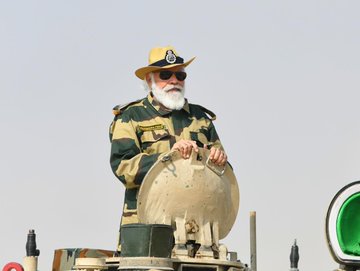
Looking like some battling Old Testament figure transplanted to the Longewala border outpost in the Thar — a strikingly full white beard, camouflage tunic, dark glasses, and a BSF hat, riding an Arjun MBT, Prime Minister Narendra Modi once again proved he has no equal on the Indian political scene for engineering optics, or registering on the camera.
The PM’s presence among them and what he said was no doubt comforting to the army and para-military troops but it was largely unexceptionable stuff. But let’s consider his comments possibly pertaining to China because that’s the one adversary the Indian government and leaders over the decades stretching back to Jawaharlal Nehru have shown absolutely no instinctive feel for nor ever displayed the necessary confidence or desire to tangle with. That may be the reason why — by way of compensatory rhetoric during the BJP’s current tenure in government — bombastic talk has emanated from Modi exclusively directed at Pakistan!
There are three points in Modi’s peroration at Longewala troops that one can reasonably assume relate to China with which this country has been in a military faceoff since May this year in eastern Ladakh. One, he talked of the world being troubled by certain “expansionist” forces who sport a dated — “very 18th century” and “distorted mindset”. Two, he painted India as a country that “believes in policy of understanding others and making them understand but if an attempt to test [India] is made, then the country will give a fierce reply.” continuing standoff with China at Ladakh border. And finally, he mentioned India having the strength and, presumably the government he heads, having the political will to give — what else — a “befitting” reply to those challenging it. “The world now knows”, he asserted, “that India will not compromise with its interests even one bit.”
Take his points, one by one. Modi is quite simply wrong when he talks of territorial expansionism being an obsolete phenomenon. It reflects badly on the personnel in MEA and PMO advising him, who ought to have slightly deeper historic knowledge. In any case, hardheaded states on the make, such as China, intrinsically value territory and rely on strategic geography to establish an extended global presence. They covet the territorial space on land and sea of adjoining states especially if they are less venturesome, more passive, such as India, and have proved that territorial expansionism is very much on their agenda. Just because the Chinese allude to nonsensical history to buttress their dubious claims does not make China’s territorially expansive policies an anachronism — it is part and parcel of Beijing’s traditional approach of relating to lesser powers among which it clearly counts India. So, no, where China is concerned territorial expansionism is not passe’.
Are there clues in the other things Modi said that may indicate which way his government is leaning vis a vis a likely compromise with China? Beijing has not made it easy on the Modi regime. While eight painful sessions of fruitless talks between corps commanders on the border have come and gone without any progress to show for them, the Xi dispensation has not budged a whit from its original position that the Indian army vacate the heights on the Kailash range — the Rezangla ridge line — it showed the wit, for a change, to capture — beating the Chinese PLA to it. The only give on its part has so far been the offer to withdraw its forces to Finger 8 area in the Pangong Tso north area as long as India does not advance beyond its current presence on Finger 3 even though the Indian claim line extends to Finger 8! This supposedly is a Chinese concession!
Delhi, on its part, is seeking “comprehensive disengagement”. What does this mean exactly? Press reports quote Indian official sources as saying this would involve the two sides withdrawing an equal distance, something the Chinese seem inclined to accept because it will require the Indian army and Special Frontier Force units manning the Kailash heights to climb down encouraging the PLA, as several retired Indian generals have stated, to then quickly occupy these commanding hill tops and permanently disadvantage the Indian army. Considering that no other big power endows bilateral agreements with the ridiculous sanctity that the Indian government insists on doing, India has always lost out and will do so again as the PLA will quickly present Indian with a new Line of Actual Control — something I have been warning about from my first post on this subject mid-May onwards.
In this context, the prime minister’s third point that “India will not compromise one bit” is rendered irrelevant. See what the PLA has done vis a vis the Y-junction on the Depsang Plains — they have blocked Indian patrolling units from reaching Indian areas northwestwards to the Karakorum Pass — the most strategic subregion — the so-called “sub-sector North” in army parlance. And because the Indian army has not forced the issue by forcibly removing the blocking PLA units, that entire area amounting to some 900+ sq kms has, in effect, been lost. So, while in theory Modi and MEA may, with a straight face, aver China has captured no Indian territory and that the LAC remains undisturbed, in reality PLA extensively holds Indian ground and LAC has been grossly violated.
It appears Modi is in no mood to ruffle Xi’s feathers and order offensive operations to push the PLA out of Y -Junction and to recover lost Indian territory. The GOC XIV Corps Harinder Singh was at fault when, instead of ordering instantaneous action to bulldoze through the PLA block when army patrols first encountered it, he waited for higher authorities to green signal some counter-move, which he should have known would never come, leave alone in time for him to do something decisive. This was a tactical decision that was unnecessarily elevated by the Leh Corps HQ to strategic, even political, decision-making level, which was not warranted.
On the negotiating front too India is losing. As I argued in my early posts on the subject, MEA by attributing PLA aggression to an “indistinct” LAC actually provided Beijing with a justification for its moves that it has used ever since. Seeing Delhi on the defensive, moreover, China is now discreetly shoving India into accepting its terms. Here’s where Modi’s “won’t compromise a bit” promise ought to kick in. But it hasn’t. The PM, moreover, has been equally squeamish in not demanding that PLA get the hell out of the Y-j on the Depsang and, if it didn’t do so, that the Indian army would do whatever is needed for Indian units to resume patrolling in that sub-sector to which the Indian army has been denied access. And when the PLA block is removed that precautions would be taken to prevent the Chinese from pulling such blocking maneuvers in the future.
Plainly, Modi, foreign minister S Jaishankar and NSA Ajit Doval have singly and collectively failed to make Beijing “understand”, among other territorial enclaves being contested, the importance the Indian government and people attach to controlling the areas with patrolling points 10, 11, 11A, 12, 12A, etc. north and northwestwards of the Y-junction. And it is clear India has been severely “tested” by the provocation of the PLA maintaining its blockade. So per point 2 of the Longewala speech: Where, oh, where is the “prachand” (fierce) response?
This brings us to the central issue. In the light of the foregoing arguments, would it be wrong to conclude that the PM’s latest speech was the usual hot air Indian politicians emit anytime they have an audience, in this case a captive one? There may be something after all to the lurking suspicion about the BJP government seeming keener than Beijing to arrive at a resolution of the problem even if it means surrendering Indian territory beyond the Y-j and, thereby, giving up the ghost of strategically dominating the Gwadar-bound Chinese commercial traffic, and military movements on the China-Pakistan Economic Corridor in support of Pakistan’s control of Hunza and Gilgit-Baltistan, the region the Imran Khan government has incorporated as another province.