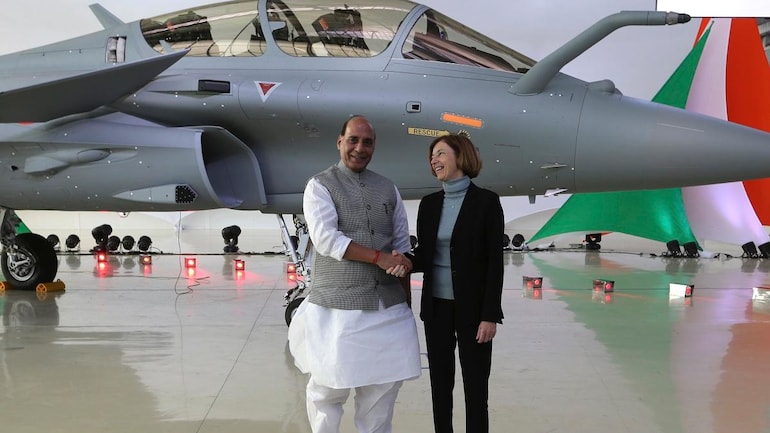
[Defmin Rajnath Singh with his French counterpart, Florence Parly in Ambala]
Earlier this month, the Indian Air Force formally inducted five Rafale combat aircraft — two 2-seat trainers, and three combat-ready single seater aircraft, into the 17th ‘Golden Arrows’ Squadron in Ambala. Another five Rafales with IAF roundels are at the Dassault base in Merignac in southern France, being used for conversion of MiG-21bis pilots, ground handling and maintenance crews. The retraining stints are for six months for each lot of Indian pilots and technicians, with the pilots allotted the contracted number of training sorties alongside a French instructor.
Making allowance for the occasion, there was the expected hyperbole. The defence minister Rajnath Singh called the aircraft a “game changer” and, with less the Chinese adversary in Ladakh in mind than the domestic audience, added that it sent a “big and stern message to the entire world, especially those eyeing our sovereignty.” The French defence minister Florence Parly not to be outshone in exaggeration said that “India has world class capability and incredible sovereign tool. India has an edge over the entire region.” She was merely embroidering what her Indian counterpart had stated in Merignac on 8 October 2019 when formally accepting the first lot of Rafales. After a joy ride in the plane, the Indian leader had declared “the new Rafale Medium Multi-Role Combat Aircraft (MMRCA)” as making “India stronger” and giving the IAF an “exponential boost” to “its air dominance” capability.
Why Rajnathji was briefed to say this is not important. But how the IAF means to actually obtain air dominance with just 36 of these aircraft is a mystery. Sure, Rafales working in tandem with Su-30MKIs can plausibly achieve this objective as former Air Chief Marshal BS Dhanoa stated, but by themselves even twice this number of Rafales in Indian colours cannot. But, as the late defence minister Manohar Parrikar was convinced, larger numbers of Su-30s would alone have sufficed for the purpose. Moreover, the additional Su-30s could have been secured at a fraction of the Rs 59,000 crore upfront cost of the Rafales or, to repeat myself, for just a “truckload” of the exorbitantly-priced Meteor, Scalp and Hammer missiles that these aircraft will be armed with, and which have been tested and proven by the French Air Force against such military heavyweights as Libya and Syria!
This begs the question I long ago asked — where was the need for the Rafale in the first place?
But whether India dominates the skies is not Parly’s interest; that the IAF procures an additional 36 Rafales is. In a meeting with the French press at the embassy that evening, Parly was reportedly confident that Paris will be able to ring up such a sale on the same terms, but without the ‘sunk costs’ of attending infrastructure — airconditioned hangars, special diagnostic and testing machines, etc.
When reminded by a pesky French journo that such a follow-up deal clashes head-on with Prime Minister Narendra Modi’s ‘atm nirbharta’ policy and the thrust of Rajnath Singh’s ‘negative list’ thinking, Madame Parly dissembled but did not budge from her stand, indirectly hinting that such a deal would be signed for the same reason the original was approved in April 2015: Modi will agree to buy ’em. End of argument! Irrelevant considerations like, where’s the money? are obviously not expected to intrude into the Indian government’s calculations, or at least Paris does not expect them to.
Both France and the IAF had gamed this out right, and their plan is working. IAF was the decisive actor here. It had sought the 36 Rafales it was partial to from the beginning as a wedge purchase easing the buy, as I had predicted, of more such aircraft to fill the Service’s entire 126 MMRCA requirement without having to go through the transfer-of- technology and licensed manufacture cycle.
As part of Indian Prime Minister Narendra Modi’s ‘self-reliant India’ policy, Defence Minister Rajnath Singh issued a list of 101 defence items in August with different timelines beyond which their import will be banned, with a second list soon to follow. From December 2020, the armed forces will not be able to purchase some 69 types of foreign-sourced military goods, including many major weapons systems and platforms: ship-borne cruise missiles, diesel submarines, missile destroyers, light combat aircraft and helicopters.
Most of these are already produced in India under licence, so the government is confident the ban will force the Indian defence industry to achieve self-sufficiency within a decade. Because imports will not be allowed for any reason, the military will be compelled to become stakeholders in indigenous programs. However, there has been minor pushback, with immediate purchases from abroad being approved to fill ‘voids’ in the war wastage reserve and the war stock just in case hostilities flare up with China in Ladakh.
Singh promised contracts worth US$54 billion to the Indian defence industry, but instead spawned scepticism because this figure includes funding for procurements that are already underway. The reality is that the Indian government has awarded US$34 billion of contracts to foreign arms suppliers, far exceeding the US$20.25 billion for Indian companies. Since defence budgets are written annually, there is no hint of long-term government funding for particular programs.
There are also more fundamental problems with the plan. It is ironic that a country more-or-less capable of making its own strategic armaments — nuclear warheads, long-distance missiles and ballistic missile submarines — is unable to produce conventional weapons. Because strategic weaponry is not available at some arms bazaar, these were developed in-country under a special dispensation — the ‘technology mission’ mode — directly under the Prime Minister. This precluded the procedural hassles, niggling financial oversight and bureaucratic foot-dragging usually faced by conventional weapons development projects. The arms self-reliance policy will be boosted if all indigenous conventional weapons projects too are developed under a similar regime.
India’s mindbogglingly complex defence procurement system, tilted against local industry, has been only superficially reformed. The latest version of the Defence Procurement Procedure defines a hierarchy topped by indigenously designed, developed and manufactured (IDDM) items. Next are items satisfying the ‘Make in India’ (MII) initiative, which includes equipment reproduced by foreign companies from their international product lines — Lockheed Martin’s F-16 fighter aircraft, for example, which will be sold as the new F-21.
IDDM items must include at least 60 per cent Indian content (whether by weight or value is unclear), with the same requirements applying to spares, special tools and test equipment. The MII category allows foreign firms to get away with only 40 per cent, skewing the competition cost wise in their favour. This pushes the armed services towards the MII option, involving munitions that are proven but that quickly become obsolete.
This process is complicated by the lack of procedures to assess the use of local content in either category — the defence force will have to take foreign firms at their word, which isn’t always reliable. In this case, kicking the crutch of foreign weaponry from underneath the armed services will not advance the cause of a ‘self-reliant India’ without first removing the anomalies in the procurement procedures.
The military has a habit of finding anything imported acceptable and anything Indian-made suspect. The travails of the Indian-designed and developed 4.5 generation, near all-composite Tejas light combat aircraft are well known. The Indian Air Force (IAF) contributed little to the project other than frequently changing the Air Staff Qualitative Requirements, imposing delays in the prototype and certification stages and, when the aircraft rolled out, claiming it was technologically dated. The IAF was finally pressured into buying a squadron’s worth of Tejas, and, with the push for indigenisation, will soon order an additional 83.
The Indian Armed Forces were also unconvinced by the Indian-designed Arjun main battle tank, buying too few to support the necessary economies of scale. Despite outperforming the Russian T-90 MBT in all field tests, the army contends the Arjun is wider and heavier than the specifications. Meanwhile, their T-90 fleet keeps growing.
The precedent for the stepmotherly treatment of locally-produced armaments was established in the mid-1970s, when the IAF favoured the British Jaguar low-level strike aircraft at the expense of the HF-73, the advanced variant of the Indian-designed Marut HF-24 — the first supersonic jet fighter to be produced outside of North America and Europe.
Compared with their peers in the public sector, private-sector defence industrial firms boast better designing wherewithal, work ethic and labour productivity. But the Modi government continues to relegate private firms to the role of sub-contracting for the apathetic and wasteful defence public sector units, resulting in time and cost over-runs, delayed delivery schedules and alienated military customers.
The government has so far ignored the economically sensible solution of making the defence industry more profit and export-minded. That would entail Hindustan Aeronautics Ltd. sharing the design and source code for the Tejas LCA with Tata Aerospace and Mahindra Aerospace, creating multiple production lines for a combat aircraft with a ready market in the developing world. They could also task Larsen & Toubro, the engineering giant that puts together the Arihant SSBN, with producing conventional submarines.
A more ambitious approach would be to divide the public-sector research and development and defence industrial assets into two giant competing combines, each under the managerial control of leading private sector companies such as Tata and L&T. These two complexes would then bid for weapons contracts, with the Defence Ministry funding development in the prototype and selection phase.
Absent such optimal use of defence industrial resources, prospects are bleak for a militarily self-sufficient India.
Four months into the Chinese annexation of Indian territory in eastern Ladakh, specifically in the Galwan Valley, the Hot Springs-Gogra-Kugrang area, and in the stretch of the northern shore of the Pangong Lake from Fingers 3 to 8, the BJP government is unwilling to call China out.
Its case is that while the PLA intrusions and build-up are in the ‘dead zone’ 2kms on either side of the Line of Actual Control — meaning in the 4km belt astride it, there otherwise is no hint of Chinese aggression! This in the face of overwhelming evidence that the PLA has indeed gobbled up Indian land and will not stir out of it for any reason. If the government hopes that it will be able to leverage the “preemptive” occupation of Black Top and other peaks by the Indian army in the Kailash Range south and southeastwards of the Pangong, around the Spanggur Gap, to get the PLA out of where it has encroached and is now consolidating its presence, then it has misread China’s intentions terribly enough to render Indian diplomacy it is banking on, futile. Not that it has prevented foreign minister S Jaishankar from doing the obligatory rounds of Moscow, etc. and hoping to realize by these means the restoration of the status quo ante.
In this reality denial mode, the ruling party in Parliament yesterday stuffed the opposition, daring it to not support the motion of support for the armed forces in this their time of trial. The positive vote was then construed as a general backing for government policy. Neat! Except this policy teeters between doing nothing to reverse the Chinese capture of Indian territory and approving military actions, such as taking Black Top, etc., that while disadvantaging PLA forces some in that sub-sector, did not in its execution entail great risk of things going wrong.
On the basis of what the Indian army has done and not done in Ladakh so far, several worrisome aspects of Prime Minister’s approach driving Indian policy are becoming clear. Modi definitely does not want more Indian casualties. Containing the public ire after the gruesome killing by the PLA troops of the 16 Bihar Regiment personnel June 15 was a touch and go thing, and resisting the people’s desire for just retribution a delicate political operation the Modi regime barely pulled off.
The lesson learned was that the best way of avoiding Indian deaths on the LAC is to avoid hostilities as much as possible. Nor is Modi in a mood to countenance military escalation for any reason. This rules out any action by the army to force the Chinese out of areas on the Indian side of LAC they are presently entrenched in.
The August 29 Black Top action, in the event, was a perfect symbolic act showing a strong Indian army that far from taking guff from the PLA was taking the fight to the Chinese. Except it involved little real risk to Indian troops, as it was “preemptive” action. It was sort of the Ladakhi version of the Balakot strike on the other front. There was less physical harm done the adversary than that the operation suggested a dynamic Indian response and salved India’s ego.
Escalation has been avoided also by studiously ignoring the inconvenient fact of PLA’s territorial aggrandizement by rhetorically beating around every bush but that one. Modi has thus at once legitimated the Chinese moves and absorption of Indian territory into the ‘Tibet Autonomous Region’, incentivized President Xi Jinping to stop the PLA from grabbing more Indian territory than it had perhaps planned to do but far more land than Modi wants to lug around as political liability.
This has led to a counter Indian military build-up but one that seems designed for the army to stay put, weather the winter, rather than fight the PLA. It serves Modi’s aim of capping the military confrontation at the existing level of to-ing and fro-ing.
This is the logic of Modi’s “no casualties and no military escalation, at all cost”-approach, his brave sounding words during his day-trip to Nimu with references to the sudarshanchakra wielding Lord Krishna notwithstanding. After all, when the Modi regime, indirectly claims in Parliament that there’s no sign of Chinese aggression anywhere, nothing that cannot be explained by the indistinctness of the LAC on the ground, there’s no reason for Beijing to either disagree or, importantly, be disagreeable.
Happily, this policy conforms to the Indian armed services’ mindset of not provoking the PLA, not taking ‘pangas’ with the Chinese. And it is in line with the country’s traditionally defensive-passive-reactive military posture where China is concerned. Except, Modi’s over-cautious policy is the reverse of “no risk it, no biscuit” — a phrase a famous American football coach mouthed to urge his team to show initiative and aggro on the field. Transposed to the Sino-Indian confrontation, it means just the opposite — do less, do nothing, so less harm comes to you, with the ‘biscuit’ going to the PLA and Indian territory being lost permanently to China.
This includes the loss of access to all the patrolling points and land northwestwards of the Y-junction on the Depsang Plains and will lead to the DSDBO Highway becoming vulnerable to a Chinese pincer closing in from the Galwan and the Depsang endangering, in the process, India’s access to the Siachen Glacier and, incidentally, negate any Indian plans for striking at the Sino-Pakistani joint at the Karakorum Pass. This last objective is what the PLA had uppermost in mind strategically to achieve and, thanks to Prime Minister Modi, it has now done it.
As predicted in my last post, the extended S. Jaishankar-Wang Yi pow-wow in Moscow that reportedly concluded well after midnight, India-time, in substantive terms produced zilch. Keeping in mind Russian sensitivities and the Russian foreign minister Sergey Lavrov’s determination to see the two not end their meeting with nothing, the Indian and Chinese minister reached a laboured 5-point agreement that far from brightening the prospects of peace may have set the scene for more military exchanges in eastern Ladakh. Depending on what transpires and however the intensity and scale get ratcheted up by the forward units of either side, we may yet have full bore hostilities.
The first point repeated the tired line of “not allowing differences to become disputes” — Jaishankar’s signature tune. The second, cleverly from the Chinese point of view, puts the onus on the military level talks — yes, the same patience-sapping talkathons conducted in Moldo-Chushul by the XIV Corps commander Lt Gen Harinder Singh and Major General Liu Lin, PLA in-charge of the southwestern border sector, and at less senior levels — to reach a modus vivendi and “quickly disengage, maintain proper distance and ease tensions”. The third point features the Indian government’s insistence that both sides “abide by all the existing agreements and protocol on China-India boundary affairs” starting with the 1993 peace and tranquillity agreement “in the border areas and avoid any action that could escalate matters” — though the 1993 accord is nowhere mentioned. In the fourth point, they agreed that the military-to-military interactions continue, on parallel tracks, with the Special Representatives level talks and the WMCC (Working Mechanism for Consultation and Coordination) meetings. And the final point, putting cart before the horse, voiced the unwarranted hope that the two countries “expedite work to conclude new Confidence Building Measures”.
That the 5-points mean little was stressed by Wang who, in response to Jaishankar’s saying that India “would not countenance any attempt to change the status quo unilaterally” and expressing his desire that bilateral ties resume their earlier “largely positive trajectory”, reiterated China’s “stern position” on the situation in the border areas. He emphasised “that the imperative is to immediately stop provocations such as firing and other dangerous actions that violate the commitments made by the two sides”, adding that it is also “important to move back all personnel and equipment that have trespassed” and the “frontier troops must quickly disengage so that the situation may de-escalate”. Meaning, that Beijing will not compromise a whit on its stance that because Indian troops violated the LAC, they’d have to withdraw to obtain peace premised on Delhi accepting the new LAC secured by the PLA. This frontally contradicts the Indian government’s goal articulated by Jaishankar June 17 of restoring “the status quo” as existed in Ladakh in April 2020.
It is clear though what the Chinese strategy is in the non-military sphere. It is to sow confusion with a plethora of negotiations — each negotiating channel, at least on the Indian side, getting in the way of every other, and seeding a mess that Indian official and military circles will be preoccupied with, while Beijing conveys the impression of progress being made, however haltingly, in this or that or the other channel. As mentioned in the previous post, at the apex level Wang Yi is discussing ways to resolve issues simultaneously with Jaishankar and with the NSA, Ajit Doval. Why Delhi agreed to this twin-apex track in the first place many years ago is not a mystery. In theory, the National Security Adviser in the PMO has the ears of the prime minister — the only person in the Indian system who counts — and is the channel the PM can use for directed intervention bypassing the bureaucratic maze in MEA. So far, some 22-23 sessions of the Special Representatives level talks have been held with nothing to show for them. And it doesn’t seem to matter if the NSA is a Mandarin-speaking China expert or not. Doval was preceded as Special Representative by Shivshankar Menon — NSA to Manmohan Singh, and former Foreign Secretary, who cut his diplomatic teeth in China. It made no difference — there are no results.
That China nevertheless is happy plugging for multiple active negotiating streams suggests they serve China’s purpose, not India’s. It is time Delhi called a halt to this farce of negotiations, and restricted all negotiating with the Chinese to a single forum, a unitariness of command Beijing has achieved by making Wang the go-to guy even as on the Indian side there’s a whole bunch of people mucking up the works. So, the negotiating strategy needs to be sorted out.
To add to India’s troubles, the two principals while alighting on the 5 points in Moscow entirely ignored the fluid reality on the ground in eastern Ladakh, which is hurtling towards some serious military engagements. Except, no one on the Indian side seems to be very clear about what the field reality is, not even the army.
Consider the situation on the north shore of the Pangong Lake. Per press reports, there is supposedly an Indian troop concentration on the Finger 3 ridge to match the strength of the Chinese force on Finger 4 and to deter it from advancing towards Finger 3 via the connecting “knuckle” — the site where the two sides are presently facing each other at not too great distance. But what is really confusing is the Indian army sources have told the press that the PLA is physically blocking Indian troops from reaching a high point — presumably the highest point — on Finger 3 ridge by suddenly appearing with flags every time an Indian detail tries to reach it. (Refer https://indianexpress.com/article/cities/delhi/pangong-fingers-hot-up-scramble-for heights-as-pla-men-mass-on-ridge-india-sends-more-troops-6591327/ )
So what is it? Are Indian troops really in control of all of the Finger 3 area or not, the knuckle connecting the fingers apart? Because if the PLA is entrenched on Ginger 4 alone, how can they suddenly appear on Finger 3?
Or, is it an unpalatable truth the army is unwilling to own up to that it has lost or nearly lost all of Finger 3 to the PLA as well? Or, if this feature has not been wholly lost, that the Chinese military units have been somehow allowed to get on the Finger 3 ridge? Because a source in the above-mentioned news story is reported as saying: “The assessment was that sooner than later, the Chinese would descend to cut off our access to Dhan Singh Thapa Post. We had to make sure they were blocked. Now along the entire Finger 3 ridge, Indian troop strength has been increased at different places to match the Chinese.”
If Finger 3 is being contested with the PLA, besides the Major Dhan Singh Thapa post at the foot and on the western side of Finger 3, Indian military presence in, and control of, Fingers 1 and 2 too are imperilled. After all, if the Chinese have taken Finger 3, why would they not try and also push Indian troops out of Fingers 1 & 2, thereby occupying all of the northern shore and completing a route of the Indian army? This reading of the situation fits in with HQ XIV Corps’ apparent belief that the PLA will seek to displace Indian troops from the Finger 3 ridge and add it to all the Indian territory already annexed to the west of it — the extended area from Fingers 4 to 8. Still, Indian military sources explain these aggressive PLA moves as merely a reaction to the Indian occupation post-August 29 of the commanding heights on the Kailash range around Spanggur Lake, proximal to the south bank of the P-Tso. This has only heightened the uncertainty about what’s happening as regards these hilly spurs on the Pangong.
Of course, the Chinese encroachment and permanent occupation of all the Fingers is a worrying prospect, and vacating the PLA from these areas will be a fairly major military undertaking. But the move to contest Finger 3 (and logically also Fingers 1& 2) could be a feint, to divert the Indian military’s focus and resources from the Kailash range that makes the disposition of Chinese forces on the Spanggur Tso and the southern end of Pangong untenable.
The fact is realizing the government’s objective of status quo ante will require the army to vacate the PLA from Fingers 4 to 8, remove Chinese troops from the Y-junction in the Depsang Plains, and PLA presence from the Galwan Valley and the Hot Springs-Gogra-Khugrang area, and protecting the DBO highway by securing the mountain heights on the eastern bank of the Shyok River, will necessitate the Indian army being more aggressive and proactive.
One can only hope the preemptive occupation and fortifying of Black Top and other heights in the Kailash range was not a one-off thing — a rare island of aggression in an otherwise bland sea of caution.
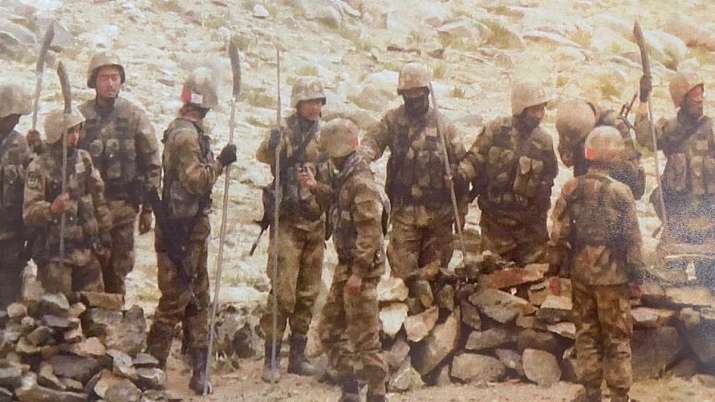
Hearing the Chinese Foreign Ministry spokesman say the near-clash September 7 at Mukhpari was due to the Indian army offering “serious provocation of an egregious nature” and then have the MEA accuse the People’s Liberation Army (PLA) for “blatantly violating agreements and carrying out aggressive manoeuvres” and firing small arms, a third country tuning in may find it hard to blame one or the other side for ratcheting up proceedings. This confusion would have persisted but for a picture of the incident snapped by a mobile camera and flashed to the India media.
It shows 15-20 Chinese troops, some of them unusually large-bodied – specially chosen for this intimidation mission in padded body armour. They had automatic rifles slung across their shoulders, standing over a small stone wall marking Indian territory, shouting and gesturing with ‘guandaos’ in their hands. Guandao is a Chinese polearm – a long lance with a slightly curved scything blade, a weapon from the 3rd Century AD in the time of the Eastern Wu Dynasty. It conforms with the PLA use of the slightly more modern, but still medieval, nailed maces in the June 15 confrontation in the Galwan Valley that led to the killing of 20 personnel of the 16 Bihar Regiment.
The PLA may not think such regression is the future of war. But it apparently believes it can use museum pieces, instead of in-date arms, to escape the charge of initiating military hostilities, and to shove the forward-deployed Indian mountain infantrymen, not similarly equipped, into escalating matters by reacting with automatic gun fire. Post-Galwan clash, Indian troops, if attacked, are instructed to use their assault weapons. By such contrivances, Beijing hopes to make India responsible for starting a fracas, violating existing agreements on the use of force on the disputed border, and to secure an excuse for military escalation. It is a clever ruse the Indian government and military seem to be dumbfounded by when such PLA tactics can be easily countered by arming troops with nail-spiked steel maces, etc. to enable them to respond in kind, which hasn’t been done.
The fact that the Indian jawans at Mukhpari neither flinched nor reacted precipitately in the face of jeering PLA troops itching for a fight and discharged their weapons in the air only in response to the Chinese doing the same, indicates tremendous discipline on their part. Following on the success of the Tibetan-manned Special Frontier Force (SFF) to surreptitiously secure Black Top on the night of August 29, it is a genuine psychological and tactical military reverse for the Chinese.
Black Top is the highest point in the Kailash mountain range surrounding the Spanggur Lake and Indian occupation of it renders vulnerable the PLA presence at lesser heights and its post at Moldo hosting artillery and a fleet of armoured vehicles. It does three other things – dominates all east-west routes in the vicinity, blocks the PLA from realizing its original objective — capturing the southern shore of the Pangong Tso and, according to the former Northern Army commander, Lieutenant General HS Panag, enables Indian units to move to the south bank of the Spanggur Lake and even advance northeastwards towards Rudok.
A more confident Indian army, rather than waste time gloating over its so far small successes, should prepare, with fast moving Special Forces (such as the SFF and the Ladakh Scouts) in the van, to take back the area — Fingers 4 to 8 — on the northern bank of the Pangong Tso, remove the PLA blockade at the Y-junction on the Depsang Plains, dislodge the Chinese from Indian territory around the Hot Springs-Gogra-Kugrang area, secure the mountain ridge on the east bank of the Shyok River to protect the new highway to Daulat Beg Oldi and the access route to the Karakorum Pass, and to fortify the hilltops it occupies in the Kailash Range.
General Panag, for one, rues the Indian army’s “error of judgement” in not occupying the “plateau-like areas” to the east of the Kailash Range which would have preempted their use by the PLA as staging areas for Chinese offensives he expects will be mounted to clear the Indian presence from the Chushul sector, in particular Black Top, which he thinks the Chinese cannot afford to have remain under Indian control. To thwart PLA attacks, he advises that the approaches to Indian-held positions be mined and embedded with Improvised Explosive Devices.
The uptick in the Indian army actions in eastern Ladakh, however, is not matched by equally efficacious Indian diplomacy. Commenting on the Chinese disregarding numerous “understandings” since 1993 to limit forces that can be deployed on the LAC and to restrain them, the external affairs minister (EAM) S. Jaishankar, had nothing very profound to say other than that this “raises very, very important questions” and “calls for very, very deep conversations between the two sides at the political level.” All this may be very, very good but doesn’t progress a diplomatic solution any.
In fact, it hints at the EAM kicking the can down the road, putting the onus on Prime Minister Narendra Modi to resolve the problem at his level with Chinese President Xi Jinping.
This is a reasonable conclusion to reach considering Jaishankar in his video conversations achieved nothing and is unlikely to accomplish much in the luncheon meeting with his Chinese counterpart Wang Yi in Moscow, September 10, and neither did the National Security Adviser (NSA) Ajit Doval who video-conferenced with Wang on July 5. If anything, there’s every possibility that Wang is playing Doval off against Jaishankar. Because policy- and decision-making processes in the Government of India are famously stove-piped and coordination is nonexistent, NSA and EAM on separate tracks negotiating with the same Chinese interlocuter, may further differently nuanced aims and agendas — a situation Wang is bound to milk.
Whatever gains the Indian army may register in eastern Ladakh could thus be squandered by Messrs Doval and Jaishankar at the negotiating table.
India does not have a good record when it comes to negotiating post-military success. With the 161 Brigade under ‘Bogey’ Sen poised to take Muzzafarabad, Nehru decided to halt all operations in the 1947-48 conflict over the erstwhile princely kingdom of Jammu & Kashmir and trust the UN to resolve the issue. In 1965, at the Tashkent peace talks that the Soviet Union hosted to end the “war” with Pakistan, the diminutive Indian Prime Minister Lal Bahadur Shastri succumbed to the size-wise towering Field Marshal Ayub Khan’s plea for “rahmat” (kindness) and unthinkingly returned the Haji Pir Bulge to Pakistan, whose capture lopped off some 200 kms between Jammu and Srinagar. It laid waste to the singularly bold and resolute effort by 1 Para commanded by Major (later Lieutenant General) Ranjit Singh Dyal, MVC, that led to the capture of this salient from where Pakistan had infiltrated its soldiers in mufti into the Srinagar Valley as part of Operation Gibraltar, and has ever since done the same with jihadis.
Such stupidity was repeated six years later and then in trumps when, instead of imposing a victor’s peace — which is never fair or equitable to the losing party and so sanctified by international law, and compelling Pakistan to hand over Pakistan-occupied Kashmir, Gilgit and Baltistan to India and formalizing the boundary or, at a minimum, cementing what is now the Line of Control in J&K into a delineated border, Indira Gandhi unconditionally returned 93,000 Pakistani Prisoners of War in Bangladesh to Pakistan. She was persuaded to do so by Pakistan PM Zulfiqar Ali Bhutto’s promise of delivering on this latter boundary solution once he stabilized the political situation back home. That Bhutto desperately needed this generous Indian gesture to establish his creds with GHQ, Rawalpindi, and to shore up his domestic standing and support was known to Indira’s advisers in Simla, not that they or the PM cared. India thus surrendered the single most significant leverage Delhi had to obtain a permanent politico-military fix for Kashmir, and said Good Bye to the last opportunity for durable peace in South Asia.
Sure, the situation in eastern Ladakh is nowhere comparable to these previous military successes, nor is it militarily settled in any way. After parroting for four months the Chinese-cum-Indian government/MEA line that the indistinct LAC was the reason for China’s aggression, and expecting Delhi to resolve the matter by reasoning with the Chinese at the twin (military and diplomatic) negotiating table, the army brass finally stirred. And then only because prime minister Modi prodded them. During his briefing in Nimu, Ladakh, he reportedly told Rawat, Naravane, Harinder & Co. to tell him what the army would do, not what the Chinese had done.
The actions to preemptively occupy the commanding heights (Black Top, Magar Hill, etc) in the mountains on the southern shore of the Pangong Tso followed and are fine, coming as a relief after an unbelievable period of passivity. But these cannot be counted as other than minor tactical gains that surprised the PLA. The Chinese plainly did not expect the Indian forces to take even such small initiatives. Whatever else these actions achieved, Beijing was alerted to India stiffening its spine somewhat and, after four months of unresisted occupation activity that may have added in excess of 60-odd sq kms in the Galwan and the Pangong (Fingers 4 to 8) areas to China’s bag, signaling it is in the game after all.
But now, Russia’s peacemaking foray intervenes. S Jaishankar, the giveaway expert — how can we forget the unforgetable! — the 2008 nuclear deal where he handed India’s nuclear testing option on a platter to Washington? — in the Foreign Office riding herd as minister, heads for Moscow, there to confer, September 9-11, with his Chinese and Russian counterparts, Wang Yi and Sergei Lavrov, respectively. Ostensibly to transact whatever Shanghai Cooperation Organization business there is to handle, Lavrov will push Jaishankar and Wang to, on the sidelines, hammer out a deal to end the Sino-Indian confrontation. That, in the process, Putin-ite Russia’s reputation as honest broker and go-between will be polished, explains Moscow’s motivation.
But what and where’s the danger? It lies in neither Modi nor Xi Jinping to-date saying anything that is directly accusatory or about the other’s culpability for things going askew in Ladakh. Modi has been scrupulous in avoiding making any reference to Chinese annexation of Indian territory and has consoled himself and the country by drawing an analogy to the “chakradhari” Lord Krishna in the Mahabharata epic and such like — how aptly I cannot say because my reading of English translations has been episodic, even as Xi has waxed authoritative about sinicizing the stubborn Dalai Lama-loving Tibetans. So, unless Modi gives the clearest instructions to Jaishankar, like the direct and clear order by the short time PM Deve Gowda to Arundhati Ghose, the Indian ambassador to the UN disarmament conference, to veto the draft comprehensive test ban treaty that was in the works in Geneva and which the Indian government was being pressured to sign, Jaishankar may take it upon himself to sell Indian interests down the drain.
Delhi’s declared position is that it wants the restoration of the status quo ante and rejects the Chinese terms of the two sides withdrawing an equal distance from wherever their forces currently find themselves. Jaishankar may believe that he can convince Modi that because this is all the give Wang offered him, and because peace with Xi’s China is so much the PM’s personal stake and priority, that he took it. Whence the Indian army will be asked to back down from the heights in the Chushul sector even as the PLA by and large retains its position on the newly realigned LAC there as also on the Galwan and the Pangong Tso.
Twenty-two years ago, the establishment IDSA journal — ‘Strategic Analysis’ published a research paper of mine in its January 1998 issue [“Getting Tough with China” (https://idsa.in/system/files/BhartKarnad1998.pdf — my name is misspelled in the URL!]. It argued for “equitable” not “equal” security, showing just why the peace and tranquility agreement signed by Narasimha Rao in 1996 was injurious to the national interest, as it required the two forces to pullback 40 kms. And how, in “as the crow flies”-terms, especially in the east, it would mean the Indian army backing all the way down to the foothills even as the PLA remains on the Tibetan Plateau in striking distance of the LAC. I had suggested that the pullback distance should involve the time it takes either side to mobilize a certain military mass on the LAC in each of the sectors. Should this be the Indian negotiating standard today, it would have to additionally factor in the differential in the extent and quality of the border infrastructure (roads, telecom connectivity, etc) which, in a comprehensive agreement, would necessitate the PLA retreating all long the disputed border roughly, at a minimum, to the west-east line Rutog-Shiquanhe-Zanda-Zhongba-Xigase-Yarlung-Bowo-Zayu. This, incidentally, in some ways is the true measure of the conventional military superiority the PLA presently enjoys over the Indian army in a long war.
In the shorter time frame, however, India is not that severely disadvantaged. And the Indian army may be better off carrying out actions in eastern Ladakh to permanently entrench itself on the heights that it has recently secured. And more particularly, it should get on with forcefully displacing the PLA from the Y-junction in the Depsang Plains and to occupy the tops of the range abutting on the eastern bank of the Shyok River in a salutary show of strength and intent, to protect the new highway to Daulat Beg Oldi and maintain its proximity to the Karakorum Highway. And Indian Special Forces (SF), with the Tibetan-manned Special Frontier Force and the Ladakh Scouts in the van with the Navy’s marine commando coming in from lake-side in a pincer attack, ought to be tasked with eliminating the PLA strong points on the ridges above Fingers 4 to 8 on the northern shore of the Pangong Tso. Fast-moving SFs are better suited for such ops than even the acclimated troops of the new mountain offensive corps. This part of Ladakh was inaccessible in 1962, a fact the PLA mercilessly exploited. In 2020 with the stocking and prepositioning of stores proceeding apace, the Indian Air Force in the worst case will hopefully be able to sustain an air bridge, periodically topping off supplies for forwardly deployed Indian formations in the winter.
One fervently prays the CDS General Rawat finds the above suggestions to be, in his own words from another context, “the best, suitable” course for the Indian military to follow. It will free Modi to tell Jaishankar to engage Wang in pleasantries about the Bolshoi theatre’s current production of Don Carlo, and do nothing else. The less our foreign minister is asked to do by way of negotiating, the less harm he will end up doing the country.
There were two casualties in the night operation on Aug 29 by a unit of the Special Frontier Force (SFF) to take Black Top Hill south east of the Thakung post — the main Indian encampment on the southern bank of the Pangong Lake.
SFF, recruiting mainly from the exile Tibetan community in India, was set up originally at the end of the 1962 War as the country’s covert warfare arm in the fight against China. As a ready motivated force of youthful, highly trained commando, its formal brief is to clandestinely carry out tasks to hinder the People’s Liberation Army (PLA) in its rear areas in Chinese-occupied Tibet (COT) even as the Indian army takes on the enemy frontally in conventional hostilities. Initially it was manned by the warlike khampas of the Kham region of eastern Tibet, who formed the praetorian guard for the Lama-ist order centered on Lhasa. Armed with obsolete weapons, the khampas offered enough resistance to hold up for a while the advance elements of the invading PLA force rushing to capture Lhasa in 1949. SFF now comprises besides mostly exile Tibetans also other mountain people.
(The Ladakh Scouts and the Nubra Guards — comprising natives of the Shyok and Nubra Valleys, merged later into the Ladakh Scouts, were founded for similar reasons and missions in their respective native areas of deployment.) The SFF and the Ladakh Scouts are manned by people with unique constitutions that thrive in the thin high mountain air and can better withstand the harsh environs of high altitudes than the plains-origin soldiery.
It is hardly surprising the SFF set about its task with gusto on Black Top Hill, because it is precisely their unbounded enthusiasm and get-go attitude that eventuated in some free lance, unauthorized, actions by many of its trained personnel expert in demolitions and other destructive jobs inside Tibet whereupon, the Government of India in its characteristic craven-ness, decreed in 1973 that it not be used within 10 kms of the Line of Actual Control, defeating the very purpose of the SFF! May be after the latest Chinese adventurism in eastern Ladakh and the manner in which the SFF have performed, the Modi government will end these foolish, even ridiculous, restrictions on the SFF activity and permit its routine use across the LAC to impose on the PLA recurring high cost in lives and destroyed assets.
Officered by the army, the SFF has its own rank and organizational structure and payscales, and is based out of Chakrata near Dehradun, in a training complex called ‘Establishment 22’. It comes under the purview of the Special Services Bureau controlled by RAW. Formed into some 36 Companies, or six battalions, the SFF is the go-to unit for high risk actions and the only such outfit with several companies trained as paracommando for airborne operations. It has played a role in many actions, notably in the 1971 Bangladesh War. Time to enlarge these units — the Ladakh Scouts and especially the SFF by several battalions each and let them get on with their work unhindered.
Now to revert to Aug 29 night ops: Commander of the lead SFF company, Tenzin Nyima, was killed by a landmine when he was leading his troops in the approaches to the Black Top Hill. The fact that the area was mined suggests the Chinese had planted them in anticipation of preventing Indians from occupying it in strength. That Hill was taken and the Chinese prevented from establishing themselves there — the highest point on the Pangong Tso’s southern bank with a panoramic 360 degree view with a look down line of sight targeting now available, making the Chinese post at Moldo on the Spanggur Lake extremely vulnerable. With the subsequent Indian presence on Gurung Hill and Magar Hill at lower altitudes on either side of the Spanggur Gap, the PLA force, boasting of some armoured vehicles at Moldo, is pretty much bottled up.
The Black Top action was prompted, reports say, by sighting of a Chinese movement. The more likely reason may have been an electronic signals intercept of the PLA plan for the occupation of the Black Top and associated hill heights — Red Top, Helmet Top, et al, whence the approval of the preemption mission.
———–
For Special Forces, the difference between war and peace is notional. Even so, the least that outfits like the SFF can expect is that those of its members who lose their lives in operations are accorded the honour and recognition due martyrs, their bravery publicly eulogized, their families treated by the government with the utmost respect and visibly and conspicuously showered with the gratitude of the nation.
Instead, the brave SFF company commander Tenzin Nyima, aged 53, lies unheralded, forlorn, in a casket draped with the Indian tricolour and the Tibetan flag in a modest house in the refugee colony in the village of Choglamsar in Ladakh, his memory emblemized by Tibetan mourning rituals and the flickering flame of yak butter lamps with the only thing ringing in the ears of the Nyima Family being, not the accolades of a grateful nation, but the advice by possibly a RAW official to not talk to anyone about commander Tenzin’s SFF antecedents and his 33-year service! The Nyima family was hesitant to speak for fear of Indian government’s reprisals. Reached for comment, the Indian defence and home ministries had nothing to say.
The late SFF Company commander Tenzin Nyima lies forlornly
The Reuters news agency carried this story about Tenzin Nyima but not a single major Indian newspaper or online news service published it. I got it from the Karachi-based Pakistani daily, Dawn, at https://www.dawn.com/news/1577705/tibetan-soldiers-death-near-tense-india-china-border-sheds-light-on-covert-unit. The story quotes a young member of the kashag — the Tibetan government in exile in Dharamsala. “We respect and love India for giving us shelter but it is time the nation acknowledges the crucial role played by our men in the SFF,” Lhagyari Namgyal Dolkar, a 34-year-old Tibetan lawmaker told Reuters. “If an Indian soldier dies, the country declares him as a martyr, government pays rich tribute. Why are Tibetan refugees not bestowed the same respect?” asks Dolkar, whose family members have served in the SFF, with an uncle who fought on the Kargil heights in 1999.
It is time the services of the SFF and martyrs like Nyima are publicly acknowledged and praised by the defence minister Rajnath Singh and the Prime Minister Narendra Modi, the role of the Tibetans in SFF nationally lauded, and their special military role against the PLA ceremoniously marked and celebrated. And hereafter, RAW should encourage and reward the SFF for its derring-do behind the Chinese lines, and otherwise set them loose to create mayhem in Tibet. For too long the Indian government and the Indian military have acted, where China is concerned, like the proverbial rabbit in a python’s pen — frightened into immobility, eyes glazed, brains dazed, as if awaiting doom.
Having finally and belatedly woken up to the possibilities, let the army brass not now fall back into its usual passive defensive funk. Rather than remain content with the actions to-date, the army should exploit the psychological edge it has secured against the PLA and proceed expeditiously to seal off the Chinese bridgehead on the southern bank of the Pangong on the Chinese side of the LAC (as recommended in my previous post).
It is such bold follow-up forward propulsive actions that will unhinge the PLA and loosen its blockade at the Y-junction on the Depsang Plains — the far greater strategic concern for India, even as the pressure eases on the Indian army units on the northern shore of the Pangong Lake, enabling them to drive the Chinese all the way back to Finger 8. After all, what use are Indian troops sitting atop Finger 4 ridge?
These are tactical moves that surely don’t require the Leh XIV Corps Commander to get cleared by that perfectly wretched band of nincompoops and dunderheads in the China Study Circle (which also includes the Vice Chief of the Army Staff as ex-officio member) — the premier fount of China policy in the government. Good Lord! Modiji will do the national interest no harm if he never listens to this bunch of idiots ever again.
Two days after I pointed out in my last post the futility of just “reviewing India’s options” even as S Jaishankar & Co. try and resolve the dispute with China through negotiations, the PLA proved with its night time (Aug 29-30) operation that it believed in more direct action. It is another matter that as the Indian army’s statement says the “Indian troops pre-empted this PLA activity on the Southern Bank of Pangong Tso Lake, undertook measures to strengthen our positions and thwart Chinese intentions to unilaterally change facts on ground.” Instead of the forwardly deployed Indian troops being paralyzed by their surprise action, the intruding Chinese unit, for a change, found itself challenged and its plan for establishing a new LAC alignment this time, ambitiously, on the southern shore of the Pangong Lake, nullified by alert Indian jawans who had previously occupied the immediate heights.
This was all to the good. But then the very next thing did the Indian army did was predictable and wrong. Almost reflexively, the Indian field commander called for a meeting in Chushul with his local Chinese opposite number where, over a cuppa chai no doubt, the two and their juniors endlessly mulled what the PLA soldiers were up to and being told repeatedly in response that they were merely traipsing around on hallowed Chinese territory. How any of this helped is anybody’s guess.
The right thing for the Leh XIV Corps Commander to have done immediately on receiving the signal of this latest Chinese encroachment attempt was to use it as a decision pivot to order instantaneous mobilization and rapid launch of forces to drive the PLA units northeastwards to the point on the Lake where the Chinese have established a bridgehead on the southern bank for the purpose of decanting its troops from the northern shore onto the approaches to the Thakung Pass area on the Indian side.
True, Indian forces on the offensive, fighting hard to reach that south shore bridgehead, well into the Chinese side of the LAC would mean India occupying what is Beijing-claimed territory. This advance, moreover, ought to have been be followed up by the theatre command speedily pouring masses of troops into this salient — there being no dearth of troops with some 60,000-strong Indian presence in that sub-sector, and having them rush to firm up a defensive line on the southern shore with the lake in front as natural barrier. For the first time, the Indian army would have been seen as having taken the initiative and, in a fell swoop, reoriented the LAC — “possession is three quarters of the law” remember! — and, in operational terms, obtained the upper hand.
Time has been lost with the army choosing to powwow in Chushul, stopping after “thwarting” the PLA ingress to presumably preen itself. Except, had this incident been converted into an offensive opportunity and a drive set into motion, the momentum of the Indian military mass would have carried Indian formations quickly to the Pangong shoreline where the PLA troops crossed over. The reason why it would have panned out this way is because it would have been an unexpected Indian move, surprising the PLA, catching them unprepared to deal with a fast-paced and far-reaching movement. And it would have been a perfect, albeit belated, riposte to the PLA entrenching itself in the area Fingers 4 to 8 on the northern shore that is Indian. This is what the Indian army needs to do right away before the PLA regains its composure.
But what was China’s aim in the first place? Nothing that China does is of tactical value alone; there invariably is a larger purpose. And no Chinese move is ever innocent of geographic calculations because, unlike the Indian government and military, the Chinese have what the pioneering geopolitical strategist Halford Mackinder called, the “map reading habit of mind”.
Now look at the Pangong Tso through this map reading lens and what would the Chinese see? If they drew a north-south line roughly from the end of Finger 4 across the lake to the southern shore and extended it further down, and if the PLA were tasked with capturing the stretch of the southern bank of the lake to that point where the line meets the shore, you would have neatly partitioned the Pangong Lake area with China keeping the larger portion in the east, with the smaller lesser part left to India as a consolation. This, it appears, is the sort of partition PLA is planning to realize.
This makes the kind of Indian counter-action proposed here to secure the northeastern shoreline of the lake and ensconce the Indian military there, an absolute necessity. The sooner Modi, Army HQrs and the Leh commander Harinder Singh recognize that this is what needs to be done the better. Jaishankar and MEA can continue talking crap with Zhongnanhai.
There is however a problem of rushing unacclimated forces to the high altitude desert of Ladakh. Goodly parts of the three Divisions hurriedly deployed to eastern Ladakh will take some time to get accustomed to not merely function but fight in the thin air. But offensive operations against the PLA cannot wait. Here’s where the fullest use of regiments recruiting local mountain youth, such as the justly famed Ladakh Scouts, will come in handy. They have a decisive operating edge over other troops and even the Han-manned PLA who are uncomfortable at heights. The Ladakh Scouts along with other Special Forces in particular the Special Frontier Force featuring motivated Tibetan exiles, and especially the navy’s Marine Commando for lake-shore ops, would obviously be in the van, easing the advance of the Indian main force. And, by way of abundant caution, air defence systems would have to be readied in case the PLA uses its air assets ex-air bases it has constructed in that sector, and to deter the situation from going really askew or from escalating, have the canisterised nuclear warheaded Agni missiles in the theatre as backdrop.
However, what’s the chance the Indian army will finally go on the offense and do something this venturesome, or remotely risky, and the Modi regime permit it?
Five months into the Chinese annexation of Indian territory, the Chief of Defense Staff General Bipin Rawat gingerly girded up his loins to announce August 25 the possibility of military action to vacate this aggression. “The defence services always remain prepared for military actions should all efforts to restore status quo along the LAC not succeed”, he said. Without, perhaps, meaning to do so, he indirectly issued a mea culpa first by stating that the Indian military “are tasked to monitor and carry out surveillance and prevent such transgressions from turning into intrusions” — tasks the army clearly and manifestly failed to carry out, then by repeating the tired old excuse mirroring the Ministry of External Affairs’ statements for the army doing nothing: “Transgressions along the LAC [occur] due to differing perceptions about its alignment”. And lastly, by justifying military inaction by hiding behind the government’s position “to peacefully resolve any such activity and prevent intrusions”. It has ended up further tarnishing the army’s image.
Rawat’s revealing that Defence Minister Rajnath Singh and National Security Advisor (NSA) Ajit Doval had met with the three service chiefs on Saturday, August 22, to discuss the military stand-off with China and to review “all options with the objective that PLA restores status quo ante in Ladakh” was not reassuring because it actually indicated a lack of appetite for the hard option. Reviewing options is after all what the senior most levels of the army and government have been doing all these months without bringing any closure.
On parallel track, the external affairs minister S Jaishankar, in a couple of interviews took a different but equally wishy-washy tack. Talking to Hindustan Times he said “We are engaging China through diplomatic and military channels. There are essentially two elements in our approach. One is starting 1993 and then every few years, we have had a series of agreements (with China). Their import is that both sides will keep minimum force on the Line of Actual Control (LAC). But that is not the case now. We have very large number of Chinese forces and frankly, we are at a loss to know why. There are also certain norms of behaviour that were prescribed. Clearly, if we want peace and tranquillity on the border, we need to adhere to those agreements. Second, I accept there are some differences in perceptions in the LAC. But there is again a clear understanding that neither side will attempt to unilaterally change the status quo. It was because of these agreements and the adherence to them that the bilateral relationship moved forward in other, different spheres, including the economic one. And this must continue if the relationship has to grow. But there will naturally be issues if the peace and tranquillity is put under stress.”
He thus admitted just how clueless MEA and the Modi government generally were in not anticipating PLA action — “we are at a loss” — in reading China and President Xi Jinping’s intentions, and how bereft of ideas they continue to be as regards dealing with a China that violates mutually agreed upon norms with impunity, and has over the years repeatedly wrongfooted Delhi with its territory grabbing initiatives. Experience is a hard taskmaster. However, the Indian government, like some particularly dumb student who gets smacked around but doesn’t get it, has fallen back on, when not appeasing Beijing, taking the ostrich’s way out of trouble — burying its head in the sand.
This last was evidenced in the Prime Minister’s astonishing television address June 19 in which he point blank denied the Chinese had done anything untoward on the disputed border, leave alone something as crass as invading and occupying Indian territory. Nor did he mention Chinese aggression in his Independence Day speech when the entire nation had tuned in. The sole reference to the eastern Ladakh scene was Modi’s praise for the strong counter-response June 15 by the 16 Bihar Regiment soldiers who inflicted casualties on the PLA on the Galwan. The implied warning was that China can expect this kind of violent reaction if it pushes India’s buttons in the future. Except, the Indian jawans’ giving it as good as they got reaction can be attributed to their own derring-do and not to anything thing the army higher command, and even less the Modi government, had ordered. In the event, the conclusion is inescapable — and this is what Beijing no doubt gleaned from that incident — that Delhi will wake up only if Indian lives are lost; short of that and other than having the MEA hee and haw, will look the other way if the PLA gobbles up Indian land.
Jaishankar dilated some more on this approach, this time to Rediffnews.com, thus: “This is surely the most serious situation after 1962. In fact, after 45 years, we have had military casualties on this border. The quantum of forces currently deployed by both sides at the LAC is also unprecedented. If you look back over the last decade, there have been a number of border situations — Depsang, Chumar and Doklam. In a sense, each one was different. This one surely is. But what is also common is that all borders situations were resolved through diplomacy. I am not minimising either the seriousness or the complex nature of the current situation. Naturally, we have to do what it takes to secure our borders. As you know, we are talking to the Chinese both through military channels and diplomatic ones. In fact, they work in tandem. But when it comes to finding a solution, this must be predicated on honouring all agreements and understandings. And not attempting to alter the status quo unilaterally.”
Two things about Jaishankar’s views reflect poorly on the Modi regime. One, the belief that past is prelude, that situations in the present and future are unfolding/will unfold as they have done in the past. This is nonsense because if past crises are deconstructed, there’s no pattern other than Beijing not keeping to any script, taking a different tack on each occasion. The only constant is the unvarying objective of territorially extending the Chinese realm. And secondly, if as Jaishankar publicly declared, the aim is to restore the status quo ante, why is the current situation deemed by him to be “complex”? By Jaishankar’s own telling, the Chinese acted against the settled norms, broke the rules and, notwithstanding the differing perceptions of the LAC alignment, are entrenched deep on the Indian side of the disputed border — a provocation that cries out for remedial military operations. Does it not suggest that by depicting the context as “complex” Jaishankar is creating diplomatic space for the Modi government to cede ground to China, to accept the newly imposed LAC, and otherwise to lend legitimacy to both the expansive Chinese actions and the resulting new territorial fait accompli presented to India?
This then is the China the Modi dispensation views as reasonable and desirous of a negotiated settlement when every indication suggests the PLA has settled in for good on the new border that it has created for itself in eastern Ladakh. Undeterred, Jaishankar hopes to engage in the chimerical pursuit of a negotiated solution when next he meets with the Chinese foreign minister Wang Yi in Moscow as part of a Russian peace-making effort under the aegis of the Shanghai Cooperation Organization September 9-11.
Except, Wang has already staked out his position. On his return to Beijing after a recent tour of Tibet he declared, according to the Xinhua news agency, that the security and stability of Tibet is of pivotal importance to China’s overall development. This statement was the backdrop for Xi’s ordering party, government and military leaders to “solidify border defences and ensure frontier security” and ensure “national security and enduring peace and stability” in the regions bordering India. Xi was speaking at the 7th Central Symposium on Tibet Work, which finished its deliberations in Beijing last Saturday. This ‘Symposium’ is described as “China’s most important forum for Tibet policies”, and the first held since 2015. Moreover, with the HH the Dalai Lama and India’s unplayed ‘Tibet card’ in mind, Xi warned the Tibetans to fight separatism, “form an impregnable fortress in maintaining stability”, and “adapt to socialism and Chinese conditions”. Because there’s not an iota of give in Xi’s and Wang’s statements, what give there is will be on Jaishankar’s part (considering he is an expert in giveaways, to wit, his handiwork — the 2008 nuclear deal with the US that all but robbed India of the nuclear testing option).
In this setting, how to make sense of General Rawat’s and minister Jaishankar’s utterances? It is plain the Indian government is conflicted between the military’s wanting even at this late date to do something, anything, and the insistence by the MEA to stay on the diplomatic course and seek peaceful resolution, the prospects of which are nil if this solution involves the PLA retreating to behind the claim lines existing prior to April-May. In one sense, these are different organizational outlooks on the problem staring the country hard in the face of an implacable enemy making a monkey out of India in both the military and diplomatic arenas.
It has shown up the Indian Army’s incapacity for prompt action, let alone, war as reflected in the low levels of preparedness, and in always being “surprised” by whatever PLA does. Skeptics may reverse this line of thought and say that because the brass is institutionally loath to act against the PLA for fear of being bested, the army puts itself in a position to be surprised and then uses the fact of unreadiness as cover for being insufficiently proactive and counter-aggressive.
And, Indian diplomacy has been shown up as terminally genuflecting to Beijing, issuing mealy-mouthed statements, offering up excuses — clashes due to “differing perceptions of the Line of actual Control”, etc — and sticking by its theme of China being open to a negotiated deal even as India is getting whacked in the head.
From Maozedong’s days, China has perceived India as a sissy state; the developments in Ladakh have proved to one and all that this, in fact, is the case.
DefMin Rajnath Singh at the HAL Light Combat Helicopter production line
Foreign control of cyber space, Prime Minister Narendra Modi warned in his Independence Day address, “can be a threat to the social fabric of our country, our economy and can even threaten the development of our nation; we are very well-aware of that. India is very cautious and is planning to take steps to combat these risks.” This was not the first time he had talked about cyberspace and the need for the country to be self-sufficient in related technologies, and to harness its potential for accelerated development and for better governance. While the message may have got across to the people, it apparently has not to the officials manning the government.
A day earlier on August 14, Niti Ayog chairman Amitabh Kant, who is regarded by many insiders as the PM’s favourite babu barring his Personal Private Secretary PK Mishra, unveiled the ‘Aspirational Districts Programme’ (ADP) for digital connectivity that Modi has touted as the vehicle for faster all-round rural progress. So, what’s the problem? Bypassing the normal tendering process, Niti Ayog picked Oracle Corporation of California to provide the cloud-based database management system and software driving this programme. Why is that important? Because it kept the relevant technology competent Indian companies out of the game, preventing them from competing for a contract that, should the programme be extended nation-wide, will be worth thousands of crores of rupees. Were there competition, an Indian company would likely have won, giving a fillip to, and registering the government’s vote of confidence in, indigenous technology development. It would have put teeth in Modi’s plan for an ‘atm nirbhar Bharat’ (self-reliant India). Instead, the ADP is controversial, labelled by a former official, as “another scam, another excuse” to award a big tech company contract when schemes — e-seva portal, common service centres, etc. — already exist to do the same job as Oracle is commissioned to do. “None of these bureaucrats or Big Tech companies will actually go down to ground level to solve real problems” this official said. “They will just fete each other in airconditioned rooms and make nice presentations.”
Had Niti Ayog taken the indigenous route on ADP, other ministries would perforce have taken note because the Department of Telecommunications (DoT) notionally responsible for ADP is, perhaps, the most egregious among government agencies in resisting and rejecting indigenous technology. The public sector BSNL signed a contract with Huawei for advancing its 4G network despite clear injunctions from the government not to do so. But then it was taking its cue from its parent — DoT, which had top listed the Chinese Huawei Company in the 5G sweepstakes despite national security concerns. It resiled from its position only after the Swadeshi Jagran Manch approached the Prime Minister. But to prove the point that generalist civil servants are never wrongfooted, the secretary responsible for pushing Huawei was, after retirement, appointed to head an ‘expert’ committee deciding on non-Huawei choices. Predictably, the Committee is inclining towards Nokia of Finland and Ericsson of Sweden as alternative suppliers when various Indian companies have already developed different technology components of an even more advanced telecommunications system, such as photonic transmission, but are missing a single entity to integrate these various technologies into a single 5G+/6G system designed and engineered for India by Indians!
Or, take the fibre-optic project connecting Chennai with the Andaman and Nicobar island chain. National security was offered as the reason by external affairs minister S Jaishankar to not only shift the contract from the lowest bidder, Huawei, to the Japanese company NEC, but got the Universal Service Obligation Fund (USOF), to finance it. USOF is a little known, separately administered unit within DoT tasked with funding rural telephony and indigenous networks, and known mostly for being, according to a source, “wholly corrupt”. “My question is” writes Smita Purshottam, ex-Indian Foreign Service, who retired as ambassador to Switzerland, “why no such grounds were invoked for domestic ICT networks?” Purshottam is founder and head of SITARA (Science, Indigenous Technology and Advanced Research Accelerator), an organization campaigning for home grown technology in government contracts and having as its members some of the smartest high-tech Indian companies and startups. In a note dated August 15 to SITARA members, she also pointed out how Jaishankar’s own ministry, MEA, has been remiss on the self-reliance front, not giving “any contracts under telecom Lines of Credit (LOCs) to domestic companies”, adding tartly, “I fail to see how a group dedicated to promoting domestic upgradation can get excited about LOCs benefitting only foreign companies [especially when] resources are scarce and the imperative of domestic development [of technology] is greater.”
And that’s the trouble. The current BJP government may be Modi-centered and top-driven. But Modi cannot be everywhere, monitoring everything. Hence, government agencies and departments, rather than being motivated by the principle of self-reliance (which would have led, for instance, to DoT forging a consortium of Indian private sector firms as 5G+/6G technology integrator), and the MEA offering telecom LOCs to Indian firms, they seek excuses and loopholes to continue importing goods and technologies, manifesting the characteristic Indian craze for “phoren”. It makes nonsense of the Prime Minister’s call for atm-nirbharta. All these instances suggest the PM and the rest of the government are not really on the same page, that Modi decrees something be done in a certain way beneficial to the nation only to have the bureaucrats habituated to doing things another way, carrying on as they have always done.
Modi’s self-reliance policy to a considerable extent pivots on the success of medium, small, and micro enterprises (MSMEs). I have long advocated the need for the government to incentivize in every way possible the emergence of MSMEs as the Indian version of the German ‘mittelstand’ – a concept France has replicated, as the source of technological innovation in the country. Except, other than lip service the government has done little to encourage and ensure the MSMEs their ease of doing business. Horror stories abound of would-be startups in the MSME sector, after getting initial clearances, having their projects, capital and other resources held up by rapacious, rent and bribe-seeking politicians, police and petty functionaries. Again, it shows a disconnect this time between what Delhi intends and how entrepreneurs and MSMEs are hobbled at the local level where Modi’s writ doesn’t run.
There, however, is light at the end of the tunnel where military hardware is concerned. I have long maintained that the government should go ‘cold turkey’ on arms imports and simply ban purchases of all armaments. Throwing the Indian defence industry thus into deep water, I argued, is the only way to force it to learn to swim. It is good the Modi government accepted the advice in principle. On August 9, Defence Minister Rajnath Singh released a list of some 101 defence items, each with its own timeline, beyond which their import is banned. It will beneficially shake up the scene. Sixty-nine of these items have a very short time window and cannot be purchased abroad after December this year. In this section are featured major high value systems, including ship-borne cruise missiles, towed 155mm artillery, tactical simulators for various combat arms, missile destroyers, anti-submarine warfare ships, light combat aircraft, light combat helicopters, specialized kinds of shells and ammunition, radars, assault and long range sniper rifles, conventional submarines, electronic warfare systems, self-propelled barges, drones, and machine guns.
This list may appear ambitious but between the private sector and DPSUs almost all these items are already being produced in the country. The more important and welcome aspect of the new procurement policy is that the escape route for the armed services to import these items by rejecting the indigenous versions as quality-wise deficient is closed. Meaning, the forces and the relevant combat arms will have to become stakeholders in the indigenous programmes and work with the manufacturers to, if required, improve the product.
The fly in the ointment is the possibility that the government will succumb to pressure mounted by the labour unions in defence public sector units (DPSUs) to hand over the main manufacturing contracts to them, with private sector firms thrown crumbs as subcontractors. This would be a fiasco. The track record of DPSUs over the last six decades in terms of product quality, and delivery within time and cost constraints is so abysmal, to appoint them principal contractors would, for the Modi government, be like taking an axe to its self-reliance policy.
Alternatively, it would make sense, for instance, to assign the Indian Navy’s Project 75i diesel submarine production to Larsen & Toubro – the only private sector company with the production wherewithal and its invaluable role and experience in building nuclear powered submarines, and compare its performance with that of the public sector Mazgaon Docks Ltd, which has struggled with producing the Scorpene submarine – delivering the first unit 12 years late and at almost twice or more of the stipulated cost.
The government will have to begin to trust the profit-driven private sector which cannot afford to waste time or resources nor to violate contract terms or alienate customers by rolling out sub-standard products as DPSUs routinely do. The IAF, for example, has often had to induct into service new HAL-built Jaguar low-level strike aircraft with leaky fuel lines because the Service has no choice. The Indian government should ensure private sector companies a major role hereafter and force the DPSUs to compete with them. Competition may, in fact, improve DPSUs’ product quality and delivery schedules.
There is an urgent and large IAF requirement for the Tejas Mk-1A. Even with two assembly lines, HAL cannot produce more than 18 LCAs annually. Getting DRDO-HAL to share source codes for this aircraft with Mahindra Aerospace and other companies with capability to, at a minimum, have as many as four Tejas production lines outputting some 72 aircraft a year, will enable a whole big aviation industrial ecosphere to spring up of small and big firms designing and producing components, systems, subsystems and ancillaries, employing people in thousands with positive cascading effects on the economy. Mahindra have already been selected by Boeing to manufacture the F/A-18 E/F Super Hornet carrier aircraft in the hope the Indian Navy will buy it. What is problematic is the Super Hornet’s conforming with the Rajnath Singh list featuring the LCA, whose navalised variant not too long ago passed the carrier landing and takeoff test and may be ready for induction in the same time frame as Mahindra can get up the India-made F-18. In any case, multiple LCA production lines will result in decreasing unit cost, increasing profits from export orders, and internally generated funds being available for the development of the follow-on indigenous advanced medium combat aircraft.
LCA then can be in the van of the Modi government’s ‘atma nirbharta’ defence policy, and help it to take wing. Should Modi and Rajnath Singh follow it, they will be remembered for birthing a multi-faceted, world-class Indian defence industry and for generally seeding a high value, high technology sector that will assist India to pull itself up by its bootstraps.