Human rights is the new ideological divide in the coming Second Cold War. The confrontation between the Western Capitalist world and the Eastern (Soviet Union and China) Communist bloc was the centerpiece of the First Cold War that ended with the demise of the Soviet Union in 1992-93, with the free market-capitalist ideology coming out on top. It was around the time that China having got the measure of the US-dominated international system and benefitted from Chairman Dengxiaoping’s reforms which incentivized Western capital and manufacturing industries to set up shop in China and to gain from low labor costs and state subsidised infrastructure, such as ready-to-occupy factories and industrial parks (such as Shenzen outside Hong Kong) with nearly free supply of water, electricity, etc. and, at the demand end, unfettered access of Chinese manufactures to the wealthy American market, led to China’s rapid emergence in the new millennium as the workshop of the world, and its equally rapid rise up the economic rank-order of countries.
China did not abandon Communism. Rather, its imaginative leadership, starting with Deng, coupled the capitalist get-go spirit and native entrepreneurship with socialist state control that strengthened the Chinese Communist Party’s grip on Chinese society until now when, under the leadership of President Xi Jinping, it is no liberal haven but is economically firing on all cylinders even with a pandemic raging all over the world that US scientists now claim is due to the novel corona virus engineered as a biological weapon that escaped the confines of a government lab in Wuhan.
Human rights was not an issue in Sino-US relations during the Donald J Trump presidency. The focus then was more on strongarming China into leveling the playing field where bilateral trade was concerned, and closing down Chinese access to American technical research in a host of cutting-edge knowledge areas, ranging from nano tech to bio-electronics, high speed computing to data fusion, robotics to artificial intelligence, wherein Chinese high-tech companies, when not stealing classified research through cyber means disregarded intellectual property rights (IPR) and simply replicated high-end products and processes for its own market and for export. And it promulgated laws that compelled foreign companies, seeking to set up manufacturing hubs in China, by law to transfer their proprietory technologies whole to their Chinese partners — usually some Chinese state agency or the other in private sector guise. Alongside, the Chinese also helped its investors to buy off advanced technology Western companies and soon the Chinese tech sector not only got up to speed on the entire range of technologies but also pushed China into the forefront of tech-wise competent countries.
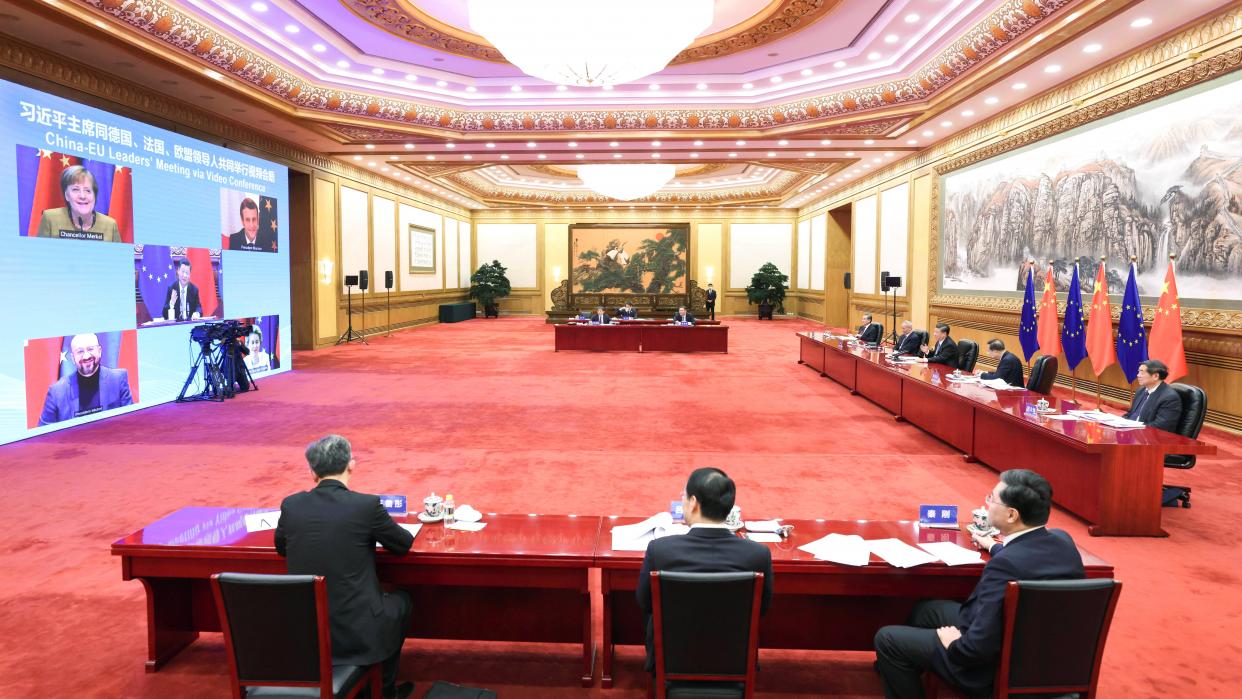
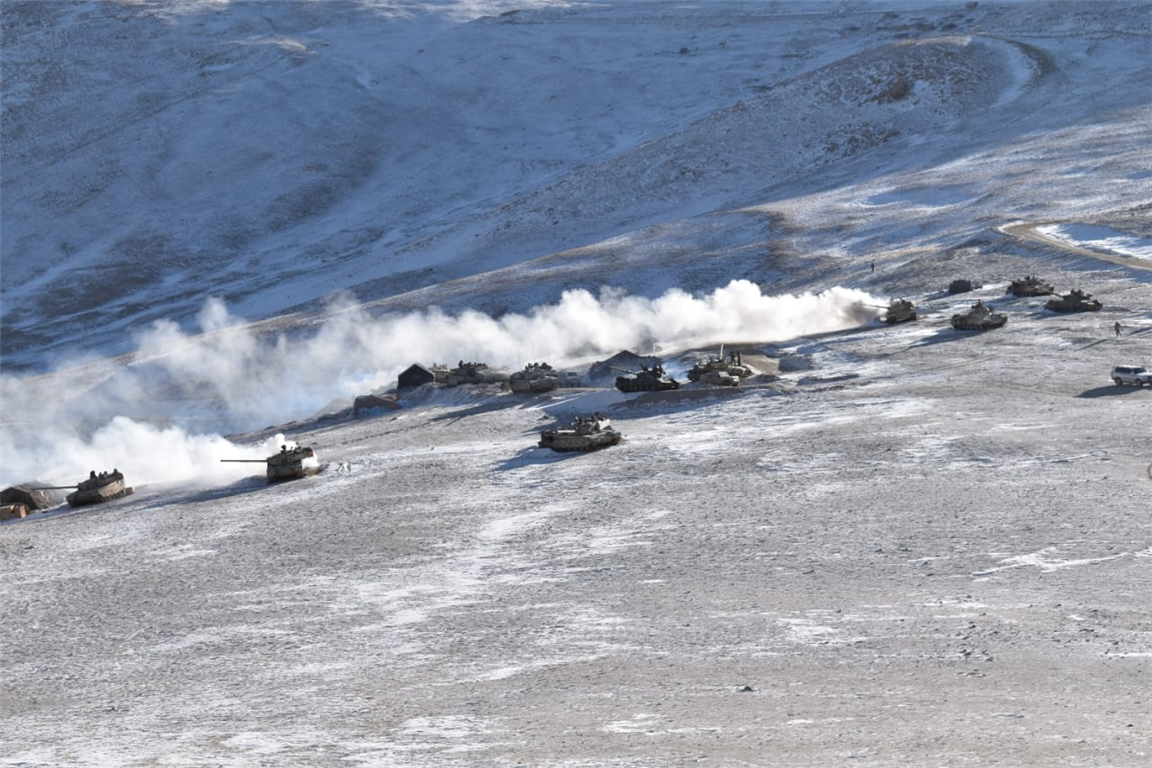
European firms were as much victims of China’s predatory economic and trade practices as American companies. But because Trump made a show of beating down China by himself and because he had sufficiently riled EU capitals by badtalking NATO and poisoning the cross Atlantc partnership generally, the rift between Europe and the US widened and China quickly exploited it. In end-December 2020 in a virtual China-EU summit there was agreement on cross investments, which is now on hold. This because the new US President Joe Biden, in the old presidenial mould, sought to revive a collegial relationship with Western Europe. And secondly, Xi’s China, a little too full of itself, began brazenly to, on the one hand, treat its minorities, especially the Tibetans in Tibet and Uyghur Muslims in Xinjiang with criminal harshness — ethnocide campaigns, concentration camps, etc, showing absolute contempt for human rights, certain its wealthy trading partners would rather make money off China than make an issue of mistreatment of these peoples and, on the other hand, to aggrandize disputed territories on land ( Ladakh, Bhutan) and sea (South China Sea, Senkaku/Diaoyu Island chain).
With the US-European consensus on dealing with China solidifying, the Biden Administration in continuation of the Trump line, has challenged Beijing on a host of issues, making it clear that a hard push was coming. Thus, for instance, China’s soft power arm — the so-called Confucius Institutes that the Chinese government had funded and set up on numerous university campuses in the US and Europe, are being shut down. Ostensibly, these institutes were there to spread Chinese language and culture; except they actually functioned as distant police posts of the Chinese state — keeping tabs on Chinese students, reporting on their public anti-China utterances, and even functioning as facilitators for the shanghai-ing of advanced research carried out on these campuses, among other nefarious activities.
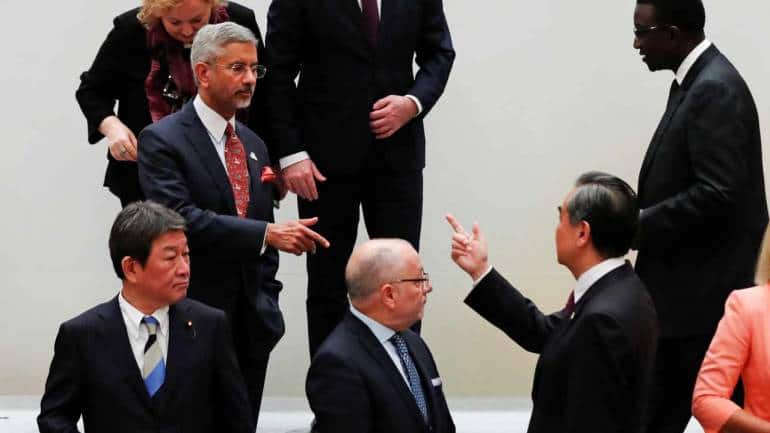
The line between the two blocs was formally drawn at Anchorage in Alaska March 18 where the US Secretary of State Anthony Blinken and the Chinese foreign policy chief Yang Jiechi got into a slanging match with a lot of finger-wagging at each other, with the latter — referencing the January 6 insurrection in Washington DC, the institutionalized ill-treatment of Blacks, violence against Asian-Americans and minority communities in America, newly promulgated laws in various states within the US to make voting difficult for these people, all of which renders nonsensical the theoretical democratic rights enjoyed by all Americans — telling Blinken that China will have none of the Yankee notions of democracy and human rights. And by way of an ‘in your face’-measure, Beijing announced the elimination of elected government in the erstwhile British colony of Hong Kong. Beijing then upped the ante, responding to US sanctions on Chinese Communist party notables of Xinjiang held responsible for the excesses against the Muslim Uyghurs and on the export of Xinjiang-grown cotton — an economic lifeline for that province, by counter-sanctioning US officials and unleasing a domestic campaign against buying Western goods.
Sino-US relations were, in any case, headed south fast. The US Navy is reviving a separate fleet for the Indo-Pacific — the 1st Fleet, and increasing its freedom of navigation patrols in the contested waters of the South China Sea. US Secretary of Defence Lloyd Austin’s recent swing through Asia, other than to find a way out of the Afghan imbroglio, was to firm up a pan-Asian coalition against China. More active than ever before, the Chinese Navy is now using swarming tactics with supposedly civilian vessels to crowd out fast patrol boats and corvettes of the navies of the Philippines and Indonesia, and of Japan around the Senkakus.
These are large geopolitical developments. But underlying them is the human rights and democracy divide alluded to earlier. China and its main strategic partner, Russia, make no bones about their polities not giving a damn about individual rights and freedoms. The West led by the US, on the other hand, make a fetish of them and, ignoring the fairly deplorable state of affairs at home, seek hypocritically to make these issues something of a litmus test. It is hard to impress anyone with such blatant two-faced policy that amounts to using the relative low state of human rights and slide in democratic order as a means of harrassment and diplomatic pressure.
It is in this melee that India finds itself gingerly traipsing around the edges. The problem for the Indian government is this: It cannot credibly claim that excesses are not routinely committed in the country against religious minorities (Muslims), and Dalits and the other lower castes, that the National Register of Citizens in the borderlands of Assam and in the Northeast is not an inherently discriminatory device to select people for conferment of citizenship and the benefits that accrue from such status, or that the Indian State is becoming more illiberal in terms of freedom of expression, and less tolerant of criticism. The US-based Freedom House has accummulated evidence, collated data, and based on this trove of information concluded that India is slipping badly in the democratic sweepstakes. It formally downgraded India from a “free” country to “partly free” — which is really bad considering just how much the Indian government invests in India’s democratic status to finagle all manner of considerations from the West, and specifically in the fight against China. And what must have really hurt the Prime Minister was its assessment that “The changes in India since Modi took charge in 2014 form part of a broader shift in the international balance between democracy and authoritarianism, with authoritarians generally enjoying impunity for their abuses and seizing new opportunities to consolidate power or crush dissent.”
India’s plunge down the freedom list will be diplomatically used to pressure countries such as India sensitive about their ‘democratic’ credentials. Modi’s India has reacted to such slippage by threatening to have its own human rights commission evaluating developments in the US and other countries in the West. This is no bad enterprise to launch to keep discussions with Western governments on an even keel. The ability to counter US/European charges of disrespect for human rights, etc in India by trotting out the obvious patterns of discrimination against “foreigners” and coloured minorities of all stripes makes for a handy cudgel to hit back with. But if the Modi government is really serious about such a counter then an Indian human rights council or commission will have to be constituted as a permanent body that looks everywhere, keeps tabs on all countries. And it will have to publish reports on a regular basis with facts marshalled in an orderly fashion accompanied by sober analysis. Considering most Indian official agencies are a mess, the prospects of such a thing working are dim.
Absent such an institutional counter, the Indian government can do little else than hope that the official soft-peddling of criticism will suffice in pushing the human rights abuse issues to the background in bilateral dealings with the western countries. It can also try and divert attention by making common cause with the West in reprimanding Asian and other countries falling short on democratic and HR metrics. This has obvious dangers that India is now facing with Delhi going a little overboard in admonishing the military junta in Myanmar, for instance. This is bound to have negative repercussions for India and tighten China’s stranglehold on that country. Shedding its initial caution on the displacement by the military junta in Myanmar of the Aung San Suu Kyi-guided government, it suddenly turned around and came out publicly and shrilly against the increasing violence in Yangbon. Instructed by the Jaishankar-ministered MEA, the Indian permanent representative at the UN Security Council, threw India’s support behind the US position and a neighbour under the bus. Rather than limiting himself to urging “maximum restraint” on both sides — which “evenhanded” stance the Myanmarese junta would have appreciated, he formally condemned the military’s violence against the Myanmarese people, no doubt much to Yangbon’s annoyance and Beijing’s delight. It instantly earned India a place in the junta’s doghouse. One wishes Modi’s MEA had left the treatment of Aung San Suu Kyi, et al alone and said nothing at all. Crucifying a neighbouring state for democratic shortfalls sets India up for precisely the kind of political shellacking it has sought to avoid on the receding democracy-front. Because it will not prevent India from being roasted by the American and European do-gooding agencies. So why deliberately shove your hand into a beehive as Delhi has now done on the Myanmar issue and be surprised at being stung?
This sort of unthinking policy to win a reprieve from the US only hurts India’s national interest while increasing the American leverage on Indian foreign and military policies. Myanmar is but a symptom of the larger malaise afflicting the country in the external realm where between China, relentlessly pushing its advantage, and the US, just as strongly motivated to enlarge its “democratic” camp by hook or by crook, India becomes the passive subject of assault by both sides.
The Modi government would be better advised, and India better off, if with China on his mind, Modiji rethought the path he is set out on of aligning closely with Washington — a line that Jaishankar is pushing hard, and instead worked to recover India’s “strategic autonomy”. Regaining such autonomy will not in any way prevent the country from cooperating militarily and otherwise with the US and other interested states to hogtie China. What it will preclude is this tilting to the US position on any and everything as a policy reflex that potentially has high cost in the short, medium and long term. China will try and screw India at every turn for any reason — just because it can, to extract advantage. The Modi government is now ensuring that the US too will punch India around, also because it can and because it wants Delhi to toe its line.
But unlike in the 1950s when India got up everybody’s nose, in the Second Cold War that’s beginning, there’s no Krishna Menon in our ranks rhetorically to skewer China for its genocide in Tibet and Xinjiang, or show up America for its democratic pretensions, and otherwise dance expertly around the human rights minefield. Krishna Menon was a “pain in the ass” for everybody and no one did more harm to the Indian military and the cause of national security than he. But he was also the only Indian diplomatically feared by everyone for his waspish tongue and “take no prisoners”-debating style that frequently reduced those he targeted into angry incoherence.





 Security Wise