

I ask this question because many of us see the dots but don’t connect them. Aakar Patel, a Gujrati and sometime India head of Amnesty International, did in an article after the 2014 general elections about four Gujrati leaders who have — for good or ill — shaped India and its politics. He wittily summed up the Gujju Maha-Four and posed his own question thus: “One hundred years ago, a Gujarati man arrived from South Africa to save Indians from the British. Some years after that a Gujarati man arrived from London to save Muslims from Hindus. Some years after that a Gujarati man arrived to save India from disintegration. This year a Gujarati man arrived to save India from corruption, underdevelopment, lack of hygiene and other stuff. The question is: Why do you people need so much saving? And why must Gujarati Man always have to do it?” considering his state constitutes only 5% of the country’s population. (https://www.livemint.com/Leisure/9bPcjodNrxhX8bZaj7q2wK/An-introduction-to-the-Gujarati-man.html)
Aakar Patel was, of course, referring respectively to Mohandas Karamchand Gandhi, Mohammad Ali Jinnah, Vallabhbhai Patel, and Narendra Modi. His mock-serious query, however, raises an interesting issue of whether there is, in fact, an identifiably Gujrati way of statecraft, just as there’s supposedly a distinctly British way of diplomacy, and of war, or an American way of conducting international relations, or even a Pakistani way of war. Patel identifies the Gujrati trait of showing no talent for war or things military which he attributes to the fact that the last time Gujratis actively took up arms was against the invading Afghan looter Allauddin Khilji and then in a losing effort in 1297 AD. “Useless at fighting, Gujarati Man”, he writes, “has forgotten the smell of freedom, so long has he been under the thumb of Afghan, Mughal, Maratha and Englishman.”
While all the fighting spirit was thus leached out of Gujratis and other Indians in a system of peace imposed by elements external to the state when not foreign to the subcontinent, the natives of Gujrat did what other Indians didn’t do as well — channel the violence and competitiveness natural to homo sapiens into business and politics, until now when the Gujrati brand of business and politics reflects unmatched cunning, ruthlessness and amorality — qualities which if yoked to advancing national security, for instance, would have done the country a lot of good. Instead, Gujratis in particular became productive camp followers of the British in their colonizing efforts in Africa, opening up the African hinterland to petty commerce with their “dukus” and earning the eternal hostility of black Africans as exploiters (which is evident to this day in Kenya, Tanzania, and Uganda). The Maha-Four characterised these Gujrati qualities in their politicking on the national scene.
This Gujrati behaviour was, however, unlike that of the other people in what was pre-1947 India, who seemed so beaten down and sapped of will the British were surprised at just how easy it all was, how owing to very little resistance from the locals, they had taken over India. When not in a triumphalist vein attributing the acquisition of this territorial jewel in their crown to the manifest destiny of an all-conquering race, the British pointed to the “cowardice” of “the Hindoo” — an agnostic description, incidentally, to cover all the peoples of India — Hindu, Muslim and others alike, as the reason for their success.
Robert Orme, the historian who as secretary to Robert Clive travelled with him on his military campaigns in the Gangetic Plains wrote after the Battle of Plassey (1757) that brought down Sirajudaulla, Nawab of Bengal, and laid the foundations of the British Raj, that the Indian was the “most enervated inhabitant of the globe [who] shudders at the sight of blood, and is of a pusillanimity only to be excused and accounted for by the great delicacy of his configuration.” It was an impression reinforced by the vegetarianism practised by many Hindus, which is also of paramount social concern in Gujrat. Except, the passivity and pacifism displayed by the Indian populace was only for the firangi because Indians, whenever permitted to do so, happily cut each other’s throat, driven by localised animus that curiously spared the British during the Raj. It was a short step from there for Rudyard Kipling by the end of the 19th Century to commend colonialism and to enjoin the US to carry the “White man’s burden” until then supposedly borne manfully by Britain, of bringing order to much of the world peopled by “lawless breeds”.
So, what has this bit of social-colonial and imperial history got to do with with Gujrati statecraft? Every thing!
Central to the Gujrati mindset is “dhanda” — business — and the pursuit of personal profit. By its very nature, it involves genuflecting before the powerful and compromising and conciliating with them and, generally, avoiding activities disruptive of good relations, like tension-mongering, violence and war. In this context, posturing is permitted, not so taking matters to a breakdown of ties. And should things not work out, to consider use of force but only against the weak.
Judging the main actions of each of the first three among the Gujju Maha-Four by the above metric reveals that (1) the three freedom movement leaders — Gandhi, Jinnah (until the 1920s) and Patel were, like all members of the Indian National Congress, collaborators with the British who did not believe in, nor advocate, the violent overthrow of the Raj but were committed to winning freedom legally, through “Constitutional means”, i.e., by working within the limits dictated by the British, (2) Patel, ever the practical Gujrati, pushed for Partition based on his experience of Muslim League ministers making the Nehru-led Interim government (1946-47) non-functional, this even as Gandhi, typically sent mixed signals about conceding Pakistan (and Jawaharlal Nehru opposed it); (3) Patel, unlike Nehru, also supported the giving of Jammu and Kashmir to Pakistan in return for Jinnah accepting Junagarh and Hyderabad in India, and was for a complete exchange of populations to enable India and Pakistan to emerge as wholly Hindu and Muslim respectively, which proposal was negatived by Nehru, and (4) Gandhi, Patel and Jinnah all trusted the English enough to want continued close association with Britain after independence despite Britain’s horrific colonial record — an intolerably demeaning system of racial apartheid, its long standing policy of sharpening Hindu-Muslim differences eventuating in the bloody partitioning of the country, and sustained looting of India and transfer to Britain of unimaginable wealth that, in current value, amounts to some $47 TRILLION according to recent calculations by the Columbia University economist Utsa Patnaik.
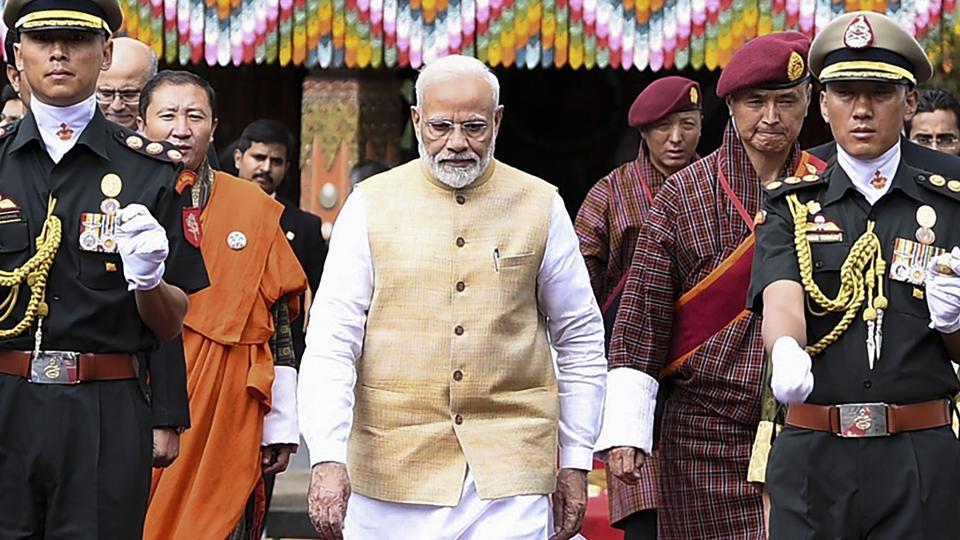
A similar pattern of behaviour fueled by the same dhanda imperative informs Modi’s actions and policies. Consider this: Very like Gandhi, Jinnah and Patel, Modi is very mindful of appeasing the powerful, taking care not to upset or alienate either the US or China, and reluctant to respond aggressively to even the direst provocation offered by them.
Thus, notwithstanding the American record of over 60 years of subterfuge, sabotage and stratgems that, in the main, sought to “balance” India in South Asia by conventionally arming Pakistan, and to keep India non-weapons nuclear, failing in which aim and for the sake of restoring “balance”, approving China’s transfer of nuclear weapon and missile technologies and design expertise to Islamabad, and the fact that the US pressured the Congress party regime of Manmohan Singh to refrain from reacting to the seaborne strike on Mumbai by Pakistan ISI-sponsored terrorists, Modi trusts America to do right by India.
Modi, from day one in office, courted the US, going out of his way to accommodate Washington by aligning Indian policies with US strategic interests. He signed the three “foundational accords” — LEMOA, COMCASA, BECA, for instance, that could result in US armed forces utilizing Indian bases for military operations in the Indo-Pacific — the reason why his Congress party predecessor Manmohan Singh refrained from doing so because he felt it was politically risky.
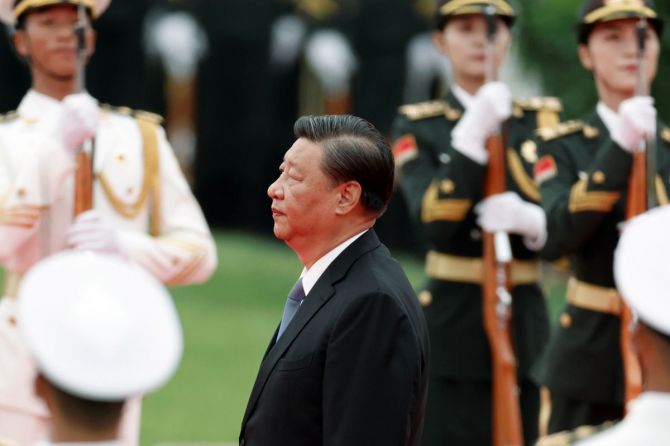
And Modi very early bought into Xi Jinping’s transparently bogus line of a concert of India and China for the greater good of Asia. This was to be cemented by the airy promises Xi made in Wuhan and reiterated at the Mammallapuram summit of tens of billions of dollars worth Chinese infrastructure investment funds to turn India into another version of Shanghai. A Prime Minister would have to be particularly naive and gullible or, as is more likely, predisposed to act in this way, to fall for this Chinese approach. But Modi fell for it.
His belief in the value of friendship with China is such that he has persisted with the policy of not demanding recognition of “One India” inclusive of all of Jammu & Kashmir for recommitting to the “One China, two systems” that Beijing has flogged, and with the “No tit- for-tat” policy — of not responding in kind, even if belatedly, to Beijing’s proliferating nuclear bombs and missiles to Pakistan by speedily onpassing nuclear warheaded medium and short range missiles and other armaments to countries on China’s border — Vietnam, Indoensia and Philippines. And, two years into the Chinese absorbing 1,000 sq kms of manifestly Indian territory in the Depsang Plains adjoining the Karakorum Pass in eastern Ladakh and the construction of “villages” on disputed territory in Arunachal Pradesh and in the trijunction area with Bhutan, he remains unwilling to even admit the Chinese PLA have annexed Indian land. And, far from instructing the army to vacate the Chinese military presence from Ladakh by any and all means and at whatever cost, he has, in effect, formalized the Chinese claim lines on the Pangong Tso by coupling the withdrawal of PLA units from terrain features — Fingers 3 and 4 — on the northern shore of the lake, with the retreat of Indian SFF units from the Kailash Range, thereby losing India a major foothold and the last vestiges of negotiating leverage with China.
So, OK, Modi is a realist about Indian military capabilities and aware of the difficulty of forcibly removing the PLA from Indian real estate. But why did he have to walk the extra mile to second Beijing’s stated position that its army had not intruded into Indian territory even an inch by, in fact. claiming “Koi andar ghus ke nahin aya hai”? In any case, one can see why Xi desires rapprochement with Modi’s India (on Chinese terms, of course).
Meanwhile, our esteemed foreign minister S Jaishankar, conforming to the PM’s policy proclivities, mouthed inanities such as his contention that Sino-Indian relations were going “through a bad patch”, as though the dispute with China is some small clubhouse disagreement at the Delhi Gymkhana about which the Indian government does not need to be disagreeable. And, that Beijing has understood the message he has been trying to send since the Galwan encounter first came to light in May 2020 that the restoration of territorial status quo ante is the precondition for resumption of normal relations, as if China cares two hoots for the return of normalcy because even a supposedly strained relationship has not hurt annual Chinese exports to India, which remain in excess of $70 billion. So, what’s the incentive for China to pullback its forces from the sizeable area it has grabbed? In other words, Jaishankar’s self-proclaimed clear messaging has not registered on Beijing.
And as regards the US, Jaishankar has assumed the role of America’s bullhorn in the region. Addressing a Bloomberg economic event November 19, unprecedentedly for India’s foreign minister, he justified the US posture, calling the reality of a strategically receding America, post-military defeat in Afghanistan, “ridiculous” and advising the audience “not to confuse” the ongoing global “rebalancing” with USA’s “decline”. He sounded verily like an earnest junior public relations staffer at the US Embassy! This was ineffably sad both because of the optics and because of substance, considering US President Joe Biden and the newly designated “Helmsman”, Xi, had decided in their November 15 virtual summit “to chart a more positive course” as reported by the US Institute for Peace. Meaning, Washington is prepared to cut a seperate deal with Beijing, leaving its Asian allies and strategic partners, including India, to scurry around to secure their own interests the best they can!
Then again, if you don’t acknowledge a problem, it doesn’t exist!





 Security Wise