Agnipath: Seminal Reset Now, But More Problems Later

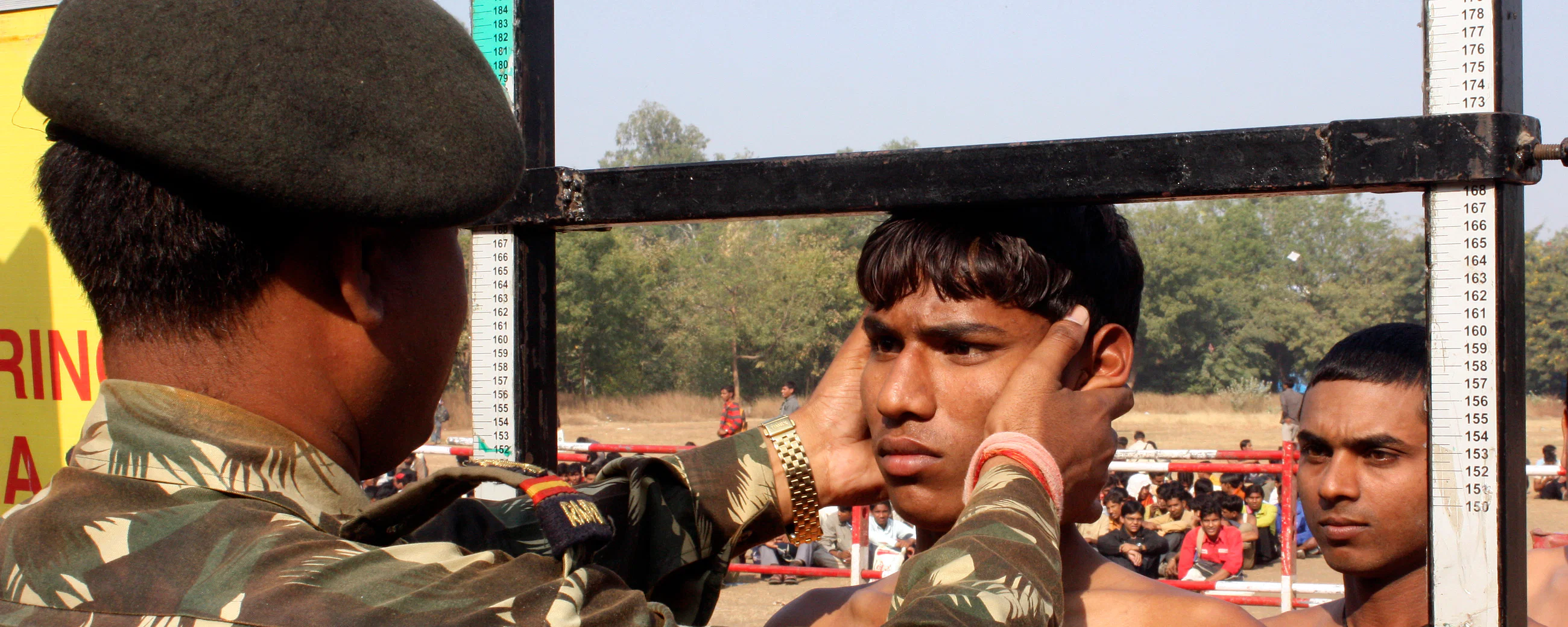
An Indian army officer measures the height of a youth during a recruitment drive in Ahmedabad.
(Photograph: REUTERS/Amit Dave)

Agnipath – the scheme for a four-year ‘tour of duty’ as the mainstay of recruitment into the military services announced by Defence Minister Rajnath Singh the other day, alas, has more negatives attending on it than clear-cut benefits.

Shedding Colonial Structures

The pros first: It is a seminal attempt at reconfiguring the imperial-era structured mercenary army that had won for the British their globe-girdling empire. In its post-1947 avatar, the Indian Army continued with its colonial institutions and affectations, such as the officers’ mess and cantonment culture, that has long irked Prime Minister Narendra Modi and is, perhaps, the prompt for this underway policy to ‘Indianise’ the military.

National armed forces comprising sometime soldiers, Agniveers, may constitute—in one sense—a genuinely citizen military. But whether it will obtain an effective modern army, navy, and air force is an issue deserving attention.

It will be intriguing, in any case, to see how the army chief, General Manoj Pande, a veteran sapper, proposes to re-engineer the infantry-heavy army dominated by proud, single class, regiments (Gurkha, Sikh, Jat, Madras, Maratha, etc.) deliberately designed during the British Raj on the politically astute but divisive myth of the ‘martial races’ into an army of Agniveers.

Three Vastly Different Services

Rajnath Singh was joined at the podium by the three services’ Chiefs of Staff. But let’s be clear that it is the infantry-heavy army – the least technical among them, that will mainly take in the short service recruits because the navy and air force simply cannot be expected to do so. Their relatively small manpower requirements coupled with technology-based wherewithal and war fighting concepts deter them from following Agnipath.

Ironically, it is precisely the technical expertise imparted to entrance-level sailors and airmen in esoteric technologies to enable them in peacetime and war, to operate systems of all kinds (sonar, avionics, radar, communications, etc.), to run and maintain warships and aircraft, to upkeep powerplants and weapons and secondary systems onboard varied platforms, and otherwise to keep the Indian Navy and the Air Force in play, that makes them more readily employable in the civilian world should any of them seek an early exit from military careers or a second career post-retirement.

In other words, many of the positives Rajnath Singh claimed for the Agnipath programme, such as producing technically competent, high-tech workers that industry would gladly offtake and who will end up increasing labour productivity, and spurring industrial and GDP growth, etc., are an exaggeration. Because it is certain that the 25% of the Agniveer cohort who show any talent for technology will be retained by the army to run its high-tech equipment.

The reason for this is because of the differing nature of warfare the three armed services prepare for. While air and naval warfighting are, as mentioned, machine-intensive, land wars are manpower weighted. An army needs unending hordes of preferably youthful ‘boots on the ground’ to fight for and hold mountainous territory against a hostile China.

Moreover, training a person with a high school or higher education to handle an assault rifle and to master basic infantry tactics is manifestly easier, takes less time, and costs far, far less than getting a newly minted sailor to become an expert, say, in sonar operations or to turn an airman into a proficient combat aircraft jet engine mechanic

What After The Four Years?

The average Agniveer may join with the idea of achieving some technical competence at the end of four years of service, but will soon discover he is only another passed-over infantry grunt with no marketable skills to sell, other than—as is the case now—as a hire for the proliferating private agencies in the business of providing ‘security’ to buildings and compounds.

In the event, how much of an incentive is the Rs 12-14 lakh bounty promised the Agniveer at the end of his brief army tenure? Of course, Rs 12-14 lakh is not a sum to be sneezed at. For the masses of otherwise inadequately-educated and unemployable youth, this money is magnet enough. But as roughly 30,000 of each year’s Agniveer cohort—the current level of army retirees—is disgorged into the society two things might happen, neither of them good.

Discontent will spread fast among them once they realise their job prospects are as bleak as ever. The frustrated among them, now trained to use small arms and chemical explosives, may choose to use these newly acquired skills for criminal, even insurrectionary, purposes and emerge as a major law and order-qua-internal security problem for the country.

Or, and this is more likely, political pressure will begin brewing – grassroots up, almost from the programme initiation stage, especially in the population-dense, voter-rich, Uttar Pradesh and Bihar, where the Agnipath intake can expect to be the largest – to convert the four-year contracted tenure of the Agniveers to 15-year military service with pension.

This is the usual end-state of all supposedly ‘temporary’ government workers ranging from clerks, school teachers, safai karamcharis to anganwadi helpers.

Compounding The Problem You Set Out To Solve

Is there a politician alive who will be able to resist such pressure, in an election year (which is nearly every year)? And, lo and behold, the army will become still more bloated, and the defence pensions budget more distended. The harbinger of things to come is the violent anti-Agnipath protest in Uttar Pradesh and Bihar. The youth demographic seems to be saying that patriotism and military service are good but they prefer pensionable jobs anywhere they can get them.

The Agnipath scheme designed to solve the problems of an aging army and ballooning defence pensions could end up, at best, only compounding them.

More immediately, assuming General Pande needs six months to firm up the new recruitment process, the Agniveer army could begin forming up only by next year or even by 2024 when the next Lok Sabha elections are due. Who is to say Agnipath won’t win Modi yet another term in office with a bigger majority, even if it means succeeding governments and the Indian taxpayers are left holding the can?


A version of this piece published 16 June 2022 in BloombergQuint (BQ) Prime, at https://www.bqprime.com/opinion/agnipath-seminal-reset-now-but-more-problems-later

Posted in asia-Pacific/Indo-Pacific, Asian geopolitics, China, China military, civil-military relations, Culture, Decision-making, Defence Industry, domestic politics, Geopolitics, geopolitics/geostrategy, guerilla warfare, India's China Policy, India's strategic thinking and policy, Indian Air Force, Indian Army, Indian democracy, Indian ecobomic situation, Indian Navy, Indian Ocean, Indian Politics, Indian state/administration, Indo-Pacific, Internal Security, Military/military advice, society, South Asia, technology, self-reliance, Terrorism | 19 Comments

The Army’s sizing dilemma

Indian Army Recruitment 2018: Indian Army recruiting for multiple posts;  July 16 last date to apply

[An army recruitment rally]

An attribute of a poor over-populated Third World India, where a majority of the people still eke out a marginal existence is that no job, however dangerous, goes unfilled. It matters little if that vacancy is in the public or private sector, or how menial and risky it is. For those living hand to mouth — some 70% of the population of 1.3 billion, any job is better than not having one.

The most sought-after jobs for the masses of the barely literate unemployables, including cleaning sewers, sweeping city lanes, laying railway tracks or dumping hot bitumen to make roads in the heat of the noonday sun, are where the government (central, state, municipal) is employer. Because they promise a steady income and pensionable retirement.

Then there are the railways and the defence services — the two biggest central government employers.

The railways have 1.26 million persons on the payroll. The railway retirees totaling some 1.55 million people exceed the 1.25 million in active service, and the pension costs amount to some Rs 53,000 crores — fully 25% of the revenue of the railways (in 2021), with monthly pension averaging Rs 9,000.

55,000 personnel retire annually from the 1.4 million strong armed services, with defence civilians being in larger proportion. (The defence civilian was discussed in the previous post.) It has resulted in a perpetually growing defence pensioner community that has now ballooned to 2.6 million retirees. The average annual defence civilian pension is roughly Rs. 5.38 lakhs versus Rs. 1.38 lakhs for military pensioners, reflecting longer career spans for the former. 

The trouble is public and political pressure is the greatest on the railways and, especially, the armed services, to if not increase their manpower requirements than NOT to reduce them, nor in any way to restrict youth offtake from the traditional recruiting areas of Punjab, Haryana, et al. It is one of the reasons for India remaining stuck with a populous, industrial age, army that seems incapable of transforming itself into a force capable of cyber age warfare of the near future featuring Artificial Intelligence (AI), drone swarms, and autonomous weapons systems. This is so as much for want of political will as of financial and technological resources. The choice therefore is between investing in growingly expensive manpower, or in new fangled technology and exhorbitantly-priced in-date armaments.

Now collate the fact of a resource-constrained army with the nature of the youth demographic in the country. The “youth bulge” of a few years ago is flattening out. Young men and women below 25 years of age comprise half of India’s population. But of this 50%, the cohort in the 19-23 years age group — the feedstock for the army, actually peaked at 127 million last year (2021). Decreasing fertility rates owing to increases in education levels of women and their entry into the workforce is why. That is good news.

But this development in no way lessens the impact of the factors exacerbating the unemployment problem. The most devastating of these is the sub-standard education system mass-producing, for all practical purposes, illiterates. Instead of citing bone dry statistics, let me reproduce here an illustrative example of the tragedy being played out all too often in this country of too few even lowest category government jobs being chased by far too many supposedly well-degreed youth, featured in a monograph on India’s “demographic burden” by a French political scientist, Christophe Jaffrelot. “When the Indian Railways announced that it would create 63,000 jobs – all situated in the lowest level of its employment ladder”, he writes, “20 million candidates applied, including 419,137 BTech degrees holders and 40,751 people with master degrees in engineering.” That is 318 applicants for each of the 63,000 “trolleyman” or track labourer jobs on offer! He doesn’t mention the riots that occur, albeit irregularly, at railway and army recruitment centres and rallies.

What this says about the “BTech” and “Masters” degrees liberally dispensed like so much confetti is best left unsaid. But the effect on those 19 million odd youth in the above railways case who failed to get even the meanest job they applied for, must be devastating. It highlights what I have in the past written about — the urgent need for the government to stress vocational training obtaining persons with skill-sets ranging from the quotidian (plumbing, electrician work) to really high-value (high-pressure welding, care and maintenance of robotic machines, etc.) with strict professional certification standards geared to industry needs. Instead, thanks to government policies a fairly unregulated educational sphere thrives with literally hundreds of thousands of colleges in just as many rinky-dink universities yearly pushing out into the labour market unimaginable numbers of unemployable youth with degrees in all sorts of disciplines that count for less than nothing. The analog here of students at the lower secondary level (according to newsreports regarding Delhi government schools which, incidentally, are among the better-run school systems in India!!) — Class 5 students unable to read Class 2 texts, or to do a simple division.

In any case, it is the 19-23 year old youth cohort at the centre of the latest army recruitment policy innovation that’s apparently being considered by the government. In order ostensibly to curb the defence payroll and pensions spend, it proposes a binding contract for all army recruits of four years service, with only a quarter of every cohort being retained after the initial 4-year tenure for longer service with the proviso that the time pulled upto that date of service extension is not counted for purposes of remuneration, seniority, promotion, retirement benefits, etc.

This is, for obvious reasons, a singularly silly scheme and has the fingerprints all over it of the Niti Ayog caboodle run by that glib, voluble, jargon-spouting super-annuated civil servant — Amitabh Kanth, heading it. It is unlikely any uniformed brass took it seriously. In any case, it was leaked to the press to ascertain the public reaction — the usual kite-flying exercise the government occasionaly indulges in. It has elicited a lot of heated responses.

Particularly noticeable was the reaction of a retired armoured corps officer, Major General Bishambar Dayal, in a May 29 Hindi TV news programme debate on the subject. He was so agitated, it is a wonder he wasn’t marched off from the TV studio to the police station charged with violating the infamous sedition law — Section 124A of the Indian Penal Code.

Dayal first hinted reasonably that army HQ had no part in cobbling this 4-year “tour of duty” service concept. He then ranted — going seriously akilter as he went along — that the Indian army has never relied for success on technology as much as it did on highly motivated jawans. And how this idea of short term trooper level service system being proposed would blow up the traditional “naam, namak, nishan” basis of unit proficiency. He topped it by well, inciting — there’s no other word for it — the youth to come out on the streets to compel the government and the army to back down. When questioned he sheepishly acknowledged, however, that the prevailing policy of 15-year colour service with lifelong pension to follow of a manpower-intensive fighting force may not, after all, be sustainable. (Refer https://www.youtube.com/watch?v=OnsqzvCkezA )!

The most alarming aspect, even more than his call to arms, as it were, to Indian youth, all rendered in thunderous fashion, was his view that the army had to retain its basic nature as primarily an employment generator and social escalator particularly for rural youth — because, he raved, the jawan is the “brahmastra”, not weapons or technology, and that, by implication, that any army plan to transition to a more compact, technologically in-date, fighting force, is to go down the wrong track! His opinions, perhaps shared by many other officers and Other Ranks, reveal the inertia the army appears to be cocooned in.

But in one respect Dayal is right. Right-sizing the army cannot be effected on the basis of a slapdash proposal sans thought such as this one, put together by God knows who, but needs to be done on the basis of a detailed study by the CDS secretariat to see the extent to which the current strength of the army and of specific combat arms and technical and other cadres can be pruned partially or fully to accommodate automated weapons systems driven by AI in the order-of-battle. Decisions will also have to be made about such parts of the military’s functioning that can be out-sourced based on their econo-military effect and consequences, and accordingly to alight on a force restructuring plan and programme.

Then again, if economizing on the forces and curbing expenditure on payroll and pensions is the immediate and urgent goal, why not revert to the original 5/7 year colour service the army had followed up to the 1970s before the lifetime employment notion was implemented, hurting the army’s agility, stamina and edge on the battlefield?

Indeed, in the classified report on defence expenditure as Adviser, defence expenditure I had prepared for the 10th Finance Commission chaired by the former defence minister, the late KC Pant, I had flagged the issue of pension costs soon outpacing the combined military modernization costs on capital account and the running/maintenance costs on revenue account. I had outlined a schemata for streamlining manpower management and flow from the army to the paramilitary forces and state police armed constabulariries. The Narasimha Rao government in 1995 had accepted that report in toto,

It was really a simple arrangement that was articulated. An average jawan after 7-year colour service would join the reserve but concurrently, after a short reorientation training for civilian law & order duties, join the paramilitary organization with vacancies for service until retirement. Because the demobilized and already skilled jawans would need no weapons, tactical, or technical training (signals, maintenance, logistics, etc), it would save the national exchequer huge sums of money currently spent on training and on related establishments of the Indo-Tibetan Border Police, Border Security Force, Central Reseve Police Force, Industrial Security Force, et al all controlled by the Home Ministry. It would result, I contended, in these paramils becoming more effective in the field and displaying unit coherence and discipline — an inherent carryover from army service, that is not as readily evident in these paramilitary organizations. The financial benefit would be that the pension payout on military account would be deferred, leading to considerable cuts in defence pension allocations.This plan, suitably amended, deters pension-seeking by men in their late twenties, and needs only to be dusted off, fleshed out, and brought up-todate.

The core idea in it is to establish the army as the sole source of trained and skilled armed manpower for not just the central paramils but all state armed police units, including the police Special Forces (such as the Andhra Pradesh state police’s Greyhound force) active in counter-insurgency role. There is an in-built integrity to this scheme of armed manpower management that’s missing in current atomised arrangements that end up being a drain on financial resources and a waste of skilled military manpower — neither of which India can afford.

The positives of this model notwithstanding, it has no chance realistically of being adopted by the governments at the centre and in the states all of whom zealosuly guard their separate recruiting turfs because it is in the paramilitary and state police recruitment that politicians can exercise their power of patronage, besides having armed forces they can command and control.

So, the present way of doing things will be persisted with. Myriad paramils each with its own “culture” and “ethos” and, ironically, a desperate desire to be like the army in all respects — arms training, uniforms, insignia of rank, procedures and protocols end up being what they are — bad copies of the original. Moreover, because the paramils are run by Indian Police Service officers, these domestic law and order forces responsible for internal security end up with the characteristic ills of the Indian police, including corruption, lax operating style, and a “dheela-dhala” attitude.

Posted in asia-Pacific/Indo-Pacific, Asian geopolitics, China, civil-military relations, corruption, Culture, Cyber & Space, Decision-making, guerilla warfare, Indian Army, Indian ecobomic situation, Indian para-military forces, Intelligence, Internal Security, Military/military advice, society, South Asia, space & cyber, Special Forces, Terrorism, Weapons | 31 Comments

Modi Govt @ 8| Two vexing defence problems the Narendra Modi government has dealt with

Under the Narendra Modi-led government, we have seen a refreshingly bold departure from the past when governments seemed unwilling to deal with two defence-related problems: the pension issue, and the more debilitating matter of reliance on foreign arms 

————————

May 26 marks eight years since Narendra Modi became Prime Minister of India,
and since 2014 a Bharatiya Janata Party (BJP)-led National Democratic Alliance
(NDA) government has been in power at the Centre. Where defence and national
security are concerned, the people of India have been told that this government
is sufficiently alert and effective in protecting national interests and
territory.

The government has proved particularly adept in wrapping itself around the
flag and associating with the military. Unwittingly though while resolving some
longstanding issues, other equally baffling problems have been created.

The government has delivered, for instance, on its ‘One Rank, One Pension’
promise — a nettlesome issue previous governments kicked down the road for want
of financial resources. In the 2022 defence budget of Rs 5.25 lakh-crore, the
Rs 1.19 lakh-crore pensions bill combined with the outgo on payroll expenses
exceeds the spend on force modernisation and maintenance costs. Should this
trend continue, India will soon be able to afford either an adequately sized
force, or the weapons to equip it supported by minimal stocks of spares and
ammo — not both.

It may be recalled that based on the projected economic growth rate, and
assumption of annualised 10 percent increase the defence budget was expected to
reach the 3 percent GDP level recommended by the 11th Finance Commission by
2004. In reality, the defence budget has stagnated at the 2-plus percent of GDP
level, and budgetary increases have barely kept pace with inflation. The
result: No buck, no bang! Still the armed services have managed somehow to
contend with live, disputed, borders with China and Pakistan. How well? Don’t
ask.

There is a simple two-pronged solution that has not so far occurred to the Government of India. First, to match the military manpower cuts, the strength of 400,000 ‘defence civilians’ employed by the Ministry of Defence (MOD) should be slashed by half. India needs DRDO scientists, engineers, and the like, but can do without the horde of peons, clerks, stenographers, and section officers clogging up the MOD and other government offices everywhere. Official business conducted through a safeguarded computer network will eliminate the hopeless files-system and the endless numbers of babus associated with it, and coffee/tea machines can replace peons, and improve the MOD’s dismal operating efficiency.

Second, the defence civilian pensions should be shifted to the Government of
India administration pensions account, thereby, at a stroke, freeing up roughly
80 percent of the defence pensions bill monopolised by retired defence
civilians. It is monies the armed services can utilise to sharpen their
war-fighting capability.

Through these two steps the Prime Minister can be credited for, (1)
modernising the Indian military, making it razor-sharp, without raising the
defence allocation, (2) digitising and de-bureaucratising the MOD (as a test
bed for upgrading the government’s conduct of business), and; (3) removing the
demeaning caste-like hierarchy featuring low-grade workers.

The other major change in the defence sphere is the drive to make India
self-reliant in armaments. Again, Modi had the right idea with his aatmnirbharta policy.
Except, in the years since he mooted it, there has been more confusion and
drift than genuine progress; a situation not improved by a series of updated
defence procurement procedure documents issued by the MOD that regularly trip
up Defence Minister Rajnath Singh and ministry officials as much as they do the
military brass and public and private sector defence industrial companies.

No one is quite sure what aatmnirbharta means. Do foreign
companies producing dated military products (F-16 fighter plane, say) fit the
guidelines? But doesn’t that undercut the objective? To compound the confusion,
Singh in the past year has released lists of military goods the armed services
can no longer import, including major weapons systems such as helicopters,
artillery guns, warships, and submarines. It is supposed to encourage
in-country research, design, development and production of advanced weaponry,
and support systems, save the country tens of billions of dollars in hard
currency, seed a vibrant defence industrial ecosystem to meet the armed
services’ equipment needs, to generate export revenues, and have a multiplier
effect on the rest of the economy.

Singh’s negative lists, prima facie, suggest the government wants results
fast, to obtain which it is prepared to throw all concerned parties into deep
water, and hope they learn to swim. This, incidentally, is the correct approach
to shock the armed services, the MOD, and defence public sector units,
habituated to weapons systems screw-drivered from imported completely knocked
down (CKD) and semi-knocked down (SKD) kits, out of their licensed manufacture
comfort zone.

Denied the import option, the military will have to take ownership of
indigenous weapons projects and, crucially, prepare to fight with
Indian-designed armaments that may not initially meet the foreign weapons
standard. It is an unavoidable stage in making aatmnirbharta work.

The Modi years to-date have seen a refreshingly bold departure from the past
when the government seemed unwilling to deal with the two main tasks at hand,
namely, the pensions issue that had the entire military community up in arms,
and the more debilitating matter of reliance on foreign arms.

The solution for the first problem was enabled by the government’s readiness
to sequester the necessary funds and take a financial hit, and for the second,
was the decision to kickstart the Indian defence industrial economy by closing
off the imports channel, and incentivising the public sector and private sector
companies with promise of full order books. India may finally be on the way,
hiccups apart, to consolidating its military power.

———-

Published May 25, 2022 as part of a series of articles assessing 8 years of the Modi government in Moneycontrol.com, at https://www.moneycontrol.com/news/opinion/modi-govt-8-two-vexing-defence-problems-the-narendra-modi-government-has-dealt-with-8572091.html 


Posted in arms exports, asia-Pacific/Indo-Pacific, China, China military, civil-military relations, Culture, Decision-making, Defence Industry, Defence procurement, domestic politics, geopolitics/geostrategy, Great Power imperatives, India's China Policy, India's Pakistan Policy, India's strategic thinking and policy, Indian Air Force, Indian Army, Indian ecobomic situation, Indian Navy, Indian Politics, Indian state/administration, Indo-Pacific, MEA/foreign policy, Military Acquisitions, Military/military advice, Pakistan, Pakistan military, society, South Asia, Strategic Relations with the US & West, Technology transfer, technology, self-reliance, United States, US., Weapons | 13 Comments

A ‘get to know’ Quad summit and the missed US-2 opportunity with Japan

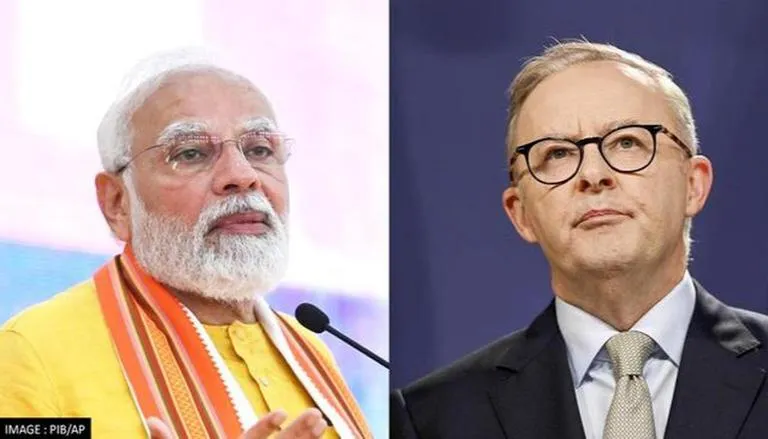
[Modi and the new Australian PM, Anthony Albanese]

One of the reasons the outgoing Conservative party prime minister Scott Morrison quickly conceded the elections was to give Canberra the time to prep the incoming Labour party PM, Anthony Albanese, for the Tokyo summit of the Quadrilateral heads of government, May 23-25. But, however, successful the Australian Foreign Office is in bringing Albanese upto speed, it is unlikely he will have crystalized his party’s views on anything as to begin negotiating substantively with his Quad counterparts, even less to commiting Australia to new initiatives. Especially because, it is still not certain that the ruling Labour Party will have a majority and have its own government, or whether Albanese will have to make-do with a coalition government with smaller parties and independents, which will necessitate policy compromises.

In the event, much of the summit will be spent with the Indian prime minister Narendra Modi, US President Joe Biden, and Japanese Prime Minister Fumio Kishida, who technically is the most experienced of this lot of leaders in both foreign and military policy fields, getting to know the new Australian leader. Kishida was foreign minister from 2012 to 2016 in Shinzo Abe’s government and in 2017 pulled time as Japan’s defence minister.

But niceties apart, there are certain things about Albanese that will help him resonate with Modi. In his acceptance speech, he reminded the audience about his humble background — he grew up with his mother who is a “welfare pensioner” — something that’s bound to stir Modi’s empathy and fellow-feeling. Moreover, his promise to make his country “a renewable energy superpower” — meaning hydrogen, solar and wind power, parallels Modi’s own agenda of making India a leading “hydrogen power” by 2050. This could be the context for substantive collaboration in developing renewable energy technologies and, foreign policy-wise, will be the low-hanging fruit Modi and Albanese can pluck.

However, on issues relating to the Quad’s raison d’etre — containing China by all means, particularly military, there may be chasm between Australia and the other Quad members. With Morrison’s single-minded security-oriented approach missing from the Tokyo pow-wows, a wishy-washy attitude may prevail vis a vis collaring China. The work will thus be cut out for Biden to persuade Albanese to, at least, continue with Morrison’s policy of permitting the northern Australian coast to be built up as an extended staging area for American and other Quad air, naval, and land forces. In fact, to thwart the Chinese PLA, navy and air force from acting up in the South China Sea and, precipitously, against Taiwan, the US Army already has over a thousand troops stationed in Darwin. This port is also being configured to host US navy’s nuclear-powered attack and cruise and ballistic missile-firing submarines. How Albanese will dovetail these aspects with his government’s economic imperative to ease relations with China,is a matter of conjecture.

But given that the Australian economy has slowed down considerably — the main reason for Morrison and his party losing the elctions — and is in need of a quick “pick me up”, reopening the Australian market to Chinese goods is a fix Albanese will opt for. Chinese exports in the last 20 years registered a double digit annualised growth rate, in 2020 touching some $58 billion. In turn, Albanese will hope Beijing opens the tap for Chinese investments in the extractive and other industries and otherwise kick-start the Australian economy. Aware of the wind blowing its way, Beijing has already begun to incentivize this trend by increasing Australian revenues from importing, in the main, Australian grain, gas, iron ore, and coal. The intent, no doubt, being to weaken the security cooperation aspects of the Quad that the Xi Jinping regime has publicly voiced its displeaure against. Indeed, it is the fear of provokng China that thas resulted in both Delhi and Tokyo tippy-toeing around the military objectives of the Quad.

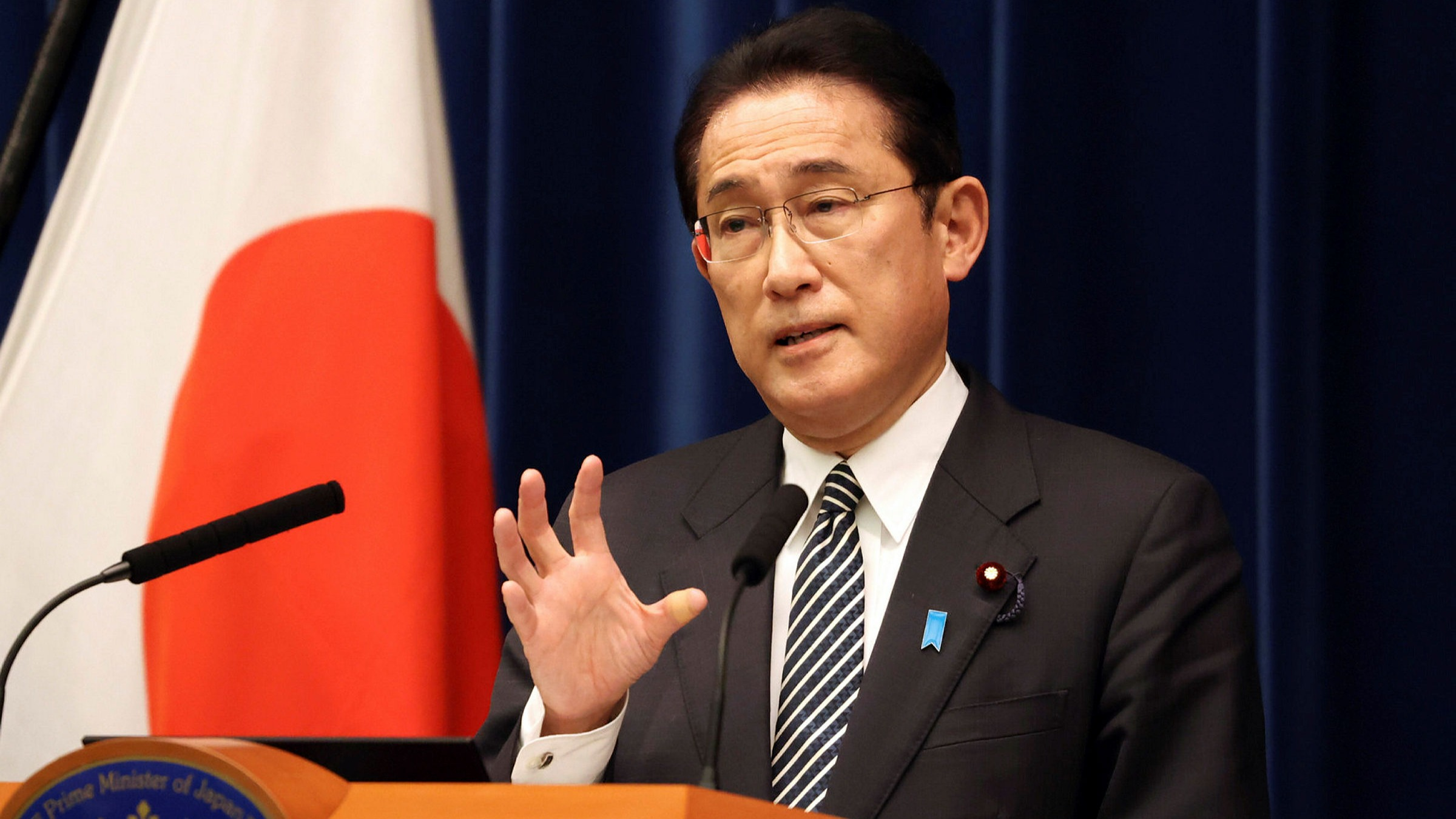
[Prime Minister Fumio Kishida]

And it is precisely this fear of China that has been the biggest stumbling block in ratcheting up the India-Japan strategic partnership. In Japan’s case, because it now also has a potentially rogue Russia run by Vladimir Putin, in a raggedy war in Ukraine in which the Russian army, for whatever reasons, has still not conducted an all-fronts smash-up campaign, potentially lashing out, as Tokyo suspects and, suicidally, opening another front on the Kurile Islands. This in any case is a contingency Tokyo is becoming alive to.

In India’s case, it is because of the Indian government’s and the Indian military’s seeming inability to think and act strategically — now part of their DNA. The chance for a really China-constrictor set-up was provided by Abe — the first Asian leader in recent times with a truly strategic bent of mind. In 2007, in his second year in his first short tenure of 2 years as prime minister he proposed the “security diamond”. He did so not in the US or in any European forum or even from a prestigious platform in his native Tokyo, but in his address to the Indian Parliament. It indicated the centrality he accorded India. Elected back to power in 2012 for a longer run as prime minister, a post he voluntarily vacated in 2020, Abe worked on that “security diamond”, fashioning it with Washington into the more practicable (and less abstract) Quadrilateral.

Tragically, that Quadrilateral, has been running in place and going nowhere since, in part because it lacks a military mission and motor which, in turn, can be attributed to Modi picking the wrong project to prioritise from among the items offered India by Abe during his January 2014 state visit — four months before Modi swept into power. In the following years, as flagship of the strategic partnership, Modi chose to install the Shinkansen highspeed railway connecting Mumbai to Ahmedabad with Japanese credit worth $15 billion rather than use that money to set up a plant to produce the Shinmaywa short takeoff US-2 multirole maritime aircraft and its spares to meet the Indian Navy’s needs as well as the global demand!

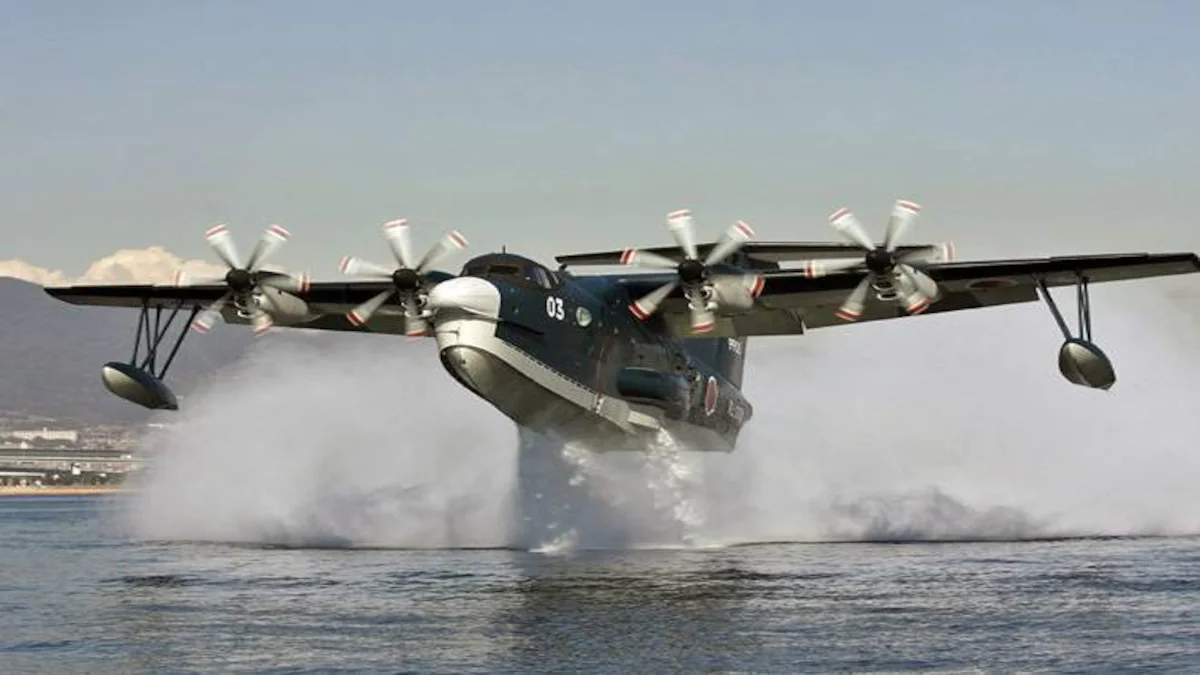
[US-2 taking off]

Unanimously rated the best such aircraft in the world, the US-2 is adept variously in surveillance and reconnaissance, in the antiship attack role, in landing on a coin anywhere, including near oil rigs carrying provisions, repair material or rotational crews, or next to smuggler dhows or motorised craft carrying terrorists for seaborne attack (as on Mumbai 26/11 in 2008) or Somali pirates operating off Aden, allowing the on-board marine commando (MARCOS) in the latter instances to take care of business, or even to airlift Special Forces for expeditionary tasks on the Indo-Pacific littoral or in protection of friendly island-nations (Maldives, Mauritius, Seychelles, Sri Lanka). It can do all this in really rough sea conditions, and is the pluperfect platform for patrolling and protecting 24/7 the country’s 572 widely dispersed island territories in the Bay of Bengal, the Andaman Sea and in the Arabian Sea.

So, what does the most strategic-minded among the Indian armed services — the Indian Navy, do? it rejects Japan’s US-2 project, saying its immediate requirement of just 12 US-2s did not justify such expenditure and that it’d stick with the antiquated Dornier 228s instead. The Navy has understated its US-2 requirement. Just as replacement for the Dorniers, the Navy alone will need 27 US-2s and the Indian Coast Guard another 17, for a total of 44 US-2s — a very respectable first order for the Indian-built flying boat. But no, 12 is the number the Navy stuck to, never mind the full technology transfer and manufacturing wherewithal and training that Japan promised, or the contract for supply of Indian-made spares for US-2s everywhere, and even grant-in Japanese aid to finance the whole deal! (The US-2 fiasco is detailed in my 2018 book — Staggering Forward: Narendra Modi and India’s Global Ambition, pp. 256-269.)

Hardly to be wondered then that Tokyo assessed India and its government to be not worth the strategic trouble, and reconciled itself to doing things “the India Way” — playing the short game for small gains. Hence, security cooperation is showcased by joint naval exercises and such. When a project with limited impact and then mostly in Modi’s Gujarat is preferred to one that’d have enabled India to secure a versatile flying boat, establish itself as the sole producer of the US-2 aircraft in the world, and to seed a genuine aerospace industry in the bargain, what’s left to say?

Still, if there’s any residual strategic wit remaining anywhere in the Indian government and the military one prays even at this late hour for that wit to manifest itself in a prompt to Prime Minister Modi to try and revive the Shinmaywa US-2 deal even if now India has to pay for it out of its own pocket.

Posted in Africa, arms exports, asia-Pacific/Indo-Pacific, Asian geopolitics, Australia, China, China military, civil-military relations, Culture, Decision-making, Defence Industry, Defence procurement, DRDO, Europe, Geopolitics, geopolitics/geostrategy, Great Power imperatives, India's China Policy, India's strategic thinking and policy, Indian democracy, Indian ecobomic situation, Indian Navy, Indian Ocean, Indo-Pacific, Maldives, MEA/foreign policy, Military Acquisitions, Military/military advice, Missiles, Nuclear Weapons, South Asia, South East Asia, Special Forces, Sri Lanka, Technology transfer, technology, self-reliance, Terrorism, United States, US., Weapons | 20 Comments

‘Don’t Expect US Help In A War With China’

A 2-part interview in Rediff News published on May 19 & May 20

Part 1 

‘The US will not want to tangle with China landwards.’
‘Nor will the US confront the Chinese navy seawards on India’s account.’

IMAGE: External Affairs Minister Subrahmanyam Jaishankar and Defence Minister Rajnath Singh at a joint news conference with United States Secretary of State Antony J Blinken and Defence Secretary Lloyd Austin III after the fourth India-US 2+2 Ministerial Dialogue at the US State Department in Washington, DC. Photograph: Michael A McCoy/Pool via Reuters

Dr Bharat Karnad, the national security expert at the Centre for Policy Research, the New Delhi-based think-tank, believes the time has come for the Narendra Damodardas Modi government to draw up a strategic non-aligned policy to suit India’s interests.

“India, its government, and Indians, generally, will have to get out of the debilitating habit of mind of expecting some big power to come to its aid and fight its wars,” Dr Karnad tells Rediff.com Senior Contributor Rashme Sehgal in the first of a two-part interview:

Home Minister Amit Shah said at a book launch in New Delhi on May 11 that Prime Minister Modi has transformed India’s foreign policy and made it subordinate to India’s defence and security interests.

This is true, especially in light of the Ukraine developments when the Modi government successfully resisted the relentless pressure the US and West European States, in particular, put on New Delhi to sever India’s arms and energy supply lines to Russia.

In the ongoing Russia-Ukraine war, has India’s tight rope walking between looking after its interests vis a vis Russia without displeasing the US been a success? In the event of a Chinese attack in the future, will the US come to our rescue?
What about Home Minister Shah’s statement made on May 5 where he spoke about India reclaiming Pakistan occupied Kashmir?

India, its government, and Indians, generally, will have to get out of the debilitating habit of mind of expecting some big power to come to its aid and fight its wars.

  • That has never happened in the past and will not in the future — no matter what is at stake.

The US will not, in particular, want to tangle with China landwards — a policy inhibition nursed from the Korean War (1950-1953) when the US-led Allied forces suffered grievous losses and were pushed by the PLA back down to the 39th Parallel where the lines stabilised on the present North Korea-South Korea border.

Nor will the US confront the Chinese navy seawards on India’s account.

Washington may, however, channel real time intelligence, etc and do things that do not in any way involve American ‘boots on the ground’.

The aggressive ‘recovery of Pakistan occupied Kashmir’ issue raised by the Modi regime seems to be more a provincial and national political ploy to keep Pakistan and the domestic Opposition on the defensive, primarily because militarily it is a difficult goal to achieve what with Chinese strategic interests being directly engaged with the Belt and Road Initiative-related ‘China-Pakistan economic corridor’.

There is an equally strong possibility that with Russia’s increasing dependence on the Chinese, the Russians will also not come to our help in case of a Chinese attack.

Russia will not come to India’s direct assistance either.

It, in any case, will have enough on its hands for the next few decades by way of reconstructing its own economy (sans revenues worth some 300 million euros a day from export of oil and gas to Germany and other European States) and that of the Donbas region of eastern Ukraine it will annex.

As far as the Russia-China nexus goes, Moscow is no strategic fool.

It is mindful of not being a cog in China’s hegemonic designs and is as wary of potential territorial inroads by China in mineral rich eastern Siberia as India is about a Chinese imperium in Asia and the PLA occupying Indian land in Ladakh and elsewhere.

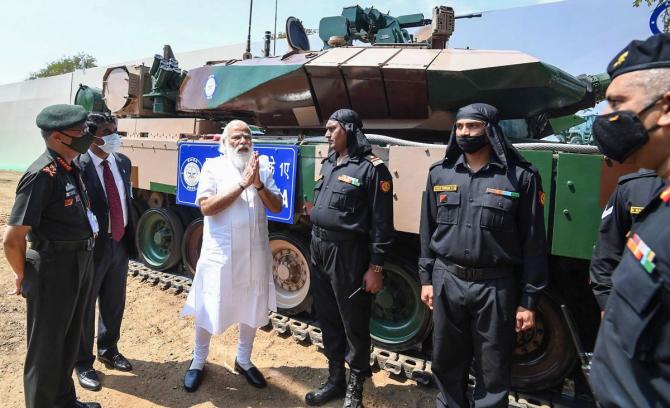
IMAGE: Prime Minister Narendra Damodardas Modi hands over the indigenously developed Arjun Main Battle Tank (Mark 1A) tanks to the Indian Army in Chennai. Photograph: PTI Photo

A perception that has gained ground as a consequence of the Russia-Ukraine war is that Russian weaponry has not proved to be all that good and therefore demand for it will be reduced in the future.
Do you see that happening in the case of India which remains heavily dependent on Russia for arms supplies?

All weapons systems end up performing less than as advertised in brochures and by arms salesmen.

That said, yes, the Ukrainian partisans have revealed a major design flaw, for instance, in the T-72 main battle tank — the wrong placement of the ammo storage compartment under the crew cupola, which tends to blow up with the first guided anti-tank munition hit midship.

It is a matter of grave concern to the Indian armoured forces featuring the T-72.

Maybe, this will finally convince the armoured brass in the directorate in army headquarters to take ownership of the indigenous Arjun MBT (which handily beat the Russian T-90 and T-72 tanks in test trials in all weather, all conditions, all terrains!), and to buy this Indian combat vehicle in bulk and invest fully in its further improvement.

On the other hand, the Su-30MKI air superiority fighter and the MiG-29 for air defence have no peers.

But even these renowned planes pale in many performance aspects to the home-grown Tejas 1A! If the Ukraine crisis proves anything it is for the Indian military to ‘Buy Indian’ so that Prime Minister Modi’s laudable atmanirbharta mantra does not remain mere rhetoric.

I ask this question in the context that in a recent article, you have very caustically mentioned how the 2008 India-US civilian nuclear cooperation agreement which was supposed to deliver ‘20,000 MW by 2020’ and the 2012 Defence Technology and Trade Initiative to transfer advanced military technologies and high-value tech collaboration have hardly delivered.
The only important joint project to-date involving US assistance for developing a combat aircraft jet engine in India was called off by President Trump.
Why does the US have reservations in providing advanced equipment and technology transfer to India given that we are a member of QUAD?

The fact is the US does not like to share its top-end technology with anyone, including its closest allies, because it perceives it as the US military’s edge in battle.

For example, the United Kingdom — America’s closest, most intimate, ally invested several billion dollars in the development of the multi-role Lockheed F-35 combat aircraft and expected a wholesale transfer of its technology. But once F-35 got into production stage, Washington refused to pass on source codes for the software driving the onboard avionics. 

So, what chance, do you think, India has in securing really high military technology?

https://www.rediff.com/news/interview/dr-bharat-karnad-dont-expect-us-help-in-a-war-with-china/20220519.htm

Part 2

‘This may indeed be India’s moment’

May 20, 2022 09:30 ISTGet Rediff News in your Inbox:email 

‘For the first time, all major countries are discovering India’s indispensability to their own foreign policy interests.’

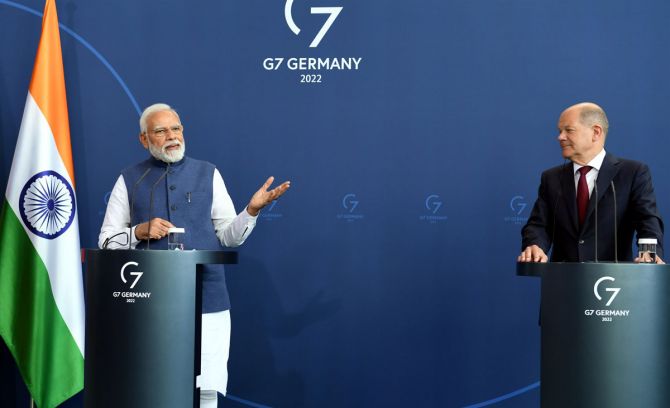
IMAGE: Prime Minister Narendra Damodardas Modi and German Chancellor Olaf Scholz at the federal chancellery in Berlin, May 2, 2022. Photograph: Press Information Bureau

Dr Bharat Karnad, the national security expert at the Centre for Policy Research, the New Delhi-based think-tank, believes the time has come for the Narendra Damodardas Modi government to draw up a strategic non-aligned policy to suit India’s interests.

“Despite being stonewalled by New Delhi on the Ukraine issue, the US, NATO States, Japan, Russia, and even China want India as their ‘best friend’ as British Prime Minister Boris Johnson said during his recent visit,” Dr Karnad tells Rediff.com Senior Contributor Rashme Sehgal in the concluding segment of a two-part interview:

You have argued that America and the European Union need India to ring fence China. Considering our close economic dependence on China, is that feasible?

Get the facts right! India does not depend on China for anything that cannot be bought from other sources.

It is China that depends on India’s vast consumer market to keep its industry in clover — the reason why the Modi government has to begin seriously limiting Chinese access to the Indian market.

Even as Indian companies operate under severe regulatory strain in China, Chinese companies are afforded full freedom by the Indian government to mint money, selling all manner of manufactures to Indians.

It is time the Modi regime wised up and did something meaningful to hurt China economically by simply evening out the economic playing field. Is that too much to ask?

Does being non aligned prevent India from evolving a strategic foreign policy to suit its own interests?
The Modi government says since India is being wooed by several foreign nations and this is ‘India’s moment’.

Goes without saying that being non-aligned increases India’s options and policy choices.

Good that the Modi government discovered the merits of this stance, even if a little belatedly.

This may indeed be ‘India’s moment’ because for the first time all major countries are discovering India’s indispensability to their own foreign policy interests.

This is why despite being stonewalled by New Delhi on the Ukraine issue, the US, NATO States, Japan, Russia, and even China want India as their ‘best friend’ as British Prime Minister Boris Johnson said during his recent visit.

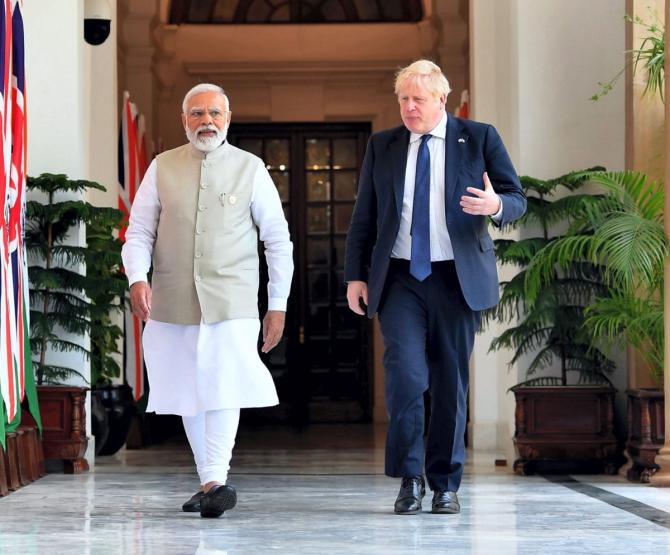
IMAGE: Prime Minister Modi and British Prime Minister Boris Johnson at Hyderabad House in New Delhi, April 22, 2022. Photograph: Press Information Bureau

Do we have the economic muscle to hard talk the US, China and the EU given that our economic parameters are showing a downward slide?

India, because of its vast market, packs an economic wallop.

Ironically, it is the Indian government and trade and commerce ministry, in particular, that refuses to drive hard bargains, time and again succumbing to external pressures and to the institutional desire to be ‘responsible’ and hew to the World Trade Organisation and other norms even when no major power does that.

For evidence, look at all the unrestrained and unfavourable Free Trade Agreements the government has signed with all and sundry in recent years.

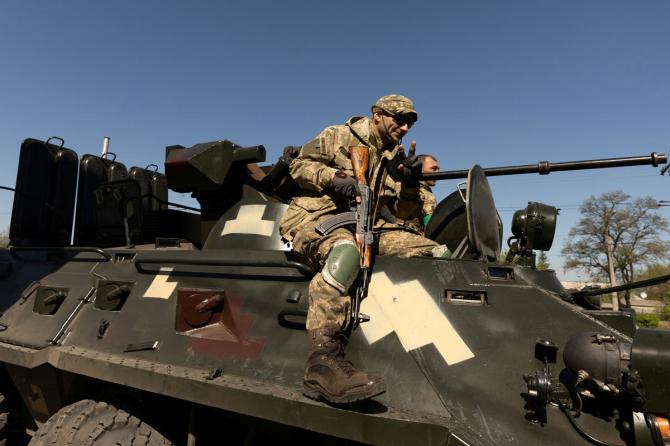
IMAGE: Ukrainian soldiers ride an armored vehicle en route to the front in the Donetsk region. Photograph: Jorge Silva/Reuters

How would you evaluate India’s foreign policy especially in its handling of the Russia-Ukraine conflict?

The Modi government has achieved stellar success with its Russia-Ukraine policy — warding off Western pressure with ease while, even if for form’s sake, upbraiding Moscow for the invasion excesses, and otherwise managing to maintain a ‘balance’ between the feuding parties.

Do you see the ongoing crisis in Sri Lanka impacting us in any way?

Hard to take pleasure from a neighbour’s dive into despond. But the ruling Rajapaksa family has been a pain in India’s butt.

The current Sri Lanka president, Gotabaya Rajapaksa, in particular, having it in for India for its support to the secessionist Liberation Tigers of the Tamil Eelam which he as defence minister ruthlessly crushed in the bloodiest of civil wars.

The good thing for India is that Gotabaya Rajapaksa having pushed his country wilfully into a nepotistic form of government in which family members held all the high ranks and wielded all the levers of power, and worse into a ‘debt trap’ laid by China and into bankcruptcy, all political parties in Sri Lanka including the ruling Sri Lanka Freedom Party, are agreed that Colombo has to change course.

Here Modi’s far-seeing policy of opening multi-billion dollar lines of credit for Sri Lanka to use to offtake Indian commodities and consumer items to meet shortages and quell popular unrest, will help in getting India-Sri Lanka relations back on track.

https://www.rediff.com/news/interview/dr-bharat-karnad-this-may-indeed-be-indias-moment/20220520.htm

Posted in arms exports, asia-Pacific/Indo-Pacific, Asian geopolitics, Central Asia, China, China military, Culture, Decision-making, Defence Industry, Defence procurement, DRDO, Europe, Geopolitics, geopolitics/geostrategy, Great Power imperatives, India's China Policy, India's strategic thinking and policy, Indian Air Force, Indian Army, Indian ecobomic situation, Indian Navy, Indian Ocean, Indo-Pacific, Intelligence, Japan, MEA/foreign policy, Military Acquisitions, Military/military advice, Missiles, Relations with Russia, Russia, russian assistance, russian military, South Asia, Sri Lanka, Strategic Relations with South East Asia & Far East, Strategic Relations with the US & West, Technology transfer, technology, self-reliance, Trade with China, United States, US., Weapons | 18 Comments

The Discovery of India’s Heft (but not yet of how to use it)


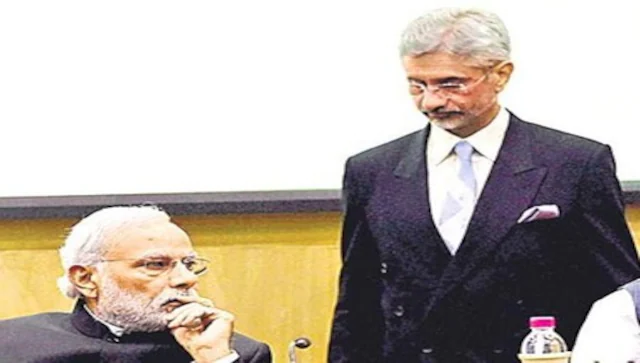
[Modi and Jaishankar]

That India has clout if it acts independently in pursuit of narrowly defined national interest is something the Narendra Modi government apparently discovered, courtesy the Ukraine war. It reveals what is fundamentally wrong with Modi’s world view and how the S. Jaishankar-led Ministry of External Affairs assesses the world and India’s role in it.

     Initially skipping around moral issues to avoid condemning Russia for its messy military intervention, India became more forthright in pursuing its national interest. It was  uneasy about running afoul of the United States and the West but  unwilling to court President Vladimir Putin’s wrath.

     The balance of Delhi’s concerns was this: The US and European states, could be persuaded to be flexible on account of China, West’s other great rival, otherwise benefitting strategically. The Modi government hinted at the possibility of China using the Ukraine tensions to initiate hostilities across the disputed border as it had done in 1962 when exploiting the super powers’ distraction with the Cuban missile crisis to start the mountain war that India lost. It is a danger heightened by an unpredictable Putin, in a pique, slowing down the flow of military spares and creating no end of trouble for the Indian armed services. It eventuated in India’s “neutral” stance and abstentions on several UN votes, which preempted Putin from getting punitive.

     The success in dealing with the US and Russia led Jaishankar, at the Raisina Dialogue 2022, to declare, a trifle triumphantly, that “It’s better to engage with the world on the basis of who we are rather than try and please the world by being a pale imitation of what they are” and to not let “others define us, [or, have the] need to get approval from other quarters, [which] era”, he said, is “behind” us.

     This is very rah-rah and self-congratulatory, of course.  But the era he would like the country to forget is the one in which he had ceaselessly talked up India as needing to be part of “a rules-based order” — one dominated politically by the United States and the West, and economically by the US and China. It is a system, moreover, that because India had no part whatsoever in crafting, requires it to traipse through the minefields of clashing US, European, Russian and Chinese interests. In the event, like it or not, India and its interests are defined by whichever powerful country or countries it wants to sidle up to.

     Still, taking Jaishankar at his word, is he saying the extant correlation-of-forces was examined, India’s choices pondered, and decision made to pursue national interest by relying on itself? In that case, what’s not to like? Except, the success in resisting American pressure to disengage from Russia without alienating Washington, it must be noted, was at the sufferance of both the US and Russia.    

     The Indian foreign minister’s statement, however, suggested something else: A new, more disruptive, attitude and a departure from, what I have called, a “creeper vine” foreign policy that India adopted post-Cold War of clinging to the US to rise. Plainly, this is not so as Modi subsequently clarified. On the eve of his European tour, the PM reassured everybody that India’s rise would not be at the “cost” of any other country. So, disruption of the existing international order is not on the cards. In reality, it means India remaining what it has always been — a tame and timid country ready to ride any passing coattail with little gain in sight.     

     That’s not a surprise. The 2008 India-US civilian nuclear cooperation agreement promised “20,000 MW by 2020”, and the 2012 Defence Technology and Trade Initiative (DTTI) advanced military technologies and high-value tech collaboration. Neither delivered. The only important project involving US help to design and develop a combat aircraft jet engine in India was terminated by President Donald Trump, notwithstanding the “Howdy, Modi!” and “Namaste Trump” galas in Houston and Ahmedabad respectively. And the series of DTTI and 2×2 meetings with the US have, like the Joint Working Group negotiations with China to resolve the border dispute, produced only promises to meet again.

     The “India as responsible state”-mantra that’s routinely rolled out to explain the country’s external behaviour has covered for India’s foreign and military policy inaction, lack of political will, loss of nerve, and for compromises at every turn. India has failed to respond to China’s nuclear missile arming Pakistan with like strategic arming of countries on China’s periphery. Incidentally, this was a late 1970s-vintage provocation the US was party to. Delhi then delayed the export of conventional warheaded Brahmos supersonic cruise missile to Vietnam, Philippines, et al, until now but blamed Russia for not previously permitting such sale, when India had the indigenous short-range Prithvi missile that it could have liberally dispensed.  And India did not instantly retaliate with air strikes against significant targets within Pakistan when terrorists attacked Parliament in December 2001, and Mumbai in November 2008.

     The fact is India never needed to placate the US, nor required the Ukraine issue to assert its policy freedom. It is America, the European Union, and Russia as I have long argued, that crucially need India to ringfence China. No other country in Asia has the location, size and the all-round heft. What is missing is an Indian government with the vision, iron will and self-confidence to talk straight with Washington and to demand a substantial price for partnering the US — expeditious transfers of high technology and such. Instead, New Delhi appears content with the H1B visa crumbs Washington throws its way.

     For reasons of economic and military counterweighting and access to its market, the US, EU, Russia and China alike find India indispensable to their plans.  It is “India’s moment” alright but not, as former Foreign Secretary Shyam Saran roundaboutly argues, to get closer to America. That would be to squander a glorious opportunity for the country to emerge as international system balancer and great power, unconstrained by partnerships with big powers. Alas, that is not the path Modi and Jaishankar are taking.

——

Published in the Deccan Herald, May 9, 2022, at https://www.deccanherald.com/opinion/comment/the-discovery-of-india-s-heft-but-not-yet-of-how-to-use-it-1107549.html

Posted in arms exports, asia-Pacific/Indo-Pacific, Asian geopolitics, Australia, Central Asia, China, China military, civil-military relations, Culture, Decision-making, Defence Industry, Defence procurement, disarmament, DRDO, Europe, Geopolitics, geopolitics/geostrategy, Great Power imperatives, India's China Policy, Indian Air Force, Indian Army, Indian ecobomic situation, Indian Navy, Indian Ocean, Indo-Pacific, Japan, MEA/foreign policy, Military Acquisitions, Military/military advice, nonproliferation, nuclear industry, Nuclear Policy & Strategy, nuclear power, Nuclear Weapons, Relations with Russia, Russia, russian assistance, russian military, SAARC, society, South Asia, South East Asia, Strategic Forces Command, Strategic Relations with South East Asia & Far East, Strategic Relations with the US & West, Technology transfer, technology, self-reliance, Trade with China, UN, United States, US., Vietnam, Weapons, Western militaries | 11 Comments

The next CDS — Admiral Karambir Singh!

[Admiral Karambir Singh]

The Narendra Modi government, having looked at all options, including “deep selection”, have apparently determined that the former Chief of the Naval Staff, Admiral Karambir Singh, who retired end-November 2021, is the best person to succeed the late General Bipin Rawat as Chief of the Defence Staff and Secretary, Department of Miltary Affairs. The announcement is likely to be made soon.

Unlike Rawat whose Pauri-Garhwal connections helped, Karambir is being brought in after considerable thought expended on his selection in the PMO and elsewhere, whence he will, in some respects, enjoy even greater backing in the inevitable bureaucratic turf battles and in fights over critical decisions.

When advocating Karambir’s appointment as CDS in a Dec 14, 2021 post on this Blog (https://bharatkarnad.com/2021/12/14/indias-next-chief-of-defence-staff-and-his-remit/), I had alluded to the “democratic” precedent of the US President, John F Kennedy, in 1961 installing a retired US Army Chief of Staff, General Maxwell Taylor, as his Chairman, Joint Chiefs of Staff. By way of Admiral Karambir’s qualifications, I had said that, as a naval helicopter pilot he had professional skills and the experience to empathize with, and to win the respect of, the air force and of the helicopter-equipped army aviation wing and hence of the army — “the sort of background” few chiefs of staff have possessed, and which Rawat plainly lacked (leading to such boo-boos as his dismissal of the IAF as a “supporting arm”). And the Admiral will have to root out from the CDS secretariat his predecessor’s antipathy to expeditiously and extensively establishing military bases on the Indian Ocean littoral and in archepelagic island nations (Maldives, Mauritius, northern Mozambique coast, etc) and to carving out a ready-use expeditionary element in the Indian armed forces to counter China’s fast-growing footprint, and effectively handling crises, in the region.

His naval helicopter background is pertinent. Unlike aviator naval chiefs in the past — mostly carrier-borne fighter pilots (Arun Prakash, Sureesh Mehta) who flew combat aircraft off decks (VSTOL Harriers and, in Prakash’s case, also Hunter, as part of an IAF squadron during the 1971 War, in which stint he won the Vir Chakra), and with an attitude more akin to that of the “Fly-boys” in the air force, the no-nonsense Karambir flew Kamovs and, as CNS, wore his phlegmatism on his sleeve. It is a trait that will stand him in good stead as CDS when he will be required to juggle the demands of the three armed services and of the Coast Guard, and to alight on inter se priorities where expenditure programmes are concerned, on the one hand and, on the other hand, to deal with the sometimes difficult political leaders (Modi, defence minister Rajnath Singh) and the civilian MOD bureaucracy, withut rubbing anyone too much the wrong way. What may have impressed the powers that-be is also the Admiral’s reputation as a “straight arrow” which, incidentally, will deter these other parties from pushing him on issues.

It will be interesting to see if as CDS, the Admiral stays with the Rawat plan for the consolidation of resources and “theaterization” of the numerous military commands, or tweaks it to make it more practicable. Many military stalwarts who have headed the Andaman & Nicobar Command (ANC), such as the former CNS, Admiral Arun Prakash, believe that an excellent working model for integrating command and control as well as the fighting and other military assets already exists in the Port Blair-headquartered ANC. What needs to be done, they claim, is for it to be upscaled. Several such operationally integrated commands, they feel, would ease the movement towards a genuinely integrated Indian military, one in which the constituent services operate seamlessly.

The trouble with the ANC, however, is that all the good it does in fosterig a genuine “joint” mindset and habit of working is frittered away as soon as officers on rotation in the Command revert to posts in their original service on the mainland when they have to buckle on the same old mental and attitudinal straitjackets. Even minimal loyalty to jointness is prevented from getting cemented by the extant career reward structure — the Confidential Reports that count of the senior staff officers are written annually not by the Commander-in-Chief, ANC, but by the chiefs of the services they belong to. Thus, promising careers have been cut short because senior officers were perceived by their chiefs as being too wedded to the concept of jointness or too supportive of the integrated setup than was deemed good for the parent service!

This aspect of the ANC offers a peek into the promotion system that’s in desperate need of overhaul which, hopefully, the new CDS will undertake, pronto! This is an absolute imperative if an integrated military is ever to bcome reality. Indeed, Karambir Singh should consider incorporating a scheme for awarding additional points to officers for pulling time in joint units/organizations, and to define minimum thresholds of “jointness points” beyond senior-Major or equivalent level as prerequisite for promotion to the next higher rank. Institutionalizing such promotion schema will provide just the incentive necessary for the officer corps in the three armed services to become more military jointness- and integration-minded.

Posted in arms exports, asia-Pacific/Indo-Pacific, Asian geopolitics, China, China military, civil-military relations, Decision-making, Geopolitics, geopolitics/geostrategy, Great Power imperatives, India's China Policy, India's strategic thinking and policy, Indian Air Force, Indian Army, Indian ecobomic situation, Indian Navy, Indian para-military forces, Indo-Pacific, Maldives, MEA/foreign policy, Military Acquisitions, SAARC, society, South Asia | 38 Comments

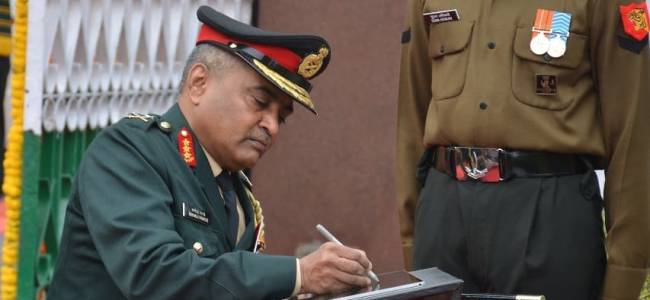
Finally, a sapper as army chief

[The new COAS, General Pande]

It is generally believed that sapper and signals officers are the brainiest lot in the army, and for good reason. They are called on to have their wits about them in combat and required to come up with engineering solutions on the run for often complex problems in unfolding battefield scenarios. Good thing that finally a sapper — General Manoj Pande, has made it as COAS. The Narendra Modi government needs to be commended for this selection.

Combat engineers have until now been overlooked on the dubious basis that they are from a support arm. Except in reality, they are often the lead unit that allows them to display gut-wrenching valour of the type a Bombay Sapper, Lt Gen Premindra Singh Bhagat, say, showed as a raw Lieutenant in the World War II campaign in Eritrea in January 1941 that fetched him the Victoria Cross. Bhagat lashed himself to the front end of a Bren gun carrier and single-handedly cleared 15 minefields over 55 miles in 4 days, uprooting these mines laid by the Italian army around Galladat by hand, one at a time. He did his work regardless of two Bren carriers blowing up underneath him and the explosions puncturing his eardrums!

Bhagat had all the credentials and the seniority to succeed General GG Bewoor as COAS in 1974, but Prime Minister Indira Gandhi, fearing his popularity among the soldiery and reputation for straight-talking, played dirty. She extended Bewoor’s term by a fortnight, just long enough for Bhagat’s retirement date to come due and render him ineligible for promotion, and just so she could appoint a fellow Kashmiri, Lt Gen TP Raina, as COAS. But unwilling to pass up on Bhagat’s proven leadership nous, engineering skills and general competence, she installed Bhagat as chairman of the prestigious Damodar Valley Corporation which runs a series of hydel and thermal power stations in Bengal and Jharkand.

The next combat engineer who was overlooked by the government to fill the COAS post was army commander and Madras Sapper, Lt. Gen. DSR Sahni in 1993. For me he was special because he was an alumunus of my military school –to give its original moniker — King George’s Royal Indian Military College, Belgaum, which in my time (in the late Fifties-early Sixties) was simply King George’s School. As Northern Army Commander, Sahni hosted my visit as adviser, defence expenditure, (Tenth) Finance Commission in Sept 1992, to the Command HQrs, Udhampur. Between long discussions in his office and at his residence, he ordered me to do a darshan of Vaishnodevi, and deputised the Command’s chief signals officer, a KGS classmate as my escort.

Sahni’s clearly articulated Long View, in particular, was a revelation and convinced me the army needed him as its chief for his strategizing ability alone. Back in Delhi, I tried to plead his obvious qualifications for the COAS job to the powers that be but the Narasimha Rao government put General BC Joshi in the chair. This even though Joshi was medically unfit and should not have been in the running at all. But he wrangled a certificate to show his blood pressure was under control which was not the case, and died in office.

But why do sappers deserve more regularly to be considered for the COAS’ post? In the main because, as engineers they have a problem solving habit of mind and because from a supporting arm, they do not have the kind of blind loyalty to their combat arm that infantry, armour/mech and artillery officers effortlessly summon, and which loyalty invariably weighs in on their decisions, skewing them. Inherent in problem solving is objectivity, which is central to making sound decisions.

Why an engineering background helps in defence decisionmaking was evidenced during Manohar Parrikar’s time as Defence Minister. Parrikar, a mechanical engineer from IIT, Mumbai, and inarguably the most competent man in the history of the Republic to-date to hold this post, after a comparative cost-benefit analysis of Su-30, Rafale, F-16, and Saab Gripen, that involved mathematical calculations, sensibly chose the option of augmenting the Su-30MKI fleet rather than going in for an entirely new fighter aircraft requiring exorbitantly priced munitions and a new, expensive and separate maintenance infrastructure and specially-trained manpower. It earned Parrikar a one-way ticket back to Goa, because the Modi regime had unwisely plonked for a US$12 billion government-to-government deal with France for 36 Rafale aircraft, which will be more an albatross round IAF’s neck than an operational asset.

General Pande will have opportunities galore to showcase his problem solving-mindset and his objectivity, esecially in according inter se priority to the various competing procurement/modernization-related and maintenance-related expenditure programmes. It will decide the direction the army will move in and the kind of force it will become in the future. And also, with consistently wise and measured decisions, Pande will hopefully impress everybody ensuring, in the process, that combat engineers will not get the short shrift again.

Posted in arms exports, asia-Pacific/Indo-Pacific, Asian geopolitics, civil-military relations, Culture, Decision-making, Defence procurement, Europe, Geopolitics, geopolitics/geostrategy, Great Power imperatives, India's strategic thinking and policy, Indian Air Force, Indian Army, Indo-Pacific, Military Acquisitions, Military/military advice, South Asia | 4 Comments

Pak on the boil: Time for Modi to display Chanakyan foresight

It is always bad news when a neighbouring country plunges into a political crisis. India faces double trouble with two adjoining states on the boil —Pakistan and Sri Lanka. While President Gotabaya Rajapaksa’s exit may mollify the people and a belt-tightening International Monetary Fund (IMF) rescue programme save the Sri Lankan economy, no straightforward solution is in sight for Pakistan, where severe IMF strictures turbocharged the campaign against the Imran Khan government.

The situation in Pakistan is more nettlesome also because, apart from the IMF-imposed economic austerity, the dynastic leadership of the two main opposition parties—Pakistan Muslim League (Nawaz) under Shehbaz Sharif and Bilawal Bhutto’s Pakistan People’s Party—with a gaggle of Maulana Fazalur Rehman-led small religious parties in train, had a personal stake in regime change, what with the former Prime Minister, Nawaz Sharif, in exile in London, being pursued on corruption charges.

But having unseated the ruling Pakistan Tehreek-e-Insaf (PTI) regime, the opposition may find a deposed Imran an even greater challenge once he marshals his resources and PTI takes to the street and makes life miserable for the “khichdi” government of Shehbaz Sharif. In his address on the eve of the ‘no confidence vote’, Imran had warned this would happen. He seems to have majority support with the very large and motivated under-30 demographic in the country, fed up with rule by the dynasts, backing him.

In the political chess game in Pakistan, if government power is the king piece, the Pakistan army—as the guardian of the Pakistan ideology and the central prop of any civilian dispensation—is the queen piece that can manoeuvre any which way to ensure its interests are safeguarded. This translates into the Pakistan military getting its customary 16 percent share of the budget. Except last year, the national debt soared to 95 percent of GDP and 85 percent of the budget was apportioned to servicing it. This situation has been a long time developing and is expected to worsen, leaving little for the army—the reason why the Pakistani military brass, General Qamar Javed Bajwa being the latest, have discounted India as a threat; a position that undermines the Pakistan army’s raison d’etre. But Shehbaz reassured the Pakistan army by tying peace with India to the Kashmir dispute resolution. The withdrawal of the army’s support on account of Imran’s alienating the US led to his downfall.

But Pakistan’s straitened circumstances mean that war with India is unthinkable. Prime Minister Narendra Modi made the right moves by calling for peace and a joint effort to resolve development issues. He can go further in his response to the moderation shown by GHQ, Pakistan, in recent years—prompt release of Wing Commander Abhinandan, non-reaction to the misfired Brahmos missile—by more fully orienting the Indian military China-wards. The redeployment of the I Corps, the army’s leading armoured strike formation, to the east is a beginning and, hopefully, will eventuate in a single armoured corps for Pakistan contingencies and the shifting of two strike corps worth of manpower and war materiel to raise two additional offensive mountain corps for the China front. Because one thing is certain—India cannot anymore afford to be delusional and prepare for a “two-front war”.

Fighting the far superior Chinese People’s Liberation Army in all domains, candidly speaking, is beyond the capacity of the Indian armed forces into the mid-term future, and why addressing this deficit should be India’s principal military concern and task hereon. It is a mission India should have embarked on post-1971 Bangladesh War when Pakistan was reduced and the minuscule threat it originally posed became non-existent. But political inertia and vested interests of various combat arms ensured the Indian government and military stayed stuck in the past.

Whatever the consequences for Pakistan, Prime Minister Shehbaz will be inclined, as his older brother Nawaz Sharif was, to open the border, resume trade, and negotiate the Kashmir issue through the backchannel. It had won for Nawaz Prime Minister Atal Bihari Vajpayee’s trust and the memorable bus trip to Lahore, a promising peace process torpedoed by General Pervez Musharraf’s 1999 Kargil misadventure.

To encourage Shehbaz to proceed along mutually beneficial lines, Prime Minister Modi should consider opening billion-dollar credit lines for Islamabad to offtake Indian manufactures and agricultural commodities to tide things over. Billion-dollar Indian credits are working in Sri Lanka to distance Colombo from Beijing, and could help to wean Pakistan away from China.  It would display Modi’s Chanakyan foresight, set India and Pakistan on a course of irreversible peace, and put him, along with Shehbaz, in the running for the Nobel Peace Prize.                                                                                                  

————-

Published in The Sunday Standard, Sunday, April 17, 2022 at https://www.newindianexpress.com/magazine/voices/2022/apr/17/pak-on-the-boil-time-for-modito-display-chanakyan-foresight-2442086.amp

Posted in asia-Pacific/Indo-Pacific, Asian geopolitics, China, China military, civil-military relations, Culture, Decision-making, Europe, Geopolitics, geopolitics/geostrategy, Great Power imperatives, India's China Policy, India's Pakistan Policy, India's strategic thinking and policy, Indian Air Force, Indian Army, Indian democracy, Indian ecobomic situation, Indian Navy, Indo-Pacific, MEA/foreign policy, Military/military advice, Missiles, Pakistan, Pakistan military, SAARC, society, South Asia, Sri Lanka, Weapons | 30 Comments

Re-discovering strategic autonomy — thank you, Ukraine Crisis!

[Russian tank on a Mariuopol street — Day 26 of invasion]

Diverted by the prospect of easy pickings west of the Dneiper River, which did not materialize with the Ukrainian resistance showing more mettle and staying power than Moscow expected, Russia is getting back to achieving its original goal. As predicted in a February 23 post [“There will be no war over Ukraine, here’s why”] when hostilities were initiated, that limited goal was the absorption of the Russian-majority areas of Luhansk and Donetsk in the Donbas region and an eastern border belt comprising Mariuopol, Khersan and possibly Odessa as a logical extension of Kremlin’s 2014 move that annexed Crimea. That’s now the aim now. It will enable Russia to control the Sea of Azov and, more importantly, the Black Sea. The command of the Black Sea coast, in particular, eliminates Russia’s biggest vulnerability — NATO naval forces potentially exploiting the maritime approaches from the south.

External Affairs Minister S. Jaishankar’s declaration in Parliament yesterday that India’s stand on Ukraine is guided solely by the national interest and, hence, that it can no more ignore the availability of Russian oil at discounted prices needed for growth than the looming China threat, which requires the military supply line to Russia be kept well oiled and the historically warm relations with Russia maintained, was a formal reassertion of India’s policy of strategic autonomy. It is several steps away from the conspicuous tilt to the US and the West manifested in the 2008 civilian nuclear cooperation deal with America that Jaishankar, ironically, had engineered as Joint Secretary (Americas) in the MEA. The three Indo-US foundational accords (LEMOA, COMCASA, BECA) that followed during Narendra Modi’s time as Prime Minister were merely the icing on the cake.

The relentless campaign waged by Washington and West European governments to pressure New Delhi into siding with them against Russia, was not a surprise. Washington pulled out all the stops, including a ham-handed effort by the Biden Administration’s advertised economic “hitman” and deputy National Security Adviser, Daleep Singh. He visited Delhi only to end up firing blanks and sounding silly with his public threats of “consequences” to India if it failed to fall in line with respect to imports of Russian energy and weaponry. “The more leverage that China gains over Russia, the less favourable that is for India. I don’t think anyone would believe that if China once again breaches the Line of Actual Control, Russia would come running to India’s defence,” he said. Appropriately, Daleep Singh said this on April Fool’s Day, because the obvious riposte to that is: Is there anyone anywhere who believes the US, India’s “strategic partner”, no less, will “come running to India’s defence” in the same situation?!

This makes one wonder why the US and the West expected India to make common cause with them on Ukraine, in the first place. Is it because of Jaishankar’s success in smoothtalking the US, in particular, into believing that New Delhi had turned a corner, was now more firmly with the West than ever before, and even gradually aligning its armament-sourcing accordingly?

That the sale of military hardware is, in effect, the lifebouy that’s keeping Indo-Russian ties afloat was accepted as a given by Messrs Lavrov and Jaishankar — a condition both agreed would not be upset. Referring to the same condition, US Defence Secretary Lloyd Austin informed the US House Armed Services Committee on April 6 that the American government agencies “continue to work with [India] to ensure they understand that it’s not in their …best interest to continue to invest in Russian equipment.” Coincidentally or otherwise, these exchanges happened just when Boeing is preparing to conduct a fly-off of the twin-engined F/A-18 from the static ski-deck at INS Hansa in Goa. This aircraft is competing with the Rafale-M[arine] and the Russian MiG-29K fleet air defence aircraft to outfit the first Indian (Kochi) shipyard-built aircraft carrier now undergoing final seatrials. The deal is for some 27 carrier aircraft worth several billions of dollars.

The sale of armaments is the lynchpin-reason persuading US and Russia to desist from pushing the Modi regime too hard on Ukraine lest it react by going the other way, the former because it hopes to replace the latter as prime arms supplier, and the latter because it expects to hold on to its pole position as the main high-value arms vendor.

In any case, had the Ukraine crisis not occurred, the Modi government would have had a more difficult time of shrugging off American and Russian pressure. Still, with the Ukraine issue front and centre, the Indian government rediscovered the joys and strategic benefits of remaining conspicuously neutral in disputes that do not directly involve India, and of exercising policy latitude and freedom of manoeuvre that such positioning affords it. Neutrality has allowed India to reassert its strategic autonomy and to play off the US and Russia against each other for strategic gain.

Abstaining from voting on resolutions in the Security Council has so far served India’s purposes. The resolution in the UN General Assembly later today (Thursday, April 7) moved by Lithuania to suspend Russia’s membership in the UN Human Rights Council on account of alleged Russian human rights violations, however, is a more testing proposition. Because an abstention will help the West, Moscow has warned it will be construed as an unfriendly act. Did MEA anticipate such a situation and alert the visiting Russian foreign minister Sergey Lavrov last week that Delhi could not not be consistent and not abstain? If it did, then India is in the clear. If it did not, then the question arises why not? And were the Indian Permanent Representative and his office and MEA at this end all sleeping on the job? After all, Vilnius aided by the US and Western delegations at the UNHQ in New York would have been busy this past fortnight getting the resolution up and marshaling the support for it.

If an abstention is unavoidable but Moscow was informed beforehand, it will be Kremlin’s call on how punitive it wants to get with India because that will possibly incur for Russia huge cost. Considering India has been firm about not taking sides and, given what’s at stake — global correlation of forces-wise, Moscow will likely lump it, as the US and its camp followers did on previous Indian absentions. This aside, the anodyne statements that Delhi has issued urging end to the conflict and offer of India’s good offices as peacemaker are par for the course. Not that either Kyiv or Moscow will accept Indian mediation when the direct line of communications between Presidents Vladimir Putin and Volodymyr Zelensky is buzzing, and it is only a matter of time before Kyiv accepts a compromise solution around Moscow’s original intervention aim.

The funny thing in all this is to see how the lot of Indian-origin academics and such in US universities and thinktanks have uniformly echoed the Washington line about India needing to come in on the side of the great and the good, of democracy and freedom. Their unsolicited advice, it is evident, is less owing to any conviction than personal professional gain: On such drivel are tenure tracks to the professoriate firmed up and “research funding” finagled. In which case why does the media in India take these guys seriously or feature their writing in op-ed space? May be because most Indian newspapers and television media intentionally or otherwise too are serving foreign interests?

Strategic autonomy is a function of India’s size, location, resources and potential. It is a necessity if India is to make anything of itself on the international stage. The leverage it gives India is something Modi, perhaps, is only now beginning to appreciate. Except, the correct lesson needs to be drawn, which is that when China next attacks India, New Delhi should at most expect sympathy but no material or other support from the US and Western European states, or America’s Asian allies (Japan and South Korea). Not because India “faulted” on the Ukraine issue, but because that’s the natural position for the uninvolved with their own national interests to look after, to alight on. It will be prudent, in the event, for Delhi to prepare to fight China on its own — no quarters asked or given, and whatever it takes, which last is what I have all along been advocating that India do.

Posted in arms exports, asia-Pacific/Indo-Pacific, Asian geopolitics, China, China military, corruption, Culture, Decision-making, Defence Industry, Defence procurement, Europe, Geopolitics, geopolitics/geostrategy, Great Power imperatives, India's China Policy, India's strategic thinking and policy, Indian Air Force, Indian Army, Indian ecobomic situation, Indian Navy, Indian Ocean, Indo-Pacific, Japan, MEA/foreign policy, Military Acquisitions, Military/military advice, Northeast Asia, Relations with Russia, Russia, russian assistance, russian military, sanctions, society, South Asia, Strategic Relations with South East Asia & Far East, Strategic Relations with the US & West, UN, United States, US., Weapons, Western militaries | 37 Comments