

[Japanese Prime Minister Sanae Takaichi]
The holding of the 16th India-Japan Annual Summit in Gauhati July 1-3 is appropriate as India east of the Siliguri Corridor is in Southeast Asia, which is becoming a zone of contention in the fight against the relentlessly expanding and assertive China. The steely-nerved Japanese Prime Minister Sanae Takaichi, who has without fear raised the ante with China, is a political protege of the late great Japanese Prime Minister, Shinzo Abe, and was groomed to further her mentor’s strategic agenda. Especially close to Abe was his “southern strategy” anchored by India. The idea was that by cultivating India on China’s southwestern extremity, the Chinese resources and military forces would be stretched thin along the line to the East Sea and the Sea of Japan, which would benefit both India and Japan. It was a strategy that began taking shape in 2005 when on his state visit to Delhi he and Manmohan Singh, for the first time and formally, gave the bilateral relations a “strategic” spin.
A strangely unprotected Abe was felled in July 2022 by a demented assassin, and his strategic dream lost a bit of the head steam that he had tried hard to build up. Truth to tell though, things began going wrong when Abe’s grand idea of a defence industrial linkup to cement ties with India stuttered to a halt with the extraordinarily shortsighted Indian Navy leadership hesitating about the Abe offer, made during his December 2005 state visit, of the short takeoff turboprop Shinmaywa US-2 flying boat on terms so generous only the Prime Minister’s prodding of the Shinmaywa corporate leaders would have led to them. The greater tragedy then was that there was no strategic-minded guidance from the political quarters considering MK “Saint” Antony as Defence Minister decided there would be no single vendor defence contracts during his tenure to avoid potential taint on his pristine reputation, and this despite it being a government-to-government deal and, despite the NSA Shivshankar Menon driving it. But, the opposition from the Defence Ministry proved the stopper, where an idiot babu (joint secretary) produced idiotic reasons for nixing it — among them that this deal would upset China!
With the MoD resisting the US-2, Manmohan Singh transferred the case for Amitabh Kant, then secretary, department of industrial policy, to helm as a “national project”. The proposal was joint production to start with, with manufacture of various high-value components previously produced by Shinmaywa for Boeing and Airbus, followed speedily by full production of aircraft. A Joint Working Group of the two countries was set up to fast forward the deal that would involve Shinmaywa doing the final assembly and integration in India. The business model estimated it’d cost India $2 billion but would earn the country revenue from global sales of $6 billion at a minimum! But nothing came of it!
The Japanese embassy is keen to revive the deal and as the (previous) Japanese ambassador told me at a dinner party several years ago, the Japanese bureaucracy that had gone out of its way to accommodate Abe only to have the momentum stop in Delhi, was irked and turned reluctant about the revival scheme.
The Gauhati summit is the occasion for Modi to now step up and put the Shinmaywa US-2 back on the agenda, and this time actively push it, as Abe had done the last time. And should there be signs of Takaichi showing interest, for Modi to tell Nau Sena Bhavan to not look the Japanese gift horse in the mouth a 2nd time, to shut up and accept what’s offered — one of the more remarkable engineering marvels, the US-2.
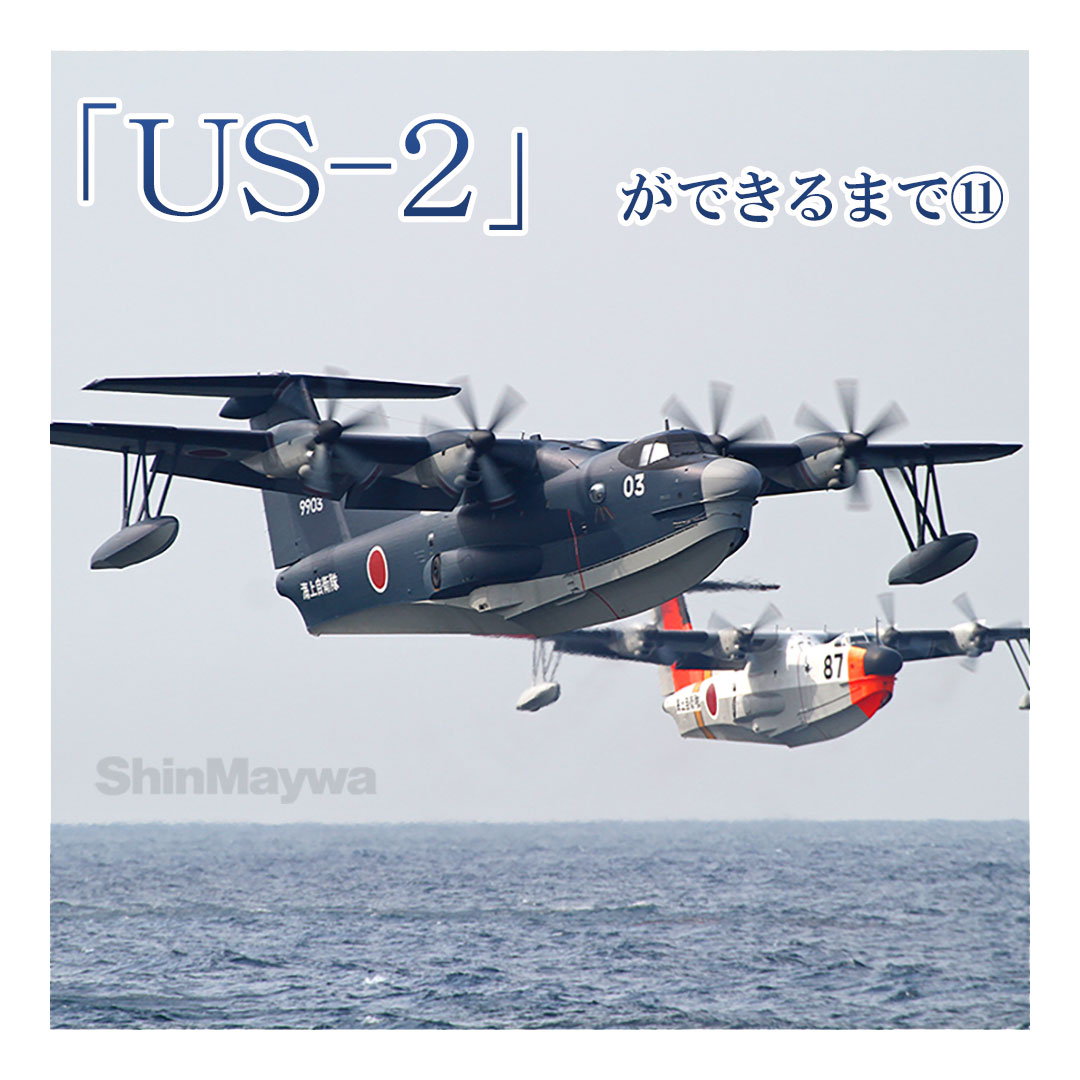
[US-2s on sortie]
The US-2, as I wrote in my 2018 book ‘Staggering Forward: Narendra Modi and India’s Global Ambition’ (pages 258-259), is able to operate in “sea state 5”, meaning it can tackle 3 metre-high waves that many Indian warships find hard to ride. Then there is the plane’s capacity to takeoff from a standing start in water in 7 seconds flat and inside of 300 meters (when its nearest competitor takes 40 seconds to liftoff of the water)!! And the Shinmaywa plane that, also operates from land, can align to winds in any direction, has a very low draft, enabling it to get close to a beach (as long as it is hard), it has a glass cockpit, and is the only certified amphibious aircraft of its kind in the world.
Consider the terms: After the first one or two US-2 bought off the shelf, the remaining 10 sea/air dual use aircraft (of the initial order) would be produced entirely in India, with the assembly line transferred to an Indian site, and in the 2 years needed to set up the factory here, an entire complement of skilled Indian marine and aircraft engineers and technicians would be trained by Shinmaywa in their facilities in Japan. Thereafter Japan as well as other prospective customers for this enormously versatile aircraft would have to buy this plane and its spares from India. The Japanese were ready to finance it too!
It is powered by 4 Rolls-Royce AE2100J engines and unique for any amphibious aircraft it has a fifth engine developed by the Japanese. It blows compressed air over the control surfaces of the wings and tail for Boundary Layer Control (BLC) that permits short takeoffs and landings. To quote the Shinmaywa website, BLC “allows [the US-2] to fly slower than regular aircraft [and to] greatly reduce the speed of take-off and landing, and …the impact and seawater splash upon landing.” And the plane’s design with “the fuselage, near the base of the wings, [prevents] seawater from being inhaled.” https://www.shinmaywa.co.jp/english/insight/how-the-us2-is-made/how-the-us2-is-made-11.html
How would this aircraft not be an absolutely perfect fit for the Indian Navy and the growing Coast Guard and not otherwise majorly suit the country’s maritime security needs to the fullest? In fact, it is an all-in-one solution for almost any maritime mission imaginable. It can carry 20+ fully armed MARCOS (Marine Commando) alongwith equipment for operations to finish off smuggling by dhows from the Gulf and piracy in the Gulf of Aden (by landing the US-2 almost next to the smuggler dhow or pirate boat! rather than, as is the case now, having a Dornier aircraft fly around radioing suspicious activity, so by the time any ship gets there, there’s no offending vessel in sight!, for full-fledged Special Forces ops, for rescuing Indian expatriates efficiently from war torn theatres in the Middle East and elsewhere, and to deliver food and medicine in HADR (humanitarian assistance and disaster relief) role. And, most important, to effectively police the vast Indian island territories in the Bay of Bengal and the Indian Ocean. There are over 836 islands, islets, and rocks, according to the Survey of India spread over 277,000 sq miles (720,000 sq kms) in the surrounding seas, and 2.37 million sq kms of the Exclusive Economic Zone to monitor.
India’s squeamishness to committing substantively to military cooperation where the US and the US-led Quad is concerned, is understandable and, prudently speaking, even warranted. It is strategically foolish and foolhardy to bank on the manifestly unreliable and untrustworthy United States as a security partner.
But cooperating militarily with Japan is absolutely essential, and urgent. India had the opportunity to forge a steel-clad security relationship with Tokyo during Shinzo Abe’s time. That opportunity is now again available with Sanae Takaichi. Modi should surprise the Japanese PM by mooting a strategic accord and propose the cross-stationing of naval flotillas in each other’s bases for short stints to start with, to be converted to permanent deployment later. The Indian Navy has to get out of the Indian Ocean and into China’s backyard, just as the Chinese PLA Navy is doing in India’s backyard by establishing its presence west of Malacca and, now with the Mongla port handed over to it by Dhaka, literally next door. If Delhi fails to respond in the manner suggested, it may as well kiss its backyard goodbye.
Moreover, nothing will spook Beijing more, because nothing frightens China more than a militarised Japan — Chinese still shudder at the thought of the imperial Japanese army massacres in wartime Nanjing. That psychological memory will be fired up — and Delhi should help fire it up — by a militarised Japan in league with an aggressive India! Because that’s what’s needed and is the call of the hour. Hopefully, Modi will rise to the occasion and put some Indian military skin in the game to jointly halt China in its tracks by also getting India, the Indian Navy and the Indian Coast Guard the Shinmaywa US-2.
For a change, Modiji, be strategically bold, proactive and decisive!


professor I don’t agree with the last points. Indian navy in china’s backyard is you are talking about south china sea. But they see it as a matter of sovereignty. Chinese lack the ruthlessness of the russians and Americans doesn’t mean they will not go to war. Since their leaders have done tremendous investment in education and r&d they act with restraint and they think time is by their side which is absolutely correct. Instead of doing this you should advise modi to unveiled 5 trillion dollar investment plan in strategic sectors just like trillion dollar investments recently announced by the Japanese govt and by Lee jae myung of South korea. That is more urgently needed.
‘Am dead set against the correct sequencing nonsense — investment in strategic sectors, etc. The strategic problem of China is here and now.
Email from Ajai Shukla, former Defence editor, Business Standard
Tue, Jun 30 at 5:45 PM
Thanks for that perspective, Bharat. It would be further enlightening for many of us if the naval officers could chip in with their views.
Regards,
Ajai
Colonel Ajai Shukla (Retired)
Editor
Gambit Analytics LLP
Mister Karnad All this is encouraging, but what is going to stop DJT from screwing this [and the Japanese for this] along with the British because of the ShinMaywa US-2’s Anglo-American-origin Rolls-Royce AE2100J engines just like the Americans along with the French are screwing the LCA Tejas w.r.t. its engines?
Nothing! Reason why I have long advocated going all in with the Kaveri, making it a technology mission that got for the country the Agni misiles in IGMDP.
@Bharat ji disagree. We need to reverse engineer Al-31P (or al41/51) engine and start from there and we should be aiming for 240kn.
(much better than giving our taxpayers money to foreign entity like Safran/Rolls Royce. They will make engine for themselves and give us 2nd level tech, it is definitely not Atmanirbhar.
We need to grow up. We are using trainer engines in Tejas /AMCA.
What happened to DEW?
Professor Karnad, I admire your persistence in advising the GOI but you must be well aware of the fact in your heart that nothing will ever change for the better in this country.
Corruption, opportunism and colonial hangover is so much prevalent in India that it has come to characterize the national DNA.
Nothing will irk China more than the diplomatic recognition of Taiwan as an independent nation by the GOI.
When Indian establishment couldn’t accomplish this simple task, do you seriously think that India can ever confront China militarily?
sir why is india not backing anti shia sunni in pakistan as a means to divide that nation along ethnic lines. We already have been doing it with the baloch separtist since upa2. It will force pakistan to relocate it’s resources away from the Indian border to its interior to save the country and, if we are really lucky, balkanize it
Mr Singh sir,
C’mon man please read some latest news. RSS is secretly meeting with the Pakistanis in Sri Lanka. Baluchistan , Dhurandhar , Unknown Gunman etc they are to fool people like us. Mature boys like RSS and Dr Karnad supports dialogue with Pakistan. Furthermore, support you break Pakistan into 4 parts but the people are not going anywhere just remember Bangladesh. We did break it in 1971 now we still consider it as enemy territory. So what stops the 4 parts of Pakistan from coming together and make life difficult for us !
Dr Karnad , wonderful article penned by you. However if you ask me what the Japanese actually want from India are young females and (males) from the North Eastern regions/countries (given their Mongolian features which are similar to the Japanese in appearance in addition to the Japanese imperial legacy in Manipur Kohima regions) due to an ageing society lacking enough nurses and caregivers. This is the main interest for the Japanese leader madam Takachi I believe and the reason she choose Guwahati.
But Gauhati was Delhi’s call
This report says that Madam Takachi dropped her visit to Guahati. May be the Japanese do not want anymore to do defence deals like you mention here.
https://www.ndtv.com/india-news/japan-pm-drops-guwahati-leg-of-india-visit-assam-looks-for-reason-11679278
Maybe the ongoing troubles in Manipur was the reason for shifting the Annual India-Japan summit to Delhi.
@typhoon…..Good for the Northeastern citizens. They can earn more in Japan than in India furthermore the way northeastern citizens are mistreated in India by stereotyping, racist, derogatory comments, at least they won’t face such problems in Japan.
Gaurav Tyagi , I have to agree with you. I remember one lady from Arunachal Pradesh saying, “people from China say we are Chinese, people from Delhi say we are Chinese (chinki) who are We?”
Mr. Karnad Since the ISI and the ISPR are only inter-services organisations in letter and not in spirit due to their respective heads, the Director-General always being a Lieutenant-General and Major-General from the Pakistani Army, even if this isn’t the case with the incumbent head of the ISPR, has India ever tried to weaponise this to drive a wedge [due to resentment among the Pakistani Navy and Pakistani Air Force personnel working in these organisations due to the dominance of the Pakistani Army personnel who get to head these] organisations so that it results in in-fighting and self-destruction in these two anti-India organisations?
If not, why isn’t India doing this?
The PAF and PN are too insignificant to count compared to Pakistan Army.
Professor,
In the three levels of warfare, defining a nation as hostile or allied is strictly a political duty at the strategic level. Only then can the military properly allocate resources and template war plans. India entirely lacks this top-down clarity.
Procurement choices, defense spending, and deepening alliances like the cross-posting you mentioned demand a clearly demarcated threat assessment
Without a definitive mandate from the PMO detailing objectives and timelines, inter-ministerial synergy is impossible. Instead, ministries retreat into silos to chase isolated agendas.
Until the political leadership defines the threat map, our strategic posture remains hollow.
This is especially true of our China working group, which is currently running on pure cope and denial.
Japanese deal,buying US-2 other stuff requires us to accept china as threat whole-heartdly and have clear timelines for our objective or else all that we stand on is just fugazi.
Sir, no disagreements here at all, but I must say that no amount of diplomatic and security alliances will help unless we develop our own indigenous capabilities in applied sciences, technology and medicine. I am not just talking about LLMs and software products – as too many people focus on – but also heavy equipment, high-quality machine tools, specialised chemicals and materials, to name a few. I am a mathematical scientist myself and work on developing AI-based surrogate models for significantly speeding-up R&D simulations – the sad thing is that there is so much to be done, but next to no one is interested in developing tech from the ground up; everyone (including companies making industrial equipment) just want to import designs from elsewhere and fabricate it, or design using entirely empirical formulae from engineering handbooks (which never builds core scientific understanding, which is absolutely essential for high-quality manufacture and extrapolation), or use expensive foreign simulators without even bothering to develop equations on their own and using canonical equations instead.
No wonder we as a nation are in this state. This “dhandho” attitude, which I believe, is a direct consequence of Gandhism, has to be rooted out. Sri Aurobindo (who is absolutely worth reading in general, IMO) had written in detail about this kind of attitude in his books, especially “The Renaissance in India” – I don’t think India can overcome this without completely dismantling this stupid democracy that we have, and this mollycoddling of filth, vermin and scum, that we hold sacrosanct. The corrupt and cowardly leadership (which is also dominant in the Indian Army at ranks higher than the Brigadier level, and similarly for the Air Force and Navy) – across political parties – is merrily buying expensive duds from foreign sources (in both the military and civilian spheres) rather than pay people decent salaries to develop indigenous tech. I really look forward to the day when a Shivaji Maharaj-type figure destroys this stupid Republic and its dumb democracy, throws the Constitution into the trash bin, and establishes a strict, Imperial Germany-esque state.
Email from Admiral Arun Prakash, former, former Chief of the Naval Staff
Thanks Bharat for your interesting commentary.
However, I find your fixation with the US-2 (including half a chapter in “Staggering Forward”) quite intriguing??
For the following reasons, IMHO, the IN took a sound decision by rejecting what would have become an “albatross” around its neck.
(a) Water bodies lack the visual markers required to take-off & landing (runway lights, a center-line, and approach aids) of an airfield. Judging altitude above a featureless water surface is notoriously difficult (the “glassy water” illusion), requiring special training & high flying skills to prevent “controlled flight into water”, in calm seas.
(b) Claiming the ability to operate in sea state 5 is all very well, but it would demand piloting skills of a very high order to land in the midst of 10-15 ft high waves. There is also a phenomenon called “swell” which may or may not be in the same direction as the waves. A contrary swell causing a 5-degree roll and wing-tip contact with water could send the aircraft cartwheeling. And our monsoon season (of rough seas) lasts 4-5 months in a year.
(c) India’s tropical waters are warm and suffer from very high salinity – a deadly combination which accelerates corrosion of aircraft and engine parts. (Our ASW helicopters hover at 40 ft, but when they return to ship, they are covered with salt deposit & a lot of the ship’s fresh water is spent on washing them down every evening). Imagine the havoc salt water would play on the hull & engines of an amphibian that taxies, takes off & lands in salt water multiple times daily, day after day.
(d) When not parked ashore, amphibians require an elaborate system of anchoring or mooring to buoys and a boat support system for maintenance.
(e) Manufacturing the US-2 in India would have presumed adequate orders at home and abroad as well as regular supply of RR engines from UK. Both doubtful assumptions.
(f) Finally, the JMSDF has a force of 90 odd maritime patrol aircraft, but has, since 2003, acquired only six US-2!!! Obviously, they know something they didn’t tell us.
Warm regards.
Admiral Arun Prakash (Retd
Dear Admiral Prakash,
Thank you so much for taking the time out to respond in such detail.
With your incomparable background as a naval aviator of renown and extensive naval experience, I hesitate to react at all. But, for what it is worth, I’ll bring up a few points.
Yes, I have been an advocate of the Shinmaywa US-2. Here’s a response to the many important issues you have raised:
It is a pity the armed services far from leading the charge on full and complete indigenisation, chose not to take ownership of homegrown projects starting with the HF24. For the navy’s part, the Leander frigate was a great start in the 1960s. But that project and subsequent ones for frigates and destroyers have still not gone beyond indigenisation by weight to complete indigenisation by value. The critical high value systems are still all imported because we desisted from reverse engineering anything, and learning from that experience to design and build everything we use. Because, as I recall Air Chief Marshal S Krishnaswami telling me, we are “responsible” and reputed for respecting IPRs!
Respectfully,
Bharat Karnad
Great arguments Mr. K! When one reads your articles and books, the passion you have for the country’s future and frustration at how things are not working is evident. I am sure I speak for all the readers of your blog, when I say how thankful I am for for creating awareness amongst us. One can only hope there are more people of your ilk who can carry the baton with the aim to influence policy (not that your audience is signing you off anytime soon)..
I did my student project on the LCA-Tejas Flight Control computer during Dr. Kota’s days at the helm of ADA and used to see the Kaveri engine on the roadmap. The given wisdom back then was that the Kaveri will soon become the IAF’s mainstay engine and will replace the GE engines. 22 years later and I still see the GE engines being considered even for the AMCA (let’s not start on the Tejas MK-2 and other upgrades not happening yet).. Given a fighter jet’s engine is its beating heart around which you design the plane, its quite unfortunate that the Kaveri or an alternative hasn’t seen the light of the day..
I guess the point I am trying to get to is – there aren’t many in the government or the policy apparatus who take the long view and create a national imperative and take it to completion – like creating and launching an indigenous fighter plane engine, functioning rugged Light Utility helicopters or home-made turbines for our ships – whatever it takes..
What do you think it takes to create an environment for such endeavours to succeed? The Integrated Guided Missile Program or the IN’s roadmap towards building our own warships (atleast the metallurgy and exoskeleton) are 20th century examples. How do we evolve as a nation towards self-sufficiency in the 21st century?
Had hoped that, by now, there’d be a battalion of analysts consistently pushing a hard nationalist-hard power, tech self sufficiency-strategically expansive line within and outside the military and the government. A lone voice or two don’t count
arun prakash
Sun, Jul 5 at 9:46 AM
Dear Bharat,
Thanks for your response to my comments on the US-2.
Just to keep the “pot boiling”, may I respond to another remark, which one sees repeatedly in your writings & commentaries?
You’ve often blamed the services thus: “far from leading the charge on full and complete indigenisation” etc.
Yes, ideally each service should have taken ownership of certain vital projects and (MBT, jet engine, advanced fighter etc) and pursued it like the navy has in the case of warships and nuclear subs. But you forget or disregard the fact that pursuit of technology is not the primary remit of the military – WARFIGHTING is.
Our defence technological & industrial base (DTIB) consists of the DRDO, with its huge force of scientists and a network of 50 labs, backed by the production facilities of 9 DPSUs and 41 ordnance factories (now reorganized in divisions). This massive DTIB is controlled & directed (or mis-directed), not by the Service HQs but by the Depts of R&D as well as Dept of Def Prod & Supply.
Remember that the “triple-hatted” head of the Department of R&D in the MoD is of Secretary rank, while the Service HQs are (still) “Attached Offices” of the Department of Defence (or Military Affairs). This is not just a “bureaucratic detail”, because the Sec R&D/SA to RM/ Chairman DRDO is at liberty to spend the defence R&D budget as he pleases, and does not always consult the Chiefs. That is why we have hypersonic missiles before our jawans have an infantry carbine, and China is flying the WS-15 in the 6th Gen J-36, while we struggle with the Kaveri for want of a flying testbed.
In your writings, you rarely blame the political decision-makers for their total myopia in failing to appreciate the vital importance of defence R&D, as well as the long gestational periods involved and heavy funding demanded by military-industrial projects. This is manifest in political indifference towards vital projects like Tejas, Kaveri and the Arjun battle-tank.
Finally, there only ONE government functionary, who has a panoramic view of the DTIB as well as immediate access to the centre of power in PMO; the Principal Scientific Adviser to the PM. This position has been held by eminent scientists: Kalam (1999-2001) and Chidambaram (2002-2018).
While repeatedly targeting the military, have you ever questioned the role played by these two functionaries in our laggard DTIB???
I attach a recent article on this topic.
Warm regards,
Arun Prakash
From Dr V Siddhartha
Fri, Jul 17 at 2:59 PM
1. Why only hypersonic missiles vs carbines. Ask Arun Prakash how come the Navy has home-developed nuclear-powered submarines, but relies on the Germans for diesel ones!
2. For the rest — ho hum — here we go again! You know of course that ALL “Staff Projects” of DRDO are undertaken only as per Service technical requirements they have signed-up to. Staff projects are regularly reviewed during execution, as a matter of routine, by the Services at the level of (at least) Directors of Staff Requirements — only to have those changed by the Services, repeatedly, derailing their timely execution.This syndrome, among several others, inthe relationship(s) between the Services, DDP&S and DR&D have been repeatedly raised, addressed, and reported on in four/five formal “review” Committees of DRDO — going all the way back to Bhagavantam-Kothari — all which Committees have had formal Services representation at (at least) Deputy-Chiefs level.
3. I have said many times before, while in service, and say again, that all import-substitution D&D should be funded directly by the Services on whoever they wish to. They do not want to do that because then they (the Services) will have to answer to Defence Audit!
VS
Emai,from Ajai Shukla
Ajai Shukla
Sun, Jul 5 at 12:24 PM
Dear Bharat, Admiral, Arun Prakash, and my respected colleagues,
This exchange has made for great reading, and there are important points on both sides. I would say the jury is still out on the question of whether the Japanese flying boat is essential for the Indian Navy or not.
However, there is another important point that needs more consideration and that is whether the Japanese would be reliable, industrial partners and technology partners for this particular project.
You all would recall that the Japanese government did not grant permission for the Soryu attack submarine to be offered to India as one of the contenders in the project 75-I tender. I am still trying to understand this dichotomy — i.e. the submarine being considered too sensitive to be offered to India, and at the same time the flying boat being touted as a force multiplier that is essential for the Indian Navy. Perhaps it is because the submarine is a frontline combat platform while the flying boat is not. Perhaps one day Tokyo will reveal the logic behind this decision, but for now it places a shadow over Japan’s reliability as a partner.
I would love to hear any thoughts that contributors and readers might have on this issue.
Warm regards,
Ajai
But Ajai, India’s interest in the Soryu came much after initial offer of the US-2 that, to Abe’s dismay, was rejected. Surely, Tokyo cannot be blamed for cooling off on the security cooperation front thereafter. And, as far as Japan’s reliability — it has not been tested, while every other sovereign supplier has failed!
Doctor Karnad Do you think this https://youtu.be/pHhUgi-uqWo is a good enough proof on its own that the Rajiv Gandhi-era CIT-X and CIT-J have been resurrected in the Narendra Modi-era?Is this why we see mysterious/unidentified gunmen eliminating anti-India terrorists in Pakistan?
Who knows
Greetings professor.
Why not completely rely on UMVs for the same purpose you have outlined in the article? In a recent rescue op by the US in the strait, a UMV was put to great use.
And UMVs would be cheaper to procure/preferably manufacture , easier to maintain and easier to evolve into a completely autonomous AI drive coastline protection fleet in say 5-7 years time.
UMVs can also carry MARCOS, maybe not in the number you mentioned for now but that problem too can be solved by deploying a higher number of UMVs.
Regards.
Jai Hind!
Very feasible!
professor do you think regime change in china is the only way to stop their assertiveness in Asia pacific. Because even when china was poor agrarian country after ccp came in power they did not hesitate to fight against Americans and soviets what they deemed as sovereignty and geostrategic interests. So what future do you see of asia pacific? If us is able to prevent china from takeover of taiwan nothng will stop china to again rearm and prepare after few years? Is it possible to deter china without risk of nuclear war or nukes are the only option?
@BharatKarnad
Greetings Professor Karnad, a bit unrelated to this essay but couldn’t stop myself from asking this
In an essay and at the KPS gill memorial speech last year you had mentioned that you met Mr gill you have seen him in person
I recently read your essay on DGP Gill Titled, “The last, great, Jat — The No Nonsense -KPS Gill “
Here is the link – https://bharatkarnad.com/2017/05/28/the-last-great-jat-the-no-nonsense-kps-gill/
where you described DGP Gill as one of India’s most decisive internal security figures. You highlighted his determination, unconventional counter-insurgency approach, and the role he played in defeating Khalistani militancy and restoring stability in Punjab during one of the most challenging periods in India’s history.
However, with the recent controversy surrounding the film Satluj, based on the life of human rights peace activist Jaswant Singh Khalra, the debate over Gill’s legacy has resurfaced. Supporters of Gill argue that he was confronting a violent insurgency marked by assassinations, bombings, and fear among ordinary citizens, and that strong measures were necessary to defeat a movement that threatened Punjab’s stability.
At the same time, critics point to allegations of fake encounters, disappearances, and extrajudicial killings of 25000 people on a genocidal scale during the counter-insurgency period, particularly in connection with investigations carried out by figures like Khalra. They argue that even in the face of terrorism, the state must remain accountable and within the boundaries of law.
My question is Given this renewed debate, how do you believe history should ultimately judge KPS Gill’s legacy? Should he primarily be remembered for defeating a violent separatist movement and restoring peace, or should the methods used during that struggle receive equal consideration?
Do you believe the criticism of Gill overlooks the extraordinary circumstances Punjab faced, or do you think these concerns represent an important part of evaluating his legacy?
Thank you for your time, Professor.
Insurgents/terrorists can only be defeated by tactics they employ, which are rarely human rights & law sensitive. KPS grasped that and was possibly the greatest policeman in the country’s history so far — the scourge of Khalistani separatists.
Sir, if I may ask a slightly unrelated question: How do you see the announcement of India and Indonesia to develop Sabang Port together vis-à-vis containing China ?
Sabang naval development will help India and Indonesia to jointly contain China east of Lombok and Sunda Straits, even as the Indian navy chokes off the Chinese at Malacca
Sir, I have a question for you, and a rather provocative one at that: in his book China’s Legalists: The Earliest Totalitarians and the Art of Ruling, Prof. Zhengyuan Fu described in detail how the modern Chinese state is not an aberration from that of previous Chinese (sp. Han) empires, and is, at its core, a Legalist state that uses Marxist-Leninist ideology-cum-rhetoric along with the accompanying formatting, as its outer cloak, to camouflage the inner core, and has enhanced this using modern technology. If true – and I think it indeed is – it means that we are dealing with an opponent who keeps resurrecting himself by way of the familiar phenomenon of dynastic cycles, and thus, a military solution to this problem is, to use mathematical terms, a necessary but not sufficient condition.
You have repeatedly advocated for playing hardball with China, using military means as well, as opposed to the timid, “good-boy” approach that characterizes the mentality of our brain-addled, cowardly government and higher-level military leadership (of ranks above that of Brigadier, Commodore and Air Commodore). While I do not disagree with you on that, I do think that we need to go further, and work towards a complete extermination of not just the CCP or the PRC, but of Chinese civilization itself. I say this because assuming that we do get our act together and work towards the goals you have described as regards China, the best possible outcome would be the destruction of the CCP and the end of the PRC, but then what? Even a cursory study of Chinese history shows that China is fully capable of rebounding – do we really want to take that risk by leaving the underlying structure untouched? I know this militates against the moral and ethical concerns of a lot of Indians, but I firmly believe that the only way to deal with a permanent enemy like China is to take a leaf out of Imperial Rome’s book – they salted the soil of Carthage so that the defeated Carthaginians were exterminated for good and never again posed a threat to Imperial Rome – and do its functional equivalent to China (yes, that includes Taiwan, Hong Kong and the Chinese diaspora too).
I know this seems unrealistic – even bordering on the deranged – but I’d like to just mention here that unenviable as our state is, we are still better off than we were in our relatively recent past. In other words, keeping the overall contexts in mind, we are still better-positioned than we were when Chh. Rajaram Maharaj was fighting the ace Mughal general Zulfiqar Khan from the former’s capital of Jinji (in modern-day TN), while the other front of the 27 year-long Maratha war of independence was active with equal fury in Maharashtra, coordinated from the fort of Vishalgad by Ramachandra Pant Amatya. Despite the fact that the Maratha Empire was fighting for dear life, Rajaram Maharaj had a clear vision of the plans of conquest outlined by his father – the great Chh. Shivaji Maharaj – which called for recovering Raigad and the rest of the Maratha territories, then conquering the entirety of peninsular India, and then expanding forth into North and Northwest India, and re-establishing Hindu rule over the subcontinent. Now this seems crazy given that this was being planned by a man who was fighting a war of survival, but it is ultimately this vision that not only led to the Marathas eventually winning the war in 1707 (Aurangzeb died a broken, depressed and defeated man, having utterly failed in his core objectives behind the war), but also to their expansion and imperial conquests, starting with the great Bajirao-1. They were willing to take risks, and reaped the rewards – the question is: how long are we, who are far better-positioned to pursue our interests, going to keep appeasing a permanent enemy?
Thank you for a stimulating post. And Congratulations on your historical takes on India and China; your meta-strategic approach is particularly impressive. Have not read Zhengyuan’s treatise nor contest the imperial cycles aspect of China’s history. What I am NOT persuaded by, however, is the view that China’s external endeavours had a legalistic underpinning which, from my readings, is an Anglo-Saxon invention. What’s notable is how modern China has adjusted to this legal order by quickly promulgating in response to, or by way preempting, adverse international reaction to its aggressive territorial moves landward or seaward. It is aggression by lawfare to justify its expansive view of national security I wish Delhi could summon. In contrast, India has behaved as if it has a stake in an order it had no hand in shaping. That’s been my pet peeve for decades. This is why Indian foreign and military policies have always been passive-defensive, and there is an aura of futility and fatalism about them.
As to whether India can uproot the Chinese civilization and it’s structures — a magnificent mission to embark on were India capable of doing so but I am, like you, not at all optimistic that it can manage such a vast enterprise. It requires strategic imagination and boldness Indian policy makers lack.
But I pray you continue with your study into aspects few Indians care to delve into, and keep me posted about your insights that I and other readers can benefit from.
Thank you, Sir. Yes, I will keep sharing things from time to time on this site, so as to stimulate further discussion and also to learn new things by way of debating on them. Also, I found your point about the Anglo-Saxon invention of the idea that modern China’s external endeavours have Legalist underpinnings, interesting; I will have to explore it in greater detail, before I can conclude anything definitively.
Regarding strategic imagination and boldness being areas where our policymaking is sorely lacking in, I agree. Also, I’d like to add that we need to build up our capacity – by this, I specifically mean that of heavy industry, advanced chemicals and materials science, and customised industrial equipment. I know this sounds somewhat non-intuitive, but no amount of expertise in product design is going to help if we do not have the knowledge base needed to build the equipment that produces said products – semiconductors being an excellent case in point. It is exactly this segment where East Asia has us by our collective testicles – and like the absolute idiots that they are, our government is pushing for one FTA after another, so as to kill those small businesses who are brave enough to actually work towards genuine aatmanirbharta.
Funnily enough, this was intuitively grasped by Nehru (whom I overall hate but I still freely grant that he did get quite a few things right) – despite being a Fabian socialist living in the fool’s paradise that too many liberals prefer to live in, he correctly recognised the importance of heavy industry, equipment and chemicals/materials, and set up multiple PSUs for the same. After all, this sector enables all other industries to survive and thrive, and so this was definitely a good move – the only criticism that I have of this move was that this was done directly by the government, rather than supporting and enabling Indian capitalists – big and small – to do so.
professor what does india uprooting chinese civilization mean? Are india and china really civilizationally adversaries?
Professor
Walking backwards,this romanticization of the Marathas and Shivaji is a joke. The Marathas were able to push north solely because they filled a power vacuum left by a fractured, post-Aurangzeb landscapeone thoroughly hollowed out by Nadir Shah’s 1739 sack of Delhi and the subsequent chaos of autonomous factions.
Frankly, if people in North India read the actual history of the famines caused by the Marathas, these Shivaji statue would have a very hard time standing there. Furthermore, treating Aurangzeb as a fool misses the point. He was a ruthless pragmatist managing an empire hitting its structural limits; he constantly cut tactical deals with local rebel elites and co-opted zamindars to stave off late-stage imperial decay. He knew exactly how to play the balance of power.
On the China front and civilizational extermination, do serious people really think a conventional military is the tool for such a task ?The British didn’t break the Qing Empire’s old guard through raw boots on the ground; they engineered the Opium crisis to structurally hollow out China’s economy and social fabric, using military interventions merely to formalize the capitulation. Today, the CCP is simply replicating that exact blueprint: supplying raw drug materials to Mexican cartels, and lobbying for weed legalization in the West. Asymmetric subversion is the core playbook; conventional war is just the final punctuation.
As for India, what was this country even assembled for in the first place, other than resource extraction and exploitation? And are we not doing that rather efficiently, Professor?
Let’s stop projecting grand civilizational missions onto a state apparatus that was structurally assembled by the British for nothing more than top-down resource extraction, tax collection,etc.
Agree with the China-segment of Shivam’s comment. Didn’t expect such a weird, fantasy-driven turn to this discussion.
Agree. But an all-aspect and aggressive civilisational war with China is a meta-strategic detour worth taking as a thought-experiment!
Mr. Karnad
On Japan, I do not hold very high regard for this country to put it very mildly for a simple reason. If a country cannot vacate its territory for 8 decades of a external power (US) that used atomic weapons on them, that’s all one needs to know about self respect. Especially now that we know what a missile salvo can do to a military or naval base as witnessed in the Iran war. Worse the Japanese central bank continues to be buyer of the US treasury bonds.
The best Japan can do for India AS A START is to simply transfer some of their excess forex reserves to the RBI to shore up the rupee and India can find its way around technology. India is not short on talent.
Secondly, the “exchange ratio” concept that you have discussed in some of your previous writings and interviews/podcasts. Why would China (1.4 billion population hesitate to not annihilate Japan (122 million population with a rapidly ageing population) despite all the Japanese history with them and achieve permanent peace ? . After all , it is the same China who took the challenge to the successful British Indian army of the WW2 in 1962 and we all know the result.
Well, Japan hardly had a chance. It was an abjectly defeated country with the US presence in the country post-1945 formalised during General Douglas MacArthur’s term as Supreme Commander, Allied Powers, in occuped Japan — a virtual pro-consulship.
Dear Vidurawakened , An wonderful post from your side. however I am not sure the way you explain about the situation regarding Alamgir in 1707. What Alamgir did was to ensure both Shivaji , Sambhaji and Rajaram were gone before 1707 and later the whole Bhonsle dynasty of Shiva Rai ended up in a civil war between Queen Tarabai and Shahuji , all thanks to Alamgir strategic thinking. Later Marathas ended up working for the Mughals and when they fought with Abdali in 1761 in Panipat, they were actually fighting for the Mughals!!!!!
Indians fighting to defend the Moghuls in The 3rd Battle of Panipat was hardly novel. From Akbar’s reign, the tradition of the royal houses of Rajputana offering daughters and sisters in marriage to Moghul notables as “alliance politics” was the done thing, whence Akbar’s armies being led by the Maharaja of Jaipur, etc.
Dr Karnad, it was one thing for the Rajputs to fight for the Mughals since barring The house of Udaipur (only under Rana Pratap)only for some time (later Rana Pratap son Amar Singh surrendered to the then Mughal prince Khurram known to posterity as Shah Jahan) almost all major Rajput kingdoms always fought for the Mughals !!!! But Alamgir’s great strategic thinking ensured Marathas also ended up fighting for the Mughals long after Alamgir was gone !!!! In fact even Shibaji and Sambhaji also were Mughal mansabdars for a time in their lives. I believe for any realist like you, it is imperative to study and appreciate Alamgir as a master strategist.
I’m afraid that you got a few things wrong. Assuming that you have made this post in good faith, let me provide a few corrections here:
Now based on the above, do you really think Alamgir was a master-strategist in the overall sense? Shah Jahan built up the Mughal empire to its maximum power (while also kinda bankrupting it in the process), only for Aurangzeb to destroy it himself – this is why, people praising Aurangzeb as some kind of “master-strategist” remind me of BJP devotees who keep on discovering “masterstrokes” in every one of Leaderji’s idiotic moves.
Thank you much for the many details. Wonder if any of this is taught in our high schools? If not, then it should be.
Thanks a lot Vidurawakened for giving such details. Now here is my reply.
Excellent post by Vidurawakened.
We are often scared even to think this way, let alone act on it. If we don’t believe in ourselves, no one else will. We must treat our national ambitions as achievable and practical rather than dismissing them as unrealistic.
As a developing country, our aspirations should be more ambitious and our approach more willing to take calculated risks than that of developed nations like the US. We have far more to gain from boldness than from excessive caution.
Too many of our policies are designed to minimize risk and simply copy Western policymaking from energy to national security. Instead, we should aspire to become a more outward-looking and expeditionary power. History shows that security and military strength often create the conditions for trade and economic growth, not the other way around.
As a society, we are often quite amoral in our day-to-day conduct, yet we suddenly become highly moralistic when it comes to international relations. It’s a kind of Schrödinger’s morality we invoke moral principles selectively depending on the context
Thanks, and I totally agree. Even the US became rich and powerful this way – the 13 colonies (the “original US”) expanded to become the gigantic USA by a mix of conquest, exploration-cum-settlement, land purchases, land-grabbing and extermination of opponents (viz. Native Americans). It is this that gave the US the strength it has, and that in turn gave it its economic heft.
For a civilization like ours, which has survived the colonization from both predatory Abrahamisms – first, the 3rd one, and then the 2nd one – the aim should be to not just regain our past glory, but to surpass it, by any means necessary (and yes, we do have a proud history – to give just one example, it was the Gupta Empire that crushed the White Huns and the only thing that ultimately led to Hunnic breakthroughs was the collapse of the Gupta Empire due to cascading economic problems caused by ceaseless wars with the Huns). Until and unless Indians have the attitude of “I care only about securing Indian interests, and if for that, the rest of the world has to be burned to ashes, so be it”, India will never rise. After all, as the saying goes, if you don’t aim for the stars, you won’t even reach the moon.
Yes, policies, economic reforms, quality infrastructure, serious R&D investment (as a mathematical scientist myself, I’m sick and tired of this dhandhogiri that characterizes our society), etc. are absolutely necessary, but they are more like second-order fixes; the main thing is to develop an aggressive and assertive mentality, as a people, centred around a strong national (read: Hindu civilizational) identity, and address frankly the selectively invoked Schrödinger’s morality that you correctly pointed out – we are an extremely corrupt, degenerate and immoral society as regards our interpersonal conduct, but we want to be a Raja Harishchandra when it comes to dealing with the outside world, especially our predatory opponents. No wonder India is such a mind-bogglingly low-trust society that is easily picked on even by puny nations that should have been wiped off the face of the Earth long ago.
Professor,
Any change of opinion on Iran-US conflict, regarding us stepping away.
The tit for tat strike have ended from last night, from last night iran is targeting for military capabilities degradation, They might get some usa casualties in kuwaiti atacms site
Trump will still not order US boots on the groud — the only real metric.
Trump will have to order boots on the ground, Israel wants it this way, he will do so after the mid-term.
Doubt it.
@BharatKarnad
Professor A former (SFC) Commander again addressed the controversy surrounding the 1998 thermonuclear test, particularly the debate over whether the claimed 45-kiloton device worked as intended. He said that he was fortunate enough to personally meet two key figures and stalwarts associated with the tests and those stalwarts are Dr. A.P.J. Abdul Kalam and Dr. R. Chidambaram both of whom assured him that the device had worked.
As a result, he stated that he has no reason to doubt the test’s success. He further added that the data obtained from the 45-kiloton test is sufficient to design and develop thermonuclear weapons in the 200-kiloton class.
Do you trust the former Strategic Forces Commander a man who oversaw the nuclear arsenal?
Nope. No SFC commander to-date has had even passing acquaintance with nuclear exlosion packages, staged devices, etc. Further, Kalam was a rocket system integrator and to the extent he was involved in N-matters, it was as DRDO chief overseeing the work on the warhead geometry to fit Agni-missile nose cones. Re: Chidambaram — don’t get me re-started on him!
@BharatKarnad
Sure Sir Chidambaram is a Crook he ain’t even a nuclear scientist
But coming back to the former Strategic Forces Commander, Lt. Gen. Amit Sharma, in this podcast he repeatedly says that his foremost responsibility was ensuring India’s nuclear forces could survive a first strike and retaliate. In other words, he repeatedly emphasizes that India would absorb the enemy’s first nuclear strike before responding.
In fact, another former SFC Commander before Gen. Amit Sharma, Lt. Gen. Balraj Nagal, pointed out one of the drawback of the No First Use policy.
He wrote, and I quote:
The current doctrine is essentially defensive in nature based more on moral values and a non-threatening approach. However this doctrine does not ensure protection of the state in the first instance. The first responsibility of the doctrine and the government is to ensure survival and protection of the state from destruction, annihilation and devastation, however the present doctrine of No First Use of Nuclear weapons does not meet the critical criteria of no damage, minimal or least damage to the nation. The doctrine allows the adversary to strike first and cause destruction and devastation of its own choosing.
His concern appears to be that a nuclear doctrine should not only guarantee retaliation but also seek to minimize or prevent catastrophic damage to the nation in the first place, rather than accepting it as the price of deterrence.
Here is his essay https://www.vifindia.org/sites/default/files/national-security-vol-3-issue-2-colloquium-BNagal.pdf
Do you agree with this notion of us Absorbing the first strike
Or Do you agree with Lt. Gen. Nagal’s assessment? More broadly, do you think a doctrine that explicitly accepts absorbing a first nuclear strike before retaliating is strategically sound cause that is what This SFC officer Lt Gen Amit Sharma is saying in this Interview
I argued against NFU when the doctrine was being drafted in 1st NSAB! It is there detaled in my book ‘Nuclear Weapons and Indian Security’. And R Chidambaram was a nuclear scientist.
@BharatKarnad
Some of the things he said also closely match what you’ve explained before in your essays
For example, he said that Pakistan is unlikely to use nuclear weapons first because “they are not so foolish.”
He also stated that the launch codes are not given to the commanders of India’s SSBNs. While the submarines carry nuclear-armed missiles, the authorization to launch comes from New Delhi. He added that India has sufficient command-and-control redundancies in place to ensure a retaliatory strike even in the event of a surprise attack.
He further claimed that, in Pakistan, it is the Chief of the Army Staff who ultimately controls the country’s nuclear weapons.
Based on your understanding, Professor, who actually exercises operational control over Pakistan’s nuclear arsenal? Is it the Chief of Army Staff, or is it the Strategic Plans Division (SPD), led by officers such as Lt. Gen. (Retd.) Khalid Kidwai and Lt. Gen. Ausaf Ali.
COAS
I made a small mistake in my previous reply to Vidurawakened in this following statement of mine, “Alamgir was so successful strategy wise that not only he managed to get Queen Tarabai and Shambhuji to fight with each other (even after Alamgir’s death)” it should have been “Alamgir was so successful strategy wise that not only he managed to get Queen Tarabai and Shahuji to fight with each other (even after Alamgir’s death)“
Also I had written incorrectly as “In fact it was Malik Ambar , a Habshi slave and later general of the Bijapuris“. It should be written as “In fact it was Malik Ambar , a Habshi slave and later general of Ahmadnagar“.
Further correspondence from Ajai Shukla:
Ajai Shukla
Tue, Jul 14 at 5:46 PM
You’re absolutely right about most arms suppliers having already proved their unreliability, whereas Japan has still to do so. But it would be setting Japan up for failure to proceed on these grounds. The US 2 is too big, costly, and potentially prestigious to be a testing ground for Japan’s abilities as an arm supplier to India.I have no doubt that a project to build the US 2 in India, and to buy significant quantities of the aircraft, would be vehemently opposed by the Indian Air Force, which would use every argument to scuttle the project. My biggest fear is that it would be used against the entire aircraft carrier project, deploying the argument that aircraft carrier battle groups are unaffordably expensive. And it is true, we have to admit, that the US 2 is a very expensive flying boat.
Wouldn’t it be more prudent to partner Japan in building and developing an unmanned version of this flying boat that would be far cheaper for having removed the live crew from the equation. Furthermore, it would provide Indian tech agencies and companies a genuine role in developing a new project — rather than merely paying lip service to Atmanirbharta?
Either way, this is an important argument, and I think you should keep hammering away at it.
Warmly,
Ajai
Colonel Ajai Shukla (Retired)
Editor
Gambit Analytics LLP
Ajai,
US-2, too costly? As compared to what exactly — Rafale Marine clocking in at US$285 million, US$7.4 billion for 26 aircraft?
That the spend on US-2 may hurt aircraft carrier acquisition, may be a good reason to buy this seaplane considering the vulnerability
of big vessels in a supersonic/hypersonic missile age!
But your idea of exploring with Japan a joint developmet of a drone version of US-2 is novel and worth pursuing. But, while possibly
good for surveillance and strike missions, an unmanned drone will be unable to perform the expeditionary bit of carrying SF, hauling
back Indian expats, etc.
Bharat