
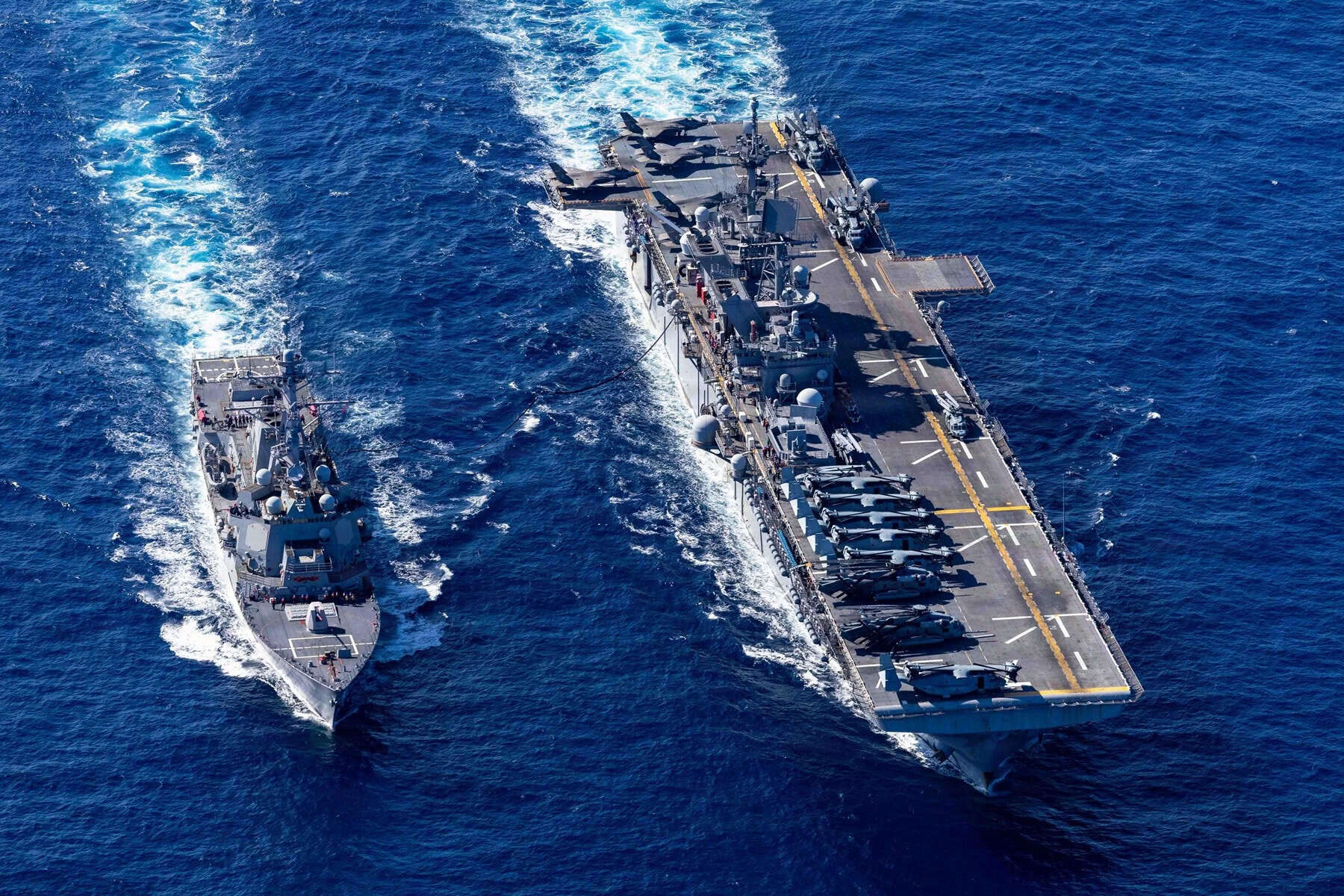
[The embarked 31st US Marine Expeditionary Brigade on ships nearing the Persian Gulf]
As predicted in my March 10 post — “America preparing to cut and run from Iran“, the US is in fact getting the hell out of the Gulf War. This prediction required no talent for prophesy, just a scan of America’s war record of the last 50 years! 2-3 weeks is what US President Trump is giving himself to wrap things up and call it a day. Because, he claims, he has won the war, “obliterated” Iran’s nuclear capability, installed a new regime in Tehran. Really, no. The world has wisened up to Trump’s foreign policy by bluff, bullying, lies, exaggeration and hyperbole. The American consumer staring at $4 a gallon fuel is the domestic political reason why the US is upping stakes and vamoosing. It proves my point that Americans have no stomach for war, especially when remote fighting — push a button from an aircraft at 20,000 feet here, destroy a target hundreds of miles away there, is insufficient and the situation calls for transitioning to “boots on the ground”. That means bodybags and the political end of the US President of the day! So, Trump says Bye! Bye! to the Gulf leaving UAE and Riyadh pleading for the US to finish the job of replacing the Ayatollahcracy with a more amenable regime. No go, Abdul!
Trump, moreover, with his unique talent for making enemies of close friends, alienated the Gulf states by not providing them with an impenetrable air defence cover that was promised, and the next thing they knew was everybody running for shelter as Iranian missiles slammed arbitrarily into their military bases with American presence and into skyscrapers making the Dubai, Doha and Qatar skylines a liability for the emirs and sheikhs who saw their tall buildings fall, high-flying international residents flee, businesses consider re-location, and the reputations particularly of UAE and Saudi Arabia as safe havens for fun & investment, crater.
Evan as the Pasdaran (Islamic Revolutionary Guard Corps) counter-attacked, Trump crowed that the Saudi Crown Prince, Mohammed Salman, would have to “kiss my ass” for help, saying this at a meeting in his Florida White House at Mar-a-lago of Saudi and UAE Sovereign Fund managers who Trump expects to invest billions of dollars in the US and save his political skin! Such crassness from Trump is par for the course because he publicly talked of American bombs raining down on Iran as “beating the shit out of it”! But it will cost America. Salman is no fool but also will not take this public insult sitting down. The Arab billions will stay with the Saudis and the UAE.
The European NATO allies who mock Trump as an arriviste and can barely keep the contempt they feel for him under check, refused to enter the war as demanded by him by deploying naval escorts for tankers plying the Strait of Hormuz, and went further. The Leftist Prime Minister Pedro Sanchez closed Spain’s airspace to US Air Force planes flying to the Gulf theatre, an action quickly replicated by the Giorgia Meloni regime in Italy and by President Macron of France, who earlier had damned US air strikes against Iran as “unilateral”. Poland then followed by refusing to send one of its Patriot air defence systems to the Gulf as requested by Washington. The Starmer government in the UK did not say no to Trump but is making haste so slowly that by the time the Royal Navy aircraft carrier finally reaches the Gulf the operational need for it will have evaporated — Whitehall’s point! Trump reacted with a post on Truth Social: “build up some delayed courage, go to the Strait, and just TAKE IT. You’ll have to start learning how to fight for yourself, the U.S.A. won’t be there to help you anymore, just like you weren’t there for us. The hard part is done. Go get your own oil!” Unlike the US President, the European leaders are no idiots
To compound the frustrating situation for the US, the Houthis fired a missile at an American target, promising more fully to get into action. So Trump is looking at a two-punch economic disaster looming for the American and the world economies: the two most critical energy seaways are getting shut down — the Hormuz Strait by Iran, and the Bab el-Mandeb Strait (and the Red Sea-Suez route) by the Houthis. And to crown the developments, the US military suffered a major hardware loss – a direct Iranian missile hit that blew up an American E-3 AWACS (airborne warning and control system) yesterday; it was being readied at the Prince Sultan Base in Saudi Arabia for a sortie to direct US and Israeli attack planes to targets. This is not to mention an alleged Iranian missile strike against the most advanced US aircraft carrier, USS Gerald Ford, anchored off Israel in the Mediterranean, which compelled its removal from the theatre. The rapid expenditure of munitions by US forces has denuded its inventory so much the US Indo-Pacific commander has warned there’s not much left to fight China with should Xi invade Taiwan at this time!
The biggest winner of the Iran War unsurprisingly is Iran. With its military infrastructure quite literally reduced to powder and pulp with some 13,000 military facilities and installations destroyed by ceaseless US and Israeli bombing, the Islamic Guards still manage — a month into the war, to fire guided munitions to unsettle the US and its camp followers in the Gulf, laughing off Trumps’ threats to take out de-salination plants and civilian power stations, because they have over 417 de-salination plants that have greened desert spots in the Gulf states in their crosshairs. Reducing them to dust would return the emirates, sultanates and sheikhdoms to their original state — local fishing boat berths and caravan serais of yore, a prospect to chill the hearts of these desert rulers (who, of course, will betake themselves with their hundreds of billions of $, to Switzerland!).
Iran, moreover, has lost nothing that it prizes most. Nearly 600 tons of 60% enriched uranium are in tact, stored in an underground complex in Isfahan, geographically almost at the centre of the country, rendering any attempt by US and Israeli Special Forces to capture it, and cart it out of Iran, all but impossible. This vast amount of enriched uranium can, at a pinch, be turned into countless small radiation diffusion devices or “dirty atom bombs”, and are stored in bins deep underground that the Pasdaran guard more zealously than almost anything else in Iran. And further, Iran’s stocks of missiles and drones, and of grain, are being constantly replenished by Russia and China through the Caspian Sea route immune to American interdiction, with Moscow also feeding Tehran’s military with satellite-derived target coordinates and over-the-horizon terminal guidance for its weapons. And with Iran asserting its rights over Hormuz, every ship permitted safe passage through the Strait has to pay a $2 million fee — a small time revenue stream compared to Iran’s shipping its own oil unhindered from Kharg island to the world!
Most astonishing, however, is the grit and the spirit shown by the Irani people, not all of them supporters of Khamanei’s theocratic state. But they have firmed up, patriotically backing it in fighting off the Americans and Israelis. They are suffering enormous privation — food and electricity shortages, and are under terrific social strain but not buckling. There’s no people’s movement to replace the rule by shia clerics that Washington had fervently hoped would materialise once the first US bombs hit home. And, as a bonus, the Global South seems to be slowly but definitely coming around to supporting a besieged Iran.
The biggest loser of this war is India. Not because it got involved in any way, but because it did not, satisfying itself with Prime Minister Narendra Modi and his foreign minister S Jaishankar spewing banalities. And then screwing up in the one diplomatic foray it embarked on at the UN. Instead of abstaining on both the Russian Resolution in the Security Council that sought an immediate unconditional cessation of hostilities by all sides — a reasonable objective to push, and on the Bahraini Resolution blaming Tehran for reacting to the Gulf states-aided US-Israeli attacks on Iran by striking at them, Delhi chose to co-sponsor the latter Resolution, putting India squarely in the Arab-Western camp. As a consequence, India’s problems may have just begun.
Sure, Modi wants to preserve his relationship with UAE and Saudi Arabia — the foundation for his Gulf policy — arguably the only successful prong of Indian foreign policy in the last decade. Indian labourers in the Gulf send back remittances amounting to almost $50 billion in the first quarter of 2026 — some 40% of the inward remittances totaling $138 billion (with UAE accounting for some 20% of it and Saudi Arabia 7%). It is a nice little hard currency cushion the Modi regime has over the years wasted on useless armament purchases, featuring such things as the dated Rafale fighter aircraft for the IAF and the navy! It also wants to protect the relationship with Israel — the source of advanced military technology. All this is understandable.
But there’s a lot of space between protecting Indian interests in the Gulf and Israel, and protecting the national interest vis a vis the US. Or, have Modi and Jaishankar missed out on the basic thrust of the American policy clearly and publicly articulated in Delhi recently by visiting senior Trump Administration officials?
We had Christopher Landau, US Deputy Secretary of State, who buried the Modi regime’s flawed assumption that America would do for India what it had previously done for Dengist China — assist it to rise to great economic and military power. At the Raisina Dialogue 2026 — MEA’s annual poster event, Landau said no, that won’t happen because Washington had learned its lesson, and would not be a party to its own further diminution by setting up yet another economic competitor and rival. It left the Modi dispensation reeling — the main prop of its US policy kicked from underneath it by the Americans!
Next, Landau’s counterpart in the Pentagon, US Deputy “Secretary of War” Eldridge Colby, son of a storied former US Central Intelligence Agency chief, William Colby, fetched up and formally aired, what I call, America’s compartmentalised strategy for India at the Delhi branch of an American thinktank. Washington will strive, he said in effect, to keep India down, preferably under its thumb, economically and in the technology sphere, prop up Pakistan as its main agent in the region, but will expect Delhi to help the US counterpoise China in the Indo-Pacific! Colby and Washington calculate that the Indian government is sufficiently spooked by the China threat to want to rely on the US strategically and to do so on American terms. And sure India should arm itself with American weapons, and reproduce any US military goods it wants but under license, thus lighting fire to the atmnirbharta pyre.
So far India has played America’s poodle without demur. It has adjusted its energy policy as per US directives, turning off and on the Russian oil spigot. Currently, this tap is open because as US Treasury Secretary Scott Bessent told the Press, America has “permitted” India to resume buying oil from Russia to stabilise the supply end of the International energy market. Private players, like Reliance, are careful not to tread on US toes, and simply follow the Modi regime’s lead. This is now a business incentive for Reliance because it has committed to buying $300 billion worth of oil from a new refinery being constructed in Texas, in other words it is subsidising that refinery’s construction — a deal Trump has hailed as a new era of Indo-US cooperative relationship.
But, sorry, all this Indian money and Delhi’s willingness to accommodate American interests will only buy India license-production deals for stuff like the GE 414 jet engine, not its source code! Nor will it buy Delhi consideration in the Trump tariffs scheme — India will continue paying 15%-18% tariffs on its exports to the US, lower than the 50% rate imposed earlier only because the US Supreme Court ruled such tariffs illegal. In short, India will get absolutely no US concession on anything.
Meanwhile, “Field Marshal” Asim Munir and Pakistan are making merry on the American penny. Islamabad parlayed a diplomatic arrangement by which, with the closure in 1979, of Iran’s embassy in Washington, Pakistan was looking after that country’s interests in the US, into a mediator role in the ongoing War in the Gulf. It is playing the role of a communications channel it last played when Henry Kissinger was courting China in the early 1970s and often used official Pakistan visits to detour secretly to Beijing to confer with Maozedong and Zhouenlai to facilitate US President Richard Nixon’s great rapprochement and “opening to China”. And Pentagon has resumed arms assistance to Islamabad. And on the other side, Tehran has given blanket permission for all Pakistani oil bearing ships to negotiate the Hormuz narrows, even as Indian vessels are treated on a case-by-case basis, which reflects Tehran’s displeasure.
All this time, with the Gulf War spinning out of their comprehension, Modi-Jaishankar find the bilateral relations with Tehran in trouble. Modi’s basic geopolitical construct of North-South connectivity to link Indian trade to Central Asia via Chabahar in Iran and Afghanistan to rival Beijing ‘s China-Pakistan Economic Corridor, is in the doldrums. Over $500 million has been invested but its success is hostage to Washington’s intemperate Iran policy, subject to mostly its downs. In any case, it is going nowhere! The Gulf War has put IMEC (India-Middle East-Europe Economic Corridor) as well in deep freeze.
India’s “between and betwixt” posture in the new Gulf war, and its tendency to bow down to the US while Modi and Jaishnakar mouth inanities about the Gulf War and fixate on Pakistan, is not going down well in the Global South where, even though India is the current chair of BRICS, it is the Brazilian President, Inacio Lula, who is making waves, standing up for Third World interests, and opposing America’s war against Iran without UN authorization or even formal declaration of war. The latter epitomised by the US nuclear attack submarine torpedoing the Iranian navy frigate, Dena, returning home after the Indian navy had hosted an Iranian flotilla of three warships at its International Fleet Review in Visakhapatnam and in the Milan naval exercise. Sure, India afforded two of the Iranian ships and their crews “safe harbour”. But India had moral responsibility to see the Iranian ships safely home, but there was not a squeak of diplomatic protest by Delhi demanding an explanation from Washington for its heinous act.
Trump and America are running away from war, and from the Gulf, not to return in any substantial way to the region for a very long time. Had the Modi regime kept its wits about it, understood the undercurrents, and kept atop the developments in the Persian Gulf, India would have had a strategic role in shaping and influencing that region post-US. In the event, neither America nor Iran cares for India and its regional interests, and UAE and the Saudis know the Indian remittance economy survives at their sufferance and they can control Delhi. India is really up a creek, and the Modi government seems not even to be aware of the deep waters it is treading.
At the core the issue is of India being strung out between strategic subservience to the US — that has led to its Gulf policy ending in a cul de sac, and economic dependence on China, with both Washington and Beijing now hanging Modi-Jaishankar and India out to dry.


 Security Wise
do you think india is supporting afghanistan’s sovereignty? (Covertly supporting TTP).
as someone who knows economics. If we donot have universal education and healthcare infrastructure building is of no use. So it is not actually loss. Central asian states will anyways have more trade with india simply because pakistan has no domestic demand. Playing communication channel is no success.
we should think of building something like chinese bri after attaining at least 90 95 percent literacy rate and fixing economic inequality at home. Then the govt does not have to beg foreign countries for tech transfer and visa for indian immigrants. But this thing modi govt has made clear will not invest in primary education. So we have to wait till the next govt.
What guarantees will iran get professor? Shouldn’t iran also understand our problems with pakistan and china. After the war ends do you think iran foreign policy will be influenced by china due to their beidou 3 satellite help?
Very good summary, captures all angles.
Is America’s strategy to keep India as its poodle, a new policy under Trump? Or was it inherited from the Obama administration? The Obama administration was very willing to accommodate India on anything – under Def Sec Ashton Carter’s pentagon, there was an India department created that people vied to be part of.
Agreed, India continues to play 2-D chess under Trump. Stopped buying Russian oil, begged for permission to resume buying after the Iran conflict began – all signs of a country under the US thumb. Not sure co-sponsoring the UN resolution is going to earn India any gratitude.
It has been in the making a while.
Professor, what could have india done differently given the constraints in this situation?
India had everything to lose by taking sides. It did.
Professor, there has been significant discussion online regarding whether India may be preparing to resume Operation Sindoor, following recent high-level security meetings held by the NSA and the Defence Minister and Prime Ministers meeting with all states Chief Ministers additionally, developments such as the temporary closure of airports in Jodhpur, Bikaner, Jaisalmer, and Adampur, along with siren testing in border areas have contributed to this speculation. Whats your perspective on this situation?
Look, the Indian army and government missed the opportunity to take back, say, the Haji Pir salient, as my posts at the time — go back and read them! — had suggested we do, once air dominance was achieved by May 9, 2025. That opportunity was lost because GOI and army instead accepted the Pakistani offer of ceasefire. Not sure Sindoor can be revived.
yes it will be total war. Cyber and space fully sponsored by china.
Mr. Karnad
What are your thoughts about the soviet naval officer Andrei Martyanov who holds a some views as per below and has expressed this very openly in many of his interviews :
Only too true. The US is a tech-dependent military adept in remote warfare, as I mentioned, and has rarely won with its “boots on the ground”.
The IAF has placed an order for 60 indegeniously made “Ghatak’ UCAVs which is an unmanned bomber jet somwhat similar to the B2-Spirit bomber in design, do you think that we are finally on the right path transitioning towards unmanned systems saving us billions while also delivering high risk, deep strike Atmanirbhar capability?
Should hope so.