
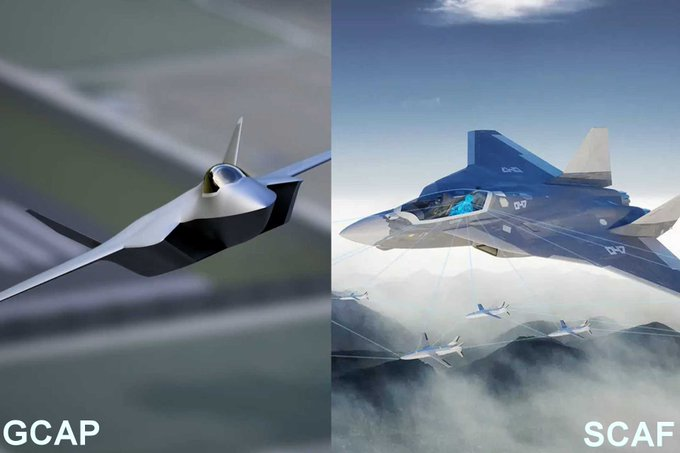
[GCAP Vs FCAS]
Every military procurement deal is a boondoggle. Apparently the Ministry of Defence thinks the Indian government has money to burn, and that the Indian taxpayer will uncomplainingly fund the armed services’ procurement excesses. There has been an unending series of exorbitantly priced defence buys in the last few years which make little sense, taken singly or together, do not follow the tech trends, and are completely oblivious of where warfare is headed — it is towards vast numbers of small, cheap and mobile drones and autonomous weapons as the military successes by Ukraine against Russia and Iran’s against the combined might of the US and Israel have shown.
Anytime there’s an announcement of a new fighter plane deal or of an investment in one, I despair. It is invariably yet another decision in a time-tested pattern of the Indian Air Force buying into the wrongest thing, choosing the most expensive fighting platform option available, at the wrong time and just when manned aerial warfare is becoming extinct, and when the atmnirbharta/self-reliance programme needs desperately to be rescued from going down the drain.
So here we are — the great Rajnath Singh, who doesn’t tire of yakking about atmnirbharta, and the Defence Ministry he “leads”, once again indulging the foresight-less IAF’s fetish for flying blind in clear light. On Vayu Bhavan’s plea, the Defence Ministry endorsed the service’s outlandish demand for a still more “exquisite” aerial weapons platform that the country can acquire by joining one of the two European consortia developing a 6th generation fighter aircraft! There’s the GCAP (Global Combat Air Programme) with the UK-Italy-Japan and the Dassault-led FCAS (Future Combat Air System) involving France, Germany and Spain. A more spendthrift and straight forwardly foolish and foolhardy decision is hard to conceive, even as the idiot electronic and print media and commentariat in the country do their customary wahs, wahs, and genuflect before the wisdom shown by all concerned!
When one thought the Indian Air Force couldn’t go any lower than with the Rafale deal, which pretty much killed off the Tejas project, it did. It plunged lower by seeking participation in GCAP/FCAS that will write finis to the indigenous Advanced Medium Combat Aircraft programme (AMCA). With the kind of latitude allowed the IAF by a mindless defence ministry and government to buy what it wants from wherever it wants, no surprise the Indian Navy too wanted in on the goodies, the fun buys! So it decided on the Rafale Marine carrier aircraft — this being its contribution to the Indian military’s dive into the depths of despond, at a time when the 2-engined Tejas designed for carrier operations had made it through all the test trials, and was on a fast-paced induction schedule into fleet service. Like the Air HQ, the NHQ too, did not do the right, nationalist, and patriotic thing. The cost of this folly? Rs 63,000 crore ($7.5 billion) for 26 Rafale Marine (Rafale-M) carrier fighter jets at $289 million for each plane WITHOUT weapons!
There’s no price tag mentioned for joining GCAP/FCAS yet, but it is not hard to extrapolate from the by now familiar figures for the most recent deal — Rs 3.25 lakh crore ($40 billion) for what was called the “Make in India” initiative for 114 Rafale aircraft, 18 off the shelf, 96 srewdrivered in the world’s leading aircraft screwdrivering facility — HAL. That amounts to Rs 2,850 crore EACH for an antiquated 4.5 generation fighter aircraft that went up in Sindoor and, for its troubles, was promptly shot down by the Chinese copy of the 4th-generation Israeli Lavi, the J-10 flown by the Pakistan Air Force! If this sad warplane, Rafale — exactly the same generation as Tejas but far less agile, costs so unimaginably much, how much more will joining GCAP or FCAS cost?
An initial total programme estimate for GCAP was $96 billion, which figure has escalated to something over $120 billion. Of this sum, Italy’s most recent estimated contribution by workshare and investment is $21.8 billion, leaving Japan and the UK to pick up $50 billion each. The Italians and the Brits are keen to water down their contribution by getting India in — when there’s an unsaleable product, the wisdom in the international arms bazar is to go to the Indian military — every foreign defence industry’s saviour! But GCAP is on an accelerated drive because Japan, fearing the Chinese Air Force, which is unveiling new high-tech combat aircraft every other year, reportedly wants it on the flightline soonest as replacement for its Mitsubishi F-2. In the event, it is too late to rework the whole workshare and proportionate investments aspects. But GCAP states would be very happy, of course, for the IAF to buy their plane, but it will get it last after the charter members have met their requirements. But because entry into the project is unlikely, the GCAP option may be off but, theoretically, split 4 ways the Indian contribution to it, at first glance, would be around $30 billion.
Ah, we come now to the IAF and Indian Navy’s favourite supplier — France! The FCAS cost estimate is $117 billion. But it is on its last legs because France and Germany differ on the basics — France thinks it already has the Rafale platform design that can be fruitfully embellished with new tech and built on as the advanced FCAS. But Dassault is unwilling to share the source code for the baseline Rafale system with Germany, arguing that Germans have zero aircraft designing and development capability, and Berlin can’t do much better than shut up, ride pillion, and periodically fork up the Euros! Germany feels insulted as does Spain, which has produced the medium range transport plane C-295 that Tata are assembling in the country, but little else. Enter the winner of the INTERNATIONAL SUCKER title – (We have to win at something) India!
Typically when in doubt, France, and every other arms supplying country, rounds in on India — everyone’s best and most valued customer, that can be taken for a ride anytime! And rounding in on the armed service dearest to Paris’ heart after its own Armée de l’air re-labelled since 2020 as Armee de l’air et de l’espace — the Indian Air Force! Dassault is hoping it can rope India into financing this whole wretched enterprise even as Germany and Spain wisely decamp. To recap, the FCAS initial cost of $117 billion is expected to escalate in lifetime cost terms to somewhere between 300 billion Euros (or Rs 3,25,13,10,00,00,000) and ONE Trillion Euros (Rs 10,83,77,00,00,00,000) !!!!!!!!!!! Halve whatever the price tag, and that, conservatively speaking, will be India’s contribution! Think of this mindboggling sum and blanche! Who says India is a poor country? Look beyond the Potemkinised New Delhi, Narendra Modiji!
[Su-57]
If the IAF is so eager for quickly stepping-up into the 5th-gen aircraft milieu, the Russian offer of its Sukhoi-57 seems reasonable, especially as it comes with complete transfer of source code, which will help finesse the Indian AMCA design and performance as well, and to integrate Indian-designed missiles into it, etc. Though let’s be clear: It is not a genuine stealth aircraft as it lacks the S-shaped engine ducts, say. But makes up for it by having recessed engine placement and an antiradar mesh on the fan-front. It can supercruise — go supersonic without afterburner, has endurance at 3,500km range (extendable to 4,500kms with external fuel tanks) and a 2-seat configuration (the IAF desires) for longrange strategic missions — useful considering the Service’s antipathy to a genuine strategic bomber — the Tu-160 White Swan with 13,500km range for non-stop 25-hour flying. Plus, importantly, the Su-57 (NATO codenamed “Felon”) has concealed in-built bomb-bays, so unlike the hideously expensive Rafale with weapons under-slung and on external wingpoints that would light up enemy radar like a Christmas tree at distance, it is relatively invisible. The 57’s radar cross section increases only for the moments the bays open for the weapon drop/release. And the entire deal will be far more affordable. And the IAF would have two mainline 5th gen+ aircraft — AMCA and Su-57 in its fleet. Politically, it will help correct the country’s foreign policy that has tilted so far US/West-wards there is near certainty of the country stepping voluntarily into America’s vassalage. See how India’s energy politics is hostage to Trump’s domestic political imperatives, highlighted by recent developments on the US-Iran war front.
It will make the Rafale completely redundant, and the deal for it can and should be cancelled. And if Rajnath Singh and the Defence Ministry have any military sense, which they don’t, the Rafale-Marine would be ditched as well, and trust reposed in the indigenous naval Tejas as the Indian Navy’s flag carrier fighter/strike aircraft.
Compared to the number of conflicts it has engaged in, post-1971, the IAF has had little to show by way of success. Its record of aerial kills is negative — it has lost more aircraft than it has downed enemy planes, as the first day (May 7) of last year’s Op Sindoor — 5 aircraft lost, or the 1st day of the Kargil conflict (two aircraft lost) in 1999, proved. (AP Singh can talk all the nonsense he wants about “12-15” Pakistan Air Force aircraft, including F-16s, the IAF supposedly shot out of the skies during Sindoor and, while at it, Air Chief Marshal, why not claim the destruction of the entire PAF fleet?! But he knows the score.)
But damned if the IAF does not have a very impressive record of killing home-designed and developed aircraft — the HF-24 Marut, HF-71/72/73, Tejas 1A, 2, and now the Chief of the Air Staff, ACM Aman Preet Singh, can proudly and symbolically mount the head of the AMCA in the officer’s mess on Zakir Hussain Marg, and gloat over another kill! Because, with over half a trillion dollars needing to be committed to FCAS prospectively where will the private sector consortium of L&T, Tata, & Bharat Forge — the finest in the country, tasked with designing, developing and producing the AMCA, get the money from? And with the attention diverted to the FCAS will the IAF ever actually buy any AMCAs when they are produced?
Fortunately, this horrendous GCAP/FCAS investment plan is so far only a paper demand by the Defence Ministry. Prime Minister Narendra Modi will have to ultimately decide if pouring hard-earned Indian wealth after poor European investments is a good idea. Whosoever is advising him on these issues will, hopefully, suffer from a fit of common sense, and prevail on Modi to reject this IAF-Defence Ministry request outright, and get the Prime Minister to tell the IAF to live within the country’s means — a piece of counsel he may like to extend to the other chiefs of staff he meets periodically as well, and to the senior commanders of the three armed services he confers with annually.


 Security Wise
only after china takes away arunachal pradesh our country will develop strategic mindset. What do you think professor? Does the government read your blogs?
Who knows and who cares?
Excellent analysis as usual.
1.Do you think after the military success of the JF-17, the PAF will be successful in selling the jet to the middle east and Africa.
2. Why are we not able to export our own indigeneous Akash missile defense system(which I believe has performed extremely well during the operation), at these times of global turmoil when there is a shortage of THAD and PATRIOT batteries and interceptors and a battle tested cheap and reliable defense system can prove to be a lifeline for the gulf region.
Because Indian defence agencies are bad at selling anything, a situation aggravated by the fact that there’s no after-sales service, as many foreign customers have discovered to their dismay.
Iran is fighting the 21st century war with missiles and drones, where the IAF and govt have not moved beyond Kargil. As Lt Gen Raj Shukla said in an ANI interview the Indian military hierarchy has not taken any lessons from the Russia-Ukraine war.
Trump announces ceasefire for 5 days. Professor, is this basically TACO? Just like he announced a pause on tariffs on china, which he never unpaused, maybe he might do the same here and get out?
Israel says they will continue though.
Yup, TACO Trump (as I predicted)! TACO — Trump Always Chickens Out
My friend in Abu Dhabi however said he could still hear interceptions. Interesting to see if Israel and Iran continue to fight it out with the Americans gone
No, Israel will stop. Otherwise, the Pasdaran will keep Hormuz closed
So basically Tugalaq Trump ended strengthening the failed regime even more by surrendering to Iran at this stage of the war. Now Iranians tasted victory next time they ll have better strategy for Hormuz and handling Israel, GCC countries. Iran turned out be another Vietnam for US.
Professor, a former Pakistani diplomat has stated that Pakistan should consider striking Delhi and Mumbai in response to any potential U.S./Israeli military action. Do you believe this indicates a genuine strategy, or is it merely political brouhah?
Well, yes, it is the North Korean model of deterrence — hit us, we’ll take out Tokyo!
All that is needed right now is to stop the foreign fighter aircraft purchase for five years only. During these five years, Tejas and AMCA will be on a fast track and start populating Air Force squadrons.
That’s why the Indian Air Force is so desperate to scuttle this indigenous pipeline and keep the foreign gravy train coming.
The need in the meantime is to buy more drones, rockets and missiles, especially Brahmos and Shahed types.
However, India’s imported air force will not let this happen.
@BharatKarnad
https://www.reddit.com/r/IndiaSpeaks/s/lIiGBzJef8
Professor i do suggest you please checkout this 1 min Video.
Abdul basit was a former high commissioner to india. He says if US(or maybe even israel) were to pose a danger to the pakistani arsenal and they fear decapitation then Some of those warheads will be lobbed on to New delhi and Bombay.
Is this to be taken seriously?
Cause as far as i can see this seems to be a commitment of commiting national suicide if the arsenal is snatched from them
Email from Lt Gen Arun K. Sahni (retd), former GOCINC, South West Command
Arun Sahni
Tue, Mar 24
Dear Bharat,
I am in agreement that the indigenous Indian Aircraft manufacturing of Tejas needs to be supported. The engine issue that is on the anvil with Safran is the project that needs a push.Investments in Gen 6 project is not a priority.
We can band wagon anytime later for the EU consortium will always be keen to welcome India
I am aware that GE engine manufacturing of the LEAP engine is partially done in India , creating an ecosystem in the private space.
So lets look at indigenisation.
Best Wishes
Arun Sahni
Why the heck does India keep emerging as the eternal loser from every single geopolitical situation?
Even after watching Ukraine get carved up by drones, Armenia get steamrolled by Azerbaijan’s drone swarm, our own Operation Sindoor turning into a messy reminder with Rafale losses, while success of our anti radar drone strikes was success on the battlefield. Now Iran creating a nightmare for Israel-US even after having no air deniability or air space control, it’s crystal clear to every person with common sense that present-day warfare is drones, unmanned systems, and swarms, not some fantasy about manned jets.
But what does our brilliant government do? They’re still jerking off over 6th-generation fighter jets — planes that won’t exist in meaningful numbers until our grandchildren are old enough to vote — while China controls the drone market and pakistan is in JV with Turkey
Instead of flooding the forces with thousands of attritable drones, counter-drone systems, and autonomous kill chains right now, we prefer to blow billions on Ladli Behna freebies, revdi after revdi, and every other vote-buying cash transfer scheme that keeps the illiterate masses clapping like trained seals.
This isn’t governance. This is national suicide with a smile, funded by our taxes and justified by “welfare.” (sorry for the rant)
Well put. The answer to the first question: look at the qualifications of the people at the helm that our much-ballyhooed “democracy” has thrown up. Are they fit to administer a small municipality council, let alone a great, rising nation? Besides, in this general culture of sycophancy and venality, there is no general/marshal/admiral of the calibre of Manekshaw who can say “no” the highest authority and can thus mould the military without heed to kickbacks or career advancement.
About the Rafale losses, must note that finally there is glee and dollops of schadenfreude among Indian patriots to see that the odious person rubbing it in how IAF lost 6,7,10 jets is now himself losing face with 17 advanced jets lost and counting! Surprised our venerable Prof has not weighed in on this final settling of scores!
Of the 16 US “aircraft” downed, most were MQ-9 drones. But two F-15s went down under friendly fire, one KC-155 refueller crashed after mid-air collission. But one F-35 took a hit, landed safely with an injured pilot. The more meaningful losses, as widely acknowledged, were of a couple of the exorbitantly priced AN/TPY-2 radar at the heart of the lone Terminal High Altitude Area Defence (THAAD) system in the Gulf region, now inactive. See
http://timesofindia.indiatimes.com/articleshow/129721687.cms?utm_source=contentofinterest&utm_medium=text&utm_campaign=cppst
Professor why do you think the modi govt is not interested or is it scared, to predicate india’s foreign policy on military power ?like in operation sindoor?
like captain shiv kumar our naval attache in Indonesia said that govt had asked the iaf not to hit pakistan air defence ir military targets first. Why is the govt doing this?? Does modi want to solve the kashmir issue??
GOI has always been risk averse
risk averse is one thing that modi doesn’t want to fight war.
but only if he wants to do 3 day operation shouldn’t that be done properly.
Refer my posts on Sindoor
I refer you to “yeh yuddh ka yug nahin hai…”
Your Excellency Prof. Bharat Karnad,
Since China controls 70% of rare earth minerals production and over 90% of the refining, separation and permanent magnet production, these minerals are critical for manufacturing sector, from civil consumer goods [automobiles etc] to military [Drones etc].
Is there any alternative of china available, so that India can reduce it’s dependence on China and shift to more reliable options ?
India has rare eaths and the Indian govt and private sector companies are investing in mining, processing and refining them
Professor,
1. Not really, not anymore.
2. Russia is a better bet to escape dependency, combined with the Tejas-AMCA line, than the US, France, etc.
Prof, what is your opinion on Pak’s current diplomacy around talks amongs arabs, israelis, and americans? Is it good that India has stayed out of this and does it benefit Pakistan?
As mediator, Pakistan will be accorded all consideration against India — a not as useful partner
what role does usa want to pakistan play in west Asia professor? After all pakistan s the one dependent on other countries for loans. Or is it china will use pakistan for making an Islamic nato after the war ends? Is pakistan important gor Saudis just for nukes?
Yes, Pak promised Saudis NW access, but in practical terms it’s not on.
Pakistan is a channel of communications, not mediator.
professor after the war ends do you think usa hubris will decrease and they will allow their ‘allies’ to exercise strategic autonomy instead of treating them as vassals. Will there be structural change in their foreign policy?
Nope. because Trump will sell it as a great win!
Prof Karnad,
You have frequently mentioned the use of a long-range bomber like Tu-160, because it is a nuclear option that can be recalled, unlike a missile.
Do you think we still have a use-case for a bomber in the era of asymmetric warfare? It is a sitting duck for the drone and anti-aircraft missiles right?
Absolutely. Most SAMs cannot reach the sustained cruise altitude of a Tu-160 White Swan strategic Bomber
Dear Professor Karnad,
I have been following the Iran war with unusual interest. Certain questions however trouble me greatly. Where can I find vertebrae (33) for our PM and Foreign Minister Jaishankar. The whole External Affairs Ministry needs vertebrae followed by Vitamin shots every 2 hours. Otherwise the most insulting comments from Trump and his team about India is going unnoticed.If we do not respect ourselves, how can you expect others to treat you with dignity
Trump comes out with statements like “he allowed India to buy Russian oil” Scott Bessant said the samething . Couldn’t somebody ask ” hey, why did you allow us to buy Russian oil now?” and must force them to answer. The world is undergoing a supply chain shock. The markets have to be flooded with that commodity to make it function normally.
Even Iranian Oil is not sanctioned. While the world stares at Iran, Iran delivers it’s daily supply of oil in Oman. This would have been enough to tell Trump to F.O. We don’t have to listen to US diktats. Focus on other markets and get new customers.
And Indian Govt officials should remember to wear their cojones after bath, as many forget that. See how the Govt of Iran reacted. News Anchor :We are planning to send Marines. Iranian Foreign Minister: Ok!
NA : What do you mean ok?.IFM: You said you wanted to come. We will wait for you.
NA: What? IFM: Our Military has undergone rigours training and we think we can manage.
The fact of the matter is every IRGC and Al-Quds soldier has been blooded in battle. Somebody was telling his colleague “We had a good time fighting them in Iraq, Lebanon, Syria and the Gaza.They didn’t know it was us”.
Iran is basically turning one of the West’s most potent weapons against itself. Hence Trump says one thing one day, says something else the next day. ” We destroyed the Iranian Airforce” Iran doesn’t have an Airforce. The last jet it bought was a F4 Phantom in 1974! We destroyed Iran’s Navy! Iranian Navy had 10 to 15 old frigates. So what? What you don’t hear is Gerald S Ford caught fire. How? The US Navy says the fire started in the Laundromat and nearly 200 sailors are injured. I do the laundry every week. I never knew it was so dangerous!
Now all US carriers stand atleast a 1000 kms away from Iran. Notice the syntax. Thit e Americans and Israelis ” We will do this and it will be like that.Then we will go for the next move”. See the complete discounting of Iran. They presume to be superior and hence will win the war . They have concluded Iran has no agency of its own
and it might respond differently. Right enough US/Israel bombed Iran but it doubtful if they have even met an Iranian soldiers. Everything military in Iran is underground, under a 8 feet of granite. Massive tunnels have been dug, it is further strengthened with reinforced concrete , and most of the factories are like that.
Iran is a large country 4 times the size of Iraq. Everything that IRGC does is calculated, methodical and deliberate. One old uncle appeared on YouTube after the war began. I have sleep issues sometimes.
He took us to a pile of missiles and spoke softly. This lot is from 2013. We will use them first and only after that we can proceed. (They have a very, very, very, large quantity of missiles,). The anchor asked him how did you manage to do all this? You know from 2001, our name began to appear on the axis of evil list: Iran, Iraq and Syria. Our leaders thought we should get ready for facing any eventuality.
In other words, Iran began preparing for this war 25 years ago. Their trained soldiers were sent Hezbollah, Hamas , fought ISIS, Al Nusra, along with the Iraqi Resistance against the US. The members of the Iraqi Resistance are professional soldiers with the Iraqi Army. The Iraqi Govt called on the soldiers to help their Iranian brothers when the need arose!
.
.
.