
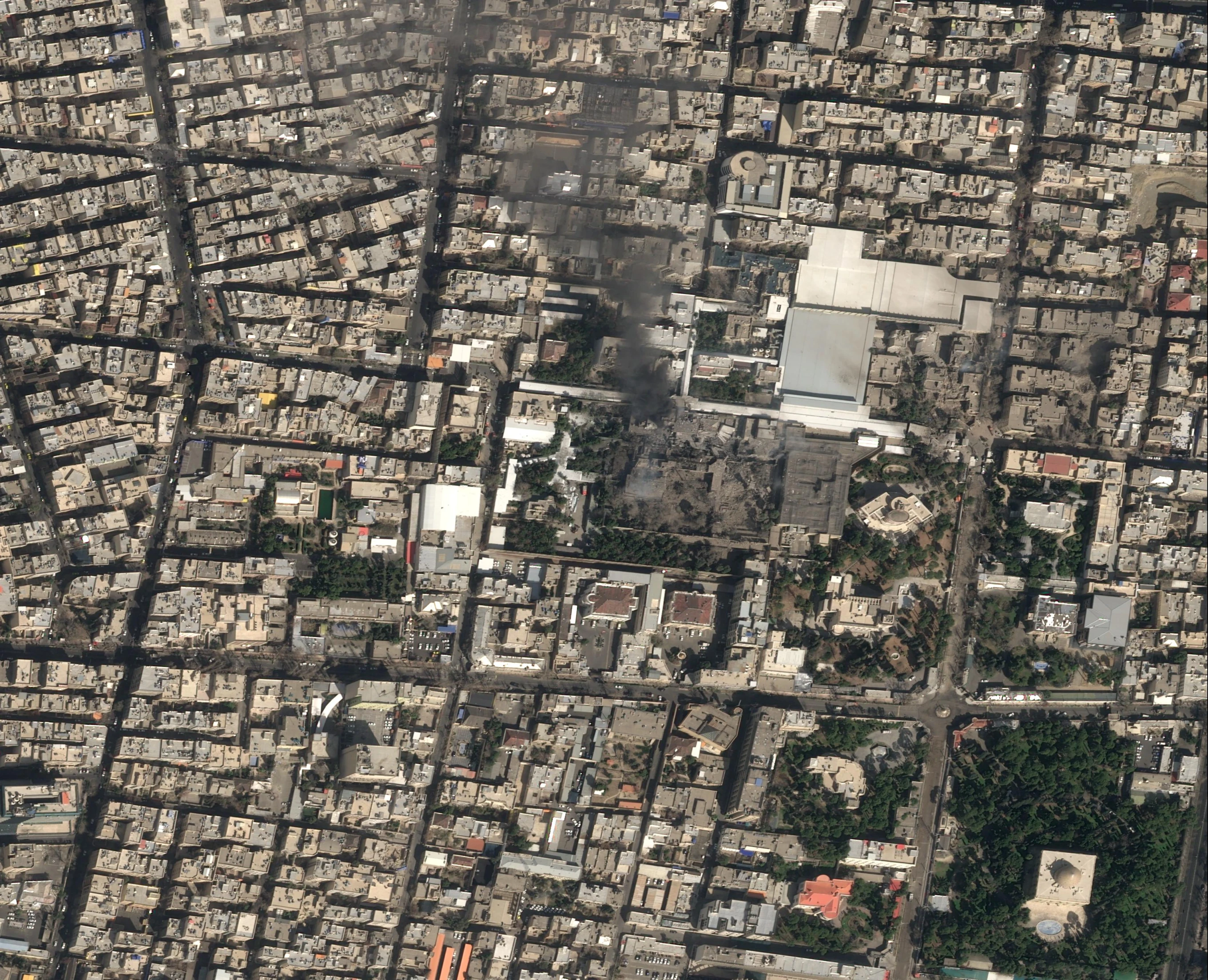
[Strike on the Khamanei compound in Tehran]
It has the makings of a catalytic war. The US and Israel jointly struck Iranian targets, mostly nuclear-related installations and other strategic assets in Tabriz, Isfahan, Shiraz, the port city of Chabahar, Ayatollah Khamanei’s residential compound in Tehran and, to make a point, the centre of Shia Islam, Qom.
As warned, the Pasdaran — Islamic Revolutionary Guard Corps, retaliated with missile firings on Tel Aviv, and the air bases in Jordan, Kuwait, Bahrain housing US Navy’s 5th Fleet, Qatar and Saudi Arabia, and the international airport in Dubai, UAE, 2nd home to Bollywood stars and rich Indians, who must now be questioning their wisdom of investing in million dirham homes and apartments there.
Warnings of such an extension and spread of the war is what Tehran had hoped would deter the US government from going in with Israel in the initial air strikes. It didn’t.
If any of the emirates and kingdoms of the Gulf had any kind of consequential militaries, they would have felt compelled to respond to the Iranian strikes in kind. But because they are mostly American camp followers, they are on the horns of a dilemma. They cannot alienate Tehran and the shia minorities in their own societies (especially in Bahrain) or motivate the shia groups fighting Israel in West Asia — Hezbollah and Hamas in the main supported by Iran, by mounting even symbolic actions against the Tehran regime. And yet they cannot be drawn into a larger conflagration because the status of the UAE emirates and sheikhdoms in particular who, other than because of their oil economies, have fashioned themselves into global finance centres. Imagine how quickly Dubai would revert to a desert outpost if the large Financial Institutions decamp, leaving the various Sheikhs’ and emirs’ plans for their small estates evolving into technology, education, and cultural nodes, in the dust.
This is why there will be no catalytic war to engulf the Gulf.
The notion of ‘catalytic war’ was originally conceived in the 1950s by Henry Rowen, then a professor in business management at Stanford University, and later the 2nd head of RAND and Assistant Secretary of Defence in the George Bush Administration. He theorised that the two super powers — the US and USSR would be drawn into a nuclear war should their regional allies start conflicts that would suck the super powers into them.
Some 70 years later, we have a situation of a possible reverse catalytic war — the US’s lead role against a regional power that reacts by striking at America’s allies in the proximal areas inducing the latter to respond, triggering a full blown military imbroglio. But this won’t happen because the exchange ratio for the Gulf states for thus stretching the conflict could be catastrophic as mentioned above. So, starting with Jordan — the worst hit, none of the Iran-targeted states will unleash their puny forces against Tehran.
Catalytic war in the reverse mode won’t happen also because most of the leading West European countries have come out against the US-Israeli conflict initiation, with France and Spain, not Iran, raising the issue yesterday in the UN Security Council. So, Trump is now aware that his anti-NATO posture is coming home to roost, that European NATO will no longer support US-started conflicts anywhere in the world (unlike in the Cold War when UK and Australia joined the US in the war in Korea, and many NATO states despatched their troops to fight alongside American soldiers in Vietnam and much later in Afghanistan). Now, Washington has only Benjamin Netanyahu’s Israel to bank on. And where Iran is concerned, it is the Israeli tail that is wagging the American dog — with Trump falling in line with Tel Aviv’s longstanding demand for a regime change in Tehran.
While Trump and Israel have claimed that the mullahcracy in Iran has had its leadership decapitated — that Ayatollah Ali Khamanei has been killed, it is unlikely this alone will mean much if the balance of forces within Iran continues to be with the shia clerics.
In the Islamic Republic of Iran, there are four main players — the shia clergy and their main pillar of support — the all powerful Pasdaran with its intelligence tentacles reaching out into the nooks and crannies of the state and society, weeding out the protesters and unreliables wherever they may be found.
Secondly, there is the religiously conservative population in the vast countryide — the real strength of the clerical government in the country. Thirdly, there are the city folks in major urban centres — the people who supposedly yearn for the good times during the reign of Mohammad Reza Pahlavi, who projected himself as the latest in the line of Persian emperors going back to Cyrus the Great circa 5th Century BC. Even though this Pahlavi’s father, Reza Shah, was commander of a Persian Cossack Brigade, who was picked by Western powers at the end of Worl War I to rule Persia and protect their oil investments and interests. But a parallel democratising political development occurred with the Iranian majlis (parliament) in 1952 electing Mohammad Mosaddeg, a reformist, as head of government only to have the US Central Intelligence Agency stage a coup a year later, and return Iran to the West-friendly absolute rule of Reza Shah’s son, Mohammad Reza, which was ended by Ayatollah Khomeini in 1979. This Mohammad Reza’s son, the 1960 born Reza Pahlavi as the lineal descendent is Trump’s man to fill, once again, the vacant Iranian “throne”.
The fourth and decisive player are the baazaris — the traders, with enormous financial clout, whose siding with Khomeini ended the Pahlavi “dynasty”. This then is the setup, and the baazaris again will determine the side the balance of power will tilt in Iranian politics. The baazari element is too culturally tuned against the West to sustain the return of the American educated Reza Pahlavi as an obvious American stooge.
This analysis raises three side issues — two important, the third not so. First, when and how will the Iranian military with the Pasdaran in the van use the more “advanced weapons” in their arsenal that they have threatened to fire after they have expended the stock of older missiles and such? Assuming that at least one set of these new weapons are supersonic anti-ship missiles, will they be used to sink the most high value targets in the seas offsore — the US aircraft carriers led by the latest USS Gerald Ford equipped with EMALS (ElectroMagnetic Launch System) for rapid launch and recovery of strike aircraft, now anchoring off the Israeli coast, and reachable by longrange supersonic anti-ship missiles allegedly transferred to Iran by Russia/China? Should an American carrier be sunk, it will sink Trump’s presidency as well as surely as tomorrow’s sunrise. Trump will not react reflexively by doing anything foolish, like using tactical nuclear weapons, say. Why? Because then Moscow and Beijing will come to Tehran’s aid, and then there are no bets as to what might happen next. World War is too pregnant a phrase to bandy about loosely. But such a prospect does hove into view.
But what if Trump responds with a huge conventional military venture, all combat arms and assets in? No amount of aerial bombing will bring Iran to its knees. What will is a land war, and that is not something the US army, which has time and again shown it cannot win close quarter fights, and will abhor getting into. Further, if Gerald Ford is sunk with all its defences turned on, what prevents an enthused Pasdaran/Iranian navy-military from bringing down the other carrier and all the carrier escorts in nearby waters, and taking out US 5th Fleet ships berthed in Bahrain? If the Iranians don’t fire these missiles then questions will arise about the Pasdaran chickening out. Can Pasdaran survive that supposed calumny?
It leads to the second issue– actually that old question asked in Sherlock Holmes’ mystery of the missing race horse — Silver Blaze! Why did the dog not bark?! Here the dog is Russia-China, both big powers with interest in retaining the Ayatollah dispensation in Tehran. Why has there been not a squeak out of them even though Trump daily rants against them? After all, the mere fact of Soviet nuclear attack submarines trailing the Enterprise carrier group in the Bay of Bengal in 1971 allowed the Indian army to complete its business in East Pakistan. A similar presence could sow no end of doubts in the Trump White House and in the mind of the US military and save Tehran’s goose.
The third issue is the recent trip by Narendra Modi to Israel. From the first sense, one does get the feel that the returns for Delhi from the much heralded visit, as some commentators have concluded, are paltry. But be that as it may, the interesting thing is that Netanyahu must have alerted Modi to the ingoing Israeli strikes on Iran. So where was the need for the Indian government to put in its two pice worth of nonsensical advice to the US, Israel and Iran to seek peace?! The proverbial counsel given a blonde bimbo is relevant here: Don’t open your mouth and prove it!


 Security Wise
The Ayatollah is dead. His detractors in Iran, those youth who suffered under the despotic religious laws are rejoicing. Trump eggs them on to take over the country for him. The conservative leadership has been decapitated for a second time. Iran claims that the religious rule will continue as the next in line have been designated.
West expects that who ever takes over next will capitulate and do the deal it wants. Surely instability in the Gulf is bad news for India.
Two questions I have for you, professor:-
1) GOI is bending to Trump’s will on Iran — Chabahar is nearly lost (unless a US-friendy regime is installed)
2) Iran’s N-program has been grievously hurt — it may not be possible for it to enrich fissile material from 60% to 92% weapon grade.
@BharatKarnad Is it possible that the Iranian government is upselling their counter-attack operation as an Islamic, Muslim Jihad/a religious holy war to the Iranian people, their enemies and to the whole world, and due to this, they’ve used the Battle of Khaybar as an inspiration to name their counter-attack operation as Fateh Khyber?
Actually pan Islamism made Iran weak. See all gulf muslim states are standing with Israle and US. Shia iranians fighting for sunni arab palestenian muslims is utter foolishness. Iran’s economy collapsed,people are dying due to useless wars caused due to this pan islamist ideology.
Iran would have much progressed economically and militarily had they gone pragmatic in thinking instead of non practical pan islamisim. Pan islamism never worked in practical sense in international politics. See how seasonal jihadi pakistanis are fighting hardcore jihadi afghans.
@Deepak As far as I’m concerned, leaving aside the genuine concern for the safety and well-being for the Indian Diaspora in West Asia, I’m happy for what the West Asian, Sunni, Muslim, Arab nations, Shia, Muslim, Persian, Iran and the US including the French in the UAE, the British in Cyprus and Turkey faced as of yesterday due to this ongoing Israel, America and Iran war.
The Sunni, Muslim, Arab nations deserve what is happening to them because of their use of their petro-dollars to fund and support anti-India terrorist groups, anti-India mosques spewing hatred and terror, including at places near the borders.
The Shia, Muslim, Persian, Iran deserves what is happening to it for violating India’s sovereignty in the past by bringing its war with the Jewish, Zionist, Israel to India and also for anti-India statements by Ali Khamenei in the past.
NATO member-nation Turkey deserves what happened to it for its anti-India behaviour of supporting Pakistan, Azerbaijan and its usual and predictable anti-India stance.
Britain and France deserve what happened to them for colonising and occupying India in the past.
The US deserves what happened to it for all its arrogance, bullying, racism, so-called tariffs/sanctions among a long list of anti-India things done by it.
US/isr already have number of moles inside iranian army, nothing is gonna happen, iran is just attacking non critical US /Arab/Isr sites to calm down their citizens.
@BharatKarnad
Greeting Professor Nice to interact with you
Read entire thing and i have few questions
1)You suggest that sinking a US carrier like USS Gerald R. Ford would collapse an American presidency. But wouldn’t such a strike instead unify US domestic opinion and justify overwhelming retaliation against Iran? Japan tried something like that in pacific and then at the end we saw 2 mushroom clouds over 2 japanese cities.
2)You dismiss the possibility of escalation, yet history shows wars expand through miscalculation rather than intention. Are you underestimating the risk of accidental escalation, especially in a missile-saturated battlespace?
3)And last You suggest Russia and China are strategically silent. Or is it simpler neither Moscow nor Beijing is willing to risk confrontation with the US over Iran. If that’s the case, doesn’t it prove that middle powers like India must assume no one will stabilize the system?
1) Unify the US people, perhaps. But Trump goes
2) Escalation can be due to anything
3) Yes. Reason why I have said India has to rely only on itself
The US-Israeli decapitation of Iran proves that modern conflict favors the all-out aggressor, the Indian military’s commitment to limited war and calibrated retaliation as seen in Operation Sindoor effectively signal to our adversaries that we are a self-deterred power, incapable of ever achieving a definitive, system-altering victory?
Dear Prof Bharat Karnad,
Do you think that the decline of Islamic Republic of Iran will boost Baloch movement in Pakistan, since big part of Balochistan comes under Iran, the anarchy in Iran will make Pakistan indirectly unstable.
Is it good for India ?
That’s an interesting prospect: a united Balochistan, inclusive of Iranian Baloch territory. Not sure, if there’s a pan-Baloch leadership and movement to realise it
Maybe just Maybe Modi went there to strike a deal with Netanyahu regarding this, Once Israel has its own Govt in Iran. They will for sure love to carve out new countries out of Iran.
Modi Govt has completely sided with the Israel-US on this. And we all know it’s actually Israel dragging US into this. New Government If (BIG IF) comes chances are there is gonna be a MOSSAD guy heading it.
About the two dogs (external actors: Russian and China) that did not bark, even though Iran has been a major petroleum supplier to China, they clearly didn’t heed the famous dictum of Benjamin Franklin: “It’s best to hang together than to hang separately”. What is more bemusing is the two internal Iranian dogs that didn’t bark: its S-400 radar system and its putative Air Force. Both have been woefully missing in action. Israeli jets have been traversing the Iranian airspace and shedding their payloads with total impunity. Evidently, the bark of these dogs is worse than their bite.
Yes, the 60% grade Uranium can be used but it will be more a radiation diffusion device than an atomic bomb. Iranian Air Force was never much of anything. S-400 — a good system, was not properly utilised
excerpt from the below article:
Israel’s F-35I “Adir” stealth fighters penetrated Iranian airspace. They did so under a cloak of electronic and cyber warfare. Iranian S-300 and S-400 air defense systems were effectively blinded following coordinated cyber intrusions attributed to Israel’s Unit 8200 and the US National Security Agency
The Blogs: Operation Roaring Lion: Israel’s Decisive Blow to Iran’s Military Machine | Jannus TH Siahaan | The Times of Israel
Mr. Karnad . Some Iranian commentators on twitter (now X) have argued that technically the current hidden 441 kg 60% enriched uranium can still be utilized for a nuclear weapon although with not the same yield. your thoughts ?
where do you think this is now headed. as per trump’s wish for Iran to surrender ?or until the us/israeli interceptors are near exhaustion within a week and all sides spin it as a victory and everyone is back to square 1 ?
Iranians will not accept regime change. While Israel would prefer such a denouement, Trump has limits beyond which he cannot stay in the hostilities. Among the limits are the body bags coming home, and US ammo, missile, and other shortages.
The Baazaris don’t support the regime anymore – with the economy crashing, acute drinking water shortages and what not. The mullahs are only being kept in power by the all powerful IRGC, Quds and the Army. Even the Iranian security apparatus is full of holes – anything this gets decided, gets leaked to Israel.
one Islamic country, hated (and feared) by the entire region. It never did any good to its citizens and the region in general. It had many options, but all it did was spew venom and chant death to Israel and America. One thing is definite – the mullahs are too obtuse and theologically orthodox. Just like Notth Korea, but without the nukes. Best be done with them and see what comes next. Definitely the region will roil for ages to come. The only beneficiaries here are Israel, the US propped Saudi / Bahraini regimes and Trump’s family (and cronies).
The US has secured its oil supplies through the Venezuela operation, so it has options. As regarding downing the Carrier Ford – not sure it’s gonna happen. They would’ve done it already. The US needs to do something decisive before it runs out of its interceptors. Netanyahu wants boots on the ground, which will never happen. I don’t think anyone has appetite for a long protracted war. They want this over with.
And who knows, may be the goal isn’t regime change. They are going to install someone who will – 1. Agree to never pursue the nuclear option 2. Stop saying the extermination of Israel is their life’s purpose and 3. Open up Iran’s resources to Western (read American) companies. That’s a win Trump can walk away with. The blowback that will follow after, he will let others deal with it.
one thing is gladdening. Iran had / has been a menace for a long time. Took a bully like Trump to stand up to a bully. He took out Qassem Soleimani in 2020 and he’s finishing the job now. Right or wrong, time will only tell.
The bigger question – what’s India gaining / losing from all this? What are its options?
@Bharat Karnad
Professor i have a few questions
1)If the joint US–Israel strikes on Iran demonstrate anything, it is that non-nuclear states or threshold nuclear states remain vulnerable to regime-change operations, decapitation strikes, and strategic coercion. Isn’t it therefore far more likely that Tehran will draw the opposite lesson from this conflict not to abandon its nuclear ambitions, but to accelerate weaponisation, disperse its programme, harden its facilities, and seek an overt, deliverable nuclear deterrent as quickly as possible? After all, history appears to show that regimes without nuclear weapons are attacked, while those with credible nuclear deterrents are handled with extreme caution. Why would Iran not conclude that only an actual bomb not ambiguity, not diplomacy guarantees survival.
2)And if the latter is the case, doesn’t this underline the strategic value of possessing a robust deterrent (including true intercontinental capability and thermonuclear warheads) rather than a minimal ‘symbolic’ arsenal a lesson India should heed by accelerating its ICBM development and thermonuclear warhead mastery.
God knows whether our thermonuclear weapons will ever work or not?
I would really appreciate a answer from your side
@BharatKarnad
Professor i have a rare 2002 edition of your book Nuclear Weapons and Indian Security. It is, quite frankly a Gem of a book and an extraordinary and prescient work. What stands out most is how clearly you articulated over two decades ago that India’s nuclear forces must deter not only China and Pakistan, but also the possibility of coercion or hegemonic advances and intervention by extra-regional great powers, including the United States.
Your argument that India requires a genuine intercontinental capability paired with credible high-yield thermonuclear warheads so that deterrence rests not on symbolism but on unquestionable retaliatory capacity appears even more relevant today after the slaughter of Iranian regime
With this combination the sheer amount of destruction that the SFC could inflict around the globe would detter anyone
In light of recent events in West Asia and the demonstrated vulnerability of regimes that lack an overt, survivable strategic deterrent, one cannot help but revisit your thesis with renewed seriousness. The message seems stark: in an unforgiving international system, only those states capable of imposing unacceptable costs globally are insulated from extreme coercive pressure.
I also understand that you are working on a new title. May I ask if there are any updates regarding its publication? I very much look forward to reading your latest thinking.
Dear Sir,
Iran is important for India for its geography.Only way India can access Central Asia and Afghanistan without need of Pakistan. Mullah regime is not pro India but not hostile as well(little favorable to Pakistan due to pan islamic mindset). Also Iran is the only non US vassal state in the entire region.
A non nuclear but stable independent Iran is good for India.
Do you think India has any plan to work with Russia and China to avoid another Yunus in the form of Reza Pahlavi who ll be just a US stooge favoring Pakistan like his father.
@BharatKarnad The delicious irony today is the US F-15s until-today unbroken combat track record of having never being shot down, having being shot down using US weapons used by an US ally, Kuwait!
And even more so to the F-15 maker, Boeing who massaged Donald John Trump’s ego by naming their under-development new fighter jet F-47, with 47 being a reference to Donald John Trump being the 47th POTUS!
So much for the USA being the hottest nation on the planet and being the most powerful military in the history of the world as claimed by Trump Administration 2.0.!
do tell, which other military could have done what the US has done just this year. Case in point the russians who after years of war with a feeble ukraine has managed to take 10% of Ukrainian land. The good professor here talks down the US military and some actually take it verbatim. And his contention that america cant fight close quarters combat is delusional. America has never lost a war. Its just gotten bored of being in them and then walked away.
Rough@R[y]der is being delusional here along with the so-called The United States of America whose Korean war ended in a stalemate and its wars in Vietnam, Afghanistan and Iraq ended with it running away with its tail between its legs.
The Americans have all the willpower to start a war all over the world for any nonsensical excuse including perceived grievances, but, the moment US troops start getting killed in combat and their coffins start returning to the so-called greatest nation on the planet, all Americans right from the citizenry to the entire political class to the US Congress and the government lose the will to continue to fight including seeing the fight to the finish!
The Americans just don’t have this in them, just like in the past, including in the present with the so-called POTUS hammering consistently about having no US boots on the grounds and then doing a flip-flop by now talking about US boots on the ground.
Wars aren’t won just by using the Navy and the Air Force, the Army too is needed to wage wars and win wars. The US administration is aware of this or blissfully ignoring this in order to avoid the political and other backlashes that will come due to bringing US boots on the ground.
So, @Ryder, it’s who is being delusional here! Use your brain and rewind to yesterday’s hat-trick shooting down of 3 US F-15s using US weapons by the US ally Kuwait! So much for the US having never lost a war. As for the bored and walked away part, that’s a recurring slacker move after having had egg on its face and the ignominy that came with it!
So, keep your sermons, hypocrisy, arrogance, delusions to yourself.
So much for being the hottest nation on the planet, it was indeed the hottest day on the planet for the so-called The United States of America in Kuwait! So much for being the most powerful military in the history of the world!
It is easy to get “bored” and to “walk away” when you are getting whipped — Vietnam, Afghanistan.
Posit. Iran under US tutelage helps India. It reduces their dependency on Pakistan and that means less money and arms to the Generals, which translates to security benefits for India. At a wider level, India is no fan of a mullah regime. It was the Iranian Islamic revolution that laid the groundwork for the contemporary era’s rise of Islamism in our area. The ISI inspiration has been the IRGC, right from 1979!
I have a speculative theory here trying to get into trump’s mind . I guess after getting his little success in little Venezuela , trump thought he would knock off Iran in a couple of days ,and take his trip to China with a sky high confidence at end of this month and gloat about it with confidence to Emperor Xi in the northern capital (Beijing) about he took down his two closest allies.
In fact now, he must me wondering that he might have pay Emperor Xi a visit “on his knees” (hyperbole) looking for an honorable exit from this Persian quagmire.
Here in fact he might reach out to “his best friend/nice guy Modi” and India might be able to offer him an off ramp as it can still speak with Iran, Israel/US. It might be quite a sight to see Netanyahu/Trump/Larijani sign a ceasefire agreement in Delhi in front of the world cameras.
@BharatKarnad
Professor i have a few questions
1)If the joint US–Israel strikes on Iran demonstrate anything, it is that non-nuclear states or threshold nuclear states remain vulnerable to regime-change operations, decapitation strikes, and strategic coercion. Isn’t it therefore far more likely that Tehran will draw the opposite lesson from this conflict not to abandon its nuclear ambitions, but to accelerate weaponisation, disperse its programme, harden its facilities, and seek an overt, deliverable nuclear deterrent as quickly as possible? After all, history appears to show that regimes without nuclear weapons are attacked, while those with credible nuclear deterrents are handled with extreme caution. Why would Iran not conclude that only an actual bomb not ambiguity, not diplomacy guarantees survival.
2)And if the latter is the case, doesn’t this underline the strategic value of possessing a robust deterrent (including true intercontinental capability and thermonuclear warheads) rather than a minimal ‘symbolic’ arsenal a lesson India should heed by accelerating its ICBM development and thermonuclear warhead mastery.
God knows whether our thermonuclear weapons will ever work or not?
I would really appreciate a answer from your side
All my books have stressed, to be on the safe side, the need maximally to develop the N-arsenal with ICBM capability rather than stay with what I have called a “half-cocked deterrent” we have now.
Sir, US has now struck Iran with almost same impunity in 2026 which it used in Iraq in 2003. With kidnapping one President and killing other of a major country, all talks of US in decline seem negated by the events (Venezuela, Greenland, Cuba etc.), ain’t it?
The French has updated its nuclear doctrine. I am eagerly waiting for your blog on its global ramifications on proliferation and certainly on Europe looking at ongoing conflict.
Prof Karnad,
Nice and very apt reference to Silver Blaze :-).
I feel the reason Kremlin and Zhongnanhai have been silent is:
1. China does not fight another’s war, no matter if the other country is idelologically close or part of a common alliance.
2. Trump and Putin possibly had cut a deal when the latter visited Alaska few months back. In exchange for a favorable solution to Ukraine, Russia would restrict itself to mere verbal condemnation and nothing else.
During the 12 day war last year, Iran’s air-force and air defences were decimated. if R/C wanted, they would have helped rebuild this, Ukraine war notwithstanding. China is the biggest buyer of Iranian oil, and they stand to lose the most if a pro USA government sits in Teheran. So it is a bit surprising that they are not fully in the game here.
it is also true that R/C work behind the scenes and they western press may not know the full extent of their involvement. But still it feels a long shot.
It is true that no matter how reviled the Ayatollah regime was, an external aggressor always unifies the population. So you are right, Iran will not fold over so easily.
If a naval asset like USS Abraham Lincoln/ Gerald Ford is sunk, it would be a massive casus belli, and possibly might invite a nuclear retaliation on Teheran/ Isfahan? The exchange ratio as you have explained elsewhere is horribly skewed against Iran. But what is going to happen is continual lone wolf, sleeper cell based attacks in many places across the world.
A point on Iran’s nuclear readiness. Do you think that Iran trusted USA (the Obama Admin’s deal) to pledge not to make the bomb? Because US/ IL have moved heavens and earth to deny them them the same. From killing scientists to Stuxnet – Wikipedia, or they just were not resourceful enough to make it. In hindsight both Ukraine and Iran would probably regret the option of not going nuclear.
Thanks as always for your response,
Prabal
The US attack on Iran has once again proved that only nuclear weapons are insurance against predatory powers.
India is not a neutral actor in this war anymore. From producing weapons for Israel to providing logistical support to US war machine. GOI has picked a side. There hasnt even been any statement from India to call on US to stop this war even though it affects its econ9my any risks it diaspora in the Gulf.
Here a US defence analyst claims that Indian ports are being used by US navy in this war.
https://x.com/i/status/2028861017300865379
I think the picture would become clear in 1 week. If the Iranian government capitulates in a week and becomes a pliant state of the USA, USA hegemony in the world and Israeli hegemony in Middle East would become a fact. However, if the war lasts for more than a week, it would be advantageous to Iran and by extension China. The reasons are:
1- The war is deeply unpopular in the USA and, hence, the people will not support a longer engagement.
2- Interceptor stocks of the Gulf states will last only a week and the USA seems to be unwilling to transfer more of them. If the USA becomes a security threat rather than a security provider to the GCC, China is likely to replace the USA as the net security provider of the region.
3- Given the unprovoked aggression and the strength of USA-Israel combine, the Iranian government can easily sell the ceasefire as a victory.
It seems that the neighbors of Iran are perceiving a victory of the Iranian regime here. Hence, they have all expressed condolences over Khamenei’s death. Despite Iranian attacks on Qatar, Al-Jazeera’s editorial stand is broadly pro-Iranian.
Coming to the dogs that are not biting i.e. China and Russia, their support may be strategic. China is possibly providing information and materials to the Iranian regime. Some of the claimed attacks on USA military assets are really impressive. If Iran beats back the USA-Israel aggression with Chinese support, China would become the Middle East’s net security provider because of its control over Iran and reliable supply of military equipment. If the Iranian regime capitulates, China’s losses will be serious but not grievous.
Correct. Russia and China are providing accurate target coordinates from satellite intel/sensors permitting Iranian guided munitions to hit home
In my opinion Russia and China especially the latter should do more. China should send its naval fleet to confront the American battleships. This Yankee nonsense has crossed all limits.
First the abduction of Venezuelan President then the killing of Khamenei. Trump’s main motive is to divert the attention of people from Epstein Files, in which he has been mentioned as indulging in all sort of carnal activities.
But China won’t do anything concrete military as I keep saying China is at par with the west in infrastructure, way better than the west in public law and order but military wise China is nothing.
Dear Sir,
Pakistan warned Iran against targeting Saudi and reminded them about defense pact they signed last year. Will Saudi and US allow Pak to be neutral sitting ducks in this war?
What do you think Iran will do to Pakistan and Pakistan to Iran if war continues long time.
If Iran Pakistan fight starts that is the best case scenario for India as Pakistan will be surrounded by enemy states on all sides combined with internal trouble from Baloch,kpk militants plus possible Shia trouble may give new headache to Pak.
From Indian perspective this is one of most important thing to watch for.
There’s no love lost between Iran and Pakistan
At the least can we expect Iran helping Taliban with some weapons like advanced drones to hit hard on pak or create atleast smaller version of Hezbollah kind of shia militia inside pakistan to keep check on it because even if ceasefire achieved with 10 days of war and regime survives with lot of injuries, Israle and US may try regime change again at opportunistic time. Pakistan has no option but to side with Saudi and US-Israle in any future conflict and Pak not able to stop Trump to attack Iran which Iran hoped Pak may probably convince Trump with the kind of influence they enjoy in his administration.
Professor Karnad,
It is now Day 4 of the conflict and the picture is considerably sharper than when you wrote this post. Khamenei and much of the senior clerical leadership have been decapitated, and the US-Israel combine appears to be systematically working its way through the IRGC command structure, seemingly intent on pre-empting any successor from consolidating power. Iran, for its part, has not been passive — it has struck Israel multiple times on an escalating scale, hit US partners across the broader Middle East to deliberately generate regional chaos, and is now openly threatening to close the Strait of Hormuz, which would choke global oil supplies and trigger cascading disruption in financial markets worldwide.
Given this trajectory, I have two specific questions for you:
1. What were the actual end-goal objectives of Israel and the US when they initiated this conflict?
States of this calibre do not stumble into wars of this magnitude — they war-game scenarios extensively. So what, in your assessment, was the desired endstate that Israel and the US mapped out before the first strike? Was it purely the permanent destruction of Iran’s nuclear programme? Full regime change with a pliant successor installed in Tehran? The permanent defanging of the IRGC as a regional force-projection instrument? Or was there a more opportunistic calculus — that Trump, emboldened after Venezuela, believed Iran could be brought to its knees quickly before domestic US opinion turned and before interceptor stocks ran low? The answer matters because the gap between the stated objectives and what is actually achievable on the ground will ultimately determine how and when this ends.
2. How do you see this conflict concluding — and on whose terms?
You correctly noted in your post that a full-scale land war is beyond American appetite and that no amount of aerial bombing will force Iran’s surrender. Yet both Trump and Netanyahu are now publicly committed to regime change, making a clean off-ramp politically difficult. With the Strait of Hormuz threat now on the table — a move that would hurt China far more than it hurts the US — and with Russia and China (as you noted in the comments) apparently providing covert satellite targeting intelligence to Iran, where do you see the pressure-release valve? Is there a negotiated settlement possible that gives Trump a face-saving “win,” or are we headed for a prolonged war of attrition that grinds down US interceptor stocks and domestic political will while Iran absorbs the blows and waits it out?
Would very much value your reading of the endgame.
You may have seen the report of Netanyahu being spooked by Trump opening a channel of negotiation with some parties within the present dispensation, independent of Israel. Trump does not want the war to be around when the November Congressional midterm elections are on. So that’s a definite timeline. The Kurd land offensive in the northwest is the only one with a chance of succeeding. Otherwise, no US-Israeli troops on the ground means no conflict resolution unless Trump’s secret channel works.
@BharatKarnad
Professor
What are your views About the recent sinking of an Iranian Frigate by a US Nuclear Submarine near the coast of sri lanka.
People here are actually thinking that indian ocean is india’s ocean. And that how could the Sub have come in and sink a foreign vessel in our so called backyard
But i have a few questions
1)After the recent sinking of iranian warship the Warship vs Submarine debate is again up in india. What do we need our Sub fleet has really been lagging behind i am talking about the SSNs and SSK which will be responsible for majority of the warfighting. Whereas the SSBN programme is still going at good pace.
2)After America’s hegemonic advances in middle east against Iran. Shouldn’t we now Test 12000km A6 to send a clear message to washington.
Also Nukes and Crayons are again relevant in International relations after the recent slaughter of Iran. No dount ultimate gurantor of security and sovereignty as brodie rightly said “Absolute Weapon”
Would like to know what you think?
Under internatonal law, without a US declaration of war such sinking of the Dena is, as far as I understand it, illegal, not that it matters to Washington. That Dena had just taken part in recent joint naval drills with the Indian and other navies, makes it, well, more poignant. But this kill was outside both the Indian and SL waters. So,…
Should GOI be silent about this sinking of an unarmed vessel on its doorsteps? Are you surprised at the near complete absence of Indias foreign minister from news cycle? No statements at all on this war.
Modi under the Trump pump, is why!
Professor, now that America has destroyed Iranian ship DENA in Indian ocean, do you think Iran could use a dirty bomb against Israel?
Look, crafting a radiation diffusion device from 60% enriched UR would be not be difficult; but not so easy would be delivering it. And should the latter somehow happen, then the consequences for both Israel, Iran and the Gulf region generally would be devastating
@BharatKarnad
They could certainly do that.
Iranians could use their medium-range ballistic missiles paired with a dirty bomb. Such an attack could potentially kill thousands in Tel Aviv.
However, if that were to happen, Iran would effectively be signing its own death warrant.
Israel would likely unleash its “Samson Option,” using nuclear weapons to bombard Tehran, and the United States could also deploy B-2 bombers with Air launched B61 nuclear bombs, vaporizing the regime and wiping it out of existence.
professor if iran wins the war will our influence go away in west Asia due to modi Israel visit
No. Most Arab Gulf countries, including Saudi Arabia, have close relations with Israel, often permitting the Israeli aircraft to overfly their skies, especially because Iran, the leader of shia Islam is the target.
Delhi will be in a catch-22 situation over this issue, which raises two questions: One, was India unaware of such submarine activity in its proximate waters? If yes, this raises further questions on the competence index of India’s underwater domain awareness.
Two, if India was aware of such activity, was Delhi informed/apprised of the proposed US action when the Dena departed Visakhapatnam for Iranian waters? An affirmative answer to both these questions could lead to potentially discordant consequences for India, both in the domestic and regional context.
The Sri Lankan government and navy are to be applauded for providing swift SAR (search and rescue) and picking up the survivors. But here is another nettlesome question: Why did India not contribute to this SAR effort?
Excerpts from the following article;
https://indianexpress.com/article/opinion/columns/us-submarine-strike-iran-warship-dena-sri-lanka-india-10565661/?ref=hometop_hp
My opinion is that Indian establishment was fully aware of the impending American strike and they colluded with the Yankees that’s why India didn’t provide any SAR (search & rescue) assistance.
News coming just now is that Iranian missiles have decimated a whole contingent of Kurds who were amassing to attack Iranian govt forces. If true, that shows there is still considerable fight remaining with IRGC, despite the incessant pounding it has been subject to. There is a real risk of the war spreading to India since India is continuing to fulfill its LEMOA obligations to the US Navy.
@BharatKarnad
Damn Would watch this!!
i knew just like sindoor you would definately appear on a podcast/interview regarding some nuclear related stuff after the recent slaughter or iran
Prof,
Opening of Hormuz seems to have become the primary objective of this war from US perspective now. With lot of threats from Trump and Netanyahu.
How do you think US will attempt to achieve that? Will it realy send ground troops to make shallow incursions? Will Gulf states risk joining such effort?
Who can put anything past Trump?
And now a counter-threat from Tehran warning of strikes on the most critical infrastructure in the Gulf region — the desalination plants. Hitting these would revert places like Dubai to desert