
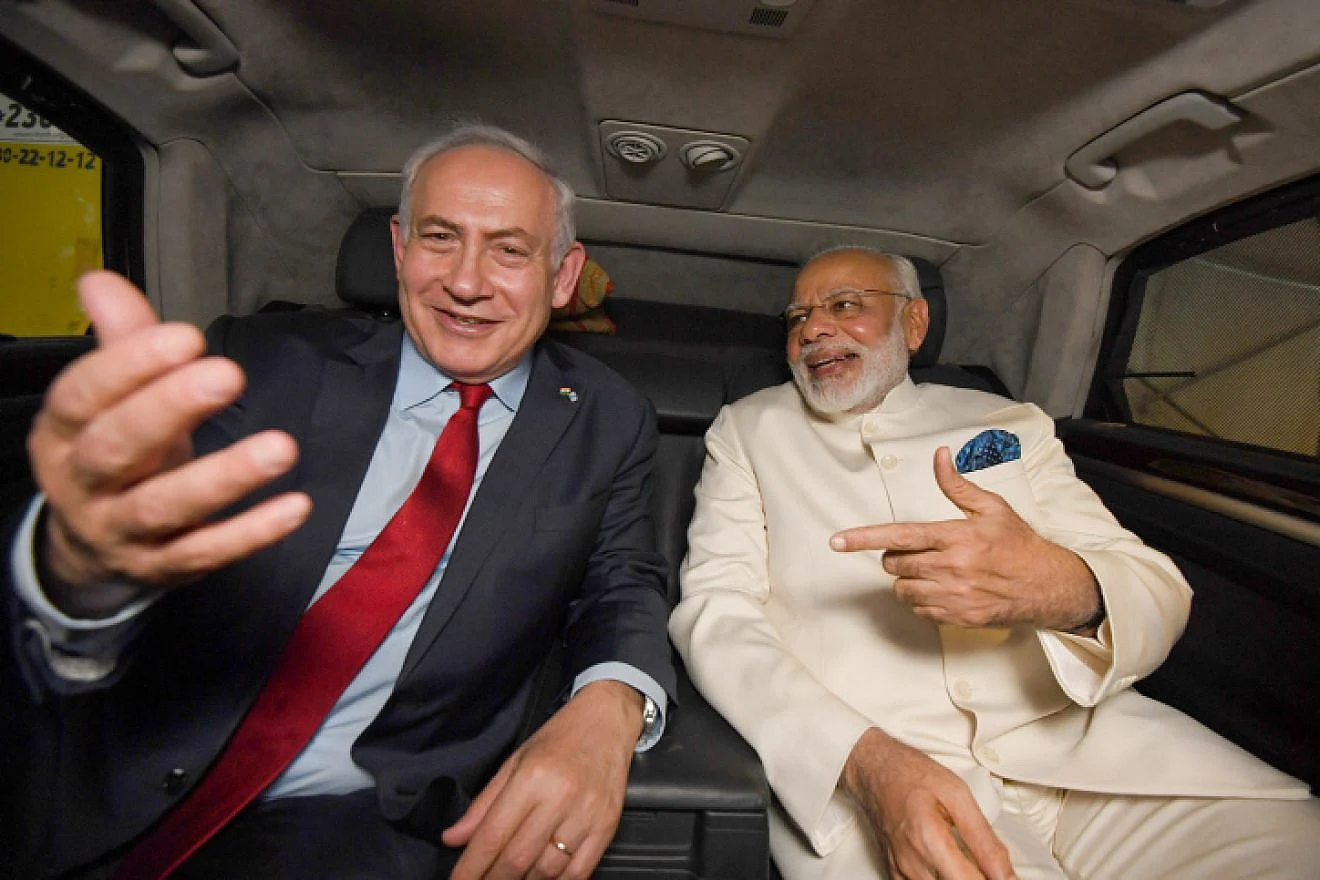
[Prime Ministers Benjamin Netanyahu & Modi]
After the visit by President Emmanuel Macron, India and France have just sealed what is officially touted as a “Special Global Strategic Partnership”. This is diplomatese for the fleecing of India, exemplified by the nearly Rs 4 lakh crore deal for the 4.5 generation Rafale fighter aircraft with the first 20 bought off the shelf, and some 90-odd of the rest assembled here by who else, HAL.
This defence public sector unit is to subscribe to a production scheme that starts at the 30% “indigenous” level rising to 60% by the end of its 30-year run. Even an otherwise weakheaded defence minister Rajnath Singh senses something is very wrong with the cost-product calculus, and has asked that the indigenisation level be upped but only to 50%. Hopefully, he means starting out, because Dassault Avions would be only too happy to reduce the end-level by 10%!
It did not occur to our respected defence minister or even Prime Minister Narendra Modi to tell Macron — that the contract will have to include ALL SOURCE CODES FOR EVERYTHING ON THE AIRCRAFT, INCLUDING WEAPONS, OR NO DEAL! Whatever the understanding to-date to buy this aircraft, it can be junked at any time. At a minimum, full and certifiable transfer of source codes should be the condition for the deal going forward. India holds the whiphand here, not France. Why is Delhi acting as a supplicant? It is Paris that wants India’s money, not the other way around. So Modi should INSIST on this! Nobody in the Indian government apparently appreciates just how much of a lifeline this deal is. For France!
While Modi misses no platform to blow his atmnirbharta trumpet, the head of Dassault — maker of the Rafale, Eric Trappier, has been equally determined in ensuring that his Company parts with no technology of any consequence in the Rafale deal, including source codes. Indeed, he severly and publicly reprimanded the head of the German firm, Thyssen-Krupp Marine, for promising source codes to India for the HDW 214 diesel submarine to get the navy’s Project 75i. He obviously fears Thyssen-Krupp will set a precedent for the rest of the arms suppliers, who have treated India as an endless source of sustenance, to follow. It is Trappier that the British weekly, The Economist, blamed for cratering the European trilateral 6th generation Future Combat Air System project, because he did not want to share the Rafale technologies with Germany and Spain as the tech base for the FCAS. So he is being consistent in not helping India become an independent fighter aircraft producer. But that is France’s problem.
The way the transaction has progressed it is as if Modi and Rajnath are nothing, the Indian government is zero and will bend to whatever the mighty Trappier and Dassault deign to SELL to the IAF! Thank you IAF leadership for doing France’s/Dassault’s work for them by projecting the Rafale plane as something the service and Indian security cannot do without — when that is about as hollow a claim as can be conjured up by a set of unscrupulous salesmen to a bunch of yokels! But, hey, Trappier has won out. India will pay a princely sum for a fast aging fighter platform and that too MINUS source codes. But let’s speculate a bit about what may be possible.
The 60% indigenisation level would be upped, and the timeline for it contracted to 3-4 years should Messrs Modi & Rajanth Singh sternly press Paris. But having staked a position, France is unlikely to budge but, should push come to shove, will agree — it is desperate to have this deal and the accruing bank balance to fund its own future programmes — to no indigenisation beyond 80%. Why 80%? Because the 20% level remaining with Dassault/MBDA for the most advanced Rafale tech, that will come as “black box” technologies, is what will hand Paris the “short leash” — the means of controlling the Rafale fleet and hence the IAF, and hence Indian military options for the lifetime of this plane in Indian service!
Except that will still leave India without the Rafale source codes which, in Indian hands, would help to fit, for instance, Indian-designed bombs, rockets and missiles and even avionics without Dassault/MBDA intervening to extract massive fees for integrating them into the plane.
This “mother of all defence deals” in terms of the sums involved, will empty out the Indian taxpayer’s purses to make a wealthy France, wealthier! This when, in pursuance of Modi’s atmnirbharta policy, such extraordinarily large sums in hard currency could have been invested in, say, additional production lines in the far more labour-efficient, process-wise effective, and product quality-wise better private sector for the Indian designed Tejas light combat aircraft in all its versions — 1A, 2, as a natural lead in to the AMCA (advanced medium combat aircraft) programme already allotted to the consortium of Tata, L&T, Bharat Forge, et al. This, perhaps, makes too much logic and sense for the Indian government.
But why the above preamble for a post on Modi’s Feb 25-26 trip to Israel? Because the Rafale deal with France is a cautionary tale for the sort of defence cooperation the Prime Minister should not enter into with Tel Aviv.
The strategic-minded Israeli Prime Minister Benjamin Netanyahu has already announced a 30-year timeline for his country to become fully independent of US support because he has judged correctly, as the Indian government seems incapable of doing, that relying on America even in the midterm could be perilous and it is a risk his country cannot and will not take. Keeping the Israeli economy afloat is the key.
India-Israel relations are in fine fettle and the sharing of intelligence and ways and means of fighting Islamic extremism and terrorism, and managing disputed borders, is by now fairly routine. But bilateral ties are ready for an upgrade. Logically, because Israel is the start-up nation of renown and creates and innovates technology as its staple, and because most such technologies are first deployed for use by the Israeli Defence Force in its security systems, it is necessary, Netanyahu has concluded, that his country find a reliable, ideologically resonant partner. An economically prospering and friendly India fits that bill. Indeed, the Israeli government is looking to explore the possibility of drawing India into more extensive defence cooperation, and Israeli defence and high-tech companies are seeking Indian investors and partners for joint programmes to sell in a global market.
These developments have germinated, I believe, from an idea I first conveyed to Uzi Landau — I have written about this in previous posts — in, if I recall correctly, 2002, when he was visiting Delhi as the Israeli Minister for Public Security. He had come over for a meeting with me at the Centre for Policy Research, along with Shabtai Shavit, who headed Mossad from 1989 to 1996. Among other things that we talked about, I suggested to them the obvious mesh of Israel tech muscle with Indian finance and large DPSU production infrastructure to manufacture traditional military hardware for consumption by both the Indian and Israeli militaries — from large items such as tanks, long range guns, to small arms and ammo and artillery shells. Economies of scale and lowered unit price would obtain. This could lead, I argued, to Indian financing of, and participation in, at all levels, with Israeli companies researching and developing cutting edge weapons systems and military software, and how such a partnership could free both states from the inconstant “friendship” of the US. They were intrigued by the 2-way defence/security bond I was proposing. I pitched the same concept to Prime Minister Ariel Sharon when he visited Delhi in September 2003.
The idea made its way through the Israeli government and got traction in the Indian government, fructifying in the 2006 deal between the DPSU Bharat Electronics Ltd and Israel Aerospace Industries (IAI) for joint design and development of the Barak 8 (or Barak LR) long range surface to air missiles (LRSAMs) to protect Indian aircraft carriers and warships. The first test firing of this ship air defence system was in 2010. By 2018, four Kolkatta-class destroyers had the Barak 8 protection. To date, India has invested between $1.4-$2 billion in this project. It led to extension of the project to meet the Indian army’s demand for area air defence, and yet another programme, this time to design and produce a medium range variant of this missile.
Indians may have wished for a fairer division of work. DRDO produced the dual pulse rocket motor for the 150 km range, mach 2 missile, and IAI the MF Star multi-function, surveillance, track, and guidance radar. Still, it is a successful enough partnership to whet the Israeli appetite for more such cooperative ventures. And that’s where matters stand.
If defence cooperation is not to stay stuck in the Barak 8 mode, it may be wise for Prime Minister Modi to take the lead in furthering this cooperation by broadbasing it with a proposal, as was originally envisaged, to have the production of Israeli conventional weapons platforms and small arms move at least partially from Israel to India, to benefit the Indian armed services as well as the IDF and for export, and to establish an India-Israel Defence Cooperation Council as the lead mechanism for the purpose, and to realise the larger agenda of meshing the two defence industries for the good of both the countries.
It will be a departure from the typical license production/screwdrivering projects the DPSUs undertake of second rate equipment, such as the Rafale. And it will involve the conjoining of the unique talents and strengths of the two countries. What may emerge is a very strong joint defence science, R&D, and industrial complex to power the ambitions of India and Israel, and as a player on the global scene. And it will cement a desirable embrace.


 Security Wise
But Prof, aren’t you glad that India at least wasn’t bulldozed to buy that notorious white elephant F-35 to please the Orange-man or to make up that absurd import number of $500B in 5 years? I was dreading that prospect. Personally, I am happy it was Rafale, not Typhoon nor F-35. France is a reliable partner and they would be bending over backwards to cater to our defence needs, in the light of the dire state of their own economy and their friction/rivalry with Washington.
My point is why isn’t GOI exploiting France’s dire straits all round to get better terms? No source codes!
Agreed: so much for our practice of Chanakya-neeti!
Sir, the deal has been reported to be around 3.25 to 3.6 Lakh crores instead of 75,000 crores.
What was I thinking? My mistake, sorry! Text corrected, and thanks.
Could you point out the reason (in short) for us not going after Su-57 sir? Is it the technical shortcomings of the plane or extreme US pressure or both? I was amazed when no deal was announced during Putin’s recent India visit inspite of so much build up, specially in Russian media. It’s perplexing.
I think both, though last when we heard from HAL (a month or so back), it said it was considering the Russian terms.
Earlier Indo-Russian summits used to be about signing of complicated Military and Technical deals. That has changed drastically in the last few years. One wonders who is in worse position, Russians who are not able to secure deals even after promising full technology transfer and even source codes (for Su-57) or Indians who are so fearful of US that we neither can build (due to engines) nor buy 5th Gen platforms (now Oil also). Ukraine war seems as a boon for China and a nightmare for India. Is a Russo-US detente possible sir, so that India could possibly breathe? Till when will these two giants (connected by race (almost) and religion) keep fighting with bystander China tightly controlling it’s schadenfreude since 1945.
Yes, that’s what Trump’s pressure on Kyiv to end UKR war on Russian terms is about. But that won’t lessen the pressure on India to not buy Russin.
@BharatKarnad
Damn, that was a fantastic essay, sir.
Honestly, I had no idea you had such deep connections and firsthand experience. You were actually at the table, having conversations with people like Shabtai Shavit, Ariel Sharon, Ausaf Ali, Aharon Yariv, and Jaswant Singh that’s truly remarkable. The list seems endless.
If you don’t mind me asking, what was it like sitting across from such influential figures and policy makers? Were there any particular moments or conversations that left a lasting impression on you? Did any of them surprise you in terms perspective compared to their public image?
I’d love to hear more behind-the-scenes insights if you’re willing to share
Mind, these were separate — non official — contacts and conversations. The Sharon meet was with Israel’s other well-wishers.
Well, whatever importance may be attached to such interactions, it is never in the moment, but always in retrospect!
@BharatKarnad
Nice esaay sir
but i have a few questions and now i am searching for answers.
1. On source codes & leverage-
You say India “holds the whip hand” in the Dassault Rafale deal. Given that even close NATO allies don’t get full mission-system source codes, what realistic leverage would force Dassault Aviation to concede? Would India truly have walked away despite IAF squadron shortages?
2. On autonomy vs urgent deterrence-
You prioritize long-term sovereignty over dependency.But with China’s military rise accelerating, can India afford a 10–15 year capability gap while Tejas Mk2/AMCA mature?Where’s the red line where imports become strategically necessary?
3. On the Israel alternative-
You propose deeper defence integration with Israel beyond the Barak 8 model.Given Israel’s reliance on US components and export controls, how do we avoid indirect US veto power?Would this simply shift dependency rather than eliminate it? Remeber how americans intervened when we tried to purchase arrow 2 BMD system in 2000s
I would like to know your perspective on these.
1) This is a bigger issue discussed at length in the book I am writing.
2) If China is to be deterred, my proposal for deploying forward deployed short-fuse tiered posture with atomic demolition munitions, and canisterised A-1s is far better.
3) That’s precisely the control, other than funding, Israel would like to escape.
Email from Smita Purushottam, IFS, retired as ambassador to Switzerland
Thursday, February 19, 2026 at 07:17:39
Bharat, you really think the Israelis will not make a fool of us? You are dvocationg cooperation with one of the most predatory regimes on the planet. You are a realist.
Warm regards
Smita,
Predatory, perhaps from the Palestinian point of view.
But India-Israel relations are different, as you know, and
we have benefitted a lot.
Bharat
Email follow-up from Ambassador Purshottam:
Smita Purushottam
To: me · Fri, Feb 20 at 11:29 AM
How? One way purchases and more to be committed, people are saying we will destroy even what little Atmanirbhar capabilities we have in missiles with the missile deals with Israel. And moreover: “Israel has begun controlling the Indian deep state – political power, economic power, media, foreign policy and national security tech. Further, the cyber part of the critical infrastructure of our country is increasingly protected by their security tools (with privileged access to these systems). They have their largest embassy outside of USA here in Delhi.”
They have bought enormous space for their aerospace industry in Gurgaon. Our slavish open armed welcome to Big Tech means this penetration will increase (Google bought Wix, Alex Carp rules in US, AI will be a potent weapon), a mortal danger to our State and long term, our values as a civilised nation. Not to speak at the drubbing our international image is getting.
I am absolutely crushed by the war against civilians, babies, that little girl shot more than 300 times, but above are stronger reasons to stay clear of these sinister wielders of clandestine power over the US and now the Indian State, something you have also protested.
We cannot allow the western narrative on Israel to blind us. Do read the Isarel Lobby, written by two other realists.
Smita,
If GOI is buying into the US offers — like invitation to build on the American stack, etc., isn’t Israel, that is pulling away from the US, the better option — hard realpolitik here? Yes, have read Walt and Mearsheimer’s book. But remember that AIPAC helped set up the Indian lobby and influence op in Washington. And don’t you wish Indira Gandhi had not stopped, at the 11th hour, the Israeli strike fleet, supported passively by the Indian military, from taking out Kahuta and the Paki N-capability in 1982? If you do the pros and cons, the pros win hands down, especially prospectively. Our problem is we are too sentimental a people to conduct Chanakyan foreign policy and, of course, the babus and the rest are bikaoo (purchasable)!
Bharat
Smita Purushottam
Fri, Feb 20 at 11:51 AM
Israel controls the US, and Big Tech and Israeli agencies are hand in glove, especially Unit 8200. You have also stood with us during our protests against the selling out of Indian national interest.
I am not being sentimental (that comment was only from a personal point of view), hard headed analysis shows we are being overrun by neocolonial powers, and Israel is at the core, not an ally. The only thing that unites the two regimes is the common hatred of Muslims, under which everything is justified, any compromise of national interest included.
I have never been wrong with my analysis of long term trends, and hope you see behind the curtain, what is really happening.
But, Smita, I have not been wrong either in the reading of geopolitics, about India’s missed opportunities, and about what the country needs to do in the external realm, as my books and writings 1994 onwards attest. Indeed, in light of the MEA never crediting outsiders with influencing anything, Shivshankar Menon, does so. See his contribution, as also Pratap Bhanu Mehta’s, in Kanti Bajpai, ed., How Realist Is India’s National Security Policy? [Routledge, 2023].
In terms of policy subversion from the inside Israel, by any metric, is a far lower order threat than the US. In the event, on this issue let’s agree to disagree.
Bharat
Response from Ambassador Purshottam:
Smita Purushottam
Fri, Feb 20 at 1:00 PM
Yes, that is the reason we respect your views and am arguing with you, which i dont bother with the rest who are outright desh drohis. You should be able to see how they use these same arguments to sell out India.
Been watching discussions on this deal sir, it’s been said that not HAL but a private sector player (yet to be decided) would be assembling the Rafales. But the timelines look really bad, stretching into late 30’s.
But there are newsreports saying HAL has the assembling contract
there is report in the media circulating that Dassault aviation is valued at 26 billion . We are ordering 32 billion value of rafales how bizzare is that we could buy this company. Your views sir. Have a good day
Yea, and Embraer was available for sale for just $2 BILLION JUST 3-4 years ago. And Adani has only now woken up!
Nothing has better exemplified the duplicity and bluster underlying the “Make in India” claims than the vignette this past week of the Chinese AI-powered robot dog as invented by Galgotias U! The “screwdriver technology” of yore has now given way to co-opting foreign inventions as our own. The rest of the world are laughing at us, and for good reason.
Dr Karnad, As usual, you argued well in what you believe. However I am not ready to believe Bibi Netanyahu can ever be independent of the US. Bibi Netanyahu has ruled Israel for more than 20 years. Without US government approval and direct Trump intervention within the Israeli system, Bibi would be in Jail now for familiar crimes in power ie corruption and nepotism. Israeli defence industries cannot do without US money ie Sillicon valley and Wall Street money even Florida County taxpayer pension fund money. As a realist, the basic quality should be to stick to facts and not creating fantasies
If Israel is moving away from the US, which it is, India’s defence cooperation of the kind outlined with Israel will help move the needle in that direction, and will serve both countries’ interests. You are overstating many things. If anything the net tech innovation flow is from Israel to the US. The state pension funds, likewise, go wherever they can make steady money, so that’s not a factor. The plan and policy may be ambitious, but nothing relating to it is “fantasy”.
Dr Karnad, What assumptions made you decide that Israel is moving away from the US
Mainly Netanyahu’s intent. And his record — he’s never failed!
But Netanyahu is surviving politically only because of explicit support to him by Trump and US ambassador Huckabee. Bibi is 75 plus and not getting any younger. How Can he survive without US support ? Moreover how can Israel have independent military industrial complex when almost half of IDF soldiers and researchers and even high level commanders from Unit 8200 have foreign passports and the fastest growing Ultra-Orthodox population does not want to join Army ? My conclusion is that this assumption of you is similar to your position about couple of years back of India bringing together Iran, Israel and Saudis at a time when China brokered the Saudi-Iran detente. This is realism without practicality ie intent without solid capabilities.
There is a Saudi-Houthi back channel to Tehran. One of the reasons for the proposed Iran-Israel-Saudi concordat was that it’d consolidate IMEC against China’s BRI
Dont have any great insight but it’s doubtful as an observer that Israel can do without USA. No matter how technologically advanced it gets it’s geography and demography will remain too small to be of great consequence without an ally like the USA. In the latest Israel Iran war we have seen that while Israel has destroyed Iranian proxies by taking them on one at a time, it wasn’t without the financial, military and diplomatic backing of USA, as in the past. Even getting Israel out of the direct war with Iran which it initated as a tag team was left to USA. Agree with Ms Purshottam that Israel and US are tied to the hip. Also agree that there is room to maneuver and we can expect that not everything Israel does is necessary cleared by the US in advance. Afterall the Kahuta story was clearly not okayed by USA. But if Indias relations with USA goes south then so too will it’s ties with Israrel. Hope GOI wakes up and begins the distancing we need from America in defence matters.
But US relations with India and Israel “going south” is just the context for the latter two states to tighten their embrace
Dr Karnad, your take on this please:
WSJ: India’s Coast Guard has seized three tankers sanctioned by the U.S. that it says were involved in illicit ship-to-ship transfers off its western coast, a move that analysts said marks New Delhi’s first direct support of U.S. efforts to crack down on the so-called dark fleet.
The vessels were intercepted on Feb. 6 about 100 nautical miles northwest of Mumbai and were part of an “international oil-smuggling racket,” the Coast Guard said in an Instagram post. The tankers are now anchored off Mumbai and under investigation, a spokesman said on Tuesday.
India seizes 3 US-sanctioned ships linked to Iran near Mumbai
https://www.reddit.com/r/worldnews/comments/1r7mca6/india_seizes_3_ussanctioned_ships_linked_to_iran/
YouTube: NJdFi0rvj8M
Uncle Tom-ish behaviour by the Indian state
Perfect metaphor for the present Indian state and its bankrupt foreign/defence policy. But the literary allusion will be lost on the subliterate policy-makers.
Dr Karnad, As I said you were too optimistic of India becoming independent of the US. Similarly your hopes of the Israelis being independent of the US will be dashed very soon. Let’s face the fact sir. Both the Indian and Israeli deep state establishments are deeply tied to the US and these bonds cannot be broken by any notions of Realism.
I believe we need Super Su-30 and that also 1000+ in one go. Why? we already making them, when make 1000, economies of scale will kick in. if we decide we can even make it 100% local.
Finally, its better to have something to fight when war comes to us.
Tejas are not reliable because of our dependency on US supplied engines. I have no issues with our manufacturing capability but power source. BTW, this engine is trainer jet engine.
Could you sir, recommend a few books to us which you found to be most consequential, ones which time has not made irrelevant, basically your favourite books so that we commoners could also educate ourselves a bit.
Sure. Have a large library, but here are a few books I often re-read for nuggets I might have missed over the years — (1) Bernard Brodie – Strategy in the Missile Age (this is a classic for the ages!), (2) Henry Kissinger — Diplomacy, (3) Robert Massie — Dreadnought, (4) Michael Pillsbury — Chinese Views of Future Warfare, (5) Edward Said — Culture and Imperialism, (6) Stephen Peter Rosen — India and Its Armies, (7) David Evans & Mark Peattie — Kaigun: Strategy, Tactics and Technology in the Imperial Japanese Navy 1887-1941, (8) Evan Feigenbaum — China’s Techno-Warriors, and (8) O. Mannoni — Prospero & Caliban: The Psychology of Colonization (1st published in 1948, reissued by University of Michigan Press, and is perhaps the most insightful study on the mentality of colonized peoples. It dwells on the French Algerian experience, but he could be writing of India and Indians of yesteryears and of the present!)
Thanks a lot sir.
@BharatKarnad
Damn good
Thank you professor always wanted to see your book recommendation!
Glad you shared it with the audiences
@BharatKarnad
You left one out i.e The Absolute Weapon by Brodie.
I have been looking at brodie’s books for the past 2 months. And hand down one his works are one the best
1)Sea Power in the Machine Age (1939)
His first major work, analyzing naval strategy in the era of mechanized warfare.
2)A Layman’s Guide to Naval Strategy (1942)
A more accessible explanation of naval strategy during World War II.
3)The Absolute Weapon (1946, editor)
A landmark volume on atomic weapons and deterrence; Brodie wrote the influential introductory essay.
4)Strategy in the Missile Age (1959)
His most famous book, developing modern nuclear deterrence theory.
5)Escalation and the Nuclear Option (1966)
A detailed study of escalation dynamics and limited nuclear war.
6)War and Politics (1973)
A broad theoretical treatment of the relationship between military power and political objectives.
7)From Crossbow to H-Bomb (1973)
Your were indeed lucky to have such a knowlegable man and strategic genius as your tecacher
Damn professor who in indian establishment is closest brodie in interms of strategic mindidness and strategy
Who is India’s Bernard Brodie?
Yes, they are all great books.
Just got the last-mentioned (#8) from the University Library. Looking forward to perusing it. Thanks for the recos. Will check out Kaigun next.
Prof Karnad,
Had a very fundamental question on the source codes of any aircraft like Rafale. I work as an IT Professional and hence my idea of source codes may be different from what a defence equipment would be.
Usually when a company builds a proprietary software, the source code is its intellectual property, unless it is officially classified as Open Source. The software has interfaces that can be coupled with custom functions or libraries written by the end user. For instance Microsoft Excel is closed source, but it allows you to build your custom subroutines for advanced calculations that may not be shipped by Microsoft.
A company never discloses its source, as it will directly erode its competitive edge. On the same lines, isn’t Dassault justified in withholding the source codes for Rafale, as long as it provides IAF an option to integrate its missiles, bombs (even avionics) etc. with a well defined interface?
It does indeed reiterate the fact that Tejas which was our own design should have been the cornerstone of other IAF aircraft like AMCA etc. because we have the right to enhance/ customize this as we please. But alas, this will probably never happen, as aircraft design is more complex than assembly, something which you have rightly alluded to in past.
Prabal@ — In essence, there’s no difference, true, depending on how critical it is to the producer state’s own security.
The larger point I was hoping to make is that the source code is for the 4.5 generation aircraft as Tejas is. If so much
public money is being invested in a foreign product,it means we are funding their FCAS development at the expense of our Tejas variants and AMCA! And that’s the rub!
@BharatKarnad
The french are really smart
They can fund their entire Military industrial complex for the next 15 years with this Indian Money. And they will use this money to design god knows maybe a next generation SSBN,SSN or fighter aircraft
@BharatKarnad
Professor in your interview with hindol sengupta you said you wanted bernard brodie on your dissertation committee during your time at UCLA .
But you then said that unfortunately it didn’t happen
If you are willing to share can you tell us what went wrong?
I passed my doctoral qualifiers and then my differences with Brodie, growingly evident in my course work, began to tell. He asked me to write my dissertation for someone else. I did not want to. Thereafter, I lost interest but ruminated awhile on my decision, and returned home after a decade in California.
@BharatKarnad
Professor Karnad,Sir I find your decision to step back from Brodie’s committee fascinating. But I wonder do you think that losing the opportunity to work with a strategist of his stature may have limited your exposure to certain ideas early on in your career in 20s-30s? Could challenging him while staying engaged have offered a different kind of growth, even if it was uncomfortable?
Sometimes growth comes from staying in uncomfortable situations do you ever reflect on what you might have gained had you pushed through rather than returning to homeland
Each one of us is different in how he/she reacts in a situation. I am what I am, and did what I did. I don’t regret it.
Professor, if the iran/middle East flares up , American patriots stock would be in depleted state with major resources in centcom , Do you see chinese capitalizing on it too put on a naval blockade around taiwan. It is pretty evident with chinese pushing taliban to push for heating up the central zone to execute their plans in Indo-pacific with facade of deploying minor resources on Japan front .
No. PLA is in too unsettled a condition with its apex leadership in Xi’s gulag
@BharatKarnad
Professor may i suggest you please pen down a essay on The recent Israeli–American onslaught on Iran it has marked a dangerous escalation in the region. Since the afternoon of 28th February, almost every major Iranian city including Tehran, Isfahan, and even Chabahar has reportedly come under bombardment.
In retaliation, Iran has launched missiles at American bases in Bahrain, Qatar, and the United Arab Emirates, as well as targeting the headquarters of the United States Fifth Fleet. Missile strikes have also been directed toward Tel Aviv and Haifa.
Tomahawk missiles and drones are being exchanged, and tonight the Middle East may witness what feels like a meteor shower of gunpowder across its skies.
There is also concern about the possibility of American aircraft carriers being targeted. Some speculate that an Iranian general could even undertake a kamikaze-style mission, further intensifying the conflict.
And what’s the endgame now
In this fog of war cannot trust the indian media
Only your essay can be trusted. So yeah please spare some time from your busy schedule
@BharatKarnad
Sir can the audiences know what’s your take on the attack on iran by usa and israel
Would like to read a new post on this
@BharatKarnad
ali khamenei is dead!!!!!
middle east will never be the same again
Not really he was already 85
Came across this interview in I24 news(Israel) about Israel manufacturing its weapons in India for the world. Along the lines of what you have mentioned in this blog. Kind of condescending tone here but the substance is the same I guess.
Disclaimer: Can’t vouch for the translation being accurate.
https://x.com/i/status/2027996102490800541