
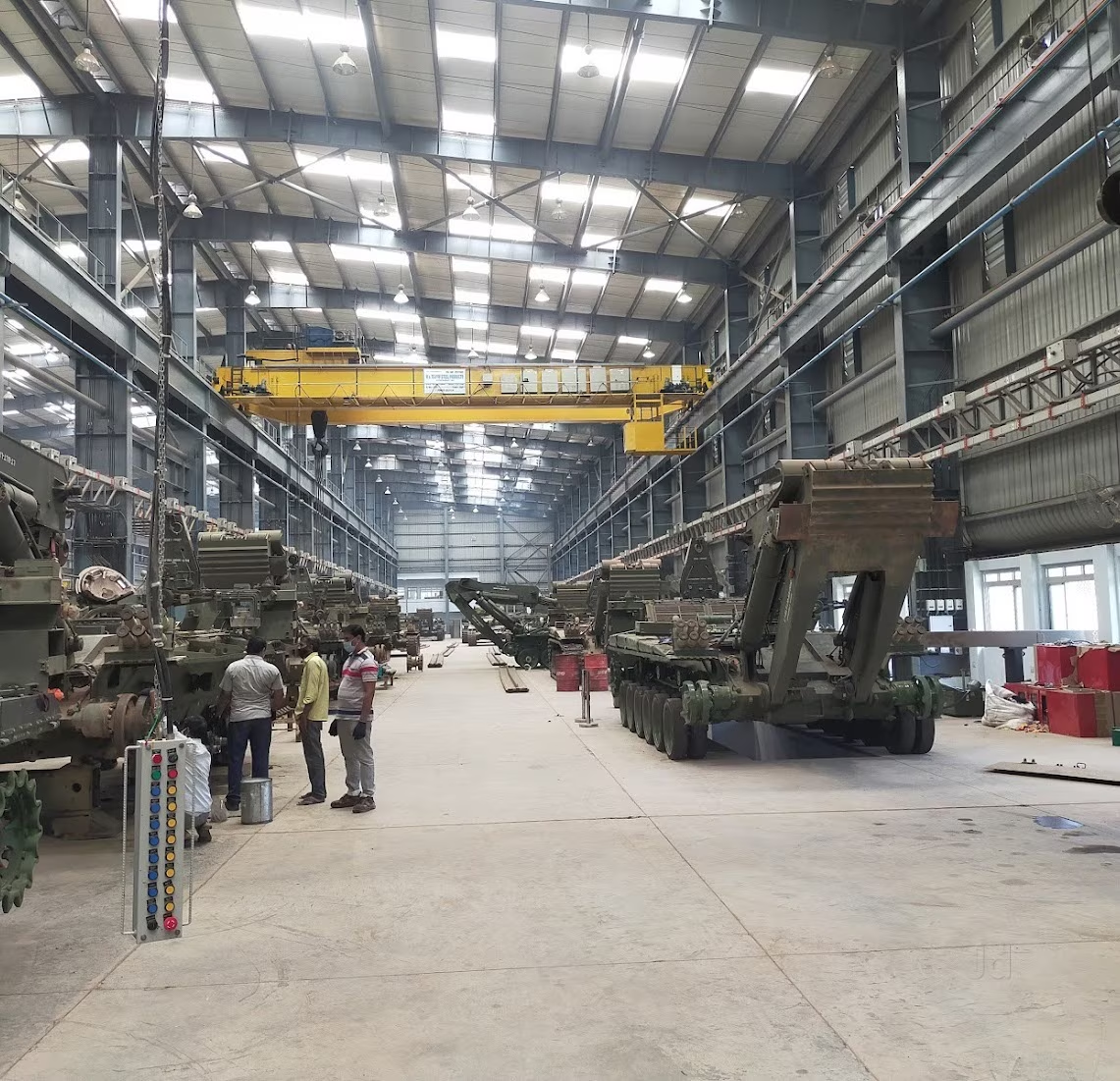
[Heavy Vehicles Factory, Avadi]
This is what a pink paper, not known for criticism of government policies, said on Oct 3 about the Modi regime’s move to allow Indian subsidiaries of foreign arms manufacturing corporations to bid for defence procurement contracts as Indian entities. “In a move that could severely undercut India’s domestic defence industry, the Modi government is considering allowing wholly owned local subsidiaries of foreign original equipment manufacturers (OEMs) to qualify as ‘Indian vendors’ in defence procurement. This long-pending demand of multinational arms makers, discussed by a special task force led by former cabinet secretary Rajiv Gauba, threatens to hand the lucrative defence market to global giants while sidelining homegrown firms. Instead of strengthening indigenous manufacturing, the government appears set to empower foreign corporations at the expense of Indian companies, raising questions about its oft-repeated rhetoric of Atmanirbhar Bharat.” (https://economictimes.indiatimes.com/news/defence/govt-likely-to-recognise-foreign-defence-companies-local-arms-as-indian/articleshow/124278267.cms)
The instant conversion of a foreign company into an Indian one that foreign equipment manufacturers have been clamouring for just so they can crowd the genuinely home-grown Indian companies out of the bids for military hardware, is recommended by a taskforce chaired by Gauba, whose tangential exposure to defence issues was as a young IAS officer appointed private secretary to defence minister George Fernandes in the late 1970s. It means, essentially, that he is another successful babu, our very own “Sir Humphrey” (from that BBC comedic takeoff on the British civil service — “Yes, Prime Minister!”), who has next to no domain expertise in defence and national security but does fine winging it in all policy areas, just so things don’t change very much! And a policy failure is portrayed as roaring success!
It is exactly the sort of civil servant Prime Minister Narendra Modi seems to have a liking for even if what Gauba advises be done will gut especially the Indian private sector defence industry that is still at the takeoff stage because it has been prevented from actually taking off by the BJP government’s atmnirbharta policies that promote only superficial arms self-sufficiency.
That Modi, like Gauba, cannot distinguish between “Made in India” — where the entire weapon system is designed, developed, and produced in the country, and “Make in India” where any foreign goods can be imported in disaggregated kit-form and assembled or screw-drivered — something the Defence public sector units — HAL, Mazgaon, the Avadi tank factory, et al, have been doing for the past 70 years, was pointed out by me way back in 2015 or thereabouts when the PM started talking about atmnirbharta without detailing his agenda. 11 years later we know what that means.
It is not that Modi (or a Gauba) does not understand the difference, but that he is into taking a shortcut for a policy that far from making the country atm nibhar will drive it further into foreign arms dependency while sounding the deathknell for worldclass private sector companies that have come up — not because of, but despite, the government. The L&Ts, Godrej Aerospace’s, Bharat Forge’s, Mahindra, and hundreds of other large firms and SMSEs that produce components, ancillaries, and sub-assemblies that have together built nuclear submarines, complex space systems and what not, now find themselves up a creek, even as the state-funded DPSUs who are corporatised only in name and wouldn’t survive a day were they to actually compete with L&T, Bharat Forge, and so on, prosper.
But Modi, a couple of months back, publicly disclosed what he meant by atm nirbhar — his “Make in India” policy, he said, involves “Indian toil”. So, for the PM it is enough that Indians employed in these Indian factories of foreign arms companies, being set up here in the hope of getting the exact bonanza they are getting now, will be screwdrivering vintage second rate military hardware the Indian military seems to be enamoured by. So, at least, the country should have no illusion that it is getting anything more than an ersatz arms self-sufficiency. And the contracts these foreign companies masquerading as Indian firms will generate will be but a channel to divert national wealth into defence industries abroad, but now indirectly! But, this policy wrinkle will simplify procurement by bypassing the “jhanjat” of tech transfer. So nothing has changed, will change! This is next generation reform.
It is clear why the Gauba Task Force on “next gen reforms” was constituted — mainly to provide justification for a policy that already had Modi’s stamp — the policy in the PM’s words of “GLOCAL” — GLObal + loCAL! Hurray, Go Glocal!!
There would be NO problem at all if foreign arms producers established their manufacturing units here to avail of lower labour and running costs, produce military goods exclusively and strictly for EXPORT. But now when this policy is implemented, the local private sector defence industry — the sharp edge, will suffer the proverbial double whammy. It will not be able to underbid these foreign-companies in Indian guise in deals from the Indian armed services, and the armed services will indent for major weapons platforms directly in g2g (govt-to-govt) deals with foreign countries because there’s no restriction to their global tendering. That’s how a whole bunch of exorbitantly priced items made their way into the Indian order of battle — Rafale aircraft, Scorpene diesel submarines, T-90 tanks, and similar ridiculous buys whose sell-by date has long since expired.
Welcome to India — the dumping ground for antique Western weaponry, and at humoungous hit to the national exchequer! But India is a rich country with a $21.87 trillion economy (in Purchasing Power Parity terms) per International Monetary Fund data — the third wealthiest in the world (after China and the US), don’t you know!
Anytime the Government of India ends up doing the country’s national security apparatus real harm, there’s always a government commission, committee, or taskforce providing the road map, that it can blame for things going wrong. That dirty work is now being done by the Gauba Taskforce that has striven to kick the legs from underneath the halfway, half-hearted effort mounted so far by the Modi regime to have the country become a supposedly militarily significant power propped up by a hollow indigenous defence industrial might.
Surely, in the Gauba taskforce report the case will be elaborately made about out how and why foreign arms companies permitted entry into the Indian market through such means will ultimately help Indian defence industry “mature” and thrive. There will be lots of technical business jargon, and colourful “pies” and venn diagrams — stuff Modi likes in the presentations made to him. And very likely that part of the report will be authored by someone called Janmeya Sinha, chairman, Boston Consulting Group (BCG), India. BCG is a major consultancy hired by American defence companies when they make their sales pitches to the Pentagon. The Indian station of the BCG now is part of the Indian government’s decision making to ease the entry of US companies into the Indian defence sector. Can there be a more obvious Trojan Horse that we are pulling right into our battlement? Guess whose instructions the Indian branches of Lockeed, General Atomics, General Dynamics, Boeing, Northop Grumman, etc. will follow? Government of India’s/Indian Defence Ministry’s or Washington’s — and that too, Trump’s America???
But this turn in India’s defence economics of putting the foreign fox — BCG — in the Indian hen house — India’s defence procurement decisionmaking process, seems by now quite routine. There’s no ministry or Department of the Government of India that has not recruited one of these Western consultancy firms — Mckinsey & Co., Pricewater-houseCoopers (PwC), Deloitte Touche Tohmatsu Limited, Ernst & Young Global Limited and KPMG International Limited, to tell them what they already know but want the imprimatur of foreign consultants. In the period 2017-2022, 308 consultancy assignments valued at some Rs 500 crore from various government ministries, departments and organisations, are in the books. (https://indianexpress.com/article/express-exclusive/in-5-years-16-ministries-gave-rs-500-crore-work-to-big-five-consultants-9018061/) This is a new kind of scam the Indian government is now a willing partner in. It begets the kind of situation the country had until recently when the Department of Telecommuications was a Huawei fort inside the BSNL and government.
But this development seems in the mainstream of the Modi government’s recent initiatives that see nothing wrong in signing Free Trade Agreements left and right drawn up by that shortsighted commerce minister, Piyush Goel, and his bunch of babus, with provisions in them to permit British and European companies to bid for all Indian government procurement contracts at the central, state and local levels worth $750 billion annually, which will void the Indian industry. There are other provisions in them that will bar Indian entities from demanding the transfer of source codes as part of sales deals to enable the re-engineering, say, of weapons and other systems for retrofitment on imported hardware and weapons platforms, to fit India’s needs and requirements. Hence, Dassault Avions’ refusal to part with source codes for the Rafale aircraft means that DRDO cannot integrate Indian designed and produced missiles and ordnance into the IAF Rafales. And even for the most minor modifications the IAF will have to go to the French company — an endless revenue stream for Dassult! Apparently Paris had alerted the French defence industry to New Delhi’s agreeing to such provisions in the soon to be formalised FTA with EU (and also with the UK and the US).
Is there to be no end to India’s sucker-hood? Apparently not, because Modi’s atmnirbharta policies are cementing India’s reputation as a classic sucker, the yokel who time and again is taken for a ride! But worse, considering this trend of foreign elements dictating the course of the nation’s security, economic, commercial, and trade policies, and everything else, India can’t be far from full-blown Banana Republic status.
——–
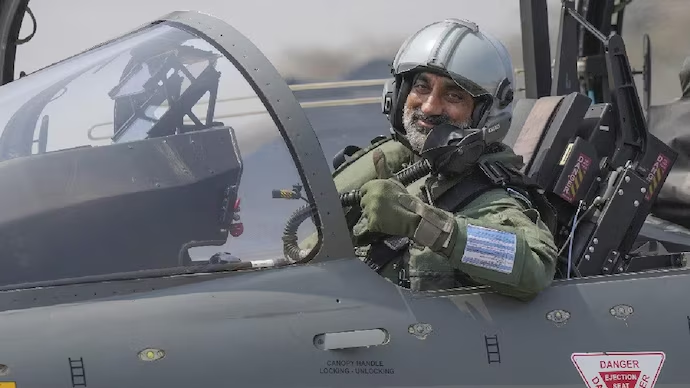
[ACM AP Singh, Chief of the Air Staff, in the Tejas cockpit]
Three months after Operation Sindoor, Air Chief Marshal Amar Preet Singh, just the other day came out with the fantastical claim that the IAF had shot down/shot up/destroyed as many as 12 to 13, even 15, Pakistani military aircraft, ranging from F-16 and JF-17 fighter planes, C-130 transporters, to the Saab Erieye airborne early warning aircraft, besides damaging numerous PAF air bases and radar installations while, ironically, rubbishng Pakistani claims of IAF losses as so much fiction. Why he suddenly woke up this late in the day to voice such patent nonsense, is not clear.
If it was IAF’s belated attempt to challenge the successful Pakistani narrative pushed by Field Marshal Asim Munir that convinced US President Donald Trump — the wrecking ball bringing down the bloated US government, who was inclined any way to give the benefit of doubt — if there was any, to Pakistan about just how the three day “WAR” panned out, it failed! Trump has repeatedly stated publicly that 5 to 7 IAF were lost in that operation.
This is credible information because, as I keep iterating, the Indian government and military are so fully penetrated through human intelligence, electronic intel, and most importantly, and so transparent because of the high resolution 24/7/365 satellite imagery, especially from low earth orbit satellites with sub-10 cm resolution that can spot a football from space. Do you reckon, Washington does not know in excruciating detail just how many aircraft and air bases were shot up in either India or Pakistan? Are aircraft, Brahmos missile, drones and loitering munitions not bigger than a football?
So, even if we believe nothing else the US President says, one can trust what Trump said about IAF losses. If the Air HQ knows better, now is the time for AP Singh to furnish the evidence to contradict Trump’s figures, and to back his own claims of the destruction of 12-15 PAF aircraft — any photo imagery, satellite imagery (even if nowhere reaching the minute resolution levels of the US Kh-11 ‘Big Bird’ optical intel satellite constellation), infrared thermal imagery, sensor reads, signals intercepts, absolutely anything to prove the Air Chief Marshal was right, will do. But, of course, no such proof or evidence will be provided. This only doubles the mystery about why such ludicrous claims were made at this time.
The air chief said he would not help out the Pakistanis by releasing information about Indian losses in Sindoor. Ummm! So he thinks the Americans won’t give it to GHQ, Rawalpindi? And then he wondered if there was even a single photo evidence of a downed IAF aircraft, when actually there is –hasn’t he seen the Rafale debris video from a Bhatinda native — it is there, available on the internet. In the day of mobile telephony it is always better to say nothing, than to open your mouth and get immediately refuted.
AP Singh’s boast of a 300 km deep “kill” within Pakistan and of radar suppression is, however, more believable — but some evidence will be helpful, if only to inspire confidence that when the Indian military brass speak, they are not always serving up dollops of “khyali pulao”! And when thrown a dolly about declining squadron strength, the IAF chief promptly talked of 114 more Rafale, what else! Yea, the same Rafale, whose high-value Spectra avionics and electronic warfare suit laid such a big egg in Sindoor. The same Rafale whose source codes are unavailable, so DRDO is unable to retroactively mesh Indian missiles with its fire control system. So, a fleet of this frightfully expensive and intrinsically flawed aircraft is going to go up against the Chinese Air Force? Good Luck!


 Security Wise
As a member of the Kargil Review Committee once put it aptly, the politician in India enjoys power without responsibility, the bureaucrat without accountability, and the military without directionality.
Email from Smita Purshottam, former ambassador to Switzerland
Smita Purushottam
Tue, Oct 7 at 11:35 PM
They have been talking a lot about deepening Atmanirbharta, so this is not unexpected. It applies perhaps to Diwali and festival artefacts.
Regards,
Email from Shivanand Kanavi, NIAS
Tue, Oct 7 at 10:15 PM
Your latest blog: https://bharatkarnad.com/2025/10/07/modi-governments-death-blow-to-indian-defence-industry-iaf-chiefs-fantastical-claims-2-notes/
is truly damning.
As for Air Chief there is fog of war on all sides starting with Balakot etc. As for atma-nirbharta, was Parriker smarter and more strategic in thinking than these Johnies ? Is that why he was sent back to Panaji ?
regds
Shivanand Kanavi Adjunct Faculty, National Institute of Advanced Studies, Bengaluru;Former VP TCS
https://reflections-shivanand.blogspot.com/2024/05/interview-dr-anil-kakodkar-part-1.html
His POV on 1998 tests doesn’t seem unjustified,
Is his judgement correct professor ?
NO. And let’s remember, Kakodkar is no physicist — just a mechanical engineer. I’d trust the word any day of the late Dr PK Iyengar, chairman, IAEC, a world class physicist who had worked with the 1994 Physics Nobel laureate Bertram Brockhouse on neutron scattering techniques. For Iyengar’s professional take on the S-1 test “as a partial thermonuclear burn”, see my Nuclear Weapons and Indian Security, 2nd ed.
Thanks for the clarity Professor
@BharatKarnad
” For Iyengar’s professional take on the S-1 test “as a partial thermonuclear burn”, see my Nuclear Weapons and Indian Security, 2nd ed”
Is that info in the 1st ed too
like i could only get my hands on the 2002ed possibly the last copy of the 2002 book available in delhi and online but sometimes i think have i missed any significant info
And what is in those extra 50 pages in the 2005 edition. You are the author so the best person to ask sir?
Also sir any updates regarding the upto date edition of this tome and your upcoming new title? Can’t wait for it to come out
My regards
Of course! Sorry, lack the time to do all that
Feels like a cry from the heart of someone who passionately believes this is just institutional malaise and can be rectified in due course.
What if it isn’t? What if this malaise is driven by short term goals of all parties involved – Netas, Babus, Military, Arms Dealers / Middle-men and the likes. Your lament against the Consultants (McK, BCG,..) is understandable, but will stay that way.
Is there a Country whose system we can hold as a benchmark of sorts? Or is this going to keep continuing this way?
@Lonestar Indian- This malaise has been there since the formation of India in the year 1947.
A paedophile, sex maniac (refer to his experiments with truth) British mole is revered as the ‘father of the nation’ and his ugly face is on the currency.
A party whose parent organization served as British spies is giving certificates of nationalism.
There is no hope for this land of the corrupt.
Dear Professor,
Is it an unfair generalization to say that there is a fundamental flaw in the Indian character that leads us to make such illogical decisions? Merely corruption does not explain it. Lack of intelligence does not explain it. Bureaucratic red tape does not explain it. Any layman in India can simply compare the kind of decisions China makes in its national interest with the decisions GOI takes and be flabbergasted. Since you mentioned Gauba committee, I would like to point out to your readers how conclusions of such committees even if not implemented immediately are pulled out of cold storage later on when it is found to be expedient. Like the Mandal and the latest one that MP government has pulled out of the bag on increasing reservations.
I can only thank you for bringing up such issues and starting a debate on them when the mainstream media is constantly switching from one sensational propaganda to next.
@BharatKarnad
Also sincere thank you professor for this blog and you being brutally honest and realist . It’s rare to find someone who speaks with such honesty, depth, and independence especially on issues as complex and critical as nuclear strategy,geostrategy and MIC. Your realist approach, free from government influence, is what makes your voice so important and refreshing.
Your blogs have being consistently raising the bar in strategic analysis. So yeah Thank you for the strategic clarity.
“Rafale whose source codes are unavailable” –
Could anyone please explain what is a high value “source code” in the context of “Rafale whose source codes are unavailable”? In particular, in which engineering literature (textbooks, journals ….) “source code” has been mentioned.
Professor, this is what privatizastion means in India absent a powerful and competent state. It is not in the DNA of Guj/Maru lobby to spend money on R&D. Their entire business model consists of labor arbitrage, screwdrivergiri and white-labelling. Moreover, these lalas start undercutting genuinely R&D focused private companies with their crony capitalism.
Fixing India is easy, can be done in a decade, we know the solutions it’s the implementation that is lacking. Blaming import lobby, babus, Armed forces is an exercise in futility. The real culprit is the democracy and the leaders that it produces.
India’s future depends on whether it can overcome its suicide pact with democracy; change gears and adopt the Chinese system.
@Rajeev- Well said. This actually is happening behind the scenes.
RSS wishes to replicate the CPC model in India.
Sudhendra Kulkarni is the most prominent Chinese mole in India. He is the link man for the aforementioned project and gets loads of sponsored trips to China with all three W’s included.
If it wanted to change gears it would have done the background preparation: taken over military, bureaucracy, media and judiciary. So that when the time comes to change gears, the transition would be less shaky.
Instead, BJP has been digging itself deeper into the democratic ditch without any plan to get out of there.
If there was a competition for self goals, we would have Gold. The Indian entity of Foreign player will file all the IPs with Indian scientist, Indian talent and we will be sold the propriety tech at massive premium with make in india logo, we would be subsidizing the foreign innovation rather than creating our own massive defense complex. I so wish India does an nuclear test, gets banned by western power and our hand is forced for Indian innovation.
The sad part is what choice does an Indian voter have ? Modi with no real innovation and revdi or Congress worst of same without even building anything?
Ek aur machli gayi pani mein
https://ukdefencejournal.org.uk/india-to-buy-350m-uk-made-missiles-in-major-defence-deal/
ADS toh hum khud bhi bana sakte the fir bhi import
Stephen P Cohen had once said that India’s foreign policy revolves around defence equipment purchases. This missile however is being procured for LCH with BDL partnership not for ADS and may be filling a niche requirement. Does not sound so bad as say Stryker because it does not appear to be affecting any indigenous program.
“NO. And let’s remember, Kakodkar is no physicist — just a mechanical engineer” …
I do not understand what is at loss in the context. Nuclear physics with its implementation in various fields is fundamentally multidisciplinary in character. Even the first-year students studying nuclear forces in a physics course are aware of the brilliant research and contribution made by Professor Wigner who was a chemical engineer. It comes in mind of the foremost mathematician of that era John von Neumann who made the decisive step in designing how to induce nuclear fusion starting from fission reactions. That was the crucial step in the US for developing nuclear arsenal. THE BOTTOM LINE IS THAT SCIENCE AND TECHNOLOGY IS NOT COMPRTMENTALISED.
Eugene Wigner was a mathematical physicist, a student of von Neumann’s. The latter’s main contribution in the Manhattan Project was the mathematical modelling of the explosive lenses. Being a physicist does matter — they conceive weapons and assemblies. Engineers only build them, which is fine. But know the difference, and the reason why physicists form the aristocracy in nuclear weapons programmes.
Thanks for your response. On an aside, could you please orient us what is afoot in Sir Kreek. Here is a link:
Sir Creek comes alive from slumber
Nothing much really!
@BharatKarnad
professor karnad sir may i request you pen down a blog on the afghan FM visit to india and it’s effects on this subcontinent
Professor, here is an interview of Mathukumalli Vidyasagar, designer of Tejas’s CLAW, pointing out how the Indian private sector doesn’t spend on R&D.
But GOI does not incentivise R&D by big firms by promising them defence custom, tax holidays, etc. So what do you expect?
1)Tata group:
Net Income: $13 billion.
Total Assets: $300 billion.
2) Adani Group:
Net Income: $4.9 billion
Total Assets: $51 billion
3) Reliance Industries Ltd:
Net Income: $9.6 billion.
Total Assets: $230 billion.
4) Larsen & Toubro Ltd:
Net Income: $2.1 billion.
Total Assets: $45 billion.
They have all the money in the world for R&D but it’s not in their DNA. A small company like Ather Energy Ltd. has done far more R&D than these fat cats.
They know only one mantra: “maximize shareholder value”. why would they waste money on R&D?
I could not understand what is being claimed in the video. In the US, or even in the Western World, to my knowledge, no government agency or department, will hand out any money (better said finance) directly to any private company. For example, USAFRL, a government outlet in reality, maintains its research labs in various part of the country. All R&D contracts related to US Airforce must go through their monitoring. They give grants, seed money specifically for R&D, and so on, which could be spent in collaboration with university or academic research centers with private players. Lockhead Martin and IBM and others which are private maintain their own research centers for R&D. In my perception, GOI cannot be faulted in this context.
The total cost of Tejas program to date is 9,000 Crore. Cost of 36 Rafael – 60,000 Crore. Cost of 114 Rafael by extrapolation? – Maybe around 2,00,000 Crore!
Even an uneducated guess should also tell us that doubling the projects funding should reduce time to Delivery somewhere in the ballpark of 30%-50%?
You would expect the opposition to bring up this matter, but they seem to be foreign agents only hell bent on accusing the government of wrongdoing every time they do something actually beneficial and keep their mouth shut every time the government hurts the national interest.
Catch 22 🤔
@Amandeep Singh- India is a new nation formed in 1947. All this bullshit about India being the so called “sonnaey kii chidiaa” in medieval times are all fairy tales.
India during medieval times was a geographical region not a unified culture or a political entity.
At the time of Independence there were over 540 princely states. We were never ONE nation.
This is how a handful of Britishers from an island 1000s of miles away enslaved the entire subcontinent of Millions of people.
We were always divided into 100s of warring kingdoms ruled by Rajas, Peshwas, Nawabs, nizams, Wazirs and warlords who lived in luxury and were fighting among themselves, while the vast majority of the population lived in abject poverty & misery.
Post formation of India in 1947. Political parties have refined corruption to such a level that in the present day, no politician is clean, all of them are crooks and national interest is a phrase only to be used during public talks.
if you don’t like India then please leave NOW !!!
I’ve never once seen Trump claim that those figures of 5/6/7 aircraft shot down belong exclusively to a single air force, nor have I seen him indicate which side lost how many of those total figures he keeps throwing up. He simply mentions total figures – “They shot down XYZ # of aircraft, it was a lot of bad fighting, almost went nuclear, then I said we wouldn’t do trade & I’d hit them with tariffs if they didn’t stop” etc etc
To me it seems clear that the IAF chief is claiming 4-5 PAF fighters shot down from the air, and one more long range kill (the AWACS) – setting aside the remaining ~10 or so aircraft which were destroyed on ground (including potentially one more AWACS and a C-130). So those 4-5 + a likely maximum potential loss of 1-2 IAF fighters in the air, gives you a total of the ~7 fighters Trump is talking about.
I appreciate the Dr. doing plain speak and being incredibly demanding & (often harshly) critical out of a place of sincerely wishing the country well, rather than blindly jingoistic or self-congratulatory – but at some point we have to trust our Gvt & forces and give them basic benefit of doubt compared to trusting far less reliable, bad faith actors and repeat offenders of the likes of Pakistan (about whom the less said the better) or the famously erratic & unreliable Trump, whatever intelligence assets he has at his disposal notwithstanding (having access to top notch intel doesn’t necessarily mean what he says in public is remotely true)
@Aditya Batra- No valid reasoning just illogical, senseless comments.
Happy diwali 🪔 Professor,
any reading suggestions for the holidays 🙂
@BharatKarnad
professor karand recently munir in speech said and i am paraphrasing “that pakistan’s mililtary would respond much beyond the expectations of the initiator, diminishing distinction between combat and communication zone,the reach and locality of our weapon systems will shatter the misconceived immunity of india’s geographic vastness and strategic depth.The deeply hurting military and economic looses inflicted will be much beyond the imagination and calculations of the perpetrators and i warn the indian leadership that there is no space for war in a nuclear weaponized environment. We shall respond decisively and beyond proposals to even a minor provocation without any qualms
Now the main point of the speech was that they will inflict economic looses in the next round
https://theprint-in.cdn.ampproject.org/v/s/theprint.in/opinion/pakistan-next-target-could-be-india-economy/2767343/?amp=&_gsa=1&_js_v=a9&usqp=mq331AQIUAKwASCAAgM%3D#amp_tf=From%20%251%24s&aoh=17610490200468&referrer=https%3A%2F%2Fwww.google.com&share=https%3A%2F%2Ftheprint.in%2Fopinion%2Fpakistan-next-target-could-be-india-economy%2F2767343%2F
this recent must read article by print written by r jagannathan also tells the same thing
i belivee in the next round Pakistan will seek to inflict some economic damage in Gujarat, which is home to two of the largest refineries in the world—Reliance’s and Nayara Energy’s. It also hosts many ports run by the Adani Group. A couple of direct missile hits on any of these targets will dent economic confidence in the India story. Crude and petro-goods globally will flare up.
Now what will be our response if this were ever to happen i.e strikes on indian economic assets
would like to know your views
Would this mean total war?
Yes, if it involves N-weapons. Otherwise, no. And, in any case,
the talk of India and Pakistan is always bigger than their action.
Professor, you’ve completely missed the target. The people pushing for this videshinirbhar model are the Indian private sector companies who want to do away with IDDM, as it is an impediment to their white-labelled products.
The private sector after all takes its cues from the military and the government — if foreign goods is what’s preferred, that is what they will plonk for, IDDM or no IDDM. They cannot be blamed.
The big private companies control/fund the politicians and media; their tentacles extend to babudom and military. Politicians are fulfilling the wishes of certain companies who don’t wanna spend money on R&D, they just want to do the CKD assembly. These companies find the IDDM(Make1&2) barrier hard to cross, hence…
@BharatKarnad
Greetings professor karnad just finished reading staggering forward and would like to write a short summary based review of it
Professor Karnad presents a bold and critical analysis of India’s foreign and security policy during Prime Minister Narendra Modi’s first term (2014–2018). The book argues that while Modi came to power with strong rhetoric about positioning India as a leading global power, the actual foreign policy execution has fallen short of that ambition. Karnad suggests that despite the Prime Minister’s dynamic persona and active diplomacy, India has largely continued a cautious, reactive foreign policy, rather than asserting itself as a decisive, strategically autonomous power.One of the book’s strengths lies in its wide-ranging coverage — from India’s relationships with major powers like the U.S., China, and Russia, to its nuclear posture like forward deploying short range agnis on LAC, military preparedness, and defense manufacturing. Karnad is particularly concerned with India’s continued focus on Pakistan, arguing that this distracts from the more serious long-term strategic challenge posed by China. He also critiques India’s growing dependence on the U.S., calling instead for a return to genuine strategic autonomy rooted in self-reliance, hard power, and a clearer articulation of national interest.The book is unapologetically provocative. Karnad urges bold steps, such as revisiting India’s no-first-use nuclear policy, projecting naval power more aggressively in the Indian Ocean, and rethinking alliances in light of India’s civilizational identity and long-term goals. While some of his suggestions are controversial,occasionaly giving the impression of personal frustration but they too are presented with conviction and supported by deep knowledge of India’s strategic institutions and history.At its core, Staggering Forward is not just a critique, but a wake-up call. It challenges Indian policymakers, analysts, and citizens to rethink what kind of power India wants to be — and how far it is willing to go to achieve that status.
Now i would like to ask about your upcoming title.
after reading this one now i am looking forward to it . Any updates professor Can the audience get it hands on it by january?
By turn of the year, unlikely. But, by next year for sure! (Sorry, but as one ages — I am running 77! — doing sustained writing I find is difficult. This is a lame excuse, I know, but bear with me.)
https://swarajyamag.com/defence/operation-sindoor-showed-the-iafs-strength-but-also-its-blind-spots
this author nicely pointed what u pointed long back
What is the qualification of Ambani or Adani to be defence contractor other than being number 1 chaploos???